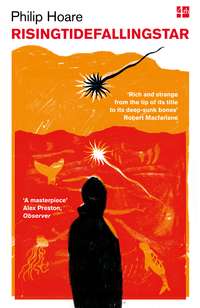
Kitabı oku: «RISINGTIDEFALLINGSTAR»


Copyright
First published in Great Britain in 2017 by
Fourth Estate
An imprint of HarperCollinsPublishers
1 London Bridge Street
London SE1 9GF
www.4thestate.co.uk
Copyright © Philip Hoare 2017
Cover design and illustration by Joe Lyward
Philip Hoare asserts the moral right to be identified as the author of the work.
A catalogue record for this book is available from the British Library
All rights reserved under International and Pan-American Copyright Conventions. By payment of the required fees, you have been granted the non-exclusive, non-transferable right to access and read the text of this e-book on screen. No part of this text may be reproduced, transmitted, down-loaded, decompiled, reverse engineered, or stored in or introduced into any information storage and retrieval system, in any form or by any means, whether electronic or mechanical, now known or hereinafter invented, without the express written permission of HarperCollins.
Source ISBN: 9780008133702
Ebook Edition © 2017 ISBN: 9780008133696
Version: 2018-05-24
Dedication
For Pat
Contents
Cover
Title Page
Copyright
Dedication
Epigraph
THERISINGSEA
HEGAZESTOTHESHORE
THESTARLIKESORROWSOFIMMORTALEYES
SOMETHINGAMAZING
THEPEOPLEOFTHESEA
ZEROANDEVERYTHINGTOGETHER
UNDERAGREENSEA
THEHANDSOMESAILOR
STELLAMARIS
THESEATHATRAGEDNOMORE
Also by Philip Hoare
About the Publisher
Chapter initial illustrations by Joe Lyward
Epigraph
‘The sea, everywhere the sea, and no one looking at it’
DANY LAFERRIÈRE

THERISINGSEA
Not long ago but long enough, I looked into the old cupboard in my bedroom and at the back, among the piles of floppy discs and peeling spines of my children’s encyclopaedias, I found a notebook. It was in an old-fashioned imperial format, half-bound with blue cloth and shiny paper, its fore-edge delicately spattered like a blackbird’s egg. It came from the cable factory where my father had worked all his life. Inside, on feint-lined pages intended for notes on amps and electrical resistance, were writings and drawings I’d done when I was about fifteen years old.
On each left-hand page was a picture, in bright poster paint: a futuristic city, art deco designs, lithe figures out of some space opera or Russian ballet; fantastical images I’d collected in my teenage head. Halfway through the book I’d painted something I’d really seen: a leaping killer whale, slick with clear nail varnish to mimic its black-and-white skin, as if it had jumped out of the sea, rather than a concrete pool in a suburban safari park.
On the right-hand pages I’d composed lyrics and prose, the things I couldn’t say out loud. Looking at this parade of longings forty years later, I realised that the fifteen-year-old me had mapped out his life along those pale blue lines. As if I’d already lived in reverse. Everything that came after had been entered in that blue notebook, balanced on my knees while I watched television in our front room, waiting for whatever might come next.
The wind howled at my window like a wild animal, a snarling beast demanding to be fed. The house held fast against horizontal rain that threatened to find every crack in the walls. The air was full of water, driven directly from the shore. Between the falling trees and the pounding waves, it seemed that the sea – for all that it was a mile away or more – was reaching out for me in the darkness. The newspapers and the television and the websites warned us not to walk near it, as if our mere approach might be dangerous, as if its tentacles might reach out and drag us in.
Growling and yowling, ranting and rocking, falling back to catch their breath before their next assault, the storms kept on coming, and there was nothing we could do. The world had become turbulent with its own temper, its air sweeping over oceans in a tropical fury. If we ever felt guilty, we felt it now.
At least the sea is visible in its rage; the wind is an unseen monster. You don’t hear the wind; you hear what it leaves behind. It is defined by what gets in its way – trees, buildings, waves. Perhaps that’s why it preys on our imagination so disturbingly. The spinning of the globe seemed to have become audible – the sound of a world out of kilter. For what sins were we being punished? What had we done wrong? In Caribbean hurricanes during the seventeenth century, Spanish priests would toss crucifixes into the waves or hold the Host up into the wind, for fear that their sinful flocks were responsible for God’s displeasure.
That winter, storm after storm raked southern England. Tearing and snapping, the wind never seemed to stop. As I lay in bed, I could feel its volume whipping and squalling around me, changing direction wilfully, a mad car out of control.
Then, just when it seemed it could not get any worse, a mighty gale, as near as we might get to a hurricane, ripped out of the cover of night and into the naked day. Unable to sleep, disturbed by the charged air, as if its ions were crackling in my brain, I cycled down to the shore and took shelter under the eaves of the yacht club, a wooden building which seemed about to whirl off into the wind. Behind me stood a medieval abbey, and a fort once visited by the Virgin Queen to survey her maritime kingdom, its Tudor ramparts now protected from the waves by a long sea wall.

I’ve known this shore all my life: from its ancient Seaweed Hut – a weird structure which might as well have been put up by Iron Age inhabitants – to the brutal towers of its nineteen-sixties housing estate. It is as familiar to me as it is to the birds that scrabble for their livelihoods in its shingle and mud. I’d taken it for granted, that it would always be there.
I couldn’t believe what I was seeing. The beach was being torn apart before my eyes. The wall, usually only lapped even at the highest spring tide, was entirely overwhelmed. Waves – to call them waves seems pathetically inadequate – had lost their laterality and gone vertical, rising higher than a house.
My world had lost its moorings. This was not some rocky Cornish or Scottish coast, buttressed against such a battering; this was a sedate, suburban shore, complacent and unprepared; a soft place on the southern edge of England, open to the rest of the world, successively invaded and settled for millennia. This estuary even had its own Roman deity, Ancasta. Clearly, she had been offended.
It was as though someone had computer-generated the weather and ramped it up to a ridiculous degree. An invisible alien, formed of roaring air and raging water, had been unleashed. The sea spray reached the tops of the trees on the shore. It was terrifying, and exhilarating. My heart raced to keep up with every rattling rolling rumble; a cacophony created by raked-up shingle and creaking trees, the Foley effects of enraged gods flinging nature around.
I watched it like some viral video; not rerun, but in real time. Behind this frontline, people were driving cars, taking buses, going to work, school, shops, locked in their own personal climate. We shared the same city; but they felt safe, seeing the storm through their screens. I was on the edge of it, physically confronted by the violence, as shocking as if I’d come across a fist fight on the street.
The sea wall had been replaced by a wall of sea. The placid site where I propped up my bike every morning, where I’d leave my clothes and slip into the water, joining rather than entering it, had become a deadly, repulsive place.
It was the only day during those storms that I did not, could not swim; perhaps the only day that year. Even at the height of the past days’ disruption I’d launched myself into the madness, defying the warnings. So what if anything went wrong? I didn’t take my mobile phone in case of emergency because I don’t have one. People say I should be careful; but why be careful, when we are so full of cares? This was the opposite of that. I glorified in my stupidity. Foolhardy, a hardy fool. I had rocked with the waves, holding my head above water like a shipwrecked dog, dodging planks and plastic buckets. A single trainer had floated past, then a motorbike helmet; I wondered if the head might still be in it. I was borne up by the rollercoaster ride, exultant and excited, although I had soon found myself spat back onshore.
Not that day. That day I had to admit defeat, and defer to a greater power.
During the night the wind woke me again, prowling around the house like a midnight demon, ready to suck me out of the window. The sound was beyond sound: one white noise comprised of many others, fit to eviscerate my dreams.
In the morning, not quite believing what had happened during the darkness – was that last night, or the night before; did I even imagine it? – I ventured out on the third day of the storm, expecting to see a newly devastated world.
But the streets looked the same, just as they do when you come back from holiday. Only a few fallen branches from the trees hinted at the mayhem of the small hours. I rode on down to the beach, not knowing what to expect, but expecting it anyway.
There I realised that the storm had taken its final revenge. Defeated by what it could do inland, it had reshaped the coast itself.
The beach had been lifted up and thrown back, creating a shingle tsunami. The path had been replaced by a tangle of branches and rope, a twisted mass of line and grass torn from some other shore, in the way drowned men’s pockets are turned inside out. The flotsam lay still, but contorted with the torque and tension of the wind and water. Tiny balls of coloured plastic, like the roe of some new petrochemical sea creature, were scattered through the wrackline. The calm itself was violent.
Then I saw the sea wall. The waves had fallen back to reveal their guilty secret. The long straight stalwart of my pre-dawn swims, my chilly changing place, my launching point from the land, had been smashed to pieces, kicked over by a petulant child. The wall had stood for seventy years or more, made of the same stone that had built the abbey and fort behind it. Now, like the abbey, it lay in ruins.
I took it personally. A structure I knew as well as my own body had been reduced to rubble. And I knew I was responsible. I had allowed this to happen.
No one would ever rebuild this place, this insignificant corner, bypassed by ships and cars. The aftermath of this assault was the reality of ‘managed retreat’, in the bureaucrats’ parlance; the desertion of an already forgotten site. We had abandoned beauty, abandoned nature. This was the future: the rising sea on a suburban shore. I wanted to cry, but the hardness of the stone stopped me. So I picked my way over the remains, pulled off my clothes, and got in.
The sea was still filled with debris; household doors and tree trunks floated like lumber thrown from a giant’s outhouse. And even as I swam, the waves began to rise again, responding to an invisible moon. Giving up the struggle, I climbed out, fighting to get dressed as the wind whipped my clothes into air-filled versions of me.
I rode off into a new landscape. Time had sped up; geological change happened overnight. New streams had been formed and new islands created in the flood. Reluctant to let me go, the waves lashed me as I passed.
Frail as I am as a human, I had the ability to withstand the storm. But along this coast, thousands of seabirds died in those few days, ten thousand guillemots alone. Birds that mate for life waited for partners who would never return.
That afternoon I found a dead guillemot on the beach. Its slender-sharp bill and black-brown body lay slumped on the shingle like a soft toy lost over the side of a passing ferry. It was so perfect – and so far from the rocky ledges where it breeds so close to its fellows that they preen one another, even though they are not partners – that I wondered if I should take it home with me. I talked to it, commiserating with its fate. The next tide claimed it – only to bring another victim, rolled about in nylon line.
I pulled it out. It was an avocet. A delicate, emblematic bird I’d only ever seen from afar, suddenly brought into near focus, graphically black and white, a piece of netsuke. I don’t think I’ve ever seen anything so exquisite, there in my hands. I turned it over in my fingers, feeling its long, scaly legs – relics of its reptilian past – and their knobbly joints like threaded veins, or worms that had swallowed soil. It was their colour that amazed me: an indefinable, pearly blue-mauve withheld under a soft misty bloom; electric, verging on iridescent. I could only compare it to the oceanic blue-grey of a gannet’s bill, as if this were a marine colour reserved for a seabird’s exclusive use. The legs, which might have been made out of some alien metal or art nouveau glass, culminated in tiny black claws, embedded like chips of polished jet.
It was an enamelled animal. Vitrified. As much jewellery as a live, or recently dead, thing. It was hard to believe it had stood on such fragile stilts, let alone stalked its prey from them. Then I remembered the living avocets I’d seen, moving with eighteenth-century elegance, as if they might dance a gavotte. Avocets enact their own rituals, gathering in a circle and bowing to one another like dandies.
I opened the bird’s wings, a pair of fans fluttering across a ballroom. They felt taut with what they were expected to do; not yet quite useless, yet no use now, either. They articulated lightness and lift. The black-capped head, which once bobbed in the shallows, sweeping through the water with its upturned bill, ended in the final, defining, typographical tick that is the avocet’s glory. It was almost too beautiful to touch, but I prised open the ebony splint, like the split reed of a musical instrument. Its lower half was precisely ridged to speed its ploughing; a keratin tool engineered to micron perfection, tapering to a paper-thin tip, as sharp as a squid’s beak. I remembered the sound that played through it, a shapely insistent peep, accompanying the nervously graceful movement as the creature swung its bill from side to side in search of invertebrates. Even the bird’s binomial expressed its exotic allure – Recurvirostra avosetta, as if it were a minor Egyptian god.
With a wrench and a twist, I pulled off the head. The muscles and oesophagus came away, dangling raw and red. Then I spread the body on a long piece of flotsam, laying out the bird on the knotted wood, under the grey sky.
Beautiful, but broken.
As the year slows to its midnight, the solstice blows in fierce and wild, the last of December putting up a fight. Day and night blur; it’s difficult to say when one becomes the other. In the glittering darkness long before dawn, a silver ring of ice is slung around the moon, catching stars and planets in its circle. Their heavenly bodies hang in the O: orbits within orbits, eyes within eyes. I swim through the inky sea, my white body breaking the black surface, moving through the moon.
The tide is high again. It often is here, more than most places, since Southampton Water experiences an unusual double tide, standing twice as high and twice as low every day, swelled and drained by the Atlantic Pulse that drives up and down the Channel. In David Copperfield, Dickens’s watery, autobiographical book, Mr Peggotty, mindful of his ‘drowndead’ relations, says of Mr Barkis, ‘People can’t die, along the coast … except when the tide’s pretty nigh out. They can’t be born, unless it’s pretty nigh in – not properly born, till flood. He’s a going out with the tide.’ The rise and fall brings life and death beyond our control. When the moon is full, the tide is high at noon and midnight, like a clock. The tide is time; the two words share the same root, as does tidy. We are all tidied up by time.
I stand on what is left of the sea wall in the moonlight, charged by its brightness. Apparently Siberian shamans would strip naked during the full moon to absorb its energy; maybe it’ll warm me with its secondhand daylight. The satellite silences our world; it has mysterious powers, as Bernd Brunner notes, still not quite explained, like black holes or gravity itself: some scientists believe the lunar effect extends to the land too, triggering earthquakes as though the planet’s tectonic slides were tides of their own.
And if our home is a living thing, then the sea is its pumping heart, swelling as the moon swings around the earth, tugging at our blood, at the tide inside of me. After all, the entire planet consists mostly of water, like us, and we are governed by its cycles more powerfully than by any elected body. Its tides are our future. They are always racing ahead, every day an hour further on, a reminder that we will never catch up with ourselves, no matter how fast we may swim.
But then, for me every day is an anxiety in my ways of getting to the water. I worry that something will stop me from reaching it, or that one day it won’t be there – as it is, and it isn’t, twice a day. I’ve become so attuned to it, so scared of it, so in love with it that sometimes I think I can only think by the sea. It is the only place I feel at home, because it is so far away from home. It is the only place where I feel free and alive, yet I am shackled to it and it could easily take my life one day, should it choose to do so. It is liberating and transforming, physical and metaphysical. Without its energy, we would not exist. There is nothing so vast in our lives, so beyond our temporal power. If there were no oceans, would we have our souls? ‘The sea has many voices | Many gods and many voices,’ T.S. Eliot wrote. ‘We cannot think of a time that is oceanless.’ ‘In civilisations without boats,’ said Michel Foucault, ‘dreams dry up.’ Even if we could live without the oceans, a world of arid plains and dry valleys would lack mystery; everything would seem knowable, exposed.
In the womb we swim in salty water, sprouting residual fins and tails and rudimentary gills as we twist and turn in our little oceans. It was a tradition in maritime communities that if a child was born with the amniotic sac, the caul, over its head, she or he would never drown, having survived this near-suffocation. To be born thus was to be ‘born behind the veil’, and a preserved caul – itself a veil between life and death – would extend protection to anyone who carried it: David Copperfield is born with a caul which is auctioned when he is ten years old, leaving him uncomfortable and confused at having part of himself sold off. We first sense the world through that fluid filling our mother’s belly; we hear through the sea inside her. The sea is an extension of ourselves. We speak of bodies of water, and Herman Melville wrote of ‘the times of dreamy quietude, when beholding the tranquil beauty and brilliancy of the ocean’s skin’. Compared to the thin epidermis of land we occupy, the great volume of the sea exceeds our sway; it lends our planet its depth, and ourselves a sense of depth.
And if we are mostly water, hardly here at all, then other celestial bodies might be entirely aquatic. An astrophysicist once told me about newly discovered exoplanets that may be composed of water hundreds of kilometres deep, with only a few rocks at their hard core. Disdaining our need for land, these globular oceans, spinning translucently in some distant galaxy, may be inhabited, as astrobiologists hypothesise – it being their business to study that which may or may not exist – by giant whale-like creatures, half-swimming, half-flying through their atmospheres.
The ubiquity of the sea – from this grey estuary in which I swim, to the great open oceans – is itself interplanetary, connecting us to the stars, not really part of our world at all. It doesn’t begin until it begins, and then it never seems to end. It writes itself in the clouds and the currents, a permanently changing script, inscribing and erasing its own history, held down by air and gravity in a tacit agreement between land and sky, filling the space in between. It’s a nothingness full of life, home to ninety per cent of the earth’s biomass, providing sixty per cent of the oxygen we breathe. It is our life-support system, our greater womb. It is forever breaking its own boundaries, always giving and always taking. It is the embodiment of all our paradoxes. Without it we couldn’t live, within it we would die. The sea doesn’t care.
Down there lies another history, the unseen record of what is going on up above. Preserved in the freezing vaults of the National Oceanography Centre in Southampton are sample cores from the sea bed, long columns of mud and sediment whose layers tell out deep time like the rings in a tree or the waxy plugs in a whale’s ear. Composed of falls of marine snow – minute animals and plants and minerals, the makings of limestone- and chalk-to-be – along with dark strata deposited by ancient tsunamis, their past is our future foretold. The water itself has an age, up to four thousand years old, a story of its own. And even if the sea has become a carbon sink, absorbing the energy we have released from the sun, this cistern of our sins is still the repository of our dreams.
But as I just told you, the sea doesn’t care. It deals life and death for innocent and guilty alike.
The Tempest, Shakespeare’s last and most watery play, was first performed at court for James I on All Saints’ Day, 1611. It opens uproariously, slapping the audience in the face with a life-threatening storm and ‘fraughting souls’ on a ship about to split. In the dramatic tumult, panic spreads blame. Antonio, the usurping Duke of Milan, curses the boatswain – who is trying to save the ship – as a ‘wide-chopped rascal – would thou mightst lie drowning | The washing of ten tides!’ He is arrogantly invoking the practice of hanging pirates on the shore, leaving their corpses to swing in successive tides: ‘He that’s born to be hanged need fear no drowning.’
Yet, as the audience slowly becomes aware, these scenes of rip, wreck and panic – overturning all order as the crew fight for their lives and the aristocrats’ status counts for nothing in the face of the waves: ‘What cares these roarers for the name of king?’ – turn out to be nothing more than a magic trick, a theatrical effect within a theatrical effect, a storm raised by a sorcerer’s art and his impish familiar. As Ferdinand, the king’s son, his hair up-staring, leaps from the sinking vessel set aflame by Ariel’s divided fire, he cries, ‘Hell is empty | And all the devils are here.’ (It is an image which may have been inspired by James I himself, author of Demonologie and personal supervisor of the torture of witches, who believed that during a voyage back from Oslo in 1590 his ship had been beset by storms summoned by witchcraft, and demons had been sent to climb its keel.)
Suddenly, and as if in a dream, the castaways find themselves in an eerie calm, on an island full of strange noises, peopled by beings they cannot quite discern; an alien place, although the survivors themselves are aliens too. Some of its spirits are only rumoured, like Sycorax the witch, named after sys for sow, and korax for raven, a fated bird from an ‘unwholesome fen’. Others are all too present, like her son Caliban, a bastard creation, ‘a savage and deformed slave’, amphibious, half-man, half-fish, ‘Legged like a man! And his fins like arms!’ He is a chimeric creature, as if slithering out of an evolutionary sea; his counterpart is Ariel, an ambivalent, fluid spirit of the air who eludes definition and can be anywhere in an instant. Both are ruled over by the all-powerful magician Prospero in his water-bound exile.
Recently, on a shelf of stranded books being sold to benefit a bird sanctuary overlooking the Solent, I discovered a 1968 Penguin edition of the play. It was an oddly apt place to find it: this silted-up seventeenth-century harbour, overflown by marsh harriers and stalked by godwits and avocets, was the domain of the Earl of Southampton – Harry Southampton, Shakespeare’s Fair Youth and possibly his lover, who lived at nearby Titchfield Abbey, where the playwright’s works were performed.

I paid fifty pence for the book, attracted by its cover, designed by David Gentleman. Splashed with broad swathes of solid colour, the wood engraving, inspired by the work of Thomas Bewick, seemed to span the turbulent year of its nineteen-sixties publication – when protestors lifted up pavement stones, to find the beach below – and the uncertainties of its seventeenth-century contents.
A three-masted ship tilts in a stylised sea, rolling on waves below stormy clouds towards a tree-blown island and a rocky cave, all rendered in sludgy, overlapping shades of subdued blue and green, grey and teal, like the birds and land and sea around the building where I’d bought the book. The design was almost cartoon-like, folkloric, and layered. It caught the dark mystery and music of the words within.
The Tempest is a ceremony, a ritual in itself, publicly performed in a sky-open theatre on the site of the Blackfriars monastery on the Thames, a river into which sacrifices were once thrown to propitiate the gods. It is a pared-back, mysterious work, ‘deliberately enigmatic’, as Anne Righter says in her introduction to the Penguin edition, ‘an extraordinarily secretive work of art’, so emblematic that it might be acted out in mime, without any words at all.
Its origins lay in the fate of Sea Venture, which sank off Bermuda in 1609 while carrying colonists from Plymouth to Jamestown; Harry Southampton himself was an investor in the Virginian settlement. Shakespeare drew on William Strachey’s account of the wreck, a natural history of disaster, with its tales of St Elmo’s fire at the height of the storm – ‘an apparition of a little round light, like a faint Starre, trembling, and streaming along with a sparkling blaze’ – and the eerie calls of petrels coming in to roost, ‘a strange hollow and harsh howling’. Their cries earned Bermuda its reputation as an island of devils, one which Strachey rationally dismissed, although he did acknowledge the presence of other monsters: ‘I forbear to speak what a sort of whales we have seen hard aboard the shore.’
The Tempest is the closest Shakespeare comes to the New World. It is almost an American play, although two centuries later its castaways might have been washed up on another colony: Van Diemen’s Land, on whose remote south-western shores one can still imagine a seventeenth-century shipwreck and its stranded sailors stumbling about on the alien sand. Some saw Caliban and Ariel as symbolic representations of newly-discovered native peoples, whose countries were already being plundered by the West; others have seen a reflection of an island nearer to home: Ireland, a troublesome place filled with its own wild people, and regarded as a plantation to be conquered. But equally, Prospero’s isle might be utopia, a nowhere place over which his magic rises as a mist veiling time and space – just as a century earlier, Columbus, researching his expedition, had written notes and marginalia about strange people cast up on the shores of the Azores and the west of Ireland: ‘We have seen many notable things and especially in Galway, in Ireland, a man and a woman with miraculous form, pushed along by the storm on two logs.’
Shakespeare, nearing the end of his life, appeared to have recreated himself in the omniscient magician; others have seen Prospero as a reflection of Elizabeth I’s astrologer, John Dee, who communed with angels using a golden disc, and peered into his black obsidian mirror – stolen from the New World – in order to see the future and the past. The whole play seems to be happening before it was written. It is fraught in the original sense of the word, as a ship filled with freight, as well as with meaning. Shakespeare was familiar with the ocean: he refers to it more than two hundred times in his works, and some critics believe that he was once a sailor. Certainly he knew its meaning, and set The Tempest on a ‘never-surfeited sea’, a transformative place. After the storm, Ariel tells Ferdinand that his father, the king, lies ‘full fathom five’; he has been made immortal by the water, becoming a baroque jewel in the process:
Of his bones are coral made;
Those are pearls that were his eyes;
Nothing of him that doth fade,
But doth suffer a sea-change
Into something rich and strange.
For the artists and poets who came after, The Tempest lingered in its magical power and deceptive simplicity. Samuel Taylor Coleridge thought that Prospero’s art ‘could not only call up the spirits of the deep, but the characters as they were and are and will be’, and that Ariel was ‘neither born of heaven, nor of earth; but, as it were, between both’. For Percy Shelley, who would be nicknamed Ariel, the play evoked ‘The murmuring of summer seas’ and his own in-between state. And for John Keats, in whose volumes of Shakespeare’s works the play was the most heavily scored, it became a pattern for his imaginative life, like a map to be followed. Indeed, he sailed down Southampton Water with The Tempest in his pocket.
In April 1817, Keats, then a medical student in London, took the coach to Southampton in search of distraction. He had loved the sea ever since he’d read of ‘sea-shouldering whales’ in Spenser’s The Faerie Queene – ‘What an image that is!’; his poetry habit had made him ‘a Leviathan … all in a Tremble’, and in a letter to his friend Leigh Hunt, he evoked ‘a Whale’s back in the Sea of Prose’. But as he walked along the port’s medieval walls and looked down the grey waterway, the young poet did not see what Horace Walpole had seen a generation before, ‘the Southampton sea, deep blue, glistening with vessels’, nor even any of the dolphins which sometimes swam up it. Instead he found muddy shores laid bare at low tide; the sea had run out. ‘The Southampton water when I saw it just now was no better than a low water Water which did no more than answer my expectations,’ he told his brothers, ‘– it will have mended its Manners by 3.’ Keats’s nerves were raw, so he took out his Shakespeare and quoted from The Tempest for solace: ‘There’s my comfort.’ That afternoon he left on the rising tide, sailing to the Isle of Wight where, troubled by the island’s strange noises and unable to sleep, he began his long poem, Endymion, filled with moonbeams and snorting whales and leaping dolphins and the tale of Glaucus, the fisherman-turned-god with fins for limbs, whom Endymion frees from Circe the witch.
Keats’s contemporary J.M.W.Turner was also stirred by the restless sea. His imagination stained southern skies: he sketched this shore and painted storms off the Isle of Wight, and when he claimed to have had himself lashed to a ship’s mast in a blizzard so that he could create a great swirling vortex of waves and cloud – as if he were seeing into the future – he gave the vessel’s name as Ariel. And in this stormy story, Shakespeare and Turner would in turn influence another writer. Herman Melville’s eyes had been damaged by scarlet fever in his childhood and rendered as ‘tender as young sparrows’; he was thirty years old, with a career at sea behind him, when he read Shakespeare, discovering a large-print edition of the playwright’s works in 1849. As he began to write about his great white whale – his head full of Turner’s spumey paintings he’d seen in London that year – Melville read The Tempest and drew a box around Prospero’s ‘quiet words’, the magician’s wry response to his daughter’s naïve exclamation on seeing the aliens:
Miranda. O! wonder!
How many goodly creatures are there here!
How beauteous mankind is! Oh brave new world,
That has such people in’t!
Prospero. ’Tis new to thee
Melville, himself the scion of a colony, saw the prophecy in Shakespeare’s drama and in Turner’s art: both helped him create the strange, ominous world of Moby-Dick. In it, Captain Ahab is a monomaniacal Prospero, and as the opening of The Tempest is lit by St Elmo’s fire, so the same eerie light garlands his ship, the Pequod, in a ghostly glow; animals acquire symbolic meaning – whales and birds accompany the narrative as familiars, swimming and flying alongside the story – and the sea rises up as if with a mind of its own, as it does in Turner’s paintings. Meanwhile mortal men pursue their deadly trade: a restive crew sails into the unknown – among them a tattooed cannibal, Queequeg, a kind of Caliban – and Ahab blasphemously baptises his harpooneers in the name of the devil. Nor would the American’s fascination with Shakespeare’s play end there. At the end of his own last work, Billy Budd, Melville imagines the hanged body of his Handsome Sailor consigned to the deep, entangled in oozy weeds; it is an echo of Jonah’s fate in a biblical sea – ‘where the eddying depths sucked him ten thousand fathoms down, and the weeds were wrapped about his head’ – but also of Alonso in The Tempest, who, believing his son to be drowned, wishes he too was ‘mudded in that oozy bed’.
Constantly recreated, constantly re-enacted, The Tempest lived on beyond its creator, passed on from hand to hand. It became a secret cipher, a futuristic shipping forecast, an extended magical spell. It conjured a queer sea out of its strange beasts and its masquerades, and stood against time and tide even as it rose with them in a storm stirred up by a dramatist whose own identity still seems fluid and uncertain.
As a new century loomed, the play gained momentum, gathering clouds rather than diminishing with distance and time. A few years after Melville left Billy Budd on his desk unpublished, another former sailor, Joseph Conrad, drew on The Tempest for his Heart of Darkness, with Kurtz as a terrible Prospero. Two decades later, Eliot embedded fragments of the play in The Waste Land, as if Shakespeare had foreseen the undone. Eliot’s work was rivered with the brown god of the Thames and the ship-wrecked, sea-monstered coast of New England he’d sailed as a boy; and as his Madame Sosotris lays out the Tarot card of the drowned Phoenician Sailor – ‘Those are pearls that were his eyes’ – she warns ‘Fear death by water.’ Meanwhile, the bones of another sailor, ‘a fortnight dead’, are picked clean by the creatures of the sea, the slimy things the Ancient Mariner saw down there.
Haunted and haunting, The Tempest accompanied the twentieth century as a parallel rite; few other works of art have been so replicated, remodelled, and re-presented. W.H. Auden reimagined its characters’ fates in his verse drama The Sea and the Mirror; Aldous Huxley drew on it ironically for his brave new world; and the science-fiction film Forbidden Planet turned Ariel into Robbie the robot for an era fearful of its own aliens. And at the end of the darkened nineteen-seventies – as a British satellite named Prospero spun into outer space, following its fellow transmitter, Ariel, launched a decade earlier – Derek Jarman, living in a London warehouse on the Thames and fascinated by John Dee, filmed his alchemical version as ‘a chronology of three hundred and fifty years of the play’s existence’, with Prospero played by the future author of Whale Nation, a sibilant blind actor nicknamed Orlando as Caliban, an androgynous man-boy as Ariel, and Elisabeth Welch singing ‘Stormy Weather’ surrounded by dancing sailors. In this lineage of otherness, filled with hermaphrodites and shape-shifters, it does not seem a coincidence that the director wanted Ariel’s songs to be sung by the starman who obsessed me, and who presided over my blue notebook.
The word ‘tempest’ itself derives from the Latin tempus, for time. Everything is new and old on Prospero’s island. Like the sea itself. Always changing, always the same.
Out of the blackness obscure noises drift from the docks, booming over the water. The red lights of the power-station chimney blink like an industrial lighthouse, summoning and warning. You can be what you want to be in the dark. For me, it used to be nightclubs under London streets. Now it’s another nocturnal performance.
An hour before dawn, before the light starts to stain the summer sky violet, I ride back to the beach. Foxes sidle out of the woods and rabbits flash their white scuts at the approach of my bike light. High in the trees over the shore, a pair of tawny owls converse in screeches. Crows hang in the branches, all angular tails and beaks, as if they’d been born out of the boles. All these creatures own this place in the interregnum of the dark; they should not be anywhere else. No one could have told you when you were young what would happen. They didn’t dare. It’s enough to realise that what we have lost is still ahead of us. I see things that are not there.
One magical moment; I feel like a penitent. The sea is so still it seems like a sin to break its surface. But I do. Swimming at night, with diminished sense of sight, only makes the act all the more sensual. You feel the water around you; you lose yourself in its sway. Fish bite me, leaving loving grazes.
I turn on my back, watching the stars fall.
I first saw it slumped on the weedy slipway one afternoon. A deer, sprawled at the high water mark. It looked perfect, lying there, thrown up by the tide, staring glassy-eyed to the sky. Had it died trying to swim across from the forest? Or had it slipped and fallen, cloven hoofs clattering on the concrete with panic in its eyes? Perhaps it had been shot, although there was no wound in its russet pelt.
The next day someone had hauled out this sea-deer, this antlered seal, and impaled it on the spikes of the metal railings. It hung there by its neck, dangling as a warning, the way farmers nail dead owls, wings outstretched, to barn doors. I wanted to relieve it of this indignity, to take it down from its cross, but I hadn’t the strength.
So I waited to see what happened next.
The following day it reappeared on the shore, as if it had climbed down overnight. It was accompanied by a carrion crow, tentatively but intimately pecking away at the flesh, performing the last rites. I wished the bird well, and a good breakfast.
I’d forgotten about the carcase when, a week later, I came across its remains in the surf. By now the body had been reduced to a single strand of vertebrae, picked clean by crabs and gulls. It was down to its essential scaffolding, its skeletal beauty twisted like the ghost of a horned sea serpent lolling in the water. The stubby antlers sprouted from the bulbous, rough-edged rings on the forehead; caught between them was a scrap of fetlock-like fur. Skeins of grey flesh still hung about the skull, scrappily attached to the thin white bone. I had to have it, this grotesque piece of flotsam, something to add to the pile back home, the fragments of blue-and-white china, the clay pipes with the bloom still on them, the shards of misty sea-glass, the chunks of green-glazed medieval pots, the stones pierced with holes.
Using a bit of driftwood to hold down the spine, I pulled at the antlers, twisting and wrestling with them as with a bull. It occurred to me, as I did so, how easy it might be to detach a human head. With a stagger, I succeeded in wrenching off my trophy, my prize for having watched so patiently. I had to gouge out a gelatinous eye before stuffing the skull into a plastic bag and tying it to the back of my bike.
I rode away from the beach, passing walkers who wouldn’t guess at my cargo. Back home I opened a hole in the warm brown earth and buried the head up to its antlers. They stood proud of the soil like a pruned rose bush. I piled rocks on top to guard against predators and went back indoors to wait till the antlers sprouted and grew like branches, and as below the surface the skull grew roots which became bones, its lost vertebrae, femurs and ribs all restored, ready to rear up out of the earth, a resurrected, a newly-grown deer of my own.

HEGAZESTOTHESHORE
The runway is spattered with coloured lights, a constellation fallen from the sky. I’m led out into the sharp night air, and take my place beside the pilot. He tells me to slide my seat forward and strap myself in. The dual controls move over my lap, operated by a ghostly co-pilot; incomprehensible dials and LED displays tick and flicker on the console. The plexiglass windows shake with the propellers as we taxi onto the airstrip. We stand ready for takeoff, behind a huge airliner, the kind in which I’ve just spent six hours getting here. But these last few miles seem the most difficult.
The little plane follows the behemoth, drawing courage from its slipstream. The pilot mutters into his microphone, the runway clears and the wings wobble. Suddenly we are rising over the dark city, made darker by the sea at its edge.
I have to catch hold of my breath, like a child on Christmas morning. I want to turn to the pilot and say, Isn’t this amazing? But he just stares ahead, wearing his white pressed shirt, quietly suppressing his ecstasy. Everything falls away, all the houses and streets and offices and institutions, leaving only the black water.
The airstrip lights vanish, replaced by winter stars. Orion lurches over the horizon, lazily rising into position, echoing Cape Cod’s fragile shape in his starry frame. The night is so clear, made clearer by the cold, that I can see through the Hunter’s spaces to the stars he has swallowed, the stars that are being born. We’re astronauts for twenty minutes, inside the sky, flying into another system. I look up and down: there’s no difference above or below. The sea is full of stars; the stars are full of the sea.
Out of the blackness ahead a line of red lights appears, trembling, beckoning us down. It is a tentative landfall: the only thing below us is sand. We return to earth with a bump. For all I know we might have arrived on another planet. Then the pilot turns round in his seat and says, ‘Welcome to Provincetown.’
These past few days the bay has been filled with mergansers. They’re saw-beaked, punk-crested birds, forever roving over the sea in their search for food or sex. Just offshore, three males arch their necks in lusty splendour, fighting over a female. Pat says black-backed gulls sometimes take them. Pat is my landlady, although sealady might be a better term. She’s lived here for seventy years. She knows this place as well as her own body. It is through her eyes that I see it.
Close up, red-breasted mergansers are even more extreme: big, pugilistic, as though they’re cruising for a fight. I see the detached head of one rolling in the tideline. I pick it up, running my index finger along its velociraptor teeth. This winter beach is no place of innocence and play, but a site of carnage and slaughter.
From my deck I hear the forlorn calls of loons drifting across the bay. In the mid-distance is the rocky, guano-spotted breakwater. It was built to protect the harbour, but it was soon colonised by cormorants. They’re despised for their droppings that dribble like fishy porridge, and for their supposed depletion of the fishermen’s catch; so greedy that they dislocate their jaws to swallow fishes whole. Only Pat sees them for what they are: sentinel creatures she has drawn over and over again, kayaking out to the breakwater and tethering to a lobster buoy, Zeiss binoculars in one hand and a black marker pen in the other.

Pat – who resembles a bird herself, with her shock of silver hair, intense brown eyes and high cheekbones – channels these charismatic spirits. Haughty of our disdain, they pose in portrait after portrait, a cormorant lineage, each profile worthy of a Hapsburg prince. Clamped to the rocks by their claws, heads bent to preen or raised to the sky, they hold out their wings – to cool their bodies as much as to dry their feathers – casting shadows of themselves. Some saw the crucifix in the shape they threw, a symbol of sacrifice; others discerned something darker.
In the opening pages of Jane Eyre, published in 1847, Charlotte Brontë’s young heroine takes Thomas Bewick’s A History of British Birds from a library shelf on a winter’s afternoon, and hiding in a curtained window seat, loses herself in descriptions of ‘the haunts of sea-fowl’ in the Northern Ocean, surrounded by ‘a sea of billow and spray’ and the ‘marine phantoms’ of wrecked ships.
Bewick’s engravings of ‘naked, melancholy isles’ echo Jane’s abandonment as an orphan, ‘an uncongenial alien’. Later, when she meets Mr Rochester, she shows him three strange watercolours she has painted. One portrays a woman’s body from the waist up, seen through a vapour as the incarnation of the Evening Star; another depicts an iceberg under a muster of the northern lights, overloomed by a veiled and hollow-eyed head. In the third allegory, a cormorant perches on the half-submerged mast of a sinking ship. The bird is ‘large and dark, with wings flecked with foam; its beak held a gold bracelet set with gems, that I had touched with as brilliant tints as my palette could yield, and as glittering distinctness as my pencil could impart’. Below it, ‘a drowned corpse glanced through the green water; a fair arm was the only limb clearly visible, whence the bracelet had been washed or torn’.
The double-crested cormorant’s binomial, for all its Linnaean rigour, is resonant of such gothic airs. Phalacrocorax auritus conflates the Greek for bald, phalakros, and korax, for crow or raven, with auritus, the Latin for eared, a reference to the bird’s breeding crests. Its common name also reflects the same allusion, if not confusion, as a contraction of corvus marinus, sea raven – until the sixteenth century it was believed that the two species were related. Indeed, like ravens, cormorants have a noble antecedence: James I kept a cormorantry on the Thames, overseen by the Keeper of the Royal Cormorants who hooded his charges and tied their necks to stop them swallowing their prey. Bewick called them corvorants and thought their tribe ‘possessed of energies not of an ordinary kind; they are of a stern sullen character, with a remarkably penetrating eye and a vigorous body, and their whole deportment carries along with it the appearance of the wary circumspect plunderer, the unrelenting tyrant’; he noted that Milton’s Satan perches as a cormorant in Paradise, a banished black angel on the Tree of Life.
The cormorant, whose darkness is implicit in its ability to dive one hundred and fifty feet into the sea, predates any tyrannical monarch; its pterosaur pose evokes the reptilian past of all avians. But to some modern eyes, the cormorant is all too common: a scavenger, a sea crow, or, in the careless calling of the American deep South, the nigger goose. According to Mark Cocker, British anglers call it ‘black death’, and demand its execution. But all name-calling reflects only on ourselves: we name to know and own, not necessarily to comprehend. We don’t even have the right words for ourselves.
Like other animals, cormorants have been forced to share the human stain. Far from eating ‘our’ fish, the prey they take is of little value to us. Rather, they appear to be attracted to objects that we discard. In 1929, E.H.Forbush, the indefatigable state ornithologist of Massachusetts – a man who acted as a defence attorney for such accused avians (even though he himself ate some of the species he studied) – noted that a cormorantry off Labrador was embellished with objects the birds had salvaged from shipwrecks, diving like Jane Eyre’s bracelet thief to retrieve penknives, pipes, hairpins and ladies’ combs. Their finds decorated their nests as if they were making their own artistic comments on our disposable culture.
One autumn morning, after a terrific storm that had swept over the Cape and depressed my spirit with its violence, I woke at dawn to find the sea in front of Pat’s house filled with cormorants, hundreds of them. Driven off the breakwater, they’d gathered in a dense raft, avian refugees in an abstract arrangement, each sharp upturned yellow bill, white throat and sinuous neck creating a repeated rhythm, a crazy cormorant expressionism. A scattering of sea crows, marks on the water.
Some perched on the rotting remains of the old wharf, its stanchions reduced, storm by storm, to forty-five-degree angles sticking up out of the water. I watched as the birds rose and fell as one with the swelling waves. Later, I saw them further out. They’d found a source of food, and as the sun glinted on their bobbing bodies they were overflown by herring gulls, a flickering grey layer to their inky black shapes. It was a frenzied, silent scene, watched only by me.
Most mornings, I walk down the beach to meet Dennis and his dog, Dory. Dennis is handsome and everyone loves him. He’s sturdy, with salt-and-pepper hair and a trim beard; he reminds me of Melville. When we get off the whalewatch boat it takes us three times as long to get home, because he stops so often to talk to friends and acquaintances in town. Dennis was once a teacher; he did his national service in the coastguard, but has loved birds ever since he was a boy growing up in Pennsylvania. He came to Provincetown by chance, and stayed. Everyone’s a washashore here, like the soil itself, brought as ballast to these unstable sands; even the turf came from Ireland, to be laid as lawns for the gracious gardens of the East End.
That morning, as Dennis and I walked towards each other, I saw a bird crouched on the rocky groyne in between us. It had tucked its head into its wings; I presumed it was preening, or sleeping. But as we drew near, Dennis took up his binoculars. Something was wrong. He gestured at me with open hands and then at the cormorant, which slipped off the rocks and into the water.
The bird’s bill was lashed to its back by fishing line, and it was tugging pathetically at the monofilament. We followed as it swam parallel to shore. It wanted to return to the land, confused by what had happened to it, as if it might peck off its trusses. But each time we approached, it went back to the water. Dennis was not optimistic. ‘It’ll just keep swimming out – or it’ll dive,’ he said.
I waded into the sea. Dennis ran further up the beach, staying close to the bulkheads to keep his profile low. I tried to splash the cormorant ashore. It worked: the bird made for the beach and Dennis dashed towards it, unafraid of its flapping bulk.
Suddenly there it was, in our hands. A startling sapphire circle around a green cabouchon eye; a fractured sharpness, staring back unblinking. Up close, every feature took on the definition that Pat had drawn: the yellow-tipped bill and its hooked tip, the matt black wings. Primeval enough from afar, this near the bird looked even more like an archaeopteryx on the beach; evolution in our fingers.
Any bird exists apart from us: unmammalian, and therefore uncanny. Yet I could imagine myself a cormorant mate, entranced by this handsome fellow, building a nest on the rocks, proudly holding our bills in the air in celebration of our cormorantness. We took the bird to the deck of a beach house under construction, where a workman produced a knife. Swiftly, Dennis cut the line and pulled the hook from the cormorant’s mouth. Blood trickled out, bright and fresh against the black feathers. Dennis was promptly pecked on the thumb for his trouble, drawing his own blood in turn. I unwound the bird’s bound wings. In a second it was free, half running, half flying back to the water for its lunch.

After a day of louring greyness, when the town seems bowed down by the low pressure – ‘Everyone I meet says they have to go home and sleep,’ says Pat – I retreat to my studio in the timber house. Its double gables rise over the beach like some Nordic chapel or a barn raised by settlers, held up by a pair of cinderblock chimneys. I sleep in its eaves, in an attic like a chandler’s loft or a ship’s prow. At night I climb up to my platform bed via a wooden ladder, ascending to my dreams, descending in the morning, clambering down backwards the way I would at the stern of a boat.
The house is a fragile and sturdy construction, built to withstand three hundred and sixty degrees and three hundred and sixty-five days of weather. In the winter the wind worries at its windows, with their layers of glass and screens, grooves and latches, a complicated, ultimately ineffectual system of defence. No one wins against the wind, not even these wind’s eyes. Running in front of the house is the deck, a wide wooden stage over which Pat lays a path of threadbare yard-sale rugs to stop its splinters from entering her bare feet. They lend the boards a tattered luxury, like some trampled boudoir. Stirred by the wind and rain, they take on a life of their own, rucking like a ploughed field out of which ever-larger splinters sprout as spiky seedlings.
The whole house is still partly tree. The knots in its walls have fallen out over the years, leaving spy-holes and escape routes for whatever creeps and scratches about inside. There are so many compartments, cupboards, stairs and crawl spaces – so many spaces within spaces – that there could be colonies of creatures living under its eaves. Even as I write this, I discover a narrow staircase which I had never seen before in all the years I’ve been staying here, hidden in a cupboard and leading to the top floor like some secret escape route. And when I open the built-in linen closet on the first floor, a cat hisses at me, leaps up a shaft and disappears into an interior where, for all I know, an entire community of feral felines might reside. I sleep with bare boards next to my head, stamped with the timber merchant’s marks,
MILL 50 MILL 50 MILL
W.C.
L.B. ®
UTIL 3/4 W.R. CEDAR
and occasionally silverfish run up and down the western red cedar, their filigree antennae feeling their way like tiny lobsters, while mice scratch in the eaves. I feel the weather and the sea through the wooden walls and the way the day arrives and the night leaves, and there’s sand instead of biscuit crumbs in my sheets. Sometimes the whole house becomes a woodwind instrument played by a demented child. Doors rattle, urgent spirits seeking admission. Timbers creak as a ship caught in ice; articulated chimney cowls squeak like weather vanes turning in the wind. The house reverberates as though remembering how it was built, an echo chamber resonant with everything happening outside and everything that ever happened within. It may be inanimate, but it makes me more alive, this big beach hut. How could anyone not feel that way, knowing that out there is the sea, and all land is lost to the horizon?
The front hits us, head on. The waves, which yesterday lapped the footings of the house, turn over themselves in their remorseless assault on the bulkhead that acts as a buffer between the house and the sea. Town regulations, designed to allow the shifting sand its sway, mean that even the most luxurious decks and dining rooms are temporary arrangements. Pat’s house, now in its sixth decade, was built to be part of rather than apart from the water; in stormy spring tides the sea actually runs right underneath it, disdaining its foundations. By the end of the century all those exclusive properties and ramshackle shacks alike will yield to the waves. ‘The truth is,’ the philosopher Henry David Thoreau wrote on one of his visits to the Cape, ‘their houses are floating ones, and their home is on the ocean.’
Directly in front of the house is a raft tethered by a chain to the sea bed. It’s another stage, a four-foot-square island of performance. In the winter seals lounge on it, their doggy heads and flappy feet held in the air to keep warm. Summer visitors think the raft is built for human swimmers; they soon realise that it’s covered in deposits from its other tenants, the eider ducks that take up winter leases, and for whom it is a safe perch even when it rocks wildly in high seas.
Pat and I watch a duck and drake circling the float as if sizing it up. The male makes the first move, followed by his partner. They stake out their separate corners, like a couple seeking their own space. Another male appears with his mate; she is allowed on board, he is rebuffed by the first male. It’s a stand-off. There follows a ritual puffing up of chests and fluttering of wings, like a contest on the dance floor. The inevitable compromise is reached, and the newcomers are admitted. Soon, in the niceties of eider choreography, a third couple arrive and the same rite is observed. All their gestures and cooing, which seem quaint to our anthropomorphic eyes – as if they were saying to each newcomer, ‘No room, no room’ – are in fact grim and determined expressions of potential violence and struggle for precedence.
Eiders are another of this shore’s animal spirits. They preside, like the cormorants and the seals, imbued with their own inscrutability. The raft is their portal: I imagine them diving off it and coming up in a willow-pattern world to reassume their imperial presence, shrugging their lordly wings as they do so. They may be the largest of the ducks, but they’re also the fastest bird in level flight, able to fly at seventy miles an hour against fierce nor’easterlies. They are endlessly interesting to me, seen from my deck or through my binoculars. Their heads slope down to wedge-shaped bills, redolent of Roman noses or a grey seal’s snout. Their black eye patches and pistachio-green napes look like exotic make-up, although Gavin Maxwell thought that they wore the full-dress uniform of a Ruritanian admiral. Their table manners are hardly refined: they use their gizzards, lined with stones, to grind and crush the mussels and crabs which they swallow whole. Birds as machines.
They too have suffered. In Britain they were used for target practice during the Second World War; thousands of them, lying in rafts on the sea, were blasted away. On the Cape that winter I find many eider carcases strewn across the sand, ripped open and spatchcocked, as if the violent cold were too much even for them, despite their downy insulation. One victim’s eyes have long since puckered into blindness, but its nape is still tight, like the back of a rabbit’s neck, more fur than plumage. Eiders are still harvested for their air-filled feathers to make quilts and coats, ‘robbing the nests and breasts of birds to prepare this shelter with a shelter’, as Thoreau wrote. They tolerate our appropriation; they have no choice. But while we may have our uses for them, their features speak of something unknowable.
Perhaps it is those eyes. Yes, it’s those eyes. It always is. They take in the whole of the world, even as they ignore it.
Held out into the Atlantic, Cape Cod is a tensed bow, curled up and back on itself, a sandy curlicue which looks far too fragile to withstand what the ocean has to throw at it. Battered by successive storms, its tip has been shaped and reshaped for centuries. It is only halfway here, and not really there at all. It is porous. The sea seeps into it.

THESTARLIKESORROWSOFIMMORTALEYES
I return to the Cape on the eve of the new year. The summer is long gone. The sun looks as strong as ever, but it is made milky by the cold, its span over the horizon shortened. The days open late, become public, flicker, then close early, reclaiming their privacy.
As Dennis and Dory and I walk the beach at Herring Cove, the Arctic wind hits us full on. It bites at my face, tearing off the sun’s facile heat. I pull my scarf over my nose and stumble through the sand. Dennis kneels to the ground; we observe the rituals of the dead. A herring gull lies eviscerated, its guts pecked out by a glaucous gull which we saw at a distance, crouching over its cousin, ready and welcome protein. Dennis records the carcase on an index card. The blood, on pure white feathers, is strangely orange. The hole in its belly is big enough for me to wear the dead bird as a hat, should I so wish.
I throw Dory’s ball. She is naked, save for her collar. I worry that she might be shivering too. Her brow furrows and she cocks her head to one side as she asks me to throw the ball again. When we are with dogs, physicality is uncomplicated. They walk beside us as our outliers. Part of the human party, they are also our bridge with the natural world. They are our other. They are not cleverer than us, so we love them.
Like all animals, Dory has extraordinary eyes. Hers are fringed with pale lashes. No human could look so exquisite, or so feral, so unadorned. I can see why people once worshipped dogs. As we drive to the beach Dory perches on the armrest between Dennis and me, peering intently ahead, seeing and hearing things we do not see or hear. We only know because her ears rise or her eyes twitch. She knows where we are going. Perpetually expectant, as if every experience were a surprise, her body quivers with the excitement of just being alive. It is Funktionslust; an animal’s pleasure in doing what it does well, in being itself.
Dory is an import, like everyone else here, rescued from the backstreets of Miami. Now she scents foxes and chases balls, sometimes letting them roll into the surf, then staring at them as if daring me to go in after them. Her breeding, such as it is, may be Caribbean – a wild dog, the sort you see roaming Haitian beaches in packs and howling in the heat of the night – but her compact body seems suited to this winter landscape. Her neat flat coat is the colour of the dunes and the parched grass, although now she is growing fine silver hairs through her desert pelt. She never stops being, never stops running for her ball; I think her heart would burst before she let up the chase. Her life runs ahead of ours, speeding up as she races alongside us in another time zone. I’d like to talk to her in her voice, but like Wittgenstein and his lion, I wouldn’t understand what I might hear. Debbie, Dennis’s wife, says that sometimes Dory comes back from the woods shaking as if in fear, as if she’d seen something out there.
‘I am secretly afraid of animals,’ Edith Wharton, an erstwhile New Englander for all that she spent almost all her life in Paris, wrote in 1924, ‘– of all animals except dogs, and even of some dogs. I think it is because of the Usness in their eyes, with the underlying not-usness which belies it, and is so tragic a reminder of the lost age when we human beings branched off and left them; left them to eternal inarticulateness and slavery. Why? their eyes seem to ask us.’
The wonder is that all animals are not afraid of us. J.A. Baker, who spent the nineteen-sixties observing the wildlife of Essex, wrote of finding a heron on the winter marshes, trapped by its wings frozen to the ground. Baker dispatched the bird, humanely, watching the light leave its frightened gaze and ‘the agonised sunlight of its eyes slowly heal with cloud’.
‘No pain, no death, is more terrible to a wild creature than its fear of man,’ Baker concludes, in a deeply affecting passage, cited by Robert Macfarlane: ‘A poisoned crow, gaping and helplessly floundering in the grass, bright yellow foam bubbling from its throat, will dash itself up again and again on the descending wall of air, if you try and catch it. A rabbit, inflated and foul with myxomatosis … will feel the vibration of your footstep and will look for you with bulging, sightless eyes. We are the killers. We stink of death.’ Nature writing becomes war reporting. I remember the countryside of my childhood infected with that disease. In his ‘Myxomatosis’, written in 1955, Philip Larkin sees a rabbit ‘caught in the centre of a soundless field’, and uses his stick in an act of mercy. ‘You may have thought things would come right again | If you could only keep quite still and wait.’ My sister remembers our father having to do the same thing: the same terrifying eyes, the same dispatch.
We only play our roles; animals’ fates are our own. The fifteenth-century orator Pico della Mirandola, in his essay ‘On the Dignity of Man’, declared that to be human is to be caught between God and animal: ‘We have set thee at the world’s centre that thou mayest more easily observe what is in the world.’ Five hundred years later, the Caribbean writer Monique Roffey saw that ‘Animals fill the gap between man and God.’ That gap has widened. As John Berger observed, animals furnished our first myths; we saw them in the stars and in ourselves. ‘Animals came from over the horizon. They belonged there and here. Likewise they were mortal and immortal.’ But in the past two hundred years, they have gradually disappeared from our world, both physically and metaphysically: ‘Today we live without them. And in this new solitude, anthropomorphism makes us doubly uneasy.’
We expect animals to be human, like us, forgetting that we are animals, like them. They ‘are not brethren, they are not underlings’, the naturalist Henry Beston wrote from his Cape Cod shack in the nineteen-twenties; to him, animals were ‘gifted with extensions of the senses we have lost or never attained, living by voices we shall never hear … other nations, caught with ourselves in the net of life and time, fellow prisoners of the splendour and travail of the earth’. That fear we see in their eyes is fear in alien eyes, eyes created for other realms.
Dennis, Dory and I walk on, around the cove. The tide peels back time, revealing frozen expanses of sand and waves of wrack. Skeins of briar and line have twined together like an elongated net constructed to catch primeval fish. I half expect to see a Neolithic family foraging on the beach. The landscape is moonlike, bone-scattered. Sere, stripped back by the winter, pallid and raw. Yet despite the intense cold – so barbarous it becomes a kind of warmth – the shore is full of life.
Everything is residual and tentative in the intertidal zone; a place belonging to no one, ‘a sort of chaos’, as Thoreau saw it, ‘which only anomalous creatures can inhabit’. Ribbed mussels, elegantly slipper-shaped in metallic blue and mauve, lie next to tiny flat stones, beige and green and purple and ringed with white. Through this tesserated pavement, samphire pushes up its stiff fingers; it’s called pickle grass here, a name that sums up its salty gherkin crunch. Stattice stands upright; even its everlasting purple flowers have been leached to a lifeless brown. Wind-burnt stalks of wild rose have long since lost their scent, but can still tear bare flesh. Pale-green lichens, barely alive at all, grow infinitesimally, stone flowers in this tundra-by-the-sea.
Dennis shows me his favourite tree: a stunted cedar like a large bonsai, spreading its skirt over a sandy hillock, as though claiming the site of an ancient tumulus. Impaled in a bayberry bush is the empty shell of a crab, probably dropped by a passing gull, still snapping its upraised claws at the sea across the dunes.
The estuary ahead widens with the falling tide. In the distance is Race Point Light. In between is Hatches Harbor, site of another lost settlement, like Long Point. Dennis thinks this was the place known as Helltown – an outpost for the outcasts of an already remote place, the human reverse of this heaven. Perhaps it resembled Billingsgate Island down at Wellfleet, which was reserved for young men, with its own whale-lookout, tavern and brothel.
Today there’s not a soul to be seen on this beach. But one winter morning I arrived here to see what looked like black sails a mile down the shore. As they dipped and swayed, I thought they belonged to particularly intrepid windsurfers. Only when I raised my binoculars did I see that the dark triangles were rising and falling, flexingly powered by something far bigger and stronger than a wetsuited human. I realised, with a sharp intake of cold breath, that they were the flukes of right whales, rolling in the waves.
Trying to remember the intricate geography of this outermost edge of the Cape, I cycled round to the fire road and as far as I could to the distant beach, abandoning my bike in the dunes. I would have run if the sand had allowed me. Cresting a low hill and stumbling through the marran grass, I suddenly regained the shore.
Below me lay a great crescent-shaped arena, occupied by hundreds of herring gulls. As I approached, they rose as one like a theatre curtain to reveal, barely twenty yards beyond the surf, half a dozen right whales engaged in what scientists call a surface active group, and what you and I might call foreplay.
I crouched there, doing my best not to disturb them. For an hour or more I watched their sleek blubbery bodies tumble and turn over one another in an intimate display, all the stranger and more physical for their nearness to the shore, as if they might be beached in the throes of their passion. But nothing could have curtailed those caresses. A harbour seal sat at the waterline watching too, hesitating to share the waves with these loved-up leviathans. It was a spectacle made more extreme by the cold, the sun, the wind and the silence as these gigantic animals, whose glossiness seemed to absorb all the light and the energy of the day, danced around one another in an amorous ballet whose choreography was determined only by their own sensuality.
There are no whales today, amorous or otherwise. Perhaps it is too cold even for their courtship. Dennis and I take shelter in the lee of a dune. For a few moments we’re out of the wind and can draw warm breath again. With the sun on our backs, our muscles relax. Hunched shoulders and curled hands loosen a little. As I look around, I realise that we are surrounded by bones – femurs and sternums, ribs and skulls – all tangled up in the salt hay.
We’re standing in a graveyard, an animal ossuary.
Poking about in the wrack we find a fox splayed in the tousled seaweed as if caught in the act of running, or of agony. Its flesh has been stripped away like an anatomical drawing. Clenched jaws display fine canines; ribs are picked clean. But its brush, the length of its body again, streams behind it, resplendent, rotting.
Nearby is a gannet. Or rather, its wings, six feet wide, great white-and-black contraptions discarded by some modern Icarus who’d fallen face-first into the grainy wet sand, leaving a pair of feet sticking out of the ground. A single gannet would fill my box bedroom back home; a bird on a giant scale. I hold the feathers up behind my back, as if the fledgling buds had burst through my skin, sprouting from my shoulderblades and unfolding to lift me into the air. I remember reading in my children’s encyclopaedia that my dreams of growing functional wings were impossible, because I’d have to grow a breastbone longer than my body. The accompanying illustration showed a man with his sternum hanging down between his legs, like some grotesque man-bird chimera drawn by Leonardo.

We turn back into the wind. The strand sweeps open and wide, connecting the inner bay with the outer sea. A beach that in summer is filled with sunbathers and anglers remains resolutely empty. I take off my clothes – no easy matter with frozen fingers and gloves, hat, scarf, jacket, fleece, two jumpers, boots and socks and jeans and long johns to contend with – and run into the navy-blue sea. It rolls on, and on. It looks like it did six months ago and five thousand years ago. It even feels the same. I treat it accordingly, borne up, singing, as though nothing has changed. As though everything will always be like this, and always was.
It is New Year’s Day.
Dennis and Dory walk on ahead. Glowing pink and shivering like a dog, my extremities as navy blue as the sea, I struggle back into my clothes, unable to do my jacket up with my numb fingers, and run after them. Dory looks back, apparently relieved. Did she think I’d been lost for good? In the car park Dennis has to rub my hands in his, making jokes about hoping that none of his friends will be driving by. My teeth chatter and my muscles shiver, shaking me back to life. Skin and bone burn like a hard cold flame. And they continue to burn and shake for an hour afterwards, till my body is convinced that the threat is over. Every swim is a little death. But it is also a reminder that you are alive.
Out at sea, hundreds of eiders and mergansers bob in the waves. They must be among the most hardy of all animals, these sea ducks, forever riding on the freezing water, resilient and resigned. At the north end of Herring Cove – in the lee of the rip of the Race where the sea turns dark as it becomes the ocean – is a sandbar which traps a temporary lagoon at high tide. In the heat of summer it’s a wonderfully warm place to swim, as languorous as a Mediterranean pool, although once I was horrified to see half a humpback beneath me, its great white knobbly flipper all but waving to me from the sandy bottom, as if its part-carcase were preserved by the salt water. Today the tide is running fast, and would quickly carry me out to sea.
This entire rounded tip of the Cape is a curling catchment, a beneficiary of long shore drift, perpetually shifting to reveal shipwrecks sticking out of the dunes. After winter storms have destroyed most of the car park – leaving its tarmac hanging in slabs like cooled lava over the sand – a chunk of ship, stirred out of retirement, emerges up the beach. Was it washed up or merely uncovered by the storms, lying there all along as I walked there, its knees and ribs beneath me, rubbed and eroded by the decades in which they have rolled around on the sea bed, waiting to be revealed like some vast wooden whale? It might be the remains of a twentieth-century vessel or a Viking longboat. The splintered timbers and curled ribs of oak lie cloaked in emerald-green weed, bolted pieces of something whose shape can only be guessed at.
‘The annals of this voracious beach! who could write them, unless it were a shipwrecked sailor?’ Thoreau wrote as he wandered from one end of the Cape to the other from 1849 to 1857, continually drawn back to this inbetween place. ‘How many who have seen it have seen it only in the midst of danger and distress, the last strip of earth which their mortal eyes beheld! Think of the amount of suffering which a single strand has witnessed! The ancients would have represented it as a sea-monster with open jaws, more terrible than Scylla and Charybdis.’
Walking towards Provincetown, Thoreau saw an arrangement of bleached bones on the beach ahead, a mile before he reached them; only then did he realise they were human, with scraps of dried flesh still on them. It was a sign Shelley had already foreseen, ‘On the beach of a northern sea’, as if in a premonition of his own demise, ‘a solitary heap, | One white skull and seven dry bones, | On the margin of the stones’.
On another walk Thoreau was told of two bodies found on the strand: a man, and a corpulent woman. ‘The man had thick boots on, though his head was off, but “it was along-side”. It took the finder some weeks to get over the sight. Perhaps they were man and wife, and whom God had joined the ocean-currents had not put asunder.’ Like the victims of Titanic, some bodies were ‘boxed up and sunk’ at sea; others were buried in the sand. ‘There are more consequences to a shipwreck than the underwriters notice,’ said Thoreau. ‘The Gulf Stream may return some to their native shores, or drop them in some out-of-the-way cave of ocean, where time and the elements will write new riddles with their bones.’ I see that same sea in his eyes, eyes that seem to see the sea forever; what it had found, and what it had lost.

Nearly four thousand ships have been wrecked along the Cape’s outer shore, from Sparrowhawk, which ran aground down at Orleans in 1626 and whose survivors were given refuge by the Pilgrims at Plymouth, to the British ship Somerset, which came to grief off Race Point in 1778 during the Revolutionary War, having fought in the Battle of Bunker Hill, foundering on the sandy bar off the Race. Twenty-one of its sailors and marines drowned, but more than four hundred were taken prisoner and sent to Boston. The Cape Codders escorting them gave up halfway, possibly worn down by their charges asking, ‘Are we there yet?’ Somerset has appeared every century since, in 1886, 1973 and 2010; a spirit ship, a beached Flying Dutchman. One writer in the nineteen-forties claimed that scores of people had seen ‘ghosts in the vicinity, ghosts of the British sailors’. The ship remains a sovereign vessel; perhaps I ought to reclaim it for my queen.
Meanwhile, many other wrecks lie out there like time machines. Thoreau saw the bottom of the sea as ‘strewn with anchors, some deeper and some shallower, and alternately covered and uncovered by the sand, perchance with a small length of iron cable still attached, – of which where is the other end?’
‘So many unconcluded tales to be continued another time,’ he wrote. ‘So, if we had diving-bells adapted to the spiritual deeps, we should see anchors with their cables attached, as thick as eels in vinegar, all wriggling vainly toward their holding-ground. But that is not treasure for us which another man has lost; rather it is for us to seek what no other man has found or can find.’
Wreckage and the wrecked: they merge into one, a mangling of man and land, of vessel and sea. I think of Crusoe cast up on the shore waiting for Friday’s footsteps, as the waves washed over a plaintive nineteen-sixties soundtrack; of Ishmael, another orphan, clinging to a coffin carved for Queequeg which provided his lifebuoy; of beached whales and beached humans. And I hear my father singing, ‘My bonny lies over the ocean, my bonny lies over the sea, my bonny lies over the ocean, O, bring back my bonny to me.’ I used to hear ‘body’ for ‘bonny’.
When Thoreau was visiting the Cape, an average of two ships every month would be lost in winter storms, especially on the deceptive bars off the Race at Peaked Hill, where shoulders of sand shadow the ocean’s edge. The roaring breakers catch white on the shifting shelf, luminous at night with the memory of the lives they’ve taken. And all this happened within sight of land.
‘Ship ashore! All hands perishing!’
These tempests were not conjured up by a magician, nor were there any sprites on hand to guide the survivors to safety. Commonly, sailors did not learn to swim – partly through superstition – ‘What the sea wants, the sea will have’ – and partly through practicality, knowing that adrift on the open ocean, their flailing would only prolong their fate. Any attempts to save the shipwrecked were often defeated by the elements. Would-be rescuers could only look on and wait until the storms subsided, by which time it was too late. All that was left to do was to salvage the wreck. In the eccentric museum at the Highland Light, housed in a 1906 hotel standing in the shadow of the lighthouse on the windblown headland, one of the most haunted places I have ever visited, a row of assorted chairs from many different disasters stands as a testimony to lost souls and salvaged domesticity: a sad line of mismatched seating, ranged along a wall at a students’ party. Upstairs, rooms with stable doors lined along a long, narrow and dimly-lit corridor; they still seemed filled with fitful guests, and something in the darkness down the end told me to get out.
Those who did make it ashore could die of exposure in this no-man’s-land, with no hope of reaching dwellings set deep inland, far from the raging sea. In 1797 the Massachusetts Humane Society set up ‘Humane-houses’, a series of huts equipped with straw and matches to provide survivors with warmth and shelter. Their echoes remain in the shacks still scattered through the dunes: rough constructions put together from grey beach-wood and timbers as though assembled by those lost sailors. Even in the town, salvaged ships’ knees propped up houses against the storms that brought the flotsam here, while Thoreau recorded fences woven with whale ribs.
Other dangers lurk in these countervailing waters, seen and unseen. Locals told Thoreau there was ‘no bathing on the Atlantic side, on account of the undertow and the rumour of sharks’, and he was warned by the lighthouse keepers at Truro and Eastham not to swim in the surf. They would not do so for any sum, ‘for they sometimes saw the sharks tossed up and quiver for a moment on the sand’. Thoreau doubted this, although he did see a six-foot fish prowling within thirty feet of the shore. ‘It was of a pale brown color, singularly film-like and indistinct in the water, as if all nature abetted this child of ocean.’ He watched it come into a cove ‘or bathing-tub’, in which he had been swimming, where the water was just four or five feet deep, ‘and after exploring it go slowly out again’. Undeterred, Thoreau continued to swim there, ‘only observing first from the bank if the cove was preoccupied’.
To the philosopher, this back shore seemed ‘fuller of life, more aërated perhaps than that of the Bay, like soda water’, its wildness lent an extra charge by that sense of life and death. Down at Ballston Beach, where Mary and I often swim out of season while seals and whales feed just off the sandbar, the powerful undertow seeks to pull us out. Not long ago a man swimming here with his son was bitten by a great white shark. Public notices instruct swimmers to avoid seals, the sharks’ true targets. Recently a fisherman showed me a photograph on his phone, taken at Race Point. A great white breaks the surfline, barely in the water, with its teeth around a fat grey seal. I place my quivering body in that tender bite, the ‘white gliding ghostliness of repose’ which Ishmael discerned, ‘the white stillness of death in this shark’. I still swim there, despite Todd Motta’s warning, ‘You don’t wanna go like that.’ The water is as hard and cold as ever. But one day, I think, I will not come out of it.
In his book The Perfect Storm, the story of a great gale which hit New England in 1991, Sebastian Junger details the way a human drowns. ‘The instinct not to breathe underwater is so strong that it overcomes the agony of running out of air.’ The brain, desperate to maintain itself to the last breath, will not give the order to inhale until it is nearly losing consciousness. This is the break point. In adults, it comes after about eighty seconds. It is a drastic decision, a final, fatal choice – like an ailing dolphin deciding to strand rather than drown because of something deep in its mammalian core; ‘a sort of neurological optimism’, as Junger puts it, ‘as if the body were saying, Holding our breath is killing us, and breathing in might not kill us, so we might as well breathe in.’
Drawing in water rather than air, human lungs quickly flood. But lack of oxygen will have already, in those last seconds, created a sensation of darkness closing in, like a camera aperture stopping down. I imagine that receding light, being drawn deep, caught between the life I am leaving and the eternity I am entering. We know, from those who have come back from death, that ‘the panic of a drowning person is mixed with an odd incredulity that this is actually happening’. Their last thoughts may be, ‘So this is drowning,’ says Junger, ‘So this is how my life finally ends.’
And at that final moment, what? Who will take care of my dog? What will happen to my work? Did I turn the gas off? ‘The drowning person may feel as if it’s the last, greatest act of stupidity in his life.’ One man who nearly drowned, a Scottish doctor sailing by steamship to Ceylon in 1892, reported the struggle of his body as it fought for the last gasps of oxygen, his bones contorting with the effort, only to give way to a strangely pleasant feeling as the pain disappeared and he began to lose consciousness. He remembered, in that instant, that his old teacher had told him that drowning was the least painful way to die, ‘like falling about in a green field in early summer’.
It is that euphoria which offers an aesthetic end, leaving the body whole and inviolate, a beautiful corpse, as if the sea might preserve you for eternity. There is an inviting compulsion about falling into the sea, because it seems such an unmessy, arbitrary way to go. You’re there one minute, in another world the next; a transition, rather than a destruction.
On his journey from New York to England in 1849 on the ship Southampton, Melville saw a man in the sea. ‘For an instant, I thought I was dreaming; for no one else seemed to see what I did. Next moment, I shouted “Man overboard!”’ He was amazed that none of the passengers or sailors seemed very anxious to save the man. He threw the tackle of the quarter boat into the water, but the victim could not, or would not, catch hold of it.
The whole incident played out in a strange, muted manner, as if no one really noticed or cared, not even the man himself.
‘His conduct was unaccountable; he could have saved himself, had he been so minded. I was struck by the expression of his face in the water. It was merry. At last he drifted off under the ship’s counter, & all hands cried, “He’s gone!”’
Running to the taffrail, Melville watched the man floating off, ‘saw a few bubbles, & never saw him again. No boat was lowered, no sail was shortened, hardly any noise was made. The man drowned like a bullock.’
Melville learned afterwards that the man had declared several times that he would jump overboard; just before his final act, he’d tried to take his child with him, in his arms. The captain said he’d witnessed at least five other such incidents. Even as efforts were made to save her husband, one woman had said it was no good, ‘& when he was drowned, she said “there were plenty more men to be had.”’
Half a century later, in 1909, Jack London – who was a deep admirer of Melville – published Martin Eden, his semi-autobiographical account of a rough young sailor who becomes a writer. London, the son of an astrologist and a spiritualist, was born in San Francisco in 1876. He had led an itinerant life as seaman, tramp and gold prospector. He was a self-described ‘blond-beast’, a man of action, the first person to introduce surfing from Hawaii to California; he also became the highest-paid author in the world with books such as The Call of the Wild, The Sea-Wolf and White Fang. But the proudest achievement of his life, he said, was an hour spent steering a sealing ship through a typhoon. ‘With my own hands I had done my trick at the wheel and guided a hundred tons of wood and iron through a few million tons of wind and waves.’
London wrote Martin Eden while sailing the South Pacific, trying to escape his own fame; the New York Times had reported FEAR JACK LONDON IS LOST IN PACIFIC when he didn’t arrive as expected at the Marquesas, the remote islands where Melville himself had jumped ship in 1840. In London’s book, Eden, the first man to himself, cynical about his new-found celebrity, contemplates suicide in the early hours of the morning. He thinks of Longfellow’s lines – ‘The sea is still and deep; | All things within its bosom sleep; | A single step and all is o’er, | A plunge, a bubble, and no more’ – and decides to take that step. Midway to the Marquesas, he opens the porthole in his cabin and lowers himself out.
Hanging by his fingertips, Eden can feel his feet dangling in the waves below. The surf surges up to pull him in. He lets go.
Everything in his strong constitution fights against this act of self-destruction. As he hits the water, he begins to swim; his arms and legs move independently of his will, ‘as though it were his intention to make for the nearest land a thousand miles or so away’. A tuna takes a bite out of his white body. He laughs out loud. He tries to breathe the water in, ‘deeply, deliberately, after the manner of a man taking an anaesthetic’. But even as he pushes his body down vertically, sinking like ‘a white statue into the sea’, he is pushed back to the surface, ‘into the clear sight of the stars’.
Finally, Eden fills his lungs with air and dives head-first, past luminous tuna, plunging as deep as he can. His body bursts with bubbles. He is aware of a flashing bright light, like a lighthouse in his brain. He feels he is tumbling down an interminable stairway. ‘And somewhere at the bottom he fell into darkness. That much he knew. He had fallen into darkness. And at the instant he knew, he ceased to know.’ Eden, this handsome sailor whose body is described as solid, hewn and tanned, is compressed by the weight and darkness of the sea, falling asleep on its bed, so still that a shake of the shoulder could not wake him. He has been sacrificed to his own ideals, his own masculinity. London said his novel was about a man who had to die, ‘not because of his lack of faith in God, but because of his lack of faith in men’. His writing is vivid enough to recall his own youthful attempt to drown himself in San Francisco Bay, when ‘some maundering fancy of going out with the tide suddenly obsessed me’. ‘The water was delicious,’ he wrote. ‘It was a man’s way to die.’
Ücretsiz ön izlemeyi tamamladınız.