Kitabı oku: «The Crossing Place: A Journey among the Armenians»
PHILIP MARSDEN
The Crossing Place
A Journey among the Armenians

Copyright
William Collins
An imprint of HarperCollinsPublishers 1 London Bridge Street London SE1 9GF www.WilliamCollinsBooks.com
This eBook first published in Great Britain by William Collins in 2015
First published in Great Britain by HarperCollinsPublishers in 1993
Copyright © Philip Marsden 1993
Preface and postscript copyright © Philip Marsden 2015
Philip Marsden asserts the moral right to
be identified as the author of this work
A catalogue record for this book is
available from the British Library
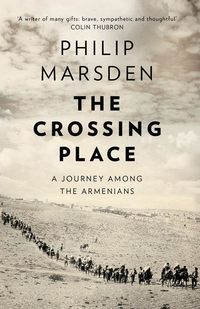
Cover photograph: Turkey / Armenia: Armenian refugees fleeing
Turkish massacres, Anatolia, 1915 © Bridgeman Art Library
All rights reserved under International and Pan-American Copyright Conventions. By payment of the required fees, you have been granted the non-exclusive, non-transferable right to access and read the text of this e-book on-screen. No part of this text may be reproduced, transmitted, down-loaded, decompiled, reverse engineered, or stored in or introduced into any information storage and retrieval system, in any form or by any means, whether electronic or mechanical, now known or hereinafter invented, without the express written permission of HarperCollins
Source ISBN: 9780008127435
Ebook Edition © April 2015 ISBN: 9780007397778
Version: 2015-03-17
HarperCollinsPublishers has made every reasonable effort to ensure that any picture content and written content in this ebook has been included or removed in accordance with the contractual and technological constraints in operation at the time of publication.
EPIGRAPH
The wind is singing, the leaves of the mulberry-tree are shuffling.
Eternal song; eternal life; eternal death; eternal sorrow; and eternal joy…
Vahan Totovents, Scenes from an Armenian Childhood,
(Trans. Mischa Kudian)
CONTENTS
Cover
Title Page
Epigraph
Map
Preface to the 2015 Edition
Prelude
Part I The Near East
1
2
3
4
5
6
7
8
Part II Eastern Europe
9
10
11
12
13
14
Part III Armenia
15
16
17
18
19
20
21
22
23
Postscript
Keep Reading
References
Index
Acknowledgements
About the Author
Copyright
About the Publisher
MAP


PREFACE TO 2015 EDITION
On a cold grey morning in January 1991 I stood beneath the departures board at London’s Victoria Station, waiting to catch the boat-train to Paris. A rucksack leaned against my shins and a crowd of commuters – blank-faced and winter-wrapped – flowed past me. I was in my late twenties, and I was going to Armenia.
In my pocket I had a black oilskin notebook with a list of Armenian sites and contacts in places from Venice to Nicosia, Damascus to Sofia, Aleppo to Cluj, Istanbul to Bucharest. I had arranged them by country, and the last page was headed USSR – still in existence, just, with names in Odessa, Tbilisi and Yerevan. I was wearing new boots and a new coat. In my rucksack was a change of clothes, a towel, books, two maps (one ‘Turkey and Western Asia’, the other ‘Osteuropa’), a short-wave radio, a Nikon F3 camera, a lot of transparency film, a letter of introduction from the Armenian Patriarch of Jerusalem and $2,000 in cash. I also had two passports, one with Israeli stamps and one without. In neither of the passports was a single visa.
I felt neither prepared nor unprepared; the uncertainty of the journey was too great to be nervous. I had developed an idea of the traditional Armenian diaspora as a powerful and secretive network of communities spread across the Middle East and Eastern Europe. If I locked into that network, and was accepted, all would be fine. Visas would appear, borders would open before me. At least that was what I hoped: proving it was part of the point of the journey. My two main fears were being kidnapped in the Levant and being turned back, anywhere. I was determined not to fly.
From Paris my plan was to carry on by train to Venice, then to Athens, and by ferry to Cyprus. That was the easy part. From then on, I would need visas and luck and the help of my contacts. The first decision would be whether or not to go to Lebanon. The bombing phase of the First Gulf War was already underway; Western hostages were still being held in Beirut and the Bekaa Valley.
For months before, I’d been living in a single-room flat in the Armenian quarter of Jerusalem’s Old City. I took daily lessons in Armenian with the charming Father Anooshavan, who was alleged to speak thirty-six languages. I spent a great deal of time with the poet and historian George Hintlian, who acted as mentor to my planned odyssey. I talked to monks, scholars and seminarians. I met recent refugees from Karabagh, second-generation refugees from Iran, and third-generation refugees from Turkey. In 1915 the entire Armenian population had been driven from Anatolia; many were massacred there, on the edge of dusty towns; many more were driven down into the Syrian desert. Over a million died. In Jerusalem, there were a few very old survivors who, in darkened rooms, laid their stories before me.
At that time the Old City was more than usually tense. On to the first Palestinian Intifada were heaped the war-fears that had followed Saddam’s invasion of Kuwait. I recall the cheek-sting of tear gas, the fear of walking in the alleys at night, of a stone to the head or a street stabbing. I recall the Al-Aqsa massacre of 8 October and watching an Israeli settler standing in the Ghawanima minaret, shooting down at Palestinians in the concourse of the mosque.
That morning at Victoria station, I carried a couple of other things with me, things I’d picked up in Jerusalem. One was a particular strain of anger that is unavoidable if you spend any time in the Middle East. I had arrived in Jerusalem with an outsider’s view of the Palestinian conflict. But as the months passed and I saw the reality of day-today life, I found myself with a visceral reaction to the Israeli occupation. A similar indignation, overlaying any attempt at neutrality, had grown to colour my Armenian studies. In 1915, under threat from enemies on all sides, the Turkish authorities had every right to be nervous of Armenian loyalties. But what they did to the Armenians overshadows any political context. This book is not an attempt to explain the events of 1915; it is the record of my own experience of travelling among the Armenians, at a particular moment in world history, at a particular moment in my own life. Re-reading it now, more than two decades on, I can see how partisan I’d become, and remember how natural that position felt.
The other piece of baggage was something that would grow sharper over the coming months, that would stay with me for years afterwards. It was the idea that violence and disorder were the way of the world, and that at that time in the early 1990s, with the Middle East in chaos and the Soviet Union fracturing, they were both on the rise. I was, I recall now, in that state of mind that sees everywhere the signs of imminent catastrophe.
Two months later I reached the Syrian town of Deir ez Zor. After days in the desert, visiting the massacre sites, I crossed the Euphrates on a bus. It was late afternoon and a dusty light hung heavy over the town, as if the sun had lost its vigour. Down a side alley, I knocked on a door and an Armenian let me in swiftly and locked it behind him.
I don’t remember much of that evening, except his ninety-year old mother sitting still and silent on a stool. But in the morning he took me to see something remarkable. Amidst the boxy concrete buildings, the overhead tangle of wires, stood the Armenian Martyrs’ Memorial church – only just completed.
It wasn’t only a church but an entire complex of buildings – a museum, an archive, community rooms. The sunlight glowed on walls of fresh-cut, butter-yellow limestone. Into the stone were carved khachkars, those crazily intricate Armenian crosses that mark places of note. Down in the crypt of the church was a gallery of black-and-white photos of the massacres – beheaded men and naked starving women and, like members of a lost family, the Anatolian towns from which the Armenians had been driven. Full-length silk robes and silverware stood in glass cases. It was all that was left.
In the middle of the room were more glass cases, but these ones were set into the floor. Under the glass lay the pale bones of victims. Some of them had come from the cave at Shadaddie, where several thousand people had been burnt and suffocated. From the middle of the ring, rising from the bones like a tree trunk, was a marble pillar. Its stocky girth pushed up out of the crypt, through a hole in the floor above and into the main space of the church. I leaned in to gaze at its light-tinted top, probing the interior as if it was another world. It was named the Column of Resurrection.
The church was consecrated just a couple of months after I visited. The Armenian Catholicos of Cilicia came up from Beirut to conduct the ceremony. Over the years since, tens of thousands of Armenians have made the journey across the desert to visit the Martyrs’ Memorial church. Until the recent Syrian civil war, a vast gathering took place there each year on the day of commemoration, 24 April. The memorial site is often compared to Auschwitz, built at one of the places where the Armenians were concentrated after their long march, and where they died in such numbers. It is a site that for Armenians offers a hint of solidity amidst the perennial loss – stone buildings to offset the villages and towns that were gone, the centuries-old way of life, the abandoned cemeteries and ancient khachkars, the generations that might have been born.
In the summer of 2014, the town of Deir ez Zor fell into the hands of ISIS. The Armenian priest received a phone call inviting him to accept their authority. He refused. The Armenian Church of the Holy Martyrs was dynamited. Its treasures and mementoes were destroyed, its archive burnt. The charred bones from Shadaddie were buried once again, in tons and tons of rubble.
The story of the Armenian massacres did not begin in 1915, and nor did it end then. Persecutions stretched back through the centuries, flaring into periodic pogroms and forced exile. The Armenian communities set up elsewhere have proved often just as frail, just as vulnerable. When I was in Aleppo in 1991, refugees from the civil war in Beirut had pushed the Armenian population in the city to one hundred thousand; from 2012, the tide turned and the Armenians fled the opposite way.
The collective memory of 1915 has followed its own precarious and unpredictable path. For decades, the Armenians were almost silent, as if a combination of shock and shame prevented them saying anything. Then on the fiftieth anniversary, in 1965, one hundred thousand people gathered in Yerevan to demand restitution of historical lands in Turkey. The effect was extraordinary. Many in the Soviet republic didn’t even know of the catastrophe, while in the diaspora the scattered victims and their descendants suddenly found a voice. Thereafter, the cries for recognition grew louder and the sense of grievance became a powerful political force.
The reaction of the Turkish state has been denial – denial that there was ever a systematic campaign to rid the country of Armenians, denial that Armenian deaths were anything more than incidental damage caused by civil conflict. Armenian anger intensified. In the 1970s, extremists conducted a campaign of terror against Turkish diplomats. Many more have been involved in more restrained lobbying of governments around the world to recognise the genocide – which in turn has provoked further dismissal from the Turkish state.
No-one now has any direct memory of what happened in 1915. The survivors I interviewed are long since dead. Although the dissemination of evidence has grown in the intervening years, the entire episode has been successfully muddied by Turkish denial. The debate has revolved around whether or not there was a ‘genocide’, a concerted attempt to eradicate the Armenians as an ethnic group and whether it is possible to describe it with a word that was only coined in 1948. The polarisation of opinion, the fear of Turkish retribution against parliaments who vote to acknowledge the Armenian genocide, have helped to maintain the opacity of the water.
The terminology doesn’t matter. The events remain, casting their shadow over the entire twentieth century. In 2009, Geoffrey Robertson QC trawled the available material and wrote a report entitled ‘Was there an Armenian Genocide?’ ‘No reputable historian,’ he concluded, ‘could possibly deny the central facts of the deportations and the racial and religious motivations behind the deaths of a significant proportion of the Armenian people.’
I am often asked: what interested you in the Armenians? I used to find the question surprising: who could not be interested in the Armenians once you knew their story? But I now realise that what people really meant was this: why did I immerse myself so completely, cut myself off so entirely, in order to travel through the diaspora and down to the southern Caucasus?
That year was the most extraordinary of my life, yet I still find the question hard to answer. I was motivated by the genocide, yes, the shock of discovering its details and the continuing campaign of denial. But it wasn’t just that, nor even mainly that. Nor was it the extraordinary achievements of the Armenians – the perfect stone churches, those miracles of form in the treeless expanse of eastern Turkey, nor the devotional beauty of the medieval manuscripts. It wasn’t the music, the repertoire of traditional laments and marriage songs, the strains of the kamancha or the duduk, which in a few breathy notes can conjure up a yearning for Armenia and its mountains even for those who’ve never even seen them.
All those things are astonishing but they were not what kept my curiosity alive. It was something about the Armenians themselves, their half-hidden role in history, their Zelig-like presence in the Byzantine Empire, the Mughal Empire, the Ottoman Empire, the Soviet Empire. It was what they knew of the world, of the deep lessons of loss and landlessness, of living among strangers, of how to make light of borders and the obstacles of long journeys. It was the nobility of so many of their lives, the fierce conviction that our mortal endeavours should be pursued always with energy and courage, that to be alive is to be awake, never to be complacent, never to rest, that any sense of belonging on this earth is both fleeting and illusory. Sometimes it seems to me as if long ago, far back in a collective past that pre-dates most of the world’s existing ethnic groups, the Armenians discovered a secret, and swore never to disclose it but hand it down from generation to generation, wherever they happened to be. It’s a secret that’s been so closely guarded for so many centuries, that what remains is less the secret itself than the habit of keeping it.
That would explain their survival, the ceaseless exercise in will and competence that sustains it. It would explain the life of individuals like Joseph Emin, whose roamings took him from the courts of eighteenth-century Europe to the Caucasus to try and liberate his people. It explains too the fedayi I saw that first day in Yerevan, down from the mountains to bury their dead with their black beards and blue-grey eyes, and Janna Galstian, who abandoned a brilliant acting career for war in Karabagh where I met her in 1993 as deputy military commander of the Hadrout region. It explains the life and work of the great musician Gomidas, collector of a thousand Armenian folk songs, who deciphered the medieval notation system but was driven out of his mind by the experience of 1915. It explains the power of the letters of Mesrop Mashtots’s Armenian alphabet and the melismatic chants of the church choirs, and the genius of Armenian masons, photographers and merchants, and of those Armenian priests, stuck in some far-off outpost of the diaspora, in Poland or Transylvania or Iraq who say the liturgy for the last time to an empty church, then lock the door and step outside, into the dangerous world.
Philip Marsden, Ardevora, December 2014
PRELUDE
One summer, walking in the hills of eastern Turkey, I came across a short piece of bone. It was lodged in the rubble of a landslip and had clearly been there for many years. I rubbed its chalky surface and examined the worn bulbs of the joint; I took it to be the limb of some domestic animal and dropped it into my pocket.
Beyond the rubble, the land fell away to a dusty valley which coursed down to the plain of Kharput. The plain was hazy and I could just make out a truck bowling across it, kicking up a screen of pale dust in its wake. I carried on down the valley. It was a strange, still place and rounding a bluff, I stumbled on the ruins of a village. A shepherd was squatting in the shade of a tumbled-down wall, whistling. I showed him the piece of bone and gestured at the ruins around him.
The shepherd nodded, wiping together his palms in an unambiguous gesture. He said simply, ‘Ermeni.’ Then he took the bone and threw it to his dog.
Ermeni: the Armenians. The guide books hardly mentioned the Armenians. No one mentioned the Armenians, yet everywhere I went over the coming weeks, every valley of that treeless Anatolian plateau, was haunted by them. Arriving one morning on the shores of Lake Van, I took a boat to the island of Aghtamar. The island had once been the court of an Armenian king, the centre of a tiny realm squeezed between Persia and Byzantium, but now it was uninhabited.
Continuing north, around the lower slopes of Mount Ararat, I came to the ruins of the Armenian city of Ani. Its extraordinary thousand-year-old cathedral, in no man’s land between the Turkish and Soviet borders, was open to the sky, shelter for three ill-looking sheep. A long way up a gorge near Digor, I found an Armenian church so perfect in its design that at first I did not notice its collapsing roof, nor the gaps in its walls.
I left Anatolia with a clutch of half-answered questions. Who were these people, and what had happened? I knew about as much as most – that the Turks had done something terrible in the First World War, that Armenia was the first Christian nation, that it had hovered for centuries on the fringes of the classical world. But it was not an explanation. Everything that I learnt about the Armenians only served to deepen the mystery, to make them more surprising, more enigmatic.
The following year I was travelling through northern Syria and came across an archaeologist in Aleppo. He knew a good deal about the Armenians and one afternoon took me to meet Torkom, an elderly Armenian lawyer with a bony face and deep-set blue eyes. Torkom lived alone, at the top of a set of winding stairs. His room was dark and musty and filled with books. A few glass-fronted cases had been built into the wall for manuscripts and they glowed with a yellowy light; they looked like preserved organs in laboratory jars.
When he heard I was interested in the Armenians, Torkom peered at me suspiciously.
‘Why?’
I said I’d been to eastern Anatolia.
‘Yes?’ I told him about the cathedral at Ani and the church at Digor. I told him about the bone and the ruined villages and he shrugged as if to say: ‘What do you expect?’
But when I mentioned Lake Van, he said, ‘My family was from Van. You see my eyes? I have Van eyes – deep blue.’
‘Like the lake,’ I said. He smiled and led me into a back room. A photograph of Mount Ararat hung on one wall. Beneath it was a large desk, covered in papers.
‘Do you know anything about the marches?’ he asked.
‘Very little.’
He opened one of the drawers and handed me the xerox copy of a hand-drawn map. Years of interviews had gone into that map, he said. He had collaborated with an Armenian truck driver who knew every town and village of northern Syria, and they had spliced the oral information with the few written records to draw the map. It looked to me somewhat like a tidal chart: a mass of arrows curling and twisting down the page. But the arrows, when I looked closely, were overlaid on a map of the Near East and they all pointed in more or less the same direction, away from Anatolia, south towards the Syrian desert.
I spent the following day in Torkom’s library.
On 24 April 1915 the Turkish authorities arrested Constantinople’s six hundred leading Armenians. They rounded up another five thousand from the city’s Armenian quarters. Few of these people were ever seen again.
In the interior Turkish forces began to deport the Armenians. Torkom showed me the published report of one of the only foreigners who had witnessed what these deportations really meant. Leslie Davis had been the American consul in Kharput. He had watched the Armenian groups come and go, and had listened to the rumours. Since it was wartime his movements were severely restricted and he had been unable to confirm what he heard. But one morning before dawn he managed to slip out of the town. He rode on to the plain of Kharput.
And wherever he rode he saw the Armenians. They were casually buried in the roadside ditches, their limbs half eaten by scavenging dogs; he saw the heaps of charred bones where the remains had been burned; he saw the swollen bodies of the newly dead and in places they lay so thickly in the dirt that his horse had difficulty avoiding them. As the day wore on, Davis rode further into the hills. He reached the shores of Lake Goeljuk. Here, in the valleys leading down to the lake, the scene was the same: corpses scattered amidst the thornscrub, bunched together in their hundreds – at the foot of cliffs, in gorges, in the hidden folds of land.
Those who weren’t killed at once were gathered into convoys and driven south. These were the marches. Davis had managed to compile an account of just one of these dismal convoys; it had left Kharput on 1 July 1915:
| Day 1 | 3000 Armenians leave Kharput. Escort of seventy zaptieh under command of Faiki Bey. |
| Day 2 | Faiki Bey levies 400 lira from convoy for its safety. Faiki Bey disappears. |
| Day 3 | First women and girls taken by Kurds. Open violation by zaptieh. |
| Day 9 | All horses sent back to Kharput. |
| Day 13 | 200 lira levied by zaptieh. Zaptieh disappear. |
| Day 15 | Kurdish ‘guard’ take 150 men and butcher them, then rob convoy. Joined by another convoy from Sivas. Numbers swell to 18000. |
| Days 25–34 | Harassed by villagers. Many women taken. |
| Day 40 | Eastern Euphrates. Blood-stained clothes on river-bank; 200 bodies in water. Armenians forced to pay to avoid being thrown in river. |
| Day 52 | Kurds take everything, including clothes. |
| Day 52–9 | Naked, without food or water. Women bent double from shame. Hundreds die beneath hot sun. Forced to pay for water. Money hidden in hair, mouth, genitals. Many throw themselves into the wells. Arab villagers give them pieces of cloth out of pity. |
| Day 60 | 300 remain from 18000. |
| Day 64 | Men and the sick burned to death. |
| Day 70 | 150 arrive in Aleppo. |
When I rose after several hours of reading such accounts, I felt dazed and numb. I walked back into the centre of Aleppo, through the high, narrow streets with their 1950s cars and the clattering souks. But I could not erase the images of the massacres. I carried on walking until well after dark and by the time I returned to my hotel had decided to try and find out more. One place in particular had struck me – a certain cave at Shadaddie. I rearranged my plans: I took Torkom’s map and a letter of introduction and left Aleppo for the desert.
South from the town of Hassakeh, the road ran straight ahead of the bus for mile upon mile. It dipped and rose and tapered towards a low horizon, but did not change direction. Beside it the telegraph poles echoed into the distance until the heat-haze dissolved everything into a shimmering mass. On Torkom’s map, Shadaddie was no more than a dot in the desert. A thin arrow pointed down to it from Ras ul-Ain. Now it has become an oil-drilling station and in one of the pre-fab homes I found a technician who nodded when I gave him Torkom’s letter: yes, he knew about the cave.
The technician drove me out of the town in a battered jeep. I sat half-hidden in the back and at the checkpoints crouched down behind the seat; we were now close to the Iraqi border and the oilfields were well guarded.
A dry wind swept through the flaps of the jeep. It sped out across the desert and into the jumble of hillocks ahead. It was a cool, unrelenting wind and in places it had scoured the sand from the bedrock and the quartzite gleamed beneath it as white as bone. Nothing grew here. The only things that moved were the lifeless profiles of the nodding-donkey pumps. We left the road and slowed on to a rutted track. All around it were the egg-like shapes of compacted dunes. We bumped along the track until the dunes gave way to a wide depression. The technician stopped the jeep and pulled on the handbrake. Lighting a cigarette, he pointed into the hollow.
Flash-floods had cut a deep gulch which pushed down into the rock below. I followed its dry pipe-like channel to where it opened out suddenly into the mouth of a cave. Peering into the cave-mouth, I could see the chamber spread out as if from the lantern of a dome. I dropped down onto a damp, muddy floor. Three startled doves flew out through the skylight. At the foot of one wall, where the sun fell on it, was a green cushion of moss. Down to one side a passage led away into the darkness. The air was warm and heavy and I felt that here, if anywhere, was the Armenian story – hidden inside a muddy cupola, in an area sealed off by state secrecy, tucked away and buried in a hollow amongst a thousand other hollows, beneath the crust of a desert that stretched for hundreds and hundreds of miles in every direction. Here was where Armenia had ended.
I turned on a torch and went down the passage. There was no sign at all of what had happened, nothing to show that it had ever been anything but a vast storm-drain for the desert.
But for the zaptieh, it had provided a ready-made solution. As the mountains were emptied of Armenians so the Syrian desert filled up. The order came from Constantinople to clean up the area. All sorts of methods were adopted. Shooting was slow. Some were driven into the river. A great many simply perished from disease and hunger and thirst. Shadaddie provided its own natural apparatus. The passage was very long and very roomy.
The guards brought the Armenians here and pushed them in by the thousand; as more fell in so the first ones were forced down the passage. Then the guards dragged scrub to the entrance and set fire to it. That night they kept a watch over the cave, camping on the edge of the hollow. Then they returned to the town.
They might have got away with it (are there other Shadaddies that went unreported?), had a young boy not been able to get enough air from the depths of the tunnel to survive and, three days later, to crawl over the bodies and the ashes of the fire, back up to the desert.
The passage went on, curving and dipping in ways I could only imagine. I could see little in the yellow tube of light. The air became still and I could no longer feel the breeze from the entrance. I felt drawn on into the tunnel by a strange irresponsible urge. Each footfall seemed to take me further from the familiar. I felt a huge emptiness behind me – but a bigger one in front. I was trespassing, a grave-robber motivated by something darker than greed: I was driven by curiosity. I knew there was nothing I would find, but I carried on. I carried on without really thinking. I carried on because to turn back was to lose what there was left of Armenia.
My feet slid and splashed through unseen puddles. I steadied myself with a hand on the damp wall. I could feel the tunnel narrow and I began to stoop. Then one foot slipped on a mud bank and the torch spun out of my hand; it clanged against a rock and went out.
For several minutes I squatted there, quite still. I passed a hand in front of my face, and saw nothing. I turned my head one way and then the other, and soon did not know from which way I had come. I tried to imagine the smell of smoke seeping down the tunnel, and the noise – would there have been hysteria, or simply quiet resignation? Mothers murmuring for their children in the void, the few men too broken to care, the tangled bodies, the slow suffocation …
For an instant I felt the cave spin around me. Submerged by the horror it had witnessed, I was suddenly disoriented.
It passed almost at once. I crouched and ran my hands around my feet, probing for the torch, wrist-deep in the slimy clay, pushing through the cave’s damp and formless floor. My fingers struck something hard. I clutched it and with the other hand found the torch, several yards away. I thought it must be another bone but when I switched on the torch it turned out to be a large crystal – five inches of transparent calcite in the shape of an arrowhead.
Outside again, the Armenian technician clapped a hand on my shoulder and smiled for the first time. He was worried I’d got lost. He lit another cigarette and started up the jeep. I wrapped the crystal in a scarf and buried it away in my bag. It seemed an appropriate relic from the cave: Armenia may have died here, but something survived. A year or so later, in Israel, I took it with my unanswered questions to Jerusalem.
The old city of Jerusalem, the holiest square mile on earth, is divided into four distinct quarters. Three of the quarters – the Jewish, Christian and Muslim quarters – represent the great monotheistic faiths that have sanctified and fought over the city for hundreds of years. The fourth quarter is the Armenian quarter.
That the Armenians have survived in this, the most intense of all cities, is proof of their extraordinary resilience. The Armenian quarter is in fact the longest established of them all – and it remains the most secretive. Much of it lies within its own high walls, where the laity live cheek-by-jowl with the monastic order of St James. It is closed to visitors and only for half an hour each day are non-Armenians allowed inside to visit the cathedral.
Peering into the side chapel of St James, which contains those of the saint’s limbs which did not reach Compostela, I heard a voice behind me.
‘Can I be of any help?’
A man with black-rimmed glasses introduced himself as George Hintlian, the community’s historian. I told him I had seen Ani and Digor and that I had brought something from the cave at Shadaddie.
‘I could tell you were not interested just in the cathedral.’
‘How could you tell?’
‘I could just tell.’
He took me up to his office and I laid the calcite crystal on his desk. He smiled and shook his head in disbelief. ‘Let me show you around the quarter.’
For several hours we wandered through a labyrinth of crypts and alleys and sunny courtyards. He took me up over the roofs and in amongst the cloisters to meet the monks, and when I left he said, ‘If ever you want to find out more about the Armenians, why not come and spend some time here with us?’
I left the crystal with George and within eighteen months I was back. My Armenian questions would not go away. I told George I wanted to get to Armenia and he said he could help. I stayed in Jerusalem for a few months, in a small, vaulted room on the border of the Jewish and Armenian quarters. The city was tense; Kuwait had just been invaded and all talk that autumn revolved around the likelihood of war. Jerusalem waited. The Israelis waited and the Palestinians waited; the Armenians waited between them. I waited – all the time planning a roundabout journey to Armenia, to seek out the Armenian communities that appeared to be scattered throughout the Middle East and Eastern Europe.
I took daily lessons in Armenian with a polyglot monk, took long walks with George, talked to everyone I could, and spent the rest of the time among the books of the Gulbenkian Library. I visited the Armenian community in Jaffa and a fifth-century Armenian monastery in the Judean desert; I spent a week with the Armenians of Cairo. And I realized more and more that the Armenian story was not so much one of massacre and persecution, as survival.
The first princes of Armenia had emerged in central and eastern Anatolia about six centuries before Christ. Five hundred years later, Armenia stretched fleetingly all the way from the Mediterranean to the Caspian Sea. At other times during these centuries the Armenian rulers paid tribute to the Persians, to Byzantium, to the Baghdad caliph, or some combination of the three. Even in these years Armenia’s survival seemed improbable. Lying always on the fringes not only of opposing powers but opposing beliefs, the Armenians would adhere to no one’s ideas but their own. In AD301 the Armenian King Trdat III became the first ruler to adopt Christianity – while in Rome the worst persecutions of Christians were yet to come.
When some years later Constantine chose the outlawed cult to be the cornerstone of Byzantine theocracy and the world’s greatest empire, the Armenians still stuck to their own interpretation. In 451, at the Council of Chalcedon, the Byzantine bishops agreed some sort of Christian orthodoxy; the Armenians didn’t even turn up – they were too busy fighting off the Sassanid Persians.
Even the earth itself seemed to conspire against them. Within a few hundred miles of Ani are the borders of half of the world’s twelve major tectonic plates. In a single earthquake in the ninth century, seventy thousand were recorded as having been killed in one Armenian town alone.
Yet during this first Christian millennium, between the earthquakes and invasions, between the Mazdaeans, Manichaeans, Muslims, dyophysites and dualists, the Armenians emerged briefly to stage brilliant half centuries of their own, writing and building with passionate skill, before being stifled again by some rampant horde. In the ninth century Armenia emerged again as an independent state, centred on the city of Ani. I had caught a scent of that city’s genius, sitting in its ruined cathedral a few years before. At one time Ani was bigger than most European cities. But in 1064 the Seljuk Turks swept up out of Asia and sacked it.
What should have happened then to this small people, occupying as it does the perennial buffer between empires, the most routed, trampled-over region on earth, was a gradual assimilation into its bigger and more powerful neighbours. Its scattered families should have struggled on for a couple of generations in exile, clinging proudly to traditions before intermarriage consigned them to history’s roll of honour: a set of dusty ruins on the Anatolian plateau and some glass cases in the British Museum.
Instead the Armenian princes travelled five hundred miles to the south-west. There in the lee of the Taurus mountains, in Cilicia, they established a new Armenian kingdom. Many of those who didn’t flee and who weren’t killed by earthquakes nor slaughtered during the Seljuk invasion, but who remained on the land, were driven in 1604 by the Safavid Shah Abbas down into Persia. And those who survived both the Seljuks and Shah Abbas, and who didn’t drift away beyond the Ottoman empire, who weren’t killed in the pogroms of the 1890s, nor those of 1909, but who stayed in the villages, were rounded up in 1915, pushed down one of history’s dark side-alleys and murdered.
More than a million Armenians died in the last years of the Ottoman empire, a half of Anatolia’s total. The Turks had managed to do what numerous powers had tried before them: they managed to finish Armenia, though not the Armenians. In most of the world’s cities you can find Armenians – Armenian newspapers in Armenian script, Armenian restaurants. In exile the Armenians are curiously resilient; only the Jews have resisted assimilation as fiercely. In the mountains of Colombia there is a small town actually named Armenia where they serve ‘Antioch-style’ beans. In Paris the first-ever café was opened in 1672 by an Armenian, as it had been earlier in Vienna, by the same Armenian spy who had helped break the Turkish siege. At the siege of Vienna the Polish King Jan’s private doctor had been an Armenian, as was the doctor to the harem of Akbar the Great, the Mogul emperor whose adopted Armenian son was regarded by the Jesuits in India as the greatest poet of his time.
The ‘Polish Byron’, Słowacki, had an Armenian mother, as does the chess-master Garry Kasparov, as did Gurdjieff, as did the Abbasid Caliph al-Mustadi who ruled the entire Arab world during the twelfth century, except for Egypt where a few years earlier Armenian vizirs held power, and Jerusalem where the hereditary Crusader rulers had long had Armenian blood coursing through their royal veins. When Richard the Lionheart was married, in Cyprus, his best man was an Armenian; the last king of Armenian Cilicia, exiled in France, taught the French king to play chess. It has even been suggested that the Man in the Iron Mask was none other than the Armenian patriarch of Constantinople.
The first yoghurt in the United States was manufactured by the Armenian family Columbissian. The particular green ink of the US dollar bills was developed by an Armenian, as was the MiG jet, named after Mikoyan, whose brother was the longest-standing member of Stalin’s Politburo, and the first to denounce him. Abel Aghanbekyan, an Armenian economist, produced the blueprint for perestroika.
They shouldn’t really exist at all. They should have been destroyed, written out of history by its worst horrors. But they have survived. Instead of a footnote to the story of these border regions, the Armenians can be read like a kind of subtext.
With the Gulf War imminent, the Soviet Union crumbling and Eastern Europe in a state of dangerous uncertainty, it seemed the perfect time to set off around the Armenian diaspora, to try and reach Armenia itself. I prepared to leave Jerusalem.
In the library of the Armenian quarter, tacked to the wall, were the lines of the Armenian writer William Saroyan:
I should like to see any power of the world destroy this race, this small tribe of unimportant people, whose wars have all been fought and lost, whose structures have all crumbled, literature is unread, music is unheard, and prayers are no more answered. Go ahead, destroy Armenia. See if you can do it. Send them into the desert without food or water. Burn their homes and churches. Then see if they will not laugh, sing and pray again. For when two of them meet anywhere in the world, see if they will not create a New Armenia.
Wondering what Saroyan meant by a ‘New Armenia’, and wondering what remained of the old, I said goodbye and left the monastary on a damp December evening. I headed for Venice, where there had been an Armenian community for more than eight hundred years.
I THE NEAR EAST
They chose the Worst Thought, and then ran to join Wrath.
From the Zoroastrian Gāthas, yasna 303, in which the Deceiver tricks God into letting man acquire the wrong spirit.
1
I was looking a long while for Intentions,
For a clew to the history of the past for myself, and for these chants – and now I have found it,
It is not in these paged fables in the libraries (them I neither accept nor reject,)
It is no more in the legends than all else,
It is in the present – it is this earth today.
Walt Whitman
Venice was cold. Small ice floes littered the canals and drifted into the lagoon like soggy notes. No one lingered long outside; the piazzas were empty. But it wasn’t just the cold. From the balustrade of a palazzo on the Grand Canal, the students had draped a banner: NO ALLA GUERRA! NO ALLA CATASTROPHE! The catastrophe for the Venetians was that the Gulf war was scaring away the tourists. I had the place almost to myself.
The Mourad-Raphaelian school was the only one for the children of Venice’s Armenian community. Its director looked more Italian than Armenian; he wore scarlet socks and walked with short, urgent strides. I met him hurrying away from the school. ‘Please,’ he called back, ‘wait inside! My car is in the middle of the road. It is broken.’
‘Your car?’ In Venice? But he was already gone.
I pushed open the school’s heavy oak door and entered a panelled hall. Bright sun fell across the flagstones, and through the windows was a small courtyard. But there was no sign of life. Upstairs it was the same – bare floors and echoing corridors. It seemed more abandoned palace than school. Only the walls and ceiling, flourishes of rococo plaster, gilded swags and voluptuous oils, seemed alive. Too alive, in fact. The overnight train to Venice had been a sleepless affair, and so much early-morning baroque made me a little nauseous. I found a window overlooking the canal and watched the sunlight flicker on its filmy surface.
The Armenians have long been in Venice. When it emerged as a power in the twelfth century they were already well established. Their talent for innovation, an exile’s talent, litters the chronicles of the republic. Sinful Hagop set up a printing press in 1514 and produced the first Armenian printed book, while Anton Surian – ‘Anton the Armenian’ – built ships. Twice his own designs had helped save Venice: once with a frigate whose beam-mounted cannon swung the battle of Lepanto, and then again with a salvage ship that unclogged centuries of broken ships from the lagoon. But in recent years the community has been whittled away to almost nothing. Many of the old families have gone to Milan.
The director returned and showed me into a high-ceilinged office. The walls were refreshingly plain and hung with the familiar icons of Armenian exile: a view of Ararat, and large colour plates of half-ruined churches, standing alone in the mountain wastes of western Armenia, old Armenia, Turkish Armenia.
‘Yes,’ sighed the director. ‘Not many are left here. You know, it’s a full-time job being an Armenian.’ He stretched his arms open wide, nodding at each of his hands. ‘Here … and here. I struggle to keep up with my brother in Syria and Egypt, in America and Persia. If I relax for an instant, it is gone!’ His arms flopped to his sides. ‘You understand?’ He picked up the telephone and tried to track down a mechanic.
Running a car in Venice also seemed a full-time job, so I thanked him and walked out again into the frosty streets.
I telephoned Father Levon Zekiyan and we arranged to meet in a small café near the Chiesa San Rocco. Father Levon held Venice’s chair of Armenian studies. He was a tall man, with a distinct sartorial elegance. I’d been given his name in Jerusalem, but I’d seen it too at the head of various scholarly papers. He’d written a great number of papers, in several languages, and his footnotes were always a maze of different scripts. Enthusiasm for the minutiae of Armenian history set his conversation darting around the centuries, but did not make him shy of the broad sweep. When I asked him the big question – what keeps the Armenians Armenian – he paused for only a moment.
‘The whole thing,’ he explained, ‘comes down to a single idea. And the key to it is the script. Mesrop Mashtots was our greatest political thinker! In the fifth century he invented the alphabet – he realized Armenia as a power was finished. If the Armenians were to survive without territory, they had to have a common idea, something that was theirs alone. The script embodies the idea.’
‘And what is the idea?’
‘Ah, you cannot describe it! You can give it a name but you cannot describe it. If you are lucky, you will come to know it a little.’ He took a sip of wine and smiled. ‘Our poet Sevak called it simply Ararat.’
Ararat – of course. Ararat echoes around things Armenian like a persistent cliché. It is the name of Armenian journals, Armenian books, Armenian businesses and restaurants; in the United States there is an Armenian credit card called Ararat, as is an Armenian nursing home in California. The national football team is called Ararat, and the mountain’s dual-peaked profile had hung in every Armenian home I’d seen so far. I knew it as a symbol of exile, staring as it now does into Armenia from across the Turkish border. But Father Levon’s idea was much more than that. I began to see the mountain as something more enigmatic: an article of faith, the survival of an animistic past.
Osip Mandelstam, after several months in Armenia, also became aware of Ararat’s peculiar presence:
I have cultivated in myself a sixth sense, an ‘Ararat’ sense: the sense of attraction to a mountain.
Now, no matter where fate carry me, this sense already has a speculative existence and will remain with me.
I had seen Ararat too – from Dogubeyazit in Turkey. But it had left no particular mark on me. Perhaps I had to wait to see it from Armenia.
I left Father Levon in the Piazza San Marco and took a boat across the lagoon to the island of San Lazzaro. The afternoon was crisp and beautifully clear. Only two other passengers were on the boat; one of them was an Armenian monk. For more than two hundred and fifty years, San Lazzaro has been an Armenian monastery. It is now one of the great storehouses of Armenian culture, with its collection of thousands of manuscripts – pages and pages of Mesrop’s script.
The monk from the boat passed me on to another monk who guided me around the monastery, Climbing the stairs to the museum, he asked me for news of the Armenian monastery in Jerusalem. I went in to some detail about the new patriarch and the bishops and the old retainers of the Holy Places, but I could see he had lost interest; they were members of the Brotherhood of Saint James, he was a Mekhitarist, a wholly different sect.
San Lazzaro’s museum, on the other hand, was a testament to the cohesion of the diaspora. Each exhibit, brought to the island by devoted pilgrims, was another dot on the Armenian map. It was like the collection of some well-travelled Victorian philanthropist. Under a Tiepolo ceiling, Persian ceramics stood with Iznik dishes and Kutahya ewers; there was an ivory Taj Mahal, some ivory filigree orbs (seven inside one another, like a Russian doll), a silver Ethiopian hand cross, St Petersburg miniatures, stamps, banknotes, a Crusader sword, a Canova cast of Napoleon’s son, a Burmese boustrophedon manuscript explaining in Pali the initiation rites of a Buddhist priest, and a mummy. In 1925 Egypt’s foreign minister, an Armenian, had brought the mummy, along with a Bubastis cat. The mummy was the monk’s favourite exhibit.
He led me away from the main gallery to a room lined with the buckram spines of English classics. There, hanging over the door, was a portrait of Lord Byron. All through the winter of 1816, several times a week, Byron crossed the lagoon to visit the monks of San Lazzaro. He developed a fascination with Armenia, discovering among other things that it was the supposed site of Earthly Paradise.
‘Their country,’ he wrote, ‘must ever be one of the most interesting on the globe.’
In this room Byron took on the Armenian language. His letters tell of his endeavours: ‘In the mornings I go over in my gondola to hobble Armenian with the friars … my mind wanted something craggy to break upon … this was the most difficult thing I could discover … a Waterloo of an alphabet …’ In Venice itself, his pursuits were easier:‘… the lady has, luckily for me, been less obdurate than the language …’ After some months his visits to San Lazzaro dried up.
The next day, before leaving Venice, I called ahead to Cyprus. I told Garo Keheyan, an Armenian I’d met in Jerusalem, that I planned to be in Nicosia in a few days.
Crossing the Rialto that evening I saw the Grand Canal just beginning to ice over. In Trieste there was a night train to Yugoslavia. It snowed heavily in the night and at Belgrade a guard stumbled along the track to thaw the points with a flaming torch. The train ploughed on, south through Serbia, through dead valleys and silent forests, beneath swollen clouds. The day slid past in a series of frozen images: a man with a gun on an icy pond, the breath of a horse at a level-crossing, a yellow pig leaping in the snow.
The following afternoon at Piraeus was warmer. A ship from Odessa was in port and the Ukrainians lined the docks’ perimeter fence. By their feet lay piles of china plates, plastic dolls, knives, forks, and tins of caviar. I bought a bottle of Armenian brandy from a stern Russian woman and carried on past the ones with smiles and powder-blue eyes and no goods at their feet, prepared to go to any lengths for hard currency.
The ship to Cyprus was practically empty. Half a dozen people gathered in its burgundy lounge as if for a bad joke: a Jew, a priest, a London cabbie, and a Greek cabaret artiste. The Orthodox priest settled down to watch a TV game show while the cabbie vilified Saddam Hussein for the ‘artiste’. I took the brandy and sat with the Jew, an antiques dealer with shoulder-length hair and dark, smiling eyes. He was on his way to marry a girl he’d never met. A friend in Lithuania had sent him her picture and now they were to meet at a certain hotel in Cyprus, go through the civil ceremony, and start anew in Haifa.
‘Call me a fool,’ he said. ‘But I feel good about it.’
I drank to his bride and he asked me what I was doing in Cyprus.
‘I’m on my way to Armenia.’
‘Armenia? What are you going to find there?’
‘I have no idea.’
‘So we are both on a mystery tour!’
It was well after dark when the ship hauled in her warps and eased away from the dock. The antiques dealer suddenly thought of something: ‘I remember there were some Armenians in Cairo. Extraordinary people. They had an expression – perhaps you’ve heard it. They used to say that the Armenians were “caught between the hammer and the anvil”.’
‘And they say that if the hammer falls often enough you end up with a diamond.’
After a day and a half we berthed in Limassol and I took a bus up to Nicosia. There I went to find Garo Keheyan whom, I hoped, would be able to advise me. I was trying to get back to the Armenian communities of Syria. There were two options: to go straight there, by boat to Latakia, or to go via Beirut. A lot of Armenians lived in Beirut; it had at one time been the most important city of the diaspora. But while the Gulf war continued, I was not keen on going in. Nor did I have a Lebanese visa. But then I had no Syrian visa either; in fact I had no visas for any of the countries I wanted to visit before Armenia – nor for Armenia itself.
In part this was due to the confusion of the Gulf war and the mess of the Soviet Union. But I saw it also as a test. The Armenians have travelled these regions more consistently, more zealously than any other people. They have always lived by travelling – as merchants, adventurers or pilgrims – with all the cunning and enterprise that it requires. That the Armenians remained so mobile, and yet survived as a distinct people, was a miracle that I still had not understood. When borders were sealed by warring empires – Mameluke and Seljuk, Seljuk and Abbasid, Ottoman and Safavid, Safavid and Mogul – the Armenians’ network of exiled communities spanned them all. Often they were the only link between rival courts and carried messages in their own script like a code. Because of the eternal instability of Armenia itself, the rigours of a peripatetic life were part of being Armenian; frontiers and wars just an everyday obstacle. My own journey would have to be an experiment in this.
Garo shrugged when I asked him if I should go, and in truth I’d already decided. He knew the Lebanese consul and telephoned her to vouch for me. All I needed, she said, was a letter from the British High Commission to free them of any responsibility. I secured the visa and arranged – through Garo’s own travel agency – a passage to Beirut. I had two days before the boat left; the Armenian network was already proving its worth.
Garo was not just a travel agent. He was also Cyprus’s Brazilian consul, director of a bank, a property developer, a would-be publisher and a power-broker of the Armenian republic’s burgeoning foreign affairs. But his real enthusiasm was reserved for esoteric thought. He had a library full of ancient wisdom and a Great Dane named Plato.
Nicosia, he explained, had its own mystic – the Magus of Strovolos; not his favourite, by any means, but worth a hearing. That week he was giving a series of lectures. We drove through Nicosia to Strovolus, known to be the city’s dullest suburb. The day’s lecture was in a large shed in a leafy garden. A group of Germans filled the room and hung through the open window to catch the Magus’s words. He started by talking about psychotherapy. Literally the word meant ‘healing the soul’. A misnomer, explained the Magus, for the soul is the one part of us that is never sick. It is the other things, the worldly things like doubt and desire heaped around the soul that make us sick.
The ‘Magus’ took his title from the priestly caste of Zoroastrians and displayed in his teaching some of the dualism that they had taught. Dualism was outlawed by the early Church, like so much else that was good, but it survived in Armenia. It found its way eventually into Western Europe to become the basis for the great medieval heresies, the Albigensians and Cathars. It was Armenian exiles – ever the carriers of Oriental ideas – who are believed to have introduced it.
The Magus sat on his stool in a grey, button-up cardigan, spreading his appealing heresies in mellifluous tones, speaking of the powers of auto-therapy, of modern evils, of peace. And it was all grist to the mill for the gentle Germans who sat with eyes closed, palms upturned. His American supporters, wary of the war, were not so loyal. They had stayed at home and sent as proxy a set of small tape recorders which whirred and clicked at the Magus’s feet.
For fifteen hundred years Armenians had been fleeing to Cyprus – heretics, subversives, exiled princes and kings, poets, monks, pogrom survivors and orphans. Once there, things have become little easier. They watched the island shift from one power to the next – from Abbasid to Byzantine, Byzantine to Knights Templar, to French Crusader, to Venetian, to Ottoman, to British, and from British into civil war. Looking at the island on the map, it appears somehow anvil-shaped, and there’s never been a shortage of people to wield the hammer.
The Nalchadjians had been particularly unlucky. On a hot June afternoon in 1963 the Nalchadjians were married at Nicosia’s Armenian church. It was a glamorous occasion. The Nalchadjian factories in Famagusta and Kyrenia were large and prosperous, and the couple stepped from the church into a cheering bay of Armenian well-wishers, who had gathered beneath the cypresses.
Mrs Nalchadjian had kept something of her dark, Armenian beauty, but the factories had all gone. I went to see her in a small, third-floor flat in Greek Nicosia, which had the advantage of being close to the new Armenian church.
‘Yes, it was a wonderful service,’ she sighed, turning the page of her photograph album. ‘The shooting didn’t start until the reception.’
When he heard the shots the vartabed left the party and hurried through the deserted streets to lock up the church. It was never used again.
Mrs Nalchadjian turned the album’s last page, which was empty. ‘For our daughter’s wedding. She’s engaged to an Armenian doctor, a lovely man. But he lives in Beirut and things are still a bit difficult there.’
‘The church,’ I said. ‘What has happened to the old church?’
‘I don’t know. Some say it’s a café, others that it’s destroyed. No one’s been back.’
At the Greek checkpoint, I signed some papers and they let me through. I walked on past the UN checkpoint, through no man’s land, to the Turkish checkpoint. There, I signed more papers and pledged I’d be back before the border closed at dusk.
While Greek Cyprus has grown fat since the occupation, and its roads purr now with German cars, the Turkish side has become something of a backwater. It is like a sleepy Anatolian town, with peasant families living in the wrecks of old Ottoman villas, grazing sheep and moustachioed cloth merchants with rolls of suiting tucked under their arms. All that still lives of a non-Turkish past are the rusting hulls of Morrises and Hillmans.
The church was hard to find. Victoria street had looked easy on the map, but it was a Greek map and all the names had been changed. Asking for an Armenian church was even less tactful here than in Anatolia. So I idled past the fruit stalls and abandoned hans, the foundries and workshops, followed the zig-zag of the Green Line until, not far in from the western wall, I spied the telling pinnacle of a church tower.
The high gate was padlocked. Its wrought-iron whorls were trussed with barbed wire. A board had been crudely tied to the gate: a victory targe with a soldier bursting from the red and crescent moon of the Turkish flag. Behind it the courtyard appeared untouched from the day of the Nalchadjian wedding. The cypresses were gone and the flagstones bordered with weeds, but it had about it the air of neglect rather than destruction.
Nor was the church a café. That too was abandoned and tufts of grass billowed from its walls. Another Armenian church in ruins. I tried to get in but on the other side was a military assault course, all raked dirt and poles and rope-nets and pits. When I went a little later to Famagusta to see what had become of the fourteenth-century church there, I found it also adjacent to an assault course. There were the poles and rope-nets and pits. I began to wonder whether Armenian churches might form some essential part of Turkish military training.
Ücretsiz ön izlemeyi tamamladınız.