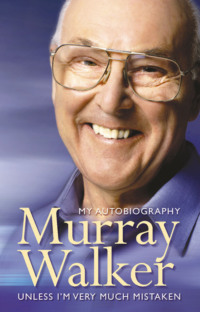
Kitabı oku: «Murray Walker: Unless I’m Very Much Mistaken»

MY AUTOBIOGRAPHY
Murray Walker
UNLESS I’M VERY MUCH MISTAKEN

Contents
Cover
Title Page
Introduction
1 A Proud Brummie
2 Tanks it is Then
3 A is for Advertising
4 Starting at Masius
5 Goodbye Mars, Hello Wheels
6 My Second Life
7 The Rough Stuff
8 Hell on Wheels
9 You Name It, I Did It
10 A View from the Commentary Box
11 My Wonderful World of Formula 1
12 This is My Life
13 Every One a Winner
14 I Am Very Much Mistaken
15 Out With a Bang
16 A Full-Time Passion
Plates
Career Appendix
Index
Photographic credits
About the Author
Copyright
About the Publisher
Introduction
Like everyone, I left my mother’s womb without a very clear idea of what I wanted to do with my life yet here I am, nearly 80 years on, starting to write about it. Why? Who cares?
Years ago I gave myself the answer when I was gossiping at a motor-racing gathering with some great characters that included Rob Walker, friend, mentor and sponsor of the great Stirling Moss. Rob, one of nature’s gentlemen, was a member of the Johnnie Walker whisky family and didn’t exactly have to worry where his next pay cheque was coming from. I asked him when he was going to write his life story. He seemed amazed. ‘Oh, I couldn’t do that, Murray. It’s one thing reminiscing with a bunch of chaps like this but I’d just dry up if I tried to put it all on paper.’
‘Rob,’ I said, ‘if you don’t do it and go to your grave with everything you’ve said and done still in your head, you’ll be committing a crime against motor racing. You must do it.’
So I believe I have memories and stories to tell that might interest and entertain those many people who haven’t had the good fortune to be where I have been. But how Rob felt is how I feel right now, staring glumly at my laptop. So much done and so much to say, but where to start and how to go about it? All sorts of things motivate me to try though, one of which is gratitude. I’ve been both lucky and privileged, having had a fabulous life full of richness, variety and satisfaction, with hardly any setbacks. From as far back as I can remember I’ve enjoyed almost every second of it, basically because I like people and there are usually plenty of them around whose company and friendship I can share.
Normally I’m not much of a chap for looking back; to me the present and future matter more than the past. Life is about making things happen – planning, organizing and getting it done – and I like it most when anticipation turns to realization. But I must be getting old (well I am old, though I certainly don’t feel it) because I now want to remind myself about who I’ve known, where I’ve been, what I’ve seen and what I’ve achieved. So I’m writing this book primarily for my own satisfaction, not for the money!
Many years ago in my youth I spent a long time trying to persuade a particular girl whom I was very fond of to marry me, but she finally refused because she said I was too interested in security. We went our different ways, but to this day I have an unashamed horror of being insecure – having a mortgage I can’t keep up with, not being able to pay the bills, wondering what would happen if I wasn’t earning, or whether the pension would be enough. I’ve a theory that there are two sorts of people in life: those who work for someone else for a salary and, hopefully, the greater security that goes with it, and others who work for themselves, take risks and can potentially do better, though not necessarily. Well, I’m one of the former. I can think of few really big ‘risk’ decisions I’ve made in terms of my career development, and luckily for me those I’ve had to make all paid off. I’ve largely reacted to situations rather than initiated them, but things seem to have worked out pretty well. I’d love to be a bright spark who ducks and dives and comes out ahead – someone like Bernie Ecclestone, whom I greatly admire – but I’d hate to be the one who ducks and dives and falls flat on his face. Better to be at ease with yourself than try to be something you are not.
‘He’s obsessed. If it hasn’t got an engine he’s not interested,’ says my long-suffering wife, Elizabeth. This is not entirely true, but I confess that the groaning bookshelves in my study do not include the works of Shakespeare, selections from Chaucer or too many volumes of poetry. Talking of Elizabeth, incidentally, you are not going to hear too much about her in this book. It’s not that I do not love her dearly or respect and admire her, because I do all of those things by the bucketful, it’s just that Elizabeth’s attitude is ‘He’s public, I’m private’. We met at a London party when I was 34 and although it took me far too long to get around to the subject of marriage I really was smitten at first sight. She is a tower of strength and has an infinitely better brain than me, but whereas I love the limelight and positively revel in it, her idea of purgatory is to have her photograph taken or to appear in public. She wouldn’t welcome me banging on about her qualities here either, so I’m not going to do so. It’s a marriage of opposites I suppose, but just like it says in the old song: ‘We’ve been together now for 40 years [and more] and it don’t seem a day too much. There ain’t a lady living in the land as I’d swap for me dear old Dutch.’ I wouldn’t have been able to do what I have done without her and she’s the one for me.
I have to confess that I’m a workaholic. I’m absolutely useless at relaxing. I get irritated, bored and restless. For about 20 years Elizabeth and I didn’t have a normal holiday because I spent all the time either at my job or doing broadcasts. I really enjoyed both my work and what was then my hobby – commentating. Saving for security mattered more to both of us than spending now and maybe suffering later, but neither of us regrets it for we certainly haven’t been deprived. It’s different now, because we go on cruises to magnificent places and, in my last commentary year, we had a fabulous trip to Australia, Thailand and Malaysia with, hopefully, more to come.
‘For God’s sake, don’t ever retire,’ Elizabeth used to say. ‘What on earth are you going to do with yourself?’ Throughout my life I’ve had to be doing something all the time, whether it’s writing, researching my next race, going to it, beavering round while I’m there, talking about it, or travelling home eagerly to await the next one. And that’s still the case now that I’ve retired from full-time commentating. I always reckoned that writing this book was going to take me a good 12 months, after which something else would turn up. It always does.
I’ve managed to go from one thing to the next with little difficulty and have always made the best of my lot rather than dreaming up impossible goals. From my beginnings in Birmingham, with the wonderful influence of my parents (had my Dad not been obsessed with motor cycles I may not have had half the life I have); my childhood, passing through several schools; my time in the army, in both war and peacetime, from which I returned far more of a man than before; and jobs with Dunlop – at the time one of Britain’s greatest companies – and two major advertising agencies with whom I became satisfyingly successful; not to mention all my wonderful experiences in motor sport: through it all I have never been unhappy with the way things have turned out, whatever the change of direction. It’s all been worthwhile, enjoyable and good experience for the rest of my life.
What about the broadcasting though? I thought you were never going to ask. It’s difficult to know where to begin because it has been going on for so long now. In fact, it could be a question of heredity. I often wonder whether I would have been so passionately interested in motor sport had I not been born and brought up with it, whether I would have attempted to race motor cycles had my father not been so successful, or whether I would ever have picked up a microphone had he not been as brilliant and gifted a speaker, writer and commentator. It’s impossible to tell, but it looks as though I am a chip off the old block and that’s very much all right by me; I cannot think of anyone I’d more aspire to be like than my father. After a long and distinguished racing career – of which more later – he became editor of the failing magazine Motor Cycling. He turned it round by sheer ability, hard work and personality, matched the sales of the previously dominant competitor, Motor Cycle, and also became a much-loved broadcaster.
It must be in the genes: all his siblings were ‘arty’ in some way. My Uncle Eric was Professor of South African history at Cambridge and Cape Town Universities, my Aunt Elsie was a gifted painter and all the rest were good communicators. In 1935 when Dad had given up racing, the BBC asked him to do their radio commentaries (there was no television back then) for the Isle of Man TT, the Ulster Grand Prix and other motor cycle events. He took to it like a duck to water. In sport there are people who compete at the top level and people who can talk about it entertainingly, but there aren’t many who can do both supremely well. In my day James Hunt could and, more recently, Martin Brundle can, but my father was unique. He made you feel as though you were there, with an infectious enthusiasm overlaid by total knowledge of his subject, and he was the BBC’s top man on the sport for 31 years.
Those that can, do; those that can’t, talk about it, so maybe that’s why I ended up where I did. I was reasonably good at trials riding on my 500T Norton – I won a Gold Medal in the 1949 International Six Days Trial at Llandrindod Wells and various other awards – but it was at racing that I wanted to excel. I’ve always believed that if you want to do anything enough you will succeed, so I couldn’t have wanted to race that badly because in 1949 I decided that I was far more likely to get somewhere in business than by trying to set the world’s racetracks alight. I retired at the peak of my inconsiderable form after I’d won a 250cc heat at Brands Hatch. Thereafter I confined my lack of two-wheeled talent to weekend commuting between Dunlop in Birmingham and my home in Enfield, on my Triumph Tiger 100.
At heart I think I’m a bit of a ham, for I’ve always enjoyed public speaking and was therefore delighted when I got my first chance at broadcasting – albeit on a public address system. The Midland Automobile Club asked me if I’d like to do the PA commentary on a combined car and bike meeting at their world-famous Shelsley Walsh hill-climb in Worcestershire. My father had been due to commentate for the BBC but had to drop out at the last moment, and was being replaced by the man who had been booked to do the PA. The Club asked my father, who’d caused the situation, to recommend someone to take his place.
‘Why not try the boy?’ he said. ‘I think he’ll be all right. Even if he isn’t it won’t be a disaster because he’ll only be talking to the spectators and they’ll be able to see what’s going on anyway.’
I suppose it was nepotism, but I wasn’t going to say no. You have to grasp your opportunities where they are offered in this world. And never mind the spectators: as far as I was concerned I was talking to one man at Shelsley – Jim Pestridge, the BBC producer. There was no way he was going to miss me for my voice was blasting out of a battery of loudspeakers right by his side. Now, the way you do a PA commentary and the way you do a radio commentary are quite different. With the former there’s no need to talk non-stop as your role is more to give information and announcements than to commentate on the action, which the punters could see for themselves. The hell with that! I thought. For Jim’s ears I submitted the poor devils on the hill to a non-stop barrage of facts, figures, hysteria and opinion. (Not much has changed!) And it worked. The next week Geoffrey Peck, one of the BBC’s senior sport producers, invited me to an audition to commentate at an imminent Goodwood car meeting. And I got the job.
One thing led to another. ‘We’d like you to do the second position, Stowe Corner, at Silverstone at the 1949 British Grand Prix,’ said Geoffrey after my successful Goodwood stint. Yes! I was on my way for what was to be a half-century-plus career doing what I wanted to do, travelling the world, going to wonderful places, working with stimulating people, satisfying my ego and, moreover, being paid for it!
For the next 13 years, in addition to my developing advertising career, I would be my Dad’s number two as the only long-term father-and-son sports commentary team the BBC has ever had. That was entirely to do with motor bikes but, as the years rolled by, I would also cover, for both BBC and ITV, anything to do with motor sport: motor-cycle trials, scrambles and races of every type and class, truck racing, power boats, touring car racing, sports cars, rallycross, Formula Ford, Formula 3, Formula 3000, Formula 5000 and, of course, the pinnacle of them all, Formula 1.
It was here that I developed a reputation of being an enormously excitable chap who used colourful phrases but didn’t always get things right in his enthusiasm to communicate what he was seeing. Inevitably people remember my amusing ‘mistakes’ more than the factual comment, but importantly they found them endearing – and that didn’t do me any harm! Not so for others though, given my entirely justified reputation for the ‘Murray Walker Kiss of Death’. I would confidently predict something was going to happen and, dramatically, it wouldn’t. At the 1986 Australian Grand Prix Keke Rosberg came up to me and asked if he could have a word – a highly unusual move for an F1 driver.
‘This is my last race, Murray. I’m retiring after it.’
‘I know that, Keke, I’ve been talking about it for ages.’
‘Well, this being my last race I’m particularly anxious to do well in it.’
‘Of course you are, good luck to you my friend.’
‘Murray, if I am doing well, for Christ’s sake don’t say anything about it!’
He was leading the race, I said he was going to win his last event, and he got a puncture and retired.
Similarly, in 1993 the BBC did some technical fiddling that allowed me to talk to Damon Hill while he was actually qualifying on the track. I wasn’t going to risk breaking his concentration while he was working but right at the end of the session he took pole position and on his run-down lap I shouted out, ‘FANTASTIC Damon! POLE POSITION! Well done! You must be delighted!’
‘Thanks, Murray,’ came Damon’s reply, which was going out to the BBC’s vast worldwide audience, but as he went on to say how happy he was and how much he was looking forward to starting from the front in the race, I was horrified to see the word PROST appear above HILL on my timing monitor. In my excitement I had failed to spot that Alain had passed the start just before the flag went out and could therefore still do a hot lap that would count. To my acute embarrassment The Professor beat Damon’s time by a tenth of a second and snatched pole position from his team-mate.
‘Damon,’ I said. ‘That was the good news. The bad news is that you are now starting second. Alain’s just beaten you.’
I conveniently cannot remember what Damon said in the car but he came up to me afterwards and said, ‘Murray, do something for me will you?’
‘Anything, Damon. What is it?’
‘In future just keep your mouth shut, will you?!’
Another Williams success, Portugal 1990, was even more embarrassing. After a brilliant victory ahead of Senna and Prost, Nigel Mansell made his way to the interview room standing in the back of an open car, waving to the crowd, and hit his forehead on a steel beam. He staggered in and sat down as the cameras started rolling. ‘Nigel,’ I said. ‘First of all, will you carefully and slowly take your cap off. You’ve got an enormous bump on your head. Can you let them see it? Right up there’ … and stuck my outstretched finger right into the middle of it. It’s a clip that’s been shown dozens of times and it never fails to raise a laugh. I hope my life story is even half as entertaining … and rather less painful.
CHAPTER ONE A Proud Brummie
People think of me primarily as a commentator and yes, to my continual amazement, I’ve been one for well over half a century. But for the first 59 years of my life it was very much a second string to my ‘proper job’ in advertising and to be honest I sort of blundered into it, partly out of desire and partly because of circumstances at the time. Did heredity play a part or was it just the environment in which I was brought up? It’s impossible to tell. But of one thing I’m sure. A lot of my characteristics come from my mother and maybe even more from my father.
My mother was the daughter of Harry Spratt, a well-to-do draper and gents outfitter (as they used to call them in the 1920s) who owned businesses in the market town of Leighton Buzzard, Bedfordshire. She had a pretty idyllic upbringing amidst a loving atmosphere in a fine home with servants, horses and stables, and she seems to have wanted for nothing. She was an extremely attractive woman, both physically and personally, had a very strong personality, was very much the belle of the local ball, very feminine and great fun. But she was also extremely bright, pragmatic and good with money, being a very nifty operator on the Stock Exchange. She created a wonderful home for me to grow up in, I loved her dearly and suspect that her influence resulted in me marrying as late as I did.
Into her life in the 1920s came Sergeant Graham William Walker, despatch rider, Royal Engineers, then convalescing at Leighton Buzzard after having been injured in France in World War One by a German shell. The son of William Walker of Aberdeen, Company Secretary of the Union Castle shipping line, and his wife Jessie, this young, attractive man (most attractive, even in hospital blues, according to my mother) was potty about motor bikes. He was also personable, had a highly developed sense of humour and couldn’t have done a dirty trick if he’d thought about it, so it’s not surprising my mother fell for him. His father, Grandpa Walker, I remember as a kind, gentle man with a fine white beard. His wife, who produced four sons and two daughters, was a dominant woman who ruled her family with a rod of iron and adored my father, her youngest son, probably because he was the only one who stood up to her. Sadly she seemed a rather unhappy woman, and after her husband’s death she spent most of her time wintering in Madeira and restlessly buying, moving into and then selling numerous expensive houses.
When my father set about wooing Elsie Spratt it wasn’t long before they were wed. And, the way these things happen, their marriage was followed by the arrival of 9lb 12oz Graeme Murray Walker on 10 October 1923. I was born at home at 214 Reddings Lane, Hall Green, Birmingham, for at that time my father was working there – so, like Nigel Mansell, I’m a Brummie and proud of it. I nearly killed my poor mother: at one point during her immensely long labour the doctor told my father, ‘They can’t both make it. One of them’s got to go. It’s the mother or the child. You’ve got to decide.’
‘No question,’ said Father, ‘it’s the child.’
Fortunately both of us survived, but my parents never tried for another. ‘I lost the blueprint,’ said my father. He subsequently told me that, while he certainly didn’t mind being a father, it had never been one of his great aims in life. My mother had always made the running and was keen to have another, but the fear of losing her had well and truly put him off.
I worshipped my father for he was a wonderful man. I called him ‘Daddy’ to his dying day, when I was in my thirties, but I frankly feel a bit of a twit doing so now. He was kind, generous, as honest as the day is long, a brilliant communicator and an immensely hard worker. Not a demonstrative man but a pillar of support if ever one was needed and never deviating in his loyalty to his beloved wife and son. But he was a terrible worrier. My mother used to say, ‘Tim worries if he hasn’t got something to worry about because if he hasn’t there must be something wrong.’ (‘Tim’ was her nickname for him – don’t ask me why.)
His passion was motor bikes. He joined the Royal Engineers as a despatch rider in World War One because of it and they dominated his life. But motor cycles were looked on very differently in those days. Incomes were vastly lower and so was the general standard of living: no central heating, no washing machines, no fridges, no fitted carpets; homes with telephones were highly unusual and television didn’t even exist. Cars were rare and for the wealthy. There were no interesting and exotic foreign foods, no wine-drinking and no credit cards. You were somebody if you had a motor bike and very much somebody if you had a motor bike and sidecar. So, as my Dad made an increasingly successful living through racing them and tuning them for others, I grew up in a very comfortable atmosphere dominated by motor bikes.
It was certainly an unusual childhood. Where the fathers of other children went to work in the morning, came home in the evening and were home at the weekends, mine was forever disappearing to race on the Continent, soon to reappear with some massive trophy, for he was very much one of the top men of his day. That being so you’d think I would either like or loathe what he did, but in truth I was pretty much unimpressed by it. When I think back on it I’m quite ashamed by my apathetic attitude, because he was a great man who achieved an enormous amount in what was far too short a life. He wore himself out editing a motor-cycle magazine and recruiting despatch riders for the army in World War Two, smoked too much and died in 1962 at only 66 years of age.
Conversely, my mother lived until she was a spirited 101. She had a home in the New Forest fairly near us and not long before she died I went to see her on one of my regular visits.
‘Hello, dear,’ she said, looking disapproving. ‘It’s time you had your hair cut.’
‘But I’ve hardly got any left, Mother.’
‘Well, what you have got is too long!’
So what did I do? I had it cut.
I’d give my eye teeth to have been with my father at an age of understanding and appreciation when he was racing but as a young and developing child I just didn’t realize how lucky I was. To the extent that I thought about it at all, racing motor cycles was what he did for a living. Whereas some boys’ fathers were plumbers and others were solicitors or doctors, mine raced motor cycles. But I thought it was great when, as a result of it, I went to places like Holland, Spain, Germany and France to be with him at one of the Grands Prix. None of my friends did that. All this was at a time when ‘The Continent’ was somewhere that very few people in Britain had ever been. France and Germany were more foreign then than Russia is now. People had neither the time nor the money to travel far from home. Very few had been out of the UK, hardly anyone ‘abroad’ spoke English and communications were comparatively archaic. There’s no doubt that travel broadens the mind and it surely broadened mine.
When I was born my father was a works rider for the fabled Norton motor-cycle company with its legendary Bracebridge Street address which, in truth, was anything but inspiring, being a typically drab 1920s Birmingham factory site. But because of its riders’ achievements, its image among racing enthusiasts was all-powerful. It was the start of my father’s career and his day was yet to come, but he won countless awards for Norton, including second place to the great Freddie Dixon, about whom volumes could be written, in the 1923 Isle of Man Sidecar TT. In its day the TT was more important than all the rest of the world’s races put together so this was quite a feat. In my study I have the actual piston from his side-valve engine. It makes me feel quite spooky when I look at it.
In 1925 the Walker family moved to Wolverhampton, for my father had been made an offer he couldn’t refuse – to become Competitions Manager for Sunbeam, ‘the Rolls-Royce of motor cycles’ as the company modestly described itself. More success led to another move in 1928, this time to Coventry and Rudge-Whitworth, which has long since disappeared but was then one of the world’s truly great motor-cycle manufacturers – at a time when motor bikes were a highly desirable everyday means of personal transport for normal people, as opposed to a sporting device for enthusiasts. And that was where my father really came good. Rudge, Norton and the rest of Britain’s motor-cycle manufacturers who dominated the world were in a head-to-head battle for sales. The promotional benefits, both at home and overseas, that came from sporting supremacy were immense, so racing success was vital. At Rudge-Whitworth my father was Sales and Competition Director and he got down to it with a will.
In 1928 he came within an ace of winning what was then by far the most important race in the world, the Senior TT, retiring in the lead with only 14 of the 268 miles to go after a titanic scrap with the great Charlie Dodson. Just two months later he got his revenge by becoming the first man to win a motor cycle Grand Prix at an average speed of over 80mph. It was the Ulster Grand Prix and this time he beat Charlie, after an even more epic duel, by 11 seconds in a race where they were wheel-to-wheel for over two and a half hours. And this on the bumpy, gruelling Clady Circuit riding a bike with no rear suspension, almost solid girder forks, hand-operated gear change and skimpy, narrow, bone-hard tyres. No disrespect to the modern superstars but they made them tough in those days.
With the sales office in London and the factory in Coventry my father had constantly to commute from one to the other by way of the A5 in his mighty 4.5 litre Lagonda, with its mammoth Lucas P 100 headlamps which used to impress young Murray so much. It was a stunning motor car. So he said to my mother, ‘We can live in the Midlands or in the northern part of London. I don’t mind, so it’s your choice.’ Well, that was no contest for my mother who, as a Bedfordshire-born country girl, detested the industrial Midlands where her son had been born and in which he subsequently lived, worked and thoroughly enjoyed himself.
Off we went then to Enfield in Middlesex, which is where I spent most of my time from the age of five until I married at the ripe old age of 36.
Father raced on for Rudge on bikes whose constant development by the brilliant chief designer George Hack had made them the class of the field. He rode to victory in the Isle of Man in 1931, and received an impressive 15 silver TT Trophy Replicas, which I still proudly have. In 1931, Hack masterminded a new 350cc which had never even turned a wheel until it got to the Isle of Man, but the three works entries finished first, second and third with all three team members, my father, Ernie Nott and Tyrrell Smith, breaking the race and lap records. Mighty days! And that’s not to mention umpteen Continental Grand Prix wins. Had there been World Championships in those days, my father would undoubtedly have won at least one of them.
In the meantime I grew up. If my mother had an idyllic youth then I most certainly did. A governess at home started my early education, which was followed by a couple of prep schools in the country before I went to my father’s old public school at Highgate to be taught by several of the masters who had taught my Dad. One of them was the Reverend K R G Hunt, whose claim to fame was that he had played soccer for England as an amateur. On one occasion he got me out in front of the class to beat me (as they did in those days) for something trivial like putting sticky seccotine on the board rubber.
‘I’m going to give you three strokes, Walker, but before I administer justice have you got anything to say in mitigation?’
‘Yes, Sir! I thought you’d be interested to know that I will be the second generation of Walkers you have beaten because you beat my father.’
‘Oh did I? Well, I’m now going to give you six for that!’
Which taught me not to be cocky and to keep my mouth shut in difficult circumstances.
I really enjoyed school. I was no great scholar, but a steady grafter; I got School Certificate with Credits (the equivalent of A-levels today) including, believe it or not, a Distinction in Divinity. I needed an extra subject to compensate for my incompetence at Maths and taught myself by learning almost by heart the Acts of the Apostles and the Gospel according to St Matthew.
Within two years of my arrival at Highgate I’d learnt to play the bugle in the School Corps, become a Prefect, mastered the intricacies of the intriguing wall game Fives, proudly won my First Class shot (0.303 Short Model Lee-Enfield World War One rifles with a kick like a mule) and demonstrated a staggering lack of ability at soccer and cricket due to an abysmal lack of hand and eye co-ordination. Then came the ‘Phoney War’ and with it evacuation to Westward Ho! in glorious North Devon, as the School’s governors were convinced that there was going to be a war and that London would be heavily bombed. They were right on both counts but a year early, so we soon returned. In 1939 we were back in Devon again, this time for the duration, and I was there until 1941.
What a life it was! My school house was at the end of a superb beach with the Atlantic breakers crashing ashore just beneath my dormitory window. Hardly affected by the rationing to which the rest of Britain was subjected, it was shorts and shirts the whole year round, weekend cycle rides to Clovelly and Appledore, excitedly staring up at the Avro Ansons of Coastal Command as they lumbered across the blue skies in search of U-boats, swimming in the sea, sunbathing on the Pebble Ridge and the joy of achieving things that mattered to me as I developed. I rose to the giddy height of Company Sergeant Major of the School Corps, pompously marching about shouting commands in my World War One khaki uniform, complete with knee-length breeches, puttees, peak cap, scarlet sash and a giant banana-yellow drill stick with a silver knob on the top. I became Captain of Shooting with the honour of an annual competition at Bisley and even, arrogance of arrogance, an instructor to members of the LDV (Local Defence Volunteers: the predecessor of the Home Guard, or ‘Dad’s Army’), many of whom had fought in World War One, teaching them how to use a Lewis machine gun. And I loved it.
But then, at 18, and with school behind me, it was time to go to war myself. As Britain unflinchingly suffered the devastating ravages of Hitler’s Messerschmitt, Dornier and Junkers bombers, while his seemingly invincible armies raced across Russia, it was also slowly starting to ready itself for the invasion of Europe. My country needed me. Youth does not heed the horrors of war and I was eager to go – but in one particular direction. Conscription was very much in force and if you waited to be called you went where they sent you. However, if you volunteered and were accepted you went where you wanted to. I had stars in my eyes and knowing that inadequate eyesight prevented me from going for every schoolboy’s dream – fighter pilot – I volunteered for tanks. I was accepted all right but, believe it or not, they said, ‘Sorry Murray, you’ve got to wait. Not enough of the right sort of kit for you to train on. So off you go. Fill in the time and we’ll let you know when we’re ready.’
What a frustrating setback. It is difficult to convey to today’s generation, who are lucky not to have experienced it, how totally involved, intense and patriotically passionate everyone in Britain was about the war. Germany, and everything to do with it, was then regarded as the personification of evil. It is easy now, divorced from the bitter loathing and hatred that war inevitably generates, to accept that the vast majority of its people were (and are) the same as us but there was naturally little appreciation and no tolerance then of the fact that the ordinary Germans had been taken over by an obsessive megalomaniac and the fanatical political machine he had created. Hitler and his minions were doing unspeakably terrible things in the name of the Third Reich and were aiming for world domination. With the enemy literally at the door, Britain had its back to the wall and was fighting for its very survival. There was a gigantic amount to be done and I desperately wanted to be a part of it. I still had a bit of a wait ahead of me though.
‘Fill in the time,’ they had said. But how? It clearly wasn’t going to be long before I was in battledress but, as I have so often been, I was lucky.
At that time the Dunlop Rubber Company, then one of Britain’s greatest companies, awarded 12 scholarships a year to what they regarded as worthy recipients and I was fortunate to win one of them. Sadly, Dunlop now exists only as a brand name, having been fragmented and taken over by other companies including the Japanese Sumitomo organization whose country it did so much to defeat in the war. But back then Dunlop, with its proud boast ‘As British as the Flag’, was a force in the world of industry with many thousands of employees all over the world. It owned vast rubber plantations and produced, distributed and sold tyres, footwear, clothing, sports goods, cotton and industrial products and Dunlopillo latex foam cushioning.
Its scholarship students were based at its famous Fort Dunlop headquarters (part of which still exists beside the M6 in Birmingham) and had tuition and fieldwork on all of its activities as well as instruction from top people on every aspect of what makes a business tick, from production and distribution to marketing, law and accountancy. It was an invaluable grounding. I had a whale of a time, living in digs at 58 Holly Lane, Erdington with the Bellamy family, spreading my wings and discovering, amongst other things and to my surprise and delight, that girls had all sorts of charms I hadn’t experienced at Highgate.
But then came the call via a telegram. ‘We’re ready for you now, Murray. Report to the 30th Primary Training Wing at Bovington, Dorset on 1 October 1942’. I went there as a boy and rather more than four years later was demobbed at Hull as a man.
CHAPTER TWO Tanks It Is Then
In August 1939, at the age of 15, I was having the holiday of a lifetime in Austria, accompanying my parents to what was then the most prestigious event in the world of motor-cycle sport – the International Six Days Trial. Sadly, like the Mille Miglia and the Targa Florio, it has long since been discontinued because of road congestion, but then it was exactly what its name implies: a gruelling, and virtually non-stop, road time trial for modified road bikes with tremendously demanding speed stages. Britain excelled in the event and in 1939, following three successive British victories, it was to be held in Austria. Following its annexation by Germany, Austria was totally under the control of the Nazis, who offered to give Britain an organizational rest and to base the event at glorious Salzburg.
It was a superb location amid the glorious Alpine scenery and my father, who knew the event thoroughly as ex-captain of a winning International Trophy team, had been invited by the War Office to give expert guidance to the British Army teams. The political situation was extremely tense with the threat of war between Britain and Germany, and while we were in Salzburg the Foreign Ambassadors of Russia and Germany, Molotov and Count von Ribbentrop, signed the Russo-German non-aggression pact. Hitler was aggressively rattling his sabre at Poland and the inevitability of war was gloomily forecast. In those days international communications were not as they are now, so the War Office said that in the event of, and only in the event of, an extreme emergency they would send a telegram detailing action and instructions.
Unusually for anything German, the Trial suspiciously showed every sign of having been hurriedly thrown together, almost as though they hadn’t really expected to be holding it. ‘There will be no problem,’ said Korpsführer Huhnlein, the Nazi boss of all German motor sport, ‘as there will not be a war now that we have signed the pact with Russia.’ On day five though, with all the British teams in very strong positions, a telegram that had been delayed for 24 hours arrived from the War Office, reading: ‘War imminent. Return immediately.’
Panic stations! While maps were urgently consulted to find the quickest route to the border, my father went to see Huhnlein.
‘We’re off,’ he said.
‘Why on earth are you doing that?’
‘Because the British War Office has instructed us to go.’
‘But there isn’t going to be a war and even if there is I give you my personal guarantee that you will all be provided with safe conduct out of Germany.’
‘Just one question,’ said my father, ‘What is your level of seniority in the Government?’
‘I am ranked number 23,’ said Huhnlein.
‘Well what happens if any of numbers one to 22 reverse your promise?’
‘That wouldn’t happen.’
‘Sorry, but we cannot take the risk. We go.’
For me the trip had been wonderful: the long car ride from England to Salzburg in my father’s Rover, exploring beautiful, Mozart-dominated Salzburg with my mother, watching the riders race by, the charm of the sun-soaked Alpine scenery, and the quaint Austrian hotels. The dash home through France was full of drama too but shortly after we returned to Enfield Prime Minister Neville Chamberlain announced that Britain was at war with Germany for the second time in 30 years. Not so very much later I would be heavily involved in it myself. But first, back to school and glorious Devon, my scholarship at Dunlop, and, as my time approached, the decision about how I could best get into the war.
If you haven’t actually been in one, no matter how much you’ve read about it, you just don’t realize how horrific war is, how brutal, bestial and mindless. My image of tank driving included racing across the desert trailing great plumes of sand, having leave in exotic Cairo and being in my element with something mechanical. It was an ignorant and absolutely pathetic attitude but I was fresh off the farm, full of patriotic fervour, desperately wanting to do something about the evil which then looked likely to overcome the world. So once I got the call on 1 October 1942 I took the train from Waterloo to Wool in Dorset and reported for duty as number 14406224 at the 30th Primary Training Wing (PTW) at Bovington.
Bovington was and is the home of the Royal Armoured Corps and the whole area seethed with tank activity. There were gunnery ranges at Lulworth, the workshops, the wireless schools, the maintenance areas and driving ranges, not to mention the NAAFI – Navy, Army, Air Force Institute – Bovington’s centre of social activity and culinary excellence. (‘A char and a wad please, dear.’) It was a popular belief that they put bromide into the buckets of tea to suppress the libido of the licentious soldiery. If they did it was just as well, for the fraternization between the ATS girls and the lads was frequent and vigorous enough as it was.
My ignorance of life outside my loving family and school friends was compounded by my youth and inexperience so the 30th PTW was an exciting new experience and a huge culture shock for me. As a wet-behind-the-ears army private, I found myself amongst all sorts of people that I’d never come across before. In the bed on one side of me in the barracks room was an incredibly upmarket chap, whose name I have genuinely forgotten and whose general uselessness was well nigh unbelievable. On the other side was a laconically lovely bloke called Ted Nicklin who, if I remember correctly, was a welder from Walsall and as streetwise as they come. I am convinced that living as part of such a disparate mix did me all the good in the world, because it taught me there were other points of view, other ways to speak and more ways than one to skin a cat.
The 30th PTW was all about the beginnings of discipline – what armies win or lose by. ‘Do what you’re told. Don’t question it. Do it!’ was the unbreakable rule at the 30th and rightly so. Soldiers in combat must instinctively obey, not argue whether their orders are right. So seemingly endless drill parades, standing rigidly to attention when addressed by anything senior to the regimental goat, kit cleaning, sentry duty, assault courses and physical training were the order of the day, every day. If you were lucky enough to have leave, you had to report to the Orderly Sergeant for inspection before you were allowed to depart the barracks. He would closely inspect the backs of the tiny brass buttons in the rear vent of your greatcoat and the bit between the heel and the sole of each of your boots to make sure they were highly polished. Daft? No, it was discipline. But by far the worst thing as far as I was concerned was sentry duty.
It was winter and very cold and the system was two hours on and four hours off – dressed in full order. Battledress trousers and tunic, webbing belt and gaiters, boots, greatcoat, a gas mask satchel strapped to the chest, rifle and ammunition pouches and, literally, to top it all, a steel helmet. Clumsily clumping off to the sentry position in that lot was bad enough, but then standing in one spot for two hours of freezing night-time monotony was purgatory. But worse was yet to come. When you thankfully returned to the barracks room for an enamel mug of tea and four hours off, you had to sleep on the floor, or try to, without removing any of your kit – including your steel helmet – only to be woken for the Orderly Officer’s inspection just as you’d dropped off.
Eventually, as a result of all this marching, cleaning, running, jumping, parading, sentry-going, weapons inspecting, church parading and general hammering into shape I was ready to move onwards and upwards to Stanley Barracks. Not now as a humble Army Private but as a very proud Trooper to the 58th Training Regiment of the Royal Armoured Corps. Still at Bovington – but the first hurdle had been cleared.
Psychologically the 58th Training Regiment was on another planet because now I felt as though I was really on my way to the commissioned rank to which I had always aspired. My army ambition was geared to it and I would have been gutted and ashamed if I hadn’t made it. Life was at a higher level and altogether more specialized, in that it was more mechanically and ‘tank’ oriented with six months of driving, gunnery, wireless and crew commanding instruction.
Learning to drive was great. I was already proficient on a motor cycle, thanks to the 1928 250cc Ariel Colt my father had given me, but driving on four wheels was something new. We had to learn in a Ford 15cwt truck, which had a V8 engine and whose clutch was either in or out; nothing in between and a bit like a Vincent-HRD 1000cc motor cycle. Get it right and you went: get it wrong and you stalled. By the way, I’ve never taken a driving test in my life, because when I came out of the Army in 1947 you didn’t have to – all you needed was a certificate of proficiency from your Regimental Technical Adjutant. As I was the Technical Adjutant I didn’t find that too difficult!
So in the 58th it was not just more assault courses, physical training, marching, drill, belt and gaiter blancoing and ghastly sentry-going, although there was still plenty of all of those, but also getting to grips with the rudiments of being a ‘tank man’ – gunnery and maintenance, tactics and wireless, weapons handling, and enemy tank recognition. I’ll never forget the first time I drove a tank. It was a 20-ton Crusader and I can still feel the thrill as I hunkered down into the driver’s compartment, with its 340bhp 12-cylinder Liberty engine thundering away behind me. Rev it like mad, clutch up and – GO! With the crash gearbox in top it could do 40mph in the right conditions and, believe me, that felt more like 400mph. In the Crusader you steered by pulling two metal bars like pencils that braked the appropriate track and made the tank turn one way or the other. You felt invincible as the whole thing noisily bucked and plunged, ripped and roared its way ahead. Magic! I’ve always been grateful for the fact that I was one of the lucky ones: my tank was never hit by an armour-piercing shell from the Wehrmacht’s awesome 88mm anti-tank gun, my turret never penetrated by the blast from a terrifying Panzerfaust and I was never hit by mortar fire.
I loved it all at the 58th except two things: Morse code and Corporal Coleman. Morse code was my bête noire. I could never get my head round having to tap out electrical sound messages, machine-gun-like, in the form of dots and dashes with a key that moved only a fraction of an inch. But I beavered away at it and became just about good enough to get by. Corporal Coleman was something else though. At the 58th you may have been potential officer material but you certainly weren’t yet an officer cadet – or likely to be unless you played your cards right. Officers were gods and Non-Commissioned Officers (NCOs) were all-powerful. A bad report from an NCO could ruin your chances and they all knew it.
Well into my time with the 58th I got a simple cold which I ignored. With all the assault courses, getting sweaty, swimming icy rivers in battle order and other physically demanding things, it rapidly got worse. Like everyone, the last thing I wanted to do was to report sick, because if you had to go to hospital you were automatically retarded. So I didn’t … until ultimately I could hardly stand up and simply had to. Sick parade meant you had to assemble your kit for inspection by the Orderly Corporal – in a specific way to a very specific pattern. Highly polished boots with their soles upward. Highly polished mess tins alongside them. All your clothing folded and arranged a specific way, millimetrically precise and faultlessly creased. Blankets folded and gas mask, webbing equipment and cutlery all present and correct and spotlessly clean. Then you stood, alone and ramrod-erect, to attention at the end of your bed whilst the Orderly Corporal gave it his minutest attention.
Enter Corporal Coleman. Not, in my admittedly biased opinion, one of nature’s charmers at the best of times. Unsurprisingly my kit hadn’t been laid out as army-approved as it might have been and it didn’t go down well with Corporal C, who swept the whole lot on to the floor, kicked it round the barracks room and shouted, ‘Now do it all again – and properly!’ Or rather less refined words to the same effect.
Remember what I was saying about army discipline? There was no point in protesting and anyway I was in no state to, so I did as he said. And, having made his point, it was to his satisfaction this time. Then I dragged myself off to see the MO, who said, ‘You’ve got pneumonia. You’re going to hospital.’
I’m not a chap who holds grudges but for many years I dreamt of meeting Corporal Coleman again in circumstances where I held the upper hand. But I never did and in spite of my long hospitalization I returned to the 58th, completed my training successfully enough to be selected for my War Office Selection Board (WOSB) and appeared before it. I made the grade and, to my unbounded pride and joy, was told to report as an Officer Cadet to number 512 Troop Pre-OCTU (Officer Cadet Training Unit), Blackdown. Yes! Yes! Yes!
It was at Blackdown that Sergeant Major Hayter of the Coldstream Guards and I had a parade-ground encounter that taught me a lesson. Never was a man better named. Picture the 18-man 512 troop, now sophisticated and hardened veterans of drill parades, expertly marching and halting as one, symmetrically wheeling, turning and rifle-bashing their way around the vast black tarmac acreage of Blackdown’s drill square, fearlessly and faultlessly responding to the stentorian commands of Sergeant Major Hayter.
‘By the left, quick march! Left, right, left, right, left, right, left.’
‘Squad ’alt!’
‘Quick march! Left, right, left, right, left, right, left. Aybout turn! Left, right, left, right, aybout turn! Left, right, left, right, LEFT TURN! Left, right, left, right, LEFT TURN! Left, right, left, right, RIGHT TURN!’
And who turned left? I did.
‘SQUAD ’ALT!’
‘Officer Cadet Walker come ’ere, SIR!’
(All Officer Cadets had to be addressed by NCOs as ‘Sir’, which was usually done with great emphasis and heavy irony.)
‘We got it all wrong didn’t we, SIR?’
‘Yes, Sergeant Major.’
‘Shall we show them how to do it properly then, SIR – just you and me?’
‘Yes, Sergeant Major.’
‘Right then. Officer Cadet Walker only. Quick March!!’
I think you’ve got the drift now and he had me sweating round the square performing obscure drill manoeuvres by myself for a solid 10 minutes. And the lesson it taught me? Listen out, stay sharp and don’t assume that everything is going to be as it used to be.
In spite of that I continued really to enjoy the drill sessions. There is something very satisfying about marching proud, swinging your arms high with your back straight and your head up, knowing that, as a unit, you look terrific. We were getting to be soldiers now!
Blackdown held no terrors like Corporal Coleman. I reached the required standard without interruption and, in October 1943, it was goodbye to 512 Troop at Pre-OCTU and hello to 115 Troop RAC OCTU at the Royal Military Academy at Sandhurst, the most famous and historic in the world. Sandhurst, as it is known, has been the elite training centre for regular officers of the British Army since the early 1800s and, compared to Bovington and Blackdown, was relatively luxurious. When World War Two broke out it became the Officer Cadet Training Unit for Royal Armoured Corps (RAC) personnel only. We were quartered in the historic buildings and followed the long-established Sandhurst traditions and practices that had made the British Army so dominant and powerful over the centuries. I was immensely proud to be associated with and shaped by them and to be trained in such impressive surroundings.
Some 23 of us started in 115 Troop and six months later 18 of us reached the giddy heights of Second Lieutenant. Sandhurst was enormously enjoyable but it was also tough, because of the ever-present fear of failing what was a pretty demanding mental and physical regime. The whole thing was even more intense than Blackdown with major emphasis on determination, initiative and leadership. The Sandhurst assault courses had some fiendish elements. One of them required you to climb up a 40ft hill in full kit, run off the top of it on to a single narrow plank, clear a gap on to another plank, run across that, jump on to a third plank and then rush down the hill. I’ve seen strong men stuck with one foot on each plank and a 40ft drop beneath them, transfixed with fear and panic and unable to move. Being put into a room into which CS gas was pumped, but not being allowed to put on your gas mask until you had inevitably inhaled some of the filthy stuff was not a lot of fun either. Nor was having to negotiate pitch-dark shoulder-width underground tunnels while some joker dropped thunderflashes around you. However I made it, only to experience the supreme test of physical horror – a Welsh battle course.
It started at a Youth Hostel at Capel Curig, in Caernarvonshire, from which we set off to do infantry manoeuvres, sleeping rough and living off the country until we reached Britain’s highest mountain, 3500 ft Mount Snowdon. I was the one carrying the 2in mortar and my abiding memory of the whole week was the Troop Sergeant’s non-stop screaming to ‘double up, the man with the mortar!’ But after days and nights of marching, digging slit trenches, attacking seemingly invulnerable positions, sleeping in pig sties and other fun things, we finally got to the lower slopes of Snowdon.
‘I want 10 volunteers to climb to the top with me,’ said Captain Marsh, our course commander. And, of course, dead keen, I volunteered. It was hard, but we went up a comparatively easy route and had a double bonus at the end. Apparently, it is very unusual to get an uninterrupted view from the top of Snowdon but ours was as clear as a bell and you could see for miles in every direction – magnificent. As soon as we were done we were bussed back to the hostel we had started from – those who hadn’t volunteered, in the belief that they would get to the hot baths and beds before us, were made to march there on a compass bearing that got them back, by way of rivers and very rough country, at four in the morning. My respect and admiration for what was known in World War One as the ‘PBI’ (Poor Bloody Infantry) had increased tenfold and I knew now why it was that I had wanted to serve in tanks – you didn’t have to walk and had a roof over your head.
The camaraderie at Sandhurst was wonderful; the tank driving and commanding and the gunnery fabulous; and the occasional evenings in the pub were great. Even the Church parades were very special because they were held in the RMA Chapel: an immensely dignified and very moving scene of military tradition and magnificence. But of course all good things come to an end. For me that was on 8 April 1944, my passing out day, with all the moving pomp and circumstance at which the Army is so accomplished. My parents and friends were there and the salute was to be taken by that great American General Dwight Eisenhower, Commander in Chief of the Combined Allied Forces which, in just two months’ time, would be landing on the coast of Europe to commence its bloody liberation.
On to that magnificent parade ground in front of the Old College, then, marched the entire Sandhurst contingent in proud formation, with heads held high, arms swinging and boots resounding to the drum beat and stirring military marches of the band that preceded them. I certainly felt emotional – even 57 years on I can still feel the excitement and pride. I was now Second Lieutenant Walker, Royal Armoured Corps, wearing the coveted black beret and ready to go to war from a sealed camp at Manningtree, near Harwich, the gateway to the Continent.
My recollections of Manningtree are dim and my recall of the ship I boarded dimmer, but the trip itself was smooth and straightforward. It took quite a long time: we turned right after Harwich and headed south through the Straits of Dover for the Mulberry Port at Arromanches, a wonderful example of British initiative and enterprise. To bypass the heavily defended French ports of Le Havre and Cherbourg, enormous concrete caissons were prefabricated in Britain and towed out to France on D+1, 7 June, to create a brand new port almost the size of Dover. When we were put ashore the whole area was a hive of khaki-clad activity with tanks, trucks, guns and all the other bric-a-brac of warfare flowing out of ships and on to the shore along the floating roadways. I wasn’t there long because I was rapidly assigned to a tank transporter column that was to make its way to Brussels. And what a journey that was. As the lengthy convoy of enormous American White tractor units with their massive trailers, each carrying a Sherman tank, slowly churned its way through the recently liberated French countryside into Belgium we got an enthusiastic reception from the population, still euphoric after their liberation from ‘les salles Boches’.
I was very lucky to join the Royal Scots Greys, even if I was rather a round peg in a square hole. First raised in 1678, the regiment was one of the foremost in the British Army and had fought with great distinction in Palestine and in General Montgomery’s magnificent Eighth Army from the Western Desert to Tripoli. It had taken part in the invasion of Italy, landed in Normandy, fought its way through France into and out of Belgium and was now at Nederweert in Holland where I joined it.
So, as a young, untried and totally inexperienced new boy I was becoming part of one of the toughest, most case-hardened fighting units of all. When I reported to the tent of the charming Major Sir Anthony Bonham he said to me, ‘Welcome to the Regiment, George, we are glad to have you with us.’
Somewhat embarrassed, I said, ‘The G is for Graeme, actually, Sir, but my friends call me by my second name, which is Murray.’
‘Oh,’ he replied. ‘I thought Murray Walker was a hyphenated, double-barrelled name.’
I had the feeling that he was rather disappointed that it wasn’t, because that’s the sort of regiment it was: very Cavalry, very regular, officered by moneyed County gentry, many with Scottish connections, who had been educated at the very best and most expensive schools and who had known each other and fought together for a long time. I was and still am immensely proud to have been a Greys Officer and to have fought with them but I certainly felt as though I was in a club of which I was not a natural member.
Major Bonham told me, ‘You will be responsible to Sergeant McPherson, Murray.’
Sergeant? What the hell does he think this Second Lieutenant’s pip on my shoulder is – confetti?
‘I know what you’re thinking,’ he said. ‘Fresh out of Sandhurst I expect you think you’re God’s gift to the British Army, but you should know that McPherson has been with us since Palestine. He has forgotten more about fighting and the way the Regiment does it than you’ll ever know and when he says you are capable of commanding a troop you will have one.’
He was, of course, absolutely right. So I watched and listened and before long I got my own troop. A few days later we moved to the island between the Waal and Neder Rijn rivers north of Nijmegen where I had my first experience of sentry-go, Greys style. Up all night standing in the Sherman’s turret, with the Germans on the other side of the river, thinking that every sound you heard was one of them creeping up to blast you to perdition with a Panzerfaust. This was shortly after the airborne forces’ foiled attempt to capture the bridge over the River Maas at Arnhem and to launch the 21st Army Group across the Rhine into Germany. From our positions on the other side of the river we could see parachutes and supply containers for the beleaguered airborne troops hanging from the trees. One night I had to transport ammunition on my tank to troops of the American 101st Airborne Division. It was not a job I relished as, silhouetted against the sky, we slowly felt our way along the dark and narrow road with no turn offs. There was a great deal of heavy and very messy fighting at this time, clearing river banks, woods and other difficult areas and, as ever, the Regiment came out of it with great distinction.
During the actual fighting, we tried to rest whenever and wherever we could – in the vehicles, in barns and even in Dutch homes. On one occasion though, when I was seeking billets for my troop, the door was opened by a completely bald woman whose head had been shaved by revengeful villagers because she had collaborated with the Germans. The time we spent in our winter quarters was really good. I was billeted in a very comfortable Dutch home in Nederweert with the Regimental Quartermaster, Captain Ted Acres, a dry, exact, pedantic and incredibly efficient chap, and Fred Sowerby, a blunt and cheerful Yorkshireman who ran the light aid detachment. It was Fred who refused to help me out of a difficult situation when I forcibly removed the windscreen of my regimental Jeep. I had done so in a moment of madness when driving across an airfield while a B17 bomber was starting to take off. The chap who was with me said he’d bet I couldn’t catch it. I not only did so but clipped the back of its tailplane with the top of my windscreen. ‘You did it, you silly young bugger,’ said Fred, ‘so you can live with the consequences!’
Ücretsiz ön izlemeyi tamamladınız.