Kitabı oku: «You Have To Kiss a Lot of Frogs»
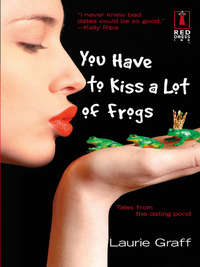
You Have to Kiss a Lot of Frogs
Laurie Graff
 www.mirabooks.co.uk
For my mother,
Lonnie
and for my brother,
Steve
ACKNOWLEDGMENTS
Thank you to…
All the family members, friends, peers and people who have inspired and encouraged me. You know who you are!
Margaret Marbury at Red Dress Ink for picking me out of the slush pile and saying “yes,” and the RDI committee in New York, Toronto and the U.K. for agreeing with her.
My editor, Melissa Jeglinski, who is a joy to work with. Who helped me create a road map for Karrie Kline. Who has great ideas, and great taste in restaurants!
The entire RDI team for their wonderful and creative work on all aspects of this book, and special thanks to Zareen Jaffery for her help.
Robert Youdelman, Danielle Forte and Dianne Jude for their terrific work, and Mark Pedowitz for pointing me in that direction.
Nancy Kelton whose class, Writing from Your Personal Experience, started something. The “Los Angeles Writer’s Bloc” and “The WorkShop Theater Company.”
Lisa Forman and Ruth Kreitzman for pushing me to write.
Jill Cohen for the serendipitous act that led to publishing this book!
Jamie Callan for oh so much, for everything!
Nancy Giles for the delicious brainstorms!
Ellen Byron, Steve Keyes and Matt Graff for support from the beginning.
Stewart Zuckerbrod, Tracy Tofte, Sandy Eisenberg, Pam Clifford and Susan Banerjee for always listening to me read. Phyllis Heller for ideas. Mary Gordon Murray for living through the rewrite process with me, and Marlene Kaplan who’s going in the white limo!
And in memory of David Stenstrom who was the first one to say, “Laurie, you should be writing this down.”
CONTENTS
You Have to Kiss a Lot of Frogs
April Fools’ Day
Hell’s Kitchen, NYC 2003
Wake Me When We Get There
Flashback—Easter Week
Brooklyn, NY 1969
Nottingham Forest
Memorial Day Weekend
The Catskills, Upstate NY 1988
David’s Dad
Rosh Hashana
Central Park West, NYC 1988
Whose Party Is This Anyway?
Daylight Saving Time Ends
Grand Central Station, NYC 1989
A Clue in Time Saves Nine
Tisha B’av
Greenwich Village, NYC 1990
Roman Holiday
My Birthday
Gramercy Park, NYC 1991
My Worst Date…Almost
New Year’s Day
Chelsea, NYC 1992
The Clan of the Cab Bears
Passover
Port Authority, NYC 1992
Wherefore Art Thou?
Valentine’s Day
Upper East Side, NYC 1994
That’s All, Folks
An Hour Later
Ten Blocks North, NYC 1994
Joy to the World
Flashback—Last Christmas
Charlottesville, VA 1993
That’s Really All
Present—Fifteen Minutes Later
Back in the Elevator, NYC 1994
The Truth About Men and Astrology
Flag Day
The Upper West Side, NYC 1994
From the Top
Election Day
The Theater District, NYC 1994
Eating out of His Hand
Veterans’ Day
Soho, NYC 1994
Feast Your Eyes
Twenty Minutes Later
Fifth Avenue, NYC 1994
The Lightbulb at the End of the Tunnel
Three Months After That
Midtown, NYC 1995
Cheesecake Delight
Labor Day
The Great Lawn, NYC 1995
Life in the Fast Lane
First Day of Autumn
Los Angeles, CA 1995
The Lion’s Share
Groundhog Day
West L.A., CA 1996
What’s the Big Deal?
Hanukkah
Studio City, CA 1996
The Call of the Wild
Mother’s Day
Beverly Hills, CA 1997
Weight-Listed
First Day of Summer
Los Feliz, CA 1997
Starry, Starry Night
Last Day of Summer
Hollywood, CA 1997
There’s No Place Like Home 250
Two Weeks Later
Hollywood, CA 1997
We Have So Much in Common 262
The Next Night
Hollywood, CA 1997
You Should Be So Lucky
Presidents’ Day
West Hollywood, CA 1998
A Eulogy for Henry
My Fortieth Birthday
West Palm Beach, FL 1998
The Wedding
Father’s Day
Brentwood, CA 1998
How Personal Do You Want to Get?
Halloween
Columbus Avenue, NYC 1998
Putting Back the Pieces
Thanksgiving
West Palm Beach, FL 1998
In Motion
St. Patrick’s Day
Baltimore, MD 1999
Unscrambled
Liberation Day
NYC Underground 1999
I Can Do That
Martin Luther King Day
My Kitchen, NYC 2000
Modem Operandi
Columbus Day Weekend
Henry Hudson Parkway, NY 2001
Shiksa Syndrome
Counting the Omer
West End Avenue, NYC 2002
In Search of the Regular Ultimate Hold
Fourth of July
East Hampton, NY 2003
The Water in the Walls
New Year’s Eve
Brooklyn Heights, NY 2003
About the Author
Coming Next Month
1
You Have to Kiss a Lot of Frogs
April Fools’ Day
Hell’s Kitchen, NYC 2003
I like being a woman. I also like being friends with other women. I don’t, however, like feeling forced into participating in some ritual with an entire flock of them I’ve never even met. It’s like having to wear those dumb party hats, and blow on those even dumber paper things at midnight with a bunch of strangers on New Year’s Eve. You’re thrown in with people you don’t know and don’t want to be with, but you’re all going to share this intimate event with glee. If it kills you. And that’s how I feel at this bridal shower.
Here I am. Tuesday. 6:00 p.m. Right after work, if you actually have a normal job, and I’m standing in a Mexican restaurant in midtown Manhattan, holding a margarita I’m not drinking because I don’t like the salt. I’m stuck wearing gray wool slacks because I came from an audition for a soup commercial, à la Winter in Vermont, and realized way too late that the bag with my dress was at home on my bed, and not with me. The bright fluorescents highlight the brown roots on my red head, and a silver barrette is holding together a few strands of hair, attempting to disguise a bad bang trim. That time-of-the-month bloat is making my size-four pants feel tight, and my hair feels hot around my neck. I can’t help but compare myself to everyone around me. They seem perfectly coiffed, and groomed, and excited to be here. I’m one of fifty overeager women waiting for Marcy to arrive to surprise her because, finally, after twenty-five years of dating, she’s met some guy she’s going to marry. And everyone’s gabbing how they’re sooooooo happy for her. Frankly, I don’t believe it.
The married ones must be remembering their showers. The too many toaster ovens and Crock-Pots, the friction between the maid of honor and the other best friends, and now the contemplation if the marriage has lived up to the fanfare of the shower.
The single ones are standing with plastic smiles, wondering if the person getting married is really better off than they are. That’s me. I wonder, is Marcy really Happy Now? And is that to say she really never was before? After the years of angst and dates and therapy and plans for when The One arrives, when It happens, what does It feel like? What does it feel like to be with Mr. Right. Mr. It. Does it feel great? Does it? Does it feel better than it did before? Does it feel better than I feel standing in the middle of it? Watching. Comparing. Are other people unconditionally happy for this person or is it just me?
“Sssshh, she’s coming.”
“AAHHHHHH!!!”
“QUIET…QUIET…quiet…”
The lights in the restaurant are out, and there’s chatter coming up the stairs to the balcony. Everyone pushes together in the middle to see. To see how Marcy will react. She thinks her mom and aunt are taking her to see The Phantom of the Opera. Aunt Tessie’s visiting from Philadelphia and wants to see it, she’s heard “The Music of the Night” sung so much over the years. Marcy thinks they’re coming to Fajita Fajita for a bite before the show. Little does she expect that tonight, eight weeks before her wedding, years after attending God knows how many showers herself, instead of seeing Phantom, she would see every important female she knows tell her, “I’m so happy for you. I told you it would happen. It happens for everybody. It just has to be your time.”
“Watch it, Marcy,” I hear a gravelly voice say. “You stepped on my toe.”
“Oops. Sorry, Mom.”
“I can’t see,” says the other one. Obviously Tessie. “Go ahead of me, Marcy, dear. It’s dark.”
“SURPRISE!”
The lights snap on, and Marcy sees every woman she’s ever known in her entire life before her—wide-eyed, drunk from waiting and wishing her well in her new life. Marcy is heroic, because Martin has found her. Marcy is elevated to another level, because Martin has picked her. Marcy is thrown to the other side. The side that is validated. She’s no longer going to be Single. It’s happened. It’s happening now. And as a result, Marcy can’t move.
I lift my five-foot-one-inch frame onto my toes so I can get a better look. Marcy’s leaning against the banister of the balcony. She turns to face us. Her bright auburn hair falls back, and her smile spreads so far across her face it’s inside her ears. She looks like she may faint. The banister is holding her up for dear life.
Marcy’s face is frozen in terror. No. Not terror. Happiness. Terrorized happiness. Her small body’s wobbling. Will all this happiness make her keel over?
“Ehhhhhhhh!” Marcy cries out. Her grotesque smile opens wider and wider, and her eyes bulge out. “Ehhhhhhhh!”
We are happy for Marcy. We are. But now we are worried. Our smiles are plastered to our faces as we watch her meld into the banister.
“You’re getting maaarried!!!” a cousin calls out. Her red nails wave at Marcy, and her gold-and-diamond rings catch the glimmer of the light shining above the picture of a bullfight that’s painted on red velvet.
“Look at all your guests!” shouts her sister-in-law to be.
“Everyone sit!” says her maid of honor, who’d been spending the last few minutes at the banister trying to catch Marcy if she were to fall.
Marcy is walked over to a table by her mother and aunt Tessie, each holding half of her up. They smile at everyone, as if they were in a procession. Marcy remains in shock, until she passes the pile of one hundred beautifully wrapped presents that should cover almost every item on her registry. She is suddenly composed.
“Let’s eat!” announces Marcy, taking her seat in the center.
We watch a moment. Marcy has caught her breath, and so we catch ours. We sit down to eat the guacamole. I take a seat near the gifts. I want to get a good look at what I’m missing.
Seven weeks later I wake up in the middle of the night. I have just turned forty-five and no Martin came and saved me from it. I am still in my apartment, or what I hope is still my apartment. The notice to buy me out of my rent-stabilized lease arrived the day before my birthday. My unemployment claim expired, and my acting prospects quietly disappeared in my forty-fourth year, just to make my forty-fifth as frightening as possible. I never bought that “Forty” was the “NewThirty,” and feel petrified to find out that “Fifty” is the “New Forty.” I am currently boyfriendless and in no shape to date.
Perhaps I should kill myself.
This seems like an interesting idea. I can kill myself tonight and just slip away. What am I supposed to do tomorrow anyway? Gynecologist appointment, gym, audition for a vacuum cleaner commercial… Now might be a good time. I have to slip away one day anyway. At least I’d have the say as to when and how.
I’d no longer have to worry about money. That would be a relief. I wouldn’t be afraid I’d get raped running the reservoir, hit by a car or blown up by a terrorist. I wouldn’t have to keep up with fashion trends, do laundry or search for the perfect haircut. I’d never have to overhear another ridiculous cell phone conversation on the bus, or waste my time running ridiculous errands. I wouldn’t have to wait on hold for a representative to come on the line while simultaneously waiting for AOL to get me online, only to waste more time deleting junk e-mail when I finally got there. Never again would I have to press one for more options, or watch Dubya, looking oh so presidential in jeans and cowboy boots, give another inspiring speech recited off a TelePrompTer. I’d never have to hang around and watch people I love grow sick and die, or witness my young face and body turn old. I’d never get some awful disease, shrivel up in the hospital, and lose my dignity while chin hairs grew unruly and unattended. I wouldn’t have to look for a new agent, and I could finally stop dating.
Good idea. Now. How?
Instantly every idea seems awful. No guns. No razors. No noose and no ovens. The only possibility would be pills, and who am I kidding? I don’t have a prescription and I’m not going to get one, because I’m never going to do this. I don’t want to die. I want to get a great acting job, and fall in love, and get married. I want to honeymoon in Italy, and buy a huge co-op on Central Park West. I want to go to Zabar’s, and eat cherry cheese strudel.
With the exception of the cherry cheese strudel, dying seems easier to accomplish. But if I screwed up, which I would because I don’t want to do it, it would only be interpreted as a call for help. Then I’d have to use the balance of my medical insurance to go to some kind of rehab and therapy, and for sure I would lose my apartment. By the time I got back rents would be even more expensive, even more of the good guys would be taken, and everyone would point at me as the one who tried to off herself. It would probably go on my permanent record. No. It’s easier to take two Tylenol, warm up some hot milk, read a chapter of Heartburn and a few tarot cards until I fall back to sleep.
Forget that. I cannot sleep. I am obsessed. Forty and single. My God, wait, I’m forty-five and single! How did this happen? Oh, so what if I am forty-five and single. So was my mother when she married Henry. No, Millie was just forty. And she was Divorced With Child Single, not Never Been Down That Aisle Single. Still, how much worse is it than when I was thirty and single? Or thirty-five and single? Or fort— Oh… Ohh…
Much worse. Much, much worse.
Decades of people’s good-intentioned sayings flash before me.
“It only takes one.”
“There’s lots of other fish in the sea.”
“When it’s right, you know.”
“You’re next.”
“Every pot has a cover.”
“When it’s your time, it will just happen.”
“Let go and it will come to you.”
“You never know what a day brings.”
“What’s yours is still out there.”
“Trust in the universe. All unfolds according to plan.”
Decades of dates flash before me. I think about those men. What were their names? Oh yeah, I remember…and then there was that completely idiotic…and, OH!!, that was truly…
Hmmm… I can think about that. Those stories. Count them like sheep. Instead of feeling mortified, maybe I can laugh. Embrace it. Rejoice. This is it. This is my life!
Well, I don’t have to go that far, but it wouldn’t be such a bad idea to simply accept it as mine. I’m still here. I’m not dead and I can still date. And maybe it’s really not so horrific. Maybe it’s not such a big deal. Maybe you just have to kiss a lot of frogs.
2
Wake Me When We Get There
Flashback—Easter Week
Brooklyn, NY 1969
My mother took me to my favorite store, The Little Princess, on Queens Boulevard to buy the dress. It was dark-blue velvet with an empire waist, and a white satin ribbon that tied under the breasts, though I didn’t have any yet. I wore it when she married Henry.
It was a nice wedding. I was the flower girl. I walked between the folding chairs, and threw rose petals on the hardwood floors of Rabbi Bernstein’s study. Millie, my mother, thought that was a goyishe thing to do, but I had insisted since they always did it that way on TV. The rabbi forgot to pour the wine into the glass, and Henry pretended to drink it during the prayers so as not to hurt his feelings. My mother laughed so hard she shook, and my grandma Rose thought she was crying.
“Now she’s finally taken care of,” my grandma told me when she tucked me into bed that night. I got to stay with my grandma while my mother and Henry went to Miami for their honeymoon. I was sleeping in Grandpa Lou’s bed. My grandparents had had single beds throughout their marriage. Grandpa Lou died three years ago. I was eight. The year before he died my mother brought me to Brooklyn for my Easter vacation to learn how to swim at the local YMCA. It was a special program that guaranteed that in just five days every child would learn how to swim. Faithfully every morning, Grandpa Lou and I walked what felt like miles to the Y. He waited in the lobby while I took my swimming lesson. The instructors called me Blue Eyes and told me I had the prettiest bathing suits. I wore a different one each day. But I hardly got them wet. I only sat on the ledge of the pool like a beauty queen or waded in the shallow end. I didn’t want to go in the water. It was cold. I was scared. After every lesson I would see Grandpa Lou and cry. He didn’t want me to go back. He and Grandma Rose had a big argument about it.
“Gants gut meshuggeh with the swimming lessons,” I heard him tell Grandma Rose in the kitchen. “She’s going to get pneumonia.”
“Sha! The kinder will hear.” Grandma Rose talked in a loud hushed voice. She talked in English and Yiddish. “Millie wants her to learn how to swim,” said my grandmother.
I didn’t want to stop going. I just wanted to stop being scared, and I didn’t know how to do that. So every day we went. Every day I cried. Every day they fought.
At the end of the week my grandmother came down with hives, and my mother came to the final class to see my progress. Every kid swam the length of the pool except me. With much coaxing I was able to do a ball float. I didn’t learn how to swim until Henry taught me.
I lay in Grandpa Lou’s bed and thought about how he would come in the locker room after each lesson. “Cover up,” he said, while he took off his coat and put it over my bathing suit. I could tell Grandma Rose was thinking about him, too, as she tucked me in.
“Are you in tight, mamala?” she asked. She brushed a few wisps of hair off my face and stuck them behind my ear. “You’ll see, Karrie, one day you’ll be a bride. You’ll marry a rich man. He’ll buy you a big diamond ring, and he’ll take care of you. And you’ll do it right the first time. Not like your mother. Okay. That’s finished. Henry’s a good man. A mensch. Not like your father, that clown.”
She wasn’t joking. My real father had run off to join the circus when I was four. At least that’s what I thought. For a few years we received postcards from around the country saying, “Hi, Cookie! What’s doin’ tips and all? The circus has come to town. Love, Mel.”
My mother said he wasn’t really at the circus, he just wrote that. And I wasn’t sure if writing to “Cookie” meant writing to me or my mom. But I always pictured him eating fire and jumping through hoops. Traveling across the country, and putting up circus tents. After a while the cards stopped, and I forgot about him.
Then about a year after the swimming lessons, my mom told me one night that Maggie McGraw from the apartment upstairs would be watching me because she had to pay a shiva call. She told me that Henry Eisenberg’s wife had died. I knew Henry Eisenberg from the neighborhood and he was always nice to me. He lived in the apartment building around the corner.
My mother went to his building that night and took the elevator to the sixth floor. When she got off the elevator she saw an open door. She looked at the name on the door and walked in. Millie said it was raining and she left her wet umbrella in the hall.
My mother went in the living room and sat down. A lit memorial candle burned on the end table. The only person there was an old man. He was sitting on a cardboard box that was supposed to look like a wood crate. That’s what people sat on when they had to sit shiva.
“Where is everybody?” Millie asked. “Where’s Henry?”
“Who’s Henry?” the old man asked. He had an Eastern European accent.
“Who are you?” asked Millie.
“I’m Bernard Aisenberg. I just lost my wife. Who are you?”
“I’m Millie Klein. I was looking for Henry Eisenberg. He just lost his wife.”
Bernard looked at my mother. Then he looked disappointed.
“Does this mean you’re not staying?”
My mother collected her wet umbrella and went across the hall to pay the right shiva call. Apparently her story won a piece of Henry’s heart. It happened slowly, but three years later they wed.
“You’re a whole family now. A mother. A father. You have a stepbrother, Lenny. He’s all grown up and away at college, but still…” said Grandma Rose as she slipped into the bed next to mine. “Better at that age he’s away. The long hair and who knows what else.”
She took out her teeth at night. It made her whole face sag, and her voice sound funny. Grandma Rose looked much, much older. I used to be scared when I was little, but now I was used to it.
“You have a brand-new apartment with your own bedroom,” she said, turning off the night-light. The room was quiet. I heard her breathing and rearranging her blankets. “You have a normal life now. It’s what I always wanted for your mother, and what I want for you.”
A light from the street shone in through the cracks of the venetian blinds. I heard the sound of a car driving by. Brooklyn seemed different to me than Queens. Older. They were both okay, but nothing like Manhattan.
Grandma Rose called Manhattan New York. My mother and I called it The City. I think that had something to do with being from Brooklyn or Queens, but I wasn’t sure. Grandma Rose said when my mother and Henry got married, she would take me to New York to see Radio City and the Rockettes.
“You’ll have to wear sunglasses,” she had told me, “because there are so many bright lights in Radio City it hurts your eyes. Chandeliers there. And colored lights on the stage. Everything glistens. And all the girls are dancing, and wearing sequins, and everybody applauds when they kick their legs in the air. It’s a whole line of girls, but when they kick it goes up like one leg.”
We would be going tomorrow. Tomorrow. I couldn’t wait. I would watch everything the girls did, because when I grew up I would be a Rockette and live in The City.
“A nice normal life for all my girls,” Grandma Rose repeated. I heard her reach for a tissue and blow her nose. “Wouldn’t you like that?”
I didn’t want to lie, and I didn’t want to tell her I was going to be a Rockette, so I didn’t say anything.
“Are you sleeping mamala? She must be asleep. Gai shlofn,” I heard her say, and in the half-lit dark saw her put the tissue under her pillow.
I felt private and secretive as I drifted off to sleep, thinking of everything but a normal life in Queens.
3
Nottingham Forest
Memorial Day Weekend
The Catskills, Upstate NY 1988
“I bought extra just for you,” said Henry, taking a slab of lox and tucking it into an onion-and-garlic bagel. “You know you can have another one. You’re thin. You can afford it.”
“I’m really not that hungry,” I said, picking up the Sunday Daily News and fishing for the comics. The Parade section caught my eye and I started to read. “My husband and I are having a disagreement. I said that David Cassidy was the only son of Shirley Jones on The Partridge Family, but my husband insists that Shaun played the youngest Partridge. Life here hasn’t been the same since. Who is right? Conflicted in Connecticut.”
“I’m making eggs,” my mother yelled out from inside the house. I positioned myself near the screen door to be able to carry on a conversation with both of them. I watched my mother pour the yellow liquid into the frying pan. “This is the best part about being up here,” she said, stuffing the eggshells down the garbage disposal and flicking the switch. “I wish we had one of these in Queens.”
“The modern miracles of the Catskills,” I said, picking up the I Love My Grandparents mug Lenny’s wife Sharon had sent from Boston. It had pictures of their two-year-old twin girls on it. “Good coffee, Ma.”
“Henry made it.”
“I love it up here,” said Henry, setting up his bagel, cigar, paper, radio and fisherman’s cap on a plastic table, ready to embark on a day of sitting out on the deck and watching the resort community of Nottingham Forest walk by.
“Maybe when you retire you guys should live here all year,” I said.
“No, too cold,” said Henry.
“The winters are too cold,” yelled out my mother, who kept up her end of the conversation from the kitchen.
“Too much ice in the winter,” said Henry.
“You know how icy it gets up here in winter?” said Millie.
“We’ll stay in Queens, and when we retire we’ll go to Florida,” said Henry.
“We’re going to Florida. I want to be near my brother. We’ll live by Uncle Sy and Aunt Cookie,” said Millie.
“We want to be near family,” said Henry, from the deck. “In Florida it’s warm.”
“It’s warm,” said Millie, from the kitchen. “Why should I freeze?”
“We don’t need to be cold,” said Henry, getting up and sliding open the screen door in an attempt to hear.
“Shut it. The mosquitoes.” Millie turned to me. “Karrie, come in here and help me carry this platter.”
I nibbled at a piece of lox and stared down the whitefish with its bulging eyes before I went into the house.
“Have you called your machine since you’re here?” Millie asked, removing the eggs from the frying pan and putting them on a Lucite platter. She handed it to me, then lifted the arm of the faucet and drew some water into the pan to unfasten the pieces of egg that stuck to the nonstick Teflon.
“No. Not since Friday.” I brought the platter out to the deck and put it on the outside table.
“Maybe someone called. Maybe you have an audition,” she said, wiping her hand with a dish towel as she joined me at the table outside. “Henry. Eggs?”
Henry looked up from his beach chair and shook his head.
“You just want to know if that doctor guy from the park called.” I took a fork and started eating the eggs from the serving platter.
“Put it on a plate,” said Millie.
“I don’t want a lot.”
“I don’t care how much you want. But if you want some, put it on a plate. Don’t eat like that, Karen, it’s not nice.” My mom put some eggs on my plate. I knew she meant it because she called me Karen, and not Karrie. “It doesn’t matter if I care if the doctor called you or not. It matters if you care. It’s your life.” She took a bite of her eggs. “So, did he call?”
“Yes. He’s working this weekend. He called to say he’s on call. Don’t get so excited. We’ve only been out a few times.”
“Who’s excited? I’m not excited. It doesn’t matter to me.”
It mattered to her. And it mattered to me but I didn’t want to tell her. I had just turned thirty and I had met a Jewish doctor. I was a cliché. What’s more, I really liked him, but he seemed a little remote. I was trying to be cool, something I wasn’t very good at.
“I had a blind date last week,” I said, opening up a new can of worms, giving more information than necessary, illustrating just how cool I was not. I needed to take the attention off the doctor guy because I didn’t want to appear overly interested in case it didn’t work out. I had enough trouble dealing with my own feelings about these things without having to worry about my mother’s. “My voice coach set me up with his high school buddy.”
“How was that?”
“Delightful.” This was easy. A straight case of an idiot guy. I was off the hook. “We ate in Chinatown,” I told my mother, “we walked around. Then we got on the subway, he said he’d take me home. When we were approaching Times Square he asked if he’d be able to come in when we got uptown. I told him if he wanted we could watch the news and I’d make some tea. He said he didn’t want tea and he wasn’t interested in the news. He wanted to make out with me on my couch. And if I had no interest in making out with him I should let him know, because Times Square was where he made his connection and he didn’t want to wind up uptown and have to pay another token to go home if, ultimately, he wasn’t going to get what he wanted.”
My mother looked heartbroken. “I don’t know what’s wrong with these guys,” she said, finishing her eggs. “I think the whole world’s crazy.” Millie paused. “You didn’t go home and make out with him after that I hope.”
“You want me to even answer you?”
“What can I tell you,” Millie said, when there was really nothing to say.
“Let me clean up,” I said.
“It’s all right. I’ll do it.” Millie collected the dishes and brought them inside the house.
Henry waved to the neighbors across the way. Molly Berger, and her husband, Hal, were on their deck playing with their grandchildren. The kids saw Henry and waved back. Henry was a kid magnet. He started to play with them by throwing his cap in the air and pretending not to be able to catch it. The children watched from across the court. Whenever the cap seemed to almost touch bottom, they squealed with delight, only to get more excited when Henry actually caught it.
Molly motioned for Hal to keep both eyes on the kids when she saw me on the deck. She left hers and walked across to ours. Her gold sandals clacked against the wood as she made her way up the stairs.
“Karrie, hello,” she said, pulling me into her large frame and hugging me. “How are you? When did you get up?”
“Two days ago.”
“Really? I didn’t see you. What have you been doing?”
“You want a cold drink?” Henry asked her. “It’ll only take a minute. We’ve got iced tea, seltzer, sodas, whatever you want.”
“No. I just had something with the kids. I’m running back,” said Molly, pulling over a chair and sitting down.
“So tell me…” she said, as if I knew what it was I was supposed to tell.
“Tell you…?”
“Everything!”
“About?”
“You know…”
Molly and I were in cahoots. And the fact that I was clueless didn’t seem to make any difference. She looked at me and crossed her arms. “Karrie, you’re a smart girl. What do you think I’m talking about?”
“Molly, no offense. I have no idea.”
“You seeing anybody? I love to talk with single girls,” she confessed to Henry. “I know you just turned thirty so you must be interested in settling down.”
I looked up at Henry and smiled a closemouthed smile. Actually it was much more like a grimace.
“How are your grandchildren?” I asked Molly, changing the subject. “They look cute. How old are they now?”
“Jessica’s three and Zachary’s five next month. Wendy has her hands full. But my Scotty does very well, thank God, and she has help. You know, they have a very big house in Roslyn. You should visit. Maybe Scott has some friends for you.” She winked.
“Yeah,” I said, standing up and walking a few feet away. I put my leg up against the edge of the deck and knelt over it, stretching my calves as I contemplated a run.
“Grandma Molly, come here.” Molly turned her head to see Zachary on the deck calling her. “We’re hungry.”
“I should be getting back.” Molly stood and waved to Millie through the glass door. “See you later,” she said, walking to the edge of the deck and putting her hand on the handrail for support. “Don’t worry, Karrie. In this world all you need is a little mazel.”
“What was that?” I said. Henry went back to his paper. He didn’t want to get involved. “What was that, Henry? What’s the matter with her?”
“Keep your voice down,” he said, reaching to light his cigar. “She only meant well.”
My mother came back outside wearing a green-and-black-striped bathing suit with a white chiffon kerchief wrapped around her head.
“Who meant well?” Millie asked as she unfolded a reclining beach chair. She lay down on the chair, pulled the straps of her bathing suit down and basked in the sun.
“Do me a favor and don’t talk to anyone about me, Ma, okay?” I decided I would go for a run around the lake. I decided I might jump in.
“What did I say?”
“Nothing, no one said anything,” said Henry.
“She comes over here,” I said to my mother, pointing my head toward the Berger house, “and has a one-way dialogue with me, about my life. Asks the questions and even answers them herself.”
“Don’t pay attention,” my mother said. “I just wouldn’t answer her.”
“Just don’t pay attention,” said Henry.
I stopped stretching, stood up and leaned over my mother in her reclining position.
“What do you mean? Just have someone sit and invade my privacy and not care? Not answer? Just sit and let people talk at me as if they were talking to a wall?”
“I don’t know why you’re getting so worked up about this,” Henry said, flicking his cigar ashes into an ashtray. “She means well.”
Millie folded her right hand across her chest, holding her bathing suit up, while she used her left to prop up her body.
“I don’t know why you take everything so personally,” she said.
“She’s talking about me. It’s personal.”
“She doesn’t mean anything by it. It’s just conversation, Karrie.”
“Mom. It’s condescending.”
“It’s not condescending, it’s talk. If you were happy it wouldn’t bother you.”
“What does that mean?”
“Just what I said. If you were happy it wouldn’t bother you.”
“What makes you think I’m not happy?”
“I don’t want to talk anymore,” Millie said, lying back down. “Talk to Henry.”
“People just want to see you happy,” he explained.
“People just want to gossip,” I said.
“So what?” said Millie. “What do you care?”
“Would you like people to come to you and feel they can comment on your life?”
“There’s nothing to comment on in my life,” said my mother. “My life is normal.”
“And what does that mean?”
“My life is a normal life,” my mother said defiantly. “I have a normal job, a husband, a daughter, a house. Normal.”
“By whose standards?” I was furious. “What makes you think anyone around here sets the standard for normalcy?” I made a grand gesture to the entire development of Nottingham Forest. It was just built and in its first year. I didn’t know anyone there so it was doubtful Molly and Hal did set the standard, but it proved my point. Or at least it tried to prove the only point I had.
“All right,” said Henry, putting out his cigar, “let’s drop it.”
“Let’s not,” I said.
“Let’s,” said my mother. “Let’s not ruin this day. You’re upset because you just turned thirty and you’re not married.”
“That’s absolutely not true! You’re upset that I just turned thirty and I’m not married. I’m not.” I wasn’t. But I was a little upset that I had just turned thirty. And I was a little more upset that I didn’t currently have a steady boyfriend. And I was really upset that I had just been released from being on hold for three national commercials. But that wasn’t the point. None of this was. Molly Berger was an annoying Yenta and nobody came to my defense. Nobody would let me say what I feel.
“I’m not upset about anything. I’m completely happy,” I said. “Completely.”
“Good,” said my mom. She resumed her reclining position on the beach chair. “Just keep in mind that it gets harder to meet someone as you get older. People meet when they’re in college. That’s the place to meet.”
“That’s where Lenny met Sharon,” said Henry.
“First of all, Henry, Lenny met Sharon after college. After graduate school. Years after. In a bar in Boston. You may have college mixed up with college town. Second of all, I didn’t want to get married to anybody in college. I don’t even want to get married to anybody now. I’m an actress.”
“So what does one thing have to do with the other?”
It was the first question my mother posed that made any sense and I started to think about it. I wanted to talk about it. What did one thing have to do with the other?
“Okay, I’ll tell you something, Mom.” I wasn’t sure if this was an answer, but it felt like the beginning to understanding the question. “This is the thing.” I looked across to see that the Bergers were safely ensconced in their house and out of earshot. “I have a much more interesting life than Wendy. I’m an actress. I live in the city. I go out all the time to concerts, theater. I take classes. I date all these guys. I’m single!”
“Keep your voice down,” said Henry. “We don’t need the neighbors to know our business.”
“Why not? They know it anyway. They may as well hear it from the horse’s mouth and get it straight.”
“Do you want to go home?” my mother asked. “If you’re going to be like this just go home and don’t ruin my weekend.”
“I’m trying to talk to you.”
“And I’m talking to you. Wendy is a lucky girl that she met Scott. And Wendy has a very interesting life. She has a husband, Karrie. Children. A house.”
“How interesting can that be? Come on, Ma. They live in the suburbs. They go to malls. She’s a dental hygienist.”
“Fine. Don’t get married. Don’t have children. Don’t do anything normal. Stay in the city. Stay single. Just leave me alone and don’t complain.”
I walked away from the conversation and into the house. I didn’t understand. I didn’t understand my mother. I didn’t understand Henry. I thought I understood Molly, but so what. I didn’t understand why anyone thought there would be any consequences to not marrying by thirty. I didn’t understand why anyone thought that was remotely important. I didn’t understand why it all bothered me so much, and I certainly didn’t understand how to understand it.
I always had a date. I met a lot of guys. I just assumed that by the time I was, oh, I don’t know…thirty-seven or -eight, or my God, even forty, one of these guys would just work out. Meanwhile, all I wanted was to work and make money acting and have a boyfriend and have fun. I wanted to go with the flow. I admit it often felt like going against the tide, but I really wanted to enjoy my life and enjoy being me.
I bent down to put on my running shoes. I would run. I would run it out of my system. And I would feel. Better.
“Oh!!!” I turned around and saw Henry behind me. He had followed me into the house, but I didn’t see.
“Don’t say anything,” said Henry as he slid the door closed. “Let’s just drop it and keep the peace with you and your mother. But you’ll see,” he said, all-knowing. “One day you’ll meet someone and you’ll forget about the acting and the city. You’ll have a change of heart. Settle down. You’ll feel different.”
I looked at my stepdad. I knew he meant well, and I knew he believed his theory. Perhaps for some it was that easy, and perhaps for others it was that true. But in my gut I knew he was wrong.
4
David's Dad
Rosh Hashana
Central Park West, NYC 1988
Rosh Hashana. One of the holiest days of the year in Judaism. And I was in rehearsal for a show. To be a nun, no less.
I was invited to spend the holiday with David’s family and was pretty happy about this. I had met David a few months back in Central Park. We were both running the reservoir. We passed each other and smiled. When we passed each other on the second lap I gave him a flirtatious little wave, one finger at a time, then dashed out of the park. About five minutes later I heard, “Hey, wait up. Aren’t you the woman who was running?” I turned around to see David standing on the corner of Fifth and 90th Street catching his breath and waiting for my response. David said he was a little out of shape. He was a first-year surgical intern at Lenox Hill Hospital and spent most of his time off call asleep.
The adrenaline was pumping as I showered and changed at the rehearsal studio downtown. The show was rehearsing in New York, but would be running in Philadelphia. I’d be leaving town the following week for an open-ended run. I was superexcited about spending the holiday with David and his family. I hadn’t met anyone yet, and was told that everyone would be at his aunt and uncle’s, including Grandpa Max who was a little deaf.
We were to meet at five o’clock at his parents’ apartment off the park at West 92nd. Five o’clock sharp I arrived with a bottle of wine, a shopping bag filled with my tap shoes, and a big hand puppet that looked like a nun. A prop for one of my numbers.
His mother answered the door.
“Hi! I’m Kitty. Come in.” I was taken with this very attractive and svelte woman. The apartment was open and pretty too.
“You can put your things over there. David tells me you do something creative. What is it?”
“I’m an actress,” I said, hiding Sister Mary Annette. I stood for an awkward moment. “Uh—thanks for having me. It’s real nice to be with a family on the holidays. I’m working, and my folks are in Florida with my aunt and uncle.”
“A Jewish girl?” Kitty looked shocked. “With that light coloring and those blue eyes! Sid, come out here. Your son brought home a Jewish girl.”
Sid bounded from the bedroom adjusting his bow tie.
“Hi, there,” he beamed. “Welcome.”
Kitty went into the kitchen to prepare some hors d’oeuvres, and suggested Sid and I get acquainted. We sat on the big beige sofa.
“David tells me you’re a retired gynecologist,” I said. “My doctor’s on 79th and Park.”
“My practice was across the street. You know, Karrie, lots of my patients were artists. Writers, actresses, painters. Sometimes they couldn’t afford to pay me in money, so they paid me with their work.”
He pointed to several beautiful paintings that hung in the living room.
“I love these. We had more, but when we sold the house in New Jersey we couldn’t take everything. Actually, these mean more to me than the money.”
Kitty came in with drinks. We talked about my show.
“May I see what you’ve got in that shopping bag?” she asked. “I’m dying of curiosity.”
I pulled out “Sister” and let her sing a few bars.
“I love it when she projects her voice like that!” said Sid.
“You could give David some lessons,” said Kitty. “Speaking of—where is he?”
“I bet he’s asleep,” I said.
Kitty went into the kitchen to call.
“David works hard,” said Sid. “It was rough when I did it too. We’ve been getting lots of David’s mail. All sorts of literature on orthopedic surgery. I’ve been reading it all, so in my spare time I can become an expert on orthopedics.”
Sid was warm and proud.
“I know what’s next for you, Karrie. A white picket fence, a couple of children…”
“Oh, God,” I said. “I guess in time, but what would I do all day? I’d go crazy. I have to work.”
“You’re right,” Sid agreed. “It’s different now. A woman needs to work too. Right now Kitty works and I stay home. People need their own interests. Their own validation. A couple can’t be together twenty-four hours a day all the time. But having kids is great. My three children were educated right from the start. And this is the result. My son Greg is a CPA, Stew is a dentist and David is following in my footsteps.”
It was obvious his youngest was special to him. And David felt the same. The day I met David he told me he was having dinner with his “Daddy” that evening. He wanted to spend as much time with him as possible since his dad suffered a severe heart and kidney problem. Diabetes. Looking at this man aglow, I’d never have known it.
“I’m going to give David a buzz too,” he said. “Knowing him, he fell back to sleep.” As he moved toward the phone he looked at me. “Just wait. After tonight we’ll have you married off!”
“Oh!” I wanted to sound surprised, as if the thought had not occurred to me. However, I’d been thinking about it a little more seriously all summer. Well—not that seriously, and not with much intensity. A boyfriend, a steady boyfriend, a relationship, that was important. That was imminent. But marriage? When college ended, I considered myself too young. I was always “just in my twenties.” But now I was thirty. That was an age, as everyone made certain to keep reminding me. But more important, I liked how this felt. I liked David, his mother, and I was really liking his dad. They liked me, and art and culture. It was everything all rolled into one. And best of all, they lived in the city!
About half an hour later David arrived. His dad pulled him around in a big bear hug.
“How’s my boy? Sit down next to me and tell me how you are. You look great.”
I watched the two of them, side by side, and noticed similar mannerisms. Particularly a certain way they would convey comprehension.
“Uh-huh,” nodded Sid.
“Uh-huh,” nodded David.
I could see David thirty-five years from now. I began wanting to see David thirty-five years from now.
As we got ready to leave, David asked to borrow one of his father’s ties. Sid and I watched him knot the tie in the mirror.
“He’s the apple of my eye,” his dad told me. “I love all my children very much and never played favorites, but my youngest, this one, he’s the apple of my eye. I adore him.”
We went across the street to David’s aunt and uncle’s apartment for dinner. The table in their dining room was surrounded by family. His cousin, Paul, was there with his wife, Judy, who was seven months pregnant with their first child. We ate and laughed and enjoyed ourselves. After dessert Sid sat next to me and looked to his dad, Max, a psychiatrist who was talking with David.
“That’s Dr. Friedman Number One,” he said, pointing to his father, “Dr. Friedman Number Two,” he said, pointing to himself, “and Dr. Friedman Number Three,” he finished, as he pointed to David. “Three Dr. Friedmans!”
“Isn’t it nice to spend the holiday with your family, David?” Kitty asked several times during the meal.
“I remember when all these kids were little and running around this table,” said Sid. “Now everyone’s grown up and most of them live away. This is what’s left of the New York contingent. It’s up to this generation to carry on. Start the cycle all over again.” It was a warm family. Smart, cultured and most of all, welcoming. For the first time I realized the implications of being, virtually, an only child. I didn’t have much of a relationship with my stepbrother, Lenny, or his wife or kids. Unlike David’s family, with siblings and the promise of nieces and nephews and generations to come, in mine it would be up to me to start the cycle all over again. I was feeling eager to oblige.
The evening came to an end. We rode down in the elevator and said our goodbyes on the street. Sid walked over to me and David. “Take care of her,” he said. “She’s bright, she’s articulate, she’s a nice kid. Take care of her.”
Then Sid turned to face me. “Take care of him, okay?”
We all hugged goodbye. Sid looked at us once more.
“Take care of each other.”
“So…” I said, as David and I walked west towards the park. The evening was a complete success. I had been uncertain as to how things were progressing between us, and I thought tonight had clarified them. It certainly had for me. I knew where I wanted to stand. I turned to David, expecting him to put his arm around me with possession and pride. I had been completely accepted by his family. His dad. I smiled at him.
“That was fun,” I said, breaking the silence. “Thank you.”
“Yeah,” he said, putting his hands in his pocket. “I don’t make that much of these things. I’m glad you came though. I’m worried about my dad. Okay if we walk back to your place instead of a cab?”
There it was again. Nothing that said this is great and nothing that said it was over. We walked south on Central ParkWest toward my apartment on 78th Street. We walked in the relationship silence. Not the good kind where you know you can’t wait to get each other home and into bed, but the ambivalent kind. The kind where one person has more power because they know they’re the one who’s holding back. But they’re not telling you they’re holding back, and since you don’t really know this for sure, and you certainly don’t want to make a big deal out of nothing and create a problem that may not even exist, you decide you’re overly sensitive, paranoid, insecure. All of the above. You have no choice but to smile sweetly, keep your unspoken agreement in the relationship silence, and hope the other person will break it. That any second it will be broken by him seductively pushing you up against the bricks of the next building, off to the side of the burgundy awning, gently moving his hands across your cheeks, pulling back your hair and tenderly, deeply, passionately kissing you and kissing you and whispering in your ear, “Let’s get out of here. Let’s go home.” On the other hand, you could suddenly find yourself on 78th Street turning right to Amsterdam Avenue and wonder how you got there.
“David, do you want to come up?” The telling moment that can make or break it.
“Sure, I’ll stay.”
We rang for the elevator and I thought about the summer. One night in July I had just gotten back home after a weekend on the Cape. I felt really good, my skin was a little tanned and my hair had that great windblown look from sailing. I was wearing a pair of white shorts and a short sleeveless green tank top. My best friend Jane had come over. I looked at her when the buzzer rang.
“Expecting someone?” she asked.
The abrupt sound of the buzzer caught us in the middle of “haircut interruptus.” Jane had just gotten back from ten months on the road doing the lead in a national tour. She played a character in a fairy-tale musical where people appeared to be destined to live unhappily ever after. Despite her better judgment she got her hair cut in Detroit, just before returning to New York. We were in my bathroom pushing her thick black hair in every direction desperately trying to make it right. We had met on a national tour years earlier, rocking and rolling our way through high school in the fifties. Jane was full of passion and insight, loved her work and family. And even in the face of the haircut drama had the great vision to know that ultimately “it would grow.” I really admired her for that. I pressed the intercom and heard David’s sleepy voice.
“Hey—can I come up?”
“Yeah,” I said, before even checking with Jane. “That’s him! That’s the doctor guy. You’ll get to meet him.”
David came up to my apartment and had his bike with him. He had been riding around the city and missed me. I was very excited he showed up. But the excitement of surprising me, meeting my friend and telling me I was beautiful quickly evaporated, and the three of us just sat there in an awkward quiet till Jane said it was time for her to leave.
“I’ll walk you down to the lobby, Janey,” I said. “David, hang out. I’ll be right back.”
I stood in the elevator with Jane waiting for approval. Nothing came.
“So?” I wanted her to say something great about him.
“He’s cute,” she said.
“Yeah. He is, isn’t he? The dark hair and eyes.”
“And he seems to like you a lot.”
“Yeah? Yeah.”
The elevator opened and a couple with a little terrier got in. We stood in front of the glass double doors.
“What, Jane. You can tell me.”
Jane looked at me with eyes that said she wanted to be a good friend and didn’t want to hurt me.
“I’m just not a fan of ambivalent relationships,” she said.
“Oh. That.” My heart sunk. I knew she was right. I wound up missing David even when I was with him. He was far away when he was right next to me. Was it the hospital, his schedule, his dad, me? Or was it just David? When I went back upstairs David was already asleep.
Now, almost two months later, nothing between us had become any more clear. Except now I would be working in Philadelphia for an unknown amount of time. I decided the distance would be good. Our visits would be great. Absence makes the heart grow fonder. And I decided it wasn’t me, it wasn’t David, it wasn’t us and it wasn’t work. I decided David was just concerned about Sid.
He talked about his father our last night together before I left town with the show. “You do know, David, that you’re really lucky to have a dad like that.”
David knew. David also knew his father’s health was failing. So as the year progressed he did all he could to get through the intern program and make his father proud. But David was unhappy. He probably suffered more from sleep deprivation than unhappiness, but his undefined unhappiness gnawed at him. It colored our relationship gray. Murky. Ambivalent. Still, I wanted David. I wanted to belong to what seemed so appealing during the holiday. I spent the next six months in Philadelphia missing David, playing a nun and living like one.
In the spring David and I took a vacation to St. Barts. I had high hopes. The island was gorgeous and David and I were great travel partners. We rented a Jeep and he drove through the hills like James Bond. Every night we drank a bottle of wine on a new beach and brought in the sunset. We skinny-dipped and ate fabulous French food. We hiked and took a boat to St. Marten. We did everything you do on a vacation but make love. By the end of the week David went back into his ambivalent silence and we broke up on the plane coming home.
Ücretsiz ön izlemeyi tamamladınız.