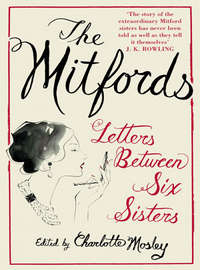
Kitabı oku: «The Mitfords: Letters between Six Sisters»

THE MITFORDS
Letters Between Six Sisters
EDITED BY
CHARLOTTE MOSLEY

CONTENTS
COVER
TITLE PAGE
BIOGRAPHICAL NOTES
INDEX OF NICKNAMES
THE MITFORD FAMILY TREE
EDITOR’S NOTE
INTRODUCTION
ONE · 1925–1933
TWO · 1933–1939
THREE · 1939–1945
FOUR · 1945–1949
FIVE · 1950–1959
PLATES
SIX · 1960–1966
SEVEN · 1967–1973
EIGHT · 1974–1994
NINE · 1995–2003
INDEX
ACKNOWLEDGEMENTS
ABOUT THE AUTHOR
PRAISE
ALSO BY THE AUTHOR
COPYRIGHT
ABOUT THE PUBLISHER
BIOGRAPHICAL NOTES
 NANCY (28 November 1904–30 June 1973) ‘Naunce(ling)’, ‘The Old French Lady’, ‘The Lady’, ‘Dame’, ‘Susan’, ‘Soo’.

Married to Peter Rodd, 1933–58. No children. Studied briefly at the Slade School of Art before embarking on a writing career with Vogue and The Lady. Worked in London at Heywood Hill bookshop during the war. Fell in love with Free French officer Gaston Palewski in 1942, moved to Paris in 1946 to be near him and remained in France, an ardent Francophile, for the rest of her life. Flirted with socialism and fascism before becoming a staunch Gaullist after meeting Palewski. Achieved fame with her post-war novels and repeated the success with four historical biographies. Author of the novels Highland Fling (1931), Christmas Pudding (1932), Wigs on the Green (1935), Pigeon Pie (1940), The Pursuit of Love (1945), Love in a Cold Climate (1949), The Blessing (1951) and Don’t Tell Alfred (1960), and of the historical biographies Madame de Pompadour (1954), Voltaire in Love (1957), The Sun King (1966) and Frederick the Great (1970). Editor of a collection of letters of nineteenth-century Mitford cousins, The Ladies of Alderley (1938) and The Stanleys of Alderley (1939), and of a volume of essays and journalism, The Water Beetle (1962). Her notorious article on ‘U and Non-U’ (upper-and non-upper-class usage) in Encounter magazine (1954) was reprinted in Noblesse Oblige (1956).
 PAMELA (25 November 1907–12 April 1994) ‘Pam’, ‘Woman’, ‘Woo’, ‘Wooms’, ‘Woomling’.

Down-to-earth in her tastes and interests, she was a superb cook and happiest living in the country in the company of her dogs. From 1930 to 1934, she managed the farm at Biddesden in Wiltshire for Diana’s first husband, Bryan Guinness. Married to physicist Professor Derek Jackson, 1936–51. No children. When married, she lived at Rignell House, Oxford, before moving to Tullamaine Castle, Ireland, in 1947. In 1963, she settled in Zurich and shared her life with two women, Giuditta Tommasi and Rudi von Simolin. Returned to England in the mid-1970s to live at Woodfield House in Gloucestershire, which she had bought in 1960. She became an acknowledged expert on rearing poultry. Entertained the idea of writing a cookbook but never found time to finish it.
 DIANA (17 June 1910–11 August 2003) ‘Cord(uroy)’, ‘Bodley’, ‘Honks’, ‘Nard(y)’.

The acknowledged beauty of the family. Married to Bryan Guinness, 2nd Baron Moyne, 1929–34. Two sons, Jonathan and Desmond. Married fascist leader Sir Oswald Mosley in 1936. Two sons, Alexander and Max. A visit to the 1933 Nuremberg Nazi Party Rally ignited a lifelong admiration for Hitler. Imprisoned in Holloway in 1940 under Defence Regulation 18B. Released in 1943, reunited with her children, and held under house arrest until the end of the war. Moved to Ireland in 1951 and lived between Co. Galway, Co. Cork and France. Settled permanently outside Paris in 1963. Until Mosley’s death in 1980, she devoted herself to the furtherance of his comfort and happiness. Edited and contributed to The European, 1953–60, a monthly magazine to advance Mosley’s ideas of a united Europe. Reviewed for Books & Bookmen and the Evening Standard. Author of an autobiography, A Life of Contrasts (1977), pen portraits of friends, Loved Ones (1985), and a biography, The Duchess of Windsor (1980).
 UNITY (8 August 1914–28 May 1948) ‘Bobo’, ‘Boud(le)’, ‘Bird(ie)’.

Artistic, rebellious and keen to shock, she became a supporter of the Nazis after attending the Nuremburg Parteitag with Diana in 1933. Moved to Munich in 1934. Met Hitler in February 1935 and continued to see him frequently until the outbreak of war. Attempted to commit suicide in 1939 when war was declared between England and Germany. She lived on as an invalid, cared for by her mother, until her death aged thirty-three.
 JESSICA (11 September 1917–23 July 1996) ‘Decca’, ‘Hen’, ‘Henderson’, ‘Boud’, ‘Susan’, ‘Soo’, ‘Steake’, ‘Squalor’.

Became a socialist in her teens and eloped, aged nineteen, to civil-war-torn Spain to marry her cousin Esmond Romilly. Moved to America in 1939. Esmond joined the Canadian Air Force and was killed in 1941. Two daughters, Julia (died at five months) and Constancia (‘Dinky’). Married American attorney Robert Treuhaft in 1943. Two sons, Nicholas (died aged ten) and Benjamin. Active member of the American Communist Party, 1944–58, and energetic campaigner for civil rights. The success of her autobiography, Hons and Rebels (1960), enabled her to make a living from writing. Prolific investigative journalist and author of Lifeitselfmanship (1956), The American Way of Death (1963), The Trial of Dr Spock (1969), Kind and Usual Punishment (1973), a second volume of memoirs, A Fine Old Conflict (1977), The Making of a Muckraker (1979), Faces of Philip, A Memoir of Philip Toynbee (1984), Grace Had an English Heart (1988) and The American Way of Birth (1992).
 DEBORAH (31 March 1920 –) ‘Debo’, ‘Hen’, ‘Henderson’, ‘9’, ‘Stublow’, ‘Miss’.

Married, in 1941, Lord Andrew Cavendish, who succeeded his father as 11th Duke of Devonshire in 1950. One son, Peregrine, two daughters, Emma and Sophia. Immunized by her sisters’ fanatical views, she remained firmly apolitical all her life. An astute and capable businesswoman, she was largely responsible for putting Chatsworth, the Devonshire family home, on to a sound footing after she and her husband moved back into the house in 1959. Accused by Nancy of illiteracy, she was suspected by her family and friends of being a secret reader. Diana believed that unlike most people who pretend to have read books that they have not, Deborah pretended not to have read books that she had. She took to writing late in life and produced The House: A Portrait of Chatsworth (1982), The Estate, A View of Chatsworth (1990), Farm Animals (1991), Treasures of Chatsworth (1991), The Garden at Chatsworth (1999), Counting My Chickens (2001), The Duchess of Devonshire’s Chatsworth Cookery Book (2003) and Round About Chatsworth (2005).
INDEX OF NICKNAMES
| Al | Alexander Mosley, Diana’s son |
| Bird/Birdie | Unity |
| Blor | Laura Dicks, the Mitfords’ nanny |
| Bobo | Unity |
| Boud/y | Unity |
| Cake | Queen Elizabeth, the Queen Mother |
| Cha | Charlotte Mosley, Diana’s daughter-in-law and editor of these letters |
| Colonel, Col | Gaston Palewski |
| Cord | Diana |
| Count/y | Jean de Baglion |
| Cuddum | Communist |
| Deacon | Elizabeth Cavendish, Deborah’s sister-in-law |
| Debo | Deborah |
| Decca | Jessica |
| Diddy | Ellen Stephens, the Devonshires’ nanny |
| Dink/y/Donk | Constancia Romilly, Jessica’s daughter |
| Duch (my) | Mary, Duchess of Devonshire, Deborah’s mother-in-law |
| Em | Emma Tennant, née Cavendish, Deborah’s elder daughter |
| Farve | Lord Redesdale |
| Fat Friend (F. F.) | President John F. Kennedy |
| Fem | Lady Redesdale |
| French Lady | Nancy |
| Hen/Henderson | Deborah or Jessica |
| Honks | Diana |
| Id/Idden | Ann Farrer, a first cousin of the Mitfords |
| Jonnycan | Jonathan Guinness, Diana’s eldest son |
| Kit | Oswald Mosley |
| Lady | Nancy |
| Leader/Lead | Oswald Mosley |
| Little gurl | Sophia Cavendish, Deborah’s younger daughter |
| Loved One | President John F. Kennedy |
| Maggot | Margaret Ogilvy |
| Mrs Ham | Violet Hammersley |
| Muv | Lady Redesdale |
| Nard/y | Diana |
| Naunce/Naunceling | Nancy |
| Oys | James and Chaka Forman, Jessica’s grandsons |
| P’s/Parent Birds | Lord and Lady Redesdale |
| Prod | Peter Rodd, Nancy’s husband |
| Recs | Chickens |
| Revereds | Lord and Lady Redesdale |
| Rud/Rudbin | Joan Farrer, a first cousin of the Mitfords |
| Sir O | Oswald Mosley |
| Squalor | Jessica |
| Sto/Stoker | Peregrine Hartington, Deborah’s son |
| Tig | Anne Tree, née Cavendish, Deborah’s sister-in-law |
| TPOF | Lady Redesdale, ‘The Poor Old Female’ |
| Tud/Tuddemy | Tom Mitford |
| Uncle Harold | Harold Macmillan |
| Wid/Widow | Violet Hammersley |
| Wife | Lady Mersey |
| Woman/Woo/Wooms | Pamela |
THE MITFORD FAMILY TREE

EDITOR’S NOTE
The correspondence between the six Mitford sisters consists of some twelve thousand letters – over four million words – of which little more than five per cent has been included in this volume. Out of the fifteen possible patterns of exchange between the sisters, there are only three gaps: no letters between Unity and Pamela have survived, and there are none from Unity to Deborah. The proportion of existing letters from each sister varies greatly: political differences led Jessica to destroy all but one of Diana’s letters to her, while the exchange between Deborah and Diana, the two longest-lived sisters, runs to some three thousand on each side.
The Mitfords had a brother, Tom, who was sent away to school aged eight while his sisters were taught at home. Although he composed many dutiful letters to his parents, Tom rarely wrote to the rest of the family. Unlike his sisters, for whom writing was as natural as speaking, he took no pleasure in the art of corresponding. (In 1937, in a brief note added to the bottom of one of Unity’s letters to Jessica, he deplored his ‘constitutional hatred’ for letter-writing.) Perhaps his later training as a barrister also made him wary of committing his thoughts to paper. Nancy often wrote to Tom before she married and although over a hundred of her letters to him have been preserved, as have a handful from his other sisters, the correspondence is so one-sided that no letters to or from Tom have been included in this volume.
Letters make a fragmentary biography at best and I have not attempted to present a comprehensive picture of the Mitfords’ lives; those seeking a more complete account can turn to the plentiful books by and about the family. In order to weave a coherent narrative out of the vast archive and link the six voices, I have focused my choice of letters on the relationship between the sisters. I have also selected striking, interesting or entertaining passages, as well as those that are particularly relevant to the story of their lives. While some letters have been included in their entirety, more often I have deliberately cut them, sometimes removing just a sentence, at other times paring them down to a single paragraph. To indicate all these cuts would be too distracting and they have therefore been made silently.
As in many families, the Mitfords used a plethora of nicknames and often several different ones for the same person. While the origins of most of these are long forgotten, the roots of a few can be traced. Sir Oswald Mosley, Diana’s husband of forty-four years, who was known as ‘Tom’ or ‘the Leader’ before the war and ‘Sir O’, ‘Sir Oz’ or ‘Sir Ogre’ after the war, was nearly always called ‘Kit’ by Diana. In private she admitted that the name came from ‘kitten’ but, realizing its inappropriateness for such a powerful character, she wrote in her memoirs that she could not remember how it had originated. Deborah knew him as ‘Cyril’ because as a young girl she had asked her mother how she should address her new brother-in-law and misheard her terse answer, ‘He’S Sir Oswald to me’. Nancy often referred to Mosley as ‘Keats’, a derivation of ‘Kit’. Deborah’S husband, Andrew Devonshire, was known as ‘Ivan’ (the Terrible) or ‘Peter’ (the Great), according to his mood. He was also called ‘Claud’ because when his title was Lord Harrington, before he inherited the dukedom, he used to receive letters addressed to ‘Claud Hartington Esq.’ To make matters even more complicated, Nancy and Jessica addressed and signed letters to each other as ‘Susan’ or ‘Soo’, for reasons now forgotten; Deborah and Jessica called each other ‘Hen’, and by extension ‘Henderson’, inspired by their passion for chickens; Jessica and Unity were to each other ‘Boud’, from a private language they invented as children called ‘Boudledidge’. Nancy addressed Deborah as ‘9’, the mental age beyond which she claimed her youngest sister had never progressed.
I have left unchanged the sisters’ numerous nicknames for one another as they are intrinsic to their relationships, but for clarity I have standardized other nicknames and regularized their spelling. The only other editorial changes that have been made to the text are the silent correction of spelling mistakes – except in childhood letters; the addition of punctuation where necessary; and the rectification of names of people, places and books. In my footnotes and section introductions, I have referred to people variously by their first name, surname or title, aiming for quick recognition rather than consistency. Foreign words or phrases have been translated in square brackets in the text; the translation of longer sentences has been put in a footnote.
As a child, Nancy invented a game in which she played a ‘Czechish lady doctor’ and adopted a thick foreign accent. This voice endured and the letters are scattered with ‘wondair’ for ‘wonderful’, ‘nevair’ for ‘never mind’, and other phonetic approximations of Mitteleuropean English. After Nancy moved to France, should she ever use a French word in conversation, Deborah, who did not admit to speaking the language, would interject with ‘Ah oui!’ or ‘Quelle horrible surprise’, expressions that have found their way into the letters. Deborah was also the instigator of the frequent plea ‘do admit’ – not something any Mitford did willingly – which was an attempt to catch the attention of one of her siblings and get them to agree with her. The exaggerated style of writing that the sisters used, a continuation of the drawling way in which they spoke, began in childhood and originated in part from their brother Tom’s ‘artful scheme of happiness’, a particular tone of voice that he employed when trying to wheedle something out of someone. ‘Boudledidge’, which Jessica and Unity often used in their letters to each other, was a derivation of this way of speaking. ‘Honnish’, a language invented by Jessica and Deborah, was derived not from the fact that as daughters of a peer they were Honourables but from the hens that played such an important part in their upbringing. Their mother, Lady Redesdale, had a chicken farm from whose slim profits she paid for the children’s governess and the sisters each kept their own birds and sold their eggs to their mother in order to supplement their pocket money.
The Mitford sisters all wrote in longhand, except for Jessica who learned to type at the beginning of the war. Their handwriting is clear and legible, and, as a rule, they dated their letters. Pamela, who was probably dyslexic, kept a dictionary at hand and her spelling is usually accurate. Her occasional use of unorthodox capitalizations and spelling has been retained. The sisters’ letters to each other are held in the archives at Chatsworth, where they have been collected by Deborah, with the exception of those written to Jessica which are in the Rare Books and Manuscripts Library at Ohio State University. The letters in this volume are previously unpublished, except for a dozen that were included in Love from Nancy and three times that number in Decca.1
At a certain point, the sisters became aware of the value of their letters and of the possibility that they might one day be published. In 1963, Nancy advised Deborah to throw nothing away because the correspondence of a whole family would be ‘gold for your heirs’. Pamela, who until then had discarded most of her letters, began to preserve them, and Jessica started keeping carbon copies of her correspondence in the 1950s. It is nevertheless abundantly clear that the sisters did not write with an eye to posterity; the frankness, immediacy and informal style of their communications bear this out. Only when I had begun editing these letters did the idea of publication at times inhibit the two surviving sisters. A few months before she died in 2003, Diana wrote to Deborah, ‘I’ve started this letter and for the first time in my life I can’t think of anything to say. My old mind is a blank. If this had happened sooner it would have saved Charlotte a lot of trouble.’ Happily, it did not.
1 Love From Nancy: The Letters of Nancy Mitford, edited by Charlotte Mosley (Hodder & Stoughton, 1993); Decca: The Letters of Jessica Mitford, edited by Peter Y. Sussman (Weidenfeld & Nicolson, 2006).
INTRODUCTION
The Mitford sisters first began to make headlines in the late 1920s and have rarely been out of the news since. Between them they were close to many key figures of the last century. They knew Winston Churchill, John F. Kennedy and Hitler; were friends of Lytton Strachey, Evelyn Waugh and Maya Angelou; sat for Augustus John, Lucian Freud and Cecil Beaton; entertained the Queen, the Duchess of Windsor and Katherine Graham; were guests of Lord Berners, Goebbels and Givenchy. They lived out their lives in very different spheres, from the London of the Bright Young Things, pre-war Munich and cosmopolitan Paris, to rural Ireland, left-wing California and the deep English countryside.
How did these six sisters, offspring of parents whose highest hopes for their daughters were that they should make good wives, achieve such fame? Some clues can be found in the personalities and careers of their forebears. Talent often misses a generation and the sisters’ grandfathers on both sides of the family were notable in their day. Bertram Mitford, the 1st Baron Redesdale, was a diplomat, politician and author. His memoirs were admired by Edmund Gosse and his collection of popular Japanese stories, Tales of Old Japan, is still in print today. The Mitfords’ maternal grandfather, Thomas Gibson Bowles, was a politician and journalist who started the popular weekly satirical magazine Vanity Fair (unrelated to its modern namesake) and The Lady, founded in 1883 and still famous for its classified columns advertising for domestic help. A combative and opinionated self-made man, Bowles used Vanity Fair and his position as a Member of Parliament as weapons to bring down his opponents. Never afraid of saying what he thought, he relished being a gadfly to the Establishment and engaged in a constant guerrilla warfare of press campaigns and court cases. His energy, wit and what The Times described as a ‘temperamental dislike of compromise’ passed down in generous measure to his granddaughters, who also inherited his interest in politics and a gift for writing.
While the sisters’ enduring reputation owes much to their originality, forceful opinions, and good looks, the turbulent times in which they grew up provided the catalyst for their highly publicized exploits. The decade leading up to the Second World War was one of ideological extremes and, like many of their contemporaries, they were drawn to radical politics which they saw as the answer to Europe’s ills. Their beliefs spanned the political spectrum, from fascism, Nazism and communism, to socialism, Gaullism and Conservatism, politics dividing the family as surely as religion had done in former centuries, political absolutism replacing religious absolutes. The causes they took up were closely connected with the men who embodied them, with the difference that Unity and Jessica chose men whose politics corresponded with their own natural ideological tendencies, while Nancy and Diana’S political beliefs were sustained by the men they loved.
For a family that is regarded as quintessentially English it is interesting that all the sisters, except Deborah, spent much of their lives abroad. Consciously or unconsciously, the desire to set themselves apart from their siblings, to stand out as individuals and not just as one of the ‘Mitford girls’, drove them not only into opposite political camps but also to different parts of the world. What the sisters shared, however, was stronger than that which divided them. In spite of their differences, and however little their daily lives might have in common, they needed to keep in touch; recounting their lives to each other was a vital part of their existence. Only Jessica broke this chain by completely severing ties with Diana before the war, when political antipathy replaced her childhood love for her ‘favourite person in the world’, and when too much bitterness made meeting on the basis of sisterly fondness ‘unthinkable’.
A family correspondence of this scope and size is rare; for it to include four such gifted writers makes it unique. Nancy, Diana, Jessica and Deborah were all published authors, their books international bestsellers that are mostly still in print. Even Unity, whose suicide attempt effectively cut off her development in her mid-twenties, and Pamela, who was slowed down by a bout of childhood polio, wrote with natural, distinctive voices.
Eighty years separate the earliest surviving letter between the sisters – a note written in 1923 by nine-year-old Unity, who was on a seaside holiday in Sussex, to thirteen-year-old Diana who had stayed at home – and the last – a fax sent in 2003 by 83-year-old Deborah from her home in England to 93-year-old Diana who was dying in Paris. The letters began as a trickle while the sisters were still living at home, swelled in number in the 1930s as they gradually went out into the world, and reached a flood after the war when they setfled in different countries and saw each other less often. Although they started using the telephone in the 1950s – Diana and Deborah used to ring regularly on Sunday mornings and when Nancy and Diana were both living in France they spoke almost daily – telephoning remained of secondary importance; letters were their principal means of keeping in touch. The post and everything that touched on it played a key part in their lives: Jessica left $5,000 in her will to her local postman; Deborah’s idea of contentment in old age was to be the postmistress of a small village; and at the end of her life Diana was reconciled to moving from a house and garden in the suburbs to a flat in Paris mainly because it was situated immediately above a post office. While the sisters’ correspondence with one another represents just a fraction of their total output – they rarely left a letter unanswered and kept up with many hundreds of other correspondents – it is unique because it was sustained over a lifetime.
The strength of feeling amongst the sisters was intense: childhood love, sympathy, generosity and loyalty were mixed with hate, envy, resentment and exasperation – sentiments that remained with them to a greater or lesser extent throughout their lives and give their letters to one another an adolescent quality which persists even in old age. During their childhood, alliances were formed and broken, common enemies fought then sided with. As they grew up, politics hardened their positions and determined which camp they chose to support. In a family where overt demonstrations of love were avoided and where the English upper-class code of frowning on any public display of emotion was observed, teasing was a relatively safe way of dealing with sibling rivalry and of expressing affection. The joking relationship between them acted as a safeguard, creating an environment in which tensions could be defused before they grew too serious. Nancy, as the eldest, was usually the instigator of these practices which she carried on even in later life, partly in commemoration of schoolroom custom but also because her jealousy of her sisters was never fully resolved and her feelings towards them remained ambivalent. Teasing, in her hands, could become a cruel weapon, while for the others it was a way of deflating self-importance or relieving the tedium of long winter evenings when they had only each other for company. Their father, Lord Redesdale, disliked having people to stay, and when there were guests he did not always make them feel welcome. Once when the house was full of Nancy’s friends, he shouted down the table to his wife, ‘Have these people no homes of their own?’
Jessica described having sisters as ‘a great toughening and weathering process’ which prepared one for later life. When Nancy once ventured that she thought sisters were a protection against life’s cruel circumstances, Jessica countered that, as a child, her sisters were the cruel circumstances. Diana wrote that she regarded it as a fault of their upbringing that it should be considered unthinkable to admit to ‘weakness, misery or despair’. Certainly all six sisters had the capacity to withstand private tragedy and public opprobrium with unusual resilience – often appearing insensible to other people’S opinions – and were practised at putting on a brave face and hiding their vulnerability behind a lightly worn armour of flippancy and self-deprecation. They wore this protective shield not just with the outside world, where it was often taken for ruthlessness, but also with each other and, with few exceptions, rarely shared their most intimate confidences. While avoiding emotional depth and turning everything into a joke is a widespread English custom, the sisters’ comic genius transformed a national character trait into an art form.
Less inhibited than their memoirs and more intimate than the biographies that have been written about them, the sisters’ correspondence explores the kaleidoscopic pattern of their shifting relationships and exposes less-well-known sides of their complex and contradictory characters. Unlike many books about the Mitford family that have focused on the years when the sisters’ exploits intersected with historical events, their letters cover their whole lives, revealing how triumphs and tragedies wore down their youthful fanaticism.
The sisters wrote to each other to confide, commiserate, tease, rage and gossip but above all they wrote to amuse; when something made them laugh, half the fun of it was to relate it to a sibling. Beneath their contrasting personalities they shared a common temperament: unconditional in their loves and hates and passionate about the causes they embraced, they also possessed the ability to laugh at themselves and to make light of even the darkest predicaments. It is this indomitable spirit, fierce courage and irrepressible enjoyment of life that make their letters so powerful, eloquent and entertaining.
I had letters from you & the Lady* & Henderson** today, wouldn’t it be dread if one had a) no sisters b) sisters who didn’t write.
Deborah to Diana, 21 July 1965
* Nancy
** Jessica
ONE 1925–1933

The Mitford children in 1921: Unity, Pamela, Deborah, Tom, Nancy, Jessica and Diana.
There are few letters to record the Mitford sisters’ childhood and early youth, and such letters as they did write were mostly to their mother and father. Nor are there many letters dating back to the eight years covered in this section. By 1925, only Nancy, aged twenty – one, and Pamela, aged eighteen, had gone out into the world; the four youngest children were still in the nursery or schoolroom. Nancy’s main family correspondent at the time was her brother Tom, and Pamela – who confided mostly in Diana – was the least prolific writer of the sisters.
When the letters begin, the family had been living for six years at Asthall Manor, a seventeenth-century house in the Cotswolds, which the sisters’ father, Lord Redesdale, had bought when he sold Batsford Park, a rambling Victorian pile that he had inherited in 1916 and could not afford to keep up. Before the First World War, David Redesdale, or ‘Farve’ as he was known to his children, lived in London where he worked as office manager for The Lady, the magazine founded by his father-in-law. Life in the country was far better suited to this unbookish, unsociable man, whose happiest moments were spent by the Windrush, a trout river that ran past Asthall, or in the woods where he watched his young pheasants hatch. Unluckily for his family, country sports did not exhaust his energies and Asthall, which the children loved, was not to his liking. In 1926, they moved to Swinbrook House in Oxfordshire, a grim, ungainly edifice that Lord Redesdale had built on top of a hill near Swinbrook village. All the sisters except Deborah, who was six when they moved, disliked the new house, which was cold, draughty and impractical. Worst of all, unlike Asthall where the library had been in a converted barn some distance from the house and where the children were left undisturbed, there was no room at Swinbrook that they could call their own. The younger children found some warmth and privacy in a heated linen cupboard, later immortalized in Nancy’s novels as the ‘Hons’ cupboard’, while the older children had to share the drawing room or sit in their small bedrooms. Lord Redesdale was hurt by the family’s dislike of his dream project and began to spend more time at 26 Rutland Gate, a large London house overlooking Hyde Park that he had bought when Asthall was sold.
The sisters were in awe of their father. Strikingly handsome, with the brilliant blue eyes that passed down to his children, he was kind-hearted, jovial and the source of much of the fun that was had in the family. Deborah remembered him as ‘charming, brilliant without being clever’ and uproariously funny when in a good mood. She wrote that when he and Nancy started sparring they were better than anything she had ever seen on stage, ‘a pair of comedians of the first order’. But he could also be impatient and had a violent temper. The smallest transgression – a child spilling her food or being a minute late – could send him into a towering rage. His anger was all the more alarming for being unpredictable: he would turn with sudden fury on one of his daughters and then, for no apparent reason, decide to single out another. Their way of standing up to him, and of drawing his unwrathful attention, was to catch their father in one of his sunnier moods and tease him, which he took in good part. Jessica used to call him ‘the Old Sub-Human’ and pretend to measure his skull for science or would gently shake his hand when he was drinking a cup of tea to give him ‘palsy practice’ for when he grew old. Nancy’s caricature of him in her first novel, Highland Fling, as the jingoistic, hot-tempered General Murgatroyd – a precursor of the formidable Uncle Matthew in her later novels – was an effective way of reducing this larger-than-life figure to less alarming dimensions. As they grew up, the sisters rarely seem to have resented Farve and looked back on his autocratic eccentricities with affectionate amusement. The inclination to hero – worship is foreshadowed in their relationship with their father; like the other powerful men who were to come into their lives, he could do no wrong.
Their resentment – and that of Nancy and Jessica in particular – against the perceived shortcomings of their upbringing was reserved for their mother. In contrast to her moody, volatile husband, Sydney, or ‘Muv’ as her children called her, was cool and detached. Her own mother had died when she was seven years old and at the age of fourteen she had taken on the responsibility of running her father’s household. This had taught her financial prudence and to be a good manager – qualities that came in useful later when raising a family of seven on never quite enough money – but it also created a certain rigidity in her attitude to her children when they were growing up; an inflexibility that fuelled her daughters’ rebellious behaviour and their desire to shock.
From her father, Lady Redesdale had inherited definite opinions about health and diet, believing that the ‘good body’ would heal itself more effectively without the intervention of doctors or medicine. An early campaigner against refined sugar and white flour, she made sure that her children ate only wholemeal bread, baked to her recipe. Physically undemonstrative, she rarely exhibited outward signs of maternal warmth and seldom hugged or cuddled her daughters, who had to compete fiercely for the scarce resource of her attention. In ‘Blor’, an essay on her childhood, Nancy described her mother as living ‘in a dream world of her own’, detached to the point of neglect. In her fictional portrait of her as Aunt Sadie, she depicted a more sympathetic character but one that was nevertheless remote and disapproving. But the aloofness that some of her daughters complained of also had its positive side, enabling their mother to remain calm in the face of an unpredictable husband and to deal impartially with six boisterous and constantly feuding girls (her ambition had been to have seven boys). She was also fair, principled, direct, selfless and honest to the point of innocence. As the sisters grew up and their escapades sent their mother reeling from one calamity to the next, her unshakeable loyalty and acceptance of their choices in life showed that she cared for her daughters very much indeed.
Like most girls of their class and generation, the sisters were educated at home. Lady Redesdale taught all her children until they were eight, after which the girls moved to the schoolroom to be instructed by governesses and Tom was sent away to boarding school. Nancy and Jessica blamed their mother for this lack of formal education, even though Lord Redesdale was just as opposed to sending his daughters to school. ‘Nothing would have induced him to waste money on anything so frivolous’, wrote Deborah. He also worried that they might develop thick calves from being made to play hockey. Neither parent believed that girls should be educated beyond basic literacy and regarded intellectual women as ‘rather dreadful’. The Redesdales’ views were not uncommon at the time but their children’s response was more unusual. Nancy’s bitterness at not having received what she considered a proper education was enduring and runs as a refrain throughout her correspondence. Jessica wrote that the dream of her childhood was to be allowed to go to school, and that her mother’s refusal to countenance it had burned into her soul.
It is questionable, however, whether the sisters would have been better educated had they gone away to school. At the time, fashionable establishments for girls taught social rather than intellectual skills, preparing pupils for marriage and the drawing-room rather than the workplace. When the Redesdales eventually allowed Nancy, at the age of sixteen, to go to Hatherop Castle, a small private school for girls from ‘suitable’ families, the mainly non-academic curriculum concentrated on music, dancing and French, whereas at home, the sisters were free to make use of their grandfather’s first-rate library and Nancy and Diana became bookworms at an early age. It was perhaps the boredom of being confined at home with only siblings for company that rankled with Jessica and Nancy as much as their lack of formal schooling. Not until they left home and had to earn a living – they were the only two sisters who did not marry rich men – did they have cause to view their rudimentary education as a handicap.
The age gap between the Mitford children meant that they formed almost two separate generations. In 1925, the year that opens this collection of letters, the older children, Nancy, Pamela, Tom and Diana, ranged between the ages of twenty-one and fifteen. The youngest three, Unity, Jessica and Deborah, were aged eleven, eight and five. Nancy had ‘come out’ when she was eighteen and had followed her first season as a debutante with three further years of weekend parties and balls. She had met the right people, made many friends and quite enjoyed herself, but she had failed to do the expected thing and find a husband. With very little money and no immediate prospects, she was living at home, taking out her frustration on her sisters. The three youngest looked up to her like a remote star: her vitality, cleverness and supreme funniness lit up the family atmosphere, as did her determination to turn everything into a joke, but she was too caustic and indiscreet to be the recipient of anyone’s confidences. In Unity’s copy of All About Everybody, a little book of printed questions that she asked her family and friends to fill in, Nancy put as her besetting sin ‘disloyalty’, a trait that could make her incomparably good company but an uncertain ally.
Nancy’s usual victim was Pamela, whose unguarded nature made her an obvious target for teasing. Diana, however, presented more of a challenge; she was fully Nancy’s intellectual equal, with just as determined a character, and was able to stand up to her sister’s bullying. Occasionally Nancy managed to exert her seniority and successfully torment her younger sister. When she was sixteen, she formed a company of Girl Guides, appointed herself captain and tried to make ten-year-old Diana salute her. On another occasion, she pretended to have heard the Redesdales discuss sending Diana to boarding school, an idea that filled her little sister with horror. But they both enjoyed reading, which drew them together, as did a similar sense of humour and a longing to escape the confinement of Swinbrook. As they grew up, they became, according to Diana, great friends. But underlying the friendship was a deep current of envy on Nancy’s part towards a younger sister who was already a great beauty and the instant centre of attention with the undergraduate friends that Nancy brought home. These feelings were exacerbated when Diana, aged eighteen, married the extremely rich and good-looking Bryan Guinness and became a sought-after London hostess.
Shortly before Diana’s engagement to Bryan in 1928, Pamela accepted a proposal of marriage from a neighbour of the Mitfords, Oliver Watney. The prospect of having two younger sisters married before she was may help to explain Nancy’s unwise decision to become unofficially engaged to Hamish St Clair-Erskine, a friend of Tom’s from Eton who was younger than her and homosexual. Her infatuation with Hamish dragged on for five unsatisfactory years, causing her a great deal of unhappiness. During this period she started to write her first articles for Vogue, and in 1930 was taken on as a regular contributor to cover social events for The Lady. This brought in a little pocket money, as did her first two novels, Highland Fling and Christmas Pudding, light satires on upper-class life that sketched out the world she would so successfully depict in her accomplished post-war novels.
Nancy used to say that the first three years of her life were perfect, ‘then a terrible thing happened, my sister Pamela was born’ which ‘threw me into a permanent rage for about 20 years’. Her affront at being supplanted in the nursery was compounded by an insensitive nanny who immediately shifted all her love and attention to the new baby. By the time Nancy was six and Pamela three, they might have overcome their differences and played together, had not Pamela contracted polio which affected her physical and mental development. She was in constant pain from an aching leg, and often tearful and sad. Her illness was doubtless a strain on Nancy: ‘you’ve got to be kind to Pam, she’s ill’, was dinned into her unceasingly. Instead of narrowing, as it normally would, the age gap between the two sisters widened. Pamela, who was the least able to defend herself, became Nancy’s scapegoat. She learnt to keep her head down and seems never to have shown any ill will towards her tormentor. She loved jokes as much as the rest of the family, and laughed about her own limitations, but she refused to retaliate or compete in the teasing. Her sisters nicknamed her ‘Woman’ because, like a symbolic character in a medieval Mystery Play, she epitomized the womanly virtues of simplicity and goodness. From her mother, she inherited dignity, common sense and the talent for making a comfortable home; from her father, a love of the countryside, where she was at her happiest. In 1925, when these letters begin, Pamela was a shy seventeen-year-old debutante, confiding to Diana her nervousness about going out into the world.
Unlike Nancy, who was a late developer and drew out her adolescence well into her twenties, Diana, by the time she was thirty, had been twice married, given birth to four sons and experienced the most eventful decade of her life. When these letters begin, she was a precocious fifteen-year-old, dreaming of independence. Her closest companion in the family, both in age and interests, was Tom, and when he was home for the holidays the two were inseparable. Diana admired her brother’s musical and intellectual talents and delighted in the company of his sophisticated friends. These glimpses of a world of art, music and intelligent conversation increased her yearning to escape the restrictive family atmosphere. The 1926 General Strike, sparked off by the grim working conditions in the coal mines, made a deep impression on her, kindling her social conscience and fostering a lifelong interest in politics. Whereas Nancy treated the national emergency as something of a joke and disguised herself as a tramp to frighten Pamela who was running a canteen serving food to strike-breaking lorry drivers, Diana felt the injustice of the miners’ situation acutely. Her interest in politics was also fuelled by visits to Chartwell, Winston Churchill’s family home in Kent. Churchill’s wife, Clementine, was a first cousin of Lord Redesdale, and two of the Churchill children, Diana and Randolph, were much the same age as Tom and Diana.
In 1927, Diana spent six months studying in Paris, where she said she learnt more than in six years of lessons at Asthall. For the first time in her life she was free of the strict chaperoning imposed by her parents and of having to jockey for position among her sisters. The painter Paul-César Helleu, a friend of Thomas Gibson-Bowles, was an important influence during her visit. He took her to the Louvre and Versailles, introduced her to his artist friends and admired her looks, making her aware for the first time of the effect of her exceptional beauty. When she returned to Swinbrook, Diana was more impatient than ever to get away from its schoolroom atmosphere. The following year, at the end of her first season, a proposal of marriage gave her the chance to escape. Bryan Guinness, the sensitive and diffident elder son of Lord Moyne and heir to a brewing fortune, fell deeply in love with her. A poet and novelist, Bryan was part of a group of Nancy’s Oxford friends that included Evelyn Waugh, John Betjeman, Roy Harrod, Harold Acton, James Lees-Milne, Henry Yorke and Robert Byron, young men whose interests represented everything that Diana aspired to. She and Bryan were married in January 1929 and divided their time between London and Biddesden, a fine eighteenth-century house in Wiltshire, where Diana was able to give free rein to her talent for decorating and entertaining. Unity, Jessica and Deborah often went to stay with the young couple and in 1930 Pamela settled in a nearby cottage to run the Biddesden farm. Nancy was a less frequent visitor. Caught up in her unhappy affair with Hamish and very short of money, it was galling to see Diana settled in a splendid house, surrounded by a loving husband and two healthy babies. However, the picture of happiness that Diana and Bryan presented was not as bright as it appeared. Although they were undoubtedly in love, there was a basic incompatibility between them that soon made itself felt. Increasingly, Bryan wanted to stay at home with only his family for company while Diana, who was eager to travel and fill her house with friends, found this domesticity all too reminiscent of the life she had so recently managed to escape.
In the spring of 1932, Diana sat next to Sir Oswald Mosley at a dinner party in London. The former Conservative MP and Labour Minister, whose New Party had been resoundingly defeated in the previous year’s general election, was preparing to break with parliamentary politics and launch the British Union of Fascists (BUF). Diana fell under the spell of this seasoned womanizer and compelling talker who seemed to her to have all the answers to Britain’s problems. In Mosley, she found the combination of a powerful man she could love and a cause to which she could dedicate herself, a pattern that Unity and Jessica – and to a lesser extent Nancy – were to conform to in their different ways. Mosley was married and made it clear that he would not leave his wife. Undeterred, and encouraged by Mosley, Diana decided to divorce Bryan in order to be available for her lover whenever he could spare the time from politics, family and the other women in his life. By throwing in her lot with Mosley, Diana was prepared to sacrifice her social position, distance herself from her beloved Tom, who disapproved of her leaving Bryan, alienate her parents – who refused to allow her two youngest sisters to visit her – and even risk losing her sons. She once wrote of her decision, ‘I probably ought to have behaved differently but I never regretted it’. Of the family, only Nancy supported Diana’s choice and became a regular visitor to the house in Eaton Square that Diana took after her divorce. It was no doubt easier for Nancy to be close to her sister when she was unpopular than when she was at the height of her success.
Unity was described by her mother as a sensitive, introverted little girl, who used to slip under the dining-room table if anything was said at meals that upset or embarrassed her. By the time she was eight, and had graduated to the schoolroom, she had become naughty and disruptive, her shyness concealed beneath a tough shell of sullen defiance. More solemn than her sisters, she lacked their quick wit and enjoyed practical rather than verbal jokes. In an effort to stand out, she behaved outrageously. When she was fourteen, partly because she was so difficult at home and partly because she wanted to go away, Lady Redesdale decided to make an exception among her daughters and sent Unity to boarding school. The three establishments she attended were no more successful at controlling her than her governesses had been and she was expelled from all of them. In 1932, she followed her older sisters and was launched into society: ‘a huge and a rather alarming debutante’, according to Jessica. Social life bored her and she had not grown out of the need to draw attention to herself. The only party she enjoyed was a Court ball, where she distinguished herself by stealing Buckingham Palace writing paper. In early 1933, to fill in the months before another Season, she enrolled at a London art school. Diana’s house in Eaton Square was forbidden to the two youngest Mitfords because of the scandal of her divorce and involvement with Mosley, but Unity, freed from parental supervision, was able to call on her sister whenever she liked. On one of her visits she met Mosley and became an instant convert to his ideas. The fascist cause had the attraction of being disapproved of by her parents, as well as providing her with the thrill of being connected to its charismatic leader. For Diana, who at the time was cut off from most of her family, Unity’s enthusiastic support was reassuring.
TWO 1933–1939

Letter from Unity to Diana.
By mid-1933, to all appearances, the three eldest Mitford sisters were settling down. At almost thirty, Nancy had at last reached the end of her affair with Hamish and was engaged to Peter Rodd, a clever, handsome banker, son of the diplomat Lord Rennell, who seemed on the surface a far better prospective husband than Hamish. Pamela was living in a cottage at Biddesden and managing the Guinness farm. Diana’s affair with Oswald Mosley was still regarded with disapproval by her parents, but her divorce from Bryan and the sudden death of Mosley’s wife had weakened the Redesdales’ opposition. The three youngest Mitfords were giving no outward cause for worry. Unity had become a keen member of the British Union of Fascists but this had been kept secret from her parents and they had no reason to suspect her growing fanaticism. Jessica, who was going to Paris for a year to learn French, was about to have her first taste of longed-for freedom. Thirteen-year-old Deborah was content in the Swinbrook schoolroom.
But beneath the deceptively calm surface, personal choices and political events combined to make the years leading up to the war a period of turmoil in the sisters’ lives. Nancy had accepted Peter’s proposal of marriage on the rebound, just a week after Hamish, desperate to extricate himself from their sham engagement, had pretended to be engaged to another woman. Peter, or ‘Prod’ as he soon became known in the family, was no more in love with Nancy than Hamish had been, but, like her, he was nearing thirty and was under pressure from his parents to marry. Peter’s career before meeting Nancy was as inglorious as his record after their marriage: he had been sent down from Oxford and was then sacked or had resigned from a succession of jobs, mostly found for him by his father. He was not only a drinker and a spendthrift, but pedantic and arrogant to boot. For Nancy, however, his proposal came as balm after the humiliation of being jilted by Hamish and she remained blind to his shortcomings. They were married at the end of 1933 and settled in Rose Cottage, a small house near Chiswick, where Nancy, in love with being in love, played for a while at being happy, writing to a friend, with no apparent irony, that she had found ‘a feeling of shelter & security hitherto untasted’. Since Pamela’s engagement to Oliver Watney had been called off, Nancy was now the only married Mitford – a not unimportant consideration as the eldest daughter. It was not long, however, before her determination to be amused by Peter’s inadequacies began to falter and her ability to overlook his unfaithfulness, neglect and over – spending was severely tested. In 1936, they moved into London, to Blomfield Road in Maida Vale, which suited Nancy because it brought her closer to her friends. But with no children – she suffered a miscarriage in 1938 – her marriage was increasingly unhappy.
Nancy could never take politics very seriously. Peter had left-wing leanings and she too became a socialist for a while, ‘synthetic cochineal’ according to Diana. When they returned from their honeymoon Peter and Nancy went to several BUF rallies, bought black shirts and subscribed to the movement for a few months. In June 1934 they even attended Mosley’s huge meeting at Olympia, which must have led Diana to hope that another sister was being won round to the cause. But Nancy was beginning to find Unity and Diana’s fanaticism distasteful. It was not just their political opinions that she disliked, she also deplored the seriousness with which they defended them. The posturing and self-importance that accompanied extremism went against her philosophy that nothing in life should be taken too seriously. Characteristically, she responded with mockery and wrote Wigs on the Green, a novel that satirized Mosley, fascism and Unity’s blind enthusiasm. Its publication in 1935 angered Diana: Mosley and his movement were one area where jokes were unacceptable and she regarded any attack on him as an act of betrayal. She broke off relations with Nancy and the two sisters hardly saw or wrote to each other until the outbreak of war four years later. Unity also threatened never to speak to Nancy again if she went ahead with publication but failed to put her threat into action. Nancy’s letters to Unity, written in the same mocking tone that she used in her novel, betrayed an underlying affection for her wayward younger sister in spite of her aversion to her politics.
Pamela ran the Biddesden dairy farm until the end of 1934. After her broken engagement she had many suitors but formed no deep emotional attachments. John Betjeman, the future poet laureate, proposed to her twice but, although fond of him, she was not in love and turned him down. Her hobby was motoring; she was a tireless driver and made several visits to the Continent in her open-topped car, travelling as far as the Carpathians in Eastern Europe. In 1935, Derek Jackson, a brilliant physicist with a passion for horses, who worked at the Clarendon Laboratory in Oxford and hunted with the Heythrop hounds in the Cotswolds, began to court her. He had known the Mitfords for some years and, according to Diana, was in love with most of them, including Tom. Pamela was the sister most readily available and he proposed to her. Fifteen – year – old Deborah, who had a crush on Derek, fainted when she heard the news. Pamela and Derek were married at the end of 1936 and set off for Vienna for their honeymoon. On arrival, they were greeted with the news that Derek’s identical twin, Vivian, also a gifted physicist, had been killed in a sleigh-riding accident. Part of Derek died with his brother, who meant more to him than anyone – including Pamela – ever could. Derek’s speciality, spectroscopy, the study of electromagnetic radiation, was, unsurprisingly, a closed book to Pamela and she did not share his interest in painting and literature. Their joint passion was for their four long-haired dachshunds and the dogs may have gone some way towards making up for the children Derek did not want and which Pamela never had. Derek had inherited a large fortune from shares in the News of the World and was a generous man. They settled at Rignell House, not far from Swinbrook, where Pamela’s housekeeping talents made them very comfortable. Pamela’s few letters that survive from this period are written to Jessica, after Jessica’s elopement with Esmond Romilly, and to Diana to thank her for visits to Wootton Lodge, the house in Staffordshire that the Mosleys rented between 1936 and 1939. Derek got on well with Mosley and shared many of his political opinions. Nancy attended Pamela’s wedding but saw little of her until after the war; she did not like Derek and he in turn resented her treatment of Pamela.
In May 1933, Mosley’s 34-year-old wife, Cynthia, died from peritonitis, a month before Diana was granted a divorce from Bryan. Diana records that both she and Mosley were shattered by Cimmie’s unexpected death. Mosley threw himself into building up the BUF, which was growing increasingly militaristic and disreputable in the eyes of the general public, and embarked on an affair with Alexandra (Baba), Metcalfe, his wife’s younger sister. That summer, while the man for whom she had sacrificed so much was on holiday with another woman, Diana received an invitation to visit Germany from Putzi Hanfstaengl, Hitler’s Foreign Press Secretary, whom she met at a party in London. The British press had been criticizing the Nazis’ attacks on the Jews, and the BUF’s anti-Semitic stance was bringing it into conflict with British Jewry. When Diana questioned Hanfstaengl about the German regime’s attitude to Jews, he issued a challenge: ‘You must see with your own eyes what lies are being told about us in your newspapers’. In August, while her two sons – Jonathan was now three and a half and Desmond nearly two – were spending the holidays with Bryan, Diana left for Germany, taking with her nineteen-year-old Unity whose allegiance to Mosley made her a natural ally. Hitler had been elected Chancellor at the beginning of the year and the sisters’ arrival coincided with the annual Nuremberg Party Congress, a four-day celebration of the Nazis’ accession to power. The gigantic parades impressed Diana and demonstrated that fascism could restore a country’s faith in itself. Although Hanfstaengl’s promise of an introduction to Hitler did not materialize on this visit, she saw that links with Germany could be useful for furthering the interests of Mosley, whose career and welfare had now become the centre of her existence. At the end of 1934, with Mosley’s encouragement, she returned to Munich for a few weeks to learn German.
Unity had been in Germany since the spring of that year. She too had been enthralled by the Parteitag parades and her burning ambition was now to meet Hitler, whom she considered ‘the greatest man of all time’. Confident that she would succeed, she persuaded the Redesdales to allow her to live in Munich, where she set herself to learn German so as to be able to understand the Führer when they eventually met. From then until the outbreak of war, Unity lived mostly in Germany. Heedless of the inhumanity of the regime, she embraced the Nazi creed unquestioningly and let it take over her life. Hitler became her god and National Socialism, as she wrote exultantly to a cousin, ‘my religion, not merely my political party’. When she discovered that the Führer often lunched informally at the Osteria Bavaria, a small local restaurant, she started going there daily, sitting at a table where he could see her, and waited to be noticed. In February 1935, her patience was rewarded when Hitler invited her over to his table, spoke to her for half an hour and paid for her lunch. Over the next five years she was to see him more than a hundred times. She was rarely alone with him and, in spite of what has often been speculated, there was no love affair. Just to be in her idol’s orbit was sufficiently intoxicating and gave Unity a sense of importance which led her to imagine that she had a role to play in Anglo-German relations.
Unity spent her first months in Munich lodging with Baroness Laroche, an elderly lady who ran a finishing school for young English girls; she then lodged in a students’ hostel and a succession of flats before moving, in June 1939, into accommodation in Agnesstrasse found for her by Hitler and belonging, she wrote insouciantly to Diana, ‘to a young Jewish couple who are going abroad’. All the other members of the Mitford family, except Nancy, eventually made their way out to Germany. The Redesdales, who had initially disapproved of Nazism, were eventually won round to Unity’s point of view – permanently so in the case of Lady Redesdale.
Diana also met Hitler for the first time in the spring of 1935 and she remained loyal to their friendship for the rest of her life. In her view, the Second World War and its horrific consequences could have been avoided. Of all the sisters, the contradictions in Diana’s character are perhaps the most difficult to reconcile. The latent anti-Semitism and racism of pre-war Britain, assumptions that she never questioned, were at odds with her innately empathetic nature. Her admiration for a barbaric regime, whose essential characteristic was dehumanizing its opponents, jarred with the qualities of generosity and tolerance that led her family and many friends to cherish her. Endowed with originality and intelligence, and priding herself on intellectual honesty, she never acknowledged the reality of Hitler’s criminal aims. While her pre-war sympathy with Nazism can be accounted for by her witnessing the economic transformation of Germany under National Socialism, Diana’s post-war defence of Hitler can be mainly explained by her devotion and undeviating commitment to her husband. Mosley’s links with the Nazis and his opposition to the war brought his political career to an end and led to his and Diana’s imprisonment for three and a half years – years of social ostracism and public vilification during which they were separated from their young children. Diana, who possessed all the Mitford obduracy, sacrificed so much for Mosley that forever afterwards she had to go on defending his cause or admit that the losses and privations she had suffered were for no purpose.
Diana made several visits to Germany before the war and in 1936 she and Mosley were secretly married in the Berlin house of Nazi leader Joseph Goebbels, with Hitler as a guest. Ostensibly the secrecy was to protect Mosley’s political image but the main purpose was to keep the press from discovering the reasons for Diana’s frequent trips to Germany. The British Union of Fascists was in urgent need of funds and, with the help of a member, Bill Allen, who was an advertising magnate, Mosley had developed a scheme to set up a commercial radio station on German soil from which to broadcast to southern England. (No advertising was allowed on British wireless at the time and companies had no means of promoting their goods on the airwave.) Diana’s friendship with Hitler and other Nazi officials placed her in an ideal position to negotiate a deal, but it was essential that the connection between the proposed radio station and Mosley was not made public since the BUF’s unpopularity would almost certainly have led advertisers to boycott the project. It also suited Mosley to keep his marriage secret because he was still carrying on an affair with his sister-in-law. At the end of 1938, Diana successfully obtained Hitler’s agreement to the project and the station would have started broadcasting the following year had war not put an end to the venture. The birth of the Mosleys’ first son, Alexander, in November 1938, coincided with the signing of the contract and precipitated public disclosure of their marriage.
Diana’s closest confidante in the family during this period was Unity and they wrote to each other regularly during the pre-war years. Their correspondence, especially Unity’s, forms the bulk of surviving letters from the late 1930s. Incongruously written in the gushing tones of breathless excitement normally reserved for romantic fiction, the two sisters’ letters about Nazi Germany unavoidably dominate this section.
In the autumn of 1933, sixteen-year-old Jessica and her first cousin Ann Farrer travelled to Paris. Here they attended classes at the Sorbonne and lived with a Madame Paulain who was conveniently lax about chaperoning her charges and allowed the girls to slip out unobserved to nightclubs and the Folies-Bergère. In letters to her mother Jessica was careful not to mention these escapades but she did describe the riots that broke out in Paris following the sacking of the city’s right-wing police chief. She quoted from the communist daily, l‘Humanité, as well as from the Daily Mail, and expressed regret that her quartier had been much too quiet during the unrest. On returning to England, she endured a season as a debutante, a custom that went against her progressive principles but which she confessed to have been ‘rather guiltily looking forward to’. In 1935, Jessica read two more books that influenced her deeply: The Brown Book of the Hitler Terror, published in 1933, which detailed the horrors perpetrated after the burning of the Reichstag when communist and other opponents of the Nazis were rounded up, savagely beaten and in some cases murdered; and Out of Bounds: The Education of Giles and Esmond Romilly, written by two rebellious young cousins of the Mitfords. The Romilly brothers were the sons of Clementine Churchill’s sister, Nellie, and nephews by marriage, therefore, of Winston Churchill. Esmond’s contribution to Out of Bounds enthralled Jessica because his attitudes and opinions were so similar to her own. As a schoolboy at Wellington College, Esmond had interrupted Armistice Day commemorations by distributing anti-war leaflets, started a subversive magazine attacking public schools and, aged sixteen, had run away to work in a left-wing London bookshop. Jessica had followed his exploits – the subject of scandalized family gossip – for several years and hero-worshipped her cousin from afar, judging her own revolt against parental authority trivial by comparison.
In early 1937, Jessica and Esmond met by chance at the house of a cousin. Esmond had recently come back from Spain, where he had been fighting with the International Brigades and where he was planning to return as correspondent for the News Chronicle. For nineteen-year-old Jessica, this was the chance to translate her romantic idealism into reality and she begged Esmond to take her with him. They improvised a plan to trick the Redesdales into believing that Jessica was on holiday with friends, drew the money out of her ‘running-away’ account and disappeared to Spain. It was two weeks before their ruse was discovered. Nancy and Peter, to whom it was thought Jessica would be most likely to listen, went out to try to persuade her to come home but the attempt ended in a bitter row. Jessica had made up her mind and she and Esmond were married in Bayonne on 18 May, with Lady Redesdale in attendance. If there was any residual element of playfulness about Jessica’s politics – Nancy used teasingly to call her a ‘ballroom communist’ – it was eradicated by her marriage to Esmond, which also marked the beginning of a hardening in her feelings towards her family. Esmond was not amused by Unity’s friendship with the ‘sweet’ Führer, and although Diana had sided with Jessica over her elopement, Esmond’s hatred of fascism was unconditional.
Jessica’s break with Diana was final and, except in 1973 when Nancy was dying, they did not meet or correspond after 1937. Whenever Unity was in England, however, Jessica would arrange to see her – without Esmond’s knowledge – and although few of their letters from the period have survived, they continued to write to each other up to, and after, the war. That Jessica never broke with Unity as she had done with Diana – Nazism, after all, was no less abhorrent to her than fascism – highlights the complexity of the relations between the sisters. In a letter to her mother, Jessica wrote that she considered Diana a dangerous enemy and the fact that she ‘was once related’ to her made no difference to her feelings, yet in the very same letter she sent her love to Unity. In Unity’s last letter to her parents before she tried to kill herself, she sent ‘particular love’ to Jessica. Perhaps the close ties Jessica and Unity had formed as children were too strong to break, or perhaps Unity’s childishly boastful behaviour masked her sincerity of purpose and meant that Jessica could never take her seriously. Or did Jessica recognize in Unity a fellow zealot whom she could respect, even though they were at opposite ends of the political spectrum? Whatever the reasons, Unity’s espousal of Nazism remained an unsolvable riddle to her sister. ‘Why had she’, Jessica mused, ‘to those of us who knew her the most human of people, turned her back on humanity?’
In February 1939, Jessica and Esmond left for the United States. They had expected a storm of indignation to greet Chamberlain’s signing of the Munich Agreement, which handed over part of Czechoslovakia to Germany, and when it did not materialize the spectre of a completely Nazified Europe no longer seemed remote. Esmond looked to America for a new adventure, somewhere to explore while waiting to see whether Britain would fight. Money difficulties also contributed to their decision to leave the country: they had run up debts on their London flat and were being hounded by bailiffs. When Jessica came into a trust fund of £100 on her twenty-first birthday, rather than pay the bills they decided to spend it on one-way tickets to New York.
For Deborah, alone among the sisters, the sale of Swinbrook in 1936 was a lasting sorrow and spelt an end to what she regarded as an idyllic childhood. Lord Redesdale’s fortunes had not recovered from the Depression and he could no longer meet the cost of maintaining a large house and estate. Although Lady Redesdale had grown fond of the village and enjoyed living in the country, she went along with her husband’s decision. They moved to the Old Mill Cottage on the outskirts of High Wycombe, some thirty miles from London, taking with them Jessica and Deborah, the only two sisters still at home. The picture in the public mind of the Mitfords’ childhood is largely formed by Jessica’s first volume of memoirs, Hons and Rebels, and by Nancy’s novels. Both Jessica and Nancy remembered their childhood essentially as a period of unhappiness and discontent, and their parents as cold and unloving. Deborah had a much easier time than her older sisters; she found Lady Redesdale no stricter than other mothers and was fond of her father. The shock waves sent out by the escapades of her older siblings reached her as distant disturbances and were not sufficient to undermine the security of her well-ordered life, in which lessons with a succession of governesses alternated with long hours in the stable and on the hunting field. There was also a single term at The Monkey Club, a London finishing school from which Lady Redesdale quickly removed her when Deborah told her that it was full of communists. Jessica’s elopement, however, came as a complete surprise and, following closely after the sale of Swinbrook, shook her profoundly. It was a betrayal of the complicity she thought she shared with her beloved childhood companion and it brought an end to their intimacy. Jessica, who envied Deborah’s beauty and her position as their parents’ favourite, never realized how much she had meant to her youngest sister or understood how deeply her disappearance had upset her. To add to Deborah’s distress, the Redesdales forbade her to go to Jessica’s wedding and would not allow her to visit the Romillys when they returned to England. Although Deborah managed to see her sister a few times in secret, the visits were not a success. She did not get on with Esmond, did not like his communist friends, and found being in their company a ‘lowering experience’.
Deborah’s adolescent letters show that she could be quite as sharp and funny as Nancy but without her eldest sister’s spiteful streak. She adopted an apolitical stance early on, partly because she had seen the damage that extremism had inflicted on her family and partly because, unlike her sisters, politics simply did not excite her. When she visited Germany in 1937 and had tea with Hitler, she dismissed him as one of the ‘sights’, and was far more interested in a handsome musician in a band. Like Nancy, she deplored the fact that politics made people lose their sense of the ridiculous and she poked fun at Unity and Diana’s earnest involvement. Deborah looked forward to being a debutante, enjoyed her London Season, and, shortly after her ‘coming-out’ dance in March 1938, fell in love with Lord Andrew Cavendish, younger son of the Duke of Devonshire, to whom she soon became unofficially engaged.

Darling Corduroy,
You really are the most brick like girl I know. Thank you a MILLION times for the divine pound which I found here last night when I arrived back from the Isle of [Wight] nearly crying with tiredness, and I nearly died of joy when I saw the £1 because naturally I thought that the £10 was meant for my birthday you are a brick. We had a lovely time at the Widow’s1 except that Muv & Debo had to do her knitting for her all the time so that wasn’t too good. Debo found a copy of Farve’s letter2 to you in TPOF’s3 bag, poor Corda you do have bad luck, but the worst of the storm of fury fell before you came back, & was braved by Tuddemy,4 who softened them both down a heap. Boudy is in top-hole form & has told me all about her semi romance with Putzi,5 at least I call it a semi romance.
Idden6 & I went on the Sunday school outing to Southsea, & had some romance with (a) a Frenchman who we picked up on the Prom, & (b) two men on a switchback & one of them asked Idden to go to Blackpool with him for a week but I don’t think she’s going. It was fun.
Give my love to TPOL7 & Jonathan & Demi8 if they are there.
Much love & millions of thanks from Decca

Darling Honks
Thank you SO much for the HEVERN eveninger,1 Blor was ‘dumfounded’ when Nancy told her what it cost. I honestly never seen anything quite so lovely in all my.
I even forgive you being a fascist for that.
Thanks ever so much.
Best love from Debo

We are having a fine time though very sorry to miss all the fun at home. We hear such dreadful accounts of the weather that we really couldn’t face the journey. Why do people say they don’t enjoy honeymoons? I am adoring mine.1 You must come out here soon it is wonderful & everyone is so nice & kind.
Best love, NR

Darling Forgery
The book1 about you is going to be extraordinary, your grandparents who you live with are called Lord & Lady Tremorgan (TPTPOF)2 & you are called Eugenia let me know if you would rather not be.
I will finish this later.
Oh deary. Aunt Sport3 came & said some wonderful things & the chiefly wonderful was in Kew. She wanted to find out why her camellia drops its buds, so went up to a gardener & said ‘Good afternoon. Bud dropping by a camellia please?’ The gardener just said ‘Overfeeding’ & went on with his work. It was funny.

Nancy’s engagement to Peter Rodd was announced in July 1933. They were married five months later.
Much love, NR
WRITE

Darling Nard
I’m so dreadfully sorry to hear you are so ill & couldn’t go to the great meeting,1 I think it’s too awful for you to have missed it. It does sound such heaven. What an outcry in the papers, though! As to Bill Anstruther-Gray,2 I’m longing to see him thoroughly beaten up. He does deserve it. Was Nancy at the meeting?
Poor Nard, how awful, your illness costing you such a lot. I do hope you’re better by now, & not in pain. It sounds horrid.
Such a terribly exciting thing happened yesterday. I saw Hitler.3 At about six last night Derek4 rang me up from the Carlton Teeraum & said that He was there. Derek was having tea with his mother & aunt, & they were sitting just opposite Him. Of course I jumped straight into a taxi, in which in my excitement I left my camera which I was going to take to the shop. I went & sat down with them, & there was the Führer opposite. The aunt said ‘You’re trembling all over with excitement’, and sure enough I was, so much that Derek had to drink my chocolate for me because I couldn’t hold the cup. He sat there for 1½ hours. It was all so thrilling I can still hardly believe it. If only Putzi had been there! When he went he gave me a special salute all to myself.
Do write & tell me whether or not you think Olympia was a success? Does the Leader think so? I suppose all these absurd attacks in the papers are bound to do the Party a certain amount of harm. The accounts in the German papers were marvellous.
I do love hearing stories about the kits5 in your letters, do always tell me if they say anything funny.
With best love from Bobo

Darling Nard
Thank you so much for your letter, & the cutting about Tilly’s divorce.1 I’m so glad Edward won, although I hardly know him, because I do think she was a little brute to say such horrid things about him.
Thank you so much too for sending me the cutting about Putzi2 – I never see the Express here. I wonder if it’s true or if the Express put it in out of spite – I should think it is probably true, it’s just the sort of thing Putzi would do. Members of the Party are furious about it & I don’t wonder, they don’t like their high-up members making themselves ridiculous abroad. I saw to it that the cutting was shown all round the Brown House.3 I hope Putzi is coming back in about a fortnight, or even sooner, I hope he won’t bring Miss Olive Jones here, I would be cross.
The excitement here over the Röhm4 affair is terrific, everyone is horrified. No-one knew about it until last night. I heard rumours after dinner & immediately went into the town, where there were printed accounts of it stuck up in the chief squares. I couldn’t believe it at first. I went to the Brown House, but the street was guarded by SS men so I couldn’t get near. I waited in a huge crowd in a square near for two hours, they were all waiting to see Hitler & Goebbels5 come away from the Brown House. While we stood there several huge columns of SS, SA & Stahlhelm marched past us to the Brown House, & huge lorries full of sandbags with SS or Reichswehr sitting on top, & there were SS men dashing about the whole time on motorbikes & cars. It was all very exciting. Then word was passed round that Hitler & Goebbels had left by a back entrance & were already flying to Berlin, so I came home. Today no-one can talk of anything else, & there is a rumour that Schleicher6 & his wife, Röhm & Heines7 have all killed themselves. I wonder if it is true. I am so terribly sorry for the Führer – you know Röhm was his oldest comrade & friend, the only one that called him ‘du’ in public. How anyone could do what Röhm did I don’t know. It must have been so dreadful for Hitler when he arrested Röhm himself & tore off his decorations. Then he went to arrest Heines & found him in bed with a boy. Did that get into the English papers? Poor Hitler. The whole thing is so dreadful. I must now go into the town & find out what has happened since last night.
With best love to you & the Kits & Nan from
Bobo

Darling Nancy
Thank you ever so for your letter. How lovely, are you really going to give a party when I get back? I hope it will be as lovely as the one before I went. I actually return next Thursday the 19th, but have to go straight to Swinbrook, and please give me time to have my one-&-only evening dress altered by Gladys1 so it fits me, otherwise I couldn’t possibly come. So could it be about 1½ weeks after my return?
Ücretsiz ön izlemeyi tamamladınız.