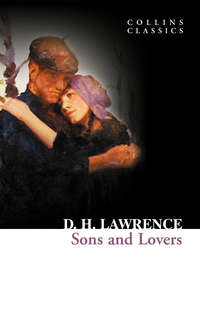
Kitabı oku: «Sons and Lovers»
Collins Classics
History of Collins
In 1819, Millworker William Collins from Glasgow, Scotland, set up a company for printing and publishing pamphlets, sermons, hymn books and prayer books. That company was Collins and was to mark the birth of HarperCollins Publishers as we know it today. The long tradition of Collins dictionary publishing can be traced back to the first dictionary William published in 1824, Greek and English Lexicon. Indeed, from 1840 onwards, he began to produce illustrated dictionaries and even obtained a licence to print and publish the Bible.
Soon after, William published the first Collins novel, Ready Reckoner, however it was the time of the Long Depression, where harvests were poor, prices were high, potato crops had failed and violence was erupting in Europe. As a result, many factories across the country were forced to close down and William chose to retire in 1846, partly due to the hardships he was facing.
Aged 30, William’s son, William II took over the business. A keen humanitarian with a warm heart and a generous spirit, William II was truly ‘Victorian’ in his outlook. He introduced new, up-to-date steam presses and published affordable editions of Shakespeare’s works and Pilgrim’s Progress, making them available to the masses for the first time. A new demand for educational books meant that success came with the publication of travel books, scientific books, encyclopaedias and dictionaries. This demand to be educated led to the later publication of atlases and Collins also held the monopoly on scripture writing at the time.
In the 1860s Collins began to expand and diversify and the idea of ‘books for the millions’ was developed. Affordable editions of classical literature were published and in 1903 Collins introduced 10 titles in their Collins Handy Illustrated Pocket Novels. These proved so popular that a few years later this had increased to an output of 50 volumes, selling nearly half a million in their year of publication. In the same year, The Everyman’s Library was also instituted, with the idea of publishing an affordable library of the most important classical works, biographies, religious and philosophical treatments, plays, poems, travel and adventure. This series eclipsed all competition at the time and the introduction of paperback books in the 1950s helped to open that market and marked a high point in the industry.
HarperCollins is and has always been a champion of the classics and the current Collins Classics series follows in this tradition – publishing classical literature that is affordable and available to all. Beautifully packaged, highly collectible and intended to be reread and enjoyed at every opportunity.
Life & Times
Post-Victorian Britain
David Herbert Lawrence was a creative talent who consistently tested the boundaries of acceptability through his work. He viewed post-Victorian Britain as morally bankrupt due to the effects of industri-alization and the associated changes in social structure and was generally regarded as antiestablishment by his contemporaries. The sexual content of his literature was considered by many at the time as little more than pornography prose. While other writers merely implied instances of sexual encounter in their work, Lawrence wrote detailed descriptive accounts of his character’s sexual exploits. He also dared to suggest that class divides were crossed for want of sexual gratification and for that he became something of a social pariah.
In his third novel; Sons and Lovers (1913), Lawrence explores the Oedipus complex – an unhealthy affection between a mother and her sons. The analytical psychologist Sigmund Freud had coined the term in 1910 and his work on psychology was very new and enticing during that period. Lawrence wrote the book, drawing upon and interpreting his own relationship with his mother. Sons and Lovers explores how difficult it can be for cosseted sons to escape the emotional ties of their mothers. The basic theme is that the protagonist, Paul Morel, always feels that his mother owns his soul even when he breaks away and takes a lover. He can therefore never fully give his soul to a lover.
Lawrence was also reportedly sexually confused in his early life. He had intimacies with young men as well as women and although in the book there are no homosexual encounters, his use of the term ‘lovers’ does suggest that Lawrence was hinting at gender ambiguity. The book shocked polite society as it was, because the plot could be boiled down to being a contest between love and lust. The first son dies from the metaphorical crossfire between his mother and his lover, while the second is left emotional bereft and forlorn following his own battle.
Shortly after the outbreak of World War I, Lawrence married a German divorcee named Frieda Weekley. He also publicly voiced his anti-war views which were at odds with the majority of the British Public who displayed a strong fighting spirit and will to win. The German connection and his expressed contempt meant that Lawrence and his wife were treated with a good deal of suspicion. In addition to this, Lawrence was investigated for obscenity in his writing. Everything came to a head when he and his wife were accused of spying for the Germans. They lived on the Cornish coast and were accused of signalling information to German U-boats. By 1917 the Lawrences had been forced to relocate to central England, away from the coastline, with use of the Defence of the Realm Act.
With the capitulation of the Germans in 1918 the war was ended and the Lawrences opted for voluntary exile abroad. In 1919 they moved to Italy and spent three years exploring southern Europe and a few years later in 1922 they emigrated to the US via Australia. Eventually Lawrence’s ill health forced them back to Europe where he received treatment for tuberculosis.
Lady Chatterley’s Lover
In his final years he drafted his most notorious novel; Lady Chatterley’s Lover, which was published in 1928, two years before his early death at the age of 44. The book caused an absolute outrage and was banned from publication in England until 1960. It was in the Sixties that Penguin publishing house took the case for its publication to court and a trial began which helped to redefine the British attitudes to sex and literature.
Lady Chatterley’s Lover was considered entirely unacceptable because it broke a number of rules. Firstly, it had a working-class man indulging in coitus with an upper-class woman. Secondly, it went into explicit detail about their sexual intercourse. Thirdly it used words that were banned from print at that time. All in all, it was too lewd for the British to even consider reading.
It has been suggested that Lawrence wrote his final novel as ‘one in the eye’ for the British in retaliation for his treatment during the war years. There is probably an element of this in his motive, but he also saw himself as a voice of truth. Having come from humble beginnings, he had a problem with the veneer of respectability that the British upheld in his day. So, his instinct was to tear it away in the only way he knew how: by deconstructing British society and exposing what he saw as the truth.
Lawrence was one of the first novelists to realize that the ability to write brings power and the ability to commit one’s views to paper imbues them with potency. It is because the ownership of those views can be passed to others and disseminated to many more. What is more, they live on independent of their originator, as was illustrated perfectly by Lawrence’s untimely death.
Lady Chatterley’s Lover demonstrated that the animal is still in us all, no matter how we may pretend to be above our instinctual urges. Our evolutionary success owes itself to our desire to procreate as organisms regardless of social factors and that is essentially the theme of the book. Lawrence felt that to address such a primal behaviour deserved the use of explicit and expletive language to drive the point home. The attempt to do this in the 1920s was perhaps Lawrence’s biggest mistake – it wasn’t until the sexual revolution of the 1960s that Britain was ready for Lady Chatterley’s Lover and the jury at the trial decided after five days at court that the book did not subvert morals or religion. On its first day of publication, Lady Chatterley’s Lover sold 200,000 copies.
D. H. Lawrence’s Motives
Some creative people possess a desire to use their chosen medium as a form of self expression to such an extent that they are perceived as dangerously subversive and D. H. Lawrence certainly fits into that bracket. Partly fuelled by his contempt for conventions surrounding the ‘done thing’, but also because he had a genuinely libertarian mindset, Lawrence could not tow the line. In his opinion, if people were offended by his writing, it was because they were too concerned about society and what others thought of them. Lawrence possessed a kind of self-confidence borne of a desire to speak his mind. What he failed to acknowledge is that societies require rules to prevent them from descending into anarchy. And to preserve those rules, it requires people to be conservative about conventions and orthodoxies. It wasn’t that those in authority necessarily disagreed wholeheartedly with Lawrence’s take on humanity, but that they felt it was unnecessary to express it, as everyone already knew that people broke the rules.
With that as a starting point it meant that Lawrence’s novels were automatically reduced to being sensationalistic prose, peppered with adolescent facetiousness by way of over-indulgent descriptions of sex and the kind of language that was the preserve of the spoken word in insalubrious circumstances.
Some have attributed Lawrence’s turbulence to his sexual confusion as a young man. It is known that he had affections for members of the same sex, but in later life took a wife, which perhaps suggests that his courage drew short of open homosexuality. It may be that this imposed behavioural censorship was such a frustration to him that he used his literature as an outlet to vent his spleen at a society that would not let him be himself.
Table of Contents
Cover Page
Title Page
History of Collins
Life & Times
PART ONE
CHAPTER 1 The Early Married Life of the Morels
CHAPTER 2 The Birth of Paul, and another Battle
CHAPTER 3 The Casting off of Morel—the Taking on of William
CHAPTER 4 The Young Life of Paul
CHAPTER 5 Paul Launches into Life
CHAPTER 6 Death in the Family
PART TWO
CHAPTER 7 Lad-and-Girl Love
CHAPTER 8 Strife in Love
CHAPTER 9 Defeat of Miriam
CHAPTER 10 Clara
CHAPTER 11 The Test on Miriam
CHAPTER 12 Passion
CHAPTER 13 Baxter Dawes
CHAPTER 14 The Release
CHAPTER 15 Derelict
CLASSIC LITERATURE: WORDS AND PHRASES adapted from the Collins English Dictionary
Copyright
About the Publisher
PART ONE
CHAPTER 1 The Early Married Life of the Morels
“The Bottoms” succeeded to “Hell Row.” Hell Row was a block of thatched, bulging cottages that stood by the brookside on Greenhill Lane. There lived the colliers who worked in the little gin-pits two fields away. The brook ran under the alder trees, scarcely soiled by these small mines, whose coal was drawn to the surface by donkeys that plodded wearily in a circle round a gin. And all over the countryside were these same pits, some of which had been worked in the time of Charles II, the few colliers and the donkeys burrowing down like ants into the earth, making queer mounds and little black places among the corn-fields and the meadows. And the cottages of these coalminers, in blocks and pairs here and there, together with odd farms and homes of the stockingers, straying over the parish, formed the village of Bestwood.
Then, some sixty years ago, a sudden change took place. The gin-pits were elbowed aside by the large mines of the financiers. The coal and iron field of Nottinghamshire and Derbyshire was discovered. Carston, Waite and Co. appeared. Amid tremendous excitement, Lord Palmerston formally opened the company’s first mine at Spinney Park, on the edge of Sherwood Forest.
About this time the notorious Hell Row, which through growing old had acquired an evil reputation, was burned down, and much dirt was cleansed away.
Carston, Waite and Co. found they had struck on a good thing, so, down the valleys of the brooks from Selby and Nuttall, new mines were sunk, until soon there were six pits working. From Nuttall, high up on the sandstone among the woods, the railway ran, past the ruined priory of the Carthusians and past Robin Hood’s Well, down to Spinney Park, then on to Minton, a large mine among corn-fields; from Minton across the farm-lands of the valleyside to Bunker’s Hill, branching off there, and running north to Beggarlee and Selby, that looks over at Crich and the hills of Derbyshire; six mines like black studs on the countryside, linked by a loop of fine chain, the railway.
To accommodate the regiments of miners, Carston, Waite and Co. built the Squares, great quadrangles of dwellings on the hillside of Bestwood, and then, in the brook valley, on the site of Hell Row, they erected the Bottoms.
The Bottoms consisted of six blocks of miners’ dwellings, two rows of three, like the dots on a blank-six domino, and twelve houses in a block. This double row of dwellings sat at the foot of the rather sharp slope from Bestwood, and looked out, from the attic windows at least, on the slow climb of the valley towards Selby.
The houses themselves were substantial and very decent. One could walk all round, seeing little front gardens with auriculas and saxifrage in the shadow of the bottom block, sweet-williams and pinks in the sunny top block; seeing neat front windows, little porches, little privet hedges, and dormer windows for the attics. But that was outside; that was the view on to the uninhabited parlours of all the colliers’ wives. The dwelling-room, the kitchen, was at the back of the house, facing inward between the blocks, looking at a scrubby back garden, and then at the ash-pits. And between the rows, between the long lines of ash-pits, went the alley, where the children played and the women gossiped and the men smoked. So, the actual conditions of living in the Bottoms, that was so well built and that looked so nice, were quite unsavoury because people must live in the kitchens, and the kitchens opened on to that nasty alley of ash-pits.
Mrs. Morel was not anxious to move into the Bottoms, which was already twelve years old and on the downward path, when she descended to it from Bestwood. But it was the best she could do. Moreover, she had an end house in one of the top blocks, and thus had only one neighbour; on the other side an extra strip of garden. And, having an end house, she enjoyed a kind of aristocracy among the other women of the “between” houses, because her rent was five shillings and sixpence instead of five shillings a week. But this superiority in station was not much consolation to Mrs. Morel.
She was thirty-one years old, and had been married eight years. A rather small woman, of delicate mould but resolute bearing, she shrank a little from the first contact with the Bottoms women. She came down in the July, and in the September expected her third baby.
Her husband was a miner. They had only been in their new home three weeks when the wakes, or fair, began. Morel, she knew, was sure to make a holiday of it. He went off early on the Monday morning, the day of the fair. The two children were highly excited. William, a boy of seven, fled off immediately after breakfast, to prowl round the wakes ground, leaving Annie, who was only five, to whine all morning to go also. Mrs. Morel did her work. She scarcely knew her neighbours yet, and knew no one with whom to trust the little girl. So she promised to take her to the wakes after dinner.
William appeared at half-past twelve. He was a very active lad, fair-haired, freckled, with a touch of the Dane or Norwegian about him.
“Can I have my dinner, mother?” he cried, rushing in with his cap on. “‘cause it begins at half-past one, the man says so.”
“You can have your dinner as soon as it’s done,” replied the mother.
“Isn’t it done?” he cried, his blue eyes staring at her in indignation. “Then I’m goin’ be-out it.”
“You’ll do nothing of the sort. It will be done in five minutes. It is only half-past twelve.”
“They’ll be beginnin’,” the boy half cried, half shouted.
“You won’t die if they do,” said the mother. “Besides, it’s only half-past twelve, so you’ve a full hour.”
The lad began hastily to lay the table, and directly the three sat down. They were eating batter-pudding and jam, when the boy jumped off his chair and stood perfectly still. Some distance away could be heard the first small braying of a merry-go-round, and the tooting of a horn. His face quivered as he looked at his mother.
“I told you!” he said, running to the dresser for his cap.
“Take your pudding in your hand—and it’s only five past one, so you were wrong—you haven’t got your twopence,” cried the mother in a breath.
The boy came back, bitterly disappointed, for his twopence, then went off without a word.
“I want to go, I want to go,” said Annie, beginning to cry.
“Well, and you shall go, whining, wizzening little stick!” said the mother. And later in the afternoon she trudged up the hill under the tall hedge with her child. The hay was gathered from the fields, and cattle were turned on to the eddish. It was warm, peaceful.
Mrs. Morel did not like the wakes. There were two sets of horses, one going by steam, one pulled round by a pony; three organs were grinding, and there came odd cracks of pistol-shots, fearful screeching of the coconut man’s rattle, shouts of the Aunt Sally man, screeches from the peep-show lady. The mother perceived her son gazing enraptured outside the Lion Wallace booth, at the pictures of this famous lion that had killed a negro and maimed for life two white men. She left him alone, and went to get Annie a spin of toffee. Presently the lad stood in front of her, wildly excited.
“You never said you was coming—isn’t the’ a lot of things?—that lion’s killed three men—I’ve spent my tuppence—an’ look here.”
He pulled from his pocket two egg-cups, with pink moss-roses on them.
“I got these from that stall where y’ave ter get them marbles in them holes. An’ I got these two in two goes—’aepenny a go—they’ve got moss-roses on, look here. I wanted these.”
She knew he wanted them for her.
“H’m!” she said, pleased. “They are pretty!”
“Shall you carry ‘em, ‘cause I’m frightened o’ breakin’ em?”
He was tipful of excitement now she had come, led her about the ground, showed her everything. Then, at the peep-show, she explained the pictures, in a sort of story, to which he listened as if spellbound. He would not leave her. All the time he stuck close to her, bristling with a small boy’s pride of her. For no other woman looked such a lady as she did, in her little black bonnet and her cloak. She smiled when she saw women she knew. When she was tired she said to her son:
“Well, are you coming now, or later?”
“Are you goin’ a’ready?” he’cried, his face full of reproach.
“Already? It is past four, I know.”
“What are you goin’ a’ready for?” he lamented.
“You needn’t come if you don’t want,” she said.
And she went slowly away with her little girl, whilst her son stood watching her, cut to the heart to let her go, and yet unable to leave the wakes. As she crossed the open ground in front of the Moon and Stars she heard men shouting, and smelled the beer, and hurried a little, thinking her husband was probably in the bar.
At about half-past six her son came home, tired now, rather pale, and somewhat wretched. He was miserable, though he did not know it, because he had let her go alone. Since she had gone, he had not enjoyed his wakes.
“Has my dad been?” he asked.
“No,” said the mother.
“He’s helping to wait at the Moon and Stars. I seed him through that black tin stuff wi’ holes in, on the window, wi’ his sleeves rolled up.”
“Ha!” exclaimed the mother shortly. “He’s got no money. An’ he’ll be satisfied if he gets his ‘lowance, whether they give him more or not.”
When the light was fading, and Mrs. Morel could see no more to sew, she rose and went to the door. Everywhere was the sound of excitement, the restlessness of the holiday, that at last infected her. She went out into the side garden. Women were coming home from the wakes, the children hugging a white lamb with green legs, or a wooden horse. Occasionally a man lurched past, almost as full as he could carry. Sometimes a good husband came along with his family, peacefully. But usually the women and children were alone. The stay-at-home mothers stood gossiping at the corners of the alley, as the twilight sank, folding their arms under their white aprons.
Mrs. Morel was alone, but she was used to it. Her son and her little girl slept upstairs; so, it seemed, her home was there behind her, fixed and stable. But she felt wretched with the coming child. The world seemed a dreary place, where nothing else would happen for her—at least until William grew up. But for herself, nothing but this dreary endurance—till the children grew up. And the children! She could not afford to have this third. She did not want it. The father was serving beer in a public-house, swilling himself drunk. She despised him, and was tied to him. This coming child was too much for her. If it were not for William and Annie, she was sick of it, the struggle with poverty and ugliness and meanness.
She went into the front garden, feeling too heavy to take herself out, yet unable to stay indoors. The heat suffocated her. And looking ahead, the prospect of her life made her feel as if she were buried alive.
The front garden was a small square with a privet hedge. There she stood, trying to soothe herself with the scent of flowers and the fading, beautiful evening. Opposite her small gate was the stile that led uphill, under the tall hedge, between the burning glow of the cut pastures. The sky overhead throbbed and pulsed with light. The glow sank quickly off the field; the earth and the hedges smoked dusk. As it grew dark, a ruddy glare came out on the hilltop, and out of the glare the diminished commotion of the fair.
Sometimes, down the trough of darkness formed by the path under the hedges, men came lurching home. One young man lapsed into a run down the steep bit that ended the hill, and went with a crash into the stile. Mrs. Morel shuddered. He picked himself up, swearing viciously, rather pathetically, as if he thought the stile had wanted to hurt him.
She went indoors, wondering if things were never going to alter. She was beginning by now to realize that they would not. She seemed so far away from her girlhood, she wondered if it were the same person walking heavily up the back garden at the Bottoms as had run so lightly on the breakwater at Sheerness ten years before.
“What have I to do with it?” she said to herself. “What have I to do with all this? Even the child I am going to have! It doesn’t seem as if I were taken into account.”
Sometimes life takes hold of one, carries the body along, accomplishes one’s history, and yet is not real, but leaves oneself as it were slurred over.
“I wait,” Mrs. Morel said to herself—“I wait, and what I wait for can never come.”
Then she straightened the kitchen, lit the lamp, mended the fire, looked out the washing for the next day, and put it to soak. After which she sat down to her sewing. Through the long hours her needle flashed regularly through the stuff. Occasionally she sighed, moving to relieve herself. And all the time she was thinking how to make the most of what she had, for the children’s sakes.
At half-past eleven her husband came. His cheeks were very red and very shiny above his black moustache. His head nodded slightly. He was pleased with himself.
“Oh! Oh! waitin’ for me, lass? I’ve bin ‘elpin’ Anthony, an’ what’s think he’s gen me? Nowt b’r a lousy hae’f-crown, an’ that’s ivry penny—”
“He thinks you’ve made the rest up in beer,” she said shortly.
“An’ I ‘aven’t—that I ‘aven’t. You b’lieve me, I’ve ‘ad very little this day, I have an’ all.” His voice went tender. “Here, an’ I browt thee a bit o’ brandysnap, an’ a coconut for th’ children.” He laid the gingerbread and the coconut, a hairy object, on the table. “Nay, tha niver said thankyer for nowt i’ thy life, did ter?”
As a compromise, she picked up the coconut and shook it, to see if it had any milk.
“It’s a good ‘un, you may back yer life o’ that. I got it fra’ Bill Hodgkisson. ‘Bill,’ I says, ‘tha non wants them three nuts, does ter? Arena ter for gi’ein’ me one for my bit of a lad an’ wench?’ ‘I ham, Walter, my lad,’ ‘e says; ‘ta’e which on ‘em ter’s a mind.’ An’ so I took one, an’ thanked ‘im. I didn’t like ter shake it afore ‘is eyes, but ‘e says, ‘Tha’d better ma’e sure it’s a good un, Walt.’ An’ so, yer see, I knowed it was. He’s a nice chap, is Bill Hodgkisson, ‘e’s a nice chap!”
“A man will part with anything so long as he’s drunk, and you’re drunk along with him,” said Mrs. Morel.
“Eh, tha mucky little ‘ussy, who’s drunk, I sh’d like ter know?” said Morel. He was extraordinarily pleased with himself, because of his day’s helping to wait in the Moon and Stars. He chattered on.
Mrs. Morel, very tired, and sick of his babble, went to bed as quickly as possible, while he raked the fire.
Mrs. Morel came of a good old burgher family, famous independents who had fought with Colonel Hutchinson, and who remained stout Congregationalists. Her grandfather had gone bankrupt in the lace-market at a time when so many lace-manufacturers were ruined in Nottingham. Her father, George Coppard, was an engineer—a large, handsome, haughty man, proud of his fair skin and blue eyes, but more proud still of his integrity. Gertrude resem-bled her mother in her small build. But her temper, proud and unyielding, she had from the Coppards.
George Coppard was bitterly galled by his own poverty. He became foreman of the engineers in the dockyard at Sheerness. Mrs. Morel—Gertrude—was the second daughter. She favoured her mother, loved her mother best of all; but she had the Coppard’s clear, defiant blue eyes and their broad brow. She remembered to have hated her father’s overbearing manner towards her gentle, humorous, kindly-souled mother. She remembered running over the breakwater at Sheerness and finding the boat. She remembered to have been petted and flattered by all the men when she had gone to the dockyard, for she was a delicate, rather proud child. She remembered the funny old mistress, whose assistant she had become, whom she had loved to help in the private school. And she still had the Bible that John Field had given her. She used to walk home from chapel with John Field when she was nineteen. He was the son of a well-to-do tradesman, had been to college in London, and was to devote himself to business.
She could always recall in detail a September Sunday afternoon, when they sat under the vine at the back of her father’s house. The sun came through the chinks in the vine-leaves and made beautiful patterns, like a lace scarf, falling on her and on him. Some of the leaves were clean yellow, like yellow flat flowers.
“Now sit still,” he had cried. “Now your hair, I don’t know what it is like! It’s as bright as copper and gold, as red as burnt copper, and it has gold threads where the sun shines on it. Fancy their saying it’s brown. Your mother calls it mouse-colour.”
She had met his brilliant eyes, but her clear face scarcely showed the elation which rose within her.
“But you say you don’t like business,” she pursued.
“I don’t. I hate it!” he cried hotly.
“And you would like to go into the ministry,” she half implored.
“I should. I should love it, if I thought I could make a first-rate preacher.”
“Then why don’t you—why don’t you?” Her voice rang with defiance. “If I were a man, nothing would stop me.”
She held her head erect. He was rather timid before her.
“But my father’s so stiff-necked. He means to put me into the business, and I know he’ll do it.”
“But if you’re a man?” she had cried.
“Being a man isn’t everything,” he replied, frowning with puzzled helplessness.
Now, as she moved about her work at the Bottoms, with some experience of what being a man meant, she knew that it was not everything.
At twenty, owing to her health, she had left Sheerness. Her father had retired home to Nottingham. John Field’s father had been ruined; the son had gone as a teacher in Norwood. She did not hear of him until, two years later, she made determined inquiry. He had married his landlady, a woman of forty, a widow with property.
And still Mrs. Morel preserved John Field’s Bible. She did not now believe him to be—. Well, she understood pretty well what he might or might not have been. So she preserved his Bible, and kept his memory intact in her heart, for her own sake. To her dying day, for thirty-five years, she did not speak of him.
“Good gracious,” she cried, “coming home in his drunkenness!”
“Comin’ home in his what?” he snarled, his hat over his eye. Suddenly her blood rose in a jet.
“Say you’re not drunk!” she flashed.
She had put down her saucepan, and was stirring the sugar into the beer. He dropped his two hands heavily on the table, and thrust his face forward at her.
“‘Say you’re not drunk,’” he repeated. “Why, nobody but a nasty little bitch like you ‘ud’ ave such a thought.”
He thrust his face forward at her.
“There’s money to bezzle with, if there’s money for nothing else.”
“I’ve not spent a two-shillin’ bit this day,” he said.
“You don’t get as drunk as a lord on nothing,” she replied.
“And,” she cried, flashing into sudden fury, “if you’ve been sponging on your beloved Jerry, why, let him look after his children, for they need it.”
“It’s a lie, it’s a lie. Shut your face, woman.”
They were now at battle-pitch. Each forgot everything save the hatred of each other and the battle between them. She was fiery and furious as he. They went on till he called her a liar.
“No,” she cried, starting up, scarce able to breathe. “Don’t call me that—you, the most despicable liar that ever walked in shoe-leather.” She forced the last words out of suffocated lungs.
“You’re a liar!” he yelled, banging the table with his fist. “You’re a liar, you’re a liar.”
She stiffened herself, with clenched fists.
“The house is filthy with you,” she cried.
“Then get out on it—it’s mine. Get out on it!” he shouted. “It’s me as brings th’ money whoam, not thee. It’s my house, not thine. Then ger out on’t—ger out on’t!”
“And I would,” she cried, suddenly shaken into tears of impotence. “Ah, wouldn’t I, wouldn’t I have gone long ago, but for those children. Ay, haven’t I repented not going years ago, when I’d only the one”—suddenly drying into rage. “Do you think it’s for you I stop—do you think I’d stop one minute for you?”
“Go, then,” he shouted, beside himself. “Go!”
“No!” she faced round. “No,” she cried loudly, “you shan’t have it all your own way; you shan’t do all you like. I’ve got those children to see to. My word,” she laughed, “I should look well to leave them to you.”
“Go,” he cried thickly, lifting his fist. He was afraid of her. “Go!”
“I should be only too glad. I should laugh, laugh, my lord, if I could get away from you,” she replied.
He came up to her, his red face, with its bloodshot eyes, thrust forward, and gripped her arms. She cried in fear of him, struggled to be free. Coming slightly to himself, panting, he pushed her roughly to the outer door, and thrust her forth, slotting the bolt behind her with a bang. Then he went back into the kitchen, dropped into his armchair, his head, bursting full of blood, sinking between his knees. Thus he dipped gradually into a stupor, from exhaustion and intoxication.
The moon was high and magnificent in the August night. Mrs. Morel, seared with passion, shivered to find herself out there in a great white light, that fell cold on her, and gave a shock to her inflamed soul. She stood for a few moments helplessly staring at the glistening great rhubarb leaves near the door. Then she got the air into her breast. She walked down the garden path, trembling in every limb, while the child boiled within her. For a while she could not control her consciousness; mechanically she went over the last scene, then over it again, certain phrases, certain moments coming each time like a brand red-hot down on her soul; and each time she enacted again the past hour, each time the brand came down at the same points, till the mark was burnt in, and the pain burnt out, and at last she came to herself. She must have been half an hour in this delirious condition. Then the presence of the night came again to her. She glanced round in fear. She had wandered to the side garden, where she was walking up and down the path beside the currant bushes under the long wall. The garden was a narrow strip, bounded from the road, that cut transversely between the blocks, by a thick thorn hedge.
She hurried out of the side garden to the front, where she could stand as if in an immense gulf of white light, the moon streaming high in face of her, the moonlight standing up from the hills in front, and filling the valley where the Bottoms crouched, almost blindingly. There, panting and half weeping in reaction from the stress, she murmured to herself over and over again: “The nuisance! the nuisance!”
She became aware of something about her. With an effort she roused herself to see what it was that penetrated her consciousness. The tall white lilies were reeling in the moonlight, and the air was charged with their perfume, as with a presence. Mrs. Morel gasped slightly in fear. She touched the big, pallid flowers on their petals, then shivered. They seemed to be stretching in the moonlight. She put her hand into one white bin: the gold scarcely showed on her fingers by moonlight. She bent down to look at the binful of yellow pollen; but it only appeared dusky. Then she drank a deep draught of the scent. It almost made her dizzy.
Mrs. Morel leaned on the garden gate, looking out, and she lost herself awhile. She did not know what she thought. Except for a slight feeling of sickness, and her consciousness in the child, herself melted out like scent into the shiny, pale air. After a time the child, too, melted with her in the mixing-pot of moonlight, and she rested with the hills and lilies and houses, all swum together in a kind of swoon.
When she came to herself she was tired for sleep. Languidly she looked about her; the clumps of white phlox seemed like bushes spread with linen; a moth ricochetted over them, and right across the garden. Following it with her eye roused her. A few whiffs of the raw, strong scent of phlox invigorated her. She passed along the path, hesitating at the white rose-bush. It smelled sweet and simple. She touched the white ruffles of the roses. Their fresh scent and cool, soft leaves reminded her of the morning-time and sunshine. She was very fond of them. But she was tired, and wanted to sleep. In the mysterious out-of-doors she felt forlorn.
There was no noise anywhere. Evidently the children had not been wakened, or had gone to sleep again. A train, three miles away, roared across the valley. The night was very large, and very strange, stretching its hoary distances infinitely. And out of the silver-grey fog of darkness came sounds vague and hoarse: a corncrake not far off, sound of a train like a sigh, and distant shouts of men.
Her quietened heart beginning to beat quickly again, she hurried down the side garden to the back of the house. Softly she lifted the latch; the door was still bolted, shut hard against her. She rapped gently, waited, then rapped again. She must not rouse the children, nor the neighbours. He must be asleep, and he would not wake easily. Her heart began to burn to be indoors. She clung to the doorhandle. Now it was cold; she would take a chill, and in her present condition!
Putting her apron over her head and her arms, she hurried again to the side garden, to the window of the kitchen. Leaning on the sill, she could just see, under the blind, her husband’s arms spread out on the table, and his black head on the board. He was sleeping with his face lying on the table. Something in his attitude made her feel tired of things. The lamp was burning smokily; she could tell by the copper colour of the light. She tapped at the window more and more noisily. Almost it seemed as if the glass would break. Still he did not wake up.
After vain efforts, she began to shiver, partly from contact with the stone, and from exhaustion. Fearful always for the unborn child, she wondered what she could do for warmth. She went down to the coal-house, where was an old hearthrug she had carried out for the rag-man the day before. This she wrapped over her shoulders. It was warm, if grimy. Then she walked up and down the garden path, peeping every now and then under the blind, knocking, and telling herself that in the end the very strain of his position must wake him.
At last, after about an hour, she rapped long and low at the window. Gradually the sound penetrated to him. When, in despair, she had ceased to tap, she saw him stir, then lift his face blindly. The labouring of his heart hurt him into consciousness. She rapped imperatively at the window. He started awake. Instantly she saw his fists set and his eyes glare. He had not a grain of physical fear. If it had been twenty burglars, he would have gone blindly for them. He glared round, bewildered, but prepared to fight.
“Open the door, Walter,” she said coldly.
His hands relaxed. It dawned on him what he had done. His head dropped, sullen and dogged. She saw him hurry to the door, heard the bolt chock. He tried the latch. It opened—and there stood the silver-grey night, fearful to him, after the tawny light of the lamp. He hurried back.
When Mrs. Morel entered, she saw him almost running through the door to the stairs. He had ripped his collar off his neck in his haste to be gone ere she came in, and there it lay with bursten button-holes. It made her angry.
She warmed and soothed herself. In her weariness forgetting everything, she moved about at the little tasks that remained to be done, set his breakfast, rinsed his pit-bottle, put his pit-clothes on the hearth to warm, set his pit-boots beside them, put him out a clean scarf and snap-bag and two apples, raked the fire, and went to bed. He was already dead asleep. His narrow black eyebrows were drawn up in a sort of peevish misery into his forehead, while his cheeks’ down strokes, and his sulky mouth, seemed to be saying: “I don’t care who you are nor what you are, I shall have my own way.”
Mrs. Morel knew him too well to look at him. As she unfastened her brooch at the mirror, she smiled faintly to see her face all smeared with yellow dust of lilies. She brushed it off, and at last lay down. For some time her mind continued snapping and jetting sparks, but she was asleep before her husband awoke from the first sleep of his drunkenness.
CHAPTER 2 The Birth of Paul, and another Battle
After such a scene as the last, Walter Morel was for some days abashed and ashamed, but he soon regained his old bullying indifference. Yet there was a slight shrinking, a diminishing in his assurance. Physically even, he shrank, and his fine full presence waned. He never grew in the least stout, so that, as he sank from his erect, assertive bearing, his physique seemed to contract along with his pride and moral strength.
But now he realised how hard it was for his wife to drag about at her work, and, his sympathy quickened by penitence, hastened forward with his help. He came straight home from the pit, and stayed in at evening till Friday, and then he could not remain at home. But he was back again by ten o’clock, almost quite sober.
He always made his own breakfast. Being a man who rose early and had plenty of time he did not, as some miners do, drag his wife out of bed at six o’clock. At five, sometimes earlier, he woke, got straight out of bed, and went downstairs. When she could not sleep, his wife lay waiting for this time, as for a period of peace. The only real rest seemed to be when he was out of the house.
He went downstairs in his shirt and then struggled into his pit-trousers, which were left on the hearth to warm all night. There was always a fire, because Mrs. Morel raked. And the first sound in the house was the bang, bang of the poker against the raker, as Morel smashed the remainder of the coal to make the kettle, which was filled and left on the hob, finally boil. His cup and knife and fork, all he wanted except just the food, was laid ready on the table on a newspaper. Then he got his breakfast, made the tea, packed the bottom of the doors with rugs to shut out the draught, piled a big fire, and sat down to an hour of joy. He toasted his bacon on a fork and caught the drops of fat on his bread; then he put the rasher on his thick slice of bread, and cut off chunks with a clasp-knife, poured his tea into his saucer, and was happy. With his family about, meals were never so pleasant. He loathed a fork; it is a modern introduction which has still scarcely reached common people. What Morel preferred was a clasp-knife. Then, in solitude, he ate and drank, often sitting, in cold weather, on a little stool with his back to the warm chimney-piece, his food on the fender, his cup on the hearth. And then he read the last night’s newspaper—what of it he could—spelling it over laboriously. He preferred to keep the blinds down and the candle lit even when it was daylight; it was the habit of the mine.
At a quarter to six he rose, cut two thick slices of bread and butter, and put them in the white calico snap-bag. He filled his tin bottle with tea. Cold tea without milk or sugar was the drink he preferred for the pit. Then he pulled off his shirt, and put on his pit-singlet, a vest of thick flannel cut low round the neck, and with short sleeves like a chemise.
Then he went upstairs to his wife with a cup of tea because she was ill, and because it occurred to him.
“I’ve brought thee a cup o’ tea, lass,” he said.
“Well, you needn’t, for you know I don’t like it,” she replied.
“Drink it up; it’ll pop thee off to sleep again.”
She accepted the tea. It pleased him to see her take it and sip it.
“I’ll back my life there’s no sugar in,” she said.
“Yi—there’s one big un,” he replied, injured.
“It’s a wonder,” she said, sipping again.
She had a winsome face when her hair was loose. He loved her to grumble at him in this manner. He looked at her again, and went, without any sort of leave-taking. He never took more than two slices of bread and butter to eat in the pit, so an apple or an orange was a treat to him. He always liked it when she put one out for him. He tied a scarf round his neck, put on his great, heavy boots, his coat, with the big pocket, that carried his snap-bag and his bottle of tea, and went forth into the fresh morning air, closing, without locking, the door behind him. He loved the early morning, and the walk across the fields. So he appeared at the pit-top, often with a stalk from the hedge between his teeth, which he chewed all day to keep his mouth moist, down the mine, feeling quite as happy as when he was in the field.
Later, when the time for the baby grew nearer, he would bustle round in his slovenly fashion, poking out the ashes, rubbing the fireplace, sweeping the house before he went to work. Then, feeling self-righteous, he went upstairs.
“Now I’m cleaned up for thee; tha’s no ‘casions ter stir a peg all day, but sit and read thy books.”
Which made her laugh, in spite of her indignation.
“And the dinner cooks itself?” she answered.
“Eh, I know nowt about th’ dinner.”
“You’d know if there weren’t any.”
“Ay, ‘appen so,” he answered, departing.
When she got downstairs, she would find the house tidy, but dirty. She could not rest until she had thoroughly cleaned; so she went down to the ash-pit with her dust-pan. Mrs. Kirk, spying her, would contrive to have to go to her own coal-place at that minute. Then, across the wooden fence, she would call:
“So you keep wagging on, then?”
“Ay,” answered Mrs. Morel deprecatingly. “There’s nothing else for it.”
“Have you seen Hose?” called a very small woman from across the road. It was Mrs. Anthony, a black-haired, strange little body, who always wore a brown velvet dress, tight fitting.
“I haven’t,” said Mrs. Morel.
“Eh, I wish he’d come. I’ve got a copperful of clothes, an’ I’m sure I heered his bell.”
“Hark! He’s at the end.”
The two women looked down the alley. At the end of the Bottoms a man stood in a sort of old-fashioned trap, bending over bundles of cream-coloured stuff; while a cluster of women held up their arms to him, some with bundles. Mrs. Anthony herself had a heap of creamy, undyed stockings hanging over her arm.
“I’ve done ten dozen this week,” she said proudly to Mrs. Morel.
“T-t-t!” went the other. “I don’t know how you can find time.”
“Eh!” said Mrs. Anthony. “You can find time if you make time.”
“I don’t know how you do it,” said Mrs. Morel, “And how much shall you get for those many?”
“Tuppence-ha’penny a dozen,” replied the other.
“Well,” said Mrs. Morel, “I’d starve before I’d sit down and seam twenty-four stockings for twopence ha’penny.”
“Oh, I don’t know,” said Mrs. Anthony. “You can rip along with ‘em.”
Hose was coming along, ringing his bell. Women were waiting at the yard-ends with their seamed stockings hanging over their arms. The man, a common fellow, made jokes with them, tried to swindle them, and bullied them. Mrs. Morel went up her yard disdainfully.
It was an understood thing that if one woman wanted her neighbour, she should put the poker in the fire and bang at the back of the fireplace, which, as the fires were back to back, would make a great noise in the adjoining house. One morning Mrs. Kirk, mixing a pudding, nearly started out of her skin as she heard the thud, thud, in her grate. With her hands all floury, she rushed to the fence.
“Did you knock, Mrs. Morel?”
“If you wouldn’t mind, Mrs. Kirk.”
Mrs. Kirk climbed on to her copper, got over the wall on to Mrs. Morel’s copper, and ran in to her neighbour.
“Eh, dear, how are you feeling?” she cried in concern.
“You might fetch Mrs. Bower,” said Mrs. Morel.
Mrs. Kirk went into the yard, lifted up her strong, shrill voice, and called:
“Ag-gie-Ag-gie!”
The sound was heard from one end of the Bottoms to the other. At last Aggie came running up, and was sent for Mrs. Bower, whilst Mrs. Kirk left her pudding and stayed with her neighbour.
Mrs. Morel went to bed. Mrs. Kirk had Annie and William for dinner. Mrs. Bower, fat and waddling, bossed the house.
“Hash some cold meat up for the master’s dinner, and make him an apple-charlotte pudding,” said Mrs. Morel.
“He may go without pudding this day,” said Mrs. Bower.
Morel was not as a rule one of the first to appear at the bottom of the pit, ready to come up. Some men were there before four o’clock, when the whistle blew loose-all; but Morel, whose stall, a poor one, was at this time about a mile and a half away from the bottom, worked usually till the first mate stopped, then he finished also. This day, however, the miner was sick of the work. At two o’clock he looked at his watch, by the light of the green candle—he was in a safe working—and again at half-past two. He was hewing at a piece of rock that was in the way for the next day’s work. As he sat on his heels, or kneeled, giving hard blows with his pick, “Uszza—uszza!” he went.
“Shall ter finish, Sorry?”* cried Barker, his fellow butty.
“Finish? Niver while the world stands!” growled Morel.
And he went on striking. He was tired.
“It’s a heart-breaking job,” said Barker.
But Morel was too exasperated, at the end of his tether, to answer. Still he struck and hacked with all his might.
“Tha might as well leave it, Walter,” said Barker. “It’ll do to-morrow, without thee hackin’ thy guts out.”
“I’ll lay no b—finger on this to-morrow, Isr’el!” cried Morel.
“Oh, well, if tha wunna, someb’dy else ‘ll ha’e to,” said Israel.
Then Morel continued to strike.
“Hey-up there—loose-a’!” cried the men, leaving the next stall.
Morel continued to strike.
“Tha’ll happen catch me up,” said Barker, departing.
When he had gone, Morel, left alone, felt savage. He had not finished his job. He had overworked himself into a frenzy. Rising, wet with sweat, he threw his tool down, pulled on his coat, blew out his candle, took his lamp, and went. Down the main road the lights of the other men went swinging. There was a hollow sound of many voices. It was a long, heavy tramp underground.
He sat at the bottom of the pit, where the great drops of water fell splash. Many colliers were waiting their turns to go up, talking noisily. Morel gave his answers short and disagreeable.
“It’s rainin’, Sorry,” said old Giles, who had had the news from the top.
Morel found one comfort. He had his old umbrella, which he loved, in the lamp cabin. At last he took his stand on the chair, and was at the top in a moment. Then he handed in his lamp and got his umbrella, which he had bought at an auction for one-and-six. He stood on the edge of the pit-bank for a moment, looking out over the fields; grey rain was falling. The trucks stood full of wet, bright coal. Water ran down the sides of the waggons, over the white “C. W. and Co.” Colliers, walking indifferent to the rain, were streaming down the line and up the field, a grey, dismal host. Morel put up his umbrella, and took pleasure from the peppering of the drops thereon.
All along the road to Bestwood the miners tramped, wet and grey and dirty, but their red mouths talking with animation. Morel also walked with a gang, but he said nothing. He frowned peevishly as he went. Many men passed into the Prince of Wales or into Ellen’s. Morel, feeling sufficiently disagreeable to resist temptation, trudged along under the dripping trees that overhung the park wall, and down the mud of Greenhill Lane.
Mrs. Morel lay in bed, listening to the rain, and the feet of the colliers from Minton, their voices, and the bang, bang of the gates as they went through the stile up the field.
“There’s some herb beer behind the pantry-door,” she said. “Th’ master ‘ll want a drink, if he doesn’t stop.”
But he was late, so she concluded he had called for a drink, since it was raining. What did he care about the child or her?
She was very ill when her children were born.
“What is it?” she asked, feeling sick to death.
“A boy.”
And she took consolation in that. The thought of being the mother of men was warming to her heart. She looked at the child. It had blue eyes, and a lot of fair hair, and was bonny. Her love came up hot, in spite of everything. She had it in bed with her.
Morel, thinking nothing, dragged his way up the garden path, wearily and angrily. He closed his umbrella, and stood it in the sink; then he sluthered his heavy boots into the kitchen. Mrs. Bower appeared in the inner doorway.
“Well,” she said, “she’s about as bad as she can be. It’s a boy child.”
The miner grunted, put his empty snap-bag and his tin bottle on the dresser, went back into the scullery and hung up his coat, then came and dropped into his chair.
“Han yer got a drink?” he asked.
The woman went into the pantry. There was heard the pop of a cork. She set the mug, with a little, disgusted rap, on the table before Morel. He drank, gasped, wiped his big moustache on the end of his scarf, drank, gasped, and lay back in his chair. The woman would not speak to him again. She set his dinner before him, and went upstairs.
“Was that the master?” asked Mrs. Morel.
“I’ve gave him his dinner,” replied Mrs. Bower.
After he had sat with his arms on the table—he resented the fact that Mrs. Bower put no cloth on for him, and gave him a little plate, instead of a full-sized dinner-plate—he began to eat. The fact that his wife was ill, that he had another boy, was nothing to him at that moment. He was too tired; he wanted his dinner; he wanted to sit with his arms lying on the board; he did not like having Mrs. Bower about. The fire was too small to please him.
After he had finished his meal, he sat for twenty minutes; then he stoked up a big fire. Then, in his stockinged feet, he went reluctantly upstairs. It was a struggle to face his wife at this moment, and he was tired. His face was black, and smeared with sweat. His singlet had dried again, soaking the dirt in. He had a dirty woollen scarf round his throat. So he stood at the foot of the bed.
“Well, how are ter, then?” he asked.
“I s’ll be all right,” she answered.
“H’m!”
He stood at a loss what to say next. He was tired, and this bother was rather a nuisance to him, and he didn’t quite know where he was.
“A lad, tha says,” he stammered.
She turned down the sheet and showed the child.
“Bless him!” he murmured. Which made her laugh, because he blessed by rote—pretending paternal emotion, which he did not feel just then.
“Go now,” she said.
“I will, my lass,” he answered, turning away.
Dismissed, he wanted to kiss her, but he dared not. She half wanted him to kiss her, but could not bring herself to give any sign. She only breathed freely when he was gone out of the room again, leaving behind him a faint smell of pit-dirt.
Mrs. Morel had a visit every day from the Congregational clergyman. Mr. Heaton was young, and very poor. His wife had died at the birth of his first baby, so he remained alone in the manse. He was a Bachelor of Arts of Cambridge, very shy, and no preacher. Mrs. Morel was fond of him, and he depended on her. For hours he talked to her, when she was well. He became the god-parent of the child.
Occasionally the minister stayed to tea with Mrs. Morel. Then she laid the cloth early, got out her best cups, with a little green rim, and hoped Morel would not come too soon; indeed, if he stayed for a pint, she would not mind this day. She had always two dinners to cook, because she believed children should have their chief meal at midday, whereas Morel needed his at five o’clock. So Mr. Heaton would hold the baby, whilst Mrs. Morel beat up a batter-pudding or peeled the potatoes, and he, watching her all the time, would discuss the next sermon. His ideas were quaint and fantastic. She brought him judiciously to earth. It was a discussion of the wedding at Cana.
“When He changed the water into wine at Cana,” he said, “that is a symbol that the ordinary life, even the blood, of the married husband and wife, which had before been uninspired, like water, became filled with the Spirit, and was as wine, because, when love enters, the whole spiritual constitution of a man changes, is filled with the Holy Ghost, and almost his form is altered.”
Mrs. Morel thought to herself:
“Yes, poor fellow, his young wife is dead; that is why he makes his love into the Holy Ghost.”
They were halfway down their first cup of tea when they heard the sluther of pit-boots.
“Good gracious!” exclaimed Mrs. Morel, in spite of herself.
The minister looked rather scared. Morel entered. He was feeling rather savage. He nodded a “How d’yer do” to the clergyman, who rose to shake hands with him.
“Nay,” said Morel, showing his hand, “look thee at it! Tha niver wants ter shake hands wi’ a hand like that, does ter? There’s too much pick-haft and shovel-dirt on it.”
The minister flushed with confusion, and sat down again. Mrs. Morel rose, carried out the steaming saucepan. Morel took off his coat, dragged his armchair to table, and sat down heavily.
“Are you tired?” asked the clergyman.
“Tired? I ham that,” replied Morel. “You don’t know what it is to be tired, as I’m tired.”
“No,” replied the clergyman.
“Why, look yer ‘ere,” said the miner, showing the shoulders of his singlet. “It’s a bit dry now, but it’s wet as a clout with sweat even yet. Feel it.”
“Goodness!” cried Mrs. Morel. “Mr. Heaton doesn’t want to feel your nasty singlet.”
The clergyman put out his hand gingerly.
“No, perhaps he doesn’t,” said Morel; “but it’s all come out of me, whether or not. An’ iv’ry day alike my singlet’s wringin’ wet. ‘Aven’t you got a drink, Missis, for a man when he comes home barkled up from the pit.”
“You know you drank all the beer,” said Mrs. Morel, pouring out his tea.
“An’ was there no more to be got?” Turning to the clergyman—“A man gets that caked up wi’ th’ dust, you know,—that clogged up down a coalmine, he needs a drink when he comes home.”
“I am sure he does,” said the clergyman.
“But it’s ten to one if there’s owt for him.”
“There’s water—and there’s tea,” said Mrs. Morel.
“Water! It’s not water as’ll clear his throat.”
He poured out a saucerful of tea, blew it, and sucked it up through his great black moustache, sighing afterwards. Then he poured out another saucerful, and stood his cup on the table.
“My cloth!” said Mrs. Morel, putting it on a plate.
“A man as comes home as I do ‘s too tired to care about cloths,” said Morel.
“Pity!” exclaimed his wife, sarcastically.
The room was full of the smell of meat and vegetables and pit-clothes.
He leaned over to the minister, his great moustache thrust forward, his mouth very red in his black face.
“Mr. Heaton,” he said, “a man as has been down the black hole all day, dingin’ away at a coal face, yi, a sight harder than that wall—”
“Needn’t make a moan of it,” put in Mrs. Morel.
She hated her husband because, whenever he had an audience, he whined and played for sympathy. William sitting nursing the baby, hated him, with a boy’s hatred, for false sentiment, and for the stupid treatment of his mother. Annie had never liked him; she merely avoided him.
When the minister had gone, Mrs. Morel looked at her cloth.
“A fine mess!” she said.
“Dos’t think I’m goin’ to sit wi’ my arms danglin’, cos tha’s got a parson for tea wi’ thee?” he bawled.
They were both angry, but she said nothing. The baby began to cry, and Mrs. Morel, picking up a saucepan from the hearth, accidentally knocked Annie on the head, whereupon the girl began to whine, and Morel to shout at her. In the midst of this pandemonium, William looked up at the big glazed text over the mantelpiece and read distinctly:
“God Bless Our Home!”
Ücretsiz ön izlemeyi tamamladınız.