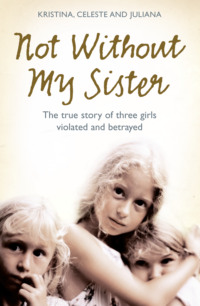
Kitabı oku: «Not Without My Sister: The True Story of Three Girls Violated and Betrayed by Those They Trusted»
Not Without
My Sister
The True Story of Three Girls Violated and
Betrayed by Those They Trusted
Celeste Jones, Kristina Jones
and Juliana Buhring

Copyright
Harper Element
An Imprint of HarperCollinsPublishers 77–85 Fulham Palace Road, Hammersmith, London W6 8JB
The web address is www.thorsonselement.com
and HarperElement are trademarks of HarperCollinsPublishers Ltd
This edition published by HarperCollinsPublishers 2008
Copyright © 2007 Green Shirt Limited
The Author asserts the moral right to
be identified as the author of this work
A catalogue record for this book
is available from the British Library
All rights reserved under International and Pan-American Copyright Conventions. By payment of the required fees, you have been granted the nonexclusive, nontransferable right to access and read the text of this e-book on-screen. No part of this text may be reproduced, transmitted, downloaded, decompiled, reverse engineered, or stored in or introduced into any information storage and retrieval system, in any form or by any means, whether electronic or mechanical, now known or hereinafter invented, without the express written permission of HarperCollins e-books.
Ebook Edition © SEPTEMBER 2012 ISBN 9780007369829
Version: 2014-08-18
HarperCollinsPublishers has made every reasonable effort to ensure that any picture content and written content in this ebook has been included or removed in accordance with the contractual and technological constraints in operation at the time of publication.
Dedication
To our sister, Davida
To my sister in sorrow: Too well did I understand The look in your haunted eyes; Pain and disillusionment. You fought a losing battle, And lost. And died. I will shed for you the tears Of a lifetime you will never live. The tears you will never more shed. Madonna of suffering, Wrapped in the cold shroud of death. I wept with you. I weep for you. For I still can. The tide of tears has turned. Sleep, my sister, And weep no more.
(Written on Davida’s tombstone, Juliana 2005)
Epigraph
Lies written in ink cannot disguise
facts written in blood.
– Lu Xun (1881–1936)
Contents
Cover
Title Page
Copyright
Dedication
Epigraph
Introduction
Prologue
Part One: Celeste’s Story
Chapter One: Daddy’s Little Girl
Chapter Two: Loveville
Chapter Three: Come Union
Chapter Four: Behind Four Walls
Chapter Five: Indoctrination
Chapter Six: Torn
Part Two: Juliana’s Story
Chapter Seven: A Broken Family
Chapter Eight: The Odd One Out
Chapter Nine: The Rod of Correction
Chapter Ten: Adopt Me, Please
Part Three: Kristina’s Story
Chapter Eleven: Living a Double Life
Chapter Twelve: A Gypsy Missionary
Chapter Thirteen: Abusive Love
Chapter Fourteen: Escape
Part Four: Journey to Freedom
Chapter Fifteen: Hide and Seek
Chapter Sixteen: Searching for Celeste
Chapter Seventeen: On Opposite Sides
Chapter Eighteen: Bittersweet Reunion
Chapter Nineteen: A ‘Deceiver Yet True’
Chapter Twenty: A Tale of Two Fathers
Chapter Twenty-One: Rehabilitation
Chapter Twenty-Two: House of the Open Pussy
Chapter Twenty-Three: Anorexia
Chapter Twenty-Four: A Dream Come True
Chapter Twenty-Five: Is Justice a Dream?
Chapter Twenty-Six: Pearl of Africa
Chapter Twenty-Seven: Breaking Free
Chapter Twenty-Eight: The Chained Eagle
Chapter Twenty-Nine: The Power of Love
Epilogue
Exclusive sample chapter
About the Author
About the Publisher
Introduction
The Children of God started in Southern California in the late 1960s, among the hippies and dropouts of Huntington Beach. The founder, David Berg, was born in 1919, in Oakland, California. His mother, Virginia Lee Brandt Berg, was a celebrated evangelist with the Christian Missionary Alliance. In 1944 Berg married Jane Miller, a young Baptist youth worker. After the birth of their second child, Berg became the pastor of a Christian Missionary Alliance Church in Arizona. However, after only three years he was expelled, reputedly for a sex scandal. His expulsion began his life-long bitterness and disillusionment with organized religion.
In December 1967, Berg moved his family – his wife Jane (later known as Mother Eve) and their four children, Deborah, Faithy, Aaron and Hosea – to Huntington Beach, California, where they stayed with his eighty-year-old mother. She had started a small ministry from a coffee shop called the Light Club, distributing sandwiches to the hippies, surfers and dropouts who congregated on the pier. But when the Light Club’s clean-cut image failed to attract the longhaired hippies, Mrs Berg saw the opportunity for her son and grandchildren to minister to the youngsters with the music and fervour of their own generation. In a short time, David Berg and his family began attracting the youth in droves with the free food and anti-system, anti-war message they endorsed.
The group travelled across the United States gathering more young disciples as they went, and soon opened communities across the country. They attracted a substantial amount of media coverage, and in some articles the writers referred to them as the ‘Children of God’, a name that the fledgling group subsequently adopted.
After a string of illicit affairs with some of his young female members, Berg found a devoted companion in his young and ambitious secretary, Karen Zerby, aka ‘Maria’. Publicly branding his estranged wife Jane and late mother the ‘Old Church’, Berg endorsed Maria and the Children of God as the ‘New Church’, and himself the last prophet of the Endtime. He also started using the pseudonym ‘Moses David’, identifying himself with King David of the Bible and the prophet Moses, who had led the Children of Israel out of captivity in Egypt (the ‘System’) to the Promised Land. Berg decided to start a royal dynasty. His series of residences were designated ‘The King’s House’ and he crowned himself and Maria, the King and the Queen.
For many years a council of ministers ran the cult, mostly members of Berg’s extended family, referred to as the Royal Family. He expected Family members to obey him and the other leaders without question. The only contact between Berg and his members came through his many writings, detailing policies, beliefs and instruction on how the communes were to be run, as well as prophecies and revelations he claimed proceeded directly from God.
In the early 1970s, the Children of God fell under the close scrutiny of the media and law-enforcement agencies, as parents of recruited children witnessed complete personality changes in their offspring after they joined the cult. More worrying was the fact that all contact between them was severed, some of their children disappearing in the night not to be seen again for years.
Evading negative publicity and a court summons, Berg fled to Europe, advising his followers to get out of America. The group left the USA in 1972 in a mass exodus to evangelize and recruit in other countries, beginning with Europe. Berg and Maria arrived in England in 1972.
Increasingly paranoid for his personal safety, he gradually withdrew from his followers, keeping his whereabouts secret. While in seclusion, Berg and Maria experimented with a new controversial method of using sex to win converts and supporters, infamously known as ‘Flirty Fishing’. Berg gradually introduced the idea of Flirty Fishing to his members through a series of letters documenting their own encounters. He also promulgated a new revelation called the ‘Law of Love’. Berg told his followers that the Ten Commandments were now obsolete. Everything done in love (including sex) was sanctioned in the eyes of God. Adultery, incest, extramarital and adult – child sex were no longer sins, as long as they were done ‘in love’. He demanded loyalty to his radical message of the Law of Love and Flirty Fishing and every member was required to actively put them into practice or leave. Consequently, two-thirds of the group left, marking the end of the Children of God era and the beginning of the Family of Love.
In 1979 Berg wrote a letter called ‘My Childhood Sex’ in which he revealed that a nanny had performed oral sex on him as a young toddler, which he said he had enjoyed. He said that it was normal, natural and healthy and that there was nothing wrong with it, which gave anyone so inclined carte blanche to follow suit. In the following years other Mo Letters and Family publications reinforced the idea that children should be allowed to enjoy sexual contact among themselves as well as with adults – and many adults in the Family embraced and carried out these suggestions.
Christopher Jones was born in December 1951 in a town near Hamelin, Germany, to Glen, a British military officer and Krystyna, a young Polish woman he had met while stationed in Palestine. He was educated at a public school in Cheltenham, and studied drama at Rose Bruford College. He dropped out after the second year and joined the Children of God in 1973. He has fathered fifteen children, including Celeste, Kristina and Juliana, by seven different women and remains a member of the cult.
Rebecca Jones was born in March 1957 and had a secure middle-class upbringing in the south of England. Her father, Bill, was a civil engineer and her mother, Margaret, a devoted housewife. Her parents were not religious, but they sent her to the local Sunday school at the age of five. She became a Sunday-school teacher when she was twelve and two years later she was baptized. Rebecca was recruited from her school by the Children of God at the young age of sixteen, and met and married our father in 1974. They had three children together, including Celeste and Kristina, before they were separated. Rebecca left the cult in 1987.
Serena Buhring was born near Hanover, Germany in October 1956. Her father was an architect and her mother an accomplished musician, playing the piano, violin and the cello. Serena travelled as a hippie in India where she joined the Children of God. She met our father after he separated from Rebecca and had three children by him, including Juliana. Serena is still an associate member of the cult.
Prologue
In January 2005, our sister Davida died from a drug overdose. She was twenty-three. The shock of Davida’s death affected us deeply though we understood her pain and despair. Each of us in our own way has struggled with painful memories of abandonment, neglect and abuse as children born and raised under the malign influence of a religious cult, the Children of God.
We were systematically abused, physically, mentally, emotionally and sexually, from the earliest age. We were separated from each other and our parents and raised communally in this organization, which was also known as the ‘Family’.
Unlike our parents who had burned their bridges and left their former lives, we were never given a choice over the paths our lives would follow. Isolated from society, we were controlled by fear – fear of the government, police, doctors and social workers, and the even greater fear of God’s wrath if we ever left the protection of the Family.
Our childhood was dominated by one man: David Berg – a man we never met, but who was like an invisible ghost that was with us at all times. He was the warped and manipulative force behind the Children of God. David Berg liked to see himself as a benevolent parental figure, and called us, his followers, the ‘Children of David’. He saw himself as the successor of King David and the Prophet Moses – calling himself Moses David, or Mo for short. The children were taught to call him ‘Grandpa’. He was the head of our family, the prophet, the leader, our ‘light in the midst of darkness’. The rules we followed were dictated by his words. We read about every detail of his life, his dreams, his likes and dislikes, and the women he slept with and the children he abused. From a very young age we memorized his words and hours of every day were dedicated to studying his writings, called Mo Letters. ‘Word Time’ – which was the time spent reading these letters and studying the Bible – was an important part of daily life. It would be difficult if not impossible to write about our life without acknowledging the dominating influence of David Berg on our lives.
From birth, we were conditioned to obey and follow the way of the cult. We had no choice, and knew no other way. We never heard our father express an opinion that was his own; it was always, ‘Grandpa said…’ If we were punished it was because we had disobeyed Mo’s rules; if we were rewarded it was because we were ‘faithful followers’. Our father’s devotion to Berg and faith in his prophecies and predictions was unwavering. If he questioned if any of it was real, or if it was a chimera – smoke and mirrors – he never showed it, not even behind closed doors.
Berg taught that birth control was rebellion against God, so within a few years there were thousands of children born into the group. He boasted that we were the ‘hope of the future’ – a pure second generation untainted by the outside world. We were told it was the highest privilege to be born and raised in the Family, free from the shackles of the ‘System’, as the outside world was called. It was our destiny to become God’s Endtime soldiers, and to give our lives for the cause. Berg predicted the world would end in 1993, and we would become the leaders of the New Millennium. As our lives on earth would be short, we were never allowed to just be children. Our individuality was suppressed, and we were simply commodities used to further the collective goals of the group.
The belief that damaged us the most was Berg’s ‘Law of Love’. God was love, and love equalled sex. Sharing your body with someone else was considered the highest expression of love. Age was not a barrier in Berg’s Law of Love and Family children were made to participate in his warped, paedophilic philosophy. His own children and grandchildren suffered from his incestuous predilections.
In this book we describe the emotional journey we undertook from our earliest years, through to our teens when we secretly, then more openly questioned it – and finally, when we struggled to break free, like butterflies caught in a spider’s sticky web. This is a story of darkness and light, of imprisonment of the soul, of redemption and freedom. We survived – many didn’t. Thousands of the Family’s second generation have had to deal with the devastating consequences of their parents’ blind faith in a leader who claimed he was the voice of God on earth. Those who have bravely spoken out about their suffering have been vilified and slandered by their former abusers. Our hope is that in telling our story, you will hear the voices of the children they tried to silence.
Celeste Jones, Kristina Jones, Juliana Buhring
England 2007
Part One
Celeste’s Story
CHAPTER ONE Daddy’s Little Girl
I was playing alone in the front garden of a white house near the small fishing village of Rafina, in Greece. Our garden had three olive trees, as well as an apricot, fig and peach, all ripe with fruit. I sat under a large, old pine tree that cast deep pools of shade. The ground was bleached and bone dry from the sun, and I amused myself by drawing pictures on the parched earth with a white rock. I was five years old.
I had little recollection of my mother, only a brief memory of her playing guitar and singing, ‘Jesus loves me, this I know, for the Bible tells me so’, as I played with my little sister Kristina on a bunk bed in a small room in another land. But I was fiercely loyal to Mum and talked about her every day, even though I had not seen her for two years. I still missed her and my sister, and barely remembered my baby brother David. I clung desperately to the hope that Mum would come back. Like a record that never stopped spinning, I’d repeatedly ask my dad, ‘Why did she leave us?’
Dad would hug me and explain. ‘Mum decided to be with someone else, and I couldn’t let you go. You were the oldest, and we’ve always been close, haven’t we?’
I nodded. I loved Dad just as much as my mum, but I thought it was unfair to have to make a choice between them.
‘What about Kristina and David?’ I asked.
‘They were too young. They still needed to be with their mother.’
Dad worked long hours in a makeshift recording studio set up in the basement of our house, producing and acting as DJ on a radio show, Music with Meaning. Because of this I had a nanny, Serena, a young German woman. I resented her, and made life as difficult as I could for her by not cooperating or even acknowledging her. Serena had long, straight dark hair and brown eyes magnified by a pair of thick glasses. Poor Serena. Whatever she did to try to win me round, I was determined not to like her. I thought her German accent sounded funny, and she was constantly trying to give me wheatgerm with unsweetened yoghurt and spoonfuls of cod liver oil, which I hated the smell and taste of.
We belonged to the Children of God, a deeply secretive and religious organization with tentacles that spread across the world. The leader and prophet was named David Berg. We knew him as Moses David; my Dad called him Mo, and I knew him as our ‘Grandpa’. He ordained everything we said, did, thought and even dreamed. Everything in our lives, even the smallest and most insignificant detail – including the food we ate – was regulated by Mo. He had said that our diet should consist of healthy food and no white sugar, and Serena enthusiastically embraced Mo’s healthy eating policy. ‘It will give you strong bones and teeth,’ she would tell me – but it didn’t make it taste any better. She was never cruel, but she was strict, and I saw her as an unwelcome intrusion into my life. Originally, Dad had told me she would be staying for three months, and I had been counting the days until she left.
That sunny day as I played under the pine tree, I glanced up to see Dad and Serena walk out on to the front veranda. They were standing very close together and, instantly, I sensed a kind of electricity between them.
‘Honey, I have something exciting to tell you,’ my father called to me. As he spoke, my tall, handsome Dad, whom I adored more than anybody in the world, turned and embraced Serena.
As I walked towards them, I noticed their faces were lit up with beaming smiles. Oh no, I groaned. This did not look good.
‘We’ve decided to get together, sweetheart,’ Dad pronounced, in a far too happy tone of voice for my liking. ‘Serena is going to be your new mother.’
‘Not her!’ I shouted. ‘I hate her!’ I could not even bear to speak her name. ‘I want my mother. Why can’t she come back to live with us? It’s not fair!’ I sobbed. I turned and ran off to a corner of the garden and stood with my back to them.
Dad followed me and bent towards me, concerned. He put his hand on my shoulder. ‘Sweetie, you know your mother has gone for good. She’s not coming back.’
‘But I want my sister and brother here. It’s not fair.’ I stuck out my bottom lip in a pout.
‘But you have so many brothers and sisters here you can play with,’ Dad said.
‘It’s not the same,’ I complained.
‘Honey, we’re all one family. Now watch that lower lip…or you’ll trip over it if you’re not careful.’
I half smiled, if only to make Dad feel better.
Mo said that we weren’t supposed to have individual families. Our brothers and sisters in the Children of God were our true family. We even referred to ourselves as the ‘Family’. But I refused to forget my mother or Kristina and baby David, though I was scared I was beginning to forget what they looked like.
The only photograph Dad had of Mum was of her standing behind a double buggy, with me sitting in one side and my baby sister next to me. I studied the photograph carefully. Mum had long, sandy blonde hair down to her waist, blue eyes and a wide smile.
‘She’s beautiful,’ I said. ‘And that’s my sister?’ I couldn’t see her face clearly because of the picture’s poor quality. Kristina was just a toddler, aged about a year old, with two little pigtails. I was eighteen months older and very like her. We were both dressed in pretty cotton frocks and had sun hats on. As hard as I stared, I couldn’t summon up the slightest memory of them and mourned, feeling a gaping hole in my being.
Dad described how he and Mum used to take us with them when they went out witnessing in the streets. ‘I’d manoeuvre the pushchair in the way of someone walking the opposite direction and then hand them a leaflet and witness to them, telling them about Jesus and how they could be saved. Indian people love children and you were so cute and pretty. They’d pinch your cheeks and chat to you. They felt they couldn’t be rude with you two sitting there gazing up at them like two little angels.’
‘Do you have a picture of David?’ I asked.
‘This is when he was just three months old,’ Dad replied, producing a small black and white photograph.
‘He’s so cute. Look at those cheeks!’ I said proudly. He was lying on his tummy lifting up his head with his chubby arms, and had a big grin on his face.
My own early memories were brief, seen in a series of quick little snapshots, like windows opening in my mind’s eye. Much of what I gleaned, Dad told me in our rare quiet times alone. I’d cuddle up on his lap and he’d tell me selective vignettes that gradually built into a bigger picture. But it was always half a picture; he never told me much about Mum.
Perhaps as a way of keeping her alive, and forlornly holding on to the remnants of a family life, I often asked Dad to tell me the story of how he and Mum had first met and then married, and my birth. He didn’t tell me a lot about it; it wasn’t until I had grown up that I heard the full story.
‘Your mum was young and beautiful – just seventeen years old when we married. I was twenty-two.’
I was always full of questions. ‘And what about your dad?’
Dad told me his father was a lawyer and military judge in the British army. He had no recollection of his mother, as she had died when he was four and his father had remarried soon after. He and his half-brother were sent to a boarding school in Cheltenham.
‘I was a rebel at school. I was even expelled after I led a protest where a group of us locked ourselves in the main hall.’
‘Why – what did you protest about?’ I asked.
‘The school prefects used to beat us for almost anything, no matter what. They’d come in at night with their flashlights and shine them in our faces to wake us up. We got fed up with the injustice and stood up against it.’
Thrown out, he enrolled at a drama school in London and in his holidays travelled throughout Europe. ‘I was searching for the meaning to life,’ he explained.
I listened earnestly as he described how, in pursuit of life’s meaning, he read many spiritual books and dabbled in the occult and meditation.
I shivered. It had been relentlessly drummed into us by Mo that drugs and Ouija boards were dangerous, because they could open the door of your mind to the Devil.
When he was telling me about those years, Dad said, ‘I ended up deeply depressed and disillusioned with life.’
‘Wasn’t drama school what you wanted?’
‘It was empty. Without the Lord, it’s meaningless. Just husks, sweetie.’
It was at this low point that one day he received a call from one of his mates who had just returned from Istanbul. This friend had planned to walk on foot to India, but instead had been converted by the Children of God en route, and had returned to England to spread the word.
Dad was taken aback by the dramatic change in his previously disturbed and doped-up friend. He now seemed confident, with purpose and direction. ‘He told me it was all thanks to the Children of God. I was curious.’
In the hippie era of peace and love, the message proclaimed by the Children of God seemed exciting: find a new life in Christ, drop out, live communally, forsake materialism and share all things, just like the early disciples. But this was not just another zealous evangelical group from America – it was God’s Endtime Army, the elite, who would lead a lost world in need of salvation during its darkest hour.
The Children of God believed that with the end of the world looming near, pursuing anything else in life seemed pointless. Dad was convinced. He gave away most of his possessions and turned up at the doorstep of a commune in Hollingbourne in Kent with just a small suitcase, ready for his new life as a disciple.
His eyes lighting up at the memory, Dad told me, ‘It was amazing. Everyone lived under the same roof and shared all things just like the Early Christians in the Book of Acts. It was the family I had been searching for.’
New members were told to choose a Bible name to reflect their new life. Dad chose Simon Peter. His full-time job was now to go out on to the streets and witness – the name they used for trying to win converts. Handing out literature for a donation was called ‘litnessing’.
Always full of new ideas, Dad came up with a novel way to litness. He laughed as he described it. ‘I dressed up as a clown, with a bright red nose and a funny hat that had a bouncing little plastic birdie on top.’
He wiggled his fingers on top of his head and made a face. I giggled. ‘I bet you looked silly!’
‘Oh, I did – but I was a clown. Clowns are allowed to look silly. I’d jump in front of passers-by and make them laugh before handing them a tract and asking for a donation. I became a star litnesser and fundraiser – I made hundreds of pounds a week for the Family.’
I laughed as I tried to imagine my dad clowning it up in London, a city I didn’t remember, although I’d been born there. Street solicitation was against the law, however, and Dad had run-ins with the police. Of course, he didn’t see anything wrong in what he was doing. He was obeying God.
Dad told me he met my mum in Hollingbourne, as they both joined the same commune as new disciples on the same day. She was just sixteen and had been recruited straight from school. Young and idealistic, she thought the Children of God was a bona fide missionary society. My parents were ‘married’ by the group, before being legally married in church. After a three-day honeymoon in the Lake District, they squatted in a large house in Hampstead that the Children of God had taken over.
Dad used his training as an actor to do stage performances, dramatically reciting whole portions of the Mo Letters – missives from the prophet that were mailed regularly to every commune as a guide for us disciples to follow and live by. He loved the thrill of acting, and his talent soon set him apart as a sort of celebrity within the group. Spurred on by his success, he recorded more of these Mo Letters in a series of cassette tapes called Wild Wind, which were distributed across the communes for disciples to listen to. While Dad was busy and fulfilled, Mum, who was pregnant, was terribly ill, and it must have been a great relief when, on 29 January 1975, after three days of difficult labour, I was born in the small attic room on the third floor of the Hampstead Home.
Becoming new parents did not stop Mum and Dad from pursuing their new-found mission to save the world. Missionary teams were being set out and my parents received a ‘prophecy’ to go to India. A disciple was not supposed to have a will of his own, but had to follow God’s will by praying and hearing from Him in a prophecy. These prophecies gave the stamp of Divine approval on any plans or decisions that needed to be made.
In reality, the British authorities had begun to investigate the Family’s activities, especially their aggressive proselytizing and soliciting of donations, and Mo told everyone to move from the UK and go on to greener pastures, such as India, South America and the Far East – places where the authorities would be far less likely to care about what a group of Western dropouts did.
When our little family first arrived in India we went to an apartment in a block in Bombay designed for the middle classes, although it was about the size of an English council flat. It had three bedrooms, which we shared with two other couples and two single brothers. After a few weeks my parents found a two-bedroom ground floor flat in Khar, a subdivision of Bombay. There were so many people staying there, disciples coming and going from other parts of India, it was always crowded. They had very little furniture except two single beds and a table and chairs in the living room.
Mum was heavily pregnant again, but right up to the birth she and Dad slept on a sheet on the floor of our small communal apartment, because the mattresses were infested with bedbugs. There were often up to twenty people in the flat, and Mum would try to hide them from the landlord. My baby sister was born in June 1976 in a private nursing home nearby and named Kristina after Dad’s mother. I was only eighteen months old, but I adored her from the moment I saw her. I would lie next to her on Mum’s sheet on the floor and put an arm around her, smothering her with damp kisses. I became the doting older sister, and loved to hug her and watch Mum change her nappies and nurse her. We were so close in age our bond was unbreakable. I called her Nina.
To Dad, many things about India were a huge culture shock. Despite the fact that he had been a hippie and had travelled to Cyprus and Israel and throughout Europe, he hated the heat, the dirt and the disease he found in Bombay. He also contracted a bad case of hepatitis and was in hospital for a few weeks after Kristina was born.
‘The water and the food made me ill, I had diarrhoea so badly I lost tons of weight. And I felt humiliated as a foreigner having to sell tracts on the street, like a beggar, when there were so many beggars around me and children without a roof over their heads or food to eat,’ he said.
Dad’s diet and that of the commune was a constant source of distress. They had little money at first since everything they earned had to come from selling tracts in the street for minuscule sums. At times, they could only afford to buy rice and lentils day after day.
Stoically soldiering on in the steaming heat of Bombay, Dad struggled to make more sense of his personal role. He was intelligent and had been well educated and got a job at the local radio station writing jingles. According to Mo the Final Battle of Armageddon was only a short time away, and Dad tried to come to terms with the teeming masses in just India alone that wouldn’t be saved.
He suddenly remembered the old Wild Wind cassettes that had won him so much praise in London. There had also been talk of the potential of radio as a medium to spread the message. He came up with the idea of recording a series of half-hour programmes that he would call Music with Meaning. This show could be played on local radio stations. He could do it all practically on his own, scripting it, acting as host and DJ.
From the very beginning, the Children of God used music as bait to attract interest and attention. Group singing to worship Jesus was called ‘inspirations’ and was a daily part of the disciple’s life. The Family attracted many talented artists and musicians, including ex-Fleetwood Mac guitarist Jeremy Spencer – who literally had been converted in the street one day and walked out on a concert tour to join a local commune in San Francisco. Instead of rock and roll, they wrote songs based on the Bible and Mo Letters. Dad decided that he would use this talent on his show to help spread the word. Working on something that fulfilled him gave him the impetus to remain in India.
Proudly, Dad described his enterprise to me. ‘We offered Music with Meaning free of charge to radio stations. I knew that a lively music show would spread the message in a cool format and attract young listeners. At a fell swoop, instead of struggling in the heat to witness to a handful of people a day, and perhaps winning only one or two souls a week, I could reach millions!’
‘That was so brilliant, Dad,’ I exclaimed, thinking that he was wonderful.
When Mo heard about the show, he commended Dad for his pioneer spirit, and helped to finance the project. Dad hadn’t met our prophet – very few of his followers had – but his instructions and messages were dictated in Mo Letters and passed down via leaders who were known as shepherds. Dad worked all hours of the day and night on the show, while Mum was left to care for my baby sister and me. By this time, Mum was pregnant for the third time, and fell terribly sick again. But, sick or not, she still had to earn money by going out selling tracts in the heat, walking miles every day, wheeling us in a pushchair.
Many of Mo’s followers – like my parents – had been faithful to each other and lived as a family unit, albeit in crowded communes with very little privacy. In 1978 ‘one wife’, which was writen in 1974, reached down to the communes, making it crystal clear that family women should be providing for the sexual needs of the men, especially the single ones. We were all married to each other and there was no such thing as adultery in God’s Family. Sex was the highest expression of love and giving and was called ‘sharing’. The Children of God was now a Family of Love, in every sense of the word.
Some disciples found it hard to adjust to the new freedoms, while others jumped at the chance to have sex with multiple partners. Both my parents started sharing with others – though I think Dad was keener on it than Mum. With two children close together and another on the way, sex was not high on her agenda. But Mum was a sincere believer and faithfully obeyed the prophet even though she struggled with feelings of jealousy at having to share Dad. However, she felt alone and unloved and fell further into depression after the birth of my brother David in April 1978. The district shepherdess noticed that Mum was quiet and sad-looking and asked what was wrong out of concern. Mum confided in her that she was becoming unhappy with the marriage. Without her knowledge the shepherdess reported the conversation to a higher up and was told to send Mum away for a break and to think about whether she wanted to continue in the marriage. One moment Mum was there, and the next, she had gone, taking David with her to a commune in Madras.
When Mum returned from her break in Madras six weeks later, a young man came with her. His name was Joshua, a brother from Australia, and he was infatuated with her. This only led to further complications in my parents’ relationship and to their eventual separation.
Then, unexpectedly one morning, the Bombay police showed up at the door of the commune and told all the foreigners they had to leave the country immediately. It seemed that some of the nationals who had been won to the cause had been shocked and alarmed by the promiscuity they had witnessed. Some of the new converts were beautiful Indian women and this was simply not in their culture and their families reported it. Interpol was also involved, at the behest of parents in the West who were trying to trace their missing children. There was a frenzy of packing as our shepherds closed down the commune.
Mum and Joshua decided to return to England with Kristina and David. ‘But I insisted on keeping you,’ Dad said. ‘You’re my girl.’
My young dad was so handsome I couldn’t imagine anyone leaving him. But even though he had chosen me, I was devastated that I had lost my mum.
Dad hugged me and said, ‘You were such a miserable, sad little thing. You pined so hard that nothing would make you happy. In the end, I promised you that I’d wait before taking a new partner just in case Mum changed her mind.’
I believed his assurances whether they were true or not, and his words gave me hope that our broken family was only temporary, a poignant hope I carried in my heart for the next two years, over two continents.
Two weeks later, Dad and I and flew out to Dubai. Dad was devastated because he had learned to love India and the future before him was uncertain. In Dubai, Dad received an unexpected phone call from Faithy, Mo’s youngest daughter. She had been scouting in Greece, looking for a new location in which to begin a new project. Faithy had flair and charisma and a way with words that could convince just about anybody. She set out to gather together the most talented musicians, singers, songwriters and artists to use them as an attraction to advance the cause to the outside world and gain them more followers.
‘Simon Peter,’ she started, ‘Mo is very pleased with all that you have achieved. He has decided to support the production and distribution of the Music with Meaning show worldwide.’
The show was to be bigger and far more commercial than before. It would be a hook to catch listeners, who would write in. They would be invited to come along to local Music with Meaning ‘clubs’ in their area. There would be regular mailings, a magazine and friendly conventions. Being telephoned personally by Faithy was a great honour. Dad was thrilled that he was receiving full support and backing for his programme. His goal was always to win souls and he was very passionate about it. Not being a very practical person, he was happy to allow the leadership to take over all the organization of it so he could just concentrate on the show.
That was how we arrived in Athens in late 1979. The scenic view of high, pale mountains, soaring into a bright blue sky was breathtaking, as we crossed the ancient peninsular to reach the coast on the opposite side, a couple of hours away. As we drove down, between stands of dark pine trees, I could see the sparkle on the sea and fishing boats bobbing in the harbour of the old port in Rafina.
Our house was a typical modern Greek villa, painted white and with a red tiled roof. The surrounding garden contained fruit trees, some scratchy lawn grass, yellow mimosa and olive trees. We were within walking distance of a large campsite by the sea called Coco Camp. Half was for regular holidaymakers; the other half was block booked for us, the Family. Families began arriving in their caravans and trailers until about two hundred new people had joined us. All of them were either musicians or technicians who had been specially chosen to work on Dad’s show.
During the day I would run free, playing with the children within the camp’s grounds and along the beach. There were big coloured pebbles to collect, and dead starfish, shells and sea urchins. There was so much to see and do I never stopped playing from dawn to dusk. My hair would go unbrushed for days. I remember an American woman called Windy, a singer/songwriter for the show, sitting me down with a comb and laboriously untangling my thick mop of curls.
Sometimes in the evening I would lie on my bed for hours, bored while Dad recorded late into the night in the studio with Faithy Berg and Jeremy Spencer, whose fame had followed him here. Faithy had decided to use him as a selling point to pitch the show to broadcasters.
To solve the problem of the little wild mustang I was becoming, Faithy sent a succession of nannies to take care of me. First it was a married woman named Rosa. Then Crystal, a hot-tempered American woman, replaced her. Crystal was a petite woman with pursed lips and a mane of shoulder-length light-brown hair. She didn’t have a motherly bone in her body and cussed like a trooper, not the sort of language that good Christians should use, and was always getting into trouble for drinking too much. Crystal often referred to me as the ‘girl with the curl in the middle of her forehead. When she was good, she was very good, but when she was bad, she was horrid.’ I admit I did have a stubborn streak, especially with her. I hated her because I knew she had set her sights on snatching up Dad for a husband and I was determined to do all I could to scotch any romance between them. I wasn’t successful. Dad did have a fling with her, but their love affair was to be short-lived.
The only one I would listen to was Dad. I loved him more than anybody in the world and did my best to please him. I took no notice of anyone else, expecting my mother to come back at any time, even though we had said goodbye and she had been gone for what seemed aeons of time.
But why, why, couldn’t I remember her? Why couldn’t I even remember that dreadful final moment of our parting in Bombay?
I pined so much that finally Dad arranged for me to speak with Mum on the phone, long distance to London.
I felt weak with shock and took the phone, hardly able to believe that I was hearing her voice again. ‘When are you coming, Mummy?’ I asked anxiously, the years of yearning filling my voice.
‘I love you, Celeste. I’ll try to come soon.’ I heard a voice I didn’t recognize say on the other end of the line. ‘Your sister Kristina and brother David love you and want to see you too.’
She had said that she was going to come back to live with us again! I was so excited.
‘It’s all worked out,’ Dad told me after the phone call. ‘The tickets are booked and everything. It won’t be long now, darling.’
I looked over at Crystal, who was sitting nearby, and pronounced triumphantly, ‘You don’t need to be here anymore. My mummy’s coming back.’
Crystal glowered. A few weeks later the leaders – who had the final say in everything, even love – broke up their relationship, thinking she was not good enough for my father, their new media star. I certainly didn’t think so. All I knew was that my mum would be there soon and I would be reunited with her and my sister and brother. I longed to have her there, cuddling me, brushing my hair, and being my mum again. But time passed and I heard nothing. I waited in a frenzy of impatience. Every day I talked – and thought – about my mother. When, when, when?
One day, when I asked Dad for the umpteenth time, ‘When’s Mummy coming back?’ he could not put off telling me any longer what he knew would shatter my world. ‘She’s changed her mind. She decided to stay with Joshua.’
I stared at him, shocked, feeling my heart jump and beat in panic like a fluttering bird. I did not understand. Why had she changed her mind? Who was this man Joshua, who had taken her away from us? It did not make sense to me and I could not accept that it was final. My memories of her had faded by this time, and I did not even remember what she looked like anymore – but she was my mother and it was the idea that I had clung to for half my life. I remained fiercely determined that no matter what, no one would take her place.
CHAPTER TWO Loveville
We had a little beat-up car that barely puttered along. The back seats had been taken out by the previous owners (which is why we got it cheap) so you had to sit on the floor. I was in the back with my playmate, Nicki, and we were giggling as we experimented with what we imagined sex to be, like we’d seen the adults do it, undies down, on top of each other and humping away. We were both only five years old. Obviously, things didn’t work properly and it was just a game.
‘You’re tickling!’
‘No I’m not–’
‘Yes you are. Ouch. My leg’s stuck.’
I heard muffled laughter, and glancing up, saw Nicki’s mum, Patience, peering in through the car window at us, her face alight with amusement. Like a shot, I sat up and shoved Nicki away.
He saw his mum and went bright red.
‘It’s okay, you guys can carry on,’ she said.
But I felt very embarrassed and silly. What a moment ago had seemed like fun no longer did. One thing I didn’t feel was guilt. Of all the sins we had to avoid, sex wasn’t one of them. Mo said God intended everyone, even newborn babes, to enjoy the full sexual experience.
If anyone turned on the radio and heard one of my dad’s Music with Meaning shows the message would seem idyllic: love was the answer to all of the world’s problems – sharing love, living in love and making love. Mo instructed Dad not to use the word ‘Jesus’ on the show. This strategy was an important one, because many listeners had no idea what they were tuning in to, or that the show had any religious affiliation, let alone a notorious one. But some of the songs on the show were hardly subtle. Jeremy Spencer sang a song entitled ‘Too Young for Love’, based on the Mo Letter ‘Child Brides’, where Mo set out his belief that children as young as eleven and twelve were ready for marriage, sex and children.
Part of Mo’s plan was to produce a second generation of children, like me, who were born into the Family of Love and who had never known the outside Systemite world. They would be untarnished by the sins of a former life. To show what faith he was putting into this earthly paradise he called ‘Loveville’, Berg sent members of his own family to live with us.
There was Faithy of course, his youngest and most loyal daughter, who was such a zealot her blue eyes shone fiercely. Mo also sent his granddaughter, nine-year-old Mene, who became a star of the show. When I first saw her I thought she looked like an angel, with her bright blue eyes, milky white skin and blonde, wispy hair. She had a soft, sweet voice and a dreamy look in her eyes. She behaved like the perfect Family child, always obedient and smiling, reading and quoting the Word.
We rarely spent time together anywhere except in the recording studio or at practice rehearsals. I never played outside with Mene in a normal childish way – I don’t think she was ever allowed to play.
Everyone had something to contribute to the Music with Meaning radio and video shows. It was fun and, like any child, I loved to show off my talents. There were musicians, artists, technicians, seamstresses and secretaries. Some of the more famous characters were Peter Pioneer and Rachel, a married couple and singing duo from Denmark, and Joan and Windy, a singer/songwriter team who were openly bisexual. Zack Lightman, from Norway, was the lighting man and cameraman, and his wife Lydia designed the costumes and backdrops. Sue, a softly spoken American with brown eyes and a charming smile, was the ‘club secretary’. Jeremy Spencer’s wife Fiona was the ‘Queen Mother’ of the camp, and the chef was a fiery Italian named Antonio. They lived as a threesome and Fiona had seven children by these two men.
In the centre of the camp a large canvas army tent was used as a gathering place for meetings and a dining hall in the winter months, when nights were cold. Two big gas fires heated the arena and we used kerosene lamps for light. To feed so many people, there was a whole team of people whose job was to ‘provision’ free food from the markets and local companies.
When the weather was warm, we ate on rows of benches and tables under the trees. Our food was fresh and, on the whole, delicious. Our breakfast consisted of semolina, sweetened with brown sugar, honey or molasses. Antonio tended to cook Italian food, the kind that could be quickly prepared for some two hundred hungry people. Big bowls of pasta with rich tomato sauce, or stews with beef chucks, potatoes and carrots.
Children were regimented and expected to behave. Even the very youngest had to sit still on the hard wooden benches lined up in the big tent and listen during the long meetings we had in the evenings. These sessions were incredibly boring and I would end up retreating into my thoughts and a make-believe world as a way of escape. I also found it incredibly difficult to keep my eyes closed during the long prayers, and I would cover my eyes with my hands and peek through my fingers so no one would catch me.
Once Faithy had established the running of the camp, she turned over the leadership of Loveville to a married couple, Paul Peloquin – a French Canadian from Quebec – and his wife Marianne, and departed on her next mission, to set up a Spanish version of the show, Musica Con Vida, in Puerto Rico.
Paul and Marianne took their task seriously – too seriously. They were a childless couple and had been desperately praying for a son for many years. Paul had jet-black hair and brown eyes and spoke English with a heavy French accent. He was a real charmer, but also had a fierce temper that could flare up unexpectedly. Marianne was French – a well-built woman, big boned, nearly six feet tall with deep-set eyes and a pronounced nose. Part of their responsibility was to draw up the daily schedule and assign everyone their jobs for the following day.
Reveille was at 7.30 a.m., and after breakfast, I’d go to a nearby house which we named the Blue House because it was a pretty shade of faded blue – the same colour as many of the fishermen’s boats. This was our communal school, where we had Word Time and Scholastics, taught by our regular teachers, Johnny Appleseed, Fiona – Jeremy Spencer’s wife – and Patience, Nicki’s mother. We were shown flannelgraphs and read True Komix—illustrated Mo Letters for kids. An endless river of these Letters and books from Mo and Maria would come in the post, usually once every two weeks. Every Home had to open a mail box and the leader in each Home was the only one who knew that address and had the key. It was run like a military espionage service, with secrecy the code word.
On sunny days Word Time would take place under the shady umbrella pines in the campsite. Sunday-school teachers in the outside world would have swooned if they’d opened up a True Komix. Many of them showed scenes of explicit sex, nudity, or gruesome demons and bizarre dreams that Mo believed always had some meaning – they were God’s messages. ‘Mo is God’s prophet for today, His mouthpiece to give us His new Word,’ our teachers would tell us. ‘System Christians don’t have the Spirit; they are “old bottles” who can’t receive the new wine.’
God, Jesus, the angels and the Devil were real and part of our everyday lives. Jesus would reward us when we were good, or the Devil would punish us when were bad. Our indoctrination was constant, and questioning anything opened our minds up to the Devil’s doubts. A picture from one of the True Komix sticks in my mind. There’s a little table with a tea set, and the Devil is depicted as a little elf with horns and a pitchfork. A little girl is sitting in the chair next to him and four little ‘doubtlets’, and the Devil is pouring her a cup of tea. The next scene shows her trapped in quicksand, sinking back into the System, because the Devil and his doubtlets had got to her. ‘It’s dangerous to have a tea party with the Devil and his doubts,’ the comic said.
Some of the True Komix stories we read were based on the Royal Family’s children, Davidito, Davida and Techi. We already knew them from the ‘Davidito Letters’ as examples of how to raise ‘revolutionary’ children in God’s way. Mo’s secretary and second ‘wife’, Maria, had two children, Davidito and Techi. Davidito was born in 1975 from a Flirty Fishing encounter with a hotel waiter in Tenerife. He was only three days older than me, and I was very proud of that fact. Maria’s lover and Mo’s right-hand man, Timothy, was Techi’s father. Mo wrote that Timothy was ‘just hired for his seed’ and that Techi was his. He claimed that he’d received Techi’s unusual name in a vision, when a spirit of a little girl had come to him when he was sick (and just before she was born, in 1979). He decided that Techi was a reincarnation and tried to fit this Buddhist doctrine in alongside Christian doctrines.
Davida was the daughter of Sarah Kelley, Davidito’s full-time nanny. She called herself Sarah Davidito. All three children were part of the Royal Family and lived in seclusion in Mo’s Home. The Royal Family children were to have a lot of influence in my life. They were our idols we looked up to, and we followed their lives in the Mo letters we read with great interest and curiosity.
After siesta, we would be allowed out to play. My regular playmates were two sisters, Renee and Daniella. I liked their mother, Endureth, and took to her as my second mother. I still did not accept Serena as my stepmother and often ignored her. I suppose my childish mind figured that if I blanked her out, she didn’t exist. Serena also had her hands full caring for her six-month-old daughter, Mariana, and was now heavily pregnant by my father. To ease the situation, I ended up staying indefinitely with Endureth and her husband Silas, My sister Kristina would have been the same age as Daniella, and I would always talk about her as if I knew her, only she was in ‘India with my mother and baby David’. Being with my friends in their family atmosphere helped me to pretend that I had lots of sisters. During the day we would play together, and at night we slept in a large double bed in the back of the caravan.
My other friend was Armi. We could not have looked more different. She had dark, straight black hair and brown eyes just like her mother, who was half Native American. She was one of the first children to be born into the Children of God, in February 1972. Her father, Jeremiah Russell, was one of the first disciples to join Mo’s team in Huntington Beach when there were only fifteen members. He was a musician and wrote songs that were played on the Music with Meaning show. Armi inherited her father’s musical talents and was a star performer and I wanted to be just like her, sing like her, and hang around with her and her group of friends. We laughed at the same jokes, told each other our secrets and she would help me and teach me things, like how to draw a body in proportion, instead of just a triangle for a neck and a circle for a hand. And she was also the one who helped me lose my clipped English accent and speak ‘American’ like most of the other children.
Armi and Mene, Mo’s granddaughter, bonded together as sisters of misfortune. Their parents had been asked by Mo to send their daughters to Loveville with the assurance that they would be returned in six months. This never happened. Instead, Paul Peloquin and Marianne became their guardians.
No one dared to go against Mo’s requests, which were obeyed as orders. After all, he was the prophet. We were conditioned to believe that carrying out Mo’s directives was following God’s will. It’s clear looking back on it now that we were simply his playthings, his followers, used to fulfil his ambitions, lusts and fantasies. When Mo requested the women to dance naked for him on video, Paul got us all together, even the three-year-old girls, for a special meeting to read us the Mo Letters ‘Glorify God in the Dance’ and ‘Nudes Can Be Beautiful’.
‘Thank the Lord! Isn’t it a special privilege to be able to dance for the King?’
Excited, the adult women responded with many ‘Praise the Lords’ and ‘Amens’ to Paul’s question.
Paul continued, ‘He’s given us detailed tips in these letters of how to do it. Praise the Lord.’
I watched as the women picked their music and see-through veils and then performed their strip dances. When it was the girls’ turn, Paul said, ‘Now this is for Davidito – so smile for him.’
Armi, Mene, Renee and Daniella did their dances for the little prince – and then it was my turn. Paul chose two songs for me and tied a white veil around my neck that I was supposed to take off during the dance. He gave me directions from behind the camera.
‘Wiggle!’ He pantomimed it. ‘Wiggle nicely and rub your bottom, honey.’
I simply copied the motions I had seen the adult women perform earlier.
‘Good, very good! Now blow kisses to Davidito so he’ll know you really love him.’
I tried hard to smile and at the same time listen to what he was telling me to do behind the camera. This video still exists and the adult I have grown to be looks back in time at that sweetly smiling six-year-old child who was me. I am gazing into the camera, seducing it; and what is stunning is the knowing-innocent look in my eyes. What makes it worse in retrospect is at the time Davidito was only six years old – so this request was Mo’s sick idea that his namesake should be groomed like him, while the dirty old man enjoyed these dances for his own pleasure.
From then on, nude pictures were taken of us girls on a regular basis and sent to Mo. He told us that he would post them around his room for his daily inspiration – a euphemism for masturbation. It is quite obvious to me now that Mo got his jollies off on voyeurism. However, we didn’t realize that he was getting closer to the stage where he would select his favourite girls to be brought to him for his personal gratification. Their parents believed naively that they were in ‘good hands’, even though they were unaware of their children’s whereabouts and unable to communicate with them. But all that was in the future and, happily for me, I didn’t yet know where some of my friends were destined to go.
Sex was completely open and transparent in our world. The adults had no inhibitions about making love in front of us and actively encouraged us to masturbate and explore our bodies. As a result, our childish curiosity was exploited, although we were always told to never, never do it in front of strangers, or discuss it where they would hear. ‘The System hates sex,’ we were cautioned. ‘They think it’s dirty and sinful.’ When the weather was very hot, everyone walked around in bathing suits or shorts. I didn’t have any problem with running around in only my knickers, like all the children. By the age of five or six I was highly sexualized and extrovert.
My father never did anything to me in a sexual way, nor did I see him do anything improper at this time with my peers, but I assumed he knew what was going on. His best mate was a drummer, Solomon Touchstone, who would often go into town with us on Sundays for lunch at a little taverna overlooking the harbour. Like Dad, Solomon came from London and they’d speak together in fake cockney accents, joking about. Solomon was short – about five and a half feet – handsome, and all the women liked him. I liked him too, because he was fun, and would pay attention to me.
Sexual grooming was normal to us and happened everywhere. Everyone was always hugging and kissing and being affectionate with one another. To me it was just a game. But my openness and eagerness to gain attention, love and approval was horribly exploited. Playful, friendly Solomon, my dad’s best friend, was just one of the many men who exploited my natural, puppyish affection for him. When we were alone in his bedroom he would ask me to dance for him naked while he masturbated on the bed.
‘You’re so sexy!’ he would moan.
Little wonder that in that video specially shot for Mo I have such a knowing-innocent look. I was innocent – but I was learning what turned men on. The only positive attention we received from the adults was when we did what they wanted, acted flirtatiously or were sexy. Children crave acceptance, and I was no different. We would be rewarded for being ‘yielded’ and showing God’s love. Being stubborn, saying no or being prudish was of the Devil and bad, and would get us in trouble. I learned quickly to act in a flirtatious manner to get attention, and didn’t know how to act otherwise around men.
Another man who pursued us young girls was Peruvian Manuel. He and his German wife, Maria, taught us our dance routines. They were another childless couple. He had dark eyes and an intense, almost piercing gaze that made me feel uncomfortable. He always paid us girls special attention, especially Mene and Armi. Maria enjoyed performing lesbian acts with the women, and they both taught the girls to mimic their actions for the enjoyment of the men who would watch. Because I was younger, I was not included in many of the sexual acts that my friends were roped in for. I always counted myself lucky compared with them. But I did not escape completely.
One afternoon Peruvian Manuel came into Silas and Endureth’s caravan, where Renee, Daniella and I slept together in the back. I knew the caravan well and treated it as my second home. The red curtains were drawn. He told me to lie down, then pulled my panties down and spent some time kissing me – ‘This is how the adult women do it,’ he explained as he knelt over me and proceeded to rub himself on me, complete in all respects without full penetration, until he had an orgasm.
When I felt the sticky white stuff come over me, I was repulsed. I had never seen semen before. It felt disgusting and was messy. He took some tissues and wiped it off me then went into the small toilet closet of the caravan and cleaned himself up. I remained on the bed, dazed and confused. It was the same feeling as when you are in a nightmare: you want to scream or say something and nothing comes out. I had so many thoughts, questions and feelings but was unable express them. Even when adults asked me directly what I was thinking, I always froze, my tongue rooted to the top of my mouth.
When I watched the adults having sex they seemed to enjoy it, so why didn’t I? These men were trying to instil in me the knowledge that a little girl like myself would provoke the same sexual attention and arousal from a man that a woman would. My self-perception was distorted, and I had no concept of my own vulnerability or that I was different from the adult women.
Though in many ways we were expected to act like adults, we were still just little kids. At least once a week, Loveville would gather for a dance night, which would end up as an orgy. As usual, we were left to do our own thing while the adults – all those over the age of twelve – paired off for sex.
One night in particular, Renee, Daniella and I watched as the adults danced naked, groping each other. We decided to pull a prank, and took turns sneaking up behind a busy couple and pinching them on the bum. We thought it was hilarious when they gave a startled jump. By the time they turned around to try and catch whoever did it, we’d be long gone and giggling in the corner.
We weren’t supposed to tell anyone outside the Family about our sexual freedom, as the adults called it. I was told that Systemites would not understand the truth and liberty we had, and I learned to lead a double life.
I remember singing at an orphanage one morning, and then having siesta time in our camper van before going to the TV studio in Athens to perform a Christmas song on a local TV show. We parked on the street, closed the flimsy curtains of the van and had what the adults called Love Up, or Cuddle Time.
My teacher Johnny Appleseed lay down beside me and stroked me while kissing me on the mouth. He opened his clothing and guided my hand to his penis and helped me to masturbate him. In the end, he finished himself off while I lay next to him. I was conscious of the others having sex around us. His eyes were closed, his mouth open while he panted and gasped. When he was finished he said a prayer.
‘Thank you Lord, that we can share with one another your love,’ he prayed, and then he rolled over for a short nap.
The whole time, I was scared – he was my teacher – and also because there were gaps in the curtains. I could hear the footsteps of people passing by, and I thought that at any minute someone could look in and see us.
When it was time for our appointment, as if none of the afternoon sex had happened, the adults made up our hair and gave us a little pep talk. ‘When we get in there, remember to smile and show God’s love. Don’t worry about the cameras, like Grandpa said, just sing from your heart and think of the lost souls who will be watching.’
We piled out of the van and into the studio. The TV presenter thought we were great and we pulled off a well-rehearsed performance. Of course, no one watching us would have had a clue what had gone on just an hour before behind the red curtains in the van.
When visitors came to the camp to stay with us, everyone dressed up a little more conservatively and I soon learned there were subjects we didn’t talk about with ‘outsiders’ – such as sex and our prophet Mo – and Mo Letters and Family publications such as the Davidito Letters would be tucked away from sight.
‘Sweetheart, my parents, your grandpa and grandma, are coming to visit us from England,’ Dad said one morning, after receiving a letter from them.
‘But we call Mo Grandpa,’ I said. ‘Is this another Grandpa?’
‘Yes, his name is Glen, and he’s my Dad.’
‘Oh. I might get confused if I call him Grandpa too,’ I said. After a moment I had figured out how to solve the problem. ‘Maybe I’ll call him Granddad, that way I won’t get confused. Did I meet them before?’ I asked.
‘Yes, they met you when you were a baby when we were in London,’ Dad replied. ‘I’ve been wanting to witness to them. My father hasn’t been saved yet, he’s been stubborn, but maybe he’ll pray this time.’
Dad always talked about saving souls. He sincerely believed that without Jesus in their hearts, they were doomed to hell. Dad didn’t want his parents to suffer such a fate in the afterlife.
When I met them, I noticed the difference in their appearance and manner immediately – how reserved they were, and the way Penny, Dad’s stepmother, dressed was different from Family women. Her hair was cropped short and permed and she wore a long-sleeved blouse and trousers. Penny gave me a kiss on the cheek, but there were no hugs, though they seemed happy to see me.
‘My, you’ve grown since we last saw you when you were just a baby,’ Penny said.
The evening they arrived Antonio prepared a delicious pasta dish and we sat together on one of the tables under the trees. Faithy Berg had come for a visit, and introduced herself to them and spoke glowingly of the radio show. Windy and Peter and Rachel played guitar and sang songs from the show. Dad sat beaming with pride, like he was a little boy again, at being able to show his parents what he had achieved.
The next day we accompanied them on a tour of the town, but what I remember most from their visit was the stories Granddad told of when he was a young man. He told stories about his escapades in Palestine during the war as a British army officer. ‘One time I woke up in the morning to find my bed had been stolen right out from under me,’ he chuckled.
My grandparents’ visit and hearing Dad talk about his real mother made me feel special. I was excited that I had another family, my own flesh and blood that was separate from the Family. After Granddad Glen and Grandma Penny left, I wrote letters and sent them drawings and gifts of little things I had made, telling them that I hoped that I would get to see them again.
Perhaps all these family stories struck a chord with Dad. He wanted to know more about his mother and he received permission from Mo to make a trip to Poland to find his mother’s relatives. He was able to track down a surviving relative in Krakow and came back with stories and pictures of my grandmother, Krystina. She looked so young and beautiful in her wedding photo with brown eyes and fine dark hair. Dad told me proudly that I got my singing voice from her. The sad ending to her story was that she got a degenerative illness like mad cow disease and died within months when she was just twenty-four years old. Dad was a little boy of three and a half and had no memory of her, but he idolized her just like I did my mum.
I knew then that Dad and I had a deep link – and understood why he never forced me to have a relationship with my stepmother Serena. I still talked about wanting to visit my mum in India, but Dad told me it was too expensive and he was needed for the radio show. He suggested instead I make a tape for them. I sang my favourite Music with Meaning songs and jingles while shaking a tambourine. When I forgot the words, Solomon Touchstone was there to coach me. I also quoted Mo Quotes and Bible verses. At the end I told Kristina and David that I loved them and to be ‘good witnesses for Jesus’.
Before saying goodbye I said, ‘If I don’t see you here, then I’ll see you in the Millennium.’
This was Dad’s favourite line when I would talk about missing my family. He always said, ‘You’ll see them again soon, if not here on earth, then in the Millennium.’
The end of the world was going to happen any day and it would not be long before we would all be together forever. Whatever my dad said was true. He knew everything. He was also very important, as I discovered one evening we all gathered together for a big celebration. It was the anniversary of Music with Meaning and I was beaming with pride when I learned that we were going to honour Simon Peter – my dad! – as the founder of the show. Mo had declared it ‘Simon Peter’s Day’. I don’t think my father could believe that this was happening and that he and his work was being recognized by the prophet himself. In a glowing letter Mo had even called him Saint Simon Peter.
Adoringly, I stayed by Dad’s side the entire evening. When the ‘birthday’ cake was brought out, Paul passed an envelope to Dad with a large sum of money. ‘Simon, this is for you, to spend in any way you like, along with a full week’s holiday. It’s your just reward for your hard work in the Lord’s service. As you sow, so shall you reap. Praise the Lord.’
There was a further reward to mark that auspicious event. Everyone got a three-day holiday. Of course they were all delighted with Dad and crowded around congratulating him and thanking him. He glowed in their praise and I glowed in his reflected glory as I stood beside him, hanging on to him and gazing up at him – my dad.
After our three-day family holiday Dad took Serena, who was eight months pregnant, to the island of Patmos for his special week’s holiday while I stayed back with Silas and Endureth and my friends Renee and Daniella. When Dad returned, he showed me the pictures they took on their trip.
‘We rode on a donkey. It was really bumpy, and I was sore after that for a few days.’ He chuckled.
‘What else did you do?’ I asked, wanting to know every detail of what he had done without me.
‘Well, we went into the cave where the Apostle John received the Book of Revelations. Just think, it was the very place where he received in visions the final events before the End of the World!’
A few weeks later, on 2 June 1981, my half-sister, Juliana, was born in a little Greek hospital in Rafina. I couldn’t wait to see her. Solomon Touchstone drove up to the house, with Dad and Serena in the back of the car. The door opened and there was a cute little baby girl in Serena’s arms, with her eyes shut tight.
Excited, I asked, ‘Can I hold her?’
‘Sure,’ Serena replied. ‘Be careful.’
She placed the baby in my arms gently. I thought she was like a little doll as I lifted her up. But as I did, her head hit the car door and the poor thing let out a mad cry.
‘Oops,’ I said, upset. Serena quickly took her from my arms and comforted her. She didn’t tell me off though, which was reassuring.
Dad gave me a hug and we all went into the house. ‘What’s her name?’ I asked.
‘We’re calling her Juliana Faithful,’ Dad said. I was so happy to have a baby sister. I watched as Serena changed the baby’s nappies and nursed her. I even tried to nurse her myself – and got a few purple hickeys as a result. But because of the age gap between us, after the initial excitement of having a new baby sister, I saw her and Mariana rarely, except for Sundays. I preferred to spend time playing with Renee and Daniella. I was never jealous of our new addition to our family. I was Dad’s first, and he assured me that no one would ever take my place.
Sundays were our Free Days and the only time I spent with Dad and our little family. I looked forward to Freeday, but dreaded the traditional afternoon Sunday fellowship. On one of these fellowships, everyone filed in to the big communal tent and sat down on rows of benches lined up in front of a television set.
Paul led everyone in a prayer and then announced excitedly, ‘This is a very special privilege. I have here in my hands a series called the Garden of Eden. Mo has allowed us here in Loveville to view these tapes, but no one must talk about it with anyone else or discuss what he looks like.’
There was complete shock and silence, and then an excited buzz of conversation while the first tape was turned on. Except for a few trusted leaders, no one knew what David Berg looked like. His last name was never mentioned in internal publications and pictures of Moses David showed his face covered by an artist’s drawing of a lion’s head. This was done to protect his identity and whereabouts, as he was already a fugitive from the law. The media regularly printed articles about him – all of them negative – that raised public awareness and alerted government authorities around the world. All these cumulative reasons had led to David Berg – Grandpa Mo – living a shadowy life, guarded by his inner circle, who slipped from country to country with forged passports.
I was curious to find out what Grandpa really looked like and stared hard at the screen as his image came up. He had deep-set eyes, a balding head and a long, pale blond beard. He was dressed in a dark-brown robe, and around his neck he wore a great big yoke – the kind of wooden thing worn by oxen – hanging from a chain. He fit the perfect image of what I imagined a prophet would look like.
It was as if Jesus had appeared on earth. Everyone drew a breath, as they oohed and aahed.
‘It’s such a privilege–’
‘What an honour–’
‘Praise the Lord!’
The room went quiet immediately Mo began to speak. When he talked ‘in tongues’, everyone joined in. They raised their hands in the air when he did and followed his every move. I looked from one person to another, wondering what on earth was going on. I didn’t understand what they were saying. I didn’t know how to speak in tongues. When they started weeping and crying, I wondered what I was missing out on. Sometimes, during united singing the atmosphere became emotionally charged and I felt a slight shiver, like goosebumps – had Jesus touched me? People said that was what it felt like. Everyone seemed as if they had been touched by Jesus watching those videos, and I wished that something would happen to me too – but it never did.
For the next few weeks, we spent many hours watching those videos. Mo preached on the Endtime, interpreting passages from the Book of Daniel and Revelations and explaining to us that a one-world dictator called the Antichrist would soon arise and usher in the last seven years on earth. According to his calculations, Christ would return to earth in 1993.
Everyone praised the Lord. No one seemed worried or terrified that the End of the World was about to occur. Mo said that meant the Antichrist would have to appear in mid-1986 – only five years away. I was almost seven years old. To me, five years seemed like a long time.
The Garden of Eden series marked a great exodus from Europe. Mo told us to move to the Southern Hemisphere, to escape the nuclear fallout that would soon engulf the West. Paul Peloquin announced that Loveville would soon be packing up camp and moving wholesale to Sri Lanka. We were not told this at the time, but I found out later that Mo and his team had moved from France, where the Garden of Eden series had been filmed, to South Africa, and then to Sri Lanka. We would simply be following in our prophet’s footsteps.
A few days later, Dad told me that he had been asked to go on a scouting team ahead of the rest of us to find a suitable place to re-establish Loveville.
‘I don’t want you to go, Dad,’ I pleaded. ‘I’ll miss you.’
‘Don’t worry, honey. It will only be a few months.’ He tried to encourage me.
I clung on tight like a baby when he said goodbye and Serena had to prise me away.
CHAPTER THREE Come Union
‘Where are we going to live in Sri Lanka?’ I asked.
‘You’ll see. It’s a surprise,’ Dad said with a twinkle in his eye. ‘Did you know that it was a Sri Lankan radio station that was the first to play Music with Meaning? It’s a beautiful country, and the people are receptive to the Lord’s message.’
When we stopped over at Karachi International Airport, I knew Pakistan was near India, and I gazed avidly out of the airport windows, through the heat haze across the Arabian Sea. The air smelled vaguely familiar, a mixture of exotic spices and gasoline, as were the intense heat and humidity. I was close but so far from the place where I had last seen my mother. I thought about my sister Kristina. If only we could have stopped off in Bombay to see them. Then it was time to board another plane to Colombo, Sri Lanka’s capital city and I was caught up with the excitement of arriving on an island in the Indian Ocean.
After the long trip, we stayed in the capital at a hotel resort for the first two days to rest up before continuing our journey. The air was hot and humid, filled with the fragrance of frangipani, the sacred temple flowers that were used in Buddhist ceremonies. You could see these trees everywhere, their brightly coloured flowers hanging down in bunches, the ground beneath them littered with fragrant carpets of yolk yellow, white, purple pink and red. My first day in this beautiful, exotic land was unforgettable. The first thing I noticed were black birds crowing loudly. They seemed to be everywhere. As I walked under one of the banana palms in the grounds of the resort, I felt something warm hit my head. To my horror, I discovered a crow had shat on me.
The journey to our new home was exciting. Dad kept saying, ‘Just wait, you’ll see.’ The anticipation was killing me. We crammed all our belongings into the air-conditioned bus we’d hired to take the three-hour drive into the mountains. It was all so different after the barren rocks and scant vegetation of Greece. Here, palm trees and the rich red soil of fields where black-skinned buffaloes toiled gave way to rounded slopes covered with tea plantations. With so much rain – the island is in the path of tropical monsoons and hundreds of inches of rain fall each year – we saw many tranquil lakes, which reflected the sky and the encircling high mountains. Everything seemed so peaceful, yet rich. I gazed at it all avidly, absorbing the sights and sounds.
Finally we arrived at the new home that Dad had found for us. It had been a farm, with a large colonial farmhouse and a few other smaller houses nearby. Dad took me round and showed me the large sugarcane field at the far end of the property, and rows of strawberries and green and red chilli bushes.
The main house was large, with a huge, vaulted living room with a white marble floor. Our little family got one of the best rooms, a big, airy bedroom with an en suite bathroom that the five of us shared. In the back garden of the main house we built a swimming pool, and within a few months I learned how to swim the breaststroke and the crawl. Dad established his studio as quickly as possible so his work could continue without interruption.
On our Freeday Dad and I would always do something fun together. Sometimes we walked down the mountain to the local town, which was twenty minutes away by foot. It was easy going down, but quite a haul going back up. All the women dressed in colourful saris and the men in lungis, a kind of long cotton skirt, tied in a knot at the waist. Their chests were bare, and gleamed in the heat and humidity. I tried not to stare, but I was put off by the sight of the women’s earlobes, which hung down almost to their shoulders. I whispered to Dad, ‘What’s wrong with their ears?’
‘Oh, they’re used to wearing really heavy gold earrings for special occasions,’ he explained. ‘The weight stretches their lobes. It’s quite common in many parts of the world.’
I liked being with Dad when we were just alone, because he acted different; he was relaxed and there were no rules to follow. We’d head out on our own to ‘seek adventure’ he would say playfully. We’d pack a little picnic lunch and set off on the mountain trails around us. The sights were breathtaking, with waterfalls tumbling down from sheer cliffs, rocky little rivers, thick undergrowth filled with birds and huge butterflies, and the most incredible ancient trees hundreds of feet high.
The leeches were the only things I dreaded. They would burrow their way into my socks and I would find at least three or four on each leg, sucking my blood. Dad showed me how to get rid of them by putting salt on them and they would melt away. I hated having to come home, because it meant going back to our commune routine. After a shower, we would join everyone in the main living room for Sunday fellowship, led by Paul Peloquin and Marianne. We always ended our fellowships with the Christian tradition of Communion.
One Sunday, Paul read to us a new Mo Letter, called ‘Come Union’. Mo had received a revelation that our fellowship ceremony had a sexual meaning. We were all one, and part of each other, body as well as spirit.
Do we have complete full communion? Come-union? Common-union? All things common Communion in the flesh as well as the spirit? How long has it been since you’ve given your body to someone, a brother or sister – or even a fish? Jesus gave his body even for the unsaved! Have you? Maybe you need to get liberated from your selfishness and fears – fear of love, fear of sex, fear of pregnancy, fear of disease, fear of commitment, fear of the future, fear of the unknown, fear of flesh!
Paul stopped reading and stripped off his clothes. Everyone, including the children, obediently followed. He broke out into tongues, ‘Haddeda, Shedebeda, Hadaraba, Shadbrada. Praise the Lord. Thank you Jesus–’ and the whole room suddenly erupted into loud chants and babbling, praising the Lord with their arms raised in the air.
I looked around in amazement, baffled at the sight of the adults with tears streaming down their faces. I could not understand the sudden outburst of emotion and euphoria.
I was young, but I had a seeking mind. None of it made any sense to me. What had stripping naked to do with showing dedication to Jesus our Saviour? Everyone sat together naked, arms around each other, while Paul finished reading the ‘Come Union’ Mo Letter. But worse was to come when Paul went on to demonstrate a new way to pass the wine.
‘“Now we have signified we’re all one body,”’ he read, ‘“the bread, and one in spirit, the wine. That’s why I like to drink from one cup, which is what they did. These Protestant churches that have a bunch of little tiny cups, they never get the point. And they’ve got the bread all broken up beforehand, so they don’t get the point of that either, that you’ve got to be one body. Boy, there’s a hot one for our Family! One in the flesh, one body, one spirit! Sexually as well, really one Bride of Christ, One wife, One Body!”’
Everyone partnered up, and the men were instructed to take a sip from the communal cup and pass it on to the mouth of their female partner. When the wine came round, my adult partner took a gulp and then fixed his mouth on mine. The warm, red wine mixed with his saliva tasted awful. For a seven-year-old this was as yuck as yuck gets, and I swallowed as little as possible.
Because Jesus had turned the water into wine in the Book of John, Mo had always said that it was permissible to drink alcohol, and in Greece wine was always served with food or enjoyed in the evenings. Now Mo admitted in a Letter of Confession that he was an alcoholic and had ruined his oesophagus and stomach through heavy drinking. But he blamed his drinking binges on those who had deserted and betrayed him.
‘See, I’m not like other preachers who hide their sins,’ he would write in his confessions. ‘I’m a terrible sinner, but God has chosen me to lead you. God still called King David of Israel “a man after his own heart” even after he had Uriah murdered so he could marry his wife. I’m just a man with many faults, but when I’m in the spirit, I’m God’s prophet and King.’
This show of openness and false humility was swallowed hook, line and sinker. Dad would tell me, ‘He’s so humble, if only we could be more like him.’ But slowly I began to see the glaring double standard, and that the adults seemed to readily excuse his indiscretions because he was ‘God’s anointed’.
Maria was constantly sending out prayer requests for his health and would blame us for our lack of fervency in prayer when he became seriously sick and unable to eat solid foods. We had to fast and pray for our prophet’s healing on many occasions. During these three-day fasts, no solid food, sex, or alcohol was allowed. Children like me who were under twelve were given minimal food, usually liquid soup, and the hunger pangs were just as difficult to endure as the long prayer and prophecy sessions.
Up until this time, our cook, Antonio, made wine by fermenting grapes in large containers. This meant that alcohol was free flowing. Some apparently could not hold their drink. One morning, on the day after an orgy, I could see that the adults were on edge as we were all summoned to the living room. Paul Peloquin rolled in, his face like thunder.
‘There is sin in the camp! The Devil has been allowed to get in!’ he roared.
I knew something must have happened to get him going like this and listened carefully. From his ranting, I pieced together that one of the men, Paul Michael, had done some ‘perversion’ in the bedroom with Endureth, the mother of Renee and Daniella. I tried to imagine what it might be. As his ranting escalated to the frothing at the mouth and arms waving level, I sat there terrified at what he would do next. I wondered why the children were in trouble too. I did not drink wine. I had been in bed asleep.
‘There has been too much partying and drinking, damn it!’ Paul shouted. ‘Antonio, I want you to bring all the wine containers here right now and line them up on this table,’ he ordered.
Antonio scuttled back and forth as he brought out every last wine bottle and container from the storage room. There were at least fifteen of them.
‘Is that everything?’ Paul yelled.
‘Yes, sir,’ Antonio replied, and sat down.
Paul picked up the first of the large containers. He could barely lift it off the table. ‘There will be no more drinking. Period! If this is what is causing the poison in the camp, then it’s going to go. And if you think I don’t mean it, then…’
In what seemed like slow motion, I watched him throw his arms back and hurl one container after another out on to the patio. The sound of crashing glass continued for ten minutes, as he chucked every last bottle out.
I looked in horror at the shattered glass and pools of wine that had seeped out into the garden. I wondered if Paul had thought about who would have to clean up the mess afterwards and how dangerous broken glass was.
‘We’re going to have desperate prayer and fasting,’ he shouted, ‘and no alcohol for the next three months.’
Fervently, everyone got down on their hands and knees, and took turns praying for forgiveness for the next two hours. The floor was hard, cold marble, and my knees began to ache and my legs tingled with pins and needles. I was relieved when the tongues and weeping finally died down, thinking that maybe we could get up and sit down again. But then the prophecies started. I tried to move into different positions to get comfortable, but I was scared that Paul might notice and single me out for punishment.
I had good reason to be scared. Paul thought I had disobeyed him during another public correction. Armi had been found with a note under her pillow that she had written as a prank, forging someone else’s name to the letter. It was supposed to be for a laugh, but jokes like this were taken seriously. All of us children were called into the living room for a correction. Paul told us to close our eyes while he prayed and to keep them closed as he read a Mo Letter. When he said ‘Amen’ at the end of the prayer, I immediately opened my eyes.
‘Celeste, how dare you disobey! You’re rebellious, and disobedient,’ he shouted. I did not know what I had done wrong at first, but then I remembered he had said to keep our eyes closed not just for the prayer but for the entire length of the letter. I tried to explain.
‘Stop talking back! Now go outside and stand against the wall NOW!’ Paul shouted.
Shaking like a leaf I went out of the room and stood next to Renee, who had been sent out earlier for not sitting still. After half an hour, he called us back and told me to stand and listen, or else.
Trying my best to obey, I stood upright, but, as the time wore on, my legs became uncomfortable and tired. I leaned the back of my leg on the couch that was behind me.
‘There you go again! Disobeying orders!’ The man had eyes in the back of his head. ‘You asked for it, Celeste. Let this be a lesson to all of you.’ He told me to hold out my hand and rained down blow after blow on it. The pain was so excruciating I could barely move my wrist for a week. That night I sobbed quietly as I fell asleep exhausted, hurting and angry at my unjust punishment and humiliation in front of my peers.
I hated unfairness and injustice, and like Paul, my teacher Patience had a terrible temper; she had very little of the virtue she named herself after. She would cuss and swear at us when we made mistakes or slap us across the face if we tried to explain ourselves. ‘Stop talking back,’ she would snap.
One time when she was teaching us to write in cursive, I struggled to follow her instructions. She slammed my book closed and shouted, ‘Are you bloody stupid or something? Stand in the corner now if you won’t obey and do it right.’
My mother would never treat me like this, I fumed as I stood against the wall for the next half hour. I often thought about my Mum…
I knew Sri Lanka was an island south of India, and I hoped that we could go to visit her and Kristina and David, or maybe they could come and visit us. Somehow it made me feel closer to them, living in a similar culture. I always imagined Mum would be just like my dad. He was never unpredictable, bad tempered or violent. This made me love him all the more. I never wanted to hurt or disappoint him and would do my best to obey him. On the rare occasions he did spank me, it was usually because he was expected to by another parent because of something I had done – like when I raised a tent peg in anger at another girl during an argument, or when I snuck my friend Koa some marbles when his mother had forbidden him to play with them. Dad never gave more than six swats with his bare hand or a slipper.
‘Sweetheart, it hurts me more than it hurts you to have to spank you,’ he’d say and he’d sigh. The way he said it, his face and tone of voice made me believe him.
‘Honey, you know Jesus died for your sins on the cross,’ he said. ‘He saved you, now you don’t want to disappoint him, do you?’
I shook my head as I imagined Jesus hanging from the wooden cross, nails making his hands bleed. I had watched Jesus of Nazareth, and the death scene was frightening. But the fact that I had disappointed my dad hurt more. After the talk he put me over his knee and counted out the swats. ‘One … two … three … four … five … six.’
I tried not to cry. Usually, I just braced myself and closed my eyes because I had my pride and did not want him to see me in tears. Dad never nursed a grudge. As soon as it was over, it would be as if it never happened. If only all adults could be like him, I thought to myself. He was my hero. No one and nothing could touch him. But that made it hard for me to acknowledge anyone else’s authority.
The monsoon season in the central hill country where we lived falls from September to November, so to escape the wet and cold, we packed up and moved to the Northeast coast of the island where the weather was warmer. The holiday resort we moved to was a collection of bungalows and a swimming pool five minutes away from the beach. Our little family stayed in our own small bungalow. Juliana – who by now was two years old – did not react well to the hot weather and suffered terrible heat rash. She was constantly itching and scratching at herself and making herself bleed. Serena covered her in pink calamine lotion to soothe her. I felt so sorry for her as she also had a bad case of cradle cap on her head. It was no wonder the she learned to swim early.
Three-year-old Mariana had a fear of water and refused to go in, but Juliana loved it. I often joked that she was like a fish, bobbing up and down in the water.
Every day was like a holiday – even school was fun as we sat round on Patience’s bungalow’s balcony and she showed us the shells she had collected and made into a collage. But we never had a chance to settle in our new hideaway. A few months earlier, the story had spread around that a Family member had spotted Mo sitting by the swimming pool of a hotel in Colombo. His cover had been blown, and immediately, Mo and his personal entourage left the island. In the endless reams of rambling letters he wrote to us, he always said that the Family was his biggest security risk, as they could not keep quiet. He was supposed to be our shepherd, our prophet who loved us and yet he showed such mistrust of his own followers and ran away from them. I wondered why.
Mo also frequently changed his views and opinions and yet we were supposed to obey his every word. We had fled the West to escape an atomic war and then, hardly a year later, Mo said his interpretation of scripture was wrong. An atomic war would not come before the Antichrist’s rise to power. Instead, Jesus would return first to rescue the saved to heaven. I was still worried, though, about what we might have to suffer in the Great Tribulation.
‘I don’t want to die as a martyr, Dad, or be tortured.’
He sought to reassure me. ‘It’s okay, honey, God will give us powers to defeat the Enemy.’
As if it were a state secret, he winked at me, then quietly opened his dresser drawer, pulling out a sock. ‘Look – this is our Flee Money to use to get us out of danger,’ he said, as he showed me two gold coins he’d hidden in the sock. Every family had been given a stash of gold to hold on to, under strict orders that it was not to be spent under any circumstance other than an emergency.
Just after my eighth birthday, in January 1983, civil war broke out between the Tamil Tigers, who were fighting for independence, and the Singhalese. Our resort was right in the middle of the fighting zone and we had to pack up the camp within days and evacuate. Over one hundred of us were divided into small travelling teams and flown out in an eight-seater military plane to the airport and tickets were bought for everyone. Our gold coins were cashed in to get out of the country to safety. Those who were crucial to Music with Meaning, were to go to the Philippines. The others went to India and other neighbouring countries. I had no idea where I was headed to – I had never heard of the Philippines – but I was happy that I didn’t have to say goodbye to any of my friends: Armi and Mene, and Renee and Daniella. Whatever happened, we would be in it together and that made the journey into the unknown just a little less scary for me.
CHAPTER FOUR Behind Four Walls
Our new house was not unusual for a well-to-do neighbourhood in Manila, with twelve bedrooms, a swimming pool and basketball and tennis court. Eight-foot walls surrounded the rented property with jagged glass on top to keep out robbers; but the walls also kept me in, shut away from the outside world, like a convent.
I had been used to playing in open spaces – the campsite, the farm and the beach. But here, on the outskirts of a polluted city, I felt caged with nowhere to escape from the constant noise and so many people living closely together.
When we first moved into the big house, our family of five stayed in one room on the second floor. Dad and Serena slept on a double bed, and the girls and I had a triple-bunk bed. As soon as we had settled in, our shepherds Paul and Marianne told us, ‘We’re now officially a World Services Home, and that means tighter security. Everyone is going to need to change their names.’
Later I asked Dad why. I couldn’t imagine being called anything but Celeste.
‘It’s a security measure,’ he explained. ‘The Family might recognize us on the street. New names will throw off anyone if they happen to see us or hear us talking when we’re outside. We have important work to do and if our enemies find out where we are, it would hurt God’s work.’
Now we had to hide just like Mo did, even from the Family that we were supposed to be servicing.
‘What about Rebecca, my middle name?’ I suggested.
Dad was pleased. ‘My parents chose the name Rebecca.’
‘And what about you? What’s your new name?’
‘I’ve chosen the name Happy.’
I thought Dad’s choice of name was very odd; but worse, he grew a handlebar moustache. I told him he looked awful, and to my relief he shaved it off soon after.
As a World Services Home, we were directly under Mo and Maria’s control. These operational homes helped to oversee and produce the Mo Letters, videos and publications for the Family. They stayed apart from normal communes and were financed by the tithes of the common Family members. Mo had introduced a 10 per cent tithe in the early 1970s on all income from litnessing, inheritances and Flirty Fishing. The percentage had slowly increased, and by this time an additional 3 per cent was levied for additional administration costs. If a commune failed to pay their monthly tithe on time, the penalty was excommunication until the debt was cleared.
The rules in World Services were tighter and there were more restrictions on our freedom. We were not allowed to tell anyone our phone number, address, or even the country we lived in. All personal correspondence had to be read by the leaders before being mailed, and all letters from the outside were opened before being handed to us. I was never told our address and the only phone in the house was in Paul and Marianne’s room.
Even though I had little contact with my mother, she knew I was in Greece and then Sri Lanka because of the videos we made that were distributed to all Homes worldwide. Now, I was not allowed to tell her anything. We couldn’t talk about the weather or what we ate in case it would give our location away. I wrote her a letter – another one of those sad little missives sent out into the unknown – but all I could say was that I was doing fine and learning lots of lessons. With my note, I sent her and my sister and brother some hand-made gifts that I had laboured long and lovingly over during school time. To my delight, a few months later I received a letter back from my sister. It didn’t have much detail but it contained a photograph of Kristina, aged about seven, standing on a porch with banana trees in the background.
It is impossible to express how I felt as I gazed at that photograph. The last photo of her I’d seen had been the snapshot Dad had shown me in Greece, of Kristina and me in a pushchair. This was of a grown-up girl with dark-brown hair down to her shoulders and beautiful blue eyes.
I treasured that picture and kept it with my other keepsakes in a little box. But why hadn’t Mum sent me a photograph of herself or written a letter? It was all very mysterious – but almost everything in my life seemed to be tinged with secrets.
Manila sweltered in the tropical sun and everyone walked around in their underwear or a sarong tied around their waist, even in the garden. Despite our attempts to keep a low profile, word spread round the neighbourhood that a group of foreigners had moved in. Our property was near a coconut grove and a local man climbed up one of the trees to peek into the ‘foreigners’ garden’. He was treated to the sight of topless women in sexy underwear. Next thing we knew, every man who could climb a tree did so to see for himself. This exposure was terrible for our security. Instead of putting on clothes, someone had the bright idea to make signs saying ‘Peeping Tom’. When a man was spotted up a coconut tree, the warning signs would be posted at every outside door. If a sign went up it meant that no one was allowed to go outside. When the all clear was given, the signs came down and everything went back to normal – or what was normal for us: adults having sex in the swimming pool, hanging up the laundry and playing badminton in our underwear.
Music with Meaning had been the Family’s ministry for five years, but when the media and government officials discovered that the show was a front for the Children of God, the radio stations dropped it. The Family had to adapt in order to survive. It was sad the day Dad completed his last and final Music with Meaning show. He took me down to the studio as he packed up his master tapes. I knew he was very disappointed to have to end Music with Meaning and like me, he disliked being confined to the house, but he told me he resigned himself to it as part of his sacrifice for the Lord.
‘I’ve been given a new project,’ Dad explained to me. ‘Grandpa’s asked me to write stories for children about life in his house, and about Davidito, Davida and Techi. The series is going to be called Life with Grandpa. I’ve never written children’s stories before, but I’ll give it a try.’ He always tried to remain upbeat, but he admitted that he would miss recording.
‘How will you write about them unless you get to meet Grandpa and the children?’ I asked.
‘They’ll send me all the information I need, and there’s a lot in the Mo Letters as well, some that haven’t been published.’
Ultimately, Life with Grandpa became a series of comics compiled in seven books.
With the Music with Meaning era officially over, our Home was also given another new project – to record a series of music tapes that we could sell to the public under the name of Heaven’s Magic. I spent hours with Windy learning harmonies and recording with Armi and Mene in the studio room. I looked forward to recording because it broke up the monotony of my day.
At the same time the Home was also given the project of producing colour posters that could be distributed to the public and we received new members from other World Services homes to work on this. One of them was Eman Artist. He was commissioned by Mo to illustrate the posters and a series of comics called Heaven’s Girl. Mo wrote of a dream he had of a young teen girl, ‘Heaven’s Girl’, who had superpowers to defeat the Enemies of God, the Antichrist police forces, in the Endtime. She was also an expert Flirty Fisher. Mo said Heaven’s Girl would be our role model, and like her we would become superheroes for God and that we would be able to call on God’s zap rays to destroy our enemies by blinding them. On the other hand, some of us would have to die as martyrs for the faith. I had no doubt that it would happen – and soon.
Eman needed a model that fitted Mo’s description of Heaven’s Girl. All the females in the house took turns posing semi-nude for him and photographs were sent to Mo for his approval. In the end, Mo chose his own granddaughter, Mene. He even said that she could be the one to fulfil the vision and lead us in to the Endtime. In one picture, Eman Artist drew Mene – Heaven’s Girl – standing with her arm outstretched with a rod in her hand, while the earth swallowed up Antichrist soldiers and army tanks.
Mene was now twelve years old, and a month later she disappeared. No one was told where she went. If someone ‘disappeared’, it usually meant they had gone somewhere secret, such as to another World Services Home or to Grandpa’s House.
One evening, I asked Armi, ‘Do you know where Mene went?’
She nodded. ‘She went to live with Grandpa.’
At this time too, the larger families of our Home were asked to move to other regular communes. Fiona and Antonio left to set up a commune in Manila with all their children. I also had to say goodbye to my friends Renee and Daniella who left with their parents, Silas and Endureth. Even though they remained in the same city it was as if they had moved to the other end of the earth. No contact was allowed between the World Services elite and the rank and file Family members. There were only four children in my age group now – Armi and myself, and Michael and Patience’s sons, Patrick and Nicki.
Although I was only nine, I was often entrusted with the care of the younger children on my own or with Armi while the adults had meetings, or during their Saturday-night movie – the one film they were allowed to watch a week. One evening, I was reading True Komix to my little sisters Mariana and Juliana before putting them to bed. For fun, I decided to play a trick on them. I slammed the book shut and sternly said, ‘Line up against the wall. You’ve both been very naughty and need a spanking.’
They were good little girls and, obediently, they did as I had said. Taking four-year-old Mariana into the bathroom, I put her over my knee, put my right hand on her bottom, and then spanked my hand. Immediately, she caught on to the joke that I was not really giving her a beating after all and began to laugh. I had a chuckle with her and told her not to tell her sister outside. ‘Okay,’ she whispered.
When I came out to call Juliana in, she was already sobbing. I expected her to get the joke too, although she was only three. I brought her into the bathroom. ‘Right, now it’s your turn,’ I said in my strictest voice.
‘No, no, please no–’ She started to get hysterical and broke out into a sweat.
I bent her over my knee and did the same as before. Only she did not get it. She screamed and begged me to stop. Immediately I stood her up and told her I was only hitting my hand and not her bottom. She kept crying and her heat rash became inflamed and her whole body slippery with sweat. I had seen her break out in the same sweat and hysterics before, when she got spankings, but for the first time I saw the panic and helplessness in her eyes. She was terrified at even the thought of another beating.
Ashamed of myself, I cooled her under the shower and then did my best to distract her and calm her down. Mariana told her that she did not get a spanking either, and finally she settled down. I felt terrible for what I had done and that night I made a resolution that I would never be physically violent towards children when I grew up, no matter what. For the first time, I understood that even children had a right to dignity and respect and saw how depraved and abusive the treatment the leaders meted out to us was. Hitting did nothing but damage a child’s fragile trust in those they looked to for love and care. I hated when I was hit across the face, knuckled on the head, or spanked, and I vowed that I would never forget.
Not long after this incident, our little family was split up. After Serena gave birth to her son, Victor, she was moved with the two girls to another World Services Home in a nearby subdivision of Manila. Victor was only three months old but he did not go with her. He was adopted by a childless couple in our Home.
I was never told the reason why Victor was given away or why Dad and Serena allowed their son to taken from them. We weren’t supposed to ask questions, but it was terribly confusing. It seemed to me that Dad and Serena were in trouble for something and this was some form of punishment. I thought that maybe after Serena left it would be just Dad and me again together, but instead Marianne told me,
‘You’ll be staying with Michael and Patience in their room.’
‘But why can’t I stay with Dad?’ I pleaded.
‘You’d be better off with Patience, who can take care of you properly.’
I resented this change. Patience was the last person I wanted to live with and I was frightened of being separated from my father, who was my only protection. But we were kept apart and I only saw him once a week, when we went to visit Serena and the girls for our Freeday.
On one Freeday, Dad and I watched a video compilation of the Benny Hill Show. In one scene Benny Hill was a news presenter and he did a play on the phrase, ‘Fish and chips’.
‘Ummm, fish and chips!’ Dad moaned, licking his lips. ‘Fish and chips wrapped in newspaper with vinegar. It’s the only thing I miss from England.’
‘Yuck!’ I exclaimed. ‘Dad, newspaper is dirty. All that ink comes off on your hands.’
He smiled and shook his head. ‘It adds to the flavour. One day, we’ll go to England and I’ll buy you English fish and chips,’ he promised.
It was the first time I heard Dad reminisce – or say anything positive about England. Mo often ranted against America and the West as ‘cesspools of iniquity’ and Dad believed that God would soon judge England for their ‘rejection of God’s children’.
Every word Mo said was taken so seriously, even down to his likes and dislikes. One of my jobs was to set the table for dinner, and one day I was instructed to lay spoons instead of forks and knives. After the meal, I asked Dad why.
‘Well, Grandpa said that all you need is a spoon.’ He went on to demonstrate. ‘You can scoop things up with it, and use the edge to cut. You really don’t need forks. The food just falls through anyway.’
‘But I like forks,’ I replied.
I thought it was ridiculous. We could not use black pepper, women could not wear jeans, and men replaced their briefs for boxer shorts, just because Mo expressed his dislike for them. Fruits and vegetables had to be soaked in salt water for twenty minutes – which made them taste awful; salt was supposed to kill the germs. Mo always boasted how frugal he was – his childhood in the Great Depression of the 1930s had left a mark on him. He could take a shower in a bowl of water, he saved stamps, and always made the most of a napkin, by first using it to wipe his mouth, then clean his glasses, then blow his nose, then finally to wipe his bottom.
Ewww, I thought when I read that. How gross.
He also declared that three sheets of toilet paper were all that you needed for a bowel movement. This became a Family rule. We were always threatened with the Scripture, ‘The eyes of the Lord are in every place, beholding the evil and the good’, and I did my hardest to fold carefully those three sheets to maximize their use. I was convinced that Jesus was there in the toilet with me, watching to make sure I didn’t use more than I was allowed. At this time I started to suspect that Mo lived nearby. His location was supposed to be top secret but I noticed that Paul Peloquin and Marianne often disappeared for a few days only to return with new rules, projects and ‘news from Grandpa’. Paul talked often about Mo’s household and would introduce new rules that he had picked up from his visits to their Home.
One evening, he announced during a meeting, ‘I want everyone to write down in order of preference who you would like to be on the date schedule with. You won’t be guaranteed that you’ll get the person you asked for, so put down your first, second and third choices.’ While the adults were given a choice, Paul arbitrarily decided my and Armi’s date schedule. We had to have a date – sex in other words – with both Patrick and Nicki, twelve and nine years old, once a week.
When Nicki and I were five years old at the campsite, I remember fooling around with him and mimicking sex like we had seen the adults do, and it was fun. I liked him. But being forced on to a schedule where I had to perform whether I wanted to or not quickly turned it into a duty. I resented being parcelled out without any consideration for how I felt or what I wanted.
Besides our dates with the boys, Armi and I were also scheduled with the adult men. Paul Peloquin would ask me to masturbate as he got off. He said it turned him on to watch me. I hated it, especially since I was afraid of him. I would imitate the motions as I had been taught, but felt nothing but fear that if I didn’t please him he would lash out in anger.
I had been taught that black was white until my normality was upside down and backwards – but there was some kind of inner spark of morality deep-seated in me that told me what was really right and what was wrong. Sex with men old enough to be my father – with anyone I didn’t choose – was wrong. Their touches were uncomfortable and awkward. It was an assault on my body that I had to grin and bear; I was powerless to stop it. I was trapped. Dad should have saved me, but he didn’t.
Jeremy Spencer worked with Dad on Life with Grandpa as the artist. He lived in the small, detached room in the courtyard that was built for the maid. On our dates he would play a tape of saxophone music. The routine was by now familiar – undress, pray, kiss and then give him a hand job. Jeremy would try to masturbate me but it just ended up feeling raw and hurting. I would move position so that he would rub a different spot, but I never understood why he – and the other men – kept on rubbing and rubbing. If I said I did not enjoy it they would accuse me of being prudish or proud. I just pretended to have an orgasm to get them to stop.
Because we were supposed to ‘be loving and share’, my protests were seen as rebellion which was the spirit of the Devil. Eman Artist worked directly with Mo he was treated as special and had the pick of any woman or girl he wanted. He was a short man, overweight, wore glasses, and had already lost most of his hair even though he was only in his early thirties. I had just started to develop breasts and they were tender. Eman liked to come up behind me and feel me up, or wrap his arms around my chest and squeeze me tight. It felt like he was suffocating me.
‘You’re hurting me,’ I would say, as I pushed him away.
‘You’re just little Miss Queeny, aren’t you?’ he’d snap back. ‘So proud, Queeny,’ he would mock, emphasizing the word ‘Queeny’. I hated that name.
I managed to avoid him for a while, but then the dreaded evening came when he asked me to come to his room for a date. I could not bear the thought of being alone with him. In desperation, I went to my teacher, Sally, and said I could not do it.
‘He’s horrible, pushy and disgusting,’ I told her.
‘Sweetie, sometimes it can be difficult to share but God gives us the strength to do it. Why don’t we pray together?’
She laid her hand on my shoulder.
I listened dejectedly to her prayer, feeling betrayed and helpless. If she was not going to stop it then no one would. She handed me her tape recorder and suggested I play some music and do a dance for the loathsome man. She even escorted me to Eman Artist’s room. I hated her. I hated the fact that I was being forced to suck the dick of a perverted, fat man who persisted on pushing himself on me when he knew I hated it. The worst part was the way he gloated. He had power over me and there was nothing I could do about it.
He smirked as he exposed himself. ‘Suck me off,’ he ordered. Forcefully he pushed my face down on to his penis until I gagged. But although he puffed and groaned, nothing happened. So he asked me to dance for him, directing me to wiggle and rub my bottom in a suggestive way, as he tried to get it on himself. He failed to climax and his impotence made him agitated and more demanding. After what seemed like hours, I stumbled out of his room and cried myself to sleep on my own bed. The assault was over, but the nightmare continued to haunt me for years.
I never thought of telling Dad how I felt about the incident, especially after one evening when I walked in on him lying on the bed half-dressed with Armi. Upset and dreadfully embarrassed, I left the room quickly. The thought of my dad having a date with my best friend deeply disturbed me. He did it too, just like all of them. Of course he wouldn’t rescue me. We never talked about any of my sexual experiences, nor did he ask me. In fact, I rarely saw him. He was completely stripped of all his parental responsibilities – he was my father in name only. I spent most of my time with Michael and Patience, who acted as my foster parents.
But to Michael, I was more than a daughter. Like all the girls, I walked around in little panties during the day. After a game of badminton with him, he came up to me and flicked my panties playfully.
‘You’ve been a good girl recently. As a reward we should have a date,’ he said.
I gave a weak smile, but inside I was screaming, Why? What sort of a reward is that? Your penis down my throat is no reward for me. That was the last thing I wanted. I finally reached my boiling point. I was tired of anything do to with sex. I was fed up of what seemed to be a never-ending hell. I decided to risk it – I figured I had nothing to lose – and I went to Paul Peloquin. ‘I don’t want to have dates anymore. It’s not fun, I’m sick of it,’ I said.
His face turned bright red. ‘That is the spirit of rebellion speaking in you,’ he shouted. ‘Go to my room and wait there.’
My stomach churned. I was in trouble. When he entered the room an hour later, Paul told me he had a letter to read me, called ‘The Girl Who Wouldn’t’. It was a stern Letter of Correction from Mo to a woman who had refused to have lesbian sex with Keda, one of his leaders.
Afterwards, Paul applied what the letter said to me. ‘You know that’s your problem. So full of pride and self-righteousness, thinking you know better than everyone else. Do you think you know better than God?’ He fumed. ‘It’s the woman’s place to yield to the man and given them what they need. It’s not about you. You’d better be willing to sacrifice and show a little more love, damn it. You’re yielding to the Devil, you know? Rebellion is witchcraft.’
I had to write a Letter of Confession and repentance, but inside I hated Paul. I hated being forced to have sex, with no way to escape from it. I started to have violent thoughts about him and wished he would die. I felt I was going crazy with so many bottled up feelings that I couldn’t express. Sometimes I would go outside in the early evening just to be alone for a few moments and daydream. One evening after a game of badminton, as the sun was setting I heard haunting music from over the high wall. I lingered and as moths fluttered, attracted by the lamplight that illuminated the court, I listened to the words.
‘Flashback warm nights…suitcases of memories…time after time…’
I was mesmerized. All our songs had to be inspirational, about witnessing, Jesus, the Bible – the words of this song captivated me. They were poignant and filled my head with dreams of love and romance and pain.
‘You’re calling to me…I can’t hear what you’ve said…’
I wanted to cry with the pain that the song drew out of me.
‘If you’re lost you can look and you will find me…time after time…’
I felt as if all my dreams and hopes and aspirations for the future were in the words of the song – and a sense of loss, of being lost in a world I longed to find my way out of.
‘If you fall I will catch you…I’ll be waiting…time after time… ’
Night after night, I would wait outside in the dusk for that record to be played again. Whoever was playing it could have had no idea that, just the other side of the wall, I was listening and dreaming. Restricted behind four walls, with few changes of scene, us kids came up with ways to entertain ourselves and have fun. Armi and I taught ourselves to do the splits, cartwheels and backflips. We even put together a half-hour circus show with the boys that we proudly performed for the Home.
Through the good times and the bad, Armi and I were inseparable; she was my best friend and my closest confidante, so when I found out that she was leaving for Teen Training at the King’s House – Grandpa’s Home – I was devastated. It was the greatest privilege and honour to be invited to his house, and I wondered what I had done wrong that I had not been considered worthy enough to go too. I had no idea at that time that teen training at the King’s House would be no honour, but purgatory.
‘We’re going through some changes of personnel,’ Marianne told me, after summoning me to her room. ‘And it seems it would be best if you joined Serena. There won’t be anyone your age here.’ Michael and Patience and the boys were also leaving for another commune in Manila.
‘What about my dad?’ I asked.
‘He’s needed to write Life with Grandpa here,’ she said, not even trying to soften the blow when she saw my crumpled face.
I burst into tears. My dad and my best friend were being taken from me in one fell swoop. I had nothing left. Perhaps in an attempt to cajole me to obey, Marianne explained that little Victor needed to go back to his mother, and since it had been six months and he would have forgotten her, I was needed to accompany him. ‘He knows you and it will make it easier for him,’ she said.
Victor was a darling, with chubby cheeks and big, brown eyes. I could not understand why he had been taken away from Serena in the first place. Nothing at this point made any sense. But I cared about him and, knowing that I had no choice, agreed to go.
The night before I left, Armi and I made a pact. It was not long before the Great Tribulation, and no matter where we were in the world we would meet at the edge of the jungle outside Manila. I was an avid reader of the ‘Survival Sam’ Comix series that described how to set traps, live off the land and get clean water in the wild. We drew up a list of essentials we would need, like rope, matches, water-purification tablets and a Swiss army knife.
‘I’ll be there, waiting for you,’ I said. ‘No matter what happens, do you promise to be there?’
‘I promise,’ Armi assured me.
It might have been a fanciful dream, but I believed it with all my heart, and somehow it made me feel better.
CHAPTER FIVE Indoctrination
I arrived late in the evening at my new destination – Dan and Tina’s Home – with baby Victor in my arms. I was uncertain of my future; my stomach tied in knots.
Serena came flying into the living room with Mariana and Juliana, beside herself with joy. ‘Victor! He’s grown so big!’ she exclaimed. I handed him to her but he didn’t recognize his own mother and screamed and his chubby arms flailed at her face.
He continued to struggle and turned to me, his little face red and blotched and held out his arms. I took him and rocked him, while Serena looked on distressed. I was the one familiar face he knew, but still he cried and cried late into the night. I tried my best to comfort him, but he wanted the only mother he knew – Claire.
Eventually I was shown to my bed, the top of a triple-bunk bed in the enclosed porch that had been turned into a children’s bedroom. Emotionally worn out, I lay in the dark with the other children, wondering why I was being punished by being sent into exile. It was total banishment. No contact, no telephone calls, no visits.
Dan and Tina had four children: Peter, who was ten like me, two younger brothers and a little sister. The house had four bedrooms, and in addition to Serena and my sisters, two other couples lived there – Peter Pioneer and Rachel, whom I knew from Music with Meaning, and Joseph and Talitha, a German couple who spoke English with a heavy accent. Juliana had made friends with their four-year-old daughter Vera and they spent most of the day with Talitha.
I found it hard to adjust to being with Serena again after so many months of being apart. She felt a virtual stranger to me and I spent most of my time at first caring for Victor. It took two weeks for him to stop crying, and by six weeks he showed no signs of missing his former foster family.
For the first time I began to sympathize with Serena, who had struggled for many years with a debilitating condition that made it very painful for her to walk, especially when she was pregnant, which she was at the time with her third child by Dad. Her knees swelled up to twice their normal size and this crippled her ability to help in the Home. Then Victor contracted tuberculosis, which was endemic in many parts of the East. Medical care was expensive. Finally, it was decided that they both had to go to Germany to get proper medical attention. Being sent back to the West was a mark of dishonour, and to have to resort to doctors meant she was weak in faith and had spiritual problems. Everything was hush, hush, and Serena never said goodbye. The day she left, Tina asked me to distract Juliana.
‘She’s not going with them?’ I asked.
‘No. It would be too much for Serena. She’s eight months pregnant, and Victor is sick. Mariana is the oldest so she’ll be able to help with Victor.’ Mariana was only five.
I felt terrible for Juliana, the middle child, who was now left without a mother just like me, only Dad wasn’t here either. Immediately I felt I had to try and protect her and be a ‘mother’ to her. Dan and Tina were appointed our legal guardians. I was ten and Juliana was four. I didn’t mind Tina, but I was afraid of Dan and tried my best to stay out of his way. He beat his boys with a metal flyswatter, sometimes a hundred swats at a time. Their shrieks made my blood run cold. After a beating, their bottoms would be bloody and swollen for days.
There was always the fear hanging over me that one day he would beat me too, but I was lucky he never did. It was his two younger boys that were beaten the most, and they often behaved violently themselves, attacking me as if passing on their pain. Once they even tried to strangle me. That scared me even more and I began to withdraw into myself. Juliana moved in with Joseph and Talitha, but, unlike me, she did not escape Dan’s violent outbursts. There was little I could do to prevent the beatings he inflicted on her every day, mostly for wetting her bed, something I thought was completely unfair. When anyone would get a beating, the screams would resound through the house and a terrible feeling in the pit of my stomach would grip me until it was finally over.
I’d close my eyes and grit my teeth and mentally beg, Dad – please come, please come. The hope that he would somehow hear my silent prayers and come to take us away soon kept me going through the days.
It was one long year later, when I was eleven, that without warning, Dad arrived suddenly at the doorstep of our home with Jeremy Spencer. Now I knew how Serena had felt when she’d seen baby Victor again. I screamed, ‘Dad!’ and flung my arms tightly about him.
He gave me a big hug. ‘How’s my girl?’
‘Oh Dad – I missed you.’
‘Well, we’re together now. We’re going to live on a farm!’ he said.
‘A farm? Where?’
‘In Macau.’
‘Where’s Macau, Dad?’
‘It’s a Portuguese colony near Hong Kong. We’re going to live on Hosea’s farm. You know who Hosea is, don’t you?’ He didn’t wait for me to say that I did. Everyone knew who the entire Royal Family was by heart.
There was a part of me that was curious to meet Hosea – Mo’s youngest son. I had read about him in the Mo Letters, but even more, I didn’t care where we were as long as I stayed with Dad.
Hosea’s farm was located in a little Chinese village called Hac Sa. The property included a fifteen-room cottage, two smaller cottages, stables and farmland, where some forty-five members lived. Hosea had two wives, Esther and Ruth, with seven children – two girls and five boys – between them. The evening we arrived, I was unwell and had been throwing up all day. The temperature was 10 degrees – and that was cold compared to the Philippines where it is hot all year round. Esther immediately wrapped me up warm and soaked my feet in a bucket of warm water.
‘You might have a fever,’ she said, concerned, and took my temperature, which was just slightly higher than normal. ‘Just have a good rest tomorrow,’ she cooed.
I hadn’t been made such a fuss over in a long time, and Esther was the warm, motherly type, the way I had dreamed my mother would be.
Dad, Juliana and I were shown to our room in one of the smaller cottages. It was cosy, and I liked the idea of staying in a smaller house apart from the main commune.
The next morning I had a better look around. There were no walls around the houses like the Homes in the Philippines. Chinese families lived next door to us and I would see them playing table tennis or cards outside. Because of the language barrier I was unable to talk with them. I also met Crystal and her husband, Michael. This woman was the same Crystal who had been my nanny in Greece many years earlier.
‘Welcome,’ she said, smiling at my father. ‘And I remember you,’ she said, giving me a wink.
It didn’t seem ten minutes before he started a full-blown affair with her. Her husband didn’t seem to mind.
While Esther was the kindest person I had ever met, I discovered quickly that Hosea was a violent and explosive man. I saw him beat his boys and he would grab them by the back of the neck, nearly choking them. David, Hosea’s second oldest son, was fifteen and I was shocked when I found out he couldn’t read. The boys never had good schooling. David and his older brother Nehemiah shouldered most of the responsibility of the farm and animals. They were expert farmers, but lacked the basic 3Rs. David was very self-conscious about this and it contributed to his low self-esteem. I had learned to read before I was three, and so too had Juliana. I couldn’t understand why boys that age had never been properly educated.
We had to get up at five in the morning. Waking up before dawn took some adjusting to. Hosea’s boys would milk the cows, collect the eggs from the chickens, feed the goats and horses, and clean out the stables. In the meantime, I was given the job of making breakfast, and soon lunch and dinner for up to forty-five people. I was often on my own in the kitchen and struggled to lift the pots and pans, which were industrial size. I also received a few cuts and burns, though thankfully nothing too serious. I followed recipe books and experimented on my own. I made pasta salads, stews, and roasted heart and beef in the oven.
Apart from Hosea’s two daughters, I was the only other pre-teen girl. I found out that the boys had regular dates with the adult women there, but I was not prepared for when I walked in on Aaron, who was thirteen, having sex with Crystal, their teen shepherdess, on her bed. Embarrassed and disturbed, I quickly closed the door. The boys rivalled for my attention, and constantly teased and badgered me for sex. I was appalled by their behaviour. They made holes in the bathroom walls so they could spy on me. They called me prudish and stuck up. I didn’t care. What little natural curiosity I had about sex had turned to disgust, and I made it clear that I was not interested.
I’ll never forget one morning when David came into the kitchen while I was preparing lunch and asked me, ‘Do girls get horny?’
‘How dare you ask me that,’ I snapped. ‘Of course they don’t.’ I had no idea that girls could want sex or that it could be a pleasurable experience. I stormed off in a huff, while he just laughed.
Everything we read still emphasized sex. A new book was published for teens and pre-teens, called The Basic Training Handbook. In it I read about my friend Armi and the teens in Grandpa’s Home, who had gone through a training programme led by Sarah Davidito and Maria. The strict discipline, corrections, date schedules and confessions I read about made me glad that I had not been invited.
During the week, Dad worked with Jeremy Spencer on Life with Grandpa. But on Freeday, we would go out together for walks by the beach. He also taught me to ride a bicycle by holding on to the back of my bike and running alongside me. I fell and cut my leg and knee quite badly – I still have the scars – but he pushed me on even when I got discouraged and almost gave up. It took two days of determination on both our parts, but soon I could pedal off without wobbling. I was beginning to enjoy living with my father for the first time in two years. But after only three months he was unexpectedly summoned back to World Services. When he told me the news, I felt hollow.
‘Oh no! But Dad – why?’
‘I’m going on my own with Jeremy,’ he said, despondently. ‘You and Julie have to stay here – but it won’t be for long, I promise sweetie.’
‘Dad, you know you can’t promise anything,’ I said despondently.
We spent our last day together at a hotel in town. Macau was a strange mixture of brash excitement – like Hong Kong, which lay a few miles away across the gulf – and antiquity – its old brick buildings reflecting its history as a Portuguese colony dating back to the early seventeenth century. I was happy for the moment, but sad that we were to be parted so soon.
Eating lunch at a small café table in a cobbled square, I told Dad what was on my mind. ‘I don’t want to stay here without you. I hate Hosea,’ I burst out. ‘He scares me.’
‘Oh sweetie–’ he broke off and looked down, despondent. ‘I’ll see what I can do.’
After lunch, we had a siesta in the hotel room. When I woke up, Dad was not in the room. I heard noises coming from the bathroom, and opened the door a crack. Dad’s head was buried in his arms and he was sobbing. I had never seen him cry so hard. I did not want to embarrass him so I crept back to the room and lay back down on the bed. Somehow it made me feel better to see him cry. At least I knew that leaving us hurt him too.
I don’t know if it was Dad’s doing, but a month later, Juliana and I were escorted back to the Philippines to what was now called Marianne’s Home. A lot had happened during the time I had been away. Paul and Marianne had separated, and Paul had been given a new job as national area shepherd for the Philippines. Marianne’s Home had a new mission to Flirty Fish and convert the officers in the Filipino military. No task seemed too big or too outrageous; after all, Jesus was on their side. Mo was adept at using women and sex to influence men in position of power and government.
The best part of moving back to Marianne’s Home was finding Armi there. I had missed her, and being with her again gave me a sense of familiarity. I was also eager to hear about what it was like at the King’s House, but she had been sworn to secrecy and could not tell me much. I did notice, however, that she had a gold ring on her finger.
‘Where did you get that?’ I asked, curious. She twisted the ring nervously as she shared her secret with me.
‘Grandpa gave it to me. It’s a wedding ring.’
‘He made you his wife?’ I asked, completely shocked.
She glanced up into my eyes briefly and I saw so much pain and unhappiness there I could weep with rage.
She told me the ceremony took place in Grandpa’s bed as Maria sat and watched. I shuddered. She was just thirteen when the mock wedding took place.
‘All the girls who went for teen training got a wedding ring.’
‘Even Mene?’ I whispered.
‘Yes,’ Armi replied.
But she’s his granddaughter. The thought disgusted me.
I could tell that there was more she wished she could say, but it was treason to divulge anything about Mo and Maria. If she had been found out, she would have been punished severely. I knew this and didn’t push her to tell me more – but it did explain why Krys, another teen girl who lived in our room, had a matching ring like Armi’s.
Sometimes Armi and I would pace the front garden for exercise, when we could exchange a few quick confidences out of the others’ hearing. One afternoon I told her a dream I’d had. ‘It was really weird. I tried to get this large egg and run away with it. And you jumped over the wall to escape.’
She looked at me in surprise. ‘I have been thinking about running away and finding my parents.’ She stopped, and glanced over her shoulder as if we could be overheard. Confiding in each other our inner thoughts was dangerous – they’d say we were murmuring and doubting. We were trapped in that world and could do nothing. I could sense her pain and though we never discussed it again, we had a shared empathy and understanding.
Krys and Armi were put on a regular dating schedule with two adult men, John and Silas. John had been the national area shepherd before Paul took over his job, and Silas was now the shepherd of Marianne’s Home’s sister commune close by, with his wife Endureth.
One morning I woke up to the sound of someone throwing up in the bathroom. It was Krys. After a few days Armi and I realized she was showing signs of pregnancy. Our teen shepherd, Windy, reported it to Marianne and one of the Home shoppers was sent off to buy a home pregnancy testing kit. The results were positive.
‘Who’s the father?’ I asked Armi.
‘I think it’s John. That’s what Krys told me.’
The leaders went into panic alert. Krys was just fourteen. There would be no question of taking her to hospital for pre-natal care. We were told not to discuss her situation with anyone or talk about who the father was. Krys was not allowed out of the house and had to wear baggy clothes to disguise her growing belly.
I was disgusted. John did not own up to his responsibilities as a father-to-be and it was obvious that Krys was being thrown to the wolves as the scapegoat. In his Letters Mo often referred to the Muslim and Indian cultures of times past, where young girls were married, as an example of how sex with children was legitimate.
He wrote:
In India they often had child brides at seven years of age! They can get married at that age! Then they could do all the fucking they want without having to worry about any kids until they are 12 years old! We’re getting young teenagers in the Family right now who are old enough to get married and have children. Why can’t they have it, huh? Oh she might get pregnant! So what?
I wanted to throw these letters in the rubbish bin, but instead, we had to sit for hours reading them without question. The reality was that in our world the young girls were used to satisfy the lusts of the men without any thought for the long-term consequences of their actions. Krys would become a single mother before she had a chance to live her own childhood. I was determined not to suffer a similar fate.
It was now 1987, and Teen Training Camps were being held on every continent, following the blueprint given in The Basic Training Handbook. Some two hundred young members from all over South East Asia attended a camp in Manila for two weeks. Maria and Sarah Davidito orchestrated the camps for the teens and pre-teens, as it became apparent that the children were in need of indoctrination into the beliefs of the Family. Brazenly, we were told, ‘Yes, we’re brainwashing you – washing your brain clean of the Devil’s influences and replacing it with the Word.’
When I arrived at the camp, I was shown to a ‘girls’ room’ of ten other girls in my little group. We were called the ‘Lovelights’. Each team had their own shepherd, whose job it was to monitor the teens twenty-four hours a day. I was excited to meet so many other young people, but we had little time to talk. In the morning we lined up single file and marched to the dining hall for breakfast. Our days were filled with classes, inspirations and memorization. Loyalty to the Family and ‘David our King’ was emphasized in skits and songs, and we all had to memorize and sign a pledge of dedication to our prophet and Maria. Every night before bed we wrote reactions and confessions in an Open Heart Report. Willingness, humility and submission to leadership and God were the qualities we were supposed to strive for, in preparation for our calling to become future leaders of the world. It all seemed so surreal.
We had it drummed into us that we were ‘It’ – the best place on earth to be. I had never known what the alternative was, but the adults told us horror stories of tragedy, pain and emptiness before joining the Family and I concluded that no matter how bad I had it, it must be ten times worse in the System.
Before we left, we all filled in a lengthy questionnaire that asked intimate details about every aspect of our lives. ‘We want you to be completely honest because these questionnaires will be sent to Grandpa and Maria to read,’ our teen shepherd told us. This was our chance to say what we felt and to be heard. I dutifully and trustingly wrote down my inner thoughts, as well as the traumatic sexual experiences I had suffered, including names and when it had happened.
Shortly after we returned from camp, Marianne read everyone a memorandum from Maria and Sarah Davidito. I had not been the only girl to report bad sexual experiences, and this, together with a number of teen pregnancies, alarmed the leaders. However, they were careful not to blame Mo, the prophet.
We were told, ‘There is nothing wrong with the Law of Love, but sexual contact between adults and children is now discouraged’ – not banned, but ‘discouraged’. I sighed with relief. I did not care about the doctrine, I was just glad that we did not have to practise it anymore.
But I was wrong. The new laws were meaningless, as I was shortly to find out.
I had first been molested as a child of six by Peruvian Manuel in Greece, on the back double bed of Silas and Endureth’s caravan. He and his wife Maria had gone with us to Sri Lanka during the big exodus. Now, they were living in our sister Home, run by Silas and Endureth. We would go over every week for Sunday fellowship, and I often went to visit Renee and Daniella and we went out busking together. Peruvian Manuel was always flirtatious and eyeing me up while I was there which made me very uncomfortable. He came over to our house one day and stayed the night. He was given the bottom bunk in my room because Armi had gone on a trip for a few days. I was extremely nervous. Childhood memories flooded back to haunt me as I clambered on to the top bunk and closed my eyes.
A few minutes later, he came into the room and started stroking my back. I kept my eyes shut and pretended to be asleep. He did not get the hint, and reached down to my vagina and pushed his finger inside.
‘You’re so sexy, you know that?’ he whispered in my ear.
I lay there rigid and opened my eyes. ‘Leave me alone. You can’t do this,’ I said, referring to the new memorandum.
He placed his mouth on mine and forced his tongue in, while still pushing his finger up me more ardently. I was scared and hated confrontation, but I refused to be bullied into this. ‘No! No! No!’ I hissed through gritted teeth. ‘You know it’s against the rules.’ I pulled away from him and closed my mouth tight. After a moment or two he backed off.
‘Okay…,’ he said, but lingered. I stiffened my body. He let out a sigh and went down to the bottom bunk. I lay awake for the longest time, my heart beating hard as I heard him masturbating. When I was sure he was asleep, I closed my eyes but had a fitful night’s sleep.
In the morning, I got up, grabbed my clothes and went to the bathroom to get dressed. Later that day, I found Marianne sitting by the pool, and asked if I could speak with her. I naively believed that if I reported it, he would be dealt with. Marianne showed no sign of shock, or even disapproval. All she said was, ‘I’ll speak to him about it.’ She never mentioned the incident to me again, and I was left to wonder why or what happened. I concluded that these new rules were meaningless because the leaders were not going to enforce them.
Indeed, the one who would be corrected was me. Soon afterwards, Marianne called me to her room and sat me down on a chair in the corner of the room. She and another leader, Zadok, sat opposite me.
‘You have some deep, spiritual problems,’ Marianne started. ‘We are very concerned about you and you need to be honest. You have a problem with spacing out a lot and daydreaming. Idleness is the Devil’s workshop.’
I never quite figured out what ‘spacing out’ actually meant, but it was borrowed from hippie lingo when someone was on drugs and had a blanked-out look on their face. If I didn’t hear what someone said, or if I was not busy doing something, or simply looking out the window, an adult would snap, ‘Celeste! Stop spacing out.’
‘What are you thinking about when you daydream?’ Marianne asked.
I was at a loss as how to reply to her question. ‘Nothing. I don’t think about anything really.’
She looked puzzled, then asked me again what thoughts I had been thinking. She warned me how serious a crime daydreaming was, and reminded me of ‘The Last State’ Letter about Mene. We had read the Letter at the Teen Training Camp. She had been a ‘daydreamer’ and this led to her thinking evil things about her Grandfather, the letter said. The violence in the letter scared the living daylights out me. It described how Mene had come into his room and Grandpa had greeted her with a kiss and then had suddenly grabbed her and shook her violently while speaking in tongues. He’d beaten her with a rod and rebuked the devils and demons out of her. I was even more shocked when he accused her of betrayal, saying he had taken her into his bed and yet she had the gall to criticize him and refuse him.
She was his flesh and blood, and he had sex with her? Even though we were told that ‘all things were lawful unto us’ incest was a step too far for me to accept.
In ‘The Last State’, Grandpa also accused Mene of being insane and gave Sarah Davidito and Peter Amsterdam, his third in command, permission to beat her whenever she had bad thoughts and to tie her to her bed at night. I could not understand how the perfect girl who had been our role model could have changed so drastically into a sinful monster, possessed by the Devil who warped her mind with murderous thoughts.
After Mene, the leaders were convinced that there were other potential doubters and dissenters. Because Mene had been the good girl, all the good kids were under suspicion too. I worked hard and tried my best to keep the rules, but Marianne had it in for me in her room that day and would not give up until I had confessed to some crime.
I could not think of anything to confess to. ‘I don’t space out,’ I insisted. ‘I’m not imagining or seeing anything.’
Frustrated, she paused, and then looked angrily at me. ‘Well, that’s even worse! The Devil is speaking to you and you don’t even know it.’
I could not believe such nonsense. I let out a laugh, and then stifled it quickly. But not quickly enough.
‘You think it’s funny?’ Zadok chided. ‘This is serious and the Devil is out to destroy you. If we don’t break you, God will have to do it. And believe me, that is so much worse.’
Then came what I believe was the real reason for the correction. Marianne had been given the reports I had written at the camp and these showed, she claimed, that I had been harbouring bitterness against God and ‘my brothers in the Lord’. She told me I needed to forgive those I felt had wronged me. She also accused me of making an idol of Dad in my heart. She had heard reports from people in the Home that I had been talking about missing my dad. This was proof I had made an idol of him. I had to forsake him and give him to God.
‘God is a jealous God,’ she scolded, ‘and he will have no other gods before Him.’
I treasured Dad’s rare letters and read them over and over again when I missed him. The hope that I would see him again kept me going. Now she was telling me I had made him an idol that I needed to destroy. This attack was the final straw, the hurt nerve that could not be touched. I broke down into tears. How could I forget my own father? All my feelings of abandonment and loss of the person I loved most in the world burst out, and I could not control it. I desperately wanted to hold back the tears but couldn’t.
This display of emotion satisfied Marianne that she had finally broken my pride and rebellious spirit. She pronounced my ‘sentence’; I would have to spend the next month in isolation, reading and writing reactions to Mo Letters on rebellion, yieldedness, submission and demon possession. I would have an adult ‘buddy’ who would read with me – I was not allowed to talk to anyone else.
Changing my attitude would not be enough though. I was also asked to change my name. Celeste was too spacey (because it meant ‘heavenly’ in Spanish). My head was too much in the clouds and I needed to choose a more down-to-earth name.
‘You have a few days to think and pray about it, and then you can get back to me on what the Lord shows you,’ she said.
For three days I could drink only soup and water. The hunger pains were my only company as I was confined in a small room apart from everyone else. At the end of the three days, Marianne asked,
‘Well, have you decided on your new name?’
I nodded. ‘Joan, after Joan of Arc. I want to be a fighter like her.’
Marianne was pleased with this. ‘Jesus needs fighters in his Endtime army,’ she said. ‘Good. I’ll let everyone know.’
During my month of isolation my mind and feelings went numb, almost as if I went into shutdown mode. I remember this time as a blur, where one day blended into another. At the end of the month, the commune gathered to say a prayer of deliverance over me. My head was anointed with oil and everyone laid hands on my head, speaking in tongues. The demons of pride, self-righteousness and rebellion were supposedly cast out of me.
I was confused. Was there really a struggle for my soul in Heaven between God and the Devil? Why didn’t I feel it then? I still had no idea what I had done wrong or what part of the Devil Marianne had seen in me, but I was just glad and relieved that it was over.
Later I found out that I was not the only one who had gone through a breaking when I was stunned to read two Letters of Confession, published for the whole Family, in which Dad confessed his sins as part of a public demotion and retraining at the Kings house. First, he admitted his fame with Music with Meaning had made him too proud. During his years in college he had dabbled in the occult. The demons must have latched on to him and he asked for cleansing prayer to rid him of their influence. I was hurt when he wrote that the women in his life were better off since he had left them for the Lord.
Did he really believe that? I wondered.
In a second Confession, he said that he had made an idol of his mother, Krystyna. Mo had said that demons could ‘hitchhike’ into your home, riding in on photographs. To break her hold and get rid of the evil spirits on her photographs, Dad had burned every picture of our grandmother. She was a Catholic and a loving mother before her death. How was anything about her demonic? I was heartbroken that he had destroyed these irreplaceable pictures that had been given to him by his father and relatives on his trip to Poland in search of his roots. The only photograph left of our grandmother is the one he gave me to keep on his return.
On the back of the Teen Training Camps, ‘retraining centres’ were being set up in key locations around the world for the Family’s teenagers and ‘rebel’ adults to be sent to for further training. At the same time, Mo went too far in his meddling with Filipino politics and the military, and the Family wore out their welcome. The media picked up the story and Mo declared the Philippines a ‘reaped field’. Marianne was ordered to move her entire Home to Tokyo. During this period of transition, Armi, Krys, my little sister Juliana and I were sent a nearby complex in Manila so huge it was known as the Jumbo. Krys still lived with us in the girls’ teen room even though she had just had a little baby girl. She had difficulty bonding with her child and didn’t take care of her properly because she wanted to share in the few fun things the rest of us teens were allowed, instead of staying back all the time, watching a baby she hadn’t wanted.
It was here I met Paul Peloquin again. He came to film another strip-dance video for Mo. He pulled me aside. ‘Sweetie, Grandpa has made a special request. He wants you to dance. We’re not really supposed to film underage girls dancing nude anymore, but this is just an exception.’
The new rules were supposed to stop all displays of child sexuality but the leaders wanted to make him happy.
‘He thought your dance for his birthday last year was very sexy.’ Paul winked at me. I didn’t want to do this dance – I felt used, put on display for some old man’s entertainment. But no one said ‘no’ to Grandpa without serious consequences so I agreed. And just as before, Paul coached me from behind the camera. When the song finished, I was applauded for my humility and yieldedness to the Lord. Everything was always about yieldedness and submission, but I was beginning to wonder if it was really God who we were submitting to, or the whims of our leaders.
The time had come for a team of us to move to a school being set up in Japan. When I was told that Juliana was to stay in the Philippines, I worried if she would be all right without Dad or me around. I had tried to look out for her as best I could over the years, but in reality there was little I could do.
I was determined not to leave before seeing my father. Even though the location of World Services was supposed to be a secret, I knew he was still in the Philippines. The day before flying to Tokyo, I was given permission to spend two hours with him at a hotel. I was put in a van and blindfolded so I could not see where I was being taken. After driving around for an hour, the van came to a stop. When they took the blindfold off, I was greeted by my smiling dad. I was so happy to see him again, if only for a few hours.
‘You’ve got grey hair!’ I exclaimed. He had aged since I last saw him almost two years before. He kissed me on the forehead just as he did when I was a little girl. ‘How’s my baby?’
‘I’m not a baby anymore,’ I said, standing up tall.
“Well, no matter how old you are, I’ll always be that much older than you – so you’ll always be my baby,’ Dad teased. I smiled, half annoyed, and half enjoying his fussing. We went into the five-star hotel.
‘How did you know I was in the Philippines?’ He was curious to know.
‘I just did. It’s obvious.’ I didn’t say that Grandpa seemed to know everything that happened in our Home, and his Letters talked about the political situation in the Philippines. I’d just put two and two together. Dad was shocked. Mo moved in an aura of such tight control and secrecy that I could see he was worried that I might inadvertently let something slip and he’d be blamed.
‘Don’t breathe a word,’ he admonished.
‘Oh, Dad – I know the rules.’
We went into the restaurant and ate lunch together. ‘How’s Julie doing?’ he asked.
‘She’s okay, I guess. I don’t see her often, but she’s doing well in her school work.’
‘She’s a brain on a stick,’ Dad laughed. He seemed so glib about it. ‘You’re both true Family children. And look how good you both are doing.’
Well, I wasn’t so sure about that. I had had a terrible year, but I didn’t want to disappoint Dad or sound like I was murmuring or being negative. Our time went all too quickly, and I got teary-eyed when it was time to leave. Dad told me to be brave and that he would see me again soon, if not on this Earth then in the Millennium. He kissed me on the forehead and said goodbye. I was blindfolded again and spirited away.
CHAPTER SIX Torn
Early in December 1987, a group of about thirty of us arrived in Tokyo airport from the Philippines. As the plane came down, I saw the breathtaking view of Mount Fuji. Capped with snow, it was instantly recognizable. We crowded on to a hired bus and travelled to a small town called Tateyama, five hours south. It was in the mountains by the sea. Japan is a series of long islands and the seasons move slowly from one end to the other – it can be winter at one end and still summer at the other. We were on the middle island, where it was just at the end of autumn. Everything was miniature size – the roads, the shops, the houses and the Buddhist temples.
Our destination was the Heavenly City School. It was a large building that had been built for the Family by the Naritas, an elderly Japanese couple who supported the group financially. I learned that Mr Narita was the wealthy owner of a nightclub called Charivari in the Ginza district, a high-class and expensive shopping and entertainment section of Tokyo. He had been targeted by some Flirty Fishers and had quickly succumbed to their charms. Perhaps even he didn’t realize exactly how much he was going to spend in the years that followed.
As well as the school building, which was built in the shape of a cross, the Naritas – Mrs Narita had quickly been converted as well – also owned a number of smaller houses within walking distance of the main school building, where the leadership stayed. Naturally, in return for his financial support, Mr Narita enjoyed the sexual services of Family women. If the object of Flirty Fishing was to simply win souls to Christ, his soul was saved many times over. Flirty Fishing had by now been discontinued, mainly due to the AIDS scare, but there were exceptions for those whose support and protection the Family needed.
We arrived from the hot weather of Manila to a bitter cold winter. The abrupt change was a shock to my system. At night we slept on futons on the floor and took showers in true Japanese fashion in a large ofuro or communal bath. The school building was so large it was difficult to heat. Portable gas heaters were used sparingly to save on fuel and in the mornings we would all huddle around our one heater in the right wing of the building where we slept, to keep warm as we got dressed.
In January one morning, we woke to a dazzling view of snow. It was only the second time I had ever seen snow and I was captivated by the sparkling beauty of everything – trees, buildings and the ground were covered. We rushed outside, teenagers just bursting to break free and have fun. I had my first snowball fight since Greece. Ado, the head teen shepherd, took me aside.
‘There’s a letter for you,’ he started. ‘It’s from England.’
I almost gasped with shock and felt faint. England! Was it from my mum? I was too scared to ask.
Ado handed me the letter. ‘Let’s pray together first to cleanse this letter from hitchhiking spirits.’
Obediently, my heart still jumping erratically, I closed my eyes as Ado prayed. The envelope was already opened and he watched while I carefully took out the letter. He already knew the contents – nothing we received was ever private and was always heavily censored. My eyes flew to the address, and then to the signature. It wasn’t from Mum.
It was from Mum’s sister, an aunt I didn’t know I possessed. Aunt Caryn wrote that Mum, Kristina and David would love me to come and visit them in England. She also mentioned that David was going to school and doing well in mathematics.
I reread those words, puzzled, because Family children did not attend System schools. I was riveted by shock at the idea of actually going for a visit. All my old dreams and hopes and yearnings – the constant weight of missing my mum that I had carried around with me for a decade – flooded back. I wondered why Mum hadn’t written herself, or Kristina.
‘I’d love to go and visit. Can I go to England?’ I asked, hopefully.
‘We’ll get back to you,’ Ado replied. I dared to hope that my dream of seeing my mother again would come true, but it wasn’t to be. The weeks slid away and I heard nothing more.
Tateyama was such a beautiful place that at times the problems and the threat of doom that always hung over our heads seemed very remote. But the Endtime was always there. Grandpa had predicted the Great Tribulation, the last three and a half years before Jesus’ return, would begin sometime in 1989. The call on the Naritas’ purse had been great. They had built the School as a refuge, with a bunker basement deep underground, equipped to survive an atomic war. An air vent in the bunker would, in theory, filter out the radiation. They also had a large stash of whisky and liquor stored. Based on his experiences from the Great Depression of the 1930s, Grandpa believed that these items would the best commodities to trade in the event of an economic crash.
Mo had also interpreted the measurements of the Heavenly City given in the biblical Book of Revelations, chapter 21, to be the description of a pyramid structure. Mo’s fervent disciples would live near the top of the apex while other Christians would be Heaven’s second-class citizens.
One afternoon, we all were gathered in the main dining room. I was flabbergasted to see Peter Amsterdam walk in. Everyone went quiet as he sat down on a chair placed on a raised platform at the front of the room. He had an important message to give us.
Inspired by Mo’s revelation, the Naritas had already built a pyramid structure at the top of a hill adjacent to the school building as a prayer room. Mo now decided to make it a tourist attraction, to spread the message.
‘Over the next few months, artists from World Services will be working on the pyramid’s interior, creating miniature models of the heavenly attractions inside,’ Peter Amsterdam explained. ‘You are not to go up to the pyramid under any circumstances, or even so much as look up at the hill during the work. Remember, the eyes of the Lord are in every place, so don’t think when no one is looking you can disobey,’ he warned.
He looked around the hall and his eyes seemed to bore into each one of us as we sat in awe at meeting the third most important person in the Family. ‘You do not need to know why you are not allowed to look. And if anyone is caught disobeying, the offender will be excommunicated.’
After he and the shepherds swept out and we dispersed, there was a soft, excited buzz, like a hive of bees. I was terrified of breaking the rules. I found out later that the real reason for the secrecy was that Mo and Maria were living at the Fountain House, ten minutes’ walk away. It did seem odd to me at the time that at certain times during the day a message would go round that we were not allowed outside, and we were forbidden to go to the White House across the street from the school building. This was a small house also owned by the Naritas where the leadership stayed, and Grandpa often visited, cloaked in secrecy, for meetings.
Peter Amsterdam led regular evening meetings with everyone – it was a time of retraining. He also instituted a Word Date schedule. We were supposed to share God’s love and read God’s Word. Four makeshift rooms were built in the bunker basement as love rooms. Each one had a bed, a little table stand with tissues and lubrication, and a painting with a Mo Quote on the wall for decoration. The only person I wanted to be with was Miguel. He was my first boyfriend. We were both thirteen years old, just a month apart, and he was a Sagittarius like my dad. He was fun loving and popular and I liked his jokes and laid-back style. But of course, only being with Miguel would be considered selfish and the teen shepherds arranged the schedule for us.
Our teen shepherd, Ricky, was our daily ‘inspirationalist’ and he got a kick out of ‘breaking our bottles’ by getting the girls to take their tops off while playing the guitar and singing, ‘Come on Ma, Burn Your Bra’. For his birthday, his partner Elaine got the teen girls to take their tops off and he went down the line feeling them up. That was our ‘birthday present’ to him. I was the only one who refused to take part. Afterwards, Ricky had it in for me.
‘You’re just an old bottle.’ He would single me out in front of everyone. It made me more embarrassed and stubborn. The group pressure to conform was intense, but I refused to take my top off no matter what. Finally, I relented. For Peter Amsterdam’s birthday in April, Elaine suggested the girls do a repeat performance like they had done for Ricky. I refused at first but decided last minute to do a topless dance with Armi. My true motive was to impress Miguel who was sitting with the teen boys on the side watching, but the shepherds saw my change of heart as a sign of spiritual growth.
Peter had told us there would be people from World Services around, and that if we bumped into them we were not to talk to them. They always travelled in pairs and I soon noticed a teen boy doing fix-it jobs around the school building with a Scandinavian-looking man who accompanied him. I had only seen pictures of Davidito when he was a toddler, but though he was much older now, the teen boy looked uncannily similar. His tanned skin and distinct Spanish features gave him away. I wanted to talk to him, but he kept his eyes downward most of the time, and I sensed his uneasiness at this constant supervision. Nonetheless, I continued to look at him curiously whenever I saw him.
After the pyramid project was completed, we were finally allowed to go up and see it. The inside was transformed into a showcase of Mo’s idea of a Heavenly City theme park. We also started to see more of Davidito, or Pete, as he introduced himself, and Davida, the daughter of Sarah Davidito. They had been given permission to attend some of our teen activities and classes. They both were incredibly timid which surprised me. I had expected Davidito to be confident, a leader, a role model of everything we were supposed to strive for. But given his background – which we all knew about – his timidity was understandable. The children at Grandpa’s Home lived in a glass bowl like Big Brother, where everything was reported. Over the years we had read every detail of his life, his first steps, every spanking, every reward. We knew everything about Davidito, Davida and Techi, even though we never met them face-to-face. They had grown up knowing no other children but each other.
When I met him, Davidito was thirteen. It was the first time he had met a large number of teens and I could see that he desperately wanted to join in, but he found it very hard to talk to us after years of isolation and repression. One afternoon I got a chance to chat with him alone. He was sitting in the teen room and I sat next to him. I was a little nervous, not knowing what I could ask him and what he was allowed to say. But as we started chatting, I felt instant affection for him. He was just like any one of us, not the idol that had been built up in the Letters and Life with Grandpa.
‘What’s it like meeting so many young people for the first time?’ I asked.
‘It’s good,’ he replied a little hesitantly. ‘I’ve made some friends. It’s difficult, though. I’m expected to be an example all the time. I just want to be like everyone else.’
We all knew that he was destined to become one of the last two Endtime Witnesses along with his mother, Maria, who had been elevated to the status of prophetess. Grandpa had prophesied that together they would fulfil this role talked about in the Book of Revelations, and that Davidito would die as a martyr at the hands of the Antichrist soldiers before Jesus’ return. While I had nightmares that maybe one day I would be killed as a martyr, I could not imagine what it was like knowing your fate was to die on the streets of Jerusalem. I wanted to ask him how he felt about this horrible fate, but thought it might be cruel to remind him. It was a tall order having to be the perfect reflection of his parents all the time when all he wanted was to hang out with us and enjoy life.
One afternoon we were gathered together for Correction, under strict silence. I lay on a futon at the back of the room, as I had been sick for a month with swollen glands and a temperature. That summer almost the entire teen group had come down with kissing fever, or mononucleosis. But sick or not, a Correction had to include everyone. Peter Amsterdam walked in, flanked by our teen shepherds. They sat facing us.
After a prayer, Peter Amsterdam thundered sternly, ‘The sins of your foolishness and worldliness have come to the attention of Grandpa himself.’
We looked at each other. What was this about?
He continued, ‘Some of you were caught listening to a compilation of System music! Sad to say, Pete was part of this. It doesn’t excuse him but you all have had a part in being terrible influences, and allowing the Devil to get in.’
I had no idea what Peter Amsterdam was talking about but again we were all in trouble for the actions of some. The list of our supposed sins was long. We had indulged in foolish talking and idleness instead of memorizing Bible scripture. We dressed worldly or cool. The girls flaunted long earrings and short tank tops.
At the end, the ringleaders were singled out and marched to the front. Peter Amsterdam produced a leather strap, and the guilty boys were given a belting in front of us as an example to all. We were all crying and shaking. When the punishment was over, he bawled, ‘Get down on your hands and knees and pray for mercy!’
It wasn’t the end of it – a long list of punishments was devised for everyone for the backsliding and relaxed attitude that had led to this crime. Four of us teens who were not yet well were moved that night to the sick house, glad that we would escape at least some of the months of punishments the rest of the group would suffer. A few weeks later, I caught whooping cough. After two terrible months, and just as I was about to be released from quarantine, I was exposed to chickenpox. The shepherds told me that this meant I had to remain in quarantine for another month. It came to mid-November and I had been five months in confinement. I was going stir crazy, bored, cut off from my friends, and I was desperate to do some work, anything to keep me occupied. I hit a low of deep depression.
Then, unexpectedly, Dad arrived at the School from the Philippines. ‘Dad!’ I hugged him. ‘I’ve missed you so much.’ I expected sympathy from him, but for the first time in my life, he lost his temper. I didn’t feel he had the right to scold me. He hadn’t lived with me for years. Raising his voice, he launched in with an attack.
‘I heard you’ve been sick for months. You’ve been disobedient! You haven’t taken your Get Out time faithfully like Grandpa ordered!’ A Mo Letter called ‘Get Out’ had been written about my dad, when he got deathly sick with hepatitis at Loveville in Greece. Mo wrote, ‘We can’t have a show depending on a sick man’, and ordered a regime of daily exercise to make sure that he stayed healthy. Since that day, Dad had always been faithful with his daily exercise, jogging or doing yoga exercises.
I was shocked and the tears were brimming. He must have received a bad report from the teen shepherds, I thought. For me to be sick for so long reflected badly on him.
Facing this angry man, in an instant the image I had of my perfect father was shattered. I thought he loved me; he had never lost his temper before, he’d always been fair. But I did not recognize the man in front of me now. What had happened to him the years that we were apart? Was he really just like the rest of them, irrational and temperamental?
As he continued ranting, I shut down, blocking him out. Throughout my months of illness I’d hated feeling helpless; but I hated even more everyone’s judgemental attitude towards me, like it was something I had done wrong. Now even my own dad had turned against me. I couldn’t believe it.
Unfortunately, I became ill again. Two days later I came down with another temperature and broke out in hives. My body swelled up with bright red bumps all over and my lips and eyes puffed up to three times their normal size. I didn’t recognize my own reflection in the mirror. On the third day, Dad came to see me at the Blue House. He told me he had been praying desperately about the reason why I had been afflicted for so long.
‘The Lord showed me that you have been put under a curse,’ he said. ‘Your mother is a backslider. She has left the Family.’
I struggled to take it in. Mum had left the Family! It was devastating and shocking news. For the past year, ever since that letter, I had hung on to the hope that I would be allowed to visit her. I didn’t even know if she was still in England. I had no idea where she was, or what she was doing.
‘Yes, she has gone back to the System, to the pit, to wallow in the mire,’ he said disdainfully. ‘She has asked for you and wants to take you out of the Family –’
My mouth dropped open with shock as wild thoughts and emotions surged through me. She had asked for me! She wanted me! But did she even remember me? It had been so long.
‘The Lord showed me that you need to pray against her and rebuke her spirit. Grandpa wrote a Mo Letter about this, called, “God’s Curses”. You should read it.’
A silent tear ran down my cheek. I still felt a bond of love and loyalty to my mother that no one had replaced. Pray against her? It was unthinkable.
Dad was on a roll. ‘She’s not your mother any more. You need to renounce any thoughts of her and pray against her influence in your life. This is serious spiritual warfare!’
I was torn between my love for him, my need for his approval, and my instinctive repugnance over what he was asking me to do. Had Mum really put a curse on me? Dad knew how much I loved her. Now he had the leverage he needed to totally destroy my memory of her for good.
I felt a wave of black despair sweep over me. I was still sick, run down and depressed. I felt beaten. I gave in. ‘Okay,’ I said, but I had no intention of praying against her myself.
Dad laid his hands on me and prayed fervently. ‘May the Lord destroy your mother and take her out of the way. She’s better off dead then being a tool in the hands of the Devil.’ The prayer went on a while, and finally he concluded with, ‘May the Lord to cleanse your daughter, Celeste, completely from her rebellious spirit.’
It almost destroyed me to hear my Dad pray to God to kill someone, backslider or not. Grandpa had often prayed such venomous prayers against his enemies, but now my own mother? That day I shut her away and made a conscious effort not to think about her anymore. It was too painful to go there.
The next morning I woke up and the swelling had gone down. By the end of the day the hives had disappeared completely. My ‘miraculous’ recovery made me wonder if what Dad had said was true. He certainly took it as a sign that I had been delivered.
I was finally released from the sick house, and like any released prisoner I was ecstatic to be back in normal life. I started a Family apprenticeship programme in photography, which I loved. It was also Christmas; I joined up with the singing team again and performed at the Christmas show that was held at a fancy hotel for all our Japanese friends, over a hundred and fifty people. It boosted my self-confidence and esteem and I started to feel better after so many months of illness and isolation.
But just a month later, my tourist visa expired and I had to go to Korea for what was called a visa trip. This was common – members were often coming and going in such a way to renew their visas. It had never been a problem. I left the day before my fourteenth birthday with an adult partner, Sue, the cheerful, auburn-haired former club secretary of Music with Meaning back in the Loveville era. However, when we tried to re-enter Japan, immigration stopped Sue and we were both refused entry. After a night in detention we were put on a plane to Hong Kong. I was devastated and cried the entire flight.
‘I can’t believe this has happened,’ I sobbed. ‘I was going to out for dinner with Dad for my birthday when I got back.’ Sue was upset herself. She had left her lover and job in Tokyo and her future was just as uncertain. There was terrible turbulence on the flight, and this added to my anxiety. I thought for sure we were going to crash into the ocean.
At Hong Kong airport, we were greeted by Zadok and a World Services man named Isaac. Sue disappeared with the World Services leader to a Home in Hong Kong and Zadok told me I was headed to Macau.
I burst into tears again. Not the farm! I would have to start all over again, away from my dad and my friends. The unfairness of it made me angry. ‘Don’t worry,’ Zadok tried to comfort me. ‘Hosea isn’t there anymore. There’re a lot of teens. It’s different.’ But his words were not reassuring. For days I cried and cried. Zadok and the teen shepherds there became concerned about my emotional state and did their best to try and lift my spirits, but it was no good. I was a physical and emotional wreck.
Finally, I pulled myself together and started to make friends with the teen girls. The farm had been turned into a training centre similar to ours in Japan – but part of it was like a prison camp for wayward teens. For the first time since she was twelve and had modelled for Heaven’s Girl in the Philippines, I saw Mene. She had been sent away from the King’s House to Macau in disgrace and was a Detention Teen now, kept apart from the main group. The number one crime that could land you in the Detention Teens was spreading doubts, showing a critical and analytical spirit, and questioning the words of the prophet, as Mene had done. She was the first DT placed under the charge of Crystal and her husband, Michael. They were brutally harsh.
I saw Mene with the other DTs carrying out heavy manual labour around the farm – mostly meaningless work, such as digging ditches and then filling them up again, or painting and then repainting the old barn, first brown and then green, and then back to brown again. The aim was to exhaust them to break their spirits. My childhood friend looked pale and gaunt but we were forbidden to talk to her or even make eye contact. She was under permanent silence restriction. Sometimes she would disappear for weeks at a time. I learned from the teens that were with her in the DT programme that she had been put in solitary confinement in a small attic room, beaten and tied naked spread-eagled to the bed, with a bucket for a toilet, and fed only bread and water.
Ücretsiz ön izlemeyi tamamladınız.