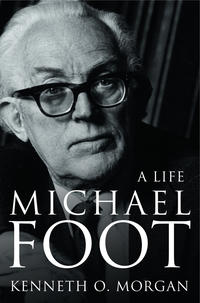
Kitabı oku: «Michael Foot: A Life»

Kenneth O. Morgan
MICHAEL FOOT
A LIFE

DEDICATION
For Joseph
CONTENTS
COVER
TITLE PAGE
DEDICATION
PREFACE
1 Nonconformist Patrician (1913–1934)
2 Cripps to Beaverbrook (1934–1940)
3 Pursuing Guilty Men (1940–1945)
4 Loyal Oppositionist (1945–1951)
5 Bevanite and Tribunite (1951–1960)
6 Classic and Romantic
7 Towards the Mainstream (1960–1968)
8 Union Man (1968–1974)
9 Social Contract (1974–1976)
10 House and Party Leader (1976–1980)
11 Two Kinds of Socialism (1980–1983)
12 Into the Nineties
ENVOI: Toujours l’Audace
SELECT BIBLIOGRAPHY
INDEX
ABOUT THE AUTHOR
PRAISE
NOTES
BY THE SAME AUTHOR
COPYRIGHT
ABOUT THE PUBLISHER
PREFACE
Michael Foot has had a very long and colourful life. He was chronicler and participant in central aspects of British twentieth-century history. His first general election found him crusading for Lloyd George’s Liberal Party in 1929. His twentieth and last saw him campaigning for Labour in his old seat, Ebbw Vale/Blaenau Gwent, seventy-six years later. He spans the worlds of Stafford Cripps and Tony Blair. He was a doughty opponent of appeasement in the later 1930s: his book Guilty Men made him famous at the age of twenty-seven. He was vocal in condemning the invasion of Iraq in 2003. He stands, and feels himself to stand, in the great and honourable tradition of dissenting ‘troublemakers’, the heir to Fox and Paine, Hazlitt and Cobbett. He played in his life many parts. As icon of the socialist left, he was custodian and communicator of British socialism. He was the greatest pamphleteer perhaps since John Wilkes, a formidable editor, and author of a glittering biography of his idol, Nye Bevan. He was a scintillating parliamentarian, an inveterate critic and peacemonger as Bevanite, Tribunite and founder member of CND, yet also a belligerent patriot and internationalist from Dunkirk to Dubrovnik. He was a central figure and champion of the unions in the Labour governments of the 1970s, a key player in Old Labour’s last phase. Less happily, he was for almost three tormented years Labour’s leader. Perhaps most important of all, he was a deeply cultured and literate man whose learning was absolutely central to his politics. He was heir to the Edwardian men of letters, the Liberals Morley or Birrell, and politically more innovative than either. Over sixty years he was an inspirational and civilizing force, if a deeply controversial one. His passing will symbolize a world we have lost.
When Michael Foot asked me if I would write a new authorized biography, I was, of course, both excited and honoured. At the same time, I had some doubts. After writing a large biography of one veteran Labour leader, Jim Callaghan, I wondered whether it would be wise to write another, especially on someone so removed from Callaghan’s own wing of the party. Although Callaghan and Foot worked with immense loyalty as colleagues in the Labour government of 1976–79, they were very different as men and as democratic socialists. Someone who worked for them both told me that they were not ‘best buddies’, while Jim Callaghan himself, just before he died in March 2005, showed himself to be a bit wary of my new project. Another point was that, while I had never really been on the right in Labour terms since I first joined the party in 1955, I was not really Old Labour either, despite the stereotypes of amiable journalists who have vainly tried to depict me as its ‘laureate’. On the contrary, I have always been a liberal devolutionist rather than a state centralist (being Welsh may have something to do with that), while on several major issues my views were not those of Michael Foot, notably on CND and on Europe. Although an admirer of Bevan (whose features adorn the sticker on my car window), I was not a Bevanite. And finally, at the start of 2003 I was doing something else, namely writing an academic book on the public memory in twentieth-century Britain. I have always been a historian rather than a biographer; only six of my books have been biographies. I was also an active member of the Lords (dissident Labour), an institution of whose abolition Michael Foot has always been an ardent supporter.
But as soon I began work and began talking to Michael Foot about his career, my doubts immediately dissolved. Having written on Jim Callaghan’s equally fascinating career proved to be a huge stimulus, both in seeing somewhat similar episodes from another perspective, and in finding contrasts and comparisons between two totally different men, each capable of the greatness of spirit to work with someone to whom he was not naturally attuned. The fact that I started from a somewhat different political (and perhaps literary) standpoint from Michael Foot was in itself exciting in trying to examine his principles and his crusades from the outside. Michael himself was typically honourable and honest in recognizing that I came from somewhere else on the Labour continuum, and that in any case I was writing as a detached scholar and lifelong academic. It is characteristic that he has made no effort to read, let alone censor, anything I have written. His view of freedom of expression and interpretation, and the need to pursue them uninhibitedly and audaciously, has been most admirably exemplified in his approach to his own biographer, and I greatly respect that. Even membership of a non-elected House has not, perhaps, been a barrier. And finally, to someone working on the public memory, there is no finer custodian or exemplar of it than Michael Foot, deeply aware, as hardly any contemporary politicians are, of the vital importance of the past – history, legend, memory and myth intertwined – in shaping the present and pointing the way ahead. So writing on Michael Foot has enormously stimulated my earlier interests. As I have moved into my eighth decade, it has given me several new ones: I know far more about Montaigne, Swift or Hazlitt, for example, than I ever did before, and my mind is much the richer for it. In all ways, I have found writing about Michael deeply stimulating. This book has been great fun to write, and it would be nice to think that some readers might find it fun to read. No doubt I shall find out.
There is another personal aspect too. Back in 1981 I received a letter from Jill Craigie, Michael’s wife, in effect suggesting that I might write his life. She invited my wife Jane and me to their house in Pilgrims Lane for a delightful dinner and talk. In fact, for whatever reason, the offer was never actually made – to my relief at that time, as I was then heavily involved with two long books, two small children and a beautiful and dynamic young wife, as well as being a busy Oxford tutor. I was not exactly looking out for ways of filling up my empty hours. I met Jill for the last time in the autumn of 1997 at an event at Congress House, near the British Museum, to celebrate the centenary of Nye Bevan’s birth. She had not been well, and she looked ill and rather sad as she came up to me and (without needing to explain) said quietly that we both knew she should have taken a different decision years earlier. I felt deeply moved, but mumbled something to the effect that I was still very much alive, and that there was still time. Jill died two years later. I would like to think that in writing this book I have been fulfilling a kind of secret bond of trust between us. I well know she would not have agreed with all its contents, but it would have been fun to have been appropriately chastised by this tough, determined but warm, loyal and lovable woman.
My main debt of gratitude is, of course, to Michael Foot himself. Apart from honouring me by asking me to write the book, he was always freely available for formal interviews or offhand chats, always open in making his papers (when they could be unearthed!) available to me, and quite astonishingly kind in giving me some of his own or his father’s books, several of them rare. He is an extraordinarily warm and generous person, a man of unforced, spontaneous learning. Simply to work through his personal edition of Montaigne’s writings, read in Hereford hospital after a serious car crash in late 1963 and covered with his own scholarly pencilled annotations, is in itself an education. Whether at home in his Pilgrims Lane basement rooms or cheerfully installed in an upstairs dining room over the goulash, raspberries and white wine at the Gay Hussar in Greek Street, talking to this ever-young nonagenarian has been nothing less than a joy, and I count myself fortunate indeed. I am also greatly indebted to the quite selfless kindness of Jenny Stringer, who has not only looked after Michael but in many ways looked after me as well during the writing of this book. I am also very grateful to Sheila Noble, who allowed me to look through Michael’s papers in her own possession in Clapham. Kay, Baroness Andrews, was kind in making the initial connections, her interest in the book no doubt shaped by her background as a citizen of Tredegar. I am also grateful to Michael’s many nice housekeepers who gave me so many splendid lunches. I particularly recall lunchtime conversations in Welsh with two of them, observed by Michael with amused tolerance. I have never met the authors of two earlier biographies, Mervyn Jones, and Simon Hoggart and David Leigh, but I would also wish to thank them for valuable information in their books which has helped me, especially on the personal aspects.
I am also hugely indebted, of course, to the kindness of Michael’s friends and colleagues. I have greatly benefited from formal interviews with Ian Aitken, Lord Barnett, Francis Beckett, Tony Benn, Albert Booth, the late Lord Bruce, the late Lord Callaghan, the late Baroness Castle, the late Dick Clements, Roger Dawe, Lord Evans of Parkside, Alan Fox, Vesna Gamulin, Geoffrey Goodman, Brian Gosschalk, Baroness Gould, Lord Hattersley, Lord Healey, Lord Hunt of Tanworth, Jack Jones, Dr Hrvoje Kacic, Sir Gerald Kaufman MP, Lord Kinnock, Jacqui Lait MP, Sir Thomas McCaffrey, Keith McDowall, Lord McNally, Baroness Mallalieu, Nada Maric, the late Lord Merlyn-Rees, Lord Morris of Aberavon, the late Lord Murray of Epping Forest, Sue Nye, the late Lord Orme, Lord Owen, Lord Paul, Sir Michael Quinlan, Caerwyn Roderick, Clive Saville, Lord Steel, Sir Kenneth Stowe, Elizabeth Thomas, Hugh Thomas, Lord Varley, Lord Wedderburn, Baroness Williams of Crosby, Vivian Williams and Sir Robert Worcester.
I am also grateful for valuable information gained from, amongst others, Dr Christopher Allsopp, Lord Anderson of Swansea, Sir Kenneth Barnes, Lord Biffen, Lord Brookman, Dr Alan Budd, Lord Burlison, Lord Carter, Lord Corbett, Sir Patrick Cormack MP, Lord Dubs, Lord Eatwell, Robert Edwards, Dr Hywel Francis MP, John Fraser, Baroness Gale, Jadran Gamulin, Lord Gilmour, Baroness Golding, Dr Andrew Graham, Lord Graham of Edmonton, Peter Hain MP, Lord Hogg, Lord Howe of Aberavon, Lord Irvine, Baroness Jay of Paddington, the late Lord Jay of Battersea, Lord Jones of Deeside, William Keegan, Paul Levy, Lord Lipsey, Lord Mason, Mrs John Powell, Professor Siegbert Prawer, Lord Prior, Lord Rodgers, Lord Sheldon, Dr Elizabeth Shore, Robert Taylor, Baroness Turner of Camden, Dennis Turner and Alan Watkins. I am also indebted to Francis Beckett for audio-visual material.
All academic writers are massively indebted to the philanthropic race of librarians. The staff of the House of Lords Library have been extraordinarily helpful, not least their former chief, David Lewis Jones from Aberaeron – diolch yn fawr iawn i ti am dy caredigrwydd. The librarian of the Reform Club, Simon Blundell, has been eternally helpful. I am also much indebted to the staff of the People’s History Museum, Manchester, where Michael Foot’s formal papers are so admirably housed, especially my old friend Stephen Bird. The helpful staff of the New Bodleian Library in charge of the newspaper stacks; my old friend John Graham Jones of the Political Archive, the National Library of Wales, Aberystwyth; Drs Allen Packwood and Andrew Riley at Churchill College, Cambridge; Ms Mari Takayanagi of the House of Lords Record Office; Ms Sally Pagan of Edinburgh University Library; and Ms Rachel Hertz at the Harry Ransom Humanities Center, the University of Texas at Austin, have all been kindness itself, while the library staff of The Queen’s College, Oxford, have served me cheerfully as they have done since 1966. I am truly fortunate in my college, its Provost and Fellows, and all its staff.
I am delighted that the Right Honourable Tony Blair allowed me to publish one of his private letters. I am also very grateful for permission to publish material where trustees own the copyright, notably the Beaverbrook Papers in the House of Lords Record Office; to Baroness Jay for material from the private papers of Lord Callaghan in her possession; and to Sir Patrick Cormack MP for showing me the portrait of Michael Foot in 1 Parliament Street as well as to the artist, Graham Jones, for allowing me to use it in illustrating this book.
For the second time, a manuscript of mine has been read by my old friend Professor David Howell of the University of York. His extraordinary learning and attention to detail have both saved me from many errors and much enriched my knowledge on matters ranging from trade union elections to the goal-scoring exploits of Plymouth Argyle. The Dictionary of Labour Biography is in the best of hands. My MS was also read by my daughter Katherine, and she too was immensely helpful for her insights both as a civil servant and as a young person.
I am also much indebted to Alison and Owain Morgan for generously giving me material on and insights into the career of Isaac Foot, whose life they have published with Michael; Chris Ballinger of Brasenose College, Oxford, for great help with the more recent National Archive records; to my colleague at Queen’s, Nick Owen, for giving me material on Indian politics in the thirties; to Clive Saville for sending me fascinating information on his time with Michael Foot in Whitehall; to my old friend Professor Dai Smith for material on Raymond Williams, whose biography he is writing; to another old friend, Professor Roger Morgan, and to John Allinson for sending much helpful information on Leighton Park School; to an almost lifelong colleague, Professor Wm Roger Louis, for help at the Harry Ransom Center, Austin, Texas; and to Dr Peter Gaunt, Professor John Morrill and Dr Stephen Davies for informing me about the Cromwell Association. I have also benefited from the learning of Dr James Ward and my Lords colleague Ted Rowlands for guidance on Dean Swift. Indeed the companionship of many gifted and humane colleagues in the Lords has been a boon beyond measure, since I have had expert advice from Bhikhu, Lord Parekh, on Indian affairs, from Bill, Lord Wedderburn, on the complexities of labour law, and from Trevor, Lord Smith of Clifton, with shrewd thoughts on many matters from the benches of the Liberal Democrats. Anne-Marie Motard of the University of Montpellier has always been a reassuring force. My literary agent, Bruce Hunter, has been friend and wise adviser as for decades past, and my editor at HarperCollins, Richard Johnson, has made my first experience with that great publishing house quite delightful, as has my wonderful copy-editor, Robert Lacey. Since one of my unfortunate common experiences with Michael Foot is to have been the victim in a serious car crash, in my case in 2004, I would also like to thank Professor David Murray of the Nuffield Orthopaedic Centre, Oxford, for restoring me physically (twice).
Most authors owe much to their families. Partly through adversity, ours is closer than most. I am hugely grateful to my two amazing children, David and Katherine, for their love, moral support, knowledge of word processors and unfailing enthusiasm for their obsessive bookish father; to my lovely daughter-in-law Liz, another writer in the making; and to my little grandson Joseph, a free-thinking, free-walking radical to whom this book is dedicated. This is my first big book since 1973 in which my beloved late wife, Jane, played no part. Yet maybe she was present after all. In 1987, at the parliamentary launch party of my book Labour People, one of the politicians dealt with there (very favourably) ignored the publishers’ invitation. He also ignored us in the Commons corridor as we approached the terrace room. By contrast, Michael Foot had replied at once, and made a very warm and witty speech at the event. ‘No surprise there,’ said Jane with finality. ‘Michael Foot is a gentleman.’ As always, she was right.
KENNETH O. MORGAN
Long Hanborough,
May Day 2006
1 NONCONFORMIST PATRICIAN (1913–1934)
On a fine sunny evening on 14 July 2003, the Prime Minister, Tony Blair, hosted a reception in Downing Street. But this was a New Labour event with a difference. It was attended not only by the predictable great and good of the British Labour movement and the associated media, but also by a rich variety of rebels and dissenters, veterans of CND, Tribune and Troops Out, a representative sample of those people that the historian A. J. P. Taylor had christened, in a famous book in 1957, Britain’s ‘troublemakers’. They were there to honour a frail old man of almost ninety, compelled to be seated but full of life and nodding his head in synchronized animation. This was Michael Foot, an almost legendary icon on the Old Left, one-time leader of the Labour Party, long-term oppositionist parliamentarian, editor and essayist, pamphleteer and man of letters, a scourge of Guilty Men in high places ever since he first made his name in that famous wartime tract published just after Dunkirk, sixty-three years earlier. This reception was merely the most spectacular of many events designed to make July 2003 a month of celebration of Michael’s latest landmark. That same week there was to be a massed gathering of his friends at his favourite Gay Hussar restaurant in Greek Street, Soho, at which the eminent journalist Geoffrey Goodman presided and Michael was awarded a shirt of his beloved Plymouth Argyle football team bearing the number 90 on its back. He had, he was told, been formally registered as part of the Argyle squad with the Football League, perhaps to reinforce his team’s left-wing attack. The following week there was another reception in the very epicentre of the establishment, this time the Foreign Office in Carlton Gardens, genially presided over by the Foreign Secretary Jack Straw, Member for Blackburn and successor and protégé of Michael’s old comrade and love, Barbara Castle. He described how Michael had made in the House of Commons in 1981 the finest speech that he, Straw, had ever heard.
But the evening in the Downing Street garden on 14 July, Bastille Day appropriately, was the highlight. It was set, as Foot would have particularly appreciated, in a place steeped in history, where the newly elected Labour Prime Minister Clement Attlee had convened his excited ministers in 1945 and Lloyd George’s ‘garden suburb’ of private advisers had once conducted intrigues and manoeuvres from temporary huts set amongst the flowerbeds. People wondered what Tony Blair himself might say about so traditional and committed an Old Labour stalwart. In fact his speech was charming, generous and relaxed. He recalled Michael’s dedication to human rights (though not to socialism), and paid especial tribute to his strong backing of the young Blair’s effort to become candidate for the Sedgefield constituency in 1983 – a reflection no doubt of Foot’s positive response to Blair’s early campaign in the Beaconsfield by-election in 1982, and also perhaps of his determination to ward off the selection of a hard-left Bennite, Les Huckfield. Michael, in response, spoke at much greater length and with less precision, although, to the joy of some present, he did manage an amiable throwaway reference to George Galloway, a far-left socialist shortly to be expelled from the Labour Party for his support for Saddam Hussein. The whole occasion was entirely relaxed and enjoyable, Old and New Labour as one, poachers and gamekeepers drinking in common celebratory cause. Vocal protests from demonstrators outside in Whitehall directed against Downing Street’s later visitor that evening, Israel’s Prime Minister Ariel Sharon (with which many in the garden sympathized), were satisfactorily inaudible. As they left, people commented on how relaxed Tony Blair looked even at a time of pressure during an inquiry by the Commons Foreign Affairs Committee into the origins of the invasion of Iraq four months earlier. This was made especially difficult by the embarrassed evidence from the government scientist, arms expert and apparent whistle-blower, Dr David Kelly. Honouring Michael Foot, himself a vocal critic of the Iraq war, meant for the moment the burying of hatchets all round.
Four days later, the birthday bonhomie disappeared. The body of the tormented David Kelly was discovered in woodland at Southmoor, near his home in southern Oxfordshire. Suicide was suspected. Angry friends accused Tony Blair of indirect complicity. Foot’s birthday party was to prove almost the last happy evening that the Prime Minister would know for many months to come. The shadow of Kelly and the other consequences of the Iraq venture would haunt him right down to the general election of May 2005, which saw Labour’s majority fall by almost a hundred. But whatever these events meant for Tony Blair, they were perhaps not a bad symbol for the career of Michael Foot – loyal acclaim from the party, genial genuflection from the establishment, but an underlying background of conflict, tension and tragedy throughout the near century of which he was chronicler and survivor.
This unique combination of elitism and dissent went right back to Michael Foot’s ancestral roots. His family and forebears shaped his outlook and style more than they do for many public figures. More important, he himself believed that their influence was decisive, and often paid testimony to their historic importance, by word and by pen. It was a background of West Country dissent that dated from the historic conflict between Crown and Parliament under Charles I. Cromwell was very much the people’s Oliver for the tenant farmers and craftsmen of Somerset, Devon and Cornwall. But it was also a tradition of patriotic dissent, of dissent militant. Francis Drake was an earlier hero for the community from which the Foots had sprung, his freebooting illegalities discounted amidst the beguiling beat of Drake’s Drum. In August 1940 Isaac Foot, Michael’s father, was to give a famous broadcast, ‘Drake’s Drum Beats Again’, comparing the little boats at Dunkirk with Drake’s men o’war. Similarly it was Cromwell the warrior whom Michael and all the Foots celebrated – the victor of the battles of Marston Moor, Naseby and Dunbar, the man who supported the execution of his king and conducted a forceful, navy-based foreign and commercial policy – quite as much as the champion of civil and religious liberties. It is not at all surprising that Michael, ‘inveterate peacemonger’, unilateralist and moral disarmer, should also brandish the terrible swift sword of retribution in the Falklands and in Croatia and Bosnia later on. Like the legend of John Brown’s body, his prophetic truth would go marching on.
The Foot dynasty of Devon were robust specimens of West Country self-sufficient artisans. In the main they were village carpenters and wheelwrights, working on the Devon side of the river Tamar which separates that county from Cornwall. On balance, the Foot dynasty were Devonian English, indeed very English, not Brythonic or Cornish Celts. The earliest traced of them is John Foot, who is known to have married Grace Glanvill in the Devon village of Whitchurch, near Tavistock, on 21 October 1703. Then came successively Thomas Foot (born 1716), another Thomas Foot (1744–1823), John Foot (1775–1841) and James Foot (1803–58), all resident in the hinterland of Plymouth, all Methodists subscribing in their quiet way to that city’s tradition of vibrant nonconformity, and with folk memories of Plymouth’s role as a bastion of parliamentarianism, almost republicanism, during the civil wars of the 1640s. Men recalled the siege of Plymouth during those wars, and the citizens’ proud resolve not to be starved by the royalist armies into surrender. There was a permanent monument to it in Freedom Fields, close to the later home of Isaac Foot and his family. The man who really established the Foot tradition and mystique was Michael’s grandfather, the elder Isaac (1843–1927).1 A carpenter and part-time undertaker by profession, he moved to Plymouth from Horrabridge in north Devon, reportedly with just £5 in his pocket. He built his own house, branched out as a small entrepreneur and as such took a more public role in the civic life of Plymouth. A passionate Methodist and teetotaller, he was anxious to civilize the somewhat turbulent seaport in which he lived, and left as his legacy a Mission Hall in Notte Street, near the city centre, which he himself had financed and built, along with Congress Hall for the Salvation Army. His son, the younger Isaac (1880–1960), began life with clear expectations of a professional career. He qualified as a solicitor, and after a brief period in London was articled to a solicitor back in Plymouth, married a Scots fellow Methodist, Eva Mackintosh, in 1904, set up his own firm of solicitors, Foot and Bowden, in the same year, and moved to live in Lipson Terrace, a comfortable upmarket road in the northern part of the town. It was in this secure bourgeois enclave that the seven children of the Foot dynasty were born.
Isaac Foot, Michael’s father, was the sixth of eight children, of whom five were to live to a considerable age.2 He was a memorable personality of dominating influence. As its patriarch, he was passionate in his defence of the Foot family. When he wrote to congratulate Michael on a fine maiden speech in Parliament in August 1945, at the same time he condemned Churchill for not appointing his other son Dingle to the Privy Council after his service at the Ministry of Economic Warfare: ‘I shall never forgive him for that. Now the Foot family move to the attack. When folk attack the Foot family, they are biting granite.’3 His outlook and lifestyle were challenging and highly individual. Of all the seven children of this Liberal patriarch it was Michael who was said most to resemble him. Until his nineties Michael would readily turn to his father’s views on politics and literature, on Cromwell or Napoleon, on Swift or Hazlitt or Burke, to bolster his own line of argument. Isaac Foot had been a radical youth, and at the age of eighteen was attracted to H. M. Hyndman’s Marxist party the Social Democratic Federation (SDF),4 but not for long. He was one of many young professional men stirred by the Liberal landslide victory in the general election of January 1906, when both the two Plymouth seats were captured by Liberals from the Conservatives. In 1907 he was elected a Liberal councillor and rose to become Deputy Mayor in 1920, at hand to take an enthusiastic part in the celebrations of the tercentenary of the sailing from the city of the Mayflower. He was basically an old Liberal, committed to the traditional battles with the bishop, the squire and especially the brewer. He shared to the full the nonconformist crusade for civic equality which made Devon, Cornwall and (to a lesser degree) Somerset more similar to the political outlook of rural Wales than to the rest of southern England. But Isaac responded very positively also to Lloyd George’s social radicalism, his ‘People’s Budget’ of 1909 with its new taxes to pay for social reform, which the Lords rejected, and the successful battle with the Upper House in 1909–11, resulting in the passage of the Parliament Act. Despite the huge Liberal schism created later by the ‘coupon election’ in December 1918, when Lloyd George and his followers continued in coalition with the Unionists (Conservatives), the Welshman remained something of a Foot family talisman from then on. Isaac Foot actually stood for Parliament in January 1910 as Liberal candidate for Totnes, but was heavily defeated by the Conservative. He stood again in December 1910, this time for Bodmin, a seat held by another Liberal the previous January by the slender margin of fifty votes, and was defeated there by an even narrower margin, just forty-one votes. The turnout was 86.6 per cent in this traditionally hard-fought seat, and Foot stayed on as candidate.
During the war he was among those numerous West Country Liberals who took the side of the fallen Asquith after Lloyd George had ousted the Prime Minister in a putsch involving leading Conservatives and press men like Max Aitken (soon to become Lord Beaverbrook) in December 1916. Isaac Foot had in any case been a strong critic on libertarian grounds of the conscription measure passed by the Asquith coalition that May, and defended many conscientious objectors in tribunals during the war. This was not popular, and ensured his heavy defeat in a second contest for Bodmin in the general election of December 1918; he also failed in a by-election in Plymouth in 1919, after which the successful Conservative candidate Nancy, Lady Astor became the first woman MP to take her seat in Parliament. But Isaac hung on, and eventually won Bodmin in a by-election in February 1922 with a strong majority of over three thousand. He held on to the seat in the general elections of 1922 and 1923, lost in 1924 and was returned again to represent the same constituency in 1929 and then in 1931 when (from 3 September) he served in Ramsay MacDonald’s National Government as Minister for the Mines.
Several of them became close friends of Michael Foot. Among them were men of high talent (women were marginalized in a highly chauvinist university at that time). Frank Hardie, President of the Union in Hilary term 1933 during the King and Country debate, was a charismatic President of the University Labour Club. Anthony Greenwood, President of the Union in Trinity term 1933 and a handsome man popular with women undergraduates, saw the pro-Communist October Club founded in his rooms in Balliol – and later suppressed by the proctors. Paul Reilly of Hertford College, the son of a famous architect, was another young man of the far left, and a long-term friend of Michael Foot. He was later to be an important figure in industrial design and director of the Design Council. Foot’s most important close friendship was with John Cripps of Balliol College. He was a patrician socialist with whom Foot shared a house in his final year at Oxford and with whom he was to visit America on a debating tour in 1934, and who was to become a major figure in countryside matters. Unlike his friends Reilly and Foot, he gained a first in the Schools. It was through John’s father, Sir Stafford Cripps, an outspoken MP and voice of far-left views after the collapse of the Labour government (in which he had served as Solicitor-General) in 1931, that Michael Foot was to secure his first important entrée into the Labour Party.
For Michael the Union, as the focus of Oxford social and political life, was the institution to conquer, and he made astonishingly swift progress. Dingle and John had both been Presidents in the twenties, and as it happened both spoke in Union debates in the Trinity term of 1932. A speech of John’s was described as ‘stupendous’ in the Oxford Magazine.44 As for Michael, his brand of revivalist Liberal oratory swept opponents aside. Elected early on to the Library Committee, he was elected Treasurer for Hilary term 1932, then became Librarian, and in June 1933 defeated David Graham, ex-Librarian, in winning the presidency by a large majority. Anthony Greenwood graciously wrote a balanced and delicate appraisal of his election: ‘He would do well to pay a little more attention to the serious parts of his speeches. At present he seldom really deals with the subject. But it was a great oratorical effort and fully justified the result of the polling. I hope that Mr Foot will have a very happy term in the chair which has become almost a monopoly of his family.’ Foot’s election brought much joy. Greenwood wrote privately to congratulate him: ‘I thought your speech last Thursday was first rate, as it was in the Eights Week debate.’45 His mother Eva wrote with almost a sense of inevitability: ‘Do you think Graham really thought of getting it?’ Isaac combined paternal warmth with practicality:
The Foot colours have been kept flying high. I send you a cheque for ten pounds and made a further pull in the overdraft. If invested in the Abbey Road it will be worth about eighty pounds at the age of ninety. No swollen head, my lad.46
In the event, Michael’s term as President passed by satisfactorily, though inevitably silently on his part. He returned to debating the following term in loud support of a motion that ‘the presence of four hundred and seventy Conservatives in the House is a national disaster’. Towards Tories, Foot observed, he had ‘an inflexible loathing’.
His experiences in the Oxford Union profoundly shaped Foot’s political image. The Union nurtured his particular style of oratory, heavily sarcastic towards opponents, the swift marshalling of key points of an argument, the deliberate focus on the opposition’s strongest point before destroying it, the inexorable advance towards an unanswerable conclusion. Reinforced by ample quotations from historical and literary eminences, Foot’s speeches were hard to rebut. From this time on he was to become celebrated as an incomparable revivalist stump speaker. Equally, the sometimes more measured approach necessary in House of Commons debates, or in television interviews, was much harder to capture. But his unique debating style, with a distinctive rhythm and cadences, and unorthodox changes of emphasis that made him hard to interrupt, was central to his political fame.
The dominant theme of his speeches at the time was always resistance to war. Foot is a good example of the rebellion of the young in the later twenties and earlier thirties, responding eagerly to anti-war works like All Quiet on the Western Front or Goodbye to All That, using images that exposed ‘merchants of death’, denouncing the ‘system of Versailles’ and calling for a new international order with open covenants openly arrived at. One book on the wartime experience that made a particularly deep impression on him was the poet Edmund Blunden’s Undertones of War (1928). Foot’s credo came out very clearly in a compilation of four essays by recent Oxford undergraduates, Young Oxford and War, published by Selwyn Blount in 1934, under the unexpected editorship of a rising Indian politician, V. K. Krishna Menon, and with a brief foreword by Harold Laski.47 The authors were a varied group. R. G. Freeman was a Communist and President of the short-lived October Club. Frank Hardie, the former Union President, wrote ‘as a pacifist and a socialist’. Keith Steel-Maitland, whose chapter was easily the most practical and down-to-earth, was a moderate Conservative.
Finally there was Michael Foot, writing passionately as a near-pacifist Liberal. He condemned the rise of militarism in schools and universities in recent years: ‘There can be no real distinction between defence and offence in the modern world.’ He quoted freely from anti-war Union of Democratic Control authors like G. Lowes Dickinson and Norman Angell, author of International Anarchy, a phrase which appeared with much frequency in Foot’s early writings. He applauded the pacifist arguments advanced by Quakers and others, and pointed to the success of German Protestants in, so he claimed, resisting Hitler. Pacifism implied ‘unilateral disarmament’ and argued that evil should not be resisted with evil. The broad pacifist movement was plagued by internal divisions but could focus on ending international anarchy and ‘the elimination of force from the conduct of international affairs’. His was by no means a complete or unqualified pacifist argument. A properly constituted collective peace force to provide a backing of law ‘does not contain the elements objected to by the pacifist’. But instances in which resort to arms could ever be accepted by one of Foot’s outlook seemed hard to spell out in practical terms. It was a young man’s tract, rich in idealism, uncertain in logic, lacking in any kind of practical detail. But it embodied themes that were constantly to recur in Foot’s later career.
Foot emerged from Oxford with a glowing reputation as a potential young politician, even perhaps a future minister, Cripps and others thought. As noted, he announced his release from Oxford life with a trip to Paris with his brother John, spent in part breaking their vow of abstinence from alcohol, in part pursuing in vain a pretty young French girl Michael had met at Pencrebar the previous year. His student days had officially come to an end, but there was an interesting coda that autumn. With his close friend John Cripps he went to the United States for the first time in a debating tour on behalf of the Oxford Union. America was neither a country nor a culture that had impinged greatly on Michael’s early years, although he enjoyed aspects of its artistic life such as the films of Walt Disney and the voluptuous Mae West, and had some emerging interest in writers such as Emerson and Thoreau. Politically, like many young Englishmen, he had much enthusiasm for Franklin Roosevelt’s New Deal programme, which he regarded as an attempt to shore up social welfare and progressive economics against backwoods Republican reactionaries during the Great Depression, and indeed as an inspiration to the world. But it belonged ‘over there’, and had little directly to offer the young Foot (though this was equally true of young Labour economists like Hugh Gaitskell, Douglas Jay or Evan Durbin at the same period).
It was a gruelling visit, with twenty-two debates between 26 October and 4 December 1934.48 They went mostly to universities on the eastern seaboard, ranging from Yale and Penn State to Bates College, Maine. The last two debates took them almost seven hundred miles west, as far as Michigan. Michael Foot and John Cripps, ‘two quiet young chaps wearing glasses’, as they were described in the Atlanta Journal,49 were usually given left-wing motions to defend, which they both did with much success, defending trade unions, condemning military training in schools, attacking isolationism in American foreign policy. The old Liberal in Foot emerged in a robust attack on American trade policy at New Rochelle, New York, on 26 November: ‘If you uphold an isolationist policy, you can no longer remain a great creditor nation, you can no longer remain a great exporting nation.’ The result would be the same economic collapse and mass unemployment that were then so visible in Britain. He and Cripps were invariably triumphant in these debating jousts, and a succession of student newspapers wrote in praise of their wit and eloquence. Foot’s ‘brilliant rebuttal’ in a motion on the need for trade unions was praised in Yale News,50 although there were some murmurs that the Oxford Union seemed a bit facetious by American standards. There were also random interviews in which Michael told the Americans of the importance of Mickey Mouse to the British view of transatlantic culture.51 The tour was, in its way, an important episode for Foot. America was never so appealing that it shaped his political or other views: despite his enthusiasm for most aspects of Roosevelt’s New Deal, he was too intensely English for that. But the visit enlarged his vision in many respects. For instance, one aspect he noticed was the apparently much greater prominence of women in higher education in the US, notably in some distinguished women’s colleges at which he and Cripps spoke. The trip took him out of his familiar English radical world for a while, and helped him to grow up.
Michael Foot’s early years made him a distinctive, perhaps unique, kind of politician. He somehow bridged new and old, the brave new world radicalism of the post-war generation alongside the cultural depth of a Victorian man of letters. He was in many ways an old young man; equally he remained an eternally youthful spirit well into extreme old age. He drew from his origins a passionate attachment to the traditions of his family, and of Plymouth and the West Country more generally. He acquired an immense stock of vivid, easily mobilized political and literary influences and allusions. An apt quotation from Foot could spear opponents at will. His political connections were strong, first with Lloyd Georgian Liberalism, though perhaps Stafford Cripps might direct him towards new horizons. As a young debater at Oxford he acquired a fluency and poise in debate, buttressed by a kind of cultural confidence that pushed him towards a public career. He discovered that he could speak and he could write, with passion, conviction and often brilliance. He had all the idealistic fervour of a young anti-war radical at that time. Yet perhaps the abiding legacy from his younger days was an ability to place himself in historical context. When he reflected on current political and social issues, Drake and Cromwell, Tom Paine and Hazlitt, even aberrant turncoats like Edmund Burke, were at his shoulder. He felt himself to be somehow their heir, a past and future king of libertarian dissent, but searching still for a coherent movement to lead or even to join. But, whatever his future, he would share with the inspirational Isaac a demonic energy to pursue great causes. For ‘He trespasses upon his duty who sleeps upon his watch.’ No Foot ever dared do that.
2 CRIPPS TO BEAVERBROOK (1934–1940)
When Michael Foot’s hero, David Lloyd George, came to London as a young man at the age of seventeen in November 1880, he set eyes on the House of Commons for the first time. In his diary he admitted to having ‘eyed the assembly in a spirit similar to that in which William the Conqueror eyed England on his visit to Edward the Confessor, the region of his future domain. Oh, vanity!’1 Five years later he unveiled to his future wife, Maggie Owen, the force of his terrifying ambition: ‘My supreme idea is to get on … I am prepared to thrust even love itself under the wheels of my juggernaut if it obstructs the way,’2 and he was as good as his word. Michael Foot, by contrast, felt no such overpowering urge. Although the son and brother of Liberal MPs (and possessed of a good deal more historical knowledge of the Norman Conquest than Lloyd George), he had no driving political ambition. To none of his friends did he suggest that he might consider becoming a parliamentary candidate. Indeed, when he came down from Oxford in June 1934, even when he returned from the United States six months later, he had no idea of what he might do in life. His brothers were finding their feet professionally, Dingle in chambers as a barrister as well as being an MP, Hugh in the Colonial Service, John in the solicitors’ firm Foot & Bowden back in Plymouth. But none of these routine occupations appealed to Michael’s imagination even though he too, in his way, sought ‘to get on’.
In fact he spent his first six months after graduating very much on the move. There was the jolly visit to Paris with John mentioned earlier, on which he spent a small legacy of £50 from his grandfather, a reward for earlier abstemiousness, successfully chasing culture, less successfully chasing girls, gleefully downing his windfall with glasses of Pernod. There followed a far more significant trip for the longer term when he went on across Europe, taking a train to Venice – very much his cherished city in later years – and then a boat from Trieste to Haifa to join his elder brother Hugh (‘Mac’), now serving in the Colonial Service amongst the continuing tensions of Palestine. Hitherto Michael had had no particular interest in the tensions between Jews and Arabs, although most British Liberals, from Lloyd George downwards, had a broad sympathy for the Jews and for the Zionist movement. Churchill’s philo-Semitism when a pre-war Liberal MP was well known. But Michael Foot’s trip in 1934 had a major impact upon him. It was to stimulate the first of many controversial crusades. He first became aware of the qualities of the Jews on the slow boat to Haifa, since virtually all the other passengers on it were Jewish. One of them was an ardent chess player with whom Foot first played serious chess. On this voyage his Jewish friend won every time, but Foot was to become ‘one of the strongest players in the House of Commons’ in later years.3
When he reached Palestine Michael stayed with his brother Hugh at Nablus, in the famous biblical region of Samaria. For one hellfire Welsh nonconformist preacher the very name had been a symbol of communal turbulence: ‘What was Samaria? Samaria was the Merthyr Tydfil of the land of Canaan.’4 In 1934 it was no more tranquil, with a small number of Jewish settlers in a prolonged stand-off with a large Arab community scattered throughout desert villages. Michael quickly realized the complexities of the situation in Palestine, a region left in conflict and possible chaos after the ambiguous pledges to both communities made by Lloyd George’s government after the disastrously imprecise Balfour Declaration of 1917. But whereas brother Hugh, like most in the Colonial Service, was a warm sympathizer with the Arabs, it was the plight of the beleaguered Jewish minority that haunted Michael all his life. After a few tense weeks in Nablus he returned home by a circuitous route, including a cheap ship from Beirut, his first flight, from Athens to Salonika, and a stopping train through Yugoslavia and back to England. There followed his debating tour in America with John Cripps. He returned home just in time for Christmas, after which the more practical problems of getting and spending had to be resolved.
The way that things worked out for him had a critical effect on his entire life. In the absence of any attractive alternative his thoughts turned to writing a work of history, in which the present-day moral would emerge. His chosen area was the life of Charles James Fox, to whom he had been pointed by his reading of George Otto Trevelyan and others, and who had interested him when working for prizes at Leighton Park school. Fox had much appeal as a subject. He was a critic of the overmighty authority of George III and his King’s Friends. He was a colourful personality, sexually liberated – usually a feature of Foot’s chosen heroes, including Hazlitt, Byron and H. G. Wells. He was a literate apostle of the Enlightenment. Above all, he championed the ideals of the French Revolution and of civil liberty through dark times in peace and in war. Foot was always a passionate supporter of the revolutionaries of 1789: they drew him to Tom Paine and to Hazlitt in his reading. A fellow chess enthusiast, Charles James Fox inspired Foot as an essential link in a native English radical tradition that bound the Levellers in Putney church to Cobden and Bright and Lloyd George and Bertrand Russell and the anti-war apostles of the Union of Democratic Control in 1914: the relationship of all this to the separate complexities of the socialist tradition was something he had yet to work out. Fox was naturally opposition-minded; he was seen by A. J. P. Taylor as the founder of the dynasty of ‘trouble-makers’ which his 1957 Ford’s Lectures at Oxford celebrated, and whose steps the Campaign for Nuclear Disarmament consciously followed. Fox had kept alive the red flame of radical courage during the bleak Pittite years. He was the most natural of subjects for the post-Oxford idealist Michael Foot.
But the book never happened. Foot had no money, no publisher, not even a synopsis to wave around. Instead he found himself trapped in a humdrum office job, which was to change his life. It was to become a central point of self-reference and self-definition in his own later interpretation of his career. This arose from his friendship with John Cripps, which led him to spend much time in vacations at ‘Goodfellows’ in the west Oxfordshire village of Filkins, the squire’s home of John’s father, the famous advocate and by now socialist firebrand Sir Stafford Cripps. He also went on holiday with the Cripps family to the Scilly Isles. Foot’s relationship with Stafford Cripps soon became a decisive one. He needed a hero and a patron: in Cripps, as later in Beaverbrook, he found both. ‘Goodfellows’ fascinated him with its array of visiting Labour, trade union and socialist celebrities. He met George Lansbury, Labour’s current evangelistic pacifist leader, whose pacifism appeared even to Foot surreal, but with whom he became friendly in Lansbury’s last years. He was impressed by Ernest Bevin, the Transport and General Workers Union’s General Secretary, as an authentic working-class leader of much strength of personality; much less so by the taciturn Clem Attlee. A far more potent influence than either was one occasional visitor, the young Welsh MP Aneurin Bevan, who was to shape his destiny for ever. There were also young people like Geoffrey Wilson, an idealistic Quaker who was to become Stafford Cripps’s private secretary on his ambassadorial visit to Moscow in 1940. Clearly, amidst such company Foot’s traditional Liberalism would be facing a severe challenge. But Cripps was attracted by his son’s interesting and knowledgeable young friend, anxious to help him forward and to enlist his literary and oratorical talents for his own versions of the socialist cause. Cripps’s brother Leonard, a ship-owner and a director of the Holt shipping firm’s Blue Funnel Line which traded with southern Africa and the Far East, needed a personal assistant. His nephew John had been pencilled in for this post, but John (a caustic critic of his uncle’s right-wing views) suggested his friend Michael instead. Thus it was that on 1 January 1935 the impressionable young Foot began work amidst the cranes and bunkers of the alien shipyards of Liverpool’s docks.
Michael Foot’s time in industrial Liverpool was not a relaxed one, and he left after barely nine months. But for ever afterwards he would give this period a legendary Damascus-like status as the time when he first witnessed social hardship and became a left-wing socialist. It is important to try to establish how far the poverty of working-class Liverpool was pivotal in this conversion, and indeed what kind of socialism it was to which he was drawn. Certainly he found his job in the Blue Funnel Line boring and undemanding. He used as much time as he could in making notes on the back of business correspondence on the career and ideas of Charles James Fox. He had hoped that his new job might entail some overseas travel, for which he had now acquired a taste, but none was forthcoming and he was office-bound. Foot told his mother how heartily he disliked all the people he worked with and for. Leonard Cripps was boring, Sir Richard Holt ‘the last word in malignant density’. Others had ‘stunted intelligences’, while the routine duties were ‘dull as ditchwater’.5
But Liverpool, the first industrial working-class city of which he had any experience, was far more compelling. He found lodgings in a Yiddish-speaking Jewish home which his recent visit to Palestine made congenial. He spent time exploring the shabby backstreets of the dock-side areas. He also transferred his footballing interests, at least for a time, to supporting Everton at Goodison Park. He treasured in later life an ‘Ode to Everton’ that he composed in 1935, which was printed in the Liverpool Daily Post. It laid particular emphasis on ‘Dixie’s priceless head’, a reference to the prolific goal-scoring centre-forward ‘Dixie’ Dean.6 But crucially, within a month of arriving on Merseyside the old West Country Liberal had joined the Labour Party as an active, ardent crusader and canvasser. (Oddly, in accounts of his career he tends to give 1934, not 1935, as the date of his conversion.) Michael had got religion, and wanted the world to know. Soon he was an energetic participant in the committee meetings and street-corner campaigning of the Liverpool Labour Party. He met congenial comrades here, including two future parliamentary colleagues, Sydney Silverman, an eloquent Jewish lawyer, and the formidable and pugnacious Bessie Braddock and her husband Jack, both ex-Communists. To what extent Michael’s conversion was the consequence of empirical observation might, however, be examined. After all, commentators have wondered how far George Orwell’s famous book of the same period was actually the product of first-hand observation of Wigan Pier. John Vincent once commented in an Observer book review that ‘a man who describes as flabby Lancashire cheese which is crumbly gives himself away at once’.
Without doubt, Michael Foot’s compassionate heart and soul were deeply stirred by the poverty he saw in the dockside community and in Liverpool’s backstreets. It was a maritime city with a weak manufacturing base, and thus very high unemployment, painfully evident on street corners amidst its shabby terraces. Equally clearly, his speeches and articles while at Oxford show a young man moving rapidly leftwards in his revulsion for militarism and dictatorship. His criticisms of socialism in ‘Why I am a Liberal’ are half-hearted questionings of the merits of centralization. Most of his close friends at Oxford – John Cripps, Paul Reilly, Tony Greenwood – were emphatically Labour. And without doubt his acquaintance with Stafford Cripps and the bracing radical atmosphere of ‘Goodfellows’ were a powerful influence too. But, most characteristically, Michael’s conversion came through the medium of books – and indeed not sober works of socio-economic analysis, but imaginative works of fiction. While crawling to his office on Liverpool’s trams, his mind was focused not only on the slums through which he passed but on the books he read on his journey. Arnold Bennett was a particularly powerful stimulant: his How to Live on Twenty-Four Hours a Day (1910) made a lasting impact on the young socialist. It is actually a short book, not at all one of Bennett’s masterpieces, but Foot no doubt appreciated the chapter on ‘Serious Reading’, which lavished great praise on Hazlitt’s essay ‘Poetry in General’ – ‘the best thing of its kind in English’.7 Foot also read extensively the novels of H. G. Wells, destined to loom alongside Cripps and Bevan as supreme inspirations. Tono-Bungay’s relatively brief account of socialist ideas was exciting to him, more perhaps for its subtle exposé of the immoralities of free-market competitive capitalism. Bernard Shaw was another important influence, though he was less favoured because of his criticisms of Wells’s Short History of the World.8 Foot’s was an undoctrinaire ethical socialism, a gospel of words and ideas, similar to that which had impelled young men like Attlee or Dalton into the Independent Labour Party. On more immediate matters, Foot was excited by Bertrand Russell’s Proposed Roads to Freedom. Economic theory does not seem to have interested him. At first he was innocent of connections with Marxism, although by 1937 he was instructing the equally young Barbara Betts (the future Barbara Castle) in the intellectual delights of Das Kapital. His ideology, such as it was, kept its distance from the formal programmes of the Labour Party, still in 1935 trying to redefine its policies after the catastrophe of 1931 had laid bare the emptiness of its economic notions, and perhaps also the wider problem of attempting to modify and humanize a capitalist order which it ultimately wished to abolish.
Nor was Michael Foot a Fabian. He had met Beatrice Webb at Stafford Cripps’s home, and did not take to her admonitory style. He did not become a socialist in order to promote orderly administration by a bureaucratic elite; nor, without a background in local government at any level, was he inspired by the heady vision of ‘gas and water socialism’. The first book by the Webbs that he read, and indeed responded to positively, was their Industrial Democracy, which he read together with Barbara Betts at her Bloomsbury flat. Years later, in 1959, he took sharp issue with the Fabian historian Margaret Cole on the Webbs’ vision of socialism: ‘I think there is running through a great deal of what they wrote … a strong bureaucratic, anti-libertarian attitude which often reveals what I think is a real contempt for those who are engaged in Socialist agitation, protest and activities of that nature.’ He pointed out Beatrice’s patrician absence of interest in the great propaganda work of Robert Blatchford, editor of the early socialist newspaper the Clarion (he might have added her contempt for Keir Hardie and George Lansbury as well). For much of their career the Webbs were unconvinced that the Labour movement was the instrument of change, rather than a generally-defined ‘permeation’ and gradualism. Revealingly, Foot added as a criticism the Webbs’ uncritical adulation of the Soviet Union and Communist doctrine, in contrast to the far more critical approach of his old journalist friend and mentor H. N. Brailsford, historian and intellectual guru of the socialist left.9 Foot’s conclusions appear to endorse many of H. G. Wells’s assaults on the Fabian high command in the Edwardian period, and the general line of criticism indicated in one of his favourite books, The New Machiavelli. It was a battle of the books which Margaret Cole was most unlikely ever to win. For Foot, then, socialism was a greater liberalism, a doctrine of social and aesthetic liberation. It implied new values and a new society. It made Michael in time the natural disciple of the imaginative crusader Aneurin Bevan and the natural husband of the cultural socialist, Jill.
In this quest, Stafford Cripps seemed at this period the natural messiah. Since the 1931 schism, with the defection of MacDonald and his Chancellor Philip Snowden to become allies of the Tories, Cripps had led a sharp advance to the left. He preached a style of socialism that went far beyond the cautious parliamentary parameters within which Labour had grown up. He joined the far-left Socialist League, a movement of middle-class intellectuals, formed in 1932, in large part from the ILP when it disaffiliated from the Labour Party. It was a movement in which Michael Foot was shortly to enlist. Cripps campaigned to promote a new foreign policy in alliance with the Soviet Union: the League of Nations was dismissed as ‘the International Burglars’ Union’. He also pressed for the social ownership of all major industries and utilities, based not on state nationalization but on workers’ control. At the 1933 party conference Cripps proclaimed in Marxist terms that a socialist government would never receive fair treatment under capitalism, with the City, the Civil Service and the establishment all ranged against it. He called for some form of emergency government to entrench socialism in our time. In January 1934 he caused even greater alarm and shock by suggesting that Buckingham Palace would be foremost amongst the institutions seeking to defeat an incoming Labour government. This doctrine horrified leaders such as Dalton, Attlee and Morrison: Beatrice Webb thought him an extremist and his ideas revolutionary. By the 1935 general election Cripps’s erratic behaviour meant that his star was soon to wane. He himself recognized the fact by giving private financial help to Clem Attlee as assistant party leader in Lansbury’s last phase. But to the young Michael Foot, a books-driven evangelist yearning for a cause, Cripps was the most obvious instrument of creating a new socialist society.
Ücretsiz ön izlemeyi tamamladınız.