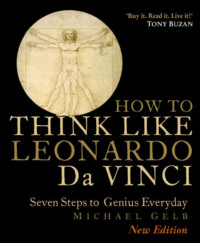
Kitabı oku: «Think Like Da Vinci: 7 Easy Steps to Boosting Your Everyday Genius»


THINK LIKE DA VINCI
7 EASY STEPS TO BOOSTING YOUR EVERYDAY GENIUS
MICHAEL GELB

Dedication
This book is dedicated tothe Da Vincian Spirit manifested inthe life and work of Charles Dent.
Contents
Cover
Title Page
Dedication
Preface: “Born of the Sun”
Preface to the New Edition
PART ONE
Introduction: Your Brain Is Much Better than You Think
Learning from Leonardo
A Practical Approach to Genius
The Renaissance, Then and Now
The Life of Leonardo da Vinci
Major Accomplishments
PART TWO The Seven Da Vincian Principles
Curiosità
Dimostrazione
Sensazione
Sfumato
Arte/Scienza
Corporalita
Connessione
Conclusion: Leonardo’s Legacy
PART THREE
The Beginner’s da Vinci Drawing Course
Leonardo Da Vinci Chronology: Life and Times
Recommended Reading
List of Illustrations
Acknowledgments
About the Author
Copyright
About the Publisher
Preface: “Born of the Sun”
Think of your greatest heroes and heroines, your most inspirational role models. Maybe, if you are very lucky, the list includes your mom or dad. Perhaps you are most inspired by great figures from history. Immersing yourself in the life and work of great artists, leaders, scholars, and spiritual teachers provides rich nourishment for the mind and heart. Chances are, you picked up this book because you recognize Leonardo as an archetype of human potential and you are intrigued by the possibility of a more intimate relationship with him.
When I was a child, Superman and Leonardo da Vinci were my heroes. While the “Man of Steel” fell by the wayside, my fascination with Da Vinci continued to grow. Then, in the spring of 1994, I received an invitation to visit Florence to speak to a prestigious and notoriously demanding association of company presidents. The group chairman asked, “Could you prepare something for our members on how to be more creative and balanced, personally and professionally? Something that will point them in the direction of becoming Renaissance men and women?” In a heartbeat I responded with my dream: “How about something on thinking like Leonardo da Vinci?”
It was not an assignment I could take lightly. My students would already have paid substantial fees to attend the six-day “university,” one of several opportunities the society offers its members each year to meet in the world’s great cities to explore history, culture, and business while pursuing personal and professional development. Given the chance to choose among several concurrent classes – mine was running at the same time as five others, including one taught by former Fiat president Giovanni Agnelli – members were invited to rate each speaker on a scale of one to ten and were encouraged to walk out of any presentation they didn’t like. In other words, if they don’t like you, they chew you up and spit you out!
Despite my lifelong fascination with my new topic, I knew I had work to do. In addition to intensive reading, my preparation included a Da Vinci pilgrimage, beginning with a visit to Leonardo’s Portrait of Ginevra De’ Benci at the National Gallery in Washington, D.C. In New York, I caught up with the traveling “Codex Leicester” exhibit sponsored by Bill Gates and Microsoft. Then to London to see the manuscripts in the British Museum, The Virgin and Child with St. Anne at the National Gallery, and to the Louvre in Paris to spend a few days with Mona Lisa and St. John the Baptist. The highlight of this pilgrimage, however, was visiting the château of Cloux near Amboise, where Da Vinci spent the last few years of his life. The château is now a Da Vinci museum, with amazing replicas of some of Leonardo’s inventions crafted by engineers from IBM. Walking the grounds that he walked, sitting in his study and standing in his bedroom, looking out his window, seeing the view that he gazed at every day, I felt my heart overflow with awe, reverence, wonder, sadness, and gratitude.
Of course, I went on to visit Florence, where, eventually, I gave my talk to the presidents. The fun began when the person introducing me confused her notes on my biography with the paper I had submitted on Da Vinci. She said – and I am not, to quote Dave Barry, making this up – “Ladies and gentlemen, I am extremely privileged today to introduce to you an individual whose background surpasses anything I have ever encountered: anatomist, architect, botanist, city planner, costume and stage designer, chef, humorist, engineer, equestrian, inventor, geographer, geologist, mathematician, military scientist, musician, painter, philosopher, physicist and raconteur … Ladies and gentlemen, allow me to present … Mr. Michael Gelb!”
Ah, if only …
Well, the talk was a success (no one walked out), and it gave birth to the book you hold in your hands.
Before that unforgettable introduction, one of the members approached me and said, “I don’t believe that anyone can learn to be like Leonardo da Vinci, but I’m going to your lecture anyway.” You may be thinking something similar: Is the premise of this book that every child is born with the capacities and gifts of Leonardo da Vinci? Does the author really believe that we can all be geniuses of Da Vinci’s stature? Well, actually, no. Despite decades devoted to discovering the full scope of human potential and how to awaken it, I side with Da Vinci’s disciple Francesco Melzi, who wrote on the occasion of the maestro’s death: “The loss of such a man is mourned by all, for it is not in the power of Nature to create another.” As I learn more about Da Vinci, my sense of awe and mystery multiplies. All great geniuses are unique, and Leonardo was, perhaps, the greatest of all geniuses.
But the key question remains, Can the fundamentals of Leonardo’s approach to learning and the cultivation of intelligence be abstracted and applied to inspire and guide us toward the realization of our own full potential?
Of course, my answer to this question is: Yes! The essential elements of Leonardo da Vinci’s approach to learning and the cultivation of intelligence are quite clear and can be studied, emulated, and applied.
Is it hubris to imagine that we can learn to be like the greatest of all geniuses? Perhaps. It’s better to think of his example guiding us to be more of what we truly are.
This is a guidebook, inspired by one of history’s great souls, for that journey. An invitation to breathe the vivid air, to feel the fire in your heart’s centre, and the full flowering of your spirit.
Michael J. Gelb
January 1998
Preface to the New Edition
On July 15, 2003, I had the delightful opportunity to speak with the audience at the 2nd Stage Theater in New York City following a sold-out performance of Mary Zimmerman’s brilliant play The Notebooks of Leonardo da Vinci. One of the questions from the audience may reflect something in your mind as you hold this book in your hands: “How can the scope and depth of Leonardo’s genius be understood and why does his influence seem to be growing?”
We can speculate about the origins of Leonardo’s unparalleled genius, but the more we learn about him the more the mystery seems to grow. And so does his influence, even in popular culture. In the opening scene of the major motion picture The Italian Job rapper turned actor Mos Def walks along the canal in Venice reading this book. Def shows it to one of his partners in crime, played by Jason Statham, and explains why Leonardo is so “cool.” The maestro also stars in Dan Brown’s best-selling mystery novel The Da Vinci Code, and makes cameo appearances in various episodes of Star Trek as a holographic adviser to the captain of the Enterprise.
This universal fascination with the supreme man of the Renaissance reflects a more personal, intuitive inkling about our own possibilities for creative expression. Beyond all his stellar achievements, Leonardo da Vinci serves as a global archetype of human potential. Since this book was first published in 1998, it’s been translated into 18 languages and I’ve heard from enthusiasts around the world. A Polish elementary school teacher uses the seven principles to organize her class curriculum. The head of strategy for a major London-based consulting firm discovered that Leonardo was an invaluable ally in helping his multinational clients solve some of their most important business problems. And a 32-year-old father from Tennessee commented, “This book gave me everything I always wanted to teach my children but didn’t have the words to say.”
One of my favorite bits of feedback came from renowned anthropologist, visionary, author and shaman Jean Houston. A modern Renaissance woman, Jean serves as an adviser to world leaders on accessing the essential wisdom of the universal archetypes expressed in diverse cultures and traditions. About a year after Think Like Da Vinci was first published I was invited to speak to a group of 500 psychotherapists in Washington, D.C. After the presentation, Jean, who was also there to address the conference, appeared and whispered in my ear, “Leonardo is very pleased.”
It’s easy to imagine Leonardo’s pleasure when Ricardo Muti conducted Beethoven’s Fifth in tribute to him at La Scala in September of 1999. The celebration took place exactly 500 years after the day when the model for Leonardo da Vinci’s magnificent 24-foot-tall equestrian sculpture was destroyed by invading French troops. Now, the “Lost Horse” was being resurrected in Milan, and after leaving the concert one could almost see the smile in the eyes of the statue of Leonardo which graces the center of the La Scala square.
The rebirth of the Horse began in the imagination of a former airline pilot and art collector, Charles Dent, to whom this book is dedicated. Although he died in 1994, Dent’s work continued through the non-profit organization he founded. Honoring a promise made to Dent on his deathbed, the board of Leonardo da Vinci’s Horse, Inc. led a coalition of donors, artists, metallurgists, volunteers and scholars in fulfilling this dream. Sculpted by Nina Akamu, the majestic Horse stands proudly in Milan with a second full size casting in the Fredrik Meijer Gardens in Grand Rapids, Michigan. Smaller scale bronze replicas also adorn Leonardo’s hometown of Vinci, Italy and the Dent family hometown of Allentown, PA.
The rebirth of this lost masterpiece is a testament not only to the maestro’s artistic genius but also to his embodiment and expression of the human creative spirit. This spirit was also alive in October of 2001 when Queen Sonja of Norway dedicated a bridge linking her country and Sweden. Built based on an original design sketched in 1502 by Leonardo da Vinci, the bridge was originally intended for the Turkish Sultan Bejazet II. But, the Sultan declined to proceed with the project because its revolutionary pressed-bow engineering and 720-foot span seemed “too fantastic.” In 1996, Norwegian artist Vebjørn Sand saw Leonardo’s sketch and, moved by its graceful beauty and powerful symbolism, dreamed of recreating it. After six years of fundraising and testing, in cooperation with the Norwegian Transportation Ministry, Sand’s Leonardo Bridge was unveiled just outside Oslo. Spanning the highway connecting Norway to neighboring Sweden, it is the first civil engineering project in history based on an actual Da Vinci design. Sand imagines a Leonardo Bridge on every continent as a global tribute to the remarkable life and genius of Leonardo da Vinci and his inspiration for all of us to express our own creative potential.
Sand and Dent’s nephew Peter were both present at the opening reception of the amazing exhibition of Da Vinci drawings at New York’s Metropolitan Museum of Art in the spring of 2003. Over flutes of prosecco we shared our reflections on the maestro’s drawings and his vivifying presence. We agreed that if God could draw this is what it might look like. Sand then laughed as he shared the story of one municipal council committee that had declined to proceed with the building of a Leonardo bridge because they felt that the design was “too futuristic.” Dent explained that having helped fulfill his uncle’s vision to create Leonardo’s Horse, his organization was now merging with the Discovery Center of Science and Technology, with a mission to bring Leonardo’s inspiration to science education for children around the world. The Center’s educational mission is expressed in the seven principles for thinking like Leonardo that you will learn in the pages that follow.
One of Leonardo’s favorite images was the rippling circles of water that flow out from the center when a stone is dropped into a pool of water. Leonardo’s life was a gem tossed into a pool of time that became known as the Renaissance and his genius ripples on and on into eternity. The art critic Bernhard Berenson summed it up when he said of Leonardo, “Everything he touched turned to eternal beauty.” My wish for you is that you will allow the principles for thinking like Leonardo to bring a touch of that rippling beauty to your life every day.
Michael J. Gelb
September 2003
PART ONE
Introduction Your Brain Is Much Better than You Think.

Although it is hard to overstate Leonardo da Vinci’s brilliance, recent scientific research reveals that you probably underestimate your own capabilities. You are gifted with virtually unlimited potential for learning and creativity. Ninety-five percent of what we know about the capabilities of the human brain has been learned in the last twenty years. Our schools, universities, and corporations are only beginning to apply this emerging understanding of human potential. Let’s set the stage for learning how to think like Leonardo by considering the contemporary view of intelligence and some results of the investigation into the nature and extent of your brain’s potential.
Most of us grew up with a concept of intelligence based on the traditional IQ test. The IQ test was originated by Alfred Binet (1857–1911) to measure, objectively, comprehension, reasoning, and judgment. Binet was motivated by a powerful enthusiasm for the emerging discipline of psychology and a desire to overcome the cultural and class prejudices of late nineteenth-century France in the assessment of children’s academic potential. Although the traditional concept of IQ was a breakthrough at the time of its formulation, contemporary research shows that it suffers from two significant flaws.
The first flaw is the idea that intelligence is fixed at birth and immutable. Although individuals are endowed genetically with more or less talent in a given area, researchers such as Buzan, Machado, Wenger, and many others have shown that IQ scores can be raised significantly through appropriate training. In a recent statistical review of more than two hundred studies of IQ published in the journal Nature, Bernard Devlin concluded that genes account for no more than 48 percent of IQ. Fifty-two percent is a function of prenatal care, environment, and education.
The second weakness in the commonly held concept of intelligence is the idea that the verbal and mathematical reasoning skills measured by IQ tests (and SATs) are the sine qua nons of intelligence. This narrow view of intelligence has been thoroughly debunked by contemporary psychological research. In his modern classic, Frames of Mind (1983), psychologist Howard Gardner introduced the theory of multiple intelligences, which posits that each of us possesses at least seven measurable intelligences (in later work Gardner and his colleagues catalogued twenty-five different subintelligences). The seven intelligences, and some genius exemplars (other than Leonardo da Vinci, who was a genius in all of these areas) of each one, are:
 Logical-Mathematical – Stephen Hawking, Isaac Newton, Marie Curie
Verbal-Linguistic – William Shakespeare, Emily Dickinson, Jorge Luis Borges
Spatial-Mechanical – Michelangelo, Georgia O’Keeffe, Buckminster Fuller
Musical – Mozart, George Gershwin, Ella Fitzgerald
Bodily-Kinesthetic – Morihei Ueshiba, Muhammad Ali, F. M. Alexander
Interpersonal-Social – Nelson Mandela, Mahatma Gandhi, Queen Elizabeth I
Intrapersonal (Self-knowledge) – Viktor Frankl, Thich Nhat Hanh, Mother Teresa
The theory of multiple intelligences is now accepted widely and when combined with the realization that intelligence can be developed throughout life, offers a powerful inspiration for aspiring Renaissance men and women.
In addition to expanding the understanding of the nature and scope of intelligence, contemporary psychological research has revealed startling truths about the extent of your potential. We can summarize the results with the phrase: Your brain is much better than you think. Appreciating your phenomenal cortical endowment is a marvelous point of departure for a practical study of Da Vincian thinking. Contemplate the following: your brain
is more flexible and multidimensional than any supercomputer.
can learn seven facts per second, every second, for the rest of your life and still have plenty of room left to learn more.
will improve with age if you use it properly.
is not just in your head. According to renowned neuroscientist Dr. Candace Pert, “… intelligence is located not only in the brain but in cells that are distributed throughout the body … The traditional separation of mental processes, including emotions, from the body is no longer valid.”
is unique. Of the six billion people currently living and the more than ninety billion people who have ever lived, there has never, unless you are an identical twin, been anyone quite like you. Your creative gifts, your fingerprints, your expressions, your DNA, your dreams, are unprecedented and unique.
is capable of making a virtually unlimited number of synaptic connections or potential patterns of thought.
What happens to your brain as you get older? Many people assume that mental and physical abilities necessarily decline with age; that we are, after age twenty-five, losing significant brain capacity on a daily basis. Actually, the average brain can improve with age. Our neurons are capable of making increasingly complex new connections throughout our lives. And, our neuronal endowment is so great that, even if we lost a thousand brain cells every day for the rest of our lives, it would still be less than 1 percent of our total (of course, it’s important not to lose the 1 percent that you actually use!).
This last point was established first by Pyotr Anokhin of Moscow University, a student of the legendary psychological pioneer Ivan Pavlov. Anokhin staggered the entire scientific community when he published his research in 1968 demonstrating that the minimum number of potential thought patterns the average brain can make is the number 1 followed by 10.5 million kilometers of typewritten zeros.
Anokhin compared the human brain to “a multidimensional musical instrument that could play an infinite number of musical pieces simultaneously.” He emphasized that each of us is gifted with a birthright of virtually unlimited potential. And he proclaimed that no man or woman, past or present, has fully explored the capacities of the brain. Anokhin would probably agree, however, that Leonardo da Vinci could serve as a most inspiring example for those of us wishing to explore our full capacities.
LEARNING FROM LEONARDO
Baby ducks learn to survive by imitating their mothers. Learning through imitation is fundamental to many species, including humans. As we become adults, we have a unique advantage: we can choose whom and what to imitate. We can also consciously choose new models to replace the ones we outgrow. It makes sense, therefore, to choose the best “role models” to guide and inspire us toward the realization of our potential.
Leon Battista Alberti (1404–1472) was the original uomo universale and one of Leonardo’s “role models.” Architect, engineer, mathematician, painter, and philosopher, Alberti was also a gifted athlete and musician.
So, if you want to become a better golfer, study Ben Hogan, Jack Nicklaus, and Tiger Woods. If you want to become a leader, study Winston Churchill, Abraham Lincoln, and Queen Elizabeth I. And if you want to be a Renaissance man or woman, study Leon Battista Alberti, Thomas Jefferson, Hildegard von Bingen, and best of all, Leonardo da Vinci.
In The Book of Genius Tony Buzan and Raymond Keene make the world’s first objective attempt to rank the greatest geniuses of history. Rating their subjects in categories including “Originality,” “Versatility,” “Dominance-in-Field,” “Universality-of-Vision,” and “Strength and Energy,” they offer the following as their “top ten.”
10. Albert Einstein
9. Phidias (architect of Athens)
8. Alexander the Great
7. Thomas Jefferson
6. Sir Isaac Newton
5. Michelangelo
4. Johann Wolfgang von Goethe
3. The Great Pyramid Builders
2. William Shakespeare
And the greatest genius of all time, according to Buzan and Keene’s exhaustive research? Leonardo da Vinci.
As Giorgio Vasari wrote of Leonardo in the original version of his The Lives of the Artists, “Heaven sometimes sends us beings who represent not humanity alone but divinity itself, so that taking them as our models and imitating them, our minds and the best of our intelligence may approach the highest celestial spheres. Experience shows that those who are led to study and follow the traces of these marvelous geniuses, even if nature gives them little or no help, may at least approach the supernatural works that participate in his divinity.”
Our evolving understanding of the multiplicity of intelligence and the capacities of the brain suggests that nature gives us more help than we might have imagined. In Think Like Da Vinci we will “study and follow the traces” of this most marvelous of all geniuses, bringing his wisdom and inspiration to your life, every day.
A PRACTICAL APPROACH TO GENIUS
In the pages that follow you will learn a practical approach, tested in experience, for applying the essential elements of Leonardo’s genius to enrich your life. You will discover an exhilarating, original way of seeing and enjoying your world as you develop powerful strategies for creative thinking and new approaches to self-expression. You’ll learn proven techniques for sharpening your senses, liberating your unique intelligence, and harmonizing body and mind. With Leonardo as your inspiration, you will make your life a work of art.
Although you may already be familiar with Da Vinci’s life and work, you’ll finish this book with a fresh perspective and a deeper appreciation for this most enigmatic figure. Looking at the world from his point of view, you may also get a taste of the loneliness genius brings. But I guarantee that you’ll be uplifted by his spirit, inspired by his quest, and exalted by your association with him.
The book begins with a capsule review of the Renaissance and its parallels with our time, followed by a biographical sketch of Leonardo and a summary of his major accomplishments. The heart of the book is the discussion of the Seven Da Vincian Principles. These principles are drawn from an intensive study of the man and his methods. I’ve named them in Leonardo’s native Italian. The good news is that Leonardo’s principles will probably be intuitively obvious to you. You do not have to try to invent them in your life. Rather, like much of common sense, they need to be remembered, developed, and applied.
Giorgio Vasari (1511–1574), architect of Florence’s Uffizi and a pupil of Michelangelo’s, originally published his The Lives of the Artists in 1549. He was credited by scholars with effectively inventing the discipline of art history with that book. Lives remains the most important source on Italian Renaissance art. With uncanny flair Vasari profiles the lives and work of almost two hundred painters, sculptors, and architects, including Giotto, Masaccio, Brunelleschi, Donatello, Botticelli, Verrocchio, Raphael, Michelangelo, Titian, and, of course, Leonardo.
The Seven Da Vincian Principles are:
Curiosità – An insatiably curious approach to life and an unrelenting quest for continuous learning.
Dimostrazione – A commitment to test knowledge through experience, persistence, and a willingness to learn from mistakes.
Sensazione – The continual refinement of the senses, especially sight, as the means to enliven experience.
Sfumato (literally “Going up in Smoke”) – A willingness to embrace ambiguity, paradox, and uncertainty.
Arte/Scienza – The development of the balance between science and art, logic and imagination. “Whole-brain” thinking.
Corporalita – The cultivation of grace, ambidexterity, fitness, and poise.
Connessione – A recognition of and appreciation for the interconnectedness of all things and phenomena. Systems thinking.
Having read this far, you are already applying the first Da Vincian principle. Curiosità – the quest for continuous learning – comes first because the desire to know, to learn, and to grow is the powerhouse of knowledge, wisdom, and discovery.
If you are interested in thinking for yourself and freeing your mind from limiting habits and preconceptions, then you are on track for the second principle: Dimostrazione. In his search for truth, Da Vinci insisted on questioning conventional wisdom. He used the word dimostrazione to express the importance of learning for oneself, through practical experience.
Pause for a few moments, and recall the times in the past year when you felt most vividly alive. Chances are, your senses were heightened. Our third principle – Sensazione – focuses on sharpening the senses, consciously. Leonardo believed that refining sensory awareness was the key to enriching experience.

Portrait of the Maestro.
As you sharpen your senses, probe the depths of experience, and awaken your childlike powers of questioning, you will encounter increasing uncertainty and ambiguity. “Confusion endurance” is the most distinctive trait of highly creative people, and Leonardo probably possessed more of that trait than anyone who has ever lived. Principle number four – Sfumato – guides you to be more at home with the unknown, to make friends with paradox.
For balance and creativity to emerge from uncertainty requires principle number five – Arte/Scienza – or what we now call whole-brain thinking. But Da Vinci believed that balance was more than just mental. He exemplified and affirmed the importance of principle number six – Corporalita – the balance of body and mind. And if you appreciate patterns, relationships, connections, and systems – if you seek to understand how your dreams, goals, values, and highest aspirations can be integrated into your daily life – then you are already applying principle number seven: Connessione. Connessione ties everything together.
“We respect him by learning from him.”
– FREUD ON DA VINCI
Each principle is highlighted by excerpts from the maestro’s notebooks and illustrated with his sketches or paintings. This illumination is followed by some questions for reflection and self-assessment. These questions are designed to stimulate your thinking and inspire your application of the principles. The questions are followed by a program of practical exercises for cultivating a personal and professional Renaissance. To get the most benefit from Think Like Da Vinci, read the whole book first, without doing the exercises. Just contemplate the questions for reflection and self-assessment. After this preview, review the explanation of each principle and then do the exercises. Some of the exercises are easy and fun, while others require challenging inner work. All are designed to bring the spirit of the maestro to your daily life. In addition to the exercises, you will find an annotated reading and resource list to guide you in exploring and applying each principle. The reading list includes recommendations on the Renaissance, the history of ideas, the nature of genius, and, of course, the life and work of Leonardo.
In the final section of the book you will discover “The Beginner’s Da Vinci Drawing Course,” and you’ll also learn how you can participate in a history-making project that embodies the essence of the Da Vincian spirit.
The Renaissance, Then and Now

Just across the Arno River, a bit off the well-trodden Florentine tourist track, you’ll find the church of Santa Maria del Carmine. Enter, make a left and then another quick left, and you are in the Brancacci Chapel, surrounded by the frescoes of Masolino and Masaccio. The first fresco on the left is Masaccio’s evocation of Adam and Eve being expelled from the garden. And it is here that the Renaissance begins: Instead of having the two-dimensional otherworldliness of medieval paintings, Masaccio’s Adam and Eve look like real human beings. Their slumping postures and downcast faces express real emotion. Portrayed in three dimensions, with their feet solidly on the ground, Masaccio’s figures herald a new era of human promise and potentiality.
To appreciate this new era, and to get the most from our study of Leonardo da Vinci, we must first gain some insight into the preceding period. In A World Lit Only by Fire: The Medieval Mind and the Renaissance, William Manchester claims that pre-Renaissance Europe was characterized by “a mélange of incessant warfare, corruption, lawlessness, obsession with strange myths, and an almost impenetrable mindlessness.” Describing the period from the fall of the Western Roman Empire to the dawn of the Renaissance, Manchester writes, “In all that time nothing of real consequence had either improved or declined. Except for the introduction of water wheels in the 800s and windmills in the 1100s, there had been no inventions of significance. No startling new ideas had appeared, no new territories outside Europe had been explored. Everything was as it had been for as long as the oldest European could remember. The center of the Ptolemaic universe was the known world – Europe with the Holy Land and North Africa on its fringes. The sun moved round it every day. Heaven was above the immovable Earth, somewhere in the overarching sky; hell seethed far beneath their feet. Kings ruled at the pleasure of the Almighty; all others did what they were told to do … The church was indivisible, the afterlife a certainty; all knowledge was already known. And nothing would ever change.”
The word Renaissance comes from the combination of the French verb renaître, meaning “to revive,” and the noun naissance, meaning birth. The Italians call it Rinascimento. After centuries of serfdom and superstition, the ideal of human power and potentiality was reborn. The revival of this classical ideal was presaged by Giotto, initiated by Brunelleschi, Alberti, and Masaccio, and reached full expression through Leonardo, Michelangelo, and Raphael. This dramatic transformation of worldview from the medieval era went hand in hand with a number of discoveries, innovations, and inventions, including:
The printing press – Made knowledge available to vast numbers of people beyond the clergy and ruling elites. In 1456 there were fewer than sixty extant copies of Gutenberg’s bible, the first book printed in Europe. By the turn of the century there were over fifteen million printed books in circulation.
The pencil and inexpensive paper – Made writing, note-taking, and therefore the recording of learning accessible to the common citizen.
The astrolabe, the magnetic compass, and the large sailing ship – Resulted in a tremendous expansion of ocean traffic, international trade, and exchange of information. As Columbus and Magellan proved that the world is not flat, much of traditional wisdom was rendered flat.
The long-range cannon – Although catapults, mangonels, and small cannons were in use for many years, they were not able to breach fortress walls. The powerful long-range cannon was pioneered by a Hungarian engineer named Urban in the mid-1400s. As the new technology spread, the feudal fortress, and therefore feudalism, soon lost its impregnability. The stage was set for the birth of the modern nation-state.
The mechanical clock – Stimulated commerce by allowing people to experience time as a controllable commodity. In the Middle Ages people had no concept of time as we understand it. The vast majority of people didn’t know what year it was or even what century they lived in.
Many of these innovations and most of the great art masterpieces of the period were fueled by the entrepreneurial spirit, the spreading desire for consumer goods, and a rush to capital. In Worldly Goods: A New History of the Renaissance, Lisa Jardine shows, with magnificent illustrations and incisive, detailed text, how the cultural and intellectual transformations of the Renaissance were driven by expanding capitalism. She suggests that “those impulses which today we disparage as ‘consumerism’ ” were present in the Renaissance mind-set that produced the works and advances we treasure today. Even commercialism played a role: “A painter’s reputation rested on his ability to arouse commercial interest in his works of art, not on some intrinsic criteria of intellectual worth.”
This extraordinary burgeoning awareness of human capability was delightfully reflected by changes in the rules of chess. Prior to the Renaissance, the queen moved only one square at a time; but as the perception of human horizons and potential expanded, she was granted the wide-ranging powers she maintains to this day.
Still, the question remains why the Renaissance took place when it did. For one thousand years prior, European accomplishments in the realms of science and exploration were negligible. Throughout the Middle Ages, the vast majority of human intellectual energy and effort was diverted to questions of doctrinal minutiae and “holy” war. Instead of exploring new lands, innovations, and ideas, the best minds engaged in debates on how many angels could fit on the head of a pin, and the church rarely hesitated to torture anyone who questioned its dogma. This, of course, put something of a damper on independent thinking.
The seminal event that led to the Renaissance, my colleague Raymond Keene and I believe, occurred in the fourteenth century when the Black Plague swept through Europe. Almost one half of the population was destroyed in a rapid and hideous fashion. Priests, bishops, nobles, and knights died in the same proportion as peasants, serfs, harlots, and tradesmen. Devotion, piety, and loyalty to the church provided no protection, shaking the faith of people from all walks of life. Moreover, wealthy families had their ranks thinned almost overnight, concentrating wealth in the hands of the lucky survivors. While they would previously have spent this wealth on the church, the wealthy began to hedge their bets after the plague and began to invest in independent scholarship. In what was at first an almost imperceptibly subtle shift of consciousness, answers were sought outside of prayer and dogma. Surging intellectual energy, dammed for a millennium in ecclesiastical reservoirs, began to flow through the pestilence-inspired breach.
Five hundred years after the Renaissance, at a time when nations and corporations rival the church in their claims to people’s loyalties, the world is experiencing an even more dramatic expansion of knowledge, capitalism, and interconnection. Air travel – the fulfillment of one of Da Vinci’s dreams and prophecies – telephones, radio, television, motion pictures, facsimile machines, personal computers, and now the Internet combine to weave an increasingly complex web of global information exchange. Revolutionary advances in agriculture, automation, and medicine are taken for granted. We’ve landed men on the moon and machines on Mars, unleashed the power of the atom, deciphered the genetic code, and unlocked many of the secrets of the human brain. These dramatic developments in communication and technology stimulate the energies of capitalism and free society and the erosion of totalitarianism.
You can’t help but notice that change is accelerating. How these changes will affect you personally and professionally, nobody knows. But, like the thinkers at the end of the cataclysmic change caused by the Black Death, we owe it to ourselves to ask if we can afford to let the authorities of our time – whether church, government, or corporation – think for us.
It is safe to say, however, that accelerating change and increasing complexity multiply the value of intellectual capital. The individual’s ability to learn, adapt, and think, independently and creatively, is at a premium. During the Renaissance, individuals with a medieval mind-set were left behind. Now, in the Information Age, medieval-and industrial-era thinkers are threatened with extinction.
The Renaissance was inspired by the ideals of classical antiquity – awareness of human power and potentiality, and a passion for discovery – but it also transformed them to meet the challenges of the time. Now we can draw inspiration from Renaissance ideals, transforming them to meet our own challenges.
Perhaps, like many of my friends, you feel that your greatest challenge is living a balanced, fulfilling life in the face of increasing stress from every direction. As we noted, our medieval ancestors had no concept of time; we, on the other hand, are in danger of being controlled by the clock. In the Middle Ages, information was unavailable to the average person, and the few books that existed were in Latin, which was taught only to the elite. Now we are awash in an unprecedented, unrelenting overflow of data. In five hundred years we’ve moved from a world where everything was certain and nothing changed to a world where nothing seems certain and everything changes.
Accelerating change has inspired a never-before-seen burgeoning of interest in personal growth, soul awakening, and spiritual experience. The sheer availability of information about the world’s esoteric traditions has launched a tsunami of seeking. (A hundred years ago you would have had to have climbed a mountain in India to learn how to meditate; today you can take a course at the Y, download information from the Internet, or choose from hundreds of volumes at your local bookstore.) At the same time, the information glut contributes to pervasive cynicism, fragmentation, and a sense of helplessness. We have more possibilities, more freedom, more options than any people who have ever lived. Yet there is more junk, more mediocrity, more garbage to sort through than ever too.
THE MODERN RENAISSANCE MAN OR WOMAN
The ideal of the Renaissance man or woman, or uomo universale, has always suggested a well-rounded, balanced person, comfortable with both art and science. The liberal arts curriculum of universities around the world originated as a reflection of this ideal. In an age of increasing specialization, attaining balance requires going against the grain. In addition to possessing a good knowledge of the classical liberal arts, the modern uomo universale is also:
Computer literate: Although even Leonardo may have had trouble programming a VCR, the modern Renaissance man or woman is attuned to developments in information technology and is increasingly at home on the World Wide Web.
Mentally literate: As discussed earlier, 95 percent of what we know about the human brain has been learned in the last twenty years. Mental literacy is a term, coined by Tony Buzan, to express a practical familiarity with this evolving understanding of the workings of the human mind. It begins with an appreciation of the vast potential of the brain and the multiplicity of intelligences, and includes the development of the accelerated learning and creative thinking skills that will be introduced in the following pages.
Globally aware: In addition to appreciating the global links in communication, economies, and ecosystems, the modern uomo universale is comfortable with different cultures. Racism, sexism, religious persecution, homophobia, and nationalism are viewed as vestiges of a primitive stage of evolution. Modern Renaissance people in the West cultivate a particular appreciation for Eastern culture and vice versa.
For seekers who wish to cut through the dross, to find deeper levels of meaning, beauty, and quality of life, Leonardo da Vinci – the patron saint of independent thinkers – beckons you onward.
Masaccio’s “expulsion” is an ironic theme for what may be the first true Renaissance painting. Both Michelangelo and Leonardo spent many hours studying it. Leonardo commented, “Masaccio showed by the perfection of his work how those who are inspired by a model other than nature, a mistress above all masters, are laboring in vain.”
Ücretsiz ön izlemeyi tamamladınız.