Kitabı oku: «The Skull and the Nightingale»
MICHAEL IRWIN
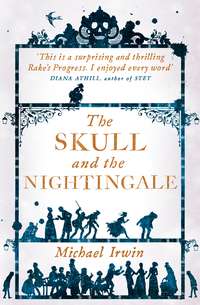
The Skull and The Nightingale

About the Book
Set in England in the early 1760s, this is a chilling and deliciously dark tale of manipulation, sex, and seduction.
When Richard Fenwick, a young man without family or means, returns to London from the Grand Tour, his wealthy godfather, James Gilbert, has an unexpected proposition. Gilbert has led a fastidious life in Worcestershire, but now in his advancing years, he feels the urge to experience, even vicariously, the extremes of human feeling—love and passion, adultery and deceit—along with something much more sinister. He has selected Fenwick to be his proxy, and his ward has no option but to accept.
But Gilbert’s elaborate and manipulative “experiments” into the workings of human behaviour drag Fenwick into a vortex of betrayal and danger where lives are ruined and tragedy is always one small step away. And when Fenwick falls in love with one of Gilbert’s pawns and the stakes rise even higher – is it too late for him to escape the Faustian pact?
Praise for The Skull and The Nightingale:
‘This is a surprising and thrilling Rake’s Progress. I enjoyed every word’
Diana Athill, author of Stet
‘I really admired and enjoyed it. The atmosphere, idiom and characters are great, and the plotting terrific – I had a genuine shock at the end’
Jenny Uglow
‘A splendid novel: immaculately researched, morally fascinating and strangely troubling. It kept surprising me and delighting me in equal measure’
Andrew Taylor, author of The American Boy
‘I devoured this dark, compelling tale of an eighteenth-century Faustus and his Mephostophilis, which troubles the reader with a growing unease from the start and never slackens pace right up to its disturbing conclusion’
Maria McCann, author of The Wilding
About the Author
After teaching at various universities around the world, Michael Irwin moved to the University of Kent, in Canterbury, where he became Professor of English, specialising in eighteenth and nineteenth-century literature. His published eighteenth century work includes a full-length study of Fielding and essays that take in Defoe, Richardson, Sterne, Smollett, Johnson and Pope.
Table of Contents
Title Page
About the Book
Praise for The Skull and The Nightingale
About the Author
Dedication
Epigraph
Chapter 1
Chapter 2
Chapter 3
Chapter 4
Chapter 5
Chapter 6
Chapter 7
Chapter 8
Chapter 9
Chapter 10
Chapter 11
Chapter 12
Chapter 13
Chapter 14
Chapter 15
Chapter 16
Chapter 17
Chapter 18
Chapter 19
Chapter 20
Chapter 21
Chapter 22
Chapter 23
Chapter 24
Chapter 25
Chapter 26
Chapter 27
Chapter 28
Acknowledgements
The Skull and The Nightingale – Reading Group Guide
Copyright
About the Publisher
For Stella
There is no difference to be found between the skull of King Philip and that of another man.
Samuel Richardson, Clarissa
1
It was a breezy day in March when I returned to London from two years of travel, my age twenty-three, my prospects uncertain. I refreshed myself with coffee at the Roebuck before making my way to Fetter Lane, and the office of my godfather’s agent, Mr Ward. Conceivably, this gentleman might be about to determine the future course of my life in twenty words. I paused at the entrance to his premises to assume unconcern.
He lurched up from behind his desk as ungainly as ever, a big fellow, with a head like a horse, and a gloomy eye.
‘Good afternoon, Mr Ward. I am glad to see you well.’
‘Good afternoon, Mr Fenwick. I have been expecting you.’
When we sat down there was a silence. I looked to him for more, but his large face was expressionless. Apparently it was for me to lead the way.
‘I hope that my godfather is in good health.’
‘I have heard nothing to the contrary.’
Mr Ward had ever been a sparse talker. I tried again.
‘Have you instructions for me?’
‘I have. Your former lodging with Mrs Deacon has been prepared for you. I will send to Mr Gilbert tomorrow to let him know that you have returned.’
‘You have nothing further to tell me?’
‘Not at this time.’
It seemed that the uncertainty was to continue.
‘I shall, of course, be writing to him myself.’
‘I had assumed as much, Mr Fenwick.’
Old long-chops was formal as an undertaker. Determined to strike a spark from him I brightened into affability.
‘Tell me, Mr Ward, do you not find me wonderfully improved by my grand tour?’
He surveyed me grudgingly till a brief gleam lit his glum face.
‘I see you are elegantly dressed, Mr Fenwick. The other improvements may require a little more time to take in.’
It was a slight enough stroke, but it gratified him to the tune of a quarter-smile. I felt sufficiently rewarded: but for my question he might not have tasted such merriment all week.
‘You laugh at me, Mr Ward,’ said I, ruefully, as though he were a jolly dog. ‘If I am to spend much time in London I shall hope to show you the progress I have made.’
He ignored my hinted question.
‘You do me too much honour, Mr Fenwick. But if you speak to me in French you will receive no reply.’
This second sally gave rise to the rare full grin, uncovering his big yellow teeth. I chuckled a response to confirm that we were on friendly terms. After all he might one day prove a useful ally. Knowing that I would learn no more, I took my leave.
At least the news had not been bad. There would be a period of suspense as messages went to and from Worcestershire: meanwhile all my possible futures still lay open. The lodgings in Cathcart Street would suit me well enough: I had stayed with Mrs Deacon before leaving for France, and found her courteous and discreet. I could lie low in her house until I heard from my godfather, adjusting myself to English ways again and tuning my tongue to my native language.

When I had exchanged courtesies with Mrs Deacon and sent for my luggage, I sat down in my parlour to write a letter.
My dear Godfather,
I returned to London this afternoon from the travels which you so generously enabled. Mr Ward advised me that I should take my former lodgings with Mrs Deacon and await your further instructions.
The last communication I received from you found me in Rouen, on the final stage of my journey home. You were at that time, you reported, in good health, and were kind enough to say that you looked forward to seeing me on my return. When we meet you will find me, I hope, better informed and a little less awkward. Your generosity would have been ill rewarded if that were not the case. In my letters to you I have attempted to convey something of what I have acquired. I can now converse fluently in French and tolerably well in German and Italian. My knowledge of the history, politics and arts of the great European countries has been greatly enhanced.
When last in London I was still something of a young country colt. I had exuberance without discipline, curiosity without direction. I hope my two years of travel have made me more reflective and purposeful. At the very least I am improved in deportment and address.
These claims may seem idle boasts. I would hope to make them good in conversation when I have the pleasure of seeing you – the godfather whose generosity to an orphan has done so much to improve his lot and widen his prospects.
I will remain in London and await further directions. Since a defined period of education has now come to an end, you may imagine that I look forward with eagerness and some little anxiety to hearing what advice you now have for me.
I remain, &c.
The composition of this grave epistle was accompanied by a facetious mental commentary. Much of the knowledge I had acquired related to activities that I would not have cared to discuss with my godfather. I was mimicking the cadences of respectability.
But I was dissatisfied with the letter even as I wrote it. It was too priggish, too fulsome: it lacked the playful touches that I fancied Mr Gilbert relished. The two-year absence had put me out of practice: I looked to recover the appropriate tone when I saw my patron again and could adapt my conversation to his responses. Perhaps it had been advisable, at this stage, to err on the side of seriousness. He was a formidable old gentleman in his way, not to be taken for granted.
Perversely pleased to be breathing smoky London air once more, I refused Mrs Deacon’s offer to prepare me dinner and strode out through the teeming, noisy streets. The wind had strengthened, and the big shop signs were swinging and creaking overhead. My destination was Keeble’s steakhouse near the Strand, which in former days I had often visited with my friend Matt Cullen. With a nod of greeting I took a seat at a table three-quarters full. It quickly struck me that my fellow-diners were talking with particular animation and vigour. I concluded, rightly as I later learned, that this was one of the regular meetings of a Conversation Club. Without attending to what was said I was content to be, once more, sitting in a haze of English words and phrases. I let the talk wash over me and fancied myself linguistically refreshed.
Whatever my future course, for the time being it was comfortable to be home. Weary from travel I drank some wine to feed my reflections, and became pleasantly bemused. What would my godfather have to say to me? Where would I be two weeks hence? Was I to be condemned to rural life? The previous morning I had been conducting my business in French: would I ever have reason to speak that language again? Hereabouts my idle stream of thought circled into an eddy. I wondered in what corner of my skull the unspoken language would be stored. How could such multifarious knowledge, such haystacks of nouns and verbs, such ladders and bridges of number and gender, be folded away into an unseen space? I pondered the paradox until my head swam – indeed I must have been grinning at my own bewilderment, for a voice cried: ‘To judge by the smile this young fellow is happy in his meditations.’
I came out of my reverie to see a dozen faces around me, chewing, drinking, talking and laughing.
‘Gentlemen,’ I said, ‘you must excuse me. I was lost in thoughts about the mysterious operations of the human brain.’
‘Beware!’ cried one of the number, ‘I smell a virtuoso. Keep your headpiece out of his hands, or he’ll be at it with microscope and scalpel.’
‘Never fear,’ said I. ‘I am an idle speculator under the influence of wine.’
‘Then fill your glass,’ said another, ‘and take us with you.’
I had no great desire to converse, but it seemed churlish to stay silent.
‘My thoughts were of this nature. If any one of our company were now to attempt to write down all the words he knew, he could spend the entire night in the undertaking. By the morning, with his task far from complete, the fruit of his labour would already be a thick wedge of manuscript. Yet his brain would need no replenishment. Where has he been storing this copious knowledge, now translated into a material mass? And how can he dispense it yet still retain it?’
The company seemed pleased by the problem. After a pause, someone said: ‘As to the former question one might proceed by a course of elimination. To begin facetiously: my poor uncle lost three limbs at the battle of Blenheim, yet his memory was unimpaired. It seems that the storage place you seek is to be found in the head or the torso.’
‘There is no need for such questions or such reasoning,’ cried another. ‘We already know that the mind is the seat of reason and memory.’
‘Indeed we do,’ said I. ‘But although I am no anatomist I believe that the contents of the skull are as unmistakably material as the limbs the gentleman referred to. How are we to account for the unique receptivity of this particular physical organ, its sponge-like capacity to contain words, concepts and images?’
Several tried to speak, but were overridden by a bony fellow with a big voice.
‘We discussed such matters a year ago. I posed questions similar to your own – and was denounced as a materialist and an atheist for my pains. But I refuted the charge very simply. The Almighty works miracles with material substance. If an acorn can contain a future tree, surely a human head can contain the contents of a dictionary?’
Fired up by now I struck back: ‘You explain one mystery by appealing to another. If the unfathomable powers of omnipotence are to be invoked there is an end to all debate.’
These words produced uproar, and during the heated exchanges that ensued I paid for my entertainment and slipped away.
It was a dark, boisterous night. I made my way back towards Holborn along busy thoroughfares, clutching my hat whenever I turned a corner into a gust of breeze. North of Lincoln’s Inn Fields the streets were quieter and but feebly lit. I was brought up short when a haggard girl stepped out suddenly from the end of an alley, crying: ‘Come this way, sir!’
‘Not tonight, I thank you,’ said I, affably enough.
‘No, no’ – in a frantic voice – ‘I need help. My child …’
She turned hurriedly into the alley, and I followed, willing to be of assistance if I could. But after a few yards she turned about, clutched my greatcoat and shouted ‘Rape! Rape!’ At once a heavy brute of a man sprang from a doorway brandishing a cudgel. Startled as I was I found myself protected, as in certain previous physical encounters, by an instant blaze of animal rage. Half avoiding the bully’s blow I seized his coat and rammed him back against the wall. He raised his club again, but I checked him with a punch to the belly, and then struck him a dowse to the chops that smacked his head back against the brickwork. The intending robber staggered sideways and stumbled to his knees. The girl leaped at me, scratching with both hands, but I wrenched her away and threw her on top of her fallen protector. Without waiting for more I hastened away.
Such a fury had surged in me that I walked an extra mile, at top pace, to allow my pounding heart to settle. It had been a sordid episode, but before I reached Mrs Deacon’s house I found myself recovered from it and not unsatisfied. The first evening of my return to England had called into play some of the aptitudes fostered by my travels. I had taken a lively part in impromptu discussion and then shown that I could hold my own in a street fight. It seemed that I was resourceful, a young man of parts.
Next morning I winced a little on rising. There was a stiffness in my shoulder and a handsome purple bruise on my ribs. It would take me a day or two to shake off these effects. Through the window I saw rain, which suited my mood well enough. Here was a stasis in my life, an interlude between the acts: I could make it a time for recuperation and reflection. I knew where I would be likely to find some of my former Oxford companions, but felt no inclination to seek them out. How could I answer the questions that would greet me until I knew what was purposed for my future and what sort of figure I was likely to cut? Matt Cullen I would have been glad to see, for he was a man I could laugh with, but our correspondence had lapsed, and I knew nothing of his whereabouts.
All morning I stayed within doors, completing the journal that I had kept during my travels. The parlour in which I was writing had a mirror at one end in which I several times caught my reflection. At length I rose to study myself more minutely and at full length. In figure I would pass muster, being above the common height, vigorous and well-knit, but my face seemed to me too open, too youthful, redeemed from blandness only by strong brown eyes. Given the common belief that a man’s character can be deduced from the front portion of his head, this could be a disadvantage. I practised certain expressions – attentive, amused, eager – and found the case somewhat improved. I could assume a variety of responses that might make me appear an agreeable companion. In repose, however, my face seemed a tabula rasa, awaiting the imprint of further experience.
The rain continuing, I worked diligently at my journal, bringing the record to a conclusion with my arrival in Dover. It was convenient that the combination of vacant time, rough weather, a bottle of ink and the wing-feathers of a goose had enabled me to capture my recollections before they were lost – I had always been quick to forget. My life being thus far in order, I was ready for what was to come.
Cathcart Street was in a quiet neighbourhood, but there was noise enough from it to bring me to the window more than once. The kennel down the middle of the road was swollen by the rain into a thick black stream, lumpy with refuse. Pedestrians in sodden clothes struggled sullenly along its edges, forced close to the walls. It was a dismal sight: there was much to be said for loitering within, warm and dry.
Later in the day, tiring of my own company, I made occasion to take tea with Mrs Deacon. Although I had lodged in the house before, I knew nothing of her beyond the fact that she was a widow, with a young daughter named Charlotte. In conversation she proved civil and shrewd, but maintained a certain reserve. It was this quality, perhaps, that caused me to see her as a handsome woman of forty, looking younger than her age, rather than as indeed a younger woman. Her composure suggested a lack of interest in any physical attraction that she might possess. I was unsure whether to play man of the world or affable young fellow. It was by chance that I found the less formal direction.
‘Do you know Mr Gilbert?’ I inquired.
‘I knew him years ago. If he communicates with me now it is through Mr Ward.’
‘Then the messages will be brief. Yesterday he offered me but fifty words.’
She smiled. ‘So many? Then you can count yourself a friend.’
‘Tell me, Mrs Deacon,’ said I, ‘how do you think this taciturn gentleman passes his evenings.’
She considered. ‘He sits in an arm-chair and reads a big black book. When it grows dark he walks the streets with a big black dog.’
‘But what is in the book he reads?’
‘Nobody knows. It is one of his secrets.’
This time we both smiled.
I was glad to have hit on this vein of whimsy in my landlady’s disposition, and to find myself easy in her company. Later that night, my imagination stirred by wine, I tried to envisage the warm body beneath the long dress. I liked what I saw with my mind’s eye, but suppressed the picture as unsuitably distracting in my present situation.
After two or three days of idleness I grew restless. I was in the unsatisfied state produced when the mind teems with questions to which there are no clear answers. Having had no living relatives since the age of ten I was accustomed to a solitary existence. Reserve and self-sufficiency were almost the only qualities I had in common with my godfather. But I fretted at being becalmed. Ambition assured me that Mr Gilbert would not have paid for my education, and sent me to the great cities of Europe unless he had substantial future plans for me. But circumspection reminded me that he was an enigmatic man whose patronage had been conferred from a distance. Although he had rescued me when I was homeless he had scarcely ever spoken of my parents, who had been his friends; and although he had countenanced occasional visits to Fork Hill House he had never encouraged me to stay for more than a few days at a time. At Oxford, therefore, I had been at pains to say nothing of my upbringing, not caring to admit that I had neither family nor home. Appearances had been preserved by bluff and evasion; but the constraint had been wearisome.
It was characteristic of Mr Gilbert to have dropped no hint as to his future intentions. For all I knew he might be planning to buy me a commission in the army or send me to the colonies. I felt no enthusiasm for either prospect. If I was to stay at home the possibilities seemed limited. I could not enter the church: neither my vagrant habits of thought nor my animal spirits would allow it. The law was hardly more inviting.
My favourite hope soared higher: perhaps too high. As far as I knew, my godfather had no living relatives. At his age he was unlikely to attempt marriage; and should he do so his thin loins would be hard put to it to originate an offspring. Surely it was time for him to proclaim me his heir and prepare me for the life of a prosperous landowner? In the country I could walk, ride and perhaps hunt. The more reflective side of my nature would find sustenance in Mr Gilbert’s well-stocked library. When I needed younger company and livelier entertainment I would spend a few raucous weeks in London. Satiety achieved, I could again retreat to Worcestershire to read books and view the world philosophically.
This was my preferred narrative: a life I could freely adjust to my personal convenience. Perversely, however, I found even this possibility uninviting as implying a premature acceptance of settled middle age. By a curious paradox my dependent condition had fostered an independence of spirit: I had become accustomed to mingling affability with reserve. It seemed to me that, unlike my Oxford companions, I would be able, if put to it, to live by my wits. I was eager for a challenge that would show me what sort of man I was.
There had been little in my childhood that I cared to remember. Even my recollections of my mother, now dead for more than ten years, were uncertain. I had turned away from the past, as by instinct, to concentrate my attentions on the present and the future. It suited my disposition to be active: if left too long to brood I tended to lose my good humour and lapse into melancholy. To avert this possibility at the present time I needed a friend in whom I could confide. It was natural, therefore, that my thoughts turned to Sarah Kinsey, the only individual who knew just how I was circumstanced. It was two years since I had last seen her, and not much less than that since she had last written to me. She had faded in my recollection as I found fresh diversion abroad; negligently I had left her letters unanswered. Since my return she was suddenly present again before my mind’s eye, shyly pretty, quick to smile. For all the seeming diffidence she had been independent: her tastes and opinions were all her own. We had talked with great freedom.
One night, in sentimental mood, I strolled to Pitman Street where Sarah had been living two years previously. I found the house in darkness, and stood to stare at it. Even as I watched, a light appeared in the window of the upstairs room where I had several times engaged in three-cornered conversation with Sarah and her aunt. Perhaps the two of them were chatting there at that very moment. I lingered for several minutes, indulging the imagined proximity and half tempted to knock at the door.
The matter was resolved when an old man emerged from a neighbouring house.
‘Pardon me, friend,’ I asked, ‘does Mrs Catherine Kinsey live here?’
‘She used to,’ he said. ‘A widow lady. But she left a year ago.’
I thanked him and turned away. Disappointed as I was, I knew that my quest had been an idle one. Even if I could have seen Sarah alone she would surely have reproached me for the breach in our correspondence. And with my future unknown, what had I now to offer? I was downcast as I trudged away: perhaps I would spend my life mourning Sarah as a lost love. Aware that a melancholy so hastily improvised could be of little substance, I savoured it nonetheless.
A week after my arrival in London I received a letter from my godfather:
My dear Richard,
I was pleased to receive word of your safe arrival. As you imply, there is much for us to discuss and consider. I would like to see you at Fork Hill House early next week, and hope that you will be able to stay for some few days. However, you may leave the bulk of your effects in the safe hands of Mrs Deacon.
Your affectionate godfather,
James Gilbert
It was a characteristically tight-fisted message. I could discern but a single clue concerning my future: it seemed that I was expected to return to London after my visit to Worcestershire. Whether the hint presaged an extended stay in the city or another journey it was impossible to guess.
2
I woke from a dream in which I was fumbling a plump whore in a dark street in Rouen. The impression stayed with me as I lay half insensible: I could smell the horse-dung on the cobbles and feel the girl’s damp warmth. Only gradually did I come to myself and recollect that I was in bed in my godfather’s house. Even then the idea was so strong upon me that had a maid-servant chanced to enter the room I might have sleepily seized on her, and perhaps derived a flesh and blood child from my fantasy. But the illusion thinned and my intellects began to confront the day. I arose, groped my way to the window and threw back the heavy curtain. On the instant I was myself again, looking out upon green lawns shining with dew below a bright morning sun. It was a sight to fill me with hope and energy. The day might hold revelations, but I felt ready to face them.
Having arrived too late on the preceding evening to see my godfather I had now to impress the man on whom my hopes depended. What manner would be best calculated to win his favour? I concluded that a respectful but easy bearing, quickened with a hint of mischief, should do the business. As I washed and dressed I tried to think myself into this demeanour. Even a hint of importunity concerning my future would be unbecoming. Pleasure at the reunion, gratitude for past kindnesses: these were the emotions to display.
Downstairs I learned that Mr Gilbert had already breakfasted. I was directed to meet him later that morning in the drawing-room at the rear of the house. Arriving before he did I had time to survey, through broad windows, the slopes of Flint Hill fringed, in the distance, by black-branched woodland. On the nearside of those trees everything I could see belonged to my godfather and might one day, conceivably, belong to me. Behind me several family portraits gazed down. I turned to stare back at my adoptive ancestors. In life they might have been formidable: in death they were so many planes of pigment. It could not be many years before my godfather would be similarly reduced. Perhaps he had aged in my absence. Perhaps he would totter in to say, ‘Let me be plain with you: I have but one month to live. This estate and all my wealth are to be yours. I wish you joy of them.’
When he did enter, however, it was with no such cadaverous air. He looked as I remembered him, lean, but by no means frail, his face shrewd and thin-lipped. As ever he was neatly groomed: the taut little wig could have been his own hair.
If he was overjoyed to see me he contrived not to show it. I adapted my manner to his, and our first exchanges were courteous rather than familiar. I had brought gifts from abroad, which I formally delivered to my benefactor rather as a visiting English ambassador might present diplomatic offerings to a Chinese potentate. He received them with corresponding decorum. Thoughtful questions were asked concerning people and places, and suitable answers given. The little minuet of civilities was creditably performed by both parties.
Later, in response to his promptings, I told him various tales of my travels, speaking, I thought, gaily and well. He listened with attention, seeming by degrees to relax his customary reserve: I could even fancy that he looked at me with approval. On occasion our dialogue all but quickened into raillery.
‘I inferred from your letters,’ he said, with lizard-like dryness, ‘that throughout your travels you conducted yourself in an exemplary way.’
‘It seemed appropriate, sir, to represent myself in a sober light.’
My godfather allowed himself a ghost of a smile: ‘I hope this sense of propriety did not circumscribe your pleasures.’
‘I was at pains to resist that possibility,’ said I, with a reciprocal hint of self-mockery.
He looked me directly in the eye, still faintly smiling.
‘I notice a scar on the back of your hand.’
‘You embarrass me, sir. It goes back to a small encounter in Florence.’
‘A matter of honour?’
‘Of intoxication, rather. It was a foolish incident, but no great harm was done.’
He nodded to close the subject, and then turned a sudden conversational corner.
‘It is two years since last you were here. Have you perceived any differences?’
‘Only that the great oak tree has gone that once stood beside the house.’
‘It had become too old and brittle. It reminded me too much of myself.’
Taken by surprise I could fashion no suitably consoling response, but my godfather did not seem to notice. He sat staring at nothing before speaking again: ‘I hope you will stay for some few days, and gain a sense of my life here.’
Two evenings later some guests from the neighbourhood came to dinner. I was curious to meet these people, since I might one day have to live on terms with them, and curious, too, to see how my reticent godfather would comport himself in company. But equally it would be my task to rise to whatever the occasion was intended to be. I should think of myself as in some sense on display.
How much the visitors would know of my situation and prospects I could not guess. I would probably be the youngest person present and the one of least social consequence. On the other hand I was educated, gentlemanly, and had recently travelled. It would not do to be ingratiating nor yet forward. I resolved to stay out of general conversation, as far as possible, but to show myself attentive to individuals.
The loudest of the company proved to be Mr Hurlock, a florid squire with a buxom wife. He was a rattling, rallying fellow, aggressive in his manner, with a laugh like the bray of an animal. I saw in him an ageing country bully, coarse and discontented. Mr Quentin, a dark man with a brooding gaze, conveyed more intelligence with greater sobriety of manner. Of a different cast altogether was Mr Yardley, as lean as my godfather, with the stooped shoulders and sallow cheeks of one who devoted many hours to reading. I remembered to have heard him mentioned as a naturalist and collector. There was also Mr Thorpe, a young parson, new to the village. He wore a propitiating smile under an alert eye.
Hurlock greeted me boisterously: ‘So you come here from France, young gentleman. Here in Worcestershire we turned against that country in ’45, when the Jacobites reached Derby and we felt French breath on the back of our necks.’
I soon diverted him to the subject of hunting, on which he had much to say. Eventually relieved of his company by my godfather I escaped to Thorpe, who proved to be a former Oxford student and quizzed me amiably about university matters.
At dinner I had Mrs Hurlock on my right hand, and found my eye taken more than once by her prominent bosom – a former attraction declined, it seemed, to a feeding apparatus, since she confided that she had borne several children. I could see that twenty years before she must have been a covetable young lady; but time and a coarse husband had diminished her assurance. ‘I believe you are a scholar,’ she told me, ‘and already a man of the world. Alas, I am merely a mother.’ To keep her conversing about her surviving offspring was as simple as whipping a top.
On my left sat Mrs Quentin, another dilapidated beauty. I first saw her from behind, and fancied from her slim figure that she was hardly more than thirty. She had merely to turn around to age twenty years, her face being faded and unhappy. When I tried to converse with her over dinner I noticed a reticence and an odd cast of expression apparently attributable to the same cause, namely her desire to keep concealed a set of blackened teeth. I talked to her in a free and lively vein to create the illusion of an exchange, but avoided provoking laughter lest she should feel obliged to join in.
The wider discussion lurched between local and national concerns. Such political comment as I heard was so fanciful that it could have concerned the government of Japan: but after all these folk were a hundred country miles from London – two full days of travel. Hurlock blustered, Thorpe was emollient, Quentin brusque. Yardley spoke but little. My godfather was the best informed of the company, and showed considerable social address. With no attempt to dominate he yet led the conversation, his manner dry and sometimes satirical. He took in all that passed, and had a word for everybody at the table.
Certain fragments of talk stayed in my memory. At one time my attention was caught by a sudden intensity in my godfather’s voice.
‘We are told,’ he said, ‘that the Almighty requires praise. I cannot understand why. Is it not as though I should want my dogs to praise me for feeding them?’
‘Perhaps, sir,’ ventured Thorpe, ‘you are interpreting the instruction too literally. Might it not be a figure – a mode of enjoining us to an active appreciation of our existence in a miraculous universe?’
‘You men of the cloth are all alike,’ cried Hurlock, through a mouthful of food. ‘If we question any mystery of religion you tell us that it is no more than a damned figure. What do you leave us of substance to believe in?’
His truculence momentarily silenced the table.
‘There are the commandments,’ said Thorpe, mildly. ‘Thou shalt not steal. Thou shalt not kill. Thou shalt not commit adultery.’
Hurlock made to expostulate further, but Mr Gilbert spoke up before him.
‘Yes,’ said he, with an emphasis that concluded the exchange, ‘those would seem to offer us something to steer by – and something to fear.’
When the ladies retired the conversation took a different turn. My godfather, who had drunk frugally, seeming to enjoy his sips more than Hurlock his mouthfuls, proceeded to draw out Mr Yardley, who had hitherto been almost silent. With a little prompting he was induced to address the company on the subject of poisons. He spoke in a high, wavering voice, chuckling from time to time at the curiosities he mentioned:
‘We have little understanding of susceptibility. A substance that will gratify one organism may prove fatal to another. You gentlemen drink brandy with pleasure, but it is known that a small amount of that beverage will kill a cat. Heh, heh! Sheep thrive on grass, but clover may prove fatal to them. We know that a snake-bite may kill, but what shall we say when a man dies from the sting of a bee, as has happened in this very parish? Heh, heh! This is the mystery of reaction: the element introduced combines fatally with something in the constitution of the victim.’
My godfather had been listening intently: ‘Might not such an external element equally prove advantageous? If brandy can kill a cat, what say you to the possibility that a saucer of burgundy might transform its intelligence?’
Yardley sniggered. ‘The example is grotesque, but in principle your hypothesis is just. The world is young: there are a million possibilities still unexplored.’
‘What possibilities?’ cried Hurlock, crimson with drink, ‘I don’t follow you, sir.’
‘For example,’ said my godfather, evenly, ‘the possibility that when A is randomly made subject to B – A being a human-being, and B a substance, a situation, or even an idea – some unpredictable outcome may result.’
This proposition being beyond Hurlock in his fuddled state, he flew into a passion.
‘Then let us fly to the moon, gentlemen,’ he shouted, banging his fist on the table. ‘Let us fly to the moon and have done!’
Nothing exceptionable had taken place during the course of the evening; yet I could not rid myself of a sense of oppression. The guests had seemed constrained by Mr Gilbert’s presence, as though a little cowed by him. Even Hurlock’s outbursts had had a quality of nervous defiance. Might my gentlemanly godfather be intimidating?
The following day he asked my opinion of his guests. Seeking to be diplomatic without insipidity I ventured that Hurlock had seemed not unlike a stage representation of a coarse hunting squire, that Yardley had said a number of interesting things, and that Quentin had something enigmatic about him.
‘Your comments are just, as far as they go’ said my godfather. ‘Hurlock is a fool. Yardley is haphazardly learned.’
‘And Mr Quentin?’
My godfather reflected before replying: ‘I can understand why you found him enigmatic. To me he is not, because I know the answer to the riddle.’ His voice lightened. ‘You were properly attentive to the ladies – gallantly so in the case of Mrs Quentin, whose bad teeth, as you must have noticed, foul her breath. Time has been unkind to her: she was comely as a young woman. Mrs Hurlock was the local beauty, eagerly courted; but she made the mistake of marrying Hurlock, who reduced her to a breeding animal. She has now ceased to breed. Perhaps neither woman has a life worth leading.’
Startled by this bluntness, I inclined my head and tried to look sagacious.
‘You have now made the acquaintance of my nearest neighbours, such as they are. I contrive to remain on good terms with all of them.’
‘I am sure you do, sir,’ I hazarded.
Mr Gilbert pursed his thin lips and then spoke reflectively.
‘It is in their interest that we should be on good terms. All of them are in some sense in debt to me. It is remarkable how much influence moderate wealth can buy.’
He spoke without emphasis, but the passage of conversation had shown a greater astringency in him than I had ever previously witnessed. It had also reminded me of the precariousness of my own position. Perhaps that had been the intention.
Over the succeeding days I had a good deal of time to myself. Much of it I passed in the library, where a great fire was kept burning. I found there many publications of recent date, including the two volumes of Dr Johnson’s great Dictionary, and a number of works concerning philosophy, medicine and astronomy. It was a pleasure to meet also my old friends Tom Jones and Roderick Random. Their presence surprised me. Did this solitary country gentleman sit peacefully by the fire, lost in tales of assignations and boisterous pranks? That possibility seemed the more remote in that here and in other rooms I saw evidence of Mr Gilbert’s speculative curiosity: a terrestrial globe, a microscope, a brass telescope, a great magnet, and an articulated human skeleton.
When weary of reading I explored the house. Everywhere there were paintings, hangings and furnishings to admire. Even to my inexperienced eye it was apparent that the Gilbert family, about which I knew next to nothing, had been distinguished not merely by wealth, but by taste and connoisseurship.
I traced back the family line through a series of portraits. There were similarities of feature across the generations, but more striking was a cast of expression that suggested an inherited family temperament. Repeatedly a composed, even severe, countenance implied lurking passions controlled by force of will. I concluded that any one of these gentlemen would have proved a shrewd antagonist in argument or business or a court of law.
As viewed from the drive that led from the main gates the house was an imposing, wide-fronted building. The main rooms, spacious and lofty, answered to that external appearance. For some reason, however, I found myself particularly intrigued when quitting these apartments to venture down narrow staircases and stone-flagged passages into the domestic quarters. Here, like a colony of rabbits, dwelt the servants, far outnumbering those they served, even when there was company in the house. I reflected that such a mansion must necessarily have such a team to run it, as an ocean-going vessel must have men hoisting sails and manning pumps. These servants were my godfather’s crew, his prosperity affording shelter and wages for footmen, housemaids, cooks, grooms and gardeners.
When the weather brightened I explored the estate. Hungry for fresh air and exertion I walked at a good pace, breathing deep. One fine morning I found myself running from sheer excess of energy. My furthest excursion was to the woods I had seen from the drawing-room window. In these first days of spring they offered little promise that they could ever resemble the shady groves of pastoral poetry. They were dense, leafless and dark – even menacing – in aspect, as though ready, at a signal, to advance like Birnam wood and overwhelm the cultivated land.
I was curious as to my godfather’s daily doings. It seemed that he spent much of each morning talking to attorneys, tenants or tradesmen and attending to business of various kinds. I began to infer that he was no passive landowner but an efficient and industrious overseer of an estate, a master of practices and responsibilities of which I knew nothing. Might he wish to groom me to take an active part in the conduct of these affairs? And would I be content to settle, at so early an age, into the role of a rural administrator? I hoped the question would not arise, while hoping also that it would.
When in his company I observed him closely, looking for signs that I might read. He was controlled in manner as in speech, moving unhurriedly. His clothes, impeccably neat, seemed to be an expression of his being. There was nothing of the animal about him. It was impossible to imagine him so much as sweating, still less rutting or at stool. Even in his eating and drinking he expressed connoisseurship rather than appetite. His disposition seemed to be the achievement of years of self-command.
I assumed that there was a purpose to my seemingly purposeless stay, although I could not be sure what it was. Was it to give me an opportunity to learn, indirectly, more about my godfather, or was it rather that he wished to learn more about me? What did I indeed feel about him, if anything? Grateful, in a formal sense, I certainly was, but my gratitude had no tincture of warmth. I could not feel myself to be blamably deficient in affection when Mr Gilbert himself displayed so little. There was no hint that he regarded me in any sense as the son he had not had. His detachment had evoked in me a similar coolness. He was my benefactor, and therefore to be propitiated. He was clever yet aloof and therefore an object of interest. If for some reason he should turn against me I suspected that he would sever the link between us without a qualm. I was therefore responsive to his moods, and ever on my guard. It had often been remarked of me that I had the capacity to please. At school, at Oxford and on my travels I had adapted myself to those I met and made friends readily. Mr Gilbert would hardly have carried his patronage so far had he not found something agreeable in my disposition. Such kindliness as I had elicited I hoped I could sustain.
I was further encouraged by a deeper and perhaps darker reflection. In several ways, after all, I had the advantage of the old gentleman. I was young and free-spirited, physically strong. If Mr Gilbert was quick-witted then so, I flattered myself, was I. Moreover by virtue of my youth, my education and my travels I might be open to modes of thought that he could not anticipate. If he chose to continue in his course of benevolence he would find me tractable and appreciative. If, for whatever reason, he was planning to dispose of my life in a manner at odds with my disposition we would be commencing a chess-game in which I would hope to hold my own.
We dined together every night, pretty comfortably as it seemed to me, but with no discernible progress towards greater intimacy. Our talk was easy and even lively, but Mr Gilbert said little that was personal. For my part I endeavoured to be entertaining, but was watchful for any hints of inquisition or irony and quick to deflect them with inconsequence, or with ironies of my own. Though nothing of moment passed between us I was satisfied that this time spent together would not lower my godfather’s estimation of my abilities.
An aspect of his conversation with which I found myself in instinctive harmony was his habit of moving unexpectedly from civil commonplaces to eccentric speculation. There was an instance of this kind when he asked me what impressions I had formed concerning his estate. Wishing to please I remarked that within its boundaries there seemed to be order, cultivation and contentment. If other landlords were similarly capable and benign, I asked, might we flatter ourselves that in the course of time the whole country might come to enjoy this state of harmony?
‘I think that unlikely,’ he said. ‘We strive for progress, but even our best attempts produce consequences at odds with our intention.’
‘But surely, sir,’ I urged, ‘the building of this great house could be seen as an absolute gain. Here is an outpost of civilized life. Within its walls certain standards of conduct and taste are upheld.’
I strove to speak in the grave manner of one who would maintain such standards.
My godfather, in an habitual gesture, paused, glass in hand, to consider my observation, and then savoured a sip of wine before replying.
‘Every building is under siege, this house not excepted. In providing privacy and protection for yourself you offer lodging-space for intruders. Mice have made their home beneath the floorboards. To control them we introduced cats. In summer you will see flies buzzing about the food, and moths blundering into lamps. Spiders lurk in corners. Birds nest in the chimneys. Moss takes root in the walls.’
Absorbed in these reflections he paused, sipped again, and then continued.
‘Similar effects are everywhere observable. Even a beggar’s shirt provides a tenement for fleas.’
I recalled my reflections about the servants below stairs, but thought it graceless to pursue the analogy.
‘You are a philosopher, sir.’
‘I have no such pretensions. I improvise. I make do.’
‘You may say so; but I have seen optical instruments, shelves of learned books …’
‘I have dabbled in this and that. I know a little about the flora and fauna of the county. Here my interests intersect with those of Yardley, though he is better informed than I. His concern is for the particular, for narrow observation and classification. Mine is for the general. I look for analogies and patterns. Lately I have taken an interest in meteorology and in the workings of the human body. The two subjects are surely connected, if only at the level of metaphor. The theory of the four humours has been abandoned, but I see why it came into being. We can have storms and droughts within.’
Then, with a sudden smile: ‘But we must replenish your glass.’
I soon had reason to recall his words. When I drew the curtains next morning the sun was shining so brightly that I had to close my dazzled eyes. I leaned from a casement and inhaled a sweet, fresh breeze that on the instant filled me with energy. This was surely to be accounted the first day of spring. When I glanced in the mirror I was surprised to see myself smiling broadly. I stripped off my nightshirt and flung my arms wide. Within the glass stood my counterpart, looking young and impudent, his black hair in disarray, his privy member standing out like a staff, and pulsing with a life of its own. I found myself in a divided state: rampant with venereal need I retained wit enough to see the absurdity of such abject submission to physical tides. I broke into a loud laugh at the expense of my animal self, and saw in the mirror my head chuckling as my tail throbbed.
Later in the morning I went striding across the sunlit lawns and fields to release some of my newly-stirred vitality. I was craving youthful company – more particularly female company. The youthfulness I might have waived in my predatory mood. If Mrs Quentin herself had crossed my path her breath might not have saved her honour. When I reached the woods I found that they were as visibly altered as I had been on rising: twigs and branches were flecked with minute spots of green. An unseen bird was singing with passion, proclaiming his feelings or needs to the whole forest.
Touched by this elevated strain I drifted into romantic thoughts of Sarah Kinsey, but thence, by brute declension, into recollections of carnal pleasures in Rome. As memory induced sensation I yielded to the spring, and made shift – with a loud cry – to discharge my seed over a clump of budding primroses. Walking back to the house, with the primacy of the intellect sheepishly restored, I found myself unable to decide whether I had defiled the bright energies of nature or simply partaken of them.
The following afternoon the sun was yet warmer, and at my godfather’s suggestion we strolled out onto the terrace. Our talk having been thus far no more than desultory trifling I was not surprised when he fell silent altogether and stood gazing out at the garden, one hand on the warm stone balustrade.
He spoke again without looking at me.
‘Your years of travel have left their mark. You are bolder, more self-assured.’
I bowed, uncertain whether this was pure compliment.
‘You have no recollection of your father, I believe?’
‘Sadly I have not.’
‘You have something of him in your appearance and disposition: the dark eyes, the affable address. Your visit has brought him vividly into my recollection.’
Here, surely, was the moment. Ten words would clinch the matter: ‘I have therefore decided to make you my sole heir.’ Unaccountably he let the opportunity slip.
‘I have been observing you. You are robust and well-made. You have the gift of pleasing in casual conversation. You smile readily, and can make people smile in return. These are not talents that I share.’
‘You do yourself an injustice, sir,’ I said, beginning my sentence before I could see the end of it. Fortunately he raised a hand to interrupt.
‘I speak without false modesty. Such capacities are rooted in temperament. For my part I can attract attention and respect.’
‘So I have observed, sir.’
Ignoring this feeble compliment, he sat himself down on a stone bench and motioned me to join him. There was a silence, during which I fancied he was preparing a statement. At length he continued, musingly: ‘I enjoyed your letters from Paris and Rome. In this house you have met some of the people with whom I commonly consort. They are a poor crew who live narrow lives. I was therefore refreshed to enjoy a tour of more exotic places, as seen through younger eyes and experienced by livelier senses.’
He turned to me: ‘How different my life here has been. In Fork Hill the successive days are all but indistinguishable. Cumulatively they distil a kind of essence, or perfume, which gives pleasure but has left me dulled. National events scarcely impinge upon me. When King George died I felt nothing. By the time I hear that a new ministry has been formed it may be on the verge of collapse.’
‘Is not that a peaceful state of affairs?’
‘It is. But it resembles the peace of the grave. I need fresh life.’
‘It would surely be open to you, sir, to spend some time in London?’
Mr Gilbert turned his face directly towards the sun and was silent for a moment, as though savouring the warmth on his thin cheeks.
‘I was once a regular visitor to the capital. But it is five years since I last was there, and I did not enjoy the experience. I found the din and the stench repellent and the social life artificial. Yes, yes, there was more to it than that, of course. But my recollections are of dirt, disorder and foolish gossip. I will not go to London again. Yet I need diversion, I need stimulation.’
With sudden earnestness Mr Gilbert placed a hand on my sleeve.
‘In consequence – in consequence I have devised an odd plan. Here I am, out of touch with London and life. The town demands a young man’s constitution, and a young man’s appetites. My proposal is that you should explore it on my behalf.’
I was floundering. ‘How so, sir? In what capacity?’
‘In the capacity of a young gentleman. You will stay in your present lodgings, and I will maintain you with a sufficient income. Your task will be to sample the life of the capital and convey to me your sense of it by regular letters.’
My spirits were rising. Was I really to live as I pleased and to be paid for doing so?
‘This is a most generous offer, sir. But what in particular–’
He silenced me with a gesture.
‘I leave the matter in your hands. When abroad you naturally felt obliged to see certain famous buildings and monuments; and you reported on them fittingly enough. Now I ask something different. Go where your own inclinations lead you. But write down what you see and hear and feel.’
I nodded, knew not what to say, so nodded once more.
‘Although I no longer care to visit London it interests me more than I can say. It is a mighty experiment – or assemblage of experiments. I want you to report on the resulting pleasures, oddities and extremities as you experience them.’
He stopped, but I remained silent, seeing that he was still ordering his thoughts. When he spoke again it was in the tone of one summing up an argument: ‘My hope is to be able to live two lives simultaneously – the familiar quiet existence here and, by proxy, a young man’s life in the town. But is my proposal agreeable to you?’
I took a deep breath. ‘How could it fail to be so?’
Mr Gilbert looked at me sharply: ‘So you have no misgivings?’
‘None, sir.’
‘I am glad to hear it.’ His face relaxed into a grim little smile. ‘I have some myself. It may be that we will lead one another into dark territory.’
Ücretsiz ön izlemeyi tamamladınız.