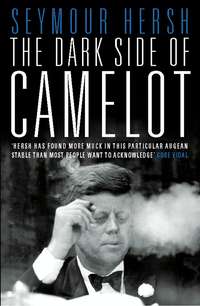
Kitabı oku: «The Dark Side of Camelot»
SEYMOUR HERSH
The Dark Side of Camelot

DEDICATION
For Elizabeth,
Matthew, Melissa,
and Joshua
CONTENTS
Cover
Title Page
Dedication
1. November 22
2. Jack
3. Honey Fitz
4. Joe
5. The Ambassador
6. Taking on Fdr
7. Nomination for Sale
8. Threatened Candidacy
9. Lyndon
10. The Stolen Election
11. Campaign Secret
12. Trapping Nixon
13. Executive Action
14. Bay of Pigs
15. Secret Service
16. Crisis in Berlin
17. Target Castro
18. Judy
19. First Marriage
20. Missile Crisis
21. Deceptions
22. Ellen
23. Vietnam
24. Last Days
Epilogue
Chapter Notes
Index
Acknowledgments
About the Author
Author’s Note
Also by the Author
Copyright
About the Publisher
1 NOVEMBER 22
It was America’s blackest Friday.
President John F. Kennedy was gunned down on a Dallas street thirty minutes after noon on November 22, 1963. Vice President Lyndon B. Johnson, who had accompanied the president to Dallas, sped back to Air Force One and was sworn in with the bloodied widow of Jack Kennedy at his side. The presidential airplane soared away from murderous Texas to the safety of Washington.
Once Air Force One was airborne, some of the military and security men on duty were able to emerge from their despair and anger to begin asking necessary questions. Was Jack Kennedy’s death the first move in an international conspiracy? Was Lyndon Johnson now the target? These concerns were shared in Washington, as the bureaucracy began the slow turn from one presidential orbit to another.
But it was the man closest to John F. Kennedy who needed to put aside his grief and begin immediately to hide all evidence of Kennedy’s secret life from the nation—as well as from the new president, who could be sitting in the Oval Office by early evening. When word came of his brother’s shooting, Attorney General Robert F. Kennedy, the second most powerful man in Washington, was at his Hickory Hill estate in suburban Virginia having a casual lunch of clam chowder and tuna fish sandwiches with, among others, Robert Morgenthau, the U.S. attorney for the Southern District of New York.*
In those first hours of horror, the president’s remarkable younger brother lived up to his reputation for pragmatism and toughness, notifying members of the family, worrying about the return of his brother’s body, answering legal queries from the new president, and, it seemed, losing himself in appropriate action. There would be time for mourning later. Now there was a state funeral to arrange and the president’s widow and children to console. Among his many telephone calls early that afternoon was one to McGeorge Bundy, the dead president’s national security adviser, who was told to protect Jack Kennedy’s papers. Bundy, after checking with the State Department, ordered that the combinations to the president’s locked files be changed at once—before Lyndon Johnson’s men could begin rummaging through them.
Bobby Kennedy understood that public revelation of the materials in his brother’s White House files would forever destroy Jack Kennedy’s reputation as president, and his own as attorney general. He had spent nearly three years in a confounding situation—as guardian of the nation’s laws, as his brother’s secret operative in foreign crises, and as personal watchdog for an older brother who reveled in personal excess and recklessness.
The two brothers had lied in their denials to newspapermen and the public about Jack Kennedy’s long-rumored first marriage to a Palm Beach socialite named Durie Malcolm. In 1947 Kennedy, then a first-term congressman, and Malcolm were married by a justice of the peace in an early-morning ceremony at Palm Beach. In an interview for this book, Charles Spalding, one of Kennedy’s oldest friends, broke five decades of silence by family and friends and confirmed his personal knowledge of the marriage. “I remember saying to Jack at the time of the marriage,” Spalding told me, “‘You must be nuts. You’re running for president and you’re running around getting married.’” The marriage flew apart. Spalding added that he and a local attorney visited the Palm Beach courthouse a few days later and removed all of the wedding documents. “It was Jack,” Spalding recalled, “who asked me if I’d go get the papers.” No evidence of a divorce could be found during research for this book.
The president’s files would reveal that Jack and Bobby Kennedy were more than merely informed about the CIA’s assassination plotting against Prime Minister Fidel Castro of Cuba: they were its strongest advocates. The necessity of Castro’s death became a presidential obsession after the disastrous failure of the Bay of Pigs invasion in April 1961, and remained an obsession to the end. White House files also dealt with three foreign leaders who were murdered during Kennedy’s thousand days in the presidency—Patrice Lumumba, of the Congo; Rafael Trujillo, of the Dominican Republic; and Ngo Dinh Diem, of South Vietnam. Jack Kennedy knew of and endorsed the CIA’s assassination plotting against Lumumba and Trujillo before his inauguration on January 20, 1961. He was much more active in the fall of 1963, when a brutal coup d’état in Saigon resulted in Diem’s murder. Two months before the coup, Kennedy summoned air force general Edward G. Lansdale, a former CIA operative who had been involved in the administration’s assassination plotting against Fidel Castro, and asked whether he would return to Saigon and help if the president decided he had to “get rid” of Diem. “Mr. President,” Lansdale responded, “I couldn’t do that.” The plot went forward. None of this would be revealed until this book, and none of it was shared with Lyndon Johnson, then the vice president.
The vice president also did not know that Jack Kennedy’s acclaimed triumph in the Cuban missile crisis of October 1962 was far from a victory. The world would emerge from fearful days of pending nuclear holocaust and be told that the president had stood firm before a Soviet threat and forced Premier Nikita Khrushchev to back down. Little of this was true, as Bobby Kennedy knew. Knowing that their political futures were at stake, the brothers had been forced to negotiate a secret last-minute compromise with the Soviets. The real settlement—and the true import of the missile crisis—remained a state secret for more than twenty-five years.
There were more secrets for Bobby Kennedy to hide.
In the last months of the Eisenhower administration, a notorious Chicago gangster named Sam Giancana had been brought into the Castro assassination effort, with Senator Jack Kennedy’s knowledge. But Giancana was far more than just another mobster doing a favor for the government—and looking for a favor in return. Giancana and his fellow hoodlums in Chicago, one of the most powerful organized crime operations in the nation, had already been enlisted on behalf of Kennedy in the 1960 presidential campaign against Republican Richard M. Nixon, providing money and union support; mob support would help Kennedy win in Illinois and in at least four other states where the Kennedy plurality was narrow. Giancana’s intervention had been arranged with the aid of both Frank Sinatra, who was close to the mob and the Kennedy family, and a prominent Chicago judge, who served as an intermediary for a meeting, not revealed until this book, between the gangster and Jack Kennedy’s millionaire father, the relentlessly ambitious Joseph P. Kennedy. The meeting took place in the winter before the election in the judge’s chambers. A few months after the election, allegations of vote fraud in Illinois were reported to Bobby Kennedy’s Justice Department—and met with no response. The 1960 presidential election was stolen.
As Bobby Kennedy knew, President Kennedy and Sam Giancana shared not only a stolen election and assassination plotting; they also shared a close friendship with a glamorous Los Angeles divorcée and freelance artist named Judith Campbell Exner. Interviews for this book have bolstered the claims of Exner, who first met Kennedy in early 1960, that she was more than just the president’s sex partner, that she carried documents from Jack and Bobby Kennedy to Giancana and his colleagues, along with at least two satchels full of cash. On one train trip from Washington to Chicago she was followed by a presidential advance man named Martin E. Underwood, who told in a 1996 interview of being ordered onto the train by Kenneth O’Donnell, Jack Kennedy’s close aide. “Kenny suggested it might be a good idea,” Underwood told me, “to go to Chicago by train. I said, ‘What train?’ It was the same train Judy took.” He watched, he said, as Exner got off in Chicago and handed a satchel to a waiting Sam Giancana. Exner, in a series of interviews for this book, further admitted that she delivered money, lots of it, from California businessmen directly to the president. The businessmen were bidding on federal contracts.
There was further evidence of financial corruption in Kennedy’s personal files. As the president’s 1964 reelection campaign neared, Kennedy was put on notice by newspaperman Charles Bartlett, his good friend, that campaign contributions were sticking to the hands of some of his political operatives. “No books are kept,” Bartlett wrote the president in July 1963, “everything is cash, and the potential for a rich harvest is clear.… I am fearful that unless you put a personal priority on learning more about what is going on, the thing may slip suddenly beyond your control.”
Robert Kennedy understood, from his own investigations, that there was independent evidence for the Bartlett allegations: one of the attorney general’s political confidants had assembled affidavits showing that money for JFK’s reelection campaign was being diverted for personal use. The Bartlett letters could not be left for Lyndon Johnson.
Yet another group of documents that had to be removed dealt with Jack Kennedy’s health. Kennedy had lied about his health throughout his political career, repeatedly denying that he suffered from Addison’s disease. But as Kennedy and his doctors knew, the Addison’s, which affects the body’s ability to fight infection, was being effectively controlled—and had been since the late 1940s—by cortisone. Far more politically damaging was the fact that the slain president had suffered from venereal disease for more than thirty years, having repeatedly been treated with high doses of antibiotics and repeatedly reinfected because of his continual sexual activity. Those records would be hidden from public view for the next thirty years. There is no evidence he told any of his many partners. Kennedy also was a heavy user of what were euphemistically known as “feel-good” shots—consisting of high dosages of amphetamines—while in the White House. Dr. Max Jacobson, the New York physician who administered the shots, was a regular visitor to the White House and accompanied the president on many foreign trips; his name was all over the official logs. Jacobson and his shots were the source of constant friction between the president’s personal aides and some members of his Secret Service detail, who persistently tried to keep the doctor, and his amphetamines, away from the White House. Jacobson’s license to practice medicine was revoked in 1975.
Jack and Bobby Kennedy were even tougher than their most ardent admirers could imagine. They seemed to glide unerringly through the nearly three years of his presidency, with its constant domestic and foreign crises. But in reality they lived and worked on the edge of an abyss. The brothers understood, as the public did not, that they were just one news story away from cataclysmic political scandal.
How to keep secrets and carry on their activities was something they had learned from their father, a successful financier and controversial public official, who masked how much money he had and how he earned it, and from their maternal grandfather, John Francis “Honey Fitz” Fitzgerald, a corrupt Boston politician who simply ignored the unpleasant realities of his public life. Jack and Bobby Kennedy also learned from their father and grandfather that—as Kennedys—they could enjoy freedoms denied to other men; the consequences of their acts were for others to worry about.
The family’s main antagonist was J. Edgar Hoover, director of the Federal Bureau of Investigation, who knew and was eager to take advantage—so the family was convinced—of the darkest Kennedy secrets, including the fact of Jack’s marriage to Durie Malcolm. Hoover’s biographers have told in compelling detail of Hoover’s ability to collect damaging political and personal information about the men in the White House and use it as a weapon. The relentless FBI director had been keeping score on the Kennedys, father and sons, since the early 1940s and was appalled by their public and private excesses. But the Kennedys understood that Hoover, for all of his moralizing, was a firm believer in the institution of the presidency, and could be counted on in moments of crisis, even those involving angry women looking for a way to make trouble for the president.
Hoover’s reappointment as FBI director was Jack Kennedy’s first announcement as president-elect.
Jack Kennedy’s embarrassing files were not the only materials removed from the White House on November 22. While Air Force One was still in the air, a senior Secret Service agent named Robert I. Bouck began disassembling yet another of the Kennedy brothers’ deep secrets—Tandberg tape-recording systems in the Oval Office, Cabinet Room, and the president’s living quarters on the second floor of the White House. There was also a separate Dictabelt recording system for use on the telephone lines in the president’s office and his upstairs bedroom. In the summer of 1962, John Kennedy had summoned Bouck and instructed him to install the devices and be responsible for changing the tapes. Apparently Bouck told only two people of the system—his immediate superior, James J. Rowley, chief of the Secret Service, and a subordinate who helped him monitor the equipment. It was Bouck’s understanding that only two others knew of the system while JFK was alive—Bobby Kennedy and Evelyn Lincoln, the president’s longtime personal secretary.
The seemingly open and straightforward young president could activate the recording system when he chose, through a series of hidden switches that Bouck installed in the Oval Office and on the president’s desk. “His desk had a block with two or three pens in it and a place for paper clips,” Bouck said in a 1995 interview for this book. “I rigged one of those pen sockets so he could touch a gold button—it was very sensitive—and switch it [the tape recorder] on.” Another secret switch was placed in a bookend that the president could reach while lounging in his chair. “All he had to do was lean on it,” Bouck told me. A third was tucked away on a small table in front of the Oval Office desk, where Kennedy often met with aides and visitors. (Bouck would say of the tabletop switch only that it was placed “under something that was unlikely to be taken away.”) Microphones were also hidden in the walls of the Cabinet Room and on the desk and coffee table in the president’s office. Kennedy made little use of the devices in the family living quarters, Bouck said. The president could record telephone conversations by flicking a switch on his desk that activated a light in Evelyn Lincoln’s office, alerting her to turn on the Dictabelt system. During its sixteen months of operation, Bouck said, the taping system produced “at least two hundred” reels of tapes. “They never told me why they wanted the tapes,” Bouck said, “and I never had possession of any of the used tapes.”
Bouck had no ambivalence as he tore his way through the office that now belonged to President Lyndon Johnson. Getting rid of the tapes and the taping system was something he did for Jack Kennedy: “I didn’t want Lyndon Johnson to get to listen to them.” The taping system was gone within hours, along with the reels of Oval Office and Cabinet Room recordings.*
By late afternoon it was getting crowded at Hickory Hill, as family friends, neighbors, and Justice Department aides—as if drawn by some survival instinct—made their way to the attorney general’s side. Surrounded by sympathetic mourners, Robert Kennedy still found time to operate in secret, and he now turned away briefly from his need to protect his brother to seek out who might have gunned him down. His first suspect was Sam Giancana, the Kennedy family’s secret helper in the 1960 election and in Cuba. He had been repeatedly heard on FBI wiretaps and bugs complaining about being the victim of a double cross since 1961: Bobby Kennedy had made the Chicago outfit a chief target of the Justice Department, and the mob’s take was down.
Another target of Bobby’s crime war was Jimmy Hoffa and his corrupt Teamsters Union; one of his most experienced operatives in that war was Julius Draznin, who was by 1963 a supervisor in Chicago for the National Labor Relations Board and responsible for liaison with the Justice Department. Bobby Kennedy had personally arranged for the installation of a secure telephone in Draznin’s apartment on Chicago’s South Side—one of many such telephones in what became an extraordinary and little-known communications system linking the attorney general with a select group of loyal government investigators across the nation. Draznin had spoken to Kennedy a few times on the secure telephone, but he talked most often with senior Kennedy aides such as Walter Sheridan, a Justice Department official closely involved with the Hoffa investigations. Draznin understood that such contacts were not to be reported to his labor board superiors. Nor, of course, were they to be mentioned to anyone from Hoover’s FBI.
Draznin’s secure telephone rang twice on November 22. The first call came from Sheridan “four or five hours” after the assassination, Draznin told me in a series of interviews for this book. “Bobby is going to call you,” Sheridan said. “He has some questions he wants you to help on—about the assassination.” Kennedy’s call came moments later. “We need all the help you can give. Can you open some doors for us in Chicago?” Kennedy made it clear, Draznin told me, that he suspected that Sam Giancana’s mob might have been behind his brother’s murder.
Moments after the call to Draznin, Kennedy dashed to the Pentagon, and with Secretary of Defense Robert S. McNamara and others flew by helicopter to Andrews Air Force Base, the home base for Air Force One, in suburban Maryland. A crowd of three thousand saddened Americans watched quietly as the presidential plane landed a few minutes after six o’clock. There was a sorrowful embrace between the president’s brother and his widow. A small entourage, Bobby among them, then followed the body to Bethesda Naval Hospital, where an autopsy was to be performed.
Despite his grief, Kennedy continued to focus on the need to protect the Kennedy reputation. At the hospital, he took Evelyn Lincoln aside. “Bobby said to me that Lyndon’s people were digging around in the president’s desk,” Lincoln told me in the most candid interview she ever gave, shortly before her death in 1995. She and her husband were at her desk packing her files of presidential papers by eight o’clock the next morning, she said, and were called into the Oval Office by President Johnson at eight-thirty. “He said, ‘I need you more than you need me’”—a remark Johnson made to all of the Kennedy staff aides—“and then said, ‘I’d like for you to move out of the office by nine A.M.’” Mrs. Lincoln immediately reported to Bobby Kennedy, who was waiting in a room nearby. “He couldn’t believe it,” Mrs. Lincoln said. “He got Johnson to agree to twelve noon.” Johnson eventually decided to delay a few days before moving into JFK’s office, but Bobby Kennedy was taking no chances; he had already ordered that his brother’s Oval Office and National Security Council files be packed overnight and shipped to a sealed office by the crack of dawn on Saturday, November 23.
The president’s personal papers and the White House tape recordings ended up in the top-secret offices of one of Jack Kennedy’s most cherished units in the government—the Special Group for Counterinsurgency, whose mission was to battle communist-led wars of liberation in Latin America and Southeast Asia. The Special Group’s third-floor corridor in the nearby Executive Office Building was the most secure area of the White House complex, with armed guards on patrol twenty-four hours a day. The president’s papers and tape recordings were now safe.
One final act of cover-up occurred in the early-morning hours of Saturday, November 23, as Bobby Kennedy and an exhausted Jacqueline Kennedy returned to the White House, accompanying the body of the fallen president. There was a brief meeting between Kennedy and J. B. West, the chief White House usher, who turned over the Usher’s Logs—the most detailed records that existed of the visitors, public and private, to the president’s second-floor personal quarters. The logs provided what amounted to a daily scorecard of the president’s sex partners, who were usually escorted by David Powers, JFK’s longtime personal aide. The logs, traditionally considered to be the public records of the presidency, were never seen again by West, and are not among the documents on file at the Kennedy Library.
Bobby Kennedy knew, as did many of the men and women in the White House, that Jack Kennedy had been living a public lie as the attentive husband of Jacqueline, the glamorous and high-profile first lady. In private Kennedy was consumed with almost daily sexual liaisons and libertine partying, to a degree that shocked many members of his personal Secret Service detail. The sheer number of Kennedy’s sexual partners, and the recklessness of his use of them, escalated throughout his presidency. The women—sometimes paid prostitutes located by Powers and other members of the so-called Irish Mafia, who embraced and protected the president—would be brought to Kennedy’s office or his private quarters without any prior Secret Service knowledge or clearance. “Seventy to eighty percent of the agents thought it was nuts,” recalled Tony Sherman, a former member of Kennedy’s White House Secret Service detail, in a 1995 interview for this book. “Some of us were brought up the right way,” Sherman added. “Our mothers and fathers didn’t do it. We lived in another world. Suddenly, I’m Joe Agent here. I’m looking at the president of the United States and telling myself, ‘This is the White House and we protect the White House.’”
Another Secret Service agent had the unceremonious chore of bringing sexually explicit photographs of a naked president with various paramours to the Mickelson Gallery, one of Washington’s most distinguished art galleries, for framing. In a reluctantly granted interview in mid-1996, Sidney Mickelson, whose gallery framed pictures for the White House in the 1960s (and continued to do so for the next three decades), acknowledged that “over a number of years we framed a number of photographs of people—naked and often lying on beds—in the Lincoln Room. The women were always beautiful.” In some cases the photographs included the president with, as Mickelson carefully described it, “a group of people with masks on.” Another memorable photograph, Mickelson added, involved the president and two women, all wearing masks. “The Secret Service agent said it was Kennedy,” Mickelson told me, “and I had no reason to doubt it.” The photographs were always of high quality, Mickelson added, similar to those taken by official White House photographers.
Mickelson told me that the procedure for handling the extraordinary material was always the same. A Secret Service agent would arrive at his shop—ten blocks from the White House—early in the morning with a photograph. “I’d look at it, take the measurement, and then he’d take it back.” The agent would return that evening, after the gallery closed, and wait once again in the same room with Mickelson until he completed the framing. He never had a chance, Mickelson told me, to make a copy of a photograph—something he thought about doing—because “the Secret Service agent was always with it.”
Mickelson, who was seventy years old when we spoke, told me that he had remained especially troubled by the photographs, and his role in framing them, because at the time his shop was deeply involved in the restoration of the White House, managed by the first lady. “I had a very good relationship with Jackie and I respected her,” Mickelson said. “But,” he added with a shrug, “my feeling is whatever the White House sends me …
“No other White House did this.”
John F. Kennedy’s recklessness may finally have caught up with him in the last weeks of his life. One of his casual paramours in Washington, the wife of a military attaché at the West German Embassy, was believed by a group of Republican senators to be a possible agent of East German intelligence. In the ensuing panic, the woman and her husband were quickly flown out of Washington, and Robert Kennedy used all of his powers as attorney general, with the help of J. Edgar Hoover, to quash investigations by the Congress and the FBI. The potential damage of the presidential liaison was heightened, as the worried Kennedy brothers understood, by the ongoing sex scandal involving John Profumo, the British secretary of state for war, that was riveting London—and the British tabloids—throughout the summer of 1963. The government of Prime Minister Harold Macmillan barely survived the scandal.
Kennedy may have paid the ultimate price, nonetheless, for his sexual excesses and compulsiveness. He severely tore a groin muscle while frolicking poolside with one of his sexual partners during a West Coast trip in the last week of September 1963. The pain was so intense that the White House medical staff prescribed a stiff canvas shoulder-to-groin brace that locked his body in a rigid upright position. It was far more constraining than his usual back brace, which he also continued to wear. The two braces were meant to keep him as comfortable as possible during the strenuous days of campaigning, including that day in Dallas.
Those braces also made it impossible for the president to bend in reflex when he was struck in the neck by the bullet fired by Lee Harvey Oswald. Oswald’s first successful shot was not necessarily fatal, but the president remained erect—and an excellent target for the second, fatal blow to the head. Kennedy’s groin brace, which is now in the possession of the National Archives in Washington, was not mentioned in the public autopsy report, nor was the injury that had led to his need for it.
November 22, 1963, would remain a day of family secrets, carefully kept, for decades to come.
* Morgenthau would not learn until he was interviewed for this book that Robert Kennedy had planned to tell him that afternoon that he was resigning his cabinet post and wanted Morgenthau to replace him as attorney general. Joseph F. Dolan, who was one of Kennedy’s confidants in the Justice Department, said in a 1995 interview for this book that Kennedy “was going to run” his brother’s 1964 reelection campaign.
* The tape recordings remained in direct control of the Kennedy family until May 1976, when they were deeded to the John F. Kennedy Library in Boston. In a report issued in 1985, the library acknowledged that it was “impossible to establish with any certainty how much might have been removed” from the collection prior to 1975. “That at least some items were removed cannot be doubted.” Some Dictabelt tapes of telephone conversations were also discovered to be in the possession of Evelyn Lincoln after her death in 1995.
2 JACK
Jack Kennedy was a dazzling figure as an adult, with stunning good looks, an inquisitive mind, and a biting sense of humor that was often self-mocking. He throve on adoration and surrounded himself with starstruck friends and colleagues. Women swooned. Men stood in awe of his easy success with women, and were grateful for his attentions to them. Today, more than thirty years after his death, Kennedy’s close friends remain enraptured. When JFK appeared at a party, Charles Spalding told me, “the temperature went up a hundred and fifty degrees.”
His close friends knew that their joyful friend was invariably in acute pain, with chronic back problems. That, too, became a source of admiration. “He never talked about it,” Jewel Reed, the former wife of James Reed, who served in the navy with Kennedy during World War II, said in an interview for this book. “He never complained, and that was one of the nice things about Jack.”
Kennedy kept his pain to himself all of his life.
The most important fact of Kennedy’s early years was his health. He suffered from a severe case of Addison’s disease, an often-fatal disorder of the adrenal glands that eventually leaves the immune system unable to fight off ordinary infection. No successful cortisone treatment for the disease was available until the end of World War II. A gravely ill Kennedy, wracked by Addison’s (it was undiagnosed until 1947), often seemed on the edge of death; he was stricken with fevers as high as 106 degrees and was given last rites four times. As a young adult he also suffered from acute back pain, the result of a college football injury that was aggravated by his World War II combat duty aboard PT-109 in the South Pacific. Unsuccessful back surgery in 1944 and 1954 was complicated by the Addison’s, which severely diminished his ability to heal and increased the overall risk of the procedures.
Kennedy and his family covered up the gravity of his illnesses throughout his life—and throughout his political career. Bobby Kennedy, two weeks after his brother’s assassination, ordered that all White House files dealing with his brother’s health “should be regarded as a privileged communication,” never to be made public. Over the years, nonetheless, biographies and memoirs have revealed the extent of young Jack Kennedy’s suffering. What has been less clear is the extent of the impact his early childhood illnesses had on his character, and how they shaped his attitudes as an adult and as the nation’s thirty-fifth president.
Kennedy’s fight for life began at birth. He had difficulty feeding as an infant and was often sick. At age two he was hospitalized with scarlet fever and, having survived that, was sent away to recuperate for three months at a sanatorium in Maine. It was there that Jack, torn from his parents and left in the care of strangers, demonstrated the first signs of what would be a lifelong ability to attract attention by charming others. He so captivated his nurse that it was reported that she begged to be allowed to stay with him. Poor health plagued Jack throughout his school years. At age four, he was able to attend nursery school for only ten weeks out of a thirty-week term. At a religious school in Connecticut when he was thirteen, he began losing weight and was diagnosed with appendicitis. The emergency operation—a family surgeon was flown in for the procedure—almost killed him; he never returned to the school. Serious illness continued to afflict Kennedy at prep school at Choate, and local physicians were unable to treat his chronic stomach distress and his “flu-like symptoms.” He was diagnosed as suffering from, among other ailments, leukemia and hepatitis—afflictions that would magically clear up just as his doctors, and his family, were despairing. Once again, he made up for his sickliness with charm, good humor, and a winning zest for life that kept him beloved by his peers, as it would throughout his life.
His loyal friend K. LeMoyne Billings, who was a classmate at Choate, waited years before revealing how much Kennedy had suffered. “Jack never wanted us to talk about this,” Billings said in an oral history for the John F. Kennedy Library in Boston, “but now that Bobby has gone and Jack is gone, I think it really should be told … Jack Kennedy all during his life had few days when he wasn’t in pain or sick in some way.” Billings added that he seldom heard Kennedy complain. Another old friend, Henry James, who met Jack at Stanford University in 1940, eventually came to understand, he told a biographer, that Kennedy was not merely reluctant to complain about pain and his health but was psychologically unable to do so. “He was heartily ashamed” of his illnesses, James said. “They were a mark of effeminacy, of weakness, which he wouldn’t acknowledge. I think all that macho stuff was compensation—all that chasing after women—compensation for something that he hadn’t got.” Kennedy was fanatic about maintaining a deep suntan—he would remain heavily tanned all of his adult life—and he once explained, James said, that “it gives me confidence.… It makes me feel strong, healthy, attractive.” A deep bronzing of the skin when exposed to sunlight was, in fact, one of the symptoms of Addison’s disease.
Kennedy had few options other than being strong and attractive; his father saw to that. Joseph Kennedy viewed his son’s illness as a rite of passage. “I see him on TV, in rain and cold, bareheaded,” Kennedy told the writer William Manchester in 1961, “and I don’t worry. I know nothing can happen to him. I tell you, something’s watching out for him. I’ve stood by his deathbed four times. Each time I said good-bye to him, and he always came back.… You can’t put your finger on it, but there’s that difference. When you’ve been through something like that back, and the Pacific, what can hurt you? Who’s going to scare you?”
Jack was always striving to be strong for his father; to finish first, to shape his life in ways that would please Joe. Jack’s elder brother, Joseph Jr., always in flourishing health, had been his father’s favorite, the son destined for a successful political career in Washington. With Joe Jr.’s death in 1944 as a naval aviator, Jack became the focus of Joe Kennedy’s aspirations. In Jack’s eyes, his father could do little wrong. Many of Jack’s friends thought otherwise, but learned to say nothing. “Jack was sick all the time,” Charles Spalding told me in 1997, “and the old man could be an asshole around his kids.” During a visit to the Kennedy home in Palm Beach, Florida, in the late 1940s, Spalding said, he and his wife, Betty, were preparing to go to a movie with Jack and his date, Charlotte MacDonald. Spalding went upstairs with Jack and Charlotte to say good night to Joe, who was shaving. The father turned to Charlotte and said scathingly, “Why don’t you get a live one?” Spalding was appalled by the gratuitous comment about his best friend’s chronic poor health and couldn’t resist making a disparaging remark about Joe Kennedy to Jack. The son’s defense of his father was instinctive: “Everybody wants to knock his jock off, but he made the whole thing possible.”
Charles Bartlett, another old friend, saw both Joe Kennedy’s toughness and his importance to his son. Bartlett, who became friends with Jack in Palm Beach after the war, declared that Joe Kennedy “was in it all the way. I don’t think there was ever a moment that he didn’t spend worrying how to push Jack’s cause,” especially as his son sought the presidency in 1960.
“He pushed them all,” Bartlett, who later became the Washington bureau chief of the Chattanooga Times, told me in an interview for this book. “He pushed Bobby into the Justice Department, and he made Jack do things that Jack would probably rather not have done. He was very strong; he’d done things for the kids and wanted them to do some things for him. He didn’t bend. Joe was tough.” And yet, Bartlett added, “I just found that, in so many things, his judgment down the road was really enormous. You had to admire him.”
Jewel Reed vividly recalled her first visit to a family gathering at Hyannis Port, Massachusetts, and the intense energy Joe Kennedy focused on his children. “The table was dynamic, and Mr. Kennedy was checking up on everybody about whether they had come in first or second or third in tennis or yachting or whatever,” she said in an interview for this book. “And he wanted them to be number one. That stuck with me a long time. I remembered how intensely he had focused on their winning.”
There was a high cost, Reed added. “His values that he imposed upon his children were difficult. His buying things. I hate to use the word bribery, but there was bribery in his agenda often.” During Jack Kennedy’s first Senate campaign, in 1952, Reed said, when he stunned the experts by defeating Republican Henry Cabot Lodge, Jr., “the billboards in Massachusetts came to about a quarter of a million dollars. That was a long, long time ago, and a quarter of a million was an awful lot of money.” Reed also said that Joe Kennedy purchased thousands of copies of Profiles in Courage, Jack’s Pulitzer Prize-winning bestseller, published in 1956, “to keep it on top of the bestseller list. I don’t know what he did with all those books. That was bribery in a way. He was pushing, and if it cost money, he paid it. I’m sure that the children couldn’t have felt comfortable about that.”
The point, Reed added, was that Joe Kennedy “loved his family. It was very evident, and I remember Teddy [Edward M. Kennedy, Joe’s youngest child] paying tribute to his father in saying that he was always there when they needed him. And that’s saying a lot.”
It was different with Rose Kennedy. As Jack’s friends knew, he was full of misgivings about his mother. Kennedy once said to his aide Kenny O’Donnell that he could not recall his mother ever telling him, “I love you.” Charles Spalding got a firsthand glimpse of a rare flash of Jack’s hostility toward his mother. “I remember being down in Palm Beach and she [Rose Kennedy] came by in the middle of lunch and said to Jack, ‘Oh, baby, I just hate the idea of your having to go back [to Washington].’ Jack just blurted out, ‘If you hadn’t pushed me to be a success, I could stay here.’”
In an interview in 1990 with British biographer Nigel Hamilton, author of JFK: Reckless Youth, a definitive account of Kennedy’s early years, Spalding speculated that Jack’s craving for women and his compulsive need to shower, as often as five times a day, were linked to a lack of mothering. Kennedy, Spalding said, “hated physical touching—people taking physical liberties with him—which I assume must go back to his mother and the fact that she was so cold, so distant from the whole thing … I doubt if she ever rumpled the kid’s hair in his whole life.… It just didn’t exist: the business of letting your son know you’re close, that she’s there. She wasn’t.”
“What is touch?” Spalding added. “It must come from some deeper maternal security—arms, warmth, kisses, hugs.… Maybe sex is the closest prize there is, that holds the whole thing together. I mean if you have sex with anybody you care about at all, you feel you’ve been touched.…”
In an extraordinary series of interviews, one of Jack Kennedy’s lovers has candidly described his strengths and weaknesses as she saw them during a bittersweet relationship that spanned four years during which he campaigned for and won the presidency. The woman, who subsequently married and had a successful career, agreed to share her insights only upon a promise of anonymity. She had met Kennedy, then a U.S. senator, at a fund-raising dinner in Boston in the late 1950s; she was nineteen years old, a student at Radcliffe, and he began flirting with her.
“It was glamorous,” she recalled. “It was supposed to be terrific. It was supposed to be just what anybody would want, what any woman would want. During that early time there would be looking at me. There would be nodding at me. There would be leaning across the table to say something just to me. There would be those signs of special attention. Yes, in public. And of course that was very flattering. I thought, ‘Oh, gosh. I really must be quite something.’”
The affair deepened. She fell totally in love with the handsome Kennedy and spent hours, after making love with him, at dinner or in long conversations in bed. “I was absolutely thrilled to the gills,” she told me. “Here I was, twenty years old, having dinner in the White House, the Abraham Lincoln bedroom. It seemed very amazing. There was a time when he needed to make a statement about a certain thing that happened in the world. And [he] went off and came back half an hour later and was really thrilled with the fact that he had come up with six declarative sentences that just laid it out.” Their relationship, the woman said, “was supposed to be secret, and so I just went along and didn’t talk about it.” As for Kennedy’s seemingly ideal marriage to Jackie, she said, “I did not have the foggiest idea of any consciousness of solidarity with other women. It just did not flicker. I cannot tell you how unevolved as a woman I was, and how it was assumed that women compete with each other for the best men. I just went right along with that. Somehow it didn’t register with me at any deep level that what I was doing was absolutely immoral, absolutely atrocious behavior.”
Kennedy, while attentive and engaging, rarely talked about his childhood in their time together, the woman told me. But she now understands that his ability to compartmentalize his life, to take the enormous risk—while seeking and occupying the presidency—of being so publicly married and so privately a womanizer, stemmed from his experiences as a child. He was “a boy who was sick frequently, who was frail, in a family where there was a tremendous premium on aggressive, competitive, succeeding, energizing activity. In the class that John Kennedy came from, there’s a tremendous emphasis on appearance and how does it look? Well, it’s not supposed to look like it’s painful. It’s not supposed to look like you feel like you don’t know something or that you don’t understand what’s going on in your family or in the world. There’s a tremendous premium on being smooth and in charge and in control—you aren’t sweaty and nervous. You just sail effortlessly through the trials and tribulations that bring down other people, but not you.”
The inevitable result, she explained, was that there were many times when Jack felt the pain of being excluded. “If you are a sickly child who spends a good deal of time in your bed at a young age in a house full of a lot of children, all of whom are in school or playing games or doing whatever they’re doing, you could feel left out. It didn’t sound like everybody then [in his family] took turns to come and sit with him and chat with him and draw pictures with him.” Kennedy could have responded to the experience, the woman told me, by learning to “identify with others in the same situation. Or you can say ‘I’m never going to have that feeling again.’” Kennedy chose to shut out the pain. “It was something he did not reflect [on] and didn’t want to think about much and hoped would never happen and went out of his way to make sure it”—thinking about his childhood emotions—“didn’t happen.”
Kennedy spoke to the woman only once, she recalled, about being a trustworthy parent. If his daughter, Caroline, who was born in 1957, ever got into any kind of trouble, “he hoped that she would come to him and not feel that she had to hide it from him. His father had always wanted him to have that feeling about him, and that was a really important thing.” The woman came to understand that Kennedy’s relationship with his father was “the most vibrant relationship he’d ever had—love, fear, palpitations, trying to please him.” Asked whether Kennedy felt he could turn to his mother for help, she answered, “I do not know. I never heard him speak about his mother. Never.”
Jack Kennedy’s delight in his children, and in all children, was profound, and recognized as such by staff aides who knew nothing of his early life. Marcus Raskin, who worked on nuclear disarmament issues for the National Security Council, recalled in an interview for this book that he and his colleagues would ask, in moments of international crisis, “Where are the children?” If Caroline and her younger brother, John, “were in Washington, then there wouldn’t be a war. If the children were away, then you weren’t sure.” The question was not facetious, Raskin insisted. Jerome B. Wiesner, the president’s science adviser, told McGeorge Bundy’s national security staff, Raskin said, “to watch where the kids are. If they’re here [in Washington], then there’s going to be no war this week. If the kids aren’t here, then we’ve got to be careful.” Wiesner’s remark was obviously tongue-in-cheek, Raskin said, but “many things are said ha-ha that have a grain of truth to them.” He and his colleagues, Raskin said, looked in moments of crisis “for some sort of human affect to understand the momentous questions that they were dealing with.”
If the president’s national security advisers understood his love for children, so did the Secret Service. Larry Newman was one of the White House agents assigned to Kennedy on the evening in August 1963 when the president made a visit to his youngest child, Patrick, born prematurely and hospitalized with a lung ailment, who was fighting for his life in Children’s Hospital in Boston. Newman, who was in the elevator with the president and Patrick’s doctor, listened as Kennedy was told that his newborn son was unlikely to survive. The elevator stopped at the fifth floor, where the pediatric intensive care unit was. The floor had been cleared of all visitors for the presidential visit. The hallway was dark; the patient rooms were illuminated by night-lights. Newman recalled in an interview for this book that while walking with the president to intensive care, “we passed a room where there were two delightful-looking little girls who were sitting up in bed. They were probably about three or four years old, and they were talking and laughing together. The only problem—one girl was bandaged up to her chin. She had severe burns. And the other had burns down her arms and huge pods [of bandages] on the end of her hands. President Kennedy stopped and just looked at these two little girls. He asked the doctor, ‘What’s wrong with them?’ And the doctor explained that one girl may lose the use of her hands. The president stood there. His son was down at the end of the hall in grave to critical condition. We just stood there with him; it was just a small party in the dark. He started feeling in his pockets—it was always a sign he wanted a pen. Someone gave him a pen. He said, ‘I’d like to write a note to the children.’ And nobody had any paper for the thirty-fifth president of the United States to write a note on. So the nurse scurries to the station and gets the name of the children and their family and Kennedy writes a note to each child. There was no fanfare, no photo-op. There was nothing. The nurse took the notes and said she would see that the family got it. And then we proceeded down the hall to see his son, who of course died the next day. It was something he didn’t need to do, but he always seemed to come out of his reserved and Bostonish [ways] with children.
“Nothing was ever said about it. There was no press release or anything. He just went on to do what he had to do—to see his son. This was part of the dichotomy of the man—the rough-cut diamond. You could see so many qualities he had that just glowed; you couldn’t see why he wanted to follow other roads that were so destructive. It was truly painful.”
The women who knew Jack Kennedy, whether they were his lovers or not, invariably spoke, in interviews for this book, about his overwhelming attractiveness. The writer Gloria Emerson was an aspiring journalist when she was first introduced to Kennedy in the 1950s at a cocktail party. “I was almost hypnotized by the sight of this man,” she told me in a 1997 interview. “He was such a stunning figure. He didn’t have to lift a finger to attract women; they were drawn to him in the battalions, by the brigades. And the interesting thing was he didn’t care if you made an effort to make him interested in you. He was perfectly cordial—but come and go, it didn’t really matter to him.”
Kennedy, Emerson added, “always seemed to be surrounded by men. And they were always talking about strategy or the moves of other people. And it was rather mysterious and exciting. You, of course, as a young girl were of no importance whatsoever. Jack always called you kid, because he couldn’t remember women’s names. It wasn’t just the looks—it was the sense of mockery and that kind of fierce intelligence. He didn’t like people who babbled. He was very impatient and often very tense. I didn’t realize it then, but I think he must have been in pain a great deal of the time. Not just the stooped shoulders, but the shifting in chairs.”
Emerson was dating one of Kennedy’s classmates from Harvard when she and Jack first met. It was before his marriage to Jacqueline Bouvier. At the inevitable round of weekend parties, she said, “he was totally unselfconscious. He walked around half-naked, with just a towel wrapped around him—all bone, all rib, all shank. You have to have tremendous self-assurance to do that. I’ve never met anyone like that again. It was the audaciousness, the intensity, the impatience, even the brusqueness. Here was a man who wasn’t going to wait; he was going to get what he wanted. He was going to go from the House to the Senate to the White House. And it was quite thrilling.”
Another part of his charm, said Emerson, was young Jack Kennedy’s total indifference “to his own beauty. He didn’t care if a woman said yes or a woman said no. There would be another one. He was so absentminded about the women he was having affairs with. Once I had a roommate in New York and we were both very young. She was having a very pleasant affair with Jack and not taking it too seriously, which seemed very wise to me. But he could never remember her name. ‘Hello, kid. How are you?’ And he couldn’t figure out how to get in touch with her, so he had to call up the doorman of the building and describe the woman, so the doorman could identify her.”
Kennedy’s longtime secret lover described, with some pain, the night before the inauguration in January 1961, when she slept with the president-elect in the Georgetown home he shared with his wife and two children. Her father, a prominent businessman, was then being considered for a high-level post in the new administration. “He [Kennedy] was getting dressed, in white tie, and he looked at me,” the woman said, and he asked, “by any chance,” whether she was related to the potential nominee. She and Kennedy had been lovers for two years by then, the woman said, and he did not know who she was.
Looking back at it, the woman added, she realized that her relationship with Kennedy was based solely on his need for “conquest.” “I was somebody who happened to cross his radar screen, and so he said, ‘Well, you. I’ll take you.’ Charge and send. I was young. I was pretty. I could talk along. I was just thrilled and said, ‘Oh, wow, gosh. Here’s this handsome older man. Here’s this person, he’s interested in me.’ But in retrospect it’s really sad. I was just another girl. There was a compartment for girls, and once you were in the sex compartment, you weren’t a person anymore. I got declassed and depersonalized” by sleeping with Kennedy.
“He did not talk about his marriage to me,” the woman added. “How do you settle within yourself a pattern of behavior that is a betrayal of someone else’s trust? There are ‘arrangements’ and there’s a whole rhetoric and a whole kind of nonsense that people talk, but the basic act is betrayal. It’s hard to be a person who is trustworthy, when in your own family you are not. I think that somehow between his money, his position, his charm, his whatever, he was caught up in feeling that he was buffered. That people would take care of it. There is that feeling that you are not accountable; that the laws of the world do not apply to you. Laws had never been applied to his father and to him.” Aiding in this was the fact that, “among other things, reporters also wanted to be his friends, wanted to have relationships with him, wanted to spend time with him. I don’t know whether they did male bonding things about women, but the fact is a lot of reporters were very keen to spend time with him. And I think that he assumed they would not turn him in. And they didn’t.”
The woman came to understand that Kennedy’s most significant attachments were not to women but to men. Jack Kennedy was a man’s man. Men adored him, just as he adored his ever-demanding father. “He preferred the company of men,” Gloria Emerson recalled. “They admired him and they wanted to be like him. And they wanted, as did women, to win his favor, but even more important, they seemed to love him. People wanted to please Jack.” Schoolmates, navy buddies, political operatives, and those colleagues in the House and Senate with whom he chased women—all were attracted to Kennedy when they first met him, and had been ever since he was a gangly teenager. Charles Spalding vividly remembered his first glimpse of Kennedy at Hyannis Port in the early 1940s. Spalding, a navy aviator, had just published a bestselling memoir on flying entitled Love at First Flight. Kennedy, also in the navy, was lying down with no clothes on, except for a swimsuit casually draped across his loins. “He liked the fact that I’d written a book that had just come out,” Spalding said. Kennedy’s undergraduate thesis at Harvard, Why England Slept, had been published a few years earlier, and Spalding politely asked how it was going. “Going like hotcakes,” replied Kennedy. “Dad’s seeing to that.”
“I never met anybody who felt that the minute was as important as it was [for him],” said Spalding. “He had to live for today. There was this inner pulse, and he could find it anywhere he went.” Kennedy made things happen. “He was fun,” newspaper editor Benjamin Bradlee recalled in an interview. “That’s what you forget. He was fun to be with. He had a great sense of humor and surrounded himself with people with humor. He teased. He liked to be teased. I enjoyed being with him.” But he made people feel that others had to live by his priorities. “He would ask you to go with him someplace a lot of times when it was inconvenient for you,” George Smathers, a contemporary of Kennedy’s in the Senate, told me. “He would say, ‘Come on, go. Come on, go.’ And he and I made several trips together. He was very wonderful, friendly and loyal.”
Kennedy’s impulsiveness was irresistible. Hugh Sidey, the White House correspondent for Time magazine, who drew close to Kennedy, had an Oval Office interview scheduled for what, he concluded, was the wrong time. When he walked in, the president was in a snit over a minor foreign policy dispute, Sidey recalled in an interview, “looking down at his desk and barking orders. And he looked up at me and says, ‘Come on, Sidey. Let’s go swimming.’ I said, ‘Mr. President, that’s the one piece of equipment I have never thought to bring when I come over for an interview.’ He said, ‘Oh, in this pool you don’t need a suit.’” Once at the pool, Sidey said, “I’m confronted with this problem of who removes his trousers first—the president or the guest?” Sidey laughed at the recollection. “Kennedy beat me. Obviously a man of practice. And we dove in.”
Sidey got his clearest insight into Kennedy, he told me, when, while doing an article on the president’s reading habits for Life magazine, he asked him to list his ten favorite books. “Without hesitating he said, ‘Melbourne,’” referring to the much-acclaimed 1939 biography of Lord Melbourne, Queen Victoria’s prime minister and political adviser. Sidey immediately read the book. “It was the story,” he said, “about the young aristocracy of Britain … who gave their lives in military campaigns, who held the ideal of empire and national honor above all else. But on the weekends, when they went to their country estates, it was broken-field running through the bedrooms. I mean they swapped wives, they slept with others. But the code of that period was nobody talked about it. And you didn’t get divorced; otherwise, you were disgraced.
“I saw Kennedy,” Sidey added, “and I said, ‘Listen, now I know you better than anything. [Melbourne] tells me more about you than anything else.’ He just laughed and said, ‘Well, I’m fascinated with it. It was an interesting period in history.’” From then on, Sidey said, he and the president had a shared secret.
Kennedy was particularly energized by the West Coast. Joe Naar, an aspiring television producer, was a friend of the actor Peter Lawford, the president’s brother-in-law, and spent weekends at the Lawfords’ Santa Monica home, which was always crowded with show business celebrities. Naar remains enthralled today when he recalls Kennedy’s vibrance and energy in their chance meetings over lunch in Santa Monica. “He would come in and sit down and go around the room,” Naar recalled in an interview. “He knew everyone’s business. He made you feel like he cared about you and about what you were doing with your life. I was like nobody—the least important person there. He knew I was trying to develop television series and he’d say, ‘I’ve got an idea for a series I want to talk to you about.’ He did that with everyone at the table, some significant and some more like me. He was just the best.” Kennedy also had an unerring ability to put others at ease. Naar’s home burned down in 1961 and the president sent a photograph of Smokey the Bear with a note wondering where the bear had been during the fire. There was a Los Angeles reception soon after, and Naar’s wife was going to meet Kennedy for the first time. She was nervous about it and practiced shaking his hand and thanking him for the photograph. When the moment came, Naar recalled, his wife instead blurted, “Thank you, Mr. Picture.” She was mortified, but Kennedy “just threw his arms all over her and hugged her and laughed. He knew what happened,” Naar told me. “And I can’t forget that.”
3 HONEY FITZ
History has been kind to John F. “Honey Fitz” Fitzgerald, Jack Kennedy’s maternal grandfather, who is invariably portrayed as an amiable longtime Boston pol famed for his energetic campaigning and singing “Sweet Adeline” at political events. The athletic, handsome Fitzgerald was said to be the first politician to campaign by automobile: dramatically speeding across Boston, he preached his antiboss, reformer message at twenty-eight rallies on the last night of his successful 1905 campaign for mayor. No one, it was said, shook more hands, danced more dances, talked more rapidly, or generated larger and more enthusiastic crowds than Honey Fitz.
It is that historical legacy that survives—and not the reality. Fitzgerald’s contentious two terms as mayor of Boston, marked by sworn testimony of payoffs and cronyism, have been muted over the years into just another example of big-city political business as usual. His political alliance with his four brothers, who were provided with city jobs and other largesse, including valuable liquor licenses, was the beginning of the brother-to-brother family loyalty that would be repeated again and again in the next generation. And Fitzgerald’s political humiliation in 1919, when he was investigated in the House of Representatives for eight months before being unseated for vote fraud, is written off in a sentence or two in most Kennedy family histories.
The incomplete historical record is partially the result of the Kennedys’ purging of unsavory events from the family lore and the ability of family members to lie when necessary. The facts surrounding Fitzgerald’s ouster from Congress were protected by the congressional rule dating back to 1880 that sealed all unpublished investigative materials for fifty years. More than three thousand pages of House Elections Committee depositions and files dealing with the challenge to the 1918 election were not available to the public until 1969, and were then left unexamined and unpublished until research began for this book.
Fitzgerald won the House seat on November 5, 1918, by defeating the incumbent, fellow Democrat Peter F. Tague, by 238 votes out of the 15,293 cast in Massachusetts’s Tenth District. (Tague had been defeated by Fitzgerald in the Democratic primary election, amid charges of vote fraud, and ran again, as a write-in candidate, in the general election.) The newly examined elections committee files show that the Fitzgerald forces, who included his young son-in-law Joseph P. Kennedy, recruited immigrant Italians, then entering the United States in huge numbers, and sent them into election precincts with instructions to use threats and physical violence to prevent Tague supporters from casting their special ballots. A few professional boxers were also hired. The House investigators determined that at least one-third of the votes in three precincts in Boston’s teeming Fifth Ward were fraudulent, so-called mattress votes cast by men who were falsely registered as living in the district in order to vote on election day. Other Fitzgerald votes were determined to have been cast by men who had been killed in combat or were still stationed overseas in World War I. Most of the illegal votes came from a strip of notorious bars and houses of prostitution in the Fifth Ward, and it was these votes, so the committee concluded, that enabled Fitzgerald to steal the election.
Fitzgerald offered little defense during the months of congressional inquiry, other than to insist that he had been “framed” and to deny that any fraud was involved in his election. The elections committee’s report was debated for more than four hours on October 24, 1919. The House voted overwhelmingly to unseat Fitzgerald and swear in his opponent on the spot.
Fitzgerald’s comment to newsmen outside the Capitol was almost jaunty: “Well, McKinley was unseated by the Congress and became a candidate and was elected president. See what’s ahead of me?” In her bestselling biography The Fitzgeralds and the Kennedys, published in 1987, Doris Kearns Goodwin took brief note of the election of 1918 and its aftermath and observed that Fitzgerald, after being ousted from office, “remained as exuberant as ever, emerging once again from disgrace like a duck from water, and the local newspapers still considered him the leading citizen of Boston.”
Why was Fitzgerald so exuberant?
One answer may be that he was successfully practicing what is known today as political spin control—putting on an act for the public and the press in an attempt to minimize the importance of the disaster that had befallen him.
Another possible answer revolves around Fitzgerald’s lifelong ability to ignore the consequences of his actions. He had run for mayor of Boston in 1905 as a reformer but, once elected, presided over a regime that became infamous for patronage and graft. “From his earliest days in politics,” Goodwin wrote, “Fitzgerald had been able to compartmentalize his actions so that he could hold on to an image of himself as a ‘good’ man and a ‘reformist politician’”—even as he joined fully in the corruption of his administration. Fitzgerald’s instinct for compartmentalization and tolerance for political dirty tricks would be passed along to his son-in-law Joe Kennedy and to Kennedy’s second son, John.
Further, Fitzgerald might have understood how much more the House Elections Committee could have made public but did not. The unpublished hearings records of the committee depict Fitzgerald as a political leader who, like other corrupt big-city politicians of his time, relied heavily on alcohol, prostitution, and violence for financial and voter support.
The same files also demonstrate that Joe Kennedy was directly involved in many aspects of his father-in-law’s public life, an involvement that has been generally overlooked by historians. Fitzgerald family patronage of Kennedy is revealed in documents such as long-forgotten 1918 campaign leaflets in which Tague released letters showing that Fitzgerald had urged him to recommend Kennedy as a director of the federal Farm Loan Board (a position Kennedy did not get). Other depositions and documents show that the elections committee suspected Kennedy of playing a major organizational role on election day in November 1918, when the Fitzgerald forces used fraud and intimidation to win Tague’s seat. Some of the mattress voters from the shadiest hotels in the Fifth Ward were asked directly by suspicious House investigators whether Joe Kennedy had played a part in their illegal vote, but they provided no evidence. There was also a suggestion that Kennedy was involved in illicit campaign financing. A Fitzgerald supporter named Thomas Giblin told under oath of a secret $1,500 campaign account—roughly $50,000 in current dollars—in a small Boston bank then controlled by Kennedy, which was viewed by many of Fitzgerald’s campaign workers as particularly dirty. “They are all running away from it,” Giblin testified. He quoted Tague as telling Fitzgerald’s campaigners that he “would have them prosecuted if they used [the Kennedy] money.”
Fitzgerald, stung by his rejection in 1919 and later political failures, is described in family biographies as a happily doting grandfather who spent many afternoons in the 1920s catering to the needs of the children of his eldest daughter, Rose Kennedy, whose burgeoning family lived a few miles away until late in 1927. Fitzgerald became especially close to his two oldest grandsons, Joseph Jr. and John, taking them to the zoo, on boat rides in the Public Garden, and to cheer for the Boston Red Sox and the old Boston Braves.
Those accounts fail to emphasize the overriding toughness of the extended Fitzgerald family, a trait that was passed along to future generations and, eventually, into the presidency. Chester Cooper, a CIA official who served in the Kennedy White House, spent his summers in the 1920s a few blocks from the beach at Nantasket, south of Boston. The Fitzgerald summer house was directly on the beach. “I remember playing in front of the Fitzgerald house,” Cooper told me in an interview. “A couple of burly guys came out of the house and said, ‘Get off our beach.’ I remember saying, ‘This is a public beach.’ I was violently hit for the first time in my life. They were [Fitzgerald] sons and uncles. They literally kicked us off the front of the beach.”
The Fitzgeralds and the Kennedys always took care of their own. In the mid-1930s, Joe Kennedy risked his standing as an insider in the Roosevelt administration by urging the president to appoint one of Fitzgerald’s brothers to a federal liquor position. President Kennedy, carrying on the family tradition, ignored talk of nepotism and appointed his brother attorney general; he ignored it again in 1962 by ensuring that Edward M. Kennedy, his youngest brother, was nominated and elected to the Senate from Massachusetts.
Fitzgerald’s relationship with his often-absent son-in-law Joe was never close, according to the Kennedy family biographers. There was a crucial side to Honey Fitz, and his continued popularity among many Boston voters, that the constantly upward-striving Joe Kennedy could not comprehend: the mayor was an old-fashioned pol who was unapologetic about his humble beginnings and worked incessantly to present himself as a man of the people.
Joe Kennedy’s political ambitions began at the top. He was ruthless, as we shall see, in his efforts while serving as President Roosevelt’s ambassador to England to collect adverse information about the president, in a poorly conceived attempt in 1940 to force FDR from office—and position himself as a viable candidate. Joe Kennedy’s political career was in ruins by the end of 1940, but he learned from his mistakes. His son Jack, emulating his grandfather, would develop a strong political base in Boston.
After his political disgrace, Honey Fitz remained loyal to the family, and did what his wealthy son-in-law told him to do. In 1942, at the age of seventy-nine, Fitzgerald served Joe’s needs by running as a spoiler in the Democratic senatorial primary in Massachusetts against an attractive New Deal Democrat named Joseph E. Casey, one of FDR’s favorites in the Congress. Fitzgerald, whose daily campaign activities were heavily subsidized by Kennedy—and carefully monitored by one of Joe’s high-powered and well-paid speechwriters—took 80,000 votes away from Casey in the primary, and inflicted so much damage that Republican Henry Cabot Lodge, Jr., won the general election easily. The defeat, as expected, embarrassed the president and seriously hurt the career of Casey, who was viewed by Kennedy as a potential threat to the political ambitions of his first-born son, Joe Jr., ambitions Joe nurtured until his son’s death in 1944. The Kennedys learned a vital lesson in 1942: even a very good candidate, like Joseph Casey, could be defeated with money.
Honey Fitz came into the limelight once again, in 1946, when Joe Kennedy turned to Jack, his eldest surviving son, as the family’s political heir. Jack came out of the war as a decorated navy hero of torpedo boat skirmishes; it was decided that he would campaign for Fitzgerald’s old seat in Congress* as one of ten candidates in the Democratic primary. The Kennedy public relations machine was turned loose again and the natural affinity between grandson and grandfather was put to work—with careful guidance from Joe, who remained in the background during the campaign, as he would throughout his son’s political career. Dozens of favorable news stories appeared as the young man and old man campaigned together in the working-class districts of Boston’s North End and West End, with the former mayor introducing his grandson to the city’s elders. Honey Fitz seemed to play a significant role in the campaign.
Jack Kennedy and his campaign workers understood, however, that Fitzgerald was an anachronism whose politics had little to do with postwar America. Robert Kennedy, in an interview for the Kennedy Library four years after his brother’s death, acknowledged that his grandfather’s political “effectiveness … was not overwhelming. He had some important introductions and contacts which were significant. But the appeal that John Kennedy had was to an entirely different group.” Kennedy added that his grandfather “felt very close to my brother.”
Jack Kennedy’s best friend, K. LeMoyne Billings, told interviewers after Kennedy’s assassination that grandson and grandfather “were absolutely crazy about each other. Jack was undoubtedly the old man’s favorite. He was a very attractive old man, full of the Irish blarney, full of mischief and full of life.… His humor was something that Jack loved so much; he adored his grandfather’s sense of humor.” As president, Jack would honor his grandfather’s memory—Fitzgerald died in 1950—by naming the presidential yacht the Honey Fitz.
Nonetheless, the family warmth was put aside at critical moments in 1946. Joe Kennedy, as usual, treated Honey Fitz contemptuously during his son’s first campaign, and Jack Kennedy, never able to stand up to his father, was unable to stand up for his beloved grandfather.
The chief adviser in the campaign, handpicked by Joe, was a hard-nosed Boston political operative named Joseph L. Kane, who had served as the political strategist for Peter Tague during his successful fight to reclaim his House seat from Honey Fitz in 1919. Kane, who was Joe Kennedy’s first cousin and childhood friend, had done little in subsequent years to hide his disdain for Honey Fitz, and did not spare him in 1946.
In an interview in the late 1950s, published in Front Runner, Dark Horse, a study of the 1960 campaign by journalists Ralph G. Martin and Ed Plaut, Kane told of the tense moment, early in the primary campaign, when Fitzgerald accidentally walked into a Kennedy strategy meeting. Kane yelled, “Get that son of a bitch out of here!” The startled young Kennedy said, “Who? Grandpa?” Fitzgerald was ushered away and Jack, his political career on the line, stayed put. Young Kennedy was learning to be as ruthless, if necessary, as his father. A few days later, a pleased Joe Kennedy praised his son’s ability to get along with the difficult Kane: “I didn’t think you’d last three hours with him,” Joe Kennedy said.
The famed Kennedy loyalty—father to sons, sons to father, and brother to brother—did not always extend, at election time, to grandfathers.
Joseph P. Kennedy, in his drive to elect Jack Kennedy in 1946, left nothing to chance—an approach he would repeat in every one of his son’s political campaigns. Kane was deemed essential, because the elder Kennedy was pouring hundreds of thousands of family dollars into the campaign; Kane, who spent forty years as a backroom political operative in Boston, knew whom to pay off and how much to pay. Kane’s political theory was very simple, as he told Martin and Plaut years later: “It takes three things to win: the first is money and the second is money and the third is money.” One primary rival was paid $7,500 to “stay in or get out,” depending on how the race was going. Yet another rival was neutralized when Kane paid to have someone with the same name enter the primary, inevitably confusing voters and splitting the vote. The Kennedy campaign bought up much of the available billboard space in the district, and advertised heavily on the radio. The campaign slogan, as devised by Kane, was appropriately vague: “The New Generation Offers a Leader.”* Thousands of leaflets and pamphlets bearing those words were mailed, and many of the eligible women voters were personally invited by mail to join with Kennedy family members at a swanky hotel reception a few days before the election. The response was overwhelming. Kane said that Joe Kennedy was used to paying for what he got. “They paid a staggering sum in the Congressional race of 1946, but Jack could have gone to Congress like everyone else for ten cents.”
John F. Kennedy campaigned vigorously and successfully for his grandfather’s old seat in Congress, and with enormous charm, intelligence, and growing confidence. His first campaign invoked strategies that would bring him continued political success: an early start, effective use of volunteers, and a ferociously loyal organization made up of family members, old friends, former schoolmates, and shipmates from his combat days in World War II, when Kennedy commanded PT-109 in the Pacific.
The essential lessons he learned in the 1946 campaign would stay with Jack Kennedy for the next fourteen years, as he moved away from the local politics of his grandfather and began his long run for the presidency: Good looks, good organization, and hard work were not enough. Above all, he needed his father—and his father’s noholds-barred spending.
* Redistricting changed Honey Fitz’s election district to the Eleventh by the time his grandson ran for office.
* Kennedy also was vague about his specific political views. In an interview during the 1946 campaign with Selig S. Harrison, then a staff reporter for the Harvard Crimson, Kennedy steadfastly refused to make any commitments. “Kennedy seems to feel honestly that he is not hedging, not playing politics,” Harrison wrote, “by refusing to offer a positive specific platform. He feigns an ignorance of much in the affairs of government and tells you to look at his record in two years to see what he stands for.” Recalling the interview in an essay for the New Republic in 1960, Harrison wrote, “It would be difficult to forget the irritation which Kennedy displayed when this reporter … peppered him with questions.…”
4 JOE
Money bought Joseph P. Kennedy enormous personal freedom, and bought his son the presidency.
At his death in 1969, Joe Kennedy’s private estate and various trust holdings were estimated by the New York Times to be worth “perhaps $500 million.” A complete accounting of what he owned, and how he got there, simply could not be obtained then, nor does one exist today. Joe Kennedy spent his life making money—and hiding it.
The Kennedy family biographers, relying on material supplied by Joe Kennedy, his wife, Rose, and other family members, have provided a familiar chronology of achievement that begins with Kennedy, a few years after his graduation from Harvard, becoming president of the Columbia Trust Company, a small Boston bank, and becoming known as the youngest bank president in the nation. Eager to avoid active duty in World War I, he left the bank in 1917 to become assistant general manager of Bethlehem Steel’s huge Fore River ship-building plant in nearby Quincy. He left the shipyard after the war to join the brokerage firm of Hayden, Stone and Company in Boston, where he was an instant success. Within a year, he generated enough money by speculating in the stock market to buy a new twelve-room home in suburban Brookline—he and Rose then had four children—and also a new Rolls-Royce. Kennedy left Hayden, Stone in 1923 and, setting up shop as an independent banker, began speculating full-time in the stock market. By 1927, generally considered to have made millions, Kennedy had moved his burgeoning family to suburban New York and himself into the movie business, where he once again was said to have made millions. With his uncanny instinct for trends, he began pulling out of the high-flying stock market before the Wall Street crash of October 1929.
In 1931, no longer a movie magnate, Kennedy became a major contributor to and fund-raiser for Franklin D. Roosevelt’s first successful campaign for the presidency. Roosevelt astonished Washington and Wall Street in mid-1934 by naming Kennedy, who was notorious as a stock market manipulator, chairman of the Securities and Exchange Commission (SEC), a New Deal agency set up to reform and regulate the financial markets. FDR was said to have explained the perplexing choice by citing, with a laugh, an old saw—“It takes a thief to catch a thief.” There was a brief stint later as chairman of the Maritime Commission and a disastrous three years as U.S. ambassador to England, where by 1940 Kennedy’s isolationism and vocal skepticism about England’s ability to continue the war against Germany made him enormously unpopular abroad and at home. It was his last government post. Kennedy would spend the next twenty years shuttling between homes in Palm Beach, Florida, and Hyannis Port, Massachusetts, shepherding the careers of his nine photogenic children and making huge amounts of money in real estate and business. After his son’s election to the presidency, Joe Kennedy served as a one-man kitchen cabinet until his severe stroke in December 1961. He remained an invalid, able to comprehend but unable to speak, until his death in 1969. He had outlived his daughter Kathleen and three sons—Joe, Jack, and Bobby.
Joe Kennedy was, by all accounts, a brilliant corporate predator and an expert manipulator of both Wall Street and his fellow investors. What is missing from the published accounts, and the public record, is an appreciation of how Kennedy was also able to profit from his understanding of the corruption that made American big-city politics work, knowledge that he acquired at the side of his father-in-law, Honey Fitz.
The House Elections Committee files make clear that Kennedy, at a minimum, served as a money man during Fitzgerald’s campaign against Peter Tague; the committee generated evidence showing that Fitzgerald’s decision to challenge Tague, a fellow Democrat, had been mandated by party bosses in Boston after Tague, while in the Congress, would not cooperate in a series of corrupt and highly profitable real estate schemes involving the Fore River Shipyard. Tague testified that he refused to help Fitzgerald and his cronies buy land adjacent to Fore River which was scheduled to be a future site for a large federal housing project. At the time, Joe Kennedy was assistant general manager of the shipyard, and the questioning by committee investigators strongly suggested that they believed Kennedy was involved in the profit-taking. Making money illicitly may well have been essential to Kennedy’s early financial success—as important, perhaps, as his skill in Wall Street speculating.
As those who worked in politics with him came to understand, the seemingly straightforward Kennedy was, at best, extremely secretive and, at worst, an incessant liar on all matters involving his financial interests. Just how much money he made and how he made it always remained a secret, even from his wife and other members of the family, who learned never to ask questions. What is known, one biographer wrote, is that money began to “flood into the family” in the early 1920s, at the same time that federal agents, who knew nothing of Joe Kennedy, began to track huge shipments of illicit liquor into the United States, triggered by the insatiable American demand for liquor and the advent of Prohibition.
Kennedy was one of the first to seize a dominant position in the liquor importing business. He used medicinal permits to avoid the restrictions of Prohibition, gaining intimate knowledge of the industry that would place him ahead of his competitors for the legal trade when the moment arrived. He swept into London in the fall of 1933, when it was clear that Prohibition was about to end, and signed agreements making him the sole American distributor of two premium scotches and Gordon’s gin.* Kennedy established Somerset Importers Ltd., and operated it until its sudden sale, for $8 million, in 1946 (equivalent to about $55 million in 1997 dollars).
Kennedy’s rapid and highly profitable shift into the liquor importing business helped trigger what would become an unverified national rumor by the time his son entered the White House: that Joe Kennedy had been deeply involved in the bootleg liquor business since the first days of Prohibition—a business that was dominated by such organized crime leaders as New York’s Frank Costello, Newark’s Abner “Longy” Zwillman, and Chicago’s Al Capone. The rumors were made more plausible by Joe’s shipbuilding experience at Fore River during World War I—most bootleg liquor came to America by boat—and by the sheer number of Kennedy and Fitzgerald family members who had been in the liquor business before Prohibition began in 1920. Joe Kennedy’s father owned at least three taverns in Boston as well as a prosperous liquor importing business that handled shipments from Europe and South America. And two of Rose Kennedy’s uncles, younger brothers of Honey Fitz, remained active in the bootleg liquor business during Prohibition.
The difficulty in attempting to evaluate the many reports of Joe Kennedy’s participation in bootlegging is the remarkable lack of documentation in government files. The FBI, in the years since Joe Kennedy’s death, has released hundreds of pages of Kennedy files in response to Freedom of Information Act (FOIA) requests, but those files—a compilation of security reviews and fawning letters between Hoover and Kennedy—make no mention of any link between Joseph Kennedy, organized crime, and the bootlegging industry. Yet, in scores of interviews for this book over four years, former high-level government officials of the 1950s and 1960s, including Justice Department prosecutors, CIA operatives, and FBI agents, insisted that they knew that Joe Kennedy had been a prominent bootlegger during Prohibition. “I do know that he had associates in organized crime who respected him,” Cartha D. DeLoach, a deputy director of the FBI under J. Edgar Hoover, said in an interview for this book in 1997. But, added DeLoach, “I only knew him through Mr. Hoover. He had considerable experience in the bygone era of smuggling, and that’s how he made his fortune, according to Mr. Hoover.”
One uncontested fact is that Joe Kennedy, through his liquor importing activities, defied all the risks and all the gossip—a defiance his son Jack would emulate in later years—by doing retail liquor business with the most notorious organized crime families throughout the post-Prohibition 1930s and well into the 1940s.
The most direct assertion of Kennedy’s involvement in bootlegging came from Frank Costello, the most powerful Mafia boss of the 1940s and 1950s, who sought in his later years to cast himself as a successful businessman. In February 1973, at the age of eighty-two, Costello decided to begin telling his life story to Peter Maas, the prize-winning New York journalist. Ten days after he began, he suffered a heart seizure and died, before Maas could fully explore the Kennedy-Costello relationship. Maas later told the New York Times that Costello had confided that he and Kennedy had been “partners” in the bootleg liquor business during Prohibition—a partnership that began, Costello said, after Kennedy sought him out and asked for his help. In an interview for this book, Maas said that Costello specifically recalled arranging for the delivery by sea of bootleg scotch to a Cape Cod beach party celebrating the tenth reunion of Joe Kennedy’s Harvard class of 1912. “We were together in the liquor business,” Costello told Maas, adding that Kennedy was responsible for the shipping of liquor to the United States from abroad.
Similarly, in his 1983 memoir, A Man of Honor, Joseph Bonanno, the retired New York Mafia boss, said that Costello always told him, “and I have no reason to doubt it, that during Prohibition he and Joe Kennedy of Boston were partners in the liquor business.… I would sometimes go to Sag Harbor, Long Island, in the summer. This was one of the coves, so I was told, that the Kennedy people used to transport whiskey during Prohibition.”*
Some of Joe Kennedy’s hired hands—those silent men whose names were appropriated for Kennedy’s buying and selling of real estate and stock—also told me their secret stories about the Kennedy link to Costello. Harold E. Clancy of South Boston, one of the few Joe Kennedy employees still alive in the mid-1990s, said in an interview for this book that it was commonly supposed by the staff that Kennedy and Costello worked together during Prohibition. Kennedy “had trucks and he also had boats,” Clancy said. “I heard anecdotes, rumors, and stories of bringing Haig & Haig scotch from Canada to Cape Cod and to Carson’s Beach in South Boston.” Another senior Kennedy aide once told him, Clancy recalled, that Costello, who made big money in the early 1930s running slot machines in New York and New Orleans, once “tried to interest the ambassador [Kennedy] in buying into the company that made the machines, but he was too smart.” (The slot machines were manufactured in Chicago by a firm controlled by the Capone syndicate.)
Clancy was recruited by Kennedy for his personal staff in the late 1950s, after spending years as an investigative reporter and editor for the Boston Traveler. He told me that the more senior members of Kennedy’s staff would share cryptic stories of Kennedy’s derring-do. Many involved Kennedy’s willingness to stand up to organized crime shakedowns in the years after Prohibition, when he was heavily involved in the legitimate sale and shipping of liquor. Kennedy, for example, was said to have hired “people from Murder, Incorporated” to deal with gangster-led unions that were threatening labor trouble. “I knew,” Clancy told me, “that Joe had hired some very hard cases to deal with these gangsters who were in control of unions and giving him a hard time.” Clancy provided no further details.*
Yet another suggestion of an early Kennedy connection to bootlegging came from a 1996 interview with Q. Byrum Hurst, an attorney in Hot Springs, Arkansas, who for more than twenty years represented Owney Madden, the notorious gangster, until Madden’s death in 1965. Madden, born in England, had in his youth been a sadistic killer in New York City, but he emerged in the 1920s as a sophisticated racketeer who moved as an equal among the crooked politicians and major crime figures along the East Coast. He ended his career as a Hot Springs casino operator, whose facilities—never challenged by local police—were always available for criminal leaders needing a quiet retreat. “Owney and Joe Kennedy were partners in the bootleg business for a number of years,” said Hurst. “I discussed the Kennedy partnership with him many times.… Owney controlled all the nightclubs in New York then. He ran New York more than anyone in the 1920s, and Joe wanted the outlets for his liquor.” Hurst, who served in the Arkansas state senate for more than twenty years, added that Madden “told me he valued Kennedy’s business judgment. He recognized Kennedy’s brains.”
Ücretsiz ön izlemeyi tamamladınız.