Kitabı oku: «Lenin: A biography»
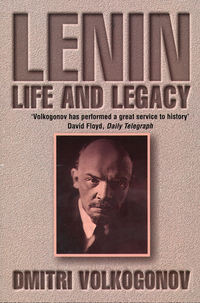
LENIN
Life and Legacy
DMITRI VOLKOGONOV
Translated and edited by Harold Shukman

Copyright
HarperCollinsPublishers 1 London Bridge Street London SE1 9GF
First published in Great Britain by
HarperCollinsPublishers 1994
Copyright © Dmitri Volkogonov 1994
Translation copyright © Harold Shukman 1994
The Author asserts the moral right to be identified as the author of this work
All rights reserved under International and Pan-American Copyright Conventions. By payment of the required fees, you have been granted the nonexclusive, nontransferable right to access and read the text of this e-book on-screen. No part of this text may be reproduced, transmitted, downloaded, decompiled, reverse engineered, or stored in or introduced into any information storage and retrieval system, in any form or by any means, whether electronic or mechanical, now known or hereinafter invented, without the express written permission of HarperCollins e-books.
Source ISBN: 9780007291649
Ebook Edition © OCTOBER 2012 ISBN 9780007392674
Version: 2016-03-21
HarperCollinsPublishers has made every reasonable effort to ensure that any picture content and written content in this ebook has been included or removed in accordance with the contractual and technological constraints in operation at the time of publication.
Contents
Cover
Title Page
Copyright
Map
List of Abbreviations
Chronological Table
Editor’s Preface
Introduction
1 Distant Sources
Genealogy
Vladimir and Alexander
The Forerunners
The Discovery of Marxism
Nadezhda Krupskaya
Inessa Armand
Financial Secrets
2 Master of the Order
Theorist of Revolution
The Phenomenon of Bolshevism
Lenin and the Mensheviks
The Paradox of Plekhanov
The Tragedy of Martov
3 The Scar of October
Democratic February
Parvus, Ganetsky and the ‘German Key’
Lenin and Kerensky
The July Rehearsal
October and the ‘Conspiracy of Equals’
Commissars and the Constituent Assembly
4 Priests of Terror
The Anatomy of Brest-Litovsk
White Raiments
Regicide
Fanya Kaplan’s Shot
The Guillotine of Terror
5 Lenin’s Entourage
The Most Capable Man in the Central Committee
The Man with Unlimited Power
The Bolshevik Tandem
The Party’s Favourite
The Leninist Politburo
6 The One-Dimensional Society
The Deceived Vanguard
Peasant Predators
The Tragedy of the Intelligentsia
Lenin and the Church
The Prophet of Comintern
7 The Mausoleum of Leninism
The Regime and the Illness
The Long Agony
The Mummy and the Embalming of Ideas
The Inheritance and the Heirs
Lenin as History
Postscript: Defeat in Victory
Keep Reading
Index
About the Author
Notes
About the Publisher
Map

Abbreviations
| AMB | Archives of the Ministry of Security |
| AMBRF | Archives of the Ministry of Security of the Russian Federation |
| APRF | Archives of the President of the Russian Federation |
| ECCI | Executive Committee of the Communist International |
| GARF | State Archives of the Russian Federation |
| GPU | State Political Administration |
| KGB | Committee of State Security |
| NKGB | People’s Commissariat of State Security |
| NKVD | People’s Commissariat of the Interior |
| OGPU | Combined State Political Administration |
| PSS | V.I. Lenin, Polnoe sobranie sochinenii (Complete Works), 5th edition, 55 vols., Moscow, 1970–85 |
| RTsKhIDNI | Russian Centre for the Preservation and Study of Recent Historical Documentation |
| TsAKGB | Central KGB Archives |
| TsAMBRF | Central Interior Ministry Archives of the Russian Federation |
| TsAMO | Central Archives of the Ministry of Defence |
| TsGALI | Central State Archives of Literature and Art |
| TsGASA | Central State Archives of the Soviet Army |
| TsGoA | Central State Special Archive |
| TsGVIA | Central State Military History Archives |
| TsIK | Central Executive Committee |
| TsKhSD | Centre for the Preservation of Contemporary Documentation |
| VTsIK | All-Russian Central Executive Committee |
Chronological Table
Until February 1918 dates in Russia conformed to the Julian or Old Style Calendar, which by the twentieth century was lagging thirteen days behind the Gregorian Western Calendar, or New Style. Thus, the February Revolution of 1917 took place in March according to the Western calendar and the Bolsheviks seized power on 25 October 1917, when in the West the date was 7 November. In the text we have used New Style dates, adding Old Style where any ambiguity might arise. In the following table, all dates are according to New Style.


Editor’s Preface
With the demise of the Soviet Union an era of Russian history was closed. It was an era that began in 1917 with the seizure of power by the Bolshevik Communist Party and ended with the disgrace and eviction of the same Party in August 1991, followed by the formal termination of the Soviet state itself at the end of the same year. From its inception to its end the Soviet state was identified with Lenin, whether alive or dead. Without him, it is generally accepted, there would have been no October revolution. Following the revolution, his name, his image, his words and his philosophy embellished, informed, exhorted and inspired generations of ordinary Soviet citizens, and especially those raised to positions of authority. He was made into an icon, a totem of ideological purity and guidance beyond questioning. All other Party leaders were found to be fallible in due course, many of the 1917 cohort in the great purge of 1936–38, and most famously Stalin in 1956 when Khrushchev debunked his ‘cult of personality’ at the Twentieth Party Congress. But Lenin remained untouched. As more and more topics of Soviet history were re-examined during Gorbachev’s enlightened leadership, and the Bolshevik old guard, exterminated in the 1930s, were rehabilitated, it became obvious that the spotlight must sooner or later fall on the last dark place on the stage – that occupied by Lenin.
A new reading of Lenin was made possible not only because Dmitri Volkogonov was granted access to the archives in the 1980s, but also, indeed chiefly, because Leninism itself had totally collapsed in the former Soviet Union. As the author of this book himself confesses, even after he had spent years collecting the incriminating evidence for his major study of Stalin, mostly written before 1985 and published in 1988, Lenin was the ‘last bastion’ in his mind to fall. Lenin has at last passed into history. No longer is he the prop of a powerful regime, the object of an ideology, or the central myth of a political culture. To engage in debate about Lenin and to assess his actions is no longer to challenge the legitimacy of an existing political system. Like him, it too has become history.
Books about Lenin have been coming out in the West almost from the moment the world first became aware of him in 1917. Even more abundantly, Soviet historians pumped out publications on allegedly every aspect of his life, and eye-witnesses of every degree added their own testimony in books with such titles as ‘They Knew Lenin’, ‘Lenin Knew Them’, ‘They Saw Lenin’, ‘Lenin Saw Them’, and so on, with variations on the theme effected by altering Lenin’s name: ‘They Knew Ilyich’, ‘Ilyich Knew Them’, etc., etc. Yet another book on Vladimir Ilyich Lenin therefore requires a word of justification.
Western books (including two by the undersigned) have largely been based on the published sources, many of them of Soviet origin. On the other hand, Soviet books from the outset have been apologist and ideological in content and purpose. From the end of the 1920s, when Stalin’s authority was complete, Soviet historians (like authors of creative literature, playwrights and film-makers) were strictly forbidden to write ‘objectively’, that is, from any other point of view than that laid down by the Central Committee of the Communist Party of the Soviet Union. Now that the Central Committee has evaporated together with the Party, there are virtually no taboos on historical research left; Russian historians may if they wish differ in their assessment of any events they choose to analyse, but access to a widening pool of hitherto concealed data will at least ensure that their interpretations are based on the full facts. Areas which have been closed to them, and only partially known to Western scholars, and which have now been opened up in this book, include the complete documentation of Lenin’s genealogy, his financial operations – German involvement in the funding of Bolshevik activity during the First World War and Soviet funding of foreign Communist Parties after it – the nature of his friendship with Inessa Armand, and the effects of his illness on his political judgment, to mention a few.
The opening of the Party and other archives of Soviet history has been a gradual and intermittent process. Numerous efforts made to publish inventories and collections of documents have met with varied success, and so far it is fair to say the process is still at an early stage. Although with the failure of the attempted coup in August 1991 the Russian state took over from the Communist Party control of all the archival collections within its boundaries, the new state has barely formulated rules on the release of documents for publication, and the picture remains unclear. Nevertheless, even the minutes of the Politburo for the 1930s have been seen by Western and Russian scholars alike, and much valuable material is now appearing in two new journals devoted to the publication of extracts from the archives, Istoricheskii arkhiv and Istochnik, and a new series of miscellanies called ‘Unknown Russia’ (Neizvestnaya Rossiya), as well as an increasing amount of similar material in journals which have survived from the Soviet era. Subject to the rules and regulations of the Russian Archive Commission (Rosarkhiv), all the documents cited in this book can be seen at the various locations indicated. Documents from the Archives of the President of the Russian Federation (APRF) have been transferred from the Kremlin to the archives of the former Central Committee (RTsKhIDNI) and TsKhSD).
The first researcher to gain access to the most secret archives was Dmitri Volkogonov. As the Director of the Institute of Military History and a serving Colonel-General, he had for years collected material for his biography of Stalin. Its publication in 1988 made him a pariah among his fellow senior officers, whose patience with him finally ran out in June 1991, when the draft of a new history of the Second World War, edited under his aegis, was discussed at his Institute and condemned. Accused of blackening the name of the army, as well as that of the Communist Party and the Soviet state, and personally attacked by Minister of Defence Yazov, Volkogonov resigned. When the attempted coup followed two months later, Volkogonov was the government’s natural choice to supervise the control and declassification of the Party and State archives.
The author’s original Russian version of this book is considerably longer than this English rendition, and the two main principles that I applied in editing it deserve a mention. As a Russian historian suddenly able to write freely about this subject, Volkogonov ranged far beyond the history of his subject, particularly into philosophical reflection and into the backgrounds of topics which, while of special interest to his Russian readers, tended either to be excessively familiar to a Western reader, or to slow down the general chronological drift underlying the shifting narrative. I felt an English reader might become impatient at times for a return to the book’s central theme. My first rule was therefore to try to preserve as much as possible of the material – published as well as unpublished – either emanating from or pertaining to Lenin himself. My second principle was to preserve material demonstrating Volkogonov’s own thesis, namely that Stalin, his system and his successors, all derived directly from Lenin, his theories and practices.
Among the questions Russian historians have yet to confront is that of continuity. For many years, Western scholars have debated the extent to which the Soviet system inherited features of the tsarist empire. Some have argued that strong, centralized government by a self-appointed oligarchy was a Russian tradition, that a passive population, inclined towards collective rather than individualistic action and fed on myths of a special destiny and of rewards to come only in the distant future (if not only after death), was also characteristically Russian. Others, especially those closest in time to the events of 1917, have suggested that the liberal and democratic aspirations of the February 1917 revolution, when Nicholas II abdicated, had viable if shallow roots that would have become strong and stable, but for the intervention of the Bolsheviks.
Whatever their differences of emphasis, all schools, whether Western or Soviet, have agreed that the Bolshevik seizure of power, and the period of turmoil that immediately followed it, diverted the country irredeemably from any previously supposed path of development. The destruction of the liberal political intelligentsia by Lenin meant that the constitutional option was a dead letter; the decimation of the peasants’ political leadership left them exposed to the Bolsheviks’ violent exploitation of their economic potential; heavy-handed Bolshevik management of the trade unions prefigured their reduction to obedient servants of the regime; Lenin’s suppression of the free press set the scene for the censorship of information by the Communist Party that is erroneously taken to be the hallmark of Stalinism; Lenin’s immediate resort to the prison, the concentration camp, exile, the firing squad, hostages and blackmail, and his creation of an entire system of punishment to replace that of the tsars, set the new order on a path of violence and universal suspicion that was to become typical of twentieth-century tyrannies thereafter.
In the view of Dmitri Volkogonov, the question of whether or not Soviet history was a continuation in any sense of Russian history is of less importance than the question of whether Soviet history is itself a continuum. In this book, he shows that between Lenin and Stalin there was neither an ideological discontinuity, nor a difference of method. And, indeed, it is his contention that, while the methods employed by Stalin’s successors were much more moderate, they were just as motivated by the impulses of their legendary founder as their monstrous predecessor had been.
Among writers on the history of the Soviet Union – whether Westerners or Russian émigrés – it was not uncommon to trace events back and to seek a point at which ‘things might have gone differently’. Many have wondered whether, had Lenin not died so early in the life of the regime, the country might have developed along less militaristic and politically sterile lines. Perhaps the New Economic Policy, allowing peasants – more or less – to work for themselves, and permitting a degree of latitude in cultural life, would have continued and led to a more tolerant order of things. In the early years of glasnost this idea was widely debated by Russian as well as Western scholars. Among the latter were many who could not accept that any good could have come from Lenin and his creations, while some still retained a lingering doubt that such an intelligent man as Lenin could possibly have initiated and carried through the inhuman collectivization and the great terror of the 1930s. In Russia, as long as the Soviet state continued to exist, Lenin remained a virtually unblemished icon.
Dmitri Volkogonov has now demolished the icon, and he has firmly committed himself to the view that Russia’s only hope in 1917 lay in the liberal and social democratic coalition that emerged in the February revolution. He has, in other words, concluded that there was no salvation to be found in any of the policies practised by Lenin, and he has taken his account further to show how Lenin’s malign influence was imbibed by all subsequent Soviet leaders. Indeed, the Party leaders, he shows, quoted Lenin and referred to his teaching, not just when mouthing their pious platitudes for the populace, but even when they were closeted in the privacy of the Politburo. Having absorbed a philosophy that had failed almost before it was put into practice, it should have caused little surprise that the practitioners of Leninism in the modern age would ultimately share a similar fate.
Introduction
The massive steel door swung open and I was ushered into a large lobby, from which a similar reinforced door led to the Communist holy of holies, Lenin’s archives. The former Central Committee building on Staraya Square in central Moscow is a vast grey edifice the size of an entire city block. Along its endless corridors are the identical wood-panelled offices where the Party hierarchs once sat, dozens of meeting rooms of all sizes, a great reading room lined with catalogues and indexes to the Party’s meticulously preserved records. And deep in its basement, reminiscent of a nuclear bomb-shelter, on special shelves in special metal boxes, I was shown all the written traces to be found of the man still regarded by some as a genius, by others as the scourge of the century.
Despite the fact that there have been five editions of his collected works in Russian (the fourth of which was translated into many foreign languages), these are Lenin’s unpublished documents, numbering 3724 in all. Another 3000 or so were merely signed by him. Why were they hidden away? Could it be that his halo would have been tarnished by publishing, for instance, his instructions in November 1922 to punish Latvia and Estonia for supporting the Whites by such means as ‘catching them out’ with more and more evidence, by penetrating their borders ‘in hot pursuit’ and ‘then hanging 100–1000 of their officials and rich folk …’?1 Perhaps such documents were concealed because there was no one left who could explain them. As the Anarchist veteran Prince Kropotkin wrote to Lenin in December 1920, when the Bolsheviks had seized a large group of hostages whom they would ‘destroy mercilessly’ (in the words of Pravda) should an attempt be made on the life of any of the Soviet leaders: ‘Is there none among you to remind his comrades and to persuade them that such measures are a return to the worst times of the Middle Ages and the religious wars, and that they are not worthy of people who have undertaken to create the future society?’2 Lenin read the letter and marked it ‘For the archives.’
Of course, our view of Lenin has changed not only because we have found there is more than the stories that inspired us for decades. We began to doubt his infallibility above all because the ‘cause’, which he launched and for which millions paid with their lives, has suffered a major historical defeat. It is hard to write this. As a former Stalinist who has made the painful transition to a total rejection of Bolshevik totalitarianism, I confess that Leninism was the last bastion to fall in my mind. As I saw more and more closed Soviet archives, as well as the large Western collections at Harvard University and the Hoover Institution in California, Lenin’s profile altered in my estimation: gradually the creator and prophet was edged out by the Russian Jacobin. I realised that none of us knew Lenin; he had always stood before us in the death-mask of the earthly god he had never been.
After my books on Stalin and Trotsky,3 I set about the final part of the trilogy with the aim of rethinking Lenin. He had always been multi-faceted, but after his death his image was channelled into the single dimension of a saint, and the more we saw him as such, the more we distanced ourselves from the historical Lenin who was still, I think, the greatest revolutionary of the century.
The intellectual diet of Leninism was as compulsory for every Soviet citizen as the Koran is for an observing Muslim. On 1 January 1990 in the Soviet Union there were more than 653 million copies of Lenin’s writings in 125 languages – perhaps the only area of abundance achieved by Communist effort. Thus were millions of people educated in Soviet dogmatics, and we are still not fully aware how impoverished and absurd our idol-worship will look to the twenty-first century.
To write about Lenin is above all to express one’s view of Leninism. In 1926, two years after Lenin’s death, Stalin produced a collection called The Foundations of Leninism. Leninism, we were told, came down to making possible the revolutionary destruction of the old world and the creation on its ruins of a new and radiant civilization. How? By what means? By means of unlimited dictatorship. It was here that the original sin of Marxism in its Leninist version was committed – not that Marx, to give him his due, was much taken with the idea of dictatorship. Lenin, however, regarded it as Marxism’s chief contribution on the question of the state. In fact, according to him, the dictatorship of the proletariat constituted the basic content of the socialist revolution. His assertion that ‘only by struggle and war’ can the ‘great questions of humanity’ be resolved gave priority to the destructive tendency.4
Thus armed, Lenin and his successors assumed that in the name of the happiness of future generations, everything was permitted and moral: the export of revolution, civil war, unbridled violence, social experimentation. The vitality and, let it not be denied, the appeal of much of Leninism derived from the perpetual human longing for the perfect and just world. The Russian revolutionaries, including Lenin, rightly exposed the age-old evils of human existence, the exploitation, inequality, lack of freedom. But having acquired the opportunity to abolish these evils, the Leninists established a new, barely disguised form of exploitation to be carried out by the state. Instead of social and ethnic inequality came bureaucratic inequality; in place of class unfreedom came total unfreedom. The Leninist version of Marxism was made flesh in this vast country, becoming something like a secular religion in the process.
In the last analysis, the Leninist promise of great progress turned into great backwardness. The founders of the Russian Marxist movement, George Plekhanov, Vera Zasulich and Lev Deich, in their ‘Open Letter to the Petrograd Workers’ of 28 October 1917, wrote prophetically that ‘the revolution is the greatest historic disaster, it will provoke a civil war which in the end will force it to retreat far from the conquests of February 1917’.5 For that matter, on the eve of the Bolshevik coup of October 1917 other Bolsheviks were not confident of success and were alarmed by Lenin’s radicalism, which with maniacal persistence was pushing the masses towards armed uprising against the Provisional Government. At the Central Committee on 16 October 1917, where the issue of the uprising was discussed, Lenin made a note, which reads: ‘“We dare not win”, that’s the main point of all their speeches.’6 A man of enormous will, Lenin succeeded in turning his party in the direction of violence and coercion as a way of dealing with the problems of peace, land and freedom.
Leninism was not restrained by national limits. With the aid of Comintern, established in Moscow in March 1919 and virtually an international section of the Russian Communist Party, he attempted to initiate revolutions wherever the possibility existed, and sometimes where it did not. In July 1920 he cabled Stalin in Kharkov: ‘The situation in Comintern is splendid. Zinoviev, Bukharin and I believe that we ought to encourage revolution in Italy right now. My own opinion is that we need to sovietize Hungary for the purpose, and maybe also Czecho[slovakia] and Romania.’7 Emissaries were sent east and west, and on Lenin’s orders the Finance Commissariat made available millions of gold roubles ‘for the needs of the world revolution’.8 Meanwhile Soviet citizens were dying in their hundreds of thousands from famine and disease. For Lenin, the revolution was everything, and it could not be achieved without countless victims.
It is impossible to think of Lenin without contemplating his brainchild, his party. Perhaps the idea of the mighty revolutionary organization is central to Leninism, but his accomplishment was not merely that he created a party with a disciplined organization, but that he was rapidly able to erect it into a state system. The Party soon acquired a monopoly of power, of thought and of life itself. It became a Leninist order, in whose name its ‘leaders’ and their ‘comrades-in-arms’ were to rule the country for decades to come. It was an ideal backbone for a totalitarian regime, but as soon as Soviet society began its rapid change in the second half of the 1980s, the Party, like a fish cast onto the bank, began to expire. Its rapid and amazingly painless disintegration after the attempted coup of August 1991 revealed its absolute inability to survive in conditions of an emerging civil society.
If the chief feature of a dictator is unlimited personal power – and Lenin had such power – we ought to see him as a dictator. Yet he was not. Certainly he regarded dictatorship as a positive virtue contributing to the success of the revolution, and certainly he saw the Bolshevik leaders as ‘dictators’ in their allocated areas of responsibility: at the 10 July 1919 session of the Politburo, Alexei Rykov was appointed ‘dictator for military supply’.9 Power for Lenin was dictatorship, but he exercised it remotely, through a flexible mechanism of ideological and organizational structures.
Little is known of Lenin’s private life. This is not only because of the Marxist postulate of the primacy of the social above the personal, but also because of the desire of the revolutionary hierarchs to keep the personal lives of their leaders secret from the masses. While every detail of the life of a minor functionary was regarded as essential information, the life of a Politburo member and his family was seen as a state secret. Their salaries, numbers of servants and automobiles, as well as the size of their houses and dachas – all such information was untouchable in ‘special files’. Nobody in Russia ever learnt, for example, what financial support Lenin had received during the years of his voluntary exile in Europe, from 1900 to 1905 and from 1906 to 1917, or who had financed the Party before the revolution, or why Lenin had never worked, in the usual meaning of the word, or how he had travelled through Germany at the height of the war, or whether the Bolsheviks had ever received financial help from Germany, Russia’s enemy, before the revolution. On 21 August 1918 Lenin wrote to his emissary in Sweden, Vatslav Vorovsky: ‘No one asked the Germans for help, but there were negotiations on when and how they, the Germans, would carry out their plan to advance … There was a coincidence of interests. We would have been idiots not to have exploited it.’10 The new regime’s relations with Germany, after the separate peace of Brest-Litovsk of March 1918, were shrouded in secrecy. In February 1921, Lenin received a cipher from the Soviet legation in Berlin reporting on the results of talks with the Germans, in the course of which agreement had been reached on the rehabilitation of the German war industry, contravening the Versailles prohibition. The German firm Blohm and Voss was ready to build submarines, Albatrosswerke aircraft, and Krupp artillery pieces on Soviet soil. Lenin responded: ‘… I think, yes. Tell them so. Secret.’11
Soviet biographies of Lenin are countless and uniformly eulogistic, singing the praises of his genius, his perfection and his greatness. Within a year of the Bolshevik seizure of power, Grigory Zinoviev virtually mapped out the first official biography and set the tone that would become almost statutory, in a speech in which he employed such terms as ‘the apostle of Communism’ and ‘Leader, by the grace of God’.12 The published memoirs of Lenin’s wife, Nadezhda Krupskaya, who knew him better than anyone, were different, though they too bear the stamp of the era, ‘the midnight of the epoch’. The exception to the rule is perhaps her memoirs about the last period of his life which, like those of his sister, Maria, were never published.
The five editions of Lenin’s collected works vary substantially. The first came out between 1920 and 1926 and numbered twenty volumes. The second and third (which differed only in the quality of their bindings) were published in thirty volumes between 1930 and 1932. The fourth, known as the Stalin Edition and the one translated into foreign languages, including English, came out between 1941 and 1957 in thirty-five volumes. The fifth, described as the Complete Edition and the one to which we refer most often in this book, was published between 1958 and 1965 and benefited to some extent from the somewhat liberal climate of Khrushchev’s early years. It ran to fifty-five volumes, while the sixth, which was in preparation when the August 1991 events occurred, was planned to have at least seventy. Lenin is inexhaustible. The most serious Soviet work on him is a twelve-volume ‘Biographical Chronicle’ which provides not merely the basic contours of the man-god’s life, but also thousands of names and facts. It also contains many cuts, silences and distorted interpretations. The biographies written in the West are immeasurably more useful, although they lack the original source material, especially on the Soviet period.
One of the most interesting published accounts of Lenin was written by Trotsky when Lenin died in 1924.13 It formed part of the material he collected for many years for a ‘big book’ on Lenin. In April 1929, exiled in Constantinople, he wrote to Alexandra Ramm, his translator in Berlin: ‘My book Lenin and His Successors cannot appear earlier than two or three months after my autobiography has come out.’ And three months later he wrote that he was writing another book on ‘Lenin (a biography, personal portrait, memoirs and correspondence)’.14 Five years later Trotsky wrote to his supporter, M. Parizhanin: ‘My work on Lenin has not yet and will not soon move beyond the preparatory stage. I won’t be able to send the first chapters for translation before July.’15 Lenin dead was no less useful to Trotsky, for personal reasons, than he was to Stalin. Both of them knew more about their patron than anyone else, but the ‘big book on Lenin’, alas, was never completed or published.
Trotsky first met Lenin in 1902, and their relationship went from mutual admiration to deep mutual rejection and back to close alliance. Trotsky could have recalled that, at the time of the 1905 revolution, Lenin in a fit of frustration had called him a balalaika, a poseur, base careerist, rogue, scoundrel, liar, crook, swine, and more. That was Lenin’s style, but it did not prevent him from writing in 1917, ‘Bravo, Comrade Trotsky!’ or from calling him ‘the best Bolshevik’. Trotsky, for his own part, was never short of an insulting epithet to throw back.
Stalin also knew a lot about Lenin, notably from the Soviet rather than the émigré period. The archives show that Stalin received no fewer than 150 personal notes, cables, letters and orders from Lenin. But many of them are fragments of telegram tape, second copies of typescript and other indirect evidence. I have alluded in my book on Stalin to the dubious authenticity of such materials. After becoming supreme dictator, and with the help of his yes-men, Stalin introduced some significant falsifications into the correspondence with Lenin, which had grown rapidly with his appointment to the post of General Secretary of the Communist Party in 1922. After his own authorized biography had appeared, it seems Stalin also planned to bring out a book on Lenin, though he never did.16
Perhaps it was another leading Bolshevik, Lev Kamenev, who received the most correspondence, 350 letters and memoranda by my reckoning, most of them still unpublished. He was much trusted by Lenin, even on personal matters, for example on Lenin’s relationship with his mistress Inessa Armand at the time he and Lenin were sharing an apartment in Poland. Kamenev’s knowledge of Lenin is important because he was the first editor, with Lenin’s direct participation, of Lenin’s collected works (1920–26). Kamenev, however, wrote little, and left nothing to compare in size with the heritage of his constant friend Zinoviev.
Grigory Yevseyevich Zinoviev and his wife Z.I. Lilina were close family friends of Lenin, and Zinoviev probably received more personal letters from Lenin than any other leader. The new Communist top brass were not modest: once in power, they took up residence in the Kremlin, expropriated palaces and estates, gave cities their names, erected monuments to themselves, surrounded themselves with bodyguards and doctors, and quickly set about publishing their collected works. Zinoviev’s best work on Lenin was possibly his introduction to the study of Leninism, in which he exhorted his readers to ‘study Lenin at first-hand! To know Lenin is to know the road to the victory of the world revolution.’17 In the early 1930s, when Zinoviev’s days were numbered, he wrote several chapters of a book on Lenin, hoping it would save him. Stalin would not so much as look at what his prisoner had written, for he had long ago decided the fate of Zinoviev, and Kamenev too.
Most of Lenin’s biographers have understandably concentrated on his social and political rôle, but it is also important to balance that against his strictly human, moral and intellectual qualities, and to do so without forgetting the historical context. The historical Lenin was a child of his time: troubled, cruel, expectant, alarming. History neither accuses nor justifies, it is a means to understand, to discern the patterns that characterize a distant age. We say the word ‘Lenin’ and we see in our mind’s eye a man whose high forehead and large bald patch suggest the embodiment of intellect – as well as the commonplace.
Gleb Krzhizhanovsky, an early associate of Lenin’s who held high office in the Soviet government, made an attempt in his book Velikii Lenin to define the essence of Lenin’s genius (to which the book was dedicated), but was more successful in describing his subject’s exterior appearance. It was, he wrote, simple and modest: ‘Short of stature and wearing his usual cloth cap, he could easily have passed unnoticed in any factory district. All one could say of his appearance was that he had a pleasant, swarthy face with a touch of the Asiatic. In a rough country coat he could just as easily have passed in a crowd of Volga peasants.’ Clearly, this description was intended to stress the ‘folksiness’, the ‘depth’, the ‘link with the lower orders’, but Krzhizhanovsky also noticed an important element: Lenin’s eyes, the mirror of the human mind. Those eyes, he wrote, ‘were unusual, piercing, full of inner strength and energy, dark, dark brown …’18 It was a feature noticed by many, especially by the writer A.I. Kuprin in his graphic description, ‘Instant Photography’. Lenin, he wrote, ‘is short, broad-shouldered and lean. He looks neither repellent, militant nor deep-thinking. He has high cheekbones and slanting eyes … The dome of his forehead is broad and high, though not as exaggerated as it appears in foreshortened photographs … He has traces of hair on his temples, and his beard and moustache still show how much of a fiery redhead he was in his youth. His hands are large and ugly … I couldn’t stop looking at his eyes … they are narrow; besides which he tends to screw them up, no doubt a habit of concealing short sight, and this, and the rapid glances beneath his eyebrows, gives him an occasional squint and perhaps a look of cunning. But what surprised me most was their colour … Last summer in the Paris zoo, seeing the eyes of a lemur, I said to myself in amazement: at last I’ve found the colour of Lenin’s eyes! The only difference being that the lemur’s pupils were bigger and more restless, while Lenin’s were no more than pinpricks from which blue sparks seemed to fly.’19 The writer Ariadna Tyrkova, who had seen Lenin at close quarters more than once, drew a simpler picture: ‘Lenin was an evil man. And he had the evil eyes of a wolf.’20
A physical detail, while of no decisive significance to Lenin’s political portrait, may nevertheless highlight his main characteristic, namely his powerful mind, a mind that was too often not merely pragmatic, flexible and sophisticated, but also malevolent and perfidious. His radical pragmatism explains the actions he took to bring about the defeat of his own country in the First World War in order to get his party into power. His radicalism compelled him to accept the loss of entire national regions of the former tsarist empire, although when complete disintegration was threatened he cast aside his internationalism and started defending that empire, by then transformed into its Soviet form.
It was power, not love of fatherland, that prompted him to save Russia. He had, after all, shown his contempt – to put it mildly – for Russia and the Russians. Writing in the autumn of 1920 to Jan Berzin, a Central Committee member of Latvian origin, about publishing Communist propaganda, he complained that things were going badly. He advised Berzin to invite two Swiss comrades from Zurich, and to pay them ‘arch-generously’. He went on: ‘Hand out the work to Russian idiots: send the cuttings here, but not occasional issues (as these idiots have been doing until now).’21 Without a blush, he could call his fellow-countrymen idiots who could only be trusted to do the simplest tasks, while left-wingers from Zurich had to be paid ‘archgenerously’. This is only a short note, but a very eloquent one, and similar evidence of Lenin’s attitude to Russianness is abundant, though of course well hidden in the archives.
In the middle of 1922 the civil war was over and Russia lay in ruins. It seemed that at last the cruelty would end. Lenin pointed out that ‘although coercion is not our ideal’, the Bolsheviks could not live without it, even where ideas, views and the human spirit are concerned. He recommended the death penalty, commuted in mitigating circumstances to deprivation of liberty or deportation abroad, ‘for propaganda or agitation or belonging to or aiding organizations supporting that part of the international bourgeoisie that does not recognize the … Communist system’.22 This proposal was later incorporated into the infamous Article 58 of the Criminal Code, under which millions constructed and then filled the concentration camps. Lenin is the source of the totalitarian ideology of intolerance. By creating the Cheka, the punitive organ of the dictatorship and his favourite brainchild, Lenin influenced the outlook of the Communists who soon came to believe that the amoral was moral, if it was in the Party’s interest. S.I. Gusev, a member of the Party Central Control Commission, addressing the XIV Congress in December 1925, declared: ‘Lenin once taught us that every member of the Party must be an agent of the Cheka, that is, we must watch and inform … I believe every member of the Party should inform. If we suffer from anything, it is not from denunciation, but from non-denunciation. We might be the best of friends, but once we start to differ in politics, we must not only break off our friendships, we must go further and start informing.’23 Leninist doctrine had donned the police agent’s cloak.
It is often said that, as he felt death approaching, Lenin was horrified by what he had done and was willing to rethink much. It may be so, but it is impossible to prove. Even had he wanted to change things, which is doubtful, he took his intentions with him to the grave. It is also said that Lenin failed to build ‘true socialism’, even with the aid of the New Economic Policy. But if one looks closely at his understanding of this ‘new policy’, one can clearly discern old Bolshevik features. NEP, as far as Lenin was concerned, was bridled capitalism, and it could be ‘slapped down’ at any time. When reports started coming in about profiteering by traders, the so-called ‘Nepmen’, Lenin reacted quickly: ‘… we need a number of model trials with the harshest sentences. The Justice Commissariat obviously doesn’t understand that the New Economic Policy requires new methods of applying punishment of new harshness.’24
Lenin never concealed his belief that the new world could only be built with the aid of physical violence. In March 1922 he wrote to Kamenev: ‘It is the biggest mistake to think that NEP will put an end to the terror. We shall return to the terror, and to economic terror.’25 And indeed there was to be enough terror of every kind. After many decades we Russians condemned it, refusing for shame to answer the question of who had started it and who had made it into a sacred object of revolutionary method. I do not doubt that Lenin wanted earthly happiness for the people, at least for those he called ‘the proletariat’. But he regarded it as normal to build this ‘happiness’ on blood, coercion and the denial of freedom.
1 Distant Sources
Vladimir Ilyich Lenin did not appear fully fledged on the scene as the leader of the radical wing of Russian social democracy. At the end of the nineteenth century, when he was not quite thirty, he was merely one among many. Julius Martov, who collaborated closely with him in St Petersburg and Western Europe between 1895 and 1903, recalled that Lenin cut a rather different figure then from the one he was to present later on. There was less self-confidence, nor did he show the scorn and contempt which, in Martov’s view, would shape his particular kind of political leadership. But Martov also added significantly: ‘I never saw in him any sign of personal vanity.’1
Lenin himself was not responsible for the absurdly inflated cult that grew up around his name throughout the Soviet period, although he was not entirely blameless. When in August 1918, for instance, it was decided to erect a monument at the spot in Moscow where an attempt had recently been made on his life, he did not protest, and only a year after the Bolshevik seizure of power he was posing for sculptors. In 1922 monuments were raised to him in his home province of Simbirsk, in Zhitomir and Yaroslavl. He regarded all this as normal: in place of monuments to the tsars, let there be statues of the leaders of the revolution. His purpose was rather to affirm the Bolshevik idea than to glorify personalities. Everyone had to don ideological garb, the uniform of dehumanized personality, and Lenin and Leninism were the main components of the costume. The deification of the cult figure was the work of the system which he had created and by which he was more needed dead than alive.
Vladimir Ilyich Ulyanov began to use the alias and pseudonym ‘Lenin’, probably derived from the River Lena in Siberia, at an early stage. His very first writings, in 1893, appeared, unsigned, in mimeographed form. He first used a signature, ‘V.U.’, at the end of 1893, and then a year later he signed himself ‘K. Tulin’, a name derived from the town of Tula. In 1898 he used the pseudonym ‘Vl. Ilyin’ when reviewing a book on the world market by Parvus (Alexander Helphand), translated from German. In August 1900, in a private letter, he signed himself ‘Petrov’, a name he continued to use in correspondence with other Social Democrats until January 1901, when he signed a letter to Plekhanov with the alias ‘Lenin’. He seems not to have settled into this alias straight away, and still went on using ‘Petrov’ and ‘V.U.’, as well as his proper name, for some time. He also adopted the name ‘Frei’ for part of 1901, and in 1902 ‘Jacob Richter’ vied for a while with ‘Lenin’. But from June of that year, it appears he became comfortable at last with the name by which the world would one day come to know him.
It is difficult to imagine Lenin as young. We are familiar with the photograph of the chubby little boy and high school student with intelligent eyes, yet he seems to have stepped straight from his youth into mature adulthood. Alexander Potresov, another early collaborator, who knew him well at the age of twenty-five, recalled that ‘he was only young according to his identity papers. You would have said he couldn’t be less than forty or thirty-five. The faded skin, complete baldness, apart from a few hairs on his temples, the red beard, the sly, slightly shifty way he would watch you, the older man’s hoarse voice … It wasn’t surprising that he was known in the St Petersburg Union of Struggle as “the old man”.’2
It is worth noting that both Lenin and his father lost their considerable mental powers much earlier than might be thought normal. I am not suggesting a necessary connection, but it is true that both men died of brain disease, his father from a brain haemorrhage at the age of fifty-four, and Lenin from cerebral sclerosis at fifty-three. Lenin always looked much older than his years. His brain was in constant high gear, and he was usually having a ‘row’ with someone, ‘row’ being one of his favourite words. It may not be a sign of his genius, but the fact is that, even when he was relatively young, Lenin always looks like a tired old man. Be that as it may, let us look at his origins, his antecedents and his background.
Genealogy
Simbirsk, where Lenin was born on 22 April 1870, was the small leafy capital of the province of the same name. At the end of 1897 it had a population of 43,000 inhabitants, of whom 8.8 per cent were of gentry (or noble) status, 0.8 per cent clergy families, 3.2 per cent merchants, 57.2 per cent ordinary town-dwellers or lower middle-class, 11 per cent peasants, 17 per cent military and the remaining 2 per cent unclassified. It had two high schools, one each for boys and girls, a cadet school, a religious school and seminary, a trade school, a midwifery school, schools for the Chuvash and Tatar minorities, several parish schools, the Karamzin Library, and the Goncharov Public Library. It had a vodka distillery, a winery, a brewery, a candle factory and flour-mill. There were a number of charitable institutions. Founded on the high side of the middle Volga in 1648 as a defence against nomadic raids, the town was soon transformed into a typical, sleepy, unhurried provincial Russian town.
In time Simbirsk became a Bolshevik shrine, renamed Ulyanovsk. A local historian, Z. Mindubaev, has written that the transformation of the ancient town into a ‘grandiose Leninist altar’ was accompanied by a ‘huge pogrom’ which flattened everything. With astonishing mindlessness, the ‘builders’ tore down ancient churches, cathedrals and monasteries. Even the church where Lenin was baptized was razed, as was a house in which Pushkin had once stayed early in the nineteenth century. The cathedral which had been erected at about the same time in memory of the fallen of Simbirsk in the war of 1812 was cleared in the 1920s to make way for a monument to Lenin. Streets were renamed after Marx and Engels, Liebknecht, Rosa Luxemburg, Plekhanov and Bebel. At the height of the famine of 1921, when the Volga region was ravaged, the local authorities allocated funds for a statue of Marx. The cemetery of the Pokrovsky Monastery was bulldozed to make way for a cosy square, leaving only one grave – that of Lenin’s father, Ilya Nikolaevich Ulyanov, with its cross removed.3
The twelve-volume ‘Biographical Chronicle’ of Lenin’s life, while it attempts (with little success) to catalogue every fact and account for virtually every waking moment of his life, is extremely laconic about his birth and background: ‘April 10 (22 New Style4) 1870 Vladimir Ilyich Ulyanov (Lenin) was born. His father, Ilya Nikolaevich, was an inspector and later the director of the province’s schools. He came of poor town-dwellers of Astrakhan. His father had been a serf. Lenin’s mother, Maria Alexandrovna, was the daughter of a doctor, A.D. Blank. The Ulyanov family lived in Simbirsk (still called Ulyanovsk in late 1994), in a wing of Pribylovskaya’s house on Streletsky Street (now Ulyanov Street) No. 17a.’5 Other information about the family has to be gleaned in fragments from the twelve volumes, most of which consist of references to Lenin ‘making plans’, or ‘destroying his opponents intellectually’, reading, writing or making a speech. Consisting of several thousand pages, it is a chronicle that presents the portrait of a political robot, not a human being.
Similar information is to be found in the official biography of Lenin, compiled by a brigade of scholars under P.N. Pospelov. All eight editions of this work, beginning with the first in 1960, can be found in any Soviet library, but it is doubtful if any have ever been consulted voluntarily. The people may have resigned themselves to believing assurances that the Party was in the hands of ‘outstanding leaders of the Leninist type’, but they always retained the lingering suspicion that this idea was exaggerated. Most people were therefore rather indifferent to the official image of Lenin. Only a few individuals, perhaps while preparing for an exam or writing a dissertation, were actually required to pore over a volume of Lenin’s works. As for Party leaders themselves, the majority of those I have known never read a word of Lenin beyond the ‘Party minimum’.6 What was regarded as the proper Leninist text to read was laid down in directives and confidential letters from the Central Committee. They were all being led by a Lenin they did not know.
In order to establish Lenin’s genealogy, we have to resort to books published in the 1920s, as well as to foreign publications and a range of Russian archives. The large Ulyanov family had many branches. Lenin’s parents married in 1863 in Penza, capital of the province of that name to the west of the lower Volga, where Lenin’s father was working as a teacher of physics and mathematics. After a spell in Nizhni Novgorod, in the centre of European Russia, the family moved to Simbirsk. There is almost nothing in the official biographies about Lenin’s grandparents, especially their ethnic origin, not that this would tell us anything about his intellectual capacities, social position or moral qualities. But there has been a great reluctance to discuss the Ulyanov family tree, no doubt because it was felt that the leader of the Russian revolution must be a Russian.
The Russian Empire, however, was a crucible of the most varied national and racial ingredients, as was to be expected in so vast a territory. I dwell on this aspect of Lenin’s biography because his ethnic background was carefully covered up to make sure that he was seen to have been, if not of ‘proletarian’, at least of ‘poor peasant’ origin. But if the ‘Chronicle’ was able to show – as it does – that his father’s father had been a serf, why was it not possible to reveal the background of his father’s mother, and his mother’s parents?
Lenin’s mother, Maria Alexandrovna, was the fourth daughter of Alexander Dmitrievich Blank, a doctor and a baptized Jew from Zhitomir. He had taken as his patronymic the name of his godfather at his baptism, Dmitri Baranov, dropped his original patronymic of Moishevich, and adopted the Christian name of Alexander in place of his original first name, Srul, the Yiddish form of Israel. According to research done by David Shub and S.M. Ginsburg, Lenin’s grandfather was the son of Moishe Itskovich Blank, a Jewish merchant from Starokonstantinov in the province of Volynia, who was married to a Swedish woman called Anna Karlovna Ostedt.7 Shub asks how a Jew could have become a police doctor, and later the owner of an estate. Referring among other things to the archives of the Holy Synod, Shub concluded that conversion to Orthodox Christianity removed many barriers to a career in state service. ‘There were,’ he writes, ‘baptized Jews in the reign of Nicholas I who occupied far higher positions than police doctor … Many such Jews were ennobled and thus achieved all the rights and privileges of that class.’8
In St Petersburg, Alexander Blank married Anna Grigorievna Groschopf, the daughter of prosperous Germans. The Blanks were evidently well off, since they were able to make several trips to Europe, notably to take the waters in Karlsbad in the Czech part of Austria-Hungary. Alexander Blank worked in various towns and provincial capitals of the Russian interior, for the most part in the Volga region, as district physician, police doctor and hospital doctor, finally occupying the prestigious post of hospital medical inspector of the state arms factory in Zlatoust, in the province of Chelyabinsk, Western Siberia. In 1847, having attained the civil service rank of State Counsellor, he retired and registered himself as a member of the nobility of Kazan, a major city on the Volga and centre of Tatar culture in the region. There he bought the estate of Kokushkino.9 This had been made possible by the large dowry his wife had brought with her. Anna Grigorievna never learned to speak fluent Russian and never abandoned her Lutheran religion. In Kokushkino she would raise five daughters: Anna, Lyubov, Sofia, Maria (Lenin’s mother) and Yekaterina.
Kokushkino was not the ‘smallholding’ of the official biographies, but was rather a small landowner’s estate where, until 1861, Blank owned serfs. This normal feature of the time was something Soviet historians were never allowed to mention. It was a busy, well populated place, and Blank was evidently a strong-willed and rather impulsive man. He was obsessed with the idea that hydrotherapy was a panacea, and wrote a book on it, stating that ‘water inside and out’ could sustain everyone in good health. He used to make his tearful daughters wrap themselves in wet sheets for the night, with the result that they couldn’t wait to grow up and marry to escape their father’s crazy experiments.
Anna Groschopf died young, and after her death her sister, Yekaterina, came to Kokushkino to take on the job of raising the children. She was an educated woman, and it was from her that Lenin’s mother acquired her ability to play the piano, to sing and to speak German, English and French. A frequent visitor to Kokushkino was Karl Groschopf, Yekaterina’s brother and a senior official in the department of foreign trade. His visits would occasion musical evenings, and the Blank girls were much attracted to their educated and exuberant uncle. Life on the estate was very much that of a typical, moderately well-off landowning family, with a strong German cultural tinge, thanks to the Groschopf connection. Unlike his Soviet biographers, Lenin never tried to hide his ‘landowner’ origins; indeed in April 1891 he signed an order inscribing his mother in the gentry register of Simbirsk province.10 And at the end of his exile in 1900, when he applied to the police department to allow his wife, Nadezhda Krupskaya, to serve out the remainder of her own term of exile in Pskov, he signed himself ‘hereditary nobleman Vladimir Ulyanov’.11 Lenin’s origins on his mother’s side were far from ‘proletarian’, a fact which underlines the absurdity of the Bolshevik practice of evaluating a person by their social class. This criterion reached grotesque proportions in the 1920s and 1930s, when people even committed suicide on discovering a ‘bourgeois’ or ‘landowner’ skeleton in their past. The Party leaders were, of course, excused as a ‘revolutionary exception’.
Lenin’s paternal lineage was plainly plebeian, and the ‘Biographical Chronicle’ makes much of the fact that his grandfather had been a serf. But this was not actually true. Lenin’s grandfather, Nikolai Vasilievich, was a Russian town-dweller12 of Astrakhan who earned his living as a tailor. He was the son of a serf, but at an early age had been released to work away from the village, and had never returned home, becoming a town-dweller – as distinct from a peasant, merchant or nobleman – by social status. It was Lenin’s great-grandfather, Vasili Nikitich Ulyanov, who had been a serf.13 He had remained single until he turned fifty, and it was only then, having saved up some money, that he married. His bride, who was almost twenty years his junior, was Anna Alexeevna Smirnova, a baptized Kalmyk, whose ethnic origin was responsible for Lenin’s somewhat Asiatic appearance. Five children resulted from this late marriage: Alexander, Vasili, Ilya (Lenin’s father), Maria and Feodosia. Ilya was the youngest child, and was born when his father was already past sixty and his mother was forty-three. His father died in 1836, leaving his wife, the five-year-old Ilya (Alexander had died in infancy), and his two daughters to his seventeen-year-old son, Vasili, to look after.
Vasili rose to the occasion and displayed exemplary enterprise, becoming a salesman for Sapozhnikov Brothers, a large commercial firm in Astrakhan. His willingness to work and his loyalty earned his employers’ trust, and he was able to look after his mother and younger brother, supporting Ilya through his studies at Kazan University until he became a teacher of mathematics, sending him money ‘for settling down’, ‘for the wedding’, ‘for the move’ and so on. Vasili, a bachelor all his life, and a diligent and enthusiastic salesman, may also have sent his cash assets to Ilya shortly before he died at a date historians have been unable to establish.14
It would not be worth dwelling on the Ulyanov family tree had the official picture not been so obscured by a mass of unnecessary trivia and painted in the colours of ‘class consciousness’, and had so much not been passed over in silence, distorted and blatantly falsified. A brief account, however, may suffice to show that Lenin’s background reflected the face of the entire empire. He had a general idea about his origins, but, although he was Russian by culture and language, his country was not his highest value – not that he particularly felt himself to be a German, a Swede, a Jew or a Kalmyk. He may have described himself as a Russian when filling in forms, but in his outlook he was an internationalist and cosmopolitan, for whom the revolution, power and the Party were to be immeasurably more precious than Russia itself. It is only important to clarify this matter because the Bolsheviks found it necessary to suppress evidence of the perfectly natural mixture of nationalities in Russia in order to present their leader as ethnically ‘pure’.
Lenin’s antecedents were Russian, Kalmyk, Jewish, German and Swedish, and possibly others, symbolizing Russian history, as it were: a Slavic beginning, Asiatic expansion, a Jewish accretion to the national intellect, and German or West European culture. Genetic selection in history is spontaneous and mysterious. But here a digression is called for. When Lenin died, the Central Committee Secretariat commissioned his elder sister, Anna Yelizarova, to collect all the materials she could find and to write a definitive account of the Ulyanovs. Anna, who was one of the founders of the Lenin Institute, set to work, and soon discovered what I also found: namely, that there was a mass of material in the St Petersburg police department archives about her mother’s descent, as well as other materials which M.S. Olminsky, chairman of the Commission for the Study of the History of the Party (Istpart), helped her locate. Some eight years later she had still not divulged her discoveries to anyone. But in 1932, two years before she died, she suddenly revealed her findings to Stalin, and said she wanted to publish them. She knew that her great-grandfather, Moishe Itskovich Blank, had been born in Starokonstantinov, that his two sons, Abel and Srul, had converted to Christianity and changed their names to Dmitri and Alexander, and that in 1820 both had been admitted into the St Petersburg Medical-Surgical Academy, from which they graduated in 1824.15
In her letter to Stalin, Anna wrote: ‘It’s probably no secret for you that the research on our grandfather shows that he came from a poor Jewish family, that he was, as his baptismal certificate says, the son of “Zhitomir meshchanin Moishe Blank”.’ She went on to suggest that ‘this fact could serve to help combat anti-semitism’. Paradoxically for a Marxist who believed in the primacy of environmental over inherited factors, she also asserted the dubious proposition that Lenin’s Jewish origins ‘are further confirmation of the exceptional abilities of the Semitic tribe, [confirmation] always shared by Ilyich [Lenin] … Ilyich always valued the Jews highly.’16 Anna’s claim explains, for instance, why Lenin frequently recommended giving foreigners, especially Jews, intellectually demanding tasks, and leaving the elementary work to the ‘Russian fools’.17 According to General A.A. Yepishev, former chief of the army’s main political directorate, who heard it from Stalin’s personal assistant Poskrebyshev, Anna’s sister Maria handed the letter to Stalin and waited while he read it carefully. His response was categorical and fierce: ‘Absolutely not one word about this letter!’ But a little over a year later, Anna approached Stalin again, asserting that ‘in the Lenin Institute, as well as in the Institute of the Brain … they have long recognized the great gifts of this nation and the extremely beneficial effects of its blood on the progeny of mixed marriages. Ilyich himself rated their revolutionary qualities highly, their “tenacity” in the struggle, as he put it, contrasting it with the more sluggish and unstable character of the Russians. He often pointed out that the great [attributes of] organization and the strength of the revolutionary bodies in the south and west [of Russia] arose precisely from the fact that 50 per cent of their members were of that nationality.’18 But Stalin, the Russified Georgian, could not allow it to be known that Lenin had Jewish roots, and his strict prohibition remained firmly in place.
In November 1937, the writer Marietta Shaginyan published an article in the Moscow journal Novy mir as the first part of her research into the genealogy of the Ulyanovs. Somehow the article went unnoticed, but in 1938 she published her work as a novel based on fact, entitled The Ulyanov Family, and dealing with the origins of the family up to the birth of Lenin. The reaction was harsh. The book was first read by a small group of senior members of the Soviet Writers’ Union, who condemned it as an ‘ideologically dangerous’ work of’petty bourgeois’ character. A month later, on 9 August 1938, the presidium of the Union convened and passed a resolution which declared that ‘in applying pseudo-scientific research methods to Lenin’s so-called “family tree”, M.S. Shaginyan gives a distorted representation of the national character of Lenin, the greatest proletarian revolutionary, a genius of mankind, who was raised up by the Russian people and who is its national pride’.19 Those responsible for writing, publishing and distributing the book were dealt with severely. In 1972, all documents on Lenin’s origins, 284 pages in all, were transferred from the various archives which held them to the Central Committee special collections, where they remained.
The German branch of Lenin’s family tree is also interesting. According to Leonhard Haas, the Swiss historian and former director of the Swiss Federal Archives, the Groschopfs, all of whom were wealthy bourgeois, came from northern Germany and could boast several notable personalities throughout German history: Lenin’s great-grandfather, J.G. Groschopf, was a representative of Schade, a German trading company. Other ancestors and descendants of Lenin’s forebears include I. Hoeffer, a well-known theologian; Ernst Curtius, the tutor of Kaiser Friedrich III; and Field Marshal Walter Model, who earned the title of ‘the Führer’s Fireman’ as an audacious commander in the Wehrmacht’s assault on Moscow in 1941.20 The Swedish branch, who were mostly artisans – wigmakers, hatters, tailors – issued from a rich jeweller, one K.F. Estedt, who lived in Uppsala and supplied the court of King Gustavus IV in the late eighteenth century.
Having settled in Simbirsk in 1869, the Ulyanovs lived the life of most civil service families or bourgeoisie of the period. Like most provincial towns at that time, social life in Simbirsk was not especially stimulating. Trade and commerce were the dominant activities, while various educational and cultural establishments provided spiritual and intellectual nourishment. Both Ulyanov parents, however, had high aspirations for their children, and their efforts left their mark. Vladimir, who was born in April 1870, had two brothers and three sisters: Anna (born 1864), Alexander (1866), Olga (1871), Dmitri (1874) and Maria (1878). Another brother, Nikolai, born in 1873, died in infancy, and another sister, also called Olga, died at birth in 1868. (The second Olga died at the age of twenty.) Lenin’s mother did not attend university, but was nevertheless well educated, thanks to the efforts of her aunt, Yekaterina Groschopf. Much has been written about the education of Lenin and his siblings, some of it accurate, but also much that is sugar-coated and exaggerated. Some authors have almost suggested that Lenin’s genius emerged while he was still in nappies. I do not intend to recount the domestic life of the family in detail, but to pick out some salient features that are sometimes missed.
The young Vladimir – invariably known in the family as Volodya – was a gifted and capable child, qualities enhanced by the comfortable, supportive atmosphere of the home, thanks to his father’s successful career. The family lived in a good house, the three eldest children each had a room of their own, there was a cook, a nanny, and servants to deal with the domestic chores. Lenin himself recalled that the family lacked for nothing. An outstanding teacher and advocate of state education, his father rose to become director of the province’s schools in a few years. He was well regarded by the authorities and was awarded several decorations, including the Order of Stanislav, First Class, finally achieving the rank of State Counsellor, corresponding on the Table of Ranks to the title of general. Having become a hereditary noble through his service career, he thus conferred the same privileged status on his family. The Ulyanovs’ life was stable and secure – until, that is, Ilya Nikolaevich died in 1886, and, out of the blue, the eldest son, Alexander, was arrested and hanged in the following year.
Volodya was always top of his class, but he showed none of the ‘revolutionary free-thinking’ described by many of his biographers. It is surely one of the most striking ironies of modern Russian history that the headmaster of his high school should have been Fedor Mikhailovich Kerensky, father of the future ‘hero’ of the February revolution of 1917 who was to be the last obstacle to the Bolshevik seizure of power in October. Kerensky père often publicly expressed his admiration for the ability and diligence shown by Volodya Ulyanov. Volodya, meanwhile, was acquiring a strong intellectual foundation as a result of family support and encouragement from his teachers. He was also acquiring deep self-confidence and a sense of superiority over his peers. He was the family favourite, accustomed to being the centre of attention. Not that he was vain, but neither did he conceal his moral ‘right’ to the primacy he believed was his, and even at that early stage he seems to have shown intolerance of other people’s views. One of Alexander’s school friends, V.V. Vodovozov, recalled that he realised, after visiting the Ulyanovs, that it would he impossible to become a close friend of Vladimir, whom he thought rude in argument, excessively self-confident and self-important, and puffed up by being thought a genius within the family and an infallible authority outside it.21
Vladimir and Alexander
Lenin’s intellectual and political self-definition still lay in the future, but one of the most decisive landmarks along the way was the fate of his brother Alexander. The age difference of four years between Alexander and Volodya meant that, as children, the younger boy very much looked up to his elder as a superior being, a hero figure, a rôle which Alexander evidently played with relish. Alexander, moreover, as the eldest child, and perhaps the brightest, also set a pattern of behaviour and activity at home that was bound to encourage his juniors to do their best intellectually: in his teens he edited a family weekly to which everyone was expected to contribute.22 The sudden and traumatic removal of such an admired and loved member of the family was bound to have a powerful effect on the lives of the others.
The execution of Alexander was a tragedy that struck at the entire family. In the young Lenin, it sparked a surge of rebellion, although it was not as literal and direct as post-revolutionary myth would have us believe. It was customary among Soviet historians to quote the words he is reported to have uttered to his sister Maria, then aged all of nine, when news of Alexander’s execution reached the family: ‘No, we will not go that way. That’s not the way.’23 According to the official accounts, the fate of Lenin’s brother ‘reinforced his revolutionary views’.24 He may well have spoken those words to his little sister, but the fact is that at this age he held no revolutionary views whatsoever, and he could not have distinguished one revolutionary ‘way’ from another.
The death of his father, undoubtedly a major tragedy and economic disaster for the family, has also been depicted in official Soviet literature as an event of ideological significance in the life of the young Lenin. Most writers followed Nadezhda Krupskaya’s clumsy assertion of 1938 that Lenin’s father’s views exerted a revolutionary influence on his children: ‘As a teacher, Ilya Nikolaevich read Dobrolyubov with particular interest. Dobrolyubov conquered the honest heart of Ilya Nikolaevich and defined his work as schools director and as the mentor of his son, Lenin, and his other children, all of whom became revolutionaries.’25 This is far from the truth.
A well educated, cultivated man of his time, Ilya Ulyanov was also deeply pious and rather conservative. His eldest daughter, Anna, recalled that he ‘had never been a revolutionary and wanted to protect the young from that way of thinking. He much admired Alexander II whose reign, especially its first phase, was for him “a bright period”.’26 The 1860s had been a period of ‘great reforms’, when the serfs had been emancipated, a measure of local self-government introduced in the provinces, the judiciary allowed to become a free professional corporation, universities and schools expanded and given greater autonomy: in a word, Russia had been launched on a path of reform in the general direction, if not of liberal democracy, then at least of social modernization. The climate of reform, combined with the government’s fear of going too far, too fast, also gave rise to a revolutionary movement, whose members – mainly students – felt that nothing would change fundamentally for the better unless the whole political structure was demolished, or at least the tsar was removed. To support the reformist trend was to be progressive, to oppose it reactionary, and to dismiss both sides of the argument revolutionary. Ilya Ulyanov definitely belonged to the first category.
Ilya’s youngest daughter, Maria, also attested to his civic loyalty: ‘[He] was not a revolutionary, and we don’t know enough to say what his attitudes were to the revolutionary activities of the young.’27 It would, however, be safe to assume that, as a teacher with a profound sense of vocation, he did much to create a democratic, humane atmosphere in the household. The harmony between husband and wife, their concern for the children, the equality between the siblings, the culture of hard work and diligence, all helped to form an extremely favourable soil for the seeds of free thinking, should they fall there. Ilya Ulyanov, in other words, created the preconditions for his children, above all Alexander and Vladimir, to be receptive to radical ideas. Ilya Ulyanov did not make Lenin a revolutionary; he and his wife merely cultivated in their children the ability to change, to feel the need for change. When Lenin’s father died in January 1886, Vladimir was not yet sixteen.
Even before she had buried her husband, Maria Ulyanov applied for a pension for herself and her children, and a little later asked the Kazan schools district for a special grant. From now on she would live only on her pension and the rent from Kokushkino, of which she was a joint owner. In September 1886 the Simbirsk district court confirmed that Ilya’s estate should pass to Maria and her children.
In April 1887, when Lenin reached the age of seventeen, he registered for military service,28 but as he was now the eldest son and potential breadwinner, he was exempted.29 He was not in fact the family breadwinner. On the contrary, thanks to his mother’s pension, and with her strong encouragement, he pursued his studies.
If it was the family culture that created the preconditions for Lenin to become radically minded, it was the fate of his brother Alexander that provided the catalyst. It is doubtful if Alexander’s tragic end changed Lenin’s revolutionary direction, since there was none to change. Vladimir’s supposed words to his sister on hearing of his brother’s execution also raise a question. ‘No, we will not go that way.’ Why ‘we’? He belonged to no secret society or circle. Perhaps Maria misremembered his words after so many years, or perhaps the heavy weight of Soviet experience suggested the words to her mind. In any case, it is hard, in purely human terms, to believe that Vladimir’s response to the news of his brother’s death would prompt him to pronounce the slogan that would make him forever a ‘proper’ revolutionary.
Alexander was a gifted youth, as the gold medal he attained on graduating from high school indicated. At school he had shown an interest in zoology and acquired three European languages, and at St Petersburg University, which he entered in 1883, he quickly became one of the top students. A month before his father’s premature death he won the University gold medal for work on annelid worms. Nothing indicated that he had been seized by the forces of social protest.
In his first years at university, Alexander was indifferent, if not sceptical, towards the political circles, but he became more involved when friends introduced him to the writings of Marx, Engels and Plekhanov. For them, Marxism emphasized the need for violence to change the existing conditions. One of the more radical members of the group, P. Shevyrev, declared that only by the removal of tyrants could life be reorganized on just principles. At first Alexander, who was wrapped up in his scientific plans and discoveries, merely listened, but gradually he was won over by the apparent logic of his friends’ radicalism, and came to feel it was morally unacceptable to stand aside from ‘the ideas of progress and revolution’, as they put it.
While Alexander was at university his contacts with Vladimir were sporadic, limited to the occasional letter with greetings to all. And when he came home on vacation, there was no particular intimacy between them. They were a close-knit family, but the children tended to pair off, and Vladimir was closest to his sister Olga, though he deferred to Alexander’s intelligence. Anna, the eldest sister, recalled once talking with Alexander after their father had died, and asking him: ‘How do you like our Volodya?’ Her brother replied: ‘He’s obviously very gifted, but we don’t really get on.’ Anna was intrigued, but Alexander refused to explain.30 This may be the only hint in all the apologist literature that relations between the siblings might not have been entirely flawless.
The 1880s in Russia were a time of harsh reaction against the assassination in 1881 of the ‘tsar-liberator’, Alexander II. Students in particular were more closely watched and harassed by the police than ever before, and Alexander’s entry into a group of conspirators who were planning the assassination of Alexander III is commonly explained by the violent dispersal by the police of a student demonstration in memory of the radical thinker Dobrolyubov on 17 November 1886. The arrest and deportation to Siberia of several student friends confronted Alexander with the moral question of how to behave in such circumstances. According to Shevyrev’s view: ‘When the government takes our closest friends by the throat, it is especially immoral to refuse to struggle, and under the present circumstances real struggle with tsarism can only mean terrorism.’ Of this dilemma Nikolai Valentinov, an early Bolshevik who knew Lenin well during the time of his first period abroad, between 1900 and 1905, and a valuable historical source in himself, wrote: ‘Painfully sensitive to suggestions of immorality, Alexander, after agonizing hesitation, began to share these views, and once he did so, he became an advocate of systematic, frightening terrorism, capable of shaking the autocracy.’31
The group of conspirators under Shevyrev’s leadership grew. Their watch on the tsar’s route from the palace to St Isaac’s Cathedral began on 26 February 1887, but they were utterly inexperienced, and when on 1 March the police intercepted a letter from one of them, the entire group was arrested. The Ulyanov family was devastated, but placed their hope in the emperor’s clemency. Alexander’s mother rushed to St Petersburg and handed in a letter to Alexander III which said, among other things, that she would purge her son’s heart of its criminal schemes and resurrect the healthy human instincts he had always lived by, if only the tsar would show mercy.
The drama caught the attention of society, and received much publicity. Maria Ulyanova’s entreaties failed, however, not only because of the tsar’s intransigence, but because Alexander refused to ask for clemency. Those who found it possible to do so had their death sentences commuted to hard labour. The trial was very short, lasting only from 15 to 19 April. Five unrepentant comrades were sentenced to hang. Even when Alexander was saying goodbye to his mother there was still the chance of salvation, but he told her in a quiet, firm voice, ‘I cannot do it after everything I said in court. It would be insincere.’ Alexander’s lawyer, Knyazev, was present at this meeting, and after the October revolution he recalled that Alexander had explained: ‘Imagine, Mama, two men facing each other at a duel. One of them has already shot at his opponent, the other has yet to do so, when the one who has shot asks him not to. No, I cannot behave like that!’
Alexander had proved himself to be extraordinarily brave. His last wish was that his mother should bring him a volume of Heine to read. On the morning of 8 May 1887 the prisoners were told they were to be hanged in the courtyard of Shlisselburg Fortress in two hours’ time. This was their last chance to appeal for clemency, but even now these young people, misguided as history may judge them to have been, proved themselves morally worthy of the nation’s memory. They were not fanatics, they believed that their country’s future could only be altered by revolutionary acts against tyrants. Alexander’s group seemed then and seems now naive, but it is impossible not to admire their willingness to sacrifice their lives in the name of freedom.
The day Alexander was hanged, Vladimir was doing his geometry and arithmetic exams, for which he got his usual top marks. The family still believed the widespread rumour that the death sentence would be commuted at the last minute. His mother’s last words to him were, ‘Be brave, be brave.’32 She was in deep mourning for a long time, comforted perhaps by the fact that, as she told her children, before his execution Alexander had bowed before the cross and so would receive God’s forgiveness.
Vladimir Ulyanov was shaken by his brother’s death. Later he would learn that Alexander had had a hand in formulating the programme of the Narodnaya Volya (People’s Will) terrorist faction, a document bearing the stamp of Marxist influence, but simplistic and ‘barracks-minded’. Still reeling from the shock of the family tragedy, Vladimir was, however, less concerned with the young terrorists’ ideas than with the stoicism and strength of will they had shown. The sharp turn that now took place in his mind was not about methods of struggle – terror or a mass movement. He still had no views on this issue. But, somewhere in the depths of his mind, the soil was now prepared for the notion that nothing would be achieved on the way to revolution without radicalism, plus the will to succeed, and it was this that became the nucleus of his outlook. His remark ‘We will not go that way’ meant – if he said it – that he realized it was not necessary to be a bomb-thrower oneself, like the unfortunate Alexander, nor was it necessary to man the barricades oneself, or put down rebellion oneself, or go to the front in a civil war oneself. And he never would do any of these things himself. The action of individual units was not important. The main thing was to command huge, virtually unwitting masses. It was a more effective way, if less noble than Alexander’s.
The Forerunners
The list of those who have been proposed as Lenin’s ideological precursors is long, and it starts with the radical nineteenth-century philosopher Nikolai Chernyshevsky. Arrested in 1862 for seditious agitation, Chernyshevsky was to spend the next twenty years in prison and in Siberian exile, where he served seven years of hard labour. Before his deportation from St Petersburg, however, he managed in 1864 to write his novel What is to be Done? and to have it smuggled out and published. It was to inspire an entire generation of Russian youth with ideas of self-emancipation and the duty to bring knowledge to the peasants. Other suggested early sources of Lenin’s revolutionary awakening include various Populist thinkers and Plekhanov’s Marxist ‘Emancipation of Labour’ Group. It is interesting to note what Lenin himself thought of the origins of his political thinking. In an essay on Lenin in 1933, Karl Radek, a brilliant pamphlet-writer and juggler of paradoxes, wrote: ‘When Vladimir Ilyich once saw me looking at a collection of his 1903 articles … his face lit up with a cunning grin and he said with a chuckle, “Interesting to see what fools we were.”’33
The sources of Lenin’s political outlook were complex, and there can be no argument about the formative effect of his brother’s death, which sent a ray of white light through the prism of his mind, a ray which, to paraphrase Winston Churchill, was refracted by that prism into red.34 The ‘prism’ was in fact a constellation of circumstances. The first of these was the government’s treatment of Vladimir and his family. When Lenin entered Kazan University in 1887, he went with a glowing testimonial from his headmaster in Simbirsk, Fedor Kerensky, who wanted to protect him from adverse association with his brother’s notoriety: ‘Neither in school nor outside did Ulyanov ever give occasion, either by word or deed, to arouse an unfavourable opinion among the school authorities or his teachers.’35 Even when Lenin was expelled from the university in the December of his first year for taking part in a student demonstration, Kerensky, both to defend the young man and to justify his confidence in him, wrote: ‘[Vladimir Ulyanov] might have lost the balance of his mind as a result of the fatal catastrophe that has shattered the unhappy family and, no doubt, has also influenced the impressionable youth disastrously.’36 But on the first occasion when Lenin attended a student meeting, during his first term at the university, he had already been ‘marked’ by the authorities.
The administrator of the Kazan educational region noted that, two days before the demonstration took place, ‘Ulyanov was up to no good: he was spending his time in the smoking-room, chatting and whispering …’ It seems that the ‘demonstration’ amounted to little more than running up and down a corridor,37 but in view of the fact that he was the brother of a condemned ‘state criminal’, Ulyanov was not merely expelled but also sent away from Kazan to the family estate at Kokushkino.
By labelling him as unreliable and suspect, the expulsion effectively excluded the young Lenin from the state educational system altogether. When his mother applied for him to be reinstated at Kazan, the Director of the Police Department in St Petersburg, P.N. Durnovo, noted, ‘We can scarcely do anything for Ulyanov.’38 The Director of the Education Department was more emphatic: ‘Isn’t this the brother of that Ulyanov? He’s also from Simbirsk high school. Yes, it’s clear from the end of the document. He should certainly not be admitted.’39 By thus ostracizing him, the tsarist authorities were steadily narrowing Lenin’s range of choices. His solidarity with his dead brother became more firmly fixed. The letters he wrote, in which he respectfully requested ‘Your Excellency’s permission to enter the Imperial Kazan University’, or had ‘the honour most humbly to request Your Excellency to allow me to go abroad to a foreign university’, and which he signed ‘Nobleman Ulyanov’, were at first unsuccessful.40 The spirit of protest grew as the regime rejected him.
Expulsion did not mean Lenin now had to earn his living as a docker or shop assistant, like his grandfather. He was ‘exiled’ to Kokushkino, and the family then moved to their farm at Alakaevka, about thirty miles from Samara. His mother acquired the property of some two hundred acres in early 1889 for the sum of 7500 roubles. Lenin now immersed himself in reading a wide range of Western and Russian social-political literature, including Marx’s Capital. The police kept their eye on him, but he gave them no trouble. Apart from attending an illegal meeting and occasionally seeing some Marxists, it is difficult to find any evidence of the so-called ‘revolutionary period in Samara’. It would be more accurate to describe this time as one of intensive preparation for the examinations to enter St Petersburg University as an external student. By the time he reached the age of twenty-two, Lenin had acquired a first-class diploma from St Petersburg and been accepted as a lawyer’s assistant on the Samara circuit. He was not destined to succeed at this profession and he soon cooled towards the busy life of a defence attorney. The few cases he was given to handle were only petty thefts or property claims, and he accomplished even these with variable success, although he did defend his own interests twice, winning on both occasions. In one case he sued his peasant neighbours for damage to the Ulyanov estate, and, much later, during a period of residence in Paris, he sued a vicomte who ran him over when he was riding his bicycle. His legal career was not something Lenin was ever keen to recall.
Returning to the question of his revolutionary roots, the time at Kokushkino was one of intensive study of the widest range of ideas. In conversation with Valentinov in 1904 in Geneva – one of the many European cities where he spent seventeen years as an émigré, with a brief interval back in Russia during the 1905 revolution – Lenin recalled reading non-stop from early morning until late at night. His favourite author was Chernyshevsky, whose every word published in the journal Sovremennik he read. ‘I became acquainted with the works of Marx, Engels and Plekhanov,’ he stated, ‘but it was only Chernyshevsky who had an overwhelming influence on me, beginning with his novel What is to be Done?. Chernyshevsky’s great service was not only that he showed that every right-thinking and really decent person must be a revolutionary, but something more important: what kind of revolutionary, what his principles ought to be, how he should aim for his goal, what means and methods he should employ to realize it …’41
Valentinov suggests that it was Chernyshevsky, who had in Lenin’s own words ‘ploughed him over’ before he had read Marx, who made the young man into a revolutionary. It is a view contested by the Menshevik writer Mark Vishnyak, who pointed out that Lenin read Chernyshevsky a month or two after the execution of his brother, and therefore ‘the soil was ready for ploughing over’, and it was the news of that event, Vishnyak claimed, that gave Lenin the charge he had needed, not Chernyshevsky’s ‘talentless and primitive novel’.42 These two views boil down to the same conclusion, namely that Chernyshevsky was Lenin’s John the Baptist thanks to the tragedy of Alexander.43 Chernyshevsky, whatever else Lenin took from him, made it possible for the young man to absorb a profound hostility towards liberalism, as one of his earliest works (1894) shows. ‘Who are the “friends of the people” and how do they fight against the social democrats?’ was published (unsigned) in mimeographed form in St Petersburg, and in it Lenin repeatedly cited Chernyshevsky and called his judgments ‘the foresight of genius’, while the ‘loathsome’ compromise of the ‘liberals and landowners’ could only hamper ‘the open struggle of the classes’ in Russia.44 He wanted to use Chernyshevsky’s writings in his attacks on the liberal bourgeoisie, particularly in order to expose the existence of ‘an entire chasm’ between the socialists and the democrats.45
In effect, Lenin used Chernyshevsky to ‘russify’ Western Marxism, which had too much of the liberal and democratic and too little ‘class war’. The split that was to take place among the Russian social democrats would be precisely over attitudes to democracy, to legal, parliamentary means of struggle, to the place of political parties in a democracy and the strength of liberal persuasion. Lenin’s forebears were, thus, those thinkers who fostered notions which reinforced the coercive, harsh, class elements in Marxism. It would therefore be true to say that Lenin was guided by pragmatic considerations in becoming a revolutionary. While worshipping classical Marxism, he could borrow concepts and ideas, arguments and rebuttals from Chernyshevsky, Peter Tkachev, Sergei Nechaev, Mikhail Bakunin, Carl Clausewitz, Peter Struve, Peter Lavrov and Alexander Herzen. He reinforced his ‘mainline’ Marxism with everything that made that teaching uncompromising, harsh and radical. Recalling the first weeks of the Soviet regime, Krupskaya wrote: ‘Closely studying the experience of the Paris Commune, the first proletarian state in the world, Ilyich remarked on the pernicious effect of the mild attitude of the workers and proletarian masses and the workers’ government towards their manifest enemies. And therefore, when speaking about struggling with enemies, Ilyich always “tightened the screws”, so to speak, fearing the excessive mildness of the masses, as well as his own.’46
The presence of Nechaev among the names of Lenin’s sources should give pause. Both Marx and Engels had condemned Nechaev’s doctrine of individual terror – just as Lenin himself would on numerous occasions. But Nechaev was more than an advocate of terror, he was synonymous with conspiratorial politics, entailing secret plans for the overthrow and merciless extermination of hated authorities and governments. In the terminology of the time, such tactics were called Blanquist, after Louis Auguste Blanqui, a radical activist in France during the 1830s and 1840s. While condemning this approach, Lenin would unhesitatingly resort to it at decisive moments. As Plekhanov wrote in 1906: ‘From the very beginning, Lenin was more of a Blanquist than a Marxist. He imported his Blanquist contraband under the flag of the strictest Marxist orthodoxy.’47 The Bolshevik Vladimir Bonch-Bruevich recalled Lenin discussing Nechaev, who had been depicted by Dostoevsky in his novel The Possessed, which fictionalized the murder of a student by Nechaev and his ‘Secret Reprisal’ group: ‘Even the revolutionary milieu was hostile to Nechaev, forgetting, Lenin said, “that he had possessed a special talent as an organizer, a conspirator, and a skill which he could wrap up in staggering formulations.”’ He also approvingly quoted Nechaev’s reply to the question of which of the Romanovs should be killed: ‘The entire House of Romanov!’48
Vladimir Voitinsky, an economist and active Bolshevik in 1905, recalled discussing Lenin’s abandonment of liberalism in conversations at the time. Lenin used to talk about the need to combat ‘liberal pompous triviality’. ‘Revolution,’ Lenin would say, ‘is a tough business. You can’t make it wearing white gloves and with clean hands … The Party’s not a ladies’ school … a scoundrel might be what we need just because he is a scoundrel.’49 Nechaev’s famous dictum, ‘Everything that helps the revolution is moral. Everything that hinders it is immoral and criminal,’ was echoed by Lenin at the III Congress of Communist Youth in 1919 when he said that everything is moral that promotes the victory of Communism. In 1918 he declared to Maria Spiridonova, the doyenne of terrorists and a member of the Socialist Revolutionary Party, that there was no room for morality in politics, only pragmatism.
Lenin adopted Marxism as a weapon, ‘freeing’ it of its ‘liberal’, ‘democratic’ trivialities, because the steel fist of the proletarian dictatorship had no need of gloves. Following the Bolsheviks’ forcible dispersal of the Constituent Assembly in January 1918, Plekhanov, ‘the father of Russian Marxism’, could write in his last article: ‘The tactics of the Bolsheviks are the tactics of Bakunin, and in many cases those of Nechaev, pure and simple.’50 The question of who were Lenin’s ideological forebears, therefore, is answered simply: he used anything and anyone if it helped him achieve his aim.
The Discovery of Marxism
There may be many reasons why Lenin became captivated by Marxism. In my opinion, his powerful and already extremely well informed mind was searching for a universal explanation of human existence. In any event, some time on the eve of 1889, when the family was still living in Kazan, he got hold of the first volume of Capital. It must have been a revelation simply in terms of the scale of its grasp, regardless of its rôle in history. Nietzsche once remarked on the ‘attraction of the distance’, and for the young Lenin, with his radical outlook, Capital’s historical distance captured his imagination, seeming to lead to the solution to all of life’s eternal and ‘accursed’ questions of justice, freedom, equality, oppression and exploitation. But who introduced Lenin to Marxism?
At the time he was expelled from university, there was a convinced young Marxist, called Nikolai Fedoseev, living in Kazan. Lenin was to meet him only once, nearly ten years later, when they were both on their way to exile in Siberia. Fedoseev had compiled a reading list for social democrats, and Lenin told Gorky in 1908, when they were together on Capri, that ‘it was the best reference book anyone had yet put together’, and that it had helped him find his way through political literature, opening the path for him to Marxism.51 Lenin’s first known writing was a piece written in 1893 called ‘New Economic Movements in Peasant Life’, in effect a review of V.E. Postnikov’s book The South Russian Economy.52 The article, which was unsigned, read like a schoolboy’s attempt at Marxist analysis. There is little of Lenin’s own ideas in it and it was rejected by the journal, Russkaya mysl’. He had greater success with a second review-article, also written in 1893 and similarly unsigned, called ‘On the So-called Question of Markets’, in which he contrasted Marxist and Populist (Narodnik) ideas on the development of capitalism in Russia, in effect arguing that ‘class’ and impersonal historic need had replaced the ‘critically thinking individual’. This article was also not published, but Lenin read it at a meeting of Marxist students in St Petersburg in the autumn of 1893, and received the praise of the engineering students present.
Lenin soon went beyond the guidelines of Fedoseev’s catalogue, and it is evident from his earliest, as well as his later, works that two main ideas in Marxism dominated his thinking: classes and class struggle, and the dictatorship of the proletariat. No other Marxist theorist took these concepts as far as Lenin, despite the fact that Marx had said very little about the dictatorship. As a social democrat, Lenin did not limit himself to commenting on and recapitulating the interpretations given by Marx and Engels, but formulated his own ‘classical’ definitions. For instance, on rural poverty, he asked, ‘What is the class war?’ and gave the answer, ‘It is the struggle of one part of the people against another, the mass of the rightless, oppressed and toiling against the privileged, oppressing and parasitic, it is the struggle of the workers or proletarians against the owners or the bourgeoisie’.53 Like so many other thinkers and revolutionaries, Lenin would fall into the trap of thinking that it was only necessary to take everything from the ‘haves’ and redistribute it ‘fairly’ and all would be well. It was the eternal mirage. As the philosopher Nikolai Berdyaev observed: ‘Many times in history the lower orders have risen up and tried to sweep away all hierarchical and qualitative differences in society and to install mechanical equality … But class is quantity and man is quality. Class warfare, elevated to an “idea”, conceals the qualitative image of man … Thus the idea of class kills the idea of man. This murder is carried out theoretically in Marxism …’54
The context in which Lenin acquired his Marxism was the debate with romantic Populism. In one of his early works, ‘What is the Legacy we are Rejecting?’, he rightly criticized N.K. Mikhailovsky, one of the leading exponents of liberal Populism, for the Populist refusal to accept capitalism in Russia and for the Populist idealization of the peasant commune.55 One can already detect in this article echoes that will soon become a hallmark of Leninist usage – ‘rubbish’, ‘slander’, ‘trivial trick’ – often as a substitute for real argument. It seems never to have occurred to Lenin to ask himself whether the dictatorship of the proletariat was compatible with the justice Marxism cherished as a fundamental idea. By what right should one class unconditionally command another? Could such a dictatorship achieve priority over the highest value, namely liberty?
Such questions did not trouble the young Lenin. When he accepted Marxism it was finally and irrevocably. He never questioned the socio-political concept of the doctrine, which was based in the last analysis on coercion as the solution to all contradictions in the interests of one class. He was never troubled by the viciousness and narrowness of this way of building the new society. It was not therefore surprising that when he became the ruler of that new society, his main preoccupation was with the punitive organs, the Cheka (the political police) and the State Political Administration, or GPU. Indeed, reading the minutes of Lenin’s Politburo after the seizure of power, it quickly becomes clear that there was scarcely a session that did not review measures for tightening the dictatorship of the proletariat – that is, the dictatorship of the Party – by widening the powers of the punitive bodies, legislating terror, ensuring the immunity of the new caste of ‘untouchables’ and the class ‘purity’ of its members. Thus, on 14 May 1921 the Politburo, with Lenin’s active encouragement, adopted a decision to widen the powers of the Cheka ‘in the use of the highest form of punishment’, i.e. the death penalty;56 in January 1922 a further step was taken to strengthen the punitive function of the dictatorship and the guarantee of the ‘class line’ by the creation of the GPU, whose chief task was to struggle against counter-revolution using the widest range of physical and psychological force. And the courts ‘must include people chosen by the Cheka’.57
As for the way these bodies were to act, Lenin himself set the style. When a cipher arrived from the Red Army in the Far East in August 1921 announcing the arrest of Baron Ungern von Sternberg, one of the leaders of the White forces in the Trans-Baikal region, Lenin personally raised the question of a trial at the Politburo. Naturally there were no objections, and he merely had to dictate the Politburo resolution as that of the highest Party tribunal: ‘The accusations must be sound, and if the proof is conclusive and beyond doubt, then a public trial should be set, conducted with the greatest despatch, and [Ungern] should be shot.’58 So much for a ‘trial’!
Nikolai Fedoseev could never have dreamed that the young man he met briefly in a station waiting-room in Siberia in 1897, as their paths into exile crossed, would turn out to be a major figure in twentieth-century history. The correspondence between the two men leaves no doubt that it was Fedoseev who had, however imperceptibly, given Vladimir Ulyanov another shove in the direction of revolution. When Lenin heard in the summer of 1898 that Fedoseev had killed himself at Verkholensk in Eastern Siberia, he was genuinely saddened. The death of the exile was embellished by romantic tragedy when his fiancée, Maria Gofengauz, living at Archangel in forced settlement, and with whom Lenin was acquainted, also killed herself. Lenin often recalled Fedoseev warmly. Gorky wrote that on one occasion, when Fedoseev was mentioned, Lenin became animated and said excitedly that if he’d lived, ‘he’d no doubt have been a great Bolshevik’.59
For Lenin, Marxism meant above all one thing, and that was revolution. It was the revolutionary message of the doctrine that attracted him in the first place. He absorbed its ideas and propositions as a convinced pragmatist, and was less interested in the early humanistic writings of Marx and Engels than he was in those concerned with the class struggle. He plunged into the Marxist world of categories, laws, principles, legends and myths, and regarded Plekhanov with reverence, which may explain why the ideas he drew from Marxism were free of a purely ‘Western’ vision of historical evolution. He was entranced by Plekhanov’s On the Monistic View of History, published under the pseudonym of N. Beltov, a book in which, Potresov wrote, the author ‘brought the ten commandments of Marxism down from Mount Sinai and handed them to the Russian young’, and, as Nicolaevsky echoed, ‘introduced the Russian intelligentsia, above all the students, who were the avant-garde of the revolutionary army at the time, to undiluted revolutionary Marxism’.60 Plekhanov wrote that ‘Chernyshevsky never missed an opportunity to mock the Russian liberals and to state in print that … he … had nothing in common with them. Cowardice, short-sightedness, narrow views, inactivity and garrulous boastfulness, these were the distinguishing features he saw in the liberals’. Plekhanov had taken as the epigraph for his book an extract from a letter Chernyshevsky had written to his wife in October 1862 when he was in the Peter-Paul Fortress in St Petersburg: ‘Our life together belongs to history: in hundreds of years from now our names will still be dear to people, and they will remember them with gratitude …’61 Lenin must have felt an affinity with these words. He was not vain or ambitious, he simply believed in his historic mission. Plekhanov’s works brought Lenin still closer to Chernyshevsky, and finally led him to the social democratic Bible, the works of Marx.
Plekhanov and Lenin would part in due course for reasons usually ascribed to differences over organization. I believe that this was a secondary cause, and that the real reason for their split was over attitudes to liberty. As early as the end of the century, Lenin, like Chernyshevsky before him, was already defining the main enemies of the working class as liberalism and so-called ‘Economism’, a sort of Russian trade unionism which encouraged the workers to organize and fight for a better economic life, while the intelligentsia would struggle for their political and civil rights. In Lenin’s view, and that of his followers, the liberals and ‘Economists’, by leading the workers away from political struggle, were denying them the opportunity to aim for socialist revolution. The Marxism preached by Lenin and the Bolsheviks had no place for liberalism and ‘Economism’, which in fact held the key to democratic change in Russia. To the end of his life, Lenin was therefore sympathetic to the early Plekhanov and openly hostile to the later one, who was to call Lenin’s 1917 policy ‘delirious’. It is interesting to note that when in April 1922 the Politburo discussed the publication of Plekhanov’s works, Lenin insisted that only one volume be compiled, and only of his early, ‘revolutionary’ writings.62
If Lenin was not fond of late Plekhanov, he positively hated the Plekhanov of the revolutionary era. Plekhanov had seen through Lenin, he understood the essence and the danger of his line. In his 1910 article ‘A Comedy of Errors’, published in his Dnevnik sotsial-demokrata, he wrote that ‘only Lenin could have gone so far as “to ask myself in which month we should begin the armed uprising …”’. Lenin’s plans, which boiled down to a seizure of power, Plekhanov called utopian.63 And indeed, as soon as the Bolsheviks had power in their hands, they quickly forgot many of their slogans and promises. Power for Lenin was the goal and the means to bring about his utopian designs.
While absorbing Marxism from the writings of the doctrine’s founders, Lenin also took up ideas from a wide range of thinkers and writers, a fact suggesting perhaps a developed ability to comprehend and, by applying his own ‘ferment’, to absorb, digest and make those ideas his own. He was, however, never able to assimilate the ideas of the liberals, who proclaimed the rule of law, or the ‘Economists’, who wanted the workers to flourish, or the Western democrats, who put parliamentary government above all else. Lenin’s ‘discovery’ of Marxism was thus extremely selective; he saw in it only what he wanted to see. Even Trotsky, who after October 1917 and to the end of his days described himself as a Leninist, criticized Lenin at the turn of the century for his lack of ‘flexibility of thought’, his belittling of the rôle of theory, which could lead to a ‘dictatorship over the proletariat’.64
By the turn of the century Lenin had acquired the conviction that, as far as his opponents were concerned, his theoretical position was unassailable, and henceforth he exhibited a rare hostility to everything that would not fit the Procrustean bed of his preconceptions. In a letter to Maxim Gorky in 1908 – the famous writer was a major benefactor of the revolutionary movement and had a close, if complex, relationship with Lenin after 1907 – on the philosophical work of the Bolshevik Alexander Bogdanov, Lenin wrote: ‘After reading it, I got into a rage and became unusually furious: it became clear to me that he has taken an arch-wrong path.’ He went on: ‘I became frenzied with indignation.’ What had made him so angry was that the Bolsheviks might draw their teaching on the dialectic ‘from the putrid well of some French “positivists” or other’.65 His Marxism was, however, plainly one-sided, Blanquist, super-revolutionary. Like a man ‘with the truth in his pocket,’ Viktor Chernov, leader of the Socialist Revolutionaries, wrote, ‘he did not value the creative search for truth, he had no respect for the convictions of others, no feeling for the freedom that is integral to any individual spiritual creativity. On the contrary, he was open to the purely Asiatic idea of making the press, speech, the rostrum, even thought itself, the monopoly of a single party which he raised to the rank of a ruling caste.’66
Marx and Engels were theorists. Lenin turned their teaching into a catechism of class struggle. As the writer Alexander Kuprin observed: ‘For Lenin, Marx was indisputable. There isn’t a speech in which he does not lean on his Messiah, as on the fixed centre of the universe. But there can be no doubt that if Marx were to look down from where he is on Lenin and his Russian, sectarian, Asiatic Bolshevism, he would repeat his famous remark, “Excuse me, monsieur, but I am no Marxist.”’67
Ücretsiz ön izlemeyi tamamladınız.