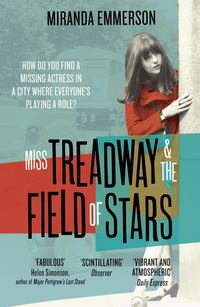
Kitabı oku: «Miss Treadway & the Field of Stars»

Copyright
4th Estate
An imprint of HarperCollinsPublishers
1 London Bridge Street
London SE1 9GF
www.4thEstate.co.uk
This eBook first published in Great Britain by 4th Estate in 2017
Copyright © Miranda Emmerson 2017
The right of Miranda Emmerson to be identified as the author of this work has been asserted by her in accordance with the Copyright, Designs and Patents Act 1988
Harper’s Bazaar and Times logos used with permission
A catalogue record for this book is available from the British Library
Cover photograph © Hulton Archive/Getty Images
All rights reserved under International and Pan-American Copyright Conventions. By payment of the required fees, you have been granted the non-exclusive, non-transferable right to access and read the text of this e-book on screen. No part of this text may be reproduced, transmitted, down-loaded, decompiled, reverse engineered, or stored in or introduced into any information storage and retrieval system, in any form or by any means, whether electronic or mechanical, now known or hereinafter invented, without the express written permission of HarperCollins.
Source ISBN: 9780008170608
Ebook Edition © January 2017 ISBN: 9780008170585
Version: 2017-05-10
Dedication
For Chas
Chapters
Cover
Title Page
Copyright
Dedication
A Beloved Daughter of County Cork
Walk On and Walk Off
Miss Treadway
The Deplorable Word
Not Going Out
Very Dark, the Georgians
Let’s
Going Out
Dr Jones Is Having Supper
A Library for Naval Men
Like the Layers of an Onion
Orla and Brennan
The Duke Vin Sound System
A Suit-Wearing, Tea-Drinking Man of London Town
Early-Morning Savile Row Blues
My Whole Life’s Just a Series of Interviews
Harold Wilson Is Not a Fascist Dictator
Colonies
The Strength of Weeds
Barnaby Hayes
Summer and Washington
Modern Holidays
Liverpool Street Station
A Chill Night on the Steps
We’re All Friends to the Police
Anna
Such a Small Person to Mean All the World
The Second Best Hotel in Town
Passengers
Epilogue
Acknowledgements
About the Author
About the Publisher


A Beloved Daughter of County Cork
Saturday, 30 October
‘Look out into the darkness,’ Iolanthe had told her. ‘Look out into the darkness and you’ll see them.’
‘Do you look?’ Anna asked.
‘Sometimes. Sometimes I forget not to. Always at the curtain, at the end. The old ones with their bags of liquorice. The dates who look at me, the dates who look at him. The students; herringbone jackets, no tie. The ones who look lustful. The ones who look bored. Some of them, you can see they’re thinking about something else entirely. You, up there on the stage, you’re nothing more than the reflection of a bulb.’
‘What are they thinking about?’ Anna asked.
‘All the stuff that’s going wrong. The stuff they can’t fix. What they’re always thinking about.’
Anna paused in the action of pinning Iolanthe’s hair and caught her eye in the mirror. The older woman was sitting in her underwear, quite still and unselfconscious as if Anna were a lover or a sister.
Anna moved Lanny’s hand to hold a roll of curls while she picked through a bowl of oddments for more hairpins. ‘It must be very strange,’ she said. ‘Everyone looking and seeing something different. As if you were a funhouse mirror.’
This made Iolanthe laugh. ‘That’s just what I am. Different for everybody. The Lanny who sits here will die as soon as she walks through that door. And a new Lanny will be born. Stage-door Lanny. Interview Lanny. Getting-the-drinks-in Lanny. I walk through the door and I start afresh. No hang-ups. No neuroses.’
Anna cast a questioning glance towards the surface of the mirror and Iolanthe seemed almost to blush. ‘That’s the idea, anyway. Live in the moment. Don’t get caught in the net.’
***
Out in the darkness of the upper stalls, tiny pinpricks of light caught Anna’s eye. Opera glasses, trained no doubt on Iolanthe, bouncing back light. Towards the stage she could see long rows of pale faces tilted upwards. From where she stood the stage looked tiny and the sound was flattened and distorted, muffled by the footsteps of the actors and the crew. Look at us all, she thought. Look at all us monkeys sitting in a great black box. Less than ten of us facing one way; nine hundred facing the other. One person speaks; the many hundred stay silent. And at the end all but the speakers will bang their little paws together. How did we all learn what to do? What made us so obedient?
Anna watched Lanny stride upstage and gesture to the crude oil painting of a woman in 1920s garb which hung above her on the living-room wall. In the semi-darkness the scene-shifters were quietly rolling the fairground set into place behind it.
‘… I had the inspiration … the ability … to be anything.’
Lanny paused and gauged the level of attention, the silence in the space. In the upper circle there was a fit of coughing. Anna saw Lanny’s face twitch just slightly with displeasure. She drove her next speech across the heads of the stalls and right into the upper circle high above. Her annoyance rang through in her delivery, her anger directed not at her fellow actor but at the audience members themselves.
‘This whoreish existence that you despise me for … I chose it. I had everything before me and I chose the life that would fit me best.’
Archie flicked three switches down and the stage went dark. Anna blinked in the blackness waiting for her eyes to refocus, and when they did she saw the shape of Lanny hopping towards her, pulling her heels off as she came.
‘Awful audience,’ she pronounced darkly, shoving her feet into black Oxfords. ‘Fuck ’em.’
Anna stripped Lanny of the negligee and opened her orange flower dress wide so she could step into it. Lanny popped the poppers shut and Anna cinched the belt as the lights rose on half a carousel and strings of fairy lights and bunting. Anna ran her hand quickly over the line of the dress, feeling for mistakes, then squeezed Lanny’s arm, telling her she was okay to step on out. And out she bounded, literally kicking her heels up, high on all kinds of wild energy.
In the corridor on the way back to the dressing room Anna met Dick, whose job it was to man the counter at the stage door.
‘There’s a journalist downstairs. Wingate. Says he’s got a meeting with Lanny. Interview? I told him he’d need to hang around till five.’
‘Okay,’ Anna told him. ‘I’ll warn her.’
‘And Cassidy called again.’
‘Cassidy?’
‘American guy. Third time this week. Is she seeing someone?’
‘No one she’s mentioned. Is there a message?’
‘Just to say he’d called.’
As act three drew to a close, Anna made lemon tea in the little kitchenette at the top of the stairs and buttered some bread. She watered Lanny’s plants and Agatha’s for good measure. She cleared the rubbish from the dressing table. The wrapping from a malt loaf, sweet papers, ticket stubs from a lunchtime showing of The Great Race.
Lanny wasn’t big on culture but she liked the pictures. Every few afternoons she’d take herself off to a matinee at The Empire on Leicester Square. What’s New Pussycat? How to Murder Your Wife. Nothing too serious, nothing tragic. Anna had tried to persuade her to go and see The Hill, but Lanny had laughed in her face.
‘A film about a bunch of sweaty men trekking over a mound of earth! Seriously? Is that what passes for entertainment with you art school types?’
‘Art school! I went to secretarial college in Birmingham.’
‘Yeah, but you have the whole black stockings, polo neck, pony tail thing going on. You’re just missing a beret and a pack of French cigarettes.’
‘You’re calling me a pseud!’
‘I’m not. It’s a look. I’m fine with it.’
‘Lanny. I am not a pseud!’
‘No, I get that. Just because it walks like a pseud and talks like a pseud …’
Anna smiled at the memory of this derision – for in truth she was rather pleased with the art school reference – then she set to sweeping magazines, knickers and old socks off the chaise longue.
Lanny was back in her dressing room by ten to five. So anxious was she to get out of costume that she tried to pull her jacket off without unbuttoning it first. Anna took her by the shoulders and sat her down, then she unbuttoned and unzipped the woman as if she were a child. She hung the costume on the rail and found Lanny a pair of jeans and a shirt which she’d thrown into the corner of the dressing room a week earlier.
‘The jeans don’t fit,’ Lanny told her.
‘Would you like a skirt?’
‘I’d like not to be so fucking cold all the time. This country just makes me want to eat. All I could hear through my final speech was hack hack sniff sniff cough cough.’
‘British audiences sniff when it’s cold.’ Anna’s eyes searched the dressing room for whatever Lanny had worn into work that day. She found it under the make-up table, a green silk dress lying in a creased heap. Anna shook out the expensive rag and handed it over.
‘You know you have an appointment at five?’
‘Do I? Who with?’
‘Some journalist. He’s been downstairs for hours.’
Lanny pulled on a pair of heels and sat at the dressing table to drink her tea. ‘Would you hang around for a bit?’
‘For the interview?’
‘Yeah; sometimes journalists can be a bit … sleazy. I haven’t got the energy for all that crap.’
‘Of course. Also someone called Cassidy called.’
Lanny nodded. ‘Did he leave a message?’
‘Just that he called.’
‘Okay,’ Lanny said. ‘Okay.’
***
Anna showed James Wingate up the many flights of stairs. He was in his fifties, Anna thought, with a gaunt, handsome face. He wore a slim-fitting navy suit with a turquoise silk tie and smelled of cigarettes.
Wingate started talking before he was even in the room. ‘Miss Green, thank you so much for seeing me between performances.’ Lanny – who had arranged herself modestly on the chaise longue, legs covered by a lap blanket – sat very still and looked at Mr Wingate.
‘My dresser didn’t tell me who it was.’
‘That’s because she has no idea who I am.’
Lanny stood, letting the blanket fall from her lap. She tugged at her green silk dress, pulling the fabric free from its belt so that it hid the curve of her breasts. Nobody spoke.
‘I’m sorry. I didn’t know that I was meant to know,’ Anna said at last. ‘Shall I get you both something to drink?’
‘Mr Wingate interviewed me for Harper’s Bazaar – this past summer – just as I was finishing filming on Macbeth.’
Wingate sat down on the chair provided for him and drew out his notebook and a small stack of papers. ‘A coffee would be delightful,’ he said without looking up.
Anna went to the kitchenette by the green room and rifled through the cupboards for coffee. Did snotty journalists drink Nescafé? Leonard – the company manager – found her staring at the jar.
‘Lanny ripping the audience to pieces?’
‘No more than usual. Someone called James Wingate wants a cup of coffee.’
‘Wingate? Ugh. Okay. Take a cup, go across the road to the 101 and get them to put real coffee in it. Might be worth a nice write-up in The Times.’
‘Seriously?’
Leonard held up his hands. ‘This is the idiocy we live with. Make the best of it.’
The windows of the 101 were steamed white against the cold and the afternoon custom seemed mostly to consist of taxi drivers, off shift, who sat at separate tables silently contemplating the melamine.
A radio muttered on a shelf above the head of the proprietor. ‘Teams of police are this evening continuing to search a vast area of moorland on the Cheshire–Yorkshire border.’ Anna tuned it out and leaned across the counter.
She slopped some of the coffee down her skirt as she climbed the stairs back to the dressing room and Wingate barely acknowledged her as she handed him the cup. He was leaning in towards Iolanthe, brows furrowed, head tilted to one side. ‘I assume you wanted to be in films as a girl? Don’t all young girls want something of the kind?’
‘I … Well, I don’t know. Let me think. I knew from an early age that I’d have to earn my own money. Supporting myself. No one was going to do that for me.’
‘Because you didn’t come from money.’
‘Well, no. But also by the time I was eighteen my father and my mother were both dead.’
‘And brothers and sisters? I don’t think we covered brothers and sisters at our last meeting.’
‘It was a very small family.’
‘Just you, then.’
‘Well, no. Not exactly. But I was the one who had to earn.’
‘You supported your parents?’
‘No. I didn’t mean … I guess … Everybody worked.’
‘Sorry, I’m just a little unclear here. You are or you aren’t an only child.’
‘I had a brother.’
‘Okay. Good.’
‘I’d rather not …’
‘You don’t like talking about him?’
‘Yes. Well … no. I don’t. Can we talk about the films?’
‘Is he proud of you? Is he jealous of your success? I mean, what does he do?’
‘He doesn’t do anything.’
‘At all?’
‘He’s dead.’
Wingate sat back in his chair and slowly crossed his legs. ‘I’m so sorry, Iolanthe. I didn’t know.’ Anna glanced up to check that Lanny was okay but the woman was staring at the floor, looking a bit perplexed, as if she was trying to remember something.
‘That must be very hard for you,’ Wingate went on.
‘I don’t know …’ Lanny sat in silence for a minute. When she spoke again she addressed herself to the rail of clothes on the far wall. ‘He was killed in 1946 when he was stationed in Japan. He was riding in a Jeep and it turned over on a bad road. He’d been too young to fight and around where we lived … well, boys were getting fake IDs and signing up at sixteen and I think Nat saw it as a mark of shame that he hadn’t … He was seventeen years old. It was his first posting.
‘It’s very strange. It’s very strange to find yourself all alone at twenty-one. And to think … well, whatever I do in my life now … I mean … other people, they do it for their parents, they do it to make their parents proud. But I couldn’t do that; that was gone for me.’ And Lanny sat in silence as if she’d forgotten they were there.
‘So tell me, Miss Green, your parents … they were from Ireland originally.’
‘My parents? Oh, well, no. Second generation. My grandparents were from County Cork. I think they left in 1880, 1885, something like that.’
‘Not because of the famine, then?’
‘No. More general.’ Lanny waved her hands in the air. ‘You know, the whole making a better life thing.’
‘And have you ever been back to Ireland. I mean: have you visited?’
‘No. I have never had that pleasure or that privilege.’
‘Do you know where in Cork they were from?’
Lanny’s voice rose a little. ‘Anna. Anna! I’m so sorry, James. There’s something nagging at the back of my mind. Do I have someone in tonight?’
‘I don’t think so.’ Anna stood. ‘Do you want me to double-check who’s got the house seats?’
Lanny waved her hand frantically. ‘No. No. No. It doesn’t matter. I’m being silly. Sit down. Pre-show nerves.’ She directed this last remark to Wingate whose eyes were rather wide.
He waited a moment and then began again. ‘I only wondered. Partly, I suppose, because Green is not a typically Irish name. I wondered if it had been changed along the way?’
‘Green? No. I think if I’d chosen a stage name I’d have gone for something a bit wilder.’
‘I wondered if it had been anglicised. If you were once all O’Gradys or MacGoverns.’
‘Well … that’s very interesting. You see, my daddy was Green, but I didn’t know my grandaddy at all because he died so young. And, well now, I assume that we were all Greens – not my mother’s family of course, they were Callaghans – but I never really asked. I mean, it’s not something that you think of, is it? “Daddy, is that definitely your name?”’ Lanny laughed, showing Wingate all of her teeth.
‘Are you tempted now to go digging around and find out?’ Wingate asked her.
‘You’ve got me interested, James, you really have.’
‘Might you make a pilgrimage?’
‘To Ireland? Perhaps. If time allows and they want me back.’ Iolanthe laughed and Wingate joined in with her. He tasted his coffee, made a face of disgust and deposited it at his feet. Lanny’s eyes wrinkled into a smile. She held his gaze for a moment.
***
After the show that evening, Anna stood by Lanny’s side as she always did and watched her clean off all the muck. The dark black liner, the red lips and the mascara made her glamorous and sultry, but she was far more lovely underneath it all. Her eyes were round and deepest brown, her eyebrows thin and delicate. Her nose was too broad for her face and underneath all the panstick it was covered in light brown freckles, which always made Anna think of her as a little girl from a storybook. Lanny’s lips were a soft, deep rose and her teeth snaggly, the inheritance of a childhood without money.
Lanny pawed at a mole on her cheek, which sprouted a single hair. ‘I look so old these days.’
Anna smiled at her in the mirror. ‘I think you look lovely. Like a woman from a Rossetti or a Waterhouse.’
‘I don’t know what those are.’
‘Rossetti? He was one of the Pre-Raphaelites. Waterhouse as well. They were painters in Victorian times who painted these big romantic pictures of women from literature. All flowing locks and big, bold eyes and lips.’
‘It sounds pornographic.’
‘Well, it is, in a way. It’s very sexual. But I wanted so much to look like those women when I was younger. My father had a book with plates in it. I wanted to be the Lady of Shalott or Pandora or a mermaid. But you really do … Without make-up …’ Anna shook her head. ‘You look more real somehow.’
‘Well, I am more real.’
‘I suppose.’
Lanny’s hand sneaked across the dressing table and picked up the mascara. ‘A little something, just for going home,’ she said.
‘What’s it like, living at The Savoy?’
Lanny met Anna’s eyes in the glass and her own eyes wrinkled into a smile. ‘It’s exactly what you’d think, child. Everything is very shiny, the breakfast is excellent and everyone looks terribly, terribly bored.’
Anna laughed and helped Iolanthe into her dress and coat. A little pile of post lay unopened on the dressing table. Lanny pushed the envelopes into her bulging handbag and then paused in the act of picking up yesterday’s Standard. She glanced down at the headline.
SNOW ON MOORS HAMPERS SEARCH
Brady and Hindley remanded
They’d hardly been off the front pages this past month. First the boy’s body, then the girl’s, now a second boy had been found.
Anna watched Lanny’s train of thought. ‘I know,’ she said, ‘I’ve been having nightmares.’
‘About the kids?’
‘After they found the girl. Under the earth. Who’d leave a child like that?’
Lanny’s face creased a little in pain. ‘I don’t want to think about it.’
‘Sorry,’ said Anna. ‘Let’s not.’
They walked in silence down the many flights of stairs. Outside the theatre Lanny belted her coat against the cold and drew on gloves. Anna paused at the corner and watched her walk away. Lanny looked over her shoulder just once and waved a hand.
‘See you Monday,’ she called.
‘See you Monday,’ Anna called back.
And then she was gone.
Walk On and Walk Off
Monday, 1 November
At half past five Anna was ready for Lanny’s arrival. A cup of lemon tea sat on the table waiting. Lanny’s clothes were ironed and hung ready for her in neat rows. The play began at seven and the cast were expected to be in place at the very latest by the half-hour call, which came at six twenty-five. Lanny normally liked to arrive early. She had make-up and hair to do. She wanted to drink her tea and go to the toilet. She wanted time so if anything went wrong with her costume it could be fixed.
Any moment now Lanny would come running in, throw down the newspaper, empty her pockets of sweets, peel herself out of her dress.
‘Fucking cold!’ she’d cry. ‘And the cabs! No one knows how to drive in this country!’
‘Did you look the wrong way again?’ Anna would ask.
‘I looked the right way. But all the assholes just kept driving in the wrong direction!’
Or perhaps tonight she’d be contemplative, slip into the dressing room without a word. If she was in a quiet mood Anna had learned to come and go without a sound. Fetching and carrying everything that might be needed as Lanny stripped herself. Sometimes Anna would find her standing naked before the mirror, touching her hand to her breasts or her belly or her thighs, lost in thought. Anna would look, too hard to be a human and not look, but then she would look away. She tried to imagine her way into the body of Iolanthe. The mind, she corrected herself. Iolanthe resided in her mind.
Half past five became six. Anna went downstairs to see Dick but Lanny hadn’t signed in yet. Leonard popped his head in to ask if she thought Lanny had been getting sick.
‘I don’t think so,’ Anna told him. ‘She just seemed her normal self.’
Anna waited. Lanny’s tea grew cold. At six twenty-five exactly the call came on the backstage tannoy:
‘Field of Stars company. This is your half-hour call. Thirty minutes, please.’
Leonard burst in again. ‘We can’t raise her at The Savoy. She isn’t there. Agatha is dressing to cover Lanny. Minnie is dressing to cover Agatha. Can you go and cast an eye over what she’s doing?’
Anna helped the young understudy to get into her clothes. Minnie was talking all the time. Running the lines at high speed over and over again. Anna gave her a hug.
‘It isn’t Shakespeare,’ she told her. ‘No one knows the words. You can say anything at all and they’ll still think it’s part of the play. Walk on, walk off and try to look like you know what you’re doing. Don’t worry. You’ll be fine. I’ll see you later for the quick change.’
She walked back to Lanny’s dressing room. The cup of tea sat on the table untouched. Was Iolanthe ill?
Of course, everyone expected Lanny to arrive by the interval. She must have gone off for the day and got stuck in traffic. That’s what made most sense. But the interval came and went and there was no Iolanthe.
Leonard phoned round the hospitals in case there had been an accident. He phoned The Savoy again and spoke to the desk clerk. Iolanthe hadn’t been in her room since Friday night.
The show came down at ten to ten. The audience cheered Agatha, though many had left at the interval since catching sight of Iolanthe Green had been their main reason for buying the tickets. Leonard called a meeting on the stage. The cast sat on chairs in a circle. Anna sat with the other dressers and the crew on the floor. Leonard told everyone about his call to The Savoy.
‘Iolanthe has to be considered a missing person. I’ve already called the police. If she hasn’t turned up by tomorrow morning they’ll be coming down to interview us here. The show will keep running but management are going to keep an eye on cancellations. If we’re not playing to at least forty per cent attendance they may take us off in another week. Don’t worry about that now, but I need to give you that warning so you’re prepared. No one of Iolanthe’s description has been admitted to any of the big hospitals. I’m going to see that as a good thing. You all did well tonight. Go home. Get some sleep. Company meeting at four tomorrow followed by a line run if it’s understudies again. Okay. Off you go!’
***
On Tuesday the papers were full of Iolanthe’s disappearance. The Mirror asked if Brady and Hindley had inspired a copycat murder in London. The Sun wanted to know if Iolanthe had fallen prey to a gang of Soho people smugglers. The Daily Express asked its readers to join police in hunting for the glamorous starlet. The Daily Telegraph wondered if fragile, unmarried Miss Green had run away from the pressures of fame.
On Wednesday afternoon, as the company of understudies gathered for yet another line run, BBC Radio News arrived to interview Leonard about Lanny’s disappearance. Anna stood in the green room beside the transistor radio and listened to Leonard intoning his worries and incomprehension at six o’clock and then again at ten. Each time she heard someone familiar speak, or read someone she knew quoted in the paper, they – the people involved, the events – became less familiar. She was starting to see it as a story herself. The story of how Lanny disappeared.
On Thursday The Times wanted to know why women weren’t safe to walk the streets of Theatreland and the Guardian wanted to know why so much attention was being paid to one wealthy actress when in the past week alone two hundred ordinary people had gone missing without any great fanfare at all.
On Friday, as Londoners gathered to burn effigies of Guy Fawkes, police were called to a disturbance at a flat in Golden Square. When they arrived they found a young male prostitute called Vincent Mar lying on the front steps having sustained a terrible head wound. The police arrested a middle-aged man who was the tenant of the flat they’d been called to attend. The man’s name was Richard Wallis and he happened to be a Junior Minister of State for Justice in Her Majesty’s Government. By the time Wallis had been released – without charge – late on Saturday night, the papers had got hold of the scandal and Iolanthe was about to be knocked quite definitively off the front pages.
Monday, 8 November
In West End Central police station, up on Savile Row, Inspector Knight had been co-ordinating a well-resourced search effort for Iolanthe but now he was running out of ideas. Statements had been taken and double-checked, posters had been mounted in prime locations, hospitals had been phoned and visited. Nobody, it seemed, absolutely nobody, had seen Miss Green.
Over the course of a fraught weekend, in which he had seen nothing of his wife or children, Knight had been instructed firmly by the Home Office that he was to scour Soho for other possible assailants of young Mr Mar who had – to the relief of many – failed to regain consciousness after the attack. But the majority of Knight’s men were assigned to the hunt for the missing actress.
The Sunday papers had attempted to try and convict Mr Wallis right there on the newsstands and pressure from the offices of government was increasing. So at 9 a.m. on Monday, Inspector Knight called into his office a detective sergeant by the name of Barnaby Hayes.
‘The government is defecating in its collective knickers, Hayes.’
‘I’m sure it is, sir.’
‘I have until next Sunday to find at least one fully fashioned scumbag who might have tried to kill, rob or bugger Vincent Mar. I also have to hope the bloody man’s about to die, because if he wakes up and recounts a night of ecstasy with Mr Wallis we’re all fucked.’
‘Sir.’
‘The worst of it is I still have to pretend to care about Iolanthe Green when any fool can see that the woman’s obviously done herself in and hasn’t had the decency to leave her body somewhere handy.’
‘Yes, sir.’
‘You’re the closest thing I have to competent in my department, Hayes. Don’t fuck up and don’t talk to any press.’
‘Sir.’
‘Find the body. Close the case. We have better things to be doing.’
Barnaby Hayes picked up the small pile of manila files and carried them out of the office to his desk. He was a meticulous and careful officer, a player by the rules. He had distinguished himself in the eyes of Knight by working long hours and never once trying to cut corners or claim he’d done work when he hadn’t. His name – as it happened – was not Barnaby at all, but Brennan. He had cast this particular mark of Irishness away from him when he joined CID.
He opened the files and rearranged their contents. He knew from bitter experience that not everyone in the department was as assiduous as he was and he could see no other way ahead but to start from scratch and re-interview everyone connected to Iolanthe. He cast his eyes down the list of eyewitnesses from the Saturday she had disappeared. The name at the top of the list was Anna Treadway. He dialled her number.
Miss Treadway
Anna Treadway lived on Neal Street in a tiny two-bed flat above a Turkish cafe. She went to bed each night smelling cumin, lamb and lemons, listening to the jazz refrain from Ottmar’s radio below. She woke to the rumble and cry of the market men surging below her window and to the sharp, pungent smell of vegetables beginning to decay.
At seven o’clock most mornings of the week she would make the walk to buy a small bag of fruit for her breakfast. Past the Punjab India restaurant, where the smell of flatbread was just starting to escape the ovens. Past the vegetable warehouses with their arching, pale stone frontages. Past the emerald green face of Ellen Keeley the barrow maker. Past the dirty oxblood tiles of the tube station where Neal Street ended and James Street began. Past Floral Street where the market boys drank away their wages and down, down, down to the Garden. Covent Garden: once the convent garden. Now so full of sin and earth and humanity. Still a garden really, after all these years.
The roads around it were virtually impassable most mornings, a deadly tangle of horses, dogs, cars and old men whose thick woollen cardigans padded out their frames until they looked like overstuffed rag dolls with pale, needle-pricked faces. Men who pulled great barrows – like floats from a medieval carnival – piled with sweetcorn and plums, leeks and potatoes and fat red cabbages that gleamed and glistened like blood-coloured gems. Men who balanced on their heads thirty crates of lavender that swayed and bowed as they walked and left the perfume trail of distant fields everywhere they went. Covent Garden, so sensual and unkempt: a temple to something, though no one could tell you quite what. Money. Nature. London. Anna sometimes thought that it acted like a city gate, announcing London’s size and grandiosity to all who visited there. Look at us, it said, look what it takes to feed us all. How mighty we must be when roused. How indomitable.
Through the garden and into the house she went. Into the vaulted space of the indoor market and through the crush of tweed jackets and donkey jackets and macs.
‘Sorry, love.’ ‘Mind yourself.’ ‘MUSTARD GREENS!’
In this world of men a woman’s voice could become lost, clambering high and low to find its place between the layers of bass and tenor sound. ‘Black— Goose— App—.’ The syllables of the woman in the dark red pinafore were eaten by the whole, swallowed down like soup in this dark, confusing dragon’s belly of a place. Anna handed the woman her pennies and the woman gave her a paper bag of blackberries in return. How strange, Anna thought it was, to pay for blackberries when she had gone every September as a child to the railway cutting at the bottom of town to fill her skirt for free.
‘Everything can be given a price if someone chooses,’ her mother said. ‘It doesn’t have to make sense to us, Anna. So little of the world makes sense.’
Back home in the little flat, she shared her early-morning rituals with an improbably blonde American called Kelly Gollman who worked as a dancer in a revue bar in Soho and who rented the better of the two bedrooms from Leonard Fleet, Anna’s boss who lived in the flat above.
Anna had never seen Kelly dance and Kelly was careful never to ask her if she might one day come into the club. Both had the uneasy feeling that they were not on the same level as the other: Kelly taking her clothes off for boozy businessmen and Anna carrying clothes and cups of lemon tea for proper actresses in a theatre with dark gold cupids above the door. Anna had the kind of job that one could tell one’s parents about and she was English and she had a leather-bound copy of Shakespeare on her bedside table.
Sometimes, if Anna was home late or Kelly early, they would meet in the little kitchen and make toast together at midnight. Anna would compliment Kelly on her clothes and her hair and her tiny waist and Kelly would laugh and demur and enjoy it all immensely. In the early days of living together Kelly had gone out of her way to compliment Anna in return, but since she found Anna’s way of dressing rather severe all she could find to talk about was books.
‘You must have read so many books. I see those library copies coming and going off the table and I … I can’t imagine.’
And Anna would smile modestly and nod. ‘I’m easily bored.’
‘I’m sure I haven’t read a book since school. I just can’t get through twenty pages without wanting to throw it out the window and do something more fun.’
Anna would shrug and smile. ‘It’s not for everyone.’
Kelly stopped mentioning the books. She stopped commenting on Anna’s cleverness. She smiled and nodded but often her eyes were cold and still. She did not trust Anna – quiet, bookish Anna – and she did not want to be friends with someone she didn’t trust.
Anna was not overly sorry when Kelly withdrew from her attempts at friendship. She had dreaded having to share a flat with someone who would try and drag her out at all hours of the day and night, try to feed her drinks or marijuana and suggest they double-date with this man or that, his friend and his other friend. Men were obstacles to progress, the murderers of time and intellect. Anna did not do men, not in the romantic way at least.
The Turkish cafe two floors below their flat was the same cafe that Anna had waitressed in from the ages of twenty-three to twenty-six. She had, when she first arrived in London, worked as a receptionist in Forest Hill and before that she had lived in Birmingham while she trained as a secretary. Before that had been school somewhere, though no one was ever quite sure where. Anna’s accent was obstinately RP. Ottmar Alabora, the manager of the coffee shop, had always meant to pin Anna down on where exactly it was that she came from, but somehow the moment always eluded him, or he would get her on to the subject and then she’d be called away to service and he didn’t like to seem insistent. He tried not to pay too much attention to any of his waitresses, but particularly not to Anna.
‘We don’t need another waitress,’ his wife Ekin had told him when she caught him, in Anna’s first week, ordering a new uniform from Denny’s.
‘We’re struggling in the evenings. You’re not there. And then I was thinking of putting more tables outside in summer. If you don’t serve people they walk away. Or leave without paying.’
‘But it’s November. Who’s going to sit outside our cafe now?’
‘She’s a nice girl. She’s starting on evenings. You’ll like her. If you don’t like her we’ll let her go.’
So Ekin came and sat in the corner of the restaurant and watched Anna work. She had a nice way with people – Ekin could see that. She was attractive but not in a blousy way. She wore her skirt at the knee and her sleeves below her elbows. Her long hair hung in pigtails and she wore no make-up. When she served Ekin her coffee and cake she smiled and thanked her for the position. Ekin turned to look through the hatch at Ottmar, who raised his eyebrows at her. Ekin made a face, but only to let him know she wasn’t angry. Anna was nice enough; she could stay.
All the same Ottmar carried around a secret shame. He had offered Anna the job in a moment of temporary madness.
She had come in one Tuesday at half past one in her best suit and had ordered coffee – Turkish coffee – which she drank without sugar. She had carried with her a copy of the book she had treated herself to from the basement of a Charing Cross bookshop and Ottmar had read over her shoulder words he loved though hardly knew in English.
‘Oh, come with old Khayyám, and leave the Wise
To talk; one thing is certain, that Life flies;
One thing is certain, and the Rest is Lies;
The Flower that once has blown for ever dies.’
Anna sat quietly, politely, as he read aloud from her book and then she turned and smiled at him and he felt unutterably foolish. He cleared her plate, though he never normally waited on the tables, and then he begged her pardon.
‘I got … I got carried away. Not so many people read poetry.’
‘Even here?’ she asked.
‘In my coffee house?’
‘In London. In Covent Garden. I thought it would have been full of poets.’
‘If it is they are not coming into my coffee house. London is full of …’ Ottmar waved his hands, tipping the spoon from Anna’s saucer. He bent down to retrieve it from under a table then knelt for a moment on the tiled floor. He looked up at Anna and she stared back at him. ‘London is full of … hare-brained people. Chancers. Gamblers. Opium fiends.’ He laughed to himself at his own exaggeration.
‘You make it sound Victorian.’
‘Do I?’
‘Like something out of Conan Doyle.’
‘I don’t—’
‘He wrote Sherlock Holmes.’
‘The Hound of the Baskervilles.’
‘That kind of thing.’
‘My uncle read me Omar Khayyám. In Arabic. Not Turkish or even English. I tried so hard to understand it. I would ask him what it all meant but he always said the pleasure was in the finding out … the discovery. He said you can keep some poems by you your whole life and they will only reveal parts of themselves to you when you are ready to hear them. So at twenty I would understand one little part of it and then at forty something else. I’m probably not making any sense.’
‘Not at all. You’re making lots of sense. I think … I think that would make me impatient. I don’t want to understand poetry when I’m fifty. I want to understand it now. What if I don’t make it to fifty? Do I have to be cheated out of all that understanding?’
Ottmar smiled apologetically. ‘I think perhaps you do. We can only grow old in days and weeks and months. There is not a short cut. Nobody can know the world at fifteen.’
‘When I was at school it used to drive me up the wall listening to the teachers go on about the folly of youth. If someone is ugly you don’t say to them: “Hey you, stop being ugly over there!” so why is it okay to mock the young for being inexperienced?’
‘I was not meaning to mock you, miss!’
‘No! Sorry. I didn’t mean you were. I meant that it sometimes feels hard to be young when no one has a good word to say about youth.’
Ottmar set down her cup and saucer. He frowned at someone out of her line of sight. ‘If we are grumpy it is because we had to leave the party and you are still there.’
‘And the party is a stupid party?’
Ottmar laughed. ‘Yes. A very stupid party. Very loud and drunken and disgusting.’ His eyes crinkled in all directions. ‘But so much fun!’
Anna laughed and Ottmar felt his heart glow in his chest.
‘Will you have anything else, miss? We have cake. We have sweets. We have baklava.’
Anna held her book at arm’s length and glared at it. ‘I spent my lunch money on something else to cheer me up. But your coffee was wonderful.’
‘Why do you need cheering up? Is it a stupid boy?’
‘A stupid boy of fifty.’
‘Too old for you. Forget him.’
‘I was called to interview at Jamiesons on Waldorf Street. And I borrowed five pounds from my landlady to buy this suit because it said: “Professional position. Business attire is requisite.” But when I got there, there were fifteen girls in the waiting room and I had hardly sat down when Mr Jamieson said: “You mustn’t be too disappointed. We had no idea we’d be so popular.” And that was that. With lunch and fares I’m out by six pounds and five shillings and I can’t conjure that kind of money out of the air.’
‘You need a job?’
‘I only have a short-term contract and it’s almost over.’
‘We have a job.’
‘Do you?’
‘Waitressing. It’s not professional, I’m afraid. I’m not sure what you’d do with the suit.’
‘I don’t mind. I mean, I have waitressed before. How many days would you want me?’
‘All week. Six days. You could start this weekend. In the evenings. If that was convenient.’
‘That would be very convenient. My name is Anna. And thank you so much.’
‘I think you should have some baklava to celebrate.’
‘I’m sorry. I’ve nothing left to spend.’
‘It’s on the house,’ said Ottmar expansively. ‘Our waiters eat for free.’
This was not strictly true.
***
Anna caught the bus from Forest Hill to Cambridge Circus every evening at 5 p.m. She worked from 6 p.m. until 11 p.m. and then stayed on until midnight helping to clean up and tidy and sitting around with the other waiters and waitresses playing pontoon for matchsticks and drinking the ends of bottles. Then she walked down to Trafalgar Square and sat for an hour in a shelter on the east side near St Martin-in-the-Fields waiting for a night bus to take her near to home. She became fascinated by the statue of Edith Cavell and would stand at the base of it in the freezing cold of a December morning, looking up.
Patriotism is not enough. I must have no hatred or bitterness for anyone.
Sometimes those words made her cry. The tears would come uncontrollably and they would not stop. And in those moments Anna found forgiveness and it made her free. But they were only moments. Forgiveness is a hard thing to hang on to.
Ücretsiz ön izlemeyi tamamladınız.