Kitabı oku: «Woman under socialism»
"The end of social development resembles the beginning of human existence. The original equality returns. The mother-web of existence starts and rounds up the cycle of human affairs." – Bachofen.
"Since the advent of civilization, the outgrowth of property has been so immense, its forms so diversified, its uses so expanding and its management so intelligent in the interests of its owners, that it has become, on the part of the people, an unmanageable power. The human mind stands bewildered in the presence of its own creation. The time will come, nevertheless, when human intelligence will rise to the mastery over property, and define the relations of the State to the property it protects, as well as the obligations and the limits of the rights of its owners. The interests of society are paramount to individual interests, and the two must be brought into just and harmonious relations. A mere property career is not the final destiny of mankind, if progress is to be the law of the future as it has been of the past. The time which has passed away since civilization began is but a fragment of the past duration of man's existence; and but a fragment of the ages yet to come. The dissolution of society bids fair to become the termination of a career of which property is the end and aim; because such a career contains the elements of self-destruction." – Morgan.
TRANSLATOR'S PREFACE
Bebel's work, "Die Frau und der Socialismus," rendered in this English version with the title "Woman under Socialism," is the best-aimed shot at the existing social system, both strategically and tactically considered. It is wise tactics and strategy to attack an enemy on his weakest side. The Woman Question is the weakest link in the capitalist mail.
The workingman, we know, is a defenceless being; but it takes much sharpening of the intellect to appreciate the fact that "he cannot speak for himself." His sex is popularly coupled with the sense of strength. The illusion conceals his feebleness, and deprives him of help, often of sympathy. It is thus even with regard to the child. Proverbially weak and needing support, the child, nevertheless, is not everywhere a victim in the existing social order. Only in remote sense does the child of the ruling class suffer. The invocation of the "Rights of the Child" leaves substantially untouched the children of the rich. It is otherwise with woman. The shot that rips up the wrongs done to her touches a nerve that aches from end to end in the capitalist world. There is no woman, whatever her station, but in one way or other is a sufferer, a victim in modern society. While upon the woman of the working class the cross of capitalist society rests heaviest in all ways, not one of her sisters in all the upper ranks but bears some share of the burden, or, to be plainer, of the smudge, – and what is more to the point, they are aware of it. Accordingly, the invocation of the "Rights of Woman" not only rouses the spirit of the heaviest sufferers under capitalist society, and thereby adds swing to the blows of the male militants in their efforts to overthrow the existing order, it also lames the adversary by raising sympathizers in his own camp, and inciting sedition among his own retinue. Bebel's exhaustive work, here put in English garb, does this double work unerringly.
I might stop here. The ethic formula commands self-effacement to a translator. More so than well-brought-up children, who should be "seen and not heard," a translator should, where at all possible, be neither seen nor heard. That, however, is not always possible. In a work of this nature, which, to the extent of this one, projects itself into hypotheses of the future, and even whose premises necessarily branch off into fields that are not essentially basic to Socialism, much that is said is, as the author himself announces in his introduction, purely the personal opinion of the writer. With these a translator, however, much in general and fundamental accord, may not always agree. Not agreeing, he is in duty bound to modify the ethic formula to the extent of marking his exception, lest the general accord, implied in the act of translating, be construed into specific approval of objected-to passages and views. Mindful of a translator's duties as well as rights, I have reduced to a small number, and entered in the shape of running footnotes to the text, the dissent I thought necessary to the passages that to me seemed most objectionable in matters not related to the main question; and, as to matters related to the main question, rather than enter dissent in running footnotes, I have reserved for this place a summary of my own private views on the family of the future.
It is an error to imagine that, in its spiral course, society ever returns to where it started from. The spiral never returns upon its own track. Obedient to the law of social evolution, the race often is forced, in the course of its onward march, to drop much that is good, but also much that is bad. The bad, it is hoped, is dropped for all time; but the good, when picked up again, never is picked up as originally dropped. Between the original dropping and return to its vicinity along the tracks of the spiral, fresh elements join. These new accretions so transmute whatever is re-picked up that it is essentially remodeled. The "Communism," for instance, that the race is now heading toward, is, materially, a different article from the "Communism" it once left behind. We move in an upward spiral. No doubt moral concepts are the reflex of material possibilities. But, for one thing, moral concepts are in themselves a powerful force, often hard to distinguish in their effect from material ones; and, for another, these material possibilities unfold material facts, secrets of Nature, that go to enrich the treasury of science, and quicken the moral sense. Of such material facts are the discoveries in embryology and kindred branches. They reveal the grave fact, previously reckoned with in the matter of the breeding of domestic animals, that the act of impregnation is an act of inoculation. This fact, absolutely material, furnishes a post-discovered material basis for a pre-surmised moral concept, – the "oneness of flesh" with father and mother. Thus science solidifies a poetic-moral yearning, once held imprisoned in the benumbing shell of theological dogma, and reflects its morality in the poetic expression of the monogamic family. The moral, as well as the material, accretions of the race's intellect, since it uncoiled out of early Communism, bar, to my mind, all prospect, – I would say danger, moral and hygienic, – of promiscuity, or of anything even remotely approaching that.
Modern society is in a state of decomposition. Institutions, long held as of all time and for all time, are crumbling. No wonder those bodies of society that come floating down to us with the prerogatives of "teacher" are seen to-day rushing to opposite extremes. On the matter of "Woman" or "The Family" the divergence among our rulers is most marked. While both extremes cling like shipwrecked mariners to the water-logged theory of private ownership in the means of production, the one extreme, represented by the Roman Catholic church-machine, is seen to recede ever further back within the shell of orthodoxy, and the other extreme, represented by the pseudo-Darwinians, is seen to fly into ever wilder flights of heterodoxy on the matter of "Marriage and Divorce." Agreed, both, in keeping woman nailed to the cross of a now perverse social system, the former seeks to assuage her agony with the benumbing balm of resignation, the latter to relieve her torture with the blister of libertinage.
Between these two extremes stand the gathering forces of revolution that are taking shape in the militant Socialist Movement. Opinion among these forces, while it cannot be said to clash, takes on a variety of shades – as needs will happen among men, who, at one on basic principles, on the material substructure of institutional superstructure, cannot but yield to the allurements of speculative thought on matters as yet hidden in the future, and below the horizon. For one, I hold there is as little ground for rejecting monogamy, by reason of the taint that clings to its inception, as there would be ground for rejecting co-operation, by reason of the like taint that accompanied its rise, and also clings to its development. For one, I hold that the smut of capitalist conditions, that to-day clings to monogamy, is as avoidable an "incident" in the evolutionary process as are the iniquities of capitalism that to-day are found the accompaniment of co-operative labor; – and the further the parallel is pursued through the many ramifications of the subject, the closer will it be discovered to hold. For one, I hold that the monogamous family – bruised and wounded in the cruel rough-and-tumble of modern society, where, with few favored exceptions of highest type, male creation is held down, physically, mentally and morally, to the brutalizing level of the brute, forced to grub and grub for bare existence, or, which amounts to the same, to scheme and scheme in order to avoid being forced so to grub and grub – will have its wounds staunched, its bruises healed, and, ennobled by the slowly acquired moral forces of conjugal, paternal and filial affection, bloom under Socialism into a lever of mighty power for the moral and physical elevation of the race.
At any rate, however the genius of our descendants may shape matters on this head, one thing is certain: Woman – the race's mothers, wives, sisters, daughters – long sinned against through unnumbered generations – is about to be atoned to. All the moral and intellectual forces of the age are seen obviously converging to that point. It will be the crowning work of Militant Socialism, like a mightier Perseus, to strike the shackles from the chained Andromeda of modern society, Woman, and raise her to the dignity of her sex.
DANIEL DE LEON.
New York, June 21, 1903.
INTRODUCTION
We live in the age of a great social Revolution, that every day makes further progress. A growingly powerful intellectual stir and unrest is noticeable in all the layers of society; and the movement pushes towards deep-reaching changes. All feel that the ground they stand on shakes. A number of questions have risen; they occupy the attention of ever widening circles; and discussion runs high on their solution. One of the most important of these, one that pushes itself ever more to the fore, is the so-called "Woman Question."
The question concerns the position that woman should occupy in our social organism; how she may unfold her powers and faculties in all directions, to the end that she become a complete and useful member of human society, enjoying equal rights with all. From our view-point, this question coincides with that other: – what shape and organization human society must assume to the end that, in the place of oppression, exploitation, want and misery in manifold forms, there shall be physical and social health on the part of the individual and of society. To us, accordingly, the Woman Question is only one of the aspects of the general Social Question, which is now filling all heads, which is setting all minds in motion and which, consequently, can find its final solution only in the abolition of the existing social contradictions, and of the evils which flow from them.
Nevertheless, it is necessary to treat the so-called Woman Question separately. On the one hand the question, What was the former position of woman, what is it to-day, and what will it be in the future? concerns, in Europe at least, the larger section of society, seeing that here the female sex constitutes the larger part of the population. On the other hand, the prevailing notions, regarding the development that woman has undergone in the course of centuries, correspond so little with the facts, that light upon the subject becomes a necessity for the understanding of the present and of the future. Indeed, a good part of the prejudices with which the ever-growing movement is looked upon in various circles – and not least in the circle of woman herself – rests upon lack of knowledge and lack of understanding. Many are heard claiming there is no Woman Question, because the position that woman formerly occupied, occupies to-day and will in the future continue to occupy, is determined by her "natural calling," which destines her for wife and mother, and limits her to the sphere of the home. Accordingly, whatever lies beyond her four walls, or is not closely and obviously connected with her household duties, concerns her not.
On the Woman Question, the same as on the general Social Question, in which the position of the working class in society plays the chief role, opposing parties stand arrayed against each other. One party, that which would leave everything as it is, have their answer ready at hand; they imagine the matter is settled with referring woman to her "natural calling." They forget that, to-day, for reasons later to be developed, millions of women are wholly unable to fill that "natural calling," so much insisted upon in their behalf, of householders, breeders and nurses of children; and that, with other millions, the "calling" has suffered extensive shipwreck – wedlock, to them, having turned into a yoke and into slavery, compelling them to drag along their lives in misery and want. Of course, this fact concerns those "wise men" as little as that other fact, that unnumbered millions of women, engaged in the several pursuits of life, are compelled, often in unnatural ways, and far beyond the measure of their strength, to wear themselves out in order to eke out a meager existence. At this unpleasant fact those "wise men" stuff their ears, and they shut their eyes with as much violence as they do before the misery of the working class, consoling themselves and others with "it has ever been, and will ever remain so." That woman has the right to share the conquests of civilization achieved in our days; to utilize these to the easing and improving of her condition; and to develop her mental and physical faculties, and turn them to advantage as well as man, – they will none of that. Are they told that woman must also be economically, in order to be physically and intellectually free, to the end that she no longer depend upon the "good-will" and the "mercy" of the other sex? – forthwith their patience is at end; their anger is kindled; and there follows a torrent of violent charges against the "craziness of the times," and the "insane emancipational efforts."
These are the Philistines of male and female sex, incapable of finding their way out of the narrow circle of their prejudices. It is the breed of the owls, to be found everywhere when day is breaking, and they cry out in affright when a ray of light falls upon their comfortable darkness.
Another element among the adversaries of the movement cannot shut its eyes before the glaring facts. This element admits that there was hardly a time when a larger number of women found themselves in so unsatisfactory a condition as to-day, relatively to the degree of general civilization; and they admit that it is therefore necessary to inquire how the condition of woman can be improved, in so far as she remains dependent upon herself. To this portion of our adversaries, the Social Question seems solved for those women who have entered the haven of matrimony.
In keeping with their views, this element demands that, to unmarried woman, at least, all fields of work, for which her strength and faculties are adequate, shall be opened, to the end that she may enter the competitive field for work with man. A small set goes even further, and demands that competition for work be not limited to the field of the lower occupations, but should also extend higher, to the professions, to the field of art and science. This set demands the admission of woman to all the higher institutions of learning, namely, the universities, which in many countries are still closed to her. Their admission is advocated to the classes of several branches of study, to the medical profession, to the civil service (the Post Office, telegraph and railroad offices), for which they consider women peculiarly adapted;, and they point to the practical results that have been attained, especially in the United States, through the employment of woman. The one and the other also make the demand that political rights be conferred upon woman. Woman, they admit, is human and a member of the State, as well as man: legislation, until now in the exclusive control of man, proves that he exploited the privilege to his own exclusive benefit, and kept woman in every respect under guardianship, a thing to be henceforth prevented.
It is noteworthy that the efforts here roughly sketched, do not reach beyond the frame-work of the existing social order. The question never is put whether, these objects being attained, any real and thoroughgoing improvement in the condition of woman will have been achieved. Standing on the ground of bourgeois, that is, of the capitalist social order, the full social equality of man and woman is considered the solution of the question. These folks are not aware, or they slide over the fact that, in so far as the unrestricted admission of woman to the industrial occupations is concerned, the object has already been actually attained, and it meets with the strongest support on the part of the ruling class, who as will be shown further on, find therein their own interest. Under existing conditions, the admission of women to all industrial occupations can have for its only effect that the competitive struggle of the working people become ever sharper, and rage ever mere fiercely. Hence the inevitable result, – the lowering of incomes for female and male labor, whether this income be in the form of wage or salary.
That this solution cannot be the right one is clear. The full civic equality of woman is, however, not merely the ultimate object of the men, who, planted upon the existing social order, favor the efforts in behalf of woman. It is also recognized by the female bourgeois, active in the Woman Movement. These, together with the males of their mental stamp, stand, accordingly, with their demands in contrast to the larger portion of the men, who oppose them, partly out of old-fogy narrowness, partly also – in so far as the admission of woman to the higher studies and the better-paid public positions is concerned – out of mean selfishness, out of fear of competition. A difference in principle, however, a class difference, such as there is between the working and the capitalist class, does not exist between these two sets of male and female citizens.
Let the by no means impossible case be imagined that the representatives of the movement for the civic rights of woman carry through all their demands for placing woman upon an equal footing with man. What then? Neither the slavery, which modern marriage amounts to for numberless women, nor prostitution, nor the material dependence of the large majority of married women upon their marital lords, would thereby be removed. For the large majority of women it is, indeed, immaterial whether a thousand, or ten thousand, members of their own sex, belonging to the more favored strata of society, land in the higher branches of learning, the practice of medicine, a scientific career, or some government office. Nothing is thereby changed in the total condition of the sex.
The mass of the female sex suffers in two respects: On the one side woman suffers from economic and social dependence upon man. True enough, this dependence may be alleviated by formally placing her upon an equality before the law, and in point of rights; but the dependence is not removed. On the other side, woman suffers from the economic dependence that woman in general, the working-woman in particular, finds herself in, along with the workingman.
Evidently, all women, without difference of social standing, have an interest – as the sex that in the course of social development has been oppressed, and ruled, and defiled by man – in removing such a state of things, and must exert themselves to change it, in so far as it can be changed by changes in the laws and institutions within the frame-work of the present social order. But the enormous majority of women are furthermore interested in the most lively manner in that the existing State and social order be radically transformed, to the end that both wage-slavery, under which the working-women deeply pine, and sex slavery, which is intimately connected with our property and industrial systems, be wiped out.
The larger portion by far of the women in society, engaged in the movement for the emancipation of woman, do not see the necessity for such a radical change. Influenced by their privileged social standing, they see in the more far-reaching working-women's movement dangers, not infrequently abhorrent aims, which they feel constrained to ignore, eventually even to resist. The class-antagonism, that in the general social movement rages between the capitalist and the working class, and which, with the ripening of conditions, grows sharper and more pronounced, turns up likewise on the surface of the Woman's Movement; and it finds its corresponding expression in the aims and tactics of those engaged in it.
All the same, the hostile sisters have, to a far greater extent than the male population – split up as the latter is in the class struggle – a number of points of contact, on which they can, although marching separately, strike jointly. This happens on all the fields, on which the question is the equality of woman with man, within modern society. This embraces the participation of woman in all the fields of human activity, for which her strength and faculties are fit; and also her full civil and political equality with man. These are very important, and as will be shown further on, very extensive fields. Besides all this the working woman has also a special interest in doing battle hand in hand with the male portion of the working class, for all the means and institutions that may protect the working woman from physical and moral degeneration, and which promise to secure to her the vitality and fitness necessary for motherhood and for the education of children. Furthermore, as already indicated, it is the part of the working-woman to make common cause with the male members of her class and of her lot in the struggle for a radical transformation of society, looking to the establishment of such conditions as may make possible the real economic and spiritual independence of both sexes, by means of social institutions that afford to all a full share in the enjoyment of all the conquests of civilization made by mankind.
The goal, accordingly, is not merely the realization of the equal rights of woman with man within present society, as is aimed at by the bourgeois woman emancipationists. It lies beyond, – the removal of all impediments that make man dependent upon man; and, consequently, one sex upon the other. Accordingly, this solution of the Woman Question coincides completely with the solution of the Social Question. It follows that he who aims at the solution of the Woman Question to its full extent, is necessarily bound to go hand in hand with those who have inscribed upon their banner the solution of the Social Question as a question of civilization for the whole human race. These are the Socialists, that is, the Social Democracy.
Of all existing parties in Germany, the Social Democratic Party is the only one which has placed in its programme the full equality of woman, her emancipation from all dependence and oppression. And the party has done so, not for agitational reasons, but out of necessity, out of principle. There can be no emancipation of humanity without the social independence and equality of the sexes.
Up to this point all Socialists are likely to agree with the presentation made of fundamental principles. But the same cannot be said on the subject of the manner in which we portray the ultimate aims to ourselves; how the measures and special institutions shall be shaped which will establish the aimed-at independence and equality of all members of the sexes, consequently that of man and woman also.
The moment the field of the known is abandoned, and one launches out into pictures of future forms, a wide field is opened for speculation. Differences of opinion start over that which is probable or not probable. That which in that direction is set forth in this book can, accordingly, be taken only as the personal opinion of the author himself; possible attacks must be directed against him only; only he is responsible.
Attacks that are objective, and are honestly meant, will be welcome to us. Attacks that violate truth in the presentation of the contents of this book, or that rest upon false premises we shall ignore. For the rest, in the following pages all conclusions, even the extremest, will be drawn, which, the facts being verified, the results attained may warrant. Freedom from prejudice is the first condition for the recognition of truth. Only the unrestricted utterance of that which is, and must be, leads to the goal.
PART I
WOMAN IN THE PAST
CHAPTER I.
BEFORE CHRISTIANITY
Woman and the workingman have, since old, had this in common —oppression. The forms of oppression have suffered changes in the course of time, and in various countries. But the oppression always remained. Many a time and oft, in the course of the ages, did the oppressed become conscious of their oppression; and such conscious knowledge of their condition did bring on changes and reliefs. Nevertheless, a knowledge, that grasped the actual feature of the oppression by grasping its causes, is, with woman as with the workingman, the fruit of our own days. The actual feature of society, and of the laws that lie at the bottom of its development, had first to be known, before a general movement could take place for the removal of conditions, recognized as oppressive and unjust. The breadth and intensity of such a movement depends, however, upon the measure of the understanding prevalent among the suffering social layers and circles, and upon the measure of freedom of motion that they enjoy. In both respects, woman stands, through custom and education, as well as the freedom allowed her by law, behind the workingman. To this, another circumstance is added. Conditions, lasting through a long series of generations, finally grow into custom; heredity and education then cause such conditions to appear on both sides as "natural." Hence it comes that, even to-day, woman in particular, accepts her subordinate position as a matter of course. It is no easy matter to make her understand that that position is unworthy, and that it is her duty to endeavor to become a member of society, equal-righted with, and in every sense a peer of man.
However much in common woman may be shown to have with the workingman, she leads him in one thing: —Woman was the first human being to come into bondage: she was a slave before the male slave existed.
All social dependence and oppression has its roots in the economic dependence of the oppressed upon the oppressor. In this condition woman finds herself, from an early day down to our own. The history of the development of human society proves the fact everywhere.
The knowledge of the history of this development is, however, comparatively new. As little as the myth of the Creation of the World – as taught us by the Bible – can be upheld in sight of the investigations of geographers and, scientists, grounded as these investigations are upon unquestionable and innumerable facts, just so untenable has its myth proved concerning the creation and evolution of man. True enough, as yet the veil is far from being lifted from all the sub-departments of this historical development of mankind; over many, on which already light has been shed, differences of opinion still exist among the investigators on the meaning and connection of this or that fact; nevertheless, on the whole, there is agreement and clearness. It is established that man did not, like the first human couple of the Bible, make his first appearance on earth in an advanced stage of civilization. He reached that plane only in the course of endlessly long lapses of time, after he had gradually freed himself from purely animal conditions, and had experienced long terms of development, in the course of which his social as well as his sexual relations – the relations between man and woman – had undergone a great variety of changes.
The favorite phrase – a phrase that the ignorant or impostors daily smite our ears with on the subject of the relations between man and woman, and between the poor and the rich – "it always has been so," and the conclusion drawn therefrom – "it will always be so," is in every sense of the word false, superficial and trumped-up.
For the purposes of this work a cursory presentation of the relations between the sexes, since primitive society, is of special importance. It is so because it can thereby be proved that, seeing that these relations have materially changed in the previous course of human development, and that the changes have taken place in even step with the existing systems of production, on the one hand, and of the distribution of the product of labor, on the other, it is natural and goes without saying that, along with further changes and revolutions in the system of production and distribution, the relations between the sexes are bound to change again. Nothing is "eternal," either in nature or in human life; eternal only is change and interchange.
As far back as one may go in the development of human society, the horde is found as the first human community. True enough, Honeger mentions in his "General History of Civilization" that even to-day in the little explored interior of the island of Borneo, there are wild people, living separately; and Huegel likewise maintains that, in the wild mountain regions of India, human couples have been discovered living alone, and who, ape-like, fled to the trees as soon as they were met; but there is no further knowledge on the subject. If verified, these claims would only confirm the previous superstition and hypothesis concerning the development of the human race. The probability is that, wherever human beings sprang up, there were, at first, single couples. Certain it is, however, that so soon as a larger number of beings existed, descended from a common parent stock, they held together in hordes in order that, by their joint efforts, they might, first of all, gain their still very primitive conditions of life and support, as well as to protect themselves against their common enemies, wild animals. Growing numbers and increased difficulties in securing subsistence, which originally consisted in roots, berries and fruit, first led to the splitting up or segmentation of the hordes, and to the search for new habitats.
This almost animal-like state, of which we have no further credible antiquarian proofs, undoubtedly once existed, judging from all that we have learned concerning the several grades of civilization of wild peoples still living, or known to have lived within historic times. Man did not, upon the call of a Creator, step ready-made into existence as a higher product of civilization. It was otherwise. He has had to pass through the most varied stages in an endlessly long and slow process of development. Only via ebbing and flowing periods of civilization, and in constant differentiation with his fellows in all parts of the world, and in all zones, did he gradually climb up to his present height.
Indeed, while in one section of the earth's surface great peoples and nations belong to the most advanced stages of civilization, other peoples are found in different sections standing on the greatest variety of gradations in development. They thus present to us a picture of our own past history; and they point to the road which mankind traversed in the course of its development. If but certain common and generally accepted data are established, that may serve everywhere as sign-posts to guide investigation, a mass of facts will follow, throwing a wholly new light upon the relations of man in the past and the present. A number of social phenomena – unintelligible to us to-day, and attacked by superficial judges as nonsensical, not infrequently even as "immoral" – will become clear and natural. A material lifting of the veil, formerly spread over the history of the development of our race, has been effected through the investigations made, since Bachofen, by a considerable number of scientists, like Tylor, MacLennan, Lubbock and others. Prominently among the men who joined these was Morgan, with his fundamental work, that Frederick Engels further substantiated and supplemented with a series of historical facts, economic and political in their nature, and that, more recently, has been partly confirmed and partly rectified by Cunow.1
By means of these expositions – especially as clearly and lucidly presented by Frederick Engels, in his support of Morgan's excellent and fundamental work, – a mass of light is shed upon hitherto unintelligible, partly seemingly contradictory phenomena in the life of the races and tribes of both high and low degree of culture. Only now do we gain an insight into the structure that human society raised in the course of time. According thereto, our former views of marriage, the family, the community, the State, rested upon notions that were wholly false; so false that they turn out to be no better than a fancy-picture, wholly devoid of foundation in fact.
All that is said and proved about marriage, the family, the community and the State holds good especially with regard to woman, who, in the various periods of development did likewise fill a place, that differs materially from the "eternal," imputed to her.
Morgan, whom Engels agrees with in this, divides the history of mankind into three main epochs: – savagery, barbarism and civilization. Each of the two first ones he again divides into an under, a middle and an upper period, each distinguishing itself from the other by certain innovations and improvements, predicated in each instance upon the control over subsistence. Morgan, accordingly, exactly in the sense of the materialist conception of history, as established by Karl Marx and Frederick Engels, – perceives the leading characteristics in the development of society to be the changes that, in given epochs, the conditions of life are molded into; and he perceives the changes to be due to the progress made in the process of production, that is to say, in the procurement of subsistence. Summed up in a few words, the lower period of savagery constitutes the infancy of the human race, during which the race, partly living in trees, is mainly nourished by fruits and roots, and during which articulate language takes its inception. The middle period of savagery commences with the acquisition of a fish subsistence, and the use of fire. The construction of weapons begins; at first the club and spear, fashioned out of wood and stone. Thereby also begins the chase, and probably also war with contiguous hordes for the sources of food, for domiciles and hunting grounds. At this stage appears also cannibalism, still practiced to-day by some tribes and peoples of Africa, Australia and Polynesia. The upper period of savagery is characterized by the perfection of weapons to the point of the bow and arrow; finger weaving, the making of baskets out of filaments of bark, the fashioning of sharpened stone tools have here their start, and thereby begins also the preparation of wood for the building of boats and huts. The form of life has accordingly, become many-sided. The existing tools and implements, needed for the control of a plentiful food supply, make possible the subsistance of larger communities.
The lower period of barbarism Morgan starts with the invention of the art of pottery. The taming and domestication of animals, and, along with that, the production of meat and milk, and the preparation of hides, horns and hair for various purposes of use, have here their start. Hand in hand therewith begins the cultivation of plants, – in the West of maize, in the East of almost all known cereals, maize excepted. The middle period of barbarism shows us, in the East, the ever more extensive domestication of animals; in the West, the cultivation of maize and plants by irrigation. Here also begins the use of adobe-bricks and of stone for house-building. The domestication of animals promotes the rearing of herds, and leads to the pastoral life. The necessity of larger quantities of food for men and beasts leads to field agriculture. Along therewith, the people begin to be localized; food increases in quantity and diversity, and gradually cannibalism disappears.
The upper period of barbarism begins finally with the smelting of iron ore, and the discovery of the phonetic alphabet. The iron plow-share is invented, making possible agriculture on a larger scale; the iron axe and spade are brought into requisition, making easy the clearing of the forests. With the preparation of iron, a number of fields are opened to activity, imparting to life a new form. Iron utensils help the building of houses, vessels and weapons; with the preparation of metals arises skilled handwork, a more perfect knowledge of weapons, and the building of walled cities. Architecture, as an art, then rises; mythology, poetry and history find support and expansion in the discovery of the phonetic alphabet.
The Orient and the countries bordering on the Mediterranean, particularly Egypt, Greece and Italy, are those in which the last sketched stage of life principally unfolded; and it laid the foundation for the social transformation that in the course of time exercised a determining influence on the social development of Europe and of the whole earth.
As a matter of course, the social development of the human race through the periods of savagery and barbarism had also its peculiar sexual and social relations, differing materially from those of later days.
Bachofen and Morgan have traced these relations by means of thorough investigations. Bachofen, by studying closely all ancient and modern writings, so as to arrive at the nature of phenomena that appear singular to us in mythology, folk-lore and historic tradition, and that, nevertheless, seem to be re-echoed in incidents and events of later days, occasionally even of our own. Morgan, by spending decades of his life among the Iroquois Indians, located in the State of New York, and thereby making observations, through which he gained new and unexpected insight into the system of life, the family and the relationships of the said Indian tribe, and, based upon which, observations made elsewhere, first received their correct interpretation and explanation.
Both of them, Bachofen and Morgan, discovered, each along his own line of research, the latter, however, far more clearly than the former, that the relations of the sexes during primitive times of human development were substantially different from the relations existing in historic days, and among the modern civilized peoples. Especially did Morgan discover – thanks to his many years' sojourn among the Iroquois of North America, and grounded upon comparative studies, which he was moved to by that which he there observed, – that all the existing races, that are still materially backward, possess systems of family and consanguinity that are totally different from ours, but must be similar to those once prevalent among all races during the previous stages of civilization.
Morgan found, at the time that he lived among the Iroquois, that among them there existed a system of monogamy, easily dissolvable by both parties, and which he designated as the "pairing family." He also found that the terms for the degrees of consanguinity – father, mother, son, daughter, brother, sister – although, according to our conception, there can be no doubt as to their application, were there, nevertheless, applied in quite different sense. The Iroquois calls not only his own children "sons" and "daughters," but also the children of all his brothers; and their children call him "father." Conversely, the female Iroquois calls not only her own children "sons" and "daughters," but all those of her sisters, and likewise do their children call her "mother." On the other hand, she calls the children of her brothers "nephews" and "nieces," and these call her "aunt." The children of brothers call one another "brothers" and "sisters;" likewise the children of sisters. Finally, the children of a woman and those of her brother call one another "cousins." Accordingly, the singular spectacle is seen of the terms of relationship going, not as in our sense, by the degree of consanguinity, but by the sex of the relative.
This system of relationship is in full force, not only among all the American Indians, as well as among the aborigines of India, the tribes of Dekan and the Gaura tribes of Hindostan, but, according to the investigations that have taken place since Bachofen, similar conditions must have existed everywhere in primitive times, as they still exist to-day among many peoples of Upper and Further Asia, Africa and Australia. When, in connection with these investigations and established facts, the investigation will be everywhere taken up on the sex and family relations of wild and barbarous nations still living, then will the fact transpire that, what Bachofen still confusedly found among numerous peoples of antiquity, and rather surmised than otherwise; what Morgan found among the Iroquois; what Cunow found among the Austral-Negros, are but social and sexual formations, that constitute the groundwork of human development for all the peoples of the earth.
The investigations of Morgan bring, moreover, other interesting facts to light. Although the "pairing family" of the Iroquois starts in insolvable contradiction with the terms of consanguinity in use among them, it turns out that, as late as the first half of the 19th Century, there existed on the Sandwich Islands (Hawaii) a family-form that actually tallied with that which, among the Iroquois, existed in name only. But the system of consanguinity, in force in Hawaii, failed, in turn, to tally with the family-form actually in existence there. It referred to an older family-form, one still more primitive, but no longer extant. There, all the children of brothers and sisters, without exception, were "brothers" and "sisters." Accordingly, they were not considered the common children of their mothers and of the sisters of these, or of their fathers and of the brothers of these, but of all the brothers and sisters of their parents, without distinction. The Hawaiian system of consanguinity corresponded, accordingly, with a stage of development that was lower than the family-form still actually in existence. Hence transpires the curious fact that, in Hawaii, as with the Indians of North America, two distinct systems of consanguinity are, or rather, at a time, were in vogue, which no longer tallied with actual conditions, but were both overtaken by a higher state. On this head Morgan says: "The family represents an active principle. It is never stationary, but advances from a lower to a higher form as society advances from a lower to a higher condition, and finally passes out of one form into another of higher grade. Systems of consanguinity, on the contrary, are passive; recording the progress made by the family at long intervals apart, and only changing radically when the family has radically changed."
The theory, – even to-day generally considered conclusive, and which is stubbornly upheld as irrefutable by the representatives of the status quo– to the effect that the existing family-form has existed since time immemorial, and, lest the whole social fabric be put in jeopardy, must continue to exist forever, turned out, accordingly, after these discoveries of the investigators, to be wholly false and untenable. The form, under which the relations of the sexes appear and the situation of the family is raised, depends rather upon the social conditions, upon the manner in which man controls his subsistence. The form changes with the changed degree of culture at each given period.
The study of primitive history leaves now no room for doubt that, at the lowest grades of human development, the relation of the sexes is totally different from that of latter times, and that a state of things resulted therefrom, which, looked at with modern eyes, appears as monstrous, and as a sink of immorality. Nevertheless, as each social stage of human development has its own conditions of production, so likewise has each its own code of morals, which is but the reflection of the social condition. That is moral which is usage; and that, in turn, is usage which corresponds with the innermost being, i. e., the needs of a given period.
Morgan reaches the conclusion that, at the lower period of savagery, there was sexual intercourse between the several grades or generations, every woman belonging to every man, and every man to every woman, – in other words, promiscuity. All men live in polygamy and all women in polyandry. There is a general community of women and of men, but also a community of children, Strábo reports (sixty-six years before our reckoning) that, among the Arabians, brothers cohabited with sisters and with their own mother. On any route other than that of incest, the increase of population is nowhere possible, if, as alleged in the Bible also, descent from one couple is granted. The Bible itself contradicts itself on this delicate point. It is stated there that Cain, after he had murdered his brother Abel, took a wife of another people. Whence came that other people? The theory of promiscuity in primitive times, that is to say, that the horde was endogamous, that sexual intercourse was indiscriminate, is furthermore supported by the Hindoo myth, according to which Brahma married his own daughter Saravasti. The same myth turns up again among the Egyptians and the northern Edda. The Egyptian god Ammon was the spouse of his own mother, and boasted of it. Odin, according to the Edda, was the mate of his own daughter Frigga.2 Morgan proceeds from the principle that, from the state of promiscuity, soon a higher form of sexual intercourse took shape. He designates this the consanguine family. Here the groups, that stand in sexual relation, are separated by grades or generations, so that grandfathers and grandmothers, within an age group, are husbands and wives. Their children, likewise, constitute a group of common couples; likewise the children of these, so soon as they have reached the requisite age. Accordingly, in contrast with the sex relations of the rawest period, in which promiscuity of sexes exists without distinction of age, now one generation is excluded from sexual intercourse with another. Sexual intercourse, however, exists between brothers and sisters, male and female cousins of the first, second and third remove. All of these together are brothers and sisters, but towards one another, they are all husbands and wives. This family-form corresponds with the system of consanguinity that still existed in Hawaii during the first part of the 19th Century, in name only, but no longer in fact. On the other hand, according to the American Indian system of consanguinity, a brother and sister can never be the father and mother of the same child – a thing, however, permissible in the Hawaiian family system. Probably the consanguine family was the state that, at the time of Herodotus, existed among the Massagetae, on the subject of which he reports: "Each man received a wife, but all were allowed to use her." And he continues: "At any time a man desires a woman, he hangs his quiver in front of his wagon, and cohabits, unconcerned, with her… He at the same time sticks his staff into the ground, a symbol of his own act… Cohabitation is exercised in public."3 Similar conditions Bachofen shows have existed among the Lycians, Etruscans, Cretans, Athenians, Lesbians and Egyptians.
According to Morgan, the consanguine family is supervened by a third and higher form of family relationship, which he designates as the Punaluan family. Punalua, "dear friend," "intimate companion."
Cunow, in his above named book, takes exception to Morgan's views that the consanguine family, which rests on the organization of marriage classes by generations, preceded the punaluan family as an original organization. Cunow does not see in the consanguine family the most primitive of all social forms, until now discovered. He sees in it merely a middle form, that takes its origin in the generation groups; a transition stage toward the pure gentile organization, on which, as a graft, the division in age classes, belonging to the consanguine family system, still continues for a time in altered form, along with the division in totem-groups.4 Cunow explains further: The division in classes – every individual, man or woman, carries the name of his or her class and generation group totem – does not serve to exclude sexual intercourse between collateral, but to prevent cohabitation between relatives in the ascending and descending line, between parents and children, aunts and nephews, uncles and nieces. Terms such as "aunt," "uncle," etc., he designates as grade-names.
Cunow furnishes the proofs for the correctness of the views in which he differs from Morgan on some points. But, however he may differ from Morgan in single instances, he emphatically defends him against the attacks of Westermann and others. He says:
"Although here and there a hypothesis of Morgan may have proved itself false, and some others may be allowed only a qualified approval, that merit none can gainsay him that he has been the first to establish the identity of the North American totem-group with the gentile organization of the Romans; and, secondly, to demonstrate that our modern systems of consanguinity and family-forms are the result of a long process of development. In a measure he has thereby first made recent investigations possible; he has first built the foundation on which we may build further." In the introduction also to his book he says expressly that his own work is partly a supplement to Morgan's book on primitive man.
The Westermanns, the Starckes, the Zieglers – the latter of whom, in his book, criticized in the introduction to the twenty-fifth edition of this work, refers mainly to the first named, in order to attack our statements with theirs – will have to submit, with good grace or bad, to the fact that the rise and development of the family has not taken the course that fits in with their bourgeois prejudices. The refutation that, in the last part of his work, Cunow bestows upon Westermann and Starcke, Ziegler's authorities, are calculated to enlighten their most fanatic followers upon the value of their caviling criticisms of, and arguments against, Morgan.
According to Morgan, the punaluan family has its start with the exclusion of consanguineous brothers and sisters, on the mother's side. Where a woman has several husbands, the evidence of paternity is impossible. Paternity becomes a fiction. Even to-day, under the rule of strict monogamous marriage, paternity, as Goethe, in his "Apprenticeship," lets Frederick say, "rests only upon faith." If with monogamy, paternity is often doubtful, it is impossible of proof in polygamy: only descent from the mother is certain and unquestionable. Accordingly, descent from the mother afforded the only criterion. As all deep-reaching transformations in the social relations of primitive man are accomplished only slowly, the change of the so-called consanguine into the punaluan family must unquestionably have engaged vast periods of time, and been broken through by many relapses, still noticeable in much later days. The proximate external inducement for the development of the punaluan family was, possibly, the necessity of splitting up the strongly swollen membership of the family, to the end that new grounds could be occupied for cattle ranges and agriculture. Probably, also, with the reaching of a higher grade of civilization, a sense gradually asserted itself of the harmfulness and indecorousness of sexual intercourse between brothers and sisters, and close relatives. In favor of this theory stands a pretty tradition, that, as related by Cunow, Gaston found among the Dieyeries, one of the South Australian tribes, on the rise of the "Mordu" consanguine group. He says:
"After creation, fathers, mothers, sisters, brothers and other near relatives married promiscuously among one another, until the evil effects of such connections showed themselves clearly. A conference of leaders was held, and it was considered in what way this could be avoided. The outcome of the conference was a request to the Muramura (Great Spirit); and he ordered in his answer that the tribe be divided into several branches, and that, in order to distinguish them, they be called by different names, after animate or inanimate objects. For instance: after the dingo, the mouse, the emu, the rain, the iguana-lizard, etc. The members of one and the same group could not marry another. The son of a Dingo could not, for instance, marry the daughter of a Dingo; each of the two could, however, enter into connections with the Mouse, the Emu, the Rat, or any other family."
This tradition is more sensible and natural, by a good deal, than the Christian tradition, taught by the Bible. It shows plainly the rise of the consanguine groups. Moreover, Paul Lafargue, makes in the "Neue Zeit" the sagacious, and, we think, felicitous point, that names, such as Adam and Eve, are not names of individual persons, but the names of gentes, in which, at the time, the Jews were joined. Lafargue solves by his argument a series of otherwise obscure and contradictory passages in the first Book of Moses. Again, M. Beer calls attention, likewise in the "Neue Zeit," that, to this day, it is a conjugal custom among Jews that the bride and the bridegroom's mother may not carry the same name, otherwise – thus runs this belief – a misfortune will befall the family: sickness and death will pursue them. In our opinion, this is a further proof for the correctness of Lafargue's theory. The gentile organization forbids marriage between persons that descend from the same gens stock. Such a common descent must be considered to exist, according to gentile principles, between the bride, that carries the name of "Eve," and the bridegroom's mother of the same name. Modern Jews, of course, have no longer the remotest suspicion of the real connection between their prejudice and their old gentile constitution, which forbade such marriages of relatives. The old gentile order had for its object to avoid the degenerating consequences of in-breeding. Although this gentile constitution has for thousands of years been destroyed among the Jews, tradition, as we see, has continued to live in superstition.
Under the mother-right, there was no written law. The relations were simple, and custom was held sacred. Under the new, and much more complicated order, written law was one of the most important requirements; and special organs became necessary to administer it. In the measure that the legal relations and legal conditions gained in intricacy, a special class of people gathered shape, who made the study of the law their special vocation, and who finally had a special interest in rendering the law ever more complicated. Then arose the men learned in the laws, the jurists, who, due to the importance of the statutory law to the whole of society, rose to influential social rank. The new system of rights found in the course of time its classic expression in the Roman State, whence the influence that Roman law exercises down to the present.
The institution of the State is, accordingly, the necessary result of a social order, that, standing upon the higher plane of the subdivision of labor, is broken up into a large number of occupations, animated by different, frequently conflicting, interests, and hence has the oppression of the weaker for a consequence. This fact was recognized even by an Arabian tribe, the Nabateans, who, according to Diodorus, established the regulation not to sow, not to plant, to drink no wine, and to build no houses, but to live in tents, because if those things were done, they could be easily compelled to obey by a superior power (the power of the State). Likewise among the Rachebites, the descendants of the father-in-law of Moses, there existed similar prescriptions.17 Aye, the whole Mosaic system of laws is aimed at preventing the Jews from moving out of an agricultural state, because otherwise, so the legislators feared, their democratic-communistic society would go under. Hence the selection of the "Promised Land" in a region bounded, on one side, by a not very accessible mountain range, the Lebanon; on the other side, South and East, by but slightly fertile stretches of land, partly by deserts; – a region, accordingly, that rendered isolation possible. Hence came the keeping of the Jews away from the sea, which favored commerce, colonization and the accumulation of wealth; hence the rigid laws concerning seclusion from other peoples, the severe regulations against foreign marriages, the poor laws, the agrarian laws, the jubileum, – all of them provisions calculated to prevent the accumulation of great wealth by the individual. The Jewish people were to be kept in permanent disability ever to become the builders of a real State. Hence it happens that the tribal organization, which rested upon the gentile order, remained in force with them till its complete dissolution, and continues to affect them even now.
It seems that the Latin tribes, which took a hand in the founding of Rome, had long passed beyond the stage of the mother-right. Hence Rome was built from the start as a State. The women that they needed they captured, as the legend tells us, from the tribe of the Sabines, and they called themselves after their Sabine wives, – Quirites. Even in later years, the Roman citizens were addressed in the Forum as Quirites. "Populus Romanus" stood for the free population of Rome in general; but "Populus Romanus quiritium" expressed the ancestry and quality of the Roman citizen. The Roman gens was of father-right stamp. The children inherited as consanguineous heirs; if there were no children, the relatives of the male line inherited; were none of these in existence, then the property reverted to the gens. By marriage, woman lost her right to inherit her father's property and that of his brothers. She had stepped out of her gens: neither she nor her children could inherit from her father or his brothers: otherwise the inheritance would be lost to the paternal gens. The division in gentes, phratries and tribes constituted in Rome for centuries the foundation of the military organization, and also of the exercise of the rights of citizenship. But with the decay of the paternal gentes and the decline of their significance, conditions shaped themselves more favorably for woman. She could not only inherit, but had the right to administer her own fortune. She was, accordingly, far more favorably situated than her Greek sister. The freer position that, despite all legal impediments, she gradually knew how to conquer, caused the elder Cato, born 234 before our reckoning, to complain: "If, after the example of his ancestors, every head of a family kept his wife in proper subjection, we would not have so much public bother with the whole sex."18
So long as the father lived, he held in Rome the guardianship over his daughter, even if she were married, unless he appointed another guardian himself. When the father died, the nearest male of kin, even though declared unqualified as an agnate, came in as guardian. The guardian had the right at any time to transfer the guardianship to any third person that he pleased. Accordingly, before the law, the Roman woman had no will of her own.
The nuptial forms were various, and in the course of centuries underwent manifold alterations. The most solemn nuptials were celebrated before the High Priest, in the presence of at least ten witnesses. At the occasion, the bridal pair, in token of their union, partook together from a cake made of flour, salt and water. As will be noticed, a ceremony is here celebrated, that bears great resemblance to the breaking of the sacramental wafer at the Christian communion. A second form of nuptials consisted in possession. The marriage was considered accomplished if, with the consent of her father or guardian, a woman lived with the chosen man a whole year under one roof. A third form of nuptials was a sort of mutual purchase, both sides exchanging coins, and the promise to be man and wife. Already at the time of Cicero19 free divorce for both sides was generally established; it was even debated whether the announcement of the divorce was necessary. The "lex Julia de adulteriis," however, prescribed that the divorce was to be solemnly proclaimed. This decree was made for the reason that women, who committed adultery, and were summoned to answer the charge, often claimed to have been divorced. Justinian, the Christian20 forbade free divorce, unless both sides desired to retire to a monastery. His successor, Justinian II, however, found himself obliged to allow it again.
With the growing power and rising wealth of Rome, mad-brained vices and excesses took the place of the former severity of manners. Rome became the center from which debauchery, riotous luxury and sensuous refinements radiated over the whole of the then civilized world. The excesses took – especially during the time of the Emperors, and, to a great extent, through the Emperors themselves – forms that only insanity could suggest. Men and women vied with one another in vice. The number of houses of prostitution became ever larger, and, hand in hand with these, the "Greek love" (pederasty) spread itself ever more among the male population. At times, the number of young men in Rome who prostituted themselves was larger than that of the female prostitutes.
"The hetairae appeared, surrounded by their admirers, in great pomp on the streets, promenades, the circus and theatres, often carried by negroes upon litters, where, holding a mirror in their hands, and sparkling with ornaments and precious stones, they lay outstretched, nude, fan-carrying slaves standing by them, and surrounded by a swarm of boys, eunuchs and flute-players; grotesque dwarfs closed the procession."
These excesses assumed such proportions in the Roman Empire that they became a danger to the Empire itself. The example of the men was followed by the women. There were women, Seneca reports, who counted the years, not as was the usage, after the consuls, but after the number of their husbands. Adultery was general; and, in order that the women might escape the severe punishments prescribed for the offense, they, and among them the leading dames of Rome, caused themselves to be entered in the registers of the Aediles as prostitutes.
Hand in hand with these excesses, civil wars and the latifundia system, celibacy and childlessness increased in such measure that the number of Roman citizens and of patricians ran down considerably. Hence in the year 16 B. C., Augustus issued the so-called Julian Law,21 which offered prizes for the birth of children, and imposed penalties for celibacy upon the Roman citizens and patricians. He who had children had precedence in rank over the childless and unmarried. Bachelors could accept no inheritance, except from their own nearest kin. The childless could only inherit one-half; the rest fell to the State. Women, who could be taxed with adultery, had to surrender one-half of their dower to the abused husband. Thereupon there were men who married out of speculation on the adultery of their wives. This caused Plutarch to observe: "The Romans marry, not to obtain heirs, but to inherit."
Still later the Julian Law was made severer. Tiberius decreed that no woman, whose grandfather, father or husband had been or still was a Roman Knight, could prostitute herself for money. Married women, who caused themselves to be entered in the registers of prostitutes, were condemned to banishment from Italy as adulteresses. Of course, there were no such punishments for the men. Moreover, as Juvenal reports, even the murder of husbands by poison was a frequent occurrence in the Rome of his day – the first half of the first century before Christ.
CHAPTER II.
UNDER CHRISTIANITY
The opposite of polygamy, – as we have learned to know it among Oriental peoples, and as it still exists among them, but owing to the number of available women and the cost of their support, can be indulged in only by the privileged and the rich – is polyandry. The latter exists mainly among the highland people of Thibet, among the Garras on the Hindoo-Chinese frontier, among the Baigas in Godwana, the Nairs in the southern extremity of India; it is said to be found also among the Eskimos and Aleutians. Heredity is determined in the only way possible, – after the mother: the children belong to her. The husbands of a woman are usually brothers. When the elder brother marries, the other brothers likewise become the husbands of the woman; the woman, however, preserves the right to take other men besides. Conversely, the men also are said to have the right of taking a second, third, fourth, or more wives. To what circumstances polyandry owes its origin is not yet clear. Seeing that the polyandrous nations, without exception, live either on high mountain regions, or in the cold zone, polyandry probably owes its existence to a phenomenon that Tarnowsky comments on.22 He learned from reliable travelers that a long sojourn at high elevations lowers the sensuous pleasures, and weakens erection, both of which return with new vigor by re-descension to lower altitudes. This lowering of the sexual powers, Tarnowsky is of the opinion, might partly account for the comparative slight increase of population on highland regions; and he is of the opinion that, when the debility is transmitted, it may become a source of degeneration that operates upon the perversity of the sexual sense.
We may also add that a protracted domicile, together with the habits of life contracted on very high or cold regions, may have for a further result that polyandry lays no excessive demands upon a woman. The women themselves are correspondingly affected in their nature. That they are so is rendered probable by the circumstance that, among the Eskimo girls, menstruation sets in only with the nineteenth year, whereas in the warm zones it sets in as early as the tenth or eleventh, and in the temperate latitudes between the fourteenth and the sixteenth year. In view of the fact that warm climates, as universally recognized, exercise a strongly stimulating influence upon the sexual instinct, – whence polygamy finds its widest diffusion in warm countries – it is quite likely that cold regions – to which high mountains and plateaus belong, and where the thinner air may also contribute its share – may exercise materially a restringent effect upon the sexual instinct. It must, moreover, be noted that experience shows conception occurs rarer with women who cohabit with several men. The increase of population is, accordingly, slight under polyandry; and it fits in with the difficulty of securing subsistence, encountered in cold lands and mountain regions; – whereby additional proof is furnished that also, in this, to us so seemingly strange phenomenon of polyandry, production has its determining influence upon the relations of the sexes. Finally, it is to be ascertained whether among these peoples, who live on high mountains or in cold zones, the killing of girl babies is not a frequent practice, as is oft reported of the Mongolian tribes, on the highlands of China.
Exactly the reverse of the custom among the Romans during the Empire, of allowing celibacy and childlessness to gain the upper hand, was the custom prevalent among the Jews. True enough, the Jewish woman had no right to choose; her father fixed upon the husband she was to wed; but marriage was a duty, that they religiously followed. The Talmud advises: "When your daughter is of marriageable age, give his freedom to one of your slaves and engage her to him." In the same sense the Jews followed strictly the command of their God: "Increase and multiply." Due to this, and despite all persecutions and oppression, they have diligently increased their numbers. The Jew is the sworn enemy of Malthusianism.
Already Tacitus says of them: "Among themselves there is a stubborn holding together, and ready open-handedness; but, for all others, hostile hatred. Never do they eat, never do they sleep with foes; and, although greatly inclined to sensuousness, they abstain from procreation with foreign women. Nevertheless they strive to increase their people. Infanticide is held a sin with them; and the souls of those who die in battle or by execution they consider immortal. Hence the love of procreation beside their contempt of death." Tacitus hated and abhorred the Jews, because, in contempt of the religion of their fathers, they heaped up wealth and treasures. He called them the "worst set of people," an "ugly race."23
Under the over-lordship of the Romans, the Jews drew ever closer together. Under the long period of sufferings, which, from that time on, they had to endure, almost throughout the whole of the Christian Middle Ages, grew that intimate family life that is to-day considered a sort of pattern by the modern bourgeois regime. On the other side, Roman society underwent the process of disintegration and dissolution, which led the Empire to its destruction. Upon the excesses, bordering on insanity, followed the other extreme, – the most rigid abstinence. As excess, in former days, now asceticism assumed religious forms. A dream-land-fanaticism made propaganda for it. The unbounded gluttony and luxury of the ruling classes stood in glaring contrast with the want and misery of the millions upon millions that conquering Rome dragged, from all the then known countries of the world, into Italy and slavery. Among these were also numberless women, who, separated from their domestic hearths, from their parents or their husbands, and torn from their children, felt their misery most keenly, and yearned for deliverance. A large number of Roman women, disgusted at that which happened all around them, found themselves in similar frame of mind; any change in their condition seemed to them a relief. A deep longing for a change, for deliverance, took possession of extensive social layers; – and the deliverer seemed to approach. The conquest of Jerusalem and of the Jewish kingdom by the Romans had for its consequence the destruction of all national independence, and begot among the ascetic sects of that country, dreamers, who announced the birth of a new kingdom, that was to bring freedom and happiness to all.
Christ came, and Christianity arose. It embodied the opposition to the bestial materialism that reigned among the great and the rich of the Roman Empire; it represented the revolt against the contempt for and oppression of the masses. But originating in Judaism, which knew woman only as a being bereft of all rights, and biased by the Biblical conception which saw in her the source of all evil, Christianity preached contempt for woman. It also preached abstinence, the mortification of the flesh, then so sinful, and it pointed with its ambiguous phrases to a prospective kingdom, which some interpreted as of heaven, others as of earth, and which was to bring freedom and justice to all. With these doctrines it found fertile ground in the submerged bottom of the Roman Empire. Woman, hoping, along with all the miserable, for freedom and deliverance from her condition, joined readily and zealously. Down to our own days, never yet was a great and important movement achieved in the world without women also having been conspicuously active as combatants and martyrs. Those who praise Christianity as a great achievement of civilization should not forget that it was woman in particular to whom Christianity owes a great part of its success. Her proselyting zeal played a weighty role in the Roman Empire, as well as among the barbarous peoples of the Middle Ages. The mightiest were by her converted to Christianity. It was Clotilde, for instance, who moved Clovis, the King of the Franks, to accept Christianity; it was, again, Bertha, Queen of Kent, and Gisela, Queen of Hungary, who introduced Christianity in their countries. To the influence of the women is due the conversion of many of the great. But Christianity requited woman ill. Its tenets breathe the same contempt for woman that is breathed in all the religions of the East. It orders her to be the obedient servant of her husband, and the vow of obedience she must, to this day, make to him at the altar.
Let us hear the Bible and Christianity speak of woman and marriage. The ten commandments are addressed only to the men; in the tenth commandment woman is bracketed with servants and domestic animals. Man is warned not to covet his neighbor's wife, nor his manservant, nor his maid-servant, nor his ox, nor his ass, nor anything that is his. Woman, accordingly, appears as an object, as a piece of property, that the man may not hanker after, if in another's possession. Jesus, who belonged to a sect – the sect which imposed upon itself strict asceticism and even self-emasculation24– being asked by his disciples whether it is good to marry, answers: "All men cannot receive this saying, save they to whom it is given. For there are some eunuchs, which were so born from their mother's womb; and there are some eunuchs, which were made eunuchs of men; and there be eunuchs, which have made themselves eunuchs for the kingdom of heaven's sake."25 Emasculation is, according hereto, an act hallowed by God, and the renunciation of love and marriage a good deed.
Paul, who, in a higher degree than even Jesus himself, may be called the founder of the Christian religion; Paul, who first impressed an international character upon this creed, and tore it away from the narrow sectarianism of the Jews, writes to the Corinthians: "Now concerning the things whereof ye wrote unto me: "It is good for a man not to touch a woman;" "he that giveth her in marriage doeth well; but he that giveth her not in marriage doeth better."26 "Walk in the Spirit and fulfil not the lust of the flesh, for the flesh lusteth against the Spirit and the Spirit against the flesh;" "they that are Christ's have crucified the flesh, with the affections and lusts."" He followed his own precepts, and did not marry. This hatred of the flesh is the hatred of woman, but also the fear of woman, who – see the scene in Paradise – is represented as the seducer of man. In this spirit did the Apostles and the Fathers of the Church preach; in this spirit did the Church work throughout the whole of the Middle Ages, when it reared its cloisters, and introduced celibacy among the priesthood; – and to this day it works in the same spirit.
According to Christianity, woman is the unclean being; the seducer, who introduced sin into the world and ruined man. Hence Apostles, and Fathers of the Church alike, have ever looked upon marriage as a necessary evil, – the same as is said to-day of prostitution. Tertulian exclaims: "Woman, thou should ever walk in mourning and rags, thy eyes full of tears, present the aspect of repentance to induce forgetfulness of your having ruined the human race. Woman, thou art the Gate of Hell!" Hieronymus says: "Marriage always is a vice; all that we can do is to excuse and cleanse it," hence it was made a sacrament of the Church. Origen declares: "Marriage is something unholy and unclean, a means for sensuality," and, in order to resist the temptation, he emasculated himself. Tertulian declares: "Celibacy is preferable, even if the human race goes to ground." Augustine teaches: "The celibates will shine in heaven like brilliant stars, while their parents (who brought them forth) are like dark stars." Eusebius and Hieronymus agree that the Biblical command, "Increase and multiply," no longer fits the times, and does not concern the Christians. Hundreds of other quotations from the most influential Fathers of the Church could be cited, all of which tend in the same direction. By means of their continuous teaching and preaching, they have spread those unnatural views touching sexual matters, and the intercourse of the sexes, the latter of which, nevertheless, remains a commandment of nature, and obedience to which is one of the most important duties in the mission of life. Modern society is still severely ailing from these teachings, and it is recovering but slowly.
Peter calls out emphatically to women: "Ye wives, be in subjection to your own husbands."27 Paul writes to the Ephesians: "The husband is the head of the wife, even as Christ is the head of the Church;"28 and in Corinthians: "Man is the image and glory of God; but the woman is the glory of the man."29 According to which every sot of a man may hold himself better than the most distinguished woman; – indeed, it is so in practice to-day. Also against the higher education of women does Paul raise his weighty voice: "Let the woman learn in silence with all subjection. But I suffer not a woman to teach, nor to usurp authority over the man, out to be in silence;"30 and again: "Let your women keep silence in the churches; for it is not permitted unto them to speak; but they are commanded to be under obedience, as also saith the law. And if they will learn anything, let them ask their husbands at home; for it is a shame for women to speak in the church."31
Such doctrines are not peculiar to Christianity only. Christianity being a mixture of Judaism and Greek philosophy, and seeing that these, in turn, have their roots in the older civilization of the Egyptians, Babylonians, and Hindoos, the subordinate position that Christianity assigned to woman was one common in antiquity. In the Hindoo laws of Manu it is said regarding woman: "The source of dishonor is woman; the source of strife is woman; the source of earthly existence is woman; therefore avoid woman." Beside this degradation of woman, fear of her ever and anon reappears naively. Manu further sets forth: "Woman is by nature ever inclined to tempt man; hence a man should not sit in a secluded place even with his nearest female relative." Woman, accordingly, is, according to the Hindoo as well as the Old Testament and Christian view, everywhere the tempter. All masterhood implies the degradation of the mastered. The subordinate position of woman continues, to this day, even more in force in the backward civilization of the East than among the nations that enjoy a so-called Christian view-point. That which, in the so-called Christian world, gradually improved the situation of woman was, not Christianity, but the advanced culture of the West struggling against the Christian doctrine.
Christianity is guiltless of woman's present improved position to what it was at the start of the era. Only reluctantly, and forced thereto, did Christianity become untrue to its true spirit with regard to woman. Those who rave about "the mission of Christianity to emancipate mankind," differ from us in this, as in other respects. They claim that Christianity freed woman from her previous low position, and they ground themselves upon the worship of Mary, the "mother of God," – a cult, however, that sprang up only later in Christendom, but which they point to as a sign of regard for the whole sex. The Roman Catholic Church, which celebrates this cult, should be the last to lay claim to such a doctrine. The Saints and Fathers of the Church, cited above, and whose utterances could be easily multiplied – and they are the leading Church authorities – express themselves separately and collectively hostile to woman and to marriage. The Council of Macon, which, in the sixteenth century, discussed the question whether woman had a soul, and which decided with a majority of but one vote, that she had, likewise argues against the theory of such a friendly posture towards woman. The introduction of celibacy by Gregory VII32– although resorted to first of all and mainly with the end in view of holding in the unmarried priesthood a power that could not be alienated from the service of the Church through any family interests – was, nevertheless, possible only with such fundamental doctrines as the Church held touching the sinfulness of the lusts of the flesh; and it goes to confirm our theory.
Neither did the Reformers, especially Calvin and the Scotch ministers, with their wrath at the "lusts of the flesh," entertain any doubt touching the hostile posture of Christianity towards woman.33
By the introduction of the cult of Mary, the Roman Catholic Church shrewdly placed the worship of Mary in the place of that of the heathen goddesses, in vogue among all the people over whom Christianity was then extending itself. Mary took the place of the Cybele, the Mylitta, the Aphrodite, the Venus, the Ceres, etc., of the southern races; of the Freia, the Frigga, etc., of the Germanian tribes. She was a mere spiritually-Christian idealization.
The primeval, physically robust, though rude yet uncorrupted races, that, during the first centuries of our reckoning, crowded down from the North and East like a gigantic ocean wave, and swamped the worn-out universal Empire of Rome, where Christianity had gradually been superimposing itself as master, resisted with all their might the ascetic doctrines of the Christian preachers. With good grace or bad, the latter were forced to reckon with these robust natures. With astonishment did the Romans perceive that the customs of those peoples were quite different from their own. Tacitus rendered to this fact the tribute of his acknowledgment, which, with regard to the Germans, he expressed in these words: "The matrimonial bond is, nevertheless, strict and severe among them; nor is there anything in their manners more commendable than this. Almost singly among the barbarians, they content themselves with one wife. Adultery is extremely rare among so numerous a people. Its punishment is instant, and at the pleasure of the husband. He cuts off the hair of the offender, strips her, and in the presence of her relations expels her from his house, and pursues her with stripes through the whole village. Nor is any indulgence shown to a prostitute. Neither beauty, youth, nor riches can procure her a husband; for none there looks on vice with a smile, or calls mutual seduction the way of the world. The youths partake late of the pleasures of love, and hence pass the age of puberty unexhausted; nor are the virgins hurried into marriage; the same maturity, the same full growth is required; the sexes unite equally matched, and robust; and the children inherit the vigor of their parents."
With the object in view of holding up a pattern to the Romans, Tacitus painted the conjugal conditions of the old Germans with rather too rosy a hue. No doubt, the adulteress was severely punished among them; but the same did not hold good with regard to the adulterer. At the time of Tacitus, the gens was still in bloom among the Germans. He, to whom, living under the advanced Roman conditions, the old gentile constitution, together with its principles, was bound to seem strange and incomprehensible, narrates with astonishment that, with the Germans, the mother's brother, considered his nephew as an own son; aye, some looked upon the bond of consanguinity between the uncle on the mother's side and his nephew as more sacred and closer than that between father and son. So that, when hostages were demanded, the sister's son was considered a better guarantee than an own son. Engels adds hereto: "If an own son was given by the members of such a gens as a pledge for a treaty, and he fell a sacrifice through his own father's violation of the treaty, the latter had to settle accounts for himself. If, however, it was a sister's son who was sacrificed, then the old gentile right was violated. The nearest gentile relative, held before all others to safeguard the boy or lad, had caused his death; he either had no right to offer him as a pledge, or he was bound to observe the treaty."34
For the rest, as Engels shows, the mother-right had already yielded to the father-right among the Germans, at the time of Tacitus. The children inherited from their father; in the absence of these, then the brothers and the uncle of the father on the mother's side. The admission of the mother's brother as an heir, although descent from the father determined the line of inheritance, is explained with the theory that the old right had only recently died away. It was only reminiscences of the old right that furnished the conditions, which enabled Tacitus to find a, to the Romans, incomprehensible regard for the female sex among the Germans. He also found that their courage was pricked to the utmost by the women. The thought that their women might fall into captivity or slavery was the most horrible that the old German could conceive of; it spurred him to utmost resistance. But the women also were animated by the spirit that possessed the men. When Marius refused the captured women of the Teutons to dedicate themselves as priestesses to Vesta (the goddess of maidenly chastity) they committed suicide.
PART II
WOMAN IN THE PRESENT
CHAPTER I.
SEXUAL INSTINCTS, WEDLOCK, CHECKS AND OBSTRUCTIONS TO MARRIAGE
Plato thanked the gods for eight favors bestowed upon him. As the first, he took it that they had granted him to be born a freeman, and not a slave; the second was that he was created a man, and not a woman. A similar thought finds utterance in the morning prayer of the Jews. They pray: "Blessed be Thou, our God and Lord of Hosts, who hast not created me a woman;" the Jewish women, on the other hand, pray at the corresponding place: "who hast created me after thy will." The contrast in the position of the sexes can find no more forcible expression than it does in the saying of Plato, and in the different wording of the prayer among the Jews. The male is the real being, the master of the female. With the views of Plato and the Jews, the larger part of men agree, and many a woman also wishes that she had been born a man and not a woman. In this view lies reflected the condition of the female sex.
Wholly irrespective of the question whether woman is oppressed as a female proletarian, as sex she is oppressed in the modern world of private property. A number of checks and obstructions, unknown to man, exist for her, and hem her in at every step. Much that is allowed to man is forbidden to her; a number of social rights and privileges, enjoyed by the former, are, if exercised by her, a blot or a crime. She suffers both as a social and a sex entity, and it is hard to say in which of the two respects she suffers more.
Of all the natural impulses human beings are instinct with, along with that of eating and drinking, the sexual impulse is the strongest. The impulse to procreate the species is the most powerful expression of the "Will to Live." It is implanted most strongly in every normally developed human being. Upon maturity, its satisfaction is an actual necessity for man's physical and mental health. Luther was perfectly right when he said: "He who would resist the promptings of Nature, and prevent their going as Nature wills and must, what else does he but endeavor to resist Nature's being Nature, that fire burn, water wet, that man eat, drink or sleep?" These are words that should be graven in granite over the doors of our churches, in which the "sinful flesh" is so diligently preached against. More strikingly no physician or physiologist can describe the necessity for the satisfaction of the craving for love on the part of a healthy being, – a craving that finds its expression in sexual intercourse.
It is a commandment of the human being to itself – a commandment that it must obey if it wishes to develop normally and in health – that it neglect the exercise of no member of its body, deny gratification to no natural impulse. Each member must fill the function, that it is intended for by Nature, on penalty of atrophy and disease. The laws of the physical development of man must be studied and observed, the same as those of mental development. The mental activity of the human being is the expression of the physiologic composition of its organs. The complete health of the former is intimately connected with the health of the latter. A disturbance of the one inevitably has a disturbing effect upon the other. Nor do the so-called animal desires take lower rank than the so-called mental ones. One set and the other are effects of the identical combined organism: the influence of the two upon each other is mutual and continuous. This holds good for man as for woman.
It follows that, the knowledge of the properties of the sexual organs is just as needful as that of the organs which generate mental activity; and that man should bestow upon the cultivation of both an equal share of care. He should realize that organs and impulses, found implanted in every human being, and that constitute a very essential part of his nature, aye, that, at certain periods of his life control him absolutely, must not be objects of secrecy, of false shame and utter ignorance. It follows, furthermore, that a knowledge of the physiology and anatomy of the sexual organs, together with their functions, should be as general among men and women as any other branch of knowledge. Equipped with an accurate knowledge of our physical make-up, we would look upon many a condition in life with eyes different from those we now do. The question of removing existing evils would then, of itself, force itself upon those before whom society, to-day, passes by in silence and solemn bashfulness, notwithstanding these evils command attention within the precincts of every family. In all other matters, knowledge is held a virtue, the worthiest and most beautiful aim of human endeavor – only not knowledge in such matters that are in closest relation with the essence and health of our own Ego, as well as the basis of all social development.
Kant says: "Man and woman only jointly constitute the complete being: one sex supplements the other." Schopenhauer declares: "The sexual impulse is the fullest utterance of the will to live, hence it is the concentration of all will-power;" again: "The affirmative declaration of the will in favor of life is concentrated in the act of generation, and that is its most decisive expression." In accord therewith says Mainlaender: "The center of gravity of human life lies in the sexual instinct: it alone secures life to the individual, which is that which above all else it wants… To nothing else does man devote greater earnestness than to the work of procreation, and for the care of none other does he compress and concentrate the intensity of his will so demonstratively as for the act of procreation." Finally, and before all of these, Buddha said: "The sexual instinct is sharper than the hook wild elephants are tamed with; it is hotter than flames; it is like an arrow, shot into the spirit of man."58
Such being the intensity of the sexual impulse, it is no wonder that sexual abstinence at the age of maturity affects the nervous system and the whole organism of man, with one sex as well as the other, in such a manner that it often leads to serious disturbances and manias; under certain conditions even to insanity and death. True enough, the sexual instinct does not assert itself with equal violence in all natures, and much can be done towards curbing it by education and self-control, especially by avoiding the excitation resulting upon certain conversations and reading. It is thought that, in general, the impulse manifests itself lighter with women than with men, and that the irritation is less potent with the former. It is even claimed that, with woman, there is a certain repugnance for the sexual act. The minority is small of those with whom physiologic and psychologic dispositions and conditions engender such a difference. "The union of the sexes is one of the great laws of living Nature; man and woman are subject to it the same as all other creatures, and can not transgress it, especially at a ripe age, without their organism suffering more or less in consequence."59 Debay quotes among the diseases, caused by the inactivity of the sexual organs, satyriasis, nymphomania and hysteria; and he adds that celibacy exercises upon the intellectual powers, especially with woman, a highly injurious effect. On the subject of the harmfulness of sexual abstinence by woman, Busch says:60 "Abstinence has in all ages been considered particularly harmful to woman; indeed it is a fact that excess, as well as abstinence, affects the female organism equally harmfully, and the effects show themselves more pronouncedly and intensively than with the male organism."
It may, accordingly, be said that man – be the being male or female – is complete in the measure in which, both as to organic and spiritual culture, the impulses and manifestations of life utter themselves in the sexes, and in the measure that they assume character and expression. Each sex of itself reached its highest development. "With civilized man," says Klenke in his work "Woman as Wife," "the compulsion of procreation is placed under the direction of the moral principle, and that is guided by reason." This is true. Nevertheless, it were an impossible task, even with the highest degree of freedom, wholly to silence the imperative command for the preservation of the species, – a command that Nature planted in the normal, organic expression of the both sexes. Where healthy individuals, male or female, have failed in their life-time to honor this duty towards Nature, it is not with them an instance of the free exercise of the will, even when so given out, or when, in self-deception, it is believed to be such. It is the result of social obstacles, together with the consequences which follow in their wake; they restricted the right of Nature; they allowed the organs to wilt; allowed the stamp of decay and of sexual vexation – both in point of appearance and of character – to be placed upon the whole organism; and, finally, brought on – through nervous distempers – diseased inclinations and conditions both of body and of mind. The man becomes feminine, the woman masculine in shape and character. The sexual contrast not having reached realization in the plan of Nature, each human being remained one-sided, never reached its supplement, never touched the acme of its existence. In her work, "The Moral Education of the Young in Relation to Sex," Dr. Elizabeth Blackwell says: "The sexual impulse exists as an indispensable condition of life, and as the basis of society. It is the greatest force in human nature. Often undeveloped, not even an object of thought, but none the less the central fire of life, this inevitable instinct is the natural protector against any possibility of extinction."
Science agrees, accordingly, with the opinion of the philosophers, and with Luther's healthy common sense. It follows that every human being has, not merely the right, but also the duty to satisfy the instincts, that are intimately connected with its inmost being, that, in fact, imply existence itself. Hindered therein, rendered impossible to him through social institutions or prejudices, the consequence is that man is checked in the development of his being, is left to a stunted life and retrogression. What the consequences thereof are, our physicians, hospitals, insane asylums and prisons can tell, – to say nothing of the thousands of tortured family lives. In a book that appeared in Leipsic, the author is of the opinion: "The sexual impulse is neither moral nor immoral; it is merely natural, like hunger and thirst: Nature knows nothing of morals;"61 nevertheless bourgeois society is far from a general acceptance of this maxim.
The opinion finds wide acceptance among physicians and physiologists that even a defectively equipped marriage is better than celibacy. Experience agrees therewith. In Bavaria there were, in 1858, not less than 4,899 lunatics, 2,576 (53 per cent.) of them men, 2,323 (47 per cent.) women. The men were, accordingly, more strongly represented than the women. Of the whole number, however, the unmarried of both sexes ran up to 81 per cent., the married only to 17 per cent., while of 2 per cent. the conjugal status was unknown. As a mitigation of the shocking disproportion between the unmarried and the married, the circumstance may be taken into consideration that a not small number of the unmarried were insane from early childhood. In Hanover, in the year 1856, there was one lunatic to every 457 unmarried, 564 widowed, 1,316 married people. Most strikingly is the effect of unsatisfied sexual relations shown in the number of suicides among men and women. In general, the number of suicides is in all countries considerably higher among men than among women. To every 1,000 female suicides there were in:62

But between the ages of 21 and 30, the figures for female suicides is in all European countries higher than for males, due, as Oettingen assumes, to sexual causes. In Prussia the percentages of suicides between the ages of 21 to 30 were on an average:

In Saxony there were to every 1,000 suicides between the ages of 21 to 30 these averages:

For widowed and divorced people also the percentage of suicides is larger than the average. In Saxony there are seven times as many suicides among divorced males, and three times as many among divorced females, as the average of suicides for males and females respectively. Again, suicide is more frequent among divorced and widowed men and women when they are childless. Of 491 widowed suicides in Prussia (119 males and 372 females) 353 were childless.
Taking into further consideration that, among the unmarried women, who are driven to suicide between the ages of 21 and 30, many a one is to be found, who takes her life by reason of being betrayed, or because she can not bear the consequences of a "slip," the fact remains that sexual reasons play a decided role in suicide at this age. Among female suicides, the figure is large also for those between the ages of 16 to 20, and the fact is probably likewise traceable to unsatisfied sexual instinct, disappointment in love, secret pregnancy, or betrayal. On the subject of the women of our days as sexual beings, Professor V. Krafft-Ebing expresses himself: "A not-to-be-underrated source of insanity with woman lies in her social position. Woman, by nature more prone than man to sexual needs, at least in the ideal sense of the term, knows no honorable means of gratifying the need other than marriage. At the same time marriage offers her the only support. Through unnumbered generations her character has been built in this direction. Already the little girl plays mother with her doll. Modern life, with its demands upon culture, offers ever slighter prospects of gratification through marriage. This holds especially with the upper classes, among whom marriage is contracted later and more rarely. While man – as the stronger, and thanks to his greater intellectual and physical powers, together with his social position – supplies himself easily with sexual gratification, or, taken up with some occupation, that engages all his energies, easily finds an equivalent, these paths are closed to single women. This leads, in the first place, consciously or unconsciously, to dissatisfaction with herself and the world, to morbid brooding. For a while, perhaps, relief is sought in religion; but in vain. Out of religious enthusiasm, there spring with or without masturbation, a host of nervous diseases, among which hysteria and insanity are not rare. Only thus is the fact explainable that insanity among single women occurs with greatest frequency between the ages of 25 and 35, that is to say, the time when the bloom of youth, and, along therewith, hope vanishes; while with men, insanity occurs generally between the ages of 35 and 50, the season of the strongest efforts in the struggle for existence.
"It certainly is no accident that, hand in hand with increasing celibacy, the question of the emancipation of woman has come ever more on the order of the day. I would have the question looked upon as a danger signal, set up by the social position of woman in modern society – a position that grows ever more unbearable, due to increasing celibacy; I would have it looked upon as the danger signal of a justified demand, made upon modern society, to furnish woman some equivalent for that to which she is assigned by Nature, and which modern social conditions partly deny her."63
And Dr. H. Plotz, in his work, "Woman in Nature and Ethnography,"64 says in the course of his explanation of the results of ungratified sexual instincts upon unmarried women: "It is in the highest degree noteworthy, not for the physician only, but also for the anthropologist, that there is an effective and never-failing means to check this process of decay (with old maids), but even to cause the lost bloom to return, if not in all its former splendor yet in a not insignificant degree, —pity only that our social conditions allow, or make its application possible only in rare instances. The means consist in regular and systematic sexual intercourse. The sight is not infrequent with girls, who lost their bloom, or were not far from the withering point, yet, the opportunity to marry having been offered them, that, shortly after marriage, their shape began to round up again, the roses to return to their cheeks, and their eyes to recover their one-time brightness. Marriage is, accordingly, the true fountain of youth for the female sex. Thus Nature has her firm laws, that implacably demand their dues. No 'vita praeter naturam,' no unnatural life, no attempt at accommodation to incompatible conditions of life, passes without leaving noticeable traces of degeneration, upon the animal, as well as upon the human organism."
As to the effect that marriage and celibacy exercise upon the mind, the following figures furnish testimony. In 1882, there were in Prussia, per 10,000 inhabitants of the same conjugal status, 33.2 unmarried male and 29.3 female lunatics, while the percentage of the married ones was 9.5 for men, and 9.5 for females, and of the widowed, 32.1 males, and 25.6 females. Social conditions can not be considered healthy, that hinder a normal satisfaction of the natural instincts, and lead to evils like those just mentioned.
The question then rises: Has modern society met the demands for a natural life, especially as concerns the female sex? If the question is answered in the negative, this other rises: Can modern society meet the demands? If both questions must be answered in the negative, then this third arises: How can these demands be met?
"Marriage and the family are the foundation of the State; consequently, he who attacks marriage and the family attacks society and the State, and undermines both" – thus cry the defenders of the present order. Unquestionably, monogamous marriage, which flows from the bourgeois system of production and property, is one of the most important cornerstones of bourgeois or capitalist society; whether, however, such marriage is in accord with natural wants and with a healthy development of human society, is another question. We shall prove that the marriage, founded upon bourgeois property relations, is more or less a marriage by compulsion, which leads numerous ills in its train, and which fails in its purpose quite extensively, if not altogether. We shall show, furthermore, that it is a social institution, beyond the reach of millions, and is by no means that marriage based upon love, which alone corresponds with the natural purpose, as its praise-singers maintain.
With regard to modern marriage, John Stuart Mill exclaims: "Marriage is the only form of slavery that the law recognizes." In the opinion of Kant, man and woman constitute only jointly the full being. Upon the normal union of the sexes rests the healthy development of the human race. The natural gratification of the sexual instinct is a necessity for the thorough physical and mental development of both man and woman. But man is no animal. Mere physical satisfaction does not suffice for the full gratification of his energetic and vehement instinct. He requires also spiritual affinity and oneness with the being that he couples with. Is that not the case, then the blending of the sexes is a purely mechanical act: such a marriage is immoral. It does not answer the higher human demands. Only in the mutual attachment of two beings of opposite sexes can be conceived the spiritual ennobling of relations that rest upon purely physical laws. Civilized man demands that the mutual attraction continue beyond the accomplishment of the sexual act, and that it prolong its purifying influence upon the home that flows from the mutual union.65 The fact that these demands can not be made upon numberless marriages in modern society is what led Barnhagen von Ense to say: "That which we saw with our own eyes, both with regard to contracted marriages and marriages yet to be contracted, was not calculated to give us a good opinion of such unions. On the contrary, the whole institution, which was to have only love and respect for its foundation, and which in all these instances (in Berlin) we saw founded on everything but that, seemed to us mean and contemptible, and we loudly joined in the saying of Frederick Schlegel which we read in the fragments of the 'Atheneum': Almost all marriages are concubinages, left-handed unions, or rather provisional attempts and distant resemblances at and of a true marriage, whose real feature consists, according to all spiritual and temporal laws, in that two persons become one."66 Which is completely in the sense of Kant.
The duty towards and pleasure in posterity make permanent the love relations of two persons, when such really exists. A couple that wishes to enter into matrimonial relations must, therefore, be first clear whether the physical and moral qualities of the two are fit for such a union. The answer should be arrived at uninfluenced; and that can happen only, first, by keeping away all other interests, that have nothing to do with the real object of the union, – the gratification of the natural instinct, and the transmission of one's being in the propagation of the race; secondly, by a certain degree of insight that curbs blind passion. Seeing, however, as we shall show, that both conditions are, in innumerable cases, absent in modern society, it follows that modern marriage is frequently far from fulfilling its true purpose; hence that it is not just to represent it, as is done, in the light of an ideal institution.
How large the number is of the marriages, contracted with views wholly different from these, can, naturally, not be statistically given. The parties concerned are interested in having their marriage appear to the world different from what it is in fact. There is on this field a state of hypocrisy peculiar to no earlier social period. And the State, the political representative of this society, has no interest, for the sake of curiosity, in initiating inquiries, the result of which would be to place in dubious light the social system that is its very foundation. The maxims, which the State observes with respect to the marrying of large divisions of its own officials and servants, do not suffer the principle to be applied that, ostensibly, is the basis of marriage.
Marriage – and herewith the bourgeois idealists also agree – should be a union that two persons enter into only out of mutual love, in order to accomplish their natural mission. This motive is, however, only rarely present in all its purity. With the large majority of women, matrimony is looked upon as a species of institution for support, which they must enter into at any price. Conversely, a large portion of the men look upon marriage from a purely business standpoint, and from material view-points all the advantages and disadvantages are accurately calculated. Even with those marriages, in which low egotistical motives did not turn the scales, raw reality brings along so much that disturbs and dissolves, that only in rare instances are the expectations verified which, in their youthful enthusiasm and ardor, the couple had looked forward to.
And quite naturally. If wedlock is to offer the spouses a contented connubial life, it demands, together with mutual love and respect, the assurance of material existence, the supply of that measure of the necessaries of life and comfort which the two consider requisite for themselves and their children. The weight of cares, the hard struggle for existence – these are the first nails in the coffin of conjugal content and happiness. The cares become heavier the more fruitful the marriage proves itself, i. e., in the measure in which the marriage fulfils its purpose. The peasant, for instance, is pleased at every calf that his cow brings him; he counts with delight the number of young that his sow litters; and he communicates the event with pleasure to his neighbors. But the same peasant looks gloomy when his wife presents him with an increase to his own brood – and large this may never be – which he believes to be able to bring up without too much worry. His gloom is all the thicker if the new-born child is a girl.
We shall now show how, everywhere, marriages and births are completely controlled by the economic conditions. This is most classically exemplified in France. There, the allotment system prevails generally in the country districts. Land, broken up beyond a certain limit, ceases to nourish a family. The unlimited division of land, legally permissible, the French peasant counteracts by his rarely giving life to more than two children, – hence the celebrated and notorious "two child system," that has grown into a social institution in France, and that, to the alarm of her statesmen, keeps the population stationary, in some provinces even registering considerable retrogression. The number of births is steadily on the decline in France; but not in France only, also in most of the civilized lands. Therein is found expressed a development in our social conditions, that should give the ruling classes cause to ponder. In 1881 there were 937,057 children born in France; in 1890, however, only 838,059; accordingly, the births in 1890 fell 98,998 behind the year 1881. Characteristic, however, is the circumstance that the number of illegitimate births in France was 70,079 for the year 1881; that, during the period between 1881 and 1890, the number reached high-water mark in 1884, with 75,754; and that the number was still 71,086 strong in 1890. Accordingly, the whole of the decline of births fell exclusively upon the legitimate births. This decline in births, and, we may add, in marriages also, is, as will be shown, a characteristic feature, noticeable throughout the century. To every 10,000 French population, there were births in the years:

This amounts to a decline of births in 1890, as against 1801, of 114 to every 10,000 inhabitants. It is imaginable that such figures cause serious headaches to the French statesmen and politicians. But France does not stand alone in this. For a long time Germany has been presenting a similar phenomenon. In Germany, to every 10,000 population there were births in the years:

Accordingly, Germany too reveals, in the space of only 21 years, a decline of 49 births to every 10,000 inhabitants. Similarly with the other States of Europe. To every 10,000 population there were live births:
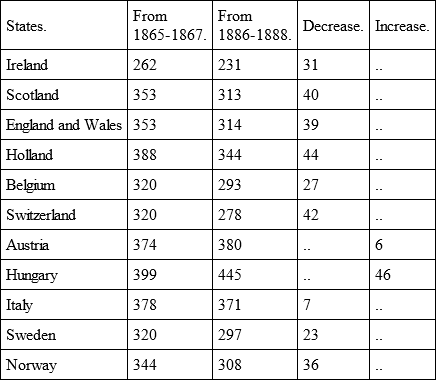
The decline in births is, accordingly, pretty general, only that, of all European States, it is strongest in France. Between 1886 and 1888, France had, to every 1,000 inhabitants, an average of 23.9 births, England 32.9, Prussia 41.27, and Russia 48.8.
These facts show that the birth of a human being, the "image of God," as religious people express it, ranks generally much cheaper than new-born domestic animals. What this fact does reveal is the unworthy condition that we find ourselves in, – and it is mainly the female sex which suffers thereunder. In many respects, modern views distinguish themselves but little from those of barbarous nations. Among the latter, new-born babes were frequently killed, and such a fate fell to the lot of girls mainly; many a half-wild race does so to this day. We no longer kill the girls; we are too civilized for that; but they are only too often treated like pariahs by society and the family. The stronger man crowds them everywhere back in the struggle for existence; and if, driven by the love for life, they still take up the battle, they are visited with hatred by the stronger sex, as unwelcome competitors. It is especially the men in the higher ranks of society who are bitterest against female competition, and oppose it most fiercely. That workingmen demand the exclusion of female labor on principle happens but rarely. A motion to that effect being made in 1877, at a French Labor Convention, the large majority declared against it. Since then, it is just with the class-conscious workingmen of all countries, that the principle, that working-women are beings with equal rights with themselves makes immense progress. This was shown especially by the resolutions of the International Labor Congress of Paris in 1889. The class-conscious workingman knows that the modern economic development forces woman to set herself up as a competitor with man; but he also knows that, to prohibit female labor, would be as senseless an act as the prohibition of the use of machinery. Hence he strives to enlighten woman on her position in society, and to educate her into a fellow combatant in the struggle for the emancipation of the proletariat from capitalism. True enough, – due to the ever more widespread employment of female labor in agriculture, industry, commerce and the trades – the family life of the workingman is destroyed, and the degenerating effects of the double yoke of work for a living, and of household duties, makes rapid progress in the female sex. Hence the endeavor to keep women by legislative enactments, from occupations that are especially injurious to the female organism, and by means of protective laws to safeguard her as a mother and rearer of children. On the other hand, the struggle for existence forces women to turn in ever larger numbers to industrial occupations. It is married woman, more particularly, who is called upon to increase the meager earnings of her husband with her work, – and she is particularly welcome to the employer.67
Modern society is without doubt more cultured than any previous one, and woman stands correspondingly higher. Nevertheless, the views concerning the relations of the two sexes have remained at bottom the same. Professor L. von Stein published a book,68– a work, be it said in passing, that corresponds ill with its title – in which he gives a poetically colored picture of modern marriage, as it supposedly is. Even in this picture the subaltern position of woman towards the "lion" man is made manifest. Stein says among other things: "Man deserves a being that not only loves, but also understands him. He deserves a person with whom not only the heart beats for him, but whose hand may also smooth his forehead, and whose presence radiates peace, rest, order, a quiet command over herself and the thousand and one things upon which he daily reverts: he wants someone who spreads over all these things that indescribable aroma of womanhood, one who is the life-giving warmth to the life of the house."
Participation in public life is to-day one of the most essential duties of a man; that many men do not yet understand this does not alter the fact. Nevertheless, the number of those is ever increasing who realize that public institutions stand in intimate connection with the private lot of the individual; that his success or failure, together with that of his family, depend infinitely more upon the condition of public affairs than upon his own personal qualities and actions. The fact is beginning to receive recognition that the greatest efforts of the individual are powerless against evils that lie in the very condition of things, and that determine his state. On the other hand, the struggle for existence now requires much greater efforts than before. Demands are now made upon man that engage ever more his time and strength. The ignorant, indifferent wife stands dumb before him, and feels herself neglected. It may be even said that, the mental difference between man and woman is to-day greater than formerly, when the opportunities for both were slight and limited, and lay more within the reach of her restricted intellect. Furthermore, the handling of public affairs occupies to-day a large number of men to a degree before unknown; this widens their horizon; but it also withdraws them ever more from the mental sphere of their homes. The wife deems herself set back, and thus another source of friction is started. Only rarely does the husband know how to pacify his wife and convince her. When he does that, he has escaped a dangerous rock. As a rule the husband is of the opinion that what he wants does not concern his wife, she does not understand it. He takes no pains to enlighten her. "You don't understand such matters," is his stereotyped answer, the moment the wife complains that she is neglected. Lack of information on the part of wives is promoted by lack of sense on the part of most husbands. More favorable relations between husband and wife spring up in the rank of the working class in the measure that both realize they are tugging at the same rope, and that there is but one means towards satisfactory conditions for themselves and their family, – the radical reformation of society that shall make human beings of them all. In the measure that such insight gains ground among the wives of the proletariat, then, despite want and misery, their married life is idealized: both now have a common aim, after which they strive; and they have an inexhaustible source of mutual encouragement in the mutual interchange of views, whereto their joint battle leads them. The number of proletarian women who reach this insight is every year larger. Herein lies a movement, that is in process of development, and that is fraught with decisive significance for the future of mankind.
In other social strata, the differences in education and views – easily overlooked at the beginning of married life, when passion still predominates – are felt ever more with ripening years. Sexual passion cools off, and its substitution with harmony of thought is all the more needful. But, leaving aside whether the husband has any idea of civic duties and attends to the same, he, at any rate, thanks to his occupation and constant intercourse with the outer world, comes into continuous touch with different elements and opinions, on all sorts of occasions, and thus floats into an intellectual atmosphere that broadens his horizon. As a rule, and in contrast with his wife, he finds himself in a state of intellectual molting, while she, on the contrary, due to her household duties, which engage her early and late, is robbed of leisure for further education, and, accordingly, becomes mentally stunted and soured.
The domestic wretchedness in which the majority of wives live to-day, is correctly depicted by the bourgeois-minded Gerhard von Amyntor in his "Marginal Notes to the Book of Life."85 In the chapter entitled "Deadly Gnat-bites" he says among other things:
"Not the shocking events, that none remain unvisited by, and that bring, here the death of a husband, yonder the moral downfall of a beloved child; that lie, here in a long and serious illness, yonder in the wrecking of a warmly nursed plan; – not these undermine her (the housewife's) freshness and strength. It is the small, daily-recurring marrow and bone-gnawing cares… How many millions of brave little house-mothers cook and scour away their vigor of life, their very cheeks and roguish dimples, in attending to domestic cares until they become crumpled, dried and broke-up mummies. The ever-recurring question, what shall be cooked to-day? the ever-recurring necessity of sweeping, and beating, and brushing, and dusting is the continuously falling drop that slowly, but surely, wears away mind and body. The kitchen-hearth is the place where the saddest balances are drawn up between income and expense, where the most depressing observations are forced upon the mind on the rising dearness of the necessaries of life, and on the ever increasing difficulty to earn the needed cash. On the flaming altar, where the soup kettle bubbles, youth and mental ease, beauty and good humor are sacrificed; and who recognizes in the old care-bent cook, the one-time blooming, overbearing, coy-coquette bride in the array of her myrtle crown? Already in antiquity the hearth was sacred, near it were placed the Lares and patron deities. Let us also hold sacred the hearth at which the dutiful German bourgeois house-wife dies a slow death, in order to keep the house comfortable, the table covered and the family in health." Such is the consolation offered in bourgeois society to the wife, who, under the present order of society, is miserably going to pieces.
Those women, who, thanks to their social condition, find themselves in a freer state, have, as a rule, a one-sided, superficial education, that, combined with inherited female characteristics, manifests itself with force. They generally have a taste for mere superficialities; they think only about gew-gaws and dress; and thus they seek their mission in the satisfaction of a spoiled taste, and the indulgence of passions that demand their pay with usury. In their children and the education of these they have hardly any interest: they give them too much trouble and annoyance, hence are left to the nurses and servants, and are later passed on to the boarding-schools. At any rate their principal task is to raise their daughters as show-dolls, and their sons as pupils for the jeunesse dore (gilded youth) out of which dudedom recruits its ranks – that despicable class of men that may be fairly put upon a level with procurers. This jeunesse dore furnishes the chief contingent to the seducers of the daughters of the working class. They look upon idleness and squandering as a profession.
CHAPTER II.
FURTHER CHECKS AND OBSTRUCTIONS TO MARRIAGE – NUMERICAL PROPORTION OF THE SEXES – ITS CAUSES AND EFFECTS
Cast in the mold of the conditions above described, many a feature of woman's character took shape, and they reached ever fuller development from generation to generation. On these features men love to dwell with predilection, but they forget that they are themselves the cause thereof, and have promoted with their conduct the defects they now make merry about, or censure. Among these widely censured female qualities, belong her dreaded readiness of tongue, and passion for gossip; her inclination to endless talk over trifles and unimportant things; her mental bent for purely external matters, such as dress, and her desire to please, together with a resulting proneness to all the follies of fashion; lastly, her easily arousable envy and jealousy of the other members of her sex.
These qualities, though in different degrees, manifest themselves generally in the female sex from early childhood. They are qualities that are born under the pressure of social conditions, and are further developed by heredity, example and education. A being irrationally brought up, can not bring up others rationally.
In order to be clear on the causes and development of good or bad qualities, whether with the sexes or with whole peoples, the same methods must be pursued that modern natural science applies in order to ascertain the formation and development of life according to genus and species, and to determine their qualities. They are the laws that flow from the material conditions for life, laws that life demands, that adapt themselves to it, and finally became its nature.
Man forms no exception to that which holds good in Nature for all animate creation. Man does not stand outside of Nature: looked at physiologically, he is the most highly developed animal, – a fact, however, that some would deny. Thousands of years ago, although wholly ignorant of modern science, the ancients had on many matters affecting man, more rational views than the moderns; above all, they gave practical application to the views founded on experience. We praise with enthusiastic admiration the beauty and strength of the men and women of Greece; but the fact is overlooked that, not the happy climate, nor the bewitching nature of a territory that stretched along the bay-indented sea, but the physical culture and maxims of education, consistently enforced by the State, thus affected both the being and the development of the population. These measures were calculated to combine beauty, strength and suppleness of body with wit and elasticity of mind, both of which were transmitted to the descendants. True enough, even then, in comparison with man, woman was neglected in point of mental, but not of corporal culture.86 In Sparta, that went furthest in the corporal culture of the two sexes, boys and girls went naked until the age of puberty, and participated in common in the exercises of the body, in games and in wrestling. The naked exposure of the human body, together with the natural treatment of natural things, had the advantage that sensuous excitement – to-day artificially cultivated by the separation of the sexes from early childhood – was then prevented. The corporal make-up of one sex, together with its distinctive organs, was no secret to the other. There, no play of equivocal words could arise. Nature was Nature. The one sex rejoiced at the beauty of the other. Mankind will have to return to Nature and to the natural intercourse of the sexes; it must cast off the now-ruling and unhealthy spiritual notions concerning man; it must do that by setting up methods of education that fit in with our own state of culture, and that may bring on the physical and mental regeneration of the race.
Among us, and especially on the subject of female education, seriously erroneous conceptions are still prevalent. That woman also should have strength, courage and resolution, is considered heretical, "unwomanly," although none would dare deny that, equipped with such qualities, woman could protect herself against many ills and inconveniences. Conversely, woman is cramped in her physical, exactly as in her intellectual development. The irrationalness of her dress plays an important role herein. It not only, unconscionably hampers her in her physique, it directly ruins her; – and yet, but few physicians dare take a stand against the abuse, accurately informed though they are on the injuriousness of her dress. The fear of displeasing the patient often causes them to hold their tongues, if they do not even flatter her insane notions. Modern dress hinders woman in the free use of her limbs, it injures her physical growth, and awakens in her a sense of impotence and weakness. Moreover, modern dress is a positive danger to her own and the health of those who surround her: in the house and on the street, woman is a walking raiser of dust. And likewise is the development of woman hampered by the strict separation of the sexes, both in social intercourse and at school – a method of education wholly in keeping with the spiritual ideas that Christianity has deeply implanted in us on all matters that regard the nature of man.
The woman who does not reach the development of her faculties, who is crippled in her powers, who is held imprisoned in the narrowest circle of thought, and who comes into contact with hardly any but her own female relatives, – such a woman can not possibly raise herself above the routine of daily life and habits. Her intellectual horizon revolves only around the happenings in her own immediate surroundings, family affairs and what thereby hangs. Extensive conversations on utter trifles, the bent for gossip, are promoted with all might; of course her latent intellectual qualities strain after activity and exercise; – whereupon the husband, often involved thereby in trouble, and driven to desperation, utters imprecations upon qualities that he, the "chief of creation," has mainly upon his own conscience.
With woman – whose face all our social and sexual relations turn toward marriage with every fibre of her being – marriage and matrimonial matters constitute, quite naturally, a leading portion of her conversation and aspirations. Moreover, to the physically weaker woman, subjected as she is to man by custom and laws, the tongue is her principal weapon against him, and, as a matter of course, she makes use thereof. Similarly with regard to her severely censured passion for dress and desire to please, which reach their frightful acme in the insanities of fashion, and often throw fathers and husbands into great straits and embarrassments. The explanation lies at hand. To man, woman is, first of all, an object of enjoyment. Economically and socially unfree, she is bound to see in marriage her means of support; accordingly, she depends upon man and becomes a piece of property to him. As a rule, her position is rendered still more unfavorable through the general excess of women over men, – a subject that will be treated more closely. The disparity intensifies the competition of women among themselves; and it is sharpened still more because, for a great variety of reasons, a number of men do not marry at all. Woman is, accordingly, forced to enter into competition for a husband with the members of her own sex, by means of the most favorable external presentation of her person possible.
Let the long duration, through many generations, of these evils be taken into account. The wonder will cease that these manifestations, sprung from equally lasting causes, have reached their present extreme form. Furthermore, perhaps in no age was the competition of women for husbands as sharp as it is in this, due partly to reasons already given, and partly to others yet to be discussed. Finally, the difficulties of obtaining a competent livelihood, as well as the demands made by society, combine, more than ever before, to turn woman's face towards matrimony as an "institute for support."
Men gladly accept such a state of things: they are its beneficiaries. It flatters their pride, their vanity, their interest to play the role of the stronger and the master; and, like all other rulers, they are, in their role of masters, difficult to reach by reason. It is, therefore, all the more in the interest of woman to warm towards the establishment of conditions that shall free her from so unworthy a position. Women should expect as little help from the men as workingmen do from the capitalist class.
Observe the characteristics, developed in the struggle for the coveted place, on other fields, on the industrial field, for instance, so soon as the capitalists face each other. What despicable, even scampish, means of warfare are not resorted to! What hatred, envy and passion for calumny are not awakened! – observe that, and the explanation stands out why similar features turn up in the competition of women for a husband. Hence it happens that women, on the average, do not get along among themselves as well as men; that even the best female friends lightly fall out, if the question is their standing in a man's eye, or pleasingness of appearance. Hence also the observation that wherever women meet, be they ever such utter strangers, they usually look at one another as enemies. With one look they make the mutual discovery of ill-matched colors, or wrongly-pinned bows, or any other similar cardinal sin. In the look that they greet each other with, the judgment can be readily read that each has passed upon the other. It is as if each wished to inform the other: "I know better than you how to dress, and draw attention upon myself."
On the other hand, woman is by nature more impulsive than man; she reflects less than he; she has more abnegation, is naiver, and hence is governed by stronger passions, as revealed by the truly heroic self-sacrifice with which she protects her child, or cares for relatives, and nurses them in sickness. In the fury, however, this passionateness finds its ugly expression. But the good as well as the bad sides, with man as well as woman, are influenced, first of all, by their social position; favored, or checked, or transfigured. The same impulse, that, under unfavorable circumstances, appears as a blemish, is, under favorable circumstances, a source of happiness for oneself and others. Fourier has the credit of having brilliantly demonstrated how the identical impulses of man produce, under different conditions, wholly opposite results.
Running parallel with the effects of mistaken education, are the no less serious effects of mistaken or imperfect physical culture upon the purpose of Nature. All physicians are agreed that the preparation of woman for her calling as mother and rearer of children leaves almost everything to be wished. "Man exercises the soldier in the use of his weapons, and the artisan in the handling of his tools; every office requires special studies; even the monk has his novitiate. Woman alone is not trained for her serious duties of mother."87 Nine-tenths of the maidens who marry enter matrimony with almost utter ignorance about motherhood and the duties of wedlock. The inexcusable shyness, even on the part of mothers, to speak with a grown-up daughter of such important sexual duties, leaves the latter in the greatest darkness touching her duties towards herself and her future husband. With her entrance upon married life, woman enters a territory that is wholly strange to her. She has drawn to herself a fancy-picture thereof – generally from novels that are not particularly to be commended – that does not accord with reality.88 Her defective household knowledge, that, as things are to-day, is inevitable, even though many a function, formerly naturally belonging to the wife, has been removed from her, also furnishes many a cause for friction. Some know nothing whatever of household matters: They consider themselves too good to bother about them, and look upon them as matters that concern the servant girl; numerous others, from the ranks of the masses, are prevented, by the struggle for existence, from cultivating themselves for their calling as householders: they must be in the factory and at work early and late. It is becoming evident that, due to the development of social conditions, the separate household system is losing ground every day; and that it can be kept up only at the sacrifice of money and time, neither of which the great majority is able to expend.
Yet another cause that destroys the object of marriage to not a few men is to be found in the physical debility of many women. Our food, housing, methods of work and support, in short, our whole form of life, affects us in more ways than one rather harmfully than otherwise. We can speak with perfect right of a "nervous age." Now, then, this nervousness goes hand in hand with physical degeneration. Anaemia and nervousness are spread to an enormous degree among the female sex: They are assuming the aspect of a social calamity, that, if it continue a few generations longer, as at present, and we fail to place our social organization on a normal footing, is urging the race towards its destruction.89
With an eye to its sexual mission, the female organism requires particular care, – good food, and, at certain periods, the requisite rest. Both of these are lacking to the great majority of the female sex, at least in the cities and industrial neighborhoods, nor are they to be had under modern industrial conditions. Moreover, woman has so habituated herself to privation that, for instance, numberless women hold it a conjugal duty to keep the tid-bits for the man, and satisfy themselves with insufficient nourishment. Likewise are boys frequently given the preference over girls in matters of food. The opinion is general that woman can accommodate herself, not with less food only, but also with food of poorer quality. Hence the sad picture that our female youth, in particular, presents to the eyes of the expert. A large portion of our young women are bodily weak, anaemic, hypernervous. The consequences are difficulties in menstruation, and disease of the organs connected with the sexual purpose, the disease often assuming the magnitude of incapacity to give birth and to nurse the child, even of danger to life itself. "Should this degeneration of our women continue to increase in the same measure as before, the time may not be far away when it will become doubtful whether man is to be counted among the mammals or not."90 Instead of a healthy, joyful companion, of a capable mother, of a wife attentive to her household duties, the husband has on his hands a sick, nervous wife, whose house the physician never quits, who can stand no draught, and can not bear the least noise. We shall not expatiate further on this subject. Every reader – and as often as in this book we speak of "reader," we mean, of course, the female as well as the male – can himself further fill the picture: he has illustrations enough among his own relatives and acquaintances.
Experienced physicians maintain that the larger part of married women, in the cities especially, are in a more or less abnormal condition. According to the degree of the evil and the character of the couple, such unions can not choose but be unhappy, and, they give the husband the right, in public opinion, to allow himself freedoms outside of the marriage bed, the knowledge of which throws the wife into the most wretched of moods. Furthermore the, at times, very different sexual demands of one party or the other give occasion to serious friction, without the so much wished-for separation being possible. A great variety of considerations render that, in most cases, out of all question.
Under this head the fact may not be suppressed that a considerable number of husbands are themselves responsible for certain serious physical ailments of their wives, ailments that these are not infrequently smitten with in marriage. As consequences of the excesses indulged in during bachelorship, a considerable number of men suffer of chronic sexual diseases, which, seeing these cause them no serious inconvenience, are taken lightly. Nevertheless, through sexual intercourse with the wife, these diseases bring upon her disagreeable, even fatal troubles of the womb, that set in, soon after marriage, and often develop to the point of rendering her unable to conceive or to give birth. The wretched woman usually has no idea of the cause of the sickness, that depresses her spirits, embitters her life, and uproots the purpose of marriage. She blames herself, and accepts blame for a condition, that the other party is alone responsible for. Thus many a blooming wife falls, barely married, a prey to chronic malady, unaccountable to either herself or her family.
"As recent investigations have proved, this circumstance – that, as a result of gonorrhea, the male sperm no longer contains any seed-cells, and the man is, consequently, incapacitated for life from begetting children —is a comparatively frequent cause of matrimonial barrenness, in contradiction to the old and convenient tradition of the lords of creation, who are ever ready to shift to the shoulder of the wife the responsibility for the absence of the blessing of children."91
Accordingly, a large number of causes are operative in preventing modern married life, in the large majority of instances, from being that which it should be: – a union of two beings of opposite sexes, who, out of mutual love and esteem, wish to belong to each other, and, in the striking sentence of Kant, mean, jointly, to constitute the complete human being. It is, therefore, a suggestion of doubtful value – made even by learned folks, who imagine thereby to dispose of woman's endeavors after emancipation – that she look to domestic duties, to marriage, – to marriage, that our economic conditions are ever turning into a viler caricature, and that answers its purpose ever less!
The advice to woman that she seek her salvation in marriage, this being her real calling, – an advice that is thoughtlessly applauded by the majority of men – sounds like the merest mockery, when both the advisers and their claqueurs do the opposite. Schopenhauer, the philosopher, has of woman only the conception of the philistine. He says: "Woman is not meant for much work. Her characteristicon is not action but suffering. She pays the debt of life with the pains of travail, anxiety for the child, subjection to man. The strongest utterances of life and sentiment are denied her. Her life is meant to be quieter and less important than man's. Woman is destined for nurse and educator of infancy, being herself infant-like, and an infant for life, a sort of intermediate stage between the child and the man, who is the real being… Girls should be trained for domesticity and subjection… Women are the most thorough-paced and incurable Philistines."
In the same spirit as Schopenhauer, who, of course, is greatly quoted, is cast Lombroso and Ferrerro's work, "Woman as a Criminal and a Prostitute." We know no scientific work of equal size – it contains 590 pages – with such a dearth of valid evidence on the theme therein treated. The statistical matter, from which the bold conclusions are drawn, is mostly meager. Often a dozen instances suffice the joint authors to draw the weightiest deductions. The matter that may be considered the most valuable in the work is, typically enough, furnished by a woman, – Dr. Tarnowskaja. The influence of social conditions, of cultural development, is left almost wholly on one side. Everything is judged exclusively from the physiologico-psychologic view-point, while a large quantity of ethnographic items of information on various peoples is woven into the argument, without submitting these items to closer scrutiny. According to the authors, just as with Schopenhauer, woman is a grown child, a liar par excellence, weak of judgment, fickle in love, incapable of any deed truly heroic. They claim the inferiority of woman to man is manifest from a large number of bodily differences. "Love, with woman, is as a rule nothing but a secondary feature of maternity, – all the feelings of attachment that bind woman to man arise, not from sexual impulses, but from the instincts of subjection and resignation, acquired through habits of conformancy." How these "instincts" were acquired and "conformed" themselves, the joint authors fail to inquire into. They would then have had to inquire into the social position of woman in the course of thousands of years, and would have been compelled to find that it is that that made her what she now is. It is true, the joint authors describe partly the enslaved and dependent position of woman among the several peoples and under the several periods of civilization; but as Darwinians, with blinkers to their eyes, they draw all that from physiologic and psychologic, not from social and economic reasons, which affected in strongest manner the physiologic and psychologic development of woman.
The joint authors also touch upon the vanity of woman, and set up the opinion that, among the peoples who stand on a lower stage of civilization, man is the vain sex, as is noticeable to-day in the New Hebrides and Madagascar, among the peoples of the Orinoco, and on many islands of the Polynesian archipelago, as also among a number of African peoples of the South Sea. With peoples standing on a higher plane, however, woman is the vain sex. But why and wherefor? To us the answer seems plain. Among the peoples of a lower civilization, mother-right conditions prevail generally, or have not yet been long overcome. The role that woman there plays raises her above the necessity of seeking for the man, the man seeks her, and to this end, ornaments himself and grows vain. With the people of a higher grade, especially with all the nations of civilization, excepting here and there, not the man seeks the woman, but the woman him. It happens rarely that a woman openly takes the initiative, and offers herself to the man; so-called propriety forbids that. In point of fact, however, the offering is done by the manner of her appearance; by means of the beauty of dress and luxury, that she displays; by the manner in which she ornaments herself, and presents herself, and coquets in society. The excess of women, together with the social necessity of looking upon matrimony as an institute for support, or as an institution through which alone she can satisfy her sexual impulse and gain a standing in society, forces such conduct upon her. Here also, we notice again, it is purely economic and social causes that call forth, one time with man, another with woman, a quality that, until now, it was customary to look upon as wholly independent of social and economic causes. Hence the conclusion is justified, that so soon as society shall arrive at social conditions, under which all dependence of one sex upon another shall have ceased, and both are equally free, ridiculous vanity and the folly of fashion will vanish, just as so many other vices that we consider to-day uneradicable, as supposedly inherent in man. Schopenhauer, as a philosopher, judges woman as one-sidedly as most of our anthropologists and physicians, who see in her only the sexual, never the social, being. Schopenhauer was never married. He, accordingly, has not, on his part, contributed towards having one more woman pay the "debt of life" that he debits woman with. And this brings us to the other side of the medal, which is far from being the handsomer.
The activity on the part of the bourgeois associations of women for the abolition of female labor and for the admission of women to the higher professions, at present mainly, if not exclusively, appropriated by men, aims principally at procuring a position in life for women from the social circles just sketched. In order to secure for their efforts greater prospects of success, these associations have loved to place themselves under the protectorate of higher and leading ladies. The bourgeois females imitate herein the example of the bourgeois males, who likewise love such protectorates, and exert themselves in directions that can bring only small, never large results. A Sisyphus work is thus done with as much noise as possible, to the end of deceiving oneself and others on the score of the necessity for a radical change. The necessity is also felt to do all that is possible in order to suppress all doubts regarding the wisdom of the foundations of our social and political organization, and to prescribe them as treasonable. The conservative nature of these endeavors prevents bourgeois associations of women from being seized with so-called destructive tendencies. When, accordingly, at the Women's Convention of Berlin, in 1894, the opinion was expressed by a minority that the bourgeois women should go hand and hand with the working-women, i. e., with their Socialist citizens, a storm of indignation went up from the majority. But the bourgeois women will not succeed in pulling themselves out of the quagmire by their own topknots.
How large the number is of women who, by reason of the causes herein cited, must renounce married life, is not accurately ascertainable. In Scotland, the number of unmarried women of the age of twenty years and over was, towards the close of the sixties, 43 per cent. of the female population, and there were 110 women to every 100 men. In England, outside of Wales, there lived at that time 1,407,228 more women than men of the age of 20 to 40, and 359,966 single women of over forty years of age. Of each 100 women 42 were unmarried.
The surplus of women that Germany owns is very unevenly distributed in point of territories and age. According to the census of 1890, it stood: —98

Accordingly, of marriageable age proper, 15-40, the surplus of women in the German Empire amounts to 27 women to every 1,000 men. Seeing that, within these age periods, there are 9,429,720 male to 9,682,454 female inhabitants, there is a total female surplus of 252,734. In the same four age periods, the proportion of the sexes in other countries of Europe and outside of Europe stood as follows: —99

It is seen that all countries of the same or similar economic structure reveal the identical conditions with regard to the distribution of the sexes according to ages. According thereto, and apart from all other causes already mentioned, a considerable number of women have in such countries no prospect of entering wedded life. The number of unmarried women is even still larger, because a large number of men prefer, for all sorts of reasons, to remain single. What say hereto those superficial folks, who oppose the endeavor of women after a more independent, equal-righted position in life, and who refer them to marriage and domestic life? The blame does not lie with the women that so many of them do not marry; and how matters stand with "conjugal happiness" has been sufficiently depicted.
What becomes of the victims of our social conditions? The resentment of insulted and injured Nature expresses itself in the peculiar facial lines and characteristics whereby so-called old maids, the same as old ascetic bachelors, stamp themselves different from other human beings in all countries and all climates; and it gives testimony of the mighty and harmful effect of suppressed natural love. Nymphomania with women, and numerous kinds of hysteria, have their origin in that source; and also discontent in married life produces attacks of hysteria, and is responsible for barrenness.
Such, in main outlines, is our modern married life and its effects. The conclusion is: Modern marriage is an institution that is closely connected with the existing social condition, and stands or falls with it. But this marriage is in the course of dissolution and decay, exactly as capitalist society itself, – because, as demonstrated under the several heads on the subject of marriage:
1. Relatively, the number of births declines, although population increases on the whole, – showing that the condition of the family deteriorates.
2. Actions for divorce increase in numbers, considerably more than does population, and, in the majority of cases, the plaintiffs are women, although, both economically and socially, they are the greatest sufferers thereunder, – showing that the unfavorable factors, that operate upon marriage, are on the increase, and marriage, accordingly, is dissolving and falling to pieces.
3. Relatively, the number of marriages is on the decline, although population increases, – showing again that marriage, in the eyes of many, no longer answers its social and moral purposes, and is considered worthless, or dangerous.
4. In almost all the countries of civilization there is a disproportion between the number of the sexes, and to the disadvantage of the female sex, and the disproportion is not caused by births – there are, on the average, more boys born than girls, – but is due to unfavorable social and political causes, that lie in the political and economic conditions.
Seeing that all these unnatural conditions, harmful to woman in particular, are grounded in the nature of capitalist society, and grow worse as this social system continues, the same proves itself unable to end the evil and emancipate woman. Another social order is, accordingly, requisite thereto.
CHAPTER III.
PROSTITUTION A NECESSARY SOCIAL INSTITUTION OF THE CAPITALIST WORLD
Marriage presents one side of the sexual life of the capitalist or bourgeois world; prostitution presents the other. Marriage is the obverse, prostitution the reverse of the medal. If men find no satisfaction in wedlock, then they usually seek the same in prostitution. Those men, who, for whatever reason, renounce married life, also usually seek satisfaction in prostitution. To those men, accordingly, who, whether out of their free will or out of compulsion, live in celibacy, as well as to those whom marriage does not offer what was expected of it, conditions are more favorable for the gratification of the sexual impulse than to women.
Man ever has looked upon the use of prostitution as a privilege due him of right. All the harder and severer does he keep guard and pass sentence when a woman, who is no prostitute, commits a "slip." That woman is instinct with the same impulses as man, aye, that at given periods of her life (at menstruation) these impulses assert themselves more vehemently than at others, – that does not trouble him. In virtue of his position as master, he compels her to violently suppress her most powerful impulses, and he conditions both her character in society and her marriage upon her chastity. Nothing illustrates more drastically, and also revoltingly, the dependence of woman upon man than this radically different conception regarding the gratification of the identical natural impulse, and the radically different measure by which it is judged.
To man, circumstances are particularly favorable. Nature has devolved upon woman the consequences of the act of generation: outside of the enjoyment, man has neither trouble nor responsibility. This advantageous position over against woman has promoted that unbridled license in sexual indulgence wherein a considerable part of men distinguish themselves. Seeing, however, that, as has been shown, a hundred causes lie in the way of the legitimate gratification of the sexual instinct, or prevent its full satisfaction, the consequence is frequent gratification, like beasts in the woods.
Prostitution thus becomes a social institution in the capitalist world, the same as the police, standing armies, the Church, and wage-mastership.
Nor is this an exaggeration. We shall prove it.
We have told how the ancient world looked upon prostitution, and considered it necessary, aye, had it organized by the State, as well in Greece as in Rome. What views existed on the subject during the Middle Ages has likewise been described. Even St. Augustine, who, next to St. Paul, must be looked upon as the most important prop of Christendom, and who diligently preached asceticism, could not refrain from exclaiming: "Suppress the public girls, and the violence of passion will knock everything of a heap." The provincial Council of Milan, in 1665, expressed itself in similar sense.
Let us hear the moderns:
Dr. F. S. Huegel says:100 "Advancing civilization will gradually drape prostitution in more pleasing forms, but only with the end of the world will it be wiped off the globe." A bold assertion; yet he who is not able to project himself beyond the capitalist form of society, he who does not realize that society will change so as to arrive at healthy and natural social conditions, – he must agree with Dr. Huegel.
Hence also did Dr. Wichern, the late pious Director of the Rauhen House near Hamburg, Dr. Patton of Lyon, Dr. William Tait of Edinburg, and Dr. Parent-Duchatelet of Paris, celebrated through his investigations of the sexual diseases and prostitution, agree in declaring: "Prostitution is ineradicable because it hangs together with the social institutions," and all of them demanded its regulation by the State. Also Schmoelder writes: "Immorality as a trade has existed at all times and in all places, and, so far as the human eye can see, it will remain a constant companion of the human race."101 Seeing that the authorities cited stand, without exception, upon the ground of the modern social order, the thought occurs to none that, with the aid of another social order, the causes of prostitution, and, consequently, prostitution itself, might disappear; none of them seeks to fathom the causes. Indeed, upon one and another, engaged in this question, the fact at times dawns that the sorry social conditions, which numerous women suffer under, might be the chief reason why so many women sell their bodies; but the thought does not press itself through to its conclusion, to wit, that, therefore, the necessity arises of bringing about other social conditions. Among those who recognize that the economic conditions are the chief cause of prostitution belong Th. Bade, who declares:102 "The causes of the bottomless moral depravity, out of which the prostitute girl is born, lie in the existing social conditions… It is the bourgeois dissolution of the middle classes and of their material existence, particularly of the class of the artisans, only a small fraction of which carries on to-day an independent occupation as a trade." Bade closes his observations, saying: "Want for material existence, that has partly worn out the families of the middle class and will yet wear them out wholly, leads also to the moral ruin of the family, especially of the female sex." In fact, the statistical figures, gathered by the Police Department of Berlin, between 1871-1872, on the extraction of 2,224 enrolled prostitutes, show:

Of 102 the father's occupation was not ascertainable.
Specialists and experts rarely take up investigations of a deeper nature; they accept the facts that lie before them, and judge in the style of the "Wiener Medizinische Wochenschrift," that writes in its No. 35, for the year 1863: "What else is there left to the large majority of willing and unwilling celibates, in order to satisfy their natural wants, than the forbidden fruit of the Venus Pandemos?" The paper is, accordingly, of the opinion that, for the sake of these celibates, prostitution is necessary, because what else, forsooth, are they to do in order to satisfy their sexual impulse? And it closes, saying: "Seeing that prostitution is necessary, it has the right to existence, to protection, and to immunity from the State." And Dr. Huegel declares himself in his work, mentioned above, in accord with this view. Man, accordingly, to whom celibacy is a horror and a martyrdom, is the only being considered; that there are also millions of women living in celibacy is well known; but they have to submit. What is right for man, is, accordingly, wrong for women; is in her case immorality and a crime.
The Leipsic Police Doctor, Dr. J. Kuehn, says:103 "Prostitution is not merely an evil that must be tolerated, it is a necessary evil, because it protects the wives from infidelity, [which only the husbands have the right to be guilty of] and virtue also [female virtue, of course, the husbands have no need of the commodity] from being assailed [sic.] and, therefore, from falling." These few words of Dr. Kuehn typify, in all its nakedness, the crass egoism of male creation. Kuehn takes the correct stand for a Police Doctor, who, by superintending prostitution, sacrifices himself, to the end of saving the men from disagreeable diseases. In the same sense with him did his successor, Dr. Eckstein, utter himself at the twelfth convention of the German Associations of House and City Real Estate Owners, held in Magdeburg in the summer of 1890. The honorable house-owners wished to know how they could prevent the numerous instances of prostitutes occupying their houses, and how to protect themselves against fines in case prostitutes are caught living in them. Dr. Eckstein lectured them on this head to the effect that prostitution was a "necessary evil," never absent from any people or religion. Another interesting gentleman is Dr. Fock, who in a treatise, entitled "Prostitution, in Its Ethical and Sanitary Respects," in the "Deutschen Vierteljahrschrift fuer offentliche Gesundheitspflege," vol. xx, No. 1, considers prostitution "an unenviable corollary of our civilized arrangements." He fears an over-production of people if all were to marry upon reaching the age of puberty; hence he considers important to have prostitution "regulated" by the State. He considers natural that the State supervise and regulate prostitution, and thereby assume the care of providing for the supply of girls that are free from syphilis. He pronounces himself in favor of the most rigid inspection of "all women, proven to lead an abandoned life;" – also when ladies of "an abandoned life" belong to the prominent classes? It is the old story. That in all logic and justice also those men should be held under surveillance who hunt up prostitutes, maintain them and make their existence possible, – of that no one thinks. Dr. Fock also demands the taxing of the prostitutes, and their concentration in given streets. In other words, the Christian State is to procure for itself a revenue out of prostitution, and, at the same time, organize and place prostitution under its protection for the benefit of male creation. What was it that the Emperor Vespasian said at a somewhat similar juncture? "Non olet!" – it smells not.
Did we exaggerate when we said: Prostitution is to-day a necessary social institution just as the police, standing armies, the Church and wage-mastership?
In the German Empire, prostitution is not, like in France, organized and superintended by the State; it is only tolerated. Official public houses are forbidden by law, and procuring is severely punishable. But that does not prevent that in a large number of German cities public houses continue to exist, and are winked at by the police. This establishes an incomprehensible state of things. The defiance of the law implied in such a state of things dawned even upon our statesmen and they bestirred themselves to remove the objection by legislative enactments. The German Criminal Code makes also the lodging of a prostitute a penal offense. On the other hand, however, the police are compelled to tolerate thousands of women as prostitutes, and, in a measure, to privilege them in their trade, provided they enter themselves as prostitutes on the Police Register, and submit to the Police regulations, – for instance, periodically recurring examinations by a physician. It follows, however, that, if the Government licenses the prostitute, and thereby protects the exercise of her trade, she must also have a habitation. Aye, it is even in the interest of public health and order that they have such a place to ply their trade in. What contradictions! On the one hand, the Government officially acknowledges that prostitution is necessary; on the other, it prosecutes and punishes the prostitute and the pimp. But it is out of contradictions that bourgeois society is put together. Moreover, the attitude of the Government is an avowal that prostitution is a Sphinx to modern society, the riddle which society can not solve: it considers necessary to tolerate and superintend prostitution in order to avoid greater evils. In other words, our social system, so boastful of its morality, its religiousness, its civilization and its culture, feels compelled to tolerate that immorality and corruption spread through its body like a stealthy poison. But this state of things betrays something else, besides the admission by the Christian State that marriage is insufficient, and that the husband has the right to demand illegitimate gratification of his sexual instincts. Woman counts with such a State in so far only as she is willing, as a sexual being, to yield to illegitimate male desires, i. e., become a prostitute. In keeping herewith, the supervision and control, exercised by the organs of the State over the registered prostitutes, do not fall upon the men also, those who seek the prostitute. Such a provision would be a matter of course if the sanitary police control was to be of any sense, and even of partial effect, – apart from the circumstance that a sense of justice would demand an even-handed application of the law to both sexes. No; "supervision and control" fall upon woman alone.
This protection by the State of man and not woman, turns upside down the nature of things. It looks as if men were the weaker vessel and women the stronger; as if woman were the seducer, and poor, weak man the seduced. The seduction-myth between Adam and Eve in Paradise continues to operate in our opinions and laws, and it says to Christianity: "You are right; woman is the arch seductress, the vessel of iniquity." Men should be ashamed of such a sorry and unworthy role; but this role of the "weak" and the "seduced" suits them; —the more they are protected, all the more may they sin.
Wherever men assemble in large numbers, they seem unable to amuse themselves without prostitution. This was shown, among other instances of the kind, by the occurrences at the German Schuetzenfest, held in Berlin in the summer of 1890, which caused 2,300 women to express themselves as follows in a petition addressed to the Mayor of the German capital: "May it please your Honor to allow us to bring to your knowledge the matters that have reached the provinces, through the press and other means of communication, upon the German shooting matches, held at Pankow from the 6th to the 13th of July of this year. The reports of the matter, that we have seen with indignation and horror, represent the programme of that festival with the following announcements, among others: 'First German Herald, the Greatest Songstress of the World;' 'A Hundred Ladies and Forty Gentlemen:' Besides these smaller cafes chantants and shooting galleries, in which importunate women forced themselves upon the men. Also a 'free concert,' whose gaily-clad waitresses, seductively smiling, brazenly and shamelessly invited the gymnasium students and the fathers of families, the youths and the grown men alike, to the 'shooting retreats.'… The barely dressed 'lady' who invited people to the booth of 'The Secrets of Hamburg, or a Night in St. Pauli,' should have been enough to justify her removal by the police. And then the shocking announcement, almost incredible of the much boasted about Imperial capital, and hardly to be believed by plain male and female citizens in the provinces, to the effect that the managers of the festival had consented to the employment, without pay, of 'young women' in large numbers, as bar-maids, instead of the waiters who applied for work… We, German women, have thousands of occasions, as wives, mothers and as sisters, to send our husbands, children, daughters and brothers to Berlin in the service of the fatherland; we, consequently, pray to your Honor in all humbleness and in the confident expectation that, with the aid of the overpowering influence, which, as the chief magistrate of the Imperial capital, lies in your hand, you may institute such investigations of those disgraceful occurrences, or adopt such other measures as to your Honor may seem fit, to the end that a recurrence of those orgies may not have to be apprehended at the pending Sedan festival, for instance…" (!!)
During the session of the Reichstag, from 1892 to 1893, the united Governments made an effort to put an end to the contradiction that governmental practice, on the one hand, and the Criminal Code on the other, find themselves in with regard to prostitution. They introduced a bill that was to empower the police to designate certain habitations to prostitutes. It was admitted that prostitution could not be suppressed, and that, therefore, the most practical thing was to tolerate the thing in certain localities, and to control it. The bill – upon that all minds were agreed – would, if it became a law, have called again to life the brothels that were officially abolished in Prussia about 1845. The bill caused a great uproar, and it evoked a number of protests in which the warning was raised against the State's setting itself up as the protector of prostitution, and thereby favoring the idea that the use of prostitution was not in violation of good morals, or that the trade of the prostitute was such that the State could allow and approve of. The bill, which met with the strongest opposition both on the floor of the Reichstag and in the committee, was pigeon-holed, and dared not again come into daylight. That, nevertheless, such a bill could at all take shape reveals the embarrassment that society is in.
The administrative regulation of prostitution raises in the minds of men not only the belief that the State allows the use of prostitution, but also that such control protects them against disease. Indeed, this belief greatly promotes indulgence and recklessness on the part of men. Brothels do not reduce sexual diseases, they promote the same: the men grow more careless and less cautious.
Experience has taught that neither the establishment of houses of prostitution, controlled by the police, nor the supervision and medical inspection, ordered by the police, afford the slightest guarantee against contagion. The nature of these diseases is frequently such that they are not to be easily or immediately detected. If there is to be any safety, the inspection would have to be held several times a day. That, however, is impossible in view of the number of women concerned, and also of the costs. Where thirty or forty prostitutes must be "done" in an hour, inspection is hardly more than a farce; moreover, one or two inspections a week is wholly inadequate. The success of these measures also suffers shipwreck in the circumstance that the men, who transmit the germs of disease from one woman to another, remain free from all official annoyance. A prostitute, just inspected and found healthy, may be infected that same hour by a diseased man, and she transmits the virus to other patrons, until the next inspection day, or until she has herself become aware of the disease. The control is not only illusory: These inspections, made at command, and conducted by male, instead of female physicians, hurt most deeply the sense of shame; and they contribute to its total ruination. This is a phenomenon confirmed by many physicians. Even the official report of the Berlin Police Department admits the fact by stating: "It may also be granted that registration causes the moral sense of the prostitute to sink still lower."104 Accordingly, the prostitutes try their utmost to escape this control. A further consequence of these police measures is that they make it extraordinarily difficult, even impossible, for the prostitute ever again to return to a decent trade. A woman, that has fallen under police control, is lost to society; she generally goes down in misery within a few years. Accurately and exhaustively did the fifth Congress at Geneva for Combatting Immorality utter itself against the police regulation of prostitutes, by declaring: "The compulsory medical inspection of prostitutes is an all the more cruel punishment to the woman, seeing that, by destroying the remnants of shame, still possible within even the most abandoned, such inspection drags down completely into depravity the wretched being that is subjected thereto. The State, that means to regulate prostitution with the police, forgets that it owes equal protection to both sexes; it demoralizes and degrades women. Every system for the official regulation of prostitution has police arbitrariness for its consequence, as well as the violation of civic guaranties that are safeguarded to every individual, even to the greatest criminal, against arbitrary arrest and imprisonment. Seeing this violation of right is exercised to the injury of woman only, the consequence is an inequality, shocking to nature, between her and man. Woman is degraded to the level of a mere means, and is no longer treated as a person. She is placed outside of the pale of law."
Of how little use police control is, England furnishes a striking illustration. In the year 1866 a law was enacted on the subject for places in which soldiers and marines were garrisoned. Now, then, while from 1860 to 1866, without the law, the lighter cases of syphilis had declined from 32.68 to 24.73 per cent., after a six years' enforcement of the new law, the percentage of diseased in 1872 was still 24.26. In other words, it was not one-half per cent. lower in 1872 than in 1866; but the average for these six years was 1-16 per cent. higher than in 1866. In sight of this, a special Commission, appointed in 1873, to investigate the effect of that law, arrived at the unanimous conclusion that "the periodical inspection of the women who usually have sexual intercourse with the personnel of the army and navy, had, at best, not occasioned the slightest diminution in the number of cases," and it recommended the suspension of periodical inspections.
The effects of the Act of Inspection on the women subjected thereto were, however, quite different from those on the troops. In 1866, there were, to every 1,000 prostitutes, 121 diseases; in 1868, after the law had been in force two years, there were 202. The number then gradually dropped, but, nevertheless, still exceeded in 1874 the figure for 1866 by 16 cases. Under the Act, deaths also increased frightfully among the prostitutes. In 1865 the proportion was 9.8 to every 1,000 prostitutes, whereas, in 1874 it had risen to 23. When, towards the close of the sixties, the English Government made the attempt to extend the Act of Inspection to all English cities, a storm of indignation arose from the women. The law was considered an affront to the whole sex. The Habeas Corpus Act, – that fundamental law, that protects the English citizen against police usurpation – would, such was the sentiment, be suspended for women: any brutal policeman, animated by revenge or any other base motive, would be free to seize any decent woman on the suspicion of her being a prostitute, whereas the licentiousness of the men would remain unmolested, aye, would be protected and fed, by just such a law.
Although this intervention in behalf of the outcasts of their sex readily exposed the English women to misrepresentation and degrading remarks from the quarter of narrow-minded men, the women did not allow themselves to be held back from energetically opposing the introduction of the law that was an insult to their sex. In newspaper articles and pamphlets the "pros" and "cons" were discussed by men and women; in Parliament, the extension of the law was, first, prevented; its repeal followed later. The German police is vested with a similar power, and cases that have forced themselves into publicity from Berlin, Leipsic and other cities, prove that its abuse – or be it "mistakes" in its exercise – is easy; nevertheless, of an energetic opposition to such regulations naught is heard. Even in middle class Norway, brothels were forbidden in 1884; in 1888 the compulsory registration of the prostitutes and the inspection connected therewith were abolished in the capital, Christiania; and in January, 1893, the enactment was made general for the whole country. Very rightly does Mrs. Guillaume-Schack remark upon the "protective" measures adopted by the State in behalf of the men: "To what end do we teach our sons to respect virtue and morality if the State pronounces immorality a necessary evil; and if, before the young man has at all reached mental maturity, the State leads woman to him stamped by the authorities as a merchandise, as a toy for his passion?"
Let a sexually diseased man, in his unbridled career of licentiousness, contaminate ever so many of these poor beings – who, to the honor of woman be it said, are mostly driven by bitter want or through seduction to ply their disgraceful trade, – the scurvy fellow remains unmolested. But woe to the woman who does not forthwith submit to inspection and treatment! The garrison cities, university towns, etc., with their congestion of vigorous, healthy men, are the chief centers of prostitution and of its dangerous diseases, that are carried thence into the remotest corners of the land, and everywhere spread infection. The same holds with the sea towns. What the moral qualifications are with a large number of our students the following utterance in a publication for the promotion of morality may give an idea of: "With by far the larger number of students, the views entertained upon matters of morality are shockingly low, aye, they are downright unclean."105 And these are the circles – boastful of their "German breed," and "German morals" – from which our administrative officers, our District Attorneys and our Judges are in part recruited.
We have seen how, as a result of our social conditions, vice, excesses, wrongs and crimes of all sorts are bred. All society is kept in a state of unrest. Under such a state of things woman is the chief sufferer.
Numerous women realize this and seek redress. They demand, first of all, economic self-support and independence; they demand that woman be admitted, as well as man, to all pursuits that her physical and mental powers and faculties qualify her for; they demand, especially, admission to the occupations that are designated with the term "liberal professions." Are the efforts in these directions justified? Are they practical? Would they mend matters? These are questions that now crowd forward.
CHAPTER IV.
WOMAN'S POSITION AS A BREADWINNER; HER INTELLECTUAL FACULTIES; DARWINISM AND THE CONDITION OF SOCIETY
The endeavor of woman to secure economic self-support and personal independence has, to a certain degree, been recognized as legitimate by bourgeois society, the same as the endeavor of the workingman after greater freedom of motion. The principal reason for such acquiescence lies in the class interests of the bourgeoisie itself. The bourgeoisie, or capitalist class, requires the free and unrestricted purveyance of male and female labor-power for the fullest development of production. In even tempo with the perfection of machinery, and technique; with the subdivision of labor into single acts requiring ever less technical experience and strength; with the sharpening of the competitive warfare between industry and industry, and between whole regions – country against country, continent against continent – the labor-power of woman comes into ever greater demand.
The special causes, from which flows this ever increasing enlistment of woman in ever increasing numbers, have been detailed above in extenso. Woman is increasingly employed along with man, or in his place, because her material demands are less than those of man. A circumstance predicated upon her very nature as a sexual being, forces woman to proffer herself cheaper. More frequently, on an average, than man, woman is subject to physical derangements, that cause an interruption of work, and that, in view of the combination and organization of labor, in force to-day in large production, easily interfere with the steady course of production. Pregnancy and lying-in prolong such pauses. The employer turns the circumstance to advantage, and recoups himself doubly for the inconveniences, that these disturbances put him to, with the payment of much lower wages.
Moreover – as may be judged from the quotation on page 90, taken from Marx's "Capital" – the work of married women has a particular fascination for the employer. The married woman is, as working-woman, much more "attentive and docile" than her unmarried sister. Thought of her children drives her to the utmost exertion of her powers, in order to earn the needed livelihood; accordingly, she submits to many an imposition that the unmarried woman does not. In general, the working-woman ventures only exceptionally to join her fellow-toilers in securing better conditions of work. That raises her value in the eyes of the employer; not infrequently she is even a trump card in his hands against refractory workingmen. Moreover, she is endowed with great patience, greater dexterity of fingers, a better developed artistic sense, the latter of which renders her fitter than man for many branches of work.
These female "virtues" are fully appreciated by the virtuous capitalist, and thus, along with the development of industry, woman finds from year to year an ever wider field for her application – but, and this is the determining factor, without tangible improvement to her social condition. If woman labor is employed, it generally sets male labor free. The displaced male labor, however, wishes to live; it proffers itself for lower wages; and the proffer, in turn, re-acts depressingly upon the wages of the working-woman. The reduction of wages thus turns into an endless screw, that, due to the constant revolutions in the technique of the labor-process, is set rotating all the more swiftly, seeing that the said technical revolutions, through the savings of labor-power, set also female labor free, – all of which again increases the supply of hands. New industries somewhat counteract the constant supply of relatively superfluous labor-power, but are not strong enough to establish lasting improvement. Every rise of wages above a certain measure causes the employer to look to further improvements in his plant, calculated to substitute will-less, automatic mechanical devices for human hands and human brain. At the start of capitalist production, hardly any but male labor confronted male labor in the labor-market; now sex is played against sex, and, further along the line, age against age. Woman displaces man, and, in her turn, woman is displaced by younger folks and child-labor. Such is the "Moral Order" in modern industry.
The endeavor, on the part of employers, to extend the hours of work, with the end in view of pumping more surplus values out of their employes, is made easier to them, thanks to the slighter power of resistance possessed by women. Hence the phenomenon that, in the textile industries, for instance, in which women frequently constitute far more than one-half of the total labor employed, the hours of work are everywhere longest. Accustomed from home to the idea that her work is "never done," woman allows the increased demands to be placed upon her without resistance. In other branches, as in the millinery trade, the manufacture of flowers, etc., wages and hours of work deteriorate through the taking home of extra tasks, at which the women sit till midnight, and even later, without realizing that they thereby only compete against themselves, and, as a result, earn in a sixteen-hour workday what they would have made in a regular ten-hour day.124 In what measure female labor has increased in the leading industrial countries may appear from the below sets of tables. We shall start with the leading industrial country of Europe, – England. The last census furnishes this picture:

Accordingly, within twenty years, the number of males employed increased 613,068, or 7.9 per cent.; the number of females, however, by 692,950, or 20.9 per cent. It is especially to be observed in this table that, in 1881, a year of crisis, the number of males employed fell off by 486,540, and the number of females increased by 80,638. The increase of female at the cost of male persons employed is thus emphatically brought to light. But within the increasing number of female employes itself a change is going on: younger forces are displacing the older. It transpired that in England, during the years 1881-1891, female labor-power of the age 10 to 45 had increased, while that above 45 had decreased.
Industries in which female exceeded considerably the number of male labor, were mainly the following:

Again the wages of women are, in almost all branches, considerably lower than the wages of men for the same hours. In the year 1883, the wages in England were for men and women as follows, per week: —

Similar differences in wages for men and women are found in the Post Office service, in school teaching, etc. Only in the cotton industry in Lancashire did both sexes earn equal wages for equal hours of work in the tending of power looms.
In the United States, according to the census of 1890, there were 2,652,157 women, of the age of ten years and over engaged in productive occupations: – 594,510 in agriculture, 631,988 in manufacture, 59,364 in trade and transportation, and 1,366,235 in personal service, of whom 938,910 were servants. Besides that, there were 46,800 female farmers and planters, 5,135 Government employes, 155,000 school teachers, 13,182 teachers of music, 2,061 artists.125 In the city of New York, 10,961 working-women participated in strikes during the year 1890, a sign that working-women in the United States, like their European fellow-female wage slaves, understand the class distinctions that exist between Capital and Labor. In what measure women are displacing the men in a number of industries in the United States also, is indicated by the following item from the "Levest. Journ." in 1893:
"One of the features of the factory towns of Maine is a class of men that may be termed 'housekeepers.' In almost every town, where much factory work is done, these men are to be found in large numbers. Whoever calls shortly before noon will find them, with aprons tied in front, washing dishes. At other hours of the day they can be seen scrubbing, making the beds, washing the children, tidying up the place, or cooking. Whether any of them attend to the sewing and mending of the family we are not quite sure. These men attend to the household for the simple reason that their wives can earn more in the factory than they, and it means a saving of money if the wife goes to work."126
The closing sentence should read: "Because the women work for wages that the men can no longer work for, and the employer therefore prefers women," – which happens in Germany also. The towns here described are the so-called "she-towns," already more fully referred to.
In France, there were, in 1893, not less than 15,958 women engaged in the railroad service (in the offices and as ticket agents); in the provincial Post Office there were 5,383 women employed; as telegraphers and telephonists, 9,805; and in the State Savings Banks 425. Altogether the number of women in France engaged in gainful occupations, inclusive of agriculture and personal service, was, in 1893, in round figures 4,415,000. Of 3,858 decisions, rendered by the trades courts of Paris, not less than 1,674 concerned women.
To what extent female labor was applied in the industries of Switzerland as early as 1886, is told by the following figures of the "Bund":

Altogether, there were then in the textile industries, 103,452 women engaged, besides 52,838 men; and the "Bund" expressly declares that there is hardly an occupation in Switzerland in which women are not found.
In Germany, according to the census of occupations of 1882, of the 7,340,789 persons engaged in gainful occupations, 1,506,743 were women; or 20.6 per cent. The proportions were, among others, these: —

To these must be added 2,248,909 women engaged in agriculture, 1,282,400 female servants, also school teachers, artists, Government office-holders, etc.
According to the census of occupations for 1875-1882, the following was the result. There were employed in industrial occupations in the German Empire: —

According to these figures, not only did female labor increase by 35 per cent. during the period of 1875-1882, while male labor increased only by 6.4 per cent., but the great increase of female labor, especially in small industries, tells the tale that only by dint of a strong application of female labor, with its correspondingly low wages, can small production keep itself afloat, for a while.
In 1882, there were to every 1,000 persons engaged in industry 176 women; in commerce and transportation, 190; in agriculture, 312.
In 1892, the number of women, employed in the factories of Germany, were of the following ages:

In the Kingdom of Saxony, notedly the most industrial portion of Germany, the number of working-women employed in the factories was: —

As a result of the new factory regulations, which limited the hours of female labor, between the ages of 14 to 16, to 10 a day, and wholly forbade factory work to children of school age, the number of working-women between the ages of 14 to 16 sank to 6,763, and of girls between the ages of 12 to 14, sank by 6,334. The strongest increase in the number of working-women, as far as we are informed, took place in the tobacco industry of Baden. According to the reports of the Baden Factory Inspector, Dr. Woerishoffer, the number of persons engaged in the said industry and their subdivisions by sexes; was as follows:

This increase in the number of female tobacco workers, denotes the sharpening competitive struggle, that has developed during the last ten years in the German tobacco as well as many other industries, and which compels the ever intenser engagement of the cheaper labor of woman.
And, as in the rest of Germany, so likewise in Baden the industrial development in general shows a larger increase of female than of male workers. Within a year, it recorded the following changes: —

Of the working-women over 16 years of age, 28.27 were married. In the large ammunition factory at Spandau, there were, in 1893, 3,000 women out of a total of 3,700 employes.
As in England, in Germany also, female labor is paid worse than male. According to the report of the Leipsic Chamber of Commerce for the year 1888, the weekly wage for equal hours were: —

In an investigation of the wages earned by the factory hands of Mannheim in 1893, Dr. Woerishoffer divided the weekly earnings into three classes: one, the lowest, in which the wages reached 15 marks; one from 15 to 24; and the last and highest in which wages exceeded 24 marks. According to this subdivision, wages in Mannheim presented the following picture: —

The working-women earned mostly veritable starvation wages. They received per week: —

In the Thüringer Wald district, in 1891, the workingmen engaged in the slate works received 2.10 marks a day; the women 0.70. In the spinning establishments, the men received 2 marks, the women from 0.90 to 1 mark.
Worst of all are the earnings in the tenement industry, for men as well as for women, but for the women it is still more miserable than for the men. In this branch, hours of work are unlimited; when the season is on, they transcend imagination. Furthermore, it is here that the sweating system is generally in vogue, i. e., work given out by middlemen (contractors) who, in recompense for their irksome labor of superintendence, keep to themselves a large part of the wages paid by the principal. Under this system, women are also expected to submit to indignities of other nature.
How miserably female labor is paid in the tenement industries, the following figures on Berlin conditions may indicate. Men's colored shirts, paid for in 1889 with from 2 marks to 2.50, the employer got in 1893 for 1 mark 50 pfennig. A seamstress of average skill must work from early till late if she means to make from 6 to 8 of these shirts. Her earnings for the week are 4 or 5 marks. An apron-maker earns from 2 marks 50 pfennig to 5 marks a week; a necktie-maker, 5 to 6 marks; a skilled blouse-maker, 6 marks; a very skilled female operator on boys' clothing, 8 to 9 marks; an expert jacket-maker, 5 to 6 marks. A very swift seamstress on men's shirts may, in the good season, and working from 5 in the morning to 10 at night, make as much as 12 marks. Millinery workers, who can copy patterns independently, make 30 marks a month. Quick trimmers, with years of experience, earn from 50 to 60 marks a month during the season. The season usually lasts five months. An umbrella-maker, working twelve hours a day, makes 6 to 7 marks. Such starvation wages force the working-women into prostitution: even with the very plainest wants, no working-women can live in Berlin on less than 8 or 9 marks a week.
According to a statistical report on wages, ordered by the Chamber of Commerce of Reichenberg for its own district, 91 per cent. of all the working-women came under the wage category of from 2 to 5 guilders a week. Upon the enforcement in Austria of the law on sick insurance, the authorities discovered that in 116 districts (21.6 per cent. of all) the working-women earned at most 30 kreuzer a day, 90 guilders a year; and in 428 districts (78.4 per cent. of the total) from 30 to 50 kreuzer, or from 90 to 150 guilders a year. The young working-women, under 16 years of age, earned in 173 districts (30.9 per cent.) 20 kreuzer a day at the most, or at the most 60 guilders a year; and in 387 districts (69.1 per cent.) from 20 to 30 kreuzer, or from 60 to 90 guilders a year.
Similar differences between the wages of male and female labor exist in all countries on earth. According to the report on Russian industry at the Chicago Exposition in 1893, a workingman made in cotton weaving 66 marks a month, a working-woman 18; a male cotton spinner 66 marks, a female 14. In the lace industry men earned up to 130 marks, women 26; in cloth manufacture, with the power loom, a working man made 90 marks, a working-woman 26 a month.
These facts show that woman is increasingly torn from family life by modern developments. Marriage and the family, in the bourgeois sense, are undermined by this development, and dissolved. From the view point afforded by this fact also, it is an absurdity to direct women to a domestic life. That can be done only by such people, who thoughtlessly walk the path of life; who fail to see the facts that shape themselves all around, or do not wish to see them, because they have an interest in plying the trade of optimism. Facts furnish a very different picture from that presented by such gentlemen.
In a large number of industries women are employed exclusively; in a larger number they constitute the majority; and in most of the others women are more or less numerously found. Their number steadily increases, and they crowd into ever newer occupations, that they had not previously engaged in. Finally, the working-woman is not merely paid worse than the working man; where she does as much as a man, her hours are, on an average, longer.
The German factory ordinances of the year 1891 fixed a maximum of eleven hours for adult working-women. The same is, however, broken through by a mass of exceptions that the authorities are allowed to make. Nightwork also is forbidden for working-women in factories, but here also the Government can make exceptions in favor of factories where work is continuous, or for special seasons; in sugar refineries, for instance. German legislation has not yet been able to rise to the height of really effective measures for the protection of working-women; consequently, these are exploited by inhumanly long hours, and physically wrecked in the small factories, especially in the tenement house industry. Their exploitation is made all the easier to the employer through the circumstance that, until now, a small minority excepted, the women have not realized that, the same as the men, they must organize in their trades, and, there where also men are employed, they must organize jointly with them, in order to conquer for themselves better conditions of work. The ever stronger influx of women in industrial pursuits affects, however, not those occupations only that their correspondingly weaker physique especially fits them for, but it affects also all occupations in which the modern system of exploitation believes it can, with their aid, knock off larger profits. Under this latter head belong both the physically exhausting and the most disagreeable and dangerous occupations. Thus the fantastic pretence of seeing in woman only a tender, finely-strung being, such as poets and writers of fiction love to depict for the delectation of men, a being, that, if it exists at all exists only as an exception, is again reduced to its true value.
Facts are obstinate things, and it is only they that concern us. They alone preserve us from false conclusions, and sentimental twaddle. These facts teach us that to-day we find women engaged in the following occupations, among others: – in cotton, linen and woolen weaving; in cloth and flannel making; in mechanical spinning, calico printing and dyeing; in steel pen and pin making; in the preparation of sugar, chocolate and cocoa; in manufacturing paper and bronzes; in making glass and porcelain and in glass painting; in the manufacture of faience, majolica and earthen ware; in making ink and preparing paints; making twine and paper bags; in preparing hops and manure and chemical disinfectants; in spinning and weaving silk and ribbons; in making soap, candles and rubber goods; in wadding and mat making; in carpet weaving; portfolio and cardboard making; in making lace and trimmings, and embroidering; making wall-paper, shoes and leather goods; in refining oil and lard and preparing chemicals of all sorts; in making jewelry and galvanoplastic goods; in the preparation of rags and refuse and bast; in wood carving, xylography and stone coloring; in straw hat making and cleaning; in making crockery, cigars and tobacco products; in making lime and gelatine fabrics; in making shoes; in furriery; in hat making; in making toys; in the flax, shoddy and hair industries; in watchmaking and housepainting; in the making of spring beds, pencils and wafers; in making looking-glasses, matches and gunpowder preparations; in dipping phosphorus match-sticks and preparing arsenic; in the tinning of iron; in the delicacy trade; in book printing and composition; in the preparation of precious stones; in lithography, photography, chromo-lithography and metachromotype, and also in the founding of types; in tile making, iron founding and in the preparation of metals generally; in the construction of houses and railroads; in electrical works; in book-binding, wood-carving and joining; in the making of footwear and clothing; file making; the making of knives and brass goods; in manufacturing combs, buttons, gold thread and gas implements; in the making of tanned goods and trunks; in making starch and chicory preparations; in metallurgy, wood-planing, umbrella making and fish manufacturing; the preservation of fruit, vegetables and meat; in the making of china buttons and fur goods; in mining above ground – in Belgium also underground after the women are 21 years old; in the natural oil and wax production; in slate making and stone breaking; in marble and granite polishing; in making cement; the transportation of barges and canal boats. Also in the wide field of horticulture, agriculture and cattle-breeding, and all that is therewith connected. Lastly, in the various industries in which they have long been considered to have the right of way: in the making of linen and woman's clothing, in the several branches of fashion, also as saleswomen, and more recently as clerks, teachers, kindergarten trainers, writers, artists of all sorts. Thousands upon thousands of women of the middle class are being utilized as slaves in the shops and in the markets, and are thereby withdrawn from all domestic functions, the training of children in particular. Finally, there is one occupation to be mentioned, in which young, especially pretty, girls are ever more in demand, to the great injury of their physical and moral development: it is the occupation in public resorts of all sorts as bar-maids, singers, dancers, etc., to attract men in quest of pleasure. This is a field in which impropriety runs riot, and the holders of white slaves lead the wildest orgies.
Among the occupations mentioned, not a few are most dangerous. Dangerous, for instance, are the sulphuric and alkaline gases in the manufacturing and cleaning of straw hats; so is the inhalation of chlorine gases in the bleaching of vegetable materials; the danger of poisoning is imminent in the manufacture of colored paper, colored wafers and artificial flowers; in the preparation of metachromotype, poisons and chemicals; in the painting of leaden soldiers and leaden toys. The on-laying of looking-glasses with quicksilver is simply deadly to the fruit of pregnant women. If, of the live-births in Prussia, 22 per cent. on an average die during the first year, there die, according to Dr. Hirt, 65 per cent. of the live-births of female on-layers of quicksilver, 55 per cent. of those of female glass-polishers, 40 per cent. of those of female lead-makers. In 1890, out of 78 lying-in women, who had been occupied in the type foundries of the district of Wiesbaden, only 37 had a normal delivery. Furthermore, according to Dr. Hirt, the manufacture of colored paper and artificial flowers, the so-called powdering of Brussels lace with white lead, the preparation of decalcomania pictures, the on-laying of mirrors, the manufacture of rubber goods, in short, all occupations at which the working-women are exposed to the inhalation of carbonic acid gases, are especially dangerous from the second half of pregnancy onward. Highly dangerous is also the manufacture of phosphorus matches and work in the shoddy mills. According to the report of the Baden Trades Inspector for 1893, the yearly average of premature births with women engaged in industry rose from 1,039 in the years 1882-1886, to 1,244 in the years 1887-1891. The number of births that had to be aided by an operation averaged for the period of 1882-1886 the figures of 1,118 a year, and for the period of 1886-1891 it averaged 1,385. Facts much graver than any of these would come to light if similar investigations were held also in the more industrially developed countries and provinces of Germany. As a rule the Inspectors are satisfied with stating in their reports: "No specially injurious effects were discovered in the employment of women in the factories." How could they discover any, with their short visits and without drawing upon medical advice? That, moreover, there are great dangers to life and limb, especially in the textile industry, in the manufacture of explosives and in work with agricultural machinery, is an established fact. Even a glance at the above and quite incomplete list will tell every reader that a large number of these occupations are among the hardest and most exhausting even to men. Let people say as they please, this work or that is not suitable for woman; what boots the objection if no other and more suitable occupation is furnished her?
Among the branches of industry, or special occupations in the same, that Dr. Hirt127 considers girls should not be at all employed in, by reason of the danger to health, especially with an eye to their sexual functions, are: The preparation of bronze colors, of velvet and glazed paper, hat making, glass grinding, lithography, flax combing, horsehair twisting, fustian pulling, iron tinning, and work in the flax and shoddy mill.
In the following trades, young girls should be occupied only when the necessary protective measures (ventilation, etc.) are properly provided for: The manufacture of paper matting, china ware, lead pencils, shot lead, etherial oils, alum, blood-lye, bromium, chinin, soda, paraffin and ultramarine (poisonous) colored paper, wafers that contain poison, metachromotypes, phosphorous matches, Schweinfurt green and artificial flowers. Also in the cutting and sorting of rags, sorting and coloring of tobacco leaf, cotton beating, wool and silk carding, cleaning of bed feathers, sorting pencil hairs, washing (sulphur) straw hats, vulcanizing and melting rubber, coloring and printing calico, painting lead soldiers, packing snuff, wire netting, on-laying of mirrors, grinding needles and steel pens.
Truly, it is no inspiring sight to see women, and even pregnant ones, at the construction of railroads, pushing heavily laden wheelbarrows in competition with men; or to watch them as helpers, mixing mortar and cement or carrying heavy loads of stone at the construction of houses; or in the coal pits and iron works. All that is womanly is thereby rubbed off from woman, her womanliness is trodden under foot, the same as, conversely, all manly attributes are stripped from the men in hundreds of other occupations. Such are the sequels of social exploitation and of social war. Our corrupt social conditions turn things topsy-turvy.
It is, accordingly, easy to understand that, considering the extent to which female labor now prevails, and threatens to make still further inroads in all fields of productive activity, the men, highly interested in the development, look on with eyes far from friendly, and that here and there the demand is heard for the suppression of female labor and its prohibition by law. Unquestionably, with the extension of female labor, the family life of the working class goes ever more to pieces, the dissolution of marriage and the family is a natural result, and immorality, demoralization, degeneration, diseases of all natures and child mortality increase at a shocking pace. According to the statistics of population of the Kingdom of Saxony, child mortality has greatly increased in all those cities that became genuine manufacturing places during the last 25 or 30 years. During the period 1880-1885 there died in the cities of Saxony, on an average, 28.5 per cent. of the live-births during the first year of life. In the period of 1886-1890, 45.0 of the live-births died in Ernsthal during the first year of their lives, 44.5 in Stolling, 40.4 in Zschopau, 38.9 in Lichtenstein, 38.3 in Thum, 38.2 in Meerane, 37.7 in Crimmitschau, 37.2 in Burgstaedt, 37.1 in Werdau, 36.5 in Ehrenfriedersdorf, 35.8 in Chemnitz, 35.5 in Frankenberg, 35.2 in Buchholz, 35.1 in Schneeberg, 34.7 in Lunzenau, 34.6 in Hartha, 34.5 in Geithaim, etc.128 Worse yet stood things in the majority of the large factory villages, quite a number of whom registered a mortality of 40 to 50 per cent. Yet, all this notwithstanding, the social development, productive of such sad results, is progress, – precisely such progress as the freedom to choose a trade, freedom of emigration, freedom to marry, and the removal of all other barriers, thus promoting the development of capitalism on a large scale, but thereby also giving the death-blow to the middle class and preparing its downfall.
The working class is not inclined to help the small producer, should he attempt the re-establishment of restrictions to the freedom to choose a trade and of emigration, or the restoration of the guild and corporation restrictions, contemplated with the end in view of artificially keeping dwarf-production alive for a little while longer, – more than that is beyond their power. As little is a return possible to the former state of things with regard to female labor, but that does not exclude stringent laws for the prevention of the excessive exploitation of female and child labor, and of children of school age. In this the interests of the working class coincides with the interests of the State, of humanity, in general, and of civilization. When we see the State compelled to lower the minimum requirements for military service – as happened several times during the last decades, the last time in 1893, when the army was to be further increased – and we see such lowering of the minimum requirements resorted to for the reason that, as a result of degenerating effects of our economic system, the number of young men unfit for military service becomes ever larger, – when we see that, then, forsooth, all are interested in protective measures. The ultimate aim must be to remove the ills, that progress – such as machinery, improved means of production and the whole modern system of labor – has called forth, while at the same time causing the enormous advantages, that such progress is instinct with for man, and the still greater advantages it is capable of, to accrue in full measure to all the members of society, by means of a corresponding organization of human labor.129
CHAPTER V.
WOMAN'S CIVIC AND POLITICAL STATUS
The social dependence of a rank or a class ever finds its expression in the laws and political institutions of a country. Laws are the mirror in which is reflected a country's social condition, to the extent that the same has been brought within definite rules. Woman, as a subject and oppressed sex, constitutes no exception to the principle. Laws are negative or positive. Negative in so far as they ignore the oppressed in the distribution of privileges and rights, as though he did not exist; positive, in so far as they expressly assign his dependent position to the oppressed, and specify possible exceptions in his favor.
Our common law rests upon the Roman law, which, recognized persons only as property-holding beings. The old German law, which treated woman more worthily, has preserved its force only partially. In the French language, the human being and the man are designated by the same word, "l'homme"; likewise in the English language, – "man." French law knows the human being only as man; and so was it also until recently in England, where woman found herself in slavish dependence upon man. It was similarly in Rome. There were Roman citizens, and wives of Roman citizens, but no female citizens.
Impossible were it to enumerate the numberless laws found on the motley map of German common rights. Let a few instances suffice.
According to the common law of Germany, the wife is a minor towards her husband; the husband is her master, to whom she owes obedience. If the woman is "disobedient," then, according to the law of Prussia, the husband of "low" estate has the right of "moderate castigation." Men of "high" estate also there are said to be who arrogate such a right to themselves. Seeing that nowhere is the force or number of the blows prescribed, the husband is the sovereign judge. The old city law of Hamburg declares: "For the rest, the right of moderate castigation of the wife by her husband, of children by their parents, of pupils by their teachers, or servants by their masters and mistresses, is hereby adjudged just and permissible."
Similar provisions are numerous in Germany. According to the law of Prussia, the husband may prescribe to the wife how long she shall suckle her child. In cases of disposing of the children, the father alone decides. If he dies, the wife is in most German States compelled to accept a guardian for her children: she herself is considered a minor, and is held unfit to attend to their education herself, even when she supports her children by her property or labor. As a rule, her husband administers her property, and, in cases of bankruptcy, the same is considered and disposed of as his own, unless a pre-marital contract secures the property to her. Wherever the right of primogeniture attaches to landed property, a woman, even if she be the first born, can not enter into possession if there be younger brothers. She can step in only when she has no brothers. In most German States, a married woman can contract only with the consent of her husband, unless she owns a business in her own name, such as, according to more recent law, she is allowed to start. She is shut off from all public function. The Prussian law on associations forbids pupils and apprentices under 18 years of age and women to join political organizations. Until a few decades ago, the attendance of women among the public at open trials was forbidden by several German codes of criminal procedure. If a woman gives birth to an illegitimate child, it has no claim to support from its father if its mother accepted any presents from him during her pregnancy. If a woman is divorced from her husband, she continues to carry his name as a lasting memento, unless she marry again.
In Germany, hundreds of frequently contradictory laws are met with. According to the bill for the new civil laws of Germany, the administration of the wife's property falls to the husband, unless the wife has secured her property to herself by special contract. This is a reactionary attitude, long since discarded by many other countries. On the other hand, the wife is allowed to retain what she has earned by her own personal labor, and without assistance of her husband, or by the independent conduct of a business enterprise.
In England, and down to 1870, the common law of the land gave to the husband all the personal property of the wife. Only with regard to real estate were her proprietary rights safeguarded; the husband, nevertheless, had the right of administration and of use. At the bar of law, the English woman was a zero: she could perform no legal act, not even execute a valid testament; she was a veritable serf of her husband. A crime committed by her in his presence, he was answerable for: she was at all points a minor. If she injured any one, damage was assessed as if done by a domestic animal: the husband was held. According to an address delivered in 1888 by Bishop J. N. Wood in the chapel of Westminster, as recently as a hundred years ago the wife was not allowed to eat at table or to speak before she was spoken to: above the bed hung a stout whip, that the husband was free to use when the wife displayed ill temper: only her daughters were subject to her orders: her sons saw in her merely a female servant. Since 1870 and 1882, the wife is not merely secured in the sole possession of the property that she brings with her, she is also the proprietor of all she earns, or receives by inheritance or gift. These rights can be altered only by special contract between the husband and wife. English legislation followed the example of the United States.
Particularly backward is the civil law of France, of most of the Swiss cantons, of Belgium, etc., in the matter of woman's civic rights. According to the Code Civil, the husband could sue for divorce upon the adultery of the wife; she, however, could institute such an action only if the husband kept his concubine at his own home (Article 230). This provision has been repealed by the divorce law of July 27, 1884, but the difference continues in force in the French criminal code, – a characteristic manoeuvre on the part of the French legislator. If the wife is convicted of adultery, she is punished with imprisonment for not less than two months nor more than three years. The husband is punished only when, according to the spirit of the former Article 230 of the Code Civil, he keeps a concubine under the domestic roof against the wish of his wife. If found guilty, he is merely fined not less than 100 and not more than 1,000 francs. (Arts. 337 and 339 Code Penal.) Such inequality before the law were impossible if but one woman sat in the French Parliament. A similar law exists in Belgium. The punishment for adultery by the wife is the same as in France; the husband is liable only if the act of adultery is committed at the home of the married couple: he may then suffer imprisonment for not less than one month, or more than one year. Slightly juster is, accordingly, the law in Belgium than in France; nevertheless, in the one place as in the other, there are two different standards of right, one for the husband, another for the wife. Similar provisions exist, under the influence of French law, in Spain and Portugal. The civil law of Italy of 1865 enables the wife to obtain a divorce from her husband only if the husband keeps his concubine at his own home, or at such other place where the concubine's presence must be considered in the light of a grave insult to the wife.
In France, Belgium and Switzerland, woman falls, as in Germany, under the guardianship of her husband, the moment she marries. According to section 215 of the Code Civil, she is not allowed to appear in Court without the consent of her husband and of two of her nearest male relations, not even if she conducts a public business. According to section 213 the husband must protect the wife, and she must yield obedience to him. There is a saying of Napoleon I. that typifies his idea concerning the status of woman: "One thing is utterly un-French – a woman that can do what she pleases."151 In these countries, furthermore, woman may not appear as a witness in the execution of contracts, testaments or any notarial act. On the other hand – odd contradiction – she is allowed to act as a witness in all criminal trials, where her testimony may lead to the execution of a person. Within the purview of the criminal code, she is on all hands considered of equal value, and she is measured for every crime or offense with the same yard-stick as man. The contradiction, however, does not penetrate the wool of our legislators. As a widow, she may dispose of her property by testament; as witness to a testament, however, she is not admissible in a number of countries; all the same, according to Art. 1029 of the Code Civil, she may be appointed the executor of a will. In Italy, since 1877, woman is qualified to appear as a witness in civil actions also.
According to the law of the canton of Zurich, the husband is the guardian of his wife; he administers her property; and he represents her before third parties. According to the Code Civil, the husband administers the property that the wife brings with her, he can sell her property, alienate it, load it with mortgages without requiring her consent, or signature. Similar provisions exist in several other cantons of Switzerland besides Zurich, in France, Belgium, Luxemburg, the Netherlands, Spain, Portugal, Sweden, Denmark and also in a large part of Germany. Countries in which community of property may be excluded in marriage are, besides parts of Germany, and a large part of Switzerland, Austria, Poland and the Baltic provinces. Countries in which the absolute independence of married women exist with respect to their property are: Italy, Russia, Great Britain and Ireland. In Norway, a law of the year 1888, on the administration of the property of married persons, provides that a married woman has the same power to dispose of her property as unmarried women, only the law specifies a few exceptions. In this law the expression is used that woman becomes un-free in marriage. Who could blame her if, there also, as happens frequently in France, women are seen to waive formal matrimonial contracts?
According to the law of Berne, what the married woman earns belongs to her husband. Similarly with most cantons of Switzerland, also in France and Belgium. The consequence is that the wife often finds herself in a state of virtual slavery: the husband squanders with lewd women or in the grog-shop what his wife makes: he incurs debts: gambles away his wife's earnings: leaves her and her children in want. He even has the right to demand from her employer the wages due her.
By the law of December 11, 1874, Sweden secures to the married woman the right to dispose freely of that which she earns by her personal effort. Denmark has raised the same principle to the force of a law; nor can, according to Danish law, the property of the wife be seized to cover the debts of the husband. Similarly runs the law of Norway of 1888.152 The right of educating the children and of deciding thereupon is, according to the legislation of most countries, the attribute of the father: here and there a subordinate co-operation is granted the mother. The old Roman maxim, that stood in sharp contradiction to the principles prevalent during the mother-right, and that clothed the father alone with rights and powers over the child, is to this day the key-note of legislation on the subject.
Among the continental countries, woman holds the freest position in Russia, – due to the communistic institutions there still in existence, or to reminiscences of the same. In Russia, woman is the administrator of her property: she enjoys equal rights in the administration of the community. Communism is the most favorable social condition to woman. The fact transpired from the sketch of the age of the mother-right, given on previous pages.153 In the United States women have conquered full civil equality; they have also prevented the introduction of the English and similar laws regulating prostitution.
The civic inequality of woman has provoked among the more advanced members of the female sex demand for political rights, to the end of wielding the power of legislation in behalf of their civic equality. It is the identical thought that moved the working class everywhere to direct their agitation towards the conquest of the political powers. What is right for the working class can not be wrong for woman. Oppressed, disfranchised, relegated everywhere to the rear, woman has not the right only, she has the duty to defend herself, and to seize every means she may deem fit to conquer a more independent position for herself. Against these efforts also the reactionary mob, of course, bristles up. Let us see how.
The great French Revolution, that, as is well known, started in 1789 and threw all old institutions out of joint, conjured up a freedom of spirits such as the world had never seen before. Woman also stepped upon the stage. During the previous decades immediately preceding the outbreak of the Revolution, many of them had taken part in the great intellectual struggle that then raged throughout French society. They flocked in swarms to the great scientific discussions, attended political and scientific meetings, and did their share in preparing the Revolution, where theory was to crystalize into fact. Most historians have noted only the excesses of the Revolution, – and as always happens when the object is to cast stones at the people and arouse horror against them – have enormously exaggerated these to the end of all the more readily extenuating the shameful transgressions of the ruling class. As a rule, these historians have belittled the heroism and greatness of soul, displayed also by many women in both camps. So long as the vanquishers remain the historians of the vanquished, it will ever be thus.
In October, 1789, a number of women petitioned the National Assembly "that equality be restored between man and woman, work and occupation be given them free, places be left for them that their faculties were fit for."
When in 1793 the Convention proclaimed "le droit de l'homme" (the Rights of Man), the more far-seeing women perceived that these were only the rights of males. Olympe de Gouges, Louise Lecombe and others paralleled these "Rights of Man" with 17 articles on the "Rights of Woman," which, on the 28th Brumaire (November 20, 1793) they defended before the Commune of Paris upon the principle: "If woman has the right to mount the scaffold, she must also have the right to mount the tribune." Their demands remained unheeded. When, subsequently, upon the march of monarchic Europe against the Republic, the Convention declared the "Fatherland in danger," and called upon all men, able to carry arms, to defend the Fatherland and the Republic, inspired Parisian women offered to do what twenty years later inspired Prussian women likewise did against the domination of Napoleon, – defend the Fatherland, arms in hand. The radical Chaumette rose against those Parisian women and addressed them, asking: "Since when is it allowed to women to renounce their sex and become men? Since when is it usage for them to abandon the sacred cares of their households, the cradles of their children, and to appear at public places, to speak from the tribunes, to step in the files of the troops, – in short, to fill duties that Nature has devolved upon man alone? Nature said to man: 'Be thou man! Racing, the chase, the cultivation of the fields, politics and violent labors of all sorts are thy privilege!' It said to woman: 'Be thou woman! The care of thy children, the details of thy household, the sweet inquietudes of motherhood, – that is thy work!' Unwise women, why wish you to become men? Is not mankind properly divided? What more can you want? In the name of Nature, remain what you are; and, far from envying us the perils of so stormy a life, rest satisfied to make us forget them in the lap of our families, by allowing our eyes to rest upon the fascinating spectacle of our children, made happy by your tender care."
The women allowed themselves to be silenced, and went away. There can be no doubt that the radical Chaumette voiced the innermost sentiments of most of our men, who otherwise abhor him. We also hold that it is a proper division of work to leave to men the defense of the country, and to women the care of the home and the hearth. In Russia, late in the fall of the year and after they have tended the fields, the men of whole village districts move to distant factories, and leave to the women the administration of the commune and the house. For the rest, the oratorical gush of Chaumette is mere phrases. What he says concerning the labors of the men in the fields is not even correct: since time immemorial down to to-day, woman's was not the easy part in agriculture. The alleged labors of the chase and the race course are no "labors" at all: they are amusements of men; and, as to politics, it has perils for him only who swims against the stream, otherwise it offers the men at least as much amusement as labor. It is the egoism of man that speaks in that speech.
At about the same time when the French Revolution was under way, and engaged the attention of all Europe, a woman rose on the other side of the Channel also, in England, to labor publicly in behalf of equal rights for her sex. She was Mary Wollstoncraft, born in 1759, and who, in 1790, published a book against Edmund Burke, the most violent enemy of the French Revolution. She later, 1792, wrote a second book – "A Vindication of the Rights of Woman" – in which she took the stand for absolute equality of rights for her sex. In this book she demands the suffrage for women in the elections for the Lower House. But she met in England with even less response than did her sisters in France. Ridiculed and insulted by her contemporaries, she went under after trying ordeals. Before the Revolution it was the encyclopedist Condorcet who principally took the field for the equal rights of both sexes.
To-day, matters lie somewhat differently. Since then, conditions have changed mightily, – the position of woman along with them. Whether married or unmarried, more than ever before woman now has a deep interest in social and political conditions. It can not be a matter of indifference to her whether the Government chains every year to the army hundreds of thousands of vigorous, healthy men; whether a policy is in force that favors wars, or does not; whether the necessaries of life are made dearer by taxes, that promote, besides, the adulteration of food, and are all the harder upon a family in the measure of its size, at a time, at that, in which the means of life are most stingily measured for the large majority. Moreover, woman pays direct and indirect taxes out of her support and her income. Again, the system of education is of highest interest to her: it goes far towards determining the position of her sex: as a mother, she has a double interest therein.
Furthermore, as has been shown, there are to-day millions of women, in hundreds of pursuits, all of them with a lively personal interest in the manner that our laws are shaped. Questions concerning the hours of work; night, Sunday and child-labor; payment of wages and notice of discharge; safety appliances in factory and shop; etc. – all are political questions that concern them as well as the men. Workingmen know little or nothing about conditions in many branches of industry, where women are mainly, or exclusively, engaged. Employers have all the interest in the world to hush up evils that they are responsible for. Factory inspection frequently does not extend to branches of industry in which women are exclusively employed: such as it is, it is utterly inadequate: and yet these are the very branches in which protective measures frequently are most needed. It suffices to mention the workshops in which seamstresses, dressmakers, milliners, etc., are crowded together in our larger cities. From thence, hardly a complaint issues; thither no investigation has as yet penetrated. Finally, as a trader, woman is also interested in laws on commerce and tariffs. There can, accordingly, be no doubt that woman has an interest and a right to demand a hand in the shaping of things by legislation, as well as man. Her participation in public life would impart a strong stimulus thereto, and open manifold new vistas.
Such demands, however, are met with the curt rebuff: "Women know nothing of politics, and most of them don't want to, either; neither do they know how to use the ballot." True, and not true. True enough, until now, very few women, in Germany at least, have ventured to demand political equality also. The first woman, who, as a writer, came out in its favor in Germany was, as far as we know, Frau Hedwig Dohm. More recently, it is mainly the Socialist working-women, who are vigorously agitating for the idea; and their number is ever larger.
Nothing is proved with the argument that women have, until now, shown little interest in the political movement. The fact that, hitherto, women have troubled themselves little about politics, is no proof that they should continue in the same path. The same reasons, advanced to-day against female suffrage, were advanced during the first half of the sixties in Germany against manhood suffrage. Even as late as 1863, the author of this book himself was of those who opposed manhood suffrage; four years later he owed to it his election to the Reichstag. Thousands of others went through the same mill: from Sauls they became Pauls. Many are the men, who either do not care or do not know how to use their important political rights. And yet that fact was no reason to withhold the suffrage from them, and can be none to now deprive them of it. At the Reichstag elections in Germany, 25 to 30 per cent. of the qualified voters do not vote at all. These non-voters are recruited from all classes: among them are scientists and laborers. Moreover, of the 70 to 75 per cent. of those who participate in the election, the majority, according to our judgment, vote in a way that they would not, if they realized their true interests. That as yet they have not realized them comes from defective political training, a training, however, that these 70 to 75 per cent. possess in a higher degree than the 25 to 30 per cent., who stay away altogether. Among the latter, those must be excepted who remain away from the hustings because they cannot, without danger, vote according to their convictions.
Political education is not gained by keeping the masses from public affairs; it is gained by admitting them to the exercise of political rights. Practice makes perfect. The ruling classes have hitherto found their account in keeping the large majority of the people in political childhood. Hence it has ever been the task of a class-conscious minority to battle with energy and enthusiasm for the collective interest of society, and to shake up and drag the large inert mass after them. Thus has it been in all great Movements: it is neither astonishing nor discouraging that the experience made with the Movement of the working class is repeated in the Movement for the emancipation of woman. Previous successes prove that pains, labor and sacrifices are rewarded; the future brings triumph.
The moment woman acquires equal rights with man, the sense of her duties will be quickened. Called upon to cast her ballot, she will ask, What for? Whom for? Immediately, emulation in many directions will set in between man and woman that, so far from injuring, will materially improve their mutual relations. The less posted woman will naturally turn to the better posted man. Interchange of ideas and mutual instruction follows, – a condition of things until now found most rarely between husband and wife: it will impart a fresh charm to life. The unhappy differences in education and view-points between the two sexes, – differences, that so frequently lead to dissensions between husband and wife, that place the husband at variance with his many-sided duties, and that injure the well-being of all, will be wiped out. Instead of a clog, the husband will gain a supporter in a compatible wife; whenever prevented by other duties from personal participation, she will spur her husband to fulfil his own. She will find it legitimate that a fraction of his earnings be spent in a newspaper, for agitational purposes, because the paper serves to educate and entertain her also, and because she realizes the necessity of the sacrifice, a sacrifice that helps to conquer that which she, her husband and her children lack, – an existence worthy of human beings.
Thus, the joining of hands by husband and wife for the common weal, so closely connected with the weal of the individual, will exert a most ennobling influence. The very reverse is called into life of that which is claimed by near-sighted people, or by the foes of a commonwealth based upon the equality of all. Nor would it end there. The relation between the two sexes would be beautiful in the measure that the social institutions will liberate husband and wife from material cares and from excessive work. Practice and education will, here as in all other cases, give further aid. If I go not in the water, I shall never learn to swim; if I study no foreign language and do not practice it, I shall never learn to speak it. Everyone finds that natural; and yet many fail to realize that the same holds good in the affairs of government and society. Are our women unfitter than the far lower negroes, to whom full political equality was conceded in North America? And shall a highly intellectual woman be vested with lesser rights than the rudest, least cultured man, – an ignorant day-laborer of the backwoods of Pomerania, or an ultramontane canalman, for instance, and all because accident let these come into the world as men? The son has greater rights than his mother, from whom, perchance, he derives his best qualities, the very qualities that alone make him what he is. Truly wonderful!
Moreover, we in Germany would no longer be running the risk of being the first to take the leap in the dark and the unknown. The United States, England and other countries have opened the way. In the State of Wyoming in the United States, woman suffrage has been tested since 1869. On November 12, 1872, writing from Laramie City, Wyo., on the subject, Judge Kingman says in the Chicago "Women's Journal":
"Three years ago to-day women obtained the right of electing and of being elected to office in our Territory, in the same manner as the other electors. During this period they have voted and have been voted for; they have exercised the functions of jurors and arbiters; they have taken part in large numbers at our elections, and although I believe that some among us oppose the admission of women from motives of principle, no one, I think, can refuse to recognize that their influence on the elections has been an elevating one. It caused them to be conducted in a more peaceable and orderly manner, and at the same time enabled our courts of justice to discover and punish various kinds of crime that had until then remained unpunished.
"For instance, when the Territory was first organized, there was scarcely a man who did not carry a revolver and make use of it in the slightest dispute. I cannot remember a single case in which a jury composed of men brought in a verdict of guilty against one of those who had shot with a revolver, but when two or three women were among them, they have invariably attended to the instructions of the Court."
In what esteem woman suffrage was held in Wyoming twenty-five years after its introduction, may be gathered from the address issued on November 12, 1894, to the Parliaments of the world by the Legislature of that State. It says:
"The possession and exercise of suffrage by the women in Wyoming for the past quarter of a century has wrought no harm and has done great good in many ways; it has largely aided in banishing crime, pauperism, and vice from this State, and that without any violent or oppressive legislation; it has secured peaceful and orderly elections, good government, and a remarkable degree of civilization and public order; and we point with pride to the facts that after nearly twenty-five years of Woman Suffrage not one county in Wyoming has a poorhouse, that our jails are almost empty, and crime, except that committed by strangers in the State, almost unknown; and as the result of experience we urge every civilized community on earth to enfranchise its women without delay."154
While giving fullest credit to the political activity of the women of Wyoming, we cannot go to the extreme, reached by the enthusiastic defenders of woman suffrage in the Legislature of that State, of ascribing exclusively to the ballot in woman's hands the enviable conditions, which, according to the account of the address, Wyoming rejoices in. A number of social causes of other nature contribute thereto. Nevertheless, the fact is unquestionable that female suffrage has been accompanied by the most beneficent results for that State, and without one disadvantage. That is the most brilliant justification of its introduction.
The example of Wyoming found followers. To-day there are a number of countries in which woman enjoys political rights to greater or less extent. In the United States, women obtained several years ago the ballot in Colorado, and in 1894 they elected a number of representatives; likewise in Arizona, and still more recently in Minnesota. In New Zealand, they took a lively part in the parliamentary elections of 1893, livelier, in fact, than the men, although they were only qualified to elect: only men were qualified to be elected. In March, 1894, the Prime Minister declared to a deputation of women that he would advocate their qualification to be elected. In 1893, there were twenty-two States in the North American Union where women were qualified both to elect and be elected for the School Boards. In Kansas, Nebraska, Colorado, Oregon, Arizona, Dakota, Idaho, Minnesota and Montana they are fully qualified electors for municipal officers, provided they are resident citizens. In Argonia, Kans., the wife of a physician was elected Mayor;155 the same thing happened in Onehunga, New Zealand. Since more than ten years ago, women in Sweden have the suffrage for departmental and municipal elections, under the same restrictions as men.
In England, the struggle, for woman's political rights has a regular history behind it. According to the old custom of the Middle Ages, women, seized of landed property, were also vested with the suffrage, and, as such also filled judicial functions. In the course of time they lost these rights. In the bill for Parliamentary Reform in 1832, the word "person" was used, a term that, according to English conceptions, includes the members of both sexes, men and women. This notwithstanding, the law was interpreted adversely to women and they were turned back wherever they made the effort to vote. In the electoral reform Act of 1867, the word "man" was substituted for the word "person." John Stuart Mill moved the re-insertion of "person" in place of "man," with the express purpose that women shall be vested with the suffrage under the same conditions as men. The motion was defeated by 196 votes against 83. Sixteen years later, 1883, the attempt was again made in the Lower House to grant women the suffrage. A motion to that effect was defeated by a majority of 16. A further attempt in 1884 was defeated in a fuller House by more than 136 votes. But the minority did not evacuate the field. In 1886 it succeeded in carrying to a second reading a motion to grant women the suffrage; but the dissolution of Parliament prevented a final vote being taken. Again, on April 27, 1892, the Lower House defeated with 175 votes against 152, the second reading of a motion on the subject presented by Sir A. Rollit, and which provided as follows:
"Every woman who in Great Britain is registered or entitled to be registered as an elector for a Town Council or County Council or who in Ireland is a rate payer entitled to vote in the election of Guardians of the Poor, shall be entitled to be registered as a Parliamentary elector, and when registered, to vote at any Parliamentary election for the county, borough, or division wherein the qualifying property is situate."
On November 29, 1888, Lord Salisbury held a speech in Edinburgh, in the course of which he said: "I earnestly hope that the day is not far distant when women also will bear their share in voting for members in the political world and in the determining the policy of the country." And Alfred Russell Wallace, celebrated as a naturalist and follower of Darwin, expressed himself upon the same question this wise: "When men and women shall have freedom to follow their best impulses, when both shall receive the best possible education, when no false restraints shall be imposed upon any human being by the reason of the accident of sex, and when public opinion shall be regulated by the wisest and best and shall be systematically impressed upon youth, then shall we find that a system of human selection will arise that is bound to have a reformed humanity for its result. So long as woman is compelled to regard marriage as a means by which to escape poverty and avoid neglect, she is and remains at a disadvantage with man. Hence, the first step in the emancipation of woman is the removal of all restraints that prevent her from competing with man on all the fields of industry and in all pursuits. But we must go further, and allow woman the exercise of her political rights. Many of the restraints, under which woman has suffered until now, would have been spared to her, had she had direct representation in Parliament."
In most sections of England, married women have the same political rights as men in the elections for the School Boards and Guardians of the Poor, and in many places are themselves qualified for election. At the county elections, unmarried women have the right to vote under the same restrictions as men, but are not themselves qualified for election. Likewise did all independent tax-paying women obtain the right to vote by the Reform Act of 1869, but are not qualified for election. Married women are in virtue of a court decision, rendered in 1872, excluded from the suffrage, because in English law woman loses her independence by marriage– a decided encouragement for women to keep away from the legal formality of legitimate marriage. Seeing that also in other respects unmarried or divorced women in England and Scotland are clothed with rights denied to married women, the temptation is not slight for women to renounce legitimate unions. It is not exactly the part of wisdom for the male representatives of bourgeois society to degrade bourgeois marriage into a sort of slave status for woman.156
In Austria, women who are landed proprietors, or conduct a business, to which the suffrage is attached, have the right to exercise the privilege by attorney. This holds both for local and Reichstag elections. If the woman is proprietor of a mercantile or industrial establishment, which gives the right to vote for the Chamber of Commerce, her franchise must be exercised by a business manager. In France, on the contrary, a woman who conducts a business, has a right to vote at the election of members for the tribunals of commerce, but she cannot herself be elected. According to the law of 1891 of the old Prussian provinces, women have the suffrage, if the landed property that belongs to them conveys the right to vote, nevertheless they must exercise the privilege through a male representative, neither are they eligible themselves. Likewise according to the laws of Hanover, Brunswick, Schleswig-Holstein, Sachsen-Weimar, Hamburg and Luebeck. In Saxony, the law allows women the suffrage if they are landed proprietors and are unmarried. If married, the woman's vote goes to her husband. In all these cases, accordingly, the right of suffrage does not attach to persons but to property – quite a light upon existing political and legal morality: Man, thou art zero if moneyless or propertyless; knowledge, intellect are secondary matters. Property decides.
We see that the principle of denying woman the suffrage on the theory of her not being "of age" is broken through in fact; and yet objection is raised to granting her the right in full. It is said that to grant woman the suffrage is dangerous because she yields easily to religious prejudices, and is conservative. She is both only because she is ignorant. Let her be educated and taught where her interests lie. For the rest, the influence of religion on elections is exaggerated. Ultramontane agitation has hitherto been so successful in Germany only because it knew how to join social with religious interests. The ultramontane chaplains long vied with the Socialists in uncovering the social foulness. Hence their influence with the masses. With the close of the Kulturkampf, the influence of the Catholic clergymen upon the masses waned. The clergy is forced to discontinue its opposition to the Government; simultaneously therewith, the rising class struggle compels it to consider the Catholic capitalist class and Catholic nobility; it will, accordingly, be compelled to observe greater caution on the social field. Thus the clergy will forfeit its influence with the workingmen, especially at such critical junctures when considerations for the Government and the ruling classes drive it to approve of, or tolerate actions and laws directed against the interests of the working class. The same causes will, in the end, have their influence upon woman. When at public meetings, through newspapers and from personal observation she will have learned where her own interest lies, woman will emancipate herself from the clergy, the same as man has done. The fiercest opponent of female suffrage is the clergy, and it knows the reason why. Its rule and its domains are endangered.
That the movement for the political rights of woman has not been promptly crowned with greater success is no reason to withhold the ballot from her. What would the workingmen say if the Liberals proposed abolishing manhood suffrage – and the same is very inconvenient to them – on the ground that it benefits the Socialists in particular? A good law does not become bad by reason of him who wields it not yet having learned its right use.
Naturally, the right to be elected should go together with the right to elect. "A woman in the tribune of the Reichstag, that would be a spectacle!" we hear people exclaim. Our generation has grown accustomed to the sight of women in the speaker's tribune at their conventions and meetings; in the United States, also in the pulpit and the jury box – why not, then, also in the tribune of the Reichstag? The first woman elected to the Reichstag, would surely know how to impose respect. When the first workingmen entered the Reichstag it was also believed they could be laughed down, and it was claimed that the working class would soon realize the foolishness it had committed in electing such people. Its representatives, however, knew how to make themselves quickly respected; the fear to-day is lest there be too many of them. Frivolous witlings put in: "Just imagine a pregnant woman in the tribune of the Reichstag; how utterly unesthetic!" The identical gentlemen find it, however, quite in order that pregnant women work at the most unesthetic trades, at trades in which female dignity, health and decency are undermined. In the eyes of a Socialist, that man is a wretch who can crack jokes over a woman with child. The mere thought that his own mother once looked like that before she brought him into the world, should cause his cheeks to burn with shame; the thought that he, rude jester, expects from a similar condition on the part of his wife the fulfillment of his dearest wishes should cause him, furthermore, to hold his tongue in shame.
A woman who gives birth to children renders, at least, the same service to the commonwealth as the man who defends his country and his hearth with his life against a foe in search of conquests. Moreover, the life of a woman trembles in the scales at child-birth. All our mothers have looked death in the face at our births, and many succumbed. The number of women who die as a result of child-birth, or who as a consequence pine away in sickness, is greater than that of the men who fall on the field of battle, or are wounded. In Prussia, between 1816-1876, not less than 321,791 women fell a prey to child-birth fever – a yearly average of 5,363. This is by far a larger figure than that of the Prussians, who, during the same period, were killed in war or died of their wounds. Nor must, at the contemplation of this enormous number of women who died of child-birth fever, the still larger number of those be lost sight of, who, as a consequence of child-birth, are permanently crippled in health, and die prematurely.157 These are additional reasons for woman's equal rights with man – reasons to be held up especially to those, who play man's duty to defend the Fatherland as a decisive circumstance, entitling them to superior consideration to women. For the rest, in virtue of our military institutions, most men do not even fill this duty: to the majority of them it exists upon paper only.
All these superficial objections to the public activity of woman would be unimaginable were the relations of the two sexes a natural one, and were there not an antagonism, artificially raised side by side with the relation of master and servant between the two. From early youth the two are separated in social intercourse and education. Above all, it is the antagonism, for which Christianity is responsible, that keeps the sexes steadily apart and the one in ignorance about the other, and that hinders free social intercourse, mutual confidence, a mutual supplementing of traits of character.
One of the first and most important tasks of a rationally organized society must be to end this unhallowed split, and to reinstate Nature in its rights. The violence done to Nature starts at school: First, the separation of the sexes; next, mistaken, or no instruction whatever, in matters that concern the human being as a sexual entity. True enough, natural history is taught in every tolerably good school. The child learns that birds lay eggs and hatch them out: he also learns when the mating season begins: that males and females are needed: that both jointly assume the building of the nests, the hatching and the care of the young. He also learns that mammals bring forth live young: he learns about the rutting season and about the fights of the males for the females during the same: he learns the usual number of young, perhaps also the period of pregnancy. But on the subject of the origin and development of his own stock he remains in the dark; that is veiled in mystery. When, thereupon, the child seeks to satisfy his natural curiosity with questions addressed to his parents, to his mother in particular – he seldom ventures with them to his teacher – he is saddled with the silliest stories that cannot satisfy him, and that are all the more injurious when he some day does ascertain the truth. There are probably few children who have not made the discovery by the twelfth year of their age. In all small towns, in the country especially, children observe from earliest years the mating of birds, the copulation of domestic animals; they see this in closest proximity, in the yard, on the street, and when the cattle are turned loose. They see that the conditions under which the heat of the cattle is gratified, as well as the act of birth of the several domestic animals are made the subject of serious, thorough and undisguised discussion on the part of their parents, elder brothers and servants. All that awakens doubts in the child's mind on the accounts given him of his own entry into life. Finally the day of knowledge does come; but it comes in a way other than it would have come under a natural and rational education. The secret that the child discovers leads to estrangement between child and parents, particularly between child and mother. The reverse is obtained of that which was aimed at in folly and shortsightedness. He who recalls his own youth and that of his young companions knows what the results frequently are.
An American woman says, among other things in a work written by her, that wishing to answer the repeated questions of her eight-year-old son on his origin, and unwilling to saddle him with nursery tales, she disclosed the truth to him. The child listened to her with great attention, and, from the day that he learned what cares and pains he had caused his mother, he clung to her with a tenderness and reverence not noticed in him before, and showed the same reverence toward other women also.158 The authoress proceeds from the correct premises that only by means of a natural education can any real improvement – more respect and self-control on the part of the male toward the female sex – be expected. He who reasons free from prejudice will arrive at no other conclusion.
Whatever be the point of departure in the critique of our social conditions, the conclusion is ever the same – their radical transformation; thereby a radical transformation in the position of the sexes is inevitable. Woman, in order to arrive all the quicker at the goal, must look for allies whom, in the very nature of things, the movement of the working class steers in her direction. Since long has the class-conscious proletariat begun the storming of the fortress, the Class-State, which also upholds the present domination of one sex by the other. That fortress must be surrounded on all sides with trenches, and assailed to the point of surrender with artillery of all calibre. The besieging army finds its officers and munitions on all sides. Social and natural science, jointly with historical research, pedagogy, hygiene and statistics are advancing from all directions, and furnish ammunition and weapons to the movement. Nor does philosophy lag behind. In Mainlaender's "The Philosophy of Redemption,"159 it announces the near-at-hand realization of the "Ideal State."
The ultimate conquest of the Class-State and its transformation is rendered all the easier to us through the divisions in the ranks of its defenders, who, despite the oneness of their interests against the common enemy, are perpetually at war with one another in the strife for plunder. Further aid comes to us from the daily-growing mutiny in the ranks of the enemies, whose forces to a great extent are bone of our bone, and flesh of our flesh – elements that, out of misunderstanding and misled, have hitherto fought against us and thus against themselves, but are gradually becoming clearsighted, and pass over to us. Finally we are aided by the desertion of the honorable elements from the ranks of the hitherto hostile men of thought, who have perceived the truth, and whose higher knowledge spurs them to leap their low class interests, and, following their ideal aspirations after justice, join the masses that are thirsting for freedom.
Many do not yet realize the stage of dissolution that State and Society are in. Hence, and although the dark blotches have been frequently pointed out in the preceding chapters, a separate treatment of the subject is requisite.
CHAPTER VI.
THE STATE AND SOCIETY
During the last few decades and in all countries of civilization, the economic life of society has assumed an uncommonly rapid pace of development, a development that every progress on any field of human activity adds swing to. Our social relations have thereby been thrown into a state of unrest, fermentation and dissolution never known before. The ruling classes no longer feel the ground safe under them, nor do existing institutions any longer possess the firmness requisite to breast the storm, that is approaching from all sides. A feeling of uneasiness, of insecurity and of dissatisfaction has seized upon all circles, high and low. The paroxysmal efforts put forth by the ruling classes to end this unbearable state of things by means of tinkering at the body social prove themselves vain and inadequate. The general sense of increasing insecurity, that comes from these failures, increases their uneasiness and discomfort. Hardly have they inserted a beam in the shape of some law into the rickety structure, than they discover ten other places where shoring is still more urgent. All along they are at perpetual strife among themselves and deeply rent by differences of opinion. What one set deems necessary, in order somewhat to calm and reconcile the increasingly discontented masses, the other considers as going too far, and unpardonable weakness and pliancy, only calculated to prick the longing after greater concessions. Striking evidences thereof are the debates in the 1894-5 sessions of the Reichstag, both on the floor of the house and in committee, on the so-called "revolutionary bill," as well as numerous other discussions in all parliaments. Within the ruling classes themselves there exist unbridgeable contrasts, and they sharpen the social conflicts.
Governments – and not in Germany alone – are shaking like reeds in the wind. They must lean on something: without support they cannot exist: they now lean on this side, then on that. In no progressive country of Europe is there a Government with a lasting parliamentary majority, on which it can count with safety. Majorities are breaking up and dissolving; and the ever changing course, in Germany, especially, undermines the last vestige of confidence that the ruling class had in themselves. To-day one set is anvil, the other the hammer; to-morrow it is the other way. The one tears down what the other painfully builds up. The confusion is ever greater; the discontent ever more lasting; the causes of friction multiply and consume in a few months more energies than years did formerly. Along with all that, material sacrifices, called for by manifold taxes, swell beyond all measure.
In the midst of all this, our sapient statesmen are lulling themselves in wondrous illusions. With an eye to sparing property and the rich, forms of taxation are selected that smite the needy classes heaviest, and they are decreed with the belief that, seeing a large portion of the masses have not yet discovered their real nature, neither will they be felt. This is an error. The masses to-day understand fully the nature of indirect imports and taxes upon the necessaries of life. Their growing political education and perspicuity disclose to them the gross injustice of the same; and they are all the more sensitive to these burdens by reason of the wretchedness of their economic conditions, especially where families are large. The rise of prices in the necessaries of life – due to indirect imposts, or to causes that bring on similar results, such as the premiums on brandy and sugar that, to the amount of dozens of millions, a part of the ruling class pockets yearly at the expense of the poor of the kingdom, and that it seeks to raise still higher – are realized to be a gross injustice, a heavy burden, measures that stand in odd contradiction with the nature of the so-called Christian State, the State of Social Reform. These measures extinguish the last spark of faith in the sense of justice of the ruling classes, to a degree that is serious to these. It changes nothing in the final effect of these measures that the draining is done in pennies. The increase in the expenditure is there, and is finally sensible to the feeling and the sight of all. Hundreds upon hundreds of millions cannot be squeezed out of practically empty pockets, without the owners of the pockets becoming aware of the lifting. The strong pressure of direct taxation, directs the dissatisfaction among the poor against the State; the still stronger indirect taxation, directs the discontent against society also, the evil being felt to be of a social as well as political character. In that there is progress. Him whom the gods would destroy, they first make blind.
In the endeavor to do justice to the most opposed interests, laws are heaped upon laws; but no old one is thoroughly repealed, nor new one thoroughly enforced. Everything is done by halves, giving satisfaction in no direction. The requirements of civilization that spring from the life of the people, demand some attention, unless everything is to be risked; even the fractional way they are attended to, demands considerable sacrifice, all the more seeing that our public institutions are overrun by parasites. At the same time, not only are all the unproductive institutions, wholly at variance with the trend of civilization, continued in force, but, due to the existing conflicts of interests, they are rather enlarged, and thus they become all the more burdensome and oppressive in the measure that increasing popular intelligence ever more loudly pronounces them superfluous. Police, armies, courts of law, prisons, the whole administrative apparatus – all are enlarged ever more, and become ever more expensive. And yet neither external nor internal security is obtained. The reverse follows.
A wholly unnatural state of things has gradually arisen in the international relations of the several nations. The relations between nation and nation multiply in the measure that the production of goods increases; that, thanks to improved transportation, the exchange of this mass of merchandise is facilitated; and that the economic and scientific achievements of each become the public possession of all. Treaties of commerce are concluded; expensive routes of traffic – Suez Canals, St. Gotthard Tunnels – are opened with international funds. Individual countries support with heavy subsidies steamship lines that help to promote intercourse between several nations. The Postal Union – a step of first rank in civilization – is established; international conventions are convoked for all imaginable practical and scientific purposes; the literary products of genius of any nation are spread abroad by translations into the leading languages. Thus the tendency is ever more strongly marked toward the internationalizing, the fraternizing of all peoples. Nevertheless, the political, the military state of the nations of Europe stands in strange contrast to this general development. The hatred of nation against nation, Chauvinism, is artificially nourished by all. The ruling classes seek everywhere to keep green the belief that it is the peoples who are hostilely inclined toward one another, and only wait for the moment when one of them may fall upon another and destroy it. The competitive struggle between the capitalists of several countries, together with their jealousy of one another, assume upon the international field the character of a struggle between the capitalists of one country against those of another, and, backed by the political blindness of the large masses, it conjures into existence a contest of military armaments such as the world has never seen before. This contest has brought forth armies of magnitudes that never were known; it produced implements of murder and destruction for land and naval warfare of such perfection as is possible only in an age of such advanced technique as ours. The contest drives these antagonisms to a head, it incites a development of means of destruction that finally destroy themselves. The support of the armies and navies demand sacrifices that yearly become larger, and that finally ruin the richest nation. Germany, for instance, had, according to the imperial budget of 1894-95, a regular army and navy outlay of nearly 700 million marks – inclusive of pensions and of interest on the national debt, which amounts in round figures to two milliards, incurred mainly for purposes of war. Under these war expenses, the appropriations for educational and other purposes of culture suffer severely; the most pressing needs in this direction are neglected; and that side of the State, devoted to so-called external defence, acquires a preponderance that undermines the original purpose of the State itself. The increasing armies absorb the healthiest and most vigorous portion of the nation; for their improvement all mental and physical forces are enlisted in a way as if education in mass-murder were the highest mission of our times. Furthermore, implements of war as of murder are continuously improved: they have attained – in point of swiftness, range and power – a perfection that renders them fearful to friend and foe. If some day this tremendous apparatus is set in operation – when the hostile forces of Europe will take the field with twelve or fourteen million men – the fact will appear that it has become uncontrollable. There is no general who could command such masses; there is no field vast enough to collect and set them up; no administrative apparatus that could nourish them for any length of time. If battles are delivered, hospitals would be lacking to shelter the wounded: the interment of the numerous dead would be an impossibility.
When to all this is added the frightful disturbances and devastations, produced to-day by a European war on the economic-field, there is no exaggeration in the saying: "the next war is the last war." The number of bankruptcies will be unparalleled; export stops – and thereby thousands of factories are condemned to idleness; the supply of food ceases – and thereby the prices of the means of life rise enormously. The number of families whose breadwinner is in the field runs up into the millions, and most of them must be supported. Whence shall the means come for all that?
The political and military state of Europe has taken a development that cannot choose but end in a catastrophe, which will drag capitalist society down to its ruin. Having reached the height of its development, it produces conditions that end with rendering its own existence impossible; it digs its own grave; it slays itself with the identical means that itself, as the most revolutionary of all previous social systems, has called into life.
Gradually a large portion of our municipalities are arriving at a desperate pass: they hardly know how to meet the increasing demands upon themselves. It is more particularly upon our rapidly growing large cities, and upon the localities situated in industrial districts, that the quickened increase of population makes a mass of demands, which the generally poor communities can come up to only by raising taxes and incurring debts. The budgets leap upward from year to year for school buildings, and street paving, for lighting, draining and water works; for sanitary, public and educational purposes; for the police and the administration. At the same time, the favorably situated minority makes the most expensive demands upon the community. It demands higher institutions of education, theatres, the opening of particularly fine city quarters with lighting, pavement, etc., to match. However justly the majority may complain of the preference, it lies in the very nature of modern affairs. The minority has the power and uses it to satisfy its social wants as much as possible at the expense of the collectivity. In and of themselves nothing can be said against these heightened social wants: they denote progress; the fault is only that their satisfaction falls mainly to the lot of the property classes, while all others should share them. A further evil lies in that often the administration is not the best, and yet is expensive. The officials often are inadequate; they are not sufficiently equipped for the many-sided demands made upon them, demands that often presuppose thorough knowledge. The members of Aldermanic Boards have generally so much to do and to attend to in their own private affairs that they are unable to make the sacrifices demanded for the full exercise of these public duties. Often are these posts used for the promotion of private interests, to the serious injury of those of the community. The results fall upon the taxpayers. Modern society cannot think of undertaking a thorough change in these conditions. It is powerless and helpless. It would have to remove itself, and that, of course, it will not. Whatever the manner in which taxes be imposed, dissatisfaction increases steadily. In a few decades, most of our municipalities will be unable to satisfy their needs under their present form of administration and of raising revenues. On the municipal as well as on the national field, the need of a radical change is manifest: it is upon the municipalities that the largest social demands are made: it is society in nuce: it is the kernel from which, so soon as the will and the power shall be there, the social change will radiate. How can justice be done to-day, when private interests dominate and the interests of the commonweal are made subservient?
[The perspective into which the Pleiades of distinguished names are thrown in the text just above is apt to convey an incorrect impression, and the impression is not materially corrected in the subsequent references to them. Neither Bachofen, nor yet Tylor, McLennan or Lubbock contributed to the principles that now are canons in ethnology. They were not even path-finders, valuable though their works are.
Bachofen collected, in his work entitled "Das Mutterrecht," the gleanings of vast and tireless researches among the writings of the ancients, with an eye to female authority. Subsequently, and helping themselves more particularly to the more recent contributions to archeology, that partly dealt with living aborigines, Tylor, McLennan and Lubbock produced respectively, "Early History of Mankind;" "Primitive Marriage;" and "Pre-Historic Times" and "Origin of Civilization." These works, though partly theoretic, yet are mainly descriptive. By an effort of genius – like the wood-pecker, whose instinct tells it the desired worm is beneath the bark and who pecks at and round about it – all these men, Bachofen foremost, scented sense in the seeming nonsense of ancient traditions, or surmised significance in the more recently ascertained customs of living aborigines. But again, like the wood-pecker, that has struck a bark too thick for its bill, these men could not solve the problem they were at. They lacked the information to pick, and they had not, nor were they so situated as to furnish themselves with, the key to open the lock. Morgan furnished the key.
Lewis Henry Morgan, born In Aurora, N. Y., November 21, 1818, and equipped with vast scholarship and archeological information, took up his residence among the Iroquois Indians, by whom, the Hawk gens of the Seneca tribe, he was eventually adopted. The fruit of his observations there and among other Indian tribes that he visited even west of the Mississippi, together with simultaneous information sent him by the American missionaries in the Sandwich Islands, was a series of epoch-making works, "The League of the Iroquois," "Systems of Consanguinity and Affinity of the Human Family," and "Ancient Society," which appeared in 1877. A last and not least valuable work was his "Houses and Houselife of the American Aborigines." A solid foundation was now laid for the science of ethnology and anthropology. The problem was substantially solved.
The robust scientific mind of Karl Marx promptly absorbed the revelations made by Morgan, and he recast his own views accordingly. A serious ethnological error had crept into his great work, "Capital," two editions of which had been previously published in German between 1863-1873. A footnote by Frederick Engels (p. 344, Swan, Sonnenschein & Co., English edition, 1886) testifies to the revolution Morgan's works had wrought on the ethnological conceptions of the founder of Socialist economics and sociology.
Subsequently, Frederick Engels, planted squarely on the principles established by Morgan, issued a series of brilliant monographs, in which, equipped with the key furnished by Morgan and which Engels' extensive economic and sociologic knowledge enabled him to wield with deftness, he explained interesting social phenomena among the ancients, and thereby greatly enriched the literature of social science.
Finally, Heinrich Cunow, though imagining to perceive some minor flaws in some secondary parts of Morgan's theory, placed himself in absolute accord with the body of Morgan's real work, as stated later in the text in a quotation from Cunow; and, following closely in Morgan's footsteps, made and published interesting independent researches on the system of consanguinity among the Austral-Negros. – The Translator.]
During the sixties there was, on the average, 1 female paralytic to 8 males; now there is 1 female paralytic to 3.49 males in Denmark, to 3.22 in middle and upper Italy, 2.89 in England, 2.77 in Belgium, and 2.40 in France. – "Wiener Arbeiter Zeitung," January 31, 1895.
According to the census of 1900 there were 5,319,912 women of at least 10 years of age engaged in gainful occupations in the United States; that is 18.2 per cent. of the total population engaged in gainful occupations, and 14.3 per cent. of the total female population of the country.
Classified by kinds of occupation, the census of 1900 shows: 977,336 women engaged in agricultural pursuits; 430,576 in professional service; 2,095,449 in domestic and personal service; 503,347 in trade and transportation; 1,313,204 in manufacturing and mechanical pursuits. – The Translator.
"Daily People, 2, 4 and 6 New Reade street,"New York, May 18th, 1903. "Editor 'Lewiston Evening Journal,' Lewiston, Me.:
"Dear Sir – The within is a translation from the German of what purports to be a German translation of an article, or part of an article, that appeared in the 'Journal.' The only date given is 1893.
"I shall esteem it a favor if you will let me have an accurate transcript of the passage in the original. If the 'Journal' had such an article, the enclosed re-translation back into English may help to identify the article. Thanking you in advance,
Yours truly,"D. DeLeon,"Ed. 'The People.'" "D. DeLeon, Esq., New York City:
"My Dear Sir – I regret that I can not find the article of which the enclosed is a transcript.
"I have no doubt of its correctness, for such is frequently the case in cities like these, where the woman is the six-loom weaver, and by her deftness is the better wage-earner.
"Very truly yours,"Arthur G. Staples,"Managing Ed. 'Lewiston Journal.'" Though success was not complete, the letter of the managing editor of the "Lewiston Journal" is a corroboration of the substance of the passage quoted. – The Translator.
A diligent search in the libraries of this city for the original of the above "Address to the Parliaments of the World," stated to have been issued by the Legislature of Wyoming in 1894, having proved vain, the Secretary of the State of Wyoming was written to. His answer was:
The State of Wyoming,Office of the Secretary of StateCheyenne, June 5, 1903. Mr. Daniel DeLeon, New York City:
Dear Sir – Replying to your letter of June 1st, would say that the Legislature of Wyoming was not in session in 1894, and did not pass any resolutions on Woman Suffrage in 1893 or 1895.
I enclose herewith the resolutions adopted by the Legislature of 1901, and also Senate and House resolutions adopted in 1903 on the subject of Woman Suffrage.
Yours truly,F. Chatterton,Secretary of State. The resolutions enclosed in the above letter were these:
[House Joint Resolution No. 8, adopted February, 1901.] Whereas, Wyoming was the first state to adopt equal suffrage and equal suffrage has been in operation since 1869; was adopted in the constitution of the State of Wyoming in 1890, during which time women have exercised the privilege as generally as men, with the result that better candidates have been selected for office, methods of election have been purified, the character of legislation improved, civic intelligence increased and womanhood developed to greater usefulness by political responsibility;
Therefore, Resolved, by the House of Representatives, the Senate concurring, That, in view of these results, the enfranchisement of women in every state and territory of the American Union is hereby recommended as a measure tending to the advancement of a higher and better social order.
That an authenticated copy of these resolutions be forwarded by the Governor of the state to the legislature of every state and territory, and that the press be requested to call public attention to these resolutions.
Edward W. Stone,President of Senate. J. S. Atherly,
Speaker of House.
Approved February 13th, 1901.DeF. Richards,Governor.[Senate and House Resolution, Seventh Legislature, 1903.] Whereas, The question of equal suffrage is being seriously considered in many States of the Union; and,
Whereas, Equal suffrage has been in operation in Wyoming ever since Territorial days in 1869, during which time women have exercised the privilege of voting generally and intelligently, with the result that a higher standard of candidates have usually been selected for office; elections have been made peaceful, orderly and dignified; the general character of legislation improved; intelligence in political, civic and social matters greatly increased; and,
Whereas, Under the responsibilities incident to suffrage the women of Wyoming have not in any sense been deprived of any of their womanly qualities, but on the contrary the womanhood of Wyoming has developed to a broader usefulness; therefore, be it
Resolved by the Senate of the Wyoming Legislature, That in view of the beneficence and practical results of equal suffrage for men and women in Wyoming, the enfranchisement of women is hereby endorsed as a great national reform and a measure that will improve and advance the political and social conditions of the country at large.
Resolved, That copies of this resolution be transmitted to Mrs. Carrie Chapman Catt, President National Women Suffrage Association, 2008 American Tract Society Building, New York, and to Mrs. Harriet Taylor Upton, National Treasurer, Warren, Ohio.
Approved February 19th, 1903.
G. A. Guernsey,President of the Senate. DeF. Richards,
Governor.
J. S. Atherly,Speaker of the House. Agitational literature on woman suffrage, furnished by the Boston, Mass., "Woman's Journal," after the above note was in print, gives the address cited in the text, but not as issued by the Legislature of Wyoming, nor in 1894. The address was adopted in March, 1893, by the House of Representatives of the Wyoming Legislature, just before the final adjournment of the body, and was not acted upon by the Senate. – The Translator.
In Indiana women may hold any office under the school laws, but can not vote for any such office.
In Kansas women exercise the suffrage largely in municipal elections.
In some form, mainly as to taxation or the selection of school officers, woman suffrage exists in a limited way in Arizona, Connecticut, Delaware, Illinois, Iowa, Kentucky, Massachusetts, Michigan, Minnesota, Montana, Nebraska, New Hampshire, New Jersey, New York, North Dakota, Ohio, Oklahoma, Oregon, South Dakota, Texas, Vermont, Washington and Wisconsin. – The Translator.