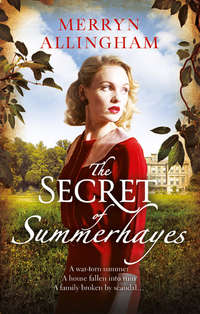
Kitabı oku: «The Secret of Summerhayes»
Also by Merryn Allingham
The Crystal Cage
The Girl from Cobb Street
The Nurse’s War
Daisy’s Long Road Home
The Buttonmaker’s Daughter
MERRYN ALLINGHAM was born into an army family and spent her childhood on the move. Unsurprisingly, it gave her itchy feet and in her twenties she escaped from an unloved secretarial career to work as cabin crew and see the world. The arrival of marriage, children and cats meant a more settled life in the south of England where she’s lived ever since. It also gave her the opportunity to go back to ‘school’ and eventually teach at university.
Merryn has always loved books that bring the past to life, so when she began writing herself the novels had to be historical. She finds the nineteenth and early twentieth centuries fascinating eras to research and her first book, The Crystal Cage, had as its background the London of 1851. The Daisy’s War trilogy followed, set in India and London during the 1930s and 40s.
Her latest novels explore two pivotal moments in the history of Britain. The Buttonmaker’s Daughter is set in Sussex in the summer of 1914 as the First World War looms ever nearer and its sequel, The Secret of Summerhayes, thirty years later in the summer of 1944 when D-Day led to eventual victory in the Second World War. Along with the history, of course, there is plenty of mystery and romance to keep readers intrigued.
If you would like to keep in touch with Merryn, sign up for her newsletter at www.merrynallingham.com

Contents
Cover
Also by Merryn Allingham
About the Author
Title Page
Chapter One
Chapter Two
Chapter Three
Chapter Four
Chapter Five
Chapter Six
Chapter Seven
Chapter Eight
Chapter Nine
Chapter Ten
Chapter Eleven
Chapter Twelve
Chapter Thirteen
Chapter Fourteen
Chapter Fifteen
Chapter Sixteen
Chapter Seventeen
Chapter Eighteen
Chapter Nineteen
Chapter Twenty
Chapter Twenty-One
Chapter Twenty-Two
Chapter Twenty-Three
Chapter Twenty-Four
Chapter Twenty-Five
Chapter Twenty-Six
Chapter Twenty-Seven
Chapter Twenty-Eight
Chapter Twenty-Nine
Chapter Thirty
Chapter Thirty-One
Chapter Thirty-Two
Chapter Thirty-Three
Chapter Thirty-Four
Chapter Thirty-Five
Copyright
Chapter One
Sussex, England, late April 1944
Something about the scene caught at him, some memory he couldn’t grasp. Behind him the tangled mass of alders – they were alders, weren’t they? – but before his eyes, a landscape he must have read about, or perhaps dreamt. He’d never been here before, that was certain. The last two years had been spent miles away, and though since January his regiment had been moving from camp to camp, this was the furthest west they had come. He pushed past the last few branches and received another scratch to add to all the others. The trees had long ago grown together to form an almost impenetrable barrier. The old fellow who’d given him a lift had heard the word Summerhayes and dropped him at what must have been the rear entrance. He should have stopped at the broken brick columns and found another way in, walked around the perimeter wall until he came to a main entrance. That was probably in the same ramshackle state, but the tanks would have bulldozed a path by now and the going would be easier. Very much easier. He should turn back.
But he didn’t. Something made him push on, that dream perhaps, a misty image he carried with him. Now that he was clear of the trees, he could see more than a few feet ahead. He appeared to be standing on what had once been a paved terrace. Beneath the heaps of dead winter leaves, he glimpsed terracotta. A Mediterranean colour, out of place in an English garden, or even an English wilderness. It appeared to circle what must have once been a lake but was now stagnant water, carpeted from one side to the other with giant water lilies. The air was slightly sour; it smelt of mud, smelt of must. In the centre of the lake, the remains of a statue, broken and chipped, rose strangely from out of the rampant vegetation. It was as though, wounded and maimed, it was trying to escape. Something about the place held him fast. He stood for a long time, feeling his pulse gradually slacken, the rhythm of his heart seeming to align itself to that of the earth. What kind of craziness was that? He shook his head in disbelief and as quickly as the heavy backpack allowed, made his way to an archway in one corner of the clearing. The exit, he imagined, but it was as overgrown as everything else, its laurel leaves a dense mass.
He looked back before shouldering through this new obstruction. On one side of the lake, there had been a small summerhouse but its roof was smashed and a giant vine had weaved its way through the corpse. Directly across the water, there had been another building, and he could see immediately that it was one built to impressive proportions. Now all that remained of it were two or three shattered columns and the raised dais they stood upon. It seemed to have been some kind of temple, for the pediment had crashed to the ground and taken several pillars with it. Did English gardens have temples? He supposed they must. In that instant, the sun emerged from a passing cloud and glanced across the remaining pillars, its rays flashing pure crystal. He gave a low whistle. The building was of marble. Once upon a time, this had been a wealthy place.
With some difficulty he pushed through the strangled archway, but was immediately brought up short. He was facing what appeared to be an acre of grass and brambles, at least six feet in height, and with no path in sight. Here and there huge palm trees rose out of the oversized meadow, spreading their arms in a riot of tough, sword-like prongs or half-tumbled to the ground, their hairy trunks dank and rotted. Between the palms, gigantic ferns hovered like green spiders inflated to monstrous size. He would never find his way through this, and he was running out of time. By now everyone would have settled their billets, his men would be waiting for orders and Eddie would be wondering where the hell he’d got to. His pal would be brewing coffee and if he hadn’t had to do that damned detour, he’d be drinking it alongside him. It had been a waste of time in any case; when he’d got to Aldershot, he’d found the regiment’s surplus equipment had already been despatched without any help from him. The logistics of constantly moving were a nightmare and he hoped this was the last camp they’d pitch before the push into Europe.
For months the regiment had been gradually inching along the south coast, practising manoeuvres as they went. It was common knowledge that an invasion this summer was on the cards; he was pretty sure it would only be a matter of weeks. He prayed, they all prayed, there’d be no repeat of the Dieppe debacle. The planners had called it a reconnaissance, his fellow soldiers a disaster. The element of surprise had been lost. A German navy patrol had spotted the Canadians and alerted the batteries on shore. His countrymen had faced murderous fire within a few yards of their landing craft – over three thousand killed, maimed or captured, and fewer than half their number returning to tell their story. He’d lost friends in that attack and mourned them still.
He pushed on, striking due north in the hope of finding some sign of men and machines, using his knife to hack a narrow path through grass that grew to the height of a small hut. It was hot and steamy and pungent. The backpack weighed heavier with each minute and though it was only April, the sun was unusually bright and he was forced to push back the fall of hair from his forehead and wipe a trickle of sweat from his face. But after fifteen minutes, he’d progressed just fifty yards. He stood still and gazed across at the tangle of grass and palms and ferns. He’d had enough.
He turned to go back the way he’d come. It was only then that he became aware he was not alone. Through the long stalks of grass, a pair of eyes peered at him, fixing him in an unnerving gaze. It was as though the grass itself was deciding whether he were friend or foe.
Then a small voice broke the silence. ‘Are you lost?’
Chapter Two
Bethany Merston turned into the drive of Summerhayes and saw the Canadian army had well and truly arrived. The estate had been a military base for years now, the house and grounds requisitioned at the outbreak of war, but this was altogether a far larger invasion. For several days past the clatter of men and trucks had been a noisy backdrop to life. The advance party, she’d guessed, but now it appeared the entire battalion had taken possession of the estate. And the men on either side of the drive – parking jeeps, carrying supplies, marching briskly between temporary shelters – were larger, too. They made the local population look weaklings. Unlike the natives, they’d not endured years of rationing, nor an interwar period of poor nourishment and intermittent work.
This morning, as the first trucks had rolled in, she’d walked to the village for whatever supplies she could forage, but returned with little. Neither she nor Alice nor Mr Ripley would get too fat on what her solitary bag contained. But at least she’d managed to buy cocoa powder for Alice’s night-time drink. Only a few ounces, and it would have to be sweetened with the honey she’d bartered for last week, but it would keep the old lady going a little longer. If Mrs Summer had cocoa at bedtime, she slept well. Even the drone of German bombers flying low towards London didn’t disturb her, and that meant that Beth slept well, too.
She crunched her way along the gravel drive taking care to avoid the whirlwind of activity, but walking as swiftly as she could. If the noise had penetrated to the upstairs apartment, Mrs Summer would be anxious. On reflection, her working life had altered little except to exchange the care of thirty small bodies for one elderly one. Looking after an old lady wasn’t that much different from looking after a young child. Both needed reassurance and practical help; both blossomed with kindness.
A few months ago a stray bomb falling on Quilter Street had obliterated the Bethnal Green school where she worked. It was a miracle it had happened at night and there had been no casualties, but it had left her jobless. Thank goodness, then, for the advert in The Lady. Within weeks she’d found the post at Summerhayes, though it was one she had never imagined for herself. But in wartime needs must, and a war spent here was as good as anywhere. The Sussex countryside was beautiful and the estate, though fallen into disrepair, still retained a little of its former glory. Above all the place was tranquil and, coming from a ravaged London, she was grateful for its peace, though now the Canadian army had arrived in force, peace might be a lost treasure.
One or two of the soldiers glanced curiously at her as she made her way to the side door, but she managed to slip into the house without attracting too much attention. She slid past the drawing room, catching a brief glimpse of several officers’ caps on the mantel shelf, past the dining room where desks were being shifted and typewriters arranged, and then up the stairs to the apartment she shared with Alice, all that was left for the old lady of the magnificent Arts and Crafts mansion she had once inhabited. Almost certainly the senior officers would be billeted in the house, while junior officers and their men were consigned to tents in the grounds. Or maybe this time they would build more permanent structures, though she doubted it. Rumours of invasion were rife and the battalion was unlikely to stay long.
Everyone was aware that the military had increased hugely of late, a steady flow of army units turning into a flood. The whole of Sussex had become a vast, armed camp. Mortars and artillery had long been familiar sounds on the South Downs, along with the screech and clatter of tank tracks in the surrounding villages, but now you couldn’t walk a country lane without being passed by a ten-ton truck or a speeding jeep. On her last visit to the village, she’d had to jump into a ditch to avoid a rogue tank trundling down the narrowest of roads and filling it from hedgerow to hedgerow.
She had reached the cramped staircase to the apartment when the wailing hit her. Mrs Summer! She raced up the remaining stairs, fumbling for the key as she went. The new girl from the village had begun work today and Beth had thought it safe to disappear for an hour and leave her to keep an eye. Molly had been cleaning the small kitchen when she’d left, but when she finally burst through the door, the girl was nowhere to be seen. Instead, Beth found the old lady in the sitting room, hunched into the corner of a wing chair, her body rocking back and forth to the rhythm of her cries. Beth glanced wildly around and her heart sank. A white envelope. Another letter. Ripley had been told to make sure that no such letters were delivered to his mistress, except via Bethany. But the former footman was an old man, a pensioner now rather than a worker, and he would be lying down on his bed for a morning nap. She had given the same instructions to Molly before she left, but the girl had clearly forgotten.
‘Mrs Summer, it’s all right, I’m here.’
She flung the bag to the floor, unmindful that their week’s rations would be squashed out of recognition, then knelt down at the elderly woman’s side and took her in her arms, holding her close and trying to calm the demented rocking. Very gradually, Alice became still and the sobs ceased. Beth stroked the thin, grey hair into place and fished in her pocket for a handkerchief to dab tears from the deeply lined cheeks.
‘But it’s not all right.’ Alice looked up, her eyes pools of sadness. ‘It’s not all right,’ she repeated. ‘She isn’t coming.’
Beth took the envelope that the old lady was still clasping and extracted a single sheet of paper. With growing anger, she read: The journey has been difficult but I’ve arrived in London at last. I will try and get to you soon. You know that is what I want above all else. But I’m feeling so tired that I’m not sure now I can make it as far as Sussex. I will write again when I feel better.
Someone was playing tricks, Beth was sure. It was cruel beyond belief. The letters were typewritten and never signed, but Mrs Summer had become convinced they came from a daughter who had disappeared thirty years ago. Why the old lady believed this, Bethany wasn’t sure. It was perhaps a simple longing for it to be true. Elizabeth Summer, she’d learnt, had never contacted her family since the day she’d eloped to marry a man of whom they disapproved. Could a much loved daughter be so callous as never to have written? Beth thought not. After all these years of silence, it was most likely that the woman was dead.
When Beth had first met her employer, it seemed that Alice Summer had thought so, too. But then the letters had started to arrive – as far as Beth knew, none had come earlier – and the old lady had become convinced that Elizabeth was still in the world. It was pointless to argue away her belief. In some corner of her mind she must always have kept her daughter alive. Hadn’t May Prendergast said that despite her long standing opposition, Mrs Summer had eventually agreed to employ a companion on the basis of a single name? Bethany, Beth, Elizabeth. The letters must have ignited a long suppressed desire and given it heart. Beth hadn’t told May about the letters, and Mr Ripley and Molly Dumbrell knew only to intercept them. The fewer people who knew of Alice’s fantasy, the better.
She took the sheet of paper and folded it back into the envelope. She would destroy it, as she had with the others, and hope Mrs Summer might forget she had ever received it. She stayed kneeling by her side, continuing to cuddle the meagre frame until she felt Alice relax a little. ‘Shall I put the kettle on?’ she said brightly. ‘We can talk over tea – I’ve some news for you from the village.’
She’d hoped this might spark interest, but the elderly woman continued to stare into her lap.
‘I met May,’ she pursued.
‘May Lacey?’ Alice lifted her head.
‘Her mother sends you her very best wishes. She’d love to come and see you, but May says that she’s almost bed-bound now.’ Mrs Lacey had once been the housekeeper at Summerhayes.
‘She was a good worker,’ Alice mused, the past as always having the power to animate. ‘A trifle sharp at times, but a good worker. And her daughter – she was a bonny girl. She did well for herself, she married the curate – May Prendergast she became – and then she got to be the vicar’s wife. Fancy that. It was a shame he died. It’s not a happy thing being a widow and this new man at the church – tsk. I’d not give him the time of day. He is far too opinionated, far too sure of himself.’
That was probably what a vicar should be, Beth reflected, but the thought remained unspoken; it was clear that Alice liked her religion vague. ‘Mrs Lacey may not be able to visit, but May will come.’ She paused at the sitting room door. ‘She’s promised to call in later this week. She has some new children to settle in the village first. They’re evacuees from Brighton – apparently the house they’ve been staying in has been declared unsafe.’
She looked forward, as much as her employer, to May’s visits. Despite their age difference, the two of them had become good friends in the few months she had been at Summerhayes. It had been May who had placed the advertisement in The Lady.
We had the devil’s own job to persuade her to get help, May had said. Me and Mr Ripley between us. She doesn’t like change and the thought of someone new in the house sent her frantic. But then she saw your letter – you’d signed it Beth – and that was enough.
Beth never used her full name if she could possibly help it. Bethany had been her father’s choice, but it served to remind her always of an old shame and of her difference from the new family her mother had created. In this case though, it had worked to her advantage. A letter signed Beth had won her the job, that and the fact that she was not much older than Elizabeth Summer had been when she had disappeared. Alice must have been thinking of Elizabeth long before the letters arrived. Letters and long lost daughters, it was an alchemy, but it had given her employment when she was desperate for work and desperate to avoid a forced retreat to the home she hated and the family who didn’t want her.
‘Will Ivy come with her?’ Alice asked. ‘When May visits?’
‘Ivy is married now, remember? That’s why May advertised in the magazine. That’s why I’m here.’
‘I remember. Of course I remember. Dear Ivy. Such a stalwart girl. And she was Elizabeth’s maid before she was mine.’
‘I know, Mrs Summer.’ Alice must have told her a dozen times already. It was as though the missing girl had come to dominate her mind to the exclusion of all else.
‘Yes,’ the old lady was saying, ‘she and Elizabeth were maid and mistress, but that didn’t matter. They grew up together and were the best of friends. Ivy knew all Elizabeth’s secrets.’ Alice turned to look out of the window. The scene below was one of frenetic activity, but it was clear that she saw none of it. ‘All her secrets,’ she repeated, ‘except where she’d gone. Elizabeth never told her that. She didn’t want to get the girl into trouble.’
The old face drooped and a tear formed in the corner of her eye. She looked hopelessly around, then caught sight of the letter still in Beth’s grasp. With difficulty she wriggled to the edge of her seat, tensing her feet on the floor, as though she would launch herself forward. Then, with both hands, reached out for the oblong of white paper.
‘I’ll put it on the mantelpiece for now and make the tea,’ Beth said hastily.
Chapter Three
The kitchen was looking bright and clean. At least Molly knew her job even if she couldn’t remember instructions. They rarely drank tea before evening and Beth hoped there would be enough to last them the next seven days. Standing in the grocer’s this morning, it seemed as though the number of coupons in their ration books shrank by the week. She put the kettle to boil and found two clean cups. It was then she became aware that the kitchen table was smothered in flowers: a wonderful bouquet of yellow freesias and white lilies. Molly must have taken delivery of them before she left. There was a card attached and she bent to read. To dear Aunt Alice. I hope these cheer you. Gilbert.
Such a kind thought. Gilbert Fitzroy had left on business but despite all the rush and bother of departure, he hadn’t forgotten his aunt. She hoped Alice would say thank you when he returned, though she couldn’t depend on it. Gilbert might be a devoted nephew but his aunt was slow in returning his regard. Whenever he called, it seemed that Alice was too tired to see him, or she was listening to her favourite wireless programme and didn’t want to be disturbed, or it was time for lunch or tea or supper. Beth had so far been unable to discover what the problem might be. No doubt the root of the trouble lay in the past since this was where Alice dwelt for most of her waking hours. Gilbert appeared unfazed by his aunt’s evident lack of affection and continued to enquire of her health and, from time to time, sent small gifts from the Amberley estate, including today’s magnificent flowers filling the small kitchen with their perfume. She would have noticed them earlier if her nerves had not been so jangled. She must thank Gilbert as soon as he got back, even if his aunt did not. In the meantime, she would do her best to return the favour by teaching his son as much as Ralph was willing to learn. So far, that hadn’t proved a great deal; Ralph was not an academic child.
She went back into the sitting room and handed Alice her cup of tea, making sure the old lady had a firm hold of the saucer. Then she returned to the kitchen and gathered up the bouquet. ‘Look, you have flowers, Mrs Summer. Aren’t they splendid? I hope I can find a vase that’s big enough. Perhaps the Venetian one?’ That was Alice’s favourite.
The old lady’s face brightened. She loved flowers, loved colour. ‘I always had fresh flowers, every few days. Mr Harris – he was the Head Gardener – he’d cut me new blooms and they would fill the house.’
‘They must have looked lovely – and smelt lovely, too.’
‘They did. The house was very beautiful. I didn’t realise how beautiful. I should have enjoyed it more. Now this is all I’m left with.’ She waved her hand at the sitting room and the narrow hallway beyond, while Beth jumped to her feet to rescue the tea. Undeterred, Alice went on. ‘You see, I was brought up at Amberley, and it was always Amberley where I wanted to be.’
When Beth made no reply, she said, ‘Do you know it?’
Amberley was Gilbert Fitzroy’s home. ‘I know of it. It’s the estate that adjoins Summerhayes.’
‘It belonged to my parents,’ she said fiercely, as though Beth’s description had somehow disputed its ownership. ‘And then to my brother, Henry.’
‘And now to your nephew.’
Alice looked blank. ‘Gilbert,’ Beth said gently.
‘Inheritance knows no distinction,’ she muttered.
Beth had no idea what she meant, but she was concerned that at any moment the conversation would lead back to Elizabeth. ‘Talking of Amberley, these flowers are from their greenhouse. Gilbert must have asked his gardener to pick them especially for you.’
The old lady sniffed. The subject was evidently closed. ‘Can I pour you another cup?’ She thought the pot would just about run to it, though the liquid looked more like straw than tea.
‘You make a good cup of tea, Bethany. Better than Ivy, she never managed to cope with rationing.’
‘Now that she’s married to a farmer, it will be less of a problem.’
‘But Higson isn’t a farmer. Not any longer. He sold the farm – the military paid a good price for it, I believe, and that decided him. He bought a bungalow in Devon, on the coast. A place called Solmouth, Sidton…’
‘Sidmouth?’
‘That’s it. He asked Ivy to marry him before he left. She’d been a good girl to him ever since his wife died.’
‘So a happy ending?’
It didn’t seem that happy to Alice. She gave a long sigh. ‘I miss her. She was with me for so many years. Not that I’m not glad for her. Mr Higson is some compensation. She lost her first love, you know. Poor Miller – such a tragedy. He was our chauffeur, but they found him in the garden at the bottom of the estate. Drowned.’
An uncomfortable tingle started in the nape of Beth’s neck and slowly spread the length of her spine. She had walked that way once and been startled how uneasy she’d felt. There had been a kind of darkness to the place that had sent her scurrying. Afterwards she’d scolded herself for being foolish, but was it possible that the garden still held fast to a bad memory?
‘I’m glad for her,’ Alice repeated. ‘She did well for herself. And May Lacey, too. Girls from humble families. Whereas my daughter threw herself away on an Irishman without a shirt to his back. It’s a different world these days.’
Beth agreed, but she’d been only half listening. She should go in search of Ralph. She was already beginning to regret her agreement with Gilbert. The war had closed the boy’s school last year and he was woefully behind with his studies. It might have been better if his father had looked for a full-time tutor. Teaching at the same time as caring for Alice was proving a challenge, and she’d had to cancel the last two lessons. Ralph had been happy with the chance to escape since he had far more interesting things to do than sums and composition, but she couldn’t let it happen again. Today she’d told herself that she would have at least two hours with him and here was Mrs Summer, trying for an outward calm, but still deeply upset. She could see how disturbed the old lady remained from the way she was holding her cup, rattling it badly in its saucer.
Alice had an inner toughness, Beth had discovered, and she wouldn’t like it that she’d been found crying. She was trying hard to put on a brave face, but the letters had caused damage. The first one had arrived a month back, shortly after Beth had come to Summerhayes. She’d been stunned when she’d learnt the tragic history of this otherwise unremarkable woman: a husband and son prematurely dead and a daughter who seemingly had disappeared from the face of the earth at just nineteen years old. That first letter had brought all the sadness that Alice carried struggling into the light.
The letters were anonymous, but from the beginning they’d indicated that the writer, whoever they were, was bound for Summerhayes. The first one had been postmarked Southampton, suggesting a traveller from abroad, but then the second and third had come from London. In each letter the unknown writer had claimed to be drawing nearer to Summerhayes, promising Alice a loving reunion. Until today. Today the promise had been withdrawn; hence the old lady’s cries of despair. But if the writer were honest in seeking Alice, why had they gone to London? Why not travel directly to Summerhayes from Southampton? But they weren’t honest, were they? Otherwise they would have signed the letters, along with their protestations of love, and Alice would know for sure who would call and when. For a short while, the old lady’s iron certainty that the letters came from her daughter had made Beth question if, in fact, Alice were right, and that perhaps the writer was an unstable woman, disturbed enough to contact her mother anonymously. But there was too much deliberation in the pattern of the letters; that suggested a calculating mind determined to cause the maximum pain. Alice was being played with, Beth thought, but why and to what purpose, she couldn’t tell. All she could do was try to protect the poor lady as best she could.
She rescued the rattling cup and cast around for a way to soothe her elderly charge. ‘Shall I start another illustration?’ Alice loved to watch her draw, no doubt because the lost daughter had been an artist and in some small way Beth’s sketch pad reminded her of happier days.
With an effort, the old lady agreed. ‘That would be nice, my dear. What is it to be?’ She pulled herself upright and arranged her face to appear interested.
‘Let me see… we’d reached the point where Izzy is lost.’ Beth brought her companion up to date with the progress of the story. ‘If you remember, she escaped from the cottage when she was told to stay there, and now she can’t find her way out of the Tangled Wood.’ Izzy was the naughty heroine who one day, Beth hoped, would entrance a young audience. She found her pad and a handful of sharp pencils, and settled herself in the chair opposite. A forest scene would make an interesting subject. For a while, the only sound in the room was the slight scratching of pencil on paper. Then Alice spoke into the silence. ‘You do know we have an artist’s studio here? It’s in one of the attics, so the military won’t have taken it over.’
Sometimes Alice’s mind was as sharp as it must have been twenty years before. She was aware of the army’s presence in the building, aware of how much space they occupied. Beth hoped she wasn’t aware of the damage several changes of military personnel had caused to the splendid house she had once called home.
‘I know about the studio, Mrs Summer, but a sketch pad and pencil is all I need. I’m not a genuine artist – just a writer and illustrator. It’s a hobby for me.’ But one day, it might not be. One day, it might be a serious undertaking and earn sufficient money to bring her true independence. In the meantime, it was useful in deflecting Alice from her obsession. Though apparently it wasn’t going to deflect her today.
‘Elizabeth was an artist,’ she announced. ‘I have the pictures she painted – somewhere.’
‘There’s one in your bedroom, I think. And very good it is, too.’
The old lady looked gratified. ‘There are others. Lots of them. Maybe in the old studio?’
Beth had been there once and found it a chaotic jumble of mouldering furniture and broken boxes. She’d had to push past thick, furry cobwebs to get into the room and when she did, had seen immediately that part of the roof must have lost tiles because a steady drip of water had found its way through and was pooling the floorboards. She’d got Mr Ripley to fetch a bucket and asked him to remember to empty it whenever it rained. But she’d said nothing to Alice of the state in which she’d found the place. Fortunately, the old lady never went further than her own few rooms – a sitting room, a bedroom and a bathroom. Beth herself slept in what at a stretch could be described as a box room and Mr Ripley bravely inhabited one of the spare attics.
‘Let me see.’ Alice leant forward. ‘The trees are beautiful.’ She pointed to the tall, slender columns of birch that Beth had drawn, fingering their outline on the page. Their delicate leaves shadowed the winding path that the small girl would tread. ‘It is such a pity that you don’t paint. Colour would bring the image to life.’
She feared the mention of paint and colour would bring Elizabeth into the conversation once more. ‘Shall I draw Izzy into the picture? I think she’ll be happy on her adventure – to begin with at least.’
‘Yes, do that.’ Alice’s voice was weary now, her eyes heavy-lidded, and before Beth had finished the illustration, the old lady was breathing heavily. She fetched a blanket from the bedroom and tucked it around the sleeping woman. She should just have sufficient time to find Ralph and haul him up the stairs for his lesson. He was bound to be in the grounds somewhere, though finding him amid the mayhem of a military arrival could prove difficult. But if she knew the boy, he would most likely be sitting on the largest tank or questioning the gun crew on their stock of ammunition. She edged the front door shut and sped down the stairs.
Chapter Four
The small boy had emerged from the thicket of grass, but he was inches away before Jos could see his entire person: his hair a thatch of light brown, his smile engaging, and his bare knees scratched and muddied.
‘I’m Ralph.’ He held out his hand.
‘Jos Kerrigan.’ They exchanged a solemn handshake. ‘You seem to know your way around this wilderness,’ Jos said. ‘Do you live here?’
‘Not here but next door – at Amberley. It’s much more fun here though. We don’t have any soldiers at Amberley.’
‘So can you show me how to get out of this darn place? Or is it all like this?’
Ralph considered the question judiciously. ‘This is the worst bit, I think, but the whole estate is pretty run down.’ That seemed an understatement to Jos. ‘I can take you to the main camp, if you like?’
‘I’d like that fine. Do you spend a lot of time there?’
‘When I’m allowed to,’ the boy said simply. ‘There’s been a camp for ages, but this week there’s been loads going on. And I’ve made a special friend.’
He was intrigued. ‘And who’s that?’
‘His name is Eddie. Eddie Rich.’
‘Is that so? He just happens to be my special friend, too.’
Ralph’s grin spread across his face. ‘He’s the bee’s knees, isn’t he?’
Jos’s deep blue eyes lit with amusement. ‘He sure is.’
‘It’s getting hot out here.’ The boy patted several stalks of grass away from his face. ‘Shall I take you to him?’
‘I’d appreciate that, Ralph.’
‘C’mon then.’ He turned round and traced a path along what Jos thought must be the thinnest line of flattened grass he’d ever seen, just wide enough for a nine year old’s feet but way too narrow for his own size twelves.
‘I’m crushing a heck of a lot of grass here,’ he called to Ralph, a few steps ahead. ‘Will it matter?’ Why it would, he couldn’t imagine.
‘It doesn’t matter at all. No one comes here except me, and it will make it easier the next time I go to the secret garden. That’s what I call it. It’s where you came in. It will make it easier for you, too, if you want to go back.’
He had no intention of ever returning to this maze of heat and bother. The grass tickled at his nose and infiltrated his ears, and on occasions he had to sway to one side to avoid a giant fern or be knocked uncomfortably into the rough trunk of a palm tree.
‘So why aren’t you at school?’ he asked conversationally, more to distract himself from the discomfort of the journey, than from any real desire to know.
‘My school’s been closed. It was just outside London, and they said it was too dangerous for us to stay.’
‘You lived at the school?’
‘Of course. I was a boarder.’
He’d heard that English families often sent their young children away to school but he’d never really believed it.
‘And now?’
‘The school moved up to Cheshire. At least, I think it was Cheshire. I don’t really know where that is.’ Neither did Jos, but it seemed strange that the child hadn’t moved with it. He must have felt settled in the school, had friends there. It seemed like a lonely life for him here.
‘My father didn’t want me to go,’ Ralph explained. ‘When I was at school near London, I could come back at weekends, you see, but Cheshire was too far. I don’t think he wanted to be on his own at Amberley all the time.’
He didn’t like to ask about the boy’s mother, fearing there had been some kind of wartime tragedy, but then Ralph said, ‘My mother’s a long way away. She’s in New York. She’s American.’
‘So it’s just your dad and you?’
‘That’s right. Well,’ Ralph said over his shoulder, ‘there are other people. Quite a few actually. There’s the butler, and the footman, and the parlour maid, and cook and a kitchen maid, and the gardener and the chauffeur…’
‘I get the picture.’
‘I could have gone to the village school, but Daddy didn’t want me to. He was going to hire a tutor and then Miss Merston came and she’s teaching me instead. It’s heaps better.’
‘And who is Miss Merston?’
The ground had gradually been sloping upwards, but in the last few yards it had taken on an even steeper incline. Beneath the weighty backpack, he was beginning to puff slightly and that didn’t please him. He’d thought himself fit enough, but he’d need to be a good deal fitter come invasion day.
‘Miss Merston is great. She rescued a bird’s nest with me last week and I’m helping the eggs to hatch. She’s a school teacher.’ Ralph sensed a little more explanation was needed. ‘She doesn’t have a school any more either, and she looks after my father’s aunt. That’s my great-aunt. Her name is Alice and she’s very old.’
They had finally emerged from the jungle of long grass and reached a gravel path. Jos breathed a sigh of pleasure, feeling solid ground beneath his feet again. He allowed himself a short stop and looked around. He was standing in what had once been a vegetable garden, he could see. Vegetable gardens, he corrected himself. The area was immense and bounded to the south by a circular brick wall against which some dessicated fruit trees still clung to a semblance of life. Vegetables had not been grown here for many a year; the soil was untilled and broken canes, rotting wooden staves and remnants of netting were strewn across its surface. In the distance, to the right, stood what was left of a string of greenhouses, their glass long shattered. Nearer to hand, a tarpaulin covered the unknown. He’d put his life on it being ammunition. It was a dismal picture and made him keen to walk on, but once through the brick arch the view was no improvement. More tarpaulins, more mounds. Several trees had been toppled and lay spread-eagled where the wind had blown them, others had brambles up to ten feet high climbing their trunks. He passed what he thought must be one of the oldest trees in the garden, stoic in its lost grandeur. A fig tree, he was sure of it. Scattered in its branches was shrivelled fruit, unharvested year on year. The gnarled trunk was punctured by bullet marks and when he looked around, he saw that nearly every surviving tree in this part of the garden was similarly afflicted. Someone had been using them for target practice. Whatever devastation had existed before the war, a succession of military occupations must have made it worse.
‘This place is in poor shape,’ he said.
Ralph looked puzzled. It was evident that for him the Summerhayes estate was fine as it was. ‘I s’pose,’ he admitted cautiously. ‘It used to look different. I saw an old photograph once. But that was a long time ago.’
The boy was still ahead of him, walking beneath the pergola that connected fruit and vegetables with the upper reaches of the garden. The pergola had once been covered by roses and its wooden structure was more or less intact, but what plants remained had grown wild, their thorns a danger to passers-by. Dodging between waving suckers, he could see lying ahead another huge open area, once a vast lawn, he presumed. At its far end was a semicircular flight of steps leading up to a flagged terrace. He could imagine the ladies of the house taking a stroll on that terrace, tripping daintily down the steps to the rolling grass. Now, not a blade was visible. The lawn had been covered in concrete and a row of trucks parked tidily across its expanse.
Noise and bustle were all around. Troops were still arriving, each truckload of men making their way to an adjoining farm where they’d pitch the tents that would be their home. Given the vagaries of the English weather, it wouldn’t be a particularly comfortable home, and he hoped that his own billet was nearer to hand – in the gardens, perhaps, despite their dilapidation. The closer he was to the house and offices, the less wading through mud he’d have to do if it rained hard.
Ralph had stopped and was looking back at him. ‘Eddie’s this way.’
He was a smart kid, Jos thought. It was a new camp with a completely different configuration from the previous one – the forward party had arrived only three days ago – yet the boy already knew his way around. Several young soldiers saluted as they passed and he managed a ragged salute in reply. The backpack was to blame.
Ralph looked up with another big smile. ‘Are you an officer then?’
‘A very junior one, kid. Eddie is too.’
‘I know. He told me. He’s in the outbuildings. We have to go this way. Have you known him long?’
‘A fair time. We joined up together when we weren’t much older than you – we’re both from the Toronto area. That’s eastern Canada.’
‘I know where it is. I’m good at geography. Well, sometimes,’ he added, evidently remembering his problem with Cheshire. ‘Have you been together ever since?’
‘We’ve been posted to different regiments in between time, but when Canada joined the war we ended up in the same battalion again.’
‘Have you been fighting together as well?’ The boy’s face sparked with excitement.
‘Oh yeah, fighting too.’ And that was some fighting. Italy. Monte Cassino. He’d been so very glad to have Eddie alongside.
A young man was shambling towards them, blond hair glinting in the spring sunshine and his gold flecked eyes warm with welcome. ‘He’s here!’ Ralph forgot his dignity and jumped up and down as Eddie came into view.
Eddie Rich wore his uniform as though it were something he’d found by chance while rummaging through a forgotten trunk, but when you looked again, Jos thought, you noticed the straight back, the sinewy arms and an expression that didn’t quite disguise a sharp intelligence.
‘Well, Ralphie, just look who you’ve found.’
‘He was lost.’
‘If he’s walked up from the depths, I bet he was.’ Eddie put his hands on Jos’s shoulders and gave him a quick hug. ‘Great to see you, pal. But what were you doing in the badlands?’
‘That’s what he calls the bottom of the estate,’ Ralph explained.
‘I was dropped off at what must have been the rear entrance, though I guess it’s not been used for a century. I tried walking up from there.’
Eddie pulled down the corners of his mouth, but his eyes laughed. ‘Not so great. Ralph to the rescue, eh?’
‘Ralph to the rescue,’ Jos agreed. ‘So when did you get here? How are things going?’
‘I came with the advance party, but the rest of the guys arrived today. They made pretty good time from Winchelsea, but as always, it’s chaos. You know the drill. How about you? How was that jewel of a town?’
‘The same as when we left it four years ago. And a completely wasted journey. Someone – God knows who – had already ordered what was left of our equipment to be sent on here. Has it arrived yet?’
‘Not that I know of, but it’s early days. So you didn’t hang around?’
‘We’re talking Aldershot, Ed. Mind you, this place doesn’t look much better.’
‘It’s seen grander days, for sure, but it’s okay. The house is kinda nice, or it was once. The colonel gets to sleep there, of course. We’re over here. I’ll show you the way. We’ve been given the Head Gardener’s office, would you believe?’
‘No tent? How did you pull that one?’
‘Don’t get too excited. We’re sharing with Wilson and Martel. And the office is twelve by twelve.’
‘We’ve still gone up in the world, I reckon. Lead on!’ He turned to Ralph who was looking uncertainly between the two men. ‘You better scoot now, but thanks for rescuing me.’
‘Before he scoots,’ Eddie put in, ‘I think a reward is in order, and I might have just the thing.’ He fished in one of his trouser pockets and brought out a small bar of chocolate.
‘Chocolate,’ Ralph breathed ecstatically.
‘He can have that later, when he’s finished his lessons.’ The voice was no nonsense but vaguely amused.
Jos turned and saw a girl that he wanted to keep looking at.
Ücretsiz ön izlemeyi tamamladınız.