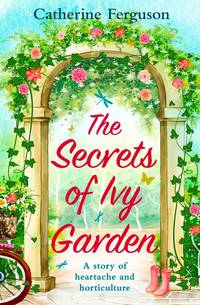
Kitabı oku: «The Secrets of Ivy Garden: A heartwarming tale perfect for relaxing on the grass»
CATHERINE FERGUSON
THE SECRETS OF IVY GARDEN

Copyright

This novel is entirely a work of fiction. The names, characters and incidents portrayed in it are the work of the author’s imagination. Any resemblance to actual persons, living or dead, events or localities is entirely coincidental.
AVON
A division of HarperCollinsPublishers
1 London Bridge Street
London SE1 9GF
www.harpercollins.co.uk
Copyright © Catherine Ferguson 2017
Catherine Ferguson asserts the moral right to be identified as the author of this work
A catalogue record for this book is available from the British Library
All rights reserved under International and Pan-American Copyright Conventions. By payment of the required fees, you have been granted the non-exclusive, non-transferable right to access and read the text of this e-book on screen. No part of this text may be reproduced, transmitted, down-loaded, decompiled, reverse engineered, or stored in or introduced into any information storage and retrieval system, in any form or by any means, whether electronic or mechanical, now known or hereinafter invented, without the express written permission of HarperCollins.
Source ISBN: 9780008253356
Ebook Edition © April 2017 ISBN: 9780008215736
Version: 2018-05-11
Dedication
For Ian and Krysy
Table of Contents
Cover
Title Page
Copyright
Dedication
Prologue
Spring
Chapter One
Chapter Two
Chapter Three
Chapter Four
Chapter Five
Chapter Six
Chapter Seven
Chapter Eight
Chapter Nine
Chapter Ten
Chapter Eleven
Chapter Twelve
Chapter Thirteen
Chapter Fourteen
Chapter Fifteen
Chapter Sixteen
Chapter Seventeen
Chapter Eighteen
Summer
Chapter Nineteen
Chapter Twenty
Chapter Twenty-One
Chapter Twenty-Two
Chapter Twenty-Three
Chapter Twenty-Four
Chapter Twenty-Five
Chapter Twenty-Six
Chapter Twenty-Seven
Chapter Twenty-Eight
Chapter Twenty-Nine
Chapter Thirty
Chapter Thirty-One
Chapter Thirty-Two
Chapter Thirty-Three
Chapter Thirty-Four
Autumn
Chapter Thirty-Five
Chapter Thirty-Six
Chapter Thirty-Seven
Winter
Chapter Thirty-Eight
Chapterr Thirty-Nine
Chapter Forty
Acknowledgements
Keep Reading…
About the Author
By the Same Author
About the Publisher
Prologue
We stood on the dusty railway platform, Ivy and I, saying our goodbyes.
The August sun burned down, making my hangover worse. (It turned out that Ivy’s home-made rhubarb and ginger wine was rather more potent than even she had realised.) I thought longingly of the cool interior of the train, imagining myself sinking into a seat and closing my eyes to ease the ache that was pulsing at my temples. My journey from the Cotswolds up to Manchester involved several changes with a long wait between connections, but it had to be done. I was due back at work in the café next day. Not to mention the fact that I was keen, as usual, to escape the countryside and get back to my home in the city, even though I hated leaving Ivy.
‘Will you get a taxi at the other end?’ Ivy looked worriedly at my weekend bag, which was stuffed so full, the zip was in danger of bursting. ‘That looks really heavy.’
I nudged her affectionately, hoisting the bag further up my shoulder. ‘I’ll survive. Don’t worry. I’m a big girl now.’
She smiled, forget-me-not blue eyes crinkling at the corners, her face tanned golden brown and etched with lines from a summer spent in the garden. ‘You might have just turned the ripe old age of thirty, but I’m always going to worry. Show me a grandma who doesn’t.’
‘Especially one who’s a mum and dad to me as well.’ I pulled her into a hug, which was a little awkward because of the bag.
‘I’ll phone you when I get back to Manchester,’ I added when she didn’t reply.
Pulling back, I realised she hadn’t even heard me. She was staring directly over my shoulder at the opposite platform, and I turned, wondering what had caught her attention. Around a dozen people with bags and suitcases – some in little groups – were standing waiting for their train to arrive.
‘What is it?’ I asked, not recognising anyone.
The intensity in her eyes took me by surprise. ‘There’s something I need to tell you, Holly,’ she murmured.
I felt a twinge of apprehension but disguised it with a laugh. ‘That your rhubarb and ginger wine is at least thirty per cent proof? It’s all right. I already know that, to my cost!’
She gripped my forearms. ‘Can you take a later train?’
I shook my head. ‘This is the last one of the day.’
‘So go back tomorrow.’
The Manchester train appeared round the bend. We watched as it glided to a halt and passengers began alighting on to the platform. Panic fluttered in my chest. Ivy and I didn’t have secrets. We knew everything there was to know about each other.
What was it she needed to tell me?
My heart fought with my head. ‘I’d love to stay another night, but I’m back at the café tomorrow morning, remember? And Patty’s already short-staffed as it is, with people off on holiday.’
Ivy nodded, seeming to recollect herself. ‘Of course. I’m being silly.’ She forced a smile and let go of my arms. ‘You have to get back.’
People were climbing aboard the train now, and the guard was walking along the platform, getting ready to blow his whistle.
I took her hand and squeezed it gently. ‘I’ll phone later and we can talk then?’
She kissed me on the cheek and shooed me into the carriage. ‘Quick, quick, or it’ll leave without you.’
I found a seat and sat on the edge of it, still gripping my bag, full of uncertainty. Ivy had held my arms so tightly when she asked me to stay. Perhaps I should slip off the train and phone in sick tomorrow?
But when I looked out on to the platform, she was smiling and waving, back to her normal self, and I thought maybe I’d imagined the flash of despair in her eyes when she begged me to change my plans. Ivy was forever saying the times we saw each other went by far too quickly. Perhaps she simply wanted to prolong our precious weekend together
At the exact same moment, we both realised she was waving with a paper bag full of chocolate orange cupcakes that were meant for me. A speciality of the village bakery in Appleton, where Ivy now lived, they were our all-time favourite cakes and Ivy brought some for me whenever she came to visit me in Manchester. So then, of course, I had to rush to the door and grab the bag before the guard blew his whistle and all the doors closed.
As the train drew out of the station, we were both laughing – me flopped back in my seat, breathless and giggling, and Ivy on the platform covering her face with her hands in mock horror.
She blew me a kiss as the train drew out of the station.
I never saw her again.
Eight months later
Spring
‘You can cut all the flowers but you cannot stop spring from coming’
– Pablo Neruda
ONE
I know I’ve cocked up again when Patty abruptly abandons the milk she’s frothing, and puts her arm around me.
I swivel my eyes at her in alarm.
My boss showers her dogs with love. But I’ve worked with her long enough – fourteen years to be precise, from being a Saturday girl at sixteen – to know that she’s fairly reserved when it comes to showing affection for actual people.
‘Oh, God.’ I bite my lip and throw a glance at the queue of lunch-time customers. ‘What did I do this time?’
Patty’s mouth quirks up at the corner. ‘You’ve just given poor Betty spicy tomato pickle with her fruit scone.’
I glance over in horror.
Betty, one of our elderly regulars, is removing her coat and settling herself at a corner table, clearly relishing the prospect of taking the weight off her bunions and tucking into a delicious home-baked scone with strawberry jam and cream.
She’s in for a nasty surprise.
Patty grabs me before I have a chance to charge over, and the empathy in her eyes almost floors me.
Ever since Ivy died, I’ve been walking around in a sort of stunned daze, doing things on autopilot. Which is why, I suppose, I gave Betty spicy tomato pickle instead of strawberry jam. And burned my hand on the coffee machine last week. As well as carefully spreading a mountain of rolls with gloopy baking fat before Patty noticed and stopped me. ‘Not sure our customers would appreciate the irony of having lard with their healthy salad sandwiches,’ she remarked dryly.
In all that time, I haven’t broken down in public even once, but all of a sudden, I’m perilously close to losing it in front of the entire café.
I dig my nails into my palms, which is meant to distract you from the emotion that’s threatening to knock you flat. It seems to work. And it’s also slightly less weird than crossing your eyes or rolling them around, other suggestions I found online.
I solve most of my practical problems online. Ivy was hopeless at DIY so I grew up tackling all the odd jobs around the house to save us money. I even fixed a leaky tap once with one of those step-by-step Wiki guides. As a result, I tend not to be daunted by tasks that other people would run a mile from.
My independent streak seems to baffle men. When they discover my parents died when I was four, they first of all think I must want to talk about it (which I absolutely don’t) and then they try to look after me and protect me from the big bad world. I should probably feel grateful. But instead, it makes me feel suffocated. That’s probably why my romantic history is peppered with fledgling relationships that I’ve ended because the guy wouldn’t give me the space I craved.
My latest doomed romance ended last summer after Adam, who I actually really liked and thought I might even be in love with, started hinting – after only three months – that we should move in together. He obviously took it as an affront when I said it was a little too early to think about that – because two weeks later, he left me for a glamour model he’d met at his local gym. I told myself I was fortunate to have found out about his shallowness so early on, and I tried not to mind when they got engaged a month after they met. Perhaps I was meant to be alone.
Ivy once told me I never gave romance a chance and she asked me if I thought I was running away from commitment. It would be natural, she said, after losing my parents so young, to fear the people I love might be snatched away from me.
Privately, I thought this was simply daft psychobabble. The guys concerned were just not for me, that was all.
‘Go and sort Betty out,’ Patty says. ‘And then go away and sort everything else out, okay?’
‘But …’ I glance at the queue of people, all staring at us expectantly.
She shakes her head, gently holding my wrists. ‘No buts, Holly. You were back at work the day after the funeral. Much too soon. And yes, I know the last thing you want to do is make the long journey back down to the Cotswolds and go through Ivy’s things …’
I swallow. ‘And get Moonbeam Cottage ready to sell.’
Just saying it makes my insides quiver. Moonbeam Cottage, in the heart of the Cotswolds, was such a huge part of Ivy’s life.
‘It has to be done.’ Patty’s tone is gentle but firm. ‘And the sooner the better, don’t you think?’ She pauses. ‘What would Ivy be saying to you now?’
I smile, tears filming my eyes. I can hear her in my head, speaking with that lovely West Country burr: ‘Don’t you stress yourself, my lover. Everything will be fine. Sooner you get down there, the sooner you’ll be back home again.’
I always trusted Ivy’s good sense above anyone else’s – except perhaps during those turbulent teen years when we fought as much as any parent and kid. She was a great mix of gentleness, modesty and steely inner strength, and I knew her better than anyone alive.
But now she’s gone …
I dig my nails into my palms until it hurts.
My grandma was special. I was so lucky to have had her in my life.
Actually, I never thought of her as ‘Grandma’. I always called her Ivy because, in reality, she was far more than just a grandmother; she was Mum, Dad and grandparent all rolled into one.
She scooped me up when I was four years old, after my parents died, and took us off to live in Manchester. Goodness knows why she chose Manchester. I once asked her why on earth she abandoned her beloved Moonbeam Cottage in the tiny village of Appleton to bring me to a big city where we knew no-one at all. She just laughed, tweaked my nose and said, ‘Isn’t that what fresh starts are all about, my lover?’
Ivy missed Mum so much – I’d hear her crying at night when she thought I was asleep – but she never ever dwelled on the day of the accident, at least not in my presence. She always said she preferred to look forward, taking me with her on our exciting ride into the future.
As a child, I piggy-backed on her zest for life; she never let fear get in the way of having an adventure – even though, on a supermarket check-out/school cleaner’s wage, the height of her walk on the wild side was our annual trip to the lights and magic of Blackpool.
Patty takes hold of my hands. ‘You don’t have to feel guilty about selling Ivy’s cottage, you know.’
I nod, unable to speak.
‘Would you want to live in Appleton? In the heart of the countryside?’ she asks gently.
‘No!’ My insides shift queasily at the thought. Visiting Ivy there occasionally I could cope with. But live in Appleton? With all the painful associations I’ve spent most of my adult life trying to push from my mind?
‘Look, love, Ivy just wanted you to be happy. She would be right behind you, whether you sold the cottage, rented it out or turned it into a refuge centre for cow-pat-hating city girls like you.’
I attempt a smile. It’s not the cow pats that are the problem, but I know that, in essence, Patty’s right. Ivy would have loved me to go with her when she moved back to the Cotswolds after she retired. But she understood that my fear of the countryside ran too deep for that. Ivy knew, as no-one else does, that the reason I cling tightly to my life here in the city is because I need to block out the past. It was why Ivy came to visit me in Manchester all the time. She wanted to make things easier for me. (Only rarely did I summon up the courage to go back to Appleton to visit her, and when I did, I could never totally relax.)
Selling Moonbeam Cottage really is my only option. I can’t drag my feet any longer. It’s now April, four whole months since Ivy died, and I’ve been putting off my trip down to the Cotswolds for far too long.
‘And don’t worry about leaving us short-staffed,’ Patty murmurs. ‘Olivia’s finished at uni and, as always, my delightful daughter is absolutely desperate for cash. So she’ll happily fill in while you’re away.’
‘She’ll do a much better job than me right now,’ I croak, feeling the familiar fears trickling in at the thought of returning to the countryside.
‘Maybe. But listen, Holly.’ Patty grips my shoulders and makes me focus. ‘Promise me you’ll take care of yourself? Take some time to get that beautiful head sorted.’ Gently, she brushes back a strand of honey-blonde hair that’s escaped from my ponytail.
She glances apologetically at the waiting customers. ‘Sorry, folks. Staff crisis. Be with you in a sec.’
‘Go,’ she hisses, handing me a ramekin of strawberry jam. ‘Your job’s here whenever you decide you want to come back, okay? Whether that’s in a month or even in six months’ time.’
Her kindness is too much. I have to get away before I break down and make a complete fool of myself.
‘Thank you,’ I mouth. Then I rush over to Betty with the jam, collect my coat and bag from the cloakroom and step outside into the blustery spring day. It’s a wrench leaving the cosy warmth of the café behind, and as the bell on the door jangles behind me and a cool breeze lifts my hair, I wonder with a pang how long it will be before I cross the threshold again. With her daily dose of light chit-chat and practical good sense, Patty has almost single-handedly kept me sane.
Ivy died on 14th December from a massive heart attack.
My memory of the run-up to Christmas and beyond is a bit of a blur, but I do remember refusing to leave my flat, despite offers from my best friends, Beth and Vicki – and also Patty – to spend Christmas with them. After the funeral in early January, I went straight back to work, even though Patty told me I needed more time to grieve. I convinced her that work was good therapy. And so for the past few months, I’ve slipped into a safe routine: keeping busy all day at the café, going home to eat and mindlessly watch TV, then sitting in the darkened kitchen, with just the pool of light from an Anglepoise lamp, to do my sketching, hour after hour, often until well after midnight when my eyes are stinging. I know if I go to bed too early, I’ll only end up lying there, staring into the darkness, fretting about the future.
I’ve always loved painting and sketching, and now it’s proving to be an absolute life-line. Ivy’s big dream for me was to study art at college when I left school. She used to say being an artist was my ‘calling’ because my paintings made people think about life and gave them pleasure. But however much I might have wanted to pursue my art as a career, I knew it was never going to be a practical option because we didn’t have the money. When Patty offered to promote me from Saturday girl to full-time staff when I was sixteen, I jumped at the chance, and I’m still there.
I still sketch, though, especially now. When I’m focused on drawing the perfect foxglove, it’s easier to keep the dark thoughts at bay.
I’ve always been the sort of practical, clear-headed person people can count on in a crisis. But since Ivy died, I’ve felt vulnerable and far less sure of myself. My insides shift queasily every time I think of making that long train journey south, leaving behind everything that’s familiar. Even telling myself it’s just for a few weeks, and then I’ll be safely back home, doesn’t seem to make any difference.
How can I bear to stay in Moonbeam Cottage if Ivy’s not there?
And then suddenly a memory blazes into my head.
Ivy and me on the waltzer in Blackpool.
We booked the same week every year, staying in the same guest house and reuniting with some other families we got to know who did the same. I loved it when I was a kid because there was always someone to play with.
No holiday in Blackpool was complete without several rides on the waltzer. Spinning round and around, clutching on to each other as the blaring fairground music swallowed our squeals. Laughing helplessly at the thrill of it all.
Scream if you wanna go faster!
Ivy always went on it with me, even though I knew it scared her. I think she worried I’d slip out of the safety belt. When we got off, she’d exaggerate her wobbly legs, staggering around to make the little kids laugh. The other mums and dads stood watching, smiling at their children and waving.
I remember feeling really proud of my fearless grandma for not letting nerves stand in her way.
Now, hurrying for home, I mentally open my wardrobe and start picking out clothes to pack. I’ll catch the train tomorrow.
I can be brave, too.
TWO
Whenever I think of the Cotswolds, where Ivy lived the last decade of her life, I think of the row of pretty golden stone cottages skirting Appleton village green and the gnarled old oak tree by the cricket pavilion. In my mind, it’s always summer there and the sky is always blue.
But when I step off the train at Stroud – the nearest station to Appleton – I’m faced with a rather different view of the Cotswolds. Storms have been raging all week, causing destruction right across the country, and today appears to be no exception. I peer out of the station entrance at people scurrying for shelter from the steady drizzle and gusty wind.
I can’t afford to hang around. There’s only one bus to Appleton every two hours – and the next one leaves in ten minutes.
Grabbing a firmer hold of my suitcase, I start running for the bus station, dodging passers-by and puddles of rainwater. As long as the bus doesn’t leave early, I should just about make it.
And then it happens.
I round the corner a little too briskly, step to one side to avoid a man with a briefcase, and instead, cannon right into someone else.
Momentarily winded, I register the black habit and white veil the woman is wearing and my heart gives a sickening thud.
Oh God, I just nearly decked a religious person!
But worse is to come.
The nun, who I notice is remarkably tall, stops for a second to regain her balance. But she lists too far to one side and ends up staggering off the pavement into the water-logged gutter.
To say I’m mortified is a vast understatement.
‘I’m so, so sorry!’ I reach out to her, then draw back my hand, just in case she’s taken some kind of vow that forbids any form of physical contact during high winds. ‘God, are you all right?’
Shit, why did I have to say ‘God’?
She’s bending to retrieve her glasses, which mustn’t fit very well because they seem to have gone flying when she over-balanced. Her attempts at picking them up are failing miserably – so, flushed and overcome with guilt, I dive in, swipe them off the ground then rub them clean on my coat before handing them back.
She puts them on, almost stabbing herself in the eye, and that’s when I notice something odd. The glasses are attached to a large, false nose.
She sways and I grab her arm to steady her, wondering what on earth is going on.
‘Seen a bunch of people dressed as monks and nuns?’ she slurs in a voice that’s surprisingly full of gravel and several octaves lower than I was expecting. ‘Disappeared. And it’s my turn to get the beers in.’
Stunned, I shake my head. So not a nun, then. Not female either, come to that.
I glance at my watch.
Bugger!
Thanks to this stag-do buffoon, I’ve now missed the bus to Appleton and there won’t be another one along for at least two hours.
An arm snakes round my waist. ‘Hey, why don’t you come along? Join the pub crawl?’
Actually, how it sounds is Heywhydntcmlongjnpubcrawl? I stare up at his stupid false nose and black-rimmed glasses, the lenses of which are like jam jar bottoms. I’m amazed he can see through them. No wonder he charged right into me.
He sways closer and the booze on his breath almost knocks me flat.
I feel like weeping. Today’s long journey from Manchester has been emotionally exhausting, to say the least, and now – to cap it all – I’m being propositioned by a drunk disguised as a nun?
It can’t get any worse. Oh hang on, apparently it can.
His hand just slipped lower and is clamped so tight, there seems to be no escape. The rest of him might be listing like a yacht in a force nine, but there’s nothing flaky about that firm grasp.
I try to move away but the pavement is packed with people and I just keep getting pushed back against him. Then when I do manage to put a small distance between us, he staggers a bit and lurches forward. That’s when I realise he was probably just grabbing on to me in an attempt to remain upright.
He grins and the cheap nylon veil slips down over one eye. ‘Dirt on your coat,’ he mumbles helpfully.
I glance down. Sure enough, there’s a big splodge of muck from where I wiped his joke glasses on my otherwise pristine beige coat. The one I had dry-cleaned last week.
‘Sorry,’ he mumbles, catching my look of horror and attempting to look contrite.
‘So you should be,’ I snap, thinking miserably of the two-hour wait ahead. ‘Pretending to be one of God’s holy sisters and making me miss my bus!’
‘Youdon’tapproveofmendressed’snuns?’
Quick translation while leaning away to avoid beery breath. ‘No, I don’t approve of men dressed as nuns. Especially if they’re rat-arsed. If I were a nun, I’d be absolutely horrified.’
He snorts, apparently finding it all very funny indeed. ‘Butyouaren’tanunareyou?’
I grit my teeth.
A six-foot-two fake nun is using me as a prop to remain standing and people are staring. Plus, I have a two-hour wait for a bus and a lovely reminder of my unholy encounter in the form of a nasty black stain on my coat.
Just then, to add insult to injury, the bus to Appleton swooshes past, hurling a litre of gutter rainwater at me. Tears prick my eyes as I watch it accelerate off into the distance.
‘No, I am not a nun,’ I growl, and Maria von Trapp on growth hormones sniggers like a schoolboy. I fix him with my sternest look. ‘Not yet, anyway.’
He blinks several times at me behind his glasses. At least, I assume that’s what he’s doing because I can’t actually see his eyes through the stupid joke lenses.
‘In fact,’ I add, enjoying his confusion, ‘I’m actually training to become a nun.’
He snorts, nearly overbalances, then starts convulsing with laughter.
‘It’s true,’ I say, feeling ridiculously offended on behalf of nuns everywhere.
He’s laughing so much, he’s having to lean against some iron railings for support. ‘You off to the convent now, then? Didn’t know there was one in Stroud.’
I give him my haughtiest stare. ‘Actually, I’m – erm – having a last long holiday in the Cotswolds before I start my training up in Manchester. And if you weren’t so pissed, you’d be wishing me luck instead of acting like an utter moron.’
I walk off, nose in the air, fairly impressed with my spontaneous put-down. When I turn a moment later, he’s leaning against a lamppost, arms folded, staring dazedly after me.
Me? A novice nun? Ha, that’s a good one!
My triumphant smile slips when it occurs to me that a vow of chastity isn’t exactly a stretch for me right now. It’s been well over six months since I did anything even remotely horizontal and non-nun-like.
I can’t face waiting for a bus, so I decide to treat myself to a taxi. It’s expensive, but I’ll get there much faster. Luckily, the taxi driver seems to sense that I don’t want to chat and leaves me alone with my thoughts as we wend our way towards Appleton.
We drive through a string of pretty villages and I try to stay calm, telling myself everything will be fine. But the trouble is, I know what’s coming. I know that in a minute, we’ll be driving into open countryside without a single house or village pub or any sign of civilisation to reassure me. It’s the wide open spaces that scare me the most.
I squeeze my eyes shut so I don’t have to look at the fields on either side that seem to stretch away to infinity. I’d thought that with the passage of time, the terror would begin to subside. But here I am, my heart pounding in my ears as if it happened only yesterday.
I want Ivy so much right now, I feel as if my heart will break.
Last time I saw her, she was waving me off on the train back to Manchester.
I remember thinking how elegant she was that day. Normally, Ivy lived in casual trousers and tops. Life was too short, she said, for feeling like a trussed-up goose in the name of fashion. But she’d taken me for an early supper at a nearby pub before driving me to the station in Stroud, which was why she was all dressed up. Right then, on that station platform, she could have passed for a woman in her late fifties. Hard to believe she was seventy-two.
Actually, the way I usually remember her now is in the old gardening garb she used to wear, or in her hiking gear, fresh from walking in the country lanes around Appleton.
A painful lump wedges in my throat.
This is how it happens. I’ll just be starting to think I’m doing okay, coping well, beginning to make plans – then boom! The thought that I’ll never be able to see Ivy or hug her ever again sends a flood of grief washing through me.
Hot tears prick my eyelids. The nails-in-palms trick isn’t working. Then something Ivy used to say zips into my mind: Worry’s like a rocking chair: it gives you something to do but never gets you anywhere.
I swallow hard, picturing her giving me one of her no-nonsense pep talks. It’s almost as if she’s sitting right here next to me, a twinkle in her eyes, on the bench in her beloved Ivy Garden. Telling me not to worry because things are never as bad as they seem and I’ll figure it out somehow.
Of course! That’s where I need to be.
Ivy Garden.
Her favourite place in the whole world.
With my eyes still closed, I picture Ivy Garden the last time I saw it, on that final weekend I spent with her.
It was a hot August day. We wandered over the road and squeezed through the gap in the hedge, to the dappled woodland clearing that, over the years, Ivy had transformed into a sanctuary of peace and tranquillity.
She discovered the place years ago, when she was newly married to Peter, my granddad. He died long before I was born, when my mum was only three years old. Ivy never talked about Peter much, except to say he was ‘a good man’. She said that a lot whenever I asked her what he was like, so I still only had a rather hazy impression of him. He was a self-employed accountant and I got the impression he worked really hard. I think Ivy liked to escape the house and leave him in peace with his calculations. More than once, I heard her say laughingly that her ‘secret garden’ had kept her sane during her marriage.
The clearing in the trees was on public land, on the edge of a wood, and Ivy nurtured it into a lovely woodland garden. She planted shrubs, flowers and grasses for every season, so there was a rolling show of colour all year round, from the banks of snowdrops and crocuses as the frosts of winter melted into spring, to the glorious russets of autumn. Many of the villagers knew about the garden and would pop in for a chat while she worked. She often lounged on the old wooden bench reading the blood-curdling thrillers she loved, her feet up, with an old cushion at her back. She never seemed to mind being interrupted.
Someone once referred to it as ‘Ivy Garden’ and the name stuck.
We were there that blisteringly hot afternoon to pick lavender so that Ivy could make her perfumed drawer sachets to sell at the Appleton summer fete. She would run up the tiny white muslin bags on her old sewing machine and then fill them with the evocatively scented dried herb, tying them up with silky pink ribbon. The proceeds would be donated to the village hall community fund.
After we picked the lavender that day, she set her old gardening trug on the mossy ground and we sank on to the wooden bench under the dappled shade of an oak tree, and drank chilled pear cider straight from the bottle. It was a relief to be out of the sweltering sun and we lingered there a long time, soaking up the birdsong and the buzz of nature, as Ivy Garden weaved its magic around us.
To our right, the glorious banks of aromatic lavender nestled close to a stone bird bath Ivy had discovered long ago in a local antique shop. Opposite the bench where we sat, on the far side of the little clearing, the tall privet hedge that bordered the road had been ‘scooped out’ to provide a shady place for a little wooden love seat that was Ivy’s pride and joy. She’d had that love seat for years and it was looking a little battered now. But it fitted perfectly in the space, as if it had been designed specially. Back then, at the height of summer, drifts of scented lilies and white foxgloves took pride of place in the garden.
The taxi slows and I hear the swish of rainwater as we drive through a flooded part of the road. I open my eyes. It’s getting dark, rain still lashing down outside and we’re motoring through another village, past a row of pretty cottages built from golden sandstone.
Moonbeam Cottage itself sits in a little row of properties just like these, directly opposite the gap in the hedge that leads to Ivy Garden. And in a lovely example of serendipity, the cottage came up for sale at exactly the time Ivy was thinking about selling the big house in Appleton, after my granddad died, and downsizing to a smaller place. She must have been so excited when Moonbeam Cottage, right over the road from her woodland garden, came up for sale. It probably seemed as if destiny had taken a hand.
During my last visit, she was keen to show off her new garden shed, a very pretty creation in shades of white and peppermint green. Fixed to the side of the door was a wooden placard with a verse carved into it:
If you long for a mind at rest
And a heart that cannot harden
Go find a gate that opens wide
Into a secret garden.
Ivy laughed and said the poem was a bit cheesy for her taste, but she wholeheartedly agreed with the sentiment, so it was staying put.
I stare out of the taxi as the fields and houses flash by. When I get to the cottage, I’ll dump my bags and go straight over the road and through that gap in the hedge. If my grandma’s spirit is to be found anywhere, it will be there. In Ivy Garden.
It’s almost May, which is when the bluebells bloom.
A little stab of reality hits. I’m planning to clear the cottage and get it on the market in double-quick time so I can get back to Manchester as soon as I can. So I probably won’t be here when the bluebells come out.
A chill cloud passes over. But I shake it off and check my phone for messages. I can’t afford to be sentimental about Ivy Garden or Moonbeam Cottage or bluebells. They represent Ivy’s past, not mine.
The signs for Appleton are becoming more frequent now; I draw in a deep, slightly shaky breath. We’re almost there.
And that’s when my heart plummets.
Oh, bugger! I came prepared for a bus journey, not a taxi. I don’t have enough cash on me to pay the fare!
When I break the bad news to the driver, he says he thinks there’s a cash point outside the village store, and to my relief, when we draw up outside it, so there is. The driver escorts me to the hole in the wall, clearly worried I’m going to run off into the gloom without paying. And then, joy of joys, the bloody machine isn’t working.
I turn in a panic, as the wind swirls an empty crisp packet around my feet. ‘I’m so sorry.’
Oh God, what do I do now?
His arms are folded and he’s wearing a resigned expression, as if he doesn’t believe a word I’m saying.
Then a voice says, ‘Can I help?’
I swing around and a man steps out of the alleyway that runs alongside the village store. He arches his brows expectantly.
‘No, no, thank you, it’s fine,’ I tell him, although it quite obviously isn’t.
The taxi driver sniffs. ‘She can’t pay the fare.’ From his tone, this is obviously not the first time it’s happened.
‘No, I can!’ I protest. ‘It’s not that I don’t have the money. It’s just I need a cash machine and this one isn’t working.’ I glance at the stranger. He’s slightly taller than me, probably around five foot nine, with a wiry build and fairish hair. ‘Is there another one nearby?’
‘We’re not exactly awash with facilities here,’ he murmurs regretfully. ‘The nearest is probably five miles away.’
The driver hitches his sleeve and looks theatrically at his watch. ‘I have another job so I don’t have time to drive around looking for a frigging bank.’ He must be wearing hairspray because his crowning glory is standing upright in the wind at an unnatural angle.
‘Look, here’s the money,’ offers the stranger, drawing his wallet from his pocket. ‘I’m Sylvian, by the way.’ He holds out his hand to me and after a second’s hesitation, I quickly shake it.
‘You can pay me back tomorrow if you feel you need to,’ he tells me.
I glance at him to see if he’s joking. ‘God, no, I couldn’t possibly let you do that. I mean, you don’t know me. I could be any old confidence trickster.’
‘She seems all right to me,’ pipes up the taxi driver. (Even if I was wearing a devil mask with a bag over my shoulder marked ‘stolen property’, he’d probably still give me a nice character reference, just so he could be on his way.)
‘Look, it’s fine,’ says Sylvian with a shrug. ‘Really. Money’s nothing to me. I don’t even care if you pay me back. It’s the love and the trust that are important, right?’
I stare at him. Is he serious? He’s smiling, so either he really is that laid-back about money or he’s a mad psychopath, just biding his time until the taxi drives off and leaves us alone next to this conveniently dark alleyway.
When I still look anguished with indecision, the driver heaves a weary sigh. ‘Look, just take the money,’ he says to me. ‘Give him your watch as collateral.’
‘That’s a good idea,’ I say, perking up and slipping off my watch.
Sylvian chuckles. ‘Thank you, but I don’t need that.’ He rifles in his wallet and draws out some notes. ‘Keep the change, mate.’
The taxi accelerates off and, feeling like a complete idiot, I stand there on the pavement opposite Sylvian, who I can’t help noticing has a rather attractive smile.
THREE
I hold out the watch again as the wind whips at my hair.
‘I really wish you’d take it. I’m staying just along the road at Moonbeam Cottage for a few weeks. Do you want me to write my address down?’ I scrabble in my bag for a pen and paper.
He smiles down at me, arms folded, the nearby street lamp picking up the vivid green of his eyes. He’s wearing a sweatshirt in the same shade. It bears a slogan that reads: Minds are like parachutes. They only function when they’re open.
‘Stop worrying,’ he says. ‘It’s no big deal.’
‘But it is!’
‘Tell you what, you can buy me a drink some time.’
‘Dinner at a good restaurant, you mean,’ I correct him, thinking of the eye-wateringly expensive taxi fare.
‘Well, if you absolutely insist.’ He raises an eyebrow and I find myself blushing. Bugger, I wasn’t asking him out!
‘So do you live here? Just so I know where to bring the cash,’ I add hurriedly, in case he thinks I have another motive for asking.
He nods, digging his hands into the pockets of his jeans. ‘Temporarily. I’m poet in residence here for a year so I’ve moved into the flat above the village store.’ I follow his gaze as he glances up at the windows. ‘The council’s paying me to encourage talent and stimulate folks’ interest in poetry. I’m running a series of workshops.’
‘Wow. What sort of poems do you write?’ I gaze at him in awe. He looks so young to be a successful poet – early thirties, at a guess.
He grins. ‘Well, I have a feeling this year’s output will feature sheep, orchards and idyllic cottages fairly heavily. The Cotswolds is certainly great for creative inspiration.’
‘Yes, it certainly is,’ I murmur fervently, while what I’m actually thinking is: Help! I’m a city girl. Get me out of here!
‘I’m giving a poetry reading in Hayworth next week,’ he says, mentioning a neighbouring village. ‘Why don’t you come along?’
‘Oh. Thanks, it sounds great, but English wasn’t exactly my strongest subject at school.’
‘No?’
‘I never really understood poetry.’ I attempt to smooth my wind-blown hair behind my ears. ‘Maths and art. That was me.’
‘So you’re creative, too? Did you study art at college?’
‘No. It’s always been my dream, though.’
He shrugs. ‘You should go for it.’
‘Maybe I will.’ I smile shyly at him.
‘Well, if you change your mind about the poetry reading, give me a shout.’ He grins. ‘We newcomers should stick together.’
I nod, liking the notion that I’m not the only stranger here. ‘Right, well, I’ll drop that money in tomorrow. And thanks again.’
‘No problem. Need help with that case?’ He glances along the road in the direction of Moonbeam Cottage.
‘No, no, it’s fine. It’s got wheels. Thanks, though.’ I manoeuvre the case around, ready to go.
‘Right, well, lovely to meet you, Holly.’ He lifts a hand and disappears through the door.
I walk the last few hundred yards of my journey feeling much lighter in spirit. Sylvian seems lovely. Open and friendly. And really very trusting.
I push open the gate and fumble for my key. And at last, I’m standing in the familiar little hallway of Moonbeam Cottage, taking in the silence as memories start flooding in.
Actually, it isn’t the complete silence I was expecting. I can hear a drip.
I cock my head to one side.
To be more precise, it’s a steady drip, drip, drip.
Alarmed, I flick on the hall light, push open the door to the living room and stare in dismay at the devastation before me. The ceiling in the far corner of the room is sagging and water is dripping down on to the wooden floor.
I glance upwards.
The bathroom?
I drop my bag and race up the narrow stairs, almost knocking several pottery plates off the wall in my haste.
The bathroom is, indeed, a disaster area. The floor has partially caved in, and I stand there, staring in horror, remembering what Ivy’s next-door neighbour, Bill, told me at the funeral. She was apparently getting out of the bath when she had her fatal heart attack.
Looking at the scene where she died, a whole host of emotions rush through me and I have to hang on to the doorframe because my legs are suddenly no use at all. As I fight to control the panic, my brain takes in the marks on the wall in the corner where water has been obviously been dripping all the way down from the ceiling and pooling on the floor. Over time, it must have soaked into the floorboards and brought part of the living room ceiling down.
I glance up in dismay. There must be a leak in the roof. Oh God, I could have done without this!
But it’s probably my fault.
The house has lain empty for over four months. When I came here for the funeral, I booked myself into a local B&B because I couldn’t bear to even set foot in the cottage. It was all still so painfully raw. The memories would have knocked me flat. If only I’d thought to at least check things were okay.
What am I supposed to do now?
Bill’s cottage next door is in darkness and it’s too late to think about calling a tradesman. Tomorrow I’ll find the number for Mike, who was Ivy’s go-to handyman when she needed work done on the cottage. I’m too tired to even imagine what patching up the roof might cost. I’ll face that after a night’s sleep.
For now, I need some heat. Unoccupied for months, the cottage is absolutely freezing. And luckily, when I flick the boiler switch, the system groans into life. It sounds just like a monster is waking up in the spare room. Hugging myself through the sleeves of my coat, I go downstairs in a daze into the compact country-style kitchen. Thankfully everything is fine in there. I find a bucket under the sink and take it into the living room, placing it to catch the drips.
Back in the kitchen, Ivy’s hideous teapot in the shape of a ladybird catches my eye. A hot cup of tea is just what I need.
The teapot hasn’t been emptied from the last time Ivy used it. With a pang of sadness, I tip the contents into the sink and squeeze out the teabags to put in the bin. Then I look at the teapot with its ladybird spots and grinning clown face and find myself smiling.
Ivy loved ladybirds; they’re all over the cottage. Ladybird coasters, ladybird mugs, ladybird ornaments displayed all along the windowsill. I always used to joke that her ladybird teapot was a step too far.
I pick it up with a wistful smile. Life is strange. I don’t know how many times I’ve laughingly threatened to have the thing recycled at the charity shop.
But now I know I’ll never part with it …
I’m about to put the kettle on when it occurs to me that the electrics might have been affected by the structural damage. Is it safe having the power on? I’ve no idea so I decide I’d better play safe and switch it off at the mains. I’ll just have to pile on extra layers. But I’m determined to stay in the cottage. There will be no more B&Bs because it’s time I stopped avoiding the bad stuff.
A feeling of isolation engulfs me. I trail through to the living room and sit on the chair by the window, staring out into the darkness. How can I bear to stay here, all on my own, without Ivy to talk to and laugh with? Even a few weeks feels like forever.
And then, as I gaze forlornly at the trees over the road, a milky full moon suddenly breaks through a gap in the rain clouds and shines down its silvery beams, illuminating the hedge opposite. I stare at it, and a little burst of hope breaks through the gloom.
Here I am in Moonbeam Cottage and a moonbeam is actually showing me the way! I can’t see the gap in the hedge from here but it’s definitely there. Suddenly, I know what I need to do.
The storm has abated slightly. I run to the front door and slide my feet into Ivy’s well-worn moccasins in the hall. They’re a size too big and they flap a bit but I reason they’ll do the job. Then I grab a torch that’s lying on the hall table and venture out again, through the creaky garden gate, pausing to give Ivy’s old silver Fiesta, parked right outside the cottage, a quick once-over. It’s ancient and getting a little rusty but last time I spoke to Ivy, Florence the Fiesta, as she called it, was still going strong.
I dash over the road. Then I stop short.
The gap in the hedge isn’t where I remember it. In fact, it isn’t there at all.
It seems that in the short time since Ivy died, the prickly twigs have somehow locked themselves together, obscuring the gap. As if the entrance was there purely for Ivy. And now that she’s gone, it’s no longer needed.
I’m just about to switch on the torch when the moon slides into view again, and in the feeble light, the gap magically reappears. Holding my breath, thorns scraping at my hands, I divide the woody tangle, determined to get to the tranquil, mossy-floored haven with its bench and bird table, love seat and cute garden shed that I know lies on the other side.
A second later, I make it through – and my feet land squarely in a pool of ice-cold rainwater.
What the hell?
The shock makes me yelp out loud. Stepping gingerly out of the muddy pool, I flick on the torch and shine it around. And my heart sinks into Ivy’s sodden moccasins as I take in the utter chaos that confronts me.
The recent storms have truly done their worst. A tree has splintered almost in two and the top half is hanging right across the centre of the little woodland glade. With a pang of horror, I realise it’s crash-landed on to Ivy’s little wooden love seat, which now lies in bits in the mud. The jolly garden shed lies on its side, no competition at all against the strength of the recent gales, and the mossy floor is flooded with muddy puddles that float with twigs and all sorts of debris.
It looks as if a giant ogre has lost its temper and rampaged about the small space, wrecking everything in sight. The only survivor of the storm seems to be the bird table, which lies at an angle against the trunk of the broken tree, but is miraculously still in one piece.
I can hardly believe what I’m seeing. A mix of anger and grief surges up inside me. I thought when I got here, I’d feel closer to Ivy. But instead, all that confronts me is ugliness. I’m just glad she didn’t have to see it like this.
When I try to reverse my way back through the hedge, the heel of my moccasin slides in the mud and I feel myself falling. Frantically grabbing for the nearest support, a handful of hedge thorns slice deep into the tender pad of flesh near my thumb, and I yelp and let go, then land on my bum in a squelchy mass of mud.
For a few seconds, I sit there stunned, experiencing the weird sensation of cold water seeping into my pants. And then I start to laugh. A giggle at first that escalates into wails of laughter, but then gradually turns into wails of a different kind. For the first time since I got the news about Ivy, I lose it completely. Great, anguished, gasping sobs, as if I’ll never be able to stop. I’m competing with the angry roar of the wind, which has started up again, and I’m grateful for that because it means I can cry as loudly as I want and no-one will hear me.
I sob until I’m soaked through with tears and muddy water. And all the time, the wind goes on raging as if it, too, is incensed by the train of horrible events that has led me to this broken wreck of a place.
After a while, my sobs lessen and some sort of stoic survival instinct kicks in. I feel slightly better having let it all out. It even seems a little comical now. But when I try to lever myself up, I promptly slip right back down into the smelly, muddy sludge. A second try also fails.
Then the rain starts again, peppering hard against my face, driven sideways by the wind, and I sit there shivering, wondering what other indignities the universe can possibly have in store to hurl at me.
I hold my face up to the rain in helpless surrender.
Then I yell at the broken tree. ‘So what the bloody hell am I supposed to do now?’
Ücretsiz ön izlemeyi tamamladınız.