Kitabı oku: «God Of Thunder»
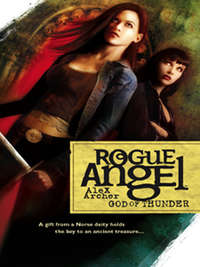
God of Thunder
Alex Archer
 www.mirabooks.co.uk
Contents
Prologue
Chapter 1
Chapter 2
Chapter 3
Chapter 4
Chapter 5
Chapter 6
Chapter 7
Chapter 8
Chapter 9
Chapter 10
Chapter 11
Chapter 12
Chapter 13
Chapter 14
Chapter 15
Chapter 16
Chapter 17
Chapter 18
Chapter 19
Chapter 20
Chapter 21
Chapter 22
Chapter 23
Chapter 24
Chapter 25
Chapter 26
Chapter 27
Chapter 28
Chapter 29
Chapter 30
Chapter 31
Chapter 32
Chapter 33
Chapter 34
Chapter 35
Chapter 36
Chapter 37
Epilogue
Prologue
Courland
Baltic Sea
1104 A.D.
Death slipped into the village with the thick fog that boiled in from the Baltic Sea. It came in on cat’s feet, but took shape as a raiding party. The warriors had been too long at sea and too long without seizing a proper treasure. This morning under the storm gathering over them, they hoped to change their luck.
Skagul, called Ironhand, led the way. He was the chieftain. A large man, well over six feet in height, he was massively muscled from a life spent working hardscrabble earth in his homeland for a harsh existence. His dirty blond beard, rimed with sea salt, hung down to his mid-chest. Tiny figurines carved of wood, stone and ivory hung in his beard and the long hair he wore pulled back in a ponytail.
The reindeer hide he’d added to his tunic to ward off blows and arrows was cracked with age but still supple and serviceable beneath the thick bearskin cloak. A metal helmet covered his head.
He carried a long-handled war ax in his right hand. His left hand was gone, replaced by a cruelly curved iron hook. Sixteen years earlier, he’d lost the hand in a battle with an opposing tribe. His father had been a blacksmith when he hadn’t gone raiding. Together, they’d fitted Skagul with the hook. He was short a hand, but he’d added an incredible weapon to his arsenal.
Senses tingling, Skagul trotted through the ice-cold ankle-deep tidewaters. The longship was nearly flat bottomed and could be sailed or rowed in only inches of water. In his years spent raiding, he’d taken his vessel across oceans, as well as upriver.
His heart beat quickly in his chest, warming him against the touch of early winter and the coming storm. The raiding season was almost over. It they didn’t take a prize soon, there would be little to show for their efforts when they returned home before winter settled.
Ahead of them, the village sat quiet and still, frosted by the light snow that had come during the night. Most of the houses were wooden one-room affairs much like the longhouses in Skagul’s village. Judging by the smoke from a few cook fires curling into the pink-hued sky, only a few people were up.
Goats bleated in small lean-tos behind many of the houses. Roosters crowed to greet the new day. A few dogs lounged in the lean-tos, as well, sharing space and warmth with the goats.
That suited Skagul and met with his expectations. The animals could be a problem, but men just crawling out of bed were often thickheaded and slow to react. He was gambling everything he had on this effort, wanting to go back to his people victoriously.
Victory meant wealth.
Behind them, the incoming tide lapped at the shore and birds cried overhead as they skirled through the sky. The dark clouds sailed the leaden sky with greater speed. The wind had picked up, buffeting the Norsemen as they hunkered down in the brush at the edge of the village.
Holding up his war ax, Skagul glanced over his shoulder.
There, in the rolling fog under the storm clouds, he spotted the dragon prow of his ship. Snarling and savage, the dragon looked fierce and hungry. Heavy red and white sails lay furled on the masts, ready at a moment’s notice. When raised, the mainsail displayed a snake, mouth open and fangs distended.
Skagul’s heart swelled with pride. Her name was Striking Serpent and she had earned her name many times over. She was a twenty-oar ship with sixty-three crewmen. There had been more, but twelve had died fighting the Finns and others had been lost along the way. Since Skagul had been chosen to command the vessel, he’d always been successful.
This, though, had been his hardest year. Only a few weeks earlier, a band of Finns had attacked them at camp and stolen away with all their goods. They’d lost everything they’d spent months stealing.
Skagul would not return home empty-handed with so many mouths to feed. Nor would he see his young crewmen return without bride-price.
“Archers,” Skagul growled.
Twenty warriors peeled away from the group. They nocked arrows to their longbows.
“There.” Skagul waved toward the forested low hills ringing the north side of the village. The land and the trees provided a windbreak against the freezing north winds, which was probably why the village had been built there.
The warriors went at once. They were mostly silent, but Skagul heard some of their gear ring and bang as they took up positions along the hills.
No one in the village noticed.
Standing, Skagul hefted his war ax. The storm winds pulled at his beard and hair. He ignored the cold and moved forward. If things went well, the villagers would take one look at them and surrender everything they had.
The dogs started barking, then ran out to challenge the invaders. Their sharp teeth flashed and snapped. The Norsemen growled.
Skagul swung his ax, cleaving the skull of one dog and killing it instantly. Other warriors killed more of them, and they left the furry corpses behind them.
The goats bleated and chickens ran for cover.
Something was wrong. The feeling coiled and twisted through Skagul’s belly like his ship’s namesake. He held up his ax, calling his warriors to a halt.
The Norsemen stopped, forming a ragged line.
No one peered from the windows of the huts or came to the doors.
Skagul pointed at his men. “You three. Check the homes.”
Immediately the warriors ran to the nearest hut. They broke down the door with their axes. The sharp crack of splintering wood cut through the whirling air. One of them went inside and returned almost immediately.
“No one’s inside,” the warrior announced.
“Check them all,” Skagul ordered. As the men went to do so, he strode angrily to the center of the village. He cursed violently, knowing that the spying they’d done the night before hadn’t gone unnoticed.
“Norseman!” a voice rang out.
Spinning, lifting his war ax, Skagul peered to the east and spotted a man standing almost hidden among the branches of a tall spruce tree. He wore reindeer hide in much the same fashion as the Norsemen but stood empty-handed. His skin was too light to be one of the Curonians, but Skagul knew they were in Courland. The man’s beard was fiery red.
“I am Skagul,” the Norseman roared.
“I’ve heard of you, Ironhand.”
Skagul waited but the other man didn’t introduce himself. “Who are you?” Skagul demanded to know.
“Your death if it comes to that.”
Fury possessed Skagul. For two weeks the frustration he’d felt at the loss of his cargo to the Finns had festered inside him. To be addressed like this, in front of his warriors, was intolerable.
“Brave words from a man hiding in a tree,” Skagul scoffed.
The stranger smiled, calmly and confidently. “I didn’t have to show myself to you at all. I could have put an arrow through your eye.” He paused. “Go to the well and draw the bucket. We’ve left tribute for you. For all your hard work to take what little other people have struggled to gain.” His tone at the end was mocking.
Skagul walked over to the well. He nodded to one of his warriors. The bucket was quickly drawn. He’d expected a trick, but the bucket was filled to the brim with chunks of amber.
The material was valuable and could be used in trade in the Arab lands, as well as with the Franks, Saxons and Celts. Fishermen along the coasts of the North and Baltic Seas dredged amber from the seafloor. Skagul didn’t know why the amber was only found there, but knew its rarity made it more valuable.
“That bucket contains a fortune,” the man in the tree declared. “You’re not welcome to it, but it’s yours for the taking. Accept it and walk away. That way neither side has to lose a life today.”
Skagul gestured. His warrior poured the contents of the bucket into a bag.
“You have more than this,” Skagul told the man in the tree.
“Not for you to take,” the man replied. “I won’t let you strip these people of everything.”
These people. The word choice hung in Skagul’s brain. “You’re not a Curonian.” The more he looked at the man, the more he thought that the man was a Norseman.
“I’m not,” the man agreed. “I was born not far from where you were, but I’m raising my children here. My home is here.”
Skagul nodded and raised his war ax. “As a fellow countryman, I’ll stand you to a proper funeral, then.”
The man in the tree grinned grimly. “Then I’ll extend you the same offer.”
At Skagul’s gesture, the archers loosed arrows that flew straight and true. The man quickly rounded the bole of the tree, disappearing from sight.
The branches deflected most of the arrows, but some of them pierced branches and the tree trunk. Almost immediately, a volley of arrows erupted from the brush, arcing high, then descending on the warriors gathered at the center of the village.
“Shields!” Skagul shouted, throwing himself to cover next to the well.
The Norsemen reacted quickly, hauling their wooden shields overhead. The Curonian arrows found flesh, as well as the shields, though. Eight of Skagul’s warriors went down under the onslaught.
Standing immediately, Skagul grabbed a shield from the nearest dead man and pulled it into place over his head. “Move, you curs! Take the fight to them!” He led the way, pounding toward the huts, slipping through them as more arrows rained death from the sky. He reached the tree line.
The Norsemen ran at his sides as they had always done, axes, hammers and swords raised. They screamed and growled like a wolf pack.
Skagul ran for the tree, not expecting to find the man there, but hoping to catch some sight of him before he was able to escape. Carrying the shield through the heavy brush slowed him only a little.
They climbed a hill, mostly out of sight of the opposing archers, and surged through the forest. Skagul glimpsed the red-bearded man running swiftly through the forest on the other side of a narrow clearing.
“I see him!” one of the Norsemen yelled. “There!”
Skagul surged in pursuit, no longer in the lead because some of the younger men were faster these days. But all of them knew not to range too far ahead so they could be cut into smaller groups.
“Form a line!” Skagul bellowed. “Stay together!”
On the other side of the clearing, the red-bearded man turned and drew a short-hafted war hammer from his back. He stood his ground, glowering at the approaching Norsemen.
A few of Skagul’s archers loosed shafts that bit into the dirt at the man’s boots, tangled in his fur cloak and hit the trees around him. One of the arrows pierced his thigh. Without looking down, the man snapped off the end of the arrow and pulled the other half through his leg. He kept his eyes on the Norsemen.
“Strike now!” the man shouted, raising the hammer above him.
The storm’s fury suddenly increased. Wind whipped through the trees, clacking naked branches against each other and raising gusts of whirling snow. Lightning blazed through the sky and reached down for the hammer in the red-bearded man’s hands.
Yellow flashed on the hammer, revealing that it had been inlaid with amber on the sides of the head and the haft. It looked as if the weapon had been forged of lightning.
The detonation of thunder came immediately on the heels of the lightning strike. A blast of heated air washed over Skagul. When he opened his eyes again, he saw a tree near the red-bearded man topple sideways, trailing smoke.
All the stories about Thor, the Norse god of thunder, who controlled storms and lightning, rushed through Skagul’s mind. He knew the gods sometimes journeyed from Asgard, where they lived, across the Rainbow Bridge to Midgard, which was what they called the human world.
This is no god, Skagul told himself, and told himself to believe it. A god would never have retreated or relied on ambushes. For Skagul saw that was what they had run into as shadows shifted in the forest on both sides of the red-bearded man. Man, he told himself again, not god.
Skagul’s reactions, honed in dozens of deadly encounters, pulled him up sharply. He opened his mouth to shout a warning. Before he could say anything, a withering hail of arrows from the Curonians drove him to cover.
This time Skagul saw the defenders hiding among the trees and brush. They rose only long enough to fire their bows and drop back behind cover.
Two of the Norsemen went down with arrows piercing them. But the others never broke stride, knowing from past experience that within a short distance they would be too close for the archers to fire again. As they raced across the clearing, the ground gave way beneath their feet. In disbelief, Skagul watched his men disappear as if the earth had opened up and swallowed them whole. Lightning flashed again and freezing rain poured from the sky. Less than twenty of the Norsemen pulled back from the edges of the pit that had been covered with branches and dead grass so that it blended with the landscape.
The trap hadn’t been prepared overnight after someone had seen the Norse ship out on the sea. The Curonians had been prepared for an invasion for some time. Skagul thought about the red-bearded man’s statement, that he was raising sons who were Curonians.
It was Redbeard, Skagul thought. He was the one who prepared the Curonians for battle.
A Norse warrior clambered up from the pit. With the rain falling, the earth had turned to greasy black mud. The man was stained with mud and blood. Three thin stakes pierced his body, letting Skagul know the bottom of the pit had been lined with them.
A single arrow flew across the distance and struck the Norseman in the face. The warrior stumbled and went down to his knees. The arrow protruded from one of his eyes through the opening in his helm. He reached for the arrow jutting from his face, then he simply rolled over and vanished once more into the pit.
Curonians charged from the trees. Their bowmen fired arrows over their heads that struck three of the surviving Norsemen.
“Back to the ship!” Skagul yelled. “Back to the ship!”
As undermanned as they were, he didn’t know if they would be successful in getting away. He ran, struggling through the brush.
Redbeard and the Curonians pursued, but they were temporarily slowed by the pit they’d built for defense. Occasional arrows slipped through the forest.
Skagul never slowed, but he heard the thump of heavy footsteps closing on him and knew who it was. Lightning flashed overhead and thunder pealed. Throwing a foot out in the slippery sand of the beach, Skagul slid forward and managed to twist his body at the same time. He brought the war ax around in a flat arc aimed at Redbeard’s midsection.
The amber hammer blocked the ax. Metal clanged as thunder pealed again.
Surprised and more wary, Skagul stepped back and raised his ax in a defensive stance. From the corner of his eye, he watched as Curonian bowmen put shafts into the backs of his men who’d made it to the sea. The Norsemen fell. The survivors of the first wave turned and charged the Curonians, unwilling to be shot down like dogs or taken prisoner. They were slaughtered one by one.
Several of the Curonians surrounded Skagul. They had arrows nocked back to their ears. At that range they couldn’t miss.
Redbeard held up a hand. Blood stained his wounded leg. He spoke in the Curonian language, obviously keeping them from loosing their shafts. To Skagul he said, “I’ve told them they can’t kill you unless I say so.”
“You’d better kill me,” Skagul replied. He was afraid, but his pride wouldn’t let him admit that. He’d always believed he would die in battle, not like a deer run to the ground by hunters.
Redbeard looked at the dead Norsemen lying on the ground around them. “I would prefer not to if I didn’t have to. We’ve already caused the death of too many of our brethren.”
“We?” Skagul scoffed.
Redbeard’s face darkened. “You chose to be greedy.”
“And those men aren’t your brethren.”
“I’ve not always lived among the Curonians,” Redbeard said.
“Where do you hail from?” Skagul asked. He pushed away the fear and tried not to acknowledge the cold that bit at him with sharp teeth.
“Birka.”
Skagul nodded. Birka was an island in Lake Malar. “I’ve been there. I come from Jorvik.”
Redbeard let out a breath. “I could demand payment from your family for your return.”
The offer was a true one, and Skagul knew then that his unwilling host was a Northman at heart. Mannbaetr reflected a man’s value in his tribe, and it was different for each individual. Even if a man killed another man in a fight, he wasn’t put to death as he would be in some cultures. Instead, the killer had to pay the mannbaetr everyone agreed on.
No one was put to death except for adultery, treason or stealing. But the worst punishment that could be doled out to a tribe member was banishment from the community.
Thinking about that, Skagul thought he had leverage that he could use. “They won’t accept a demand from someone who’s been banished.”
“I wasn’t banished,” Redbeard stated. “In my homeland, I was a jarl.”
The declaration surprised Skagul. What was a jarl, a man close to a king, doing living with the Curonians?
The storm raged overhead. Lightning blazed through the sky and leached the color from the world for a moment. The thunder rolled in over the sound of the waves.
Skagul didn’t want to be ransomed back to his village. He wouldn’t accept anything less than going back as a champion. Taking advantage of the lull, he threw himself at Redbeard.
Redbeard knocked Skagul’s ax from his hand, but Skagul had expected that. He kept rushing forward, planting his shoulder in his opponent’s chest and knocking him back. Before Redbeard could recover, two of the Curonian archers had loosed shafts.
Skagul felt the arrows bite into his flesh at his back and side, but he knew from past experience that neither wound would prove fatal. He carried scars from worse encounters.
Wrapping his hand around Redbeard’s face from behind, Skagul melded his body to that of his opponent. Skagul lifted his hook, reaching around in an effort to tear out Redbeard’s throat.
Redbeard lifted the amber hammer. Skagul thought of Thor’s enchanted hammer. It had been crafted by the black elves on orders from Loki, his half brother. The hammer was the most powerful weapon the Norse gods wielded.
Skagul thought the man was lifting the hammer to bring it into battle. It was going to be too little, too late. Skagul had torn out men’s throats before. Nothing would stop him.
Then Skagul saw a tongue of lightning reach down from the dark sky and touch his hook before he could sink the tip into Redbeard’s throat. Skagul lost his hold and flew backward, paralyzed and in agony. He felt as if he were buried in red-hot coals.
On his back in the wet sand, Skagul tried to rise but couldn’t. When he looked down, he saw that the lightning had blown off both his legs. Blood pumped from the stumps and was washed away immediately by the rushing tide.
Redbeard came to him then. Sorrow showed on the man’s face.
“It didn’t have to be this way,” Redbeard said.
Skagul focused on the amber hammer. As he lay dying, he waited to see if the Valkyries would arrive to take him to Valhalla. After all, he’d died a brave death. But he feared they might not because his death hadn’t been a wise one.
Only a fool would have tried to kill a god.
1
The four men approached Annja Creed like a well-oiled machine. Their actions told her they’d done this before.
She didn’t break stride or change direction, heading toward the Mailboxes & Stuff store that she used to mail and receive packages. In her career as an archaeologist, she often received items for study and sometimes for authentication. A handful of museums and private collectors paid her to do certificates of authenticity on items they were putting on display.
Although everything added up, payment for the certificates wasn’t much. However, the benefits included free access to those museums and private collections, and the goodwill of curators who were valuable sources of information when she was doing research.
The four men moved with determination, without speaking. They were young and athletic, casually dressed and instantly forgettable. She guessed that they had military training.
Everything’s already been planned, Annja thought. Adrenaline spiked within her, elevating her heart rate and her senses. She stayed within the flow of the lunch crowd flooding out of the buildings onto the street. Everyone was hurrying to try to make it back on time.
She knew the four men had been waiting for her, and wondered if they had followed her from her loft. She hadn’t been home in weeks. A dig in Florida had consumed her and given her a brief respite from the dregs of winter that still hovered over New York. She’d quickly dropped off luggage and headed back out.
Layered in dark winter clothing—a thigh-length navy wool coat, sweater over a long-sleeved top, and Levi’s, with a knitted black beanie and wraparound blue-tinted sunglasses, her backpack slung over one shoulder—Annja figured the team had watched her closely to recognize her. But at five feet ten and with chestnut-colored hair that dipped below her shoulders, she forgot she had a tendency to stand out in a crowd.
Nikolai, the manager at the shipping business, had left messages with her answering service to let her know she had a number of packages waiting for pickup.
So why hadn’t they picked her up at the airport? Annja mulled that over and realized that they weren’t law-enforcement personnel. Maybe they hadn’t wanted to draw attention to themselves.
Then why hadn’t they nabbed her at her loft? If they knew about Mailboxes & Stuff, they surely knew where she lived. That thought led to a whole new line of questions.
Although it stunk to the high heavens, the situation made Annja curious, and curiosity had driven her through most of her life.
Annja took her cell phone out of her pocket and punched in numbers.
“Mailboxes & Stuff,” a friendly male voice answered. “This is Nikolai. How may I help you?” His Russian accent was charming, but Annja knew it was fake. Nikolai had been born and raised in Brooklyn.
“It’s Annja.”
“Ah, Annja, it is so good to hear from you.” Nikolai lowered his voice to a conspiratorial tone. “You would not believe what has been going on.”
Annja stopped at the newsstand at the corner across the street from Mailboxes & Stuff. She waited in line as customers ahead of her picked out newspapers, magazines and snacks.
Checking the reflections in the windows of the nearby coffee shop, Annja watched the four men attempt to lose themselves in the crowd of pedestrians. If she hadn’t already made them, she knew she wouldn’t have noticed them.
“So tell me,” Annja invited.
“A man came into the store,” Nikolai said. “He showed me government credentials and claimed that he needed a package that was supposed to be delivered to you.”
The newsstand owner dealt with his clientele quickly. The line shrank faster than Annja wanted.
“What kind of credentials?” Annja asked.
“I don’t know. I didn’t get a good look. They tried to intimidate me. Something with a photograph and badge.”
“Do you remember his name?”
“Agent Smith.” Nikolai cackled. “I thought it was very humorous. I asked him if he’d seen The Matrix. ”
Nikolai was a die-hard science fiction fan. He spoke Klingon and was constantly trying to teach phrases to Annja.
“What did he do?” Annja asked.
“He was not amused. Then he threatened me. So I told him he had to have a court order before I gave any package to him. He didn’t produce a court order,” Nikolai said. “So I called the police.”
“You called the police?”
“Sure. I’m not going to play around with them. You get expensive things here, Annja, but you’re not the only client I have that does.”
“Right. So what did Agent Smith do?”
“What did he do? He left is what he did.”
“Did the police come?”
“An hour or so later, sure. Evidently my call wasn’t very important.”
“Did you file a report?”
“I did. But I kept your name out of it. I just told them that someone using government ID wanted to go through the packages.”
“What did the police say?” Only two people separated Annja from the newsstand vendor.
“Just to let them know if the guy showed up again. They really don’t like people jacking around with official identification and pretending to be police officers.”
“Have you seen him today?” Only one person remained in front of Annja.
“No. Why?”
The last customer moved off after buying copies of Time and Newsweek.
“Hang on a second.” Annja asked for copies of Cosmopolitan, Wired, National Geographic and People. If she ended up in some government agency’s interview room, it would be nice to have reading material while she waited for her attorney to arrive.
“Are you at the newsstand?” Nikolai asked.
Annja paid for the magazines and said thanks. Then she returned to the phone conversation. “Yes.”
Across the street, Nikolai peered through the Mailboxes & Stuff window. He had shoulder-length dark hair, beard stubble, a checked shirt under a sleeveless sweater and deep blue eyes.
“Do you see Agent Smith?” Annja slid the magazines into her backpack, two on either side of her notebook computer to provide extra cushioning. The backpack was built around an impact-resistant core case, but it never hurt to be prepared.
Nikolai scanned the crowd waiting for the light. “Maybe. He’s wearing different clothes today.”
Annja was aware of the four men closing in on her. “Who was the package from?”
“Mario Fellini.”
The name surprised Annja and took her back a few years. When she’d finished school, she’d worked at a dig at Hadrian’s Wall in England. The Romans had built the eighty-mile-long wall to cut the country in half, walling out the Picts.
Mario Fellini had been on the dig after completing a double major in fine arts and archaeology. He was Italian, from a large family in Florence, with four older sisters determined to marry him off.
During her time there, Annja had struck up a close friendship with Mario but it hadn’t gone any further than that.
Annja didn’t know why he would send her something. They hadn’t been in touch in years.
“Annja?” Nikolai said.
“Yes?”
“The light is green.”
Annja became aware of the pedestrians flowing around her, crossing the street. She stepped off the curb and continued across.
“Do you know this Fellini?” Nikolai asked.
“Yes. At least, I did. We haven’t talked in years.” Annja’s pulse quickened.
“Would he send you anything illegal? Like contraband, maybe?”
“If he’s still the same guy I knew, then no, he wouldn’t.”
“This is good,” Nikolai said. “Some of my customers, I’m not so sure. I try to stay away from trouble.”
“I know. I’m sorry you’re caught up in this.”
“You’re more caught up in it than I am. That is Agent Smith behind you and to your right.”
Great, Annja thought. She took a deep breath. “Is the package there at the store?”
“No. With all the interest in it, I thought perhaps I could arrange a more private delivery. I’ve got it put away for safekeeping.”
Annja smiled. “Thank you.”
“Is no problem, Annja. For you, anything. If you hadn’t gotten so famous doing that show, maybe you wouldn’t attract strange people, you know?”
Annja knew Nikolai was referring to Chasing History’s Monsters, the syndicated show she cohosted. During the trip to Florida she’d worked the dig site involving Calusa Indians. Although now extinct, the Calusa had been Glades culture American Indians who had lived on shell mounds.
Doug Morrell, Annja’s producer on Chasing History’s Monsters, had turned up a story of a ghost shark that protected the sunken remnants of Calusa villages. Annja had covered the legend of the ghost shark—which, as it turned out, most of the local people hadn’t even heard of—while she’d been on-site.
As a result of the television show, Annja had ended up being known by a lot of strange people around the world. Sometimes they sent her things.
“You remember the shrunken head the Filipino headhunter sent you?” Nikolai asked.
“Yes.” There was no way Annja was going to forget that. It wasn’t the shrunken head. She’d seen those before. The troublesome part was that it turned out to be evidence in a murder case against a serial murderer who had liked the show. That had involved days spent with interviewers from several law-enforcement agencies.
To make matters worse, in the end the investigators found out that the head shrinker had intended to send the head to Kristie Chatham, the other star of the television show. Kristie was known for her physical attributes rather than her intellect. Annja had to admit Kristie’s enormous popularity sometimes bothered her.
“That was a mess,” Nikolai sighed. “I thought I would never get the smell out.”
“I’m sure it’s not another shrunken head,” Annja said.
“I hope you’re right.”
Annja’s mind was racing. She was usually a quick thinker even under pressure. “Can you make a fake package about the same size as the one I was sent?”
“Yes, but why?” Nikolai asked.
“I want you to give it to me when I get inside.”
“Wouldn’t it be smarter to go to the police?”
“The police would drive these guys away,” Annja replied.
“That seems like a desirable thing to me.”
“They’ve made me curious.”
“You know what that did for the cat,” Nikolai pointed out.
“Cats are also great hunters. I intend to be a great hunter. I’ll talk to you in a few minutes.”
“Okay. I’ll get the package ready.”
“Make me wait on it for a few minutes,” Annja said. “I’ve got a phone call I want to make.”
“Sure.”
“Oh, and put something in the box.” It wouldn’t do to lug around an empty box.
“What should I put in it?”
“Whatever you want.”
“Papers?”
“No. Something with some weight.”
“I don’t know—”
“Anything that feels heavy, Nikolai. I just want to fool them for a minute or two.”
“Okay. I’ll find something.”
Annja broke the connection and dialed another number from memory as she went through the door to Mailboxes & Stuff. The reflection in the door glass showed that the four men were close behind her.
They split up into two teams of two. Annja knew then that they were going to try to take the package inside the store.
She was curious and they were impatient. She knew it could prove to be a recipe for disaster.
2
“You’ve reached the desk of Detective Bart McGilley. Please leave a message and I’ll get back to you. If you need immediate attention, please call Detective Manuel Delgado.” The recording gave Delgado’s number.
Standing at the counter in Mailboxes & Stuff while Nikolai went into the back to “check” for her mail, Annja dialed Delgado’s number.
Two of the men trailing Annja, one of them Agent Smith, entered the store and started looking through racks of mailing supplies. Nikolai kept an assortment of boxes, envelopes and mailing labels. Annja wondered what they would have used for cover if the accessories hadn’t been there.
Both men were intense looking. Their winter clothing could have concealed an arsenal. They never appeared to look at her.
“Detective Delgado.” The voice was smooth and Hispanic.
Annja switched to Spanish to make it harder for the men to listen to the conversation. “Hi. This is Annja Creed. I’m a friend of Detective McGilley’s.”
“I know who you are,” Delgado said. “Didn’t know you were a friend of McGilley’s, though. I catch the show every week.”
Terrific, Annja thought, a fan. She figured that could cost her a big chunk of believability.
“Seems like McGilley would have mentioned he knew you,” Delgado continued.
Maybe he’s not exactly proud of it, she thought. That gave her pause for just an instant. She couldn’t imagine Bart being embarrassed about knowing her. Then again, she couldn’t blame him, either. If Chasing History’s Monsters hadn’t opened so many doors for archaeological exploration for her, she would never have done the show.
Annja chose to ignore Delgado’s statement. “Do you know where I can find Detective McGilley? I called his cell phone number but got his answering service by mistake.”
“That wasn’t a mistake,” Delgado said. “Detective McGilley is in court today. He always switches his cell phone to his answering service when he’s on the stand.”
“Is he in trouble?” Annja thought back to the last conversation she’d had with Bart. They’d caught lunch at Tito’s and chatted briefly. Bart’s fiancée was pressing him to set a date for the wedding.
“No,” Delgado answered. “He’s testifying in a murder case. Should be a slam dunk, but the assistant district attorney wanted McGilley there. The ADA is one of the new batch of wonder kids the law school keeps churning out. She just needed a little hand-holding.”
“Do you know when you expect him back?”
“Soon. More than that, I can’t tell you.”
“All right. Can you give him a message?”
“I can.”
“Ask him to call me as soon as he has a chance.”
Delgado said he would.
Annja pocketed the cell phone. She’d exhausted the number of people she could call for help. In a way, that was sad. But then again, she didn’t usually ask for help.
A moment later, Nikolai came back with a package. It was about the size of a hardbound book. The address on the front was written in Nikolai’s hand, but Annja doubted the two men inside the store would know that.
“Thank you,” Annja said.
“Of course.” Nikolai gave her one of his patented friendly smiles. “Be careful out there.”
“I will.”
“The potato soup at Cheever’s Diner is good today,” Nikolai added as she walked toward the door.
Looking back at Nikolai, Annja couldn’t help thinking that the announcement sounded like some kind of spy code. She couldn’t believe Nikolai had just blurted that out. All that was missing was a big conspiratorial wink.
At the counter, Nikolai shrugged and looked embarrassed. “It’s warm, you know. It’ll take some of the winter chill off. That’s all I mean.”
Annja shoved the package under one arm, then walked toward the door. That was when Agent Smith made his move.
T HE MAN WAS SMOOTH —Annja gave him that. But he was working on the presumption that he was dealing with someone unused to violence. Most people would have frozen when a strange man grabbed them by the arm. An uninvited touch in polite society usually elicited a blistering look of disdain, followed by a command to release the arm or a demand to know what was going on.
By the time all that happened, it was usually too late for the person who was accosted.
Annja had expected the touch, had desired it, in fact, because it made everything easier. The move put the man in reach.
Gripping her backpack straps with her left hand, Annja turned inside the man’s grip. He stood flat-footed, never expecting her to turn like that. Or, at least, not expecting what followed.
Agent Smith opened his mouth to speak. Annja didn’t know what he was going to say. Maybe he was going to say her name, or maybe he was going to give her his fake name.
Before he could utter a word, Annja jerked a knee up into his crotch as hard as she could. He wasn’t totally unprepared, though. She felt the hard surface of a protective cup jar her knee with bruising force. Despite the presence of the cup, there was a certain amount of force that still communicated through the protective gear.
The man froze, not certain how badly he was hurt. Annja knotted her right hand in his coat and pulled him close. She head-butted him in the nose and heard it break with a loud pop. As he stumbled back, his coat fell open and revealed the pistol holstered on his hip.
Okay, Annja thought, that’s good to know. It was better to have the bad news up front. She stuck her foot between Agent Smith’s legs to hook a foot behind his, then put her shoulder in the middle of his chest. Agent Smith smashed backward into his partner.
“Help!” Nikolai shouted, going to cover behind the counter. “Help! Police!”
“Try using the phone,” Annja urged as she turned back to the door.
Nikolai’s hand came up and began feeling around for the phone handset while she bolted through the door. Agent Smith and his partner were already getting to their feet and grabbing for their weapons.
Outside, Annja turned right and ran. She knew the area well. Not only did she frequently walk to Mailboxes & Stuff, but she also jogged in the neighborhood and did most of her shopping there.
She took a firmer hold on the ersatz package as she lengthened her stride. “Excuse me. Out of the way. Coming through.” She pushed herself down the crowded sidewalk, jostling the pedestrians.
Most of the men and women shot her looks of indignation. A few of them cursed at her as only a native New Yorker could, and it would have taken a master linguist to sort out all the variations of the single-syllable word they used most.
Then they saw the pistols in the hands of the men pursuing her. Trained by the post-9/11 world, the pedestrians hit the sidewalk and wrapped their hands over their heads.
They also shouted, and the shouts caught up to Annja and passed her. In seconds, the pedestrians in front of Annja had hit the ground, as well. The sidewalk became treacherous with bodies, and there was no way she could lose herself in a crowd.
A gypsy cab with a Buddha swinging from the mirror and blaring Eminem braked to a halt at the curb. The driver hit his horn repeatedly, cursing at the traffic congestion that had gridlocked him.
Annja threw herself across the cab’s hood, sliding on her hip in a move made famous on The Dukes of Hazard television show. She hit the street on the other side of the cab and managed one step before she leaped again.
This time she sprinted across the next car. Horns blared behind her. The gypsy cabdriver shrilled curses at her, but shut up when he saw the men with guns. Annja used that sudden silence to mark the progress of the two men following her.
The other two men were across the street and tried to set themselves up on an interception course, running along the sidewalk.
By that time Annja was dealing with the oncoming traffic. It wasn’t as congested. The flow wasn’t moving quickly, but it was moving. Tires shrieked as the drivers in the inside lane tried to halt, but a New York City transit bus advertising the Late Show with David Letterman blocked her path.
Annja got her free arm up and used it to cushion her impact against the bus, slamming up against the Letterman photo. The bus never even slowed.
Whirling, Annja ran to the left. She figured the two men trying to intercept her would expect her to run to the rear of the bus and try to get around. Instead, she trusted herself to outrun the bus and the other two pursers.
She ran, breathing quickly, hoping she didn’t get a muscle cramp from the cold weather. A quick glance at Agent Smith and his partner showed them trying to negotiate the first lane of traffic that wasn’t stalled. Horns blared all around them.
Smith, his nose streaming blood, stopped long enough to yell to the other two men. He waved them back in the direction Annja had gone.
Annja’s thoughts ran rampant. Cold air hit her lungs like a fist. She’d gotten acclimated to Florida over the past few weeks, and the weather there hadn’t been anything like Brooklyn’s.
Going back to the loft is a bad idea, she told herself. She kept running. Then the side mirror of a flower-delivery van in front of her shattered. Pieces of glass scattered across the street. The sound of the gunshot followed immediately.
Panic spread over the street as some of the motorists tried to lock down their vehicles while others searched for a gap to make their getaway.
A limousine ahead of Annja plowed into the back of an older sedan. Immediately a man in a black business suit and wraparound sunglasses got out of the limo and dropped into a crouch. His hand snaked under his jacket.
Annja was pretty sure he was going for a shoulder holster. A shoot-out in the middle of the street was the last thing that needed to happen.
She jumped up in a flying kick just as the man’s hand cleared his jacket. The large pistol had a shiny nickel finish.
Swinging her left foot out, Annja caught the man in the forehead. His head snapped back and bounced off the car. He went boneless and dropped, out cold.
Thankfully, the impact didn’t throw Annja off much. She caught herself on her hands, prone on her stomach on the street.
Two car lengths behind her, Agent Smith and his friend had gone to cover, ducking behind the florist van. Seeing the unconscious bodyguard sprawled in the street beside Annja, they grew brave enough to shove their pistols around the van.
Annja vaulted to her feet and ran across the back end of the limousine. At least two rounds smashed the vehicle’s bulletproof rear window, leaving spiderwebbed cracks in the reinforced glass. The front glass of a coffee shop shattered. Patrons inside screamed and threw themselves to the floor.
Okay, Annja thought as she leaped for the curb. Now we know these guys aren’t afraid to use those guns.
She hit the pavement with both feet and stumbled forward. Knowing she had to get off the street and out of the sights of the two men, she raced for a nearby theater.
T HE THEATER WAS small, with an upper and lower screen. Decked out in yellow and red, the theater looked as if it were still in the 1950s when it had shown first-run movies instead of hand-me-downs that came out on DVD the same week.
The marquee advertised a couple of movies—one a horror picture and the other a new fantasy picture about a dragon. A line had formed at the ticket window.
Annja ran past them, slamming through one of the front doors. The box she carried absorbed some of the impact.
She was inside the building. A crew of early-twenty-somethings and a few teens worked the counter. The heavy scent of buttered popcorn hung on the air, mixing with the sharp stink of a cherry air freshener. Movie posters of the movies that were currently showing hung on the wall between the two bathrooms.
Barely breaking stride, Annja headed for the theater at the back of building. An usher in a red vest stood at the small podium reading a comic book. He looked up at Annja’s approach, then looked as if he was going to say something. By that time she was already past him, and the four armed men came through the door. People began screaming.
Annja ran inside the dark theater, cut around the corner that blocked the light from entering the viewing area and ran down the steps toward the emergency door at the back. She halted, framed by the screen as a band of warriors gathered on a rocky cliff. She looked back at the protective wall.
She knew she hadn’t left her pursuers, but she didn’t want them to lose her now. The idea of the four men searching through the theater crowd left her chilled. They needed to know where she was.
“Hey, lady!” someone yelled. “Down in front! Some of us are here to see the movie!”
The four men came around the protective wall, briefly backlit by the closing door. Agent Smith pointed his gun and fired. The shot rang out in the enclosed space, but it was quickly drowned out by the dragon’s roar on the film. On-screen, the warriors screamed and ran for their lives. Anyone watching would have thought the film was interactive, because the moviegoers did the same.
Annja turned and ran toward the lighted emergency exit as a line of bullets chopped into the wall behind her. Evidently the emergency factor compelling the men to seize the package was escalating. She couldn’t keep up the chase or an innocent bystander was going to get hurt.
Ücretsiz ön izlemeyi tamamladınız.