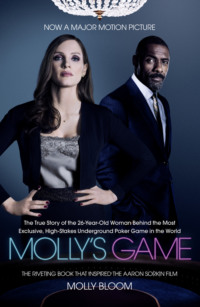
Kitabı oku: «Molly’s Game: The Riveting Book that Inspired the Aaron Sorkin Film»


Copyright
William Collins
An imprint of HarperCollinsPublishers
1 London Bridge Street
London SE1 9GF
www.WilliamCollinsBooks.com
This eBook first published in Great Britain by William Collins in 2017
Copyright © Molly Bloom 2014
Molly’s Game Motion Picture Artwork © 2017 MG’S GAME, INC. ALL RIGHTS RESERVED
Molly Bloom asserts the moral right to be identified as the author of this work
A catalogue record for this book is available from the British Library
All rights reserved under International and Pan-American Copyright Conventions. By payment of the required fees, you have been granted the non-exclusive, non-transferable right to access and read the text of this e-book on-screen. No part of this text may be reproduced, transmitted, down-loaded, decompiled, reverse engineered, or stored in or introduced into any information storage and retrieval system, in any form or by any means, whether electronic or mechanical, now known or hereinafter invented, without the express written permission of HarperCollins
Source ISBN: 9780008278366
Ebook Edition © October 2017 ISBN: 9780008274436
Version: 2017-12-07
Dedication
This book is dedicated to my mom, Charlene Bloom, who gave me life not once, but twice. Without your fierce love and unwavering support, none of this would have been possible.
Contents
COVER
TITLE PAGE
COPYRIGHT
DEDICATION
AUTHOR’S NOTE
PROLOGUE
Part One: BEGINNER’S LUCK
Chapter 1
Chapter 2
Chapter 3
Chapter 4
Chapter 5
Chapter 6
Part Two: HOLLYWOODING
Chapter 7
Chapter 8
Chapter 9
Chapter 10
Chapter 11
Chapter 12
Part Three: PLAYING THE RUSH
Chapter 13
Chapter 14
Chapter 15
Chapter 16
Chapter 17
Chapter 18
Chapter 19
Part Four: COOLER
Chapter 20
Chapter 21
Chapter 22
Chapter 23
Chapter 24
Part Five: A CHIP AND A CHAIR
Chapter 25
Chapter 26
Chapter 27
Chapter 28
Part Six: COLD DECK
Chapter 29
Chapter 30
Chapter 31
Chapter 32
EPILOGUE
ACKNOWLEDGMENTS
ABOUT THE AUTHOR
ABOUT THE PUBLISHER
Author’s Note
The events and experiences that follow are all true. In some places, I’ve changed the names, identities, and other specifics of individuals in order to protect their privacy and integrity, and especially to protect their right to tell—or not to tell—their own stories if they so chose. The conversations I re-create come from my clear recollections of them, though they are not written to represent word-for-word transcripts. Instead, I’ve retold them in a way that evokes the real feeling and meaning of what was said, in keeping with the true essence, mood, and spirit of the exchanges.
Prologue
I am standing in my hallway. It’s early morning, maybe five o’clock. I’m wearing a sheer white lace nightgown. High-beam, fluorescent light blinds me.
“PUT YOUR HANDS IN THE AIR,” a man’s voice yells—he sounds aggressive but emotionless … I raise my trembling hands and my eyes slowly adjust to the light.
I am facing a wall of uniformed federal agents stacked back as far as I can see. They are armed with assault weapons—machine guns, guns I have only seen in movies are now pointed at me. “Walk toward us, slowly,” the voice commands.
There is a detachment, a lack of humanity in the tone. I realize that they believe I am a threat, the criminal they have been trained to apprehend.
“SLOWER!” the voice warns menacingly. I walk on trembling legs, putting one foot in front of the other. It is the longest walk of my life.
“STAY VERY STILL, NO SUDDEN MOVEMENT,” warns another deep voice.
Fear grips my body, making it hard to breathe; the dark hallway begins to look blurry. I am worried I may pass out. I imagine my white negligee covered in blood, and I force myself to stay conscious.
Finally, I reach the front of the line, and I feel someone grab me, and push me roughly up against a concrete wall. I feel hands patting me down, running all along my body; then cold steel handcuffs close tightly around my wrists. “I have a dog, her name is Lucy, please don’t hurt her,” I plead.
After what feels like an eternity, a female agent yells, “CLEAR!” The man holding me guides me to my couch. Lucy runs over to me and licks my legs.
It kills me to see her so afraid and I try not to cry.
“Sir,” I say shakily to the man who handcuffed me. “Can you please tell me what’s going on? I think there must be some mistake.”
“You are Molly Bloom, aren’t you?”
I nod my head.
“Then there is no mistake.” He places a piece of paper in front of me. I lean forward, my hands still cuffed tightly behind my back. I can’t get past the first line, in black bold letters.
The United States of America v. Molly Bloom
Part One
Beginner’s Luck (noun)
The supposed phenomenon of a poker novice experiencing a disproportionate frequency of success.
Chapter 1
For the first two decades of my life, I lived in Colorado, in a small town called Loveland, forty-six miles north of Denver.
My father was handsome, charismatic, and complicated. He was a practicing psychologist and a professor at Colorado State University. The education of his children was of paramount importance to him. If my brothers and I didn’t bring home A’s and B’s, we were in big trouble. That being said, he always encouraged us to pursue our dreams.
At home he was affectionate, playful, and loving, but when it came to our performance in school and athletics, he demanded excellence. He was filled with a fiery passion that at times was so intense, it was almost terrifying.
Nothing was “recreational” in our family; everything was a lesson in pushing past the limits and being the best we could possibly be. I remember one summer my father woke us up early for a family bike ride. The “ride” ended up involving a grueling vertical climb of three thousand feet at an altitude of almost eleven thousand feet. My youngest brother, Jeremy, must have been six or so, and he rode a bike without gears. I can still see him pedaling his little heart out to keep up, and my dad yelling and screaming like a banshee at him and the rest us to ride faster and push harder, and no complaining allowed. Many years later I asked my dad where his fervor came from. He paused; he had three grown kids who had far surpassed any expectations he could have dreamed of for them. At this point he was older, less fiery, and more introspective.
“It’s one of two things,” he told me. “In my life and my career, I have seen what the world can do to people, especially girls. I wanted to make sure you kids had the best possible shot.” He paused again. “Or, I saw you all as extensions of myself.”
From the other direction, my mother taught us compassion. She believed in being kind to every living thing and she led by example. My beautiful mother is the most gentle and loving person I have ever known. She is smart and competent, and instead of pushing us to conquer and win, she encouraged us to dream, and took it upon herself to nurture and facilitate those dreams. When I was very young, I loved costumes, so naturally Halloween was my favorite holiday. I would wait anxiously each year, laboring over who or what I would be that year. My fifth Halloween I couldn’t choose between a duck and a fairy. I told my mother I wanted to be a duck-fairy. My mother kept a straight face.
“Well then, duck-fairy you shall be.” She stayed up all night constructing the costume. I, of course, looked ridiculous but her nonjudgmental support of individuality inspired my brothers and me to live outside the box and forge our own paths. She fixed the cars, mowed the lawn, invented educational games, created treasure hunts, was on every PTA board, and still made sure she looked beautiful and had a drink in hand for my father when he got home from work.
My parents parented according to their strengths: my brothers and I were guided by their combined feminine and masculine energies. Their polarity molded us.
MY FAMILY WENT SKIING EVERY WEEKEND during my childhood. We would pile into the Wagoner and drive two hours to our one-bedroom condo in Keystone. No matter what the conditions were—blizzards, stomachaches, sixty below zero, we were always the first ones on the mountain. Jordan and I were talented, but my brother Jeremy was a prodigy. We all soon caught the attention of the head coach of the local mogul team and we began training and soon even competing.
During the summers, we spent our days water skiing, biking, running, hiking. My brothers played Pee Wee football, baseball, and basketball. I started competing in gymnastics and running 5K races. We were always moving, always training to go faster, be stronger, push harder. We didn’t resent any of it. It was what we knew.
At twelve, I was running a 5K when I felt a white-hot pain between my shoulder blades. After a unanimous first, second, and third opinion, I was scheduled for emergency spinal surgery. I had a rapid onset of scoliosis. My parents waited nervously during my seven-hour surgery while the doctors cut me open from neck to tailbone and carefully straightened my spine (which looked like an S and was curved at sixty-three degrees) by extracting bone from my hip, fusing the eleven curved vertebrae together, and fastening metal rods to the fused segment. Afterward, my doctor gently but firmly informed me that my competitive sports career was over. He droned on, telling me all the activities I could not do and how one can lead a very fulfilling and normal life, but I had stopped listening.
Quitting skiing was simply not an option. It was woven too tightly into the fabric of my family. I spent a year recovering. I was homeschooled and I had to spend most of the day in bed. I watched longingly as my family left every weekend without me, sitting in bed while they flew down the slopes or went out on the lake. I felt ashamed of my brace and my physical limitations. I felt like an outsider. I became even more determined to not let my surgery affect my life. I longed to feel a part of my family again; to feel the pride and hear the praise of my father, instead of the pity. With each lonely day I grew more and more determined to never again sit life out. As soon as the X-rays showed that my vertebrae had successfully fused, I was back on the mountain, skiing with a fierce determination, and by midseason I was winning in my age division. By then, my younger brother Jeremy had taken the freestyle skiing world by storm. He was ten years old and already dominating the sport. He was also exceptional in track and football. His coaches told my father they had never seen anyone as talented as Jeremy. He was our golden boy.
My brother Jordan was also a talented athlete, but his mind was his greatest attribute. He loved to learn. He loved to take things apart and figure out how to put them back together. He didn’t want to hear imaginary bedtime stories; he wanted to hear stories about real people in history. My mom had a new story every night for him, about great world leaders or visionary scientists, and she researched the facts and wove them into engaging tales.
Ücretsiz ön izlemeyi tamamladınız.