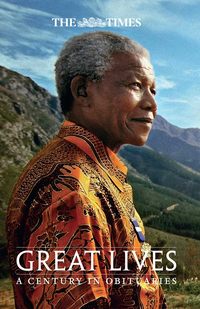
Kitabı oku: «The Times Great Lives»
GREAT LIVES

GREAT LIVES
a century in obituaries
Edited by Anna Temkin
Times Books
Published by Times Books
An imprint of HarperCollins Publishers
Westerhill Road
Bishopbriggs
Glasgow G64 2QT
www.harpercollins.co.uk
Ebook first edition 2015
© Times Newspapers Ltd 2015
www.thetimes.co.uk
Ebook Edition © September 2015 ISBN: 978-0-00-816480-5, version 2015-08-18
The Times is a registered trademark of Times Newspapers Ltd
All rights reserved under International Copyright Conventions. By payment of the required fees, you have been granted the non-exclusive, non-transferable right to access and read the text of this e-book on-screen. No part of this text may be reproduced, transmitted, down-loaded, decompiled, reverse engineered, or stored in or introduced into any information storage and retrieval system, in any form or by any means, whether electronic or mechanical, now known or hereinafter invented, without the express written permission of HarperCollins e-books.
The contents of this publication are believed correct. Nevertheless the publisher can accept no responsibility for errors or omissions, changes in the detail given or for any expense or loss thereby caused.
HarperCollins does not warrant that any website mentioned in this title will be provided uninterrupted, that any website will be error free, that defects will be corrected, or that the website or the server that makes it available are free of viruses or bugs. For full terms and conditions please refer to the site terms provided on the website.
A catalogue record for this book is available from the British Library
Cover Image © Louise Gubb
Title
Copyright
Introduction
Abridged Introduction
Contents
Lord Kitchener
V. I. Lenin
Giacomo Puccini
Claude Monet
Emmeline Pankhurst
D. H. Lawrence
Dame Nellie Melba
Sir Edward Elgar
Marie Curie
Sigmund Freud
Amy Johnson
Virginia Woolf
David Lloyd George
President Franklin D. Roosevelt
Adolf Hitler
General G. S. Patton
John Maynard Keynes
Henry Ford
Mahatma Gandhi
George Orwell
Ludwig Wittgenstein
Arnold Schoenberg
Joseph Stalin
Alan Turing
Henri Matisse
Sir Alexander Fleming
Albert Einstein
Humphrey Bogart
Arturo Toscanini
Christian Dior
Dorothy L. Sayers
Frank Lloyd Wright
Aneurin Bevan
Ernest Hemingway
Marilyn Monroe
President John F. Kennedy
Lord Beaverbrook
Ian Fleming
T. S. Eliot
Sir Winston Churchill
Le Corbusier
Yuri Gagarin
Martin Luther King
Enid Blyton
Bertrand Russell
Jimi Hendrix
President Gamal Abdel Nasser
Coco Chanel
Igor Stravinsky
Louis Armstrong
Duke of Windsor
Sir Noel Coward
Pablo Picasso
Charles Lindbergh
P. G. Wodehouse
Dame Agatha Christie
Field Marshal Montgomery
Mao Tse-tung
Benjamin Britten
Elvis Presley
Maria Callas
Charlie Chaplin
Jesse Owens
Jean-Paul Sartre
Sir Alfred Hitchcock
Mae West
John Lennon
Bob Marley
Group Captain Sir Douglas Bader
Orson Welles
Henry Moore
Andy Warhol
Jacqueline du Pré
Sir Frederick Ashton
Sugar Ray Robinson
Ayatollah Khomeini
Laurence Olivier
Dame Margot Fonteyn
Miles Davis
Menachem Begin
Francis Bacon
Elizabeth David
Willy Brandt
Rudolf Nureyev
Richard Nixon
Jacqueline Kennedy Onassis
Fred Perry
Harold Wilson
Jacques-Yves Cousteau
Diana, Princess of Wales
Mother Teresa
Frank Sinatra
Iris Murdoch
Stanley Kubrick
Yehudi Menuhin
Sir Alf Ramsey
Raisa Gorbachev
Sir Stanley Matthews
Dame Barbara Cartland
Sir John Gielgud
Sir Alec Guinness
Don Bradman
Christiaan Barnard
Spike Milligan
Queen Elizabeth The Queen Mother
Ronald Reagan
Francis Crick
Pope John Paul II
Rosa Parks
Luciano Pavarotti
Sir Edmund Hillary
Michael Jackson
Elizabeth Taylor
Steve Jobs
Sir Bernard Lovell
Neil Armstrong
Baroness Thatcher
Seamus Heaney
Sir David Frost
Nelson Mandela
Lady Soames
Lord Attenborough
Sir Terry Pratchett
Lee Kuan Yew
Acknowledgements
Index
About the Publisher
Introduction
Anna Temkin
Assistant Obituaries Editor, The Times
Perhaps the most effective way to study history is to read the obituaries of those who have shaped it. Many would agree there is no better place to do so than in the pages of The Times. Its notices have long been a prime source for scholars; to this day, contributors to the Oxford Dictionary of National Biography are invariably advised to start their research by consulting the relevant Times obituary.
The pieces chronologically assembled here, from Lord Kitchener to Lee Kuan Yew, form an enthralling snapshot of the past 100 years. Over that period The Times house style has of course changed – to include details of survivors, for example, and a final paragraph recording the date of birth and date of death. The comprehensive first edition of Great Lives, edited by Ian Brunskill, was published in 2005 and closed with the obituary of Pope John Paul II. In the ten years since, great lives have continued to be recorded in The Times. Many of these would be worthy of appearing in this second edition and the selection process has necessarily involved making invidious choices. Who to include and who to exclude, while still giving due coverage to the worlds of entertainment, sport et al? Apart from the two most high profile deaths in recent years – those of Baroness Thatcher and Nelson Mandela – the new contenders were generally open to debate. Choosing which to add and which, very reluctantly, to remove meant avoiding a number of risks: too many politicians (farewell Earl Attlee), too few writers (stay put Enid Blyton), too much music (so long Glenn Gould), not enough science (welcome Sir Bernard Lovell). All these were important considerations when updating this edition.
Rosa Parks, who died in 2007, was at the forefront of the civil rights movement and, appropriately, is now among the vanguard of the new obituaries in this compendium. Between the Iron Lady and South Africa’s much-loved ‘Madiba’, the world also lost Seamus Heaney, whose poetry caused nothing short of a literary sensation, and the doyen of television interrogators Sir David Frost, who famously teased a confession out of President Nixon over Watergate. Sir Edmund Hillary modestly described his life as merely a ‘constant battle against boredom’ but Britain held its breath as he became the first climber to reach the summit of Everest. Again, how could anyone forget the visionary Steve Jobs whose name will forever be synonymous with the ubiquitous Apple?
The perennial power of the obituary is that it brings the dead to life. At its most compelling, it combines biography and historical context with anecdotes and telling quotations; such is the art of the skilled obituarist. The majority of Times notices are written in house, but when necessary the paper avails itself of specialist knowledge from outsiders. All, however, are unsigned. This policy of anonymity ultimately allows for a fairer, fuller account of the subject’s life and the obituarist need not fear any backlash following publication. After Nubar Gulbenkian, the Armenian business magnate, was embroiled in a bitter feud with his father, a famous oil millionaire, he was concerned which side of the dispute his obituary in The Times would take. He therefore invited members of the paper’s staff for lunch at the Ritz, offering them £1000 for a view of his draft obituary. He never saw it and when the notice actually appeared in 1972, it gave a balanced portrayal of the family feud. That kind of proportional representation, as it were, is exemplified in many of the pieces reproduced here. Michael Jackson’s obituary, for instance, acknowledges his reputation as the king of pop while also addressing the sensational allegations of impropriety levelled at him.
These pages contain some of the most extraordinary lives that have defined the twentieth and early twenty-first centuries; within them are stories of genius, innovation, adversity and, at times, sheer eccentricity. Thomas Carlyle declared, ‘History is the essence of innumerable biographies’. His ‘Great Man’ theory that the past can be explained by the influence of leaders and heroes may not be infallible (after all, some of the most significant could not be regarded as either noble or heroic). Yet there is no doubt that all the men and women of this collection left an indelible mark on both the world they knew and the one that we now inhabit. Their obituaries have stood the test of time and are, in that sense, a fitting reflection of The Times itself.
Abridged Introduction
to the First Edition
Ian Brunskill
Former Obituaries Editor, The Times
From its beginnings in 1785 The Times has recorded significant deaths. Often in the early days this amounted to little more than a list of names of people who had died, and on more than one occasion The Times simply plagiarized a notice from another paper if it had none of its own. It was under John Thadeus Delane, Editor of The Times from 1841 to 1877, that this began to change. Delane clearly recognized that the death of a leading figure on the national stage was an event that would seize the public imagination as almost nothing else could, and that it demanded more than just a brief notice recording the demise. ‘Wellington’s death,’ Delane told a colleague, ‘will be the only topic’.
Delane instituted the practice of preparing detailed, authoritative – and often very long – obituaries of the more important and influential personalities of the day while they were still alive. The resulting increase in the quality and scope of the major notices ensured that, even if the paper’s day-to-day obituary coverage remained erratic, The Times in the second half of the 19th century rose to the big occasion far better than its rivals could. The investment of effort and resources was not hard to justify. The Times obituaries not only found a ready following among readers of the paper but were soon being collected and republished in book form too. Six volumes of ‘Biographies of Eminent Persons’ covered the period 1870-1894.
It was not until 1920, however, that The Times appointed its first obituary editor, and it was some years later still before the paper began to run a daily obituary page. As late as 1956, the publisher Rupert Hart-Davis could complain in a letter to the retired Eton schoolmaster George Lyttelton: ‘The obituary arrangements at The Times are haphazard and unsatisfactory. The smallest civil servant – Sewage Disposal Officer in Uppingham – automatically has at least half a column about him in standing type at the office, but writers and artists are not provided for until they are eighty.’
That was a little unfair, even at the time, but if matters have improved since then, it is in large part due to the efforts of the late Colin Watson, who took over as obituaries editor in the year Hart-Davis expressed that disparaging view and who remained in the post for 25 years. He built up and maintained the stock of advance notices so that there were usually about 5,000 on file at any one time, a figure that has remained more or less constant ever since.
Watson, in an article written on his retirement, gave a revealing and only half-frivolous account of what the whole business involves. It was – is – a relentless, if rewarding, task: ‘You may read and read and read,’ he wrote, ‘particularly history; turn on the radio; listen for rumours of ill-health (never laugh at so much as a chesty cold); and you may write endless letters – but never dare say you are on top.’
If Watson may in many respects be said to have brought the obituary department into the modern world, it fell to his successors, particularly John Higgins and Anthony Howard, to show how effectively the paper could respond when other newspapers, from the mid-1980s, began to expand their obituary coverage to match that of The Times. There were some elsewhere who claimed, in the course of this expansion, to have invented or reinvented the newspaper obituary in its modern form – chiefly, it often seemed, by treating all their subjects like amusing minor characters in the novels of Anthony Powell. In fact, as I hope this collection shows, the obituary form as practised for more than a century in The Times had at its best always been both broader in range and livelier in approach than may generally have been assumed.
Lord Kitchener
5 June 1916
Horatio Herbert Kitchener was born at Gunsborough House, near Listowel, in County Kerry, on June 24, 1850. He was the second son of Lieutenant-Colonel H. H. Kitchener, of Cossington, Leicestershire, by his marriage with Frances, daughter of the Rev. John Chevallier, dd, of Aspall Hall, Suffolk, and was therefore of English descent though born in Ireland.
He was educated privately by tutors until the age of 13, when he was sent with his three brothers to Villeneuve, on the Lake of Geneva, where he was in the charge of the Rev. J. Bennett. From Villeneuve, after some further travels abroad, he returned to London, and was prepared for the Army by the Rev. George Frost of Kensington Square. He entered the Royal Military Academy at Woolwich in 1868 and obtained a commission in the Royal Engineers in January, 1871. During the short interval between passing out of Woolwich and joining the Engineers he was on a visit to his father at Dinan, and volunteered for service with the French Army. He served under Chanzy for a short time, but was struck down by pneumonia and invalided home. He now applied himself vigorously to the technical work of his branch, and laboured incessantly at Chatham and Aldershot to succeed in his profession.
Palestine and Cyprus
His first chance of adventure arose owing to a vacancy on the staff of the Palestine Exploration Society. Kitchener was offered the post in 1874 and at once accepted it. He remained in the Holy Land until the year 1878, engaged first as assistant to Lieutenant Conder, re, in mapping 1,600 square miles of Judah and Philistia, and then in sole charge during the year 1877 surveying that part of Western Palestine which still remained unmapped. The work was done with the thoroughness which distinguished Kitchener’s methods in his subsequent career. He rejoined Conder in London in January, 1878, and by the following September the scheme of the Society was carried through, and a map of Western Palestine on a scale of one inch to a mile was satisfactorily completed. The work entailed considerable hardship, and even danger. Kitchener suffered from sun-stroke and fever. He and his surveying parties were frequently attacked by bands of marauders, and on one of these occasions both Conder and he barely escaped with their lives. On another occasion Kitchener pluckily rescued his comrade from drowning. His survey work in Palestine led directly to his nomination for similar work in Cyprus, where he began the map of the island which was eventually published in 1885.
Egypt and the Red Sea
Realising that trouble was brewing in Egypt, Kitchener managed to be at Alexandria on leave at the time of Arabi’s revolt. He served through the campaign of 1882, and, thanks largely to his knowledge of Arabic, became second in command of the Egyptian Cavalry when Sir Evelyn Wood was made Sirdar of the Egyptian Army. He left Suez in November, 1883, to take part in the survey of the Sinai Peninsula, but almost immediately returned for service in the Intelligence branch. He was sent southward after the defeat of Hicks Pasha in order to win over the tribes and prevent the further spread of disaffection. His personality and influence did much. The Mudir of Dongola in response to Kitchener’s appeal, fell upon the dervishes at Korti and defeated them. But the tide of Mahdi-ism was still flowing strongly. By July, 1884, Khartum was invested, and upon Kitchener fell the duty of keeping touch between Gordon and the expedition all too tardily dispatched for his relief.
Kitchener was now a major and daa and qmc on the Intelligence Staff. In December, 1884, Wolseley and his troops reached Korti. Kitchener accompanied Sir Herbert Stewart’s column on its march to Metemmeh, but only as far as Gakdul Wells, and consequently he was not at Abu Klea. When the expedition recoiled, it became Kitchener’s painful duty to piece together an account of the storming of Khartum and the death of Gordon. For Kitchener’s services in this arduous and disappointing campaign there came a mention in dispatches, a medal and clasp, and the Khedive’s star. In June, 1885, he was promoted lieutenant-colonel. In the summer the Mahdi died and the Khalifa Abdullahi succeeded him. Kitchener had resigned his commission in the Egyptian Army and had returned to England, but he was almost at once sent off to Zanzibar on a boundary commission and was subsequently appointed Governor-General of the Red Sea littoral and Commandant at Suakin in August, 1886. Here he soon found himself at grips with the famous Emir Osman Digna.
After some desultory fighting round Suakin Kitchener marched out one morning, surprised Osman’s camp at Handont, and carried it with the Sudanese. But in the course of the action he was severely wounded by a bullet in the neck, and was subsequently invalided home. The bullet caused him serious inconvenience until it was at last extracted. In June, 1888, he became colonel and adc to her Majesty Queen Victoria, who had formed a high and just estimate of Kitchener’s talents and ever displayed towards him a gracious regard. He rejoined the Egyptian Army as Adjutant-General, and was in command of a brigade of Sudanese when Sir Francis Grenfell stormed Osman Digna’s line at Gemaizeh. Toski, in the following summer, was another success, and Kitchener’s share in it at the head of 1,500 mounted troops won for him a cb.
Three less eventful years now went by while the Egyptian Army, encouraged by its successes in the Geld, grew in strength and efficiency. In 1892 Kitchener succeeded Grenfell as Sirdar, and in 1894 was made a kcmg.
The Reconquest of the Sudan
Lord Salisbury’s Government decided on March 12, 1896, that the time had come for a forward movement on the Nile. Their immediate object was to make a diversion in favour of Italy, whose troops had just been totally defeated by the Abyssinians at Adowa, but the natural impetus of the advance carried the Sirdar and his army eventually to Khartum. Kitchener was ready when the order to advance was given. He had 10,000 men on the frontier, rails ready to follow them to Kerma, and all preparations made for supply. At Firket he surprised the dervishes at dawn, and at a cost of only 100 casualties caused the enemy a loss of 800 dead and 1,000 prisoners. A period of unavoidable inactivity ensued to admit of the construction of the railway, the accumulation of supplies, and the preparation of a fleet of steamers to accompany the advance. Cholera ravaged the camp and sandstorms of a furious character impeded operations, but the advance was at last resumed, and after sharp fights at Hafir and Dongola, the latter town was occupied on September 23, and the first stage of the reconquest of the Sudan was at an end. Kitchener was promoted major-general, with a very good, but not yet assured, prospect of completing the work which he had begun so well.
From the various lines of further advance open to him Kitchener chose the direct line from Wady Halfa to Abu Hamed, and formed the audacious project of spanning this arid and apparently waterless desert, 230 miles broad, with a railway, as he advanced. The first rails of this line were laid in January, 1897, and 130 miles were completed by July. Abu Hamed was captured on August 7 by Hunter with a flying column from Merowi, and Berber on August 31. The remaining 100 miles of the desert railway were then completed. Fortune favoured Kitchener at this period. Water was found by boring in the desert, but the construction of the line was still a triumph of imagination and resource. There were risks in the general situation at this moment, for the position of the army was temporarily far from favourable. There was a specially difficult period towards the close of 1897, when large dervish forces were massed at Metemmeh and a dash to the north seemed on the cards. But the Khalifa delayed his stroke, and when in February, 1898, the Khalifa’s lieutenant Mahmud began to march to the north Kitchener was ready for him.
The Atbara
Mahmud and Osman Digna, with some 12,000 good fighting men and several notable Emirs, had concentrated on the eastern bank of the Nile round Shendy, and marching across the desert had struck the Atbara at Nakheila, about 35 miles from its confluence with the Nile. Kitchener, while holding the junction point of the rivers at Atbara Fort, massed the remainder of his force at Res el Hudi on the Atbara, prepared either to attack the dervishes in flank if they moved north or to fall on them in their camp if they remained inert. The reconnaissances showed that the dervishes had fortified their camp in the thick scrub, and that the dem could best be attacked from the desert side. An attack seemed likely to be costly, and Kitchener hoped that the dervishes, who were short of food, would either attack the Anglo-Egyptian zariba or offer a fight in the open field. The dervishes did not move, and not even a successful raid on Shendy by the gunboats carrying troops affected their decision. After some telegraphic communications with Lord Cromer, Kitchener drew nearer to his enemy, advancing first to Abadar and then to Umdabia. Here he was within striking distance, and in the evening of April 7 the whole force marched silently out into the desert, and after a well-executed night march came within sight of Mahmud’s lines at 3 a.m. on the morning of Good Friday, April 8. A halt was made about 600 yards from the trenches and the artillery opened fire, while the infantry was reformed for the assault, Hunter’s Sudanese on the right and the British on the left. At 7.40 a.m. Kitchener ordered the advance. A sustained fire of musketry broke out from the dervish entrenchments and was returned with interest by the British and Sudanese, who advanced firing without halting and as steadily as on parade. The din was terrific and the attack irresistible. In less than a quarter of an hour the dervish zariba was torn aside and Kitchener’s troops inundated the defences. The dervishes stood well and even attempted counter-attacks, but they were swept out of the dem into the river and the bush, leaving 1,700 dead in the trenches, including many Emirs. The wily Osman escaped, but Mahmud was made prisoner, while comparatively few of the dervishes who escaped regained Khartum. In this brief but fierce and decisive action the Anglo-Egyptian force suffered 551 casualties.
As Kitchener rode up to greet and to thank the regiments while they were reforming the men received him with resounding cheers. He may not have won their love, for no man, not even Wellington, ever less sought by arts and graces to cultivate popularity among his men, but he had given them a fight after their own hearts, and their confidence in him was unbounded and complete.
Omdurman
By June, 1898, the rails reached the Atbara, and preparations were continued for the final advance at the next high Nile. The army was gradually concentrated by road and river at Wad Hamed, on the west bank of the Nile, 60 miles from Khartum. From this point, 22,000 strong, it set out in gallant array, on a broad front, covered and flanked by the gunboats and the mounted troops. The sun was scorching and the marching hard, but the men were in fine condition and their spirit was superb. By September 1 the plain of Kerreri was reached – the plain which, according to prophecy, was to be whitened by skulls – and the cavalry now reported that the enemy was advancing. Kitchener drew up his troops in crescent formation, their flanks resting on the river, the British brigades on the left. A night attack by the dervishes was expected and might have proved dangerous, but fortunately it was not attempted, and when dawn came on September 2 the fate of the Khalifa’s host was sealed. Kitchener had ridden forward at dawn to Jebel Surgam, a high hill which concealed the two armies from each other, and returned in serious mood, for he had seen some 52,000 dervishes advancing in ordered masses to the attack, and their aspect was formidable. Well marshalled and well led, they swept away the Egyptian cavalry and camel corps, hurling them down the hill, and then turned towards the river and came down upon Kitchener with flags waving, shouting their war cries, and led right gallantly by their Emirs. It was very brave but very hopeless.Kitchener gave the order to open fire when the dervish masses were within 1,700 yards. There was a clear field of fire with scarcely cover for a mouse. The hail of bullets from guns, rifles, and maxims smote the great host of barbarism and shattered it from end to end. The dervish fire was comparatively ineffective, and though individual fanatics struggled up to within short range no formed body came near enough to charge. Completely repulsed with frightful losses the masses melted away, the survivors reeled back, and the fire temporarily ceased.
Kitchener now ordered an advance upon Omdurman in échelon of brigades from the left, and this brought on the second phase of the battle. In the échelon formation Macdonald’s Egyptian brigade on the right was farthest out in the desert, and, as the advance began, the dervish reserves and other masses which had been recalled from the pursuit of the cavalry closed upon Macdonald and delivered a furious attack. The coolness of the commander and the steadiness of his troops saved the situation. Wauchope hurried to his support, while the other brigades wheeled to their right and drove the remnants of the Khalifa’s army away into the desert. A gallant attack by the 21st Lancers under Colonel Martin upon a large body of dervishes in a khor was a stirring incident of the fight on the left, but placed the Lancers out of court for pursuit. The army resumed its march, halted at the Khor Sambat to reform, and then entered Omdurman without allowing time for the enemy to recover and line the walls. Kitchener and his staff, after wandering about the town in some danger from fire, which continued intermittently throughout the night, sought shelter with Lyttelton’s brigade, which bivouacked in quarter-column protected by pickets on the desert side of the town, and from this bivouack ‘à la belle étoile’ the commander wrote the dispatch announcing the victory.
In this great spectacular, but all too one-sided battle there fell 10,700 gallant dervishes, while twice as many more left the field with wounds. The Anglo-Egyptian losses were 386 all told. The Khalifa’s great black flag, now at Windsor Castle, was captured, and if the Khalifa himself escaped for the time being it was not long before he and his remaining Emirs fell victims to Wingate’s troops. Mahdi-ism was smashed to pieces, Gordon was avenged, and the intolerable miseries of a rule which had reduced the population by some seven million souls were brought at last to an end. Two days after the victory a memorial service was held amidst the ruins of Gordon’s old Palace at Khartum. The British and Egyptian flags were hoisted on the walls close to the spot where Gordon fell. As Kitchener stood under the shade of the great tree on the river front to receive the congratulations of his officers, all the sternness had died out of him, for the aim of 14 long years of effort had been attained. He returned home to receive the honours and rewards which England does not stint to those who serve her well in war. He was raised to the peerage under the title of Baron Kitchener of Khartum, received the gcb, and was granted £30,000 and the thanks of both Houses of Parliament. The total cost of the campaigns of 1896–98 was only £2,354,000, of which £1,355,000 was spent on railways and gunboats. Of the total sum, rather less than £800,000 was paid by the British Government.
V. I. Lenin
Dictator of Soviet Russia.
World revolution as goal.
21 January 1924
Nikolai Lenin, whose death is announced on another page, was the pseudonym of Vladimir Ilyich Ulianov, the dictator of Soviet Russia. His real name has almost passed into oblivion. It was under his nom de guerre that he became famous. It is as Lenin that he will pass into history.
This extraordinary figure was first and foremost a professional revolutionary and conspirator. He had no other occupation; in and by revolution he lived. Authorship and the social and economic studies to which he devoted his time were to him but the means for collecting fuel for a world conflagration. The hope of that calamity haunted this cold dreamer from his schooldays. His is a striking instance of a purpose that from early youth marched unflinchingly towards a chosen goal, undisturbed by weariness or intellectual doubt, never halting at crime, knowing no compunction. The goal was the universal social revolution.
Lenin was born on April 10, 1870, at Simbirsk, a little town set on a hill that overlooks the middle Volga and the eastward rolling steppes. His father, born of a humble family in Astrakhan, had risen to the position of district director of schools under the Ministry of Education. The atmosphere of the home was that of the middle-class urban intelligentsia, which ardently cultivated book-learning, was keenly interested in abstract ideas, but had little care for the arts and was at best indifferent to the Russian national tradition.
Of Lenin’s early life little is known. He attended the local high school, the headmaster of which was Feodor Kerensky, father of Alexander Kerensky, whom Lenin was one day to overthrow from political power. The boy appears to have been diligent in his studies, but retiring and morose. In 1887 his elder brother was executed for taking part in an attempt on the life of Alexander iii. This event may possibly have intensified Lenin’s revolutionary sentiments, though emotion never played a great part in his personal life. He was guided by cold logic though he well knew how to work on the feelings of others and to transform them into the motive power he required for his own purposes.
From the high school he passed on into the University of Kazan where he became a student in the faculty of law. Here he came under the suspicion of the authorities, and was expelled from the university on account of his ‘unsound political views’. He continued his studies privately, and finally took his degree at the University of St Petersburg.
Marxism in Action
In the early ’nineties the radical intellectual circles in St Petersburg were stirred by a new development of the Socialist movement. From the ’forties onward Socialism had been the accepted creed of a large proportion of Russian intellectuals, but it was a romantic Socialism, mainly of an agrarian character, and based on an extraordinary sympathy for an idealized peasantry. At the beginning of the ’nineties a small group of young men became enthusiastic advocates of what was known as the scientific Socialism of Karl Marx, and, in articles in reviews and in the theoretical public debates on economic subjects that the autocracy permitted at that time they raised a revolt against the ‘Populist’ Socialism that had become traditional in the intelligentsia. Peter Struve, who later became a Liberal, and even developed Conservative leanings, and Michael Tugan-Baranovsky, who in the end became a popular and highly respected Professor of Political Economy, were the leaders of the Marxian group. Lenin joined them and was greatly assisted by them in his early, literary, efforts, which consisted of polemical articles on the aspects of Socialism that were then in debate. At that time he wrote under the pseudonym of Ilyin.
Lenin never wrote a first-class scientific work. He was not primarily a theorist or a writer but a propagandist. For him articles and books were but means to an end. It was when the Marxists turned from theoretical discussion to the organization of party effort that Lenin found his true vocation. In 1898 the Russian Social Democratic Party came into being. It was of course a conspirative organization. Political activities were under the ban. No political parties, whether Liberal, Conservative, or Socialist, were permitted publicly to exist. The secret parties, or rather clubs, organized by the revolutionaries, recruited their adherents among the intelligentsia, and only to a very small extent among the workmen and peasants. The Marxists organized among the workmen of St Petersburg and other towns clandestine classes for instruction in Socialist doctrine.
It was dangerous work, but Russian revolutionaries were never deterred by the fear of imprisonment or exile. Lenin began his career as an active revolutionary in this comparatively innocuous form of effort. He was caught by the police, as many others were, imprisoned, and sent to Siberia. As compared with many others, his experience of police persecution was brief indeed, but it is significant that during his banishment in Siberia his character as a deliberate fomenter of discord among the revolutionary parties was already, sharply, revealed. The older exiles, who held fast to the ‘Populist’ tradition, were for the most part gentle, humane, and easy going. They formed a class apart with a strong esprit de corps, with fixed habits of comradely intercourse. When Lenin and the other Marxists came, the peace was broken, a new aggressive tone was introduced, and perpetual intrigue led to perpetual dissension and suspicion.
How Bolshevism Began
Lenin escaped from Siberia to Western Europe in 1900, and took up his abode in Switzerland. Here he became one of the leaders in the revolutionary activities of the band of refugees organized under the name of the Russian Social Democratic Party, and in 1901 he joined the editorial staff of their review, Iskra (the Spark). The party retained until the Bolshevist Revolution the title of ‘The One (or United) Russian Social Democratic Party’. As a matter of fact it was not long before Lenin himself split the party into two warring sections. At the second congress of the party, held in London in 1903, a fierce discussion arose over questions of tactics, and ended in a vote which yielded a majority (bolshinstvo) for the view advocated by Lenin. The supporters of the majority view came to be known as Bolsheviki, while the adherents of the minority (menshinstvo) were called Mensheviki. Lenin stood at this conference for an extreme centralization of the party organization and for the adoption of direct revolutionary methods, as opposed to the educational and evolutionary tactics advocated by the other side. He displayed then the temperament that moulded his career. A man of iron will and inflexible ambition, he had no scruple about means and treated human beings as mere material for his purpose. Trotsky, then Lenin’s opponent on the question of tactics, and later his chief colleague in the Council of People’s Commissaries, has given a vivid description of Lenin’s conduct on this occasion.
At the second congress of the Russian Social Democratic Party (he wrote) this man with his habitual talent and energy played the part of disorganizer of the party… Comrade Lenin made a mental review of the membership of the party, and came to the conclusion that the iron hand needed for organization belonged to him. He was right. The leadership of Social Democracy in the struggle for liberty meant in reality the leadership of Lenin over Social Democracy.
Dictatorship as a Principle
It is unnecessary to dwell at length on the theoretical side of the controversy between Lenin and the Menshevists. Both sides published in support of their views a large number of fiercely polemical articles and pamphlets, which for the uninitiated make extremely dull reading, though for the patient historian they may provide a vivid illustration of revolutionary mentality. Lenin’s idea was that the Central Committee should absolutely dominate every individual, and every local group in the party. He was opposed to any sort of democratic equality or local autonomy in the party organization. Dictatorship by a compact central group was the principle on which he worked. ‘Give us an organization consisting of true revolutionaries,’ he wrote, ‘and we will turn Russia upside down.’ He regarded his opponents in the party as opportunists and no true revolutionaries. He was for direct action, for cutting loose from all entangling compromise with Liberals and more cautious Socialists.
The Social Democrats argued vehemently and incessantly, but this did not prevent them from agitating, organizing, and conspiring in Russia. While the rival party, the Socialist Revolutionaries, agitated among the peasantry and planned and carried out a series of terrorist acts, of which several Ministers, Governors, and the Grand Duke Serge were the victims, the Social Democrats developed their propaganda among the factory workmen, with but slight success until 1906, when the discontent caused by the Japanese War and the shooting of workmen in St Petersburg on Red Sunday, January 22, provoked an openly revolutionary movement throughout Russia. The movement culminated in the granting of a Constitution on October 30, 1905. During the months immediately preceding and following this event the Socialist agitation was at its height. Then, for the first time, the masses of the Russian people became acquainted with Socialist principles, and the agitators gained experience in dealing with the masses.
Propaganda at Work
Lenin’s name was not prominent during the first Revolution. He was very active behind the scenes, organizing, directing, pushing things in his own direction, noting the readiness of the masses to respond to extreme and demoralizing watchwords, sneering at all hints of compromise, at every stage forcing a disruption between the Social Democrats and the bourgeois parties. It is curious that he refused to become a member of the first short-lived St Petersburg Council of Workmen’s Deputies, formed after the promulgation of the Constitution. Trotsky played a prominent part in this Soviet. It is characteristic of Lenin that he only adopted the Soviet idea at the moment – 12 years later – when it suited his own purposes.
From 1905 to 1907 Lenin lived in Russia under an assumed name, endeavouring to keep alive and to organize the revolutionary movement, which, in the end, the Stolypin Government ruthlessly suppressed. His name is connected with several cases of ‘expropriation’. Apparently he did not personally organize these armed raids on banks and post-offices, but considerable sums seized in such robberies were handed over to the Bolshevists and used by Lenin to develop his propaganda at home and abroad. He left Russia when the collapse of the 1905 Revolution became apparent and resumed his activities in Geneva. On the whole his position among the revolutionaries had been greatly strengthened and among the mixed crowd of new exiles who had been thrown out of Russia by the failure of the first revolutionary offensive he found many instruments suitable for his unscrupulous purpose.
In 1912 he moved to Cracow so as to be in closer touch with his agents in Russia. A singular episode, characteristic of his contempt for bourgeois morality, was his intrigue, in collusion with the Secret Police, to split the small Social Democratic Party in the Duma through a certain Malinovsky, who visited him in Cracow with the knowledge of the Head of the Department of Police.
In 1914, at the outbreak of war, Lenin was in Galicia. As a Russian subject he was arrested by the Austrian authorities, but he was released when it was discovered that he would be a useful agent in the task of weakening Russia. He returned to Switzerland, where he carried on defeatist propaganda with the object of transforming the war between the nations into a revolutionary civil war within each nation. He was joined by defeatist Socialists from various countries. The funds for these operations were perhaps provided by Germany, since the sums Lenin had received from expropriations during the first revolution were exhausted. The activities of this little group of Socialists were hardly noticed amid the great events of the war. The conferences of Zimmerwald and Kienthal in 1915 had the appearance of insignificant gatherings of crazy fanatics. Yet they drafted the defeatist revolutionary programme and framed the watchwords which later acquired enormous power in Russia and influenced the working classes throughout Europe. Lenin regarded the vicissitudes of the war purely from the standpoint of revolutionary tactics. He noted the lessons of war, industry, and State-control, and the effects of war on mass-psychology.
The Revolution of 1917
The revolution that suddenly broke out in Russia in March, 1917, gave Lenin his long-sought-for opportunity. The Provisional Government formed after the abdication of the Emperor Nicholas proclaimed unrestricted liberty and encouraged the return of the political exiles, who came flocking back in thousands. There was some difference of opinion in the Government about permitting the return of such a notorious defeatist as Lenin. He came nevertheless, transported through Germany with the help of the German General Staff. Ludendorff considered that he was likely to be a most effective agent in disorganizing the Russian Army, and wrecking the Russian front. In this he was not mistaken; what he did not foresee was that Lenin would provoke a violent revolutionary movement that was later to react on Germany herself.
Lenin was received in Petrograd with all revolutionary honours. Searchlights from armoured cars lighted up the Finland railway station, which was thronged with people. Socialists of all parties made speeches, but Lenin was not to be led away by any external success. He wanted real power. On April 14, the day after his arrival, he laid his programme before the Social Democratic Conference, a programme which six months afterwards he carried out to the letter in his decrees. At the time his speech was ridiculed by the moderate Socialists. Only a small group of Bolshevists applauded their leader when he declared that peace with the Germans must be concluded, at once, a Soviet Republic founded, the banks closed, that all power must be given to the workers, and that the Social-Democrats must henceforth call themselves Communists. His motion was rejected by 115 to 20.
Lenin had at his back a compact organization well equipped with money. The Bolshevists displayed extraordinary activity in demoralizing the Army and the workmen and in provoking riots among the peasantry. There was no power to restrain them. In Petrograd, Lenin took up his quarters in the house of the dancer Kaszesinska, and from the balcony addressed large crowds day after day. In July he attempted a coup d’état, but failed. He went into hiding, but continued to direct subversive movement. The Provisional Government under Kerensky shrank from coercive measures. The Socialist Revolutionaries and Social-Democrats who controlled the Petrograd Soviet partly sympathized with the Bolshevists, partly feared them, but in their appeals to the masses they were always outbid by Lenin’s followers, and speedily they lost ground.
After the failure of Korniloff’s attempt in August to re-establish law and order the general demoralization increased. The Army went to pieces and, taking advantage of this disorganized host of armed men, to whom he promised immediate peace, Lenin effected a coup d’état on November 7, 1917, this time without any difficulty. Lenin appeared with his followers in a Congress of Soviets, and was acclaimed as Dictator. The members of the Provisional Government were imprisoned, all but Kerensky, who escaped. There was a sharp struggle in Moscow, where for several days boys from officers’ training schools defended the Kremlin, but they finally succumbed.
Master of the Terror
Lenin took up his residence in the Kremlin, and from that ancient citadel of autocracy and orthodoxy launched his propaganda, of world-revolution. Outwardly he lived as modestly as when he had been an obscure political refugee. Both he and his wife – he had married late in the ’nineties Nadiezhda Krupskaya – had the scorn of sectarians for bourgeois inventions and comforts. Short and sturdy, with a bald head, small beard, and keen, bright, deep-set eyes, Lenin looked like a small tradesman. When he spoke at meetings his ill-fitting suit, his crooked tie, his generally nondescript appearance, disposed the crowd in his favour. ‘He is not one of the gentle-folk,’ they would say, ‘he is one of us.’
This is not the place to describe in detail the terrible achievements of Bolshevism – the shameful peace with Germany, the plundering of the educated and propertied classes, the long-continued terror with its thousands of innocent victims, the Communist experiment carried to the point of suppressing private trade, and making practically all the adult population of the towns servants and slaves of the Soviet Government; the civil war, the creation and strengthening of the Red Army, the fights with the border peoples, the Ukraine, with Koltchak and Denikin and with Poland, culminating in 1920 in the defeat of the White Armies and the conclusion of peace with Poland. Never in modern times has any great country passed through such a convulsion as that brought about by Lenin’s implacable effort to establish Communism in Russia, and thence to spread it throughout the world.
In the light of these world-shaking events Lenin’s personality acquired an immense significance. He retained control. He was the directive force. He was in effect Bolshevism. His associates were pygmies compared with him. Even Trotsky, who displayed great energy and ability in organizing the Red Army, deferred to Lenin. Both the Communist Party and the Council of People’s Commissaries were completely under Lenin’s control. It happened sometimes that after listening to a discussion of two conflicting motions in some meeting under his chairmanship Lenin would dictate to the secretary, without troubling to argue his point some third resolution entirely his own. He had an uncanny skill in detecting the weaknesses of his adversaries, and his associates regarded him with awe as a supreme tactician. His judgment was final.
He was ultimately responsible for the terror as for all the other main lines of Bolshevist policy. He presided over the meeting of the Council of People’s Commissaries which, in July, 1918, approved the foul murder of Nicholas ii and his family by the Ekaterinburg Soviet.
The Communist experiment brought Russia to economic ruin, famine, and barbarism. Under Soviet rule the Russian people suffered unheard of calamity. To Lenin, this mattered little. When the famine came in 1921 he remarked, with a scornful smile, ‘It’s a trifle if twenty millions or so die.’
He did realize, however, that the effort to maintain undiluted Communism was endangering the existence of his Government. In March, 1921, he called a halt. Against the wishes of the majority of his followers he proclaimed a new economic policy, consisting of a temporary compromise between Socialism and Capitalism, with the Communist movement in complete control. His hope was that this policy would secure a breathing space during which the Communists might rally for a new attack on world capitalism.
The famine raged. Russia sank deeper and deeper into the mire. The resources of the Soviet Government, the gold reserve of the Imperial Government which they had squandered in their wild propaganda and in their feeble pretence of foreign trade, were almost exhausted. Their one hope lay in bluffing Europe, and to this task they set themselves with great zest and incomparable skill.
Last Illness
In the midst of the rapid crumbling of all his plans, Lenin fell ill towards the end of 1921, and for many weeks was unable to take any public part in affairs. The nature of his complaint was obscure. Experts were summoned from Germany, and a bullet was extracted that had been fired on Lenin when an attempt was made on his life by the Jewish socialist revolutionary, Dora Kaplan, in 1918. There was a brief interval, during which Lenin’s health was apparently restored, and he made speeches declaring that the new economic policy would go no farther, and that concessions to capitalists were at an end. He was unable to attend the Genoa Conference, and shortly after the conclusion of the Conference the reports as to his health became more alarming. German specialists were again summoned, and his condition became so grave that steps were taken by his associates to establish a directorate, to carry on his functions.
One paralytic stroke followed another, and it became clear that Lenin would never return to affairs, that his days were numbered. He was removed to a country house near Moscow, where, under the care of nurses, he lingered on till his name grew shadowy and his party was divided by an open dispute for the succession.
Giacomo Puccini
A famous opera composer
29 November 1924
Giacomo Puccini, whose death is announced on another page, had held first place among the composers of opera in his generation so decisively that to the majority of opera-goers he seemed to stand alone. Musicians may find among his contemporaries a dozen or more names whose works for the stage they will prefer before his. Humperdinck, Strauss, Charpentier, Bruneau, and Debussy have all displayed qualities which in their different ways are beyond the range of Puccini’s art, yet no one of them competes for his position of favour in the eyes of the general public. A conservative operatic management such as we have known in London may try experiments in one or other; ever since the success of La Bohème there have been no experiments in Puccini. The only question was how quickly each new work could be hurried on to the stage. In fact, an opera of his entitled Turandot was announced for production next spring; and he had almost finished it.
Once he was regarded as a member of a group of brilliant and sensational representatives of Young Italy. The comparatively early death of Leoncavallo, the failure of Mascagni to follow up the meteoric success of Cavalleria, and the lack of any decisive characteristics in Giordano enabled Puccini to outdistance his companions in that group, and Italian opera still has the advantage in the world over that of any other country in that it rallies to its standard the great voices, whether those voices are the product of Italy or of Australia, or Ireland or America.
Puccini was born at Lucca in the same year as Leoncavallo (1858) and was, like Bach and Mozart, the inheritor of a family tradition of musicianship. He represented the fifth generation of musical Puccinis, the earliest of whom, his great-great-grandfather, bore the same Christian name, Giacomo, and, was a friend of Martini, the master of Mozart. Puccini’s father dying when the boy was six years old, it was through the determination and sacrifice of his mother, who was left poor, that he was given the opportunity of study at the Milan Conservatory. There he worked at composition with Bazzini and with Ponchielli, the composer of La Gioconda. The production of a student work, a Capriccio for orchestra, called forth praise of his possibilities as a symphonic writer, but Puccini never mistook that as an indication that he should write symphonies. He subsequently put his powers in this direction to good use in devising those running orchestral commentaries which, supporting the dialogues of his characters on the stage, form the links between the great lyrical outbursts.
For some time Puccini lived in Milan with his brother and a fellow-student, enjoying the delights and sorrows of a Bohemian existence, enduring a sufficient amount of hardship to give him a place in the long roll of struggling geniuses, and incidentally storing up memories which were to give him the right local colour for his first accepted masterpiece.
His first opera, Le Villi, a modest work suggested to him by Ponchielli, was given at the Teatro dal Verme in Milan in 1884. Its production was an important moment in his career and the success was considerable, even if one discounts something from the tone of the telegram which he sent off to his mother after the first performance: ‘Theatre packed, immense success; anticipations exceeded; 18 calls; finale of first act thrice encored.’ The substantial part of it was that Le Villi was bought for a small sum by Messrs. Ricordi, who published it eventually, but not until Puccini’s fame had been established by his subsequent works.
Le Villi in an enlarged form brought Puccini on to the stage of La Scala in the following year, but it was not until 1889 that his second opera, Edgar, arrived and was actually produced there. Edgar was a failure, the one decisive and permanent failure which Puccini ever encountered. Possibly it helped him, as many such failures have helped, to realize the necessity of making ‘every stroke tell’, as Weber said in another connection. At any rate, Puccini must have seen in it the error of accepting too readily a weak libretto, for he became exceedingly fastidious, and each one of the works by which he is known is the result of a personal choice of subject framed to his wishes by his librettists, of whom L. Illica and G. Giacosa have been the chief.
The first was Manon Lescaut, which was produced at Turin in 1893, the drama of which, like its successor, La Bohème, is treated rather as a series of episodes than as a whole. Considering how well known the Abbé Prevost’s novel was, the operatic version might have carried this treatment further. Indeed, the attempt to remodel the story so as to make the deportation of Manon in the third act consequent upon the events of the second produces considerable incongruity. As the opera stands there is either too much or too little connection between its parts to be dramatically satisfactory. Outside Italy it had at first to contend with the popularity of Massenet’s opera, but in this country at any rate it has steadily increased in popularity, and its success rests largely on the skilful musical handling of details, such as the scene of Manon’s levée, and on the passionate love music of the last act, which Caruso first realized to the full.
From the time of the production of Manon onwards Puccini’s most famous operas follow in a series with three to four years between each. La Bohème, also at Turin, came in 1896, La Tosca at Rome in 1900, Madama Butterfly at Milan in 1904. The Carl Rosa Opera Company first brought La Bohème to England and performed it in English a couple of years before it was produced at Covent Garden at the instigation of Mme Melba. Puccini came to England for the first performance of The Bohemians at the Theatre Royal in Manchester, on which occasion, it may be remarked, he was much amused by the makeshift fashion in which the brass and drums of the orchestra had to be accommodated in boxes. La Bohème having won its way both in London and the provinces, La Tosca was quickly secured and was given at Covent Garden in 1900 with Mme Ternina in the principal part. The extraordinary ill treatment which Madama Butterfly received from the Milanese public on its production at La Scala in 1904 really had very little effect on Puccini’s position with the wider public. The performance under Signor Campanini had scarcely begun when it was interrupted by hisses and cries of disapproval; it was carried through in spite of continued disturbance, and at the end Puccini took the score away with him, refusing to risk a second performance there. Yet so firmly fixed was he in the estimation of the English public that the Covent Garden authorities did not hesitate to stage it in the following year with the distinguished cast (Mme Destinn and Signori Caruso and Scotti) who were its most famous interpreters.
It is on these three works that Puccini’s fame most principally rests, and, while each of them possesses to the full his salient characteristics of glowing melody and strong characterization, the variety of their subject matter brings wide differences of musical treatment. There is a freshness and simplicity about La Bohème which does not fade with frequent repetition. La Tosca, at first rather looked askance at by serious musicians for the crudity of its melodrama, yet contains some of the most forcible musical moments in the whole of Puccini’s work. The broad tune with which the orchestra pictures Tosca’s sense of horror after the murder of Scarpia is in itself enough to proclaim Puccini’s genius for emotional melody. The whole of the music of the later scenes of Madama Butterfly, depicting the phases of hope, fear, disillusionment, heroism, shows an insight for which neither of the previous operas prepares us.
After this there was an interval of seven years before Puccini wrote another opera. He was said to have considered a number of subjects, including the story of Marie Antoinette. When one thinks of the increasing power with which he had delineated the characters of women, it seems a pity that he turned aside from his subject. When the opportunity came of a production in America he was seized by a play of David Belasco’s, which had been successful in New York, one of those hectic romances of California, in which rascality and sentiment alternate with bewildering rapidity. La Fanciulla del West was announced in the autumn of 1910 for simultaneous production in New York, Boston, and Chicago, and the composer went to New York to superintend the performance there, for which Mme Destinn and Caruso were engaged. In the circumstances it is hardly necessary to say that the arts of advertisement were used to the full and that the work was clamoured for in the principal opera houses of Europe. It is refreshing to find that the benefits of advertisement are, after all, comparatively short lived, for the boom given to The Girl of the Golden West, to quote the original title, did not blind anyone to the fact that, in spite of moments of beauty and a wealth of striking detail, it was not to be placed in the same class with its predecessors.
A still longer interval divided it from the set of three one-act operas which was completed in 1919 and which was given at Covent Garden in 1920 after performance in Italy and America. In planning his triptych, Puccini sought an opportunity to display again his power of dealing with widely different situations, involving strongly contrasted types of emotion. Il Tabarro is one of those pieces of sordid violence which have attracted all Italian composers since Mascagni’s Cavalleria Rusticana. Suor Angelica aims at an atmosphere of religious mysticism, and Gianni Schicchi is caustic comedy. In the first he was doing again what he and others had already done with success. In the second he failed by mistaking a self-conscious sentiment for a real emotion. In the third he succeeded in what for him was an entirely new genre and produced a masterpiece of opera buffa which captivated every one; that this was the general opinion in England was shown by what happened at Covent Garden. For the first few performances the three were given in sequence, and it was pointed out that Puccini wished them to be given together; then Suor Angelica was dropped, and finally Gianni Schicchi alone remained, the places of the others being filled by performances of the Russian Ballet.
In one respect Puccini set a practical example by which other composers might profit. He always gave his personal supervision to the first productions of his works, and he never conducted them. In this way he was able to assure himself that the regular conductors had a sympathetic understanding of his musical intentions and could secure what he wanted in his absence. He was ready to acknowledge the great debt which he owed to his interpreters, both conductors and singers, and his appreciation of their efforts went hand in hand with an unerring instinct for gauging their capabilities. By writing music which it was a joy to sing he could be certain that the singer would convey his own pleasure in it to the hearers. Puccini could use his orchestra for any thing that he wanted to say, either to describe the draught by which Mimi’s candle was extinguished or to enhance the first ardours of Rodolfo’s love. Even in the most lurid moments of La Tosca and Il Tabarro he handled the orchestra without a sense of effort. He knew all the tricks of modern orchestration, yet rarely, save in some passages of La Fanciulla del West, seemed to set much store by them. His unerring sense of what would be effective in the theatre was a power shared by most composers of his country, but he employed it to finer purpose than the majority in his generation. If Puccini’s was not the greatest music, at least there could never be any doubt that it was music.
Claude Monet
The great painter of light
5 December 1926
Judged by the nature and extent of his influence, Claude Oscar Monet, whose death is announced on another page, was the most important artist within living memory. Others, such as Manet and Renoir, may have excelled him in personal achievement and even in the number of their evident followers, but for what may be called infective and pervasive effects upon the body of painting there is nobody to compare with him except Cézanne, whom he long outlived, and Cézanne was not his equal in accomplishment. Monet did not invent a new thing; he would hardly have had such a widespreading influence if he did; but, happening to be born at the right moment with an instinctive bent for that expression of light which both Turner and Constable had attempted, he carried it on to fulfilment and dominated the field of painting until Cézanne, inheriting his gains, recalled the attention of artists to the claims of solid earth. He may be said to have irradiated landscape painting, and the gleams penetrated into quarters where any conscious acceptance of his influence would have been hotly disclaimed.
Though he came to be associated with the North of France, Normandy in particular, Monet was actually born in Paris, in the Rue Laffitte, on November 14, 1840 – the same day as his future friend, Auguste Rodin – his mother being a member of a Lyons family. His childhood was spent at Havre, where caricatures drawn by him and exhibited in a shop window attracted the attention of Eugène Boudin, who initiated him into painting in the open air. As early as 1856 the two were exhibiting together at Rouen, and Monet always spoke of Boudin with gratitude, saying that he had ‘dashed the scales from his eyes and shown him the beauties of land and sea painting’. The following year Monet went to Paris, but without immediate results, and in 1860 he left for Algeria to complete his military service in the Chasseurs d’Afrique. He returned invalided, with his instinct for light further confirmed. Back at Havre he fell in with Jongkind, the Dutch artist, who, like Boudin, may be said to have prepared the way for Impressionism, and the three of them worked together.
In 1863 Monet went again to Paris with the intention of entering the studio of Gleyre, and here he made the acquaintance of Renoir, Sisley, and other painters, who, with differences, were carrying on the tradition of the Barbizon group, Corot in particular. Monet quickly decided to work out his own salvation. He made his first appearance in the Salon of 1865 with two marine subjects – ‘Pointe de la Hève’ and ‘Embouchure de la Seine à Honfleur’. His work at this period showed affinities with both Boudin and Jongkind, and also with Manet – a broadening of the facts under the influence of light into atmospheric values, but without any decided attempt to realize light itself on the canvas. Its characters may be seen in ‘Plage de Trouville’, in the Courtauld collection at the Tate Gallery, though that picture was not painted until 1870.
Monet’s first attempt to paint a large landscape with figures in the open air bore the same title as a famous picture by Manet, ‘Déjeuner sur l’herbe’. It introduced him to Courbet and the two men became fast friends. An amusing story is told of a visit paid by them to Alexandre Dumas the Elder, who was stopping in Havre. This was in 1866, when Monet’s ‘Camille’, afterwards known as ‘Dame en Vert’, was attracting attention in the Salon. Neither of the artists had met Dumas, but Courbet insisted that they should call. At first they were told that Dumas was not at home, but Courbet said: ‘Tell him that it is Courbet who asks for him; he will be in.’ Dumas came out in shirt and trousers; he and Courbet embraced with tears; and the two painters were invited to lunch, cooked by Dumas himself, who afterwards paraded them through the streets of Havre in his carriage.
The following year Monet’s ‘Women in a Garden’ was rejected by the Salon, and its exhibition in a shop window brought him the acquaintance of Manet and introduced him to the group of writers, including Zola, who were then championing Manet and his friends. It was between this date and the outbreak of the Franco-Prussian War that the informal association of artists began which, consolidated by the attitude of the Salon, led to the Impressionist school. They included Monet, Camille Pissarro, Manet, Degas, Renoir, Sisley, Cézanne, Berthe Morisot, who was Manet’s sister-in-law, and Mary Cassatt among others. Not all these artists were Impressionists, as the word came to be understood, but they had common sympathies in refusing to be bound by authority.
Visit to England
During the siege of Paris, in 1870–71, Monet and Pissarro paid a visit to England, and there can be little doubt that the acquaintance with Turner and Constable which they made then had considerable influence in confirming their aims – just as the exhibition of Constable’s ‘Hay Wain’ in Paris had profoundly affected an earlier generation of French painters. It was in 1874 that the word ‘Impressionism’ was first coined, and by accident. Under the title of ‘Société anonyme des artistes peintres, sculpteurs et graveurs du 15 avril au 15 mai 1874’, the artists already named, with others, arranged a collective exhibition at Nadar’s, in the Boulevard des Capucines. Among the works by Monet there was one entitled ‘Sunrise, an Impression’, merely by way of description. The word ‘Impressionists’ was seized upon as a term of ridicule for the whole group, and though many of them had nothing in common with Monet they cheerfully accepted it as a battle-cry. Financially the exhibition was a disaster, the works being sold by auction the following year at prices averaging about 100 francs. It was at this time that Manet, who was well off, suggested to Duvet a way of helping Monet, then very poor, by buying ten of his pictures between them for 1,000 francs without disclosing the purchasers.
The Impressionists, as they were now called, continued to hold exhibitions, being supported by Durand-Ruel and other dealers with the courage of their convictions, and little by little, with the aid of intelligent criticism, hostility was overcome and the aims of Monet and his associates began to be understood. It was not, however, until 1889, when he shared an exhibition with Rodin at the Georges Petit Gallery, that Monet had a substantial success, his first one-man show in 1880 having been a failure.
With his studies of the Gare Saint Lazare in the third group exhibition of 1877, Monet had already begun the series of the same or similar subjects – railway stations, cathedrals, hay-ricks, river banks, poplars, water-lilies – under different conditions of light which were to establish his fame, and from 1889 onward his artistic reputation steadily increased. In 1883 he had settled at Giverny, in the department of the Eure, Normandy, and he remained there for the rest of his life, with occasional visits abroad, quietly and happily producing his pictures. Monet never received any honour from the State, though a tardy offer was made to him of a seat on the Académie des Beaux Arts, which he declined, and such pictures of his as are to be found in French national collections, at the Luxembourg Museum and elsewhere, are gifts or bequests. He himself presented to the French nation a series of 19 ‘Water-Lily’ paintings, and in 1923, at the age of 83, in the company of his old friend, M. Clemenceau, who was a supporter of the Impressionists in the stormy days of the ’seventies, Monet visited the Tuileries Gardens to inspect the building which was being specially constituted to contain them.
London Views
His work has been frequently shown in London, at the Goupil Gallery, the Leicester Galleries, the Lefèvre Galleries, the French Gallery, the Independent Gallery, and elsewhere, and some years ago an association of English and foreign artists was formed in London called the ‘Monarro Group’, combining the names of Monet and Pissarro as heads of the movement with which they found themselves in sympathy. In connection with Monet’s visits to England his views of the Thames, including ‘Waterloo Bridge’ and ‘The Houses of Parliament’, must not be forgotten. He is represented in the Modern Foreign Section of the Tate Gallery by two pictures only: ‘Plage de Trouville’, painted in 1870, purchased in 1924 by the Trustees of the Courtauld Fund; and ‘Vetheuil: Sunshine and Snow’, painted in 1881, included in the Lane Bequest of 1917.
Monet’s artistic progress may be described as the more and more purely æsthetic organization of his technical conquest of light and atmosphere. He did not follow the so-called neo-Impressionists into the formal dotting which was the logical outcome, or scientific application, of his own system of laying strokes or touches of pure colour side by side, eliminating all browns from the palette, but contented himself with a method which produced the effects he desired; and it was the æsthetic value, the poetry, rather than the mere realization of light that inspired him. Nor, though he was a pioneer in the discovery of ‘colour in shadow’, was he a decorative colourist by intention; he painted colour for the sake of light rather than light for the sake of colour. His work has been called lacking in design, but the charge cannot be supported. It stands to reason that if an artist is designing in atmospheric values, in veils of light, the design will not be so emphatic, so easily grasped, as if he were designing in solid forms, but nobody can look with attention at a picture by Monet and regard it as a mere representation of the facts and conditions. In this respect his work might well be compared to the music of his countryman Claude Debussy, in which, under an atmospheric shimmer, the melodies are not so immediately recognizable as they are in the works of Bach or Beethoven, but are nevertheless present to the attentive ear.
At the same time it must be allowed that the aim and methods of Monet were better adapted to some subjects than others, and with due appreciation of his cathedrals, railway stations, and Venetian scenes, we find his happiest expression in those river subjects in which a leafy garland of poplars reflects the influence of sky and water, such as the beautiful ‘Poplars on the Epte’, in the National Gallery of Scotland, Edinburgh, or in the arabesques of water lilies. A fair description of the emotional effect of a typical work of Monet at his best would be that of a ‘sunny smile’. It was inevitable that after so much trafficking in airy regions painting should come to earth again, and the concern for plastic volumes and a more emphatic design instituted by Cézanne and other leaders of the movement conveniently known as Post-Impressionism was as natural a sequence to the Impressionism of Monet, as is the desire for physical exercise after loitering in a garden. But, so far as it is humanly possible to judge, Monet left a gleam upon the surface of painting which will never entirely disappear. Monet has been the subject of many writings, including an exhaustive study by M. Camille Mauclair.
Emmeline Pankhurst
A pioneer of woman suffrage
14 June 1928
Mrs Emmeline Pankhurst, whose death is announced on another page, was born in Manchester on July 14, 1858. In her early childhood she was brought into close touch with those who had inherited the spirit of the Manchester reformers. Her father, Mr Robert Goulden, a calico-printer, was keenly interested in the reform question and the dawn of the movement for woman’s suffrage; her grandfather nearly lost his life in the Peterloo franchise riots in 1819. At the age of 13, soon after she had been taken to her first woman suffrage meeting by her mother, she went to school in Paris, where she found a girl-friend of her own way of thinking in the daughter of Henri Rochefort. In 1879 she married Dr R. M. Pankhurst, a man many years older than herself. An intimate friend of John Stuart Mill and an able lawyer, he shared and helped to mould his wife’s political views. She served with him on the committee which promoted the Married Women’s Property Act, and was at the same time a member of the Manchester Women’s Suffrage Committee. In 1889 she helped in forming the Women’s Franchise League, which, however, was discontinued after a few years. She remained a Liberal until 1892, when she joined the Independent Labour Party. After being defeated for the Manchester School Board, she was elected at the head of the poll for the board of guardians and served for five years. When her husband died, in 1898, she was left not well off, and with three girls and a boy to bring up. Accordingly she found work as registrar of births and deaths at Chorlton-on-Medlock, but her propaganda activities were considered inconsistent with her official position and she resigned.
In 1903 her interest in the cause of woman suffrage was reawakened by the enthusiasm of her daughter Christabel and she formed the Women’s Social and Political Union, the first meeting of which was held in her house in Manchester in October of that year. Two years later the militant movement was started as the immediate result of the treatment received by Miss Christabel Pankhurst and Miss Annie Kenney, two members of the union who endeavoured to question Sir Edward Grey on the prospects of woman suffrage, at a political meeting held in Manchester. In 1906 Mrs Pankhurst and her union began a series of pilgrimages to the House of Commons, which resulted in conflicts with the police and the imprisonment of large numbers of the members. In October, 1906, she was present at the first of these demonstrations, when 11 women were arrested. In January, 1908, she was pelted with eggs and rolled in the mud during the Mid-Devon election at Newton Abbot, and a month later she was arrested when carrying a petition to the Prime Minister at the House of Commons, but was released after undergoing five of the six weeks’ imprisonment to which she was sentenced. Some months later, in October, a warrant was issued for her arrest, together with Miss Pankhurst and Mrs Drummond, for inciting the public to ‘rush’ the House of Commons. During her three months’ imprisonment in Holloway Gaol she led a revolt of her followers against the rules of prison discipline, demanding that they should be treated as political prisoners. In 1909, the year in which the ‘hunger strike’ and ‘forcible feeding’ were first practised in connection with these cases, she was once more arrested at the door of the House of Commons, and after her trial, and pending an appeal founded on the Bill of Rights and a statute of Charles, dealing with petitions to the Crown, she went to America and Canada on a lecturing tour; two days before her return her fine was paid by some unknown person, so that she did not go to prison.
As soon, however, as she was back in England, she again devoted her energies to the encouragement of the campaign of pin-pricks and violence to which she was committed and by which she hoped to further the cause which she had at heart. In 1912, for her own share in those lawless acts, she was twice imprisoned, but in each case served only five weeks of the periods of two months and nine months – for conspiracy to break windows – to which she was sentenced. A year later she was arrested on the more serious charge of inciting to commit a felony, in connection with the blowing-up of Mr Lloyd George’s country house at Walton. In spite of the ability with which she conducted her own defence the jury found her guilty – though with a strong recommendation to mercy – and she was sentenced by Mr Justice Lush to three years’ penal servitude. On the tenth day of the hunger strike which she at once began (to be followed later on by a thirst strike) she was temporarily released, under the terms of the measure introduced by Mr McKenna commonly known as the Cat and Mouse Act, because of the condition of extreme weakness to which she was reduced. At the end of five months, during which she was several times released and rearrested, she went to Paris, and then to America (after a detention of 2½ days on Ellis Island), having served not quite three weeks of her three years’ sentence. On her return to England the same cat-and-mouse policy was resumed by the authorities – and accompanied by more and more violent outbreaks on the part of Mrs Pankhurst’s militant followers – until at last, in the summer of 1914, after she had been arrested and released nine or ten times on the one charge, it was finally abandoned, and the remainder of her term of three years’ penal servitude allowed to lapse.
Whether, but for the outbreak of the Great War, the militant movement would have resulted in the establishment of woman suffrage is a point on which opinions will probably always differ. But there is no question that the coming of the vote, which Mrs Pankhurst claimed as the right of her sex, was sensibly hastened by the general feeling that after the extraordinary courage and devotion shown by women of all classes in the nation’s emergency there must be no risk of a renewal of the feminist strife of the days of militancy. When the War was over it was remembered that on its outbreak Mrs Pankhurst, with her daughter Christabel and the rest of the militant leaders, declared an immediate suffrage truce and gave herself up to the claims of national service and devoted her talents as a speaker to the encouragement of recruiting, first in this country and then in the United States. A visit to Russia in 1917, where she formed strong opinions on the evils of Bolshevism, was followed by a residence of some years in Canada and afterwards in Bermuda for the benefit of her health. Since she came home, at the end of 1925, she had taken a deep interest in public life and politics, and had some thoughts of standing for Parliament, though she declined Lady Astor’s offer to give up to her her seat in Plymouth.
Whatever views may be held as to the righteousness of the cause to which she gave her life and the methods by which she tried to bring about its achievement, there can be no doubt about the singleness of her aim and the remarkable strength and nobility of her character. She was inclined to be autocratic and liked to go her own way. But that was because she was honestly convinced that her own way was the only way. The end that she had in view was the emancipation of women from what she believed, with passionate sincerity, to be a condition of harmful subjection. She was convinced that she was working for the salvation of the world, as well as of her sex. She was a public speaker of very remarkable force and ability, with a power of stimulating and swaying her audience possessed by no other woman of her generation, and was regarded with devoted admiration by many people outside the members of her union. With all her autocracy and her grievous mistakes, she was a humble-minded, large-hearted, unselfish woman, of the stuff of which martyrs are made. Quite deliberately, and having counted the cost, she undertook a warfare against the forces of law and order the strain of which her slight and fragile body was unable to bear. It will be remembered of her that whatever peril and suffering she called on followers to endure, up to the extreme indignity of forcible feeding, she herself was ready to face, and did face, with unfailing courage and endurance of body and mind.
D. H. Lawrence
A writer of genius
2 March 1930
David Herbert Lawrence, whose death is announced on another page, was born at Eastwood, near Nottingham, on September 11, 1885. His novel Sons and Lovers and his play The Widowing of Mrs Holroyd are at least so far biographical as to tell the world that his father was a coalminer and his mother a woman of finer grain. At the age of 12 the boy won a county council scholarship; but the sum was scarcely enough to pay the fees at the Nottingham High School and the fares to and fro. At 16 he began to earn his living as a clerk. When his ill-health put an end to that, he taught in a school for miners’ boys.
At 19 he won another scholarship, of which he could not avail himself, as he had no money, to pay the necessary entrance fee; but at 21 he went to Nottingham University College, and after two years there he came to London and took up teaching again. It was in these years that he wrote, under the name of Lawrence H. Davidson, some books on history. He had begun also the writing of fiction, and his first novel, The White Peacock, was published about a month after his mother’s death had robbed him of his best and dearest friend.
Sons and Lovers, published when he was 28, brought him fame. Many years of poverty were to pass before his work began to make him financially comfortable; and even then the collapse of a publishing firm in America deprived him of some of the fruits of his labours. But this revolt against society which fills his books had its counterpart in his life, in his travels, and especially in his attempt to found, in 1923, an intellectual and community settlement in New Mexico.
Undoubtedly he had genius. He could create characters which are even obtrusively real. His ruthless interpretation of certain sides of the nature of women was recognized by some women to be just. Every one of his novels, as well as his books of travel, contains passages of description so fine that they command the admiration of people whom much of his work disgusts. His powers range from a rich simplicity, a delicacy almost like that of Mr W. H. Davies, to turbulent clangour, and from tenderness to savage irony and gross brutality. There was that in his intellect which might have made him one of England’s greatest writers, and did indeed make him the writer of some things worthy of the best of English literature. But as time went on and his disease took firmer hold, his rage and his fear grew upon him. He confused decency with hypocrisy, and honesty with the free and public use of vulgar words. At once fascinated and horrified by physical passion, he paraded his disgust and fear in the trappings of a showy masculinity. And, not content with words, he turned to painting in order to exhibit more clearly still his contempt for all reticence.
It was inevitable (though it was regrettable) that such a man should come into conflict with the law over his novel The Rainbow, over some manuscripts sent through the post to his agent in London and over an exhibition of his paintings. But a graver cause for regret is that the author of Sons and Lovers, of Amores, and the other books of poems, of Aaron’s Rod, the short stories published as The Prussian Officer, Ladybird, and Kangaroo should have missed the place among the very best which his genius might have won.
In 1914 Lawrence married Frieda von Richthofen, who survives him. He left no children.
Dame Nellie Melba
A great prima donna
23 February 1931
Melba, to use the name by which she was universally known until the prefix of Dame Nellie was attached to it, whose death we regret to announce this morning, was born near Melbourne in 1859, and began her career as Helen Porter Mitchell. Her Scottish parents, who had settled in Australia, had themselves some musical proclivities. But it was not until after her early marriage to Mr Charles Armstrong that it became clear that her gifts must be taken seriously.
It was largely by her own efforts that she came to England in 1885 with the intention of cultivating her voice. When she arrived the experts to whom she appealed in London did not realize her possibilities. It is amusing to record that she was refused work in the Savoy Opera Company by Sullivan, though probably he did her and the world at large the greatest service by his refusal. She went to Paris, and to Mme Mathilde Marchesi belongs the credit of having instantly recognized that, to quote her own phrase, she ‘had found a star’.
A year of study and of close companionship with this great teacher was all that was needed to give Nellie Armstrong a brilliant début at ‘La Monnaie’ in Brussels as Mme Melba. She made her first appearance there on October 13, 1887, in the part of Gilda in Rigoletto. Her second part was Violetta in La Traviata, so that from the first she was identified with the earlier phases of Verdi, in which she has been pre-eminent ever since. Although, contrary to the traditions of the Brussels theatre, she sang in Italian, she aroused such enthusiasm that when a little later she was to sing Lakmé, and the question arose as to whether her French accent was sufficiently secure, the composer Délibes, is said to have exclaimed, ‘Qu’elle chante Lakmé en français, en italien, en allemand, en anglais, ou en chinois, cela m’est égal, mais qu’elle la chante.’
Her first appearance at Covent Garden on May 24, 1888, in Lucia di Lammermoor, was a more qualified success. Curiously enough, she was more commended at first for some supposed dramatic power than for the only two things which have ever really mattered in her case – the exquisite voice and the perfect use of it. From London she returned to the more congenial atmosphere of Brussels, and in the following year, 1889, proceeded to the conquest of Paris, where she triumphed as Ophélie in Ambroise Thomas’s Hamlet. In Paris Mme Melba had the advantage of studying the parts of Marguerite in Faust and of Juliette with Gounod, and she took part in the first performance of Roméo et Juliette in French at Covent Garden in 1889.
From this time onward Mme Melba had only to visit one country after another to be acclaimed. From St Petersburg, where she sang before the Tsar in 1891, to Chicago, where in 1893 her singing with the de Reszkes was one of the features of the ‘World’s Fair’, the tale of her triumphs was virtually the same. But from the musical point of view a more important episode was her prolonged visit to Italy between these two events. Here she met the veteran Verdi and the young Puccini. Verdi helped her in the study of Aïda and of Desdemona (Otello). She made the acquaintance of Puccini’s Manon, but La Bohème, the only one of his operas with which she was to be identified, was not yet written. Another young composer who begged leave to be presented was Leoncavallo. She sang Nedda in the first London performance of I Pagliacci a little later.
Mme Melba’s early American appearances recall her few experiments with Wagner. She sang Elisabeth in Tannhäuser at the Metropolitan Opera House, New York, during her first season there, and it was later in America that she made her single appearance as Brünnhilde. She had previously sung Elsa (Lohengrin) at Covent Garden, but she quite rightly realized that Wagner’s music was not for her. The only pity, when one recalls her repertory, is that either lack of opportunity or of inclination prevented her from turning to Mozart instead.
Her actual repertory amounted to 25 operas, of which, however, only some 10 parts are those which will be remembered as her own. La Bohème was the last of these to be added, and she first sang in it at Philadelphia in 1898, having studied it with the composer in Italy earlier in the year. She was so much in love with the music that she would not rest until she had brought it to London, and it was largely by her personal influence that it was accepted at Covent Garden. Indeed, she persuaded the management to stage La Bohème with the promise to sing some favourite scena from her repertory in addition on each night that she appeared in it until the success of the opera was assured. She kept the promise, though the rapid success of the opera soon justified her faith. To most of the present generation of opera-goers ‘Melba nights’ meant La Bohéme nights, and, for several seasons before the War and when Covent Garden reopened after it, there could not be too many of them for the public. She bade farewell to Covent Garden on June 8, 1926, when, in the presence of the King and Queen, she sang in acts from Roméo et Juliette, Otello, and La Bohème. Actually her last appearance in London was at a charity concert in 1929.
It is difficult now to realize that 30 years or so ago La Bohème seemed to offer few opportunities for the special characteristics of Mme Melba’s art, intimately associated as it then was with Donizetti, the earlier Verdi, and Gounod. But those characteristics in reality had full play in all music based on the expression of a pure vocal cantilena, and could appear in the simply held note at the end of the first act of La Bohème as completely as in the fioritura of ‘Caro nome’ or ‘The Jewel Song’. The essence of her power was due to such an ease in the production of pure tone in all parts of the voice and in all circumstances that there was no barrier between the music and the listener.
It is unnecessary to enlarge on the personal popularity of Melba here, or the almost passionate devotion which she inspired among her own countrymen on the various occasions when she revisited Australia. Her book of reminiscences, Melodies and Memories (1925), was disappointing, for it contained too little about her methods and experiences. She was generous in giving her services for good causes, and her work for War charities is remembered in the title conferred in 1918. She was then created dbe, and gbe in 1927.
Sir Edward Elgar
The laureate of English music
23 February 1934
The number of musicians of whom it can safely be said that the general public needs no explanation of their importance and asks for no justification of the place which their fellows accord them is small. Among composers this country has possessed two in the last century – Sullivan and Elgar. Of these the case of Elgar, who died yesterday at his home at Worcester at the age of 76, is the more remarkable because his genius was devoted to the larger forms of the musical art with which the ordinary man is supposed to sympathize least readily – the symphony, the concerto, and the oratorio. He never associated himself with the theatre in any close way; he never held any dominating official position in the musical life of the country, he rather stood aloof from institutions of any sort. Through nearly half his working life he was entirely unknown; during the remainder he was unhesitatingly accepted as our musical laureate.
In these days when the term ‘British composer’ is on everyone’s lips it is worth while remarking that Elgar by descent, upbringing, and education was entirely English. His father, a native of Dover, had settled in Worcester, where he kept a music shop and was organist to the Roman Catholic church of St George. His mother, Ann Greening, came from Herefordshire.
Edward William Elgar (he entirely dropped the second name in later years) was born at Broadheath, a village about four miles from Worcester, on June 2, 1857, and spent his youth in the typically English environment of the cathedral town and its surrounding country. Much has been said of Elgar’s upbringing as a member of the Roman Catholic Church and of the inspiration which it brought to his greatest choral work, The Dream of Gerontius, all of which is natural and true. But Elgar used to resent the idea that these influences in any way cut him off from others. As a boy he was constantly in and out of the cathedral listening to the music of its daily services and drawing many of his earliest and most treasured experiences from them. The Three Choirs Festivals at Worcester were sources of the most vivid delight to him. Indeed, it was characteristic of him at all times, that he loved to show himself knowledgeable on whatever others were inclined to think might lie a little outside his sphere of interest.
Early Compositions
Young Elgar had no systematic musical education, but he entered into all the musical activities of his father, which were many. He played the organ at St George’s, and, indeed, succeeded his father as regular organist there; he played the bassoon in a wind quintet (which perhaps accounts for the bassoon solo in the ‘Enigma’ Variations No. 111), but more particularly the violin, his thorough knowledge of which certainly had something to do with the brilliant passage-work of the famous concerto. He took an active part in all local music, particularly the concerts of the Worcester Glee Club, whose members gave him a bow for his violin in recognition of his services. Above all, he composed constantly, and some of the music now known in the orchestral suites, The Wand of Youth, dates from his boyhood. Pieces for violin and piano, part-songs, a motet, slight essays for the orchestra, are chief among such early works as survive. The interesting thing about them is that among much that is obvious and some that is trite one comes across turns of melody and harmony which are unmistakably the voice of Elgar. Even the first phrase of ‘Salut d’Amour’ must be allowed to be one of them.
Elgar was 32 years of age when he married, in 1889, Caroline Alice, only daughter of General Sir Henry Gee Roberts. This is hardly the place to write particularly of his wife’s influence on his career, but beyond question her unfaltering faith in him both as man and as artist sustained him through all the disappointments of his isolated position and enabled him to hold the difficult course towards success to which his helm was set.
In one respect his marriage rather emphasized the difficulties, for it caused him to live in London for the first time, and to discover how unready were musicians, publishers, and concert givers to take any interest in his music. The neglect of genius is always a fruitful theme for commentators who are wise after the event. Elgar was a genius, he lived two years in London unrecognized; these commentators cry ‘shame!’ but it is difficult to see what there was to recognize between 1889 and 1891. He had written none of the great works which have made him famous since. It may be remarked that Mr Bernard Shaw’s recently published Music in London, 1890–1894 does not contain the name of Elgar. True his overture ‘Froissart’ was produced at the Worcester Festival in 1890, and some people realized that here was something fresh and original.
Festival Works
In 1891 Elgar returned to the West Country and settled at Malvern, where he began his serious work in the composition of a number of pieces for choir and orchestra which were produced at various festivals in the succeeding years. The Black Knight, characteristically described as ‘a symphony for chorus and orchestra’, came out in 1893. Scenes from the Saga of King Olaf, Scenes from the Bavarian Highlands and an oratorio, The Light of Life, all appeared in 1896, the first at the North Staffordshire Musical Festival, the other two at Worcester. Here indeed was proof positive of the new voice in music, more than a hint of that mystical imagination, that sensitiveness to tone-colour, and that elusive yet individual gift of melody which were to seize his hearers so powerfully a little later. A patriotic cantata, The Banner of St George, for the Diamond Jubilee year, and Caractacus, written for the Leeds Festival of 1898, emphasized another side of Elgar’s musical character, an alert and nervous energy, the love of pageantry, the discovery of the poetry underlying external splendour. One finds here the Elgar of the ‘Pomp and Circumstance’ marches, the Coronation march, and the Scherzo of the Second Symphony.
The invitation to write for the Leeds Festival (this was the last festival conducted by Sullivan) was in Elgar’s case, as in that of several other English composers, the sign that he had ‘arrived’. A still more decisive landmark in his career was the production by Richter of the ‘Enigma’ Variations for orchestra in London in the following year, and it is indeed difficult to understand how, amid these signal proofs of his qualities, The Dream of Gerontius could have missed fire as it did at Birmingham in 1900. No doubt its very originality stood in its way. Choral singers accustomed to solid oratorio choruses could not understand these paeans of angels and frenzied outcries of demons. It was held to be extremely difficult. Common opinion declared that while it had beautiful moments it was a failure as a whole. That opinion has now been reversed. Every one realizes that The Dream of Gerontius has some perilously weak moments, but that as a whole it is one of the great imaginative creations of musical art.
The failure at Birmingham, however, was a step towards Elgar’s recognition outside his own country. A. J. Jaeger, an early enthusiast for Elgar’s music, and at that time reader to Messrs. Novello and Co., was instrumental in getting Gerontius accepted for performance at the Lower Rhine Festival at Düsseldorf, where it was most enthusiastically acclaimed. The approval of a keenly critical German public led to its revival at Worcester in 1902, with the result that everyone knows. Birmingham made amends by producing the two companion oratorios, The Apostles and The Kingdom, at its two subsequent festivals (1903 and 1906); the London Choral Society was formed to give the first public performance of The Dream of Gerontius in London (1903), and a special festival consisting entirely of Elgar’s music was arranged at Covent Garden in 1904. In the following year he paid his first visit to the United States, where his works were received with enthusiasm.
The Symphonies: Public Acclaim
With these triumphs the first period of Elgar’s success as a composer of choral and orchestral works on the largest scale was completed. A second and equally brilliant instrumental period was to begin with the production of the first symphony in 1908. The Variations and several concert overtures, notably the popular ‘Cockaigne’ and ‘In the South’, together with the beautiful ‘Introduction and Allegro’ for strings, had contributed to the assurance that Elgar would reach his most individual expression in some work of the symphonic type; but he was even slower than Brahms in committing himself to a symphony. When the first symphony in A flat was announced for a concert of the Hallé Orchestra under Richter at Manchester excitement ran high. The broad melody with which it opens, the restless surge of its first allegro, the delicate merging of the scherzo into the slow movement and the triumphant progress of the finale to an apotheosis of the opening theme, would have carried away an audience less thrilled with expectancy than was that which crowded the Free Trade Hall on December 3, 1908.
Never has a symphony become so instantly ‘the rage’ with the ordinary British public as did this. For some time the regular orchestras of London could not play it often enough, special concerts were arranged for it, enterprising commercialists even engaged orchestras to play it in their lounges and palm courts as an attraction to their winter sales of underwear. The ‘boom’ was as absurd as such things usually are, and as short-lived, but it was based on something real. Here at last the public had found a composer whom experts acknowledged to be a master and whom they could understand. Elgar had caught the ear of the public for big music, apart from words or voice or drama.
That the violin concerto produced by Kreisler in 1910 should have been received in the same spirit is less remarkable, for the solo work has all the advantage of personal virtuosity which the symphony lacks. Both it and the second symphony in E flat, dedicated to the memory of King Edward vii, were felt by musicians to be of a finer fibre than the first, but the quiet, reflective ending of the second symphony was in itself sufficient to prevent the work being sought for as the first had been. The majestic funeral march of this symphony and the lofty but restrained dignity of the finale make it rank very high, however, in the estimation of musicians.
The War and After
It is not surprising that a period of comparative unproductiveness should have followed on these years. The Music Makers, a short choral work of a sentimental cast, in which themes from all Elgar’s chief works were freely quoted, rather emphasized his decline in energy. One further orchestral work, the symphonic poem ‘Falstaff’, however, showed that his invention was by no means exhausted. The War came, and various pièces d’occasion, sincerely felt and fervently expressed, occupied him. Such were the music to Cammaerts’s poem ‘Carillon’ and three commemorative odes (Laurence Binyon), of which ‘For the Fallen’ was the most impressive. He turned also to the composition of chamber music, and brought out together several works of that class, a violin sonata of rather unequal texture, a delicate string quartet, and a fine quintet for piano and strings. With these came in 1919 the concerto for violoncello, which though scored for a normally full orchestra has more in common with the intimate mood of the chamber works than with that of his big orchestral period.
In the spring of 1920 the death of Lady Elgar broke the composer’s life. For some time he lived very much in retirement; but among the few occasions on which he was willing to make a public appearance were always the Three Choirs Festivals of his native West Country. But for him those festivals might not have been restored after the War, and certainly could never have enjoyed the prosperity of the last decade without the attraction of Elgar’s music given under his own direction. In 1924 the King appointed him to the traditional office, without specific duties, of Master of the King’s Musick.
There was presently some talk of his finishing the trilogy of oratorios begun with The Apostles, possibly for a Gloucester festival, but that scheme did not mature. A few minor compositions, however, were thrown off, and in the summer of 1932 Elgar mentioned casually in conversation the existence in his desk of a Third Symphony. He was persuaded to promise it to the bbc Orchestra, and it was announced for production this year. The Third Symphony, however, was not in his desk, but in his head, when he spoke of it, and, like many a great composer before him, he spoke of it as ‘practically written’ when he had made only a few sketches. Though Elgar made considerable progress with it after the offer of the bbc was accepted, ill-health last year prevented him from bringing it into a condition from which it could be finished by anyone else. During his last illness he spoke of his anxiety lest an attempt should be made by another hand to finish his work. His wishes in regard to the fragments must be respected. There is not a single movement which is near completion, though some passages have been fully scored.
Elgar was a man of many interests outside music, and as years increased they tended to absorb more of his time and attention. He loved travel, experimental chemistry, heraldry, literature, and the racecourse. Sometimes he seemed to take a whimsical pleasure in persuading himself (though he could never persuade others) that these were the serious preoccupations of his life and that the writing of symphonies was only a frivolous hobby. He was fond of saying that he knew very little about music, was not particularly interested in the performances of his works, and never read what the papers said of them. This sometimes seemed an affectation, but was really an armour of defence. He suffered much from the adulation of indiscriminate admirers and often yearned to get out of the limelight at the very moment when he deliberately walked into it. He was like his music, essentially simple and spontaneous, though the simplicity might be occasionally clouded, by decorative details. Indeed it was his power of expressing himself in his music which made so extraordinarily direct an appeal. Through all the diversity of the subjects he treated the same mind speaks. A tune of two bars or a progression of two chords is enough to reveal him. It is impossible to imagine him writing like anyone else or even purposely maintaining a disguise through a page of score.
Many Honours
Elgar received many honours both at home and abroad. He was knighted in 1904 by King Edward, and on the occasion of King George’s coronation the Order of Merit was conferred on him, a distinction never previously bestowed on a musician. In 1928 he was made kcvo, in 1931 he was created a baronet, and he was promoted to gcvo last year. The University of Cambridge led the way in the many offers of academic distinctions, honoris causa. It was at the instance of Stanford that Elgar became a Doctor of Music of Cambridge on November 22, 1900. Academic institutions of France, Italy, Belgium, Holland, Sweden, and the United States of America have paid him their several tributes. But the greatest tribute is the extent to which his music has travelled to foreign countries and has been performed by artists of the first rank. While there have been plenty of critics able to discover that his music is not a thousand things which the ideal symphony or the ideal oratorio ought to be, Elgar has been everywhere appreciated as one of the most individual composers of modern times, and distinguished from many of his contemporaries in the fact that music for him was always first and foremost beautiful sound.
Sir Edward Elgar leaves an only daughter, Carice Irene, who was married to Mr S. H. Blake in 1922.
Marie Curie
The discoverer of radium
4 July 1934
Mme Curie, whose death we announce with regret on another page, had a worldwide reputation as the most distinguished woman investigator of our times. Her claim to fame rests primarily on her researches in connection with the radioactive bodies and particularly for her discovery and separation of the new element rad-ium, which showed radiating properties to a marked degree. This was a discovery of the first importance, for it provided scientific men with a powerful source of radiation which has been instrumental in extending widely our knowledge not only of radioactivity but of the structure of atoms in general. Radium has also found an extensive application in hospitals for therapeutic purposes, and particularly for the treatment of cancerous growths by the action of the penetrating radiation emitted spontaneously from this element.
Marie Sklodowska, as she was before her marriage, was born on November 7, 1867, at Warsaw, and received her education there. She early showed a deep interest in science, and went to Paris to attend lectures in the Sorbonne. She had small financial resources, and had to teach in schools to earn sufficient money to pay her expenses. In 1895 she married Pierre Curie, a young scientist of great promise, who had already made several notable discoveries in magnetism and in the physics of crystals. Mme Curie continued her scientific work in collaboration with her husband, but the direction of their work was changed as the result of the famous discovery of Henri Becquerel in 1896, who found that the element uranium showed the surprising property of emitting penetrating types of radiation, which blackened a photographic plate and discharged an electrified body.
Examination of Pitchblende
Mme Curie made further investigations of this remarkable property using the electric method as a method of analysis. She showed that the radioactivity of uranium was an atomic property, as it depended only on the amount of uranium present and was unaffected by the combination of uranium with other elements. She also observed the striking fact that the uranium minerals from which uranium was separated showed an activity four to five times the amount to be expected from the uranium present. She correctly concluded that there must be present in uranium minerals another substance or substances far more active than uranium. With great boldness she undertook the laborious work of the chemical examination of the radioactive mineral pitchblende, and discovered a new strongly active substance which she named polonium, after the country of her birth. Later she discovered another new element, allied in chemical properties to barium, which she happily named radium. This element is present in minerals only in about one part in 3,000,000 compared with uranium, and shows radioactive properties more than a million times that of an equal weight of uranium. The Austrian Government presented Mme Curie with the radioactive residues necessary for the separation of radium in quantity, and she was in this way able to obtain sufficient material to determine the atomic weight and physical and chemical properties of the new element.
The importance of this discovery was at once recognized by the scientific world. In 1903 the Davy Medal of the Royal Society was awarded jointly to Professor and Mme Curie, while in 1904 they shared a Nobel Prize with Henri Becquerel. After the death of Pierre Curie in a street accident in Paris in 1906 Mme Curie was awarded in 1911 the Nobel Prize in Chemistry for the discovery and isolation of the element radium. In 1906 she was appointed to a special Chair in the Sorbonne and was the first woman to obtain this distinction. Later a special Radium Institute, called the Pierre Curie Institute, was founded for investigations in radioactivity, and Mme Curie became the first director. She held this post at the time of her death.
Classes at the Sorbonne
In the course of the last 20 years this institute has been an important centre of research, where students of many nationalities have carried out investigations under her supervision. Mme Curie was a clear and inspiring lecturer, and her classes at the Sorbonne were widely attended. Her scientific work was all of a high order. She was a careful and accurate experimenter, and showed marked power of critical judgment in interpreting scientific facts. She retained an enthusiastic interest in her science throughout her life, and was a regular attendant at international conferences, taking an active and valuable part in scientific discussions.
She had a deep interest in the application of radium for therapeutic work both in France and abroad, and during the War actively helped in this work. She was twice invited to visit the United States and was received with acclamation, while the women of that country presented her with a gram of radium, to allow her to extend her researches. In 1922 she was appointed a member of the International Committee for Intellectual Cooperation of the League of Nations and took an active part in their deliberations.
Mme Curie left two children. The elder, Irene, early showed marked scientific ability and married a co-worker in the Radium Institute, M. Joliot. It was a source of great satisfaction and pride to Mme Curie in her later years to follow the splendid researches made by her daughter and her husband, for they have made notable contributions to our knowledge of neutrons and transformations. During the present year, they observed that a number of elements became radioactive by bombardment with the particles from radium, and have thus opened up a new method for study of the transformation of the atoms of matter.
The many friends of Mme Curie of all nations, and the scientific world as a whole, will greatly lament the removal of one who was held in such great honour for her splendid discoveries in science, and one who by strength of character and personality left a deep impression on all those who met her.
Sigmund Freud
Psycho-analysis
23 September 1939
Professor Sigmund Freud, md, originator of the science of psycho-analysis, died at his son’s London home at Hampstead on Saturday night at the age of 83. From 1902 until recently he was Professor of Neurology in the University of Vienna. When the Germans violated Austria last year he was compelled to fly to England, where he had lived ever since.
Freud was one of the most challenging figures in modern medicine. Indeed, though his work was primarily medical, there is something incongruous in speaking of him as a doctor. Rather he was a philosopher, using the methods of science to achieve therapeutic ends. Philosophy, science, and medicine all paid him the tributes of excessive admiration and excessive hostility.
The truth would seem to be that even at this late date the time has not yet arrived when a just estimate of psycho-analysis and its founder is possible. The atmosphere is too highly charged with controversy. Supporters and opponents are still in too bitter a mood. One can neither affirm that Freud’s teaching will stand the test of time, nor deny that it may change permanently the whole conception of the operations of the human mind. Psycho-analysis, whatever it may have become in alien hands, possesses at least the merit of having been given to the world as a treatment of disease and not as a moral law. Freud, indeed, though he took great liberties with philosophy, though he was himself a philosopher malgré lui, always wrote and spoke as a man of science. He did not pretend to have invented his remarkable view of mental processes: he asserted that he had discovered it.
But Freud, the man, was clearly bigger than his detractors are usually ready to admit. His influence has pervaded the world within the space of but a few years. It can be discerned today in almost every branch of human thought, and notably in education, and some of his terms have become part of everyday language, ‘the inferiority complex’ for example.
Misunderstanding dogged Freud’s steps from the beginning. He spoke of sex in that large sense which includes the love of parents for their children, the love of children for their parents, the labours of a man to provide for his family, the tenderness of a grown man towards his mother, and so on: and immediately his intention was narrowed by his critics to their own partial view. They accused him of attempting to undermine the moral law. Again, he indicated his belief that natural impulses which have been suppressed have not, by that act, been annihilated. They remain in what he called the ‘unconscious mind’ to vex and trouble their possessors. At once the cry was raised that this man preached a doctrine of unbridled libertinism. Those raising it overlooked the fact that Freud had placed side by side with his doctrine of repression his doctrine of ‘sublimation’. We must not, he taught, regard a natural impulse as, of itself, wrong or unworthy. To do so is to abhor the law of Nature and so the order of the universe. Rather we must take that impulse and apply it to the noblest purposes of which we are capable.
This, it may be admitted, was a little like saying that a negative produces a positive, and that man owes his spiritual development to racial and social taboos. It was a doctrine which appealed strongly to Puritanical minds, with the result that Freud’s supporters, like his opponents, included persons of the most diverse views. Psycho-analysis thus became not one but a dozen battle-grounds on which the combatants fought with the fierceness of zealots. There is indeed, in all Freud’s writing, a haunting echo of theological controversy. His conception included, under other names, many ancient doctrines and dogmas. Thus there is but little real distinction between ‘original sin’ and the ‘natural impulse’ of the Viennese professor. Freud, too, adjured his patients to recognize their human nature as the necessary first step to cure; not merely the knowledge but the conviction of sin was essential to a change of heart. Again, he bade his followers know themselves by every means and devised astonishing new methods of self-knowledge or ‘self-analysis’. Thus was the evil spirit of a suppressed emotion or desire unmasked and released to be transmuted into the good spirit serving as a mainspring of action.
The famous theory of dreams and the various ‘complexes’ resolve themselves, when viewed as Freud meant them to be viewed, into observations of the activities of the ‘natural man’ imprisoned and ignored yet always alive within us. This original sin, if denied, possesses, he believed, the power to ‘attach’ itself to or ‘associate’ itself with other, apparently good and innocent thoughts, lending them, thereby, its own passionate energy. Hence the innumerable ‘anxieties’ and fears (‘phobias’) of the mentally sick: hence their strange apings of physical disease, their perverted ideas, their unreasoning prejudices. To resurrect this natural man and yoke his powers to fresh and useful enterprises was the life-aim of the physician.
There are those, today, who deny the very existence of the ‘unconscious mind’ – though their numbers are diminishing. There are others who see in nervous ailments only the failure of will power, whereby they think we hold our instincts in wholesome restraint. Finally, there are many who believe that an actual physical lesion, a disease of the body, underlies every abnormality of the mind. Freud’s doctrine is anathema to all such. His doctrine, moreover, has been modified and changed, notably by Jung, who laid far less stress than Freud on the sexual character of emotional impulse. The controversy is apt to become a barren one.
Freud was born at Freiberg, in Moravia, on May 6, 1856, and studied in Vienna and at the Salpêtrière in Paris, graduating md in 1881. Most of his numerous works have been translated into English and other languages, and he was editor of Internationale zeitschrift für Psychoanalyse and of Imago, and director of the International Journal of Psycho-Analysis. Last year he was elected a Foreign Member of the Royal Society, and many years ago he received the honorary degree of ll.d from Clark University, Worcester, Massachusetts. Professor Freud married in 1886, and had three sons and three daughters.
Amy Johnson
A great airwoman
6 January 1941
Miss Amy Johnson, cbe, whose death is now confirmed, will always be remembered as the first woman to fly alone from England to Australia. That flight took place in 1930 and her name at once became world-famous.
In the early days of the war she was employed in ‘ferrying’ material to France for the raf. Her cool courage, flying unarmed through the danger zone, was much admired by the raf pilots. Since that time she had flown a variety of aircraft many thousands of miles and she met her death while serving her country.
Amy Johnson was of Danish origin. Her grandfather, Anders Jörgensen, shipped to Hull when he was 16, settled there, changed his name to Johnson, and married a Yorkshire woman named Mary Holmes. One of their sons, the father of Amy, became a successful owner of Hull trawlers. Amy graduated ba at Sheffield University, and then went to London to learn to fly at the London Flying Club at Stag Lane, Edgware. After taking her ‘A’ licence she passed the Air Ministry examination to qualify as a ground engineer. Before starting on her flight to Australia her only considerable experience of cross-country flying was one flight from London to Hull.
Having acquired a secondhand Moth with Gipsy engine, she started from Croydon on May 5, 1930, on an attempt to beat the light aeroplane record of 15½ days from England to Australia. Considering her lack of experience at that time as a navigator, it was a marvel that she found her way so well. She arrived safely at Darwin on May 24. Thence she flew to Brisbane, where, probably through her exhausted condition, she overshot the aerodrome and crashed her Moth rather badly. Australian National Airways Limited arranged for her to fly as a passenger in one of their machines to Sydney, and in the pilot of that machine she met her future husband, Mr J. A. Mollison. She was accorded a great reception in Australia, and was received at Government House. King George V conferred on her the cbe and the Daily Mail made her a present of £10,000. On her return to England she was met at Croydon by the Secretary of State for Air, the late Lord Thomson, in person.
In 1931 she made a fine flight to Tokyo across Siberia, and then back to England, and in 1932 she started off in another Puss Moth, Desert Cloud, to beat her husband’s record to the Cape, which she did by nearly 10½ hours. The skill with which she crossed Africa proved that she had become a first-class pilot. In 1933 she and her husband acquired a D. H. Dragon aeroplane and set out to fly to New York. They successfully crossed the Atlantic, Newfoundland, Nova Scotia, Maine, and Massachusetts, but when they were approaching New York their petrol ran short and they therefore landed at Bridgeport, 60 miles short of New York, in the dark. The Dragon ran into a swamp, and overturned. It was extensively damaged, and both of them were bruised and scratched. Her flight to the Cape and back in May, 1936, will rank as one of her greatest achievements. She beat the outward and the homeward records, the record for the double journey, and the capital to capital record. The Royal Aero Club conferred its gold medal upon her in October, 1936, in recognition of her Empire flights. Her book Sky Roads of the World was published in September, 1939.
Her marriage took place in 1932, but in 1936 she resumed her maiden name for the purposes of her career, and in 1938 the marriage was dissolved.
Virginia Woolf
Novelist, essayist, and critic
28 March 1941
The death of Mrs Virginia Woolf, which must now be presumed, and is announced on another page, is a serious loss to English letters. As a novelist she showed a highly original form of sensitivity to mental impressions, the flux of which, in an intelligent mind, she managed to convey with remarkable force and beauty. Adeline Virginia Stephen was born at Hyde Park Gate, London, in 1882, the daughter of Sir Leslie Stephen (then editor of the Cornhill and later of the DNB) by his second wife, Julia Prinsep Duckworth (a widow, born Jackson). She was related to the Darwins, the Maitlands, the Symondses, and the Stracheys; her godfather was James Russell Lowell; and the whole force of heredity and environment was deeply literary. Virginia was a delicate child, never able to stand the rough-and-tumble of a normal schooling. She was reared partly in London and partly in Cornwall, where she imbibed that love of the sea which so often appears in her titles and her novels. Her chief companion was her sister Vanessa (later to become Mrs Clive Bell, and a distinguished painter). Her home studies included the unrestricted use of Sir Leslie’s splendid library, and as she grew up she was able to enjoy the conversation of distinguished visitors like Hardy, Ruskin, Morley, and Gosse. She devoured Hakluyt’s Voyages at a very juvenile age, and early acquired a love of the whole Elizabethan period that never left her. Her mother died when she was 13 and her father in 1904, when she was 22. After Sir Leslie Stephen’s death Virginia, Vanessa, and two brothers set up house together at Gordon Square, Bloomsbury, and as time went on the sisters, with Mr Clive Bell, the late Lytton Strachey, Mr T. S. Eliot, and some others, formed a group with which the name of that London district was associated, sometimes with ill-natured implications. But, so far as Virginia Woolf was concerned, she would have done honour to any district. She very soon displayed a keen and catholic critical sense which found expression in those brilliant and human articles written for The Times Literary Supplement, many of which are contained in her book, The Common Reader. In 1912 she married Mr Leonard Woolf, the critic and political writer, and went to live at Richmond, Surrey.
The marriage led to much joint work, literary and in publishing; but Mrs Woolf’s private interests remained primarily artistic rather than political. Despite friendships with Mrs Fawcett, the Pankhursts, and Lady Constance Lytton, she took no active part in the movement for woman suffrage, though as she showed in A Room of One’s Own, she passionately sympathized with the movement to secure for women a proper place in the community’s life. It was not until she was 33 (in 1915) that she published her first novel, The Voyage Out, which was a recension of a manuscript dating back some nine years. It was an immature work, but very interesting prophetically, as can be seen by comparing it with To the Lighthouse. By this time Mr and Mrs Woolf had set up as publishers at Hogarth House, Richmond, calling their firm the Hogarth Press. The high level of the works published by this press is universally recognized. Among them are some of the best early works of Katherine Mansfield, Middleton Murry, T. S. Eliot, E. M. Forster, besides the works of Mrs Woolf herself. Later transferred to Bloomsbury, the Press acquired an additional reputation for the issue of books having a political trend to the Left.
In 1919 Mrs Woolf brought out a second novel, Night and Day, which was still by way of being ’prentice work, but with Jacob’s Room (1922) she became widely recognized as a novelist of subtle apprehensions and delicate reactions to life, with a method of her own and a finely wrought and musical style. Her subsequent novels, Mrs Dalloway, To the Lighthouse, Orlando, and The Waves, rightly earned her an international reputation. These books broke away from the orderly narrative style of the traditional English novel, and are sometimes baffling to minds less agile than hers: but their subtle poetry and their power of inspiring intense mental excitement in imaginative minds are qualities which far outweigh occasional obscurity. The flux of perceptions and the inexorable movement of time were two of her chief themes; and if there is some truth in the criticism that her characters are little more than states of mind, it is also true that they are very highly individualized by the author’s remarkable power of observation. Above all, she had a perfect sense of form and of the unity – even if its expression were unattainable – underlying the whole strange process which we call human life. Mrs Woolf’s last book, published in 1940, was a profoundly interesting biography of Roger Fry.
David Lloyd George
National leadership in war and peace. A pioneer of social reform.
26 March 1945
The death of Earl Lloyd George of Dwyfor, which is announced on another page, marks the loss of one of the most controversial and commanding figures in British political life. Though for many years he had been out of office, he left an indelible mark on his country’s history both as a protagonist of social reform and as an indomitable leader during the war of 1914–18.
The Right Hon. David Lloyd George, pc, om, first Earl Lloyd George of Dwyfor, and Viscount Gwynedd, of Dwyfor in the county of Caernarvon, in the Peerage of the United Kingdom, was born in Hulme, Manchester, on January 17, 1863. His father, William, came of a stock of substantial farmers in South Wales, but, preferring books to the plough, left the farm and became a wandering missionary of education, teaching in many places, of which Manchester was the last. His mother was a Lloyd, daughter of a Baptist minister who lived at Llanystumdwy, near Criccieth, in Caernarvonshire. The father died when he was 42, leaving the mother to bring up David, then a baby of 18 months, a daughter, who was older, and another son, who was born posthumously. Hearing of her plight her brother, Richard Lloyd, at once left his workshop – he was a master bootmaker – and took his sister and her children back to live with him at Llanystumdwy. He treated his sister’s children as his own, and sent them to the village school. David at school is said to have been quick rather than industrious, and his best subjects were geography and mathematics.
Start as a Lawyer
The Georges had known Mr Goffey, a Liverpool solicitor, and in the family councils about the boy’s future it was finally decided, thanks mainly to his mother’s insistence, to make him a lawyer. At 16 he was articled to a firm of solicitors in Portmadoc. Five years later he had started as a solicitor on his own account at Criccieth, to which the family had by then removed, and his uncle’s back parlour was his first chambers. He began to get work, and in 1885 he and his younger brother William had offices in the main street of Portmadoc. Three years later – just after his twenty-fifth birthday – the young solicitor was doing well enough to marry Margaret Owen, who belonged to a prosperous yeoman family just outside Criccieth. The marriage was happy and helpful.
Lloyd George’s boyhood was cast in the great days of the Welsh national revival, which for tactical reasons looked to the Liberal rather than to the Conservative Party. Always a Nationalist and a Democrat, in this respect a typical Welshman, he had no part in the traditions of either party, and his politics were rooted in incidents and accidents of the early struggles of Welsh Nationalism. He said later in life that the chapel was his secondary school and university, and with the sap of the new national life rising in its services and in its institutions it was one not to be despised. ‘How the past holds you here!’ he exclaimed when he visited Oxford after the South African War, ‘I am glad I never came here.’
At an early age, when most boys are content to reflect the commonplaces of their school-books, he was the Hampden of the village politics. At 18 he was writing over the name ‘Brutus’ in a local newspaper articles showing a curious detachment of political judgment, but inclining strongly to the Radical wing of the Liberals. Early in 1886 he was on the first Irish Home Rule platform at Festiniog, and greatly impressed Michael Davitt by his speech. Two years later he was adopted as the Liberal candidate for Caernarvon Boroughs, and in 1890 was elected at a by-election by a narrow majority.
He did not speak frequently, and at first men noted chiefly the pleasant softness of his voice and his turn for personal quips. It was a platform speech on Welsh Disestablishment at the Metropolitan Tabernacle that first made him famous outside Wales, but he wisely stuck to his Parliamentary work, and presently became the most active among the Welsh Parliamentary rebels. He made an unsuccessful effort to create an independent Welsh Nationalist Party, with an organization of its own, and he used every device of the mutinous Parliamentarian to force the Rosebery Government to bring in a Welsh Disestablishment Bill and pass it through the Commons.
South African War
After the cordite vote of 1895, when the Liberal Government was defeated by a chance vote on the insufficiency of small-arm ammunition, the Liberals were in opposition for 10 years. Up to then a Welsh Nationalist, hardly interested in party controversy except in so far as it served Wales, Lloyd George in the 1896 Parliament became the leader of the Left Wing Liberals. Foiled in his ambition to be the Parnell of all Wales, he now threw himself with ardour into English politics. He opposed the Agricultural Rates Bill with such vigour that he got himself suspended. This was the opposition of the peasant, ‘cottage-bred’ man to the landlord who, he alleged, was subsidized by this measure.
Local feeling had run very high in his election in 1892 and 1895, but his resistance to the South African War made him the most unpopular man in the country. He conducted a campaign for the conclusion of peace, and it was almost the rule for him to have his meetings broken up. But the worst riot, and one which brought him within peril of his life, was that in Birmingham in the week before Christmas, 1901, from which he only escaped under escort by dressing in the uniform of a policeman. Yet it may be doubted whether he was ever so thoroughly happy as he was at this period of his life. He took the risks quite deliberately, believing that he was right; and he had his reward in the reputation for courage and constancy acquired at this time.
The end of the South African War marked also the end of the long period during which he had bothered or opposed his own party almost as much as their rivals. The Conservative Education Bill of 1902 gave him his first real chance to emerge as a leader of the whole Liberal Party. The Bill, which proposed to give public assistance to all voluntary schools, whether sectarian or not, offended the cardinal principle of the Nonconformists that denominational teaching should not be fostered by the State, and rallied practically all Liberals against the principle of granting public funds without imposing public control. He had full scope for his gifts of industry and oratory during every stage of the Bill, and he used them to such purpose that he won a tribute during the closing stages from Balfour himself. His efforts during 1902 procured for him a position and reputation which made his inclusion in the next Liberal Government certain.
From 1906, when the Liberals came into power, he held office continuously for more than 15 eventful years. His conduct of the Board of Trade, to which office he was appointed in 1906, was a complete surprise to all his old enemies who knew him only by his agitation in the South African War and expected to find him an intransigent, unpractical extremist. On the contrary, he was accessible to argument, ingenious in compromise, and much more independent of his officials than most Ministers. Not only was he ready to hear what the interests affected had to say on a measure that he was preparing, but he made it a practice – and here his procedure was quite original – himself to seek them out, call them in conference, and embody their criticisms, if he thought them valid, while the measure was still in the drafting stage. In this way he not only secured the more rapid passage of Bills through Parliament, but when they became law he had the cooperation of the interests affected in making them a success.
The Merchant Shipping Act, the Port of London Act, and the Patents Act (which, by the way, offended the strait-laced free-traders) were all remarkable products of this new method of legislation, which completely broke with bureaucratic tradition. Broadly, it would probably be true to say that he always had an imperfect sympathy with the orthodox Civil Service habit of mind, and, while he relied on it to administer existing law, he despaired of its giving him new ideas and looked elsewhere for them. Here was the germ of what was later known as the new bureaucracy. While he was at the Board of Trade, too, he showed his ingenuity as a mediator by settling the railway strike of 1907. His industrial settlements, however, had a way of being opportunist rather than permanent. The loss of his eldest daughter a few weeks after the strike ended was a sore grief to him.
Chancellor of the Exchequer
The 1909 Budget
In 1908 Campbell-Bannerman died. Asquith succeeded him as Prime Minister and was succeeded as Chancellor of the Exchequer by Lloyd George. At this time, and for some years later, Lloyd George was in very close association with Mr Winston Churchill. Mr Churchill, who succeeded Lloyd George at the Board of Trade, contributed a minimum wage in sweated industries, a weekly half-holiday for shop workers, and the Labour Exchanges. Lloyd George, on going to the Treasury, found an Old Age Pensions Bill already drafted by his predecessor, and after he had carried this through he turned his thought towards schemes of national insurance against sickness and unemployment, and visited Germany in the autumn of 1908 to study the German insurance system. The combination in one pair of hands of responsibility for national finance and of directing a vigorous policy of social reform was unique.
His first Budget, brought in on April 29, 1909, was described by its author as a ‘war budget’, the war being against poverty and squalor, and it dominated politics for the next two years. The speech in which it was introduced was the longest and one of the least successful that he ever made, and with its central idea of taxing the increment on land values, or at any rate with the machinery for doing this, his advisers at the Treasury are believed to have been in very imperfect sympathy, and the Bill was very badly pulled about during the eight months of unclosured debate that it consumed in passing through the Commons. Fierce as was the controversy in the Commons, it was still fiercer in the country, and rarely in our modern politics have such hard words been used on both sides. A speech at Limehouse, made by Lloyd George in July which added a new verb to the English language, is probably the best statement of his case; another at Newcastle in November described the proposals as fraught with ‘rare and refreshing fruit for the parched lips of the multitude’.
In invective and abuse Lloyd George was surpassed by his critics, and future generations re-reading the speeches of 1909 will marvel that so much sound and fury should have been generated over taxes whose yield never approached the cost of collection and which disappeared almost unregretted 10 years later. Lloyd George undoubtedly thought that the country was with him, and when the Lords threw out the Finance Bill he is alleged to have exclaimed: ‘I have them now.’ But the comparatively small majority of 124 at the first election of 1910 was almost equivalent to a defeat, for the Liberals had lost 115 seats, or 230 votes.
Leaders’ Conference
This election had a profound effect on his future. Perhaps it was now that he was converted to coalition. At any rate, it was he who, after the death of King Edward vii, made the first suggestion of the conference of party leaders that followed. It is known that Lloyd George and Balfour were in agreement at the conference, and, had their views been accepted, something like the party truce that was concluded in 1914 would have been concluded at the end of 1910. Among the terms of the concordat it is believed that Lloyd George was willing to withdraw his opposition to McKenna’s shipbuilding programme, and even to consent to some form of compulsory service. During the General Election at the end of 1910 (the second of the year) Lloyd George had the throat trouble which impaired the early beauty and flexibility of his voice.
In the next year he introduced and carried his Insurance Bill. There could be no doubt of the genuineness of his sympathy with the trials of poverty; and he was astonished at the strength of the opposition aroused. It remains, however, the most important of his legislative achievements. He proposed in the next years to attack the problem of the reform of land tenure, but his studies were interrupted by the shadows of the coming war with Germany and of the Marconi scandal. This last was the worst trouble of his political life, but no one imputed worse to him than carelessness and an imperfect sense of what was expected from one holding his high office.
Foreign Policy
It remains to gather up the threads of Lloyd George’s views on foreign policy before war came. He entered the Liberal Government in 1906 with a violent prejudice against the Liberal League and all its works, and with some good personal reason, for it had been founded as a check on the Liberal Left, of which he was the leader. He belonged to the Campbell-Bannerman wing of the party and adopted without questioning the old Liberal objections to expenditure on armaments, and pleaded for its diversion to social reform.
On this as on other matters the conference of 1910 seems to have induced a certain change of opinion. At any rate, in 1911, after the dispatch of the Panther to Agadir, he made at the Guildhall banquet a remarkable speech, in the course of which he declared that if Germany were to treat this country as of no account in the comity of nations then peace at such a price would be an intolerable humiliation for our great country. But he remained fundamentally unconvinced of the German menace. As late as January 1, 1914, in a newspaper interview, the authenticity of which was never denied, he said that he felt convinced that if Germany ever had any idea of challenging our supremacy at sea, the exigencies of the military situation must necessarily put it out of her head. He said that our relations with her were more friendly than they had been for years, and he looked forward to the spread of a revolt against militarism all over western Europe.
When the crisis began in July Lloyd George was the leader of the peace party, which was in an actual majority as late as July 31. By August 2, after (and doubtless in consequence of) the letter from the Conservative Party leaders, the Cabinet had agreed to a limited intervention in case the German fleet came into the Channel to conduct operations against the French coasts. It was to weaken this resolve that von Kühlmann issued his statement to the Press that if Great Britain remained neutral Germany would not conduct naval operations against the French coast, and this promise made some impression on Lloyd George. He told an interviewer that after such a guarantee ‘I would not have been a party to a declaration of war had Belgium not been invaded, and I think I can say the same thing for most, if not all, of my colleagues.’ In his opinion, a poll of the electors on Saturday (August 1) would have shown 95 per cent against embroiling this country in hostilities, whereas by the Tuesday after a poll would have resulted in a vote of 99 per cent in favour of war. Equally logical and equally consistent with his reluctance to enter the war was his determination that once in the war we could not afford to come out of it except as unequivocal victors.
He soon emerged as the most ardent war spirit in the Government. His early war speeches lacked Asquith’s fine mastery of phrase, but were more stirring, and two speeches, one at the Queen’s Hall in September and another at the City Temple in November, are fit to be included in any anthology of militant British oratory. Lloyd George was a member of a committee formed in October to advise the War Office on the best means of providing the guns and ammunition that were required. All countries, including Germany, had under-estimated the expenditure of shells, and, though progress was made in increasing the supplies, it fell far short of our requirements, particularly after trench war had begun. Lloyd George was at first disposed to put the blame on the ‘lure of drink’. We were fighting, he said on March 17, Germany, Austria, and drink, and the greatest enemy was drink. The final result of the offensive against this antagonist was the appointment of the Liquor Control Board.
Munitions for the Troops; Policy for Ministry
But it was evident that, however hard men worked, the output of guns and shells could only be assured by relaxation of union restrictions. ‘This is an engineers’ war,’ said Lloyd George on February 28, and on March 17 he urged a conference of trade union leaders to accept certain proposals for the dilution of labour, including the admission of women to workshops. Thus early was outlined the policy which three months later led to the formation of the Ministry of Munitions and the Munitions Act.
His energy was so much valued by the Army that when French decided in May to appeal to Caesar for a better supply of munitions, and in particular of high explosives, he sent copies of his correspondence with the Government through Captain Guest, one of his adcs and formerly a Junior Whip in the Government, to Lloyd George, and also to Bonar Law and Balfour. Colonel Repington, then Military Correspondent of The Times, was the vehicle of the appeal to the nation as a whole. It is almost forgotten that Lloyd George in a speech to the House of Commons on April 21 said much the same about our manufacture of war munitions as Asquith in his much-criticized speech at Newcastle the day before, but French’s reason for choosing Lloyd George was a just one. He had, as he said, shown by his special interest in this subject that he grasped the military nature of our necessities. There may have been other reasons, too, for the choice, for Lloyd George, a coalitionist at heart since 1910, very early in the war began to doubt whether a party Government could do everything that was required for victory.
Coalition Formed
Lloyd George, who from the South African War days took a very keen interest in military campaigns, was one of the first to shed the facile optimism which was fashionable in the first year of the war, and the likelihood that conscription and grinding taxation would be necessary soon began to oppress him. How could a party Government propose such measures? Was it not necessary to form a coalition of parties if the Government was to have the requisite moral authority? This new crisis matured about the same time as the failure, attributed to lack of munitions, of the attack on the Aubers Ridge. On May 12, 1915, Mr Handel Booth – whose relations with Lloyd George had been fairly close – suggested that the time had come when leaders of the other two parties should be admitted to the Government; three days later Lord Fisher resigned, and on May 17 Asquith, in a letter to Bonar Law, consented to the formation of a Coalition Government. There can be little doubt that Lloyd George inspired this change, which was both necessary for the successful prosecution of the war and accorded with Lloyd George’s political views, and it was certainly he who quelled the Liberal opposition. In the new Ministry, completed by the end of the first week in June, Lloyd George was Minister of Munitions, and a year later we had definitely established an ascendancy over Germany in the manufacture of munitions.
The formation of the Ministry of Munitions and the substitution of a Coalition for a Liberal Government did not exhaust Lloyd George’s energies in this wonderful first year of the war. He also had views on strategy. He saw the incipient weakness of Russia, and was one of the few who appreciated the magnitude of Hindenburg’s victories over Russia at Tannenberg and in the spring of 1915 at its true value. Mackensen’s victory over Russia at Gorlice sharpened his opinion that the chief danger was in the East, and that our sound strategy was to concentrate our offensive efforts against the weaker member of the Central Alliance. He and Mr Churchill thought alike, but whereas Mr Churchill worked for the Dardanelles enterprise, Lloyd George, as early as January, 1915, advocated the dispatch of an expedition to the Balkans to cooperate with Serbia. Briand was of the same general opinion. But the project of a French Army of the East, which it was at first intended should cooperate on the Asiatic shores of the Dardanelles, was opposed by Joffre, and by the time Briand had succeeded the military situation in Serbia was so bad, owing to the entry of Bulgaria, that our General Staff advised that there was no possibility of saving Serbia. It also advised that the employment of troops at Salonika was a dissipation of our strength. In this, however, the Cabinet was over-persuaded by Lloyd George and by the urgent appeals of the French, and the decision to land at Salonika was taken.
Prime Minister
The Change of Office
On the death of Lord Kitchener in June 1916, Lloyd George became War Minister, though it was understood that Asquith made the appointment not without reluctance. There was already widespread dissatisfaction with Asquith’s Government. It is unnecessary to consider whether or not Lloyd George now deliberately planned to supplant Asquith as Prime Minister. He did not believe that Asquith possessed the vigour and vision necessary to win the war, whereas he was confident that he himself did; and he sincerely believed, not without justification, that he was the one man best able to push the war through to victory.
The breach between the two men arose out of negotiations for the formation of a War Committee of the Cabinet, the control of which Lloyd George already wished to keep out of Asquith’s hands. On December 4, 1916, The Times published an accurate account of these negotiations in a leading article. Asquith seems to have believed that the article was inspired by Lloyd George, though in fact its contents were quite familiar in the inner circle of politics. In any case he at once wrote a letter insisting that the Prime Minister, while not a member of the Committee, must have ‘supreme and effective control of war policy’, by supervising the agenda of the Committee and having all its conclusions subject to his approval or veto. Lloyd George repudiated this interpretation of what was afoot, and accepted Asquith’s construction of the arrangement, ‘subject to personnel’, a proviso inserted partly in the interests of Carson, who shared Lloyd George’s views on Balkan strategy. In spite of this letter, Asquith, having consulted his Liberal colleagues, wrote that evening insisting that the Prime Minister must be chairman. Lloyd George then resigned. Asquith followed suit, and with the active support of Bonar Law a new Government was constituted under Lloyd George as Prime Minister, and from then on his will was practically supreme in the conduct of the war. His energy, his own buoyant confidence and courage, and his ability to impart confidence and courage to others were of immense importance.
The end of the war left Lloyd George in a position of commanding, almost dictatorial power; and that position he proceeded at once to consolidate by getting a new mandate from the constituencies for the continuance of the Coalition. The same Government which had won the war, the people were told, was necessary to reconstruct the country and make sure that the new England was to be a fit land for heroes to live in.
Whatever may have been his intention, he allowed the General Election of 1918 to degenerate into an outburst of hysteria. He returned to power with the two potential embarrassments of extravagant promises and an immense majority. They caused him moments of annoyance from the very beginning, but it was fully three years before they seriously impaired a position of personal supremacy such as no British Prime Minister had ever before enjoyed. He dominated the Government of England at a moment when, probably, England’s power in the world was greater than it had ever been.
The Versailles Treaty
Meanwhile the Peace Conference assembled in Paris. This is not the place to examine the faults or the merits of the provisions of the Versailles Treaty, but it must be noted that the longer the conference continued the more did the world lose faith in Lloyd George. All observers paid tribute to his courage in debate, his versatility, his power to win over the other negotiators and to smooth out differences between them, his extraordinary nimbleness and dialectical skill; and all alike grew to disbelieve in the fixity of his convictions or the permanence of any position which he might take up. This impression, which incidents of the next few years did little to dispel, was no less unfortunate for the reputation of Great Britain and of British diplomacy than it was for Lloyd George himself.
Ücretsiz ön izlemeyi tamamladınız.