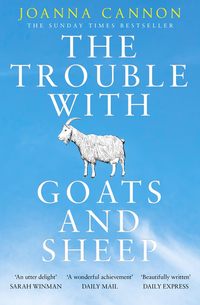
Kitabı oku: «The Trouble with Goats and Sheep»
THE TROUBLE WITH GOATS AND SHEEP
Joanna Cannon

Copyright
This novel is entirely a work of fiction. The names, characters and incidents portrayed in it are the work of the author’s imagination. Any resemblance to actual persons, living or dead, events or localities is entirely coincidental.
The Borough Press
An imprint of HarperCollinsPublishers
1 London Bridge Street
London SE1 9GF
www.harpercollins.co.uk
Published by HarperCollinsPublishers 2016
Joanna Cannon asserts the moral right to be identified as the author of this work
A catalogue record for this book is available from the British Library
First published by HarperCollinsPublishers 2016
Copyright © Joanna Cannon 2016
Lyrics from ‘Bye Bye Baby’ © Bob Gaudio, Bob Crewe
Lyrics from ‘Knock Three Times’ © Irwin Levine, L. Russell Brown
Lyrics from ‘Crazy’ © Willie Nelson
Lyrics from ‘Save all your kisses for me’ © Tony Hiller, Lee Sheriden, Martin Lee
Map by Micaela Alcaino © HarperCollinsPublishers 2016
Cover design by Claire Ward © HarperCollinsPublishers 2016
Cover illustration © Shutterstock.com 2016
All rights reserved under International and Pan-American Copyright Conventions. By payment of the required fees, you have been granted the non-exclusive, non-transferable right to access and read the text of this e-book on-screen. No part of this text may be reproduced, transmitted, down-loaded, decompiled, reverse engineered, or stored in or introduced into any information storage and retrieval system, in any form or by any means, whether electronic or mechanical, now known or hereinafter invented, without the express written permission of HarperCollins e-books
Ebook Edition © December 2016 ISBN: 9780008132187
Source ISBN: 9780008132170
Version: 2017-10-27
Dedication
For Arthur and Janice


Table of Contents
Cover
Title Page
Copyright
Dedication
Map
Number Four, The Avenue
St Anthony’s
Number Four, The Avenue
Number Six, The Avenue
Number Three, Rowan Tree Croft
Number Four, The Avenue
Number Six, The Avenue
Number Two, The Avenue
The Royal British Legion
Number Four, The Avenue
Number Eight, The Avenue
Number Two, The Avenue
Number Four, The Avenue
Number Twelve, The Avenue
Number Four, The Avenue
Number Ten, The Avenue
Number Four, The Avenue
Number Three, Rowan Tree Croft
Number Eleven, The Avenue
Number Twelve, The Avenue
Number Eleven, The Avenue
Number Twelve, The Avenue
Number Four, The Avenue
Number Six, The Avenue
Number Ten, The Avenue
Number Fourteen, The Avenue
Number Four, The Avenue
Number Four, The Avenue
The Drainpipe
Number Two, The Avenue
The Drainpipe
Number Eight, The Avenue
The Drainpipe
The Drainpipe
Number Four, The Avenue
Number Three, Rowan Tree Croft
The Drainpipe
Number Ten, The Avenue
Number Four, The Avenue
Number Four, The Avenue
The Drainpipe
Number Four, The Avenue
The Drainpipe
Number Four, The Avenue
Number Twelve, The Avenue
Number Three, Rowan Tree Croft
The Drainpipe
The Avenue
Acknowledgments
Keep Reading …
If you enjoyed this book, read on for an exclusive excerpt from Joanna Cannon’s new novel Three Things About Elsie
About the Author
About the Publisher
Number Four, The Avenue
21 June 1976
Mrs Creasy disappeared on a Monday.
I know it was a Monday, because it was the day the dustbin men came, and the avenue was filled with a smell of scraped plates.
‘What’s he up to?’ My father nodded at the lace in the kitchen window. Mr Creasy was wandering the pavement in his shirtsleeves. Every few minutes, he stopped wandering and stood quite still, peering around his Hillman Hunter and leaning into the air as though he were listening.
‘He’s lost his wife.’ I took another slice of toast, because everyone was distracted. ‘Although she’s probably just finally buggered off.’
‘Grace Elizabeth!’ My mother turned from the stove so quickly, flecks of porridge turned with her and escaped on to the floor.
‘I’m only quoting Mr Forbes,’ I said, ‘Margaret Creasy never came home last night. Perhaps she’s finally buggered off.’
We all watched Mr Creasy. He stared into people’s gardens, as though Mrs Creasy might be camping out in someone else’s herbaceous border.
My father lost interest and spoke into his newspaper. ‘Do you listen in on all our neighbours?’ he said.
‘Mr Forbes was in his garden, talking to his wife. My window was open. It was accidental listening, which is allowed.’ I spoke to my father, but addressed Harold Wilson and his pipe, who stared back at me from the front page.
‘He won’t find a woman wandering up and down the avenue,’ my father said, ‘although he might have more luck if he tried at number twelve.’
I watched my mother’s face argue with a smile. They assumed I didn’t understand the conversation, and it was much easier to let them think it. My mother said I was at an awkward age. I didn’t feel especially awkward, so I presumed she meant that it was awkward for them.
‘Perhaps she’s been abducted,’ I said. ‘Perhaps it’s not safe for me to go to school today.’
‘It’s perfectly safe,’ my mother said, ‘nothing will happen to you. I won’t allow it.’
‘How can someone just disappear?’ I watched Mr Creasy, who was marching up and down the pavement. He had heavy shoulders and stared at his shoes as he walked.
‘Sometimes people need their own space,’ my mother spoke to the stove, ‘they get confused.’
‘Margaret Creasy was confused all right.’ My father turned to the sports section and snapped at the pages until they were straight. ‘She asked far too many questions. You couldn’t get away for her rabbiting on.’
‘She was just interested in people, Derek. You can feel lonely, even if you’re married. And they had no children.’
My mother looked over at me as though she were considering whether the last bit made any difference at all, and then she spooned porridge into a large bowl that had purple hearts all around the rim.
‘Why are you talking about Mrs Creasy in the past tense?’ I said. ‘Is she dead?’
‘No, of course not.’ My mother put the bowl on the floor. ‘Remington,’ she shouted, ‘Mummy’s made your breakfast.’
Remington padded into the kitchen. He used to be a Labrador, but he’d become so fat, it was difficult to tell.
‘She’ll turn up,’ said my father.
He’d said the same thing about next door’s cat. It disappeared years ago, and no one has seen it since.
*
Tilly was waiting by the front gate, in a jumper which had been hand-washed and stretched to her knees. She’d taken the bobbles out of her hair, but it stayed in exactly the same position as if they were still there.
‘The lady from number eight has been murdered,’ I said.
We walked in silence down the avenue, until we reached the main road. We were side by side, although Tilly had to take more steps to keep up.
‘Who lives at number eight?’ she said, as we waited for the traffic.
‘Mrs Creasy.’
I whispered, in case Mr Creasy had extended his search.
‘I liked Mrs Creasy. She was teaching me to knit. We did like her, Grace, didn’t we?’
‘Oh yes,’ I said, ‘very much.’
We crossed the road opposite the alley next to Woolworth’s. It wasn’t yet nine o’clock, but the pavements were dusty hot, and I could feel material stick to the bones in my back. People drove their cars with the windows down, and fragments of music littered the street. When Tilly stopped to change her school bag to the other shoulder, I stared into the shop window. It was filled with stainless-steel pans.
‘Who murdered her?’ A hundred Tillys spoke to me from the display.
‘No one knows.’
‘Where were the police?’
I watched Tilly speak through the saucepans. ‘I expect they’ll be along later,’ I said, ‘they’re probably very busy.’
We climbed the cobbles in sandals which flapped on the stones and made us sound like an army of feet. In winter ice, we clung to the rail and to each other, but now the alley stretched before us, a riverbed of crisp packets and thirsty weeds, and floury soil which dirtied our toes.
‘Why are you wearing a jumper?’ I said.
Tilly always wore a jumper. Even in scorched heat, she would pull it over her fists and make gloves from the sleeves. Her face was magnolia, like the walls in our living room, and sweat had pulled slippery, brown curls on to her forehead.
‘My mother says I can’t afford to catch anything.’
‘When is she going to stop worrying?’ It made me angry, and I didn’t know why, which made me even angrier, and my sandals became very loud.
‘I doubt she ever will,’ said Tilly, ‘I think it’s because there’s only one of her. She has to do twice the worrying, to keep up with everyone else.’
‘It’s not going to happen again.’ I stopped and lifted the bag from her shoulder. ‘You can take your jumper off. It’s safe now.’
She stared at me. It was difficult to see Tilly’s thoughts. Her eyes hid behind thick, dark-rimmed glasses and the rest of her gave very little away.
‘Okay,’ she said, and took off her glasses. She pulled the jumper over her head, and when she appeared on the other side of the wool, her face was red and blotchy. She handed me the jumper, and I turned it the right way, like my mother did, and folded it over my arm.
‘See,’ I said, ‘it’s perfectly safe. Nothing will happen to you. I won’t allow it.’
The jumper smelt of linctus and unfamiliar soap. I carried it all the way to school, where we dissolved into a spill of other children.
*
I have known Tilly Albert for a fifth of my life.
She arrived two summers ago in the back of a large, white van, and they unloaded her along with a sideboard and three easy chairs. I watched from Mrs Morton’s kitchen, whilst I ate a cheese scone and listened to a weather forecast for the Norfolk Broads. We didn’t live on the Norfolk Broads, but Mrs Morton had been there on holiday, and she liked to keep in touch.
Mrs Morton was sitting with me.
Will you just sit with Grace while I have a little lie-down, my mother would say, although Mrs Morton didn’t sit very much at all, she dusted and baked and looked through windows instead. My mother spent most of 1974 having a little lie-down, and so I sat with Mrs Morton quite a lot.
I stared at the white van. ‘Who’s that then?’ I said, through a mouthful of scone.
Mrs Morton pressed on the lace curtain, which hung halfway down the window on a piece of wire. It dipped in the middle, exhausted from all the pressing. ‘That’ll be the new lot,’ she said.
‘Who are the new lot?’
‘I don’t know.’ She dipped the lace down a little further. ‘But I don’t see a man, do you?’
I peered over the lace. There were two men, but they wore overalls and were busy. The girl who had appeared from the back of the van continued to stand on the pavement. She was small and round and very pale, like a giant white pebble, and was buttoned into a raincoat right up to her neck, even though we hadn’t had rain for three weeks. She pulled a face, as though she were about to cry, and then leant forwards and was sick all over her shoes.
‘Disgusting,’ I said, and took another scone.
*
By four o’clock, she was next to me at the kitchen table.
I had fetched her over because she had sat on the wall outside her house, looking as though she’d been misplaced. Mrs Morton got the Dandelion and Burdock out, and a new packet of Penguins. I didn’t know then that Tilly didn’t like eating in front of people, and she held on to the bar of chocolate until it leaked between her fingers.
Mrs Morton spat on a tissue and wiped Tilly’s hands, even though there was a tap three feet away. Tilly bit her lip and looked out of the window.
‘Who are you looking for?’ I said.
‘My mother.’ Tilly turned back and stared at Mrs Morton, who was spitting again. ‘I just wanted to check she’s not watching.’
‘You’re not looking for your father?’ said Mrs Morton, who was nothing if not an opportunist.
‘I wouldn’t know where to look.’ Tilly wiped her hands very discreetly on her skirt. ‘I think he lives in Bristol.’
‘Bristol?’ Mrs Morton put the tissue back into her cardigan sleeve. ‘I have a cousin who lives in Bristol.’
‘Actually, I think it might be Bournemouth,’ said Tilly.
‘Oh,’ Mrs Morton frowned, ‘I don’t know anyone who lives there.’
‘No,’ Tilly said, ‘neither do I.’
*
We spent our summer holiday at Mrs Morton’s kitchen table. After a while, Tilly became comfortable enough to eat with us. She would spoon mashed potato into her mouth very slowly, and steal peas as we squeezed them from their shells, sitting over sheets of newspaper on the front-room carpet.
‘Don’t you want a Penguin or a Club?’ Mrs Morton was always trying to force chocolate on to us. She had a tin-full in the pantry and no children of her own. The pantry was cavernous and heaved with custard creams and fingers of fudge, and I often had wild fantasies in which I would find myself trapped in there overnight and be forced to gorge myself to death on Angel Delight.
‘No, thank you,’ Tilly said through a very small mouth, as if she were afraid that Mrs Morton might sneak something in there when no one was looking. ‘My mother said I shouldn’t eat chocolate.’
‘She must eat something,’ Mrs Morton said later, as we watched Tilly disappear behind her front door, ‘she’s like a little barrel.’
*
Mrs Creasy was still missing on Tuesday, and she was even more missing on Wednesday, when she’d arranged to sell raffle tickets for the British Legion. By Thursday, her name was being passed over garden fences and threaded along the queue at shop counters.
What about Margaret Creasy, then? someone would say. And it was like firing a starting pistol.
My father spent his time stored away in an office on the other side of the town, and always had to have the day explained to him when he got home. Yet each evening, my mother still asked my father if he had heard any news about Mrs Creasy, and each evening he would sigh from the bottom of his lungs, shake his head, and go and sit with a bottle of pale ale and Kenneth Kendall.
*
On Saturday morning, Tilly and I sat on the wall outside my house and swung our legs like pendulums against the bricks. We stared over at the Creasys’ house. The front door was ajar, and all the windows were open, as if to make it easier for Mrs Creasy to find her way back inside. Mr Creasy was in his garage, pulling boxes from towers of cardboard, and examining their contents one by one.
‘Do you think he murdered her?’ said Tilly.
‘I expect so,’ I said.
I paused for a moment, before I allowed the latest bulletin to be released. ‘She disappeared without taking any shoes.’
Tilly’s eyes bulged like a haddock. ‘How do you know that?’
‘The woman in the Post Office told my mother.’
‘Your mother doesn’t like the woman in the Post Office.’
‘She does now,’ I said.
Mr Creasy began on another box. With each one, he was becoming more chaotic, scattering the contents at his feet and whispering an uncertain dialogue to himself.
‘He doesn’t look like a murderer,’ said Tilly.
‘What does a murderer look like?’
‘They usually have moustaches,’ she said, ‘and are much fatter.’
The smell of hot tarmac pinched at my nose and I shifted my legs against the warmth of the bricks. There was nowhere to escape the heat. It was there every day when we awoke, persistent and unbroken, and hanging in the air like an unfinished argument. It leaked people’s days on to pavements and patios and, no longer able to contain ourselves within brick and cement, we melted into the outside, bringing our lives along with us. Meals, conversations, discussions were all woken and untethered and allowed outdoors. Even the avenue had changed. Giant fissures opened on yellowed lawns and paths felt soft and unsteady. Things which had been solid and reliable were now pliant and uncertain. Nothing felt sure any more. The bonds which held things together were destroyed by the temperature – this is what my father said – but it felt more sinister than that. It felt as though the whole avenue was shifting and stretching, and trying to escape itself.
A fat housefly danced a figure of eight around Tilly’s face. ‘My mum says Mrs Creasy disappeared because of the heat.’ She brushed the fly away with the back of her hand. ‘My mum says the heat makes people do strange things.’
I watched Mr Creasy. He had run out of boxes and was crouched on the floor of his garage, still and silent, and surrounded by debris from the past.
‘I think it probably does,’ I said.
‘My mum says it needs to rain.’
‘I think she’s probably right.’
I looked at the sky, which sat like an ocean above our heads. It wouldn’t rain for another fifty-six days.
St Anthony’s
27 June 1976
On Sunday, we went to church and asked God to find Mrs Creasy.
My parents didn’t ask, because they were having a lie-in, but Mrs Morton and I sat near the front so God could hear us better.
‘Do you think it will work?’ I whispered to her, as we knelt on the slippery cushions.
‘Well, it won’t do any harm,’ she said.
I didn’t understand much of what the vicar was talking about, but he smiled at me from time to time, and I tried to look sinless and interested. The church smelt of wax and old paper, and gave us shelter from a fat sun. The wooden ribs in the roof arched over the congregation, soaking heat and sweat into cool, dry stone, and I shivered under a cotton dress. We had divided ourselves out in the pews, to make it look full, but I edged towards Mrs Morton and the warmth of her cardigan. She held out her hand and I took it, even though I was too old.
The vicar’s words rumbled on the stone like distant thunder.
‘I will be found by you,’ declared the Lord, ‘and I will bring you back from captivity.’
I watched a bead of sweat make a path down Mrs Morton’s temple. It was easy to drift off in church if you angled yourself properly.
‘I will pursue them with the sword, famine and plague. For they have not listened to my words.’
That caught my attention.
‘Those who love me, I will deliver; I will protect those who know my name and when they call to me, I will answer them.’
I stared at the thick, gold cross on the altar. It reflected every one of us: the pious and the ungodly; the opportunist and the devout. Each of us had our reasons for being there, quiet and expectant, and secreted between the pages of a hymn book. How would God manage to answer us all?
‘Lamb of God,’ said the vicar, ‘who taketh away the sins of the world, have mercy upon us.’
And I wondered if we were asking God to find Mrs Creasy, or just asking Him to forgive her for disappearing in the first place.
*
We walked outside into buttery sunshine. It had spread itself over the graves, bleaching the stones and picking out the names of the dead. I watched it creep up the walls of the church until it reached the stained-glass windows, where it threw splinters of scarlet and purple into a cloudless sky. Mrs Morton and her hand had been absorbed by a clutch of efficient women in hats, and so I wandered around the churchyard in careful, horizontal lines, in case anyone was to be accidentally stepped upon.
I liked the feel of the ground beneath my shoes. It seemed safe and experienced, as though all the bones that were buried there had made wisdom grow in the soil. I walked past Ernests and Mauds and Mabels, now beloved and remembered only by the dandelions which grew across their names, until a neat gravel path brought me to the chancel. The graves here were so old, lichen had eaten into who they used to be, and rows of forgotten people stared back at me from headstones that stooped and stumbled like drunks in the earth.
I sat on newly mown grass, behind a grave which was patterned with whorls of green and white. I knew the women in hats were inclined to be time-consuming and I began to make a daisy chain. I had arrived at my fifth daisy when the chancel door opened and the vicar appeared. The breeze caught the edge of his surplice, and he billowed like sheets on a washing line. I watched him march across the graveyard to retrieve an empty crisp packet, and when he returned to the doorway, he took off his shoe and banged it on the church door to get rid of the grass cuttings.
I didn’t realize something like that would be allowed.
‘Why do people disappear?’ I said to him, from behind the gravestone. He didn’t stop banging, but slowed down and looked over his shoulder.
I realized he couldn’t see me. I stood up.
‘Why do people disappear?’ I said again.
The vicar replaced his shoe and walked over to me. He was taller than he had been in church and very earnest. The lines on his forehead were carved and heavy, as though his face had spent its entire time trying to sort out a really big problem. He didn’t look at me, but stared out over the gravestones instead.
‘Many reasons,’ he said eventually.
It was a rubbish answer. I’d found that answer all by myself and I didn’t even have God to ask.
‘Such as?’
‘They wander from the path. They drift off-course.’ He looked at me and I squinted up at him through the sunshine. ‘They become lost.’
I thought about the Ernests and the Mauds and the Mabels. ‘Or they die,’ I said.
He frowned and repeated my words. ‘Or they die,’ he said.
The vicar smelt exactly the same as the church. Faith had been trapped within the folds of his clothes, and my lungs were filled with the scent of tapestry and candles.
‘How do you stop people from disappearing?’ I said.
‘You help them to find God.’ He shifted his weight and gravel crunched around his shoes. ‘If God exists in a community, no one will be lost.’
I thought about our estate. The unwashed children who spilled from houses and the drunken arguments that tumbled through windows. I couldn’t imagine God spent very much time there at all.
‘How do you find God?’ I said, ‘where is He?’
‘He’s everywhere. Everywhere.’ He waved his arms around to show me. ‘You just have to look.’
‘And if we find God, everyone will be safe?’ I said.
‘Of course.’
‘Even Mrs Creasy?’
‘Naturally.’
A crow unfolded itself from the roof of the church, and a murderous cry filled the silence.
‘I don’t know how God can do that,’ I said. ‘How can He keep us from disappearing?’
‘You know that the Lord is our shepherd, Grace. We are just sheep. Only sheep. If we wander off the path, we need God to find us and bring us home.’
I looked down at my feet whilst I thought about it. Grass had buried itself in the weave of my socks and dug sharp, red lines into my flesh.
‘Why do people have to die?’ I said, but when I looked up, the vicar was back at the chancel door.
‘Are you coming for tea at the church hall?’ he shouted.
I didn’t really want to. I would rather have gone back to Tilly. Her mother didn’t believe in organized religion and was worried we’d all be brainwashed by the vicar, but I had to agree, or it would have been a bit like turning down Jesus.
‘Okay,’ I said, and picked the blades of grass from my knees.
*
I walked behind Mrs Morton, along the lane between the church and the hall. The verge was thick with summer: stitchwort and buttercups, and towering foxgloves which blew clouds of pollen from rich, purple bells. The breeze had dropped, leaving us in a razor of heat which cut into the skin at the tops of my arms and made speaking too much of an effort. We trudged in a single line; silent pilgrims drawn towards a shrine of tea and digestives, all strapped into Sunday clothes and decorated with sweat.
When we reached the car park, Tilly was sitting on the wall. She was basted in sun cream and wore a sou’wester.
‘It was the only hat I could find,’ she said.
‘I thought your mother didn’t want you to be religious?’ I held out my hand.
‘She’s gone to stack shelves in the Co-op,’ Tilly said, and heaved herself down from the bricks.
The church hall was a low, white building, which squatted at the end of the lane and looked as though it had been put there whilst someone made their mind up about what to do with it. Inside, it rattled with teacups and efficiency. Sunday heels clicked on a parquet floor and giant, stainless-steel urns spat and hissed to us from the corner.
‘I’m going to have Bovril,’ said Tilly.
I studied Mrs Morton, as she ordered our drinks on the other side of the room. Early widowhood had forced her to weave a life from other people’s remnants, and she had baked and minded and knitted herself into a glow of indispensability. I wondered who Mrs Morton would be if she still had a husband – if Mr Morton hadn’t been searching for The New Seekers in the footwell of his car and driven himself head-first into the central reservation of the M4. There had been a female passenger (people whispered), who appeared at the funeral in ankle-length black and crimson lipstick, and who sobbed with such violence she had to be escorted from the church by an anxious sexton. I remembered none of this. I was too young. I had only ever known Mrs Morton as she was now; tweeded and scrubbed, and rattling like a pebble in a life made for two.
‘Bovril.’ Mrs Morton handed a cup to Tilly. We all knew she wouldn’t drink it, but we kept up the pretence, even Tilly, who held it to her face until steam crept over her glasses.
‘Do you believe in God, Mrs Morton?’ I looked up at her.
Tilly and I both waited.
She didn’t reply immediately, but her eyes searched for an answer in the beams of the ceiling. ‘I believe in not asking people daft questions on a Sunday morning,’ she said eventually, and went to find the toilet.
The hall filled with people. It was far more crowded than the church had been, and pairs of jeans mixed with Sunday best. It appeared that Jesus pulled a much bigger crowd if He provided garibaldis. There were people from our avenue – the Forbeses and the man who was always mowing his lawn, and the woman from the corner house, who was surrounded by a clutter of children. They clung to her hips and her legs, and I watched as she slipped biscuits into her pocket. Everyone stood with newspapers in their armpits and sunglasses on their foreheads and, in the corner, someone’s Pomeranian was having an argument with a Border Collie. People were talking about the water shortage and James Callaghan, and whether Mrs Creasy had turned up yet. She hadn’t.
No one mentioned Jesus.
In fact, I didn’t think anyone would have noticed if Jesus had walked into the room, unless He happened to be accompanied by an Arctic roll.
*
‘Do you believe in God?’ I asked Tilly.
We sat in a corner of the hall, on blue plastic chairs which pulled the sweat from our skin, Tilly sniffing her Bovril and me drawing my knees to my chest, like a shield. I could see Mrs Morton in the distance, trapped by a trestle table and two large women in flowered aprons.
‘Probably,’ she said. ‘I think God saved me when I was in hospital.’
‘How do you know that?’
‘My mum asked Him to every day.’ She frowned into her cup. ‘She went off Him after I got better.’
‘You’ve never told me. You always said you were too young to remember.’
‘I remember that,’ she said, ‘and I remember it was Christmas and the nurses wore tinsel in their hair. I don’t remember anything else.’
She didn’t. I had asked – many times. It was better for children if they didn’t know all the facts, she’d said, and the words always left her mouth in italics.
When she first told me, it was thrown into the conversation with complete indifference, like a playing card. I had never met anyone who had nearly died, and in the beginning the subject was attacked with violent curiosity. Then it became more than fascination. I needed to know everything, so that all the details might be stitched together for protection. As if hearing the truth would somehow save us from it. If I had almost died, I would have an entire speech to use at a moment’s notice, but Tilly only remembered the tinsel and something being wrong with her blood. It wasn’t enough – even when I connected all the words together, like a prayer.
After she told me, I had joined her mother in a silent conspiracy of watchfulness. Tilly was watched as we ran under a seamless August sky; a breathless look over my shoulder, waiting for her legs to catch up with mine. She was protected from a baked summer by my father’s golfing umbrella, a life lived far from the edges of kerbs and the cracks in pavements, and when September carried in mist and rain, she was placed so close to the gas fire, her legs became tartanned in red.
I watched her without end, inspecting her life for the slightest vibration of change, and yet she knew none of this. My worries were noiseless; a silent obsession that the only friend I had ever made would be taken from me, just because I hadn’t concentrated hard enough.
*
The noise in the hall drifted into a slur of voices. It was a machine, ticking over in the heat, fuelled by rumour and judgement, and we stared into an engine of cooked flesh and other people’s feet. Mr Forbes stood in front of us, sailing a cherry Bakewell through the air and giving out his opinion, as warmth crept into the material of his shirt.
‘He woke up on Monday morning and she’d gone. Vanished.’
‘Beggars belief,’ said Eric Lamb, who still had grass cuttings on the bottom of his trousers.
‘Live for the moment, that’s what I say.’ I watched Mr Forbes sail another cherry Bakewell around, as if to demonstrate his point.
Mrs Forbes didn’t speak. Instead, she shuffled her sandals on the herringbone floor, and twisted a teacup around in its saucer. Her face had worried itself into a pinch.
Mr Forbes studied her, as he disappeared his cherry Bakewell. ‘Stop whittling about it, Dorothy. It’s got nothing to do with that.’
‘It’s got everything to do with that,’ she said, ‘I just know it.’
Mr Forbes shook his head. ‘Tell her, Eric,’ he said, ‘she won’t listen to me.’
‘That’s all in the past. This will be about something else. A bit of a tiff, that’s what it’ll be,’ said Eric Lamb. I thought his voice was softer, and edged with comfort, but Mrs Forbes continued to shuffle, and she trapped her thoughts behind a frown.
‘Or the heat,’ said Mr Forbes, patting his belly to ensure the cherry Bakewells had safely arrived at their destination. ‘People do strange things in this kind of weather.’
‘That’s it,’ said Eric Lamb, ‘it’ll be the heat.’
Mrs Forbes looked up from her twisting teacup. Her smile was very thin. ‘We’re a bit buggered if it isn’t, though, aren’t we?’ she said.
The three stood in silence. I saw a stare pass between them, and Mr Forbes dragged the crumbs from his mouth with the back of a hand. Eric Lamb didn’t speak. When the stare reached his eyes, he looked at the floor to avoid taking it.
After a while, Mrs Forbes said, ‘this tea needs more milk,’ and she disappeared into a wall of sunburned flesh.
I tapped Tilly on the arm, and a spill of Bovril escaped on to blue plastic.
‘Did you hear that?’ I said. ‘Mrs Forbes said they’re all buggered.’
‘That’s not very church hall-ey, is it?’ said Tilly, who still wore her sou’wester. She wiped the Bovril with the edge of her jumper. ‘Mrs Forbes has been a little unusual lately.’
This was true. Only the day before, I’d seen her wandering around the front garden in a nightdress, having a long conversation with the flower beds.
It’s the heat, Mr Forbes had said, as he took her back inside with a cup of tea and the Radio Times.
‘Why do people blame everything on the heat?’ said Tilly.
‘It’s easier,’ I said.
‘Easier than what?’
‘Easier than telling everyone the real reasons.’
*
The vicar appeared.
We knew he had arrived even before we saw him, because all around the room, conversations began to cough and falter. He cut through the crowd, leaving it to re-form behind him, like the surface of the Red Sea. He appeared to glide beneath his cassock, and there was an air of stillness about him, which made everyone he approached seem overactive and slightly hysterical. People stood a little straighter as they shook his hand, and I saw Mrs Forbes do what appeared to be a small curtsy.
‘What did he say in church then?’ said Tilly, as we watched him edge around the room.
‘He said that God runs after people with knives if they don’t listen to Him properly.’
Tilly sniffed her Bovril again. ‘I never knew He did that,’ she said eventually.
Sometimes I struggled to take my gaze from her. She was almost transparent, as fragile as glass. ‘He said that if we find God, He’ll keep us all safe.’
Tilly looked up. There was a streak of sun cream on the very tip of her nose. ‘Do you think someone else is going to disappear, Gracie?’
I thought about the gravestones and Mrs Creasy, and the fractured, yellow lawns.
‘Do we need God to keep us safe? Are we not safe just as we are?’ she said.
‘I’m not sure that I know any more.’
I watched her, and threaded my worries like beads.
*
The vicar completed his circuit of the room and disappeared, as if he were a magician’s assistant, behind a curtain next to the stage. The engine of conversation started again, small at first, and uncertain, then powering up to its previous level, as the air filled with hosepipe bans and stories of vanishing neighbours.
It probably would have stayed that way. It probably would have run its course, and continued until people wandered home to fill themselves with Brussels sprouts, had Mr Creasy not burst through the double doors and marched the length of the hall past a startled audience. Silence followed him around the room, leaving only the click of a cup on a saucer, and the sound of elbows nudging each other.
He stopped in front of Mr Forbes and Eric Lamb, his face stretched with anger. Tilly said afterwards that she thought he was going to hit someone, but to me he looked as though all the hitting had been frightened out of him.
The words stayed in his eyes for a few seconds, then he said, ‘You told her, didn’t you?’
It was a whisper that wanted to be a shout, and it left his mouth wrapped in spit and fury.
Mr Forbes turned from their audience, and guided Mr Creasy towards a wall. I heard him say Christ and calm down and for heaven’s sake, and then I heard him say, ‘We haven’t told her anything.’
‘Why else would she up and leave?’ said Mr Creasy. The rage seemed to immobilize him, and he became a furious effigy, fixed and motionless, except for the flush which crept from beneath his shirt and into his neck.
‘I don’t know,’ said Mr Forbes, ‘but if she’s found out, it’s not come from us.’
‘We’re not that stupid,’ said Eric Lamb. He looked over his shoulder at a sea of teacups and curiosity. ‘Let’s get you out of here, let’s get you a drink.’
‘I don’t want a bloody drink.’ Mr Creasy hissed at them, like a snake. ‘I want my wife back.’
He had no choice. They escorted him out of the hall, like prison guards.
I watched Mrs Forbes.
She stared at the door long after it had closed behind them.
Number Four, The Avenue
27 June 1976
The roads on our estate were all named after trees, and Tilly and I walked home from the church hall along an alley which separated Sycamore from Cedar. On either side of us, lines of washing stretched like bunting across deserted gardens, waiting for the whisper of a breeze, and as we walked, drips of water smacked a tune on to concrete paths.
No one realized then that, in many years to come, people would still speak of this summer; that every other heatwave would be compared to this one, and those who lived through it would shake their heads and smile whenever anyone complained of the temperature. It was a summer of deliverance. A summer of Space Hoppers and dancing queens, when Dolly Parton begged Jolene not to take her man, and we all stared at the surface of Mars and felt small. We had to share bathwater and half-fill the kettle, and we were only allowed to flush the toilet after what Mrs Morton described as a special occasion. The only problem was, it meant that everyone knew when you’d had a special occasion, which was a bit awkward. Mrs Morton said we’d end up with buckets and standpipes if we weren’t careful, and she was part of a vigilante group, who reported anyone for watering their gardens in the dark (Mrs Morton used washing-up water, which was allowed). It will only work if we all pull together, she said. I knew this wasn’t true, mind you, because, unlike the brittle yellow of everyone else’s, Mr Forbes’ lawn remained a strangely suspicious shade of green.
*
I could hear Tilly’s voice behind me. It drummed on the parched, wooden slats of the fences either side, which were beaten into white by the heat.
What do you think? she was saying.
She had been turning Mr Creasy’s words over since Pine Crescent, trying to fit them into an opinion.
‘I think Mr and Mrs Forbes are in on it,’ I shouted back.
She caught up with me, her legs fighting with the sentence. ‘Do you think they were the ones who murdered her?’
‘I think they all murdered her together.’
‘I’m not sure they look the type,’ she said. ‘My mum thinks the Forbeses are old-fashioned.’
‘No, they’re very modern.’ I found a stick and drew it along the fence. ‘They have a SodaStream.’
Tilly’s mum thought everyone was old-fashioned. Tilly’s mum owned long earrings and drank Campari, and only ever wore cheesecloth. In cold weather, she just wore more cheesecloth, layering it around herself like a shroud.
‘My mum says Mr and Mrs Forbes are curious people.’
‘Well, she’d know,’ I said.
Back doors were propped open in the heat, and the smell of batter and roasting tins escaped from other people’s lives. Even in ninety degrees, Brussels sprouts still simmered on stoves, and gravy still dripped and pooled on heavy plates.
‘I hate Sundays,’ I said.
‘Why?’ Tilly found another stick and dragged it alongside mine.
Tilly didn’t hate anything.
‘It’s just the day before Monday,’ I said. ‘It’s always too empty.’
‘We break up soon. We’ll have six weeks of nothing but Sundays.’
‘I know.’ The stick hammered my boredom into the wood.
‘What shall we do with our holidays?’
We reached the end of the fence, and the alley became silent.
‘I haven’t quite decided yet,’ I said, and let the stick fall from my hand.
*
We walked on to Lime Crescent , our sandals sending loose chippings dancing along the road. I looked up, but sunlight shot back from cars and windows and punished my eyes. I squinted and tried again.
Tilly didn’t notice, but I saw them straight away. A tribe of girls, a uniform of Quatro flicks and lip gloss, with hands stuffed into pockets, making denim wings. They stood on the opposite corner, doing nothing except being older than me. I saw them weigh out our presence, as they measured the pavement with scuffed market boots and chewed gum. They were a bookmark, a page I had yet to read, and I wanted to stretch myself out to get there.
I knew them all. I had watched for so long from the margins of their lives, their faces were as familiar as my own. I looked over for a thread of acknowledgement, but there was none. Even when I willed it with my eyes. Even when I slowed my steps to almost nothing. Tilly walked ahead, and I grew the distance between us, as stares filled with opinion reflected back at me. I couldn’t find anything to do with my arms, and so I folded them around my waist and tried to make my sandals sound more rebellious.
Tilly waited for me around the corner.
‘What shall we do now?’ she said.
‘Dunno.’
‘Shall we go to your house?’
‘S’pose.’
‘Why are you talking like that?’
I unfolded my arms. ‘I don’t know.’
She smiled, and I smiled back, even though the smiling felt unquiet.
‘Here,’ I said, and took the sou’wester from her head and put it on my own.
Her laughter was instant, and she reached for it back. ‘Some people just can’t wear hats, Gracie,’ she said. ‘It should stay where it belongs.’
My arm linked through hers and we walked towards home. Past matched lawns and carbon-papered lives, and rows of terraced houses, which handcuffed families together through chance and coincidence.
And I tried to make it enough.
*
When we got home, my mother was peeling potatoes and talking to Jimmy Young. He sat on the shelf above her head, and she nodded and smiled at him as she filled the sink with soil.
‘You’ve been gone a while.’
I wasn’t sure if she was talking to me or to Jimmy.
‘We were at church,’ I said.
‘Did you enjoy it?’
‘Not really.’
‘That’s nice,’ she said, and fished another potato from the mud.
Tilly’s laughter hid inside her jumper.
‘Where’s Dad?’ I took two cheese triangles from the fridge and emptied a packet of Quavers on to a plate.
‘He’s gone to get a paper,’ said my mother, and she drowned the potatoes with a little more certainty. ‘He’ll be back soon.’
Pub, I mouthed at Tilly.
I unwrapped a triangle and Tilly took off her sou’wester, and we listened to Brotherhood of Man and watched my mother fashion potatoes.
Save all your kisses for me, said the radio, and Tilly and I did the dance with our arms.
‘Do you believe in God?’ I said to my mother, when the record had finished.
‘Now, do I believe in God?’ Her peeling slowed, and she stared at the ceiling.
I couldn’t understand why everyone looked towards the sky when I asked the question. As though they were expecting God to appear in the clouds and give them the right answer. If so, God let my mother down, and we were still waiting for her reply when my father appeared at the back door with no newspaper, and the British Legion still smeared in his eyes.
He draped himself around my mother, like a sheet. ‘How is my beautiful wife?’ he said.
‘There’s no time for that nonsense, Derek.’ She drowned another potato.
‘And my two favourite girls.’ He ruffled our hair, which was a bit of a mistake, as neither Tilly nor I had the kind of hair that could be ruffled very successfully. Mine was too blonde and opinionated, and Tilly’s refused to be separated from its bobbles.
‘Are you staying for some lunch, Tilly?’ my father said.
He leaned over to speak and ruffled her hair again. Whenever Tilly was there, he became a cartoon parent, a surrogate father. He swooped down to fill a gap in Tilly’s life that she never realized existed, until he highlighted it so exquisitely.
She started to answer, but he had his head in the fridge.
‘I saw Thin Brian in the Legion,’ he was saying to my mother. ‘Guess what he told me.’
My mother remained silent.
‘That old woman who lives at the end of Mulberry Drive, you know the one?’
My mother nodded into the peelings.
‘They found her dead last Monday.’
‘She was quite old, Derek.’
‘The point is,’ he said, unwrapping a cheese triangle of his own, ‘they reckon she’d been dead for a week and no one noticed.’
My mother looked over, and Tilly and I stared at the plate of Quavers in an effort to be unremembered.
‘They wouldn’t have discovered her even then,’ my father said, ‘if it hadn’t been for the sme—’
‘Why don’t you girls go outside?’ my mother said. ‘I’ll shout when your dinner’s ready.’
*
We sat on the patio, our backs pressed into the bricks to keep us in a ribbon of shade.
‘Fancy dying and no one misses you,’ Tilly said. ‘That’s not very Godly, is it?’
‘The vicar says God is everywhere,’ I said.
Tilly frowned at me.
‘Everywhere.’ I waved my arms around to show her.
‘So why wasn’t He on Mulberry Drive?’
I stared at the row of sunflowers on the far side of the garden. My mother had planted them last spring, and now they stretched above the wall and peered into the Forbes’ garden, like floral spies.
‘I’m not sure,’ I said. ‘Perhaps He was somewhere else.’
‘I hope someone misses me when I die,’ she said.
‘You’re not going to die. Neither of us are. Not until we’re old. Not until people expect it of us. God will keep us safe until then.’
‘He didn’t keep Mrs Creasy safe, though, did he?’
I watched bumble bees drift between the sunflowers. They explored each one, dipping into the centre, searching and inspecting, until they reappeared in the daylight, dusted in yellow and drunk with achievement.
And it all became so obvious. ‘I know what we’re going to do with the summer holidays,’ I said, and got to my feet.
Tilly looked up. She squinted at me and shielded her eyes from the sun. ‘What?’
‘We’re going to make sure everyone is safe. We’re going to bring Mrs Creasy back.’
‘How are we going to do that?’
‘We’re going to look for God,’ I said.
‘We are?’
‘Yes,’ I said, ‘we are. Right here on this avenue. And I’m not giving up until we find Him.’
I held out my hand. She took it and I pulled her up next to me.
‘Okay, Gracie,’ she said.
And she put her sou’wester back on and smiled.
Number Six, The Avenue
27 June 1976
It was Are You Being Served? on a Monday, The Good Life on a Tuesday, and The Generation Game on a Saturday. Although for the life of her, Dorothy couldn’t see what people found funny about Bruce Forsyth.
She tried to remember them, like a test, as she did the washing-up. It took her mind off the church hall, and the look on John Creasy’s face, and the spidery feeling in her chest.
Monday, Tuesday, Saturday. She usually liked washing up. She liked to watch the garden and idle her mind, but today the weight of the heat pressed against the glass and made her feel as though she were looking out from a giant oven.
Monday, Tuesday, Saturday.
She could still remember, although she wasn’t taking any chances. They were all circled in the Radio Times.
Harold became very irritable if she asked him something more than once.
Try to keep it in your head, Dorothy, he told her.
When Harold became angry, he could fill a room with his own annoyance. He could fill their sitting room, and the doctor’s surgery. He could even fill an entire supermarket.
She tried very hard to keep things in her head.
Sometimes, though, the words escaped her. They hid behind other words, or they showed a little of themselves, and then disappeared back into her mind before she had a chance to catch them.
I can’t find my … she would say, and Harold would throw choices at her like bullets. Keys? Gloves? Purse? Glasses? and it would make the word she wanted disappear even more.
Cuddly toy, she said one day, to make him laugh.
But Harold didn’t laugh. Instead, he stared at her as though she had walked into the conversation uninvited, and then he had closed the back door very quietly and started mowing the lawn. And somehow the quietness filled a room even more than the anger.
She folded the tea towel and put it on the edge of the draining board.
Harold had been quiet since they’d got back from church. He and Eric had deposited John Creasy somewhere, although Lord knows where, she hadn’t even dared ask, and he had sat down and read his newspaper in silence. He had eaten his dinner in silence, and dropped gravy down his shirt front in silence, and when she asked him if he wanted mandarin segments with Ideal milk for afterwards, he had only nodded at her.
When she put it down in front of him, he said the only sentence to come out of his mouth all afternoon. These are peaches, Dorothy.
It was happening all over again. It ran in families, she’d read it somewhere. Her mother ended up the same way, kept being found wandering the streets at six in the morning (postman, nightdress) and putting everything where it didn’t belong (slippers, breadbin). Mad as a box of frogs, Harold had called her. She was around Dorothy’s age when she first started to lose her mind, although Dorothy always thought losing your mind was such a strange phrase. As if your mind could be misplaced, like a set of house keys, or a Jack Russell terrier, as if it was more than likely your own fault for being so bloody careless.
They’d put her mother in a home within weeks. It was all very quick.
It’s for the best, Harold had said.
He’d said it each time they went to visit.
After he’d eaten his peaches, Harold had settled himself on the settee and fallen asleep, although how anyone could sleep in this heat was beyond her. He was still there now, his stomach rising and falling as he shifted in between dreams, his snoring keeping time with the kitchen clock, and plotting out the afternoon for them both.
Dorothy took the remains of their silent meal and emptied it into the pedal bin. The only problem with losing your mind was that you never lost the memories you wanted to lose. The memories you really needed left first. Her foot rested on the pedal, and she looked into the waste. No matter how many lists you wrote, and how many circles you made in the Radio Times, and no matter how much you practised the words over and over again, and tried to fool people, the only memories that didn’t leave were the ones you wish you’d never made in the first place.
She reached into the rubbish and lifted a tin out of the potato peelings. She stared at it.
‘These are peaches, Dorothy,’ she said to an empty kitchen. ‘Peaches.’
She felt the tears before she even knew they had happened.
*
‘The problem, Dorothy, is that you think too much.’ Harold’s gaze never left the television screen. ‘It’s not healthy.’
Evening had tempered the sun, and a wash of gold folded across the living room. It drew the sideboard into a rich, dark brandy and buried itself in the pleats of the curtains.
Dorothy picked imaginary fluff from the sleeve of her cardigan. ‘It’s difficult not to think about it, Harold, under the circumstances.’
‘This is completely different. She’s a grown woman. Her and John have probably just had some kind of tiff and she’s cleared off for a bit to teach him a lesson.’
She looked over at her husband. The light from the window gave his face a faint blush of marzipan. ‘I only hope you’re right,’ she said.
‘Of course I’m right.’ His stare was still fastened to the television screen, and she watched his eyes flicker as the images changed.
It was Sale of the Century. She should have known better than to speak to Harold whilst he was occupied with Nicholas Parsons. It might have been best to try and fit the conversation into an advert break, but there were too many words and she couldn’t stop them climbing into her mouth.
‘The only thing is, I saw her. A few days before she disappeared.’ Dorothy cleared her throat, even though there was nothing to clear. ‘She was going into number eleven.’
Harold looked at her for the first time. ‘You never told me.’
‘You never asked,’ she said.
‘What was she doing going in there?’ He turned towards her, and his glasses fell from the arm of his chair. ‘What could they possibly have to say to each other?’
‘I have no idea, but it can’t be a coincidence, can it? She speaks to him, and then a few days later, she vanishes. He must have said something.’
Harold stared at the floor, and she waited for his fear to catch up with hers. In the corner, the television churned the laughter of strangers out into their living room.
‘What I don’t understand’, he said, ‘is how he could stay on the avenue, after everything that happened. He should have moved on.’
‘You can’t dictate to people where they live, Harold.’
‘He doesn’t belong here.’
‘He’s lived at number eleven all his life.’
‘But after what he did?’
‘He didn’t do anything.’ Dorothy looked at the screen to avoid Harold’s eyes. ‘They said so.’
‘I know what they said.’
She could hear him breathing. The wheeze of warm air moving through tired lungs. She waited. But he turned to the television and straightened his spine.
‘You’re just being hysterical, Dorothy. All that’s over and done with. It was ten years ago.’
‘Nine, actually,’ she said.
‘Nine, ten, what does it matter? It’s all in the past, except every time you start talking about it, it stops being in the past and starts being in the present again.’
She gathered the material of her skirt into folds and let them fall between her hands.
‘Would you stop fidgeting, woman.’
‘I can’t help myself,’ she said.
‘Well, go and do something productive. Go and have a bath.’
‘I had a bath this morning.’
‘Well, go and have another one,’ he said, ‘you’re putting me off the questions.’
‘What about saving water, Harold?’
But Harold didn’t reply. Instead of replying, he picked at his teeth. Dorothy could hear him. Even over Nicholas Parsons.
She smoothed down her hair and her skirt. She took a deep breath to suffocate her words, and then she stood up and walked from the room. Before she closed the door, she looked back.
He had turned away from the television, and was staring through the window – past the lace of the curtains, across the gardens and the pavements, to the front door of number eleven.
His glasses still lay at his feet.
*
Dorothy knew exactly where she’d hidden the tin.
Harold never went into the back bedroom. It was a holding place. A waiting room for all the things she no longer needed but couldn’t bear to lose. He said the thought of it gave him a headache. As the years turned, the room had grown. Now the past pushed into corners and reached to the ceiling. It stretched along the windowsill and touched the skirting boards, and it allowed Dorothy to hold it in her hands. Sometimes, remembering wasn’t enough. Sometimes, she needed to carry the past with her to be sure she was a part of it.
The room trapped summer within its walls. It held Dorothy in an airless museum of dust and paper, and she felt the sweat bleed into her hairline. The sound of the television crept through the floorboards, and she could picture Harold beneath her feet, answering questions and picking at his teeth.
The tin sat between a pile of blankets her mother had crocheted and some crockery left over from the caravan. She could see it from the doorway, as though it had waited for her, and she kneeled on the carpet and pulled it free. Around the edge were photographs of biscuits to tempt you inside, pink wafers and party rings and Jammie Dodgers, all joining cartoon hands and dancing with cartoon legs, and she held on to them as she lifted the lid away.
The first thing she saw was a raffle ticket from 1967 and a collection of safety pins. There were Harold’s tarnished cufflinks and a few escaped buttons, and the cutting about her mother’s funeral from the local paper.
Passed away peacefully, it said.
She hadn’t.
But beneath the pins and the grips and the buttons was what she had come for. Kodak envelopes, fattened with time. Harold didn’t believe in photographs. Mawkish, he called them. Dorothy didn’t know anyone else who used the word ‘mawkish’. There were very few pictures of Harold. There was an occasional elbow at a dinner table, or trouser leg on a lawn, and if anyone had managed to capture his face in the frame, he wore the expression of someone who had been the victim of trickery.
She searched through the packets. Most of the photographs were rescued from her mother’s house. People she didn’t know, held within white, serrated edges, sitting in gardens she didn’t recognize and rooms she had never visited. There were Georges and Florries, and lots of people called Bill. They had written their names on the back, perhaps hoping that, if their identity were known, they would somehow be better remembered.
There were few photographs of her own – an infrequent Christmas gathering, a meal with the Ladies’ Circle. A photograph of Whiskey fell to the carpet, and she felt her throat fill.
He had never come home.
Just get another cat, Harold had said.
It was the closest she had ever come to losing her temper.
The photograph she wanted was at the bottom, a weight of memories pressed upon it. She had to see. She had to be sure. Perhaps, over the years, the past had become misshapen. Perhaps time had stretched their part in it, and bloated her conscience. Perhaps, if she could see the faces again, she would recognize their harmlessness.
They looked up at her from a table at the British Legion. It was before everything happened, but she was sure it was the same table – the table where the decision had been made. Harold sat next to her, and they both stared into the lens with troubled eyes. The photographer had caught them by surprise, she remembered that, someone from the town paper wanting pictures for an article on local colour. Of course, they never used it. John Creasy stood behind them, his hands pushed into his pockets, looking out from under a Beatles fringe. Sitting in front of John was that daft clown Thin Brian, with a pint glass in his hand, and Eric Lamb was opposite Harold. Sheila Dakin was on the end – all eyelashes and Babycham.
Dorothy looked at their faces, hoping to see something else.
There was nothing. They were exactly as she had left them.
It was 1967. The year Johnson sent thousands more to die in Vietnam. The year China made a hydrogen bomb, and Israel fought a six-day war. The year people marched and shouted, and waved banners about what they believed in.
It was a year of choices.
She wished she had known then that one day she would be staring back at herself, wishing that the choice they had made had been a different one. She turned the photograph over. There were no names. After all that had happened, she was certain none of them would care to be remembered.
Ücretsiz ön izlemeyi tamamladınız.