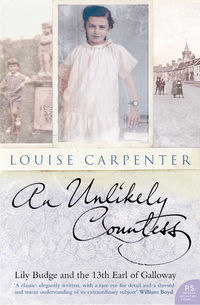
Kitabı oku: «An Unlikely Countess: Lily Budge and the 13th Earl of Galloway»
AN UNLIKELY COUNTESS
Lily Budge and the 13th Earl of Galloway
LOUISE CARPENTER

Copyright
HarperPerennial An imprint of HarperCollinsPublishers 1 London Bridge Street London SE1 9GF
www.harpercollins.co.uk
This edition published by Harper Perennial 2005
First published by HarperCollinsPublishers 2004
Copyright © Louise Carpenter 2004
PS section copyright © Louise Tucker 2005
except ‘An Unlikely Countess’ by Louise Carpenter
© Louise Carpenter 2005
PS™ is a trademark of HarperCollinsPublishers Ltd
Louise Carpenter asserts the moral right to be identified as the author of this work
‘Small Town’ Words and Music by Lou Reed and John Cale © 1989, Screen Gems – EMI Music Inc/Metal Machine Music/John Cale Music Inc, USA Reproduced by permission of Screen Gems – EMI Music Ltd, London WC2H OQY
The publisher and the author gratefully acknowledge Randolph Galloway, the Estate of Lily Budge, The Stewart Society, Joseph Bonnar, William Mowat Thomson, Michael Thornton, and Roddy Martine for permission to reproduce photographs and press clippings from private collections.
All reasonable efforts have been made by the author and publisher to trace copyright holders. In the event that we are contacted by any of the untraceable copyright holders after publication of this book, the publisher and author will endeavour to rectify the position accordingly.
A catalogue record for this book is available from the British Library
All rights reserved under International and Pan-American Copyright Conventions. By payment of the required fees, you have been granted the nonexclusive, nontransferable right to access and read the text of this e-book on-screen. No part of this text may be reproduced, transmitted, downloaded, decompiled, reverse engineered, or stored in or introduced into any information storage and retrieval system, in any form or by any means, whether electronic or mechanical, now known or hereinafter invented, without the express written permission of HarperCollins e-books.
HarperCollinsPublishers has made every reasonable effort to ensure that any picture content and written content in this ebook has been included or removed in accordance with the contractual and technological constraints in operation at the time of publication.
Source: ISBN 9780007108817
Ebook Edition © FEBRUARY 2013 ISBN 9780007391707
Version: 2016-08-05
Dedication
For Tom
and
Randolph Galloway
Epigraph
I am very fond of the good soldier Schweik … Iam convinced that you will sympathise with thismodest, unrecognised hero. He did not set fire to thetemple of the Goddess at Ephesus, like that fool of aHerostratus, merely in order to get his name intothe newspapers and the school reading books.
And that, in itself, is enough.
JAROSLAV HAŠEK, The Good Soldier Schweik
Contents
Cover
Title Page
Dedication
Epigraph
PART ONE
1 The Most Caring Place in the World
2 The Beginnings
3 Virescit Vulnere Virtus: Valour Grows Strong from a Wound
4 Tea or Coffee, ma’am?
5 Happy Days are Coming
6 Becoming Mrs Budge
7 Lobotomised Patients Make Good Citizens
8 Carnival of the Animals
9 A Crazy House
10 Anglo-Catholic with Charismatic Overtones
PART TWO
11 Poor Love
12 My Home is My Castle
13 A Shoddy Day and Age
14 Will the Earl Get a Crumb of Comfort?
15 Here, Sir!
16 I Would Have Hated to Commit Murder
PART THREE
17 We Have the Name Darling, but Alas, We do not Have the Game
18 Poor Margot is Ghastly
19 Never Judge a Person until You’ve Walked a Mile in their Shoes
20 New Places to Wear Diamonds
Afterword
P.S. Ideas, Interviews & Features …
About the Author
Approaching Lily: Louise Carpenter talks to Louise Tucker
Life at a Glance
Top Ten Favourite Books
A Day in the Life of Louise Carpenter
About the Book
An Unlikely Subject by Louise Carpenter
Read On
If You Loved This, You Might Like …
Find Out More
Select Bibliography
Index
Acknowledgements
About the Author
Praise
Copyright
About the Publisher
PART ONE
When you’re growing up in a small townYou know you’ll grow down in a small townThere is only one good use for a small townYou hate it and you’ll know you have to leave.
LOU REED, ‘Small Town’
1 The Most Caring Place in the World
On 15 May 1979, on a draughty platform at Waverley Station, Edinburgh, Lord and Lady Galloway, fresh to their titles and in a muddle with their luggage, were preparing to board a train headed for London. ‘If I can have this opportunity of going to the House of Lords, I shall take it,’ Lily Galloway had told their French lodger, Marie-Laurence Maître, in their tenement flat as she packed.
Lily, dressed in a bottle-green velvet suit, which was a touch thin at the elbows and cuffs, but brushed up on the lapels, struggled as usual with their trunks while Randolph Galloway walked ahead, hands clasped stiffly behind his back. If anybody had cared to study their expressions, in him they would have observed a vagueness, as if he inhabited another world, one he did not much care for but from which he could not escape, and in her the opposite, the alertness of a proficient nurse in constant anticipation of a crisis. Randolph was easily unsettled by noise and commotion – as a child he would become quite hysterical if a train blew its steam – and he was prone to wandering off. Lily would have to maintain vigilance.
Their brief wedding announcement had been published in the court and social pages of the Daily Telegraph on 1 November 1975. Lord Garlies, then heir to the Earldom of Galloway, had married Mrs Lily Budge, youngest daughter of the late Mr and Mrs Andrew Miller, of Duns, Berwickshire. In February 1976, following their church blessing, a large photograph of them appeared over a page of the Edinburgh Tatler with a brief caption outlining how the reception had taken place at the Caledonian Hotel in Edinburgh. The picture alone revealed that Lily was some years older than her husband and would not by any stretch of the imagination be capable of providing an heir. And while blessed with a mop of thick black hair and two rows of straight, pearly white teeth, she could not be described as a beauty. To those in Scotland who followed the births, deaths, and marriages of the aristocracy, the announcement that the 12th Earl of Galloway’s son and heir had married came as a shock. The reception had not taken place at the family seat of Cumloden, Newton Stewart, and the 12th Earl of Galloway and his daughter, Lady Antonia Dalrymple, did not attend the party.
Randolph Galloway, recognised by the Stewart Society as head of the Stewart clan, noted in Burke’s Peerage, Baronetage and Knight-age as the 13th Earl of Galloway, Lord Garlies, Baron Stewart of Garlies and a Baronet (Sir Randolph Keith Reginald Stewart, 12th Bart. of Corsewell, and 10th Bart. of Burray) was now about to take his seat in the upper house. He stood at over six feet and possessed a broad, athletic build. He had thick black wavy hair, parted and combed back from his high forehead, a strong square jaw and light, piercing blue eyes, sometimes hidden behind heavy black-rimmed spectacles. He was slim and handsome in the new three-piece suit, picked and paid for by Lily.
On arriving in London unscathed by drama, Lily and Randolph went to 20 Great Peter Street, SW1, the clergyhouse of St Matthew’s, Westminster, offered by the Vicar Prebendary Gerard Irvine. (Shortly afterwards, they would move to temporary accommodation in SW5 and thereafter use a series of cheap tourist hotels such as The Hansel and Gretel, £12.65 a night including VAT and breakfast.) The following day, 16 May, Randolph took his seat and Lily settled herself on the red leather pews of the Peeresses’ gallery, front row, first in. She watched over him proudly as he sat mute on the Conservative benches in front of her. He did not deliver a maiden speech, which was for the best.
Outside the gates of Parliament, she posed for a photograph. ‘The Lords is the most caring place in the world!’ she later told a newspaper reporter. ‘If I had my way we would live in London permanently.’
When Lily was not guiding Randolph about the wood-panelled corridors or sitting in the chamber, with her eyes attentively trained on him in the manner of a dog to its master, she could be found in one of three places: in the House of Lords’ stationery cupboard, availing herself of as many complimentary cards and envelopes as would fit into her handbag; on the telephone to family in Scotland, a service which was also complimentary; or in the tearoom, knitting needles in hand, eating tea and toast with the Scottish peeresses who befriended her.
There was nothing in Lily’s outward appearance to distinguish her from the other peers’ wives except perhaps a little weariness. She was set apart principally because she had no interest in behaving as expected. Her occasional guests from Scotland saw that she liked to congratulate the other wives on their appearance – ‘My, Lady so and so, what a dear little hat you are wearing today’ – and every morning, on entering the House, she made a point of inquiring after everyone’s health – ‘Good morning Mr Skelton [then a junior doorkeeper], how are you? And how is your mother? Oh, will you send her my regards?’
Lily and Randolph considered themselves to have an important patron. The 17th Earl of Lauderdale, Patrick Maitland, a well-respected Scottish hereditary peer, former MP for Lanark, former reporter for The Times, and one of the last men in Britain to make use of a large ear trumpet, had come to know them through the ecumenical pilgrimages he organised to St Mary’s Kirk, his private chapel in the parish of Haddington, not far from Edinburgh. They were, he had long ago concluded, a very curious couple, at times exasperating, but of the sort that he found himself drawn to helping, often against his better judgement. When Lily had asked for his help in completing the necessary paperwork to propel Randolph to the House of Lords, however, he had had few misgivings. He had lent a hand, confident, as was she, that the act of elevating Randolph to the role for which he had been born might be the making of their marriage. Now that they had succeeded, within days of their arrival Lord Lauderdale found to his dismay that his good deed had returned to torment him. Lily sought him out whenever she could, falling into step beside him as he puffed his way down the corridors, or crying out to him across the tearoom. Soon, Lord Lauderdale found himself darting behind pillars to avoid her, not easy for a man of his girth. On the rare occasions that he escaped Lily’s notice, he would watch with bemused fascination as Lily and Randolph huddled together with furrowed brows, poring over the weekly whip, ‘more out of excitement than understanding’.
Word quickly spread about Lily and Randolph’s circumstances. While the Scottish peers and peeresses might return weekly to imposing seats scattered throughout the lowlands and highlands, they were not inclined towards the high life. But even by their standards of frugality, they saw that the new recruit was unusually strapped. Lady Saltoun, chief of the Fraser clan, a cross-bencher and another addition to the upper chamber that year, recognised Randolph’s limitations immediately. She remembered him as a teenager, when he was Lord Garlies, and it made her shudder. As an eighteen-year-old girl, she had been forced by her parents to dance with him at a masonic ball in Glasgow. It had been an awkward experience and one she was keen to forget. But despite faint memories of whispered talk of the boy’s disappearance from Scottish society, his sudden and unexpected reappearance in the House of Lords thirty years later met no interrogation or indiscretion.
During those early exhilarating days, Lily experienced a feeling of true belonging. It was a feeling of power and privilege by proxy. But it was to become apparent that Randolph could not fulfil his role. Some time before they left, Lily had an encounter that reminded her of how far she had come from her world, one to which she could not now return and to which she felt she had never spiritually belonged.
The reminder came in the stately if unlikely figure of Lord Home of the Hersel, who had succeeded Harold Macmillan as Prime Minister in 1963, but who had now returned to the upper chamber as a life peer. Lily did not hesitate when she saw him walking towards her in a corridor. She stopped him in his tracks. Speaking without pause in her thick Borders accent, as was her way, she reminded him of that time when they had met quite by chance more than forty years ago. The encounter had been at the Caledonian Hotel, Edinburgh, at the wedding reception of one Bunty Johnston, the daughter of R. J. Johnston, a lawyer and the County Clerk of Berwickshire. Lily would not normally have attended such a function but her older sister, Etta, was the Johnstons’ servant girl and Lily had been invited too, as she helped Etta with the Johnstons’ spring cleaning. ‘Oh Etta, I must come, I must!’ she had said. ‘It’s the only time I will ever have the chance of seeing the inside of the Caledonian Hotel.’
‘How nice to see you again,’ the former Prime Minister replied, either out of impeccable memory or, more likely, impeccable manners. ‘It has been a very, very long time.’
2 The Beginnings
Soon after Lily May Miller entered the world on 28 October 1916, she began to understand that the single benefit of being born into small-town life was that it could eventually be left behind. Her mother, nicknamed Sis and known for being fierce and cross, had spent her life bringing up her siblings and then her children, weaving blankets at Cumledge Mill, hunched, scowling, over two looms at once. Her father, a local groom, had run away from a tenement in Glasgow, desperate for country air, and when not at home and being subjected to his wife’s wrath, could usually be found in the stables, content among the horses.
The Borders town of Duns, which sits close to the Berwickshire coastline, was until 1975, the county town of Berwickshire, the administrative commercial and agricultural hub of neighbouring border towns such as Selkirk and Galashiels. As well as the cattle market every other week, set up for the buying and selling of farm equipment, once a year there were the Hirings in the Town Square, where employers traded farm hands and children skipped and played in the accompanying fair.
Duns had none of the excitements or department stores of Edinburgh and Glasgow, but it was well served. Everything of significance was conducted in or close to the town square, dominated by the town hall, where ladies in hats and gloves stopped to exchange gossip. Sometimes the news was of the latest young girl who had got herself pregnant out of wedlock, reliable information put about by two of the three Miss Smalls, large spinster sisters in brown fur coats who ran the baby linen shop and sold sanitary towels in brown paper parcels tied up with string. (It is a measure of how little there was to do that the Miss Smalls had the time and inclination to track the menstrual cycles of their customers.) The women in the town square, or those propped on brooms on their doorsteps, would nod and tut and predict the girl’s demise. These women preferred their husbands to travel to outlying areas to buy their birth control, the thick, ghastly condoms that were washed after use and dried with a sprinkling of talcum powder. Sex: pity the person who muttered the mere word, let alone the woman who admitted enjoying it.
As Lily grew up, there was none of the gossip that had followed the birth of her sister, Agnes, two years before. Plump and blonde, Agnes, affectionately called Etta, was as physically different from her father as a child could possibly be. Lily, by contrast, had been declared Andrew Miller’s from the start. She possessed his wiry frame, the same long nose, strong jaw, and cloudy, bulbous blue eyes. When her mother scraped her black hair back from her wide pale face, knotting it in two coiled snakes by her ears, the resemblance was indeed remarkable.
John Andrew Miller liked to say he had blue blood in his veins, or bluish at least. His mother had been a Scottish servant girl called Mary Jane Bryden and she had conceived him while in service. His father, she had told him vaguely, was a man connected with the household. Once her condition had begun to show, she had been dismissed. She kept her son for eight years, but when she met a new lover she promptly gave him away to the Miller family in Glasgow, from whom he took his name.
Andrew Miller was a clever boy, the brightest in the school, he claimed, but at fourteen his education came to an abrupt halt when he discovered he now had to earn his keep. He arrived in Duns some time before 1910, probably around 1905, an unusual step, for one brother was a coal miner, the other a baker, and it would have been more natural, expected even, for him, too, to have stayed in Glasgow at the centre of the pre-war Scottish economic boom. But he wanted to work in open fields, and there were not many of those in Glasgow. The Borders made sense. After agricultural labour, domestic service provided the chief source of employment. There were many grand houses and estates dotted along the River Tweed, such as Manderston, famous for its intricate silver staircase, which required many servants.
Andrew Miller quickly found a job. He was taken on as a trainee groom in a large house called Anton Hills, eight miles from Duns town, where he slept on a narrow bed in a cramped grooms’ dormitory with panelled walls and a basin in the corner. From Anton Hills, he moved on to the much bigger and grander estate of Duns Castle, owned by the Hay family, local gentry, patrons of the poor, and dispensers of pennies at Christmas time. By now, Andrew Miller possessed all the characteristics of an adolescent boy – a scrawny overgrown body, gangling limbs, and a ghostly teenage pallor highlighted by his black hair and light, serious eyes. To relax he boxed in matches against other grooms using his bare fists. He liked to drink, too, although rarely to excess. Add in the smell of the stables and a girl might have had reason to look beyond him for a husband. Sis, however, knew a good thing when she saw it.
Her real name was Annie Colvin, after her mother, but her brothers called her Sis and, because one was notorious in the town (for drinking and poaching), she became Sis to everybody else. Sis came from a family of drunks. Her father had dementia, her mother drank, and then there were those brothers of hers, who possessed barely a social skill between them. To begin with the Colvins were a family of nine – death would claim the sickliest, one by one – crammed into a shack-like house with an earthen floor and two windows. When Sis left school at nine to look after her mother’s new baby, it was by unspoken agreement that she took over the housework too. Thereafter she cooked, cleaned, and looked after all her siblings. This upbringing was to have consequences for her own daughters. She had no notion of what it meant to be a child; her thoughts ran solely on making ends meet. She bore a hatred of alcohol; she deeply distrusted education (which she considered something to be tolerated and on no account to be pursued further than necessary); and she had a contradictory attitude towards children. She viewed them both as good – a woman’s role in life – and bad – an economic drain, especially when born into poverty, which in itself she considered an act of supreme irresponsibility.
When Andrew Miller met Sis she was a well-established presence at the mill. Day after day, in the early morning darkness, she joined the gang of women who made the long walk along the road that led out from Duns. Sis was pleasant looking in the way that the plain often are: petite with wavy, mousy hair, a reasonable figure and small, round unsmiling brown eyes. (Her younger sister was the real beauty, but she was to die giving birth to her illegitimate child.) Heaven knows exactly how her path crossed with Andrew, since Sis rarely indulged in dancing and never in drinking, but in 1910, when she was twenty, she gave birth to the girl who became known as Etta. Papa, as Sis began to call Andrew, always explained his initial hesitance in marrying her as a result of his ‘bachelor’ job at the castle. This cannot have angered Sis too much, despite having to spend another three years under her mother’s roof, for on 25 September 1913, she married him at 1 Duke Street, Glasgow, by common declaration, with Papa’s brothers, William the coal miner and James the baker, as witnesses.
Papa recognised in his new wife the courage and spirit he lacked himself. She had a fighting, steely nature and offered him the prospect of a secure family environment (he had been old enough to remember his mother abandoning him). Sis saw that Papa was free of all the vices of her own family. In his knee-high boots, riding hat, and voluminous breeches, as he proudly drove his horses through town, with their polished saddles on glossy black flanks, he was considered a splendid sight and quite a gentleman. But while each filled the other’s needs, they were ill-suited at heart. Aside from a skill for mimicry, Papa was quiet and self-contained, dour even, certainly not prone to the great surges of emotions that erupted from his wife. He had always regretted his thwarted education and as an adult, became a determined autodidact, spending hours poring over Scottish literature. At one stage he even attempted to compile a history of the Scots language, which Sis would throw on the bonfire after his death. Sis hated books and frippery, and found it hard to control her feelings, particularly if she suspected he had been drinking at the bar of the Swan Hotel.
They had been married one year when the First World War broke out. Papa did not have the resolve to become a conscientious objector, but the idea of war horrified him nevertheless. He could not hide in the stables for long. In January 1915, for example, Country Life ran an editorial posing five questions:
1. Have you a Butler, Groom, Chauffeur, Gardener, or Gamekeeper serving you who, at this moment should be serving your King and Country?
2. Have you a man serving at your table who should be serving a gun?
3. Have you a man digging your garden who should be digging trenches?
4. Have you a man driving your car who should be driving a transport wagon?
5. Have you a man preserving your game who should be helping to preserve your Country?
As Pamela Horn points out in Life Below Stairs in the 20th Century, in all the great houses in Scotland and England, building projects and improvements stopped, freeing up the men to fight. Gardens once lovingly tended were given over to potato growing, and much of the work on the estates, both indoors and outdoors, was carried out by women – those who did not go into munitions factories – be they former housekeepers and maids, or members of the Women’s Land Army. In the various gentlemen’s clubs, such as the Athenaeum in London, waitresses replaced the all-male staff. Mrs Cornwallis-West, the former Lady Randolph Churchill, readily embraced the change, and one hostess replaced her footmen with a set of ‘foot girls’, handsome, strapping young women in blue livery jackets, stripped waistcoats, stiff shirts, short blue skirts, black silk stockings, and patent leather shoes with three-inch heels. Most employers were less brazen. In the big hotels in Edinburgh, such as the Caledonian, staff quickly became depleted. In January 1916, conscription was introduced and Papa had no choice. He joined the Scots Greys, was wounded in the battle of the Somme in 1916, and returned home immediately. From that day on, he refused to talk of his war experiences, so his family never really knew what had happened to him – only that he came back pensioned off.
By the time Lily was born, Papa was working in the stables of the Swan Hotel in the town square, and the family was living in a cramped house in North Street, which stood directly opposite Sis’s parents’ house in South Street. The first few years of Lily’s life were spent in the shadow of a series of Colvin crises, which taxed Sis until she was red in the face with exhaustion and despair. Sis’s father was becoming increasingly demented (he would report Papa for abusing his horses but the inspectors always found them healthy and grazing happily, as round as barrels). Sis’s youngest brother, Arthur, her mother’s favourite, had not survived the war. (12 per cent of those who fought on the western front were killed, rising to 27 per cent of officers; Duns alone lost seventy-five men to the war.) Her mother, engulfed by grief, had taken to guzzling pitchers of whisky to numb the pain. She had also contracted dropsy and swollen to gargantuan proportions. She rarely rose from her bed. Those brothers still living at home, Jock and Jim, were indolent and disinclined to help. And then, in March 1918, Sis’s younger sister died in childbirth. Her daughter was also named Lily, but when it became apparent that nobody could or would care for her but Sis, the child was deposited at North Street and renamed Rose to avoid confusion.
If these burdens took their toll on Sis, she took them out on her own family. As a result Papa spent more time at the bar of the Swan, which angered Sis further, and the children learned never to approach their mother when she was in a rage or to contradict her even when they knew her to be wrong. Later Lily would write in the patchy beginnings of her memoirs, which she called No Silver Spoon, ‘Mother had a strong character … life had been hard for her as a child. Her environment hadn’t broken her as it might have done but had given her determination and a strong will, so it was she who set the rules, we were taught the difference between right and wrong, and if we broke the rules we were punished.’
The Miller girls, always impeccably dressed and groomed, with laundered smocks and over-combed hair, were as temperamentally different as their parents. In personality Lily was closer to Rose, a fiery, hot-headed girl quick to lose her temper. Rose would be the first to challenge Sis and the first to escape Duns, running off to Edinburgh at the age of sixteen. It was Rose with whom Lily clashed. Each night Etta would look on, dismayed, as her sisters tugged crossly at the oil lamp Sis had placed between them. Etta was far more bovine, round and plump and compliant, the prettiest of the three; a simple and uncomplicated child with no inclination to gaze to the horizon. Lily, with her odd, bony little face, bulging eyes, and pale knobbly legs protruding from her skirt like matchsticks, was the bridge between Rose and Etta. She possessed Etta’s gentleness and Rose’s bravado and courage. She was quixotic in attitude and agile in her movements – quite the opposite of the stolid Etta – and liked to dance and spin around, tossing her head so that her bunches twirled and bobbed about her ears. It was a show put on for anybody who would look, but the best audience was always Papa. Really, though, despite her love of dancing – ‘what rubbish,’ Sis would mutter – Lily learned early on that the most effective way of winning affection and love was by saying what people wanted to hear, and in this her acting skills came in useful.
Just before Lily’s fifth birthday, Papa was offered a position on a private estate in Ayrshire looking after hunters and racehorses, accommodation included. If ever there was a chance for Sis to slip the Colvin leash, it was now. The family packed up their possessions, piled them onto Papa’s horse and cart and set off for a new, independent life. Lily was devastated. It meant leaving behind her best friend, a wiry haired old woman called Hannah who lived in the bottom half of their council house. Hannah was an Irish immigrant, an agricultural labourer of the sort known in the lowlands as a bondager, and every night she was to be found in her bonnet and flounce sleeves, drunk in the town square, lashing out with her wizened legs at the local constable. She was, Lily later recalled, ‘very special. I have never met anyone like her since.’ It was life without Hannah, rather than leaving Duns, that Lily found intolerable. The old woman had fed her stories of taking to the road in a gypsy caravan, ‘with a horse to drive like a pedlarrman [sic], just the two of us,’ and one day went a step further, rasping hotly in the child’s ear ‘take care of those hands – one day you will become a great lady’.
Hannah might have been filling Lily’s head with bunkum, but it was to have one effect: it confirmed what Lily had already begun to feel, that she was different and wanted to escape. But climbing on Papa’s cart, squashed in next to Sis and her sisters, did not have the same appeal as bumping along in Hannah’s imaginary caravan.
Lily need not have worried. Within eighteen months the Millers were back. Annie Colvin’s health had taken a turn for the worst and, when duty called, Sis could not help but come running. Annie Colvin died on 19 December 1922, when Lily was eight years old. When the undertakers arrived, they found the corpse so heavy and large that it could not be carried down the staircase. Eventually the body was placed in a secure box and lowered to the pavement using a rope pulley. Given the location of the two houses and the fact that the horrible business must have attracted a crowd, it is likely that Lily witnessed her grandmother’s final indignity, lying on the pavement in her makeshift coffin.
The first time Lily felt what life might be like free of the Millers en masse, was at Duns Primary School, an unprepossessing low stone building close to North Street. The school was hardly a hotbed of self-expression. Once a week, for instance, the older girls were herded into line and marched over to Berwickshire High School so they could learn to cook for their future husbands and employers. There were also lessons in laundry and needlework, washing and ironing, hemming and patching, all practised on squares of white cotton and flannel. (At the end of the nineteenth century a series of codes was passed – by a government of men – that made it clear to schools that their grants would be adversely affected if such subjects were not included. Too many men had been rejected from fighting in the Boer War on medical grounds, and if the British male was puny and unhealthy, it seemed his wife’s cooking was to blame.) But compared to the atmosphere of chaos control and pleasure policing at North Street, school promised much. Lily did not warm to many of the spinster teachers – they were starchy and sharp-tongued and made her cry by thwacking maps with pointers and asking her questions she could not answer – but Mr Thomson, the headmaster, was heaven itself.
Danny Thomson was a strict, sprightly man who wore orange tweed plus-fours and liked to show the children clippings of the hybrid plants he grew in his garden. He taught academic subjects, but was especially keen on encouraging the dramatic arts. Although tone deaf, he was keen to involve his charges in the Borders Festival, a competition of performing arts in which many of the region’s schools took part. By 1928, after a string of victories that saw him banging on the school piano more fiercely than ever, in the interests of fairness, Duns Primary was asked not to enter. It was under Mr Thomson’s nurturing eye that Lily learned to tap dance. ‘I had been blessed with a good singing voice,’ she declared in later life, ‘a pair of light dancing feet and a certain ability to act.’ She became so good that Mr Thomson soon suggested she dance in shoes made for the job. Perhaps her mother would buy her some? Sis would no more pay for such frippery than she would prop up the bar at the Swan. Lily could go straight back to Mr Thomson and tell him what to do with such a ridiculous suggestion. Mr Thomson, keener than ever to ensure his star continued to sparkle, was not easily dissuaded. Shortly afterwards, he presented Lily with a pair of shoes he had found himself, cast-offs but tap shoes nonetheless. Lily ran home to North Street suffused with joy. The tap shoes entered through the front door and left through the window.
Lily was a bright child, but she had no encouragement at home, not even from Papa. Sis only valued instruction of the domestic kind. Her dream for her daughters extended to them gaining good positions in domestic service, which would, in turn, bring adequate and fair reward. ‘Mother thought it right and proper that training for anything should come from the landed gentry,’ Lily later lamented. Any attempts at studying at home were met with out-and-out resistance, which meant that Lily often left North Street in her immaculate pinafore with red eyes and half-finished homework. Given Papa’s regrets about his own undeveloped intellect, his inertia when it came to the minds of his daughters is less easy to explain. But he was a weak man and his position – or lack of it – is probably more a sign of how much he feared to contradict his wife than a belief that girls did not deserve the benefits of book work.
Aside from the wonderful Hannah, who, Lily later wrote, ‘From the day I crawled into her house as an infant … had taken me to her heart’, Lily (by now on the verge of adolescence) had one best friend. She was a bold, straight-talking girl called Alice Brockie, who arrived at Duns Primary tinged with the smell of the barnyard on account of living on a smallholding in the outlying reaches of Duns. Alice came from a good home. The family had once been successful farmers from Selkirk and her mother had employed a maid, but the post-war depression had forced her grandfather into bankruptcy and he had eventually sold the family business. Moving to Duns as a qualified specialist in Border Leicester sheep was a step down, to be sure, and it was said that Mrs Brockie was having trouble adapting. She was known as the Duchess, for her airs and graces, and it had also been noted that Alice’s sister, Bunty, walked about with a pet piglet under her armpit.
When Alice first arrived at the school, aged eleven, it was Lily who had offered friendship. It was typical of her, even then, to be drawn to someone down on her luck and apparently in need of help. Alice Brockie would never forget this first act of kindness. Lily’s friendship with her, which was to last a lifetime, was cemented by a shared dream of the future. The two girls, in their blue pinafores and bunches, would sit in the girls’ playground and plot their escape. ‘I am not going to end up a poor servant girl skivvying after other people! I will not! I will not!’ Alice would cry passionately.
They fantasised endlessly about leaving Duns. Mr Brockie might have been suffering the legacy of his father’s financial ruin, but he knew the work of Dickens, and every morning he would test Alice’s arithmetic as she sat on the side of the bath watching him shave his whiskers. He had stimulated Alice’s ambition and Lily found it to be contagious. Alice wanted to leave Duns, to leave Scotland, travel the world, and perhaps even become a doctor. Lily could not be so precise – it was thrilling to even think of a life beyond the town square, let alone decide what to do with it. All she knew for certain was that she wanted more than what Sis had in mind.
In 1928, when Lily was twelve, she began part-time work in a baker’s shop. Lily’s days now began at 7 a.m. with the collection of morning rolls to be delivered in a large wicker basket before school. The weekends were the busiest. Orders doubled and the Saturday bread run started at 6.30 a.m. The bakery paid Lily three shillings and sixpence a week, as well as a large bag of cakes and a bag of sweets, all of which she handed over to Sis, who then handed back nine pence, three of which she called ‘pocket money’. Lily, schooled in her mother’s impressive housekeeping, saved the sixpence ‘pay’. After returning home to North Street for breakfast, on Saturdays Sis would put Lily and Rose to work. The bedroom was turned out and the stairs and lobby scrubbed. When ‘the chores in the house were done to my Mother’s satisfaction’, the girls were given a wheelbarrow and sent to the sawmill over a mile away to collect wood. They made the journey twice, first for thin logs, and then for the fat ones Sis used for cooking mutton stew in her cauldron.
All chores, including cooking Sunday lunch (always stew, usually mutton but sometimes rabbit if Sis was feeling generous) had to be finished by Saturday evening. Sis refused to work on the Sabbath. She was, in Lily’s words, ‘a keen church goer and she set the pattern’. Setting the pattern included herding her girls to Bible class and then afternoon Sunday school, where Lily became a teacher, and badgering Papa to convert from the Church of Scotland to the Church of England. He complied, for a quiet life, but even the children noticed their father was not quite as ardent in his beliefs as one might expect of a church warden. ‘He went along with it all the same,’ Lily later wrote, a succinct epitaph for Papa’s general attitude to life.
The Millers worshipped at Christ Church, an Episcopalian church dating back to 1857. It is still there today, sitting high on Teindhill Green, which snakes across the top of Duns. It is surrounded on all sides by its graveyard and inside are the usual memorials to those singled out for special attention. Lily, in her best dress, became familiar with these as she sat in the third pew from the back where she was squashed in next to Papa, Sis, Etta, and Rose. The front pews were filled by the Berwickshire gentry, the descendants of those remembered on the walls: Mr and Mrs Hay of Duns Castle, Papa’s old employers; Captain Tippins; Lady Miller from Manderston and the incumbents of Charterhall. The congregation encompassed the very rich and the very poor, so Sunday service gave Lily her first taste of the class divide. ‘They have such loud voices,’ she would whisper to Papa. ‘Why do they shout at each other like that?’
For the other six days of the week, the gentry, apart from the Hays, remained hidden on their estates or in London. Their children were educated either at boarding school or at home. Errands were run by staff. Occasionally a car would purr through the town and the men would tip their hats if a lady were inside, but these sightings were akin to spotting a rare bird. No sooner had they come into view than they were gone. Their homes ran along banks of the River Tweed, known locally as ‘Millionaire’s Row’. Lily, like all the other ordinary girls in Duns, was not destined to breathe such air. The closest she would come to this life of privilege was waiting at the tables, clearing the hearths, and making the guest beds, and that, according to Sis, would do quite nicely.
If Lily had dodged thinking about the grim reality of her destiny, preferring instead to dream with Alice, in 1930 she was given no choice. Turning fourteen marked the official end of her education. Sis’s project was to send her into service as soon as possible and she enlisted Etta to keep an ear to the ground for a suitable position – nothing too grand, but enough to put Lily on the first rung of the domestic service ladder (the last rung being a position with a titled family). When the day came for her to leave school, her sadness at waving goodbye to Alice and Mr Thomson was made bearable only by the fact that Sis had not yet found her a position and that she would not be leaving North Street. It was never Sis’s plan to have Lily moping about at home, so when the baker for whom Lily worked offered her a job minding his children, three-year-old Olive and five-month-old Moira, Sis was happy to let her do it. This was a temporary measure until something ‘proper’ came up.
Caring for the baker’s small children brought Lily much pleasure. She took them for long walks around town, Olive toddling along by her side and Moira peering inquisitively from the pram. Lily loved tidying and rearranging the nursery. This routine continued for a few months and Lily was ‘thrilled’ at the way things had turned out. ‘However,’ she was to recall years later, ‘mother had different ideas.’
Sis spoke endlessly about the benefits of learning from the aristocracy. In a good family Lily would be looked after and would learn to distinguish what was good taste and what was bad. Being surrounded by pictures, silverware, and fine china would cultivate her. It would be impossible to live among such beauty, Sis argued, without some of it rubbing off. On a more profound level, Sis believed the upper classes were morally ‘better’: it was as simple as that.
These ideas were backed up by a series of contemporary manuals. One, for example, A Few Rules for the Manners of Servants in Good Families, published by the Ladies’ Sanitary Association in 1895, had been in wide use during Sis’s childhood. The book makes the self-will and discipline required for a future of servitude all too clear. It is a bible of dos and don’ts, and could easily have engulfed an independent-minded young woman like Lily in a fog of inferiority. Don’t walk on the grass unless permitted or unless the family is out, and walk quietly; never sing or whistle; when you meet the mistress or master on the stairs, stand back or move aside for them to pass; when carrying letters or parcels, use a small salver or hand tray; never hand over a letter directly, risking skin contact, but place it instead on a nearby table. Another, A Servant’s Practical Guide: A Handbook of Duties and Rules for the Use of Masters and Mistresses, carries the same message. Its advice for coffee time leaves a mistress in no doubt of the kind of climate to cultivate:
The women servants stand behind the buffet, and pour out the tea and coffee. The only remark offered by servants in attendance is: ‘Tea or coffee, ma’am?’ Not ‘Will you take tea or coffee, ma’am?’ or ‘Shall I give you some tea ma’am?’ A well-mannered servant merely says in a respectful tone of voice ‘Tea or coffee, ma’am?’
Following the war, many former male and female servants had been reluctant to return to their old positions; war work had given them the taste for a more independent life. But in spite of this, post-war industrial depression and high unemployment led to a steady rise in domestic staff during the inter-war years. In the Borders, where there were large estates still operating on comparatively large incomes, domestic service never stopped being regarded as the principal source of employment for young girls.
Sis quite rightly viewed Lily’s Borders upbringing as an advantage. The Fairbairn Agency on the Edgware Road in London, for example, specialised in supplying simple Scottish maids to good English families, ‘mostly titled’. Glasgow girls were always rejected ‘as they are too rough’, as were ‘stockingless or made-up girls’. Country girls were ideal because they were so sensible, unsophisticated, and lacked the wisdom of the world, the three virtues Lily desired to be rid of. But she was given no choice. ‘So my days with the children were short-lived, and I was sent to “proper service”.’
3 Virescit vulnere virtus: Valour grows strong from a wound
On 14 October 1928 at 2.45 a.m., in a large, elegant bedroom on an upper floor of 34 Bryanston Square, London W1, the 12th Countess of Galloway, gave birth to a son and heir. The boy was christened Randolph Keith Reginald Stewart, names chosen in honour of his father, grandfather, and uncle. There was also the courtesy title of Lord Garlies, which the child would keep until his father’s death, whereupon he would succeed to the title of 13th Earl of Galloway. When Randolph arrived into the world that morning there was no indication of the troubles that lay ahead. Physically, he was perfect. Lord Galloway, the 12th Earl, could rest easy. Three years before Lady Galloway had delivered a daughter, Lady Antonia Marian Amy Isabel Stewart. Now that there was a boy the line would live on, for another generation at least.
Lord Galloway was an accomplished historian, particularly when it came to how the Earls of Galloway, one of Scotland’s oldest noble families, fitted into Britain’s history. They remain one of the main lowland branches of the Stewarts, and, in the absence of a chief, are considered by the Stewart Society, founded in Edinburgh in 1899 to collect and preserve the history and tradition of the name, to be senior representatives of the clan. If a lineage dating back to the twelfth century seemed irrelevant to a small boy born after the First World War, then it was not considered to be so by that boy’s father. Documents and articles held in the Stewart Society library bear many of Lord Galloway’s annotations and corrections. His heritage brought him great pride. He did not care for family members who chose to forget it.
The Galloway earldom has its roots in the Lord High Stewards of Scotland, whose line also produced the Stuart monarchs. When David I gave the 1st High Steward, Walter, his position, he effectively made him Scotland’s equivalent of Chancellor of the Exchequer and occasional army general. It was the third High Steward – also called Walter – who turned the title into his family name, which continues to this day. An unbroken male line descends from Sir John Stewart of Bonkyl, who died at the battle of Falkirk in 1298. Two of his sons fought alongside Robert the Bruce and were rewarded with lands. Their cousin, Sir Walter, later the 6th High Steward, also distinguished himself as a commander at Bannockburn in 1314. He was knighted on the battle field by Robert the Bruce and later married his daughter. Fifty years on, their son became King Robert II. In 1607 James I made Sir Alexander Stewart Lord Garlies. Sixteen years later he created for him the Galloway earldom. Queen Elizabeth II is a direct descendant of the royal Stewarts through the female line.
The early bravery and military inclinations of the Stewart relatives – some destined to become the Earls of Galloway – continued through the centuries, right up until Randolph’s birth. Some stood out. Lieutenant General Sir William Stewart, fourth son of the 7th Earl and Countess of Galloway, for example, co-founded the Rifle Brigade and fought in the Napoleonic Wars. His journals and papers, known as the Cumloden Papers and dating from 1794 to 1809, preserved at the family seat of Cumloden, contain a record of his achievements and include revealing correspondence from the Duke of Wellington and Lord Nelson.
Everything Lord Galloway knew and felt to be true about life derived from his family legacy. He was born on 21 November 1892, to Amy Mary Pauline, the only daughter of Anthony John Cliffe of Bellevue, County Wexford, and christened Randolph Algernon Ronald Stewart. His father, Randolph Henry Stewart, son of Randolph, 9th Earl of Galloway, had joined the 42nd Highlanders in 1855 straight from Harrow School. In his military career he survived some of the empire’s most significant conflicts. He served in the Crimea and was present at the siege and fall of Sebastopol (for which he received a medal with clasp and the Turkish war medal) and also at the Indian Mutiny, during which he was present at the fall of Lucknow (another medal with clasp). He retired, as a captain, in 1876. He was fifty-five by the time he married, fifty-six when his first son was born, and succeeded as 11th Earl of Galloway, following the death of his elder brother, the 10th Earl in 1901.
Two harrowing events in early adulthood had shaped Lord Galloway’s life. The first was the death of his younger brother, the Hon. Keith Stewart, killed during the First World War, and the second was his own experience serving in the Scots Guards during the first battle of Ypres. Wounded and close to death, he had been captured by the Germans and kept prisoner before finally being returned home.
Even before the Lieutenant Hon. Keith Stewart’s death on 9 May 1915, when he was head of the leading platoon of his regiment, the Black Watch, in the charge on Aubers Ridge, near Festhubert in Flanders, he was regarded by all – family, friends, schoolmasters – as extraordinarily brilliant, a rather special boy who, had it not been for his brother’s status as first son and heir, might well have eclipsed him in every way. At Harrow he was head of school, captain of the football First XI, had won the public schools’ fencing competition in 1911, the Macnamara Prize for English three years running, and had passed second into Sandhurst in 1913, then fifth out a year later. He was gazetted to the Black Watch in August 1914, and went to the front in the December. (Lord Galloway – then ‘Garlies’ – had been at Harrow School only a year when his brother arrived and his own time there would prove to be not nearly so distinguished.)
It was inevitable that the tragic, early death of such a young man would shock the family. Keith Stewart epitomised all they stood for: brains, honour, courage, strength, and patriotism. It was some while before his body was recovered, but his popularity was so great that both commissioned and non-commissioned officers went looking for it at considerable risk to their lives. His corpse was eventually found lying within a few yards of the German trenches. It was brought back and buried by the British chaplain in the cemetery of Vieille Chapelle. In the months that followed the news his father received many tributes. Tommy Graham, who fought with him, sent back to Britain wounded, wrote to him:
He was young as far as his years are concerned, but he was old in wisdom … He never asked one of us to do something which he would not do himself: he shared our hardships and our joys; he was, in fact, one of ourselves as far as comradeship and brotherly love was concerned … We never knew who he was till we saw his death in the Press; but this we did know, that he was Lieut. Stewart, a soldier and a gentleman every inch … it’s not every day one like Stewart joins the army. There was not a man in his platoon, or the regiment for that part, but would have willingly went through hell for him, and mind you we faced hell out there on more than one occasion.’
Graham had heard of the death from another officer, Lance-Corporal Alexander ‘Sandy’ Easson, who broke the news thus:
We have lost little Lieut. Stewart … the best man that ever toed the line … None of the rest of them ever mixed themselves with us the same as he done. He was a credit to the regiment and to the father and mother who reared him; and Tommy, the boys that are left of the platoon hope that you will write to his father and mother and let them know how his men loved him … He died at the head of his platoon like the toff he was, and Tommy, I never was very religious: but I think little Stewart is in heaven. We knew it was a forlorn hope before we were half way – but he never flinched.
The Galloway family motto is Virescit vulnere virtus – valour grows strong from a wound – and so it proved for Lord Galloway, who adhered to it throughout his life. As soon as he had recovered, both from injury and from the loss of his brother, he became honorary attaché to the British legation in Berne in 1918, and then, after the war, in 1919, ADC to the military governor of Cologne. A year later his father died and he succeeded to the title. That he would incorporate his brother’s name into that of his son and heir shows how the legacy of Keith lived on. The military tradition into which the two brothers had been born sets in context the assumptions and expectations Lord Galloway would come to make of his own son, just as, one imagines, they had been made of him. It also explains the enormous sense of disappointment, bewilderment, and shame he would come to feel when he found that his heir could not live up to them. For now, though, Lord Galloway had no reason to suspect that when he married his beautiful young bride, their genes would mix so badly.
Lord Galloway’s marriage to Philippa Wendell in 1924 was seen by society as a second splendid match for the Wendell family, descendants of the victorious American Civil War general, Robert E. Lee. The Wendell sisters were not just beauties – Catherine, the eldest, was blonde and graceful, and Philippa, ‘a vivacious brunette’ – they were American beauties, bringing with them the wealth that the British aristocracy so badly needed. In the fifth volume of The Stewarts: A Historical and General Magazine for the Stewart Society, the tribute to their union reads: ‘To none of all the alliances formed in recent years between fair Americaines and members of the British aristocracy does so much interest attach – historically and genealogically at least – as to that just celebrated by Miss Philippa Wendell and the Earl of Galloway.’ Two years earlier, in 1922, Catherine had married the Earl of Carnarvon. That Philippa had followed her into the aristocracy by marrying a Scottish earl, one whose ancestry placed him at the head of the Stewart clan, was considered another piece of good fortune. ‘She comes on both sides of the house from some of the very oldest New England families,’ the report in The Stewarts gushed, ‘and, it may be added, of pronounced Royalist sympathies.’
The new Lady Galloway was perfect in every way. She was a beauty with fine, noble features. She had pale skin and dark, thick hair (Randolph was to inherit her colouring), cut into a bob and worn pulled back from her face, showing off to good effect the sharp angles of her cheekbones and jawline. She enjoyed listening to and playing classical music, which particularly delighted the musical dowager countess, who in the past had held her own festivals at Cumloden, and she wrote plays and poetry (the latter published in Punch). Added to this her uncle by marriage, Mr Percival Griffiths, possessed a fine and extensive private collection of Stewart relics. There were wonderfully wrought royal layette baskets, miniatures of Charles I hand-worked in silk; a lock of the ‘Royal Martyr’s hair’; the hawking outfit – pouch, lure, and gloves – of James VI and I; the Bible of Charles II in its bag of Royal Stewart tartan velvet – ‘probably the oldest example of that tartan in existence’ – along with rings, medallions, and trinkets.
Shortly after their marriage Lord and Lady Galloway took a house in London which led the Daily Telegraph to speculate that ‘Lady Galloway would blossom out as a leading London hostess’. She did not. Lord Galloway found that he preferred being on his estate, for which he now felt a great responsibility. Although Lady Galloway had chosen to have her baby in London, soon after Randolph’s birth they travelled back to Scotland.
Cumloden is situated in the county of Kirkcudbrightshire in the south-west, close to the towns of Newton Stewart and Minnigaff. It was not a stately home, but a converted hunting lodge, orginally built in 1821 by Sir William Stewart. The family’s main seat had been the grand and imposing Galloway House, also in the south west, but that had been sold off in 1908 due to the family’s dwindling funds. Cumloden was a low white house with black timbers, not remotely grand or imposing. At the front, there was a porch with a verandah, framed by trees, rhododendrons, laurels, box hedges and azaleas. Inside, to the right of the entrance hall, a couple of steps led off to the billiards room and the main telephone room.
Along the south-west front of the house were Lady Galloway’s sitting room; Lord Galloway’s study; a bedroom called the Orange Room for important family guests; a little store room; and the drawing room, off of which was an ante-room leading to a conservatory always filled with flowers. Double doors led from the drawing room into the dining room, outside which was a hall leading to the bedroom of the head housemaid, and underneath was the wine cellar. A flight of stairs led off to the north wing where Lord and Lady Galloway had adjoining bedrooms (Lady Galloway’s room had a spectacular view). The dowager countess also slept in a pretty room in the north wing, despite it being considered the coldest room in the house. Across the passage was a bathroom and a set of box rooms where Lord and Lady Galloway stored their much-used travel bags. From here another flight of stairs led up to the bedrooms used by the gaggle of old Stewart aunts and American relatives whenever they visited. These rooms also ran along the south-west front of the house and were called South Room (with appropriately facing dressing room), Balcony Room, Blue Room, and Roof Room. The layout continued in this manner – a series of rambling wings connected by a rabbit warren of corridors and narrow staircases. The focal point of it all, close to the entrance hall, was the grand and central spiral staircase.
The beauty of the estate, however, lay not in the house, however comfortable the interior, but in the lands, which stretched beyond the eye could see and included a deer park that Randolph would grow to love. To the west was Kirkland, the nearest farm, and further beyond, up the Wood O’Cree Road, looking over the River Cree, sat All Saints’, Challoch, the family’s church and burial yard.
On inheriting all this Lord Galloway grew further into his new role and began applying himself to a myriad of public duties. He became justice of the peace for Kirkcudbrightshire and in 1932, four years after Randolph’s birth, he was appointed Lord Lieutenant of the Stewartry of Kirkcudbright. This role lasted until 1975 and involved lunches with Queen Elizabeth II and Prince Philip, from whom – in terms of old-school austerity and iron backbone – he was not dissimilar. The same year as Lord Galloway began representing the Queen, he also embraced masonic life. He was initiated into Lodge St Ninian, No. 499, and became Right Worshipful Master when he took office in Grand Lodge as Junior Grand Deacon. (In 1945, he would become Grand Master Mason.)
Unsurprisingly Lord Galloway’s responsibilities and his extensive travelling dictated the rhythm of the household. Randolph’s early years were typical of a post-war childhood in a big house, at one turn privileged, at another, by today’s standards, emotionally lacking. It would have been quite unthinkable by the standards of his class for Lord Galloway to make his many trips abroad without his wife. As a result Randolph spent much of his time with a succession of nannies, nurses, and governesses. The year was divided into time spent at Cumloden; a large house in Sandridgebury, near St Albans, where Lady Galloway had grown up following her father’s death – a fine residence with butlers and footmen, chauffeurs for the two Rolls-Royces, cooks, general maids, and scullery maids; and London. The London trip occurred in late January, usually when Lord and Lady Galloway were abroad, and the children would travel up with the nannies to stay at 39 Lowndes Street, where they would remain until just before Easter. The children adored these trips. In the cold London air the nannies would walk them round Kensington Gardens and Hyde Park, where they would stand, eyes wide with delight, before Peter Pan’s statue. Occasionally they would go to Bryanston Square, where Randolph had been born, and curl up with Nana, their mother’s old nurse.
Ücretsiz ön izlemeyi tamamladınız.