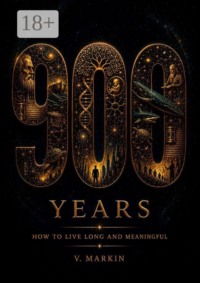
Kitabı oku: «900 Years: How to Live Long and Meaningful»
Cover designer Vladimir Markin
© Vladimir Markin, 2026
© Vladimir Markin, cover design, 2026
ISBN 978-5-0070-8945-6
Created with Ridero smart publishing system
Why 900?
There is a number that won’t leave you alone.
Nine hundred years.
That is how long, according to the oldest book in human history, Methuselah lived. That is how long the first people were given — before the Flood, before something changed the world forever.
We live to eighty.
Somewhere between these two numbers lies lost knowledge about what it truly means to be alive.
This book is looking for it.
Chapter 1
The List Nobody Takes Seriously
There is a passage in the Bible that most readers skip.
The fifth chapter of Genesis. A long list of names and numbers. Adam lived 930 years. Seth — 912. Methuselah — 969. You read it and think: well, this is just an ancient text. A metaphor. An exaggeration. Things like that don’t happen.
And you turn the page.
But wait. What if we stopped here?
— — —
This list is not accidental. The authors of the Bible did not waste words. Every name, every number carries meaning. And if we ask not «is this literally true?» but «what is this telling us?» — something unexpected opens up.
Look at the structure of the entries. They are almost identical:
«And Adam lived one hundred and thirty years, and begat a son… and the days of Adam after he had begotten Seth were eight hundred years… and all the days that Adam lived were nine hundred and thirty years: and he died.»
Every entry ends the same way: «and he died.»
Nine hundred years. And he died.
This is not a triumph. It is a reminder. No matter how long you live — the end is the same. The Bible does not celebrate the longevity of the patriarchs. It states the facts of life with cool composure.
— — —
But the numbers are still staggering.
Adam — 930 years. The first man. He saw the world still untouched, breathed air before the Fall. He knew what the world could have been.
Methuselah — 969 years. The record holder of all human history. Noah’s grandfather. He died in the year of the Flood — by some calculations, literally on the eve of it. As if he had been waiting.
Enoch — 365 years. The only one in this list who did not die. «And Enoch walked with God: and he was not; for God took him.» The shortest lifespan — and the most mysterious ending.
— — —
There is another detail worth noticing. Look at when the patriarchs had children. Adam fathered Seth at 130. Seth fathered Enosh at 105. Jared — at 162. By modern standards — deep old age. But within that system of coordinates — young men, just beginning their family lives.
This is an important clue. Age in this text is not simply a number of years lived. It is a different dimension of time.
— — —
What Theologians Say
Theologians have argued about these numbers for thousands of years. Several explanations exist.
The literal view. People really did live that long. Before the Flood, the climate, food, and atmosphere were different. Less radiation. Purer genetics.
The symbolic view. The numbers carry meaning rather than arithmetic. In ancient cultures, great age signified wisdom, authority, closeness to God.
The calendar view. Perhaps «year» was counted differently — lunar months rather than solar years. In that case, Methuselah’s 969 years become roughly 80 modern years. Entirely plausible.
The genealogical view. Each name may have referred not to one person but to an entire clan or tribe. «Adam lived 930 years» — the Adamites existed for 930 years as a people.
None of these views is settled. None is definitively proven.
— — —
All of these debates are about how to read the text. What concerns us is different: what it says about life.
Long life was the norm. People lived, had children, built, labored — and all of it stretched across centuries. There was no rush. No sense that time was running out.
And then — after the Flood — something changed. Sharply and irreversibly. Why? That question will carry us through the entire book.
— — —
Look once more at the list of patriarchs. After each name and number stands the same action.
They fathered. They lived. They died.
Three verbs. A simple formula.
Not a word about wealth. Not a word about power. Not a word about achievements.
Perhaps it is in this simplicity that the first lesson of longevity lies.
In the next chapter, we ask: what did the Flood change? Why did people begin living half as long afterward — and why do we continue shortening our lives to this day?
Chapter 2
When the World Became Different
After the Flood, something broke.
Not metaphorically. Literally — if we follow the text. Noah steps off the ark, makes an offering, receives a promise. A rainbow. A new covenant. A new beginning.
And people begin dying sooner.
Not immediately. Gradually. But relentlessly.
Shem — Noah’s son — lived 600 years. Already not 900, but still impressive. His son Arphaxad — 438. His grandson Salah — 433. His great-grandson Eber — 464. And then a sudden drop: Peleg — only 239. Serug — 230. Nahor — just 148.
Abraham, whom the Bible calls the father of nations — lived 175 years. By Adam’s standards, almost nothing.
Moses died at 120. And the Bible speaks of this as something remarkable: «his eyes were not dim, nor his natural force abated.» In other words, 120 was already an exception, already cause for wonder.
And Psalm 90 states it plainly: «The days of our years are threescore years and ten; and if by reason of strength they be fourscore years.»
Within a few hundred years, humanity «shrank» from 900 to 70.
— — —
What Happened?
The first explanation: the world changed physically. Before the Flood, the Earth was different. Above the atmosphere existed a water canopy — «the waters which were above the firmament» from Genesis. This canopy created a particular climate: even temperatures, soft light, protection from cosmic radiation. The Flood destroyed the canopy. Radiation increased. The climate turned harsh.
The second explanation: diet changed. Before the Flood, people ate only plants. After the Flood, God permits eating meat: «Every moving thing that liveth shall be meat for you.» Modern science knows that excess animal protein accelerates certain aging processes.
The third explanation: genetic deterioration. Adam and Eve came from the hands of their Creator in perfection. But every generation accumulates mutations, copying errors, damage. Like a text copied by hand a thousand times — each scribe introduces new mistakes.
The fourth explanation: spiritual. The long lives of the patriarchs were a gift of the primordial world, of closeness to the moment of creation. Each generation steps further from the source. More brokenness, more distance, shorter life.
— — —
All four explanations say the same thing in different words: we are moving away from something original. And we pay for it in years of life.
Today scientists speak of «evolutionary mismatch.» Our bodies were shaped over hundreds of thousands of years by conditions of movement, periodic hunger, natural light, clean air, and social bonds. Yet we live in offices, eat processed food, stare at screens until midnight, and suffer from loneliness in crowded cities.
We are like a wild plant transplanted into asphalt. It grows. But not the way it could.
— — —
And yet there is one detail in this story that is easy to miss.
Noah lived 950 years. Of these, 600 were before the Flood, and another 350 — after. In the new, altered world. Three hundred and fifty years in conditions that «shortened» everyone else.
What sustained him? The Bible answers briefly: «Noah was a just man and perfect in his generations, and Noah walked with God.»
Not diet. Not genetics. Not ecology. Character. A way of living. An inner core.
The Flood changed the world outside. But inside every human being something from that original order still lives. The body remembers. The cells remember. Somewhere deep in our DNA — an echo of those 900 years.
The task is not to restore the lost world. The task is to remember how to live.
In the next chapter, we step beyond the Bible and look at what other ancient traditions say about longevity.
Ücretsiz ön izlemeyi tamamladınız.