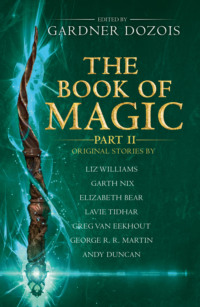
Kitabı oku: «The Book of Magic: Part 2»


Copyright
HarperVoyager
an imprint of HarperCollinsPublishers Ltd
1 London Bridge Street
London SE1 9GF
www.harpercollins.co.uk
First published in Great Britain by HarperVoyager 2018
Copyright © 2018 by Gardner Dozois
Introduction © 2018 by Gardner Dozois
Individual story copyrights appear here
Cover design © HarperCollinsPublishers Ltd 2019
Cover illustration © Stephen Youll
The author of each individual story asserts their moral rights, including the right to be identified as the author of their work.
A catalogue copy of this book is available from the British Library.
These stories are entirely works of fiction. The names, characters and incidents portrayed in them are the work of the authors’ imagination. Any resemblance to actual persons, living or dead, events or localities is entirely coincidental.
All rights reserved under International and Pan-American Copyright Conventions. By payment of the required fees, you have been granted the non-exclusive, non-transferable right to access and read the text of this e-book on screen. No part of this text may be reproduced, transmitted, down-loaded, decompiled, reverse engineered, or stored in or introduced into any information storage and retrieval system, in any form or by any means, whether electronic or mechanical, now known or hereinafter invented, without the express written permission of HarperCollins.
Source ISBN: 9780008295844
Ebook Edition © February 2018 ISBN: 9780008295868
Version: 2019-01-12
Copyright Acknowledgements
“Sungrazer” by Liz Williams. Copyright © 2018 by Liz Williams.
“The Staff in the Stone” by Garth Nix. Copyright © 2018 by Garth Nix.
“No Work of Mine” by Elizbeth Bear. Copyright © 2018 by Elizabeth Bear.
“Widow Maker” by Lavie Tidhar. Copyright © 2018 by Lavie Tidhar.
“The Wolf and the Manticore” by Greg van Eekhout. © 2018 by Greg van Eekhout.
“A Night at the Tarn House” by George R.R. Martin. Copyright © 2009 by George R.R. Martin. First published in Songs of the Dying Earth, edited by George R.R. Martin and Gardner Dozois.
“The Devil’s Whatever” by Andy Duncan. Copyright © 2018 by Andy Duncan.
“Bloom” by Kate Elliott. Copyright © 2018 by Kate Elliott.
“The Fall and Rise of the House of the Wizard Malkuril” by Scott Lynch. Copyright © 2018 by Scott Lynch.
Dedication
For
All those who work magic with words,
the most potent magic there is
About Gardner Dozois
Gardner Dozois 1947–2018
As an editor, Gardner had no peers. He discovered and nurtured more new talents than I could possibly remember or recount, myself included. It’s no exaggeration to say that I would not be where I am today if Gardner had not fished me out of the slush pile in 1970. He found me in his first editorial job, reading submissions at Galaxy, where he came upon my short story ‘The Hero’ and passed it along to the editor with a recommendation to buy. That was my first professional sale.
He was also the warmest, kindest, gentlest soul you’ll ever meet, larger than life, bawdy, funny … so funny. It was an honour to know him, and to work with him. I miss him so much.
George R.R. Martin, 2018
Contents
Cover
Title Page
Copyright
Copyright Acknowledgements
Dedication
About Gardner Dozois
Introduction by Gardner Dozois
Sungrazer by Liz Williams
The Staff in the Stone by Garth Nix
No Work of Mine by Elizabeth Bear
Widow Maker by Lavie Tidhar
The Wolf and the Manticore by Greg Van Eekhout
A Night at the Tarn House by George R.R. Martin
The Devil’s Whatever by Andy Duncan
Bloom by Kate Elliott
The Fall and Rise of the House of the Wizard Malkuril by Scott Lynch
About the Publisher
Introduction by Gardner Dozois
Sorcerer, witch, shaman, wizard, seer, root woman, conjure man … the origins of the magic-user, the-one-who-intercedes-with-the-spirits, the one who knows the ancient secrets and can call upon the hidden powers, the one who can see both the spirit world and the physical world, and who can mediate between them, go back to the beginning of human history—and beyond. Fascinating traces of ritual magic have been unearthed at various Neanderthal sites: the ritual burial of the dead, laid to rest with their favorite tools and food, and sometimes covered with flowers; a low-walled stone enclosure containing seven bear heads, all facing forward; a human skull on a stake in a ring of stones … Neanderthal magic.
A few tens of thousands of years later, in the deep caves of Lascaux and Pech Merle and Rouffignac, the Cro-Magnons were practicing magic too, perhaps learned from their vanishing Neanderthal cousins. Deep in the darkest hidden depths of the caves at La Mouthe and Les Combarelles and Altamira, in the most remote and isolate galleries, the Cro-Magnons filled wall after wall with vivid, emblematic paintings of Ice Age animals. There’s little doubt that these cave paintings—and their associational phenomena: realistic clay sculptures of bison, carved ivory horses, the enigmatic “Venus” figurines, and the abstract and interlacing paint-outlined human handprints known as “Macaronis”—were magic, designed to be used in sorcerous rites, although how they were meant to be employed may remain forever unknown. These ancient walls also give us what may be the very first representation of a wizard in human history, a hulking, shaggy, mysterious, deer-headed figure watching over the bright, flat, painted animals as they caper across the stone.
So Magic predates Art. In fact, Art may have been invented as a tool to express Magic, to give Magic a practical means of execution—to make it work. So that if you go back far enough, artist and sorcerer are indistinguishable, one and the same—a claim that can still be made with a good deal of validity to this very day.
Stories about magic go back a similar distance, probably all the way back to when Ice Age hunters huddled around a fire at night, listening to the beasts who howled in the inky blackness around them. By the time that Homer was telling stories to fireside audiences in Bronze Age Greece, the tales he was telling contained recognizable fantasy elements—man-eating giants, spells and counterspells, enchantresses who turned men into swine—that were probably recognized as fantasy elements and responded to as such by at least the more sophisticated members of his audience. By the end of the eighteenth century, something recognizably akin to modern literary fantasy was beginning to precipitate out from the millennia-old body of oral tradition—folk tales, fairy tales, mythology, songs and ballads, wonder tales, travelers’ tales, rural traditions about the Good Folk and haunted standing stones and the giants who slept under the countryside—first in the form of Gothic stories, ghost stories, and Arabesques, and later, by the middle of the next century, in a more self-conscious literary form in the work of writers such as William Morris and George MacDonald, who reworked the subject matter of the oral traditions to create new fantasy worlds for an audience sophisticated enough to respond to the fantasy elements as literary tropes rather than as fearfully regarded, half-remembered elements of folk beliefs—people who were more likely to be entertained by the idea of putting a saucer of milk out for the fairies than to actually do such a thing.
By the late nineteenth and early twentieth centuries, most respectable literary figures—Dickens, Twain, Poe, Kipling, Doyle, Saki, Chesterton, Wells—had written fantasy in one form or another, if only ghost stories or Gothic stories, and a few, like Thorne Smith, James Branch Cabell, and Lord Dunsany, had even made something of a specialty of it. But as World War II loomed ever closer over the horizon, fantasy somehow began to fall into disrepute, increasingly being considered as unhip, “anti-modern,” non-progressive, socially irresponsible, even déclassé. By the sterile and unsmiling fifties, very little fantasy was being published in any form, and, in the United States at least, fantasy as a genre, as a separate publishing category, did not exist.
When the last Ice Age started, and the glaciers ground down from the north to cover most of the North American continent, thousands of species of plants and trees, as well as the insects, birds, and animals associated with them, retreated to “cove forests” in the south, in what would eventually come to be called the Great Smoky Mountains; in those cove forests, they waited out the long domain of the ice, eventually moving north again to recolonize the land as the climate warmed and the glaciers retreated. Similarly, the lowly genre fantasy and science fiction magazines—Weird Tales and Unknown in the thirties and forties, The Magazine of Fantasy & Science Fiction, Fantastic, and the British Science Fantasy in the fifties and sixties—were the cove forests that sheltered fantasy during its long retreat from the glaciers of social realism, giving it a refuge in which to endure until the climate warmed enough to allow it to spread and repopulate again.
By the midsixties, largely through the efforts of pioneers such as Don Wollheim, Ian and Betty Ballantine, Don Benson, and Cele Goldsmith, fantasy had begun tentatively to emerge from the cove forests. And after the immense success of J. R. R. Tolkien’s Lord of the Rings trilogy, the first American publishing line devoted to fantasy, the Ballantine Adult Fantasy line, was established. It would be followed by others in the decades to come, until by the current day fantasy is a huge, diverse, and commercially successful genre, one which has diversified into many different types: sword & sorcery, epic fantasy, high fantasy, comic fantasy, historical fantasy, alternate world fantasy, and others.
For the last few decades, the most common public image of the magic-user has almost certainly been that of the benign, white-bearded, slouch-hatted, staff-wielding wizard—an image primarily composed of a large measure of Tolkien’s Gandalf the Grey and J. K. Rowling’s Dumbledore, with perhaps a jigger of T. H. White’s Merlin thrown in for flavor. Throughout history, though, the magic-user has worn many faces, sometimes benevolent and wise, sometimes evil and malign—sometimes, ambiguously, both. To the ancient Greeks, magic was the Great Science. The famous mystic Agrippa considered magic to be the true path of communion with God. Conversely, to medieval European society, the magic-user was one who collaborated with the Devil in the spreading of evil throughout the world, in the corruption and ruination of Christian souls—and the smoke of hundreds of burning witches and warlocks filled the chilly autumn air for a hundred years or more. To some Amerind tribes, the magic-user was either malevolent or benign, depending on the use to which their magic was put. In fact, nearly every human society has its own version of the magic-user. In Mexico, the sorcerer is curandero, brujo, or bruja. In Haiti, they are houngan or quimboiseur; in Amerind lore, the Shaman or Singer; in Jewish mysticism, the kabbalist; in Gypsy circles, the chóvihánni, the witch; in parts of today’s rural America, the hoodoo or conjure man or root woman; to the Maori of New Zealand, the tohunga makutu … and so on, throughout the world, in the most “progressive” societies no less than the most “primitive.”
The fact is, we’re all still sorcerers under the skin, and magic seems to be part of the intuitive cultural heritage of most human beings. Whenever you cross your fingers to ward off bad luck, or knock on wood, or refuse to change your lucky underwear before the big game, or ensure the health of your mother’s back by not stepping on the cracks in the sidewalk—or, for that matter, when you deliberately step on them, with malice aforethought—then you are putting on the mantle of the sorcerer, attempting to affect the world through magic. Then you are practicing magic, as surely as the medieval alchemist puttering with his alembics and pestles, as surely as the bear-masked, stag-horned Cro-Magnon shaman making ritual magic in the darkness of the deep caves at Rouffignac.
In this anthology, I’ve endeavored to cover the whole world of magic. Here you will find benevolent white wizards and the blackest of black magicians. Here you’ll visit the troll-haunted hills of eighteenth-century Iceland … Victorian Ireland, where the hosts of the Sidhe are gathering for war … the remote wilderness regions of Appalachia and the hill-country of Kentucky, where ancient ghosts still roam … and the streets of modern-day New York City and Los Angeles, where dangerous magic lurks around every corner. Then you’ll visit worlds of the imagination outside the time and space we know … touring the fabled, enchanted metropolis of Calfia; the bleak marshes and crumbling towns of the Mesoge, where the dead come back to prey on the living; the grim city of Uzur-Kalden, at the very edge of the world, where doomed adventures gather to set forth on quests from which few if any of them will return … visit The Land of the Falling Wall in the last days of a dying Earth to drink and dine at the Tarn House (famous for its Hissing Eels!); shop at the Mother of Markets in Messaline for bizarre simulacrum in company with Bijou the Artificer; attend the 119th Grand Symposium, presided over by the High Magnus himself, to watch a contest of skills between the world’s greatest magicians; join a perilous quest for cold mages vital to the prestige of the Great Houses who rule an alternate version of Rome after the Empire’s fall … enter an Elf-Hill, from which it may be impossible to escape … ride in the Devil’s Terraplane, join a village wizard in a seemingly hopeless battle to stand against the most malign of magics … try to talk a comet out of destroying the world … fight Revenants with fiery eyes, a toy-eater, a sinister ensorceled book … meet Dr. Dee, the famous Victorian scholar and magician … Masquelayne the Incomparable, the Eyeless One, the Lord of the Black Tor, Molloqos the Melancholy … Djinn, trolls, elves, osteomancers, egregores, deodands, grues, erbs, ghouls, scorpion-tailed manticores … the Lords of the Sidhe; the guardian spirits of Iceland; saints and sinners; the singing heads on stakes known as the Kallistochoi, who maintain magic with their endless song; Archangel Bob; the Holy Whore of Heaven; a Bouncing Boy Terror; and the Devil’s Son-in-Law.
Such dreams are inspired by magic—in fact, you could make an argument that they are magic. Such dreams persist, and cross the gulf of generations and even the awful gulf of the grave; cross all barriers of race or age or class or sex or nationality; transcend time itself. Here are dreams that, it is my fervent hope, will still be touching other people’s minds and hearts and stirring them in their turn to dream long after everyone in this anthology or associated with it have gone to dust.
Liz Williams
British writer Liz Williams has had work appear in Interzone, Asimov’s Science Fiction, Visionary Tongue, Subterranean, Terra Incognita, The New Jules Verne Adventures, Strange Horizons, Realms of Fantasy, and elsewhere, and her stories have been collected in The Banquet of the Lords of Night and Other Stories, A Glass of Shadow, and, most recently, The Light Warden. She’s probably best known for her Detective Inspector Chen series, detailing the exploits of a policeman in a demon-haunted world who literally has to go to Hell to solve some of his cases, and which include Snake Agent, The Demon and the City, Precious Dragon, The Shadow Pavilion, and The Iron Khan. Her other books include the novels The Ghost Sister, Empire of Bones, The Poison Master, Nine Layers of Sky, Darkland, Bloodmind, Banner of Souls, and Winterstrike. Her most recent book is the start of the Worldsoul trilogy, Worldsoul. She lives in Glastonbury, England, where she and her husband, Trevor Jones, run a witchcraft shop—an experience they’ve written two books about, Diary of a Witchcraft Shop 1 and 2.
Here she tells the story of an obscure, quiet-living astronomer and part-time magician who (somewhat reluctantly) answers a call from some unusual petitioners to save the world from an unusual menace in a most unusual way …
Sungrazer
Sometimes, in the church, I see a fireball eye looking at me from the shadows. It is as tiny as a button, a glowing ember beneath a pew, or lodged like a little joke in the face of one of the scowling Jacobean angels that feature on the end of every row. An angel, made demon. I think it’s a joke, anyway. The eye never seems to appear near the altar: perhaps the power of Christ, greatest magician to walk this Earth, puts it off, or maybe it is simply shy. It is possible, indeed sometimes necessary, to imagine an angry god, but an enraged cherub is just funny. I suspect, you see, that the owner of the eye is in possession of a sense of humor.
I’ve never mentioned it to anyone, not even to my daughter or granddaughters, who have, God knows, enough secrets of their own. Women’s stuff, to which as a man I’m not supposed to be privy and I probably couldn’t see it even if I was supposed to. Presumably more proper these days to refer to it as “women’s mysteries,” but I just think of it as stuff—and before anyone starts complaining, I think of my own practice in the same way. Just stuff: the matter of Britain, the components of the World beyond the world.
Getting back to the eye, it’s unthinkable to speak to the vicar about it: the old boy (he’s younger than me, by the way) would probably have a heart attack. Or exorcise me. Good Lord, Professor Fallow! What a very extraordinary thing to say. Are you feeling quite yourself? No, let’s not tell the vicar. It has always struck me as curious that this little old English church, which has such an odd history, is invariably put into the ecclesiastic hands of the most prosaic clerics, all scones and conservatism and tea. I wonder, though, if the church actually does know what it’s doing and the incumbents are the ballast, the counterweights to the wild swing and sway of the building’s own magic.
It’s definitely not much to do with religion. Hard to say how I know: I do believe in the great Powers, you see, but I’m not entirely sure that all of them are the ones we’re supposed to be worshipping on a Sunday morning. This eye, whatever it belongs to, seems too free range, although I never see it outside the church. Trapped? Possibly. But occasionally it winks at me, and that seems a bit too frivolous an act for something desperate to be free.
And this is the story of that eye.
On one particular Sunday, I had attended church as usual. I’m not an especially religious man, but it’s the done thing in a small community, particularly if one is elderly. I’m not the local squire, but I suppose I’m the next best thing: my family has been here for a long time, in an old house. And I have two professions. One is respectable, if rather unusual: I’m an astronomer. I used to teach, at one of the Southwest universities not far from here and then at Oxford, but I’ve been retired for some years and now live permanently with my daughter and her children. My wife is dead. If you could see me now, you would see an entirely familiar sort of person: British, though not English, wearing an ancient tweed jacket and—outside church—a disreputable array of hats. I carry a walking stick, and I wish a good morning to the people I meet. It’s like a kind of protective coloration: I blend well into my native habitat, like a duck-billed platypus.
The other profession? I’m a magician. You’ll find out more about that in due course.
So, church. On that chilly January Sunday, with a bitter easterly whistling around the gargoyles and occasional thin rain, I did not see the eye. Its lack didn’t really worry me one way or another; it was not a permanent phenomenon. I listened assiduously to the sermon, which was about aid to those less fortunate than oneself—a thoroughly Christian message, hard to disagree with—and sang some hymns. Then I buttoned up my coat, located my gloves—trying to start the new year off by not losing a pair a month like some daft old bugger—and went out into the winter.
Our house, which is called Moonecote, is not far from the church. I never bother to drive. I took the south path through the churchyard, what I thought of as the “river path,” although the little Moone brook which runs alongside the bounds of the church is hardly a river. This is an old place and the graves are old, too, leaning to one side like drunks at a bar and so eroded and lichen coated that the names are scarcely visible anymore. There was a handful of daffodils on one of them now, already frost blighted, but the only other flowers in sight were a tiny bunch of snowdrops, coming up along the wall. No, there was another—I blinked.
It wasn’t a flower, there against the wall of the churchyard. It was a flame.
I gave a quick glance over my shoulder. The rest of the meager congregation was either halfway to their cars or still in conversation with the vicar, who had his back turned to me. Just as well. I sidled up to the flame, which flickered with a deep red glow, most unwintry, and pretended to be fumbling with my hat. In an undertone, I said, “Who are you?”
There was no reply. I should probably explain at this point that this sort of thing isn’t precisely unknown to me, quite apart from the presence of the eyeball in the church. The churchyard, as one might expect, is full of spirits. Most are the residue of the departed, as though a little door has been left open. And usually they’re quite happy to chat, although one has to bear in mind that you’re not always accessing the full force of the soul, which is happily elsewhere—who wants to hang around a damp English churchyard for eternity, after all? Some of them take the form of light: clusters of blue flashes, or a pale, steady glow. But I’ve seen flames before, and once a drop of water, hanging suspended in the air in a tiny lustrous globe. The elements, you see. I’m sure some of them just sink back invisibly into the earth.
This little flame was dancing. No voice answered, but it leaped up onto the wall and flickered, taking sustenance from nothing.
“Who are you?” I said again.
Help him.
Spirits speak like a breath on the wind. You have to learn how to listen.
“How can I help? Who is ‘he’?”
You have to wake him.
“But who is he?”
When we ask, you must wake him.
Then it flickered and died, retreating into the wall. There was a faint glow for a second, like a patch of sunset, and it was gone.
I plodded home, somewhat amphibiously. The brook, swollen with recent rain, was high, brimming over the water meadows, but the path was safe enough. Fire and water, I thought. Water and fire. By the time I reached the house, the sky was stormy, with a single bar of light falling in the direction of the Severn estuary. The house itself, with its long drive, was quiet; it seemed to have retreated in on itself, huddling like an animal made of red Tudor brick. The kitchen garden was tidy and bare; the orchard empty of the crop of white apple sacks that had marked it throughout the autumn. There was a drift of smoke from the chimneys, but apart from that and the bar of light, the day was sodden, the color of lead. No more fire.
Alys, tall and rangy in jeans, was preparing Sunday lunch.
“Hello, dad! How was the service?”
“Went on a bit.” I could have told her about the flickering light in the churchyard, but something held me back. Pretend we’re a normal family, even if we know different.
“Oh, dear. I thought you were later than usual. Hope the church wasn’t too cold.” She bent over the Aga, fiddling with something on the stovetop.
“How was your morning? Can I do anything?”
“Quiet. And no, I don’t think you can. Beatrice has pinched the Telegraph crossword, by the way.”
I laughed. “It’s too easy for me on a Sunday.”
“Tell her that. She’ll be annoyed.”
Leaving her in the kitchen, I hung up my coat, changed my shoes, and wandered off in the direction of my study. As I climbed the stairs I could hear, muted, the voices of my granddaughters from the sitting room, then laughter. The study is at the end of a long upstairs passage, at a sort of T-junction that branches corridors in both directions, the floor uneven from several hundred years of use and subsidence. I prefer to be higher up—perhaps it’s my profession, but I like to be able to see clearly, over the land and the sky.
But as I approached the study door, someone walked rapidly and smoothly across the opening, heading down the corridor and out of sight. I caught a glimpse of a woman in a dark green dress, very long and full-skirted like an Elizabethan gown. She had a little ruff, too, which sparkled like her hair, and she was carrying a long frond of some kind of plant.
For a moment, I thought she was one of the girls, dressed up, but she was too tall—at least six foot, my own height. Heels?
“Who’s that?” I called, but there was no reply. I trotted to the end of the corridor and looked down it. No one was there.
Well, this house is full of ghosts. We do see them, you know. Not just in the mind’s eye, a fancy of the imagination, but really and truly present, just as you yourself might stand before me. I hadn’t seen this one before, but that didn’t mean that no one else had. We’ve all got our own special spirits, the ones only particular people see, and then there are the communal ones. The child by the window, for instance: we’ve all seen him in his Kate Greenaway velvet suit, his sorrowful face, like something out of a particularly emetic Victorian painting. No idea who he is. Alys and I see a doddery gardener in eighteenth-century clothes, and I think Bea might have done as well. Stella and Serena, the middle girls, talk about a pair of ghostly gazehounds, but they’re going through an animal-mad phase, so perhaps they’re tuned in to spectral beasts. Luna’s a bit too little to say for sure: hard to know if she’s seeing people or imagining them.
Ücretsiz ön izlemeyi tamamladınız.