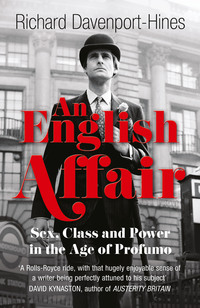
Kitabı oku: «An English Affair»
RICHARD DAVENPORT-HINES
An English Affair
Sex, Class and Power in the
Age of Profumo

Copyright
HarperPress
An imprint of HarperCollinsPublishers
1 London Bridge Street
London SE1 9GF
www.harpercollins.co.uk
First published in Great Britain by HarperPress in 2013
Copyright © Richard Davenport-Hines 2013
The right of Richard Davenport-Hines to be identified as the author of this work has been asserted by him in accordance with the Copyright, Designs and Patents Act 1988
A catalogue record for this book is available from the British Library
All rights reserved under International and Pan-American Copyright Conventions. By payment of the required fees, you have been granted the non-exclusive, non-transferable right to access and read the text of this ebook on-screen. No part of this text may be reproduced, transmitted, downloaded, decompiled, reverse engineered, or stored in or introduced into any information storage and retrieval system, in any form or by any means, whether electronic or mechanical, now known or hereinafter invented, without the express written permission of HarperCollins e-books.
Source ISBN: 9780007435845
Ebook Edition © January 2013 ISBN: 9780007435869
Version: 2019-09-24
Dedication
For Jenny, Christopher and Hugo, and never forgetting Cosmo
Epigraph
Though most English men and women cannot ‘let themselves go’, they love to think and read about people who do throw off inhibitions, either with sex or violence – provided they are punished.
Geoffrey Gorer, ‘This is the English’, The People, 30 September 1951
Snobbery – of all kinds – and prurience are the two most obvious vices of this country.
‘Anatomy of Hysteria’, Spectator, 15 November 1957
One thinks immediately of all the dreary little snobberies, the triviality, the emptiness, the susceptibility to stupid vogues. How drab and provincial we have become! How enslaved to gimmicks! English inventiveness and energy, which used to be an example to the world – have they dried up altogether, or is it simply a bad period we are going through? The two great inventions of the English, their political system and their literature, both seem at the moment rather dwindled and shabby. The parliamentary two-party system has become, whether temporarily or forever, a mere contest between public relation outfits, with professional ad men in the back room.
John Wain, ‘The Month’, Twentieth Century, July 1959
CONTENTS
Title Page
Copyright
Dedication
Epigraph
Overture
PART ONE: CAST
Chapter 1 Prime Minister
Chapter 2 War Minister
Chapter 3 Lord
Chapter 4 Doctor
Chapter 5 Good-Time Girls
Chapter 6 Landlords
Chapter 7 Hacks
Chapter 8 Spies
PART TWO: DRAMA
Chapter 9 Acting Up
Chapter 10 Show Trials
Chapter 11 Safety Curtain
Picture Section
Footnotes
Notes
Index
Acknowledgements
Also by Richard Davenport-Hines
About the Publisher
Overture
In May of 1963, when I was nine, Miss Vera Groom, the old spinster who taught me English, asked her class to name a noun beginning with a vowel. There was a new word that I was proud of knowing. I had discovered it from the cook’s Daily Express. I raised my hand, and in response to a nod from her cried out ‘Orgy!’ Miss Groom trembled: she gripped the edge of her desk; her face flushed with blood; her skin turned puce. ‘You are a foul boy,’ she said, and sent me to be caned by the headmaster.
A few days later Mr Wilcox addressed the school. It was the year Dr No sold 437,000 copies in paperback. Warner Wilcox was then in his early forties, but seemed old to me. Like many headmasters of his time, he was both overbearing and anxious. Dark-browed, stern, conscientious, he had a jolly wife who could not soothe his pent-up tension. When he rebuked his school, he would spring up and down on his heels, as if he was going to bound forward into the boys and start cuffing them. ‘It has come to my attention,’ he said in a storm of tense heel-jerks, ‘that boys are bringing James Bond novels into school. I will not have them on the premises. They are sad-is-tic novels’ – he pronounced each syllable of sadistic lingeringly before ending his speech with a savage roar – ‘and I will thrash any boy who is found in possession of one.’ As soon as I could, I asked a chauffeur what ‘sadistic’ meant. If he knew, he did not say.
Then in June came prize-giving – ten days after John Profumo’s resignation as War Minister, I estimate, and two days before the momentous House of Commons debate on that resignation. The prizes were distributed, and a rousing speech was made by a friend of Wilcox called Renée Soskin. Mrs Soskin was a mother of six. She ran both a farm in Bedfordshire and an import-export business, which she had inherited when her husband died during his morning press-ups a year earlier. Her sister was political editor of the Observer, the Sunday newspaper for progressives, and Mrs Soskin, a humane, plucky, helpful woman, was Liberal parliamentary candidate at the 1964 general election for that most high-minded London suburb, Hampstead. She had, indeed, appeared on television promoting Liberal policies for the family, in a party political broadcast for the 1959 general election. A Conservative columnist had called her ‘a most intelligent and remarkable lady almost capable of converting me to Liberalism’.1
From the prize-giving podium Renée Soskin praised Mr Wilcox, Mr Potts, Mr Lorimer-Thomas (little did she know about Mr Lorimer-Thomas) while I daydreamed. Then she began to praise fee-paying schools, and I was jolted to attention. ‘Private schools are more indispensable than ever,’ she thundered at the climax of her peroration, ‘at this time of Deplorable Breakdown of Public Morals.’ The phrase rattled round the hall: ‘Deplorable Breakdown of Public Morals’. The adults rustled and glanced at one another. I sensed from the sumptuous indignation in nice Mrs Soskin’s voice, and all the silly looks that the adults were exchanging, that ‘Public Morals’ meant pompous hypocrisy, and that I wanted their breakdown.
I suspect that on that June afternoon it became inevitable that I would write one day about the sexual oppression, guilt and bullying, the whitewashing and blackballing, the lack of irony and absurd confused anger of ‘Jack’ Profumo’s England. The London half-world of Mandy Rice-Davies and Christine Keeler, or rather of their protectors, was the world in which I grew up. My grandparents lived in Bryanston Square, two minutes’ walk from Marble Arch. My mother lived in Montagu Mews West, which lay between Bryanston Square and Montagu Square. On the other side of Bryanston Square lay Bryanston Mews West. It was in a flat there, occupied by the slum landlord Perec Rachman, that the two-way mirror was installed through which steamy voyeurs – perhaps including the osteopath Stephen Ward – watched couples performing on a bed. Ward, the scapegoat of the Profumo Affair, spent the night before his show trial opened at the Old Bailey in a friend’s flat in Montagu Square: tabloid newspapers blared that he slept in blue silk pyjamas with a pink curtain in a gilt frame behind the bed. This, indeed, was soft living. Another block to the south-east was Portman Square, where Paul Raymond of Raymond’s Revuebar bought the penthouse which he shared with the glamour model Fiona Richmond. Ringo Starr, whom Raymond employed as his interior decorator, rewarded him with a panoply of James Bond gadgets and parvenu glitziness.
At the time of her temporary disappearance in March 1963, Christine Keeler lived at Flat 164, Park West, Edgware Road, three minutes’ walk from Bryanston Mews West, and a minute further from Montagu Mews West. For a time my father kept a leggy brunette in a flat in Park West. He took me there once in 1963, bounding up to the front door, which he opened with a flourish of his key chain. I asked him why he had a key to the woman’s flat. ‘I have a key,’ he replied with immense satisfaction, ‘that opens every door in London.’ He meant money. The Edgware Road flat was my induction into sexual deception, duplicitous lives and double standards. I have been standing on tiptoes, trying to peer into secret compartments, ever since.
The irritability of London motoring is a misery that I remember too well. My father bought his first car before driving tests had been devised. His school of motoring was Toad of Toad Hall’s. His spiritual home was the fast lane: he never felt more himself than when he was behind a steering wheel with his foot hard on the accelerator. As a Christmas treat for 1959, just after the M1 motorway had opened, he took me for a quick run north from Watford, which I believe may have turned into a dashing ‘fun-drive’ all the way to Rugby and back. Certainly I recall him saying on the interminable return journey that he would write to the Minister of Transport to complain that trees had been left standing beside the motorway, and might cast dangerous shadows by moonlight. He liked high-velocity travel to lay waste to the landscape.
The speed limit of seventy miles per hour was introduced as a temporary measure in 1965 to cope with enthusiasts like my father. Every few months he would take me to Jack Barclay’s car showroom in Berkeley Square. The salesmen were thin men with thin moustaches, sharp suits and sharper eyes. They stood apart from one another, idling by the polished bonnets and winged mascots, but were swift and implacable as they headed for their prey when a customer stepped inside the plate-glass windows: lone sharks, one might say. Sometimes my father drove a Bentley, sometimes a black Alvis. One thing all his cars had in common was no wing-mirrors. Wing-mirrors, my father often told me, spoilt the line of a car. They were effeminate. A good driver, a real man, did not need to look behind him. This creed led to several accidents, many altercations and, for me, one Copernican moment of political revelation.
On a Saturday during the summer after Miss Groom sent me to be beaten, and Mr Wilcox denounced the sadism of James Bond, and Mrs Soskin deplored the breakdown of Public Morals, my father sped me to Park Lane. It was August 1964, and we were in a black Alvis with the hood down. A year earlier workmen had finished converting the sedate old carriage road of Park Lane into a dual carriageway with four lanes on both sides. Old avenues of trees were felled, the eastern meadows of Hyde Park put under macadamised tar, and concrete burrows were excavated so that Mayfair businessmen could park their Jaguars in strip-lit subterranean hideaways. Thinking of Hollywood rather than Paris, Whitehall officials had wanted to foist the name of Park Lane Boulevard as a cosmetic to cover the scars of their vandalism. My father loved the swift new Park Lane as a reminder that England was finished with slowcoaches.
There were other signs of change. Sir Philip Sassoon’s great house overlooking the park had lately been torn down, and replaced by a monstrosity that housed the Playboy Club. The developer of the site, Jack Cotton, who lived on Park Lane himself, had, in a show of braggadocio, paid Walter Gropius, the Bauhaus architect, to advise on the redevelopment. Gropius’s inspiration, with which London was learning to live, was to assert the unyielding modernity of the new building by cladding it in concrete rather than the original plan of Portland stone.
We stopped at the Hilton hotel. Its thirty storeys and jutting gimcrack modernity had been opposed at planning stage by ‘stick-in-the-muds’ whom my father had rejoiced to see quashed. The hotel towered over the rest of Park Lane, and could be seen in its unwieldy disproportions from the far end of Kensington Gardens. It was the first building in London to overlook the gardens of Buckingham Palace, and this objection, too, had been quelled to my father’s pleasure. (Thirty years later I was to read the minutes of the Cabinet meeting at which Harold Macmillan’s government endorsed this encroachment on the Queen’s privacy: the justification given was that American holiday-trippers staying in the Hilton would bring badly needed dollars to revitalise the ailing English economy.) The site had belonged until 1956 to an old banking family, the Abel-Smiths, who had a mortgage on it. This was a period when debt frightened most people as a weir would scare steady ferrymen, but spurred a bold minority rather as the wide oceans excited fearless privateers. The Abel-Smiths had therefore sold their plot for £550,000 to a property developer called Charles Clore, who bedded Keeler, as it happens. Clore, who borrowed heavily, spent another £5 million turning the site into the Hilton. In the hotel my father and I went to the American coffee shop: he gulped scalding black coffee while I spooned my way through a banana split or knickerbocker glory. I cannot imagine why we were there: perhaps a rival for the brunette was in the offing.
Afterwards, back on wheels, the Hilton behind us, my father stopped his car outside a large, abandoned house of dilapidated stucco on the corner of Hertford Street and Old Park Lane. It was awaiting demolition, he explained. Londonderry House, he added, had belonged to a proud, stupid family who had been friends of Hitler, but the last lord had been a helpless drunk who had died young. Now their day was done, the old house where prime ministers once dawdled on the marble stairs had been sold and was to be torn down. Londonderry House would be smashed for good. It represented a world that impeded progress. My father told me that another hotel for Americans was planned for this site next to the Hilton. It was glorious what competition was going to do. It was marvellous what future prosperity was promised to those who were quick to snatch their chances.
Then my father swung the car round into a full U-turn to head back to Park Lane: no unmanly glances back over the shoulder, no effeminate wing-mirrors to look in, just my father’s iron resolve as he pulled out. There followed an almighty screech of brakes, a squeal of tyres, and the sound of a horn held down hard. A black taxi cab behind us had made an emergency halt. As we completed the U-turn and passed the stationary taxi, my father stopped, looked at its driver and gave a harsh, defiant laugh: he was proud of having a chuckle that made people lose their temper or, if they were already angry, re-double their rage. The taxi driver was furious, temporarily powerless, but not, he reminded us, permanently disempowered. As my father drove off chortling, his victim shouted after him the deadly threat: ‘Wait until October!’
Everyone knew there was going to be a general election in October. ‘A Labour voter,’ my father said witheringly. He probably forgot the incident in a trice, but I never did. October came, Sir Alec Douglas-Home was displaced as Prime Minister by Harold Wilson, and I acquired the private incantation: ‘Wait until October’. For years, I would repeat the phrase to remind myself that however insecure life already seemed, there was greater instability to come. Waiting for October became the title of the self-pitying memoirs that I secretly wrote at the age of fifteen.
This book is not Waiting for October in another guise, although it is about insolence, envy and the politics of revenge. Rather, it is a history of the mentalities that made Miss Groom, Mr Wilcox, Mrs Soskin and the Edgware Road brunette. It is a study of milieux: the worlds of Harold Macmillan, Jack Profumo, Lord Astor, Stephen Ward. ‘How separate we keep ourselves in Britain,’ the Labour politician Richard Crossman reflected of the 1960s. ‘There is the legal world, the doctors’ world, the artistic world, the dramatic world, the political world. We are tremendously separate.’2 The spheres of politics, medicine, law, journalism, smart society, new money, and espionage – each a discrete segment of British society – all converged into the Profumo Affair of 1963 and detonated a shattering blast. This is a London book, which depicts the capital’s good-time girls, property dealers and Fleet Street hacks, and the ways they pointed the rest of the nation. It is about the millionaire with his new Alvis who resented the old order, thought his time had come, and longed to see the demolition ball hit Londonderry House, as well as the taxi driver who hated the millionaire, and thought his time was coming in the October election. It describes the worlds they made, and how none of them got what they wanted.
PART ONE
ONE
Prime Minister
‘I have news today that will bring a gasp from every Tory in Britain,’ reported Crossbencher, the political columnist of the Sunday Express, on 2 December 1956.
Mr Harold Macmillan is planning to retire from the Commons.
What a turnabout this is. Only the other day all the talk was of his rivalry with Mr Richard Austen Butler. He was alight with ambition, his Edwardian moustache bristling for the fray. It is true, of course, that he has lately been dropping a few little hints. In the Commons he talks of looking forward ‘to retirement from many of these troubles’. To the Tory 1922 Committee he says he is thinking ‘of the viscounty that is my right’. But these are laughed off by most people as typical Macmillan flourishes.
I report that Macmillan means exactly what he says. He intends to go. The reason? Not because of any personal clashes with his colleagues. Not because of any disagreement on policy. But he is sixty-three in February, three years older than [the Prime Minister] Sir Anthony Eden, nine years older than Mr Butler. And suddenly, with absolute clarity, he sees that the nation’s highest office is forever beyond his grasp. How sad a moment for a politician who has come so far. The moment when he realises that he is finally out of the race.
The only remaining question: When will Mr Macmillan claim his coronet?
One can imagine the poignant sorrow, the air of noble resolve, affected by Macmillan as he confided in the Sunday Express man. A few days later, Brendan Bracken, chairman of the Financial Times, reported a similar tale to the Expresss proprietor Lord Beaverbrook, but with a hard-headed gloss. ‘Macmillan is telling journalists that he intends to retire from politics and go into the morgue. He declares that he will never serve under Butler. His real intentions are to push his boss out of Number Ten.’ A month later, on 10 January 1957, after seductive courting of the parliamentary party, Macmillan became Prime Minister.1
Only a consummate politician would brief that he is on the brink of retirement as a device to reach the highest office. Macmillan had foreseen, since November, when he had a privileged talk with Eden’s physician, Sir Horace Evans, that failing health would force the Prime Minister’s retirement. He knew, too, that many Tories felt, in the backbencher Robert Boothby’s words, ‘contemptuous disdain’ for Rab Butler as a boneless appeaser, and would not have him as Eden’s successor at any cost. His ruthless clarity and oblique tactics were outstanding.2
Lloyd George was the predecessor whom Macmillan most admired, the arch-spiv among Prime Ministers – shameless, improvising, compassionate, devious, inspired. Macmillan was a politician who mastered both appearances and realities, and understood the differences between the two. He was simultaneously a romantic escapist and sturdy materialist. He studied men’s wiles, and knew their weaknesses. He was a world-weary cynic about human vanity yet could be as shocked as a boy scout by the grubbiness of people’s motives. Outward calm masked high-strung agitation. He looked like a grandee, had the manners of an Edwardian man-about-town and was one of the last men in England who still put his tongue in his cheek when making a sardonic quip. His self-protective staginess, his toying with appearances, his patrician pose of authoritative nonchalance – all so artfully embedded in the past – were a source of strength and renewal when he was Prime Minister approaching the general election of 1959, but would prove a source of increasing weakness in the years before his resignation in 1963.
Macmillan had been born in 1894 in a tall, thin house in Cadogan Place, where Knightsbridge borders Belgravia. In his parents’ home solid comforts were joined with a dread of worldly show and admiration for spartan discipline. Maurice Macmillan, his father, was a partner in the publishing house of Macmillan, an outstanding example of Victorian self-help and constructive idealism, for it had been started by Maurice’s father and uncle, themselves the sons of a crofter, a poor tenant farmer, on the Scottish Isle of Arran. Macmillan’s mother was a physician’s daughter from Indiana, which made him the only Prime Minister (apart from Churchill) to have an American mother. She proved morbidly possessive, withdrawing him from Eton when he was fifteen and sacking his tutor when he was sixteen. His education was further disrupted, for he was an early volunteer in the First World War, which began when he had been only twenty months an undergraduate at Oxford.
Macmillan’s war experiences, which proved his courage but shredded his nerves, are of supreme importance in understanding him. Overall he was wounded five times, and bore his scars and disabilities for seventy years. At first, on the Western Front, he was a bomb officer with the Grenadier Guards, training men to throw grenades, and pacifying himself with the novels of Dickens and Scott. In the first battle in which he fought, Loos in 1915, he was shot in the hand and also suffered a head injury. In 1916 he was wounded during a reconnaissance mission to German lines. ‘The stench from the dead bodies that lie in heaps around is awful,’ he wrote to his mother after the Battle of the Somme. ‘We do all the burying that we possibly can.’ Once, leading an advance platoon down a moonlit lane near the devastated village of Beaumont-Hamel, he passed a dead German with an outstretched arm rigid in death: his orderly went up and shook it. A few days later, near Delville Wood, he was hit in the knee by shrapnel and in the pelvis by machine-gun bullets. A water bottle in his tunic deflected a bullet from hitting his heart. He rolled into a shell hole in no-man’s land, where he lay for twelve hours, feigning death when Germans approached, dosing himself with morphine, and scanning a copy of Aeschylus which he had secreted in his battledress, until a rescue party found him. He nearly died of his wounds, endured several operations and years of gruelling pain. ‘The act of death in battle is noble,’ he had written to his mother a few days earlier, ‘but the physical symptoms and actual appearances of death are, in these terrible circumstances, revolting.’ He learnt, as no one should have to learn, to tell how a man had died by the way their body lay. The war left him with sporadic pain, a shuffling gait, a limp handshake and spidery handwriting. It accentuated the apprehensions that had made him such a sad, morbid, unpopular boy at Eton: ‘the inside feeling that something awful and unknown was about to happen’ which still decoyed him as Prime Minister, and forced him to retreat from the world to spend weekends in bed.3
While recuperating from his wounds, Macmillan immersed himself in books to enrich an already well-stocked mind. He had been elected a King’s Scholar at Eton in 1906, and was the first K.S. to become Prime Minister since Walpole. He ranked with Asquith as the best-read twentieth-century Prime Minister. He had the longest uninterrupted hold on power of any premier between Asquith and Thatcher. His literary-mindedness intensified when he left the army to become a partner in the family publishing firm. He became responsible for such authors as Kipling, Hardy, Yeats, Hugh Walpole, and Sean O’Casey. Maynard Keynes, who had been the boyhood friend and perhaps lover of Harold’s elder brother Daniel, was a Macmillan author with strong influence on his economic ideas. There had not been so literary a Prime Minister since Disraeli, and his love of novels made him the most vivid and alluring of political leaders. He calmed his nerves by happily re-reading Austen, Trollope and Meredith; excited his imagination with Stendhal or Nevil Shute’s dystopic tale of radiation sickness after nuclear war; honed himself by reading Anthony Powell (‘witty but pointless’) as a preliminary training for Proust.4 His temperament – nervous, subtle and theatrical – was decisive to the colour, texture and shape of the modernisation crisis in British politics and society of 1957–64.
In 1924, Macmillan captured a difficult industrial constituency, Stockton-on-Tees, by unusual methods. He insisted that his local supporters contribute to election expenses, reorganised the local association along democratic lines, declined the help (or handicap) of speakers sent by the central party organisation in London, and left unopened the parcels of official propaganda. His distress at the unemployment and privation of north-east England made him a rebel against economic orthodoxies. In 1927 he and three other young MPs who were styled ‘Tory Democrats’ issued a milk-and-water Keynesian booklet entitled Industry and the State. ‘A Tory Democrat,’ sneered a socialist professor, ‘means you give blankets to the poor if they agree not to ask for eiderdowns.’ Nevertheless, Aldous Huxley found much sense in Macmillan’s 1931 publication Reconstruction: A Plea for National Unity, and told T. S. Eliot: ‘I’m glad the young conservatives are waking up.’5
Together with Sir Cuthbert Headlam, Macmillan formed the ‘Northern Group’ of Tory MPs lobbying on behalf of the region. ‘He is a curiously self-centred man, and strangely shy and prickly – and yet the more I see of him the more I like him,’ Headlam noted after a talk in 1934. Although Headlam advised him to continue pushing progressive ideas, but to stop speaking and voting against the government, Macmillan did not restrain his dissent. He affronted fellow Tories by telling a newspaper interviewer in 1936 that ‘a party dominated by second-class brewers and company promoters – a casino capitalism – is not likely to represent anyone but itself’. That year he was the only backbencher to resign the party whip when Baldwin’s government lifted sanctions which had been imposed on Mussolini’s Italy after the invasion of Abyssinia. Although he rejoined the party after Neville Chamberlain became Prime Minister in 1937, he risked de-selection as a Conservative candidate by continuing opposition to appeasement of dictators. In 1938 he wrote a Keynesian treatise entitled The Middle Way, which indicted Conservative economics as callous and complacent, and argued for more consensual, corporatist, expansionist economics. The London Stock Exchange, he suggested, should be replaced by a National Investment Board. This was not the rebellion of a showy, self-seeking mutineer, but the dissent of a man who obstinately, perseveringly, worked out new lines for himself.6
In 1940, when Churchill became Prime Minister, he chose Macmillan as Parliamentary Under Secretary at the Ministry of Supply. About a month after this humdrum appointment, Headlam sat beside Macmillan at the long table where members dine together at the Beefsteak Club. ‘He is very much the Minister nowadays, but says that he has arrived too late to rise very high,’ Headlam noted. ‘I can see no reason (except his own personality) for his not getting on – even to the top of the tree – but he is his own worst enemy: he is too self-centred, too obviously cleverer than the rest of us.’ Shortly after this Beefsteak evening, Macmillan was motoring in a car with his private secretary, John Wyndham. After desultory conversation, Macmillan fell into brooding silence. Then suddenly, with intense emphasis, but as if talking to himself, he exclaimed: ‘I know I can do it.’7
These glimpses of Macmillan at forty-six – delighted to have reached office, but equivocal about his prospects – are telling. He felt his aptitude for power, but sensed he must disguise his clever ambition. His confidences to Headlam, his exclamation before his most trusted aide Wyndham, prefigure him briefing journalists in 1956 that his political career was over as he poised himself to take supreme control.
At the end of 1942 Churchill offered the post of ‘Minister Resident at Allied Forces Headquarters in Algiers’ to Macmillan, his second-best candidate, whom he had recently described as ‘unstable’. Macmillan accepted without a moment’s havering. It proved to be a hard job, unrewarding in outward prestige, but he won praise from those who knew of his behind-the-scenes adroitness. With both the American and Free French representatives he was direct in his approach but insinuating in his ideas. During the closing phase of the war, Macmillan headed the Allied Control Commission in Italy, becoming, said Wyndham, ‘Britain’s Viceroy of the Mediterranean by stealth’.8
By the war’s close Macmillan had been married for a quarter of a century. He had met Lady Dorothy Cavendish when he was serving as aide-de-camp to her father, the Duke of Devonshire, who was then Governor-General of Canada. They married – she aged nineteen, he twenty-six – at St Margaret’s, Westminster in 1920. The bride’s side of the church was filled with hereditary grandees: Devonshires, Salisburys, Lansdownes; the groom’s with Macmillan authors, including Thomas Hardy, who signed as one of the witnesses. The young couple took a London house, at 14 Chester Square, on Pimlico’s frontier with Belgravia. After 1926 they also shared Birch Grove, a large house newly built in Sussex under the directions of his mother. The marriage deteriorated after 1926, as Dorothy Macmillan chafed under her mother-in-law’s meddling intimidation.
As so often, hostility to same-sex activity splayed into asinine condemnation of heterosexual behaviour. ‘Adultery and fornication may be immoral but, on the lowest physical plane, they both involve the use of the complementary physical organs of male and female,’ Hailsham explained. However, ‘between man and woman the persistent misuse of these organs in any other way is often fraught with grave dangers, emotional, or even physical, to one or both of the participants’. This seems to be a verbose warning that people who enjoyed using either mouths or fingers in their sex lives were in peril of nervous or bodily collapse. Homosexual practices were worse because they used ‘non-complementary physical organs’, Hailsham continued. ‘The psychological consequences of this physical misuse of the bodily organs cannot in the long run be ignored … nearly all the homosexuals I have known have been emotionally unbalanced and profoundly unhappy. I do not believe that this is solely or exclusively due to the fear of detection, or of the sense of guilt attaching to practices in fact disapproved of by society. It is inherent in the nature of an activity which seeks a satisfaction for which the bodily organs employed are physically unsuited.’48
Hailsham sounded moral alarms monotonously, although the miscreant modernity that he despised was tied to material ease promoted by the government of which he was a member. His inaugural address as Rector of Glasgow University in 1959 flailed ‘the emotional, intellectual, moral, political, even the physical litter and chaos of the world today, when truth has almost ceased to be regarded as objective, when kindness is made to depend on political, class or racial affiliations, when only the obvious stands in need of publicity’. He felt revulsion, he declared, ‘when I look at popular pin-ups, playboys, millionaires and actresses with the bodies of gods and goddesses and the morals of ferrets lurching from one demoralising emotional crisis to another and never guessing the reason; when I view the leaders of great states, the masters of immense concentrations of power and wealth, gesticulating like monkeys and hurling insults unfit for fishwives; when I reflect on the vapidity of so much that is popular in entertainment, the triteness of so much that passes for profundity, the pointlessness and frustration in the popular mood.’ In these rounded periods lay the quandary of the Macmillan era, and the trap for Jack Profumo.49
Despite the spiritual pride of Hailsham and allies like him, Macmillan won the general election of 1959 because the Tories were more convincing as a party of liberty and progress: Labour, by contrast, seeming conservative and cheeseparing. Profumo’s campaign message to the electors of Stratford-on-Avon decried his socialist opponents as regressive killjoys and fretful regulators. ‘Most people are suffering from acute political exhaustion. Facts, figures, graphs, slogans, promises, boasts, taunts and threats galore have been chucked about for weeks.’ But some things were clear: the Labour government of 1945–51 had failed to meet expectations. ‘The Labour leaders were all so keen to establish a Socialist State that they failed to observe what made people tick and what made them kick. They divided us, depressed us, disillusioned us and nearly destroyed us.’ By contrast, since 1951, ‘we have swept away all the paraphernalia of controls and proved that Conservative freedom does work to the benefit of everyone’. Voters were ‘glad to be free of controls; but a Labour Government would clamp them on again … This is your life – don’t let Labour ruin it.’50
Hugh Trevor-Roper, who masterminded Macmillan’s election as Chancellor of Oxford University in 1960, thought that the tendency of the times was towards ‘a vulgar, jolly, complacent, materialist social democracy’. He found ominous ‘the universal absorbent materialism even of spiritual life which has triumphed in America and, unless one fights against it, will gradually triumph here too – has already triumphed in the majority of the population’. A Salford bookmaker’s son thought similarly to the Regius Professor of Modern History at Oxford. ‘I jumped at the chance,’ Albert Finney said in 1961 of his lead in the screen version of Alan Sillitoe’s novel Saturday Night and Sunday Morning, ‘because of what the film had to say about our present-day smash-and-grab society’. Some Tories shuddered at Macmillan’s bribery of voters. During elections, declared a discontented backbencher in 1962, each political party entered ‘a sort of spiv auction, each one trying to outbid the other with promises of material gain to the masses, in the cynical belief that the electorate is composed of unthinking dupes whose highest aspiration in life is to worship Mammon’.51
If Macmillan’s England seemed a smash-and-grab society to some, it remained a place of frugal, unimaginative routines for many others. Michael Wharton, the Daily Telegraph columnist, lunched every working day in a dingy Fleet Street pub on an identical meal of corned beef sandwiches washed down by brandy and ginger. He ate the same supper each evening at his Battersea flat of lime juice and soda with five fish fingers (never more or less). Yet Wharton felt deep passions, cravings and regrets, as shown by his lament for England in 1961: ‘Her empire and influence is almost gone; her patriots are too much ashamed and beaten down with incessant jeers to speak up for her, or if they do, their voices are shrill and ugly with rancour’ (a reference to the League of Empire Loyalists, a group of embittered hecklers, opposed to decolonisation, who followed Macmillan about shouting that he was a traitor). As to the countryside, farmers had become ‘money-mad mechanics, forever searching for new poisons for the soil which will ensure quick profits at any cost’; fox-hunters chased their quarry around housing estates; Morris dancers cavorted beside atomic power stations; in summer the Lake District was infested by smelly, honking pleasure traffic.
Wharton did not wonder that England, ‘the first country to suffer industrialisation and uniquely vulnerable to its final triumph, clings to survivals, landed titles, splendid rituals’. The move towards classlessness was a drift into stereotypes and the culture of grievance. ‘Policemen and sociologists, clergymen and psychiatrists are chasing the fashionable hooligans and sex maniacs; housewives yawn in deathly new towns; journalists, television interviewers and experts endlessly discuss the Problems of Today. There is the Problem of Youth, the Problem of Delinquency, the Problem of Coloured Immigration, the Problem of the Eleven Plus, the Problem of Parking.’ People thought less in terms of class loyalties, and increasingly as categories of oppressed: ‘as teenagers, homosexuals, motorists, misunderstood criminals and so on’. Mammon ruled under Macmillan, Wharton thought. ‘Over all this England, with its mingled apathy and desperation, lies a thick fog of money and of the operations of money. The ideal Englishman of the advertisements is no longer an aristocrat; he has become a salesman or a financial speculator. His office skyscrapers shoot up overnight where familiar old buildings have been (and he hires public relations men to tell us how much more beautiful they are than the old buildings and makes us ashamed of ourselves for thinking otherwise); his empires of money grow and combine, grow and combine again, continually devising new needs, new categories of people to feel those needs and buy the goods that will satisfy them, temporarily, until new needs can be devised.’52
About the time that Churchill retired as Prime Minister in 1955, the patriotic catchphrases that public men had traditionally parroted abruptly began to seem bogus, weary and redundant. A few months later, after the revelations of the Burgess-Maclean espionage cover-up, the word ‘Establishment’ was first deployed with the overtone that anything established was suspect. The notion flourished that political, administrative and economic authority was controlled by a secretive sect with strange rites and arcane customs – a mafia comprised of Wykehamists and Etonians. ‘There certainly exists in Britain a number of persons, many of them known to each other and sometimes educated together, who exercise considerable power and influence of the kind that is not open to direct public inspection,’ wrote the young philosopher Bernard Williams at the time of the general election of 1959. ‘Large areas of British life are permeated by mediocrity and the refusal to face genuine issues. Influential figures undoubtedly share, in their own refined complacent way, these characteristics, but they are not the cause of them.’ Henry Fairlie, the political journalist who was amongst the most perceptive commentators on Macmillan’s premiership, complained in the same year that this demure coinage, ‘the Establishment’, had been debauched by publicists until it was a harlot of a phrase used promiscuously by dons, novelists, playwrights, artists, actors, critics, scriptwriters and band leaders to denote those in positions of authority whom they disliked. The Establishment’s defenders argued that it was rooted in neither class nor sectional interest, and was, therefore, disinterested. Its opponents found this lack of passion or commitment to be depressing, and perhaps reprehensible.53
Macmillan’s appointment of a Scottish earl, Home, as Foreign Secretary in 1960, and of his wife’s nephew, the Duke of Devonshire, to the Commonwealth Relations Office in 1961, provoked the anti-Establishment pundits to fume (although neither man failed at his post). The Tories traditionally believed that the tests of experience and of time were sound guides, but after the 1959 election victory appeals to tradition were no longer winning. Instead, Tory leaders had to place themselves as the people best able to manage change. By 1962, Macmillan was trying to identify his party as the modernisers and Labour as retrogressive: Marples’s disastrous transport policies and Britain’s ill-fated application to join the Common Market were at the forefront of this strategy.
In July 1962, the Observer journalist and former gossip columnist Anthony Sampson published his Anatomy of Britain which, on the basis of interviews with political, business and official leaders, presented public life as amateurish, caste-ridden, dithering and cowed. His bestseller operated by the technique of the pre-war fellow-travellers who compiled Union of Democratic Control pamphlets: genealogical tables revealing distant, unsuspected cousinhoods; Venn diagrams of overlapping company directorships and schematic representations of power relations all tending to suggest there was a loose conspiracy by undemocratic, debilitated and incompetent fuddy-duddies. Sampson had a priggish belief that people should be spurred hard by overriding moral purposes; in an earlier generation he might have been a disciple of Frank Buchman’s Moral Rearmament group. He seemed to idealise men who worked exorbitantly long hours, scorned holidays and judged themselves virtuous for spreading stress in their offices.
Sampson’s book chimed with the clashing cymbals of opinion-making in 1962. Jack Plumb, the son of a Leicester shoe factory worker, was a communist in the 1930s, a Bletchley Park codebreaker during the war, a Cambridge history don from 1946 and an avid, frustrated crosspatch with a beady eye for the main chance. ‘Your time is coming,’ his lifelong confidant C. P. Snow promised him in 1960, ‘one can smell it in the air.’ Initially Plumb resented tradition: in 1962, for example, he decried the privileged readers of history books as ‘those who had nannies, prep-schools, dorms, possess colonels and bishops for cousins, and now take tea once a year on the dead and lonely lawns of the Palace’. In time he proved the very model of an anti-Establishment skirmisher who, once his enemies were routed, annexed their domains of influence and adopted their style and amenities which he had all along irritably envied. Soon he had a rectory in Suffolk and a moulin in France, ingratiated himself with philanthropic millionaires and smart noblewomen, looked cocksure in the private apartments of palaces, became a conspicuous member of Brooks’s, figured until the last moment among the peers in Harold Wilson’s notorious resignation honours list, performed a clumsy political somersault in the hope of prising a coronet from Margaret Thatcher.54
Richard Crossman was another opportunistic rhetorician where modernisation and class distinction were concerned. Reviewing Sampson’s Anatomy of Britain for the New Statesman, he pretended that political and economic power was more irresponsibly concentrated than at any time in living memory. ‘Never in our island history have so many been fooled by so few,’ he claimed. ‘An irreverent attitude to top people is the yeast that makes democracy rise. Without it a free society soon degenerates into a starchy oligarchy, an indigestible complex of collusive interest groups which can only be broken up by subjecting it to constant investigation and public exposure.’ Hostile analyses of the Establishment were class-war waged with polysyllables: a device to get one crowd out of power, and another in; to usurp one set of authority figures, and install a different lot. Anti-establishment critics masqueraded as street-fighting egalitarians, but in truth they were jostlers for place in the corridors of power.55
Simon Raven was rare among Sampson’s reviewers in resisting his thesis. The scolding theme of Anatomy of Britain was that ‘most educated Englishmen reserve their respect for old-fashioned institutions, such as Eton, Latin, the regimental system and Mr Macmillan, and refuse to recognise the demands of the New Age for such qualities as industrial efficiency and high-pressure salesmanship’, wrote Raven. He, however, wanted to be saved from despotic bores who resented people having placid, aimless moments. ‘While long-established English institutions tend to be illogical and wasteful, the values which they promote, however limited in their scope, are morally and aesthetically far superior to anything which the new world of admass tastes and applied science can show. If I want to spend my day writing Latin verses or watching cricket, as opposed to selling some beastly machine or rubbishy gimmick over a fat expense account luncheon, who is to say that I am not the better man for it?’56
Although Macmillan in 1963 headed a Cabinet with the youngest average age for a century, he was also the Prime Minister who kept his only television set at Birch Grove in the servants’ hall. Broadcasting, however, more than newspapers, showed the tendency of the times. ‘The formality of BBC official language used to be one of great reassurance; it spoke of order, like guards on trains,’ reflected Malcolm Bradbury, lecturer in English Language at Birmingham University, in the spring of 1963. ‘Now, in a wave of informality, even the news is changing. The names of contributors to newsreels are frequently mentioned (personal), announcers cough regularly and carefully do not, as they easily can, switch the cough out (informal), the opinions of people in the street are canvassed, though they frequently have none (democratic), and interviewers are aggressive and sometimes even offensive (vernacular). So, personal, informal, democratic and vernacular, becomes the new common speech for all things.’57
The challenge for Macmillan, as the protagonists of the Profumo Affair converged towards their crisis, would be to hold onto power in an age of common speech. His attendance at the Derby, the shoots at Swinton, quips about Boodle’s which were incomprehensible to ninety-five cent of the electorate, had rallied his parliamentary party after 1957, and brought a thumping electoral victory in 1959. But in the new informal, levelling and vernacular age, these poses made his government vulnerable.
TWO
War Minister
When the government minister John Profumo married the film-star Valerie Hobson on New Year’s Eve, 1954, a crowd of about fifty bystanders gathered on the pavement in Pont Street, outside St Columba’s Church, in Chelsea. Boys on rollerskates, London coppers, and two chimney sweeps made it resemble a scene from Mary Poppins. The bride, who was given away by the debonair financier Gerard ‘Pop’ d’Erlanger, wore a grey suit of vicuna, a new material from Paris, with a high collar and cuffs of sapphire mink. A grey silk bonnet was perched over her red hair. Among the fifteen guests was Leslie Mitchell, the suave-voiced broadcaster who announced the opening of the BBC television service in 1936 and of Independent Television in 1955.
The Profumos flew away on their honeymoon that evening, so spoilt by fortune that the head of Heathrow ordained that free champagne should be provided for them and fellow passengers on their Paris-bound aircraft. Next morning, as their car left the Ritz hotel in Paris, with a motorcycle escort from the US embassy revving its engines, the duty manager hastened out with the MP’s pyjamas, which had lain unworn beneath his pillow all night. The Department of Transport gave them the number plate PXH1 (‘Profumo Times Hobson equals Number One’) and a few years later the Foreign Office issued them with passports numbered 3 and 4. Jack Profumo and Valerie Hobson were a golden couple for press photographers, hotel managers and the image-conscious.
They had met exactly seven years earlier at a fancy dress ball held at the Royal Albert Hall to usher in New Year’s Day, 1947. He was dressed as a policeman, she as Madame Récamier (the nineteenth-century Paris hostess commemorated by a type of daybed). She was twenty-nine, with a string of film successes behind her, and stoically married to an inveterate womaniser. He was thirty-one, temporarily out of Parliament, but already with five years’ experience as a Conservative MP.
The Profumos were a legal and mercantile family on whom the King of Sardinia bestowed a barony in 1843. The third baron settled in England, became a naturalised British subject and in 1877 founded the Provident Life Association, which made a fortune for his descendants. The Provident enabled lower-middle-class men who could never afford to buy a house outright to take out an endowment assurance policy, pay a small weekly premium and build up a sum which would be held as a deposit when, after five years, they were entitled to borrow several hundred pounds representing the total cost of a house. Their debt would be paid off over twenty-five years.
The grandson and eventual heir to the Provident money and Italian title was born in 1915, and in 1928 started at Harrow School, perched on a hill in Middlesex, ten miles north of London. ‘While everybody knows that Englishmen are sent to public schools because that is the only place where they can learn good manners,’ Rebecca West wrote in 1953, ‘it unfortunately happens that the manners they learn there are recognised as good only by people who have been to the same sort of school, and often appear very bad indeed to everybody else.’ There was no school of which this was truer than Harrow. It had its private vocabulary (a boy was called a ‘Torpid’ until he had turned sixteen or completed two years), arcane rules (boys in their first year had to fasten all three buttons on their jackets, one button in their second year, and thereafter none), special costumes (top hats for all boys on Sundays, a red fez with tassels for football players) and other rigmaroles. ‘We lived rather like young Spartans; and were not encouraged to think, imagine, or see anything that we learned in relation to life at large,’ John Galsworthy recalled of his years at Harrow. ‘In that queer life we had all sorts of unwritten rules of suppression. You must turn up your trousers; must not go out with your umbrella rolled. Your hat must be worn tilted forward; you must not walk more than two abreast until you have reached a certain form … you must not talk about yourself or your home people, and for any punishment you must assume complete indifference.’ Giles Playfair, who was a pupil shortly before Profumo, emphasised Harrow’s ugliness (‘the stone floors and staircases, the dark subterranean passages, the dirty blue paint peeling off the walls, the ill-conditioned bed sitting-rooms and the wholly unattractive sanitary accommodation’) and philistinism (‘“He jaws about poetry”, they said, and quite tirelessly and mercilessly, by a process of mental cruelty, they saw to it that I paid the penalty for my indiscretions’). Playfair felt degraded by the fagging system, especially at mealtimes, when he had to assist one irritable butler and two kitchen youths with dirty collars and greasy hair in serving eighty hungry boys.1
Harrow School, when Profumo arrived in 1928, was pervaded by militarism, veneration of the dead and sombre pomposity. Memories of the Great War, which had ended ten years earlier, still overshadowed the school. Almost three thousand Harrovians had served, 690 were wounded, and 644 (twenty-two per cent) killed. A huge ‘War Memorial Building’ was erected amidst a range of old school premises: its ‘silent emptiness,’ wrote Christopher Tyerman in his superb history, ‘appropriate for the hollow anguish and grief caused by the losses’; but its location like ‘implanting a dead heart in the school’. There was no forgetting Harrow’s Glorious Dead for the school chapel was lined with plaques commemorating hundreds of them. The chaplain appointed in Profumo’s time had the Victoria Cross, and joined the Officer Training Corps like other masters. There was army drill, in full khaki, twice a week plus military exercises on Sunday mornings. The soldierliness embedded in the weekly timetables, the rituals of conformity, the zeal of masters in promoting notions of duty and service, exceeded anything that the Edwardians would have desired. The OTC commander was such a martinet in the 1920s that boys protested: despite newspaper coverage of their mutinous discontent, the OTC remained compulsory for Harrovians until 1973.2
The headmaster of Harrow School in Profumo’s time was Cyril Norwood, who began his career teaching in grammar schools and was nicknamed ‘Boots’ by Harrovians because his manners seemed common. Masters and pupils thought him abrasive, over-confident and self-publicising. His morality, like that of other weak men masquerading as strong, was stubborn and unimaginative. ‘His appearance was sallow and plebeian,’ recalled Playfair. ‘His manner was cold and severe … he never welcomed contradiction or allowed his will to be flouted. He was a bad listener.’ When recruiting a new master, in 1929, he sought a good cricketer in holy orders.3
Norwood published books with such titles as The English Tradition of Education. He saw public schools as a training ground for the hierarchies of adult life. ‘It is the business of everybody to obey orders: it is expected that the orders will be reasonable, but they are there not to be criticised but obeyed.’ If obedience to orders was the first principle of Norwood’s universe, conformity was the basis of his public school code. ‘Everyone sees the sense of rules, and the happiness of everyone is found in carrying them out, or conforming to them loyally.’ Norwood’s Harrow instilled a smooth-mannered duplicity. It taught boys to show outward deference to people for whom they felt little respect. It rewarded them for giving a pleasant smile while conforming to rules that they inwardly scorned. It assured them that compliance to higher authority was the essence of English racial superiority. ‘There is an inherited system of morality, which represents the experience of the race, the rules which our ancestors have found to govern the game, and there is a racial character, a setting towards some ideals and not others, towards qualities and types of pursuit which appeal to Frenchmen, and not Englishmen, or to Englishmen, and not Frenchmen.’
A boarding house was a model for the outside world, and its rules – which upheld violence, but punished sex – were applicable there, too. ‘It is proper that a House Captain should have the right to cane,’ Norwood insisted. ‘Caning is not felt by English boys to be a degradation, and it is not so looked upon. It is a quick and effective way of dealing with “uppishness” and insubordination. Nevertheless, if a Housemaster discovered that his captain was making free use of the stick, he would know that his House had gone all wrong.’ Norwood’s ideal was manliness isolated from sexual fulfilment (a common public-school experience was for a housemaster suddenly to cease thrashing with his cane once he had married and could relax with other outlets). He had no truck with physicians claiming that expulsion was the wrong treatment for schoolboy homosexuality or social masturbation: ‘they themselves would never leave a patient with smallpox in a dormitory of healthy people, and it has always seemed astonishing to me that they should think that a schoolmaster should think twice about permitting a detected corrupter to range free inside a school’.4
In this Harrow School was a microcosm of English attitudes. ‘The English are filled with fear of themselves and their own impulses – and above all of other people’, the sociologist Geoffrey Gorer reported in 1951. ‘They fear their neighbours; they fear what people would say if they did something a little different from the rest. And this terror of other people’s opinions stifles originality and invention, and often prevents the English from enjoying themselves in their own ways.’5
The Profumo Affair, one might think, was Norwood-made. Jack Profumo learnt at school how to ape the fearful English version of good behaviour while bent on quietly enjoying himself in his own way. It is hard to imagine that he was ever a shame-faced boy. He discreetly pursued his courses with outward deference but private indifference to the school authorities’ moral shams. That morality – still less the empty, fretful orotundity with which it was expressed – bore little resemblance to the imaginations and experiences of any boys or men except the insufferably prim. It provided, though, the antecedent context for the scandals of 1963. Profumo’s belief that he could bluff senior ministers with his denial of an affair with Christine Keeler was learnt in the stupid humbug of Norwood’s Harrow.
Throughout the mid-twentieth century, schools like Harrow sent to Oxford, as Hugh Trevor-Roper lamented, ‘dim paragons of reach-me-down orthodoxy’. In 1933, Profumo, who was dyslexic, went to Brasenose College, Oxford, where he read Agriculture and Political Economy – the least taxing of subjects. Brasenose was not a scholarly college. It was presided over by sozzled dons such as the epicurean Maurice Platnauer, ‘a particularly plump, peach-coloured and port-fed rat’, together with ‘a mountainous old man who drank a bottle of whisky a day’ called ‘Sonners’ Stallybrass, who peered ‘through glasses as thick as ginger-beer bottles and was forever veering away from Justinian’s views on riparian ownership to Catallus’s celebration of oral sex’ (the descriptions come from Trevor-Roper and John Mortimer). Jack Profumo had a dashing restless temperament that was well suited to Brasenose, although his carousals were never very boozy. The college luminaries preferred their undergraduates to achieve sporting Blues rather than first-class honours. Profumo, finding the rugby trials too bruising, took up polo, point-to-point riding and pole-vaulting, which earned him three half-Blues. Brasenose’s ethos resembled that of the RAF, wrote the college historian: ‘athletic, loyal, light-hearted, physically courageous’. Many Brasenose sportsmen, including Profumo, learnt to fly with the Oxford University Air Squadron (Profumo kept his own Gypsy Moth at a Midlands airfield). His son David describes him in early manhood as ‘part-daredevil and part-lounge lizard’.6
In March 1940, Profumo was elected in a by-election as Conservative MP for Kettering. Aged twenty-five, he was the baby of the House of Commons. When his father died three weeks later, he inherited a fortune, and became fifth baron of the Kingdom of Sardinia and third baron of the United Kingdom of Italy, but decided that to use his title would hinder his political career. His first vote in the House of Commons, on 8 May, was a momentous occasion. He was one of thirty-three Tory MPs, including Macmillan, who voted with Labour, rather than abstaining as sixty others did, in a vote censuring the Chamberlain government’s failure adequately to supply British troops in Norway. The Minister of Health spat on Profumo’s shoe. The Tory Chief Whip told him that he was ‘an utterly contemptible little shit’.7
As pilot officers, flight lieutenants and squadron leaders, Profumo’s generation at Brasenose were in the front line during the Battle of Britain – during which many of them perished. Profumo was not an aerial combatant, but served as an air intelligence liaison officer and then a general staff officer until he was posted abroad in 1942. He fought in the battle of Tunis, the invasion of Sicily and the conquest of Italy. He was attached to the staff of Field Marshal Alexander, for whom he liaised with the RAF and United States Army Air Force, and received both American and British decorations.
After losing his parliamentary seat in the Labour general election triumph of 1945, Profumo was promoted brigadier and spent eight months living in the British embassy in Tokyo as second-in-command of the British military mission in the Far East. He was said to have dislodged Enoch Powell from being the youngest brigadier in the British Army. It was at the end of 1946, back in England, and a prospective parliamentary candidate again, that he dressed as a policeman, went to a New Year’s Ball and met his future bride.
Profumo’s great task as Macmillan’s Secretary of State for War was to manage the abolition of National Service, and to return the army to a body of professional volunteers. His political adversary, Colonel George Wigg, jibed that this required him to massage the army’s recruitment figures so as to prevent any necessity of reviving conscription. Under the terms of the National Service Act of 1947, all eighteen-year-old men were obliged to serve in the armed forces for eighteen months (raised to two years after the outbreak of the Korean War). More than 2 million youths were called up (6,000 every fortnight): the army took over a million; there were thirty-three soldiers, or twelve airmen, for every sailor. After discharge, conscripts remained on the reserve force for another four years, and liable to recall in the event of an emergency. Although the abolition of National Service was announced in 1957, conscription continued until 1960, and the last conscripts were not released until 1963. Some suspected that the government would be obliged to introduce selective service by ballot, which opponents denounced as tantamount to crimping during the American Civil War. Others regretted the retreat from notions of individual obligations and service to the state.
By 1963 there had never been so many ex-soldiers and ex-sailors in British history. Many people respond well to being drilled: in England, millions of people were respectful of authority, conformist, glad of regular pay and communal amusements. ‘Only a fool could resent two years National Service as a waste of time,’ wrote the art connoisseur Brian Sewell, who was conscripted in 1952. ‘Bullying, brutality, intimidation and fear were among its training tools with raw recruits, victimisation too, but even these had their educative purposes, and were the stimulus of resources of resilience that had not been tapped before.’ Many young men, unlike Sewell, seethed at the regimentation and sergeant majors’ bullying. With two by-elections pending at Colne Valley and Rotherham in 1963, nearly 700 servicemen tried to escape from the armed services by standing as parliamentary candidates. The government reacted by appointing a panel, chaired by David Karmel QC, to winnow the men. Only twenty-three of the 700 applied to Karmel for interview. A single one was approved: ‘Melvyn Ellingham, twenty-four-year-old REME sergeant, yesterday became the first Army Game by-election candidate to win his freedom.’ He had joined the army aged fifteen, and had two years still to serve as a £14 8s a week electronics technician. ‘I’m for the Bomb,’ he told the Daily Express, but ‘against the Common Market. I think a united Europe would only aggravate world tension.’28
The psychic air of mid-twentieth-century England was thick with bad memories. Pat Jalland, in her history of English grief in a century of world wars, quotes from the memoir of J. S. Lucas, a private in the Queen’s Royal Regiment who, like Profumo, served in the gruelling campaigns in Italy. Before the action at Faenza in 1944, when Lucas was aged twenty-one, he was reunited with his friend Doug, beside whom he had fought in Tunisia. Doug had just asked him for a smoke when a mine exploded. ‘My hand was still opening the tin of cigarettes,’ wrote Lucas, ‘and even as I ran to where he lay, my mind refused to accept the fact of his death. One moment tall, a bit skinny, wickedly satirical, and now – nothing – only a body with a mass of cuts and abrasions and a patch of dirt on his forehead … I felt sure that some part of his soul must be hovering about. But he had gone – forever … between asking for a fag and getting one.’ That night at Faenza, in freezing cold, after heavy losses from shelling, the remnants of Lucas’s company took shelter, but he was too hungry and agitated for sleep. ‘Before my eyes there passed, in review, a procession of the mates I had lost – faces of chums who had gone in Africa, below Rome and in the battles above Rome. But most clearly I saw those who had died that day. Doug reeling backwards as the concrete mines exploded and Corporal Rich’s gentle eyes as he turned away with a goodbye “ciao”. The whole assembly of these dead comrades stood in a sombre semi-circle around me as if they were waiting and watching until the time should come when I joined their ghostly company.’ Next day Lucas was sent to the base psychiatric hospital at Assisi. There the medical officer strove to convince him that, although his grief and battle exhaustion were justified, his shame was not.29
A Midlands teenager remembered visiting Portsmouth during the 1950s, and being told that ‘Before the War’ this bombsite had been a chemist’s, or that hole had been a draper’s … ‘Before the War – Before the War’ was the sad, weird incantation of the times. All the youth could see were ‘stumps of shops, office blocks, houses, streets, piers, just stumps’. The sole undamaged residue of ‘Before the War’ was swaying wires above the streets, between the rubble and stumps, for trolley-bus power lines survive bombardment and blast. He also visited his mother’s family in Cambridgeshire. ‘There was the uncle who was half-blown to bits in the First World War, shouting and grunting meaningless sounds as he loaded hay on a truck, and then limping across and shaking my hand and screaming and laughing, and I was very frightened and people said it was a shame, and that he was very intelligent, and couldn’t help it, and how it wasn’t his fault.’30
There were widows and spinsters so lonely that they could fill their teapots with tears. In 1958 the novelist John Braine described eating poached eggs on toast in a London tea shop. The middle-aged woman next to him, ‘pale and drab in a skimpy cotton dress clinging to her scraggy body’, wore no wedding ring. When she was young, he thought, ‘some British general, breathing heavily, would have at last worked out the meaning of attrition and would have issued the order which deposited her future husband screaming on the barbed wire or drowning in the mud, and which left her, forty years later, eating a roll and butter and drinking a glass of orangeade, with dreadful slowness, alone in a London tea shop’. Later he glimpsed the woman again. ‘She was walking very slowly, her face a mask of misery, peering from side to side as if looking for help.’31
One night in 1963 another novelist, Frederic Raphael, struck up a conversation with two men on the late train from London to Colchester. The more loquacious, at first, was a reporter. He had been a warrant officer in the war, was captured by the Germans, and escaped three times. During one burst from captivity, he said, ‘he had killed an Austrian forest ranger whose boots he wanted. After killing him, he discovered the boots were the wrong size.’ The second traveller, returning from a dinner at the Society of Chartered Accountants, said little for a time, except to praise the scampi bonne femme. ‘Finally he broke out: “Have you ever seen a man’s face when he knows he’s going to die? I have. And if you’ve seen it once, you don’t want to see it again”.’ He had been a RAF navigator in an aircraft which had a forced landing on an airfield in an area north of Rome held by the Germans. The RAF men knocked out one German who attempted to detain them, and shot the other dead with his own rifle. ‘I’ll never forget the look on his face; not pretty. When he knew we were going to kill him. You can’t describe it. It’s just a thing you never forget. Thank God I wasn’t the one who had to pull the trigger. I’ll never forget the shot. Loudest thing I ever heard in my life.’ The German, he added, ‘had been a decent chap and shared cigarettes with the man who killed him.’ The reporter found Christmas unbearable. The frivolling children made him think of the bombs he had dropped which had incinerated children. Still, he opposed nuclear disarmament, and would drop the H-bomb himself if ordered to. ‘Oh yes,’ said the accountant, ‘so would I.’32
These were the ruminative confidences and formative memories that family men shared when unbending on a late night train in 1963. Jack Profumo’s England cannot be understood without them.
THREE
Lord
The Astors began at Cliveden with a row. William Waldorf Astor, the New York plutocrat, smarting from the way that he had been traduced by American newspapers during his failed candidatures for the state assembly, settled in England in 1890. Three years later he bought Cliveden, an Italianate pleasure palace perched on a high spacious site above a bend of the Thames, with a magnificent terrace commanding a prospect downstream towards Maidenhead, rather than a short view of the opposite bank.
Immediately he was mired in ill-will. He quarrelled with Cliveden’s previous owner, the Duke of Westminster, over so paltry an object as the visitors’ book. The Duke denounced the Yankee to the Prince of Wales. Astor gave a sturdy defence to the Prince’s Private Secretary, for he was intent on buying his way into the Marlborough House set. In 1895, for example, when he joined the prince’s house party at Sandringham, he made a show of paying £1,000 for a pair of bay carriage horses from the royal stud. In appreciation of Astor’s outlay, the Prince of Wales, with the Duke of Buccleuch in tow, attended a house party at Cliveden.1
Astor’s prickliness ensured his unpopularity. Staying with Lord Burton at Rangemore in 1897, the Marquess of Lincolnshire noted of his fellow guest: ‘Astor is another instance of the utter inability of American men to get on in England. Here is a man with millions – probably the richest man in the country; and yet he is given to understand that, though he is tolerated on account of his wealth, he is of society and yet not in it.’ Astor had represented Ferdinand de Rothschild when Empress Elizabeth of Austria visited London, but her suite ‘refused to call him “Thou”, though he implored them to do so. Astor assumes a … scornful deference to Ladies to whom he is speaking. He evidently resents the way he is treated; but tries not to show it.’ Two years later, Lincolnshire met Astor at Lord Lonsdale’s racing stud in Rutland. ‘He is a social failure. Pompous & proud, with an aggressive air of mock humility … The boy (who is Captain of the Boats at Eton) is at present voted a Prig.’2
Astor bought a London evening newspaper, the Pall Mall Gazette, in order to enhance his social influence, and appointed as its editor a Society swell, Harry Cust. Astor’s aunt Caroline, a snob who had imposed the notion of the exclusive ‘Four Hundred’ on New York City, had inaugurated the custom among New York millionaires of publicising their parties and controlling reputations by issuing tit-bits of news about their guests to the social columns. Astor tried to foist this foolery on London. He gave Cust a list of names, headed by the Duke of Westminster, of people who were never to be mentioned in the Pall Mall Gazette, in the mistaken belief that the English nobility cared about being mentioned in newspaper Society paragraphs. At first this was mocked, but in 1900 it brought his social nemesis.
Sir Berkeley Milne, a naval officer in command of the royal yacht (whom the Prince of Wales dubbed Arky-Barky), was taken to a musical evening at Carlton House Terrace by an invited guest who assured him that he would be welcome there. Astor ordered the interloper from his house and inserted a paragraph in the Pall Mall Gazette announcing that ‘Sir A. B. Milne RN was not invited to Mr Astor’s concert.’ This upset the haute monde more than the Boxer rebellion in China, as Lincolnshire noted at a house party for the Prince of Wales and his mistress Alice Keppel: ‘HRH quite open-mouthed with fury: and vows he will never speak to him again.’ In retaliation for this royal ostracism, Astor called Mrs Keppel ‘a public strumpet’, and told people that King Edward VII (as the Prince became after his mother’s death in 1901) had been impotent for twenty years. He believed that the government wished to nominate him for a peerage in 1902, but that this was forbidden by the King, ‘who hated me’. Thereafter, he said, he never relented in seeking ‘to attain what Edward’s spite had withheld’.3
Cliveden was never a conventional English country house. It was not the centre of a great estate which gave the owner political influence and social prestige in the county. When in 1890 Lord Cadogan, who owned much of Chelsea but no landed estates, spent £175,000 to buy Culford in Suffolk, he acquired a house with 400 acres of parkland and 11,000 acres, and got his eldest son elected as MP for a nearby constituency two years later; and in 1893 the newly created Lord Iveagh, the brewery millionaire, spent £159,000 to buy the 17,000 acre Elveden estate, which made him a power in the district. Although Astor paid a vast sum for Cliveden, he got only 450 acres, comprising woods and riverside pleasure gardens. Cliveden proved a showhouse rather than a powerhouse.
In 1906 Astor gave Cliveden to his elder son, Waldorf, who that year married an American divorcée, Nancy Shaw. The young man, whom Lincolnshire had dismissed as a prig, left Oxford with a social conscience that was rare in an American millionaire. He deplored his father as a selfish reactionary, and wished to make amends by a life of public service. This paragon entered Parliament as MP for Plymouth in 1910, before becoming effectual proprietor of the Observer, a Sunday newspaper which his father bought in 1911. He was diagnosed with a weak heart, which made him medically unfit for trench warfare, and spent the early war years monitoring wasteful army organisation. This was an indelible stain on his reputation so far as some Tories and combatants were concerned. His hopes of appointment as the country’s first postwar Minister of Health were accordingly frustrated, and his advocacy of public health reforms got him called a ‘doctrinaire Socialist’ by reactionaries. Nevertheless, by his late thirties, Waldorf Astor was entrenched among the nation’s great and good. He was a patient chairman of committees, without a dash of flamboyance, whose attitude to his good causes could be described as reticent enthusiasm (rather as his attitude to his children might be called frigidly tender).4
Old man Astor, in the midst of the Kaiser’s war, by judicious distribution of £200,000 to King George V’s favourite war charities and the fighting funds of both the Conservative and Liberal parties, obtained first a barony and then a viscountcy. When he died in 1919, Waldorf Astor went reluctantly to the House of Lords. His wife was elected for the vacant Plymouth constituency, and became the first woman MP to take her seat in the Commons.
Nancy Astor, when young, was generous, bold and funny, with quick-witted shrewdness and inexhaustible energy; but after turning fifty her sudden amusing parries turned to rash outbursts, and she became a domineering, obstinate and often hurtful spitfire. Her religion put claws on her. She converted to Christian Science in 1914, coaxed her husband into becoming a disciple of Mrs Baker Eddy, and nagged her children along the same lines. Her first marriage had ended because her husband was a dipsomaniac who became sexually importunate when drunk. She and Waldorf were both prudish teetotallers, and her temperance campaigning became notorious for its scolding tone. Before 1914 she kept two infatuated young men, Billy Grenfell and Eddie Winterton, enthralled as her amis de marie, though she was the sort of flirt who required only to be the centre of admiring attention: Billy and Eddie were never permitted any pounces.5
Nancy Astor had six children: Bobbie Shaw by her first marriage, and four sons and a daughter by her second. The eldest child of her second marriage, William Waldorf Astor (known to his friends as Bill and to his parents as Billie), was born in 1907, and became the last Astor to live at Cliveden. From his mother he received the least affection of all her children, although he strove to win her approval and pretended to believe her Christian Science indoctrination long after he had privately rejected it. She belittled, chastised, and rejected him; and resented the fact that her favourite son, Bobbie, would inherit neither the Astor money nor title. Even in old age she spread discord: as a man in his fifties, Bill would still tense when she bustled into a room; people saw him blanch before her jibes began; and his widow believed that the aortic aneurism that killed him at the age of fifty-eight was partly attributable to the anxiety that his mother had generated. Certainly, her angry obsessions wearied her husband: Waldorf described her in 1951, a year before he died, as ranting against ‘Socialism, Roman Catholicism, Psychiatry, the Jews, the Latins and the Observer’.6
The Astor children suffered from their family’s reputation for ostentatious wealth. Bill was held by his ankles out of a school window to see if gold would fall from his pockets. He was victimised by his classics tutor at Eton, Charles Rowlatt – ‘rather a nasty bounder at the best of times’, he told his mother, ‘so I hope you’ll … have his blood’. Rowlatt was an austere bachelor who commanded the Eton Officer Training Corps and heaped Bill’s next brother David with work and punishments: ‘What annoys me is the way when he loses his temper with me (a daily affair) he always ends up by saying something about all the family talking much too much,’ David complained; ‘I call it awful cheek but I daren’t tell him so.’ Nancy Astor was indeed of confounding volubility, and during the 1920s still retained her sense of the ridiculous, though this vanished with the complacent egotism and rudeness of her old age. In Rowlatt’s day she amused her children by mimicking the county ladies (and perhaps Eton ushers) deploring ‘those vulgar Americans’ at Cliveden.7
As an undergraduate at New College, Oxford, Bill Astor began to blossom, although Cliveden’s proximity to the university made it hard to break his shackles to his parents’ home. His outlook as an undergraduate was glossed by his acceptance of conventional proprieties: ‘I do like a disciplined life, belonging to a properly organised & ordered society either at the bottom, the middle or the top,’ he wrote shortly after the General Strike. Polo, hunting and racing were his chief avocations. He described a flat race in fancy dress at Oxford in 1928. ‘We had an oyster and fish and chips lunch and then fared out. I arrayed myself tastefully in a white turban, in which I placed two poppies; a blue sweater, high neck, a red and blue sash and pyjama trousers of broad pink and white stripes. I had a hireling of Mac’s, called Nippy, who really went very well. There were all sorts of costumes, Proctors, Scouts, clerics, beards, and so on. It was as muddy as a ditch.’8
Bill Astor was thoroughly anglicised for a child of American parents, although he was never convincing as a traditional Englishman. ‘There are a lot of Middle West people on board,’ he wrote to his mother from the liner Olympic as it approached New York. ‘The language of course is a difficulty as I understand not everything they say & they hardly understand a thing I say, otherwise we get on splendidly.’ He was trained for the responsibilities of public life, and instilled with an international outlook. When in 1929 he was sent to Hanover to live in a family and learn German, provincialism made him shudder. The audience at the local opera house were, he reported, ‘repulsive: in the intervals they go up to a large hall & walk round & round it, very slowly & solemnly: all in ugly ill-fitting dresses & suits’. He recoiled from ‘the dirt and perversion and vulgarity that abounds in Berlin’, as he reassured his parents. ‘The Germans deliberately go out to bring nasty things into their plays. Not funny, just horrible.’9
He was also instilled with his father’s sense of duty. Both men were meliorists who wished to be competent and kind; but whereas the older man, at a pinch, gave precedence to competence, Bill’s preference was for kindness. In 1932 his father secured his appointment as personal secretary to the Earl of Lytton, chairman of the League of Nations’ investigation into Japanese aggression in Manchuria. This visit to China (during which he had an affair with a young Russian woman who was a refugee from the Soviet system) triggered his lifelong compassion for war refugees, displaced persons and civilian casualties. Subsequently he attended the League of Nations’ discussions in Geneva on the Japanese seizure of Manchuria, deputising for Lytton who was ill. He was adopted as the Conservative parliamentary candidate for East Fulham (no doubt helped by the assurance that Astor money would pay his election expenses and subsidise constituency party funds) and in 1935 joined his mother in the Commons. He subsequently took a tall house in Mayfair at 45 Upper Grosvenor Street. Only a year later he became, through family influence, Parliamentary Private Secretary to Sir Samuel Hoare, who was successively First Lord of the Admiralty and Home Secretary. Bill Astor, who was conscientious and keen to please, visited Czechoslovakia in 1938, and returned with undiminished support for Chamberlain’s policy of appeasement.
The phrase ‘the Cliveden set’ first appeared in a socialist Sunday newspaper of November 1937 in a story about pro-German machinations. The phrase was promoted by the Marxist Claud Cockburn in his newssheet The Week, and popularised by left-wing journalists, who made play with the Astors’ (remote) German ancestry. Cliveden, in this smear campaign, became the headquarters of a conspiracy of manufacturers, bankers, editors, landlords and diplomatic meddlers, all intent on appeasing Hitler. The Astors at Cliveden, who had been shunned by the Prince of Wales’s set at the turn of the century, were to be reviled at the time of the Profumo Affair. But these cycles of denigration were nugatory beside the abuse in the late 1930s, when communists and their sympathisers concocted their shabby half-truths about the Cliveden set. Harold Nicolson’s trenchant assessment of the Cliveden set was fairer than the communist propaganda. ‘The harm which these silly selfish hostesses do is really immense,’ he noted in April 1939 of Nancy Astor and a Mayfair counterpart. ‘They convey to foreign envoys that policy is decided in their own drawing rooms … They wine and dine our younger politicians, and they create an atmosphere of authority and responsibility and grandeur, whereas the whole thing is a mere flatulence of the spirit’.10
In 1942, while Bill Astor was serving in the Middle East, his father took two decisions which snubbed him. Lord Astor’s friend, Lord Lothian, had instigated in 1938 a change in the law which enabled the National Trust to accept ownership of country houses as well as landscape (he bequeathed his own house, Blickling, to the Trust in 1940), and thus inaugurated a new phase in that charity’s protection of rural England. Two years later Lord Astor gave the house at Cliveden, together with 250 acres of gardens and woods, to the National Trust as a way of mitigating death duties. The same year he dismissed the intransigent, elderly editor of the Observer, installed a temporary replacement, gave forty-nine per cent of the shares to his second son, David, and indicated that David (then aged thirty) would become postwar editor. Bill, brought up as the heir to Cliveden and expecting to inherit the Observer, reeled under this double rebuff.
Bill Astor was thought a superlatively lucky man by those who did not know him well. He lost his Fulham seat in the general election of 1945, failed by a few hundred votes to win High Wycombe in 1950, but was returned to the Commons at the next election in 1951, despite being one of the few Conservative candidates who made clear that (based on his pre-war experience as Parliamentary Private Secretary to the Home Secretary) he supported the abolition of capital punishment and opposed birching. His views were influenced by reading Arthur Koestler’s death-cell book, Darkness at Noon. Unlike many in his party, he believed that ‘the de-brutalisation of punishment’ resulted in a falling crime rate. His father’s death in 1952 sent him to the Lords, and put an end to his ambitions for political office. In the Lords he advocated ‘civilised’ values: ‘arguments based on the emotions of revenge, of righteous indignation and of fear’ made bad law, he told peers when speaking against the death penalty in 1956. Homosexuality should not be criminalised, he argued, because ‘those of us who are lucky enough to be normal should have nothing but pity for people in that situation’.11
With women Bill was fidgety and luckless. In the 1930s he was in love with a married American woman five years his senior who had no wish to wed him. While serving in the war-torn Middle East he had a romance that petered out. Returning to England, he married in June 1945 only a month after the end of fighting in Europe – hastily, as many (including his brother David) did at that time. His bride, Sarah Norton, was recovering from the recent death of a much-loved mother and from a broken engagement to Dorothy Macmillan’s nephew, Billy Hartington, who had married someone else and been killed in action in quick succession. (Sarah Norton’s father, Lord Grantley, was a monocled clubman who worked in the film business with Valerie Hobson’s first husband; Sarah Norton’s mother had been Lord Beaverbrook’s favourite mistress.)
The newly married Astors suffered the heartbreak of three miscarriages before the birth in 1951 of their only child, William. Sarah Astor subsequently endured serious post-natal depression (a condition not then recognised or understood by physicians). In the thrall of this, during 1952, she left her husband for an Oxford undergraduate who was seven years her junior. There were long, miserable consultations with lawyers and bystanders. One mutual friend spent eight hours with her, urging reconciliation, and then had another long talk with Bill. ‘He gave it to her straight from the shoulder, giving home truths about the disastrous effect on a child of a broken home, of the cruelty of her action on me, of the deteriorating effect of this on her own character & her letting the side down generally,’ Bill reported that autumn. ‘My intention is to sit & do nothing; do nothing to create ill-will or make it harder for her to return … What hell this all is. But William is wonderful, healthy, happy, gregarious, noisy.’12 The Astors were divorced in 1953, but remained good friends and ensured that their son had an untroubled childhood.
Soon after his first marriage, wishing to provide his wife with her own country house and to plant himself in the Bicester hunting country, Bill Astor had bought Bletchingdon Park, a Palladian house in Oxfordshire, from a penurious bachelor (Lord Valentia) whose heirs were distant and obscure. Bletchingdon was still Bill’s legal residence at the time of his divorce in 1953, but was sold immediately after the judicial decree was secured, when he returned to Cliveden. It had lain in desuetude for several years, and he hoped to revive the great days when his mother had drawn smart Society, political lions and literary panthers to the house. While serving in the Middle East he had been nostalgic for the Cliveden parties that were held during Ascot Week: ‘tennis and riding in the morning: and all the girls in their best dresses and men in grey top hats fixing on buttonholes and sprays of flowers in the hall at twelve and the cars all lined up and the Royal Procession and Father’s colours on the course and polo in the evening and swimming and all the rhododendrons out and for once my parents forgetting politics and giving themselves over to social joy! I hope so much I won’t find a new order when I get back: I enjoyed the old order so much.’13
The 1950s were an envious decade. Envy was most intense among those who had lately risen in the world, as Geoffrey Gorer noted in 1951. ‘Some of the formerly prosperous classes, especially the women, are quite venomous about the advantages the working classes enjoy today, compared with before the war. But they are not as venomous as the working-class and middle-class men who are making good money and getting higher positions. Many of these people are filled with hatred for those they call “the idle rich”.’ Bill Astor encountered such resentment when he was parliamentary candidate at High Wycombe. If his wife attended a meeting in a fur coat, people seethed: ‘Look at her, flaunting her riches!’ If she left it at Bletchingdon, they hissed: ‘She’s dressing down to us! We all know she’s got a mink at home!’14
Bill Astor’s Cliveden regime did not conciliate haters of the idle rich. His belief (broadcast on BBC Radio in 1956) that the management of French stud farms was superior to their English rivals made him further enemies. Yet ‘Bill was quite snobbish in an English way’, recalled his friend Pamela Cooper. Her son Grey Gowrie thought Bill ‘lacked self-belief’, despite some remarkable qualities. ‘He worried too much about what people thought of him. He was conventional to the degree of not escaping the conventions of upper-class society, but they certainly didn’t fit him like a glove.’ Some of his guests were the smart end of rag, tag and bobtail. A luncheon guest at Cliveden noted: ‘Lord Astor had some anonymous lords and ladies (their personalities and names did not impinge on one).’15
This same guest, the writer and connoisseur Maurice Collis, in 1955 watched Astor driving in his Bentley ‘accompanied by one of those well-born but colourless chits of girls who are often to be met with at Cliveden’.16 The girl was twenty-four-year-old Philippa Hunloke, the stage-manager daughter of Dorothy Macmillan’s sister Lady Anne Holland-Martin and Harold Macmillan’s goddaughter. A fortnight later she married Bill. The couple had a discontented honeymoon in the South of France and at the Astor stud in Ireland, from which they returned estranged, but with the bride pregnant. There was an intimidating collection of guests at the new Lady Astor’s first big Cliveden dinner: King Gustav of Sweden, the Dowager Duchess of Rutland, Nancy Astor, the octogenarian pro-consul Lord Hailey, the former head of the Foreign Office Sir Alexander Cadogan, Maurice Collis, an air marshal called Lord Bandon, Isaiah Berlin, and an old courtier called Lady Worsley, all exuding stale, elderly aplomb. Philippa Astor faced her duties as chatelaine of Cliveden with flurried dread.
Ücretsiz ön izlemeyi tamamladınız.