Kitabı oku: «The Last of Us»


Copyright
The Borough Press
An imprint of HarperCollinsPublishers
1 London Bridge Street
London SE1 9GF
www.harpercollins.co.uk
First published by HarperCollinsPublishers 2016
Copyright © Rob Ewing 2016
Cover layout design © HarperCollinsPublishers Ltd 2017
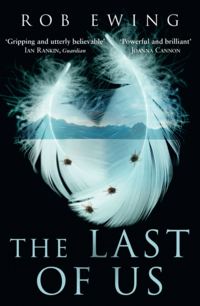
Cover photographs © Joel Santos / Plain Picture (landscape);
Shutterstock.com (flies, feather). Back cover photograph by Claire Ward
Rob Ewing asserts the moral right to be identified as the author of this work
A catalogue record for this book is available from the British Library.
This novel is entirely a work of fiction. The names, characters and incidents portrayed in it are the work of the author’s imagination. Any resemblance to actual persons, living or dead, events or localities is entirely coincidental.
All rights reserved under International and Pan-American Copyright Conventions. By payment of the required fees, you have been granted the non-exclusive, non-transferable right to access and read the text of this e-book on screen. No part of this text may be reproduced, transmitted, down-loaded, decompiled, reverse engineered, or stored in or introduced into any information storage and retrieval system, in any form or by any means, whether electronic or mechanical, now known or hereinafter invented, without the express written permission of HarperCollins.
Source ISBN: 9780008149611
Ebook Edition © October 2016 ISBN: 9780008149604
Version: 2016-12-19
Praise for The Last of Us:
‘Ewing does a fantastic job of making us feel like children again – not carefree, but lost in a confusing world replete with dangers over which we have little control’
Guardian
‘An amazing book of courage and survival … a book about memory, friendship and hope. It’s the kind of book that made me want to wake my children from their beds, just to kiss them and whisper that I love them. A tremendous novel – I absolutely loved it’
CLAIRE FULLER, author of Our Endless Numbered Days
‘Ewing succeeds brilliantly … Be warned: you’ll feel well and truly wrung-out after reading this, but you’ll also hold your loved ones that little bit closer’
The Scotsman
‘A beautiful, heartwarming story of survival and strength … an original piece of work, one which grips the reader to the very end’
The Press and Journal
‘Powerful, compassionate and brilliant. I absolutely loved it’
JOANNA CANNON, author of The Trouble with Goats and Sheep
‘Bleak, beautiful, gripping … [I] loved this book’
IAN RANKIN, on Twitter
Dedication
For Karin
Contents
Cover
Title Page
Copyright
Praise for The Last of Us
Dedication
Behind the Back Bay: Date – lost count
Three weeks ago
Back Bay: Time – now
Nineteen days ago
Back Bay: Now
Twelve days ago
Back Bay
Eleven days ago
Back Bay
Ten days ago
Back Bay
Nine days ago
Back Bay
Eight days ago
Back Bay
Seven days ago
Rona Aonranach
Last week
Past World
Back Bay
Past World
Back Bay
Past World
Back Bay
Last day
Glossary
Acknowledgements
About the Author
About the Publisher
Behind the Back Bay
Date – lost count
I have become skilled.
For starters let’s talk about dogs. When dogs die after being trapped inside you usually find them at the front or back door, or near the toilet if it hasn’t gone dry, or next to the water melted out of a freezer. I imagine them running between the two choices: water and escape, water and escape, until it’s too late.
Cats are usually by these too, or by the window if there isn’t a cat flap. But you can’t predict as well with cats, maybe because they had too much of their own mind back when they were still alive.
Being an explorer you get skilled at knowing.
I know what a cup of tea left for months looks like: dried muck. Bowls of fruit turn to furry glue. Cupboards jump with mice when you open them. Plants all die, apart from that one cactus we found, because trapped indoors was a good enough desert for it.
And dogs are more often found at doors, cats at windows. That’s the rule. Plus dogs smell worse than cats, though neither of them are very nice.
I say I’ve become skilled – but the truth is everything has got more difficult. So I can’t wait here for ever for my friends to come back. Can’t keep imagining new friends out of thin air. Can’t keep hiding in the same old sleeping bag without noticing the bad stink of it.
Even with skill you can’t truly smell yourself. If you came home Mum, magicking yourself out of the wind in the bay, this is what I think you would smell:
1 Old food
2 Dog-smell from the dog-friend (gone now)
3 The smell from my glass-cuts
4 Clothes & bedsheets
5 Pee smell (Alex’s bed before his illness)
6 Smoke (from the bad fire)
7 Shoes (seawater + shoes = epic fail)
8 Cheesy crisps (strange, we didn’t have any of them)
9 Cold wet air
10 Earwax
Still, there’s the worry about smells you can’t know, and there’s no way to come wise on that. So this morning I went outside. I went holding onto doors, chairs, cardboard boxes. Rubbish piles. And I collected the yellow bits of gorse from the field at the end of the street, and brought them in and put them in saucers all around.
Now they shine like fires far away, like when the crofters set fire to the heather and you saw it at dusk.
My eyes go slow around the room. It’s half-bright from the skylight, even though we taped cereal boxes over the glass to keep out the sun. Here in the high north, now that it’s summer, our sun hardly goes away. Underneath the skylight is Elizabeth’s bed: still made, with the edges neat the way she liked. Her rules on the wall, her survival books in a tower. Alex’s drawings and toys scattered like he always kept them, like he got grabbed in the middle of one last fight. Which I suppose he did.
I can see the stain on the carpet. Red food dye. That mark tells where it started to go bad for us.
Then the clothes that Elizabeth got out but didn’t have enough room to take. Her toys, which made me uneasy, because she was meant to be the one in charge. So uneasy that I wrapped them away from seeing.
If anyone is listening: God, or Mum, or the devil: I should say that the only obstacle from taking the bad tablet is me. That’s not a pretty thought, right? Except I was too busy with other plans for escape to notice when the thought came. When it sneaked inside me.
You see, I did one bad thing. But that bad thing led to lots of others, which grew like a crowd of dogs when you’re holding warm food.
Now it hurts too much to think about. So I’ll think about this, instead: how Alex used to ask, ‘How many more sleeps?’ How some mornings he’d wake up convinced he didn’t sleep at all. How he was sure he just went to bed and woke up and it was light. Nothing in-between.
How you used to give imaginary directions to someone driving a car over the sea to our island.
Turn southeast at Greenland. Down a bit from Iceland, up from Ireland, up and across a bit from England or Wales. Our island is one of the Western Isles – not the Outer Hebrides, which is the wrong-sounding word that mainlanders use. (Nobody knows what Hebrides means – not even our teacher, Mrs Leonard, who’s dead now, though you can still see her if you want to.)
Know what that means, Mum?
’Course you do – you are up there with God, and can see it all. Only I dare you – dare you to come down into the village, then go past the lifeguards’ station, and on to the houses that look like someone coloured them in with white chalks.
Go ask her yourself. Go on.
Mum, if it’s you that’s listening – even though you never give me any sign these days – then I have to tell you one more thing. Don’t take it the wrong way, but – your last look was a look that meant nothing.
I don’t mean that there was nothing there at all. Being skilled these days I know what a real true empty face shows – there’s usually too much teeth, plus no eyes you can figure on. And I don’t mean it didn’t mean anything to me – because it did, else I wouldn’t be forever harking back and going from one detail – creased mouth – to the next – half-wide eyes – to the next – eye-wrinkles not happy or sad – and thinking: but what does it add up to?
No, the problem about your last look was – I’m still not big enough to read it. That’s the law of faces: you can read kids younger, but older kids get hard. Adults, even harder still. If you get words as well, that can help – except when the look is sarcasm, which doesn’t go true and has no law.
But you didn’t give me any words – just a look, which might be somewhere between surprise, or all-time giving in, or not caring, or caring too much.
So I’m trying to work it out. Hopefully I get there before the time I’ve got runs out.
And now that I’ve told you that one thing – now that we’re back on talking terms – I need to ask a favour.
If you are in heaven, and seeing everything – like the crumbs at the bottom of my sleeping bag, like the gorse spread around the room or the sea’s sparkle in the window – then you need to blur your eyes for once. Stop paying attention to stuff that doesn’t matter.
Instead: help my friends.
Three weeks ago
This morning I noticed Elizabeth’s rainbow. She put water in a saucer on the windowsill, then a mirror in the water. I didn’t think it’d work, but then saw that it did.
It’s on the wall, beside the cereal boxes we taped over the big skylight. It wobbles a bit like the sea, disappears with the wind, comes back when the air is still. Just now it reminds me of a puddle with petrol spilt on it.
Elizabeth is still in bed. She’s looking towards me with her eyes open. I give her a wave but she looks like right through, like she’s thinking about the way things were before, which she usually is.
I hear a yowling noise from out on the street: one of the cats, or their kittens. They still roam around, for all days mainly, only now the bigger group is broken up into just a few stragglers who feed on rubbish like the gulls.
Saw two of the kittens taken by an eagle. The MacNeil brothers saw the rest go. Saw a crumple of fur and bones on the shore-walk next to the sculpture of the seal. The cats stayed in their house for a while after that, but I guess they got their courage working again.
Elizabeth gets up and begins to ribbon my hair without saying anything. Alex sits forward, rubs sleep from his eyes. His trousers are damp. Elizabeth gets him to stand and strips his sheets, tumbling them into a ball to be put in the garden.
Alex washes himself with a flannel then says, ‘You get up?’ His voice is dry and croaky; Elizabeth recognises the warning signs so plonks a bowl of cereal in his lap and orders him to eat. She pours ten toty cartons of cream in a glass, adds yellow sterilised water, pours the lot on top and hey presto – he’s got a normal breakfast.
Our clothes are already in three piles. Elizabeth puts on a CD – Winnie the Pooh, which we listen to while getting dressed. Then she takes the balled-up sheets and puts them in the garden beside all the others.
Alex: ‘It’s only sweat. I just sweat the bed.’
Me: ‘Don’t worry about it.’
Alex: ‘I just have a weakness for sweating …’
Me: ‘OK, I believe you.’
He’s scared of going to the toilet alone, so I take his hand and go with. The flies on the ceiling do their mad angry dance when the door opens and closes. The porch door’s stiff, not broken like the one to the kitchen.
Outside, there’s the smell of dewy grass and moss in the sun. I jump over the screeching fence, do my daily business. Alex is about to go by the door when I warn him to come away a good bit: ‘Stop being too close,’ I hiss. ‘You’re always too close. Come over by the fence.’
He comes in by the fence, pees. He looks around – to the street, to the bay, to the road going west and to Beinn Tangabhal, our big hill at the far end of town.
Alex: ‘Is it smoke?’
He’s pointing at the hill. It’s only cloud. I tell him.
‘Cloud isn’t smoke then?’
I think about it, then decide I don’t know the answer. I’m pretty sure I used to know the answer. Or maybe he’s half asleep, and it’s a kid’s question.
He’s less bleary when we get back in. By now Elizabeth is doing her routine. She turns the two radios on. One has a dial which she circles all the way, going through the stations. The other has buttons. She takes her time, slowing on the dial at the places we marked with gold stars. Then she gives Alex his injection. He already has his jumper up ready, so it’s done quick.
She holds up his pen and looks in carefully at the glass window on the inside of it.
‘Just half of this one left,’ she says.
After this Elizabeth writes our shopping list: Sheets – for 1 week. Breakfast. Batteries. Bags. Tins. Hearing a noise, she turns down the CD. We all listen. But it’s only coming from the street, a lot of yowling and screeching – it’s from the House of Cats. She turns the CD up again.
We’ve finished the funny milk that doesn’t need a fridge, so I have cartons too, and they’re not bad. There’s apricot jam after this. We dip pink wafer biscuits in, rather than using our spoons and having to wash up. Then there’s digestive biscuits, toasted over the gas-burner flame, then hint-of-mint hot chocolate.
I comb Alex’s hair. He doesn’t like wiping his face, plus he always forgets to wash his hair, so I take him to the mirror to show him how it looks and the damage it does to his appearance.
I get the toothbrushes out, brush mine. ‘Dreamt I had a wobbly tooth last night,’ I say, remembering.
Elizabeth is cleaning our cups in the bowl. ‘You missing any new ones? Or old ones, mean to say?’
I put a finger in to test: ‘All just the same.’
‘Why do we brush our teeth again? Can anybody remember?’
‘Oh not this again …’
Alex wrinkles his face at our talk of teeth. He doesn’t like having his brushed. He had a sore tooth when it was still dark and stormy, and his face went big for a week. After that he lost four of his baby teeth, all at once. He cried a lot, and it took him ages to get better. Now he has a big gap in his top teeth, with no adult ones in yet.
Me: ‘Remember all the good reasons?’
Alex: ‘Elizabeth says gum disease means sickness going in the blood. Plus, if you swallow a tooth then you don’t get a coin.’ He sighs and looks around for his clothes, which I know is just a delaying tactic.
I push down his chin, which doesn’t usually work but does today.
Me: ‘Firstly: chewing surfaces.’
The saying of this makes us stop. We both look at each other. Then we ignore ourselves.
It’s only a short walk to school. The skinny cats follow us, so we scare them off. It rained last night, but it’s sunny now, which makes the road shine.
If I almost close my eyes this brightness joins up with the shine coming from the sea. When I tell Elizabeth about this, that it’s one way of making everything look back to normal, she nods and does her distant look.
We sit down in our usual classroom seats and unpack our bags. Alex is very fussy about how he sets out his pens: he has to get the colours right before it’s good. Elizabeth sits beside Alex, then we wait for the MacNeil brothers.
I wait until the clock shows 9:02 before starting. We do reading first – this is Alex alone. Elizabeth leaves it to me, so I give him plenty of praise and tell him he’s a Good Communicator. I put a star in his reading book, then get him to read it again in his head. Then we do writing – I draw two lines in Alex’s book, ask him to do his best vowels. After this we do words, then sentences.
While he’s doing a story I take myself aside. In my head I think: All right Rona. Read this page to this page. Then do a story where you use plenty of Wow Words, and especially these – Frog, Dainty, Wolf, Tiredly.
Elizabeth is about to start her lesson when Calum Ian comes in, with Duncan following after him.
Duncan is wearing his hood up high today, the way he does when he wants to be invisible.
They take a seat as far from us as possible. Calum Ian takes out his pencil and sharpener. He starts to sharpen his pencil onto the floor in one long unsnapped strand.
‘Martin far,’ says Elizabeth.
I know she can’t help it, but she never gets it right. She says madainn mhath like there’s a Martin who’s far. The first time she said it I nearly went – ‘All right, where?’ I’ve tried to correct her, but there’s no chance she’ll come wise.
‘Pòg mo thòin,’ Calum Ian replies.
This is very rude and should never be said, not even to your worst enemy.
Elizabeth: ‘I know what Poke Ma Hone means.’ She gets the sound of that right at least.
Calum Ian looks like he knew she knew already.
‘What is it, Duncan?’ Elizabeth asks. ‘Why are you hiding yourself away?’
Duncan’s jacket scrunches.
Calum Ian: ‘He’s being quiet. He only wants to sit in peace and quiet. That’s right isn’t it, Duncan?’
Duncan doesn’t answer.
Elizabeth takes the teacher’s seat. There are ten empty places, five filled. She writes our names in the register, then hands around bits of paper.
‘We’ll start with an activity,’ she says. ‘As part of our remembering. It’s the thing where you choose a colour, then a number. All right? Then there’s a message. We can all make one. Who wants to have a go?’
She calls it a fortune-teller for our fingers. It’s like a beak with four spikes, made of paper. My first try ends up wrong. Alex can’t do his and he ends up getting offended. Calum Ian does his but looks grumpy about it, while Duncan’s hands are quick and skilled.
Me: ‘Choose a colour.’
Alex: ‘Blue.’
Me: ‘B – L – U – E. Choose a number.’
Alex: ‘Four.’
Me: ‘One two, three four. Open this up. And the message is – Keep calm and keep playing.’
In the end it’s a good enough project. We laugh at some of the ruder messages, then Alex finds one which says You see a ship! And we stop wanting to play.
We have a break, then Elizabeth says we should change activity: to real remembering.
‘Who wants to go first?’
When nobody volunteers she begins:
‘Dad used to talk about memory. He said there was short-term, and there was long-term. Can anyone tell me what the difference is?’
Nobody wants to say and get it wrong.
‘All right, so short-term’s the thought you just had. It doesn’t last, unless you remember it again. Long-term lasts, but sometimes you need to remember it to keep it strong. Otherwise it can fade, and you forget.’
She waits for us to understand. I try to remember what I had for dinner – no, it’s gone. I should’ve practised.
Elizabeth: ‘Who’ll go first?’
No one answers. Calum Ian looks up at the cracks on the ceiling, then stretches out his arms and collects back like he’s years after being bored.
‘Will you try, Duncan?’
Duncan pretends to be reading his jotter. But then, to surprise us all, he stands. He stands for the longest time, even past the point of my being nervous for him.
‘Dad used to have a game where he pretended he was a robot,’ he says in a hurry. ‘You’d control him, except he might attack.’
He waits for us to say anything. When nobody does he goes on: ‘I remember he was friendly after the pub. If he’d gotten drunk he had a joke about people annoying him to give him a trophy. He didn’t want it. They’d run up the street after him, chasing him. It was sort of stupid …’
He looks out at us, seeing if we’re still listening, looking like he’s sure we’ll be bored.
‘I thought he was trying to make himself out to be important … I thought he was worried about being too ordinary as a dad. That’s why I always practise my fiddle: so he can see how good I am when he comes back. So I can make him proud.’
He stops. Elizabeth makes a go-on face. We’re meant to be writing it all down for Duncan to keep in his diary, but I mostly prefer just to be listening.
‘Mam, she played I spy. She said it in the Gaelic. Said it with sounds, as well: I hear with my little ear. You could hear the kettle, or the wind. Or the fridge. Once she did it for her stomach rumbling. Then for her baby.’ He stops for a while, picks at some fluff on the edge of his sleeve. I can see all his face now. There’s new scabs on his chin.
‘Dad didn’t play the robot game when everything went bad. There wasn’t much I spy then either.’
After a long time and with a quiet voice he asks: ‘If a baby isn’t born, does it still get up to heaven?’
Calum Ian stops writing. He leans across and raps Duncan hard on the arm.
‘That’s you finished. You’ve done your bit. I don’t want you talking about them, all right? So, you’re done, suidh sìos. Now get your arse in and sit.’
Duncan wants to stay standing – but when Calum Ian gets up and folds his arms, he sits. His big brother looks annoyed, or maybe sad, I can’t tell. He gives Elizabeth a look like she did a stupid thing for encouraging Duncan.
‘Know what I think?’ he says. ‘There’s just as much stuff we need to forget. So get on, Big Brains, answer that: how do we stop ourselves from remembering?’
We wait on Elizabeth.
‘Remembering is all we’ve got,’ she says.
It feels like the right time to change topic. Elizabeth writes down Duncan’s memories then gives them to him.
‘Let’s move on to sums,’ she tells us.
It’s my job to hand out the workbooks. We all know the pages, but I say them anyway because that’s what happens in a class. My lesson is counting money. I have to count picture-bundles of spending money in under a minute. I use the clock on the wall. It takes me two minutes, but only forty seconds if I cheat.
Alex, who’s young, has to read Kipper’s Birthday, which he’s done before but this time with feeling. Duncan’s the same age as me, yet he won’t be encouraged. He mostly lies head-down until it’s time to go. Calum Ian is one year below Elizabeth, so he copies her mostly.
I turn the pages and stare at the sums I know I did last year. The book is very good – giving examples, sums that are worked through, but even so, it’s not enough. I don’t want to tell the boys that I don’t know. The last time I did that they called me Gloic, which means brainless idiot, not even anything to do with the truth.
Then the sun starts to shine on my desk, and now I want to be outside. I think of the gardens we saw on the way here, with flowers I haven’t the name for, either in the Gaelic or English. I recognised some very big daisies, but the rest I didn’t know. Daffodils? Roses, maybe? There might be a book in one of the houses, or the library. For learning there can’t be a better place to start than there.
‘This is dumb,’ Calum Ian says.
I look up at Elizabeth, who pretends not to hear, at least not until he says it for a second time.
‘Why is it dumb?’
Calum Ian scratches his pen across the lid of his desk. ‘It’s the same page, over and over. Plus I never cared about sums in the before. How can they help us now?’
Elizabeth lines up her jotter and pencils. Then says, ‘Sums are needed for lots of things.’
‘Say some.’
She tries to think of examples. In the long run she says, ‘Sums can tell you what the date is.’
‘No they don’t. All you need for that is a calendar. And there’s plenty of those in the post office.’
Me: ‘People used to tell the time by the sun. True. There was a shortest day and a longest. The olden-times people used sums to work it out.’
Calum Ian: ‘We’ve got calendars.’
Elizabeth: ‘Which nobody can agree the date with.’
Calum Ian: ‘Because you got your count wrong.’
He takes out his can opener – twirls the head of it, squinting his eyes at Elizabeth.
‘Why’d you get to be teacher? It could just as easy be me, or Duncan. Or Alex sitting quiet there. Or her. But it’s forever you.’
Elizabeth puts her pencils back in her satchel.
‘It’s not even as if we learn anything. We’ve been at this same page for days. Weeks.’
Elizabeth leaves the teacher’s seat and goes to sit beside Alex. Then she takes out her things and looks patient.
I know Duncan will never get up to replace her: he’s too shy. Alex is both shy and too young: he’s only six.
We hear Calum Ian’s chair screeching. He scrumples his pages then goes to the teacher’s desk.
On the whiteboard he writes his name, then underneath:
I AM A BOY NOT A FUCKING TEACHER
‘There’s no point pretending to be a teacher, because I’m not,’ he says. ‘There’s no point in any of us pretending because none of us are. The – bloody – end.’
After this he draws an arse on the whiteboard, and I have to admit this is kind of funny.
But when we start to laugh he gets furious; he rubs off what he’s written then shouts: ‘Shut your traps! Sguir dheth sin! That means you as well, Ugly-face!’
He’s talking to his brother, Duncan.
Duncan hides as deep as he can in his jacket, to match the quietness of the rest of us.
Now Calum Ian looks worried to have said what he did. He goes back to his seat, rolls down his sleeves – but they’re clarty, so he rolls them back up again.
‘Duncan could teach us the fiddle,’ Elizabeth says in a quiet voice. ‘We could get them out of the music cupboard?’
‘I’m going home.’
Calum Ian begins to pack his bag. Duncan begins to collect his things, too.
Elizabeth: ‘We could do messages?’
‘Another crap idea. Who’s looking out for them, tell me that? We send and send but we never get any back.’
‘And never will if we don’t keep sending.’
‘Fine, you do it then. See if I care.’
‘But we have to stick together. Remember the saying: “What’s going to work?”’
This is Elizabeth’s saying. She always does it when we’re struggling, or disagreeing, or needing a boost up.
When nobody adds on the next bit, she has to add it herself: ‘Teamwork! That’s what’s going to work, right? We’re all going to be a team. Right?’
‘Do your stupid sums for the team, then.’
After this Calum Ian gets up, scraping his chair, and leaves, with Duncan hurrying behind.
I look across at the drawing Duncan left on his desk.
It’s the same drawing he always does: of a face with black scored-out holes for eyes.
Elizabeth goes into one of her quiet moods. She walks me and Alex to the swing park, then leaves us.
‘See you at home,’ she says, her voice sounding like we’ve not to follow too soon.
Sometimes if I’m not concentrating I still think we’re living in our last house. We’ve moved twice now, usually when the mess gets too much. Elizabeth isn’t sure if this means we live like kings – having a new house when it suits us – or like orphans. I prefer the king choice.
It’s only Calum Ian and Duncan who’ve stayed true to their old home. This gets me the big envy sometimes, when I think of my old home, abandoned.
Alex and I sit on the swings for a bit, eating rice crackers with mango chutney spread on top.
The wind mushes the water in the bay, and the sun makes the mush glittery. The wrecked trawler out on the rocks of Snuasamul looks like the world’s biggest whale. I hold it between finger and thumb. It’s tiny.
Alex: ‘Do you think there’s a ghost on that ship?’
Me: ‘As usual – too much imagination.’
Alex goes back to nibbling his cracker. He frowns at his chutney then says, ‘Don’t want more of this. If you eat the same thing over and over you get a heart attack.’
‘Who says?’
‘No one. I just think it.’
‘Well you shouldn’t think it. It’s crazy! That’s only if you eat too many chips and you get a fat arse and you smoke. If this isn’t you, don’t worry.’
He still looks worried, though, so I decide we need to do something brave, just the two of us.
First of all, I command us in getting an offering. We pick some of the flowers we don’t know the names of, plus dandelions from the grass strip by the History Centre.
Then we go bit by bit closer to the side entrance of the big kids’ school.
No one likes going here. They made it different to the little kids’ school because of who they put in it.
It takes a while to get our confidence up: so we kick the rainbow-painted stones along the pathway, then run up and down the slopey concrete.
After that we go in.
The wind goes in first, fluttering leaves and bits of paper by the door. There’s broken glass outside one room. Dirty black stuff in spots trailing up along the corridor. On both walls are the message boards. Some of the paper displays have come down. I hold one up: there’s a bit at the top called ‘Our Wall of Achievement’, but the bit underneath has fallen away, so there’s nothing. I think this is kind of funny in a dark way, but Alex doesn’t.
Back Bay
Time – now
It’s not a very good day for seeing far out to sea. I sometimes forget to keep watching.
This morning the rain was marching adults in my dream. Mum used to call that sort of thing ‘wishful thinking’. She never said if wishing worked.
Then there are other things: things you didn’t wish for. Like the Gaelic weather sticker at the end of my bed. It said, ‘Tha i grianach’. I had to tear it, right through the happy face of the sun underneath.
All around the ferry building I put cups. Some of the plastic ones blew over, so I put round smooth stones from the shoreline in to steady them better.
Then I waited. And waited. I saw the sky go bright in a place I’d never seen bright before. So what did that mean?
Did you think it was a good idea, Mum, or not?
After the light got halfway I could see my reflection in the water under the pier.
A girl with long hair. Looking like she had a beard: her hair down in straggles, covering her face.
A reminder of who we found after we saw the painted dogs.
‘Looks like you’re facing your worst enemy,’ I say to the girl. But she wins in the end by hiding herself in ripples.
Later, I went to put flowers on the sea, to remember my friends, but the tide got me, up to my waist. That was a slip-up. I have to be more careful nowadays.
I have to think of everything.
It’s too easy to make mistakes. Two days ago, when I was on watching duty, I accidentally looked at the sun with the telescope. Since then there’s been a black moon in the middle of what I’m seeing.
Even so, I’m a smarter kid for having it. I won’t make the same mistake twice. Because the more mistakes I make, the smarter I’ll get.
Still, the thing to worry about is this: how many mistakes is a person allowed? How many mistakes can a single person make and still be? There isn’t a rule, or none that Mum ever told me.
She’s telling me the answer to her riddle. It’s time to pay attention: everything else can wait.
Now I see her, and I bury down to the bottom of my sleeping bag as the sound of her starts to become real: ‘What goes around the world but stays in the corner?’
Mum’s wearing her red and blue post office jacket. She asks the question in English so we know it’s a riddle.
We pass by Mr MacKinnon’s blue-eyed collie, the one that’s always on guard. Then the phone box. Then the forest of fifteen trees, then Orasaigh, the island where the rats used to live. Floraidh MacInnes once told me that there was a storm and all the rats came ashore and ate the annoying cats, but she’s a liar, I never believed her.
‘A shy man on a boat?’ I answer.
‘Works fine. I accept it works fine, but it’s not the answer I was looking for. Try again.’
It’s my work to get the bundles together. Mum’s fingers are inky from the packets. She whistles up for hills and down for dips. She keeps spare elastic bands in a coil around her wrist which make her hand go puffy.
‘My stand-in is coming tomorrow,’ she says. ‘He’s not been before. Early ferry, with any luck. Then that’s you and me are away on our Christmas shopping. How good is that?’
I give her the thumbs-up. It’s damp, but the heaters blast dryness. We go on the east road first, because most people live on that side of the island, then onto the north road.
My favourite postbox is the one which fills with sand in a west wind. It crackles inside like a shell.
Mum hands out biscuits to all the dogs that bark. She says that if we give enough biscuits to the barking dogs they’ll be too fat and soft in the head to chase us.
‘Chan ith a shàth ach an cù,’ she says, testing me as we drive away from another one. ‘Your mother wants to know the English translation – go ahead.’
‘None but a dog eats his fill.’
‘Apart from auld Eric in Cleit who wants to dig his ain grave with his teeth – well done.’
Mum said she learnt everything at school but the old sayings; now she wants me to know them, too.
‘Look, will you,’ she says. ‘Washing out in the rain.’
The washing is Mrs Barron’s. Mum chaps on her door. Mrs Barron is OK. Mum gets permission to take in her sheets, and when she comes back she smells of mist. Mrs Barron has handed her a letter for posting. The letter has a lovely stamp: hummingbird, green and gold.
She hands the letter to me and I put it in the going-away postbag.
‘Using up his collection,’ Mum says. ‘Since Mr Barron died. Last year it was Jubilee editions. I’m forever telling her that it’s like tearing up ten pound notes – but she has her ain mind.’
I let my fingers sift the letters in the bag. Some are smooth, others pebbly.
There’s a sheep scratching its arse on the last postbox before we get on the round back for home.
‘Fine day for it,’ Mum says, as she unlocks and empties the postbox beside the sheep. She’s mostly polite to animals in case they’re the departed returned.
When she gets back in the car I answer, ‘Stamp.’
Mum draws a tick in the air. ‘Full marks, a ghraidh! Around the world, yet stays in the corner. You got it perfect.’
‘But that doesn’t work, Mam. What if you posted a coconut? Or any round thing, like a ball? There wouldn’t be corners then.’
‘Seadh? When did you hear of anyone posting coconuts or footballs? Is that even likely?’
‘It’s exactly where your riddle doesn’t work.’
The ribbon road shines with sun and rain. Eilean Mor shows through rags of cloud.
On the drive around to the south road Mum stops to ask the cows if they’ve ever heard the like of posting coconuts.
The cows look up for a bit, before going back to their usual grass-chewing.
It’s like stones you find on the beach. Polish them, make them shine. Keep them warm in your hand.
Make a new ending. Where nobody gets sick, and the electricity comes back, like it should’ve done, like it always did when there was only a storm.
Nineteen days ago
It’s a clock which wakes me, which means I’m in trouble, as the alarms were meant to be turned off.
There’s a big mess in the room. I only notice it when it gets bad enough to hide nearly all the floor. There’s dirty clothes belonging to Alex: hanging in fankles from the pram we brought in last night. I think the pram was from a game he was playing: another game where he fell asleep and had to be lifted to bed.
We began shopping for clocks to keep time. Best of all is the radio-clock which Calum Ian found, which even tells the day of the week and the date. Still though, it doesn’t remind you of what dates are important, or the dates you might forget. Alex couldn’t remember his birthday: was it the 11th or 12th of March? Then when the lambs came nobody knew if that meant it was Easter, or spring.
We found a diary in the post office which gave us the date of Easter. But what about spring? Then Duncan noticed we’d passed a day called British Summer Time Begins. That told us it was summer, and that we were already in it. But where had spring gone?
I looked in the library, but there wasn’t any useful books on it, not even in Space & Time.
Elizabeth is writing a new sign. She adds to the bottom of it then pins it between our beds, next to the posters for Health and Wellbeing and Food Groups and How We Grow.
Alex stands in front, reading slowly with his finger.
1 RULES FOR OUR HOME
1 Tidy as you go.
2 Share food & don’t waste food.
3 Paper plates save water.
4 Make your own bed. I am not your mother
5 Don’t go to the toilet too close to the back door.
6 Dog poo on shoes indoors – bad!
7 Save batteries – don’t leave torches on at night.
8 Matches, matches do not touch, they can hurt you very much.
9 Ghosts & zombies are not real.
10 If it smells – don’t eat (main exseptions food in tins, vinegar, food in jars, mushroom soup.)
11 Teamwork will work!
12 Alarm off on every clock!!
Alex and I stare at the rules, wondering who’s to blame. I decide that the rules fit most for him – apart from the mushroom soup and vinegar and alarms bit, and the bit about dog shit, which was anyway a mistake.
Me: ‘All we needed to do was check our feet. And paper plates, they get mushy after a while.’
Alex: ‘A minute after you put me to bed I’m asleep and the torch stays on all by itself.’
Me: ‘All flavours of soup stink.’
Alex: ‘Would we get a dog? If we had a stray dog we wouldn’t need to waste a single drop of food.’
Me: ‘You can’t trust dogs to watch your food. Anyway, Alex always stands in dog shit. It’s disgusting.’
Alex: ‘You’re a dog shit.’
Me: ‘You’re the king of dog shits.’
Elizabeth: ‘Stop it, both of you! OK? All I want is for you to help me a bit more, that’s all.’
We go back to staring at the rules. Most hark back to something that’s happened. It’s hard to get everything right all of the time. Still, Alex does need to be reminded about matches. That’s a big fascination of his.
We get up, get dressed, do the routine: radios (fizzing noise), teeth (gums fine). I put batteries in the portable TV/DVD player. Snowstorm. Alex takes his injection without fuss this morning, then we have our breakfast. Today for a treat it’s creamed rice, which I used to hate but now love, especially with jam. Then when we’re done Elizabeth goes through the cupboards, making notes of anything we need. I have a suspicion of what she’s going to say before she comes out with it.
Elizabeth: ‘There’s a big issue I kept off the rules. It would be great if you’d help.’
Alex’s eyes swing up from sucking his sleeve.
‘It would really help if you’d come New Shopping. Even if you end up staying outside, it doesn’t matter. It’d just be a help to have the company.’
Alex switches from sucking his sleeve to the neck of his T-shirt. The drool on his clothes makes him stink like a dog’s bone. I tell him to pack it in.
Elizabeth: ‘I’d appreciate it.’
Alex: ‘What about Duncan, and Calum Ian? Can they not be your sidekicks?’
Elizabeth: ‘Maybe they’ve decided to do their own shopping? I didn’t even ask. All I know is I can’t do ours all by myself.’
We think about it. Alex looks very doubting. He plays a blasting game with the lightsaber I made him out of yellow card and tinfoil.
Alex: ‘There is actually a black lightsaber.’
He says this when he’s trying to put you off. Usually the conversation goes: There is a black lightsaber – No there isn’t – Yes there is – No there can’t be because light is not black – Yes there is cos I saw it in my Star Wars Clone Wars Encyclopaedia. And black light is radiation. So there. This is what he says when he’s trying to pull the wool over.
Me: ‘Can we do something fun first?’
Elizabeth: ‘Like—?’
Me: ‘Can we go to the rocks and chuck bottles?’
Elizabeth: ‘We don’t just chuck bottles: we send messages. There has to be a purpose to everything.’
Alex: ‘Why?’
Elizabeth: ‘Because we lost our adults. Because we’re alone. So we do all we can, every minute of every day, to get help. Agreed?’
It isn’t always nice when she spells it out. Anyway, school’s cancelled. To make the agreement proper I head up to Elizabeth’s rule list and add underneath:
13. All go shopping (after nice stuff.)
This settles the business for the three of us. Then we shake on it so nobody can go back on their word.
We take the shore road towards Leideag. Some birds flap around like flags. Out to sea, those islands I can’t remember the names of. We always look for boats, though our eyes are getting used to not finding them.
Further along we join the beach. There’s a lot of mess on the sand, though nothing new. A jumble of rubber tyres with faded labels on them. Hundreds of kids’ plastic chairs, the sort you’d find in a playhouse. There was a skeleton in oilskins, now there’s just oilskins. Now and then the beach changes and a bone sticks out. Calum Ian and Duncan hate this beach, because they’re scared the bones and skeletons could be one of their uncles.
We come to the life jacket that used to be around the skeleton. It’s got foreign writing on it. It might be Spanish, or French? Anyway, it isn’t a local fisherman. Elizabeth has told this to the boys, but they’re too superstitious to even come close and they won’t ever listen.
A track takes us to the end of Leideag, to the radio mast and Message Rock. Calum Ian worked out it’s the best place to launch bottles: because it’s the bit of land sticking out, it’s outside the bay, and also, the island Orasaigh stops the bottles coming back in again. He even put out two markers – yellow wellie boots – at the best launch-off.
But now he won’t come, because he got cross last time we all came. The argument began with Alex:
Alex: ‘Don’t want to throw mine in.’
Elizabeth: ‘But you’re not losing it. You’re telling your wish to the sea by sending. That’s the rule.’
Calum Ian: ‘A lot of rubbish, making wishes. Seadh, I bet they won’t come true. I bet we all end up wishing for the same thing. That would be dumb.’
Elizabeth: ‘We might not.’
Calum Ian: ‘So what’d you wish for? And you? And you? Aye: you all wished for everyone to come back, didn’t you?’
Me: ‘How did you know?’
Calum Ian: ‘Stupid fucking rubbish, wishes.’
But this morning it’s just us three. For my message I draw a picture of me with realistic hair standing beside our house. The house is a deliberate kid’s version (lots of square windows, a pig’s tail of smoke from the chimney) for extra impact. Alex has drawn himself holding a black lightsaber. No details. Elizabeth has done all the details of herself: address, age, name, family name, class at school, hair colour, cos she’s like that.
We get to the sticking-out edge of Message Rock and chuck them in. My one seems to wait for a bit – then it hurries off. It always seems to be mine that gets washed back up on the beach, which makes Alex gloat. He says he has a better throw than me, but I think it’s just luck.
At school we learnt about St Kilda. The people there ran out of food and they got tetanus and anyway there was no TV so they sent sea-mail. Sea-mail from St Kilda doesn’t get to America, it gets to the mainland. It’s a law of nature for all time. When the rescuers finally got to St Kilda the men had waited so long they’d grown beards. No one wanted to stay after, so that was the end of St Kilda.
We watch the tide as it starts to cover the rocks guarding the bay. There’s seals on the rocks, curled up like black bananas, not caring about what happened.
Me: ‘To the seals it’s all normal. Except for the rubbish, and the oil slick, which anyway didn’t last.’
Alex: ‘I used to think there was a plughole and the sea was a sink. That’s why the tide went up and down.’
Elizabeth: ‘It’s a good idea.’
Me: ‘It’s eejit-talk.’
Alex: ‘You’re an eejit.’
Me: ‘Do whales not hibernate?’
Elizabeth: ‘I don’t think so. I never heard of that.’
Alex: ‘Why don’t people hibernate? Bears do. And squirrels. And birds.’
Me: ‘Birds don’t hibernate you eejit!’
Elizabeth: ‘Nobody’s an eejit, OK? It’s a good question. I don’t know why people don’t hibernate. We’re mammals after all, and some mammals hibernate.’
Alex: ‘Do you think my mum and dad might be hibernating?’
Elizabeth looks away to the wrecked trawler.
If the sun’s low we can watch the bottles bobbing and shining for a bit, until they pass over to the sound. This morning it isn’t long before they disappear, which makes me think about how big the sea is.
Big enough for the nearest island to be blue. The mainland, to be gone.
Back when we used to take the ferry it was five hours to Oban. It never seemed too far when there were TVs and DVDs and games and dinner and showers and friends to run around with. But now the sea goes on for ever.
Alex: ‘Goodbye bottle.’
Me: ‘It can’t hear you, it’s a bottle.’
Alex: ‘Are you sure there’s no ghosts on that ship?’
Elizabeth: ‘Positive.’
Alex: ‘My bad dream is when everyone starts to come alive. I see them coming from the boat. They walk along the bottom of the sea. Then they start to come up the beach and I’m running and crying. But I’m not proper running – my legs are too slow. Are you really sure?’
Elizabeth: ‘Yes.’
Alex: ‘How sure?’
Elizabeth: ‘Listen: Dad said there was no such thing as ghosts. He said ghosts were just a figment of the imagination.’
Alex: ‘What’s a figment?’
Elizabeth: ‘A part that’s not real. A part you ignore.’
There’s no hazard tape on the door. Elizabeth’s rule for this is: Be aware anyway. Someone was digging in the back garden: there’s a pit, lined with tatty plastic. There’s no broken windows, and the door’s unlocked.
Elizabeth goes in first. ‘Hullo?’ she shouts.
No answer.
The carpets are red and gold in patterns like a king’s robes. No smell. So far. Stairs with a metal chair for going up and down on, for someone old, or with a bad back, or broken legs. Elizabeth signals us in.
Downstairs there’s a front room, kitchen. It’s very untidy. The walls are golden from smoking. Out the kitchen window we see a back garden with gnomes. Some of them are fallen over, sleeping. Windchimes trying to wake them up.
In the kitchen cupboards of old people you’ll usually find golden syrup, gravy powder. Good finds today: oatcakes, digestives, lemon curd. Hot chocolate to add to our hot chocolate supply back home.
The fridge: shut. I wear my perfume-hanky and open it. Instant pong. The food inside gone slurpy black. Elizabeth works away behind me, collecting all the worthy stuff I can’t be fashed getting: hand-spray, mousetraps, gloves, hats, scarves, clothes. Alex comes back from the cupboard under the stairs with new bedsheets.
‘This is good – we’re working as a team,’ Elizabeth says. ‘See? It isn’t so bad, is it?’
Alex: ‘It is so bad. I’m never wearing those. That’s a scarf for an old dead lady, it’s poisoned.’
‘You won’t be saying that when it gets cold.’ ‘It’s summertime. It won’t get cold.’
‘It will in winter.’
‘But we won’t be here in winter. We’ll be rescued by then, won’t we?’
Elizabeth doesn’t even answer, just packs her New Shopping into plastic bags.
Upstairs, there’s a bathroom, two bedrooms. The bath and sink are unfilled. The main bedroom has one enormous TV. Nobody in the bed, but we knew that because there was no smell. Pill packets, dried-out cups, plates. A cross on the wall. Loads of old-fashioned DVDs, which Elizabeth says are of a type called westerns. Shane. High Noon. The Magnificent Seven. It smells of dust. There’s a dressing table with loads of pairs of crinkled tights hanging from its mirror.
The bed feels warm where the sun was on it.
Alex: ‘Dust is skin. Every single second skin is falling off you. But how does dust fall when nobody’s home?’
Elizabeth: ‘Dust is other things as well.’
By the end, we’ve got a good haul. Elizabeth finds creams called Elocon and Eumovate and Liquid Paraffin, which she says are good for skin. Alex finds a ship in a bottle, plus the bedsheets. I find another clock to add to our collection. The clock is called a barometer. Elizabeth says it measures air. Right now the air is 
We almost go right into next door. But Alex stops us.
‘That’s my auntie’s house.’
‘Are you sure?’
‘’Course I’m sure! I always came here. That’s her name if you want proof.’
We read the doorplate. Then Elizabeth finds a scrumple of tape by the step.
Then I notice a B sprayed in gold on the doorframe.
Me: ‘I think … Calum Ian’s been in.’
Alex: ‘He can’t do that! He shouldn’t be going into my auntie’s house!’
Elizabeth: ‘Look … let’s just move on to the next house, all right?’
The tape makes a ripping then a sucking noise as we pull it off. Flies come out – we wait for them to stop. There’s a smell. Elizabeth pushes the door, but it’s stuck.
We know already what the problem is. There’s someone behind it.
Actually it isn’t a someone, it’s a something. A dog. Gone flat, like dead things usually are.
It’s easy to push aside. Once inside we find a carpet to cover the dog over with.
You can hardly even see it, once it’s covered.
Duncan used to reckon that dead things went flat because their souls had left their bodies.
He told us that Father MacGill once mentioned an experiment where they tried to measure the weight of a person’s soul, by taking their weight before and then after they had died. The difference in the sums, he said, was how much the person’s soul weighed.
Calum Ian, however, thought it was rubbish.
‘Flatness is the difference between sheep and sheepskin rugs,’ he said. ‘It’s fuck all to do with souls.’
The carpets are grey, the walls white. It feels like a dentist’s. In the front room there’s a fishtank. The water has turned green. The dead fish are floating in stringy black bits of mould. I go to dip my finger into the water just to hear what the plop sounds like.
Elizabeth: ‘Don’t!’
She comes and sprays my hand with soap.
There’s a big mess in the kitchen. Wood splinters, dust, bits of ceiling. The roof’s broken down. Amongst the dust and splinters are lots of black bags, tied. I check inside, but they’re empty. They feel damp still.
Me: ‘What happened?’
Elizabeth: ‘The roof caved in.’
This person was starting to get prepared. We find pots filled with water, but not covered. The downstairs bath got half-filled, but still not yet covered. The windows of one room are blocked with cardboard and sheets.
Then in a hallway cupboard we find food hidden in a cardboard box – enough, maybe, for weeks.
Alex: ‘We can eat and eat!’
Me: ‘And eat and eat!’
At the back of the cupboard there’s plastic tubs with the most complicated labels I’ve seen. The tubs contain pink stuff, brown stuff, yellow stuff. They are called recovery drinks. Elizabeth sniffs, tastes, then mixes some with her water bottle. She tries it, then gives me some.
‘Maybe OK?’ I say.
We find chocolate bars called Maxifuel Protein. In a big box. Meal replacement, it says. Hooray! We can eat just bars! No more tins! But they don’t taste much like chocolate, more like bad fudge. I don’t like them.
Me: ‘They safe?’
Elizabeth: ‘I think they are. Still in date.’
We find the person upstairs. I was expecting a man, but it’s a woman. She’s a mystery. She’s on the toilet floor. The floor has fallen through to downstairs. Her mask has slipped to her neck, with lots of brown spots on it: sick, or blood. There are towels laid out on the floor. The towels are dirty. There’s broken glass. There’s little red and white pills spilt in the bathroom. They’re stuck to the tiles like they got glued on. She’s wearing clothes like an Olympic runner. There’s mushy spots on her skin.
We gather our shopping on the front step. Elizabeth takes her blue spray-can and sprays a B on the door.
Alex: ‘No more New Shopping. Please. Can we not just stay outside now? I don’t want to do any more.’
Elizabeth: ‘You’ve done really, really well. Thank you. No more for today. We’re done.’
Alex: ‘Are you being truthful?’
Elizabeth: ‘Yes.’
Alex: ‘Why do we have to bother?’
Elizabeth: ‘Because we need to do all we can to survive OK? Remember? Anyway, I didn’t ask you to come upstairs with me. You should’ve stayed downstairs.’
Alex: ‘It was too late. I was there.’
I fill my backpack while Alex frets, and while Elizabeth adds the house to our map of food-stores.
People are mostly dead in bed, or in the toilet, or between the two. They smell the worst of all things, worse than cats or dogs. So you get in and out fast. And you don’t look at them in case the memory of the way they look becomes long-term.
Mum always said about bad stuff on the internet: ‘Never look for bad stuff because you can’t unsee it.’
On the way back home we stop at the cool box. For the past month, since the world started to feel warm, Elizabeth has kept Alex’s injections in a cool box in the stream beside our village.
Now she takes the foil packet out and stares at what’s left inside. When I try to be nosy, she shuts the box.
As soon as her back is turned I sneak a peek inside.
Me: ‘There’s hardly any!’
Elizabeth: ‘You … We’ve loads. OK? Enough for months.’
Me: ‘But just one packet …’
Elizabeth: ‘Shut up about it.’
Then it’s sandwich time: crackers, corned beef. Corned beef is the opposite of a Wow Word as it doesn’t taste of corn or beef. Today Elizabeth has made jelly-water. Our water on its own tastes of coal and chlorine, but add a packet of jelly cubes and it tastes like sweets.
After this she gives us each a tablet, which she says is a vitamin. Alex looks very suspicious about his, and so do I.
Me: ‘Where – honestly – did you get these?’
Elizabeth: ‘Shopping.’
Me: ‘New or Old?’
Elizabeth: ‘Just shopping.’
Me: ‘Did you get them from a bad house?’
Elizabeth: ‘Just because something comes from a bad house doesn’t mean it’s actually bad.’
Me: ‘I’m not keen.’
Alex: ‘Is it safe for diabetes?’
Elizabeth looks surprised, like she hadn’t thought of this. She digs out the boring book she always carries and reads it, frowning. In a long time she looks up.
‘It doesn’t mention vitamins … truthfully then, I don’t know. I think it’ll be all right.’
Me: ‘Polar bears have too many vitamins in their livers. You should check it isn’t made of polar bear.’
Elizabeth: ‘I think it would say on the packet. Like with cod liver oil for instance.’
Me: ‘And hot dogs, for instance.’
Elizabeth: ‘Smart arse.’
In the end we flick our vitamins into the stream. Elizabeth looks sad about it, but doesn’t stop us. It’s good fun, and I want to flick more, but she won’t allow.
‘We’re not getting enough fruit,’ she says. ‘I did a project last year about sailors in the olden days. They got something called scurvy. That’s where you need vitamin C. Your gums and skin start to bleed. Well, Calum Ian and Duncan have very red mouths, don’t they?’
Me: ‘That’s because they’re always sucking petrol for their stupid bonfires that never work.’
Elizabeth doesn’t disagree.
Me: ‘Know something? I got reminded there about our hot dogs. Remember, that the boys took? Well I want them back. It still gets me fed up that they stole them.’
Elizabeth: ‘Best forgotten.’
Me: ‘No it isn’t. I bet they have hundreds of stuff in their house. I bet they eat all night until they’re sick.’
Alex: ‘If I get sick the thingamabob that hangs down my throat comes out.’
Elizabeth: ‘Rubbish, it only feels like it does.’
Me: ‘I think we should go to war with them.’
Elizabeth: ‘Nobody’s going to war. We all need to stick together. Remember – what’s going to work?’
We deliberately don’t say – teamwork.
When Elizabeth and Alex go back home I lie and say I’m going for a walk.
It’s not usual for me to go alone, but she looks fed up or in a sad mood again so I get away with it.
I know their garden right away. I know their street even, because of all the black bits from fires.
Six of the posts along one fence, charred and burnt. Burnt black spots of grass, like a spaceship landed and bounced. A whole front garden, burnt in a square. A kid’s plastic go-kart half-melted into glue.
They haven’t burnt their own garden. The nameplate says R. MACNEIL. I spy around the windows like Ruby Redfort on a mission. They must be upstairs.
A sprinkled heap of coats in the hall. The carpet looks worn, but then I see it’s dried mud. Two pairs of wellies, neatly together. There’s a family smell, stronger than Duncan’s even, sort of like gammon crisps.
The living room’s a mess. Bits of fishing rod, nets, lines, lumps of metal. There’s a lot of empty cereal packets. Standards are slipping, Mum would say. There’s shopping baskets on the floor full of games, DVDs. Some of the DVDs have been melted, by Duncan I guess.
A jar on the table, full of brown muck, with darts in it. What’s that all about? It smells bad.
They must be out. I do an actorly halloooo up the stairs, but nobody shouts back.
I go upstairs. The first room must be Duncan’s: it’s a mess across the floor and smells of socks. The next room is very tidy, with even the bed made. Posters of football players, blue bedsheets, boxing gloves.
But then I realise that they’re not sleeping in either of these rooms because there’s another room: with a big bed for adults. On top of this bed are two sleeping bags, with a pillow at one end and a pillow at the other.
So many beds, they didn’t know which to choose. Calum Ian’s teddy is a monkey. Duncan’s is an Eeyore with all the stuffing coming out. Their pillows are manky, with brown bits and spots of blood on Duncan’s.
I look around the room. Duncan’s fiddle books, like he was reading them before bed. Then inside Calum Ian’s sleeping bag I see a drawing book.
The first drawing is of five kids, made up like a family. A man and a wife, one big son, middle daughter, little son. All holding hands.
With a longer look I see that the family is us. And Calum Ian made himself the dad, and Elizabeth his wife.
Feeling disgusted but still laughing, I punch Duncan’s pillow. But it feels hard, nearly breaks my hand – I find a fishing trophy hidden under it.
The trophy has his dad’s name, next to Silver Darling – One Day Winner.
Underneath Calum Ian’s pillow – there’s a camera.
It’s got batteries. It’s working. It takes me ten or twenty seconds to work it out. AUTO to get snappy,  to look.
I take a picture of my knees, both feet, then my big toes.
Then the back of my throat to show the thingamabob that Alex was talking about. That looks weird.
Ücretsiz ön izlemeyi tamamladınız.