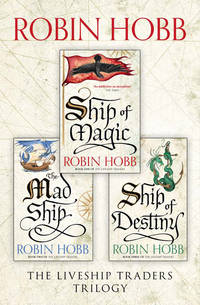
Kitabı oku: «The Complete Liveship Traders Trilogy: Ship of Magic, The Mad Ship, Ship of Destiny»
The Liveship Traders Trilogy
Robin Hobb

 Copyright
This novel is entirely a work of fiction. The names, characters and incidents portrayed in it are the work of the author’s imagination. Any resemblance to actual persons, living or dead, events or localities is entirely coincidental.
HarperVoyager
An imprint of HarperCollinsPublishers Ltd.
1 London Bridge Street
London SE1 9GF
www.harpercollins.co.uk
Ship of Magic First Published in Great Britain by HarperCollinsPublishers 1998 Copyright © Robin Hobb 1998
The Mad Ship First Published in Great Britain by HarperCollinsPublishers 1999 Copyright © Robin Hobb 1999
Ship of Destiny First Published in Great Britain by HarperCollinsPublishers 2000 Copyright © Robin Hobb 2000
Cover Layout design © HarperCollinsPublishersLtd. 2015
Illustrations © Jackie Morris.
Calligraphy by Stephen Raw.
Cover photographs © Shutterstock.com - background
Robin Hobb asserts the moral right to be identified as the author of this work
A catalogue record for this book is available from the British Library
All rights reserved under International and Pan-American Copyright Conventions. By payment of the required fees, you have been granted non-exclusive, non-transferable right to access and read the text of this ebook on-screen. No part of this text may be reproduced, transmitted, downloaded, decompiled, reverse engineered, or stored in or introduced into any information storage and retrieval system, in any form or by any means, whether electronic or mechanical, now known or hereinafter invented, without the express written permission of HarperCollins ebooks
HarperCollinsPublishers has made every reasonable effort to ensure that any picture content and written content in this ebook has been included or removed in accordance with the contractual and technological constraints in operation at the time of publication
Ebook Edition © DECEMBER 2012 ISBN: 9780007514465
Version: 2018-07-12
Praise
Praise for The Liveship Traders series:
‘Even better than the Assassin books. I didn’t think that was possible’
GEORGE R R MARTIN
‘Robin Hobb writes achingly well’
SFX
‘A wonderful book, by a writer at the height of her abilities’
J V JONES
‘A beautifully balanced story’
Manchester Evening News
‘It’s been a long time coming, but there’s a fantasy writer in our midst who’s doing something serious with a genre that deserves a lot of the cynicism directed its way. Always fascinating, its seriousness is balanced by an epic backdrop of events’
SFX
‘Put together with exceptional skill, deployed on a grand scale’
Interzone
Table of Contents
Title Page
Copyright
Praise
Ship of Magic
The Mad Ship
Ship of Destiny
Keep Reading
About the Author
Also by Robin Hobb
About the Publisher

Ship of Magic
Book One of The Liveship Traders
Robin Hobb

Copyright
HarperVoyager An mprint of HarperCollinsPublishers Ltd. 1 London Bridge Street London SE1 9GF
www.harpercollins.co.uk
First published in Great Britain by Voyager 1998
Copyright © Robin Hobb 1998
Cover Layout design © HarperCollinsPublishers Ltd. 2015 Illustrations © Jackie Morris. Calligraphy by Stephen Raw. Cover photographs © Shutterstock.com (background)
This edition 2008
Robin Hobb asserts the moral right to be identified as the author of this work
A catalogue record for this book is available from the British Library
All rights reserved under International and Pan-American Copyright Conventions. By payment of the required fees, you have been granted the non-exclusive, non-transferable right to access and read the text of this ebook on-screen. No part of this text may be reproduced, transmitted, down-loaded, decompiled, reverse engineered, or stored in or introduced into any information storage and retrieval system, in any form or by any means, whether electronic or mechanical, now known or hereinafter invented, without the express written permission of HarperCollins ebooks
HarperCollinsPublishers has made every reasonable effort to ensure that any picture content and written content in this ebook has been included or removed in accordance with the contractual and technological constraints in operation at the time of publication
Source ISBN: 9780006498858
Ebook Edition © DECEMBER 2012 ISBN: 9780007383467
Version: 2017-10-23
Table of Contents
Title Page
Copyright
Map
Prologue
1 OF PRIESTS AND PIRATES
2 LIVESHIPS
3 EPHRON VESTRIT
4 DIVVYTOWN
5 BINGTOWN
6 THE QUICKENING OF THE VIVACIA
7 LOYALTIES
8 NIGHT CONVERSATIONS
9 A CHANGE OF FORTUNES
10 CONFRONTATIONS
11 CONSEQUENCES AND REFLECTIONS
12 OF DERELICTS AND SLAVESHIPS
13 TRANSITIONS
14 FAMILY MATTERS
15 NEGOTIATIONS
AUTUMN
16 NEW ROLES
17 KENNIT'S WHORE
18 MALTA
19 TESTIMONIES
WINTER
20 CRIMPERS
21 VISITORS
22 PLOTS AND PERILS
23 JAMAILLIA SLAVERS
24 RAIN WILD TRADERS
25 CANDLETOWN
26 GIFTS
27 PRISONERS
28 VICISSITUDES
29 DREAMS AND REALITY
30 DEFIANCE AND ALLIANCE
31 SHIPS AND SERPENTS
32 STORM
33 DAY OF RECKONING
34 RESTORATIONS
35 PIRATES AND CAPTIVES
36 SHE WHO REMEMBERS
Acknowledgements
This one is for
The Devil’s Paw The Totem The E J Bruce The Free Lunch The Labrador (Scales! Scales!) The (aptly named) Massacre Bay The Faithful (Gummi Bears Ahoy!) The Entrance Point The Cape St John The American Patriot (and Cap’n Wookie) The Lesbian Warmonger The Anita J and the Marcy J The Tarpon The Capelin The Dolphin The (not very) Good News Bay And even the Chicken Little But especially for Rain Lady, wherever she may be now.
MAP

PROLOGUE
MAULKIN ABRUPTLY HEAVED HIMSELF out of his wallow with a wild thrash that left the atmosphere hanging thick with particles. Shreds of his shed skin floated with the sand and mud like the dangling remnants of dreams when one awakes. He moved his long sinuous body through a lazy loop, rubbing against himself to rub off the last scraps of outgrown hide. As the bottom muck started to once more settle, he gazed about at the two dozen other serpents who lay basking in the pleasantly scratchy dirt. He shook his great maned head and then stretched the vast muscle of his length. ‘Time,’ he bugled in his deep-throated voice. ‘The time has come.’
They all looked up at him from the sea-bottom, their great eyes of green and gold and copper unwinking. Shreever spoke for them all when she asked, ‘Why? The water is warm, the feeding easy. In a hundred years, winter has never come here. Why must we leave now?’
Maulkin performed another lazy twining. His newly bared scales shone brilliantly in the filtered blue sunlight. His preening burnished the golden false-eyes that ran his full length, declaring him one of those with ancient sight. Maulkin could recall things, things from the time before all this time. His perceptions were not clear, nor always consistent. Like many of those caught twixt times, with knowledge of both lives, he was often unfocused and incoherent. He shook his mane until stunning poison made a pale cloud about his face. He gulped his own toxin in, breathed it out through his gills in a show of truth-vow. ‘Because it is time now!’ he said urgently. He sped suddenly away from them all, shooting up to the surface, rising straighter and faster than bubbles. Far above them all he broke the ceiling and leapt out briefly into the great Lack before he dived again. He circled them in frantic circles, wordless in his urgency.
‘Some of the other tangles have already gone,’ Shreever said thoughtfully. ‘Not all of them, not even most. But enough to notice they are missing when we rise into the Lack to sing. Perhaps it is time.’
Sessurea settled deeper into the mud. ‘And perhaps it is not,’ he said lazily. ‘I think we should wait until Aubren’s tangle goes. Aubren is… steadier than Maulkin.’
Beside him, Shreever abruptly heaved herself out of the muck. The gleaming scarlet of her new skin was startling. Rags of maroon still hung from her. She nipped a great hank of it free and gulped it down before she spoke. ‘Perhaps you should join Aubren’s tangle, if you misdoubt Maulkin’s words. I, for one, will follow him north. Better to go too soon, than too late. Better to go early, perhaps, than to come with scores of other tangles and have to vie for feeding.’ She moved lithely through a knot made of her own body, rubbing the last fragments of old hide free. She shook her own mane, then threw back her head. Her shriller trumpeting disturbed the water. ‘I come, Maulkin! I follow you!’ She moved up to join their still circling leader in his twining dance overhead.
One at a time, the other great serpents heaved their long bodies free of clinging mud and outgrown skin. All, even Sessurea, rose from the depths to circle in the warm water just below the ceiling of the Plenty, joining in the tangle’s dance. They would go north, back to the waters from whence they had come, in the long ago time that so few now remembered.
1 OF PRIESTS AND PIRATES
KENNIT WALKED THE TIDELINE, heedless of the salt waves that washed around his boots as it licked the sandy beach clean of his tracks. He kept his eyes on the straggling line of seaweed, shells and snags of driftwood that marked the water’s highest reach. The tide was just turning now, the waves falling ever shorter in their pleading grasp upon the land. As the saltwater retreated down the black sand, it would bare the worn molars of shale and tangles of kelp that now hid beneath the waves.
On the other side of Others’ Island, his two-masted ship was anchored in Deception Cove. He had brought the Marietta in to anchor there as the morning winds had blown the last of the storm clean of the sky. The tide had still been rising then, the fanged rocks of the notorious cove grudgingly receding beneath frothy green lace. The ship’s gig had scraped over and between the barnacled rocks to put him and Gankis ashore on a tiny crescent of black sand beach which disappeared completely when storm winds drove the waves up past the high tide marks. Above, slate cliffs loomed and evergreens so dark they were nearly black leaned precariously out in defiance of the prevailing winds. Even to Kennit’s iron nerves, it was like stepping into some creature’s half-open mouth.
They’d left Opal, the ship’s boy, with the gig to protect it from the bizarre mishaps that so often befell unguarded craft in Deception Cove. Much to the boy’s unease, Kennit had commanded Gankis to come with him, leaving boy and boat alone. At Kennit’s last sight, the boy had been perched in the beached hull. His eyes had alternated between fearful glances over his shoulder at the forested cliff-tops and staring anxiously out to where the Marietta strained against her anchors, yearning to join the racing current that swept past the mouth of the cove.
The hazards of visiting this island were legendary. It was not just the hostility of even the ‘best’ anchorage on the island, nor the odd accidents known to befall ships and visitors. The whole of the island was enshrouded in the peculiar magic of the Others. Kennit had felt it tugging at him as he followed the path that led from Deception Cove to the Treasure Beach. For a path seldom used, its black gravel was miraculously clean of fallen leaves or intruding plant life. About them the trees dripped the second-hand rain of last night’s storm onto fern fronds already burdened with crystal drops. The air was cool and alive. Brightly-hued flowers, always growing at least a man’s length from the path, challenged the dimness of the shaded forest floor. Their scents drifted alluringly on the morning air as if beckoning the men to leave off their quest and explore their world. Less wholesome in appearance were the orange fungi that stair-stepped up the trunks of many of the trees. The shocking brilliance of their colour spoke to Kennit of parasitic hungers. A spider’s web, hung like the ferns with fine droplets of shining water, stretched across their path, forcing them to duck under it. The spider that sat at the edges of its strands was as orange as the fungi, and nearly as big as a baby’s fist. A green tree-frog was enmeshed and struggling in the web’s sticky strands, but the spider appeared disinterested. Gankis made a small sound of dismay as he crouched to go beneath it.
This path led right through the midst of the Others’ realm. Here was where the nebulous boundaries of their territory could be crossed by a man, did he dare to leave the well-marked path allotted to humans and step off into the forest to seek them. In ancient times, so tale told, heroes came here, not to follow the path but to leave it deliberately, to beard the Others in their dens, and seek the wisdom of their cave-imprisoned goddess, or demand gifts such as cloaks of invisibility and swords that ran with flames and could shear through any shield. Bards that had dared to come this way had returned to their homelands with voices that could shatter a man’s ears with their power, or melt the heart of any listener with their skill. All knew the ancient tale of Kaven Ravenlock, who visited the Others for half a hundred years and returned as if but a day had passed for him, but with hair the colour of gold and eyes like red coals and true songs that told of the future in twisted rhymes. Kennit snorted softly to himself. All knew such ancient tales, but if any man had ventured to leave this path in Kennit’s lifetime, he had told no other man about it. Perhaps he had never returned to brag of it. The pirate dismissed it from his mind. He had not come to the island to leave the path, but to follow it to its very end. And all knew what waited there as well.
Kennit had followed the gravel path that snaked through the forested hills of the island’s interior until its winding descent spilled them out onto a coarsely-grassed tableland that framed the wide curve of an open beach. This was the opposite shore of the tiny island. Legend foretold that any ship that anchored here had only the netherworld as its next port of call. Kennit had found no record of any ship that had dared challenge that rumour. If any had, its boldness had gone to hell with it.
The sky was a clean brisk blue scoured clean of clouds by last night’s storm. The long curve of the rock-and-sand beach was broken only by a freshwater stream that cut its way through the high grassy bank backing the beach. The stream meandered over the sand to be engulfed in the sea. In the distance, higher cliffs of black shale rose, enclosing the far end of the crescent beach. One toothy tower of shale stood independent of the island, jutting out crookedly from the island with a small stretch of beach between it and its mother-cliff. The gap in the cliff framed a blue slice of sky and restless sea.
‘It was a fair bit of wind and surf we had last night, sir. Some folk say that the best place to walk the Treasure Beach is on the grassy dunes up there… they say that in a good bit of storm, the waves throw things up there, fragile things you might expect to be smashed to bits on the rocks and such, but they land on the sedge up there, just as gentle as you please.’ Gankis panted out the words as he trotted at Kennit’s heels. He had to stretch his stride to keep up with the tall pirate. ‘An uncle of mine — that is to say, actually he was married to my aunt, to my mother’s sister — he said he knew a man found a little wooden box up there, shiny black and all painted with flowers. Inside was a little glass statue of a woman with butterfly’s wings. But not transparent glass, no, the colours of the wings were swirled right in the glass they were.’ Gankis stopped in his account and half-stooped his head as he glanced cautiously at his master. ‘Would you want to know what the Other said it meant?’ he inquired carefully.
Kennit paused to nudge the toe of his boot against a wrinkle in the wet sand. A glint of gold rewarded him. He bent casually to hook his finger under a fine gold chain. As he drew it up, a locket popped out of its sandy grave. He wiped the locket down the front of his fine linen trousers, and then nimbly worked the tiny catch. The gold halves popped open. Saltwater had penetrated the edges of the locket, but the portrait of a young woman still smiled up at him, her eyes both merry and shyly rebuking. Kennit merely grunted at his find and put it in the pocket of his brocaded waistcoat.
‘Cap’n, you know they won’t let you keep that. No one keeps anything from the Treasure Beach,’ Gankis pointed out gingerly.
‘Don’t they?’ Kennit queried in return. He put a twist of amusement in his voice, to watch Gankis puzzle over whether it was self-mockery or a threat. Gankis shifted his weight surreptitiously, to put his face out of reach of his captain’s fist.
‘S’what they all say, sir,’ he replied hesitantly. ‘That no one takes home what they find on the Treasure Beach. I know for sure my uncle’s friend didn’t. After the Other looked at what he’d found and told his fortune from it, he followed the Other down the beach to this rock cliff. Probably that one.’ Gankis lifted an arm to point at the distant shale cliffs. ‘And in the face of it there were thousands of little holes, little what-you-call-’ems…’
‘Alcoves,’ Kennit supplied in an almost dreamy voice. ‘I call them alcoves, Gankis. As would you, if you could speak your own mother tongue.’
‘Yessir. Alcoves. And in each was a treasure, ’cept for those that were empty. And the Other let him walk along the cliff wall and look at all the treasures, and there was stuff there such as he’d never even imagined. China teacups done all in fancy rosebuds and gold wine cups rimmed with jewels and little wooden toys all painted bright and, oh, a hundred things such as you can’t imagine, each in an alcove. Sir. And then he found an alcove the right size and shape, and he put the butterfly lady in it. He told my uncle that nothing ever felt quite so right to him as setting that little treasure into that nook. And then he left it there, and left the island and went home.’
Kennit cleared his throat. The single noise conveyed more of contempt and disdain than most men could have fitted into an entire stream of abuse. Gankis looked aside and down from it. ‘It was him that said it, sir, not me.’ He tugged at the waist of his worn trousers. Almost reluctantly he added, ‘The man is a bit in the dream world. Gives a seventh of all that comes his way to Sa’s temple, and both his eldest children besides. Such a man don’t think as we do, sir.’
‘When you think at all, Gankis,’ the captain concluded for him. He lifted his pale eyes to look far up the tide line, squinting slightly as the morning sun dazzled off the moving waves. ‘Take yourself up to your sedgy cliffs, Gankis, and walk along them. Bring me whatever you find there.’
‘Yessir.’ The older pirate trudged away. He gave one rueful backward glance at his young captain. Then he clambered agilely up the short bank to the deeply-grassed tableland that fronted on the beach. He began to walk a parallel course, his eyes scanning the bank ahead of him. Almost immediately, he spotted something. He sprinted toward it, then lifted an object that flashed in the morning sunlight. He raised it up to the light and gazed at it, his seamed face lit with awe. ‘Sir, sir, you should see what I’ve found!’
‘I might be able to, did you bring it here to me as you were commanded,’ Kennit observed irritably.
Like a dog called to heel, Gankis made his way back to the captain. His brown eyes shone with a youthful sparkle, and he clutched the treasure in both hands as he leapt nimbly down the man-height drop to the beach. His low shoes kicked up sand as he ran. A brief frown creased Kennit’s brow as he watched Gankis advancing towards him. Although the old sailor was prone to fawn on him, he was no more inclined to share booty than any other man of his trade. Kennit had not truly expected Gankis willingly to bring to him anything he found on the grassy bank; in fact he had been rather anticipating divesting the man of his trove at the end of their stroll. To have Gankis hastening toward him, his face beaming as if he were a country yokel bringing his beloved milkmaid a posy, was positively unsettling.
Nevertheless Kennit retained his customary sardonic smile, not allowing his face to betray his thoughts. It was a carefully rehearsed posture that suggested the languid grace of a hunting cat. It was not just that his greater height allowed him to look down on the seaman. By capturing his face in a pose of amusement, he suggested to his followers that they were incapable of surprising him. He wished his crew to believe that he could anticipate not only their every move, but their thoughts, too. A crew that believed that of their captain was less likely to become mutinous; and if they did, no one would wish to be the first to act.
And so he kept his poise as the man raced across the sand to him. Moreover, he did not immediately snatch the treasure away from him, but allowed Gankis to hold it out to him while he gazed down at it in amusement.
From the instant he saw it, it took all of Kennit’s control not to snatch at it. Never had he seen such a cunningly wrought bauble. It was a bubble of glass, an absolutely perfect sphere. The surface was not marred with so much as a scratch. The glass itself had a very faint blue cast to it, but the tint did not obscure the wonder within. Three tiny figurines, garbed in motley with painted faces, were fixed to a tiny stage and somehow linked to one another so that when Gankis shifted the ball in his hands, it sent them off into a series of actions. One pirouetted on his toes, while the next did a series of flips over a bar. The third bobbed his head in time to their actions, as if all three heard and responded to a merry tune trapped inside the ball with them.
Kennit allowed Gankis to demonstrate it for him twice. Then, without a word, he extended a long-fingered hand towards him gracefully, and the sailor set the treasure in his palm. Kennit held his bemused smile firmly as he first lifted the ball to the sunlight, and then set the tumblers within to dancing for himself. The ball did not quite fill his hand. ‘A child’s plaything,’ he surmised loftily.
‘If the child were the richest prince in the world,’ Gankis dared to observe. ‘It’s too fragile a thing to give a kid to play with, sir. All it would take would be dropping it once…’
‘Yet it seems to have survived bobbing about in the waves of a storm, and then being flung up on a beach,’ Kennit pointed out with measured good nature.
‘That’s true, sir, that’s true, but then this is the Treasure Beach. Almost everything cast up here is whole, from what I’ve heard tell. It’s part of the magic of this place.’
‘Magic’ Kennit permitted himself a slightly wider smile as he placed the orb in the roomy pocket of his indigo jacket. ‘So you believe it is magic that sweeps such trinkets up on this shore, do you?’
‘What else, captain? By all rights, that should have been smashed to bits, or at least scoured by the sands. Yet it looks as if it just come out of a jeweller’s shop.’
Kennit shook his head sadly. ‘Magic? No, Gankis, no more magic than the rip-tides in the Orte Shallows, or the Spice Current that speeds sailing ships on their journeys to the islands and taunts them all the way back. It’s but a trick of wind and current and tides. No more than that. The same trick that promises that any ship that tries to anchor off this side of the island will find herself beached and broken before the next tide.’
‘Yessir,’ Gankis agreed dutifully, but without conviction. His traitorous eyes strayed to the pocket where Captain Kennit had stowed the glass ball. Kennit’s smile might have deepened fractionally.
‘Well? Don’t loiter here. Get back up there and walk the bank and see what else you find.’
‘Yessir,’ Gankis conceded, and with one final regretful glance at the pocket, the older man turned and hastened back to the bank. Kennit slipped his hand into his pocket and caressed the smooth cold glass there. He resumed his stroll down the beach. Overhead gulls followed his example, sliding slowly down the wind as they searched the retreating waves for titbits. He did not hasten, but kept in mind that on the other side of the island his ship was awaiting him in treacherous waters. He’d walk the whole length of the beach, as tradition decreed, but he had no intention of lingering after he had heard the sooth-saying of an Other. Nor did he have any intention of leaving whatever treasure he found. A true smile tugged at the corner of his mouth.
As he strolled, he took his hand from his pocket and absently touched his opposite wrist. Concealed by the lacy cuff of his white silk shirt was a fine double thong of black leather. It bound a small wooden trinket tightly to his wrist. The ornament was a carved face, pierced at the brow and lower jaw so the face would be snugged firmly against his wrist, exactly over his pulse point. At one time, the face had been painted black, but most of that was worn away now. The features still stood out distinctly; a tiny mocking face, carved with exquisite care. Its visage was twin to his own. It had cost him an inordinate amount of coin to commission it. Not everyone who could carve wizardwood would, even if they had the balls to steal some.
Kennit remembered well the artisan who had worked the tiny face for him. He’d sat for long hours in the man’s studio, washed in the cool morning light as the artist painstakingly worked the iron-hard wood to reflect Kennit’s features. They had not spoken. The artist could not. The pirate did not. The carver had needed absolute silence for his concentration, for he worked not only wood but a spell that would bind the charm to protect the wearer from enchantments. Kennit had had nothing to say to him anyway. The pirate had paid him an exorbitant advance months ago, and waited until the artist had sent him a messenger to say that he had obtained some of the precious and jealously-guarded wood. Kennit had been outraged when the artist had demanded still more money before he would begin the carving and spell-setting, but Kennit had only smiled his small sardonic smile, and put coins and jewels and silver and gold links on the artist’s scales until the man had nodded that his price had been met. Like many in Bingtown’s illicit trades, he had long ago sacrificed his own tongue to ensure his client’s privacy. While Kennit was not convinced of the efficacy of such a mutilation, he appreciated the sentiment it implied. So when the artist was finished and had personally bound the ornament to Kennit’s wrist, the man had only been able to nod vehemently his extreme satisfaction with his own skill as he touched the wood with avid fingertips.
Afterwards Kennit had killed him. It was the only sensible thing to do, and Kennit was an eminently sensible man. He had taken back the extra fee the man had demanded. Kennit could not abide a man who would not honour his original bargain. But that had not been the reason he’d killed him. He’d killed him for the sake of keeping the secret. If men knew that Captain Kennit wore a charm to ward off enchantments, why, then they would believe that he feared them. He could not let his crew believe that he feared anything. His good luck was legendary. All the men who followed him believed in it, most more strongly than Kennit himself did. It was why they followed him. They must not ever think that he feared anything could threaten that luck.
In the year since he had killed the artist, he had wondered if killing him had somehow harmed the charm, for it had not quickened. When he had originally asked the carver how long it would take for the little face to come to life, the man had shrugged eloquently, and indicated with much hand fluttering that neither he nor anyone else could predict such a thing. For a year Kennit had waited for the charm to quicken, to be sure that its spell was completely activated. But there had come a time when he could not wait any longer. He had known, on an instinctive level, that it was time for him to visit the Treasure Beach and see what fortune the ocean would wash up for him. He could wait no longer for the charm to awaken; he’d decided to take his chances. He’d have to once more trust his good luck to protect him, as it always had. It had protected him the day he’d had to kill the artist, hadn’t it? The man had turned unexpectedly, just in time to see Kennit drawing his blade. Kennit was convinced that if the man had had a tongue in his head, his scream would have been much louder.
Kennit made a tiny movement of his shoulders and head, a movement that might mean yes or no, or nothing at all. He did not speak. Gankis shifted his feet about uncomfortably. The Other refilled its air sacs noisily.
‘That which the ocean washes up here is not for the keeping of men. The water brings it here because here is where the water wishes it to be. Do not set yourself against the will of the water, for no wise creature does that. No human is permitted to keep what he finds upon the Treasure Beach.’
‘Does it belong to the Other, then?’ Kennit asked calmly.
Despite the difference in species, it was still easy for Kennit to see he had disconcerted the Other. It took a moment to recover, then answered gravely, ‘What the ocean washes up upon the Treasure Beach belongs always to the ocean. We are but caretakers here.’
Kennit’s smile stretched his lips tight and thin. ‘Well then, you need have no concern. I’m Captain Kennit, and I’m not the only one who will tell you that all the ocean is mine to rove. So all that belongs to the ocean is mine as well. You’ve had your gold, now speak your prophecy, and take no more care for that which does not belong to you.’
Beside him Gankis gasped audibly, but the Other gave no sign of reacting to these words. Instead it bowed its head gravely, inclining its neckless body toward him, almost as if compelled to acknowledge Kennit as its master. Then it lifted its head and its fish eyes found Kennit’s soul as unerringly as a finger on a chart. When it spoke there was a deeper note to its voice, as if the words were blown up from deep inside it.
‘So plain this telling that even one of your spawn could read it. You take that which is not yours, Captain Kennit, and claim it as your own. No matter how much falls into your hands, you are never sated. Those that follow you must be content with what you have cast off as gew-gaws and toys, while you take what you perceive as most valuable and keep it for yourself.’ The creature’s eyes darted briefly to lock with Gankis’s goggling stare. ‘In his evaluations, you are both deceived, and both made the poorer.’
Kennit did not care at all for the direction of this soothsaying. ‘My gold has bought me the right to ask one question, has it not?’ he demanded boldly.
The Other’s jaw dropped open wide — not in astonishment, but perhaps as a sort of threat. The rows of teeth were indeed impressive. Then it snapped shut. The thin lips barely stirred as it belched out its answer. ‘Yesss.’
‘Shall I succeed in what I aspire?’
The Other’s air sacs pulsed speculatively. ‘You do not wish to make your question more specific?’
‘Do the omens need me to be more specific?’ Kennit asked with tolerance.
The Other glanced down at the array of objects again: the rose, the cups, the nails, the tumblers inside the ball, the feather, the crystal spheres. ‘You will succeed in your heart’s desire,’ it said succinctly. A smile began to dawn on Kennit’s face but faded as the creature continued, his tone growing more ominous. ‘That which you are most driven to do, you will accomplish. That task, that feat, that deed which haunts your dreams will blossom in your hands.’
‘Enough,’ Kennit growled, suddenly hasty. He abandoned any thought of asking for an audience with their goddess. This was as far as he wished to press their sooth-saying. He stooped to retrieve the prizes on the sand, but the creature suddenly fanned out its long-fingered webbed hands and spread them protectively above the treasures. A drop of venom welled greenly to the tip of each digit.
‘The treasures, of course, will remain on the Treasure Beach. I will see to their placement.’
‘Why, thank you,’ Kennit said, his voice melodic with sincerity. He straightened slowly, but as the creature relaxed its guard, he suddenly stepped forward, planting his foot firmly on the glass ball with the tumblers inside. It gave way with a tinkle like wind chimes. Gankis cried out as if he’d slain his first-born and even the Other recoiled at the wanton destructiveness. ‘A pity,’ Kennit observed as he turned away. ‘But if I cannot possess it, why should anyone?’
Wisely, he forbore a similar treatment for the rose. He suspected its delicate beauty was created from some material that would not give way to his boot’s pressure. He did not wish to lose his dignity by attempting to destroy it and failing. The other objects had small value in his regard; the Other could do whatever it wished with such flotsam. He turned and strode away.
Behind him he heard the Other hiss its wrath. It took a long breath, then intoned, ‘The heel that destroys that which belongs to the sea shall be claimed in turn by the sea.’ Its toothy jaws shut with a snap, biting off this last prophecy. Gankis immediately moved to flank Kennit. That one would always prefer the known danger to the unknown. Half a dozen strides down the beach, Kennit halted and turned. He called back to where the Other still crouched over the treasures. ‘Oh, yes, there was one other omen that perhaps you might wish to consider. But methinks the ocean washed it to you, not me, and thus I left it where it was. It is well known, I believe, that the Others have no love for cats?’ Actually, their fear and awe of anything feline was almost as legendary as their ability to sooth-say. The Other did not deign to reply, but Kennit had the satisfaction of seeing its air sacs puff with alarm.
‘You’ll find them up the beach. A whole litter of kits for you, with very pretty blue coats. They were in a leather bag. Seven or eight of the pretty little creatures. Most of them looked a bit poorly after their dip in the ocean, but no doubt those I let out will fare well. Do remember they belong, not to you, but the ocean. I’m sure you’ll treat them kindly.’
The Other made a peculiar sound, almost a whistle. ‘Take them!’ it begged. ‘Take them away, all of them. Please!’
‘Take away from the Treasure Beach that which the ocean saw fit to bring here? I would not dream of it,’ Kennit assured him with vast sincerity. He did not laugh, nor even smile as he turned away from its evident distress. He did find himself humming the tune to a rather bawdy song currently popular in Divvytown. The length of his stride was such that Gankis was soon puffing again as he trotted along beside him.
‘Sir?’ Gankis gasped. ‘A question if I might, Captain Kennit?’
‘You may ask it,’ Kennit granted him graciously. He half-expected the man to ask him to slow down. That he would refuse. They must make all haste back to the ship if they were to work her out to sea before the rocks emerged from the retreating tide.
‘What is it that you’ll succeed in doing?’
Kennit opened his mouth, almost tempted to tell him. But no. He had schemed this too carefully, staged it all in his mind too often. He’d wait until they were underway and Gankis had had plenty of time to tell all the crew his version of events on the island. He doubted that would take long. The old hand was garrulous, and after their absence the men would be eaten with curiosity about their visit to the island. Once they had the wind in their sails and were fairly back on their way to Divvytown, then he’d call all hands up on deck. His imagination began to carry him, and he pictured the moon shining down on him as he spoke to the men gathered below him in the waist. His pale blue eyes kindled with the glow of his own imaginings.
They traversed the beach much faster than they had when they were seeking treasure. In a short time they were climbing the steep trail that led up from the shore and through the wooded interior of the island. He kept well concealed from Gankis the anxiety he felt for the Marietta. The tides in the cove both rose and fell with an extremity that paid no attention to the phases of the moon. A ship believed to be safely anchored in the cove might abruptly find her hull grinding against rocks that surely had not been there at the last low tide. Kennit would take no chances with his Marietta; they’d be well away from this sorcerous place before the tide could strand her.
Away from the wind of the beach and in the shelter of the trees, the day was still and golden. The warmth of the slanting sunlight through the open-branched trees combined with the rising scents of the forest loam to make the day enticingly sleepy. Kennit felt his stride slowing as the peace of the golden place seeped into him. Earlier, when the branches had been dripping with the aftermath of the storm’s rain, the forest had been uninviting, a dank wet place full of brambles and slapping branches. Now he knew with unflagging certainty that the forest was a place of marvels. It had treasures and secrets every bit as tantalizing as those the Treasure Beach had offered.
His urgency to reach the Marietta peeled away from him and was discarded. He found himself standing still in the middle of the pebbled pathway. Today he would explore the island. To him would be opened the wonder-filled fey places of the Other, where a man might pass a hundred years in a single sublime night. Soon he would know and master it all. But for now it was enough to stand still and breathe the golden air of this place. Nothing intruded on his pleasure, save Gankis. The man persisted in chattering warnings about the tide and the Marietta. The more Kennit ignored him, the more he pelted him with questions. ‘Why have we stopped here, Captain Kennit? Sir? Are you feeling well, sir?’ He waved a dismissive hand at the man, but the old tar paid it no attention. He cast about for some errand that would take the noisy, smelly man from his presence. As he groped in his pockets, his hand encountered the locket and chain. He smiled slyly to himself as he drew it out.
He interrupted whatever it was Gankis was blithering about. ‘Ah, this will never do. See what I’ve accidentally carried off from their beach. Be a good lad now, and run this back to the beach for me. Give it to the Other and see it puts it safely away.’
Gankis gaped at him. ‘There isn’t time. Leave it here, sir! We’ve got to get back to the ship, before she’s on the rocks or they have to leave without us. There won’t be another tide that will let her back into Deception Cove for a month. And no man survives a night on this island.’
The man was beginning to get on his nerves. His loud voice had frightened off a tiny green bird that had been on the point of alighting nearby. ‘Go, I told you. Go!’ He put whips and fetters into his voice, and was relieved when the old sea-dog snatched the locket from his hand and dashed back the way they had come.
Once he was out of sight, Kennit grinned widely to himself. He hastened up the path into the island’s hilly interior. He’d put some distance between himself and where he’d left Gankis, and then he’d leave the trail. Gankis would never find him, he’d be forced to leave without him, and then all the wonders of the Others’ Island would be his.
‘Not quite. You would be theirs.’
It was his own voice speaking, in a tiny whisper so soft that even Kennit’s keen ears barely heard it. He moistened his lips and looked about himself. The words had shivered through him like a sudden awakening. He’d been about to do something. What?
‘You were about to put yourself into their hands. Power flows both ways on this path. The magic encourages you to stay upon it, but it cannot be worked to appeal to a human without also working to repel the Other. The magic that keeps their world safe from you also protects you as long as you do not stray from the path. If they persuade you to leave the path, you’ll be well within their reach. Not a wise move.’
He lifted his wrist to a level with his eyes. His own miniature face grinned mockingly back at him. With the charm’s quickening, the wood had taken on colours. The carved ringlets were as black as his own, the face as weathered, and the eyes as deceptively weak a blue. ‘I had begun to think you a bad bargain,’ Kennit said to the charm.
The face gave a snort of disdain. ‘If I am a bad bargain to you, you are as much a one to me,’ it pointed out. ‘I was beginning to think myself strapped to the wrist of a gullible fool, doomed to almost immediate destruction. But you seem to have shaken the effect of the spell. Or rather, I have cloven it from you.’
‘What spell?’ Kennit demanded.
The charm’s lip curled in a disdainful smile. ‘The reverse of the one you felt on the way here. All succumb to it that tread this path. The magic of the Other is so strong that one cannot pass through their lands without feeling it and being drawn toward it. So they settle upon this path a spell of procrastination. One knows that their lands beckon, but one puts off visiting them until tomorrow. Always tomorrow. And hence, never. But your little threat about the kittens has unsettled them a bit. You they would lure from the path, and use as a tool to be rid of the cats.’
Kennit permitted himself a small smile of satisfaction. ‘They did not foresee I might have a charm that would make me proof against their magic.’
The charm pressed its mouth. ‘I but made you aware of the spell. Awareness of any spell is the strongest charm against it. Of myself, I have no magic to fling back at them, or use to deaden their own.’ The face’s blue eyes shifted back and forth. ‘And we may yet both meet our destruction if you stand about here talking to me. The tide retreats. Soon the mate must choose between abandoning you here or letting the Marietta be devoured by the rocks. Best you hasten for Deception Cove.’
‘Gankis!’ Kennit exclaimed in dismay. He cursed, but began to run. Useless to go back for the man. He’d have to abandon him. And he’d given him the golden locket as well! What a fool he’d been, to be so gulled by the Others’ magic. Well, he’d lost his witness and the souvenir he’d intended to carry off with him. He’d be damned if he’d lose his life or his ship as well. His long legs stretched as he pelted down the winding path. The golden sunlight that had earlier seemed so appealing was suddenly only a very hot afternoon that seemed to withhold the very air from his straining lungs.
A thinning of the trees ahead alerted him that he was nearly at the cove. Instants later, he heard the drumming of Gankis’s feet on the path behind him, and was shocked when the sailor passed him without hesitation. Kennit had a brief glimpse of his lined face contorted with terror, and then he saw the man’s worn shoes flinging up gravel from the path as he ran ahead. Kennit had thought he could not run any faster, but Gankis suddenly put on a burst of speed that carried him out of the sheltering trees and onto the beach.
He heard Gankis crying out to the ship’s boy to wait, wait. The lad had evidently decided to give up on his captain’s return, for he had pushed and dragged the gig out over the seaweed and barnacle-coated rocks to the retreating edge of the water. A cry went up from the anchored ship at the sight of Kennit and Gankis emerging onto the beach. On the afterdeck, a sailor waved at them frantically to hurry. The Marietta was in grave circumstances. The retreating tide had left her almost aground. Straining sailors were already labouring at the anchor windlass. As Kennit watched, the Marietta gave a tiny sideways list and then slid from on top of a rock as a wave briefly lifted her clear. His heart stood still in his chest. Next to himself, he treasured his ship above all other things.
His boots slipped on squidgy kelp and crushed barnacles as he scrambled down the rocky shore after the boy and gig. Gankis was ahead of him. No orders were necessary as all three seized the gunwales of the gig and ran her out into the retreating waves. They were soaked before the last one scrambled inside her. Gankis and the boy seized the oars and set them in place while Kennit took his place in the stern. The Marietta’s anchor was rising, festooned with seaweed. Oars battled with sails as the distance between the two craft grew smaller. Then the gig was alongside, the tackles lowered and hooked, and but a few moments later Kennit was astride his own deck. The mate was at the wheel, and the instant he saw his captain safely aboard, Sorcor swung the wheel and bellowed the orders that would give the ship her head. Wind filled the Marietta’s sails, and flung her out against the incoming tide into the racing current that would buffet her, but carry her away from the bared teeth of Deception Cove.
A glance about the deck showed Kennit that all was in order. The ship’s boy cowered when the captain’s eyes swept over him. Kennit merely looked at him, and the boy knew his disobedience would not be forgotten nor overlooked. A pity. The boy had had a sweet smooth back; tomorrow that would no longer be so. Tomorrow would be soon enough to deal with him. Let him look forward to it for a time, and savour the stripes his cowardice had bought him. With no more than a nod to the mate, Kennit sought his own quarters. Despite the near mishap, his heart thundered with triumph. He had bested the Others at their own game. His luck had held, as it always had; the costly charm on his wrist had quickened and proved its value. And best of all, he had the oracle of the Others themselves to give the cloak of prophecy to his ambitions. He would be the first King of the Pirate Isles.
2 LIVESHIPS
THE SERPENT FLOWED through the water, effortlessly riding the wake of the ship. Its scaled body shone like a dolphin’s, but more iridescently blue. The head it lifted clear of the water was wickedly quilled with dangling barbels like those on a ratfish. Its deep blue eyes met Brashen’s and widened in expectation like a woman’s when she flirts. Then the maw of the creature opened wide, brilliantly scarlet and lined with row upon row of inward slanting teeth. It gaped open, big enough to take in a standing man. The dangling barbs stood up suddenly around the serpent’s head, a lion’s mane of poisonous darts. The scarlet mouth came darting towards him to engulf him.
Darkness surrounded Brashen, and the cold carrion stench of the creature’s mouth. He flung himself away wildly with an incoherent cry. His hands met wood, and with the touch of it, relief flooded him. Nightmare. He drew a shuddering breath. He listened to the familiar sounds; the creaking of the Vivacia’s timbers, the breathing of other sleeping men and the slapping of the water against the hull. Overhead, he could hear the barefoot patter of someone springing to answer a command. All was familiar, all was safe. He took a deep breath of air thick with the scent of tarry timbers, the stink of men living long in close quarters, and beneath it all, faint as a woman’s perfume, the spicy smells of their cargo. He stretched, pushing his shoulders and feet against the cramped confines of his wooden bunk, and then settled back into his blanket. It was hours yet to his watch. If he didn’t sleep now, he’d regret it later.
He closed his eyes to the dimness of the forecastle, but after a few moments, he opened them again. Brashen could sense his dream lurking just beneath the surface of sleep, waiting to reclaim him and drag him down. He cursed softly under his breath. He needed to get some sleep, but there’d be no rest in it if all he did was drop back down into the depths of the serpent dream.
The recurrent dream was now almost more real to him than the memory. It came to trouble him at odd times, usually when he was facing some major decision. At such times it reared up from the depths of his sleep to fasten its long teeth into his soul and try to pull him under. It little mattered that he was a full man now. It mattered not at all that he was as good a sailor as any he’d ever shipped with, and better than nine-tenths of them. When the dream seized on him he was dragged back to his boyhood, back to a time when all, even himself, had rightly despised him.
He tried to decide what was troubling him most. His captain despised him. Yes, that was true, but it didn’t make him any less a seaman. He’d been mate on this ship under Captain Vestrit and had well proved his worth to that man. When Vestrit had taken ill, Brashen had dared to hope the Vivacia would be put into his hands to captain. Instead the old Trader had turned it over to his son-in-law Kyle Haven. Well, family was family, and Brashen could accept what had been done. Then Captain Haven had exercised his option of choosing his own first mate, and it hadn’t been Brashen Trell. Still the demotion was no fault of his own, and every sailor in the ship – no, every sailor in Bingtown itself had known that. No shame to it; Kyle had simply wanted his own man. Brashen had thought it over and decided he’d rather serve as second mate on the Vivacia than first on any other vessel. It had been his own decision and he could fault no one else for it. Even after they had left the docks and Captain Haven had belatedly decided that he wanted a familiar man as second, and Brashen could move down yet another notch, he had gritted his teeth and obeyed his captain. But despite his years with the Vivacia and his gratitude to Ephron Vestrit, he suspected this would be the last time he shipped on her.
Captain Haven had made it clear to him that he neither welcomed nor respected Brashen as a member of his crew. During this last leg of the journey, nothing he did pleased the captain. If he saw a task that needed doing and put men to work on it, he was told he’d overstepped his authority. If he did only the duties that were precisely assigned to him, he was told he was a lazy lackwit. With each passing day, Bingtown grew nearer, but Haven grew more abrasive as well. Brashen was thinking that when they tied up in their home port, if Vestrit wasn’t ready to step back on as captain again, Brashen would step off the Vivacia’s decks for the last time. It gave him a pang, but he reminded himself there were other ships, some of them fine ones, and Brashen had a name now as a good hand. It wasn’t like it had been when he’d first sailed and he’d had to take any berth he could get on any ship. Back then, surviving a voyage had been his highest priority. That first ship out, that first voyage, and his nightmare were all tied together in his mind.
He had been fourteen the first time he’d seen a sea serpent. It was ten long years ago now, and he had been as green as the grass stains on a tumble’s skirts. He’d been less than three weeks aboard his first ship, a wallowing Chalcedean sow called the Spray. Even in the best of water she moved like a pregnant woman pushing a barrow, and in a following sea no one could predict where the deck would be from one moment to the next. So he’d been seasick, and sore, both from the unaccustomed work and from a well-earned drubbing from the mate the night before. Sore in spirit, too, for in the dark that slimy Farsey had come to crouch by him as he slept in the forepeak, offering him words of sympathy for his bruises and then a sudden hand groping under his blanket. He’d rebuffed Farsey, but not without humiliation. The tubby sailor had a lot of muscle underneath his lard, and his hands had been all over Brashen even as the boy had punched and pummelled and writhed away from him. None of the other hands sleeping in the forepeak had so much as stirred in their blankets, let alone offered to aid him. He was not popular with the other sailors, for his body was too unscarred and his language too elevated for their tastes. ‘Schoolboy’ they called him, not guessing how that stung. They knew they couldn’t trust him to know his business, let alone do it, and a man like that aboard a ship is a man who gets other men killed.
So when he fled the forepeak and Farsey, he went to the afterdeck to sit huddled in his blanket and sniffle a bit to himself. The school and masters and endless lessons that had seemed so intolerable now beckoned to him like a siren, recalling him to soft beds and hot meals and hours that belonged to him alone. Here on the Spray if he was seen to be idle, he caught the end of a rope. Even now, if the mate came across him, he’d either be ordered back below or put to work. He knew he should try to sleep. Instead he stared out over the oily water heaving in their wake and felt an answering unrest in his own belly. He’d have puked again, if there had been anything left to retch up. He leaned his forehead on the railing and tried to find one breath of air that did not taste of either the tarry ship or the salt water that surrounded it.
It was while he was looking at the shining black water rolling so effortlessly away from the ship that it occurred to him he had one other option. It had never presented itself to him before. Now it beckoned to him, simple and logical. Slip into the water. A few minutes of discomfort, and then it would all be over. He’d never have to answer to anyone again, or feel the snap of a rope against his ribs. He’d never have to feel ashamed or frustrated or stupid again. Best of all, the decision would only take an instant, and then it would be done. There’d be no agonizing over it, not even a prayer of undoing it. One moment of decisiveness would be all he’d have to find.
He stood up. He leaned over the railing, searching within himself for that one moment of strength to seize control of his own fate. But as he took that one great breath to find the will to tumble over the rail, he saw it. It slipped along, silent as time, its great sinuous body concealed in the smooth curve of water that was the wake of the ship. The wall of its body perfectly mimicked the arch of the moving water: but for the betraying moonlight showing him a momentary flank of glistening scales, Brashen would never have known the creature was there.
His breath froze in his chest, catching hard and hurting him. He wanted to shout out what he’d seen, bring the second watch running back to confirm it. Back then, sightings of serpents were rare, and many a landsman still claimed they were no more than sea-tales. But he also knew what the sailors said about the big serpents. A man who sees one sees his own death. With sudden certainty, Brashen knew that if anyone else knew he’d seen one, it would be taken as an ill omen for the entire ship. There’d be only one way to purge such bad luck. He’d fall from a yard when someone else didn’t quite hold the flapping canvas down tightly enough, he’d fall down an open hatch and break his neck, or he’d just quietly disappear some night during a long dull watch.
Despite the fact that he’d been toying with the notion of suicide but a moment before, he was suddenly sure he didn’t want to die. Not by his own hand, not by anyone else’s. He wanted to live out this thrice-damned voyage, get back to shore and somehow get his life back. He’d go to his father, he’d grovel and beg as he’d never grovelled and begged before. They’d take him back. Perhaps they wouldn’t take him back as heir to the Trell family fortune, but he didn’t care. Let Cerwin have it, Brashen would be more than satisfied with the portion of a younger son. He’d stop his gambling, he’d stop his drinking, he’d give up cindin. Whatever his father and grandfather demanded, he’d do. He was suddenly gripping life as tightly as his blistered hands gripped the rail, watching the scaled cylinder of flesh slide along effortlessly in the wake of the ship.
Then came what had been worst. What was still worst, in his dreams. The serpent had known its defeat. Somehow, it had sensed he would not fall prey to its guile, and with a shudder as jolting as Farsey’s hand on his crotch, he knew that the impulse had not been his own, but the serpent’s suggestion. With a casual twist, the serpent slid from the cover of the ship’s wake, to expose its full sinuous body to his view. It was half the length of the Spray and gleamed with scintillant colours. It moved without effort, almost as if the ship drew it through the water. Its head was not the flat wedge shape of a land serpent but full and arched, the brow curved like a horse’s, with immense eyes set to either side. Toxic barbels dangled below its jaws.
Then the creature rolled to one side in the water, baring its paler belly scales, to stare up at Brashen with one great eye. That glance was what had enervated him and sent him scrabbling away from the railing and fleeing back to the forepeak. It was still what woke him twitching from his nightmares. Immense as they had been, browless and lashless, there had still been something horribly human in the round blue eye that gazed up at him so mockingly.
Althea longed for a freshwater bath. As she toiled up the companionway to the deck, every muscle in her body ached, and her head pounded from the thick air of the aft hold. At least her task was done. She’d go to her stateroom, wash with a wet towel, change her clothes and perhaps even nap for a bit. And then she’d go to confront Kyle. She’d put it off long enough, and the longer she waited, the more uncomfortable she became. She’d get it over with and then damn well live with whatever it brought down on her.
‘Mistress Althea.’ She had no more than gained the deck before Mild confronted her. ‘Cap’n requires you.’ The ship’s boy grinned at her, half-apologetic, half-relishing being the bearer of such tidings.
‘Very well, Mild,’ she said quietly. Very well, her thoughts echoed to herself. No wash, no clean clothes and no nap before the confrontation. Very well. She took a moment to smooth her hair back from her face and to tuck her blouse back into her trousers. Prior to her task, they had been her cleanest work clothes. Now the coarse cotton of the blouse stuck to her back and neck with her own sweat, while the trousers were smudged with oakum and tar from working in the close quarters of the hold. She knew her face was dirty, too. Well. She hoped Kyle would enjoy his advantage. She stooped as if to refasten her shoe, but instead placed her hand flat on the wood of the deck. For an instant she closed her eyes and let the strength of the Vivacia flow through her palm. ‘Oh, ship,’ she whispered as softly as if she prayed. ‘Help me stand up to him.’ Then she stood, her resolve firm once more.
She stroked it with the back of her hand. Lovely, liquid fabric. She took out the cream-coloured lace she had chosen for trim. As soon as she got to Bingtown, she planned to take it to the Street of the Tailors. She’d have Mistress Violet sew her a gown for the Summer Ball. Her services were expensive, but silk this fine merited a skilful dressmaker. Althea wanted a gown that would show off her long waist and round hips, and perhaps attract a dance partner more manly than Brashen’s little brother. Not too tight in the waist, she decided; the dancing at the Summer Ball was the lively sort, and she wished to be able to breathe. Ample skirts that would move with the complex steps of the dances, she decided, but not so full they got in the way. The cream lace would frame her modest cleavage and perhaps make it look more ample. She’d wear her dark hair swept up this year, and use her silver clasps to hold it. Her hair was as coarse as her father’s, but its rich colour and thickness more than made up for that. Perhaps her mother would finally allow her to wear the silver beads her grandmother had left her. Nominally, they were Althea’s, but her mother seemed jealous of parting with her guardianship of them, and often cited their rarity and value as reasons they should not be worn casually. They’d go well with the silver earrings she’d bought in Brigtown.
She stood and shook out the silk, and held it up against her. The looking-glass in the room was small. She could see no more than how her tanned face looked above the green silk draped over her shoulder. She smoothed the silk, only for her rough hands to snag on it. She shook her head at that. She’d have to pumice them every day once she was home to work the callous off them. She loved working the Vivacia and feeling the ship respond to the sailors’ tasks, but it did take a heavy toll on her hands and skin, not to mention the bruising her legs took. It was her mother’s second biggest objection to her sailing with her father, that it absolutely ruined her appearance at social events. Her main objection was that Althea should have been home sharing the tasks of managing the house and lands. Her heart sank as she wondered if her mother would finally win her way. She let the silk slither from her hands and reached overhead to touch the heavy timbers that supported the Vivacia’s decks.
‘Oh, ship, they can’t separate us now. Not after all these years, not when you’re so close to quickening. No one has the right to take that from us.’ She whispered the words knowing that she need not speak aloud at all. She and the ship were linked that closely. She would have sworn she felt a shivering of response from the Vivacia. ‘This bond between us is something my father intended as well; it is why he brought me aboard when I was so young, that we might come to adulthood already knowing one another.’ There was a second tiny shivering of the ship’s timbers, so faint another might not have noticed it. But Althea knew the Vivacia too well to be deceived. She closed her eyes and poured herself forth into her ship, all her fears and anger and hopes. And in turn she felt the soft stirring of the Vivacia’s as yet unawakened spirit, answering her soothingly.
In years to come, after the Vivacia had quickened, she would be the one the ship preferred to speak to; it would be her hand on the wheel that the Vivacia answered most promptly. Althea knew the ship would run willingly before the wind for her, and would battle adverse seas with all her heart. Together they would seek out trade ports and goods that not even the traders of Bingtown could match, wonders beyond even those of the Rain Wild folk. And when she died, it would be her own son or daughter that stepped up to the helm, not one of Kyle’s get. This she promised to both herself and the ship. Althea wiped her tears on the back of her hand and then stooped to gather the silk from the floor.
He was dozing on the sand. Dozing. That was the word the humans had always used, but he had never agreed that what he did was similar to the sleep they indulged in. He did not think a liveship could sleep. No. Even that escape was denied him. Instead, he could go somewhere else in his mind, and immerse himself so deeply in that past moment that the deadly boredom of the present retreated. There was one place in his past that he used most frequently for that. He was not entirely sure what it was he was recalling. Ever since his log books had been taken from him, his memory had begun to stretch and grow thin. There were growing gaps in it now, places where he could not make the events of one year connect to those of another. Sometimes he thought perhaps he should be grateful for that.
So as he dozed in the sun, what he chose to recall was satiation and warmth. The gentle scratching of the sand beneath his hull translated into an elusively similar sensation that refused to be completely called to his mind. He did not try very hard. It was enough to cling to an ancient memory of feeling replete and satisfied and warm.
The men’s voices stirred him from that. ‘This is it? This has been here for, what did you say? Thirty years.’ An accent flavoured the words. Jamaillian, Paragon thought to himself. And from the capital, Jamaillia City itself. Those from the south provinces swallowed their end consonants. This he recalled without knowing the source of the knowledge.
‘This is it,’ another voice replied. The second voice was older.
‘This has not been here thirty years,’ the younger voice asserted. ‘A ship pulled out and left on a beach for thirty years would be worm-holed and barnacled over.’
‘Unless it’s made from wizardwood,’ responded the older voice. ‘Liveships don’t rot, Mingsley. Nor do barnacles or tubeworms find them appetizing. That is but one of the reasons the ships are so expensive, and so desirable. They endure for generations, with little of the hull maintenance an ordinary ship requires. Out on the seas, they take care of themselves. They’ll yell to a steersman if they see hazards in their paths. Some of them near sail themselves. What other vessel can warn you that a cargo has shifted, or that you’ve overloaded them? A wizardwood ship on the sea is a wonder to behold! What other vessel…’
‘Sure. So tell me again why this one was hauled out and abandoned?’ The younger voice sounded extremely sceptical. Mingsley did not trust his older guide, that much was certain.
Paragon could almost hear the older man shrug. ‘You know what a superstitious lot sailors are. This ship has a reputation for bad luck. Very bad luck. I might as well tell you, because if I don’t someone else will. He’s killed a lot of men, the Paragon has. Including the owner and his son.’
‘Um.’ Mingsley mused. ‘Well, if I buy it, I wouldn’t be buying it as a ship. I wouldn’t expect to pay a ship’s price for it, either. Quite honestly, it’s the wood I want. I’ve heard a lot of strange things about it, and not just that the liveships quicken and then move and speak. I’ve seen that down in the harbour. Not that a newcomer like me is very welcome on the North wall where the liveships tie up. But I’ve seen them move and heard them speak. Seems to me, if you can make a figurehead do that, you could do it with a smaller carving of the same wood. Do you know how much they’d pay for something like that in Jamaillia City? A moving, speaking carving?’
‘I’ve no idea,’ the older man demurred.
The young man gave a snort of sarcastic laughter. ‘Of course you don’t! It’s never occurred to you, has it? Come on, man, be honest with me. Why hasn’t this ever been done before?’
‘I don’t know.’ The older man spoke too hastily to be plausible.
‘Right,’ Mingsley replied sceptically. ‘All the years Bingtown has existed on the Cursed Shores, and no one has thought of marketing wizardwood anywhere except to the residents of Bingtown. And then only as ships. What’s the real catch? Does it have to be this big before it can quicken? Does it have to be immersed in saltwater a certain amount of the time? What?’
‘It’s just… never been done. Bingtown is an odd place, Mingsley. We have our own traditions, our own folklore, our own superstitions. When our ancestors left Jamaillia all those years ago and came to try to colonize the Cursed Shores, well… most came because they had no other options left. Some were criminals, some had shamed or ruined their family names, some were very unpopular with the Satrap himself. It was almost an exiling. They were told that if they survived, each family could claim two hundred leffers of land and would be granted amnesty for their past. He also promised us we would be left in peace, with trade monopoly over whatever goods we found worth trading. In return for the Satrap granting them this, they ceded to him a fifty per cent tax on their profits. For years, this bargain worked well.’
‘And now it no longer does.’ Mingsley laughed mockingly. ‘How could anyone believe that such a bargain would last for ever? Satraps are human. And Satrap Cosgo finds the contents of his coffers too small for the habits of pleasure he acquired while waiting for his father to die. Chalcedean pleasure herbs are not cheap, and once the habit has been acquired, well, lesser herbs simply do not compare. And so he sold, to me and my friends, new trading and land grants for Bingtown and the Cursed Shores. And we have come and been very poorly welcomed by you all. You act as if we will snatch the bread from your mouths, when all know that business but begets more business. Why, look at us here. This ship has been rotting here for thirty years, or so you say, of no use to its owners or anyone else. But if I buy, the owner will get a nice price, I don’t doubt you will work yourself a nice commission, and I will have a quantity of this mysterious wizardwood.’ Mingsley paused and Paragon could hear the silence that his companion allowed to grow.
After a moment, Mingsley continued discontentedly, ‘But I will admit I am disappointed. I thought you said the ship had quickened. I thought it would speak to us. You did not mention it had been vandalized. Did that kill it?’
‘The Paragon speaks only when it pleases him. I don’t doubt he’s heard every word we said.’
‘Hmf. Is that true, ship? Have you heard every word we’ve said?’
Paragon saw no reason to reply. After a time, he heard the younger man make an expression of disgust. His footsteps began a slow circuit of the ship, while his heavier, slower companion followed.
After a time, Mingsley spoke again. ‘Well, my friend, I’m afraid this substantially lowers what I shall offer for the ship. My first estimate to you was based on the concept that I could cut the figurehead free of the ship, take it to Jamaillia City, and sell the quickened wood for a goodly sum. Or more likely, I would end up “gifting” it to the Satrap for some extensive land grants. But as it is… wizardwood or not, it’s a singularly ugly bit of carving. What possessed someone to chop the face up so badly? I wonder if an artisan could reshape it into something more pleasing?’
‘Perhaps,’ his companion conceded uneasily. ‘I do not know that that would be wise. I had assumed you were interested in the Paragon as he is, not as a source of wizardwood. Though you must recall, as I warned you, I have not yet approached the Ludlucks with the idea of selling him. I did not wish to broach the idea unless I was sure you were interested.’
‘Come, Davad, you cannot believe me so naive as that. What is “he”, besides a beached hulk? The owners will probably be glad to be rid of him. Were this ship seaworthy, it would hardly be chained to the beach like this.’
‘Well.’ A long pause. ‘I do not think even the Ludlucks would be moved to sell him, if he is to be chopped into bits.’ An intake of breath. ‘Mingsley, I caution you not to do this. To buy the ship and refit it is one thing. What you are speaking of is something else entirely. None of the Old Traders would deal with you if you did such a thing. As for me, I would be ruined entirely.’
‘Then you must be discreet about that when you make my offer. As I have been discreet about buying this hulk.’ Mingsley sounded condescending. ‘I know the Bingtown Traders have many odd superstitions. And I have no wish to flout them. If my offer is accepted, I will float the ship and tow it off before I dismantle it. Out of sight, out of mind, as the saying is. Does that satisfy you?’
‘I suppose it must,’ the man muttered discontentedly. ‘I suppose it must.’
‘Oh, don’t be so glum. Come. Let us go back to town, and I shall buy you dinner. At Souska’s. Now that’s a handsome offer, you must admit, for I know the prices there, and I’ve seen you eat.’ The younger man laughed appreciatively at his own humour. The older man did not join in. ‘And then this evening you will call on the Ludluck family and “discreetly” present my offer. It’s all to everyone’s good. Money for the Ludlucks, a commission for you, a large supply of rare wood for my backers. Show me the ill fortune in that, Davad.’
‘I cannot,’ the older man said quietly. ‘But I fear you will find it for yourself. Whether he speaks or not, this ship is quickened, and he has a mind of his own. Try to chop him into bits, and I am sure he will not be silent for long.’
The younger man laughed merrily. ‘You but do this to pique my interest, Davad. I know you do. Come. Let’s back to town. And Souska’s. Some of my backers would very much like to meet you.’
‘You promised to be discreet!’ the older man objected.
‘Oh, I have been, I assure you. But you cannot expect men to advance me money on my word alone. They want to know what they are buying, and from whom. But they are discreet men, one and all, I promise you.’
Paragon listened for a long time to their retreating footsteps. Eventually the small sounds of men were swallowed by the more pervasive sounds of the waves and the gulls’ cries.
‘Chopped into bits.’ Paragon tried the phrase out loud. ‘Well, it does not sound pleasant. On the other hand, it would at least be more interesting than lying here. And it might kill me. It might.’
The prospect pleased him. He let his thoughts drift again, toying with this new idea. He had nothing else to occupy his mind.
3 EPHRON VESTRIT
EPHRON VESTRIT WAS DYING. Ronica looked at her husband’s diminished face and impressed the thought on her mind. Ephron Vestrit was dying. She felt a wave of anger, followed by one of annoyance. How could he do this to her? How could he die now and leave her to handle everything by herself?
Somewhere beneath the tides of those superficial emotions she knew the cold deep current of her grief sought to pull her down and drown her. She fought savagely to be free of it, fought to keep feeling only the anger and irritation. Later, she told herself. Later, when I have pulled through this and have done all the things I must do, then I will stop and feel. Later.
For now she folded her lips tight in exasperation. She dipped a cloth in the warm balsam-scented water, and gently wiped first his face and then his lax hands. He stirred lightly under her ministrations, but did not waken. She had not expected him to. She’d given him the poppy syrup twice today already to try to keep the pain at bay. Perhaps for now, the pain had no control over him. She hoped so.
She wiped gently at his beard again. That clumsy Rache had let him dribble broth all over himself again. It was as if the woman just didn’t care to do things properly. Ronica supposed she should just send her back to Davad Restart; she hated to, for the woman was young and intelligent. Surely she did not deserve to end up as a slave.
Davad had simply brought the woman to her house one day. Ronica had assumed she was a relative or guest of Davad, for when she was not staring sorrowfully at nothing, her genteel diction and manners had suggested she was well born. Ronica had been shocked when Davad had bluntly offered the woman to her as a servant, saying he dared not keep her in his own household. He’d never fully explained that statement, and Rache refused to say anything at all on the topic. Ronica supposed that if she sent Rache back to Davad, he would shrug and send her on to Chalced to be sold as a slave. While she remained in Bingtown, she was nominally an indentured servant. She still had a chance to regain a life of her own, if she would but try. Instead Rache was simply refusing to adapt to her changed status. She obeyed the orders she was given, but not with anything like grace or goodwill. In fact, as the weeks passed, it seemed to Ronica that Rache had become more and more grudging in her duties. Yesterday Ronica had asked her to take charge of Selden for the day, and the woman had looked stricken. Her grandson was only seven, but the woman seemed to have a strange aversion to him. She had shaken her head, fiercely and mutely, her eyes lowered, until Ronica had ordered her off to the kitchen instead. Perhaps she was seeing how far she could push her new mistress before Ronica ordered her punished. Well, she’d find that Ronica Vestrit was not the kind of woman who ordered her servants beaten or their rations reduced. If Rache could not find it within herself to accept living comfortably in a well-appointed house with relatively light duties and a gentle mistress, well then, she would have to go back to Davad, and eventually take her place on the block and see what fate dealt her next. That was all there was to it. A shame, for the woman had promise. A shame, too, that despite Davad’s kindness in offering Rache’s services to her, the Old Trader was perilously close to becoming a slave-dealer. She had never thought to see one of the old family lines enticed into such a scurrilous trade. Ronica shook her head, and put both Rache and Davad out of her mind. She had other, more important things to think of beside Rache’s sour temperament and Davad’s dabbling in semi-legal professions.
After all, Ephron was dying.
The knowledge jabbed at her again. It was like a splinter in the foot that one could not find and dig out. That little knife of knowing stabbed into her at every step.
Ephron was dying. Her big bold husband, her dashing and handsome young sea-captain, the strong father of her children, the mate of her body was suddenly this collapsed flesh that sweated and moaned and whimpered like a child. When they had first been married, her two hands could not span the muscled right arm of her groom. Now that arm was no more than a stick of bone clothed in slack flesh. She looked down into his face. It had lost the weathering of the sea and wind; it was almost the colour of the linen he lay on. His hair was black as ever, but the sheen had fled it, leaving it dull when it was not matted with sweat. No. It was hard to find any trace of the Ephron she had known and loved for thirty-six years.
She set aside her basin and cloth. She knew she should leave him to sleep. It was all she could do for him any more. Keep him clean, dose him against pain, and then leave him to sleep. She thought bitterly of all the plans they had made together, conspiring until dawn as they sprawled together on their big bed, the stifling blankets thrown aside, the windows flung open to the cool night breeze.
‘When the girls are grown,’ he’d promised her, ‘wedded and bedded, with lives of their own, then, my lass, we’ll take up our own life again. I’ve a mind to carry you off with me to the Perfume Isles. Would you fancy that? Twelvemonth of clean salt air and naught to do but be the captain’s lady? And then, when we get there, why, we shall not hurry to take on a cargo. We shall go together, into the Green Mountains. I know a chieftain there who’s often invited me to come and see his village. We could ride those funny little donkeys of theirs, right up to the very edge of the sky, and…’
‘I’d rather stay home with you,’ she’d always said then. ‘I’d rather keep you at home here with me for a full year, have you beside me to see a full turning of the seasons with me. We could go to our holdings in the hills for spring; you’ve never seen it, when the trees are covered with red and orange blossoms, with not a leaf to be seen on one of them. And once, just once, I’d like to have you suffer alongside me during the mafe harvest. Up every morning before dawn, rousing the workers, getting them out to pick the ripe beans before the sun can touch them and shrivel them. Thirty-six years we’ve been married, and never once have you had to help me with that. Come to think of it, in all the years we’ve been married, you’ve never been home for the blooming of our wedding tree. You’ve never seen the pink buds swell and then open, so full of fragrance.’
‘Oh, there will be time enough for that. Time enough for posies and landwork, when the girls are grown and the debts paid.’
‘And when they are, I’ll have a year of you, all to myself,’ she’d threatened him. And always he’d promised her, ‘A whole year of me. You’ll probably be heartily sick of me before it’s done. You’ll be begging me to go back to sea and leave you to sleep at night in peace.’
Ronica bowed her face into her hands. She’d had her year of him at home; woeful gods, but what a way to gain her wish. She’d had an autumn of him coughing and fractious, feverish and red-eyed, lying in their bed all day and staring out the window at the sea whenever he was well enough to sit. ‘He’d best be taking care of them,’ he’d growled whenever the sky showed a dark cloud, and Ronica had known that his thoughts were always with Althea and the Vivacia. He’d been so reluctant to turn the ship over to Kyle. He’d wanted to give it to Brashen, an untried boy. It had taken Ronica weeks of arguing with him to make him see how that would look to the town. Kyle was his own son-in-law, and had proved himself as captain on three other ships. If he’d passed him over to put Brashen in charge of the Vivacia it would have been a slap in the face to his daughter’s husband, to say nothing of his family. Even though the Havens were not Bingtown Traders, they were an old family in Bingtown nonetheless. And the way the Vestrit fortunes were faring lately, they could afford to offend no one. So last autumn she’d persuaded him to entrust his precious Vivacia to Kyle and take a trip off, to strengthen his lungs again.
As winter had darkened their skies and whitened the streets, he’d stopped coughing. She had thought he was getting better, except that he couldn’t seem to do anything. At first, when he walked the length of the house, he’d lost his breath. Soon he was stopping to breathe between their bedroom and the parlour. By the time spring came, he could not cover the distance unless he leaned on her arm.
He’d finally been home for the blooming of their wedding tree. As the year warmed, the tree had budded. There had been a few weeks when, if Ephron was not getting better, at least he got no worse. She sat by his lounge and sewed or did the accounts while he did scrimshaw or made rope mats for the doorsteps. They had spoken of the future and he had fretted about his ship and daughter. The only times they had disagreed had been over Althea. But there was nothing new about that. They’d been disagreeing about her for as long as they’d had her.
Ephron had never been able to admit that he spoiled their youngest child. The Blood Plague had carried off their boys, one by one, back in that hellish disease year. Even now, close to twenty years later, Ronica felt the squeeze in her chest when she thought of it. Three sons, three bright little boys, taken in less than a week. Keffria had barely come through it alive. Ronica had thought it would drive them both mad, to see the tree of their family stripped of every male flower. Instead, Ephron had suddenly turned his attention and hopes to the babe that had sheltered inside her womb. Attentive as he had never been during her other pregnancies, he had even tied up the ship for an extra two weeks to be sure of being home when the child was born.
When the babe had been a girl, Ronica had expected Ephron to be bitter. Instead, he had given all his attention to his young daughter, as if somehow his will could make a man of her. He had encouraged her wildness and stubbornness until Ronica despaired of her. Ephron had always denied it was anything other than high spirits. He refused her nothing, and when Althea one day demanded to go with him on his next voyage, Ephron had even consented to that. It had been a short trip, and Ronica had met the ship at the docks, convinced she would get back a girl who had had more than enough of the rough living conditions on the ship. Instead she’d seen a wild monkey up the rigging, her black hair cut back to no more than a brush, barefoot and bare-armed. Ever since then, she had sailed with her father. And now she sailed without him.
They’d had words about that, too. It had taken all her words and his pain in addition to convince him that he should stay home for a time. Ronica had assumed that, of course, Althea would stay home, too. What business had she aboard a ship without her father? When she had suggested as much to Ephron, he had been aghast.
‘Our family liveship leave port without one of our blood aboard her? Do you know the kind of ill luck you’d be inviting, woman?’
‘The Vivacia has not quickened yet. Surely Kyle, our marriagekin, should be sufficient. He has been Keffria’s husband for close on fifteen years! Let Althea stay home for a time. It would do her hair and skin a world of good, and give her a chance to be seen about town. She is of an age to marry, Ephron, or at least to be courted. But to be courted, she must first be seen. She appears but once or twice a year, a Spring Ball one year, a Harvest Gathering the next. People scarcely recognize her on the street. And when the young men of the Trader families do see her, she is in trousers and jacket with her hair queued down her back and her skin like a tanned hide. It is scarcely a suitable way to present her if we wish her to marry well.’
‘Marry well? Let her marry happy instead, as we did. Look at Keffria and Kyle. Remember how the talk raced through the town when I let an upstart sea-captain with Chalcedean blood start courting my eldest? But I knew he was a man, and she knew what was in her heart, and they’ve been happy enough. Look at their children, healthy as gulls. No, Ronica, if Althea has to be kept on a leash and primped and powdered to catch a man’s eyes, then he’s not the kind of man I want sniffing after her anyway. Let her be seen by a man who admires her spirit and strength. Soon enough she’ll have to settle down, to be lady, wife and mother. I doubt she’ll find that kind of monotony to her taste much. So let’s allow the lass a life while she can have one.’ Having delivered this statement, Ephron had leaned back on his cushions, panting.
And Ronica, because he was so ill, had swallowed her ire that he could so disparage the life that she led, and thrust down the jealousy she felt for her own daughter’s freedom and careless ways. Nor had she mentioned that the way the family fortunes were going, there might be a need for Althea to marry well. Sourly Ronica now mused that if they tamed the girl down, perhaps they could wed her off to one of their creditors, preferably a generous one who would forgive the family’s debt as a wedding gift. Ronica shook her head slowly. No. In his own subtle way, Ephron had taken the argument right to her weakest position. She had married Ephron because she’d fallen in love with him. Just as Keffria had succumbed to Kyle’s blond charms. And despite all the family faced, she hoped that when Althea married, she would love the man. She looked with heartsick fondness on the man she still loved.
Afternoon sunlight pouring in the window was making Ephron frown in his sleep. Ronica got up quietly to draw a curtain across the window. She no longer enjoyed that view. Once it had been a great pleasure to look out that window and see the sturdy trunk and branches of their marriage tree. Now it stood stark and leafless in the midst of the summer garden, bare as any skeleton. She felt a shiver up her back as she drew the curtain across the sight.
He had so looked forward to seeing their tree in bloom. But that spring the bud blight that had always spared the tree struck it full force. The flowers browned and fell suddenly to the earth. Not a one opened for them, and the scent of the rotting petals was like funeral herbs. Neither of them spoke of it as an omen. Neither of them had ever been religious people. But shortly after that, Ephron had begun to cough again. Weak little bird coughs that brought up nothing, until the day that he had wiped his mouth and nose, and then frowned at the scarlet tracings of blood on the napkin.
It had been the longest summer of her life. The hot days were a torment to him. He’d declared that breathing the heavy humid air was no better than breathing his own blood, and then coughed up stringy clots as if to prove his point. The flesh had fallen from his body, and he’d had neither the appetite nor the will to take in sustenance. Still, they did not speak of his death. It hovered over the whole house, more oppressive than the humid summer air; Ronica would not give it any more substance by speaking of it.
She moved silently, carefully picking up a small table and setting it close to her bedside chair. She brought back to it her accounting ledgers, her ink and pen, and a handful of receipts to be entered. She bent to her work, frowning as she did so. The entries she made in her small, precise hand did nothing to cheer her. Somehow it was more depressing now that she knew Ephron would insist on looking over the book the next time he awoke. For years he had taken almost no interest in the running of the farms and orchards and other holdings. ‘I leave them in your competent hands, my dear,’ he would tell her whenever she tried to present her worries to him. ‘I’ll take care of the ship and see she pays herself off in my lifetime. To you I entrust the rest.’
‘Never mind,’ he interrupted her hastily. ‘You’re talking to the man who burned his wife’s portrait, simply so that I wouldn’t have to look at what I couldn’t see. At times like these, one says and does things that… never mind, Ronica. And I did, truly, mean anything. I’m your friend, and I’ll see what I can do to help you.’
He turned and hurried away from her, down a white stone walkway to where his saddle-horse waited. Ronica stood watching as he mounted the beast awkwardly. He lifted one hand in farewell and she waved in return. She watched him ride off down the drive. Then she lifted her eyes to look out over Bingtown. For the first time since Ephron had been taken ill, she truly looked at the town. It had changed. Her own home, like many of the old Trader homes, was on a gentle hill above the harbour basin. Through the trees below, she could catch glimpses of the cobbled streets and white stone buildings of Bingtown, and beyond them the blue of Trader Bay. She could not see the Great Market from here, but she trusted it bustled on with the same trust she gave to the rising of the sun. The broad paved streets of it echoed the gentle horseshoe curve of the bay. Open and airy was the Great Market, planned out as carefully as any nobleman’s estate. Clumps of trees shaded small gardens where tables and chairs beckoned the weary buyer to relax for a time before arising to go forth and purchase more. One hundred and twenty shops with tall windows and wide doors welcomed trade from near and far. On a sunny day like today, the brightly-dyed awnings would be spread over the walkways to lure strollers closer to the merchants’ doors with their shade.
Ronica smiled to herself. Her mother and grandmother had always told her, proudly, that Bingtown did not look like a city hacked out of a wilderness on this chill and remote coast, but like any proper city in the Satrap’s dominion. The streets were straight and clean, offal and slops relegated to the alleys and drains behind the shops. Even those areas were regularly cleaned. When one left the Great Market and strolled away from the Lesser Marts, the city still presented a polished and civilized face. The houses of white stone shone in the sunlight. Orange and lemon trees flavoured the air with their fragrance, even if they did grow in tubs and have to be taken in every winter. Bingtown was the gem of the Cursed Shores, the farthest jewel of the Satrap’s cities, but still one of the brightest. Or so Ronica had always been told.
She reflected in a moment’s bitterness that she would never know, now, if her mother and grandmother had spoken truly. Once, Ephron had promised her that some day they would make a pilgrimage to holy Jamaillia City, and visit Sa’s groves and see the gleaming palace of the Satrap himself. Another dream turned to dust. She pulled her mind away from such thoughts and gazed out again over Bingtown. All there looked as it always had; a few more ships anchored in the harbour, a few more folk hastening through the streets, but that was to be expected. Bingtown had been growing, just as it had been growing all her life.
It was when she lifted her eyes to gaze out over the surrounding hills that she realized how much things had changed. Hammersmith Hill, where the oaks had always stood tall and green now showed a bald pate. She gazed at it in a sort of awe. She had heard that one of the newcomers had claimed land there and was going to use slaves to log it. But never before had she seen a hill so completely stripped of forest. The heat of the day beat down mercilessly on the naked hill; what greenery remained looked scorched and sagging.
Hammersmith Hill was the most shocking change, but it was by no means the only one. To the east, someone had cleared space on a hillside and was building a house. No, Ronica corrected herself, a mansion. It was not just the size of the building that jolted her, but the number of workers employed in its construction. They swarmed over the building site like white-coated ants in the heat of the midday sun. Even as she watched, the timber framework for a wall was hoisted into place and secured. Off to the west, a new road cut an arrow-straight path into the hills. She could only glimpse segments of it through the trees, but it was wide and well-travelled. Uneasiness rose in her. Perhaps Davad had been more correct than she had suspected. Perhaps the changes that had come to Bingtown were more significant than a mere swelling of population. And if he were right about that, then he might also be correct in saying that the only way to survive this wave of New Traders would be to emulate them.
She turned away from Bingtown and her uncomfortable thoughts. She had no time to think of such things now. It was all she could do to live with her own disaster and fears. Bingtown would have to take care of itself.
4 DIVVYTOWN
KENNIT MOISTENED HIS KERCHIEF in lemon oil and smoothed it over his beard and moustache. He regarded himself in the gilt-framed mirror over his washbasin. The oil gave an added sheen to his facial hair, but it was not that effect he had sought. The fragrance of the oil was still not sufficient to keep the stench of Divvytown from his nostrils. Coming to Divvytown was, he reflected, rather like being towed to dock in the musk and stench of a slave’s armpit.
He left his quarters and emerged onto the deck. The outside air was as sultry and humid as within, and the stink more powerful. He looked with distaste at the nearing shores of Divvytown. This pirate’s sanctuary had been well chosen. To find it, one not only had to know the way, but to be a consummate master of bringing a ship up an inland waterway. The limpid river that led to this lagoon looked no more promising than a dozen others that threaded their way through the multiple islands of the Shifting Shore to the true sea, but this one had a deep if narrow channel that a sailing ship could navigate, and a placid lagoon sheltered from even the wildest storms for anchorage. At one time, no doubt, it had been a beautiful place. Now mossy docks and piers poked out from every piece of firm land. The lush greenery that cloaked and overhung the river banks had been sheared back to bare mud. There was neither sufficient flow of water nor stirring of breeze to disperse the sewage and smoke of the clustering huts and hovels and stores of the pirate city. Eventually the rains of winter would come, to flush both city and lagoon briefly clean, but on a hot still summer day, the Divvytown lagoon harbour had all the beckoning charm of an unemptied chamber pot. To anchor here for more than a few days at a stretch invited moss and rot to the hull of a ship; to drink the water from all but a few wells gave a man the flux – and, if he were unlucky, the fever as well. Yet as Kennit stood looking down over the deck of his ship, he saw his crew working well and willingly. Even those in the boats towing the Marietta into harbour pulled away heartily, for to their noses this stench was the sweet smell of both home and pay. By tradition, their trove would be divvied out on deck as soon as the Marietta was tied up. In a few hours, they’d be up to their navels in whores and beer.
Aye, and before sun-up tomorrow, most of their hard-won loot would have passed into the hands of the soft innkeepers and whoremasters and merchants of Divvytown. Kennit shook his head pityingly and dabbed once more at his moustache with his lemon scented handkerchief. He permitted himself a small smile. At least this time, in addition to sowing their plunder throughout the town, his crew would spread the seeds of Kennit’s ambition. Before sun-up tomorrow, he’d wager that half of Divvytown would have heard the tale of Captain Kennit’s sooth-saying at the Others’ Island. He intended to be exceptionally generous with his men this day when it came to divvy-time. He would not flaunt it, but he’d take no more than a double crew-share this time. He wanted the pockets of his crew to be heavy with their pay; he wanted all Divvytown to remark and remember that the men of his ship seemed always to come to port with well-laden purses. Let them mark it up to the luck and largesse of their captain. Let them wonder if a bit of that luck and largesse might not benefit all of Divvytown in time.
The mate came to stand respectfully beside him as he leaned on the rail.
‘Sorcor, do you see that bluff there? A tower there would command a long view of the river, and a ballista or two beneath it could defend it from any ship that ever discovered our channel. Not only could Divvytown be warned well ahead of any attack, but it could defend itself. What do you think?’
Sorcor bit his lip but otherwise contained himself. Every time they put into port here, Kennit made this same proposal to him. Each time the seasoned mate answered the same. ‘Could there be found enough stone in this bog, a tower might be built, and rocks hauled up to throw. I suppose it might be done, sir. But who would pay for it, and who would oversee it? Divvytown would never stop quarrelling long enough to build and man such a defence.’
‘If Divvytown had a strong enough ruler, he could accomplish it. It would be only one of the many things he could accomplish.’
Sorcor glanced cautiously at his captain. This was new territory for their discussion. ‘Divvytown is a town of free men. We have no ruler.’
‘That is true,’ Kennit agreed. Experimentally, he added, ‘And that is why we are ruled instead by the greed of merchants and whoremasters. Look about you. We risk our lives for our gains, every sailor of us. Yet by the time we weigh anchor again, where will our gold be? Not in our own pockets. And what will a man have to show for it? Naught but an aching head, unless he has the ill luck to catch the crabs in a bagnio as well. The more a man has to spend in Divvytown, why then the more the beer or the bread or the women cost. But you are right. What Divvytown needs is not a ruler, but a leader. A man who can stir men to rule themselves, who can waken them so that they open their eyes and see what they could have.’ Kennit let his gaze move back out to the men who bowed their backs to the oars as the ship’s boats towed the Marietta into dock. Nothing in his relaxed stance could indicate to Sorcor that this was a carefully rehearsed speech. Kennit thought well of his first mate. He was not only a good seaman, but an intelligent man despite his limited education. If Kennit could sway him with his words, then perhaps others would begin to listen as well.
He ventured to shift his eyes to Sorcor’s face. A frown furrowed the mate’s tanned brow. It pulled at the shiny scar that was the remains of his slave tattoo. When he spoke, it was after laborious thought. ‘We be free men here. That wasn’t always true. More than half of them who have come here were slaves, or going to be slaves. Many wear a tattoo still, or the scar where a slave tattoo was. And the rest, well, the rest would have to face a noose or a lash, or maybe both if they went back to wherever they come from. A few nights back, you spoke of a king for us pirates. You’re not the first to speak of it, and it seems the more merchants we get here, the more they talk up such ideas. Mayors and councils and kings and guards. But we had enough of that where we come from, and for most of us, it’s why we’re here instead of there. Not a one of us wants any man telling us what we can or can’t do. We get enough of that on shipboard. Begging your pardon, sir.’
‘No offence taken, Sorcor. But you might consider that anarchy is but disorganized oppression.’ Kennit watched Sorcor’s face carefully. The moment of puzzlement told him that his selection of words had been wrong. Obviously, he was going to need more practice at this persuasion. He smiled genially. ‘Or so some would say. I have both more faith in my fellow men, and a greater appreciation for simpler words. What do we have in Divvytown now? Why, a succession of bullies. Do you remember when Podee and his gang were going about breaking heads and taking pouches? It was almost accepted that if a sailor did not go ashore with his shipmates, he’d be beaten and robbed before midnight. And that if he did, the best he could expect was a brawl with Podee’s gang. If three ships’ companies hadn’t turned on Podee and his men at once, it would still be going on. Right now, there’s at least three taverns in which a man stepping into a dim chamber is as likely to get a stick behind his ear as the whore he paid for. But no one does anything. It’s only the business of the man who gets clubbed and robbed.’ Kennit stole a glance at Sorcor. The mate’s brow was furrowed, but he was nodding to himself. With an odd little thrill, Kennit realized that the man on the wheel was paying as much attention to their words as to holding the ship steady. At any other time, Kennit would have rebuked him. Now he felt a small triumph. But Sorcor noticed it at the same moment his captain did.
‘Hey, you, ’ware there! You’re to hold the ship steady, not be listening in on your betters!’
Sorcor sprang to the man with a look that threatened a blow. The sailor screwed up his face to accept it but did not wince nor budge from his post. Kennit left Sorcor berating him for being a lazy idiot and strolled forward. Beneath his boots, the decks were as white as sand and stone could make them. Everywhere he cast his eyes he found precision and industry. Every hand was engaged at a task, and every bit of gear that was not in immediate use was carefully stowed. Kennit nodded to himself. Such had not been the case when he had first come on board the Marietta five years ago. Then she had been as slatternly a tub as any in the pirate fleet. And the captain that welcomed him aboard with a curse and an ill-aimed blow had been as indistinguishable from his greasy, scurvy crew as any mongrel in a street pack.
But that had been why Kennit had chosen the Marietta to ship aboard. Her lines were lovely beneath the debris of years of neglect and the badly patched canvas on her yards. And the captain was ripe for overthrow. Any ship’s master who had not even the leadership to let his mate do his cursing and brawling for him was a man whose reign was ending. It took Kennit seventeen months to overthrow the captain, and an additional four months to see his mate over the side as well.
By the time he stepped up to command the ship his fellow sailors were clamouring eagerly to follow him. He chose Sorcor with care, and all but courted the man to make him his loyal subordinate. Once they had taken command, he and Sorcor took the vessel out on the open seas, far from sight of land. There they culled the crew as a gambler discards worthless cards at a table. As the only men capable of reading a chart or setting a course, they were almost immune from mutiny, yet Kennit never let Sorcor’s strictness cross the line into abuse. Kennit believed that most men were happiest under a firm hand. If that hand also supplied cleanliness and the security of knowing one’s place, the men would be only the more content. Those that could be made into decent sailors were. They sailed to the limits of the ship’s biscuits and the stars he and Sorcor knew.
By the time he and Sorcor brought the Marietta into a port so distant that not even Sorcor knew the language, the ship had the guise of a prim little merchant vessel, and a crew who scrambled at a glance from either captain or mate. There Kennit spent his long hoarded crew-shares to refit his ship as best he could. When the Marietta left that shore, it was to indulge in a month of precision piracy such as the little ports on that coast had never faced before. She returned to Divvytown heavy with exotic goods and oddly stamped coins. Those of the crew that returned with him were as wealthy as they had ever been, and as loyal as dogs. In a single voyage, Kennit had gained a ship, a reputation and his fortune.
Yet even as he stepped down onto the docks of Divvytown, thinking he had realized his life’s ambition, all his joy in his accomplishment peeled away from him like dead skin from a burn. He watched his crew strut up the docks, dressed in silk as if they were lords, their swag-bags heavy with coins and ivory and curiously wrought jewellery. He knew then that they were but sailors, and their plunder would be engulfed in Divvytown’s maw in a matter of hours. And suddenly the immaculately clean decks and neatly sewn sails and crisp paint on the Marietta seemed as brief and shallow a triumph as his crew’s wealth. He rebuffed Sorcor’s companionship, and instead spent their week in port drinking in the dimness of his cabin. He had never expected to be so disheartened by success. He felt cheated.
It took him months to recover. He moved through that time in a numb blackness, bewildered by the hopelessness that had settled on him. Some distant part of himself recognized then how well he had chosen in his first mate. Sorcor carried on as if nothing were amiss, and never once inquired into the captain’s state of mind. If the crew sensed something was odd, there was no evidence of it. Kennit was of the philosophy that on a well-run ship, the captain need never speak directly to the crew, but should only make his wishes known to the mate and trust him to see them carried out. That habit served him well in those despairing days. He had not felt himself again until the morning that Sorcor had rapped on his door to announce that they had a fine fat merchant vessel in sight, and did the captain wish him to pursue it?
They not only pursued it, but grappled and boarded her, securing for themselves a fine cargo of wine and perfumes. Kennit left Sorcor in charge of the Marietta’s deck while he himself led the crew onto the merchant vessel. Up to that time, he had viewed battle and killing as one of the untidy aspects of his chosen career. For the first time that day, his heart caught fire with battle fury. Over and again he slew his anger and disappointment, until to his shock there was suddenly no one left to oppose him. He turned from the last body that had fallen at his feet to find his men gathered in knots on the deck, staring at him with a sort of fascination. He heard not so much as a whispered remark, but the combination of horror and admiration in their eyes told him much. He thought he had won his crew to him with discipline, but that was the day when they actually gave him their hearts. They would not speak familiarly with him nor ever regard him with fondness. But when they went forth to drink and carouse through Divvytown, they would brag of his strict shipboard discipline that marked them as men of endurance, and his savagery with a sword that marked them as a ship to be feared.
From that time on, they expected their captain to lead their forays. The first time he held them back and accepted a captain’s surrender of their ship, the crew had been somewhat disgruntled, until he shared out amongst them the greater crew-shares from the ransom of the ship and cargo. Then it had been all right; the satisfaction of greed can make most things right with a pirate crew.
In the intervening years, he secured his little empire. He cultivated in Chalced both merchants in the seedier ports that would buy unusual cargos with no questions asked, and lesser Chalcedean lords who did not scruple to act as go-betweens in the ransoming of ships, cargos and crews. One got far more from them for pirated cargo than one did in Divvytown or Skullsport. In recent months he had begun to fantasize that these Chalcedean lordlings could help him gain recognition of the Pirate Isles as a legitimate domain, once he had convinced the inhabitants to accept him as their ruler. He once again tallied up what he had to offer both sides. For the pirates, legitimacy, with no threat of a noose to haunt them. Open trade with other ports. Once he unified the Pirate Isles and towns, they could act together to put an end to the slavers raiding their towns. He worried briefly that that would not be enough for them, but then pushed that thought aside. For the merchants of Chalced and the Traders of Bingtown, the benefits were clearer. Safe use of the Inside Passage up the coast to Bingtown, Chalced and the lands beyond. It would not be free of course. Nothing could be free. But it would be safe. A smile ghosted across his lips. They’d like that change.
He was broken from his reverie by the flurry of activity as the deck crew hastened to throw and secure lines. The hands turned to with a will, positioning the heavy hemp camels that would prevent the Marietta from grinding against the dock. Kennit stood silent and aloof, listening to Sorcor bark the necessary orders. All about him, the ship was made tidy and secure. He neither moved nor spoke until all the hands were mustered in the waist below him, restlessly awaiting the division of the loot. When Sorcor mounted the deck to stand beside him, Kennit gave him a brief nod, then turned to his men.
‘I make to you the same offer I have made the last three times we’ve made port. Those of you who choose may take your shares as allotted and carry them off to trade and peddle as best you can. Those of you with patience and good sense can take a draw against your share, and allow the mate and me to dispose of our cargo more profitably. Those who choose to do so can return to the ship the day after tomorrow to take their remaining share of those profits.’ He looked out over the faces of his men. Some met his eyes and some glanced at their fellows. All shuffled restlessly as children. The town and rum and women awaited them. He cleared his throat. ‘Those of you who have had the patience to allow me to sell their cargo for them can tell you that the coin they received as their shares was greater than if they had tried to barter on their own. A wine merchant will pay more for our whole shipment of brandy than you will get for a single keg you bargain away to an innkeeper. The bales of silk, sold as a lot to a Trader, will fetch far more than you can trade a single bolt to a whore for.’
He paused. Below him, men fidgeted and shifted impatiently. Kennit clenched his jaws. Time and time again, he had proven to them all that his way was more profitable. They knew it, any man of them would admit it, but the moment they were tied to the dock, all good sense deserted them. He permitted himself a brief sigh of exasperation, then turned to Sorcor. ‘The tally of our gains, Mate Sorcor.’
Sorcor was ready with it. Sorcor was always ready with everything. He held up the scroll and unfurled it as if reading from it, but Kennit knew he had actually memorized what they had taken. The man could not even read his own name, but if you asked him what each crew-share should be from forty bales of silk, he could tell you in an instant. The men murmured appreciatively amongst themselves as the tally was read aloud. The pimps and freegirls who had gathered on the dock to await his crewmen catcalled and whistled, with some of the freegirls already calling out offers on their wares. The men shifted about like tethered beasts, eyes darting from Sorcor and his scroll to all the pleasures that awaited them on the dock and up the muddy roads. When Sorcor finished, he had to roar twice for silence before Kennit would speak. When he did, his voice was deliberately soft.
‘Those of you wishing to take a draw against what your crew-share of what our goods will bring may line up outside my cabin to see me one at a time. You others may meet with Sorcor.’
He turned and descended the ways to his cabin. He’d found it best to let Sorcor deal with the others. They would simply have to accept the mate’s assessment of what one third of a bale of silk was worth in terms of two fifths of a keg of brandy or a half measure of cindin. If they hadn’t the patience to wait to get their shares as coin, they’d have to accept whatever equivalent Sorcor thought fair. So far, he’d heard no grumbling against the mate’s division of the loot. Either like Kennit they did not question his honesty among his shipmates, or they simply did not dare to bring their grumbling to the captain’s door. Either was fine with Kennit.
The line of men that came to receive a coin advance against their crew-shares was disappointingly short. Kennit gave each of them five selders. It was, he judged, enough to keep them in women, drink and food for an evening, and a decent bed in an inn, if they did not decide to return to the ship to sleep. As soon as they had their money, they left the ship. Kennit emerged onto the deck in time to see the last man jump down onto the crowded dock. It reminded him of throwing bloody meat into shark waters. The folk on the dock churned and swarmed around the last seaman, the freegirls proffering their wares even as the pimps shouted over their heads that a wealthy young tar like him could afford better, could afford a woman in a bed all night, yes and a bottle of rum on the table beside it. With less determination, apprentices hawked fresh bread and sweets and ripe fruit. The young pirate grinned, enjoying their avidity. He seemed to have forgotten that as soon as they’d shaken the last coin from his pocket, they’d be as happy to leave him in a gutter or alley.
Kennit turned aside from the bluster and noise. Sorcor was already finished with his divvying. He was standing on the high deck by the rail, looking out over the town. Kennit frowned slightly. The mate must have known in advance which men wanted their shares as goods, and had already calculated what he would give them. Then his brow smoothed. It was more efficient thus, and that was ever Sorcor’s way. Kennit offered him a pouch heavy with coin, and the mate took it wordlessly. After a moment, he rolled his shoulders and turned to face his captain. ‘So, Sorcor. Are you coming with me to change our cargo to gold?’
Sorcor took an embarrassed step sideways. ‘If the captain doesn’t mind, I’d sooner have a bit of time to myself first.’
Kennit concealed his disappointment. ‘It’s all one to me,’ he lied. Then he said quietly, ‘I’ve a mind to turn off those men who always insist on taking their shares as raw goods. The more I have to sell in bulk, the better price I can get. What think you?’
Sorcor swallowed. Then he cleared his throat. ‘It is their right, sir. To take their crew-shares as goods if they choose. That’s the way it’s always been done in Divvytown.’ He paused to scratch at a scarred cheek. Kennit knew he had weighed his words before speaking when he went on, ‘They’re good men, sir. Good sailors, true shipmates, and not a one shirks whether the work is with a sail needle or a sword. But they didn’t become pirates to live under another man’s rules, no matter how good for us they might be.’ With difficulty he met Kennit’s eyes and added, ‘No man becomes a pirate because he wants to be ruled by another.’ His certainty increased as he added, ‘And we’d pay hell’s own wages to try and replace them. They’re seasoned hands, not scrapings from a brothel floor. The kind of man you’d get, if you went about asking for men who’d let you sell their prizes for them, wouldn’t have the spines to act on their own. They’d be the kind as would stand back while you cleared another ship’s deck, and only cross when the victory was assured.’ Sorcor shook his head, more to himself than to his captain. ‘You’ve won these men over to you, sir. They’ll follow you. But you’d not be wise to try to force them to give up their wills to you. All this talk of kings and leaders makes them uneasy. You can’t force a man to fight well for you…’ Sorcor’s voice trailed off and he glanced suddenly up at Kennit as if recalling to whom he spoke.
A sudden icy anger seethed through Kennit. ‘No doubt that’s so, Sorcor. See that a good watch is kept aboard, for I won’t be back this night. I leave you in charge.’
With no more than that, Kennit turned and left him. He didn’t glance back to read the expression on the mate’s face. He’d essentially confined him to the ship for the night, for the agreement between them was that one of them would always sleep aboard when the ship was in port. Well, let him mutter. Sorcor had just crippled all the dreams that Kennit had been entertaining for the last few months. As he strode across his decks, Kennit wondered bitterly how he could be such a fool as to dream at all. This was as much as he’d ever be; the captain of a ship full of wastrels who could see no further than their own cocks.
He jumped easily from the deck to the docks. At once the crowd of vendors surged toward him, but a single scowl sent them shrinking back. At least he still had that much of a reputation in Divvytown. The thought only soured him further. They gave way as he pushed past them. A reputation in Divvytown. Why, that was at least as good as admiring oneself in a piss-puddle. So he was captain of a ship. For how long? For as long as the curs under him believed in his fist and his sword. Ten years from now, there’d be a man, bigger or faster or sneakier, and then Kennit could look forward to being one of the grey-faced beggars that slunk about the alleys robbing drunks, and stood outside taverns begging for leavings.
His anger grew in him like a poison in his blood. He knew he’d be the wiser to find a place to be alone until this black mood left him, but his sudden hatred for himself and his world was such that he did not care what was wiser. He detested the sticky black mud of the streets and byways, he despised the dumped slops he stepped around, he loathed the stench and noise of Divvytown. He wished he could avenge himself on his world and on his own stupidity by destroying it all. He knew it was no time to go bargaining. He didn’t care. The brokers in Divvytown added such a large cut for themselves that it was scarcely worth his time to deal with them. They’d done far better when they’d disposed of their goods in Chalced. All the prizes they’d taken between Chalced and home he was practically giving to these vultures. In his reckless temper he let the silk go for half what it was worth, but when the Trader tried to get as good a bargain on the brandy and cindin, he uncovered Kennit’s icy wrath, and ended up paying more than their worth to keep Kennit from taking the entire cargo elsewhere. The bargain was sealed with a nod, for Kennit disdained even to shake hands with the man. The gold would be paid tomorrow when the broker sent his longshoremen to off-load the cargo. Kennit left the Trader’s parlour without another word.
5 BINGTOWN
SEVENTEEN DAYS. Althea looked out the tiny porthole of her stateroom, and watched Bingtown draw nearer. The bared masts of caravels and carracks forested the docks that lined the placid bay. Smaller vessels plied busily between anchored ships and the shore. Home.
She had spent seventeen days within this chamber, leaving only when it was necessary, and then during the watches when Kyle was asleep. The first few days had been spent in seething fury and occasional tears as she railed against the injustice. Childishly, she had vowed to endure the restriction he had put upon her simply so she could complain of it to her father at journey’s end. ‘Look what you made me do!’ she said to herself, and smiled minutely. It was the old shout from when she was small and she would quarrel with Keffria. The half-deliberate breaking of a dish or vase, the dumping of a bucket of water, the tearing of a dress: Look what you made me do! Keffria had screeched it at an annoying small sister as often as Althea had shrieked it up at an older oppressor.
That was only how her withdrawal had begun. She had by turns sulked or raged, thinking of all she would say if Kyle dared come to her door, either to be sure she was obeying him or to say he had repented his command. While waiting for that, she read all her books and scrolls again, and even laid out the silk and considered making a start at dressmaking herself. But her sewing skills were more suited to canvas than silk, and the fabric was too fine to take a chance on botching the job. Instead she mended all her shipboard clothes. But even that task ran out, and she had found she hated the empty, idle time that stretched before her. One evening, irritated at the confines of her too-small bunk, she had flung her bedding to the floor and sprawled on it as she read yet again Deldom’s Journal of a Trader. She fell asleep there. And dreamed.
Often as a girl, she would catnap on the decks of the Vivacia, or spend an evening stretched out on the deck of her father’s quarters reading his books. Dozing off always brought her vivid dreams and semi-waking fancies. As she had grown, her father chided her for such behaviour, and saw that she had chores enough that she would have no time for napping on deck. In recalling her old dreams, she put them down to a child’s vivid imaginings. But that night, on the deck of her own stateroom, the colour and detail of her childhood dreams came back to her. The dream was too vivid to dismiss as the product of her own mind.
She dreamt of her great-grandmother, a woman she had never known, but in her dream she knew Talley as well as she knew herself. Talley Vestrit strode the decks, shouting orders at the sailors who floundered through a tangle of canvas, lines and splintered wood in the midst of the great storm. In an instant, sudden as remembering, Althea knew what had happened. A great sea had taken off the mast and the mate, and Captain Vestrit herself had joined her crew to bring order and sanity back with her confident bellows. She was nothing like her portrait; here was no woman sitting docilely in a chair, attired primly in black wool and white lace, a stern-faced husband standing at her shoulder. Althea had always known that her great-grandmother had commissioned the building of the Vivacia. In that dream, however, she was not just the woman who had gone to the money-lenders and the ship-builders; she was suddenly a woman who had loved the sea and ships and had boldly determined the course of her family’s descendants with her decision to possess a liveship. Oh, to have lived in such a time, when a woman could wield such authority.
The dream was brief and stark, like the image etched in one’s vision by a lightning flash, yet when Althea woke with her cheek and palms pressed to the wooden deck, she had no doubt of her vision. There had been too many details too swiftly impressed upon her. In the dream the Vivacia had carried a fore-and-aft rig, or what remained of one after the storm’s fury. Althea had never seen her so fitted. She instantly grasped the advantages of such a rigging, and for the interval of the dream, shared her great-grandmother’s belief in it.
It was dizzying to awaken and find herself Althea, so completely immersed in Talley had she been. Hours later, she was still able to shut her eyes and recall the night of the storm, Talley’s true memory shuffled in with hers like a foreign card in a deck. It had come to her from the Vivacia; there could be no other way.
That night, she had deliberately composed herself to sleep on the deck of her stateroom. The oiled and polished planks were not comfortable, yet she put no blanket or cushion between herself and them. The Vivacia rewarded her trust. Althea had spent an afternoon with her grandfather as he carefully negotiated one of the narrower channels in the Perfume Isles. She saw over his shoulder the sightings he took of the jutting rocks, witnessed him putting out a boat and men to pull them the more swiftly through a place passable only at a certain tide. It was his secret, and it had led to the Vestrit monopoly on a certain tree sap that dried into richly fragrant droplets. No one had been up that channel to trade with the villages there since her grandfather’s death. Like any captain, he took to his death more than he could ever pass on to his descendants. He had made no chart. But the lost knowledge was not lost, but stored in the Vivacia, and would awaken with her when she quickened. Even now, Althea was certain that she could take the ship up that channel, so completely had its secrets been passed on to her.
Night after night, Althea sprawled upon the wooden deck and dreamed with her ship. Even by day, she lay there, her cheek pressed firmly to the plank, musing on her future. She became attuned to the Vivacia, from the shuddering of her wooden body as she strained through a sudden change in course, to the peaceful sounds the wood made when the wind drove her on a steady and true course. The shouts of the sailors, the light thunder of their feet on her decks were only slightly more significant than the cries of the gulls who sometimes alighted on her. At such times it seemed to Althea that she became the ship, aware of the small men who clambered up her masts only as a great whale might be aware of the barnacles that clung upon it. There was so much more to the ship than the folk that worked her. Althea had no human words to express the fine differences she now sensed in wind and current. There was pleasure in working with a good steersman, and annoyance in the one who was always making minute and unnecessary adjustments, but it was a surface thing compared to what went on between the ship and the water. This concept that the life of a ship might be larger than what went on between her and her captain was a major revelation to Althea. In the space of a handful of nights, her whole concept of what a ship was underwent a sea-change.
Instead of an enforced confinement to her quarters, the days she spent closeted in her room became an all-involving experience. She recalled well a day when she had opened her door to find it blazing morning rather than the soft evening she had expected. The cook had been so bold as to take her by the shoulder and shake her when she had drifted off into a daydream in the galley on one of her visits for food. Later she had been annoyed by an incessant tapping at her door. When she opened it, she had found not Kyle, but Brashen standing outside it. He looked uncomfortable at questioning her but still demanded to know if all was well with her.
‘Certainly. I’m fine,’ she replied and tried to shut the door on him. He stiff-armed it ajar.
‘You don’t look fine. The cook told me you looked like you’d lost half a stone of weight and I’m inclined to agree. Althea, I don’t know what went on with Captain Kyle, but the health of the crew is still part of my duty.’
She looked at his knit brow and dark, troubled eyes and saw only an interruption. ‘I’m not part of the crew,’ she heard herself saying. ‘That is what happened between Captain Kyle and myself. And the health of a mere passenger is not your concern. Leave me be.’ She pushed at the door.
‘The health of Ephron Vestrit’s daughter is my concern, then. I dare to call him friend as well as captain. Althea. Look at yourself. You’ve not brushed your hair in days, I’d say. And several of the men have said that when they have seen you on deck, you drift like a ghost with eyes as empty as the space between the stars.’ He actually looked worried. Well he might. The slightest things could set off a crew that had endured too long under too strict a captain. A bewitched woman wandering about the decks might precipitate them into anything. Still, there was nothing she could do about it.
‘Sailors and their superstitions,’ she scoffed, but could not find much strength to put into her voice. ‘Leave it, Brashen. I’m fine.’ She pushed again at the door, and this time he let her close it in his face. She’d wager that Kyle knew nothing of that visit. She had once more arranged herself on the deck and, closing her eyes, sunk into communion with the ship. She felt Brashen standing outside the door for a few moments longer, and then sensed him hastening away, back to his proper tasks. By then Althea had already dismissed him and was considering instead the water purling past her bow as the pure wind drove her slicing forward.
Days later, the Vivacia tasted the waters of home, recognized the current that gently swept her towards Trader Bay and welcomed the sheltered waters of the bay itself. When Kyle ordered out two boats to draw the Vivacia into anchorage, Althea found herself rousing. She rose to peer out through the glass. ‘Home,’ she told herself, and ‘Father.’ She felt an answering thrum of anticipation from the Vivacia herself.
She turned away from the porthole and opened her sea-chest. In the bottom were her port clothes, items of ‘proper’ apparel to wear from the docks to her home. It was a concession both she and her father had made to her mother years ago. When Captain Vestrit walked about town, he was always resplendent in blue trousers and coat over a thick white shirt, heavy with lace. It was fitting. He was Old Trader, and a captain of note. Althea would not have minded such garb for herself, but her mother insisted that regardless of how she dressed aboard ship, in port and in town she must wear skirts. If nothing else, it set her apart from the serving folk of the town. Always her mother would add that, to look at her hair and skin and hands, no one would ever think her a lady, let alone a daughter of an Old Trader family. Yet it had not been her mother’s nagging but a quiet word from her father that had convinced her to comply. ‘Don’t shame your ship,’ he had told her quietly. That was all that was needed.
So, amidst the bustle of the crew setting the anchor and making the Vivaria ship-shape for her rest in port, Althea fetched warm water from the galley kettle and bathed herself in her stateroom. She donned her port clothes: petticoat and overskirts, blouse and vest and lacy shawl and a ridiculous lace snood to confine her hair. On top of it all went a straw hat annoyingly adorned with feathers. It was when she was sashing her skirts and lacing her vest that she realized Brashen had been right. Her clothing hung on her like a scarecrow’s rags. Her looking-glass showed dark circles under her eyes, and her cheeks were almost hollow. The dove-grey of her garments and the pale blue trim made her look even more sickly. Even her hands had lost flesh, the bones of her wrist and fingers standing out. Oddly, it did not trouble her. It had been no different, she told herself, from the fasting and isolation that one might do to seek Sa’s guidance. Only instead of Sa, it had been the very spirit of the liveship that had possessed her. It had been worth it. She was almost grateful to Kyle for bringing it about. Almost.
She emerged from her room onto the deck, blinking in the bright afternoon sunlight that bounced off the placid waters. She lifted her eyes and surveyed the walls of the harbour basin. Bingtown spread out along the shore like the brightly-coloured wares in her marketplace. The smell of land drenched Althea. The Tax Docks were busy, as always. Ships coming into Bingtown had always to report there first, that the Satrap’s tax agents might inspect and tax the incoming cargos as they were unloaded. The Vivacia would have to await her turn; it looked as if the Golden were nearly ready to leave. They’d take that slip, then, as soon as it was clear.
Instinctively her eyes sought her home; she could see one corner of the white walls of the house; the rest was obscured by shade trees. She frowned for a moment at the changes she saw on the surrounding hills, but then dismissed them. Land and town had little to do with her. Her impatience and her worry about her father’s health mingled with a strange reluctance to leave the Vivacia. The captain’s gig had not yet been lowered over the side; by tradition, she would ride ashore in that. She did not relish the thought of seeing Kyle again, let alone sharing a boat ride with him. But somehow it did not seem as significant a displeasure as it would have a week or two ago. She knew now that he could never part her from the Vivacia. She was bonded to the ship; the ship herself would not tolerate being sailed without her. Kyle was an irritation in her life, but his threats no longer had any weight. Once she had spoken to her father, he would see what had happened. He’d be angry with her about what she had said of Kyle’s reasons for marrying Keffria. Recalling her own words now made even Althea wince. Her father would be angry with her and she would deserve it. But she knew him too well to fear that he would separate her from the Vivacia now.
She found herself on the foredeck, leaning far out on the bowsprit to look at the figurehead. The carved eyes were still closed, but it did not matter. Althea had shared her dreams.
‘Don’t slip.’
‘Small fear of that,’ Althea replied to Brashen without turning.
‘Not usually. But as pale as you looked, I feared you’d get giddy and just go over the side.’
‘No.’ She hadn’t even glanced at him. She wished he would go away. When next he spoke, his voice had become more formal.
‘Mistress Althea. Have you baggage you wish taken ashore?’
‘Just the small chest inside the door of my stateroom.’ It held the silk and small gifts for her family. She’d seen to its packing days ago.
Brashen cleared his throat awkwardly. He did not walk away. She turned to him in some irritation. ‘What?’
‘The captain has ordered me to assist you in any way necessary to remove your possessions from the, uh, officer’s stateroom.’ Brashen stood very straight and his eyes looked past her shoulder. For the first time in months, she truly saw him. What had it cost him to step down from first mate to sailor, simply to remain aboard this ship? She’d taken the brunt of Kyle’s tongue only once; she’d lost count of the times that either he or his first mate had taken Brashen to task. Yet here he was still, given a distasteful order whose wisdom he doubted, and doing his best to carry it out as a proper ship’s officer.
She spoke more to herself than to Brashen when she said, ‘No doubt he gets a great deal of pleasure from assigning this duty to you.’
He didn’t reply. The muscles in his jaws bunched a notch tighter, but he held his tongue. Even now, he would not speak out against his captain’s orders. He was hopeless.
‘Just the small chest, Brashen.’
He drew up a breath as if it had the weight of an anchor. ‘Mistress Althea. I am ordered to see your possessions removed from that cabin.’
She looked away from him. She was suddenly horribly weary of Kyle’s posturing. Let him think he had his way for now; her father would soon put it all right.
‘Then follow your order, Brashen. I shan’t hold it against you.’
He stood as if stricken. ‘You don’t want to do the packing up yourself?’ He was too shocked even to add ‘Mistress Althea’.
She gave him the ghost of a smile. ‘I’ve seen you stow cargo. I’ll warrant you’ll do a tidy job of it.’
For a moment longer he stood at her elbow, as if hoping for reprieve. She ignored him. After a time she heard him turn and pad lightly away across the deck. She went back to her consideration of the Vivacia’s visage. She gripped the railing tightly and vowed fiercely to the ship never to give her up.
‘Gig’s waiting on you, Mistress Althea.’
The note in the man’s voice implied that he had spoken to her before, possibly more than once. She straightened herself and reluctantly put her dreams aside. ‘I’m coming,’ she told him spiritlessly, and followed him.
She rode into town in the gig, facing Kyle but seated as far from him as possible. No one spoke to her. Other than necessary commands, no one spoke at all. Several times she caught uneasy glances from the sailors at the oars. Grig, ever a bold sort, ventured a wink and a grin. She tried to smile at him in return, but it was as if she could not quite recall how. A great stillness seemed to have found her as soon as she left the ship; a sort of waiting of the soul, to see what would befall her next.
The few times her eyes did meet Kyle’s, the look on his face puzzled her. At their first encounter, he looked almost horror-struck. A second glance showed his face deeply thoughtful, but the last time she caught him looking at her was the most chilling. For he nodded at her and smiled fondly and encouragingly. It was the same look he would have bestowed on his daughter Malta if she had learned her lessons particularly well. She turned expressionlessly away from it and gazed out over the placid waters of Trader Bay.
The small rowing boat nosed into a dock. Althea submitted to being assisted up to the dock as if she were an invalid; such was the nuisance of full skirts and shawls and hats that obscured one’s vision. She gained the dock, and for an instant Grig annoyed her by holding onto her for longer than was strictly necessary. She drew herself free of his arm and glanced at him, expecting to find mischief in his eyes. Instead she saw concern, and it deepened a moment later when a wave of giddiness made her catch at his arm. ‘I just need to get my land legs again,’ she excused herself, and once more stepped clear of him.
Kyle had sent word ahead of them and an open two-wheeled shimshay waited for them. The skinny boy who drove it abandoned the shady seat to them. ‘No bags?’ he cawed.
Althea just shook her head. ‘No bags, driver. Take us up to the Vestrit house. It’s on the Traders’ Circle.’
The half-naked boy nodded and offered her his hand as she clambered up onto the seat. Once Kyle had joined her there, the boy leaped nimbly to the nag’s back and clicked his tongue at her. Her shod hooves rang on the wooden planks of the dock.
Althea stared straight ahead as the shimshay left the docks for the cobbled streets of Bingtown and offered no conversation. Bad enough that she had to sit next to Kyle. She would not annoy herself by conversing with him. The hustle and bustle of folk and cart-traffic, the shouts of bargaining, the smells of the streetfront restaurants and tea shops seemed oddly distant to her. When she and her father had docked, it had been usual that her mother would be waiting to greet them. They would have left the docks on foot, her mother rattling off an account of all that had happened since they had left port. Like as not they would have stopped at one of the tea shops for fresh, warm sweet buns and cold tea before strolling the rest of the way home. Althea sighed.
‘Althea? Are you all right?’ Kyle intruded.
‘As well as I could expect, thank you,’ she replied stiffly.
He fidgeted, and then cleared his throat as if he were getting ready to say more. She was saved by the boy pulling in the horse right in front of home. He was by the side of the shimshay, offering his hand to her before Kyle could even stir. She smiled at him as she stepped down and he grinned back at her. A moment later the door of the house flew open and Keffria rushed out, crying, ‘Oh, Kyle, Kyle, I’m so glad you’re home. Everything is just awful!’ Selden and Malta were at their mother’s heels as she flew forwards to embrace her husband. Another boy followed them awkwardly. He looked oddly familiar; probably a visiting cousin or some such.
‘Nice to see you, too, Keffria,’ Althea muttered sarcastically, and headed for the door.
Inside the manor, it was cool and shady. Althea stood for a moment, gratefully letting her eyes adjust. A woman she did not recognize appeared with a basin of scented water and a towel and began to offer her the welcome of the house. Althea waved her away. ‘No, thank you. I’m Althea, I live here. Where is my father? In his sitting room?’
She thought she saw a brief flash of sympathy in the woman’s eyes. ‘It has been many days since he was well enough to enjoy that room, Mistress Althea. He is in his bedchamber and your mother is with him.’
Althea’s shoes rang on the tiled floors as she raced down the hallway. Before she reached the door, her mother appeared in the entry, a worried frown creasing her forehead. ‘What is going on?’ she demanded, and then, as she recognized Althea, she cried out in relief. ‘Oh, you are back! And Kyle?’
‘He’s outside. Is Father still ill? It has been months, I thought surely he would have… ’
‘Your father is dying, Althea,’ her mother said.
As Althea recoiled from her bluntness, she saw the dullness in her mother’s eyes. There were lines in her face that had not been there, a heaviness to her mouth and a curl in her shoulders that she did not recall. Even as Althea’s own heart near stilled with the shock of it, she recognized that her mother’s words were not cruel, but hopeless. She had given her the news quickly, as if by doing so she could save her the slow pain of realization.
‘Oh, Mother,’ she said, and moved towards her, but her mother flapped her hands at her in refusal. Althea stopped instantly. Ronica Vestrit had never been one for tearful embraces and weeping on shoulders. She might be bowed by her sorrow, but she had not surrendered to it.
‘Go and see your father,’ she told Althea. ‘He’s been asking for you, near hourly. I must speak to Kyle. There are arrangements to be made, and not much time, I fear. Go in to him, now. Go.’ She gave Althea two quick pats on the arm and then hastened past her. Althea heard the pattering of her shoes and the rustling of her skirts as she hurried away down the hall. Althea glanced once after her and then pushed open the door of her father’s bedchamber.
This was not a familiar room to her. As a small child, it had been forbidden to her. When her father had been home from voyages, he and her mother had spent time there together, and Althea had resented the mornings when she was not allowed to intrude on their rest. When she had grown old enough to understand why her parents might value their time alone together on his brief visits home, she had willingly avoided the room. Still, she recalled the room as a large, bright chamber with tall windows, furnished sumptuously with exotic furniture and fabrics from many voyages. The white walls had displayed feather fans and shell masks, beaded tapestries and hammered copper landscapes. The bed had a headboard of carved teak, and in winter the thick mattress was always mounded with feather comforters and fur throws. During the summers there had been vases of flowers by the bedside and cool cotton sheets scented with roses.
The door opened onto dimness. Attar of roses had been vanquished by the thick sour odour of the sickroom and the stinging scent of medicines. The windows were closed, the curtains drawn against the day’s brightness. Althea moved uncertainly into the room as her eyes adjusted to the darkness. ‘Papa?’ she asked hesitantly of the still, mounded bed. There was no reply.
She went to a window and pushed back the heavy brocaded curtains to admit the slanting afternoon light. A corner of the light fell on the bed, lighting a fleshless yellow hand resting upon the covers. It reminded her of the gaunt, curled talons of a dead bird. She crossed the room to the bedside chair and took what she knew was her mother’s post there. Despite her love for her father, she felt a moment’s revulsion as she took that limp hand in her own. Muscle and callous had fled that hand. She leaned forward to look into his face. ‘Papa?’ she asked again.
He was already dead. Or so she thought from that first look into his face. Then she heard the rasp of an indrawn breath. ‘Althea,’ he breathed out in a voice that rattled with mucus. His gummy eyelids pried themselves open. The sharp black glance was gone. These eyes were sunken and bloodshot, the whites yellowed. It took him a moment to find her. He gazed at her and she desperately tried to smooth the horror from her face.
‘Papa, I’m home,’ she told him with false brightness, as if that could make some difference to him.
His hand twitched feebly in hers, then his eyes slid shut again. ‘I’m dying,’ he told her in despair and anger.
‘Oh, Papa, no, you’ll get better, you’ll…’
‘Shut up.’ It was no more than a whisper, but the command came from both her captain and her father. ‘Only one thing that matters. Get me to Vivacia. Got to die on her decks. Got to.’
‘I know,’ she said. The pain that had just started unfolding in her heart was suddenly stilled. There was no time for it, just now. ‘I’ll get things ready.’
‘Right now,’ he warned her. His whisper sounded gurgly, drowning. A wave of despair washed over her, but she righted herself.
‘I won’t fail you,’ she promised him. His hand twitched again, and fell free of hers. ‘I’ll go right now.’
As she stood he choked, then managed to gag out, ‘Althea!’
She halted where she stood. He strangled for a bit, then gasped in a breath. ‘Keffria and her children. They’re not like you.’ He took another frantic breath. ‘I had to provide for them. I had to.’ He fought for more breath for speaking, but could not find any.
‘Of course you did. You provided well for all of us. Don’t worry about that now. Everything is going to be fine. I promise.’
She had left the room and was halfway down the hall before she heard what she had said to him. What had she meant by that promise? That she would make sure he died on the liveship he had commanded so long! It was an odd definition of fine. Then, with unshakeable certainty, she knew that when her time came to die, if she could die on the Vivacia’s decks, everything would be fine for her, too. She rubbed at her face, feeling as if she were just waking up. Her cheeks were wet. She was weeping. No time for that, just now. No time to feel, no time to weep.
As she hurried out the door into the blinding sunlight, she all but ran into a knot of people clustered there. She blinked for a moment, and they suddenly resolved into her mother and Kyle and Keffria and the children. They stared at her in silence. For a moment she returned that stricken gaze. Then, ‘I’m going down to get the ship ready,’ she told them all. ‘Give me an hour. Then bring Papa down.’
Kyle frowned darkly and made as if to speak, but before he could her mother nodded and dully said, ‘Do so.’ Her voice closed down on the words, and Althea watched her struggle to speak through a throat gone tight with grief. ‘Hurry,’ she managed at last, and Althea nodded. She set off on foot down the drive. In the time it took a runner to get to town and send a shimshay back for her, she could be almost to the ship.
‘At least send a servant with her!’ she heard Kyle exclaim angrily behind her, and more softly her mother replied, ‘No. Let her go, let her go. There’s no time to be concerned about appearances now. I know. Come help me prepare a litter for him.’
By the time she reached the docks, her dress was drenched in sweat. She cursed the fate that made her a woman doomed to wear such attire. An instant later she was thanking the same Sa she had been rebuking, for a space had opened up on the Tax Docks, and the Vivacia was being edged into place there. She waited impatiently, and then hiked up her skirts and leapt from the dock to her decks even as the ship was being tied up.
Gantry, Kyle’s first mate, stood on the foredeck, hands on hips. He started at the sight of her. He’d recently been in some kind of a tussle. The side of his face had swelled and just begun to purple. She dismissed it from her mind; it was the mate’s job to keep the crew in line and the first day back in port could be a contentious one. Liberty was so close, and shore and deck crews did not always mingle well. But the scowl he wore seemed to be directed at her. ‘Mistress Althea. What do you here?’ He sounded outraged.
At any other time, she’d have afforded the time to be offended at his tone. But now she simply said, ‘My father is dying. I’ve come to prepare the ship to receive him.’
He looked no less hostile, but there was deference in his tone as he asked, ‘What do you wish done?’
She lifted her hands to her temples. When her grandfather had died, what had been done? It had been so long ago, but she was supposed to know about these things. She took a deep calming breath, then crouched down suddenly to set her hand flat upon the deck. Vivacia. So soon to quicken. ‘We need to set up a pavilion on deck. Over there. Canvas is fine, and set it so the breezes can cool him.’
‘What’s wrong with putting him in his cabin?’ Gantry demanded.
‘That’s not how it’s done,’ Althea said tersely. ‘He needs to be out here, on the deck, with nothing between him and the ship. There must be room for all the family to witness. Set up some plank benches for those who keep the death watch.’
‘I’ve got a ship to unload,’ Gantry declared abruptly. ‘Some of the cargo is perishable. It’s got to be taken off. How is my crew to get that done, and set up this pavilion and work around a deck full of folk?’ This he demanded of her, in full view and hearing of the entire crew. There was something of challenge in his tone.
Althea stared at him, wondering what possessed the man to argue with her just now. Couldn’t he see how important this was? No, probably not. He was one of Kyle’s choosing; he knew nothing of the quickening of a liveship. Almost as if her father stood at her shoulder, she heard her voice mouth the familiar command he’d always given Brashen in difficult times. She straightened her spine.
‘Cope,’ she ordered him succinctly. She glanced about the deck. Sailors had paused in their tasks to follow this interchange. In some faces she saw sympathy and understanding, in others only the avidity with which men watch a battle of wills. She put a touch of snarl in her voice. ‘If you can’t deal with it, put Brashen in charge. He’d find it no challenge.’ She started to turn away, then turned back. ‘In fact, that’s the best solution. Put Brashen in charge of the setting up for Captain Vestrit. He’s his first mate, that’s fitting. You see to the unloading of your captain’s cargo.’
‘On board, there can be but one captain,’ Gantry observed. He looked aside as if not truly speaking to her, but she chose to reply anyway.
‘That’s correct, sailor. And when Captain Vestrit is aboard, there is but one captain. I doubt you’ll find many men on board to question that.’ She swung her eyes away from him to the ship’s carpenter. As much as she currently disliked the man, his loyalty to her father had always been absolute. She caught his glance and addressed him. ‘Assist Brashen in any way he requires. Be quick. My father will arrive here soon. If this is the last time he sets foot on board, I’d like him to see the Vivacia ship-shape and the crew busy.’
This simple appeal was all she needed. Sudden understanding swept over his face, and the look he gave to the rest of the crew quickly spread the realization. This was real, this was urgent. The man they had served under, some for over two decades, was coming here to die. He’d often bragged that his was the best hand-picked crew to sail out of Bingtown; Sa knew he paid them better than they’d have made on any other vessel.
‘I’ll find Brashen,’ the carpenter assured her and strode off with purpose in his walk. Gantry took a breath as if to call him back. Instead, he paused for just an instant, and then began barking out orders for the continued unloading of the ship. He turned just enough that Althea was not in his direct line of sight. He had dismissed her. She had a reflex of anger before she recalled she had no time for his petty insolence just now. Her father was dying.
She went to the sailmaker to order out a length of clean canvas. When she came back up on deck, Brashen was there talking with the ship’s carpenter. He was gesticulating at the rigging as they discussed how they’d hang the canvas. When he turned to glance at her, she saw a swollen knot above his left eye. So it was he the mate had tangled with. Well, whatever it had been, it had been sorted out in the usual way.
There was little more for her to do except stand about and watch. She’d given Brashen command of the situation and he’d accepted it. One thing she had learned from her father: once you put a man in charge of something, you didn’t ride him while he did the task. Nor did she wish Gantry to grumble that she stood about and got in the way. With no where else to gracefully go, she went to her cabin.
It had been stripped, save for the painting of the Vivacia. The sight of the empty shelves near wrenched her heart from her chest. All her possessions had been neatly and tightly stowed in several open crates in the room. Planking, nails and a hammer were on the deck. This, then, had been the task Brashen had been called away from. She sat down on the ticking mattress on her bunk and stared at the crates. Some industrious creature inside her wanted to crouch down and hammer the planks into place. Defiance bid her unpack her things and put them in their rightful places. She was caught between these things, and did nothing for a time.
Then with a shocking suddenness, grief throttled her. Her sobs could not come up, she couldn’t even take a breath for the tightness in her throat. Her need to cry was a terrible squeezing pain that literally suffocated her. She sat on her bunk, mouth open and strangling. When she finally got a breath of air into her lungs, she could only sob. Tears streamed down her face, and she had no handkerchief, nothing but her sleeve or her skirts, and what kind of a terrible heartless person was she that she could even think of handkerchiefs at a time like this? She leaned her head into her hands and finally allowed herself simply to weep.
They moved off, clucking and muttering to one another like a flock of chickens. Wintrow was forced to trail after them. He didn’t know what else to do. He had been in Bingtown for five days now, and still had no idea why they had summoned him home. His grandfather was dying; of course he knew that, but he could scarcely see what they expected him to do about it, or even how they expected him to react.
Dying, the old man was even more daunting than he had been in life. When Wintrow had been a boy, it had been the sheer force of the man’s life-strength that had cowed him. Now it was the blackness of dwindling death that seeped out from him and emptied its darkness into the room. On the ship home, Wintrow had made a strong resolve that he would get to know something of his grandfather before the old man died. But it was too late for that. In these last weeks, all that Ephron Vestrit possessed of himself had been focused into keeping a grip on life. He had held on grimly to every breath, and it was not for the sake of his grandson’s presence. No. He awaited only the return of his ship.
Not that Wintrow had had much time with his grandfather. When he had first arrived, his mother had scarcely given him time to wash the dust of travel from his face and hands before she ushered him in and presented him. Disoriented after his sea voyage and the rattling trip through the hot and bustling city streets, he had barely been able to grasp that this short, dark-haired woman was the Mama he had once looked up to. The room she hurried him into had been curtained against the day’s heat and light. Inside was a woman in a chair beside a bed. The room smelled sour and close, and it was all he could do to stand still when the woman rose and embraced him. She clutched at his arm as soon as his mother released her grip on him, and pulled him towards the bedside.
‘Ephron,’ she had said quietly. ‘Ephron, Wintrow is here.’
And in the bed, a shape stirred and coughed and then mumbled what might have been an acknowledgement. He stood there, shackled by his grandmother’s grip on his wrist, and only belatedly offered a ‘Hello, Grandfather. I’ve come home to visit.’
If the old man had heard him at all, he hadn’t bothered with a reply. After a few moments, his grandfather had coughed again and then queried hoarsely, ‘Ship?’
‘No. Not yet,’ his grandmother replied gently.
They had stood there a while longer. Then, when the old man made no more movement and took no further notice of them, his grandmother said, ‘I think he wants to rest now, Wintrow. I’ll send for you later when he’s feeling a bit better.’
That time had not come. Now his father was home, and the news of Ephron Vestrit’s imminent death seemed to be all his mind could grasp. He had glanced at Wintrow over his mother’s shoulder as he embraced her. His eyes widened briefly and he nodded at his eldest son, but then his Mother Keffria began to pour out her torrent of bad news and all their complications. Wintrow stood apart, like a stranger, as first his sister Malta and then his younger brother Selden welcomed their father with a hug. At last there had been a pause in Keffria’s lament, and he stepped forward, to first bow and then grip hands with his father.
‘So. My son the priest,’ his father greeted him, and Wintrow could still not decide if there had been a breath of derision in those words. The next did not surprise him. ‘Your little sister is taller than you are. And why are you wearing a robe like a woman?’
‘Kyle!’ his mother rebuked her husband, but he had turned away from Wintrow without awaiting a reply.
Now, following his aunt’s departure, he trailed into the house behind them. The adults were already discussing the best ways of moving Ephron down to the ship, and what must be taken or brought down later. The children, Malta and Selden, followed, trying vainly to ask a string of questions of their mother and continually being shushed by their grandmother. And Wintrow trailed after all, feeling neither adult nor child, nor truly a part of this emotional carnival. On the journey here, he had realized he did not know what to expect. And ever since he had arrived, that feeling had increased. For the first day, most of his conversations had been with his mother, and had consisted of either her exclamations over how thin he was, or fond remembrances and reminiscing that inevitably began with, ‘I don’t suppose you remember this, but…’ Malta, once so close to him as to seem almost his shadow, now resented him for coming home and claiming any of their mother’s attention. She did not speak to him but about him, making stinging observations when their mother was out of earshot, ostensibly to the servants or Selden. It did not help that at twelve she was taller than he was, and already looking more like a woman than he did a man. No one would have suspected he was the elder. Selden, scarcely more than a baby when he had left, now dismissed him as a visiting relative, one scarcely worth getting to know, as he would doubtless soon be leaving. Wintrow fervently hoped Selden was right. He knew it was not worthy to long for his grandfather to die and simply get it over with so he could return to his monastery and his life, but he also knew that to deny the thought would only be another sort of lie.
They all halted in a cluster outside the dying man’s room. Here they lowered their voices, as if discussing secrets, as if his death must not be mentioned aloud. It made no sense to Wintrow. Surely this was what the old man had been longing for. He forced himself to focus on what was being said.
‘I think it best to say nothing at all about any of it,’ his grandmother was saying to his father. She had hold of the door knob but was not turning it. She almost appeared to be barring him from the room. From his father’s furrowed brow, it was plain that Kyle Haven did not agree with his mother-in-law. But Mother had hold of his arm and was looking up at him beseechingly and nodding like a toy.
‘It would only upset him,’ she interjected.
‘And to no purpose,’ his grandmother went on, as if they shared a mind. ‘It has taken me weeks to talk him around to our way of seeing things. He has agreed, but grudgingly. Any complaints now would but reopen the discussion. And when he is weary and in pain, he can be surprisingly stubborn.’
She paused and both women looked up at his father as if commanding his assent. He did not even nod. At last he conceded, resentfully, ‘I shall not bring it up immediately. Let us get him down to the ship first. That is the most important thing.’
‘Exactly,’ Grandmother Vestrit agreed, and finally opened the door. They entered. But when Malta and Selden tried to follow, she stepped briskly to block them. ‘You children run and have Nana pack a change of clothes for you. Malta, you dash down to Cook and tell her that she’ll need to pack a food hamper for us to take, and then make arrangements for meals to be sent down to us.’ His grandmother was silent when she looked at Wintrow, as if momentarily puzzled as to what to do with him. Then she nodded at him briskly. ‘Wintrow, you’ll need a change of clothes as well. We’ll be living aboard the ship now until… Oh, dear.’
Colour suddenly fled from her face. Bleak realization flooded it. Wintrow had seen that look before. Many a time had he gone out with the healers when they were summoned, and many a time there was little or nothing their herbs and tonics and touches could do for the dying. At those times, it was what he could do for the grieving survivors that mattered most. Her hands rose like talons to clutch at the neck of her gown and her mouth contorted as if with pain. He felt a welling of genuine sympathy for the woman. ‘Oh, Grandmother,’ he sighed and reached towards her. But as he stepped forward to embrace her and with a touch draw off some of her grief, she stepped back. She patted at him with hands that all but pushed him away. ‘No, no, I’m fine, dear. Don’t let Grandma upset you. You just go get your things so you’re ready to go when we are.’
Then she shut the door in his face. For a time he stood staring at it in disbelief. When he did step back from it, he found Malta and Selden regarding him. ‘So,’ he said dully. Then, in a desperation he did not quite understand himself, he reached after some feeling of kinship with his siblings. He met their gazes openly. ‘Our grandfather is dying,’ he said solemnly.
‘He’s been doing it all summer,’ Malta replied disdainfully. She shook her head over Wintrow’s witlessness, then dismissed him by turning away. ‘Come, Selden. I’ll ask Nana to pack your things.’ Without a glance, she led the boy off and left Wintrow standing there.
Briefly, he tried to tell himself he should not feel hurt. His parents had not meant to diminish him by their exclusion of him and his sister was under the stress of grief. Then he recognized the lie and turned to embrace what he felt and thus understand it. His mother and grandmother were preoccupied. His father and his sister had both deliberately attempted to wound him, and he had let them succeed. But these things that had happened, and these feelings he now experienced were not faults to be conquered. He could not deny the feelings, nor should he try to change them. ‘Accept and grow,’ he reminded himself, and felt the pain ease. Wintrow went to pack a change of clothes.
Brashen stared down at Althea in disbelief. This was the last thing he needed today, he thought inanely, and then hung onto the anger in that thought to keep the panic from his mind. He pushed the door shut and then knelt on the floor by Althea. He had entered her cabin when she had completely refused to answer his raps and then his loud knocking on her door. When he had angrily thrust the unlocked door open and strode in, he expected her to hiss and spit at him. Instead he found her sprawled on the floor of her cabin, looking for all the world like one of the fainting heroines in a penny-theatre play. Except instead of falling gracefully with her hands to cushion her face, Althea lay with her hands almost clutching at the deck, as if she strove to dig her fingers into it.
She was breathing. He hesitated, then shook her shoulder gently. ‘Mistress,’ he began gently, then, in annoyance, ‘Althea. Wake up!’
She moaned softly but did not stir. He glared at her. He should yell for the ship’s doctor, except he shared her feelings about having anyone make a fuss. He knew she would rather not be seen like this. At least, that had been true of the old Althea. This fainting and sprawling on the deck was as unlike her as her moping in the cabin had been on the long voyage home. Nor did he like her pallor and the bony look to her face. He glanced about the stripped cabin, then scooped her up and deposited her on the bare mattress on the bunk. ‘Althea?’ he demanded again, and this time her eyelids twitched, then opened.
‘When the wind fills your sails, you can cut the water like a hot knife through butter,’ she told him with a gentle smile. Her eyes were distant, transfigured, as they looked into his. He almost smiled back at her, drawn into the sudden intimacy of her soft words. Then he caught himself.
‘Did you faint?’ he asked her bluntly.
Abruptly her eyes snapped into wariness. ‘I… no, not exactly. I just couldn’t stand… ’ She let her words trail off as she pushed herself up from the bed. She staggered a step, but even as he reached for her arm she steadied herself against a bulkhead. She gazed at the wall as if it presented some perfect view. ‘Have you readied a place for him?’ she asked huskily.
He nodded. She nodded in unison with him, and he made bold to say, ‘Althea. I grieve with you. He was very important to me.’
‘He’s not dead yet,’ she snapped. She smeared her hands over her face and pushed her hair back. Then, as if she thought that restored her bedraggled appearance, she stalked past him, out the cabin door. After a moment he followed her. Typical Althea. She had no concept that any other person beside herself truly existed. She had dismissed his pain at what was happening as if he had offered the words out of idle courtesy. He wondered if she had ever stopped to think at all what her father’s death meant to him or to any of the crew. Captain Vestrit was as openhanded and fair a man as skippered a ship out of Bingtown. He wondered if Althea had any idea how rare it was for a captain to actually care about the well-being of his crew. No. Of course she couldn’t. She’d never shipped aboard a boat where the rations were weevily bread and sticky salt pork almost turned poison. She’d never seen a man near beaten to death by the mate’s fists simply because he hadn’t moved fast enough to a command. True enough that Captain Vestrit never tolerated slackness in any man, but he’d simply be rid of him at the next port of call; he’d never resorted to brutality. And he knew his men. They weren’t whoever happened to be standing about on the docks when he needed a crew, they were men he had trained and tried and knew to their cores.
These men had known their captain, too, and had believed in him. Brashen knew of some who had turned down higher positions on other vessels simply to remain with Vestrit. Some of the sailors, by Bingtown standards, were too old to work a deck, but Ephron had kept them on for the experience of their years, and chose carefully the young, strong sailors he put alongside to learn from them. He had entrusted his ship to them, and they had entrusted their future to him. Now that the Vivacia was about to become hers, he hoped to Sa she’d have the morals and the sense to keep them on and do right by them. A lot of the older hands had no home save the Vivacia.
Brashen was one of them.
6 THE QUICKENING OF THE VIVACIA
THEY BROUGHT HIM ABOARD on a litter. That was what made Brashen’s heart clench and sudden tears burn his eyes. In the moment that he beheld the limp form beneath the linen sheet, he grasped the full truth. His captain was coming back aboard to die. His secret hope that Ephron Vestrit was not truly that badly off, that somehow the sea air and the deck of his own ship would miraculously revive him was only a silly child’s dream.
He stood back respectfully as Kyle supervised the men who carried his father-in-law up the gangplank. They set his litter under the canopy Brashen had improvised from canvas. Althea, as pale as if she were carved of ivory, stood there to receive him. The family trailed after him like lost sheep, to take up places around Ephron Vestrit’s litter as if they were guests and he were a laden table. His wife and elder daughter looked both panicky and devastated. The children, including an older boy, looked mostly confused. Kyle stood back from them all, a look of disapproval on his face as if he were studying a poorly-repaired sail or a badly-loaded cargo. After a few minutes, Althea seemed to break loose of her stupor. She left quietly, returning with a pitcher of water and a cup. She knelt on the deck beside her father and offered him a drink.
In the first hint of motion that Brashen had seen from him, Ephron turned his head and managed to sip some water. Then, with a vague motion of one skeletal hand, he reminded them that he must be lifted from the pallet and placed on the deck of his ship. Brashen found himself starting forward to that gesture, as he had so often sprung to obey his captain. He was briefly aware of Kyle’s scowl before he crouched by Captain Vestrit’s pallet.
‘If I may, sir,’ he said softly, and waited for the half nod of both recognition and permission that he was given. Althea was suddenly beside him, slipping her arms under her father’s bony legs as Brashen himself took the bulk of the old man’s weight. Not that there was much weight to him, or even that he was all that old, Brashen reminded himself as he eased the emaciated body down to the bare planks of the deck. Instead of frowning at the hardness of the deck, the captain sighed as if some great pain had suddenly eased. His eyes flicked open and found Althea. A trace of their old spark was there as he quietly commanded her, ‘Althea. The figurehead peg.’
Her eyes widened for an instant in a sort of horror. Then she squared her shoulders and rose to obey him. Pinched white lines formed around her mouth as she left her father’s side. Instinctively Brashen began to withdraw. Captain Vestrit would not have asked for the figurehead’s peg if he had not felt death was very near. This was a time for him to be alone with his family. But as Brashen drew back, he felt his wrist suddenly seized in a surprisingly tight grip. The captain’s long fingers dug into the flesh of his arm, and drew him back, closer. The smell of death was strong on him, but Brashen did not flinch as he lowered his head to catch his words.
‘Go with her, son. She’ll need your help. Stand by her through this.’ His voice was a hoarse whisper.
Brashen nodded that he understood and Captain Vestrit released him. But as Brashen rocked back onto his heels to stand, the dying man spoke again. ‘You’ve been a good sailor, Brashen.’ He now spoke clearly and surprisingly loudly, as if he desired not just his family, but everyone to hear his words. He dragged in a breath. ‘I’ve no complaint against you nor your work.’ Another breath. ‘Could I but live to sail again, you’d be my choice for first mate.’ His voice failed on the last words, coming out as a wheeze. His eyes left Brashen’s face suddenly, to turn unerringly to where Kyle stood and glowered. He struggled, then drew in a whistling breath. ‘But I shan’t sail again. The Vivacia will never again be mine.’ His lips were going blue. He found no more air, struggle as he might. His hand knotted in a fist, made a sudden, violent gesture that would have been meaningless to any other. But Brashen leaped to his feet and dashed forward to find Althea and hurry her back to him.
The secret of the figurehead peg was not widely known. Ephron had entrusted it to Brashen shortly after he had made him first mate. Concealed in the tumbling locks of the figurehead’s hair was a catch that would release a long smooth peg of the silky grey wood that comprised her. It was not a necessity, but it was believed that if the dying person grasped this peg as his life departed, more of his wisdom and essence would be imparted to the ship. Ephron had shown it to Brashen and illustrated how it worked, so that if some ship’s disaster felled him, Brashen might bring him the peg in his last moments. It was a duty Brashen had fervently hoped never to perform.
He found Althea dangling all but upside-down from the bowsprit as she tried to tug the peg loose from its setting. Without a word he followed her out, grasped her around the hips and lowered her to where she might reach it more easily. ‘Thanks,’ she grunted as she pulled it free. He lifted her effortlessly and set her back on her feet on the deck. She raced back to her father, the precious peg clutched tightly in her fist. Brashen was right behind her.
They were not a moment too soon. Ephron Vestrit’s death was not to be a pleasant one. Instead of closing his eyes and going in peace, he fought it as he had fought everything in life that opposed him. Althea offered him the peg and he gripped it as if it would save him. ‘Drowning,’ he strangled out. ‘Drowning on a dry deck.’
For a time the strange tableau held. Althea and her father gripped either end of the peg. Tears ran freely down her ravaged face. Her hair, gone wild about her face, clung to her damp cheeks. Her eyes were wide open, focused and caring as she stared down into the depths of her father’s mirroring black eyes. She knew there was nothing she could do for him, but she did not flinch away.
Ephron’s free hand scrabbled against the deck as if trying to find a grip on the smoothly sanded planks. He managed to draw in another choking, gurgling breath. A bloody froth was beginning to form at the corners of his mouth. Other family members clustered around them. The older sister clung tightly to her mother, wordless in grief, but the mother spoke in a low voice into her hair as she embraced her. The girl child wept, caught in a sort of terror, and clutched at her confused smaller brother. The older grandson stood back and apart from his family, face pale and set as one who endures pain. Kyle stood, arms crossed on his chest, at the dying man’s feet. Brashen had no idea what thoughts passed behind that still countenance. A second circle had also formed, at a respectful distance outside the canopy. The still-faced crew had gathered, hats in hands, to witness their captain’s passing.
‘Althea!’ the captain’s wife called out suddenly to her daughter. At the same time she thrust her older daughter forward, toward their father. ‘You must,’ she said in an odd, low voice. ‘You know you must.’ There was an odd purposefulness to her voice, as if she forced herself to some very unpleasant duty. The look on the older daughter’s face — Keffria, that was her name — seemed to combine shame with defiance. Keffria dropped to her knees suddenly beside her sister. She reached out a pale, trembling hand. Brashen thought she would touch her father. Instead she resolutely grasped the peg between Althea’s hand and her father’s. Even as Keffria made her unmistakable claim to the ship by grasping the peg above Althea’s hand, her mother affirmed it for her.
‘Althea. Let go of the peg. The ship is your sister’s, by right of her birth order. And by your father’s will.’ The mother’s voice shook as she said the words, but she said them clearly.
Althea looked up in disbelief, her eyes tracing up the arm from the hand that gripped the peg to her sister’s face. ‘Keffria?’ she asked in confusion. ‘You can’t mean it!’
Uncertainty spread over the older woman’s face. She glanced up at the mother. ‘She does!’ Ronica Vestrit declared, almost savagely. ‘It’s how it has to be, Althea. It’s how it must be, for all our sakes.’
‘Papa?’ Althea asked brokenly.
Her father’s dark eyes had never left her face. His mouth opened, moved, and he spoke a last phrase, ‘… let go…’
Brashen had once worked on a ship where the mate was a bit too free with his marlinspike. Mostly he used it to bludgeon fellows from behind, sailors he felt were not paying sufficient attention to their tasks. More than once, Brashen had been unwilling witness to the look on a man’s face as the tool connected with the back of his skull. He knew the look a man wore at that moment when pain registered as unconsciousness. That was how Althea looked at the uttering of her father’s words. Her grip on the peg laxed, her hand fell away from it to clutch instead at her father’s thin arm. That she held to, as a sailor clings to wreckage in a storm-tossed sea. She did not look again at her mother or her sister. She only gripped her father’s arm as he gaped and gasped like a fish out of water.
‘Papa,’ she whispered again. His back arched, his chest swelling high with his effort to find air. He rolled his head, turning his face to find hers before he suddenly collapsed back to the deck. The long struggle was over. The light of life and struggle suddenly left his eyes. His body settled bonelessly against the deck as if he were melting into the wood. His hand fell from the peg. As her sister Keffria stood, Althea collapsed forward. She put her head on her father’s chest and wailed shamelessly and hopelessly.
She did not see what Brashen did. Keffria stood and surrendered the peg to her waiting husband. In disbelief, Brashen watched Kyle accept it. He walked away from them all, carrying the precious peg as if he truly had a right to it. For an instant, Brashen nearly followed him. Then he decided it was something he’d just as soon not witness. Peg or no, the ship would quicken. Brashen thought he already felt a difference about her; the use of a peg would only hasten the process. But the promise he had given his captain now had a different shade of meaning for him.
‘Go with her, son. She’ll need your help. Stand by her through this.’ Captain Vestrit had not been speaking about the peg, or his death. Brashen’s heart sank as he tried to decide exactly what he had promised to do.
When Althea felt hands grip her shoulders, she tugged away from them. She didn’t care who it was. In the space of a few moments, she had lost her father and the Vivacia. It would have been simpler to lose her life. She still could not grasp either fact. It was not fair, she thought inanely. Only one unthinkable thing should happen at a time. If the events had only happened one at a time, she could have thought of a way to deal with them. But whenever she tried to think of her father’s death, at the moment of realizing it, the loss of the ship would suddenly loom up in her mind. Yet she could not think about that, not here by her father’s dead body. For then she would have to wonder how this father she had worshipped could have betrayed her so completely. As devastating as her pain was, she feared even to consider her anger. If she let her anger take her over, it might completely consume her, leaving nothing but blowing ash.
7 LOYALTIES
IT TOOK THE REST OF THE DAY to bury his grandfather. Runners were sent throughout the town to advise friends and neighbours, and his death services were cried aloud in the public markets and on the dock. Wintrow had been surprised at the number of people who came, and how swiftly they gathered. Merchants and sea-captains, Old Traders and tradesmen forsook the business of the day and converged on the dock and ship. Those closest to the family were welcomed aboard Vivacia, and others followed on the vessels of friends. Every liveship currently in the harbour followed Vivacia as she carried her former master out to where he would be surrendered to the sea.
Wintrow was uncomfortable throughout the whole ceremony. He could not sort out what he felt about any of it. It stirred his pride that so many turned out to honour his grandfather, but it seemed uncouth that so many of them offered first their condolences and then their congratulations on the quickening of the ship. As many who stopped beside the body to pay their final respects also stepped forward to the bow of the ship, to greet Vivacia and wish her well. That was where his grandmother stood, not by the body of her dead husband. Only his grandmother seemed to notice his unease. At one point she quietly told him that he had been too long away from Bingtown and its customs. That they congratulated her on the ship did not diminish one whit the grief they felt that Ephron had died. It was simply not the way of Bingtown folk to dwell on the tragic. Why, if the founders of Bingtown had dwelt on their tragedies, they would have drowned in their own tears. He nodded to her explanations, but kept his own private counsels as to what he thought of that.
He hated standing on the deck next to his grandfather’s body, hated the proximity of the other great-sailed ships as they left the harbour together to do homage to his grandfather’s burial at sea. It all seemed overly complicated, not to mention dangerous, to have all these ships sail forth, and then drop anchor in a great circle so folk might crowd along their railings and watch Ephron Vestrit’s canvas-wrapped corpse slide off a plank and slip beneath the moving waves.
Afterwards there was some totally incomprehensible ceremony in which Vivacia was presented formally to the other individual liveships. His grandmother had presided quite solemnly. She stood on the foredeck and loudly introduced Vivacia to each ship as it was sailed across her bow. Wintrow stood alongside his scowling father, and wondered both at the smile on the old woman’s face and the tears that coursed down it. Clearly, something had been lost when he was born a Haven. Even his mother had looked on glowingly, her younger two children standing at her side and waving to each ship in turn.
But that had been the larger scope of the ceremonies. Aboard Vivacia, there had been another sort of ritual entirely. Kyle possessed himself of the ship. Even to Wintrow’s untrained eyes that was plain. He barked out orders to men decades his senior and cursed them roundly if he thought they did not scamper quickly enough to his will. More than once, he loudly observed to his first mate that he had some changes in mind to make in the way this ship was run. The first time he said those words, something like a grimace of pain crossed Ronica Vestrit’s features. Observing her quietly the rest of the afternoon, it had seemed to Wintrow that the old woman grew graver and graver as the day passed, as if her sorrow for her husband’s death took root in her and grew with each passing hour.
He found little to say to anyone and they said even less to him. His mother was occupied with keeping a sharp watch on little Selden, and preventing Malta from even exchanging glances with any of the younger deckhands. His grandmother mainly stood on the foredeck and stared out over the bow. If she spoke at all, it was to the figurehead, and quietly. The very thought of that put a shiver up Wintrow’s spine. There was nothing natural about the life that animated that carved artefact, nothing at all of Sa’s true spirit in her. While he sensed no evil about her, neither did he sense anything of good. He was glad he had not been the one to insert the peg in her, and avoided the foredeck.
It was only on the trip home that his father seemed to recall he had an elder son. In a sense, it was his own fault. He heard the mate bark an incomprehensible order at two of the men. In trying to step quickly out of their way, he blundered backwards into the path of a third man he had not even seen. They both went down, Wintrow hard enough to knock the wind out of his lungs. In a moment the hand had sprung back to his feet and dashed on to his duties. Wintrow stood up more slowly, rubbing an elbow and gradually remembering how to breathe. When he finally managed to straighten up, he found himself face to face with his father.
‘Look at you,’ his father growled, and in some puzzlement Wintrow glanced down at himself, wondering if he had dirt on his clothes. His father gave him a light shove on the shoulder.
‘I don’t mean your priest’s robes, I mean you. Look at you! A man’s years and a boy’s body, and the wits of a landsman. You can’t even get out of your own way, let alone another man’s. Here. Torg. Here! Take him and put him to doing something so he’s out of the way at least.’
Torg was the second mate. He was a brawny man if not tall, with short blond hair and pale grey eyes. His eyebrows were white; it struck Wintrow that his face looked bald, it was composed of so many pale things. Torg’s notion of keeping him out of the way was to put him below, coiling lines and hanging chains in the chain locker. The coils that were already there looked just fine to Wintrow, but Torg gruffly told him to coil them up tidy, and not be slack about it. It sounded easier than it was to do, for once disturbed, the coils tangled themselves alarmingly, and seemed reluctant to lay flat again. The thick, coarse ropes soon reddened his hands and the coils were much heavier than he had expected them to be. The close air of the chain locker and the lack of any light save a lantern’s combined to make him feel queasy. Nevertheless, he kept at it for what seemed like hours. Finally it was Malta who was sent to find him, telling him with some asperity that they were dockside and tied up, if he’d care to come ashore now. It took every fragment of self-control he had to remind himself that he should behave as a future priest of Sa, not an annoyed elder brother.
Silently he set down the coil of rope he’d been working on. Every piece of rope he’d touched look less, not more orderly than when he’d began. Well, Torg could recoil them as he wished, or push the task off on some poor sailor. Wintrow had known it was busy work from the start, though why his father had wished to humiliate and irritate him, he could not fathom. Perhaps it had something to do with his refusal to push in the peg that quickened the ship. His father had said some wild words then. Well, it was over now. His grandfather was dead and consigned to the sea, the family had made plain they wished no comfort from him, and he would go home as soon as he decently could. Tomorrow morning, he decided, would not be too soon.
He went up on deck and joined his family as they thanked and bid farewell to those mourners who had accompanied them on board the ship. Not a few said their goodbyes to the living figurehead as well. The summer dusk was venturing into true night as the last person left. The family stood a bit longer, silent and exhausted, while Kyle gave orders to the mate for the unloading to proceed at earliest daybreak. Then Kyle came to tell the family it was time to go home. Kyle took his mother’s arm, and Wintrow his grandmother’s. He was silently grateful that there would be a coach awaiting them; he was not sure the old woman could have managed the uphill walk through the dark cobbled streets.
But as they turned to leave the foredeck, the figurehead spoke up suddenly. ‘Are you going?’ she asked anxiously. ‘Right now?’
‘I’ll be back at first light,’ Kyle told her. He spoke as if a deckhand had questioned his judgement.
‘Are all of you going?’ the ship asked again. Wintrow was not sure what he responded to. Perhaps it was the note of panic in her voice.
‘You’ll be all right,’ he told her gently. ‘You’re safe, tied up to the docks here. There’s nothing to fear.’
‘I don’t want to be alone.’ The complaint was a child’s, but the voice was that of an uncertain young woman. ‘Where’s Althea? Why isn’t she here? She wouldn’t leave me all alone.’
‘The mate will sleep aboard, as will half the crew. You won’t be alone,’ Kyle replied testily. Wintrow could remember that tone from his own childhood. His heart went out to the ship despite his better judgement.
‘It’s not the same!’ she cried out, even as he heard himself offer, ‘I could stay aboard if she wished it. For this night, at least.’
His father scowled as if he had countermanded his order, but his grandmother squeezed his arm gently and gave him a smile. ‘Blood will tell,’ she said softly.
‘The boy can’t stay,’ Kyle announced. ‘I need to speak to him tonight.’
‘Tonight?’ Keffria asked incredulously. ‘Oh, Kyle, not tonight. Not anything more tonight. We are all too weary and full of sorrow.’
‘I had thought we might all sit down together tonight, and discuss the future,’ his father pointed out ponderously. ‘Weary and sorrowful we may be, but tomorrow will not wait.’
‘Whether tomorrow will wait or not, I shall,’ his grandmother cut across the argument. There was a shadow of imperiousness in her voice, and for a moment, he recalled more vividly the woman he had known as a child. Even as his father drew breath to speak, she added, ‘And if Wintrow would sleep aboard and give comfort to Vivacia as best he can, I would take it as a personal favour.’ She turned to the figurehead and added, ‘I shall need him to escort me to the coach first, though. Will you be all right alone, for just a few moments, Vivacia?’
He had been vaguely aware of how anxiously the ship had been following their conversation. Now a beaming smile broke out over the carved features. ‘I am certain I shall be just fine, Ronica. Just fine.’ She shifted her glance to Wintrow, her gaze diving into his eyes so deeply that it startled him. ‘When you come back on board, would you sleep up here, on the foredeck, where I can see you?’
He glanced uncertainly at his father. They seemed to be the only two aware that he had not yet given his permission for this. Wintrow decided to be diplomatic. ‘If my father permits it,’ he concurred cautiously. He still had to look up to his father to meet his eyes, but he forced himself to do it and not to look away.
His father scowled still but Wintrow thought he also saw grudging respect in the man’s eyes. ‘I permit it,’ he said at last, making it clear to everyone that he regarded this decision as his. He looked his son up and down. ‘When you come on board, report to Torg. He’ll see you get a blanket.’ Kyle glanced from the boy to the waiting second mate, who nodded to the order.
His mother sighed out, as if she had been holding her breath. ‘Well, if that’s settled, then let’s go home.’ Her voice broke unexpectedly on that last word, and fresh tears spilled down her cheeks. ‘Oh, my father,’ she said softly, as if rebuking the dead man. Kyle patted her hand where it rested on his arm and escorted her from the ship. Wintrow followed more slowly with his grandmother. His younger siblings scrambled impatiently past them and hurried ahead to the carriage.
His grandmother moved so slowly, he thought she was excessively weary until she began speaking. Then he realized she had deliberately delayed to have a moment of privacy with him. Her voice was lowered, pitched for his ears alone.
‘It all seemed strange and foreign to you earlier today, Wintrow. Yet just now, you spoke as a Vestrit, and I believe I saw your grandfather in your face. The ship reaches for you.’
‘Grandmother, I fear I have no idea what you are talking about,’ he confessed quietly.
‘Don’t you?’ She halted their slow stroll and he turned to face her. Small but straight, she looked up into his face. ‘You say you don’t, but I see otherwise,’ she said after a moment. ‘If you did not already know it yourself, in your heart, you could not have spoken up for the ship the way you did. You’ll come to it, Wintrow. You’ll come round to it in time, no fear.’
He felt a tightening of foreboding. He wished he were going home with them tonight, and that he could sit down with his father and mother and speak plainly. Obviously they had discussed him. He did not know what they had been talking about, but he felt threatened by it. Then he sternly reminded himself to avoid pre-judgement. His grandmother said no more and he assisted her down the gangplank and then handed her up into the waiting carriage. All the others were already within.
‘Thank you, Wintrow,’ she told him gravely, and ‘You’re welcome,’ he replied, but uncomfortably, for he suspected she thanked him for more than walking her to the carriage. He wondered briefly whether he would truly welcome giving her whatever it was she assumed. He stood alone as the driver chupped to his horses and drove them off, their hooves thudding hollowly on the wooden planks of the docks. After they had gone, he lingered for a time, seeking the quiet of the night.
In truth, it was not quiet at all. Neither Bingtown proper nor the docks ever truly slept. Across the curve of the harbour, he could see the lights and hear the distant sounds of the night market. A trick of the wind brought him a brief gust of music: pipes and wrist-bells. A wedding, perhaps, with dancing. Closer to hand, the tarry torches bracketed to the dock supports provided widely-spaced circles of fitful light. The waves sloshed rhythmically against the pilings beneath the docks, and the tethered boats rubbed and creaked in their slips. They were like great wooden animals, he thought, and then a shiver walked up his spine as he recalled the liveship’s awareness. Neither animal nor wooden ship, he realized, but some unholy mix and wondered how he could have volunteered to spend the night aboard her.
As he walked down the docks to where Vivacia was tied, the dancing torchlight and moving water combined to confuse his vision and make every step uncertain. By the time he reached the ship, the weariness of the day had caught up with him.
‘Oh, there you are!’
He startled at the ship’s greeting, then recovered. ‘I told you I would come back,’ he reminded her. It seemed strange to stand on the docks and look up at her. The torchlight moved strangely over her, for though her features were human, the light reflected from her skin as it did from wood. From this vantage, it was markedly more obvious that she was substantially larger than life. Her ample bared breasts were more obvious from this point of view as well. Wintrow found himself avoiding looking at them, and thus uncomfortable about meeting her eyes as well. A wooden ship, he tried to remind himself. She’s a wooden ship. But in the gloom as she smiled down on him, she seemed more like a young woman leaning alluringly from a window. It was ridiculous.
‘Aren’t you coming aboard?’ she asked him, smiling.
‘Of course,’ he replied. ‘I’ll be with you in a moment.’
As he mounted the gangplank, and then groped his way forward on the darkened deck, he again wondered at himself. Liveships, so far as he knew, were unique to Bingtown. His instruction as a priest of Sa had never touched upon them. Yet there were certain magics he had been warned of as running counter to the holiness of all life. He ran through them in his head; the magics that deprived something of life in order to bring life to something else, the magics that deprived something of life in order to enhance one’s own power, the magics that brought misery to another’s life in order to enhance one’s own or another’s life… None of them seemed to apply exactly to whatever it was that wakened life in a liveship. His grandfather would have died whether the ship existed or not. He decided that one could not say his grandfather had been deprived of life in order to quicken the ship. At about the time he resolved that, he stumbled over a coil of rope. In trying to catch himself, his feet tangled in the hem of his brown novice’s robe and he fell, sprawling full length on the deck.
Somewhere, someone brayed out a laugh. Perhaps it was not at him. Perhaps somewhere on the shadowed deck, sailors kept watch together and told amusing stories to pass the time. Perhaps. His face still flushed, and he suppressed anger at the possible ridicule. Foolishness, he told himself. Foolish to be angered if a man was dull-witted enough to find his stumbling humorous, and even more foolish to be angry when he could not be certain that was the case at all. It had simply been too long a day. He got carefully to his feet and groped his way to the foredeck.
A single coarse blanket had been left in a heap there. It smelt of whoever had used it last, and was either badly woven or stiffened in spots with filth. He let it drop back to the deck. For a moment he considered making do with it; the summer night was not that cold, he might not need a blanket at all. Let the insult go by; he’d not be dealing with any of them after tomorrow. Then he stooped to snatch the blanket up from the deck. This was not the misfortune of an early fall of hail or a flooding river, a happenstance of nature to be weathered stoically. This was the cruelty of men, and a priest of Sa was not expected silently to accept it, regardless of whether that cruelty was inflicted on himself or on others.
He squared his shoulders. He knew how they saw him. The captain’s son, a boy, a runt, sent off to live in a monastery, to be raised to believe in goodness and kindness. He knew there were many who saw that as a weakness, who saw the priests and priestesses of Sa as sexless ninnies who spent their lives wandering about prating that the world could be a beautiful, peaceful place. Wintrow had seen the other side of a priest’s life. He had tended priests brought back to the monastery, priests maimed by the cruelty they had fought against, or dying of the plagues they had contracted when they nursed other victims. A clear voice and a steady eye, he counselled himself. He draped the offending blanket over one arm and picked his way carefully towards the afterdeck where a single night-lantern was burning.
Three men sat in the circle of dim light, a scatter of gaming pegs on the deck. Wintrow smelled the harsh edge of cheap spirits, and frowned to himself. The tiny flame of outrage inside him flared brighter. As if possessed by his grandfather’s anma, he stepped boldly into the circle of their lantern. Throwing the blanket to the deck, he asked bluntly, ‘And when did the night watch on board this ship begin drinking on duty?’
There was a general recoil from his direction until the three saw who had spoken.
‘It’s the boy-priest,’ one sneered, and sank back down into his sprawl.
Again the flash of anger ignited in him. ‘It’s also Wintrow Haven of Vestrit lineage, and on board this ship, the watch neither drinks nor games. The watch watches!’
All three men lumbered to their feet. They towered over him and all were brawnier, with the hard muscles of grown men. One had the grace to look shamed, but the other two were the worse for drink and unrepentant.
‘Watches what?’ a black-bearded fellow demanded insolently. ‘Watches while Kyle takes over the old man’s ship, and replaces her crew with his cronies? Watches while all the years we worked, and worked damned loyal, go over the side and mean naught?’
The second man took up the first’s litany. ‘Shall we watch while a Haven steals the ship that should be run by a Vestrit? Althea might be a snotty little vixen, but she’s Vestrit to the bone. Should be her that has this ship, woman or no.’
A thousand possible replies raced through Wintrow’s mind. He chose as he thought best. ‘None of that has anything to do with drinking on watch. It’s a poor way to honour Ephron Vestrit’s memory.’
The last statement seemed to have more effect on them than anything else he had said. The shame-faced man stepped forwards. ‘I’m the one that’s been assigned the watch, and I ain’t been drinking. They was just keeping me company and talking.’
Wintrow could think of nothing to say to that, so he only nodded gravely. Then his eyes fell on the discarded blanket and he recalled his original mission. ‘Where’s the second mate? Torg?’
The black-bearded man gave a snort of disdain. ‘He’s too busy moving his gear into Althea’s cabin to pay attention to anything else.’
Wintrow gave a short nod to that and let it pass without comment. He did not address any particular man as he added to the night, ‘I do not think I should have been able to board Vivacia unchallenged, even in our home port.’
The watch-man looked at him oddly. ‘The ship’s quickened now. She’d be swift to sing out if any stranger tried to board her.’
‘Are you sure she knows she is to do that if a stranger comes aboard?’
The incredulous look on the watch-man’s face grew. ‘How could she not know? What Captain Vestrit and his father and his grandmother knew of shipboard life, she knows.’ He looked aside and shook his head slightly as he added, ‘I thought all Vestrits would know that about a liveship.’
‘Thank you,’ Wintrow said, ignoring the last bit of the man’s comment. ‘I’ll be seeking Torg now. Carry on.’
He stooped and swept up the discarded blanket. He walked carefully as he left the dim circle of light, letting his eyes adjust to the deepening darkness. He found the door to Althea’s cabin standing ajar, light spilling out onto the deck. Those of her boxes that had not already been carted off were stacked unceremoniously to one side. The mate was engaged in judiciously arranging his own possessions.
Wintrow rapped loudly on the opened door, and tried not to take pleasure in the way Torg started almost guiltily.
‘What?’ the man demanded, rounding on him.
‘My father said to see you to get a blanket,’ Wintrow stated quietly.
‘Looks to me like you’ve got one,’ Torg observed. He could not quite hide the glint of his amusement. ‘Or does the priest-boy think it’s not good enough for him?’
Wintrow let the offending blanket drop to the deck. ‘This won’t do,’ he said quietly. ‘It’s filthy. I’ve no objection to worn, or patched, but no man should willingly endure filth.’
Torg scarcely gave it a glance. ‘If it’s filthy, then wash it.’ He made a show of returning to his stowing of his goods.
Wintrow refused to be cowed. ‘I should not need to point out that there is no time for the blanket to dry,’ he observed blandly. ‘I am simply asking you to do as my father commanded. I’ve come aboard for the night, and I need a blanket.’
‘I’ve done as your father commanded, and you have one.’ The cruel amusement in Torg’s voice was less veiled now. Wintrow found himself responding to that rather than to the man’s words.
‘Why does it amuse you to be discourteous?’ he asked Torg, his curiosity genuine. ‘How could it be more trouble to you to provide me with a clean blanket than to give me a filthy rag and force me to beg for what I need?’
The honesty of the question caught the mate off-guard. He stared at Wintrow, speechless. Like many casually cruel men, he had never truly considered why he behaved as he did. It was sufficient for him that he could. Quite likely, he had been a bully from his childhood days, and would be until he was disposed of in a canvas shroud. For the first time, Wintrow took physical stock of the man. All his fate was writ large upon him. He had small round eyes, blue as a white pig’s. The skin underneath the roundness of his chin had already began to sag into a pouch. The kerchief knotted about his neck was anciently soiled, and the collar of his blue-and-white striped shirt showed an interior band of brown. It was not the dirt and sweat of honest toil, but the grime of slothfulness. The man did not care to keep himself tidy. It already showed in the way his possessions were strewn about the cabin. In a fortnight, it would be a reeking sty of unwashed garments and scattered food scraps. In that instant, Wintrow decided to give up the argument. He’d sleep in his clothes on the deck and be uncomfortable, but he would survive it. He judged there was no point to further bickering with this man; he’d never grasp just how distasteful Wintrow found the soiled blanket, nor how insulting. Wintrow rebuked himself for not looking more closely at the man before; it might have saved them both a lot of useless chafing.
‘Never mind,’ he said casually and abruptly. He turned away. He blinked his eyes a few times to let them adjust and then began to pick his way forward. He heard the mate come to the door of the cabin to stare after him.
‘Puppy will probably complain to his daddy, I don’t doubt,’ Torg called mockingly after him. ‘But I think he’ll find his father expects a man to be tougher than to snivel over a few spots on a blanket.’
Perhaps, Wintrow conceded, that was true. He wouldn’t bother complaining to his father to find out. Pointless to complain about one night’s discomfort. His silence seemed to bother Torg.
‘You think you’ll get me in trouble with your whining, don’t you? Well, you won’t! I know your father better than that.’
Wintrow didn’t even bother to reply to the man’s threatening taunt. At the moment of deciding not to argue further, he had given up all emotional investment in the situation. He had withdrawn his anma into himself as he had been taught to do, divesting it of his anger and offence as he did so. It was not that these emotions were unworthy or inappropriate; it was simply that they were wasted upon the man. He swept his mind clean of reactions to the filthy blanket. By the time he reached the foredeck, he had regained not just calmness, but wholeness.
He leaned against the rail and looked out across the water. There were other ships anchored out in the harbour. Lights shone yellow from these vessels. He examined them. His own ignorance surprised him. The ships were foreign objects to him, the son of many generations of Traders and sailors. Most of them were trading vessels, interspersed with a few fishing or slaughter-ships. The Traders were transom-sterned for the most part, with after-castles that sometimes reached almost to the mainmasts. Two or three masts reached toward the rising moon from each vessel.
Along the shore, the night market was in full blossom of sound and light. Now that the heat of the day was past, open cook-fires flared in the night as the drippings of meat sizzled into them. An errant breeze brought the scent of the spiced meat and even the baking bread in the outdoor ovens. Sound, too, ventured boldly over the water in isolated snippets, a high laugh, a burst of song, a shriek. The moving waters caught the lights of the market and the ships and made of them rippling streamers of reflection. ‘Yet there is a peace to all of it,’ Wintrow said aloud.
‘Because it is all as it should be,’ Vivacia rejoined. Her voice was a woman’s timbre. It had the same velvety darkness as the night, with the same tinge of smoke. Warm pleasure welled up in Wintrow at the sound of it, and pure gladness. It took him a moment to wonder at his reaction.
‘What are you?’ he asked her in quiet awe. ‘When I am away from you, I think I should fear you, or at least suspect you. Yet now I am aboard, and when I hear your voice, it is like… like I imagine being in love would be.’
‘Truly?’ Vivacia demanded, and did not hide the thrill of pleasure in her own voice. ‘Then your feelings are like to my own. I have been awakening for so long… for years, for all the life of your father and his father, ever since your great-grandmother gave herself into my keeping. Then today, when finally I could stir, could open my eyes to the world again, could taste and smell and hear you all with my own senses, then I knew trepidation. Who are you, I wonder, you creatures of flesh and blood and bone, born in your own bodies and doomed to perish when that flesh fails? And when I wonder those things, I fear, for you are so foreign to me, I cannot know what you will do to me. Yet when one of you is near, I feel you are woven of the same strand as I, that we are but extensions of a segmented life, and that together we complete one another. I feel a joy in your presence, because I feel my own life wax greater when we are close to one another.’
Wintrow leaned on the rail, as motionlessly silent as if he were listening to a blessed poet. She was not looking at him; she did not need to look at him to see him. Like him, she gazed out across the harbour to the festive lights of the night market. Even our eyes behold the same sight, he thought, and his smile widened. There had been a few occasions when words had so reached into him and settled their truth in him like roots in rich earth. Some of the very best teachers in the monastery could wake this awe in him, when they spoke in simple words a truth that had swum unvoiced inside him. When her words had faded into the warmth of the summer night, he replied.
‘So may a harp string, struck strongly, awaken its twin, or a pure high note of a voice set crystal to shimmering as you have wakened truth in me.’ He laughed aloud, surprising himself, for it felt as if a bird, long caged in his chest, had taken sudden flight. ‘What you say is so simple, only that we complement one another. I can think of no reason why your words should so move me. But they do. They do.’
‘Something is happening, here, tonight. I feel it.’
‘As do I. But I don’t know what it is.’
‘You mean you have no name for it,’ she corrected him. ‘We both cannot help but know what this is. We grow. We become.’
Wintrow found himself smiling into the night. ‘We become what?’ he asked of her.
She turned to face him, the chiselled planes of her wooden face catching the reflected gleam of the distant lights. She smiled up at him, lips parting to reveal her perfect teeth. ‘We become us,’ she said simply. ‘Us, as we were meant to be.’
Althea had never known that misery could achieve perfection. Only now, as she sat staring at her emptied glass, did she grasp how completely wrong her world had become. Things had been bad before, things had been flawed, but it was only today that she had made one stupid decision after another until everything was as completely wrong as it could possibly be. She shook her head at her own idiocy. As she fingered the last coins from her flattened pouch, and then held up her glass to be refilled, she reviewed her decisions. She had conceded when she should have fought, fought when she should have conceded. But the worst, the absolute worst, had been leaving the ship. When she had walked off Vivacia before her father’s body had even been consigned to the waves, she had been worse than stupid and wrong. She had been traitorous. False to everything that had ever been important to her.
She shook her head at herself. How could she have done it? She had not only stalked off leaving her father unburied, but leaving her ship to Kyle’s mercy. He had no understanding of her, no real grasp of what a liveship was or what she required. Despair gripped her heart and squeezed. After all the years of waiting, she had abandoned Vivacia on this most crucial day. What was the matter with her? Where had her mind been, where had her heart been to have put her own feelings before that of the ship? What would her father have said to that? Had not he always told her, ‘The ship first, and all else will follow.’
The tavern keeper appeared suddenly, to take her coin, ogle it closely, and then refill her glass. He said something to her, his voice unctuous with false solicitude. She waved him away with the refilled glass and nearly spilled its contents. Hastily she drank it down lest she waste it.
She opened her eyes wide as if that would clear her head and looked around her. It seemed wrong that the folk in this tavern shared none of her misery. To all appearances, this slice of Bingtown had not even noticed the departure of Ephron Vestrit. Here they were having the same conversations that they’d been having for the past two years: the newcomers were ruining Bingtown; the Satrap’s delegate was not only overstepping his authority in inventing taxes, but was taking bribes to ignore slave-ships right in the harbour; the Chalcedeans were demanding of the Satrap that Bingtown drop their water taxes, and the Satrap would probably concede for the sake of the pleasure herbs Chalced sent him so freely. The same old woes, Althea thought to herself, but damn few in Bingtown would stand up and do anything about any of it. The last time she had gone to the Old Traders’ Council with her father, he had stood up and told them to simply outlaw it all. ‘Bingtown is our town,’ he’d told them determinedly. ‘Not the Satrap’s. We should all contribute toward our own patrol ship, and simply deny slave-ships access to our harbour. Turn the Chalcedean grain boats back, too, if they don’t want to pay a tax to water and provision here. Let them resupply elsewhere, perhaps in one of the pirate towns, and see if they’re better treated there.’ A roar of consternation had greeted his words, composed of both shock and approval, but when it came to the vote, the council had failed to take action. ‘Wait a year or two,’ her father had told Althea as they left. ‘That’s how long it takes for an idea to take root here. Even tonight, most of them know that I’m right. They just don’t want to face what needs to be done, that there must be confrontations if Bingtown is to remain Bingtown and not become southern Chalced. Sa’s sweat, the damn Chalcedeans are already challenging our northern border. If we ignore it, they’ll creep in here in other ways: face-tattooed slaves working Bingtown fields, women married off at twelve, all the rest of their corruption. If we let it happen, it will destroy us. And all the Old Traders know that, in their hearts. In a year or two, I’ll bring this up again, and they’ll suddenly all agree with me. You’ll see.’
But he wouldn’t. Her father was gone for ever now. Bingtown was a poorer, weaker town than it had been, and it didn’t even know it.
Her eyes brimmed with tears once more. Yet again, she wiped them on the cuff of her sleeve. Both cuffs were sodden, and she did not doubt that her face and her hair were a wreck. Keffria and her mother would be scandalized to see her now. Well, let them be scandalized. If she was a disgrace, they were worse. She had acted on impulse, going on this binge, but they had planned and plotted, not just against her but ultimately against the family ship. For they must realize what it meant for them to turn Vivacia over to Kyle, to a man not even blood related to her. A tiny cold trickle of doubt suddenly edged through her. But her mother was not born a Vestrit. She had married into the family, just as Kyle had. Perhaps, like him, she had no real feelings for the ship. No. No, it could not be so, not after so many years with her father. Althea sternly forbade the thought to have any truth in it. They must know, both of them, what Vivacia was to their family. And surely all of this was only some strange and awful, but temporary, revenge upon her. For what she was not sure; perhaps for loving her father more than she had loved anyone else in the family.
Tears welled afresh. It didn’t matter, none of it mattered. They would have to change their minds, they would have to give the ship back to her. Even, she told herself sternly, even if it meant she had to serve under Kyle as captain. As much as she hated the thought, she suddenly embraced it. Yes. That was all they wanted. Some assurance that the ship’s business would be conducted as he and they saw fit. Well, at this point, she cared nothing for any of that. He could traffic in pickled eggs and dyeing nuts as much as he wished, as long as she could be aboard Vivacia and be a part of her.
Althea sat up suddenly. She heaved a huge sigh of relief, as if she had suddenly resolved something. Yet nothing had changed, she told herself. A moment later, she denied that as well. For something had changed, and drastically. She had found that she was much more willing to abase herself than she had believed, that she would do virtually anything to remain aboard Vivacia. Anything.
She glanced about herself and gave a soft groan of dismay. She’d had too much to drink, and wept too much. Her head was throbbing and she was not even sure which of Bingtown’s sailor dives she was in. One of the most sordid, that was for certain. A man had passed out and slid from his seat to the floor. That was not that unusual, but usually there was someone to drag them out of the way. Kinder innkeepers left them snoring by the door, while the more heartless simply tumbled them out into the alleys or streets for the crimpers to find. It was rumoured that some tavern keepers even trafficked with the crimpers, but Althea had always doubted that. Not in Bingtown. Other seaports, yes, she was certain of that, but not Bingtown.
She rose unsteadily. The lace of her skirts snagged against the rough wood of the table leg. She pulled it free, heedless of how it tore and dangled. This dress she would never wear again anyway; let it tatter itself to rags tonight, she did not care. She gave a final sniff and rubbed her palms over her weary eyes. Home and to bed. Tomorrow, somehow, she would face all of it and deal with all of it. But not tonight. Sweet Sa, not tonight, let everyone be asleep when she reached home, she prayed.
She headed for the door, but had to step over the sodden sailor on the floor. The wooden floor seemed to lurch under her, or perhaps she did not quite have her land legs back. She took a bigger stride to compensate, nearly fell, and recovered herself only when she grabbed at the door post. She heard someone laugh at her, but would not sacrifice her dignity to turn and see who. Instead, she dragged the door open and stepped out into the night.
The darkness and the cool were both disorienting and welcome. She halted a moment on the wooden walkway outside the tavern and took several deep breaths. On the third one, she thought suddenly that she might be sick. She grasped at the railing and stood still, breathing more shallowly and staring with wide eyes until the street stopped swinging. The door behind her scraped open again and disgorged another patron. She turned warily to have him in view. In the dimness, it took a moment for her to recognize him. Then, ‘Brashen,’ she greeted him.
‘Althea,’ he replied wearily. Unwillingly he asked, ‘Are you all right?’
For a moment she stood in the street looking at him. Then, ‘I want to go back to Vivacia.’ The moment she impulsively spoke the thought, she knew it was something she had to do. ‘I have to see the ship tonight. I have to speak to her, to explain why I left her today.’
‘Tomorrow,’ Brashen suggested. ‘When you’ve slept and you’re sober. You don’t want her to see you like this, do you?’ She heard the note of cunning in his voice as he added, ‘Surely she would be no more pleased than your father would.’
‘No. She’d understand. We know one another that well. She’d understand anything I did.’
‘Then she’d also understand if you came in the morning, clean and sober,’ Brashen pointed out reasonably. He sounded very tired. After a moment’s silence, he proffered her his elbow. ‘Come on. I’ll walk you home.’
8 NIGHT CONVERSATIONS
HER MOTHER BROKE DOWN as soon as they were inside the door, her knees simply folding. Kyle stood shaking his head, so Keffria saw her mother to bed. The bedroom she had so long shared with her husband had become a chamber of sickness and dying. Rather than put her mother on the cot where she had kept watch so many nights, Keffria ordered Rache to make a guest room ready for her. She sat with her until the bed was ready and the serving woman settled her impassive mother into it. Then she went to check on Selden. He was crying. He had wanted his mother and Malta had told him she was busy, too busy for a crying baby. Then she had left him sitting on the edge of his bed, without so much as calling a servant to see to him. For an instant Keffria was angry with her daughter; then she reminded herself that Malta was little more than a child herself. It was not reasonable to expect a twelve year old to care for her seven-year-old brother after a day such as they had just had.
So she soothed the boy and helped him into his night robe and stayed by him until his eyes sagged shut. When she finally left him to seek her own bed, she was sure that every other soul in the household was already asleep. The dancing light of the candle as she trod the familiar halls put her in mind of ghosts and spirits. She suddenly wondered if the anma of her father might not still linger in the chambers where he had suffered so long. A shiver walked up her spine, standing up the hair on the back of her neck. A moment later she reproached herself. Her father’s anma was one with the ship now. And even if it were lingering here, surely her own father would bear her no ill will. Still, she was glad to slip soundlessly into the chamber where Kyle had already gone to bed. She blew out the candle lest she disturb him and undressed in the darkness, letting her garments fall as they might. She found the nightgown Nana had laid out for her and slipped into its coolness. Then finally, finally, her own bed. She turned back the blanket and linen and eased in beside her slumbering husband.
He opened his arms to welcome her in. He had not slept without her, but had waited for her here. Despite how long the day had been, despite how weary and sorrowful she was, that gladdened her. Keffria felt as if Kyle’s touch cut through knots of pain that had been strangling her for days. For a time he simply held her close. He stroked her hair and rubbed her neck until she relaxed in his arms. Then he made love to her, simply and gently, without words as moonlight spilled into their bedroom from the high windows. This summer night’s moon was bright enough to lend almost colours to all it touched; the cream-coloured sheets on the bed, Kyle’s hair like ivory, his skin two shades of dull gold where sun had and had not touched it. Afterwards, as she curved her body against his and rested her head on his shoulder, all was silence for a time. She listened to the beating of his heart, and the movement of air through his chest and was glad of it, and of his warmth.
Then she suddenly felt selfish and thoughtless, that she could possess all this and enjoy it, on the very night of the day when her mother lost her father, and with him all possibility of physical closeness and this kind of sharing. Lax and warm from their lovemaking, it suddenly seemed too terrible a loss to exist in any world. She did not move away from Kyle, but closer as her throat closed painfully and a single hot tear slid across her cheek to drip onto his bare shoulder. He reached up to touch it, and then her face.
‘Don’t,’ he told her gently. ‘Don’t. There have been enough tears today, and enough mourning. Let it all go, for now. Don’t let there be anything or anyone in this bed save we two.’
She caught a breath. ‘I’ll try. But my mother’s loss… I just truly realized what she lost. All this.’ Her free hand charted the length of him, from shoulder to thigh, before he caught it up and brought it to his mouth for a kiss.
‘I know. I thought of that too, as I was touching you. Wondered if there would be a time I didn’t come back to you, what you would do…’
‘Don’t even speak such an idea!’ she begged him. She put her palm to his jaw and turned his face to hers in the moonlight. ‘I still don’t know that it was right,’ she suddenly declared in an altered tone. ‘I know we talked about it, that we all agreed it would be for the best, that it would protect everyone. But the look on her face when I put my hand on the peg… and then the way she just stormed off. I never would have believed Althea would do that, just leave the funeral that way. I thought she loved him more than that…’
‘Umh.’ Kyle considered. ‘I hadn’t expected it either. I thought she loved the ship more than that, if not her father. I expected a real battle with her, and was just as glad when she gave in easily. I was sure the whole funeral ceremony would be one bitter scene after another with her. At least she spared us that. Though I confess I’m uneasy as to where she is right now. A girl should be at home on the night of her father’s death, not out gallivanting around a wild port like Bingtown.’ He paused, then added almost cautiously, ‘You know I can’t let her get away with it. She has to be rebuked; someone has to take a hand with her before she ruins herself entirely.’
‘Papa always said that Althea ran best under a light hand,’ Keffria ventured. ‘That she had to have room to make her own mistakes, as it seemed they were the only things she could learn from.’
Kyle gave a snort of disgust. ‘Forgive me, my love, but I think he said it to excuse himself from taking a father’s stand with her. She’s spoiled. She’s been indulged for as long as I’ve known her, and it shows. She constantly assumes she’s going to get her own way. It’s made her selfish and thoughtless of others. But it’s not too late for her. Finding out that was more of a shock to me than you can imagine. On the way home, when I lost my temper and ordered her into her cabin for the remainder of the voyage, I never dreamed she’d heed me. I was angry and barked out the words to get her out of my sight before I could really lose my temper with her. But she obeyed me. And I think she finally had time to do a lot of thinking in that time alone. You saw how she was when we landed. Quiet and repentant. She dressed like a lady when we left the ship, or as closely as she knows how to.’
He paused for a moment. He shook his head, tangling his blond hair against the pillow. ‘I was amazed. I kept waiting for her to try to start up the quarrel again. And then I realized, this was what she has been looking for all along. Someone to draw a line. Someone to finally take charge of her and make her behave as she knows she should. All this time, I think she was just seeing how far she could go before someone took in her sails and dropped anchor.’ He cleared his throat. ‘I respected your father. You know I did. But when it came to Althea, he was… blind. He never forbade her anything, never really told her “no” and enforced it. When I stepped in and did that, well, the difference was amazing. Of course, when she got off the ship and I was no longer in charge, then she started to get a bit wild again.’ He shrugged. For a time there was silence as he and Keffria considered her sister and her strange ways.
Kyle took a deep breath and sighed it out heavily. ‘I used to think there was no hope for her. That she’d only bring us sorrow and come to a bad end herself. But today, when she finally saw all of us united in what was best for the family, she didn’t truly oppose us. Deep inside, she knows what is right. The ship must be worked for the good of the whole family. You are eldest: it’s only right and just that you inherit the family’s real wealth. Besides, you’ve children to provide for, and the ship will let us do that. Who has Althea to provide for? Why, only herself, and I think we can trust ourselves to see that she doesn’t go hungry or naked or roofless. But if the situation were reversed and the ship had been given over to her, she would have sailed the Vivacia out of the harbour without a backwards glance, and like as not she’d have that ne’er do well Brashen as the captain on her.’
He stretched slightly, but not enough to dislodge her. His arm came around her, held her close. ‘No, Keffria, I don’t think you need to question that what we did today was for the best. We know we’ll provide for Althea, and get your mother out of her financial tangle as well. Could you say for certain that Althea would take care of your mother, let alone us and our children? I think that toward the end even your father saw the wisdom of bequeathing the ship to you, hard as he found it to hurt his little favourite’s feelings.’
Keffria heaved a sigh and settled closer against him. Every word he said made sense. That was one of the reasons she had married him; his ability to think things through so carefully and logically had made her feel so safe. That was one thing she had been certain of when she wed; that she did not want to live her life tied to a man as impulsive and fanciful as her father had been. She had seen what it had done to her mother, how it had aged her far beyond her years. Other Trader matrons lived sedate lives of ease, tending their rose gardens and grand-babies, while her own mother had each day arisen to face a man’s load of decisions and work. It was not just the accounts and the laborious working out of agreements with fellow Traders. Often as not her mother had been out on the fields on horseback, checking for herself that what her overseers said was true.
Ever since Keffria could remember, she had hated the season of the mafe harvest. When she was tiny, all she had known was that it meant her mother was already gone when she awakened, and that she might see her for an hour before bedtime, or not at all that day. As she grew older, there had been a few years when her mother had insistently dragged her along to the hot fields and the long rows of prickly dark green bushes heavy with ripening beans. She had forced her to learn how the beans were harvested, what the pests that plagued them looked like, and which diseased bushes must be pulled up immediately and burned and which must be painstakingly doused with a strong tea made from leaf mould and horse manure. Keffria had hated it. As soon as she was old enough to be concerned with her hair and skin, she had rebelled and refused to be tormented any longer. That, she recalled, was the same year that she resolved she would never marry a man who would go to sea and leave her with such burdens. She would find a man willing to fulfil a man’s role, to take care of her and keep her safe and defend their door from all troubles and worries. ‘And then I went and married a sailor,’ she said aloud. The fondness in her voice made it a compliment.
‘Um?’ The sleepy question came from deep within his chest. She set a hand on its paleness in the moonlight, enjoyed the contrast of her olive skin against his whiteness.
‘I just wish you weren’t gone so much,’ she said softly. ‘Now that Papa is dead, you’re the man of our family. If you’re not around…’
‘I know,’ he said quietly. ‘I’ve thought of that, I’ve worried about that. Why else do you think I must insist I take Wintrow on the ship with me? It’s time he stepped forward as a man of this family, and took on his share of the responsibilities.’
‘But… his priesthood,’ Keffria objected in a tiny voice. It was very hard for her to disagree with her husband, but in this one area, he had always before let her have her way. She could scarcely grasp that he might change his mind now.
‘You know I never approved of that nonsense,’ he said quietly as if in answer to her thought. ‘Offering our first-born son to the service of Sa… that’s a fine thing for the rich folk of Jamaillia to do. Shows off their wealth, that they can offer up the labour of a son and think nothing of it. That’s not the case with us, dear. But I knew you wanted it, and I tried to let you have it. We sent the boy off to the monastery. And if your father had lived for another handful of years, they could have kept him. But he didn’t. Selden’s too young to sail. The plain and simple truth of it is that this family needs Wintrow a lot more than some monastery in Jamaillia. Sa provides, you always say. Well, look at it this way. He provided us with a son, thirteen years ago. And now we need him.’
‘But we promised him,’ she said in a small voice. Inside her was a sort of agony. It had meant so much to her that Wintrow was a priest, offered up to Sa. Not all boys who were offered were accepted. Some were returned to their parents with the thanks of the monastery, but a polite letter explaining their sons were not truly suitable for the priesthood. Wintrow had not been returned. No, he had been cherished from the very beginning, advancing swiftly to his novice’s brown robe, transferred from the outlying monastery at Kall to Kelpiton monastery on the Marrow peninsula. The priests did not often send reports, but those she had received had been glowing. She kept them, tied with the gilt ribbons that had originally bound them, in the corner of her clothing chest.
‘You promised him,’ Kyle pointed out. ‘Not I. Here. Let me up.’ He disentangled himself from her arms and bedding to rise. His body was like carved ivory in the moonlight. He groped at the foot of the bed for his night robe and then dragged it on over his head.
‘Where are you going?’ she asked quietly. She knew her comment had displeased him, but he had never left her bed to sleep elsewhere before.
He knew her so well. As if sensing her worry, he reached down to smooth her hair back from her face. ‘I’ll be back. I’m just going to go check Althea’s room, and see if she’s in yet.’ He shook his head. ‘I can’t believe her foolishness. I hope she doesn’t make a spectacle of herself in Bingtown tonight. When she has a few drinks, she’s capable of saying almost anything. Scandal is the last thing we need right now. The family must be seen as stable and united until we get these financial problems under control. Any wild talk from Althea, and we could find our creditors panicking, thinking they should get what they can out of us while we’ve got it. Ah, well. We’ve had enough worries and grief for tonight. Try to go to sleep. I’ll be back in a few moments either way.’
For a long moment, Brashen feared she was going to refuse his offer of escort. Althea wove slightly on her feet as she blearily appraised him. He returned her gaze evenly. Sa, she was a sight! Her hair had come loose and sprawled across her brow and shoulders. Her face was smeared with the day’s dust and her own tears. Only her dress marked her as a woman of quality, and its dishevelled condition made it look like someone else’s cast-off. Right now, he thought sourly, she looked more like a doxie looking for a tumble than the proud daughter of a Bingtown Trader family. If she attempted to walk home alone, anything might befall her in the wildness of the night market.
But in another moment she sighed loudly. ‘Aye,’ she said, and with another heavy sigh she took his offered arm. She leaned on him heavily, and he was glad he had jettisoned his sea-bag earlier in the day. The tavern keep holding it for him knew him well, and he had parted with several small coins to ensure its safety. He did not like to think of how much more coin he had spent following her from tavern to tavern. More than he had meant to, true, but not as much as he would have ordinarily spent on a night out on the town. He was still almost sober, he reflected. This had been the most depressing first night back in home port that he had ever spent. Well, it was nearly over. All he had to do was get her safely home, and then the few hours between the stars and dawn would be his to spend as he wished.
He looked up and down the street. It was ill-lit with widely spaced torches and all but deserted at this hour. Those who were still capable of drinking were within the taverns, and everyone else in this quarter would be passed out somewhere. Nevertheless, there would be a few rogues who’d lurk down this way, hoping for a drunken sailor’s last coin. He’d be wise to go carefully, especially with Althea in tow.
‘This way,’ he told her and attempted to lead her at a brisk pace, but she almost immediately stumbled. ‘Are you that drunk?’ he asked her in annoyance before he could curb his tongue.
‘Yes,’ she admitted with a small belch. She stooped so abruptly that he thought she was going to fold up on the boardwalk. Instead she tore off first one and then another heeled and ribboned shoe. ‘And these damned things don’t help a bit.’ She stood and flung them both out into the dark street. Straightening, she turned back to him and took his arm firmly. ‘Now let’s go.’
She made her way much better barefoot, he had to admit. He grinned at himself in the darkness. Even after all the years of doing for himself, there was still some of the strait-laced Trell in him. He’d felt a shudder of horror at the impropriety of a Trader’s daughter going barefoot through the town. Well, given the rest of her condition, he doubted it would be the first thing anyone noticed. Not that he intended to troll her through the market as she was; he’d keep to the less-travelled streets and hope they met no one who could recognize them in the darkness. That much he owed to the memory of Ephron Vestrit.
But as they came to an intersection, she tugged at his arm and tried to turn toward the bright streets of the night market. ‘I’m hungry,’ she announced, and she sounded both surprised and annoyed, as if it were his fault.
‘Too bad. I’m broke,’ he lied succinctly and tried to draw her away.
She stared at him suspiciously. ‘You drank all your pay that fast? Sa’s ass, man, I knew you were a sot in port, but I didn’t think even you could go through coin that fast.’
‘I spent it on whores,’ he embellished irritably.
She appraised him in the flickering torchlight. ‘Yes. You would,’ she confirmed to herself. She shook her head. ‘Nothing you wouldn’t do, is there, Brashen Trell?’
‘Not much,’ he agreed coldly, resolute on ending the conversation. Once more he tugged at her arm but she still resisted.
‘Lots of places there will give me credit. Come on. I’ll buy for you, too.’ She had gone from judgemental to effusive in one breath.
He decided on a direct tack. ‘Althea. You’re drunk and a mess. You’re in no condition to be seen in any public place. Come on. I’m taking you home.’
The resistance went out of her and he led her docilely along the semi-dark street. They were in an area of smaller shops here, some of an unsavoury nature, others incapable of paying the high rent of a night market location. Dim lanterns shone outside those that were still open for business: tattoo parlours, incense and drug shops, and those that sated the more unusual cravings of the flesh. He was glad that trade was paltry tonight. Just when he thought that the night’s trials were over for him, Althea drew a long shuddering breath. He realized she was weeping, all but silently.
‘What’s wrong?’ he asked her wearily.
‘Now that my father’s dead, no one will ever be proud of me again.’ She shook her head blindly, and then blotted her eyes on her sleeve. Her voice was choked when she spoke. ‘With him, it was what I could do. With all of them, it’s how I look, or what others think of me.’
‘You’ve had too much to drink,’ he said quietly. He had meant the words to sound comforting, to mean that such things would only bother her when she was drunk and her defences were down. Instead they came out sounding like another condemnation. But she only bowed her head to it and followed him docilely, so he let it be. He was certainly having no luck at making her feel better, and honestly he was not sure that he wanted to make her feel better, or had any responsibility to do so. So her family had condemned her. Could she speak to him and forget how completely cast out from his kin he was? Only a few weeks ago, she had thrown that in his face. It wasn’t fair of her to expect sympathy now that the tables were turned.
9 A CHANGE OF FORTUNES
THE CRUNCHING OF SHOD FEET on the sandy rocks brought him to alertness. Despite his years of blindness, he lifted his head and turned his eyes towards the sound. Whoever was coming was silent save for the footsteps. It was not a child: a child walked more lightly and they usually came in groups, to run past him shouting insults at him and dares to one another. They had used to throw rocks at him, until he learned not to dodge them. When he endured them stoically, they soon became bored and went off to find small crabs or starfish to torture instead. Besides, the rocks did not hurt that much, and most of them did not even hit. Most of them.
He kept his arms crossed over his scarred chest, but it took an act of will to do so. When one fears a blow and cannot know from what quarter it will come, it is hard not to try to guard one’s face, even when all that is left of that face is a mouth and nose and the splintered wreckage that a hatchet had made of his eyes.
The last high tide had nearly reached him. Sometimes he dreamed of a gigantic storm, one that would come to lift him from the rocks and sand and carry him back out to sea. Even better would be one that almost lifted him, one that would slam and crash him against the rocks, break him up into planks and beams and oakum and scatter him wherever the waves and winds pushed him. He wondered if that would bring him oblivion, or if he would live on as a carved chunk of wizardwood, bobbing for ever on the tides. Sometimes such thoughts could deepen his madness. Sometimes, as he lay on the beach, listing to starboard, he could feel the screw-worms and barnacles eating into his wood, boring in and chewing deep, but never into his keel nor any of the wizardwood planking. No. That was the beauty of wizardwood; it was impervious to the assault of the sea. The beauty and the eternal condemnation.
He knew of only one liveship that had died. Tinester had perished in a fire that spread swiftly through his cargo holds full of barrels of oil and dry hides, consuming him in a matter of hours. A matter of hours of the ship screaming and begging for help. The tide had been out. Even when the blaze holed him and he sank, saltwater pouring onto his internal flames, he could not sink deeply enough to douse the deck fires. His wizardwood self had burned slowly, with black greasy smoke that poured up from him into the blue sky over the harbour, but he had burned. Maybe that was the only possible peace for a liveship. Flames and a slow burning. He wondered that the children had never thought of that. Why did they fling stones when they could have set fire to his decaying hulk a long time ago? Should he suggest it to them sometime?
The footsteps were closer now. They halted. Feet grinding sand grittily against underlying stone. ‘Hey, Paragon.’ A man’s voice, friendly, reassuring. It took him a moment and then he had it.
‘Brashen. It’s been a time.’
‘Over a year,’ the man admitted easily. ‘Maybe two.’ He came closer, and a moment later Paragon felt a warm human hand brush the point of his elbow. He unfolded his arms and reached down his right hand. He felt Brashen’s small hand attempt to grasp his own.
‘A year. A full turning of the seasons. That’s a long time for you people, isn’t it?’
‘Oh, I don’t know.’ The man sighed. ‘It was a lot longer when I was a kid. Now each passing year seems shorter than the one before.’ He paused. ‘So. How have you been?’
Paragon grinned through his beard. ‘Now there’s a question. Answer it yourself. I’m the same as I have been for the past, what, thirty of your years? At least that many, I think. Passing time has little meaning for me.’ It was his turn to pause. Then he asked, ‘So. What brings you out to see an old derelict like me?’
The man had the grace to sound embarrassed. ‘The usual. I need a place to sleep. A safe place.’
‘And you’ve never heard that just about the worst luck that can be found will be found aboard a ship like me.’ It was an old conversation between them. But they had not had it in a while, and so Paragon found it comforting to lead Brashen once more through its measures.
Brashen gave a bark of laughter. He gave a final squeeze to Paragon’s hand before releasing it. ‘You know me, old ship. I’ve already got about the worst luck that anyone could hunt up. I doubt that I’ll find worse aboard you. And at least I can sleep sound, knowing I’ve a friend watching over me. Permission to come aboard?’
‘Come aboard and welcome. But watch your step. Bound to be a bit more rot than the last time you sheltered here.’
He heard Brashen circle him, heard his leap and then a moment later felt the man hauling himself up and over the old railing. Strange, so strange to feel a man walk his decks after such a long time. Not that Brashen strode them easily. Hauled out as he was on the sand, Paragon’s decks sloped precipitously. Brashen more clambered than walked as he crossed the deck to the forecastle door. ‘No more rot than the last time I was here,’ the man observed aloud, almost cheerily. ‘And there was damned little then. It’s almost weird how sound you are after all the weathering you must take.’
‘Weird,’ Paragon agreed, and tried not to sound glum about it. ‘No one’s been aboard since the last time you were here, so I fancy you’ll find all within as you left it. Save for a bit more damp.’
He could hear and feel the man moving about inside the forecastle, and then into the captain’s quarters. His raised voice reached Paragon’s ears. ‘Hey! My hammock is still here. Still sound, too. I’d forgotten all about it. You remember, the one I made last time I was here.’
‘Yes. I remember,’ he called back. Paragon smiled a rare smile of remembered pleasure. Brashen had kindled a small fire on the sand, and drunkenly instructed the ship in the ways of weaving. His hands, so much larger than a man’s, had proven a challenge to Brashen as he tried to teach the blind ship the necessary knots by touch alone. ‘Didn’t no one ever teach you anything before?’ Brashen had demanded with drunken indignance as Paragon had fumbled his way through the simple motions.
‘No. No one. At least, nothing like this. When I was young, I saw it done, but no one ever offered me a chance to try it for myself,’ Paragon had answered. He wondered how many times since then he had dragged out the memory to pass the long night hours, how many times he had held his empty hands up before him and woven imaginary lines into the simple webbing of a hammock. It was one way to keep the deeper madness at bay.
Within the captain’s quarters, he knew Brashen had kicked his shoes off. They slid down into a corner, the same corner that everything slid into. But the hammock was secured to hooks that Brashen had mounted, and so it hung level as the man grunted and clambered his way into it. Paragon could feel it give with his weight, but the hooks held. It was as Brashen had said: surprisingly little new rot. As if Brashen could sense how hungry the ship was for companionship, he roused himself enough to call, ‘I’m really tired, Paragon. Let me sleep a few hours and then I’ll tell you all my adventures since the last time I saw you. My misadventures, too.’
‘I can wait. Get some sleep,’ the ship told him affably. He wasn’t sure if Brashen heard him or not. It didn’t matter.
He felt the man shift in the hammock and then settle more comfortably. After that there was almost silence. The ship could sense his breathing. It was not much for company, but it was more than Paragon had had for many a month. He folded his arms more comfortably across his bare chest, and focused on the sound of Brashen breathing.
Kennit faced Sorcor across the white linen cloth on the captain’s table. The mate wore a new shirt of red-and-white striped silk, and garish earrings: mermaids with tiny pearls in their navels and green glass eyes. Sorcor’s scarred face looked painfully scrubbed above his beard and his hair was sleeked back from his brow with an oil that was probably supposed to be aromatic. To Kennit, the scent suggested both fish and musk. But he let nothing of that opinion show on his face. Sorcor was ill at ease enough. Formality always strained the man. Formality plus the captain’s disapproval would probably paralyse his mind entirely.
The Marietta creaked softly against the dock. Kennit had closed the cabin’s small window against the stench of Downtown, but the noise of night revelry still penetrated in a distant cacophony. There was no crew aboard save for the ship’s boy to wait the table and a single man on watch on deck. ‘That will do,’ Kennit told the boy abruptly. ‘Be careful cleaning those. That’s pewter, not tin.’
The boy left the cabin with his tray of dishes, shutting the door firmly but respectfully behind himself. For a few moments, there was almost silence within the snug chamber as Kennit deliberately considered the man who was not only his right hand on the deck, but his sounding line for the crew’s temper.
Kennit leaned back slightly from the table. The white beeswax candles had burned about a third down. He and Sorcor had disposed of a sizable lamb’s haunch between them. Sorcor had eaten most of it; not even formality could curb his appetite when confronted with any food a notch better than swill. Still silent, Kennit lifted a bottle of wine and refilled both their long-stemmed crystal goblets. It was a vintage that Sorcor’s palate probably had no appreciation for, but tonight it was not the quality of the wine, but the expense of it that he wanted the mate to notice. When both glasses were near brimming, he lifted his and waited for the mate to take up his as well. He leaned forwards to gently ring their glasses together. ‘To better things,’ he offered softly. With his free hand, he indicated the more recent changes in his chamber.
Sorcor had been dumbfounded when he had first entered. Kennit had always had a taste for quality, but in the past he had restrained it save for pragmatic areas. He had far rather wear small earrings of gold with flawless gemstones than ornate brass gauded with glass. The quality had been in the cut and fabric of his clothing, rather than in a vast amount of ostentatious garments. Not so now. The simplicity of his cabin had given way to glitter and splendour as he had spent every last coin of his last trip’s share in Divvytown. Some of the items were not of the very finest quality, but they were the best Divvytown had to offer. And they had had the desired effect upon Sorcor. Beneath the awe in the mate’s eyes were the beginnings of a gleam of avarice. Sorcor needed but to be shown to desire.
‘To better things,’ Sorcor echoed him in his bass voice, and they drank together.
‘And soon. Very soon,’ Kennit added as he leaned back against the cushions of his austerely-carved oak chair.
Sorcor set down his glass and regarded his captain attentively. ‘You have something specific in mind,’ he guessed.
‘Only the ends. The means are still to be considered. That’s why I invited you to dine with me. That we might consider our next voyage, and what we desire from it.’
Sorcor pursed his lips and sucked his teeth speculatively. ‘I desire what I’ve always desired from a voyage. Rich booty, and plenty of it. What else is there for a man to want?’
‘A lot, dear Sorcor. A very great deal. There is power, and fame. Security in one’s riches. Comfort. Homes and families safe from the slaver’s whip.’ The last item had no place at all in Kennit’s personal list of desires, but well he knew it was the fantasy of many a sailor. A fantasy he suspected they would find stifling were it ever granted to them. It didn’t matter. What he was offering the man was what Sorcor thought he wanted. Kennit would have offered him sugared lice if he had believed they’d be a better bait.
Sorcor affected a clumsy nonchalance. ‘A man can want such things, of course. But he’s only going to have them if he’s born to them. A noble or lord or some such. It’s never going to be for me, nor even for you, begging your pardon for saying so.’
‘Ah, but it will be. It will be if we have the spine to reach out and take those things for ourselves. Lords and nobles you say, and a man has to be born to it, you say. But somewhere, there had to be the first lord. Somewhere back there, there had to be some common man who reached out and took what he wanted, and kept it too.’
Sorcor took another drink of his wine, slugging it down like beer. ‘I suppose,’ he conceded. ‘I suppose those things all had to get started somehow.’ He set his wine back down on the table and considered his captain. ‘How?’ he finally asked, as if fearing he wouldn’t like the answer.
Kennit rolled his shoulders, in a movement gentler than a shrug. ‘As I have told you. We reach out and take it.’
‘How?’ Sorcor repeated stubbornly.
‘How did we get this ship, and this crew? How did I get the ring on my finger, or you the earrings you wear? What we’ll be doing is no different than anything we’ve done before. Except in scale. We’ll be setting our goals a bit higher.’
Sorcor shifted nervously. When he spoke, his deep voice had gone almost dangerously soft. ‘What do you have in mind?’
Kennit smiled at him. ‘It’s very simple. All we must do is dare to do something no one has dared do before.’
Sorcor frowned. Kennit suspected the wine was reaching his wits. ‘This is that “king” stuff you were talking before, isn’t it?’ Before Kennit could answer, the mate shook his heavy head slowly. ‘It won’t work, Cap’n. Pirates don’t want a king.’
Kennit forced his smile to remain. He shook his own head in response to his mate’s charge. As he did so, he felt the blistered flesh under the linen bandage break anew. The nape of his neck grew wet with fluid. Fitting. Fitting. ‘No. My dear Sorcor, you took my earlier words much too literally. What do you suppose, that I see myself sitting on a throne, wearing a gold crown covered with jewels while the pirates of Divvytown bend a knee to me? Folly! Sheerest folly! No man could look at Divvytown and imagine such a thing. No. What I see is what I have told you. A man living like a lord, with a fine house and fine things, and knowing he will keep his fine house and fine things, yes and knowing his wife may sleep safely at his side, and his kiddies in their beds as well.’ He took a measured sip of his wine and replaced the glass on the table. ‘That is kingdom enough for you and me, eh, Sorcor?’
‘Me? Me, too?’
There. It was reaching him at last. Kennit was proposing that Sorcor himself could have these things, not just Kennit. Kennit’s smile broadened. ‘Of course. Of course you, why not you?’ He permitted himself a deprecating laugh. ‘Sorcor, do you think I’d ask you to throw in with me as we have done before, would I ask you to risk everything alongside me, if all I had in mind were improving my own fortunes? Of course not! You’re not such a fool. No. What I have in mind is that together we shall reach for this fortune. And not just for ourselves, no. When we are done, all our crew will have benefited. And if Divvytown and the other Pirate Isles choose to follow us, they will benefit as well. But no man will be forced to throw in his hand with ours. No. It will be a free alliance of free men. So.’ He leaned forward across the table to his mate. ‘What say you?’
Sorcor blinked his eyes and looked aside from his captain’s gaze. But when he did so, he must look about the finely appointed room, on the carefully arrayed wealth Kennit had set out just for that reason. There was no spot in the room where the man’s eyes could rest without avarice awaking in his heart.
But in the depths of his soul, Sorcor was a more cautious sort than Kennit had given him credit. His dark eyes came back to lock gazes with Kennit’s pale ones. ‘You speak well. And I cannot think of a reason not to say yes. But I know that does not mean there isn’t a reason.’ He put his elbows on the table and leaned on his arms heavily. ‘Speak plainly. What must we do to bring these things about?’
‘Dare,’ said Kennit briefly. The licking flame of triumph he felt would not let him sit still. He had the man, even if Sorcor himself did not know it yet. He rose to pace the small cabin, wine glass in his hand. ‘First, we capture their imaginations and their admiration by what we dare to do. We amass wealth, yes, but we do it as no one has before. Look you, Sorcor. I need not show you a chart. All trade that comes from Jamaillia and the Southlands must pass us before it can reach Bingtown, or Chalced and the lands beyond. This is so?’
‘Of course.’ The mate’s brow furrowed in his effort to see where this obvious fact might lead. ‘A ship can’t get from Jamaillia to Bingtown, save that they pass the Pirate Isles. Unless they’re fool enough to go Outside and dare the Wild Sea.’
Kennit nodded agreement. ‘So ships and captains have but two choices. They can take the Outside Passage, where storms off the Wild Sea are fiercest and serpents thickest and the way is longest. Or they can risk the Inside Passage, with the tricky channels and currents and us pirates. Correct?’
‘Serpents, too,’ Sorcor insisted on pointing out. ‘Almost as many serpents haunt the Inside Passage as the Outside now.’
‘True. That’s true. Serpents, too,’ Kennit acceded easily. ‘Now. Imagine yourself a merchant skipper facing that choice. And a man comes to you and says, “Sir, for a fee, I can see you safely through the Inside Passage. I’ve a pilot who knows the channels and the currents like the back of his hand, and not a pirate will molest you on your way.” What would you say?’
‘What about the serpents?’ Sorcor demanded.
‘“And the serpents are no worse within the sheltered water of the passage than without, and a ship stands a better chance within them than if she’s on the Outside, battling both serpents and storms at once. And perhaps we’ll even have an escort ship for you, one full of skilled archers and laden with Baley’s Fire, and if serpents attack you, the escort will take them on while you escape.” What would you say, merchant skipper?’
Sorcor narrowed his eyes suspiciously. ‘I’d say, how much is this going to cost me?’
‘Exactly. And I’d name a fat price, but you’d be willing to pay it. Because you’d just add that fat price to your goods at the end of your run. Because you’d know you’d get through safe to sell those goods. Paying a fat price for that assurance is much better than sailing free and taking a big chance you’ll lose it all.’
‘Wouldn’t work,’ Sorcor declared.
‘Why not?’
‘Because the other pirates would kill you if you gave out the secret ways of our channels. Or they’d let you lead a fat ship in like a lamb to the slaughter, and then they’d fall on you both. Why should they sit back and let you have all the money?’
‘Because they’d get a cut of it, one and all. Every ship that came through would have to pay into a treasury and everyone would get a cut of that treasury. Plus, we’d make them promise that there’d be no more raids against us or our towns. Our folk could sleep peaceful at night, knowing that their daddies and brothers would be coming home safe to them, and that there’d be no Satrap’s boats coming to burn their towns and take them as slaves.’ He paused. ‘Look at us now. We waste our lives chasing their ships. When we do catch one, then it’s bloodshed and mayhem, and sometimes for naught. Sometimes the whole ship goes down, cargo and all, or sometimes we battle for hours and what do we get? A hold full of cheap cotton or some such rubbish. Meanwhile, the Satrap’s ships and soldiers are putting into our villages and towns, and rounding up everyone who doesn’t flee to be carted off as slaves, in revenge for our pirating. Now look at it my way. Instead of risking our lives to attack every tenth ship that comes through, and perhaps come up with nothing, we’d get a cut of every cargo on every ship that passed through our waters. We’d control it all. At no risk to our lives save what any sailor must face. Meanwhile, our homes and families are safe. The riches we garner, we keep to enjoy.’
An idea dawned slowly in Sorcor’s eyes. ‘And we’d say no slavers. We could cut the slave-trade’s throat. No slave-ships, no slavers could use the Inland Passage.’
Kennit knew a moment’s dismay. ‘But the fattest trade to be fleeced is the slave-trade ships. They’d be the ones that would pay the most to get through fast and easy, with their cargo alive and healthy still. What percentage of their wares do they get through…’
‘Men,’ Sorcor interrupted harshly. ‘Women and kiddies. Not wares. If you’d ever been inside one of those ships… and I don’t mean on the deck, I mean inside, chained up in a hold… you wouldn’t say “wares”. No. No slavers, Kennit. Slavers made us what we are. If we’re going to change that, then we start by doing to them what they done to us. We take their lives away. Besides. It’s not just that they’re evil. They bring the serpents. The stink of slave-ships is what lured the serpents into our channels in the first place. We get rid of the slave-ships, maybe the serpents will go, too. Hells, Cap’n, they lure the serpents right into our islands and ways, chumming them along with dead slaves. And they bring disease. They breed sickness in those holds full of poor wretches, sickness we never knew or had before. Every time a slave-ship ties up to take on water, they leave disease in their wake. No. No slavers.’
‘All right then,’ Kennit agreed mildly. ‘No slavers.’ He’d never suspected Sorcor had an idea in his skull, let alone that he’d felt so passionately about something. A miscalculation. He looked anew at his first mate. The man might have to be discarded. Not just yet, and perhaps not for some time. But at some point in the future, he might outlive his usefulness. Kennit decided he must keep that in mind, and make no long-range plans based on Sorcor’s skills. He smiled at him. ‘You are right, of course. I am sure there are many of our folk who will agree with you, and can be won over to us with such an idea.’ He nodded again as if considering it. ‘Yes. No slavers, then. But all of this, of course, is a way down the wind. Were we to voice such ideas now, no one would listen to us. They’d say that what we suggested was impossible. Or every man would want to try it for himself, competing with every other. It would be ship against ship. We don’t want that. So we must keep this idea quiet and private between us, until we’ve got every pirate in the islands looking up to us and ready to believe what we tell them.’
‘That’s likely so,’ Sorcor agreed after a moment’s pondering. ‘So. How do we get them to listen to us?’
Finally. The question he had been leading him to ask. Kennit came swiftly back to the table. He forced himself to pause for the drama of the moment. He set his own glass down, and uncorked the bottle. He topped up Sorcor’s wine, and added a dollop to his own nearly-full glass. ‘We make them believe we can do the impossible. By doing things all others deem impossible. Such as, say, capturing a liveship and using it as our main vessel.’
Sorcor scowled at him. ‘Kennit, old friend, that’s crazy. No wooden ship can capture a liveship. They’re too fleet. I’ve heard tell that the ship herself can scent a passage through a channel, and cry it to her steersman. And that they can feel the luff of the wind, and catch and use a breath of air that wouldn’t budge another ship. Besides, even if we did fall upon one and manage to kill off her crew, the ship itself would be no good to us. They’ll only sail for their own family members. Any one else, they turn on. The ship would run herself aground, or onto the rocks, or just turn turtle on us. Look at that death-ship, what was his name? The one that went mad and turned on his own family and crew? He rolled and took all hands with him. Not once, but three times, or so I’ve heard. And the last time they found him, he was floating upside-down in the mouth of Bingtown harbour itself. Some say the ghost crew brought him home, others that he came back to show them Traders what he’d done. They dragged him out and beached him, and there he’s been ever since. Pariah. That was his name. The Pariah.’
‘The Paragon,’ Kennit corrected him with wry amusement. ‘His name was the Paragon, though even his own family have taken to calling him the Pariah. Yes, I’ve heard all the old myths and legends about liveships, Sorcor. But that’s what they are. Myths and legends. I believe a liveship could be taken and could be used. And if the heart of the ship could be won over, you’d have a vessel for piracy that no other ship could stand against. It’s true, what you say about the currents and winds and liveships. True, also, that they can sense a serpent long before a man can spot him, and cry it out to the archers to be ready. A liveship would be the perfect vessel for piracy. And for charting out new passages through the Pirate Isles, or battling serpents. I’m not saying we should forsake all else and go hunting a liveship. I’m just saying that if one comes our way, instead of saying there’s no use in pursuing it, let’s give it a chase. If we win it, we win it. If not, well, plenty of other ships get away from us. We’ll have lost no more than we had before.’
‘Why a liveship?’ Sorcor asked bewilderedly. ‘I don’t get it.’
‘I… want one. That’s why.’
‘Well then. I’ll tell you what I want.’ For some odd reason, Sorcor thought they were striking a bargain. ‘I’ll go along with it,’ he conceded grudgingly. ‘We’ll chase liveships when we see them, though I don’t see much use to it. Not that I’ll admit that to the men. In front of the men, I’ll be as hot to go after them as a hound on a scent. But you make me this balance. For every liveship we chase, we go after the next slaver we smell. And we board them, and throw the crew to the serpents, and see the slaves safe back to a town. No offence to your judgement, Cap’n, but I think that if we stop enough slavers and do away with the crews, we’ll gain the respect of the others a lot faster than by capturing a liveship.’
Kennit did not mask his scowl. ‘I think you overestimate the righteousness and morality of our fellows here in Divvytown. I think they’d be as likely to think us soft-headed fools to waste our time pursuing slavers only to free the cargo.’
Perhaps the fine wine had gone to Sorcor’s head faster than a lesser vintage would have. Or perhaps Kennit had unwittingly found the man’s one nerve. His deep voice was deadly soft as he pointed out, ‘You only think so because you’ve never been chained hand and foot in a stinking hold when you’re scarcely more than a lad. You’ve never had your head gripped in a vice to still you while a tattooist jabs your new master’s mark into your face.’ The man’s eyes glittered, turned inward towards a darkness only his sight could pierce. He drew a slow breath. ‘And then they put me to work in a tanner’s pit, curing hides. They cared nothing for what it did to my own hide. I saw older men there coughing blood from their lungs. No one cared, and I knew it was only a matter of time before I was one of them. One night I killed two men and got away. But where was I to go? North where it’s all ice and snow and barbarians? Back south to where my tattoo would mark me as an escaped slave, easy money for anyone who wanted to club me down and return me to my owner? Or should I make for the Cursed Shores, and live like an animal until some demon drained my blood? No. The only thing left to a man like me was the Pirate Isles and a pirate’s life. But it’s not what I would have chosen, Kennit, given the chance to choose. There’s damned few here would have chosen this.’ His voice wandered off as did his eyes. He stared past Kennit into the dim corner of the room, seeing nothing for a time. Then his gaze snapped suddenly back to Kennit’s. ‘For every liveship we chase, we run down a slaver. That’s all I’m asking. I give you a shot at your dream, you allow me one at mine.
‘Fair enough,’ Kennit declared brusquely. He knew when the final bargain had been set out on a table. ‘Fair enough then. For every liveship, a slaver.’
A coldness welled up in Wintrow. It had filled his belly first and now it flowed out through him. He literally shook with it. He hated how it made his voice waver, as if he were a child on the brink of crying when all he was trying to do was present his case rationally and calmly, as he had been trained. As he had been taught in his beloved monastery. The memory of the cool stone halls where peace flowed with the wind rose up unbidden. He tried to take strength from it. Instead it only unmanned him more. He was not there, he was here, in the family’s dining hall. The low table of golden oak polished until it shone, the cushioned benches and lounges that surrounded the table, the panelled walls and the paintings of ships and ancestors all reminded him that he was here, in Bingtown. He cleared his throat and tried to steady his voice as he looked from his mother to his father to his grandmother. They were all seated at the same table, but they were grouped at one end of it, like a panel about to pass judgement on him. As perhaps they were. He took a breath.
‘When you sent me off to be a priest, it was not my choice.’ Again he looked from face to face, trying to find some memory in them of that devastating day. ‘We stood in this very room. I clung to you, Mother, and promised I’d be good for ever, if only you wouldn’t send me away. But you told me I had to go. You told me that I was a first-born son, dedicated to Sa from the moment that I drew breath. You said you couldn’t break your promise to Sa, and you gave me over to the wandering priest to take me to the monastery at Kall. Don’t you remember at all? You stood there, Father, over by that window, on a day so bright that when I looked at you, all I could see was a black shadow against the sunlight. You said not a word that day. Grandmother, you told me to be brave, and gave me a little bundle with a few cakes from the kitchen to keep me on my way.’
Again he looked from face to face, seeking some discomfort with what they were doing to him, some trace of guilt that would indicate they knew they were wronging him. His mother was the only one to show any signs of uneasiness. He kept trying to catch her eye, to make her speak her thoughts, but her gaze slid away from him to his father. The man looked as if he were carved of stone.
‘I did what you told me to do,’ he said simply. The words sounded weak, whiny. ‘I left here and went off with a stranger. The way to the monastery was hard, and when I got there, everything was foreign. But I stayed and I tried. And after a time, it came to be my home, and I realized how correct your decision for me had been.’ Memories of his first taste of priestly life were bittersweet; the strangeness and then the Tightness of it all washed over him yet again. Tears pricked at his eyes as he said, ‘I love serving Sa. I have learned so much, grown so much, in ways I cannot even express to you. And I know that I’m only at the beginning, that it is all just starting to unfold for me. It’s like…’ He fumbled for a metaphor. ‘When I was younger, it was as if life was a beautiful gift, wrapped in exquisite paper and adorned with ribbons. And I loved it, even though all I knew of it was the outside of the package. But in the last year or so, I’ve finally started to see there is something even better, inside the package. I’m learning to see past the fancy wrappings, to the heart of things. I’m right on the edge. I can’t stop now.’
‘It was wrong,’ his father conceded suddenly. But even as Wintrow’s heart started to soar with relief, the sea-captain went on. ‘All those years ago, I knew it was wrong to send you away. I stood there and I kept my mouth shut and I let your mother have her way, because it seemed so important to her. And small as Selden was, he was a brave little fellow, and I knew I’d have a son to follow after me.’
He rose from his seat at the table and crossed the room, to stare out the window as he had on that morning years ago. Kyle Haven shook his head at himself. ‘But I should have followed my instincts. I knew it was a bad decision, and so it has proved. The time has come when I, when this family, needs a young son to rise up and take his place on the family ship, and we are not prepared. Selden is still too young. Two years from now, even one perhaps, and I’d take him as a ship’s boy.’ He turned back to face the room. ‘We brought this on ourselves, all of us. And so all of us will have to endure, without complaining, the pain of correcting that mistake. It means that you women will have to manage on your own here for yet another year. Somehow our creditors must be made to wait, and you must do whatever it takes to wring a profit out of our holdings. Those that cannot be made profitable must be sold to shore up those that can. It means another year of sailing for me, and a hard year, for we will have to sail fast and traffic in that which is most profitable. And for you, Wintrow, it means a single year in which I must teach you all you should have learned in the last three, a single year for you to learn the ways of a man and a sailor.’ He paced the room as he spoke, ticking off orders and goals on his fingers. Wintrow suddenly knew that this was how he spoke to his mate on board ship, lining out tasks to be done. This was Captain Haven, accustomed to unquestioning obedience and he was sure to be astonished by what was about to happen.
Wintrow stood, pushing his chair back carefully. ‘I am going back to the monastery. I have little to pack, and all I can do here I have done. I shall be leaving today.’ He looked around the table. ‘I promised Vivacia when I left her this morning that someone would come down to spend the rest of the day with her. I suggest you wake Althea and ask her to go.’
His father’s face reddened with instant rage. ‘Sit down and stop talking nonsense,’ he barked. ‘You’ll do as you’re told. That’ll be your first lesson to learn.’
Wintrow thought the beating of his heart was making his whole body shake. Was he afraid of his own father? Yes. It took all the defiance he could muster to remain standing. He had nothing left to speak with. Yet even as he met his father’s glare and did not look away, even as he stood still and silent as the furious man advanced on him, a cool and particular part of himself observed, ‘yes, but it’s only physical fear of physical things’. The notion caught up his whole mind in its web, so he paid no attention to his mother crying out and then shrieking, ‘Oh, Kyle, no, please, please don’t, just talk to him, persuade him, don’t, oh, please don’t!’ and his grandmother’s voice raised in command, a fierce shout of, ‘This is my home and you will not…’
Then the fist hit the side of his face, making a tremendous crack as it impacted. So fast and so slowly he went down, amazed or ashamed that he had neither lifted a hand to defend himself nor fled, and all the time somewhere a philosophical priest was saying, ‘physical fear, ah, I see, but is there another kind, and what would have to be done to me to make me feel it?’ Then the flagstone floor struck him, hard and cool despite the dawning heat of the day. Losing consciousness felt like he was sinking down into the floor, becoming one with it as he had with the ship, save that the floor thought only of darkness. So did Wintrow.
10 CONFRONTATIONS
‘KYLE, I WILL NOT HAVE IT!’
Her mother’s voice echoed clearly down the stone-flagged hall. The strident ring of it made Althea want to hurry her headache off in the other direction, even as the mention of Kyle’s name made her want to charge into battle. Caution, she counselled herself. The first thing to do was to find out what kind of weather she was sailing into. She slowed her step as she made her way down the hall to the dining room.
‘He’s my son. I’ll discipline him as I see fit. It may seem harsh right now, but the faster he learns to mind, and mind quickly, the easier it will go for him on the ship. He’ll come round, and you’ll find he’s not much hurt. More shocked than anything else, most likely.’
Even Althea could hear the vague note of anxiety in Kyle’s voice. That muffled sound, she decided, was her sister weeping. What had he done to little Selden? A terrible dread rose up in her, a desire to flee this messy domestic life and go back to… what? The ship? That was no escape any longer. She halted where she stood, until the dizzying misery could pass.
‘That was not discipline. It’s brawling, and it has no place in my home. Last night, I was willing to make some allowances for you. It had been a horrible day already, and Althea’s appearance was shocking. But this, inside my own walls, between blood-kin … no. Wintrow’s not a child any more, Kyle. Even if he were, a spanking would not have been the answer. He was not throwing a temper-tantrum, he was trying to make you see his side of things. One doesn’t spank a child for courteously voicing an opinion. Nor does one strike a man for it.’
‘You don’t understand,’ Kyle said flatly. ‘In a few days he’s going to be living aboard a ship, where opinions don’t matter unless they’re mine. He won’t have time to disagree. He won’t even have time to think. On a ship, a hand obeys, at that instant. Wintrow’s just had his first lesson in what happens if he doesn’t.’ In a quieter voice he added, ‘It just may save my son’s life some day.’
Althea heard the scuff of his boots as he walked. ‘Come, get up, Keffria. He’ll come around in a few minutes, and when he does, I don’t want you fussing over him. Don’t encourage him in behaviour I won’t tolerate. If he thinks we’re divided on this, he’ll only fight it the more. And the more he fights it, the more times he’s going to meet the floor.’
‘I hate this,’ Keffria said in a small dull voice. ‘Why does it have to be this way? Why?’
‘It doesn’t,’ her mother said flatly. ‘And it won’t. I tell you this plainly, Kyle Haven, I won’t tolerate it. This family has never treated one another so, and we are not going to start on the day after Ephron’s death. Not in my home.’ Ronica Vestrit left no room for disagreement.
It was the wrong tone to take with Kyle. Althea could have told her that. Setting herself up directly against him would only bring out the worst in him. It did.
‘Fine. As soon as he comes round, I’ll take him down to the ship. He can learn his manners there. Actually, that’s probably for the best anyway. If he learns a bit of the ship in port, he won’t have to scramble so hard when we’re under weigh. And I won’t have to listen to women argue with every order I give him.’
‘Aboard my ship or in my home,’ her mother began, but Kyle cut across her words with words of his own that made Althea both cold and hot with anger.
‘Keffria’s ship. And mine, as I am her husband. What happens aboard the Vivacia is no longer your affair, Ronica. For that matter, I believe by Bingtown laws of inheritance, this house is now hers as well. To run as we see fit.’
There was a terrible silence. When Kyle spoke again, there was an offer of apology in his voice. ‘At least, it could be that way. To the detriment of all of us. I don’t propose a splitting of our ways, Ronica. Obviously the family will prosper best if we work together, from a common home towards a common goal. But I cannot do that with my hands tied. You must see it is so. You’ve done very well, for a woman, all these years. But times are changing, and Ephron should not have left you to cope with everything on your own. As much as I respected the man… perhaps because I respected the man, I must learn from his mistakes. I’m not going to just sail off into the sunset and tell Keffria to mind things and manage until I return. I have to make provisions now to be able to stay home and run things. Nor am I going to let Wintrow come aboard the Vivacia and behave like some spoiled prince. You’ve seen what became of Althea; she’s wilful and thoughtless of others to the point of uselessness. No, worse, to the point of doing damage to the family name and reputation. I’ll tell you bluntly, I don’t know if you two can draw the lines with her that need to be drawn. Perhaps the simplest thing to do with her would be to marry her off, preferably to a man who does not live in Bingtown…’
Like a ship under full sail, Althea swept around the corner and into the room. ‘Would you care to mouth your insults to my face, Kyle?’
He was not at all surprised to see her. ‘I thought I saw your shadow. How long have you been eavesdropping, little sister?’
‘Long enough to know that you intend no good for my family or our ship.’ Althea tried not to be rattled by his calmness. ‘Who do you think you are, to speak to my mother and sister so, calmly telling them what you plan to do, how you intend to come back and “run” things?’
‘I think I’m the man of this family now,’ he proclaimed bluntly.
Althea smiled coldly. ‘You can be the man of this family all you like. But if you think you’re keeping my ship, you’re mistaken.’
Kyle sighed dramatically. ‘I thought it was only your so-called Rain Wild kin that believed that saying a thing often enough can make it so,’ he observed sarcastically. ‘Little sister, you are such a fool. Not only does the common law of Bingtown recognize your sister as sole heir, but it was put into writing and signed by your father himself. Will you oppose even him in this?’
His words disembowelled her. She felt that everything that had ever given her strength had been torn from her. She had almost managed to convince herself that yesterday had been an accident, that her father could never have consciously intended to take the ship from her. It had only been that he had been in great pain and dying. But to hear that it was in writing, and sealed by him… NO. Her eyes darted from Kyle to her mother and then back again. ‘I don’t care what my father was deceived into signing on his deathbed,’ she said in a low but furious voice. ‘I know that Vivacia is mine. Mine in a way you can never claim her, Kyle. And I tell you now, I will not be stopped until I have her under my command—’
‘Your command!’ Kyle gave a great bark of laughter. ‘You command a ship? You’re not even fit to serve aboard a ship. You have this great conceit about your abilities, this self-deception that you are some kind of a seaman. You’re not! Your father kept you aboard to keep you from getting into trouble on shore, as far as I can see. You’re not even a good sailor.’
Althea opened her mouth to speak, but a groan from Wintrow, sprawled on the floor, turned all eyes that way. Keffria started forward, but Kyle stopped her with a gesture. Their mother ignored both his look and his hand, however, to go to the boy. He sat up, obviously dizzy, holding both hands to the sides of his head. With an effort he focused his eyes on his grandmother. ‘Am I all right?’ he asked her dazedly.
‘I hope so,’ she responded gravely. She gave a small sigh. ‘Althea, would you fetch me a cold, wet cloth?’
‘The boy is fine,’ Kyle proclaimed grumpily, but Althea ignored him. She stormed off down the hall to fetch her mother a wet rag, wondering all the time why she did so. She suspected her mother of having deceived her father, of getting him to sign something he never intended. So why did she so meekly obey her now? She didn’t know, save that perhaps it was to give herself a moment away from Kyle before she killed him.
As she went down the hall to the pump room, she wondered what had become of her world. Never before had there been such doings in her home. People shouting at one another in her home was strange enough, but Kyle had knocked his own son cold on the floor. She still couldn’t believe it had happened. These things were too foreign to her, so shocking she had no idea how to deal with them or even what to feel. She doused a towel under the cold stream of water she pumped up, and wrung the cloth out well. A very nervous serving woman was lurking there in the water room.
‘Do you need my help?’ the woman all but whispered.
‘No. No, everything is under control. Captain Haven just had a bit of a temper-tantrum,’ Althea heard herself lie calmly. Under control, she thought to herself. It felt far from that to her. Instead she felt like she was a juggler’s club, flying through the air, not knowing what hand would next seize her and fling her into a rhythm. No hand, perhaps. Perhaps she would just go flying off, out of control, never again to be a part of her family’s pattern. She smiled bitterly at the ridiculous image, and put the wet cloth into an earthenware bowl before she bore it down the hall to the dining room. When she got there, Wintrow and her mother were seated at a corner of the low table. Wintrow looked pale and shaken, her mother very determined. She held both the boy’s hands in her own as she spoke to him earnestly.
Kyle, arms crossed on his chest, stood by the window. His back was to the room, but Althea could sense his indignation. Keffria stood next to him, looking up at him imploringly, but he appeared unaware of her existence.
‘… all in Sa’s hands.’ Her mother spoke earnestly to her nephew. ‘I believe that He has sent you back to us, and created this bond between you and the ship for a reason. It’s meant to be, Wintrow. Can you accept it, as you once accepted the way we sent you off with the priest?’
A bond between Wintrow and her ship. It could not be. Her heart turned to ice in her chest, but strangely her body kept moving and her eyes kept seeing. Wintrow’s whole attention was on his grandmother’s face. He simply looked at her. His Haven blood showed plain in him, in the set of his chin and the anger in his eyes. Then, as Althea set the bowl and cloth down next to him, she saw the boy take control of himself. In half a dozen breaths, his features relaxed, and for a fleeting instant she glimpsed not only a strong resemblance to her father but to her own image in the looking-glass. It shocked her into silence. When the lad spoke, his voice was mild and reasoned. ‘So I’ve heard people speak a thousand times. It’s Sa’s will, they say. Bad weather, late storms, stillborn children. Sa’s will.’ He reached for the damp cloth in the bowl, folded it carefully and pressed it against his jaw. The side of his face was already starting to purple, and he still looked shaky and unfocused. The edges of his words were soft; Althea guessed it was painful for him to speak. But he did not seem angry, or cowed, or frightened, only intent on reaching his grandmother with his words, as if by winning her to his side he could save his own life. Perhaps he could.
‘Weather and storms I am willing to say are his will. Stillborn children, perhaps. Though not when the husband had beaten his wife but the day before… ’ his voice trailed off into some unpleasant memory. Then his eyes came back to his grandmother’s face. ‘I think Sa gave us our lives, and his will is for us to live them well. He gives us obstacles, yes… I have heard folk rail against his cruelty and loudly ask “why, why?” But the next day the same folk will take their saws and go out and cut limbs from their fruit trees, and dig up young trees and move them far from where they sprouted. “They will grow better and yield more,” the orchard workers say. They do not stand by the tree and explain that it is for their own good.’
He lifted the cloth from his face and refolded it to find a cooler spot. ‘My mind wanders,’ he said unhappily. ‘Just when I want to speak most clearly to you. Grandmother. I do not think it is Sa’s will for me to leave his priesthood and live aboard a ship so that our family may prosper financially. I am not even sure it is your will. I think it is my father’s will. To get his way, he proposes breaking a promise, and breaking my heart. Nor am I unaware that this unwelcome “gift” he thrusts upon me was snatched but yesterday from my Aunt Althea’s hands.’
For the first time he turned his eyes to Althea. Despite the pain and bruised skin, for an instant her father seemed to look out of those eyes. The same infinite patience cushioning an iron will. This was not some frail, cowering priest-boy, but a man’s mind in a boy’s changing body, she realized in amazement.
‘Even your own son recognizes the injustice of what you do,’ she accused Kyle. ‘Your snatching Vivacia from me has nothing to do with whether or not you believe I can command her. It is solely a matter of your own greed.’
‘Greed?’ Kyle shouted in disdain. ‘Greed? Oh, I like that! Greed makes me want to take over a ship so ridiculously in debt, I’ll be lucky to pay her off before I die. Greed makes me want to step forward and take responsibility for a household with no concept of wise money management. Althea, if I thought you had any capacity to be useful aboard the Vivacia, I’d seize on the chance of making you work for a change. No. More than that. If you could show me but one sign of true seamanship, if you had a single ship’s ticket to your belt, I’d make you a gift of the damned ship and all her debts with her. But you’re nothing but a spoiled little girl.’
‘You liar!’ Althea cried in infinite disgust.
‘By Sa, I swear it’s so!’ Kyle roared angrily. ‘If but one reputable captain would vouch for your seamanship, I’d hand the ship over to you tomorrow! But all of Bingtown knows you for what you are. A dabbler and a pretence.’
‘The ship would vouch for her,’ Wintrow observed in a wavering voice. He lifted a hand to his forehead, as if to hold his head together. ‘If the ship vouched for her, would you do as you’ve sworn? For by Sa, you’ve offered that oath, and we all witnessed it. You’d have to live up to it. I cannot believe this quarrelling and anger was what my grandfather willed for us. It is so simple for us to restore a balance. If Althea was on board Vivacia, I could go back to my monastery. We could all go back to where we belong. Where we were happy…’ His voice trailed off as he realized that all eyes were on him. His father’s look was black with fury, but Ronica Vestrit had lifted her hand to her mouth as if his words had cut her to the quick.
‘I’ve had enough of this whining!’ Kyle suddenly exploded. He crossed the room in a few strides, to lean on the table and glare down on his son. ‘Is this what the priests taught you? To twist things about to get your own way? It shames me that a boy of my own bloodlines could use such tricks on his own grandmother. Stand up!’ he barked, and when Wintrow stared up at him wordlessly, bellowed, ‘Stand up!’
The young priest hesitated a moment, and then came to his feet. He opened his mouth to speak, but his father spoke first. ‘You are thirteen years old, even if you look more like ten and behave like three. Thirteen. By law, in Bingtown, a son’s labour belongs to his father until he is fifteen years old. Oppose me and I’ll invoke that law. I don’t care if you wear a brown robe, I don’t care if you grow sacred antlers from your brow. Until you are fifteen, you’ll work that ship. Do you understand me?’
Even Althea was shocked at the near-blasphemy of Kyle’s words. Wintrow’s voice quavered as he replied, but he stood straight. ‘As a priest of Sa, I am bound only by those civil laws that are just and righteous. You invoke a civil law to break your promise. When you gave me to Sa, you gave my labour to Sa as well. I no longer belong to you.’ He glanced about, from his mother to his grandmother, then added, almost apologetically, ‘I am not even truly a member of this family any more. I have been given to Sa.’
Ronica stood to block him, but Kyle brushed past her with a force that sent the older woman staggering. With a cry, Keffria sprang to her mother’s side. Kyle gripped Wintrow by the front of his robe and shook him until his head whipped back and forth. His words were distorted by rage. ‘Mine,’ he roared at the boy. ‘You are mine. And you’ll shut up and do as you’re told. Now!’ He stilled the boy’s body and then hauled him up on his toes. ‘Get yourself down to that ship. Report to the mate. Tell him you’re the new ship’s boy, and that’s all you are. The ship’s boy. Understand?’
Althea had watched in horrified fascination. She was dimly aware that her mother was now holding and trying to comfort a sobbing, near-hysterical Keffria. Two servants, no longer able to restrain their curiosity, were peeping around the corner of the door. Althea knew she should intervene, but all that was happening was so far outside her experience that she could only gape. Kitchen servants gossiped of having squabbles like this at home, or one heard of tradesmen apprenticing their sons against their wills. She’d heard of ship’s discipline like this on other vessels. Things like this simply never happened in the homes of Old Trader families. Or if it did, it was never spoken of.
‘Do you understand me?’ Kyle demanded, as if shouting louder at the boy would make his words more comprehensible. Dazed as he was, Wintrow still managed a nod. Kyle let go of his shirt front. The boy staggered, then caught at the table’s edge. He stood, head hanging.
‘Now means now!’ Kyle barked in angry triumph. His head swivelled to the door and a gaping serving man there. ‘You! Welf! Stop your gawking and escort my son down to the Vivacia. See that he packs and takes everything he came here with, for he’ll be living on the ship from now on.’
As Welf hastened into the room to take Wintrow’s arm and lead him out of the room, Kyle rounded on Althea. His success at bullying his son seemed to have bolstered his courage, for he challenged her with, ‘Are you wise enough to take a lesson from this, sister?’
Althea kept her voice even and low. ‘I’d be very surprised if we had not all learned something about you today, Kyle. Chiefly that there is very little you won’t do in your ambition to control the Vestrit family.’
‘Control?’ Kyle stared at her incredulously, and then turned to the other two women to see if they were as astonished as he was. But Ronica met his gaze with a black stare, while Keffria sobbed against her shoulder. ‘Is that what you think this is about? Control?’ He shook his head and gave a brittle laugh. ‘This is about salvage. Damn me, I don’t know why I try. You all look at me as if I were a criminal, when all I’m trying to do is keep this family afloat. Keffria! You know what this is about. We’ve talked about this.’
He turned towards his wife. She finally lifted her tear-stained face to meet his gaze, but there was no understanding in her eyes. He shook his head in disbelief. ‘What am I supposed to do?’ he asked of them all. ‘Our holdings are losing money every day, we’ve a liveship we’re still paying the money-lenders for, our creditors are threatening to start confiscating our holdings, and you all seem to think we should genteelly ignore it and take tea together. No, I take that back. Althea seems to think she should hasten our progress toward ruin by keeping the liveship as a toy for herself, while she spends her evenings getting drunk with the local water rats and having a bit of slap and tickle on the side.’
‘Stop it, Kyle,’ Ronica warned him in a low voice.
‘Stop what? Telling you what you already know but refuse to recognize? Listen to me, all of you, just for a few moments.’ He paused and took a deep breath, as if trying to set aside his anger and frustration. ‘I have my children to think of, Selden and Malta. Just like Ephron, I, too, will die some day. And I don’t intend for them to inherit naught but a mass of debts and a bad name. Ephron left you no sons to protect you, Ronica, no men to take over the running of the holdings. So I step up, as a dutiful son-in-law, to do what must be done, however painful. I’ve given it a lot of thought these last few months, and I believe I can get us back on our feet. I’ve established a number of contacts in Chalced, ready to deal with us. It is not really that unusual a plan: we must work the ship, and work her hard, running the most profitable cargoes as swiftly as we can transport them. In the meanwhile, we must evaluate all our holdings, without sentiment, and keep only those that can actually give us a profit this year. But even more important, we must not panic our creditors. If we sell things off wildly, they will think we are going under, and will close in on us, to get a share of what is left before it is gone. And, quite frankly, if they see Althea out drinking and carousing with lowlifes, as if there is no hope nor pride left in the family, that too will have its effect. Blacken your name, Althea, and you blacken my daughter’s with yours. Someday I hope to see Malta make a good marriage. She will not ever receive the attention of honourable men if you have established yourself as a drunk and a slattern.’
‘How dare you —’ Althea growled.
‘I dare much, for my children. I’ll see Wintrow hammered into a man, even if he grows up thinking he hates me for it. I’ll see a sturdy financial basis back under this family, even if I have to work that liveship as you never could to do it. If you cared for your own kin even half as much as I do, you’d be straightening yourself up and presenting yourself as a lady and trying to make an acceptable marriage to shore up the family fortunes.’
A cold fury now possessed Althea. ‘So I should whore myself out to the highest bidder, so long as he’ll call me wife and offer a good bride-price?’
‘Better than to the lowest bidder, as you seemed so intent on doing last night,’ Kyle replied as coldly.
Althea drew breath, swelling like an angry cat, but her mother’s cold voice cut across her quarrel with Kyle.
‘Enough.’
It was a single word, quietly spoken. As if she were setting down an armful of bedding, she moved Keffria to a nearby chair and deposited her in it. Something in the finality of her tone had silenced them all. Even Keffria’s sobs were stilled. Her small, dark mother seemed even smaller in her dark mourning garments, but when she imposed herself between Althea and Kyle, they both stepped back. ‘I am not going to shout,’ she told them both. ‘Nor am I going to repeat myself. So I suggest you both pay attention, and commit to memory what I am going to tell you. Althea. I address you first, because I have not had the opportunity to truly speak to you since you landed. Kyle, do not even think of interrupting, not even to agree with me. Now.’
She drew a breath and showed an instant of uncertainty. She approached Althea and took both her unresisting hands in hers. ‘My daughter. I know you feel yourself wronged. You expected to inherit the ship. It was your father’s plan for you. He is gone, and though it pains me, I will speak plainly of such things. He always treated you as if you were one of the sons we lost. If your brothers had survived the plague… but they did not. But, back when the boys were alive, he always said the land would go to his daughters, the ship to his sons. And although he never said so plainly, after our boys died, I believe that he intended Keffria to inherit the land holdings, and you the ship. But he also intended to live until he was an old man, to see the debt on the ship and the notes against our holdings paid off, and to see you married to a man who would sail the Vivacia for you. No. Be quiet!’ she said harshly as Althea opened her mouth to object.
‘It is hard enough to say these things. If I am interrupted, we shall never get this over with,’ she went on in a softer voice. She lifted her head up straight and met her daughter’s eyes firmly. ‘If you wish to blame someone for your disappointment, blame me. For when I could no longer deny that your father was dying, I sent for Curtil, our old adviser. And between us, we set on paper what I believed best, and I persuaded your father to set his sign to it. I persuaded him, Althea, I did not deceive him. Even your father finally saw the wisdom of what we had to do. If the family fortunes were divided now, none of us would survive. As Keffria is elder with children to provide for, I did as tradition decreed and made her the sole heir.’ Ronica Vestrit looked away from Althea’s shocked stare to her other daughter. Keffria still sat on the bench, her head on the table, but her weeping was stilled. Kyle moved to set a hand on his wife’s shoulder. Althea could not decide if he were comforting her or claiming her. Her mother spoke on. ‘Keffria knew of her inheritance. She also knows that the document states plainly that she must continue to provide for her sister’s maintenance until such time as Althea makes an appropriate marriage, at which time Althea is to be dowered with a goodly sum. So Keffria is bound, not only by blood but by written word, to do well by you.’
Ücretsiz ön izlemeyi tamamladınız.