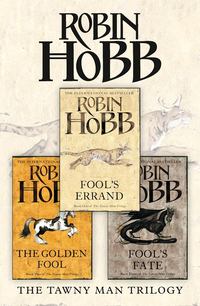
Kitabı oku: «The Complete Tawny Man Trilogy: Fool’s Errand, The Golden Fool, Fool’s Fate»
The Complete Tawny Man
Trilogy:
Fool’s Errand
The Golden Fool
Fool’s Fate
Robin Hobb

COPYRIGHT
HarperVoyager
An Imprint of HarperCollinsPublishers 1 London Bridge Street London SE1 9GF
www.harpervoyagerbooks.com
Fool’s Errand Copyright © Robin Hobb 2001
The Golden Fool Copyright © Robin Hobb 2002
Fool’s Fate Copyright © Robin Hobb 2003
Robin Hobb asserts the moral right to be identified as the author of this work
All rights reserved under International and Pan-American Copyright Conventions. By payment of the required fees, you have been granted the nonexclusive, nontransferable right to access and read the text of this e-book on-screen. No part of this text may be reproduced, transmitted, downloaded, decompiled, reverse engineered, or stored in or introduced into any information storage and retrieval system, in any form or by any means, whether electronic or mechanical, now known or hereinafter invented, without the express written permission of HarperCollins e-books.
Ebook Edition © AUGUST 2013 ISBN: 9780007532117
Version 2018-06-20
HarperCollinsPublishers has made every reasonable effort to ensure that any picture content and written content in this ebook has been included or removed in accordance with the contractual and technological constraints in operation at the time of publication.
CONTENTS
Cover
Title Page
Map
Fool’s Errand
The Golden Fool
Fool’s Fate
About the Author
Also by Robin Hobb
Copyright
About the Publisher
MAP


Fool’s Errand
Book One of The Tawny Man
Robin Hobb
DEDICATION
For Ruth and her Stripers,
Alexander and Crusades.
CONTENTS
Cover
Title Page
Dedication
ONE : Chade Fallstar
TWO : Starling
THREE : Partings
FOUR : The Hedge-Witch
FIVE : The Tawny Man
SIX : The Quiet Years
SEVEN : Heart of a Wolf
EIGHT : Old Blood
NINE : Dead Man’s Regrets
TEN : A Sword and a Summons
ELEVEN : Chade’s Tower
TWELVE : Charms
THIRTEEN : Bargains
FOURTEEN : Laurel
FIFTEEN : Galeton
SIXTEEN : Claws
SEVENTEEN : The Hunt
EIGHTEEN : Fool’s Kiss
NINETEEN : The Inn
TWENTY : Stones
TWENTY-ONE : Dutiful
TWENTY-TWO : Choices
TWENTY-THREE : The Beach
TWENTY-FOUR : Confrontations
TWENTY-FIVE : Ransom
TWENTY-SIX : Sacrifice
TWENTY-SEVEN : Lessons
TWENTY-EIGHT : Homecoming
TWENTY-NINE : Buckkeep Town
Epilogue
Copyright
ONE Chade Fallstar
Is time the wheel that turns, or the track it leaves behind?
Kelstar’s Riddle
He came one late, wet spring, and brought the wide world back to my doorstep. I was thirty-five that year. When I was twenty, I would have considered a man of my current age to be teetering on the verge of dotage. These days, it seemed neither young nor old to me, but a suspension between the two. I no longer had the excuse of callow youth, and I could not yet claim the eccentricities of age. In many ways, I was no longer sure what I thought of myself. Sometimes it seemed that my life was slowly disappearing behind me, fading like footprints in the rain, until perhaps I had always been the quiet man living an unremarkable life in a cottage between the forest and the sea.
I lay abed that morning, listening to the small sounds that sometimes brought me peace. The wolf breathed steadily before the softly crackling hearth-fire. I quested towards him with our shared Wit-magic, and gently brushed his sleeping thoughts. He dreamed of running over snow-smooth rolling hills with a pack. For Nighteyes, it was a dream of silence, cold and swiftness. Softly I withdrew my touch and left him to his private peace.
Outside my small window, the returning birds sang their challenges to one another. There was a light wind, and whenever it stirred the trees, they released a fresh shower of last night’s rain to patter on the wet sward. The trees were silver birches, four of them. They had been little more than sticks when I had planted them. Now their airy foliage cast a pleasant light shade outside my bedroom window. I closed my eyes and could almost feel the flicker of the light on my eyelids. I would not get up, not just yet.
I had had a bad evening the night before, and had had to face it alone. My boy, Hap, had gone off gallivanting with Starling almost three weeks ago, and still had not returned. I could not blame him. My quiet reclusive life was beginning to chafe his young shoulders. Starling’s stories of life at Buckkeep, painted with all the skill of her minstrel ways, created pictures too vivid for him to ignore. So I had reluctantly let her take him to Buckkeep for a holiday, that he might see for himself a Springfest there, eat a carris seed-topped cake, watch a puppet show, mayhap kiss a girl. Hap had grown past the point where regular meals and a warm bed were enough to content him. I had told myself it was time I thought of letting him go, of finding him an apprenticeship with a good carpenter or joiner. He showed a knack for such things, and the sooner a lad took to a trade, the better he learned it. But I was not ready to let him go just yet. However, for now I would enjoy a month of peace and solitude, and recall how to do things for myself. Nighteyes and I had each other for company. What more could we need?
Yet no sooner were they gone than the little house seemed too quiet. The boy’s excitement at leaving had been too reminiscent of how I myself had once felt about Springfests and the like. Puppet shows and carris seed cakes and girls to kiss all brought back vivid memories I thought I had long ago drowned. Perhaps it was those memories that birthed dreams too vivid to ignore. Twice I had awakened sweating and shaking with my muscles clenched. I had enjoyed years of respite from such unquiet, but in the past four years, my old fixation had returned. Of late, it came and went, with no pattern I could discern. It was almost as if the old Skill-magic had suddenly recalled me and was reaching to drag me out of my peace and solitude. Days that had been as smooth and alike as beads on a string were now disrupted by its call. Sometimes the Skill-hunger ate at me as a canker eats sound flesh. Other times, it was no more than a few nights of yearning, vivid dreams. If the boy had been home, I probably could have shaken off the Skill’s persistent plucking at me. But he was gone, and so yesterday evening, I had given in to the unvanquished addiction such dreams stirred. I had walked down to the sea cliffs, sat on the bench my boy had made for me, and stretched out my magic over the waves. The wolf had sat beside me for a time, his look one of ancient rebuke. I tried to ignore him. ‘No worse than your penchant for bothering porcupines,’ I pointed out to him.
Save that their quills can be pulled out. What stabs you only goes deeper and festers. His deep eyes glanced past mine as he shared his pointed thoughts.
Why don’t you go hunt a rabbit?
You’ve sent the boy and his bow away.
‘You could run it down yourself, you know. Time was when you did that.’
Time was when you went with me to hunt. Why don’t we go and do that, instead of this fruitless seeking? When will you accept that there is no one out there who can hear you?
I just have to … try.
Why? Is my companionship not enough for you?
It is enough for me. You are always enough for me. I opened myself wider to the Wit-bond we shared and tried to let him feel how the Skill tugged at me. It is the magic that wants this, not me.
Take it away. I do not want to see that. And when I had closed that part of myself to him, he asked piteously, Will it never leave us alone?
I had no answer to that. After a time, the wolf lay down, put his great head on his paws and closed his eyes. I knew he would stay by me because he feared for me. Twice the winter before last, I had over-indulged in Skilling, burning physical energy in that mental reaching until I had been unable even to totter back to the house on my own. Nighteyes had had to fetch Hap both times. This time we were alone.
I knew it was foolish and useless. I also knew I could not stop myself. Like a starving man who eats grass to appease the terrible emptiness in his belly, so I reached out with the Skill, touching the lives that passed within my reach. I could brush their thoughts and temporarily appease the great craving that filled me with emptiness. I could know a little of the family out for a windy day’s fishing. I could know the worries of a captain whose cargo was just a bit heavier than his ship would carry well. The mate on the same ship was worried about the man her daughter wished to marry; he was a lazy fellow for all of his pretty ways. The ship’s boy was cursing his luck; they’d get to Buckkeep Town too late for Springfest. There’d be nothing left but withered garlands browning in the gutters by the time he got there. It was always his luck.
There was a certain sparse distraction to these knowings. It restored to me the sense that the world was larger than the four walls of my house, larger even than the confines of my own garden. But it was not the same as true Skilling. It could not compare to that moment of completion when minds joined and one sensed the wholeness of the world as a great entity in which one’s own body was no more than a mote of dust.
The wolf’s firm teeth on my wrist had stirred me from my reaching. Come on. That’s enough. If you collapse down here, you’ll spend a cold wet night. I am not the boy, to drag you to your feet. Come on, now.
I had risen, seeing blackness at the edges of my vision when I first stood. It had passed, but not the blackness of spirit that came in its wake. I had followed the wolf back through the gathering dark beneath the dripping trees, back to where my fire had burned low in the hearth and the candles guttered on the table. I made myself elfbark tea, black and bitter, knowing it would only make my spirit more desolate, but knowing also that it would appease my aching head. I had burned away the nervous energy of the elfbark by working on a scroll describing the stone game and how it was played. I had tried several times before to complete such a treatise and each time given it up as hopeless. One could only learn to play it by playing it, I told myself. This time I was adding to the text a set of illustrations, to show how a typical game might progress. When I set it aside just before dawn was breaking, it seemed only the stupidest of my latest attempts. I went to bed more early than late.
I awoke to half the morning gone. In the far corner of the yard, the chickens were scratching and gossiping among themselves. The rooster crowed once. I groaned. I should get up. I should check for eggs and scatter a handful of grain to keep the poultry tamed. The garden was just sprouting. It needed weeding already, and I should re-seed the row of fesk that the slugs had eaten. I needed to gather some more of the purple flag while it was still in bloom; my last attempt at an ink from it had gone awry, but I wanted to try again. There was wood to split and stack. Porridge to cook, a hearth to sweep. And I should climb the ash tree over the chicken house and cut off that one cracked limb before a storm brought it down on the chicken house itself.
And we should go down to the river and see if the early fish runs have begun yet. Fresh fish would be good. Nighteyes added his own concerns to my mental list.
Last year you nearly died from eating rotten fish.
All the more reason to go now, while they are fresh and jumping. You could use the boy’s spear.
And get soaked and chilled.
Better soaked and chilled than hungry.
I rolled over and went back to sleep. So I’d be lazy one morning. Who’d know or care? The chickens? It seemed but moments later that his thoughts nudged me.
My brother, awake. A strange horse comes.
I was instantly alert. The slant of light in my window told me that hours had passed. I rose, dragged a robe over my head, belted it, and thrust my feet into my summer shoes. They were little more than leather soles with a few straps to keep them on my feet. I pushed my hair back from my face. I rubbed my sandy eyes. ‘Go see who it is,’ I bid Nighteyes.
See for yourself. He’s nearly to the door.
I was expecting no one. Starling came thrice or four times a year, to visit for a few days and bring me gossip and fine paper and good wine, but she and Hap would not be returning so soon. Other visitors to my door were rare. There was Baylor who had his cot and hogs in the next vale, but he did not own a horse. A tinker came by twice a year. He had found me first by accident in a thunderstorm when his horse had gone lame and my light through the trees had drawn him from the road. Since his visit, I’d had other visits from similar travellers. The tinker had carved a curled cat, the sign of a hospitable house, on a tree beside the trail that led to my cabin. I had found it, but left it intact, to beckon an occasional visitor to my door.
So this caller was probably a lost traveller, or a road-weary trader. I told myself a guest might be a pleasant distraction, but the thought was less than convincing.
I heard the horse halt outside and the small sounds of a man dismounting.
The grey one, the wolf growled low.
My heart near stopped in my chest. I opened the door slowly as the old man was reaching to knock at it. He peered at me, and then his smile broke forth. ‘Fitz, my boy. Ah, Fitz!’
He reached to embrace me. For an instant, I stood frozen, unable to move. I did not know what I felt. That my old mentor had tracked me down after all these years was frightening. There would be a reason, something more than simply seeing me again. But I also felt that leap of kinship, that sudden stirring of interest that Chade had always roused in me. When I had been a boy at Buckkeep, his secret summons would come at night, bidding me climb the concealed stair to his lair in the tower above my room. There he mixed his poisons and taught me the assassin’s trade and made me irrevocably his. Always my heart had beat faster at the opening of that secret door. Despite all the years and the pain, he still affected me that way. Secrets and the promise of adventure clung to him.
So I found myself reaching out to grasp his stooping shoulders and pull him to me in a hug. Skinny, the old man was getting skinny again, as bony as he had been when I first met him. But now I was the recluse in the worn robe of grey wool. He was dressed in royal blue leggings and a doublet of the same with slashed insets of green that sparked off his eyes. His riding boots were black leather, as were the soft gloves he wore. His cloak of green matched the insets in his doublet and was lined with fur. White lace spilled from his collar and sleeves. The scattered scars that had once shamed him into hiding had faded to a pale speckling on his weathered face. His white hair hung loose to his shoulders and was curled above his brow. There were emeralds in his earrings, and another one set squarely in the centre of the gold band at his throat.
The old assassin smiled mockingly as he saw me take in his splendour. ‘Ah, but a Queen’s Counsellor must look the part, if he is to get the respect both he and she deserve in his dealings.’
‘I see,’ I said faintly, and then, finding my tongue, ‘Come in, do, come in. I fear you will find my home a bit ruder than what you have obviously become accustomed to, but you are welcome all the same.’
‘I did not come to quibble about your house, boy. I came to see you.’
‘Boy?’ I asked him quietly as I smiled and showed him in.
‘Ah, well. To me, always, perhaps. It is one of the advantages of age, I can call anyone almost anything I please, and no one dares challenge me. Ah, you have the wolf still, I see. Nighteyes, was it? Up in years a bit now; I don’t recall that white on your muzzle. Come here now, there’s a good fellow. Fitz, would you mind seeing to my horse? I’ve been all morning in the saddle, and spent last night at a perfectly wretched inn. I’m a bit stiff, you know. And just bring in my saddlebags, would you? There’s a good lad.’
He stooped to scratch the wolf’s ears, his back to me, confident I would obey him. And I grinned and did. The black mare he’d ridden was a fine animal, amiable and willing. There is always a pleasure to caring for a creature of that quality. I watered her well, gave her some of the chickens’ grain and turned her into the pony’s empty paddock. The saddlebags that I carried back to the house were heavy and one sloshed promisingly.
I entered to find Chade in my study, sitting at my writing desk, poring over my papers as if they were his own. ‘Ah, there you are. Thank you, Fitz. This, now, this is the stone game, isn’t it? The one Kettle taught you, to help you focus your mind away from the Skill-road? Fascinating. I’d like to have this one when you are finished with it.’
‘If you wish,’ I said quietly. I knew a moment’s unease. He tossed out words and names I had buried and left undisturbed. Kettle. The Skill-road. I pushed them back into the past. ‘It’s not Fitz any more,’ I said pleasantly. ‘It’s Tom Badgerlock.’
‘Oh?’
I touched the streak of white in my hair from my scar. ‘For this. People remember the name. I tell them I was born with the white streak, and so my parents named me.’
‘I see,’ he said noncommittally. ‘Well, it makes sense, and it’s sensible.’ He leaned back in my wooden chair. It creaked. ‘There’s brandy in those bags, if you’ve cups for us. And some of old Sara’s ginger cakes … I doubt you’d expect me to remember how fond you were of those. Probably a bit squashed, but it’s the taste that matters with those.’ The wolf had already sat up. He came to place his nose on the edge of the table. It pointed directly at the bags.
‘So. Sara is still cook at Buckkeep?’ I asked as I looked for two presentable cups. Chipped crockery didn’t bother me, but I was suddenly reluctant to set it out for Chade.
Chade left the study and came to my kitchen table. ‘Oh, not really. Her old feet bother her if she stands too long. She has a big cushioned chair, set up on a platform in the corner of the kitchen. She supervises from there. She cooks the things she enjoys cooking, the fancy pastries, the spiced cakes, and the sweets. There’s a young man named Duff does most of the daily cooking now.’ He was unpacking the saddlebags as he spoke. He set out two bottles marked as Sandsedge brandy. I could not remember the last time I’d tasted that. The ginger cakes, a bit squashed as foretold, emerged, spilling crumbs from the linen he’d wrapped them in. The wolf sniffed deeply, then began salivating. ‘His favourites, too, I see,’ Chade observed dryly, and tossed him one. The wolf caught it neatly and carried it off to devour on the hearthrug.
The saddlebags gave up their other treasures quickly. A sheaf of fine paper, pots of blue, red and green inks. A fat ginger root, just starting to sprout, ready to be potted for the summer. Some packets of spices. A rare luxury for me, a round ripe cheese. And in a little wooden chest, other items, hauntingly strange in their familiarity. Small things I had thought long lost to me. A ring that had belonged to Prince Rurisk of the Mountain Kingdom. The arrowhead that had pierced the Prince’s chest and nearly been the death of him. A small carved box, made by my hands years ago, to contain my poisons. I opened it. It was empty. I put the lid back on the box and set it down on the table. I looked at him. He was not just one old man come to visit me. He brought all of my past trailing along behind him as an embroidered train follows a woman into a hall. When I let him in my door, I had let in my old world with him.
‘Why?’ I asked quietly. ‘Why, after all these years, have you sought me out?’
‘Oh, well.’ Chade drew a chair up to the table and sat down with a sigh. He unstoppered the brandy and poured for both of us. ‘A dozen reasons. I saw your boy with Starling. And I knew at once who he was. Not that he looks like you, any more than Nettle looks like Burrich. But he has your mannerisms, your way of holding back and looking at a thing, with his head cocked just so before he decides whether he’ll be drawn in. He put me so much in mind of you at that age that …’
‘You’ve seen Nettle,’ I cut in quietly. It was not a question.
‘Of course,’ he replied as quietly. ‘Would you like to know about her?’
I did not trust my tongue to answer. All my old cautions warned me against evincing too great an interest in her. Yet I felt a prickle of foreknowledge that Nettle, my daughter whom I had never seen except in visions, was the reason Chade had come here. I looked at my cup and weighed the merits of brandy for breakfast. Then I thought again of Nettle, the bastard I had unwillingly abandoned before her birth. I drank. I had forgotten how smooth Sandsedge brandy was. Its warmth spread through me as rapidly as youthful lust.
Chade was merciful, in that he did not force me to voice my interest. ‘She looks much like you, in a skinny, female way,’ he said, then smiled to see me bristle. ‘But, strange to tell, she resembles Burrich even more. She has more of his mannerisms and habits of speech than any of his five sons.’
‘Five!’ I exclaimed in astonishment.
Chade grinned. ‘Five boys, and all as respectful and deferential to their father as any man could wish. Not at all like Nettle. She has mastered that black look of Burrich’s and gives it right back to him when he scowls at her. Which is seldom. I won’t say she’s his favourite, but I think she wins more of his favour by standing up to him than all the boys do with their earnest respect. She has Burrich’s impatience, and his keen sense of right and wrong. And all your stubbornness, but perhaps she learned that from Burrich as well.’
‘You saw Burrich then?’ He had raised me, and now he raised my daughter as his own. He’d taken to wife the woman I’d seemingly abandoned. They both thought me dead. Their lives had gone on without me. To hear of them mingled pain with fondness. I chased the taste of it away with Sandsedge brandy.
‘It would have been impossible to see Nettle, save that I saw Burrich also. He watches over her like, well, like her father. He’s well. His limp has not improved with the years. But he is seldom afoot, so it seems to bother him little. It is horses with him, always horses, as it always was.’ He cleared his throat. ‘You do know that the Queen and I saw to it that both Ruddy and Sooty’s colt were given over to him? Well, he’s founded his livelihood on those two stud horses. The mare you unsaddled, Ember, I got her from him. He trains as well as breeds horses now. He will never be a wealthy man, for the moment he has a coin to spare, it goes for another horse or to buy more pasturage. But when I asked him how he did, he told me, “well enough.”’
‘And what did Burrich say of your visit?’ I asked. I was proud I could speak with an unchoked voice.
Chade grinned again, but there was a rueful edge to it. ‘After he got over the shock of seeing me, he was most courteous and welcoming. And as he walked me out to my horse the next morning, which one of the twins, Nim I think, had saddled for me, he quietly promised that he’d kill me before he’d brook any interference with Nettle. He spoke the words regretfully, but with great sincerity. I didn’t doubt them from him, so I don’t need them repeated from you.’
‘Does she know Burrich is not her father? Does she know anything of me?’ Question after question sprang to my mind. I thrust them away. I hated the avidity with which I had asked those two, but I could not resist. It was like the Skill-addiction, this hunger to know, finally know these things after all the years.
Chade looked aside from me and sipped his brandy. ‘I don’t know. She calls him Papa. She loves him fiercely, with absolutely no criticism. Oh, she disagrees with him, but it is about things rather than about Burrich himself. I’m afraid that with her mother, things are stormier. Nettle has no interest in bees or candles, but Molly would like to see her daughter follow her in her trade. As stubborn as Nettle is, I think Molly will have to be content with a son or two instead.’ He glanced out the window. He added quietly, ‘We did not speak your name when she was present.’
I turned my cup in my hands. ‘What things do interest her?’
‘Horses. Hawks. Swords. At fifteen, I expected at least some talk of young men from her, but she seems to have no use for them. Perhaps the woman in her hasn’t wakened yet, or perhaps she has too many brothers to have any romantic illusions about boys. She would like to run away to Buckkeep and join one of the guard companies. She knows Burrich was Stablemaster there once. One of the reasons I went to see him was to make Kettricken’s offer of that position again. Burrich refused it. Nettle cannot understand why.’
‘I do.’
‘As do I. But when I visited, I told him that I could make a place for Nettle there, even if he chose not to go. She could page for me, if nothing else, though I am sure Queen Kettricken would love to have her. Let her see the way of a keep and a city, let her have a taste of life at court, I told him. Burrich turned it down instantly, and seemed almost offended that I’d offered it.’
Without intending, I breathed out softly in relief. Chade took another sip of his brandy and sat regarding me. Waiting. He knew my next question as well as I did. Why? Why did he seek out Burrich, why did he offer to take Nettle to Buckkeep? I took more of my own brandy and considered the old man. Old. Yes, but not as some men get old. His hair had gone completely white, but the green of his eyes seemed to burn all the fiercer beneath those snowy locks. I wondered how hard he fought his body to keep the stoop in his shoulders from becoming a curl, what drugs he took to prolong his vigour and what those drugs cost him in other ways. He was older than King Shrewd, and Shrewd was all these many years dead. Bastard royalty of the same lineage as myself, he seemed to thrive on intrigue and strife as I had not. I had fled the court and all it contained. Chade had chosen to stay, and make himself indispensable to yet another generation of Farseers.
‘So. And how is Patience these days?’ I chose my question with care. News of my father’s wife was well wide of what I wished to know, but I could use his answer to venture closer.
‘Lady Patience? Ah, well, it has been some months since I have seen her. Over a year, now that I think of it. She resides at Tradeford, you know. She rules there, and quite well. Odd, when you think of it. When she was indeed queen and wed to your father, she never asserted herself. Widowed, she was well content to be eccentric Lady Patience. But when all others fled, she became queen in fact if not by title at Buckkeep. Queen Kettricken was wise to give her a domain of her own, for she never again could have abided at Buckkeep as less than queen.’
‘And Prince Dutiful?’
‘As like his father as he can be,’ Chade observed, shaking his head. I watched him closely, wondering how the old man intended the remark. How much did he know? He frowned as he continued, ‘The Queen needs to let him out a bit. The folk speak of Dutiful as they did of your father, Chivalry. “Correct to a fault,” they say and almost have the truth of it, I fear.’
There had been a very slight change in his voice. ‘Almost?’ I asked quietly.
Chade gave me a smile that was almost apologetic. ‘Of late the boy has not been himself. He has always been a solitary lad – but that goes with being the sole prince. He has always had to keep his position in mind, always had to take care that he was not seen to favour one companion over another. It has made him introspective. But recently he has shifted to a darker temperament. He is distracted and moody, so caught up in his inner thoughts that he seems completely unaware of what is going on in the lives of those around him. He is not discourteous or uncaring; at least, not deliberately. But …’
‘He’s what, fourteen?’ I asked. ‘He does not sound so different from Hap, of late. I’ve been thinking much the same things about him; that I need to let him out a bit. It’s time he got out and learned something new, from someone other than myself.’
Chade nodded. ‘I think you are absolutely correct. Queen Kettricken and I have reached the same decision about Prince Dutiful.’
His tone made me suspect I had just run my head into the snare. ‘Oh?’ I said carefully.
‘Oh?’ Chade mimicked me, and then leaned forwards to tip more brandy into his glass. He grinned, letting me know the game was at an end. ‘Oh, yes. You’ve no doubt guessed it. We would like to have you come back to Buckkeep and instruct the Prince in the Skill. And Nettle, too, if Burrich can be persuaded to let her go and if she has any aptitude for it.’
TWO Starling
Starling Birdsong, minstrel to Queen Kettricken, has inspired as many songs as she has written. Legendary as Queen Kettricken’s companion on her quest for Elderling aid during the Red Ship War, she extended her service to the Farseer throne for decades during the rebuilding of the Six Duchies. Gifted with the knack of being at home in any company, she was indispensable to the Queen in the unsettled years that followed the Cleansing of Buck. The minstrel was trusted not only with treaties and settlements between nobles, but with offers of amnesty to robber bands and smuggler families. She herself made songs of many of these missions, but one can be sure that she had other endeavours, carried out in secret for the Farseer reign, and far too sensitive ever to become the subject of verse.
Starling kept Hap with her for a full two months. My amusement at his extended absence changed first to irritation and then annoyance. The annoyance was mostly with myself. I had not realized how much I had come to depend on the boy’s strong back until I had to bend mine to the tasks I’d delegated to him. But it was not just the boy’s ordinary chores that I undertook during that extra month of his absence. Chade’s visit had awakened something in me. I had no name for it, but it seemed a demon that gnawed at me, showing me every shabby aspect of my smallholding. The peace of my isolated home now seemed idle complacency. Had it truly been a year since I had shoved a rock under the sagging porch step and promised myself I’d mend it later? No, it had been closer to a year and a half.
I put the porch to rights, and then not only shovelled out the chicken house but washed it down with lye-water before gathering fresh reeds to floor it. I fixed the leaking roof on my work shed, and finally cut the hole and put in the greased skin window I’d been promising myself for two years. I gave the cottage a more thorough spring-cleaning than it had had in years. I cut down the cracked ash-limb, dropping it neatly through the roof of the freshly cleaned chicken-house. I re-roofed the chicken-house. I was just finishing that task when Nighteyes told me he heard horses. I clambered down, picked up my shirt and walked around to the front of the cottage to greet Starling and Hap as they came up the trail.
I do not know if it was our time apart, or my newly-seeded restlessness, but I suddenly saw Hap and Starling as if they were strangers. It was not just the new garb Hap wore, although that accentuated his long legs and broadening shoulders. He looked comical upon the fat old pony, a fact I am sure he appreciated. The pony was as ill suited to the growing youth as the child’s bed in my cottage and my sedate life style. I suddenly perceived that I could not rightfully ask him to stay home and watch the chickens while I went adventuring. In fact, if I did not soon send him out to seek his own fortune, the mild discontent I saw in his mismatched eyes at his homecoming would soon become bitter disappointment in his life. Hap had been a good companion for me; the foundling I had taken in had, perhaps, rescued me as much as I had rescued him. It would be better far for me to send this young man out into the world while we both still liked one another rather than wait until I was a burdensome duty to his young shoulders.
Not just Hap had changed in my eyes. Starling was vibrant as ever, grinning as she flung a leg over her horse and slid down from him. Yet as she came towards me with her arms flung wide to hug me, I realized how little I knew of her present life. I looked down into her merry dark eyes and noted for the first time the crowsfeet beginning at the corners. Her garb had become richer over the years, the quality of her mounts better, and her jewellery more costly. Today her thick dark hair was secured with a clasp of heavy silver. Clearly, she prospered. Three or four times a year, she would descend on me, to stay a few days and overturn my calm life with her stories and songs. For the days she was there, she would insist on spicing the food to her taste, she would scatter an overlay of her possessions upon my table and desk and floor, and my bed would no longer be a place to seek when I was exhausted. The days that immediately followed her departure would remind me of a country road with dust hanging heavy in the air in the wake of a puppeteer’s caravan. I would have the same sense of choked breath and hazed vision until I once more settled into my humdrum routine.
I hugged her back, hard, smelling both dust and perfume in her hair. She stepped away from me, looked up into my face and immediately demanded, ‘What’s wrong? Something’s different.’
I smiled ruefully. ‘I’ll tell you later,’ I promised, and we both knew that it would be one of our late night conversations.
‘Go wash,’ she agreed. ‘You smell like my horse.’ She gave me a slight push, and I stepped clear of her to greet Hap.
‘So, lad, how was it? Did a Buckkeep Springfest live up to Starling’s tales?’
‘It was good,’ he said neutrally. He gave me one full look, and his mismatched eyes, one brown, one blue, were full of torment.
‘Hap?’ I began concernedly, but he shrugged away from me before I could touch his shoulder.
He walked away from me, but perhaps he regretted his surly greeting, for a moment later he croaked, ‘I’m going to the stream to wash. I’m covered in road dust.’
Go with him. I’m not sure what’s wrong, but he needs a friend.
Preferably one that can’t ask questions, Nighteyes agreed. Head low, tail straight out, he followed the boy. In his own way, he was as fond of Hap as I was, and had had as much to do with his raising.
When they were almost out of eyeshot, I turned back to Starling. ‘Do you know what that was about?’
She shrugged, a twisted smile on her lips. ‘He’s fifteen. Does a sullen mood have to be about anything at that age? Don’t bother yourself over it. It could be anything: a girl at Springfest that didn’t kiss him, or one that did. Leaving Buckkeep or coming home. A bad sausage for breakfast. Leave him alone. He’ll be fine.’
I looked after him as he and the wolf vanished into the trees. ‘Perhaps I remember being fifteen a bit differently from you,’ I commented.
I saw to her horse and Clover the pony while Starling went into the cottage, reflecting as I did so that no matter what my mood, Burrich would have ordered me to see to my horse before I wandered off. Well, I was not Burrich, I thought to myself. I wondered if he held the same line of discipline with Nettle and Chivalry and Nim as he had with me, and then wished I had asked Chade the rest of his children’s names. By the time the horses were comfortable, I was wishing that Chade had not come. His visit had stirred too many old memories to the surface. Resolutely, I pushed them away. Bones fifteen years old, the wolf would have told me. I touched minds with him briefly. Hap had splashed some water on his face, and strode off into the woods, muttering and walking so carelessly that there was no chance they’d see any game. I sighed for them both, and went into the cottage.
Inside, Starling had dumped the contents of her saddlebags on the table. Her discarded boots were lying across the doorsill; her cloak festooned a chair. The kettle was just starting to boil. She stood on a stool before my cupboard. As I came in, she held out a small brown crock to me. ‘Is this tea any good still? It smells odd.’
‘It’s excellent, when I’m in enough pain to choke it down. Come down from there.’ I set my hands to her waist and lifted her easily, though the old scar on my back gave a twinge as I set her on the floor. ‘Sit. I’ll make the tea. Tell me about Springfest.’
So she did, while I clattered out my few cups, cut slices from my last loaf, and put the rabbit stew to warm. Her tales of Buckkeep were the kind I had become accustomed to hearing from her: she spoke of minstrels who had performed well or badly, gossiped of lords and ladies I had never known, and condemned or praised food from various nobles’ tables where she had guested. She told each tale wittily, making me laugh or shake my head as it called for, with nary a pang of the pain that Chade had wakened in me. I supposed it was because he had spoken of the folk we had both known and loved, and told his stories from that intimate perspective. It was not Buckkeep itself or city life that I pined for, but for my childhood days and the friends I had known. In that I was safe; it was impossible to return to that time. Only a few of those folk even knew that I still lived, and that was as I wished it to be. I said as much to Starling: ‘Sometimes your tales tug at my heart and make me wish I could return to Buckkeep. But that is a world closed to me now.’
She frowned at me. ‘I don’t see why.’
I laughed aloud. ‘You don’t think anyone would be surprised to see me alive?’
She cocked her head and stared at me frankly. ‘I think there would be few, even of your old friends, who would recognize you. Most recall you as an unscarred youth. The broken nose, the slash down your face, even the white in your hair might alone be disguise enough. Then, you dressed as a prince’s son; now you wear the garb of a peasant. Then, you moved with a warrior’s grace. Now, well, in the mornings or on a cold day, you move with an old man’s caution.’ She shook her head with regret as she added, ‘You have taken no care for your appearance, nor have the years been kind to you. You could add five or even ten years to your age, and no one would question it.’
This blunt appraisal from my lover stung. ‘Well, that’s good to know,’ I replied wryly. I took the kettle from the fire, not wanting to meet her eyes just then.
She mistook my words and tone. ‘Yes. And when you add in that people see what they expect to see, and they do not expect to see you alive … I think you could venture it. Are you considering a return to Buckkeep, then?’
‘No.’ I heard the shortness of the word, but could think of nothing to add to it. It did not seem to bother her.
‘A pity. You miss so much, living alone like this.’ She launched immediately into an account of the Springfest dancing. Despite my soured mood, I had to smile at her account of Chade beseeched to dance by a young admirer of sixteen summers. She was right. I would have loved to have been there.
As I prepared food for all of us, I found my mind straying to the old torment of ‘what if’. What if I had been able to return to Buckkeep with my queen and Starling? What if I had come home to Molly and our child? And always, no matter how I twisted the pretence, it ended in disaster. If I had returned to Buckkeep, alive when all believed me executed for practising the Wit, I would have brought only division at a time when Kettricken was trying to reunify the land. There would have been a faction who would have favoured me over her, for bastard though I was, I was a Farseer by blood when she reigned only by virtue of marriage. A stronger faction would have been in favour of executing me again, and more thoroughly.
And if I had gone back to Molly and the child, returned to carry her off to be mine? I suppose I could have, if I had no care for anyone but myself. She and Burrich had both given me up for dead. The woman who had been my wife in all but name, and the man who had raised me and been my friend had turned to one another. He had kept a roof over Molly’s head, and seen that she was fed and warm while my child grew within her. With his own hands, he had delivered my bastard. Together they had kept Nettle from Regal’s men. Burrich had claimed both woman and child as his own, not only to protect them, but to love them. I could have gone back to them, to make them both faithless in their own eyes. I could have made their bond a shameful thing. Burrich would have left Molly and Nettle to me. His harsh sense of honour would not have allowed him to do otherwise. And ever after, I could have wondered if she compared me to him, if the love they had shared was stronger and more honest than …
‘You’re burning the stew,’ Starling pointed out in annoyance.
I was. I served us from the top of the pot, and joined her at the table. I pushed all pasts, both real and imagined, aside. I did not need to think of them. I had Starling to busy my mind. As was customary, I was the listener and she was the teller of tales. She began a long account of some upstart minstrel at Springfest who had not only dared to sing one of her songs, with only a verse or two changed, but then had claimed ownership of it. She gestured with her bread as she spoke, and almost managed to catch me up in the story. But my own memories of other Springfests kept intruding. Had I lost all content in the simple life I had created for myself? The boy and the wolf had been enough for me for many years. What ailed me now?
I went from that to yet another discordant thought. Where was Hap? I had brewed tea for the three of us, and portioned out food for three as well. Hap was always ravenous after any sort of a task or journey. It was distracting that he could not get past his bad mood to come and join us. As Starling spoke on, I found my eyes straying repeatedly to his untouched bowl of stew. She caught me at it.
‘Don’t fret about him,’ she told me almost testily. ‘He’s a boy, with a boy’s sulky ways. When he’s hungry enough, he’ll come in.’
Or he’ll ruin perfectly good fish by burning it over a fire. The wolf’s thought came in response to my Wit questing towards him. They were down by the creek. Hap had made a temporary spear out of a stick, and the wolf had simply plunged into the water to hunt along the undercut banks. When the fish ran thick, it was not difficult for him to corner one there, to plunge his head under the water and seize it in his jaws. The cold water made his joints ache, but the boy’s fire would soon warm him. They were fine. Don’t worry.
Useless advice, but I pretended to take it. We finished eating, and I cleared the dishes away. While I tidied, Starling sat on the hearth by the evening fire, picking at her harp until the random notes turned into the old song about the miller’s daughter. When everything was put to rights, I joined her there with a cup of Sandsedge brandy for each of us. I sat in a chair, but she sat near the fire on the floor. She leaned back against my legs as she played. I watched her hands on the strings, marking the crookedness where once her fingers had been broken, as a warning to me. At the end of her song, I leaned down and kissed her. She kissed me back, setting the harp aside and making a more thorough job of it.
She stood then and took my hands to pull me to my feet. As I followed her into my bedroom, she observed, ‘You’re pensive tonight.’
I made some small sound of agreement. Sharing that she had bruised my feelings earlier would have seemed snivelling and childish. Did I want her to lie to me, to tell me that I was still young and comely when obviously I was not? Time had had its way with me. That was all, and to be expected. Even so, Starling kept coming back to me. Through all the years, she’d kept returning to me and into my bed. That had to count for something. ‘You were going to tell me about something?’ she prompted.
‘Later,’ I told her. The past clutched at me, but I put its greedy fingers aside, determined to immerse myself in the present. This life was not so bad. It was simple and uncluttered, without conflict. Wasn’t this the life I had always dreamed of? A life in which I made my decisions for myself? And I was not alone, really. I had Nighteyes and Hap, and Starling, when she came to me. I opened her vest and then her blouse to bare her breasts while she unbuttoned my shirt. She embraced me, rubbing against me with the unabashed pleasure of a purring cat. I clasped her to me and lowered my face to kiss the top of her head. This, too, was simple and all the sweeter that it was. My freshly-stuffed mattress was deep and fragrant as the meadow grass and herbs that filled it. We tumbled onto it. For a time, I stopped thinking at all, as I tried to persuade both of us that despite appearances I was a young man still.
A while later, I lingered in the hinterlands of sleep. Sometimes I think there is more rest in that place between wakefulness and sleep than there is in true sleep. The mind walks in the twilight of both states, and finds the truths that are hidden alike by daylight and dreams. Things we are not ready to know abide in that place, awaiting that unguarded frame of mind.
I came awake. My eyes were open, studying the details of my darkened room before I realized that sleep had fled. Starling’s wide-flung arm was across my chest. In her sleep, she had kicked the blanket away from both of us. Night hid her careless nakedness, cloaking her in shadows. I lay still, hearing her breathe and smelling her sweat mixed with her perfume, and wondered what had wakened me. I could not put my finger on it, yet neither could I close my eyes again. I slid out from under her arm and stood up beside my bed. In the darkness I groped for my discarded shirt and leggings.
The coals of the hearth fire gave hesitant light to the main room, but I did not linger there. I opened the door and stepped barefoot into the mild spring night. I stood still for a moment, letting my eyes adjust, and then made my way away from the cottage and garden and down to the stream bank. The path was cool hard mud underfoot, well packed by my daily trips to fetch water. The trees met overhead, and there was no moon, but my feet and my nose knew the way as well as my eyes did. All I had to do was follow my Wit to my wolf. Soon I picked out the orange glow of Hap’s dwindled fire, and the lingering scent of cooked fish.
They slept by the fire, the wolf curled nose to tail and Hap wrapped around him, his arm around Nighteyes’ neck. Nighteyes opened his eyes as I approached, but did not stir. I told you not to worry.
I’m not worried. I’m just here. Hap had left some sticks of wood near the fire. I added them to the coals. I sat and watched the fire lick along them. Light came up with the warmth. I knew the boy was awake. One can’t be raised with a wolf without picking up some of his wariness. I waited for him.
‘It’s not you. Not just you, anyway.’
I didn’t look at Hap, even when he spoke. Some things are better said to the dark. I waited. Silence can ask all the questions, where the tongue is prone only to ask the wrong one.
‘I have to know,’ he burst out suddenly. My heart seized up at the question to come. In some corner of my soul, I had always dreaded him asking it. I should not have let him go to Springfest, I thought wildly. If I had kept him here, my secret would never have been threatened.
But that was not the question he asked.
‘Did you know that Starling is married?’
I looked at him then, and my face must have answered for me. He closed his eyes in sympathy. ‘I’m sorry,’ he said quietly. ‘I should have known you didn’t. I should have found a better way to tell you.’
And the simple comfort of a woman who came to my arms when she would, because she desired to be with me, and the sweet evenings of tales and music by the fire, and her dark merry eyes looking up into mine were suddenly guilty and deceptive and furtive. I was as foolish as I had ever been, no, even stupider, for the gullibility of a boy is fatuousness in a man. Married. Starling married. She had thought no one would ever want to marry her, for she was barren. She had told me that she had to make her own ways with her songs, for there would never be a man to care for her, nor children to provide for her old age. Probably, when she had told me those things, she had believed they were true. My folly had been in thinking that truth would never change.
Nighteyes had risen and stretched stiffly. Now he came to lie down beside me. He set his head on my knee. I don’t understand. You are ill?
No. Just stupid.
Ah. Nothing new there. Well, you haven’t died from that so far.
But sometimes it has been a near thing. I took a breath. ‘Tell me about it.’ I didn’t want to hear it, but I knew he had to tell it. Better to get it over with.
Hap came with a sigh, to sit on the other side of Nighteyes. He picked up a twig from the ground beside him and teased the fire with it. ‘I don’t think she meant for me to find out. Her husband doesn’t live at Buckkeep. He travelled in to surprise her, to spend Springfest with her.’ As he spoke, the twig caught fire. He tossed it in. His fingers wandered to idly groom Nighteyes.
I pictured some honest old farmer, wed to a minstrel in the quiet years of his life, perhaps with children grown from an earlier marriage. He loved her, then, to make a trip to Buckkeep to surprise her. Springfest was traditionally for lovers, old and new.
‘His name is Dewin,’ Hap went on. ‘And he’s some sort of kin to Prince Dutiful. A distant cousin or something. He’s a tall man, always dressed very grand. He wore a cloak, twice as big around as it need be, collared with fur. And he wears silver on both wrists. He’s strong, too. At the Springfest dancing, he lifted Starling right up and swung her around, and all the folk stood back to watch them.’ Hap was watching my face as he spoke. I think he found my obvious dismay comforting. ‘I should have known you didn’t know. You wouldn’t cuckold a grand man like that.’
‘I wouldn’t cuckold any man,’ I managed to say. ‘Not knowingly.’
He sighed as if relieved. ‘So you’ve taught me.’ Boyishly, his mind instantly reverted to how it had affected him. ‘I was upset when I saw them kiss. I’d never seen anyone except you and Starling kiss like that. I thought she was betraying you, and then when I heard him introduced as her husband …’ He cocked his head at me. ‘It really hurt my feelings. I thought then that you knew and didn’t care. I thought that perhaps all these years you had taught me one thing, and done another. I wondered if you thought me so dull I’d never discover it, if you and Starling laughed about it as if it were a joke for me to be so stupid. It built up in my mind until I began to question everything you’d ever taught me about anything.’ He looked back at the fire. ‘It felt horrible, to be so betrayed.’
I was glad to hear him sort it out this way. Better far that he consider only what it meant to him, rather than how it could cut me. Let him follow his own thoughts where they would lead. My own mind was moving in another direction, creaking like an old cart dragged out of a shed and newly greased for spring. I resisted the turning of the wheels that led me to an inevitable conclusion. Starling was married. Why not? She’d had nothing to lose and all to gain. A comfortable home with her grand lord, some minor title no doubt, wealth and security for her old age, and for him, a lovely and charming wife, a celebrated minstrel, and he could bask in her reflected glory and enjoy the envy of other men.
And when she wearied of him, she could take to the road as minstrels always did, and have a fling with me, and neither man ever the wiser. Neither? Could I assume there were only two of us?
‘Did you think you were the only one she bedded?’
A direct spoken lad, Hap. I wondered what questions he had asked Starling on the ride home.
‘I suppose I didn’t think about it at all,’ I admitted. So many things were easier to live with if you didn’t give them much thought. I suppose I had known that Starling shared herself with other men. She was a minstrel; they did such things. So I had excused my bedding with her to myself, and indirectly to Hap. She never spoke of it, I never asked, and her other lovers were hypothetical beings, faceless, and bodiless. They were certainly not husbands, however. She was vowed to him, and him to her. That made all the difference to me.
‘What will you do now?’
An excellent question. One I had been carefully not considering. ‘I’m not sure,’ I lied.
‘Starling said that it was none of my business; that it hurt no one. She said that if I told you, I’d be the cruel one, hurting you, not her. She said that she’d always been careful not to hurt you, that you’d had enough pain in your life. When I said that you had a right to know, she said you had a greater right not to know.’
Starling’s clever tongue. She’d left him no way to feel right about himself. Hap looked at me now, his mismatched eyes loyal as a hound’s, and waited for me to pass judgement on him. I told him the truth. ‘I’d rather know the truth from you than have you watch me be deceived.’
‘Have I hurt you, then?’
I shook my head slowly. ‘I’ve hurt myself, boy.’ And I had. I’d never been a minstrel; I had no right to a minstrel’s ways. Those who make a living with their fingers and tongues have flintier hearts than the rest of us, I suppose. Sooner a kindly wolverine than a faithful minstrel, so the saying goes. I wondered if Starling’s husband paid heed to it.
‘I thought you would be angry. She warned me that you might get angry enough to hurt her.’
‘Did you believe that?’ That stung as sharply as the revelation.
He took a quick breath, hesitated again, then said quickly, ‘You’ve a temper. And I’ve never had to tell you something that might hurt you. Something that might make you feel stupid.’
Perceptive lad. More so than I had thought. ‘I am angry, Hap. I’m angry at myself.’
He looked at the fire. ‘I feel selfish, because I feel better now.’
‘I’m glad you feel better. I’m glad things are easy between us again. Now. Set all that aside and tell me about the rest of Springfest. What did you think of Buckkeep Town?’
So he talked and I listened. He’d seen Buckkeep and Springfest with a boy’s eyes, and as he spoke I realized how greatly both castle and town had changed since my days there. From his descriptions, I knew the city had managed to grow, clawing out building space from the harsh cliffs above it, and expanding out onto pilings. He described floating taverns and mercantiles. He talked, too, of traders from Bingtown and the islands beyond it, as well as those from the Out Islands. Buckkeep Town had increased its stature as a trade port. When he spoke of the Great Hall of Buckkeep and the room where he had stayed as Starling’s guest, I recognized that a great deal had changed up at the keep as well. He spoke of carpets and fountains, rich hangings on every wall, and cushioned chairs and glittering chandeliers. His descriptions put me more in mind of Regal’s fine manor at Tradeford than the stark fortress I had once called home. I suspected Chade’s influence there as much as Kettricken’s. The old assassin had always been fond of fine things, not to mention comfort. I had already resolved never to return to Buckkeep. Why should it be so daunting to learn that the place I recalled, that grim stronghold of black stone, did not really even exist any more?
Hap had other tales, too, of the towns they had passed through on their way to Buckkeep and back again. One he told me put a cold chill in my belly. ‘I got scared near to death one morning at Hardin’s Spit,’ he began, and I did not recognize the name of the village. I had known, dimly, that many folk who had fled the coast during the Red Ship years had returned to found new towns, not always on the ashes of the old. I nodded as if I knew of the place. Probably the last time I had been through it, it had been no more than a wide place in the road. Hap’s eyes were wide as he spoke, and I knew he had, for the moment, forgotten all about Starling’s deception.
‘It was on our way to Springfest. We had spent the night at the inn there, Starling singing for our supper and a room, and they were all so kind and well spoken to us there that I thought Hardin’s Spit a very fine place. In the common room, when Starling was not singing, I heard angry talk about a Witted one who had been taken for magicking cows so they would not yield, but I paid little attention to it. It just seemed men talking too loud after too much beer. The inn gave us an upstairs room. I woke up early, much too early for Starling, but I could not sleep any more. So I sat by the window and watched the folk come and go in the streets below. Outside, in the square, folk began to gather. I thought it might be a market or a Spring fair. But then they dragged a woman out there, all bruised and bloody. They tied her to a whipping post, and I thought they would flog her. Then I noticed that some of those gathered had brought full baskets of stones. I woke Starling and asked her what it was all about, but she bid me be quiet, there was nothing either of us could do about it. She told me to come away from the window, but I did not. I could not. I could not believe it could happen; I kept thinking someone would come and make them all stop. Tom, she was tied there, helpless. Some man came up and read from a scroll. Then he stood back, and they stoned her.’
He stopped speaking. He knew that in the villages there were harsh punishments for horse thieves and murderers. He’d heard of floggings and hangings. But he’d never had to watch one. He swallowed in the silence between us. Cold crept through me. Nighteyes whined, and I set a hand to him.
It could just as well be you.
I know.
Hap took a deep breath. ‘I thought I should go down there, that someone should do something, but I was too scared. I was shamed to be so scared, but I couldn’t make myself move. I just stood there and watched, and the stones hit her. And she kept trying to hide her head in her arms. I felt sick. Then I heard a sound such as I had never heard before, as if a river rushed through the air. The morning sky dimmed, as if storm clouds were blowing in, but there was no wind. It was crows, Tom, a flood of black birds. I’d never seen so many, cawing and screeching, just as they do when they find an eagle or a hawk and set out to roust it. Only they weren’t after an eagle. They rose out of the hills behind the town and filled the sky, like a black blanket flapping on a clothesline. Then they suddenly fell on the crowd, diving and cawing. I saw one land in a woman’s hair and strike at her eyes with his beak. People were running in every direction, screaming and slapping at the birds. They spooked a team and the horses went crazy, dragging their waggon right through the crowd. Everyone was screaming. Even Starling got up to come to the window. Soon the streets were empty of everything save the birds. They perched everywhere, on roofs and window ledges, and they filled the trees so that the branches drooped with their weight. The woman who had been tied, the Witted one, she was gone. Just the bloody ropes were left there, tied to the post. Then all at once, all the birds just lifted and took flight. And then they were gone.’ His voice dropped to a hush. ‘Later that morning, the innkeeper said that he deemed she had just turned into a bird and flown off with the others.’
Later, I told myself. Later I would tell him that wasn’t true, that she might have called the birds down to help her escape but that not even Witted ones could change their shapes like that. Later I would tell him he was not a coward for not going down there, that they would only have stoned him alongside her. Later. This story he was telling now was like poison running from a wound. Best to let it drain unhindered.
I picked up the trail of his words again. ‘… And they call themselves Old Blood. The innkeeper said they’ve begun to have high ideas of themselves. They’d like to come to power, he says, like they did in the days when the Piebald Prince ruled. But if they do, they’ll take vengeance on us all. Those that don’t have the Wit-magic will be their slaves. And if any try to defy them, they’ll be thrown to the Witted ones’ beasts.’ His voice died away to a whisper. He cleared his throat. ‘Starling told me that that was stupid, that Witted folk aren’t like that. She said that mostly they just want to be left alone to live quietly.’
I cleared my throat. I was surprised at the rush of gratitude I felt towards Starling. ‘Well. She’s a minstrel. They know many kinds of folk, and have many odd corners of knowledge. So you can believe what she told you.’
He had given me far too much to think about. I could scarcely keep my mind on the rest of his tales. He was intrigued by some wild story that Bingtown was hatching dragons and that soon towns could buy a Bingtown dragon for a watch beast. I assured him that I had seen real dragons, and that such tales were not to be believed. More realistic were the rumours that Bingtown’s war with Chalced might spread to the Six Duchies. ‘Would a war come here?’ he wanted to know. Young as he was, he had only vague but frightening memories of our war with the Red Ships. Still, he was a boy, and a war seemed as interesting an event as Springfest.
‘Sooner or later, there is always war with Chalced,’ I quoted the old proverb to him. ‘Even when we are not at war with Chalced, there are always border skirmishes and a certain amount of piracy and raiding. Don’t let it worry you. Shoaks and Rippon Duchies always take the brunt of it, with relish. Shoaks Duchy would like nothing better than to carve themselves another chunk out of the Duke of Chalced’s lands.’
So the conversation moved to safer and more prosaic news of his Springfest. He told of jugglers who hurled flaming clubs and bare blades hand to hand, recounted the best jests from a bawdy puppet show he’d seen, and told me of a pretty hedgewitch named Jinna who had sold him a charm against pickpockets and promised some day to visit us here. I laughed aloud when he told me that within the hour, the charm had been plucked from him by a sneak-thief. He’d eaten pickled fish and liked it very much until he had too much wine one evening and vomited them together. He swore he’d never be able to eat it again. I let him talk on, glad he was finally taking pleasure in sharing his Buckkeep adventures with me. Yet, every story he told me showed me more plainly that my simple life was no longer suitable for Hap. It was time I found him an apprenticeship and let him strike out on his own.
For an instant, it was like standing on the lip of an abyss. I must turn Hap over to a master who could teach him a true trade, and I must set Starling out of my life as well. I knew that if I turned her out of my bed, she would not humble herself to come back to me as a friend. All the simple comfort of their companionship of the last few years would vanish. Hap’s voice pattered on, his words falling around me like a soft rain. I would miss the boy.
I felt the warm weight of the wolf’s head as he set it on my knee. He stared steadily into the fire. Once you dreamed of a time when it would be only you and me.
A Wit-bond leaves very little room for polite deception. I never expected to hunger so for the company of my own kind, I admitted.
A brief lambent glance from his deep eyes. Only we are our own kind. That has always been the problem with the links we sought to forge with others. They were wolves or they were human. But they were never our own kind. Not even those who call themselves Old Blood are as deeply twined as we.
I knew he spoke true. I set my hand to his broad skull and silked his ear through my fingers. I did not think at all.
He could not let it be. Change comes upon us again, Changer. I can feel it at the edge of the horizon, almost smell it. It is like a bigger predator come into our hunting territory. Do not you feel it?
I feel nothing.
But he heard the lie and sighed out a heavy breath.
THREE Partings
The Wit is a dirty magic, most often afflicting the children of an unclean household. Although it is often blamed on having congress with beasts, there are other sources for this low magic. A wise parent will not allow his child to play with puppies or kittens that are still at suckle, nor permit his offspring to sleep where an animal sleeps. A child’s sleeping mind is most vulnerable to invasion by the dreams of a beast, and hence to taking the tongue of an animal as the language of his heart. Often this foul magic will afflict generations of a household due to their filthy habits, but it is not unknown for a Wit-child to appear suddenly in the midst of families of the best blood. When this happens, the parents must harden their hearts and do what must be done, for the sake of all the family’s children. They should look, too, amongst their servants to see whose malice or carelessness is the source of this contagion, and the offender should be dealt with accordingly.
Sarcogin’s Diseases and Afflictions
Shortly before the first dawn birds began to call, Hap drowsed off again. I sat for a brief time by his fire, watching him. The anxiety was smoothed from his face. Hap was a calm and simple boy who had never enjoyed conflict. He was not a boy for secrets. I was glad that his telling me about Starling had put him at peace with himself. My own route to peace would be a rockier path.
I left him sleeping in the early sunlight by the dying fire. ‘Keep watch over him,’ I told Nighteyes. I could feel the aching in the wolf’s hips, echoing the gnawing pain in my scarred back. Nights in the open were not gentle to either of us any more. Yet, I would have gladly lain down on the cold damp earth rather than go back to my cottage and confront Starling. Sooner is usually better than later when it comes to facing unpleasantness, I told myself. Walking like a very old man, I returned to the cottage.
I stopped at the hen-house for eggs. My flock was already up and scratching. The rooster flew to the top of the mended roof, flapped his wings twice and crowed lustily. Morning. Yes. One I dreaded.
Inside the cottage, I poked up the fire and put the eggs to boil. I took out my last loaf of bread, the cheese that Chade had brought, and tea herbs. Starling was never an early riser. I had plenty of time to think of what I would say, and what I would not say. As I put the room to rights, mostly picking up her scattered belongings, my mind wandered back over the years we had shared. Over a decade it had been, of knowing one another. Of thinking I knew her, I corrected myself. Then I damned myself for a liar. I did know her. I picked her discarded cloak from the chair. Her scent was trapped in its good wool. A very fine quality, I told myself. Her husband provided her with the best. The sharpest part of this was that what Starling had done did not surprise me. I was ashamed only of myself, that I had not foreseen it.
For six years after the Cleansing of Buck, I had moved alone through the world. I made no contact with anyone who had known me at Buckkeep. My life as a Farseer, as Prince Chivalry’s bastard, as Chade’s apprentice assassin, was dead to me. I became Tom Badgerlock, and entered wholeheartedly into that new life. As I had long dreamed, I travelled, and my decisions were shared only with my wolf. I found a sort of peace within myself. This is not to say that I didn’t miss those I had loved at Buckkeep. I did, sometimes savagely. But in missing them, I also discovered my freedom from my past. A hungry man can long for hot meat and gravy without disdaining the simple pleasures of bread and cheese. I put together a life for myself, and if it lacked much of what had been sweet in my old life, it also provided simple pleasures the old life had long denied me. I had been content.
Then, one foggy morning about a year after I had settled into the cottage near the ruins of Forge, the wolf and I returned from a hunt to find change waiting in ambush for us. A yearling deer was heavy on my shoulders, making my old arrow scar ache and twinge. I was trying to decide if the comfort of a long soak in hot water was worth the pain of hauling the buckets and the wait for the water to heat when I heard the unmistakable sound of a shod hoof against stone. I eased our kill to the ground, and then Nighteyes and I ghosted a wide circle around the hut. There was nothing to see but a horse, still saddled, tied to a tree near my door. The rider was likely within our home. The horse flicked her ears as we sidled closer, aware of me, but not yet certain of alarm.
Hang back, my brother. If the horse scents wolf, she will neigh. If I go very softly, I might get close enough to see inside before she gives any warning.
Silent as the fog that cloaked us both, Nighteyes withdrew into a swirl of grey. I circled to the back of our cottage and then glided down to stand close to one wall. I could hear the intruder inside. A thief? I heard the clack of crockery, and the sound of water being poured. A thump was someone tossing a log on my fire. I knit my brows in puzzlement. Whoever it was, he seemed to be making himself at home. An instant later, I heard a voice lift in the refrain of an old song, and my heart turned over in me. Despite the years that had passed, I recognized Starling’s voice.
The howling bitch, Nighteyes confirmed for me. He’d caught her scent. As always, I winced wryly at how the wolf thought of the minstrel.
Let me go first. Despite knowing who it was, I was still wary as I approached my own door. This was no accident. She’d tracked me down. Why? What did she want of me?
‘Starling,’ I said as I opened the door. She spun to confront me, teapot in hand. Her eyes travelled me swiftly, then met my eyes and, ‘Fitz!’ she exclaimed happily, and lunged at me. She embraced me, and after a moment, I put my arms around her as well. She hugged me hard. Like most Buck women, she was small and dark, but I felt her wiry strength in her embrace.
‘Hello,’ I said uncertainly, looking down at the top of her head.
She tilted her face up at me. ‘Hello?’ she said incredulously. She laughed aloud at my expression. ‘Hello?’ She leaned away from me to set the teapot on the table. Then she reached up, seized my face between her hands and pulled me down to be kissed. I had just come in from the damp and the cold. The contrast between that and her warm mouth on mine was astonishing, as amazing as having a woman in my arms. She held me close and it was as if life itself embraced me again. Her scent intoxicated me. Heat rushed through me and my heart raced. I took my mouth from hers. ‘Starling,’ I began.
‘No,’ she said firmly. She glanced over my shoulder, then took both my hands and tugged me towards the sleeping alcove off the main room. I lurched after her, drunken with surprise. She halted by my bed and unbuttoned her shirt. When I just stared at her dumbly, she laughed and reached up to untie the laces of mine. ‘Don’t talk yet,’ she warned me. And she lifted my chilled hand and set it on one of her bared breasts.
At that moment, Nighteyes shouldered the door open and came into the cabin. Cold billowed into the warm room as fog. For an instant, he just looked at us. Then he shook the moisture from his coat. It was Starling’s turn to freeze. ‘The wolf. I’d almost forgotten … you still have him?’
‘We are still together. Of course.’ I started to lift my hand from her breast, but she caught my hand and held it there.
‘I don’t mind. I suppose.’ She looked uncomfortable. ‘But does he have to … be here?’
Nighteyes gave another shake. He looked at Starling and away. The chill in the room was not just from the door standing open. The meat will be cold and stiff if I wait for you.
Then don’t wait, I suggested, stung.
He drifted back outside into the fog. I sensed him closing his mind to us. Jealousy, or courtesy, I wondered. I crossed the room and shut the door. I stood by it, troubled by Nighteyes’ reaction. Starling’s arms came around me from behind and when I turned to her embrace, she was naked and waiting. I made no decision. That joining had happened between us in much the same way as night falls upon the land.
Thinking back on it, I wondered if she had planned it that way. Probably not. Starling had taken that part of my life with no more thought than she would give to picking a berry by the roadside. It was there, it was sweet, why not have it? We had become lovers with no declaration of love, as if our bedding was inevitable. Did I love her, even now, after all the years of her coming and going from my life?
Thinking such thoughts was as eerie as handling the artefacts Chade had brought from my old life. Once, such thoughts had seemed so important to me. Questions of love and honour and duty … I loved Molly, did Molly love me? Did I love her more than I loved my king, was she more important to me than my duty? As a youth, I had agonized over those questions, but with Starling, I had never even asked them until now.
Yet as ever, the answers were elusive. I loved her, not as a person carefully chosen to share my life, but as a familiar part of my existence. To lose her would be like losing the hearth from the room. I had come to rely on her intermittent warmth. I knew that I had to tell her that I could not continue as before. The dread I felt reminded me of how time had dragged and how I had clenched my soul against the healer digging the arrowhead from my back. I felt the same stiff apprehension of great pain to come.
I heard the rustling of my bedding as she awoke. Her footfall was light on the floor behind me. I did not turn to her as I poured the water over the tea. I suddenly could not look at her. Yet she did not come to me nor touch me. After a pause, she spoke.
‘So. Hap told you.’
‘Yes,’ I replied evenly.
‘And you’re determined to let it ruin everything between us.’
There seemed no answer to that.
Anger surged into her voice. ‘You’ve changed your name, but after all these years, you’ve not changed your ways. Tom Badgerlock is just as strait-laced a prude as FitzChivalry Farseer was.’
‘Don’t,’ I warned her, not of her tone but of that name. We had always taken great pains that Hap knew me only as Tom. I knew it was no accident that she spoke that name aloud now, but a reminder that she held my secrets.
‘I won’t,’ she assured me, but it was a knife sheathed. ‘I but remind you that you lead two lives, and you lead them very well. Why begrudge that to me?’
‘I don’t think of it that way. This is the only life I have now. And I but try to do by your husband as I would wish another man to do by me. Or will you tell me that he knows of me, and does not care?’
‘Exactly the opposite. He does not know, and therefore does not care. And if you look at it carefully, you will see it comes out to exactly the same thing.’
‘Not for me.’
‘Well, for a time it was the same for you. Until Hap saw fit to ruin it. You’ve inflicted your stiff standards on yet another young man. I hope you take great pride in knowing you’ve raised another moralistic, judgemental prig like yourself.’ Her words slapped me as she began to slam about the room, throwing her things together. I finally turned to look at her. Her colour was very high, her hair tousled from sleep. She wore only my shirt. The hem of it grazed her thighs. She halted when I turned to look at her and stared back at me. She drew herself up, as if to be sure I must see all I was refusing. ‘What does it hurt?’ she demanded.
‘Your husband, if he ever gets word of it,’ I said quietly. ‘Hap gave me to understand he’s a noble of some kind. Gossip can do more damage to that kind of man than a knife. Consider his dignity, the dignity of his house. Don’t make him some old fool taken with a lively younger woman …’
‘Old fool?’ She looked perplexed. ‘I don’t … Hap told you he was old?’
I felt off balance. ‘He said he was a grand man …’
‘Grand, yes, but scarcely old. Quite the opposite.’ She smiled oddly, caught between pride and embarrassment. ‘He’s twenty-four, Fitz. A fine dancer and strong as a young bull. What did you think, that I’d pastured myself out to warm some elderly lord’s bed?’
I had. ‘I thought –’
She was suddenly almost defiant, as if I had belittled her. ‘He’s handsome and he’s charming, and he could have had his pick of any number of women. He chose me. And in my own way, I do, truly, love him. He makes me feel young and desirable and capable of real passion.’
‘What did I make you feel?’ I asked unwillingly, my voice low. I knew I was inviting more pain but I couldn’t stop myself.
That puzzled her for a moment. ‘Comfortable,’ she said at last, with no thought for my feelings. ‘Accepted and valued.’ She smiled suddenly, and her expression cut me. ‘Generous, giving you what no one else would. And more. Worldly and adventurous. Like a bright songbird come to visit a wren.’
‘You were that,’ I conceded. I looked away from her, towards the window. ‘But no more, Starling. Never again. Perhaps you think my life a poor thing, but it is mine. I won’t steal the crumbs from another man’s table. I have that much pride.’
‘You can’t afford that kind of pride,’ she said bluntly. She pushed her hair back from her face. ‘Look around you, Fitz. A dozen years on your own, and what do you have? A cottage in the forest, and a handful of chickens. What do you have for brightness or warmth or sweetness? Only me. Perhaps it’s only a day or two of my life, here and there, but I’m the only real person in your life.’ Her voice grew harder. ‘Crumbs from another man’s table are better than starving. You need me.’
‘Hap. Nighteyes.’ I pointed out coldly.
She dismissed them. ‘An orphan boy I brought you and a decrepit wolf.’
That she should disparage them so not only affronted me, it forced me to face how differently we perceived things. I suppose that if we had lived together, day in and day out, such disagreements would have manifested themselves long ago. But the interludes we had shared had not been ones of philosophical discussions, or even practical considerations. We had come together at her convenience, to share my bed and my table. She had slept and eaten and sung and watched me at my tasks in a life she didn’t share. The minor disagreements we had were forgotten between one visit and the next. She had brought me Hap as if he were a stray kitten, and given no thought since then as to what we might have become to one another. This quarrel was not only ending what we had shared, but exposing that we had truly shared very little at all. I felt twice devastated by it. Bitter words from a past life came back to me. The Fool had warned me: ‘She has no true affection for Fitz, you know, only for being able to say she knew FitzChivalry.’ Perhaps, despite all the years we’d shared, that was still true.
I held my tongue for fear of all I might say; I think she mistook my silence for a wavering in my resolve. She suddenly took a deep breath. She smiled at me wearily. ‘Oh, Fitz. We need one another in ways neither of us likes to admit.’ She gave a small sigh. ‘Make breakfast. I’m going to get dressed. Things always seem worst in the morning on an empty stomach.’ She left the room.
A fatalistic patience came over me. I set out the breakfast things as she dressed. I knew I had reached my decision. It was as if Hap’s words last night had extinguished a candle inside me. My feelings for Starling had changed that completely. We sat at table together, and she tried to make all seem as it had before, but I kept thinking, ‘this is probably the last time I’ll watch how she swirls her tea to cool it, or how she waves her bread about as she talks.’ I let her talk, and she kept her words to inconsequential things, trying to fix my interest on where she planned to go next, and what Lady Amity had worn to some occasion. The more she talked, the farther away she seemed from me. As I watched her, I had the strangest sense of something forgotten, something missed. She took another piece of cheese, alternating bites of it and the bread.
A sudden realization trickled through me like a drop of cold water down the spine. I interrupted her.
‘You knew Chade was coming to see me.’
A fraction of a second too late, she lifted her brows in surprise. ‘Chade? Here?’
These were habits of mind I thought I had discarded. Ways of thinking, taught to me painstakingly by a skilled mentor in the hours between dusk and dawn during the years of my youth. It was a way of sifting facts and assembling them, a training that let the mind make swift leaps to conclusions that were not conjectures. Begin with a simple observation. Starling had not commented on the cheese. Any cheese was a luxury for the boy and me, let alone a fine ripe cheese like this one. She should have been surprised to see it on my table, but she was not. She had said nothing of the Sandsedge brandy last night. Because neither had surprised her. I was both astonished and pleased, in a horrified way, at how swiftly my mind leapt from point to point, until I suddenly looked down on the inevitable landscape the facts formed. ‘You’ve never offered to take Hap anywhere before this. You took the boy off to Buckkeep so that Chade could see me alone.’ One possible conclusion from that chilled me. ‘In case he had to kill me. There would be no witnesses.’
‘Fitz!’ she rebuked me, both angry and shocked.
I almost didn’t hear her. Once the pebbles of thought had started bounding, the avalanche of conclusions was bound to follow. ‘All these years. All your visits. You’ve been his eyes on me, haven’t you? Tell me. Do you check on Burrich and Nettle several times a year as well?’
She looked at me coldly, denying nothing. ‘I had to seek them out. To give Burrich the horses. You wanted me to do that.’
Yes. My mind raced on. The horses would have served as a perfect introduction. Any other gift, Burrich would have refused. But Ruddy was rightfully his, a gift from Verity. All those years ago, Starling had told him that the Queen had sent Sooty’s colt as well, in token of services done for the Farseers. I looked at her, waiting for the rest. She was a minstrel. She loved to talk. All I need do was provide the silence.
She set her bread down. ‘When I am in that area, I visit them, yes. And when I return to Buckkeep, if Chade knows I have been there, he asks after them. Just as he asks after you.’
‘And the Fool? Do you know his whereabouts as well?’
‘No.’ The answer was succinct, and I believed it true. But she was a minstrel, and for her the power of a secret was always in the telling of it. She had to add, ‘But I think that Burrich does. Once or twice, when I have visited there, there have been toys about, far finer than anything Burrich could afford for Nettle. One was a doll that put me very much in mind of the Fool’s puppets. Another time, there was a string of wooden beads, each carved like a little face.’
That was interesting, but I did not let it show in my eyes. I asked her directly the question that was foremost on my mind. ‘Why would Chade consider me a threat to the Farseers? It is the only reason I know that might make him think he must kill me.’
Something akin to pity came into her face. ‘You truly believe that, don’t you? That Chade could kill you. That I would help by luring the boy away.’
‘I know Chade.’
‘And he knows you.’ The words were almost an accusation. ‘He once told me that you were incapable of entirely trusting anyone. That wanting to trust, and fearing to, would always divide your soul. No. I think the old man simply wanted to see you alone so he could speak freely to you. To have you to himself, and to see for himself how you were doing, after all your years of silence.’
She had a minstrel’s way with words and tone. She made it seem as if my avoiding Buckkeep had been both rude and cruel to my friends. The truth was that it had been a matter of survival.
‘What did Chade talk about with you?’ she asked, too casually.
I met her gaze steadily. ‘I think you know,’ I replied, wondering if she did.
Her expression changed and I could see her mind working. So. Chade hadn’t entrusted the truth of his mission to her. However, she was bright and quick and had many of the pieces. I waited for her to put it together.
‘Old Blood,’ she said quietly. ‘The Piebald threats.’
There have been many times in my life when I have been shocked and have had to conceal it. That time, I think, was most difficult for me. She watched my face carefully as she spoke. ‘It is a trouble that has been brewing for a time, and looks to be coming to a boil now. At Springfest, on the Night of the Minstrels, where all vie to perform for their monarch, one minstrel sang the old song about the Piebald Prince. You recall it?’
I did. It told of a princess carried off by a Witted one in the form of a piebald stallion. Once they were alone, he took his man’s shape and seduced her. She gave birth to a bastard son, mottled dark and light just as his sire had been. By treachery and spite, her bastard came to the throne, to rule cruelly with the aid of his Witted cohorts. The entire kingdom had suffered, until, so the song said, his cousin, of pure Farseer blood, had rallied six nobles’ sons to his cause. At the summer solstice, when the sun stood at noon and the Piebald Prince’s powers were weakest, they fell upon him and slew him. They hanged him, then chopped his body to pieces, and then burned the pieces over water, to wash his spirit far away lest it find a home in some beast’s body. The song’s method of dealing with the Piebald Prince had become the traditional way to be surely rid of Witted ones. Regal had been very disappointed that he had not been able to serve me so.
‘Not my favourite song,’ I said quietly.
‘Understandably. However, Slek sang it well, to much applause, more than his voice truly merits. He has that quaver at the end of his notes that some find endearing, but in truth is the sign of a voice with poor control …’ She suddenly realized she was wandering from her topic. ‘Feelings run high against the Witted these days. The Witted ones have been restless of late, and one hears wild tales. I have heard that in one village where a Witted man was hanged and burned, all the sheep died four days later. Just dropped in the fields. Folk said it was his family’s revenge. But when they went for vengeance against his kin, they found them long gone. There was a scroll left tacked to the door of their house. All it said was, “You deserved it.” There have been other incidents as well.’
I met her eyes. ‘So Hap told me,’ I admitted.
She nodded curtly. She rose from the table and stepped clear of it. A minstrel to the bone, she had a story to tell, and demanded a stage for it. ‘Well. After Slek sang “The Piebald Prince”, another minstrel came forwards. He was very young, and perhaps that was why he was so foolish. He doffed his cap to Queen Kettricken, and then said he would follow “The Piebald Prince” with another song, of more recent vintage. When he said he had heard it first in a hamlet of Witted folk, muttering ran through the crowd. All have heard rumours of such places, but never have I heard someone claim to have been to one. When the mutter died, he launched into a song I had never heard before. The tune was derivative, but the words were new to me, as raw as his voice.’ She cocked her head at me and regarded me speculatively. ‘This song was of Chivalry’s Bastard. It touched on all he had done before his Witted taint was revealed. He even stole a phrase or two from my song of “Antler Island Tower”, if you can believe the gall of that! Then, this song went on that this “Farseer’s son with Old Blood blessed, of royal blood and wild, the best” had not died in the Pretender’s dungeon. According to this song, the Bastard had lived, and been true to his father’s family. The minstrel sang that when King Verity went off to seek the Elderlings, the Bastard rose from his grave to rally to his rightful King’s aid. The minstrel sang a stirring scene of how the Bastard called Verity back through the gates of death, to show him a garden of stone dragons that could be wakened to the Six Duchies cause. That, at least, had the ring of truth to it. It made me sit up and wonder, even if his voice was growing hoarse by then.’ She paused, waiting for me to speak, but I had no words. She shrugged, then observed caustically, ‘If you wanted a song made of those days, you might have thought of me first. I was there, you know. In fact, it was why I was there. And I am a far better minstrel than that boy was.’ There was a quiver of jealous outrage in her voice.
‘I had nothing to do with that song, as I’m sure you must realize. I wish no one had ever heard it.’
‘Well, you’ve little enough to worry about there.’ She said the words with deep satisfaction. ‘I’d never heard it before that day, nor since. It was not well made, the tune did not fit the theme, the words were ragged, the –’
‘Starling.’
‘Oh, very well. He gave the song the traditional heroic ending. That if ever the Farseer crown demanded it, the truehearted Witted Bastard would return to aid the kingdom. At the end of the song, some of the Springfest crowd yelled insults at him and someone said he was likely Witted himself and fit for burning. Queen Kettricken commanded them to silence, but at the end of the evening, she gave him no purse as she did the other minstrels.’
I kept silent, passing no judgement on that. When I did not rise to her bait, Starling added, ‘Because he had vanished when it came time for her to reward those who had pleased her. She called his name first, but no one knew where he had gone. His name was unfamiliar to me. Tagsson.’
Son of Tag, grandson of Reaver, I could have told her. And both Reaver and Tag had been very able members of Verity’s Buckkeep guard. My mind reached back through the years to find Tag’s face as he knelt before Verity in the Stone Garden before the gates of death. Yes, so I supposed it had looked to him, Verity stepping out from the stark black Skill-pillar and into the uncertain circle of the firelight. Tag had recognized his king, despite all hardship had done to Verity. He had proclaimed his loyalty to him, and Verity had sent him on his way, bidding him return to Buckkeep and tell all there that the rightful king would return. In thinking back on it, I was almost certain that Verity had arrived at Buckkeep before the soldier did. Dragons a-wing are a deal faster than a man on foot.
I had not known Tag had recognized me as well. Who could ever have foreseen he would pass on that tale, let alone that he would have a minstrel for a son?
‘I see that you know him,’ Starling said quietly.
I glanced at her to find her eyes reading my face greedily. I sighed. ‘I know no Tagsson. I’m afraid my mind wandered back to something you said earlier. The Witted have grown restless. Why?’
She lifted an eyebrow at me. ‘I thought you would better know than I.’
‘I lead a solitary life, Starling, as well you know. I’m in a poor position to hear tidings of any kind, save what you bring me.’ It was my turn to study her. ‘And this was information you never shared with me.’
She looked away from me and I wondered: had she decided to keep it from me? Had Chade bid her not speak of it to me? Or had it been crowded from her mind by her stories of nobles she had played for, and acclaim she had received? ‘It isn’t a pretty tale. I suppose it began a year and a half ago … perhaps two. It seemed to me then that I began to hear more often of Witted ones being found out and punished. Or killed. You know how people are, Fitz. For a time after the Red Ship War, I am sure they had their glut of killing and blood. But when the enemy is finally driven far from your shore, and your houses are restored and your fields begin to yield and your flocks to increase, why then it becomes time to find fault with your neighbours again. I think Regal wakened a lust for blood sport in the Six Duchies, with his King’s Circle and justice by combat. I wonder if we shall ever be truly free of that legacy?’
She had touched an old nightmare. The King’s Circle at Tradeford, the caged beasts and the smell of old blood, trial by battle … the memory washed through me, leaving sickness in its wake.
‘Two years ago … yes,’ Starling continued. She moved restlessly about the room as she considered it. ‘That was when the old hatred of Witted folk flared up again. The Queen spoke out against it, for your sake I imagine. She is a beloved queen, and she has wrought many changes during her rule, but in this, tradition runs too deep. The folk in the village think, well, what can she know of our ways, Mountain-bred as she is? So although Queen Kettricken did not countenance it, the hounding of the Witted went on as it always has. Then, in Trenury in Farrow, about a year and a half ago, there was a horrifying incident. As the story came to Buckkeep, a Witted girl had a fox as her beast, and she cared not where it hunted so long as the blood ran every night.’
I interrupted her. ‘A pet fox?’
‘Not exactly common. It was even more suspect that the girl who had this fox was neither of noble blood nor wealthy. What business had a farmer’s child with such a beast? The rumours spread. The poultry flocks of the village folk near Trenury suffered the most, but the final blow was when something got into Lord Doplin’s aviary and made dinner of his songbirds and imported Rain Wild fowl. He sent his huntsmen after the girl and fox said to be at the root of it, and they were run down, not gently, and brought before Lord Doplin. She swore it was none of her fox’s doing, she swore she was not Witted, but when the hot irons were put to the fox, it is said that she screamed as loudly as the beast did. Then, to close the circle of his proof, Doplin had the nails drawn from the girl’s fingers and toes, and the fox likewise shrieked with her.’
‘A moment.’ Her words dizzied me. I could imagine it too well.
‘I shall finish it swiftly. They died, slowly. But the next night, more of Doplin’s songbirds were slain, and an old huntsman said it was a weasel, not a fox, for a weasel but drinks the blood whereas a fox would have taken the birds to pieces. I think it was the injustice of her death, as much as the cruelty of it that roused the Witted against him. The next day, Doplin’s own dog snapped at him. Doplin had both his dog and his dog-boy put down. He claimed that when he walked through his stables, every one of his horses went wild-eyed at his passage, laying back ears and kicking their stall walls. He had two stable boys hanged over water and burned. He claimed flies began to flock to his kitchen, so that he found them daily dead in his food and that …’
I shook my head at her. ‘That is the wildness of a man’s uneasy conscience, not the work of any Witted ones I have ever known.’
She shrugged. ‘In any case, the folk cried out to the Queen for justice when over a dozen of his lesser servants had been tortured or killed. And she sent Chade.’
I leaned back in my chair and crossed my arms on my chest. So. The old assassin was still the bearer of the Farseer justice. I wondered who had accompanied him to do the quiet work. ‘What happened?’ I asked, as if I did not know.
‘Chade made a simple solution to it all. By the Queen’s order, he forbade Doplin to keep horse, hawk or hound, or beast or bird of any kind in his manor. He cannot ride, hawk, or hunt in any form. Chade even forbade him and all who live in his keep the eating of any flesh or fish for a year.’
‘That will make for a dreary holding.’
‘It is said among the minstrels that no one guests with Doplin any more unless they must, that his servants are few and surly, and that he has lost his stature with the other nobles since his hospitality has become such a threadbare welcome. And Chade forced him to pay blood-gold, not only to the families of the slain servants, but to the family of the fox-girl.’
‘Did they take it?’
‘The servants’ families did. It was only fair. The fox-girl’s family was gone, dead or fled, no one could or would say. Chade demanded that the blood money for her be given to the Queen’s counting-man, to be held for the family.’ She shrugged. ‘It should have settled it. But from that time to now, the incidents have multiplied. Not just the scourings for Witted ones, but the revenge the Witted wreak in turn on their tormentors.’
I frowned. ‘I don’t see why any of that would provoke further uprisings among the Witted. It seems to me Doplin was justly punished.’
‘And some say more severely than he deserved, but Chade was unrelenting. Nor did he stop with that. Shortly after that, all six Dukes received scrolls from Queen Kettricken, saying that to be Witted was no crime, save that a Witted one used it for evil ends. She told the Dukes that they must forbid their nobles and lords to execute Witted ones, save that their crimes had been proven against them as surely as any ordinary man’s crimes. The edict did not sit well, as you can imagine. Where it is not ignored, proof of a man’s guilt is always ample after his death. Instead of calming feelings, the Queen’s declaration seemed to wake all the old feelings against the Witted ones.
‘But among the Witted, it has seemed to rally them to defiance. They do not suffer their blood to be executed without a fight. Sometimes they are content merely to free their own before they can be killed, but often enough they strike back in vengeance. Almost any time there is an execution of a Witted one, some evil swiftly befalls those responsible. Their cattle die or diseased rats bite their children. Always it has to do with animals. In one village, the river fish they depended on simply did not migrate that year. Their nets hung empty and the folk went hungry.’
‘Ridiculous. Folk claim happenstance is malice. The Witted do not have the kind of powers you are ascribing to them.’ I spoke with great surety.
She gave me a disdainful look. ‘Then why do the Piebalds claim credit for such acts, if the work is not theirs?’
‘The Piebalds? Who are the Piebalds?’
She lifted one shoulder in a shrug. ‘No one knows. They do not announce themselves. They leave messages pegged to inn doors or trees, and send missives to the nobles. They always sing the same tune with different words: “Such a one was killed unjustly, for no crime but merely for possessing Old Blood magic. Now our wrath falls on you. When the Piebald Prince returns, he will have no mercy on you.” And it is signed with no name, but only an image of a piebald stallion. It makes folk furious.
‘The Queen has refused to send out her guard to hunt them down. So now the gossip among some of the nobility is that Queen Kettricken herself is at fault for the increased executions of Witted ones, for her punishing of Lord Doplin has made them think they have the right to their perverted magic.’ At my scowl, she reminded me, ‘A minstrel but repeats what she has heard. I do not create the rumours, nor put words in people’s mouths.’ She came closer to me and from behind me, set her hands on my shoulders. She bent down, her cheek by mine. Gently, she added, ‘After all the years we have been together, surely you know by now that I do not consider you tainted.’ She kissed my cheek.
Our current conversation had almost driven my resolve from my mind. Nearly, I took her in my arms. Instead, I stood, awkwardly, for she was right behind my chair. When she tried to embrace me, I chilled my heart. I set her at arm’s length from me. ‘You are not mine,’ I told her quietly.
‘Nor am I his!’ She blazed at me suddenly. Her dark eyes shone with her anger. ‘I belong to myself, and I shall decide who shares my body. It hurts nothing for me to be with both of you. I will not get pregnant by either of you. If any man could get me with child, it would have happened long ago. So what does it matter whose bed I share?’
She was quick-witted and words served her tongue far better than mine. I had no clever reply. So I echoed her own words. ‘I, too, belong to myself, and I decide who will share my body. And I will not share it with another man’s wife.’
I think then that she finally believed it. I had set her belongings in a neat pile beside the hearth. She flung herself to her knees beside it. Snatching up her saddle pack, she began to stuff it furiously. ‘I don’t know why I ever bothered with you,’ she muttered.
Mishap, true to his name, chose that moment to enter the cabin. The wolf was at his heels. At the sight of Starling’s angry face, Hap turned to me. ‘Should I leave?’ he asked baldly.
‘No!’ Starling spat the word. ‘You get to stay. I’m the one he’s throwing out. Thanks to you. You might ponder a moment or two, Hap, on what would have become of you if I had left you digging in that village garbage heap. I deserved gratitude from you, not this betrayal!’
The boy’s eyes went wide. Nothing she had ever done, not even how she had deceived me, angered me as much as witnessing her hurt him. He gave me a stricken look, as if he expected I, too, would turn on him. Then he bolted out of the door. Nighteyes gave me a baleful look, then spun to follow him.
I’ll come soon. Let me finish this first.
Better you had never started it.
I let his rebuke hang unanswered, for there was no good reply to it. Starling glared up at me, and as I glowered back, I saw something almost like fear pass over her face. I crossed my arms on my chest. ‘Best you were gone,’ I said tightly. The wary look in her eye was as great an insult to me as the abuse she had flung at Hap. I left the cabin and went to fetch her horse. A fine horse and a fine saddle, doubtless both gifts from a fine young man. The animal sensed my agitation and pranced restlessly as I saddled her. I took a breath, gathered control over myself and set my hand to the horse. I sent calmness to her. In doing so, I calmed myself. I stroked her sleek neck. She turned to whuffle her nose against my shirt. I sighed. ‘Take care of her, would you? For she takes no care with herself.’
I had no bond with the creature, and my words were only reassuring sounds to her. I sensed in return her acceptance of my mastery. I led her to the front of the cottage and stood outside, holding her reins. In a moment, Starling appeared on the porch. ‘Can’t wait for me to leave, can you?’ she observed bitterly. She threw her pack across the saddle, unsettling the horse once more.
‘That’s not true and you know it,’ I replied. I tried to keep my voice level and calm. The pain I had been denying broke through my humiliation at how gullible I had been, and my anger that she had used me so. Our bond had not been a tender, heartfelt love; rather it had been a companionship that had included the sharing of our bodies and the trust of sleeping in one another’s arms. The betrayal of a friend differs from the treachery of a lover only in the degree of pain, not the kind. I suddenly knew I had just lied to her; I desperately wanted her to leave. Her presence was like an arrow standing in a wound; it could not be healed until she was gone.
Nevertheless, I tried to think of some significant words, something that would salvage the good part of what we had shared. But nothing came to me, and in the end I stood dumbly by as she snatched the reins from my hand and mounted. She looked down on me from the animal’s back. I am sure she felt some pain, but her face showed only her anger that I had thwarted her will. She shook her head at me.
‘You could have been someone. Regardless of how you were born, they gave you every chance of making something of yourself. You could have mattered. But this is what you chose. Remember that. You chose this.’
She tugged the horse’s head around, not so badly as to injure her mouth, but rougher than she needed to be. Then she kicked the horse to a trot and rode away from me. I watched her go. She did not look back. Despite my pain I felt, not the regret of an ending, but the foreboding of a beginning. A shiver ran over me, as if the Fool himself stood at my elbow and whispered words at my ear. ‘Do not you sense it? A crossroads, a vertex, a vortex. All paths change from here.’
I turned, but there was no one there. I glanced at the sky. Dark clouds were hastening from the south; already the tips of the trees were stirring with the oncoming squall. Starling would begin her journey with a drenching. I told myself I took no satisfaction in that, and went looking for Hap.
FOUR The Hedge-Witch
There was a hedge-witch in those parts, Silva Copperleaf by name, whose charms were of such a strength that their potency lasted not just from year to year, but continued to protect the folk who possessed them for generations. It is said that she made for Baldric Farseer a marvellous sieve such that it purified all waters that passed through it. This was a great boon for a king so often threatened by poisoners.
Above the gate of the walled town of Eklse, she hung a charm against pestilence, and for many years the grain bins were free of rats and the stables clean of fleas and other vermin. The town prospered under this protection, until the town elders foolishly built a second gate in their walls, to admit more trade. This opened a way for pestilence to enter the town, and all there perished from the second wave of the Blood Plague.
Selkin’s Travels in the Six Duchies
High summer found Hap and me just as it had found us for the last seven years. There was a garden to tend, poultry to mind, and fish to salt and smoke against winter’s need. Day followed day in its round of chores and meals, sleeping and waking. Starling’s departure, I told myself, had effectively quenched the restlessness that Chade’s visit had sparked. I had spoken to Hap, in a desultory way, of putting him out to an apprenticeship. With an enthusiasm that surprised me, he told me of a cabinetmaker in Buckkeep whose work he had greatly admired. I balked at that, having no desire to visit Buckkeep Town, but I think he suspected I could not pay such a high prentice fee as a fine workman like Gindast could demand. In that, he was likely correct. When I asked him of any other woodworkers he had noticed, he stoutly replied that there was a boatbuilder in Hammerby Cove whose work was often praised. Perhaps we might try there. This was a far humbler master than the cabinetmaker in Buckkeep. I uneasily wondered if the boy was not tailoring his dreams to the depths of my pockets. His apprenticeship would determine the course of his life’s work. I didn’t want my lack of coin to condemn him to a trade he found merely tolerable.
Yet despite the boy’s interest, the apprenticeship remained a topic for late night talks by the hearth and little more. Oh, I set aside the small store of coins that remained to me against a prentice fee. I even told the boy that we would make do with fewer eggs for meals if he wished to let the hens set some. There was always a market for chickens, and whatever he got for them he could save towards his fee. Even then, I wondered if it would be enough to buy him a good place. Willing hands and a strong back could buy a lad an apprenticeship, it was true, but the better artisans and craftsmen usually demanded a fee before they would take a likely boy into their shops. It was the way of Buck. The secrets of a man’s trade and the good livelihood he made at it were not to be carelessly given to strangers. If parents loved their children, they either raised them in their own trades, or paid well to see them apprenticed to those who had mastered other arts. Despite the humbleness of our fortunes, I was determined to see Hap well placed. That, I told myself, was why I delayed, to muster more coin. It was not that I dreaded parting with the boy. Only that I wished to do well by him.
The wolf did not ask me about the journey I had earlier proposed. I think that, in his heart, he was relieved to see it postponed. There were days when I felt that Starling’s words had made an old man of me. Years had done that in truth to the wolf. I suspected he was very old for his kind, though I had no idea how long a wild wolf usually lived. I wondered, sometimes, if our bond did not lend him an unnatural vitality. Once it even crossed my mind that perhaps he used up my years to lengthen his own. Yet that thought came not with any resentment that he might borrow my days but with hope that we might still have a good long span together. For once the boy was apprenticed out, whom else did I have in the world besides Nighteyes?
For a time, I wondered if Chade might come to call again, now that he knew the way, but the long days of summer simmered away and the trail to our cabin remained empty. I went to market with the boy twice, taking fledged chickens and my inks and dyes and such roots and herbs as I thought might be unusual there. Nighteyes was as pleased to remain at home, for he disliked not only the long walk to the trade crossroads but the dust and noise and confusion of the crowded market. I felt much the same about it but forced myself to go anyway. We did not do as well as I had hoped, for folk at the small market we frequented were more accustomed to trade in goods than to buy with coin. Still, I was pleasantly surprised at how many folk recalled Tom Badgerlock, and commented that it was good to see me come to market again.
It was the second time we went to market that we chanced to meet Hap’s hedge-witch from Buckkeep. We had set our wares out on the tail of our pony cart in the market. Midway through the morning, she found us there, exclaiming with pleasure at seeing Hap again. I stood quietly to one side, watching them talk. He had told me Jinna was pretty, and so she was, but I confess I was startled to find her closer to my age than his. I had supposed her a girl who had turned his head when they met in Buckkeep. Instead she was a woman nearing her middle years, with hazel eyes, a scattering of freckles, and curly hair that shaded from auburn to brown. She had the round and pleasant figure of a mature woman. When he told her that her charm against pickpockets had been stolen from him before the day was out, she laughed aloud, an open hearty laugh. Then she calmly replied to him that that was exactly how the charm was intended to work. His purse had been protected when the thief took the charm instead of it.
When Hap glanced about to include me in the conversation, her eyes had already found me. She was regarding me with that expression parents usually reserve for possibly dangerous strangers. When I smiled and nodded to Hap’s introduction and offered her good day, she relaxed visibly and her smile expanded to include me. She stepped closer as she did so, peering up at my face, and I realized her eyesight was not keen.
She had brought her wares to market, and spread her mat in the shadow of our cart. Hap helped her arrange her charms and potents, and the two of them made a merry day of our marketing after that, exchanging news since Springfest. I listened in as Hap told her of his apprenticeship plans. When he spoke to Jinna, it became very clear to me just how much he had wished for the cabinetmaker in Buckkeep rather than the boatbuilder in Hammerby Cove. I found myself pondering if there was yet some way it might be arranged, not only the higher fee but for someone other than myself to negotiate the apprenticeship on his behalf. Could Chade be persuaded to help me in such an endeavour? From there my mind wandered to what the old man might ask of me in return. I was deep in such thoughts when Hap’s elbow in my ribs jolted me from my wandering.
‘Tom!’ he protested, and I instantly perceived that in some way I had embarrassed him. Jinna was looking at both of us expectantly.
‘Yes?’
‘See, I told you it would be fine with him,’ Hap crowed.
‘Well, I do thank you, as long as you are sure it would be no trouble,’ Jinna replied. ‘It’s a long road, with inns both far-spaced and expensive to one such as myself.’
I nodded my agreement to the statement, and in the next few minutes of conversation, I realized that Hap had extended the hospitality of our cottage to her the next time she happened to pass our way. I sighed privately. Hap loved the novelty of our occasional guests, but I still regarded any new stranger as a potential risk. I wondered how long I would have to live before my secrets were so old that they no longer mattered.
I smiled and nodded as they conversed, but added little. Instead, I found myself studying her as Chade had taught me but I found nothing to suggest she was anything other than the hedge-witch she claimed to be.
Which is to say that I knew very little of her at all. Hedge-witches and wizards are fairly common at any market, fair or festival. Unlike the Skill, common folk attach no awe to hedge-magic. Unlike the Wit, it does not mark the practitioner for execution. Most folk seem to regard it with both tolerance and scepticism. Some of those who claim the magic are complete and unapologetic charlatans. These are the ones who pull eggs from the ears of the gullible, tell fortunes of vast riches and lofty marriages for milkmaids, and sell love potions that are mostly lavender and chamomile, and peddle luck charms made from dismembered rabbits. They are harmless enough, I suppose.
Jinna was not, however, one of those. She had no friendly patter of talk to attract the passing folk, nor was she dressed in the gaudy veils and jewellery that such frauds usually affected. She was clad as simply as a forester, her tunic shades of green over brown buckskin trousers and soft shoes. The charms she had set out for sale were concealed within the traditional bags of coloured fabric: pink for love charms, red to rouse lagging passions, green for good crops, and other colours whose significance I did not know. She offered packets of dried herbs as well. Most were ones I knew and they were correctly labelled as to their virtues: slippery elm bark for sore throats, raspberry leaves for morning sickness and the like. Mixed amongst the herbs were fine crystals of something which Jinna claimed increased their potency. I suspected salt or sugar. Several pottery dishes on her mat held polished discs of jade or jasper or ivory, inscribed with runes for luck or fertility or peace of mind. These were less expensive than the constructed charms, for they were merely general good wishes, though for an extra copper or two Jinna would ‘hone’ the pocket stone to the individual customer’s desire.
She did a fairly lively trade as the long morning ventured towards afternoon. Several times customers enquired about the covered charms, and at least three made purchases with good silver. If there was a magic to the gadgets she sold them, it was one that neither my Wit nor my Skill could detect. I caught a glimpse of one of the charms; it was an intricate assembly of glittering beads and small rods of wood and, I thought, a tuft of feathers. She sold it to a man wishing to attract good fortune to himself and his home as he sought a wife. He was a broad man, muscled as a ploughman and homely as a sod roof. He looked about my age, and I silently wished him well in his quest.
The market was well into its day when Baylor arrived. He came with his cart and ox, and six trussed piglets to sell. I did not know the man well, despite the fact that he was as close to a neighbour as Hap and I had. He lived in the next vale and ran his hogs there. I seldom saw him. In the autumn, we sometimes made a trade, a slaughter-pig in exchange for chickens or labour or smoked fish. Baylor was a little man, skinny but strong, and ever suspicious. He gave us a glare for a greeting. Then, despite the close quarters, he forced his cart into place alongside ours. I did not welcome his company. The Wit gives one an empathy for other living creatures. I had learned to shield myself from it, but could not close it off completely. I knew that his ox was rubbed raw by the badly-fitting harness, and felt the terror and discomfort of the immobilized and sun-scorched piglets in the cart.
So it was as much self defence as neighbourliness for me to greet him with, ‘Good to see you again, Baylor. Fine litter of piglets. Best get some water into them to make them lively, and they should fetch a good price.’
He gave them a careless glance. ‘No sense stirring them up, or taking the chance they’ll get loose. Like as not they’ll be meat before the day is out anyway.’
I took a breath, and with an effort kept from speaking. The Wit is more curse than gift, I sometimes think. Perhaps the hardest part of possessing it is witnessing so completely the casual cruelty of humans. Some speak of the savagery of beasts. I will ever prefer that to the thoughtless contempt some men have towards animals.
I was willing to let our conversation end, but he came to inspect our trade goods. He made a small disparaging noise, as if surprised we had bothered to come to market at all. Then, catching my eye, he observed heavily, ‘These are good piglets, but there were three more in the litter. One was bigger than these.’
Then he paused, waiting. His eyes never left my face. Uncertain of what he expected, I replied, ‘Sounds like a nice, big litter.’
‘Aye. It was. Until the three disappeared.’
‘A shame,’ I rejoined. When he kept his stare on me, I added, ‘Lost while ranging with the sow, were they?’
He nodded. ‘One day there were ten. The next day, seven.’
I shook my head. ‘A shame.’
He took a step closer to me. ‘You and the boy. You wouldn’t have happened to see them? I know sometimes my sow ranges almost to your stream.’
‘I haven’t.’ I turned to Hap. The boy had an apprehensive look on his face. I noticed that Jinna and her customer had fallen silent, their interest caught by Baylor’s intent tone. I hated to be the centre of such attention. I felt the blood begin to rise in me, but I pleasantly asked my boy, ‘Hap, have you seen any sign of three of Baylor’s piglets?’
‘Not so much as a track or a pile of dung,’ he replied gravely. He held himself very still when he spoke, as if a sudden movement could precipitate danger.
I turned back to Baylor. ‘Sorry,’ I said.
‘Well.’ He observed heavily, ‘That’s strange, isn’t it? I know you and your boy and that dog of yours range all about those hills. I would have thought you’d have seen something.’ His remark was oddly pointed. ‘And if you saw them, you’d know them for mine. You’d know they weren’t strays, free for the taking.’ His eyes had never left my face.
I shrugged, trying to keep my calm. But now other folk were pausing in their business, watching and listening. Baylor’s eyes suddenly ranged round the audience, and then came back to me.
‘Perhaps knowledge should not be available to all. Perhaps it should be earned, parcelled out from master to worthy student only, rather than committed to paper where anyone who chances upon it may claim it for himself.’
‘I confess to some of the same doubts myself,’ I replied, thinking of the Skill-scrolls that Chade now studied. ‘And yet I have known of cases in which a master died an untimely death, and all she knew went with her, before it could be passed on to her chosen pupil. Generations of knowledge were lost in one death.’
She was silent for a time. ‘Tragic,’ she admitted at last. ‘For though masters of a skill may share a great deal of knowledge, each has his own secrets, destined only for his own apprentices.’
‘Consider someone such as yourself,’ I went on, pushing my advantage in the discussion. ‘You practise a trade that is as much an art, woven of secrets and skills shared only by those others who practise hedge-magic. You have no apprentice at all that I have seen. Yet I would wager there are aspects of your magic that are yours alone, ones that would die with you if you perished tonight.’
She looked at me for a still moment, then took another sip of her brandy. ‘There’s a chill thought to dream on,’ she replied wryly. ‘Yet there is this also, Tom. I have no letters. I could not put my knowledge in such a form, unless someone such as yourself aided me. And then I would not be certain if you had truly put down what I know, or what you thought I had told you. That is half of teaching an apprentice: making sure the youngster learns what you said, not what she thinks you said.’
‘Very true,’ I had to agree. How often I had thought I understood Chade’s directions, only to come to disaster when I tried to mix the concoction on my own? Another little ripple of uneasiness went through me, as I thought of Chade trying to teach Prince Dutiful from the scrolls. Would he teach what some forgotten Skillmaster had committed to paper, or only his understanding of it? I pulled my thoughts back from the unsettling notion. I had no duty there. I had warned him; that was as much as I could do.
Conversation lagged after that, and Jinna soon sought rest in Hap’s bed. Nighteyes and I went out to shut up the chickenhouse for the night and make our evening round of our smallholding. All was well and calm in the peaceful summer night. I cast one longing look towards the cliffs. The waves would be lace-edged silver tonight. I forbade it to myself and felt Nighteyes’ relief at my decision. We added more green alder branches to the slow fire in the smokehouse. ‘Bedtime,’ I decided.
On nights such as this, we used to hunt together.
That we did. It would be a good night for hunting. The moon will make the game restless and easy to see.
Nevertheless, he followed me as I turned back towards the hut. Regardless of how well we both recalled it, neither of us were the young wolves we once had been. Our bellies were full, the hearth was warm, and rest might ease the dull ache in Nighteyes’ haunches. Dreams of hunting would have to suffice tonight.
I awoke to the morning sounds of Jinna ladling water into a kettle. When I came out into the kitchen, she had already set the kettle to boil over the stirred fire. She looked over her shoulder as she was slicing bread. ‘I hope you don’t feel that I’ve made myself too much at home,’ she offered.
‘Not at all,’ I replied, but it did feel a bit odd. By the time I had seen to my animals and returned with the day’s eggs, hot food was steaming on the table. When we had eaten, she helped with the tidying up.
She offered me thanks for the hospitality, and added, ‘Before I go, perhaps we might do a bit of trading. Would you consider a charm or two from my stock in exchange for some of your yellow and blue inks?’
I found that I was glad to delay her leaving, not only because her company was pleasant, but because I had always been intrigued by hedge-magic. Here was an opportunity, perhaps, for a closer look at the tools of her trade. We went first to my workbench in the shed, where I packaged up pots of yellow, blue, and a small quantity of red ink for her. As I sealed the pots with wooden stoppers and wax, she explained that using colours on some of her charms seemed to increase their efficacy, but that this was an area in which she was still making discoveries. I nodded to her words, but much as I longed to, I refrained from asking more details. It did not seem polite.
When we returned to the house, she set the pots of dye on the table, and opened her own pack. She spread a number of her bagged charms on the table. ‘What will you choose, Tom Badgerlock?’ she asked with a smile. ‘I have charms for verdant gardens, for hunter’s luck, for healthy babes – that’s small use to you, let me put that one back. Ah. Here’s one you might find useful.’
She whisked the cover off a charm. As she did so, Nighteyes let out a low growl. His hackles stood as he stalked to the door and nosed it open. I found myself backing away from the object she revealed. Short rods of wood marked with shrieking black symbols were fastened to each other at chaotic angles. Ominous beads were dangerously interspersed with them. A few tortured tufts of fur, twisted and fixed with pitch clung to it. The object both offended and distressed me. I would have fled if I had dared take my eyes off it. I abruptly felt the wall of the cabin against my back. I pressed against it, knowing that there was a better path to escape, but unable to think what it was.
‘I beg your pardon.’ Jinna’s gentle words came from a vast distance. I blinked, and the object was gone, mantled in cloth and hidden from my sight. Outside the door, Nighteyes’ low growl rose to a whistling whine and ceased. I felt as if I had surfaced from deep waters. ‘It had not occurred to me,’ Jinna apologized as she thrust the charm deep into her pack. ‘It’s intended to keep predators away from chickenhouses and sheep-pens,’ she explained.
I got my breath back. Her gaze did not meet mine. Apprehension hung like a miasma between us. I was Witted, and now she knew it. How would she employ that knowledge? Would she merely be disgusted? Frightened? Scared enough to bring destruction down on me? I imagined Hap returning to a burned-out cabin.
Jinna suddenly looked up and met my eyes as if she had overheard my thoughts. ‘A man is as he is made. A man can’t help how he’s made.’
‘That’s so,’ I muttered in response, shamed at how relieved I felt. I managed to step away from the wall and towards the table. She didn’t look at me. She rooted through her pack as if the incident had never occurred.
‘So, then, let’s just find you something a bit more appropriate.’ She sorted through her bagged charms, stopping sometimes to pinch at the contents to freshen her memory of what was inside. She chose one in a green pouch and placed it on the table. ‘Will you take one to hang near your garden, to encourage your green things to prosper?’
I nodded mutely, still recovering from my fear. Moments ago, I would have doubted the power of her charms. Now I almost feared their potency. I clenched my teeth as she unveiled the garden charm, but as I stared at it, I felt nothing. When I met her eyes, I found sympathy there. Her gentle smile was reassuring.
‘You’ll have to give me your hand so I can tune it to you. Then we’ll take it outside and adjust it for your garden. Half this charm is for the garden, and half for the gardener. It’s that which is between the gardener and his bit of soil that makes a garden. Give me your hands.’
She seated herself at my table and held her own hands out to me, palms up. I took the chair opposite hers and, after an awkward hesitation, placed my palms on top of hers.
‘Not that way. A man’s life and ways are told in the palms of his hands, not the backs.’
Obediently, I turned my hands over. In my apprentice days, Chade had taught me to read hands, not to tell fortunes, but to tell a man’s past. The calluses of a sword differed from those of a scribe’s pen or a farmer’s hoe. She bent close over my hands, staring at them intently. As she scanned my palms, I wondered if her eyes would discover the axe I had once borne, or the oar I had wielded. Instead, she studied my right hand intently, frowned, then transferred her gaze to my left. When she looked up at me, her face was a picture. The smile that twisted her face was a rueful one.
‘You’re an odd one, Tom, and no mistake! Were they not both at the ends of your arms, I’d say these were the hands of two different men. It’s said that your left hand tells what you were born with, and your right hand what you have made of yourself, but even so, such differences in a man’s two hands I’ve seldom seen! Look what I see in this hand. A tender-hearted boy. A sensitive young man. And then … Your lifeline stops short on your left hand.’ As she spoke, she let go of my right hand. She set her forefinger to my left palm, and her nail traced a tickling line to where my life ended. ‘Were you Hap’s age, I’d be fearing I was looking at a young man soon to die. But as you’re sitting there across from me, and your right hand bears a nice long lifeline, we’ll go by it, shall we?’ She released my left hand, and took my right in both of hers.
‘I suppose so,’ I conceded uncomfortably. It was not only her words that made me ill at ease. The simple warm pressure of her hands gripping mine had made me suddenly aware of Jinna as a woman. I was experiencing a very adolescent response to it. I shifted in my chair. The knowing smile that flickered over her face discomfited me even more.
‘So. An avid gardener, I see, one devoted to the knowing of many herbs and their uses.’
I made a neutral noise. She had seen my garden, and could be speculating based on what grew there. She studied my right hand a bit more, sweeping her thumb across it to smooth the lesser lines away, and then cupping my fingers in her own and encouraging my hand to close slightly to deepen the folds. ‘Left or right, it’s not an easy hand to read, Tom.’ She frowned to herself, and compared the two again. ‘By your left hand, I’d say you’d had a sweet and true love in your short life. A love that ended only in your death. Yet here in your right hand, I see a love that wends its way in and out of all your many years. That faithful heart has been absent for a time, but is soon to return to you again.’ She lifted her clear hazel eyes to mine to see if she had scored true. I shrugged one shoulder. Had Hap been telling her tales of Starling? Scarcely what I would call a faithful heart. When I said nothing, she returned her attention to my hands, her gaze going from one to the other. She frowned slightly, raising a furrow between her brows. ‘Look here. See this? Anger and fear, shackled together in a dark chain … it follows your lifeline, a black shadow over it.’
I pushed aside the uneasiness her words roused in me. I leaned forwards to look into my own hand. ‘It’s probably just dirt,’ I offered.
She gave a small snort of amusement and shook her head again. But she did not return to her ominous peering. Instead she covered my hand with her own and met my eyes. ‘Never have I seen two palms so unlike on the same man. I suspect that sometimes you wonder if you even know who you are yourself.’
‘I’m sure every man wonders that from time to time.’ It was oddly difficult to meet her near-sighted gaze.
‘Hm. But you, perhaps, have more honest reason to wonder it than others. Well,’ she sighed. ‘Let me see what I can do.’
She released my hands, and I drew them back. I rubbed them together under the table as if to erase the tickling of her touch. She took up her charm, turned it several times, and then unfastened a string. She changed the order of the beads on the string, and added an extra brown bead from her pack. She re-tied the string, and then took out the pot of yellow ink I had traded her. Dipping a fine brush in it, she outlined several black runes on one of the dowels, bending close over it to peer at her work. She spoke as she worked. ‘When next I come to visit, I expect you to tell me this has been your best year ever for plants that bear their fruits above ground where the sun ripens them.’ She blew on the charm to dry the ink, then put away both pot and brush. ‘Come, now, we have to adjust this to the garden.’
Outside, she sent me to find and cut a forked branch at least as tall as myself. When I returned with it, I found she had dug a hole at the southeast corner of my garden plot. I set the pole in it as she directed, and filled in the hole. She hung the charm from the right fork of the branch. When the wind stirred it, the beads rattled gently and a small bell chimed. She tapped the bell with a fingertip. ‘It discourages some birds.’
‘Thank you.’
‘You’re welcome. This is a good spot for one of my charms. It pleases me to leave it here. And when next I come, I shall be interested to see how well it has worked for you.’
It was the second time she had mentioned visiting again. The ghost of my court manners nudged me. ‘And when next you come, you shall find yourself as welcome as you were this time. I shall look forward to your visit.’
The smile she gave me dimpled her cheeks more deeply. ‘Thank you, Tom. I shall certainly stop here again.’ She cocked her head at me and spoke with sudden frankness. ‘I know you are a lonely man, Tom. That won’t always be so. I could tell that, at first, you doubted the power of my charms. You still doubt the truth of what I can see in the palm of a man’s hand. I don’t. Your one true love is stitched in and out and through your life. Love will return to you. Don’t doubt that.’
Her hazel eyes met mine so earnestly that I could neither laugh nor frown at her. So I nodded mutely. As she shouldered her pack and strode off down the lane, I watched her go. Her words tugged at me, and hopes long denied struggled to grow. I thrust them away from me. Molly and Burrich belonged to one another now. There was no place for me in their lives.
I squared my shoulders. I had chores to do, wood to stack, fish to put by, and a roof to mend. It was another fine summer day. Best use it while I had it, for while summer smiles, winter is never far away.
FIVE The Tawny Man
There is some indication, in the earliest accounts of the territories that eventually became the Six Duchies, that the Wit was not always a despised magic. These accounts are fragmentary, and the translations of these old scrolls are often disputed, but most of the master scribes will agree that at one time there were settlements where the preponderance of folk were born with the Wit and actively practised its magic. Some of these scrolls would indicate that these folk were the original inhabitants of the lands. This may be the source of the name that the Witted people apply to themselves: Old Blood.
In those times, the lands were not so settled. Folk relied more on hunting and the collecting of wild bounty than on harvesting what they had themselves planted. Perhaps in those days a bond between a man and a beast did not seem so uncanny, for folk provided for themselves much as the wild creatures did.
Even in more recent histories, accounts of Witted folk being slain for their magic are rare. Indeed, that these executions are recorded at all would seem to indicate that they were unusual, and hence noteworthy. It is not until after the brief reign of King Charger, the so-called ‘Piebald Prince’ that we find the Wit referred to with loathing and an assumption that its practice merits death. Following his reign, there are accounts of widespread slaughter of Witted folk. In some cases, entire villages were put to death. After that time of carnage, either those of Old Blood were rare, or too wary to admit that they carried the Wit-magic.
Beautiful summer days followed, one after another, like blue and green beads on a string. There was nothing wrong with my life. I worked in my garden, I finished the repairs to my long-neglected cottage, and in the early mornings and the summer twilight, I hunted with the wolf. I filled my days with good and simple things. The weather held fine. I had the warmth of the sun on my shoulders as I laboured, the swiftness of wind against my cheeks when I walked the sea cliffs in the evening, and the richness of the loamy earth in my garden. Peace but waited for me to give myself up to it. The fault was in me that I held back from it.
Some days, I was almost content. The garden grew well, the pea pods swelling fat, the beans racing up their trellis. There was meat to eat as well as some to set by, and daily the cottage became more snug and tidy. I took pride in what I accomplished. Yet sometimes I would find myself standing by Jinna’s charm in the garden, idly spinning the beads on it as I gazed towards the lane. Waiting. It was not so bad to wait for Hap to return when I was not so aware of waiting. But waiting for the boy’s return became an allegory for my whole life. When he did come back, what then? It was a question I had to ask myself. If he had succeeded, he would return only to leave again. It was what I should hope for. If he had not succeeded in earning his prentice fee, then I would have to rack my wits for another way to gain the money. And all the while, I would be waiting still. Waiting for Hap to return would transform itself into waiting for Hap to leave. Then what? Then … something more, my heart suggested, then it would be time for something more, but I could not put my finger on what stirred this restlessness in my soul. At the moments when I became conscious of that suspension, all of life chafed against me. Then the wolf would heave himself to his feet with a sigh and come to lean against me. A thrust of his muzzle would put his broad-skulled head under my hand.
Stop longing. You poison today’s ease, reaching always for tomorrow. The boy will come back when he comes back. What is there to grieve over in that? There is nothing wrong with either of us. Tomorrow will come soon enough, one way or another.
I knew he was right, and I would, usually, shake it off and go back to my chores. Once, I admit, I walked down to my bench overlooking the sea. But all I did was sit down on it and stare out across the water. I did not attempt to Skill. Perhaps, after all the years, I was finally learning that there was no comfort for loneliness in such reaching.
The weather continued fine, each morning a cool, fresh gift. Evenings, I reflected as I took slabs of fish from their hooks inside the smoker, were more precious than gifts. They were rest earned and tasks completed. They were satisfaction, when I let them be. The fish were done to my liking, a hard shiny red on the outside, but enough moisture left trapped within to keep a good flavour. I dropped the last slab into a net bag. There were already four such bags hanging from the rafters in the cottage. This would finish what I knew we needed for the winter. The wolf followed me inside and watched me climb up on the table to hang the fish. I spoke over my shoulder to him. ‘Shall we get up early tomorrow and go looking for a wild pig?’
I didn’t lose any wild pigs. Did you?
I looked down at him in surprise. It was a refusal, couched as humour, but a refusal all the same. I had expected wild enthusiasm. In truth, I myself had little appetite for such a strenuous hunt as a pig would demand. I had offered it to the wolf in the hopes of pleasing him. I had sensed a certain listlessness in him of late, and suspected that he mourned Hap’s absence. The boy had been a lively hunting companion for him. I feared that in comparison, I was rather dull. I know he felt my query as I gazed at him, but he had retreated into his own mind, leaving only a distracted haze of thoughts.
‘Are you well?’ I asked him anxiously.
He turned his head sharply towards the door. Someone comes.
‘Hap?’ I jumped down to the floor.
A horse.
I had left the door ajar. He went to it and peered out, ears pricked. I joined him. A moment passed, and then I heard the steady thudding of hoofbeats. Starling?
Not the howling bitch. He did not disguise his relief that it was not the minstrel. That stung a bit. Only recently had I fully realized how much he had disliked her. I said nothing aloud, nor did I form the thought towards him, but he knew. He cast me an apologetic glance, then ghosted out of the house.
I stepped out onto the porch and waited, listening. A good horse. Even at this time of day, there was life in its step. As horse and rider came into view, I took breath at the sight of the animal. The quality of her breeding shouted from her every line. She was white. Her snowy mane and tail flowed as if she had been groomed but moments before. Silky black tassels bound in her mane complemented the black and silver of her harness. She was not a large mare, but there was fire in the way she turned a knowing eye and a wary ear towards the invisible wolf that flanked her through the woods. She was alert without being afraid. She began to lift her hooves a bit higher, as if to assure Nighteyes that she had plenty of energy either to fight or flee.
The rider was fully worthy of the horse. He sat her well, and I sensed a man in harmony with his mount. His garments were black, trimmed in silver, as were his boots. It sounds a sombre combination, did not the silver run riot as embroidery round his summer cloak, and silver-edged white lace at his cuffs and throat. Silver bound his fair hair back from his high brow. Fine black gloves coated his hands like a second skin. He was a slender youth, but just as the lightness of his horse prompted one to think of swiftness, so did his slimness call to mind agility rather than fragility. His skin was a sun-kissed gold, as was his hair, and his features were fine. The tawny man approached silently save for the rhythmic striking of his horse’s hooves. When he drew near, he reined in his beast with a touch, and sat looking down on me with amber eyes. He smiled.
Something turned over in my heart.
I moistened my lips, but could find no words, nor breath to utter them if I had. My heart told me one thing, my eyes another. Slowly the smile faded from his face and his eyes. A still mask replaced it. When he spoke, his voice was low, his words emotionless. ‘Have you no greeting for me, Fitz?’
I opened my mouth, then helplessly spread wide my arms. At the gesture that said all I had no words for, an answering look lit his face. He glowed as if a light had been kindled in him. He did not dismount but flung himself from his horse towards me, a launch aided by Nighteyes’ sudden charge from the wood towards him. The horse snorted in alarm and crow-hopped. The Fool came free of his saddle with rather more energy than he had intended, but, agile as ever, he landed on the balls of his feet. The horse shied away, but none of us paid her any attention. In one step, I caught him up. I enfolded him in my arms as the wolf gambolled about us like a puppy.
‘Oh, Fool,’ I choked. ‘It cannot be you, yet it is. And I do not care how.’
He flung his arms around my neck. He hugged me fiercely, Burrich’s earring pressing cold against my neck. For a long instant, he clung to me like a woman, until the wolf insistently thrust himself between us. Then the Fool went down on one knee in the dust, careless of his fine clothes as he clasped the wolf about his neck. ‘Nighteyes!’ he whispered in savage satisfaction. ‘I had not thought to see you again. Well met, old friend.’ He buried his face in the wolf’s ruff, wiping away tears. I did not think less of him for them. My own ran unchecked down my face.
He flowed to his feet, every nuance of his grace as familiar to me as the drawing of breath. He cupped the back of my head and in his old way, pressed his brow to mine. His breath smelled of honey and apricot brandy. Had he fortified himself against this meeting? After a moment he drew back from me but kept a grip on my shoulders. He stared at me, his eyes touching the white streak in my hair and running familiarly over the scars on my face. I stared just as avidly, not just at how he had changed, his colouring gone from white to tawny, but at how he had not changed. He looked as callow a youth as when I had last seen him near fifteen years ago. No lines marred his face.
He cleared his throat. ‘Well. Will you ask me in?’ he demanded.
‘Of course. As soon as we’ve seen to your horse,’ I replied huskily.
The wide grin that lit his face erased all years and distance between us. ‘You’ve not changed a bit, Fitz. Horses first, as it ever was with you.’
‘Not changed?’ I shook my head at him. ‘You are the one who looks not a day older. But all else …’ I shook my head helplessly as I sidled towards his horse. She high-stepped away, maintaining the distance. ‘You’ve gone gold, Fool. And you dress as richly as Regal once did. When first I saw you, I did not know you.’
He gave a sigh of relief that was half a laugh. ‘Then it was not as I feared, that you were wary of welcoming me?’
Such a question did not even deserve an answer. I ignored it, advancing again on the horse. She turned her head, putting the reins just out of my reach. She kept the wolf in view. I could feel the Fool watching us with amusement. ‘Nighteyes, you are not helping and you know it!’ I exclaimed in annoyance. The wolf dropped his head and gave me a knowing glance, but he stopped his stalking.
I could put her in the barn myself if you but gave me the chance.
The Fool cocked his head slightly, regarding us both quizzically. I felt something from him; the thinnest knife-edge of shared awareness. I almost forgot the horse. Without volition, I touched the mark he had left upon me so long ago; the silver fingerprints on my wrist, long faded to a pale grey. He smiled again, and lifted one gloved hand, the finger extended towards me, as if he would renew that touch. ‘All down the years,’ he said, his voice going golden as his skin, ‘you have been with me, as close as the tips of my fingers, even when we were years and seas apart. Your being was like the hum of a plucked string at the edge of my hearing, or a scent carried on a breeze. Did not you feel it so?’
I took a breath, fearing my words would hurt him. ‘No,’ I said quietly. ‘I wish it had been so. Too often I felt myself completely alone save for Nighteyes. Too often I’ve sat at the cliff’s edge, reaching out to touch anyone, anywhere, yet never sensing that anyone reached back to me.’
He shook his head at that. ‘Had I possessed the Skill in truth, you would have known I was there. At your very fingertips, but mute.’
I felt an odd easing in my heart at his words, for no reason I could name. Then he made an odd sound, between a cluck and a chirrup, and the horse immediately came to him to nuzzle his outstretched hand. He passed her reins to me, knowing I was itching to handle her. ‘Take her. Ride her to the end of your lane and back. I’ll wager you’ve never ridden her like in your life.’
The moment her reins were in my hands, the mare came to me. She put her nose against my chest, and took my scent in and out of her flaring nostrils. Then she lifted her muzzle to my jaw and gave me a slight push, as if urging me to give in to the Fool’s temptation. ‘Do you know how long it has been since I was astride any kind of a horse?’ I asked them both.
‘Too long. Take her,’ he urged me. It was a boy’s thing to do, this immediate offering to share a prized possession, and my heart answered it, knowing that no matter how long or how far apart we had been, nothing important had changed between us.
I did not wait to be invited again. I set my foot to the stirrup and mounted her, and despite all the years, I could feel every difference there was between this mare and my old horse, Sooty. She was smaller, finer-boned, and narrower between my thighs. I felt clumsy and heavy-handed as I urged her forwards, then spun her about with a touch of the rein. I shifted my weight and took in the rein and she backed without hesitation. A foolish grin came over my face. ‘She could equal Buckkeep’s best when Burrich had the stables prime,’ I admitted to him. I set my hand to her withers, and felt the dancing flame of her eager little mind. There was no apprehension in her, only curiosity. The wolf sat on the porch watching me gravely.
‘Take her down the lane,’ the Fool urged me, his grin mirroring mine. ‘And give her a free head. Let her show you what she can do.’
‘What’s her name?’
‘Malta. I named her myself. I bought her in Shoaks, on my way here.’
I nodded to myself. In Shoaks, they bred their horses small and light for travelling their broad and windswept plains. She’d be an easy keeper, requiring little feed to keep her moving day after day. I leaned forwards slightly. ‘Malta,’ I said, and she heard permission in her name. She sprang forwards and we were off.
If her day’s journey to reach my cabin had wearied her, she did not show it. Rather it was as if she had grown restive with her steady pace and now relished the chance to stretch her muscles. We flowed beneath the overarching trees, and her hooves making music on the hard-packed earth woke a like song in my heart.
Where my lane met the road, I pulled her in. She was not even blowing; instead she arched her neck and gave the tiniest tug at her bit to let me know she would be glad to continue. I held her still, and looked both up and down the road. Odd, how that small change in perspective altered my whole sense of the world around me. Astride this fine animal, the road was like a ribbon unfurled before me. The day was fading, but even so I blinked in the gentling light, seeing possibilities in the blueing hills and the mountains edging into the evening horizon. The horse between my thighs brought the whole world closer to my door. I sat her quietly, and let my eyes travel a road that could eventually take me back to Buckkeep, or indeed to anywhere in the entire world. My quiet life in the cabin with Hap seemed as tight and confining as an outworn skin. I longed to writhe like a snake and cast it off, to emerge gleaming and new into a wider world.
SIX The Quiet Years
I was born a bastard. The first six years of my life, I spent in the Mountain Kingdom with my mother. I have no clear recollections of that time. At six, my grandfather took me to the fort at Moonseye, and there turned me over to my paternal uncle, Verity Farseer. The revelation of my existence was the personal and political failure that led my father to renounce his claim to the Farseer throne and retire completely from court life. My care was initially given over to Burrich, the Stablemaster at Buckkeep. Later, King Shrewd saw fit to claim my loyalty, and apprentice me to his court assassin. With the death of Shrewd, by the treachery of his youngest son Regal, my loyalty passed to King Verity. Him I followed and served until the time I witnessed him pour his life and essence into a dragon of carved stone. Thus was Verity-as-Dragon animated, and thus were the Six Duchies saved from the depredations of the Red Ship Raiders of the Out Islands, for Verity-as-Dragon led the ancient Elderling dragons as they cleansed the Six Duchies of the invaders. Following that service to my king, injured in both body and spirit, I withdrew from court and society for fifteen years. I believed I would never return.
In those years, I attempted to write a history of the Six Duchies, and an accounting of my own life. In that time, I also obtained and studied various scrolls and writings on a wide variety of topics. The disparity of these pursuits was actually a concerted effort on my part to track down the truth. I strove to find and examine the pieces and forces that had determined why my life had gone as it had. Yet the more I studied and the more I entrusted my thoughts to paper, the more truth eluded me. What life showed me, in my years apart from the world, was that no man ever gets to know the whole of a truth. All I had once believed of all my experiences and myself, time alone illuminated anew. What had seemed clearly lit plunged into shadow, and details I had considered trivial leapt into prominence.
Burrich the Stablemaster, the man who raised me, once warned me ‘When you cut pieces from the truth to avoid sounding like a fool, you end up sounding like a moron instead.’ I have discovered that to be true, from first hand experience. Yet even without deliberately attempting to cut and discard pieces of a story, years after giving a full and just accounting of an event, a man may discover himself a liar. Such lies happen not by intent, but purely by virtue of the facts he was not privy to at the time he wrote, or by being ignorant of the significance of trivial events. No one is pleased to discover himself in such a strait, but any man who claims never to have experienced it is but stacking one lie on top of another.
My efforts at writing a history of the Six Duchies were based on oral accounts and the old scrolls that I had had access to. Even as I set pen to paper, I knew I might be perpetuating another man’s error. I had not realized that my efforts to recount my own life might be subject to the same flaw. The truth, I discovered, is a tree that grows as a man gains access to experience. A child sees the acorn of his daily life, but a man looks back on the oak.
No man can return to being a boy. But there are interludes in a man’s life when, for a time, he can recapture the feeling that the world is a forgiving place and that he is immortal. I have always believed that was the essence of boyhood: believing that mistakes could not be fatal. The Fool brought that old optimism out in me again, and even the wolf seemed puppyish and fey for the days he was with us.
The Fool did not intrude into our lives. I made no adaptations or adjustments. He simply joined us, setting his schedule to ours and making my work his own. He was invariably stirring before I was. I would awake to find the door of my study and my bedroom door open, and like as not the outside door open as well. From my bed, I would see him sitting cross-legged like a tailor on my chair before my desk. He was always washed and dressed to face the day. His elegant clothes disappeared after that first day, replaced with simple jerkins and trousers, or the evening comfort of a robe. The moment I was awake, he was aware of my presence, and would lift his eyes to mine before I spoke. He was always reading, either the scrolls and documents that I had painstakingly acquired, or those composed by me. Some of those scrolls were my failed attempts at a history of the Six Duchies. Others were my disjointed efforts to make sense of my own life by setting it onto paper. He would lift an eyebrow to my wakefulness, and then carefully restore the scroll to precisely where it had been. Had he chosen to do so, he could have left me ignorant of his perusal of my journals. Instead, he showed his respect by never questioning me about what he had read. The private thoughts that I had committed to paper remained private, my secrets sealed behind the Fool’s lips.
He dropped effortlessly into my life, filling a place that I had not perceived was vacant. While he stayed with me, I almost forgot to miss Hap, save that I hungered so to show the boy off to him. I know I spoke often of him. Sometimes the Fool worked alongside me in the garden or as I repaired the stone and log paddock. When it was a task for one man, such as digging the new postholes, he perched nearby and watched. Our talk at such times was simple, relating to the task at hand, or the easy banter of men who have shared a boyhood. If ever I tried to turn our talk to serious matters, he deflected my questions with his drollery. We took turns on Malta, for the Fool bragged she could jump anything, and a series of makeshift barriers across my lane soon proved this was so. The spirited little horse seemed to enjoy it as much as we did.
After our evening meal, we sometimes walked the cliffs, or clambered down to stroll the beaches as the tide retreated. In the changing of the light, we hunted rabbits with the wolf, and came home to set a hearth-fire more for cheer than warmth. The Fool had brought more than one bottle of the apricot brandy, and his voice was as fine as ever. Evenings were his turn to sing, and talk, and tell stories, both amazing and amusing. Some seemed to be drawn from his own adventures; others were obviously folklore acquired along the way. His graceful hands were more articulate than the puppets he once had fashioned, and his mobile face could portray every character in the tales he told.
It was only in the late evening hours, when the fire had burned to coals and his face was more shadow than shape that he led my talk where he would go. That first evening, in a quiet voice mellowed by brandy, he observed, ‘Have you any idea how hard it was for me to let Girl on a Dragon carry me off and leave you behind? I had to believe that the wheels were in motion, and you would live. It taxed my faith in myself to the utmost to fly off and leave you there.’
‘Your faith in yourself?’ I demanded, feigning insult. ‘Had you no faith in me?’
The Fool had spread Hap’s bedding on the floor before the hearth, and we had abandoned our chairs to sprawl in the dubious comfort there. The wolf, his nose on his paws, dozed on my left side while on my right, the Fool leaned on his elbows, chin propped in his hands. He gazed into the fire, his lifted feet waving vaguely.
The last flames of the fire danced merrily in his eyes. ‘In you? Well. I shall say only that I took great comfort in the wolf at your side.’
In that, his confidence was not misplaced, the wolf observed wryly.
I thought you were asleep.
I’m trying to be.
The Fool’s voice was almost dreamy as he went on, ‘You had survived every cataclysmic event that I had ever glimpsed for you. So I left you, forcing myself to believe that there was a period of quiet in store for you. Perhaps, even, a time of peace.’
‘There was. After a fashion.’ I took a breath. I nearly told him of my death watch by Will. Almost, I told him of how I had reached through Will with the Skill-magic, finally to seize control of Regal’s mind and work my will on him. I let the breath out. He didn’t need to hear that; I didn’t need to relive it. ‘I found peace. A bit at a time. In pieces.’ I grinned foolishly to myself. Odd, the small things that are amusing when one has had enough to drink.
I found myself speaking of my year in the Mountains. I told him how we had returned to the valley where the hot springs flowed, and of the simple hut I had built against the coming of winter. The seasons turn more quickly in the high country. One morning the leaves of birch trees are veined in yellow, and the alder has gone red in the night. A few more nights, and they are bare-fingered branches reaching towards a cold blue sky. The evergreens hunch themselves against the oncoming winter. Then the snow comes, to cloak the world in forgiving white.
I told him of hunting the days away with Nighteyes as my sole companion. Healing and peace were the most elusive of the prey I stalked. We lived simply, as predators with no loyalties save to one another. That absolute solitude was the best balm for the wounds I had taken to both my body and my soul. Such injuries do not truly heal but I learned to live with my scars, much as Burrich once learned to tolerate his game leg. We hunted deer and rabbit. I came to accept that I had died, that I had lost my life in every way that mattered. Winter winds blew around our small shelter, and I understood that Molly was no longer mine. Brief things were those winter days, pauses of sunlight on glittering white snow before the long, blue-fingered dusks returned to draw the deep nights close to us. I learned to cushion my loss with the knowledge that my little daughter would grow up in the shelter of Burrich’s good right arm, much as I myself had.
I had tried to rid myself of my memories of Molly. The stabbing pain of recalling her abused trust of me was the brightest gem in a glittering necklace of painful memories. As much as I had always longed to be freed of my duties and obligations, being released from such bonds was as much a severing as an emancipation. As the brief days of winter alternated with the long, cold nights, I numbered to myself those I had lost. Those who still knew I lived did not even take up the fingers of one hand. The Fool, Queen Kettricken, the minstrel Starling, and through those three, Chade: those were the four who knew of my existence. A few others had seen me alive, amongst them Hands the Stablemaster and one Tag Reaverson, a guardsman, but the circumstances of those brief meetings were such that any tales of my survival were unlikely to be believed.
All others who had known me, including those who had loved me best, believed me dead. Nor could I return to prove them wrong. I had been executed once for practising Wit-magic. I would not chance a more thorough death. Yet even if that taint could be lifted from my name, I could not return to Burrich and Molly. To do so would destroy all of us. Even if Molly had been able to tolerate my beast-magic and my many deceptions of her, how could any of us untangle her subsequent marriage to Burrich? To confront Burrich with his usurpation of my wife and my child would destroy him. Could I found future happiness on that? Could Molly?
‘I tried to comfort myself with the thought that they were safe and happy.’
‘Could not you reach out with the Skill, to assure yourself of that?’
The shadows of the room had deepened and the Fool’s eyes were fixed on the fire. It was as if I recounted my history to myself.
‘I could claim I learned the discipline to leave them to their privacy. In truth, I think I feared it would drive me mad, to witness love shared between them.’
I watched the fire as I spoke of those days, yet I felt the Fool’s eyes turn to me. I did not turn towards him. I did not want to see pity there. I had grown past the need for anyone’s pity.
‘I found peace,’ I told him. ‘A bit at a time, but it came to me. There was a morning when Nighteyes and I were returning from a dawn hunt. We’d had a good hunt, and taken a mountain goat that the heavy snows of winter had pushed down from the heights. The hill was steep as we worked our way down, the gutted carcass was heavy, and the skin of my face was stiff as a mask from the cold burning down from the clear blue sky. I could see a thin tendril of smoke rising from my chimney, and just beyond my hut, the foggy steam rose off the nearby hot springs. At the top of the last hill, I paused to catch my breath and stretch my back.’
It all came back so clearly to me. Nighteyes had halted beside me, panting clouds. I’d swathed my lower face in the edge of my cloak; now it was half-frozen to my beard. I looked down, and knew that we had meat for days, our small cabin was tight against winter’s cold clench, and we were nearly home. Cold and weary as I was, satisfaction was still uppermost in my mind. I hefted my kill to my shoulders. Almost home, I told Nighteyes.
Almost home, he had echoed. And in the sharing of that thought, I sensed a meaning that no man’s voice could have put into it. Home. A finality. A place to belong. The humble cottage was home now, a comforting destination where I expected to find all I needed. As I stood staring down at it, I felt a twinge of conscience as for some forgotten obligation. It took me a moment to grasp what was missing. The whole of a night had passed and I had not once thought of Molly. Where had my yearning and sense of loss gone? What sort of shallow fellow was I, to let go of that mourning and think only of the dawn’s hunting? Deliberately I turned my thoughts to the place and the people who were once encompassed in the word home.
When I wallow in something dead to reawaken the savour of it, you rebuke me.
I turned to look at Nighteyes but he refused the eye contact. He sat in the snow, ears pricked forwards towards our hut. The unpleasant little winter wind stirred his thick ruff, but could not penetrate to his skin.
Meaning? I pressed him, though his meaning was perfectly clear.
You should leave off sniffing the carcass of your old life, my brother. You may enjoy unending pain. I do not. There is no shame in walking away from bones, Changer. He finally swivelled his head to stare at me from his deep-set eyes. Nor is there any special wisdom in injuring oneself over and over. What is your loyalty to that pain? To abandon it will not lessen you.
Then he had stood, shaken his coat free of snow, and trotted resolutely down the snowy hillside. I had followed him more slowly.
Finally I glanced over at the Fool. He looked at me but his eyes were unreadable in the darkness. ‘I think that was the first bit of peace I found. Not that I take any credit for discovering it. Nighteyes had to point it out to me. Perhaps to another man it would have been obvious. Leave old pains alone. When they cease coming to call, do not invite them back.’
His voice was very soft in the dim room. ‘There is nothing dishonourable about abandoning pain. Sometimes peace is most quickly found when a man simply stops avoiding it.’ He shifted slightly in the dark. ‘And you never again lay awake all night, staring at darkness and thinking of them.’
I snorted softly. ‘I wish. But the most I can say is that I stopped deliberately provoking that melancholy. When summer finally came and we moved on, it was like leaving a cast-off skin.’ I let a silence follow my words.
‘So you left the Mountains and came back to Buck.’
He knew I had not; it was just his little prod to get me talking again.
‘Not right away. Nighteyes didn’t approve, but I felt I could not leave the Mountains until I had retraced some of our journey there. I went back to the quarry, back to where Verity had carved his dragon. I stood on the spot. It was just a flat, bare place hemmed by the towering quarry walls under a slate-grey sky. There was no sign of all that had happened there, just the piles of chips and a few worn tools. I walked through our campsite. I knew the flattened tents and the possessions scattered about had once been ours, but most of them had lost their significance. They were greying rags, sodden and slumped. I found a few things I took with me … the pieces for Kettle’s stone game, I took those.’ I took a breath. ‘And I walked down to where Carrod had died. His body was as we had left it, gone to bones and bits of mouldering cloth. No animals had disturbed it. They don’t like the Skill-road, you know.’
‘I know,’ he admitted quietly. I felt he had walked with me through that abandoned quarry.
‘I stood a long time looking at those bones. I tried to remember Carrod as he had been when I first met him, but I couldn’t. But looking at his bones was like a confirmation. It all had truly happened, and it all was truly finished. The events and the place, I could walk away from. I could leave it behind now and it could not get up and follow me.’
Nighteyes groaned in his sleep. I set a hand on his side, glad to feel him so near in both touch and mind. He had not approved of me visiting the quarry. He had disliked journeying along the Skill-road, even though my ability to retain my sense of self against its siren call had increased. He was even more disgruntled when I insisted I must return to the Stone Gardens as well.
There was a small sound, the chink of the bottle against the cup’s lip as the Fool replenished our brandy. His silence was an invitation for me to speak on.
‘The dragons had gone back to where we first found them. I visited them there. The forest was gradually taking them back again, grass sprouting tall around them and vines creeping over them. They were just as beautiful and just as haunting as when we first discovered them there. And just as still.’
They had broken holes in the forest canopy when they had left their slumbers and arisen to fight for Buck. Their return had been no gentler, and thus sunlight fell in shafts, penetrating the lush growth to gild each gleaming dragon. I walked amongst them, and as before, I felt the ghostly stir of Wit-life within the deeply slumbering statues. I found King Wisdom’s antlered dragon; I dared to set my bare hand to his shoulder. I felt only the finely-carved scales, cold and hard as the stone they had been carved from. They were all there: the boar dragon, the winged cat, all the widely divergent forms carved by both Elderlings and Skill coteries.
‘I saw Girl on a Dragon there.’ I smiled at the flames. ‘She sleeps well. The human figure is sprawled forwards now, her arms twined lovingly around the neck of the dragon she bestrides still.’ Her I had feared to touch; I recalled too clearly her hunger for memories, and how I had fed her with mine. Perhaps I feared as much to regain what I once had willingly given her. I slipped past her silently, but Nighteyes stalked past her, hackles abristle, showing every white tooth he possessed in a snarl. The wolf had known what I truly sought.
‘Verity,’ the Fool said softly, as if confirming my unspoken thought.
‘Verity,’ I agreed. ‘My king.’ I sighed and took up my tale.
I had found him there. When I saw Verity’s turquoise hide gleaming in the dappling summer shade, Nighteyes sat down and curled his tail tidily around his forefeet. He would come no closer. I felt the silence of his thoughts as he carefully granted me the privacy of my mind. I approached Verity-as-Dragon slowly, my heart thundering in my throat. There, in a body carved of Skill and stone, slept the man who had been my king. For his sake, I had taken hurts so grievous that both my mind and my body would bear the scars until the day I died. Yet as I drew near to the still form, I felt tears prick my eyes, and knew only longing for his familiar voice.
‘Verity?’ I asked hoarsely. My soul strained towards him, word, Wit and Skill seeking for my king. I did not find him. I set my hands flat to his cold shoulder, pressed my brow against that hard form, and reached again, recklessly. I sensed him then, but it was a far and thin glimpse of what he had been. As well to say one touches the sun when one cups a dapple of forest light in the palm of a hand. ‘Verity, please,’ I begged him, and reached yet again with every drop of the Skill that was in me.
When I came to myself, I was crumpled beside his dragon. Nighteyes had not moved from where he kept his vigil. ‘He’s gone,’ I told him, uselessly, needlessly. ‘Verity’s gone.’
I bowed my head to my knees and I wept then, mourning my king as I never had the day his human body had vanished into his dragon form.
I paused in my telling to clear my throat. I drank a bit of the Fool’s brandy. I set down my cup and found the Fool looking at me. He had moved closer to hear my hoarse words, and the firelight gilded his skin, but could not reveal what was behind his eyes.
‘I think that was when I fully acknowledged that my old life was completely reduced to ashes. If Verity had remained in some form I could reach, if he had still existed to partner me in the Skill, then I think some part of me would have wanted to remain FitzChivalry Farseer. But he did not. The end of my king was also the end of me. When I rose and walked away from the Stone Garden, I knew I truly had what I had longed for all those years: the chance to determine for myself who I was, and a time in which to live my own life as I chose. From now on, I alone would make my decisions.’
Almost. The wolf derided me. I ignored him to speak to the Fool. ‘I stopped at one more place before we left the Mountains. I think you will recall it. The pillar where I saw you change.’
He nodded silently and I spoke on.
When we came to the place where a tall Skill-stone stood at a crossroads, I halted, beset by temptation. Memories washed over me. The first time I had come here, it had been with Starling and Kettle, with the Fool and Queen Kettricken, searching for King Verity. Here we had paused, and in a flash of waking-dream, I had seen the verdant forest replaced with a teeming market-place. Where the Fool had perched upon a stone pillar, a woman stood, like him in white skin and near-colourless eyes. In that other place and time, she had been crowned with a wooden circlet carved with rooster heads and decorated with tail feathers. Like the Fool, her antics had held the crowd’s attention. All that I had glimpsed in a moment, like a brief glance through some otherworldly window. Then, in the blinking of an eye, it had all changed back, and I had seen the stunned Fool topple from his precarious perch. Yet he seemed to have shared that brief vision of another time and folk.
The mystery of that moment was what drew me back to the place. The black monolith that presided over that circle of stones stood impervious to moss or lichen, the glyphs carved in its faces beckoning me to destinations unknown. I knew it now for what it was, as I had not when I had first encountered one of the Skill-gates. I circled it slowly. I recognized the symbol that would take me back to the stone quarry. Another, I was almost sure, would bear me back to the deserted Elderling city. Without thinking, I lifted a finger to trace the rune.
Despite his size, Nighteyes can move swiftly and near silently. He seized my wrist in his jaws as he sprang between me and the obelisk. I fell with him to keep his teeth from tearing my flesh. We finished with me on my back on the ground. He stood beside but not quite over me, still gripping my wrist in his jaws. You will not do that.
‘I didn’t intend to use the stone. Only to touch it.’
It is not a thing to trust. I have been inside the blackness within the stone. If I must follow you there again, for the sake of your life, then you know I would. But do not ask me to follow you there for puppy curiosity.
Would you mind if I went to the city for a short time, alone?
Alone? You know there is no true ‘alone’ for either of us any more.
I let you go alone to try a time with the wolf pack.
It is not at all the same, and you know it.
I did. He released my wrist and I stood and brushed myself off. We spoke no more about it. That is one of the best things about the Wit. There is absolutely no need for long and painfully-detailed discussions to be sure of understanding one another. Once, years ago, he had left me to run with his own kind. When he had returned, it was his unspoken assertion that he belonged more with me than he did with them. In the years since, we had grown ever closer. As he had once pointed out to me, I was no longer completely a man, nor was he completely a wolf. Nor were we truly separate entities. This was not a case of him overriding my decision. It was more like debating with myself as to the wisdom of an action. Yet in that brief confrontation, we both faced what we had avoided considering. ‘Our bond was becoming deeper and more complicated. Neither of us was certain of how to deal with it.’
The wolf lifted his head. His deep eyes stared into mine. We shared the misgiving, but he left the decision to me.
Should I tell the Fool where we had gone next and all we had learned? Was my experience among the Old Blood folk completely mine to share? The secrets I held protected many lives. For myself, I was willing to put my entire existence trustingly in the Fool’s hands. But did I have the right to share secrets that were not exclusively mine?
I don’t know how the Fool interpreted my hesitation. I suspect he took it for something other than my own uncertainty.
‘You are right,’ he declared abruptly. He lifted his cup and drained off the last of his brandy. He set the cup firmly on the floor, then rotated one graceful hand, to halt it with one slender forefinger held aloft in a gesture long familiar to me. Wait, it bid me.
As if drawn by a puppeteer’s strings, he flowed fluidly to his feet. The room was in darkness, yet he crossed it unerringly to his pack. I heard him rustling through it. A short time later, he returned to the fireside with a canvas sack. He sat down close beside me, as if he were about to reveal secrets too intimate even for darkness to share. The sack in his lap was worn and stained. He tugged open the draw-stringed mouth of it, and pulled out something wrapped in beautiful cloth. I gasped as he undid the folds of it. Never had I seen so liquid a fabric, nor so intricate a design worked in such brilliant colours. Even in the muted light of the dying fire, the reds blazed and the yellows simmered. With that length of textile, he could have purchased the favour of any lord.
Yet this wondrous cloth was not what he wished to show me. He unwound it from what it protected, heedless of how the glorious stuff pooled to the rough floor beside him. I leaned closer, holding my breath, to see what greater wonder it might reveal. The last supple length of it slithered away. I leaned closer, puzzled, to be sure of what I was seeing.
‘I thought I had dreamed that,’ I said at last.
‘You did. We did.’
The wooden crown in his hands showed the wear of years. Gone were the bright feathers and paint that had once lent it colour. It was a simple thing of wood, skilfully carved, but austere in its beauty.
‘You had it made?’ I guessed.
‘I found it,’ he returned. He took a breath, then said shakily, ‘Or perhaps it found me.’
I waited for him to say more but he did not. I put out a hand to touch it, and he made a tiny motion as if to keep it to himself. An instant later, he relented. He held it out to me. As I took it into my hands, I realized that in sharing this he offered me far more of himself, even more than the sharing of his horse. I turned the ancient thing in my hands, discovering traces of bright paint still trapped in the graven lines of the rooster heads. Two of the heads still possessed winking gem eyes. Holes in the brim of the crown showed where each tail feather would have been set. I did not know the wood it was carved from. Light but strong, it seemed to whisper against my fingers, hissing secrets in a tongue I did not know.
I proffered it back to him. ‘Put it on,’ I said quietly.
He took the crown. I saw him swallow. ‘Are you sure?’ he asked me quietly. ‘I have tried it upon my head, I will admit. Nothing happened. But with us both here, the White Prophet and his Catalyst … Fitz, it may be that we tempt a magic neither one of us understands. Time and again, I have searched my memory, but in no prophecy I was ever taught did I find mention of this crown. I have no idea what it signifies, or if it signifies anything at all. You recall your vision of me; I have only the haziest of memories of it, like a butterfly of a dream, too fragile to recapture yet wondrous in its flight.’
I said nothing. His hands, as golden as they had once been white, held the crown before him. In silence, we dared ourselves, curiosity warring with caution. In the end, given who we were, there could only be one outcome. A slow, reckless grin spread over his face. Thus, I recalled, had he smiled the night he set his Skilled fingers to the carven flesh of Girl on a Dragon. Recalling the agony we had inadvertently caused, I knew a sudden moment of apprehension. But before I could speak, he lifted the crown aloft and set it upon his head. I caught my breath.
Nothing happened.
I stared at him, torn between relief and disappointment. For an instant, silence held between us. Then he began to snicker. In an instant, laughter burst from both of us. The tension broken, we both laughed until the tears streamed down our cheeks. When our mirth subsided, I looked at the Fool, still crowned with wood, still my friend as he had always been. He wiped tears from his eyes.
‘You know, last month my rooster lost most of his tail to a scuffle with a weasel. Hap picked up the feathers. Shall we try them in the crown?’
He lifted it from his head and regarded it with mock regret. ‘Tomorrow, perhaps. And perhaps I shall steal some of your inks as well, and re-do the colours. Do you recall them at all?’
I shrugged. ‘I’d trust your own eye for that, Fool. You always had a gift for such things.’
He bowed his head with grave exaggeration to my compliment. He twitched the fabric from the floor and began to rewrap the crown. The fire was little more than embers now, casting a ruddy glow over both of us. I looked at him for a long moment. In this light, I could pretend his colouring had not changed, that he was the white-skinned jester of my boyhood, and hence, that I was still as young as he was. He glanced over at me, caught my eyes on him, and stared back at me, a strange avidity in his face. His look was so intense I glanced aside from it. A moment later, he spoke.
‘So. After the Mountains, you went …?’
I picked up my brandy cup. It was empty. I wondered how much I had drunk, and suddenly knew it was more than enough for one evening. ‘Tomorrow, Fool. Tomorrow. Give me a night to sleep on it, and ponder how best to tell it.’
One long-fingered hand closed suddenly about my wrist. As always, his flesh was cool against mine. ‘Ponder, Fitz. But as you do so, do not forget …’ Words seemed suddenly to fail him. His eyes gazed once more into mine. His tone changed to a quiet plea. ‘Tell me all you can, in good conscience. For I never know what it is I need to hear until I have heard it.’
Again, the fervour of his stare unnerved me. ‘Riddles,’ I scoffed, trying to speak lightly. Instead, the word seemed to come out as a confirmation of his own.
‘Riddles,’ he agreed. ‘Riddles to which we are the answers, if only we can discover the questions.’ He looked down at his grip on my wrist, and released me. He rose suddenly, graceful as a cat. He stretched, a sinuous writhing that looked as if he unfastened his bones from his joints and then put himself together again. He looked down on me fondly. ‘Go to bed, Fitz,’ he told me as if I were a child. ‘Rest while you can. I need to stay up a bit longer and think. If I can. The brandy has quite gone to my head.’
‘Mine as well,’ I agreed. He offered a hand and I took it. He drew me easily to my feet, his strength, as always, surprising in one so slightly built. I staggered a step sideways and he moved with me, then caught my elbow, righting me. ‘Care to dance?’ I jested feebly as he steadied me.
‘We already do,’ he responded, almost seriously. As if he bid farewell to a dance partner, he pantomimed a courtly bow over my hand as I drew my fingers from his grip. ‘Dream of me,’ he added melodramatically.
‘Good night,’ I replied, stoically refusing to be baited. As I headed towards my bed, the wolf rose with a groan and followed me. He seldom slept more than an arm’s reach from my side. In my room, I let my clothes drop where they would before pulling on a nightshirt and falling into bed. The wolf had already found his place on the cool floor beside it. I closed my eyes and let my arm fall so that my fingers just brushed his ruff.
‘Sleep well, Fitz,’ the Fool offered. I opened my eyes a crack. He had resumed his chair before the dying fire and smiled at me through the open door of my room. ‘I’ll keep watch,’ he offered dramatically. I shook my head at his nonsense and flapped a hand in his direction. Sleep swallowed me.
SEVEN Heart of a Wolf
One of the most basic misunderstandings of the Wit is that it is a power given to a human that can be imposed on a beast. In almost all the cautionary tales one hears about the Wit, the story involves an evil person who uses his power over animals or birds to harm his human neighbours. In many of these stories, the just fate of the evil magicker is that his beast servants rise up against him to bring him down to their level, thus revealing him to those he has maligned.
The reality is that Wit-magic is as much a province of animals as of humans. Not all humans evince the ability to form the special bond with an animal that is at the heart of the Wit. Nor does every animal have the full capacity for that bond. Of those creatures that possess the capacity, an even smaller number desire such a bond with a human. For the bond to form, it must be mutual and equal between the partners. Among Witted families, when the youngster comes of age, he is sent forth on a sort of quest to seek an animal companion. He does not go out, select a capable beast and then bend him to his will. Rather the hope is that the human will encounter a like-minded creature, either wild or domestic, that is interested in establishing a Wit-bond. Simply put, for a Wit-bond to be established, the animal must be as gifted as the human. Although a Witted human can achieve some level of communication with almost any animal, no bond will be formed unless the animal shares a like talent and inclination.
Yet in any relationship there is always the capacity for abuse. Just as a husband may beat his wife, or a wife pare her husband’s soul with belittlement, so may a human dominate his Wit partner. Perhaps the most common form of this is when a Witted human selects a beast partner when the creature is far too young to realize the magnitude of that life decision. Rarer are the cases in which animals debase or dictate to their bond fellow, but they are not unknown. Among the Old Blood, the common ballad of Roving Greyson is said to be derived from a tale of a man so foolish as to bond with a wild gander, and ever after spent his life in following the seasons as his bird did.
Badgerlock’s Old Blood Tales
Morning came, too bright and too early, on the third day of the Fool’s visit. He was awake before me, and if the brandy or the late night held any consequences for him, he did not betray them. The day already promised to be hot, so he had kept the cook fire small, just enough to boil a kettle for porridge. Outside, I turned the chickens out for the day, and took the pony and the Fool’s horse out to an open hillside facing the sea. I turned the pony loose but picketed Malta. She gave me a reproachful look at that, but went to grazing as if the tufty grass were exactly what she desired. I stood for a time, overlooking the calm sea. Under the bright morning sun, it looked like hammered blue metal. A very light breeze came off it and stirred my hair. I felt as if someone had spoken words aloud to me and I echoed them. ‘Time for a change.’
A changing time, the wolf echoed me in return. And yet that was not quite what I had said, but it felt truer. I stretched, rolling my shoulders, and letting the little wind blow away my headache. I looked at my hands held out before me, and then stared at them. They were a farmer’s hands, tough and callused, stained dark with earth and weather. I scratched at my bristly face; I had not taken the care to shave in days. My clothes were clean and serviceable, yet like my hands they were stained with the marks of my daily work, and patched besides. All that had seemed comfortable and set a moment before suddenly seemed a disguise, a costume donned to protect me through my quiet years of rest. I suddenly longed to break out of my life and become, not Fitz as I had been, but Fitz as he might have been, had I not died to the world. A strange shiver ran over me. I was reminded, suddenly, of a summer morning in my childhood when I had watched a butterfly twitch and tear its way out of its chrysalis. Had it felt so, as if the stillness and translucency that had wrapped and protected it had abruptly become too confining to bear?
I took a deep breath and held it, then sighed it out. I expected my sudden discontent to disperse with it, and most of it did. But not all. A changing time, the wolf had said. ‘So. What are we changing into, then?’
You? I don’t know. I know only that you change, and sometimes it frightens me. As for me, the change is simpler. I grow old.
I glanced over at the wolf. ‘So do I,’ I pointed out.
No. You do not. You are ageing, but you are not getting old as I am getting old. This is true and we both know it.
There seemed little point in denying it. ‘So?’ I challenged him, bravado masking my sudden uneasiness.
So we approach a time of decision. And it should be something we decide, not something that we let happen to us. I think you should tell the Fool about our time among the Old Blood. Not because he will or can decide for us, but because we both think better when we share thoughts with him.
This was a carefully-structured thought from the wolf, an almost too-human reasoning from the part of me that ran on four legs. I went down on one knee suddenly beside him and flung my arms around his neck. Frightened for no reason I dared name, I hugged him tight, as if I could pull him inside my chest and hold him there forever. He tolerated it for a moment, then flung his head down and bucked clear of me. He leapt away from me, then stopped. He shook himself all over to settle his rumpled coat, then stared out over the sea as if surveying new hunting terrain. I drew a breath and spoke. ‘I’ll tell him. Tonight.’
He gave me a glance over his shoulder, nose held low and ears forwards. His eyes were alight. A flash of his old mischief danced there. I know you will, little brother. Don’t fear.
Then, in a leap of grace that belied his dog’s years, he whipped away from me and became a grey streak that vanished suddenly amongst the scrubby brush and tussocky grasses of the gentle hillside. My eyes could not find him, so clever was he, but my heart went with him as it always did. My heart, I told myself, would always be able to find him, would always find a place where we still touched and merged. I sent the thought after him, but he made no reply to it.
I returned to the cottage. I gathered the day’s eggs from the chickenhouse and took them in. The Fool coddled eggs in the coals on the hearth while I brewed tea. We carried our food outside into the blue morning, and the Fool and I broke our fasts sitting on the porch. The wind off the water didn’t reach my little vale. The leaves of the trees hung motionless. Only the chickens clucked and scratched in the dusty yard. I had not realized how prolonged my silence had been until the Fool broke it. ‘It’s pleasant here,’ he observed, waving his spoon at the surrounding trees. ‘The stream, the forest, the beach cliffs nearby. I can see why you prefer it to Buckkeep.’
He had always possessed a knack for turning my thoughts upside down. ‘I’m not sure that I prefer it,’ I replied slowly. ‘I never thought of comparing the two and then choosing where I would live. The first time I spent a winter here, it was because a bad storm caught us, and in seeking shelter under the trees, we found an old cart track. It led us to an abandoned cottage – this one – and we came inside.’ I shrugged a shoulder. ‘We’ve been here ever since.’
He cocked his head at me. ‘So, with all the wide world to choose from, you didn’t choose at all. You simply stopped wandering one day.’
‘I suppose so.’ I nearly halted the next words that came to my lips, for they seemed to have no bearing on the topic. ‘Forge is just down the road from here.’
‘And it drew you here?’
‘I don’t think so. I did go back to it, to look at the ruins and recall it. No one lives there now. Usually, a place like that, folk would have scavenged the ruins. Not Forge.’
‘Too many evil memories associated with that place,’ the Fool confirmed. ‘Forge was just the beginning, but folk remember it the best, and gave its name to the scourge that followed. I wonder how many folk were Forged, all told?’
I shifted uneasily, then rose to take the Fool’s empty dish. Even now, I did not like to recall those days. The Red Ships had raided our shores for years, stealing our wealth. It was only when they began to steal the humanity of our people that we had risen in full wrath against them. They had begun that evil at Forge, kidnapping village folk and returning them to their kin as soulless monsters. Once, it had been my task to track down and kill Forged ones; one of many quiet, nasty tasks for the King’s assassin. But that was years ago, I told myself. That Fitz no longer existed. ‘It was a long time ago,’ I reminded the Fool. ‘It’s over and done with now.’
‘So some say. Others disagree. Some still cling to their hatred of the Outislanders and say that even the dragons we sent them were too merciful. Others, of course, say we should put that war behind us, as Six Duchies and Outislanders have always moved from war to trade. On my way here, there was tavern talk that Queen Kettricken seeks to buy both peace and a trade alliance with the Outislanders. I’ve heard it said she will marry Prince Dutiful off to an Out Islands narcheska, to cement the treaty bond she has proposed.’
‘Narcheska?’
He lifted his eyebrows. ‘A sort of princess, I assume. At the very least, a daughter of some powerful noble.’
‘Well. So.’ I tried not to show how this news unsettled me. ‘It will not be the first time that diplomacy was secured in such a way. Consider how Kettricken came to be Verity’s wife. To confirm our alliance with the Mountain Kingdom was the intent of that marriage. Yet it worked out to be far more than that.’
‘It did indeed,’ the Fool replied agreeably, but his neutral words left me pondering.
I took our bowls inside and washed them out. I wondered how Dutiful felt about being used as barter to secure a treaty, then pushed the thought from my mind. Kettricken would have raised him in the Mountain way, to believe that the ruler was always the servant of the people. Dutiful would be, well, dutiful, I told myself. No doubt he would accept it without question, just as Kettricken had accepted her arranged marriage to Verity. I noted that the water barrel was nearly empty already. The Fool had always been ardent in his washing and scrubbing, using three times as much water as any other man I knew. I picked up the buckets and went back outside. ‘I’m going to fetch more water.’
He hopped nimbly to his feet. ‘I’ll come along.’
So he followed me down the dapple-shaded path to the stream, and to the place I had dug out and lined with stone so that I could fill my buckets more easily. He took the opportunity to splash his hands clean, and to drink deeply of the cold, sweet water. When he straightened up, he looked around suddenly. ‘Where is Nighteyes?’
I stood up with the buckets, their weight balancing one another. ‘Oh, he likes to go off on his own sometimes. He –’
Then pain lanced through me. I dropped my brimming buckets, and clutched at my throat for an instant before I realized the discomfort was not my own. The Fool’s gaze met mine, his golden skin gone sallow. I think he felt a shadow of my fear. I reached for Nighteyes, found him, and set off at a run.
I followed no path through the forest, and the underbrush caught at me, seeking to bar my headlong flight. I crashed through it, heedless of my clothes and skin. The wolf could not breathe; his tortured gasping taunted my body’s frantic gulping of air. I struggled to keep his panic from becoming my own. I drew my knife as I ran, ready for whatever enemy had attacked him. But when I burst from the trees into the clearing near the beaver pond, I saw him writhing alone by the shore. With one paw, he was clawing at his mouth; his jaws were stretched wide. Half of a large fish lay on the pebbled shore beside him. He backed jerkily in circles, shaking his head from side to side, trying to dislodge what choked him.
I threw myself to my knees beside him. ‘Don’t fight me!’ I begged him, but I do not think he could heed me. Red panic drenched his thoughts. I tried to put an arm around him to steady him, but he flung himself clear of me. He shook his head wildly, but could not clear his throat. I launched myself at him, throwing him to the ground. I landed on his ribs, and inadvertently saved his life. The press of my body on his chest pushed the fish clogging his throat up into his mouth. Heedless of his teeth, I reached into his mouth and clawed it free. I flung it from us. I felt him gasp in a breath. I lifted my body off his. He staggered to his feet. I felt I did not have the strength to stand.
‘Choking on fish!’ I exclaimed shakily. ‘I might have known! Teach you to be so greedy in your gulping.’
I took a deep breath of my own, relieved beyond words. However, my relief was short-lived. The wolf stood, took two staggering steps, then collapsed brokenly to the ground. He was no longer choking, but pain blossomed heavily inside him.
‘What is it? What’s wrong with him?’ the Fool demanded behind me. I had not even been aware that he had followed me. I had no time for him now. I scrabbled over to my companion. Fearfully I set a hand to him, and felt that touch amplify our bond. Pain squeezed him, deep in his chest. It hurt so that he could scarcely breathe. His heart thundered unevenly in his ears. His parted eyelids revealed only the roll of his eyes. His tongue sprawled limply from his mouth.
‘Nighteyes! My brother!’ I shouted the words, but I knew he scarcely heard them. I reached after him, willing my strength to him, and felt an unbelievable thing. He evaded me. He drew back from my reaching, refusing, as much as his weakness allowed him, that link we had shared so long. As he concealed his thoughts, I felt him slipping away from me into a greyness I could not penetrate.
It was intolerable.
‘No!’ I howled, and flung my awareness after his. When I could not make that grey barrier yield to my Wit, I Skilled into it, heedlessly and instinctively using every magic I possessed to reach him. And reach the wolf I did. I was suddenly with him, my consciousness meshed with his in a way I had never known before. His body was my own.
Long years ago, when Regal had killed me, I had fled the battered husk of my own flesh and taken shelter within Nighteyes. I shared residence with the wolf in his body, perceiving his thoughts, seeing the world through his eyes. I had ridden with him, a passenger in his life. Eventually, Burrich and Chade had called us both back to my graveside, and restored me to my own cold flesh.
This was not that. No. Now I had made his body my own, my human awareness overpowering his wolfness. I settled into him and forced calm upon his frenzied struggling. I ignored his distaste for what I did; it was necessary, I told him. If I did not do this, he would die. He stopped resisting me, but it was not concession. Instead, it was as if he disdainfully abandoned what I had taken from him. I would worry about it later. Offending him was the least of my concerns. It was strange to be in his body that way, rather like donning another man’s clothing. I was aware of every piece of him, nails to tail-tip. Air poured strangely over my tongue, and even in my distress, the scents of the day spoke sharply to me. I could smell the sweat of my Fitz self near by, and I was dimly aware of the Fool crouching over that body, shaking it. I had no time for that now. I had discovered the source of this body’s pain. It centred in my shuddering heart. My forcing calm on the wolf had already aided him somewhat, but the limping, uneven beat of his blood spoke ominously of something gone savagely wrong.
Peering down into a cellar is very different from climbing down inside it and looking around. It is a poor explanation, but the best I can offer. From feeling the wolf’s heart, I suddenly became the wolf’s heart. I did not know how I did it; it was as if I leaned desperately against a locked door, knowing my salvation was on the other side, and that door suddenly gave way. I became his heart and knew my function in his body, and knew, also, that my function was impeded. Muscle had grown thin with age, and weary. As heart, I steadied myself and sought feebly for a more even beat. When I achieved that, the press of pain eased, and I went to work.
Nighteyes had retreated to some far corner of our awareness. I let him sulk there, focusing only on what I must do. To what can I compare what I did? Weaving? Building a brick wall? Perhaps it was more like darning the worn heel of a sock. I sensed that I constructed, or rather reconstructed that which had become weakened. I also knew that it was not I, Fitz, that did this, but rather that as part of a wolf’s body, I guided that body through a familiar dance. With my focus, it did its task more swiftly. That was all, I told myself uneasily, yet I sensed that somewhere, someone must pay for this hastening of the body’s work.
When I felt the work was complete, I stepped back. I was ‘heart’ no longer, but felt with pride its new strength and steadiness. Yet, with that awareness came a sudden jolt of fear. I was not in my own body; I had no idea what had been happening to my own body all the while I had been within Nighteyes. I had no concept of how much time had passed. In perplexity, I reached for Nighteyes, but he held himself aloof from me.
I only did this to help you, I protested.
He kept his silence. I could not tell his thoughts clearly, but his emotions were plain. He was as insulted and affronted as I had ever felt him.
Fine, then, I told him icily. Have it your way. Angrily I withdrew.
At least, I attempted to withdraw. Suddenly everything was very confusing. I knew I had to go somewhere, but ‘somewhere’ and ‘go’ were not concepts that seemed to apply. It recalled me somewhat to the sensation of being caught unprepared in the full flood of Skill. That river of magic could tatter an inexperienced user’s self to threads, could unfurl a man across the waters of consciousness until he had no self-awareness left. This was different, in that I did not feel spread out and tattering, but trapped in a tangle of myself, bobbing in the current with nowhere to anchor myself save in Nighteyes’ body. I could hear the Fool calling my name, but that did me no good, for I heard his voice with Nighteyes’ ears.
You see, the wolf observed woefully. See what you have done to us? I tried to warn you, I tried to keep you out.
I can correct it, I asserted wildly. We both knew that I did not lie so much as frantically strive that my thought be true.
I divorced myself from his body. I gave up his senses, refused touch and sight and hearing, denied the dust on my tongue and the scent of my nearby body. I pulled my awareness free of his, but then hung there, suspended. I did not know how to get back into my own body.
Then I felt something, a tiny twitch, smaller than if someone had plucked a thread from my shirt. It reached for me, crawling out to me from my true body. To clutch at it was like snatching after a sunbeam. I struggled wildly to grasp it, then subsided back into my formless self, feeling that my snatching at it had only dispersed that faint sending. I held my awareness still and small, waiting as a cat lurks beside a mouse hole. The twitching came again, faint as moonlight through leaves. I forced myself to keep still, forced calmness on myself as I allowed it to find me. Like fine gold thread, it touched me at last. It probed me, and when it was sure of me, it picked at me, pulling me unevenly towards itself. The tug was insistent, yet it had no more strength than a hair. I could do nothing to aid it without destroying it. Instead, I must hang suspended, fearing that the touch would break, as it drew me uncertainly away from the wolf and towards myself. Faster it drew me, and then suddenly I could flow of my own volition.
I abruptly knew the cramped form of my own body. I poured into myself, horrified at how cold and stiff the physical confines of my soul had become. My eyes were sticky and dry from being open and unblinking. At first, I could see nothing. Nor could I speak, for my mouth and throat were likewise dried to leather. I tried to roll over, but my muscles were cramped and unyielding. I could do no more than writhe feebly. Yet even my pain was a blessing, for it was my own, the sensation of my own flesh connecting to my own mind. I gave a hoarse croak of relief.
The Fool’s cupped hands trickled water over my lips and eventually down my throat. Sight came back to me, blurry at first, but enough to reveal that the sun was far past the noon. I had been out of my body for hours. After a time, I could sit up. I reached immediately for Nighteyes. He sprawled beside me still. He did not sleep. His state of unconsciousness was deeper than that. By touching him, I could sense him as a tiny mote of awareness, buried deep. I felt the steady throb of his pulse and knew immense satisfaction. I nudged at his awareness.
Go away! He was still angry with me. I could not care. His lungs worked, his heart beat steadily now. Exhausted as he was, disoriented as I was, still it was all worth it if his life had been saved.
A time later, I located the Fool. He knelt beside me, his arm around my shoulders. I had not been aware of him steadying me. I wobbled my head to look at him. His face sagged with weariness and his brow was creased with pain, but he managed a lop-sided smile. ‘I did not know if I could do it. But it was the only thing I could think of to try.’
After a few moments, his words made sense to me. I looked down at my wrist. His fingerprints were renewed there; not silver as they were the first time he Skill-touched me, but a darker shade of grey than they had been for some time. The thread of awareness that linked us had become one strand stronger. I was appalled at what he had done.
‘Thank you. I suppose.’ I offered the words ungraciously. I felt invaded. I resented that he had touched me in such a way, without my consent. It was childish, but I had not the strength to reach past it just then.
He laughed aloud at me, but I could hear the edge of hysteria in it. ‘I did not think you would like it. Yet, my friend, I could not help myself. I had to do it.’ He drew ragged breath. His voice was softer as he added, ‘And so it begins again, already. Scarcely two days am I at your side, and fate reaches for you. Will this always be the cost for us? Must I always dangle you over death’s jaws in an effort to lure this world into a better course?’ His grip on my shoulders tightened. ‘Ah, Fitz. How can you continually forgive what I do to you?’
I could not forgive it. I did not say so. I looked away from him. ‘I need a moment to myself. Please.’
A bubble of silence met my words. Then, ‘Of course.’ He let his arm fall away from my shoulders and abruptly stood clear of me. It was a relief. His touch on me had been heightening the Skill-bond between us. It made me feel vulnerable. He did not know how to reach across it and plunder my mind, but that did not lessen my fear. A knife to my throat was a threat, even if the hand that held it had only the best of intentions.
I tried to ignore the other side of that coin. The Fool had no concept of how open he was to me just then. The sense of it taunted me, tempting me to attempt a fuller joining. All I would have to do is bid him lay his fingers once more on my wrist. I knew what I could have done with that touch. I could have swept across and into him, known all his secrets, taken all his strength. I could have made his body an extension of my own, used his life and his days for my own purpose.
It was a shameful hunger to feel. I had seen what became of those who yielded to it. How could I forgive him for making me feel it?
My skull throbbed with the familiar pain of a Skill-headache, while my body ached as if I had fought a battle. I felt raw to the world, and even his friend’s touch chafed me. I lurched to my feet and staggered towards the water. I tried to kneel by the stream’s edge, but it was easier to lie on my belly and suck water up into my parched mouth. Once my thirst was assuaged, I splashed my face. I rubbed the water over my face and hair, and then knuckled my eyes until tears ran. The moisture felt good and my vision cleared.
I looked at the slack body of my wolf, and then glanced at the Fool. He stood small, his shoulders rounded, his mouth pinched tight. I had hurt him. I felt regret at that. He had intended only good, yet a stubborn part of me still resented what he had done. I sought for some justification to cling to that stupidity. There was none. Nevertheless, sometimes knowing one has no right to be angry does not disperse all the anger. ‘That’s better,’ I said, and shook the water from my hair, as if I could convince us both that only my thirst had troubled me. The Fool made no reply.
I took a double handful of water to the wolf, and sat by him, to let it trickle over his still-lolling tongue. After a bit, he stirred feebly, enough to pull his tongue back into his mouth.
I made another effort for the Fool. ‘I know that you did what you did to save my life. Thank you.’
He saved both our lives. He spared us continuing in a way that would have destroyed us both. The wolf did not open his eyes, but his thought was strong with passion.
However, what he did –
Was it worse than what you did to me?
I had no answer for that. I could not be sorry that I had kept him alive. Yet –
It was easier to speak to the Fool than follow that thought. ‘You saved both our lives. I had gone … somehow, I had gone inside Nighteyes. With the Skill, I think.’ A flash of insight broke my words. Was this what Chade had spoken of to me, that the Skill could be used to heal? I shuddered. I had imagined it as a sharing of strength, but what I had done – I pushed the knowledge away. ‘I had to try and save him. And … I did help him. But then I could not find my way out of him. If you hadn’t drawn me back …’ I let the words trail off. There was no quick way to explain what he had rescued us from. I knew now, with certainty, that I would tell him the tale of our year among the Old Blood. ‘Let’s go back to the cabin. There is elfbark there, for tea. And I need rest as much as Nighteyes does.’
‘And I, also,’ the Fool acceded faintly.
I glanced over him, noting the grey pallor of fatigue that drooped his face and the deep lines clenched in his brow. Guilt washed through me. Untrained and unaided, he had used the Skill to pull me back into my own body. The magic was not in his blood as it was in mine; he had no hereditary predilection for it. All he had possessed was the ancient Skill-marks on his fingers, the memento of his accidental brush against Verity’s Skill-encrusted hands. That, and the feeble bond we had once shared through that touch were his only tools as he had risked himself to draw me back. Neither fear nor ignorance had stopped him. He had not known the full danger of what he did. I could not decide if that made his act less brave or more so. And all I had done was rebuke him for it.
I recalled the first time that Verity had used my strength to further his own Skill. I had collapsed from the drain of it. Yet the Fool still stood, swaying slightly, but he stood. And he made no complaint of the pain that must be playing hammer and tongs on his brain. Not for the first time, I marvelled at the toughness that resided in his slender body. He must have sensed my eyes on him, for he turned his gaze to mine. I attempted a smile. He answered it with a wry grimace.
Nighteyes rolled onto his belly, then lurched to his feet. Wobbly as a new foal, he tottered to the water and drank. Satisfying his thirst made both of us feel better, yet my legs still trembled with weariness.
‘It’s going to be a long walk back to the cabin,’ I observed.
The Fool’s voice was neutral, yet almost normal as he asked, ‘Can you make it?’
‘With some help.’ I held my hand up to him and he came to take it and draw me to my feet. He held my arm and walked beside me, but I think he leaned on me more than I did on him. I set my teeth and my resolve, and did not reach out to him through that Skill-link that hung between us like a silver chain. I could resist that temptation, I told myself. Verity had. So could I.
The Fool broke the sun-dappled silence of the forest. ‘I thought you were having a seizure at first, as used to fell you. But then you lay so still … I feared you were dying. Your eyes were open and staring. I could not find your pulse. But every now and then, your body would twitch and gasp in some air.’ He paused. ‘I could get no response from you. It was the only thing I could think of to do, to plunge in after you.’
His words horrified me. I was not sure that I wanted to know what my body did when I was out of it. ‘It was probably the only way to save my life.’
‘And mine,’ he said quietly. ‘For despite what it costs either of us, I must keep you alive. You are the wedge I must use, Fitz. And for that, I am sorrier than I can ever say.’
He turned his head as he spoke to me. The openness of that golden gaze combined with the bond between us, gold and silver twining. I recognized and rejected a truth I did not want to know.
Behind us, the wolf paced slowly, his head hanging.
EIGHT Old Blood
‘… And I trust the hounds will reach you in good health along with this missive. If it be otherwise, please have a bird sent me with such tidings, that I may advise you as to their care. In closing, I ask that you please pass on my regards to Lord Chivalry Farseer. Inform him, with my greetings, that the colt he entrusted to my care still suffers from too abrupt a weaning from his dam. In nature, he is skittish and suspicious, but we shall hope that gentle treatment and patience coupled with a firm hand will cure him of this. He has also a stubborn streak, most vexatious to his trainer, but this, I believe, we may attribute to his sharing his sire’s temperament. Discipline may supplant it with strength of spirit. I remain, as always, his most humble servant.
My best wishes also to your mistress and children, Tallman, and I look forward, when next you come to Buckkeep, to settling our wager regarding my Vixen’s tenacity on a scent as opposed to your Stubtail.’
– Burrich, Stablemaster, Buckkeep
From a missive sent to Tallman, Stablemaster, Withywoods
By the time we reached the cabin, darkness threatened the edges of my vision. I gripped the Fool’s slender shoulder and steered him towards the door. He stumbled up the steps. The wolf followed us. I pushed the Fool towards a chair and he dropped into it. Nighteyes went straight to my bedchamber and clambered up onto my bed. He made a brief show of rucking up the blankets, then settled into it and dropped into a limp sleep. I quested towards him with the Wit, but found him closed to me. I had to be content with watching the rhythmic rise and fall of his ribs as I built up the fire and put a kettle on to boil. Each step of the simple task required all my concentration. The thundering of pain in my head demanded I simply drop in my tracks, yet I could not allow myself to do that.
At the table, the Fool had pillowed his head on his arms, the picture of misery. As I took down my supply of elfbark, he rolled his head to watch me. The Fool made a face at his bitter memory of the dark, dried bark. ‘So you keep a supply at hand, do you?’ His question came out as a croak.
‘I do,’ I conceded, measuring out the bark. I began to grind it with a mortar and pestle. As soon as some was powdered, I dipped my finger into it and touched it to the side of my tongue. I felt a brief easing of the pain.
‘And you use it often?’
‘Only when I must.’
He took a deep breath and let it out. Then he stood reluctantly, and found mugs for both of us. When the water boiled, I prepared a strong pot of elfbark tea. The drug would ease the headache of Skilling, but leave behind both a jittery restlessness and a morose spirit. I had heard tales that the slave owners of Chalced gave it to their slaves, to increase their stamina at the same time that it drained their will to escape. Using elfbark is said to become a habit, but I have never found it so. Perhaps regular forced use of it could create a craving, but my own use of it has always been as a remedy. It is also said to extinguish the ability to Skill in the young, and to cripple its growth for older Skill-users. That I might have considered a blessing, but my experience has been that elfbark can deaden the ability to Skill without easing the craving to do so.
I poured two mugs of it after the bark had steeped, and sweetened both with honey. I thought of going to the garden for mint. It seemed much too far away. I set a mug before the Fool and took a seat across from him.
He lifted his mug in a mocking toast. ‘To us: the White Prophet and his Catalyst.’
I lifted mine. ‘The Fool and the Fitz,’ I amended his words, and touched my mug to his.
I took a sip. The elfbark spread bitterness all through my mouth. As I swallowed it, I felt my throat tighten in its wake. The Fool watched me drink, then took a mouthful of his own. He grimaced at it, but almost immediately, the lines in his brow relaxed somewhat. He frowned at his mug. ‘Is there no other way to get the benefit of this?’
I grinned sourly. ‘I was desperate enough, once, to simply chew the bark. It cut the insides of my cheeks to ribbons and left my mouth so puckered with bitterness I could scarcely drink water to get rid of the taste.’
‘Ah.’ He added another liberal dollop of honey to his, drank from the mug, and scowled.
A little silence fell. The edge of uneasiness hovered between us still. No apology would clear it, but perhaps an explanation would. I glanced over at the wolf sleeping on my bed. I cleared my throat. ‘Well. After we left the Mountain Kingdom, we journeyed back to the borders of Buck.’
The Fool lifted his eyes to mine. He propped his chin on one hand and looked at me, giving me his absolute and silent attention. He waited as I found my words. They did not come easily. Slowly I strung together for him the tale of those days.
Nighteyes and I had not hurried our journey. It took us the better part of a year of wandering by a very roundabout path through the Mountains, and across the wide plains of Farrow before we returned to the vicinity of Crowsneck in Buck. Autumn had just begun her warnings when we reached the low-roofed log-and-stone cabin built into the rise of the forested hill. The great evergreens stood impervious to autumn’s threats, but frost had just touched the leaves of the small bushes and plants that grew on the mossy roof, outlining some in yellow and blushing others to red. The wide door stood open to the cool afternoon, and a ripple of near-invisible smoke rose from the squat chimney. There was no need to knock or call. The Old Blood folk within knew we were there, as surely as I could sense that both Rolf and Holly were within. Unsurprised, Black Rolf came to the threshold. He stood in the cavernous dark of his cabin and frowned out at us.
‘So, you’ve finally realized you need to learn what I can teach you,’ he greeted us. The stink of bear hung about the place, making both Nighteyes and me uneasy. Yet I still had nodded.
He laughed aloud, and his welcoming grin divided the forest of his black beard. I had forgotten the size of the hulking man. He lumbered out and engulfed me in a friendly hug that nearly cracked my ribs. Almost, I felt the thought he sent to Hilda, the bear that was his bond-animal.
‘Old Blood welcomes Old Blood,’ Holly emerged to greet us gravely. Rolf’s wife was as slender and quiet as I recalled her. Her Wit beast, Sleet, rode on her wrist. The hawk fixed me with one bright eye, then took flight as she drew closer to us. She smiled and shook her head to watch him go. Her greeting was more restrained than Rolf’s, yet somehow warmer. ‘Well met and welcome,’ she offered us. She turned her head slightly and sent us a sideways glance from her dark eyes. A quick smile lit her face even as she ducked her head to conceal it. She stood beside Rolf, as slight as he was broad. She preened her short, sleek hair back from her face. ‘Come within and share food,’ she invited.
‘And then we shall take a walk, find a good place for your den, and start building it,’ Rolf offered, blunt and direct as always. He glanced up through the forest roof at the overcast sky. ‘Winter draws nigh. You were foolish to delay so long.’
And as simply as that, we became part of the Witted folk that lived in the area outlying Crowsneck. They were forest-dwellers, going into the town only for those things they could not make for themselves. They kept their magic concealed from the town-dwellers, for to be Witted was to invite the rope and the blade to your door. Not that Rolf and Holly or any of the others referred to themselves as Witted. That was the epithet flung by those that both hated and feared Beast magic; it was a taunt to be hung by. Amongst themselves, they spoke of their kind as Old Blood, and pitied any children born to them who could not bond with an animal, mind and spirit, as ordinary folk might pity a child born blind or deaf.
There were not many of the Old Blood; no more than five families, spread far and wide in the forests about Crowsneck. Persecution had taught them not to dwell too closely together. They recognized one another, and that was enough community for them. Old Blood families generally practised the solitary trades that permitted them to live apart from ordinary folk and yet close enough to barter and enjoy the benefits of a town. They were woodcutters and fur-trappers, and the like. One family lived with their otters near a clay bank, and made exquisitely graceful pottery. One old man, bonded with a boar, lived amply on the coin the richer folk of the town paid him for the truffles he foraged. By and large, they were a peaceful folk, a people who accepted their roles as members of the natural world without disdain. It could not be said that they felt the same about humanity in general. From them, I heard and sensed much disapproval for folk that lived cheek by jowl in the towns and thought of animals as mere servants or pets, ‘dumb’ beasts. They disparaged, too, those of Old Blood who lived amongst ordinary folk and denied their magic to do so. Often it was assumed I came of such a family, and it was difficult to dispel such ideas without revealing too much of the truth about myself.
‘And did you succeed in that?’ the Fool asked quietly.
I had the uneasy feeling he was asking the question because he knew I had not. I sighed. ‘In fact, that was the most difficult line I walked. In the months that passed, I wondered if I had not made a great error in coming back amongst them. Years before, when I had first met them, Rolf and Holly had known that my name was Fitz. They had known, too, of my hatred for Regal. From that knowledge to identifying me as Fitz the Wit Bastard was a tiny step. I knew that Rolf took it, for he attempted to talk of it with me one day. I told him flatly that he was mistaken, that it was a great and unfortunate coincidence both of name and bond-beast that had caused me a great deal of trouble in my lifetime. I was so adamant on the point that even that blunt soul soon realized he would never badger me into admitting otherwise. I lied, and he knew I lied, but I made it clear that it must be taken as truth between us, and so we left it. Holly, I am certain, knew as much but never spoke of it. I did not think the others in the community made the connection. I introduced myself as Tom, and so they all called me, even Holly and Rolf. Fitz, I prayed, would stay dead and buried.’
‘So they knew.’ The Fool confirmed his suspicion. ‘That group, at least, knew that Fitz, Chivalry’s bastard, did not die.’
I shrugged a shoulder. It surprised me that the old epithet still stung as it did, even from his lips. Surely I had grown past that. Once, I had thought of myself only as ‘the bastard’. But I had long ago got past that and realized that a man was what he made of himself, not what he was born. I recalled suddenly how the hedge-witch had puzzled over my disparate palms. I resisted the impulse to look at my own hands and instead poured us both more of the elfbark brew. Then I rose to rummage through my larder to see what I could find to drive the bitter taste from my mouth. I picked up the Sandsedge brandy, then determinedly set it back again. Instead, I found the last of the cheese, a bit hard but still flavourful, and half a loaf of bread. We had not eaten since breaking our fast that morning. Now that my headache was quieting, I found myself ravenously hungry. The Fool shared my appetite, for as I whittled hunks off the cheese, he sliced thick slabs off the bread.
My story hung unfinished in the air between us.
I sighed. ‘There was little I could do about what they knew or didn’t know, save deny it. Nighteyes and I needed what they knew. They alone could teach us what we had to learn.’
He nodded, and stacked cheese on top of bread before biting into it. He waited for me to continue.
The words came to me slowly. I did not like to recall that year. Nonetheless, I learned much, not just from Rolf’s deliberate teaching, but by simple exposure to the Old Blood community. ‘Rolf was not the best of teachers. He was short-tempered and impatient, especially around meal-times, much inclined to cuff and growl, and sometimes roar his frustration at a slow student. He simply could not grasp how completely ignorant I was of Old Blood ways and customs. I suppose by his lights I was as ill-mannered as a deliberately rude child. My “loud” Wit-conversations with Nighteyes spoiled hunting for other bonded predators. I had never known that we must announce our presence through the Wit if we shifted territory. In my days at Buckkeep, I had never even known that community existed among the Witted ones, let alone that they had customs of their own.’
‘Wait,’ the Fool interrupted me. ‘Then you are saying that Witted ones can share thoughts with each other, just as thoughts can be exchanged through the Skill.’ He seemed very excited at the idea.
‘No.’ I shook my head. ‘It’s not like that. I can sense if another Witted one is speaking with his bond-beast … if they are careless and free in their conversing, as Nighteyes and I used to be. Then I will be aware of the Wit being used, even though I am not privy to the thoughts they share. It’s like the humming of a harp string.’ I smiled ruefully. ‘That was how Burrich kept guard on me, to be sure I was not indulging in the Wit, once he was aware I had it. He kept his own walls firm against it. He did not use it, and he tried to screen himself from the beasts that reached towards him with it. For a long time, that kept him ignorant of my use of it. He had set Wit-walls, similar to the Skill-walls that Verity taught me to set. But once he realized I was Witted, I think he lowered them, to oversee me.’ I paused at the Fool’s puzzled gaze. ‘Do you understand?’
‘Not completely. But enough to take your meaning. But … can you overhear another Witted one’s beast speaking to that Witted one, then?’
I shook my head again, then nearly laughed at his baffled look. ‘It seems so natural to me, it is difficult to put it into words.’ I pondered a bit. ‘Imagine that you and I shared a personal language, one that only we two could interpret.’
‘Perhaps we do,’ he offered with a smile.
I continued doggedly. ‘The thoughts that Nighteyes and I share are our thoughts, and largely incomprehensible to anyone who overhears us using the Wit. That language has always been our own, but Rolf taught us to direct our thoughts specifically to one another, rather than flinging our Wit wide to the world. Another Witted one might be aware of us if he were specifically listening for us, but generally, our communication now blends with all the Wit-whispering of the rest of the world.’
The Fool’s brow was furrowed. ‘So only Nighteyes can speak to you?’
‘Nighteyes speaks most clearly to me. Sometimes, another creature, not bonded to me, will share thoughts with me, but the meaning is usually hard to follow; rather like trying to communicate with someone who speaks a foreign but similar language. There can be much hand waving and raised voices repeating words and gesturing. One catches the gist of the meaning with none of the niceties.’ I paused and pondered. ‘I think it is easier if the animal is bonded to another Witted one. Rolf’s bear spoke to me once. And a ferret. And between Nighteyes and Burrich … it must have been oddly humiliating to Burrich, but he let Nighteyes speak to him when I was in Regal’s dungeons. The understanding was imperfect, but it was good enough that Burrich and he could plot together to save me.’
I wandered for a time in that memory, then pulled myself back to my tale. ‘Rolf taught me the basic courtesy of the Old Blood folk but he did not teach us gently; he was as prone to chastise before we were aware of our errors as afterward. Nighteyes was more tolerant of him than I was, perhaps because he was more amenable to a pack hierarchy. I think it was more difficult for me to learn from him, for I had grown accustomed to a certain amount of adult dignity. Had I come to him younger, I might have accepted more blindly the roughness of his teaching. My experiences of the last few years had left me violent towards any person who showed aggression towards me. I think the first time I snarled back at him after he shouted at me for some error, it shocked him. He was cold and distant with me for the remainder of the day, and I perceived I must bow my head to his rough ways if I were to learn from him. And so I did, but it was like learning to control my temper all over again. As it was, I was often hard-pressed to quell my anger towards him. His impatience with my slowness frustrated me as much as my “human thinking” baffled him. On his worst days, he reminded me of the Skillmaster Galen, and he seemed as narrow-minded and cruel as he spoke spitefully of how badly educated I had been amongst the unBlooded. I resented that he should speak so of folk that I regarded as my own. I knew, too, that he thought me a suspicious and distrustful man who never completely lowered all my barriers to him. I held back much from him, that is true. He demanded to know of my upbringing, of what I could recall of my parents, of when I had first felt my Old Blood stir in me. None of the sparse answers I gave him pleased him, and yet I could not go into detail without betraying too much of whom and what I had been. The little I did tell him provoked him so much that I am sure a fuller tale would have disgusted him. He approved that Burrich had prevented me from bonding young, and yet condemned all his reasons for doing so. That I had still managed to form a bond with Smithy despite Burrich’s watchfulness convinced him of my deceitful nature. Repeatedly, he came back to my wayward childhood as the root of all my problems in finding my Old Blood magic. Again, he reminded me of Galen disparaging the Bastard for trying to master the Skill, the magic of Kings. Among a folk where I had thought finally to find acceptance, I discovered that yet again I was neither fish nor fowl. If I complained to Nighteyes at how he treated us, Rolf would snarl at me to stop whimpering to my wolf and apply myself to learning better ways.’
Nighteyes learned more easily and often the wolf was the one to convey finally to me what Rolf had failed to rattle into me. Nighteyes also sensed more strongly than I did how much Rolf pitied him. The wolf did not react well to that, for Rolf’s pity was based on the notion that I did not treat Nighteyes as well as I should. He took it amiss that I had been almost a grown man and Nighteyes little more than a cub at the time of our bonding. Over and over, Rolf rebuked me for treating Nighteyes as less than an equal, a distinction that both of us disputed.
The first time Rolf and I butted heads over it was in the fashioning of our winter home. We selected a site convenient to Rolf and Holly’s home, yet isolated enough that we would not intrude on one another. That first day, I began to build a cabin, whilst Nighteyes went hunting. When Rolf dropped by, he rebuked me for forcing Nighteyes to live in a dwelling that was entirely human. The structure of his own home incorporated a natural cave in the hillside, and was designed to be as much bear den as man-house. He insisted that Nighteyes should dig a den into the hill-face, and that I must then build my hut to incorporate it. When I conferred on this with Nighteyes, he replied that he had been accustomed to human dwellings since he was a pup, and he saw no reason why I should not do all the work to make a comfortable place for both of us. When I conveyed this to Rolf, he vented his temper at both of us explosively, telling Nighteyes he found nothing humorous in his surrendering his nature for the selfish comfort of his partner. It was so far from what either of us felt about the situation that we very nearly left Crowsneck right then. Nighteyes was the one who decided we must stay and learn. We followed Rolf’s directions, and Nighteyes laboriously excavated a den for himself and I built my hut around the mouth of it. The wolf spent very little time in the den, preferring the warmth of my fireside, but Rolf never discovered that.
Many of my disagreements with Rolf shared those same roots. He saw Nighteyes as too humanized, and shook his head at how little of wolf there was in me. Yet at the same time he warned us both that we had twined ourselves too tightly together, that he could find no place where he could sense one of us and not the other. Perhaps the most valuable thing Rolf taught us was how to separate from one another. Through me, he conveyed to Nighteyes the need that each of us had for privacy in matters such as mating or grieving. I had never been able to convince the wolf that the need for such a sundering existed. Again, Nighteyes learned it more swiftly and better than I did. When he so desired, he could vanish completely from my senses. I did not enjoy the sensation of being isolated from him. I felt halved by it, and sometimes as less than a half, and yet we both saw the wisdom of it, and strove to perfect our abilities in that area. Yet no matter how satisfied we were with our progress, Rolf remained adamant that even in our separations, we still shared a unity so basic that neither of us were even aware of it any more. When I tried to shrug it off as inconsequential, he became almost incensed.
‘And when one of you dies, what then? Death comes to all of us, sooner or later, and it cannot be cheated. Two souls can not long abide in one body before one takes control and the other becomes but a shadow. It is a cruelty, no matter which becomes the stronger. Hence, all Old Blood traditions shun such greedy snatching at life.’ Here Rolf frowned at me most severely. Did he suspect I had already side-stepped my death once by such a ruse? He could not, I promised myself. I returned his gaze guilelessly.
He knit his dark brows ominously. ‘When a creature’s life is over, it is over. It perverts all nature to extend it. Yet Old Blood alone knows the true depth of agony when two souls that have been joined are parted by death. So it must be. You must be able to separate into yourselves when that time comes.’ He beetled his heavy brows at us as he spoke. Nighteyes and I both grew still of thought, considering it. Even Rolf finally seemed to sense how much it distressed us. His voice grew gruffer, yet kinder. ‘Our custom is not cruel, at least no crueller than it must be. There is a way to keep a remembrance of all that has been shared. A way to keep the voice of the other’s wisdom and the love of the other’s heart.’
‘So one partner could go on living within the other?’ I asked, confused.
Rolf shot me a disgusted look. ‘No. I have just told you, we do not do that. When your time comes to die, you should separate yourself from your partner and die, not seek to leech onto his life.’
Nighteyes made a brief whistle of whine. He was as confused as I was. Rolf seemed to concede that he was teaching a difficult concept, for he stopped and scratched his beard noisily. ‘It’s like this. My mother is long dead and gone. But I can recall still the sound of her voice singing me a lullaby, and hear the warnings she would give when I tried to do something foolish. Right?’
‘I suppose so,’ I conceded. This was another sore spot between Rolf and me. He had never accepted that I had no memories of my natural mother, although I had spent the first six years of my life with her. At my lukewarm response, he narrowed his eyes.
‘As can most folks,’ he went on more loudly, as if sound alone could persuade me. ‘And that is what you can have when Nighteyes is gone. Or what he can keep of you.’
‘Memories,’ I agreed quietly, nodding. Even discussing Nighteyes’ death was unsettling.
‘No!’ Rolf exclaimed. ‘Not just memories. Anyone can have memories. But what a bonded one leaves behind for his partner is deeper and richer than memories. It’s a presence. Not living on in the other’s mind, not sharing thoughts, decisions, and experiences. But just – being there. Standing by. So now you understand,’ he informed me heavily.
No, I started to say, but Nighteyes leaned heavily against my leg, so I simply made a sound that might have been agreement. And over the next month, Rolf instructed us in his dogged way, bidding us separate, and then allowing us to come back together, but only in a thin, insubstantial way. I found it completely unsatisfactory. I was convinced we were doing something wrong, that this could not be the comfort and ‘being’ that Rolf had spoken about. When I expressed my doubts to Rolf, he surprised me by agreeing with me, but then went on to declare that we were still far too intertwined, that the wolf and I must separate even more. And we gave heed to him and sincerely tried, but held our own counsel as to what we would actually do when death came for one of us.
We never voiced our obstinacy, but I am sure Rolf was aware of it. He took great pains to ‘prove’ to us the error of our ways, and the examples he showed us were truly wrenching. A careless Old Blood family had let swallows nest in their eaves where their infant son could not only hear their familial twitterings but watch their coming and goings. And that was all he did, even now as a grown man of about thirty. In Buckkeep Town, folk would have called him simple, and so he was, but when Rolf bade us reach towards him more discriminatingly with the Wit, the reason was clear to us both. The boy had bonded, not just to a swallow, but to all swallows. In his mind he was a bird, and his dabbling in mud and fluttering hands and snapping after insects were the work of his bird’s mind.
‘And that’s what comes of bonding too young,’ Rolf told us darkly.
There was one other pair he showed us, but only from a distance. On an early morning when mist lay heavy in the vales, we lay on our bellies on the lip of a dell and made no sound nor thought amongst ourselves. A white hind drifted through the fog towards a pond, walking not with a deer’s true caution but with a woman’s languid grace. I knew her partner must be close by, concealed in the mist. The deer lowered her muzzle to the water and drank long slow draughts of the coolness. Then she slowly lifted her head. Her large ears swivelled forwards. I felt the tentative brush of her questing. I blinked, trying to focus on her, while the wolf made a small, questioning whine in the back of his throat.
Rolf rose abruptly, showing himself disdainfully. He coldly refused the contact. I sensed his disgust as he strode away, but we remained, staring down at her. Perhaps she sensed ambivalence, for she watched us with a very undeerlike boldness. An odd moment of vertigo washed over me. I squinted, trying to make the shape before me resolve into the two that my Wit told me were there.
When I was Chade’s apprentice, he used several exercises to teach me to see what my eyes truly beheld, not what my mind expected to see. Most were simple drills, to look at a tangle of line and decide if it were knotted or merely flung down, or to glance at a jumble of gloves and know which ones lacked mates. A more peculiar trick he showed me was to write the name of a colour in a mismatched ink, the word ‘red’ painted in bright blue letters. To read a list of such colours, correctly saying the printed word rather than the colour of the inked letters, took more concentration than I had expected it would.
And so I rubbed my eyes and looked again and saw only a deer. The woman had been an expectation of my mind, based on my Wit. Physically, she was not there. Her presence inside the hind distorted my Wit-sense of the deer. I shuddered away from the wrongness of it. Rolf had left us behind. In confusion, Nighteyes and I hastened after Rolf as he strode away from the sheltered dell and the quiet pool. Some time and distance later, ‘What was that?’ I asked him.
He rounded on me, affronted by my ignorance. ‘What was that? That was you, a dozen years hence, if you do not mend your ways. You saw her eyes! That was no deer down there, but a woman in the skin of a hind. It’s what I wanted you to see. The wrongness of it. The complete perversion of what should have been shared trust.’
I looked at him quietly, waiting. I think he had expected me to concur with his judgement, for he made a deep noise in his throat. ‘That was Delayna, who slipped through the ice into Marple Pond and drowned two winters ago. She ought to have died right then, but no, she clung to Parela. The hind either hadn’t the heart or the strength to oppose her. Now there they are, a deer with the mind and heart of a woman, and Parela with scarcely a thought to call her own. It goes against all nature, it does. Ones like Delayna are at the root of all the evil talk the unBlooded wag on about us. She’s what makes them want to hang us and burn us over water. She deserves such treatment.’
I looked away from his vehemence. I’d come too close to that fate myself to believe anyone could deserve it. My body had lain cold in my grave for days while I’d shared Nighteyes’ flesh and life. I was certain then that Rolf suspected as much of me. I wondered then, if he so despised me, why he taught me at all. As if he had caught some whiff of my thought, he added gruffly, ‘Anyone untaught can do a wrong thing. But after he’s been taught, there’s no excuse to repeat it. None at all.’
He turned and strode off down the path. We trailed after him. Nighteyes’ tail stuck out straight behind him. Rolf muttered to himself as he stumped along. ‘Delayna’s greed destroyed them both. Parela’s got no life as a deer. No mate, no young, when she dies, she’ll just stop, and Delayna with her. Delayna couldn’t accept death as a woman, but she won’t accept life as a deer, either. When the bucks call, she won’t let Parela answer them. She probably thinks she’s being faithful to her husband or some such nonsense. When Parela dies and Delayna with her, what will either of them have gained, save a few years of existence that neither of them could call complete?’
I could not argue with him. The wrongness I had sensed still crawled along my spine. ‘Yet.’ I struggled to make myself admit this to the Fool. ‘Yet privately I wondered if any save those two could fully understand the decision that had been made. If perhaps, despite how it appeared to us, it felt right to them.’
I paused for a time in my telling. The story of those two always disturbed me. If Burrich had not been able to call me back from the wolf and into my own body, would we have become as they did? If the Fool had not been nearby today, would Nighteyes and I dwell in one body even now? I did not speak the thought aloud. I knew the Fool would have already made that leap. I cleared my throat.
‘Rolf taught us a great deal in the year we were there, but even as we learned the techniques of the magic we shared, Nighteyes and I stopped short of accepting all the customs of the Old Blood folk. The secrets we learned, I felt we had a right to, simply by virtue of what we were, but I did not feel bound to accept the rules Rolf attempted to impose on us. Perhaps I would have been wiser to dissemble, but I was tired to death of deception, and the layers of lies that must be woven to protect it. So I held myself back from that world, and Nighteyes consented to be held back with me. So it was that we observed their community, but never engaged fully in the lives of the Old Blood folk.’
‘And Nighteyes, too, held back from them?’ The Fool’s question was gentle. I tried not to think that there might be a hidden rebuke in it, a questioning as to whether I was the one who had held him back for my own selfish reasons.
‘He felt as I did. The knowledge of the magic that is in us by our blood: this was something they owed to us. And when Rolf dangled it over us as a reward to be given only when we accepted the yoke of his rules – well, that is a form of exclusion, my friend.’ I glanced over at the grey wolf curled in my blankets. He slept deeply, paying the price of my interference with his body.
‘Did no one extend a simple friend’s hand to you there?’ The Fool’s question drew me back to my story. I considered it.
‘Holly tried to. I think she pitied me. She was shy and solitary by nature; it was something we had in common. Sleet and his mate had a nest in a great tree on the hillside above Rolf’s house, and Holly herself was wont to spend hours perched on a woven platform not far below Sleet’s nest. She was never talkative to me, but showed me many small kindnesses, including the gift of a featherbed, a side-product of Sleet’s kills.’ I smiled to myself. ‘And she taught me the many skills of living on my own, all I had never learned while I lived in Buckkeep Castle and others saw to my needs. There is a genuine pleasure to making leavened bread, and she taught me to cook, beyond Burrich’s travelling stews and porridges. I was ragged and worn when I first arrived there. She demanded all my clothes, not to mend, but to teach me the proper care of them. I sat by her fire, and learned to darn socks without lumping them, how to turn the hems on cuffs before they frayed hopelessly …’ I shook my head, smiling at the memories.
‘And no doubt Rolf was pleased to see your heads bent together so cosily and so often?’ The Fool’s tone asked the other question. Had I given Rolf reason to be jealous and spiteful?
I drank the last of the lukewarm elfbark tea and leaned back in my chair. The familiar melancholy of the herb was stealing over me. ‘It was never like that, Fool. You can laugh if you wish, but it was more like finding a mother. Not that she was that much older than I, but the gentleness and acceptance and the wishing me well. But,’ I cleared my throat, ‘you are right. Rolf was jealous, though he never put it into words. He would come in from the cold, to find Nighteyes sprawled on his hearth, and my hands full of yarn from some project of Holly’s needles, and he would immediately find some other task that she must do for him. Not that he treated her badly, but he took pains to make it clear she was his woman. Holly never spoke of it to me, but in a way I think she did it for the purpose, to remind him that however many years they had been together, she still had a life and a will of her own. Not that she ever tried to raise the pitch of his jealousy.
‘In fact, before the winter was over, she had made efforts to bring me into the Old Blood community. At Holly’s invitation, friends came to call, and she took great pains to introduce me to all of them. Several families had marriageable daughters, and these ones seemed to visit most often when I, too, was invited to share a meal with Rolf and Holly. Rolf drank and laughed and became expansive when guests called, and his enjoyment of these occasions was evident. He often observed aloud that this was the merriest winter he could recall in many a year, from which I deduced that Holly did not often open her home to so many guests. Yet she never made her efforts to find me a companion too painfully evident. It was obvious that she considered Twinet my best match. She was a woman but a few years older than me, tall and dark-haired with deep blue eyes. Her companion beast was a crow, as merry and mischievous as she was. We became friends, but my heart was not ready for anything more than that. I think her father more resented my lack of ardour than Twinet did, for he made several ponderous comments to the effect that a woman would not wait forever. Twinet, I sensed, was not as interested in finding a mate as her parents supposed. We remained friends throughout the spring and into summer. Ollie, Twinet’s father, gossiping to Rolf, precipitated my departure from the Old Blood community at Crowsneck. He had told his daughter that she must either stop seeing me, or press me to declare my intent. In response, Twinet had strongly expressed her own intent, which was not to marry anyone who did not suit her, let alone “a man so much younger than myself, both in years and heart. For the sake of making grandchildren, you’d have me bed with someone raised among the unBlooded, and carrying the taint of Farseer blood.”
‘Her words were carried back to me, not by Rolf, but by Holly. She spoke them softly to me, her eyes downcast as if shamed to utter such rumour. But when she looked up at me, so calmly and gently waiting for my denial, my ready lies died on my lips. I thanked her quietly for making me privy to Twinet’s feelings about me, and told her that she had given me much to ponder. Rolf was not there. I had come to their home to borrow his splitting maul, for summer is the time to make ready winter firewood. I left without asking for the loan of it, for both Nighteyes and I immediately knew that we would not be wintering amongst the Old Blood. By the time the moon appeared, the wolf and I had once more left Buck Duchy behind us. I hoped that our abrupt departure would be seen as a man’s reaction to a courtship gone bad rather than the Bastard fleeing those who had recognized him.’
Silence fell. I think the Fool knew that I had spoken aloud to him my most lingering fear. The Old Blood had knowledge of my identity, of my name, and that gave them power over me. What I would never admit to Starling, I explained plainly to the Fool. Such power over a man should not reside with those who do not love him. Yet they had it, and there was nothing I could do about it. I lived alone and apart from the Old Blood folk, but not a moment passed for me that I was not distantly aware of my vulnerability to them. I thought of telling him Starling’s story of the minstrel at Springfest. Later, I promised myself. Later. It was as if I wished to hide danger from myself. I felt suddenly morose and sour. I glanced up to find the Fool’s eyes on my face.
‘It’s the elfbark,’ he said quietly.
‘Elfbark,’ I conceded irritably, but could not convince myself that the hopelessness that swept through me was completely the after-effect of the drug. Did not at least some of it stem from the pointlessness of my own life?
The Fool got up and paced the room restlessly. He went from door to hearth to window twice, and then diverted to the cupboard. He brought the brandy and two cups back to the table. It seemed as good an idea as any. I watched him pour.
I know we drank that evening and well into the night. The Fool took over the talking. I think he tried to be amusing and lighten my mood, but his own spirits seemed as damped as mine. From anecdotes of the Bingtown Traders, he launched into a wild tale of sea-serpents that entered cocoons to emerge as dragons. When I demanded to know why I had not seen any of these dragons, he shook his head. ‘Stunted,’ he said sadly. ‘They emerged in the late spring, weak and thin, like kittens born too soon. They may yet grow to greatness, but for now the poor creatures feel shamed at their frailty. They cannot even hunt for themselves.’ I well recall his look of wide-eyed guilt. His golden eyes bored into me. ‘Could it be my fault?’ he asked softly, senselessly at the end of his tale. ‘Did I attach myself to the wrong person?’ Then he filled his glass again and drank it down with a purposefulness that reminded me of Burrich in one of his black moods.
I don’t remember going to bed that night, but I do recall lying there, my arm flung across the sleeping wolf, drowsily watching the Fool. He had taken out a funny little instrument that had but three strings. He sat before the fire and strummed it, plucking discordant notes that he smoothed with the words of a sad song in a language I had never heard. I set my fingers to my own wrist. In the darkness, I could feel him there. He did not turn to look at me, but awareness prickled between us. His voice seemed to grow truer in my ears, and I knew he sang the song of an exile longing for his homeland.
NINE Dead Man’s Regrets
The Skill is often said to be the hereditary magic of the Farseer line, and certainly it seems to flow most predictably in those bloodlines. It is not unknown, however, for the Skill to crop up as a latent talent almost anywhere in the Six Duchies. In earlier reigns, it was customary for the Skillmaster who served the Farseer monarch at Buckkeep regularly to seek out youngsters who showed potential for the Skill. They were brought to Buckkeep, instructed in the Skill if they showed strong talent, and encouraged to form coteries: mutually chosen groups of six that aided the reigning monarch as required. Although there is a great dearth of information on these coteries, almost as if scrolls relating to them were deliberately destroyed, oral tradition indicates that there were seldom more than two or three coteries in existence at any time, and that strong Skill-users have always been rare. The procedure Skillmasters used for locating children with latent talent is lost to time. King Bounty, father to King Shrewd, discontinued the practice of building coteries, perhaps believing that restricting knowledge of the Skill to the exclusive use of princes and princesses would increase the power of those who did possess it. Thus it was that when war came to the shores of the Six Duchies in the reign of King Shrewd, there were no Skill coteries to aid the Farseer reign in the defence of the kingdom.
I awoke in the night with a jolt. Malta. I had left the Fool’s mare picketed out on the hillside. The pony would come in, and likely had even put herself within the barn, but I had left the horse out there, all day, with no water.
There was only one thing to do about it. I arose silently and left the cabin, not closing the door behind me lest the shut of it awaken the Fool. Even the wolf I left sleeping as I walked out into the dark alone. I stopped briefly at the barn. As I suspected, the pony had come in. I touched her gently with my Wit-sense. She was sleeping and I left her where she was.
I climbed the hill to where I had picketed the horse, glad that I was not walking in the true dark of a winter night. The stars and the full moon seemed very close. Even so, my familiarity with my path guided me more than my eyes. As I came up on Malta, the horse gave a rebuking snort. I untied her picket line and led her down the hill. When the stream cut our path on its way to the sea, I stopped and let her drink.
It was a beautiful summer night. The air was mild. The chirring of night insects filled the air, accompanied by the sound of the horse sucking water. I let my gaze wander, filling myself with the night. Dark stole the colours of the grass and trees, but somehow their stark shades of black and grey made the landscape seem more intricate. The moisture in the cooler air awoke all the summer scents that had dozed by day. I opened my mouth and drew in a deep breath, tasting the night more fully. I gave myself up to my senses, letting go of my human cares, taking this moment of now and letting it stretch eternally around me. My Wit unfurled around me and I became one with the night splendour.
There is a natural euphoria to the Wit. It is both like and unlike the Skill. With the Wit, one is aware of all the life that surrounds one. It was not just the warmth of the mare nearby me that I sensed. I knew the scintillant forms of the myriad insects that populated the grasses, and felt even the shadowy life force of the great oak that lifted its limbs between the moon and me. Just up the hillside, a rabbit crouched motionless in the summer grasses. I felt its indistinct presence, not as a piece of life located in a certain place, but as one sometimes hears a single voice’s note within a market’s roar. But above all, I felt a physical kinship with all that lived in the world. I had a right to be here. I was as much a part of this summer night as the insects or the water purling past my feet. I think that old magic draws much of its strength from that acknowledgement: that we are a part of that world, no more, but certainly no less than the rabbit.
That rightness of unity washed through me, laving away the nastiness of the Skill-greed that had earlier befouled my soul. I took a deeper breath, and then breathed it out as if it were my last, willing myself to be part of this good, clean night.
My vision wavered, doubled, and then cleared. For a pent breath of time, I was not myself, was not on the summer hillside near my cabin, and I was not alone.
I was a boy again, escaped from confining stone walls and tangling bedclothes. I ran lightshod through a sheep pasture dotted with tufts of ungrazed weeds, trying vainly to keep up with my companion. She was as beautiful as the star-dotted night, her tawny coat spangled with darkness. She moved as unobtrusively as night herself did. I followed her, not with human eyes, but with the Wit-bond that joined us. I was drunk with love of her and love of this night, intoxicated with the heady rush of this wild freedom. I knew I had to go back before the sun rose. She knew, just as strongly, that we did not, that there was no better time than now to make our escape.
And in my next breath, that knowing was gone. The night still bloomed and beckoned around me, but I was a grown man, not a boy lost in the wonder of his first Wit-bond. I did not know who my senses had brushed, or where they were, nor why we had meshed our awarenesses so completely. I wondered if he had been as cognizant of me as I was of him. It did not matter. Wherever they were, whoever they were, I wished them well in their night’s hunting. I hoped their bond would last long and be deep as their bones.
I felt a questioning tug at the lead rope. Malta had quenched her thirst and had no wish to stand still while the insects feasted on her. I became aware that my own warm body had attracted a swarm of little blood-suckers as well. She swished her tail and I waved my hand about my head before we set off down the hill once more. I stabled her, and slipped softly back into the cabin, to seek out my own bed for the rest of the night. Nighteyes had stretched out, leaving me less than half the bed, but I did not mind. I stretched out beside him, and set my hand lightly on his ribs. The beating of his heart and the movement of his breath were more soothing than any lullaby. As I closed my eyes, I felt more at peace than I had in weeks.
I awoke easily and early the next morning. My interlude on the hillside seemed to have rested me more than sleep. The wolf had not fared so well. He still slept heavily, a healing sleep. I felt a twinge of conscience over that, but pushed it aside. Whatever I had done to his heart seemed to tax the resources of the rest of his body, but surely that was better than letting him die. I surrendered the bed to him and left him sleeping.
The Fool was not about, but the door was left standing open, a fair indication that he had gone out. I set a small fire, put on the kettle, and then took some time with washing up and shaving. I had just smoothed my hair back behind my ears when I heard the Fool’s footsteps on the porch. He entered with a basket of eggs on his arm. When I looked up from drying my face, he stopped in his tracks. A wide grin spread slowly over his face.
‘Why, it’s Fitz! A bit older, a bit more worn, but Fitz all the same. I had wondered what you looked like under that thatch.’
I glanced back into the mirror. ‘I suppose I don’t take much pains with my appearance any more.’ I grimaced at myself, then dabbed at a spot of blood. As usual, I had nicked myself where the old scar from my time in Buckkeep’s dungeons seamed my face. Thank you, Regal. ‘Starling told me that I look far older than my years. That I could return to Buckkeep Town and never fear that anyone would recognize me.’
The Fool made a small sound of disgust as he set the eggs on the table. ‘Starling is, as usual, wrong on both counts. For the number of years and lives you have lived, you look remarkably young. It’s true that experience and time have changed your features; folk recalling the boy Fitz would not see him grown to a man in you. Yet, some of us, my friend, would recognize you even if you were flayed and set afire.’
‘Now there’s a comforting thought.’ I set the mirror down and turned to the task of making breakfast. ‘Your colour has changed,’ I observed a moment later as I broke eggs into a bowl. ‘But you yourself don’t look a day older than the last time I saw you.’
The Fool was filling the teapot with steaming water. ‘It’s the way of my kind,’ he said quietly. ‘Our lives are longer, so we progress through them more slowly. I’ve changed, Fitz, even if all you see is the colour of my flesh. When last you saw me, I was just approaching adulthood. All sorts of new feelings and ideas were blossoming in me, so many that I scarce could keep my mind on the tasks at hand. When I recall how I behaved, well, even I am scandalized. Now, I assure you, I am far more mature. I know that there is a time and place for everything, and that what I am destined to do must take full precedent over anything I might long to do for myself.’
I poured the beaten eggs into a pan and set them at the fire’s edge. I spoke slowly. ‘When you speak in riddles, it exasperates me. Yet when you try to speak clearly of yourself, it frightens me.’
‘All the more reason why I should not speak of myself at all,’ he exclaimed with false heartiness. ‘Now. What be our tasks for the day?’
I thought it out as I stirred the setting eggs and pushed them closer to the fire. ‘I don’t know,’ I said quietly.
He looked startled at the sudden change in my voice. ‘Fitz? Are you all right?’
I myself could not explain the sudden lurch in my spirits. ‘Suddenly, it all seems so pointless. When I knew Hap was going to be here for the winter, I always took care to provide for us both. My garden was a quarter that size when the boy first came to me, and Nighteyes and I hunted day to day for our meat. If we did not hunt well and went empty for a day or so, it did not seem of much consequence. Now, I look at all I have already set by and think, if the boy is not here, if Hap is wintering with a master while he starts to learn his trade, why, then I already have plenty for both Nighteyes and me. Sometimes it seems that there’s no point to it. And then I wonder if there’s any point left to my life at all.’
A frown divided the Fool’s brows. ‘How melancholy you sound. Or is this the elfbark I’m hearing?’
‘No.’ I took up the shirred eggs and brought them to the table. It was almost a relief to speak the thoughts I’d been denying. ‘I think it was why Starling brought Hap to me. I think she saw how aimless my life had become, and brought me someone to give shape to my days.’
The Fool set down plates with a clatter, and dished food onto them in disgusted splats. ‘I think you give her credit for thinking of something beyond her own needs. I suspect she picked up the boy on an impulse, and dumped him here when she wearied of him. It was just lucky for both of you that you helped each other.’
I said nothing. His vehemence in his dislike for Starling surprised me. I sat down at the table and began eating. But he had not finished.
‘If Starling meant for anyone to give shape to your days, it was herself. I doubt that she ever imagined you might need anyone’s companionship other than hers.’
I had an uncomfortable suspicion he was right, especially when I recalled how she had spoken of Nighteyes and Hap on her last visit.
‘Well. What she thought or didn’t think scarcely matters now. One way or another, I’m determined to see Hap apprenticed well. But once I do –’
‘Once you do, you’ll be free to take up your own life again. I’ve a feeling it will call you back to Buckkeep.’
‘You’ve “a feeling”?’ I asked him dryly. ‘Is this a Fool’s feeling, or a White Prophet’s feeling?’
‘As you never seemed to give credence to any of my prophecies, why should you care?’ He smiled archly at me and began eating his eggs.
‘A time or three, it did seem as if what you predicted came true. Though your predictions were always so nebulous, it seemed to me that you could make them mean anything.’
He swallowed. ‘It was not my prophecies that were nebulous, but your understanding of them. When I arrived, I warned you that I had come back into your life because I must, not because I wanted to. Not that I didn’t want to see you again. I mean only that if I could spare you somehow from all we must do, I would.’
‘And what is it, exactly, that we must do?’
‘Exactly?’ he queried with a raised eyebrow.
‘Exactly. And precisely,’ I challenged him.
‘Oh, very well, then. Exactly and precisely what we must do. We must save the world, you and I. Again.’ He leaned back, tipping his chair onto its back legs. His pale brows shot towards his hairline as he widened his eyes at me.
I lowered my brow into my hands. But he was grinning like a maniac and I could not contain my own smile. ‘Again? I don’t recall that we did it the first time.’
‘Of course we did. You’re alive, aren’t you? And there is an heir to the Farseer throne. Hence, we changed the course of all time. In the rutted path of fate, you were a rock, my dear Fitz. And you have shifted the grinding wheel out of its trough and into a new track. Now, of course, we must see that it remains there. That may be the most difficult part of all.’
‘And what, exactly and precisely, must we do to ensure that?’ I knew his words were bait for mockery, but as ever, I could not resist the question.
‘It’s quite simple.’ He ate a bite of eggs, enjoying my suspense. ‘Very simple, really.’ He pushed the eggs around on his plate, scooped up a bite, then set his spoon down. He looked up at me, and his smile faded. When he spoke, his voice was solemn. ‘I must see that you survive. Again. And you must see that the Farseer heir inherits the throne.’
‘And the thought of my survival makes you sad?’ I demanded in perplexity.
‘Oh, no. Never that. The thought of what you must go through to survive fills me with foreboding.’
I pushed my plate away, my appetite fled. ‘I still don’t understand you,’ I replied irritably.
‘Yes, you do,’ he contradicted me implacably. ‘I suppose you say you don’t because it is easier that way, for both of us. But this time, my friend, I will lay it cold before you. Think back on the last time we were together. Were there not times when death would have been easier and less painful than life?’
His words were shards of ice in my belly, but I am nothing if not stubborn. ‘Well. And when is that ever not true?’ I demanded of him.
There have been very few times in my life when I have been able to shock the Fool into silence. That was one of them. He stared at me, his strange eyes getting wider and wider. Then a grin broke over his face. He stood so suddenly he nearly overset his chair, and then lunged at me to seize me in a wild hug. He drew a deep breath as if something that had constricted him had suddenly sprung free. ‘Of course that is true,’ he whispered by my ear. And then, in a shout that near deafened me, ‘Of course it is!’
Before I could shrug free of his strangling embrace, he sprang apart from me. He cut a caper that made motley of his ordinary clothes, and then sprang lightly to my tabletop. He flung his arms wide as if he once more performed for all of King Shrewd’s court rather than an audience of one. ‘Death is always less painful and easier than life! You speak true. And yet we do not, day to day, choose death. Because ultimately, death is not the opposite of life, but the opposite of choice. Death is what you get when there are no choices left to make. Am I right?’
Infectious as his fey mood was, I still managed to shake my head. ‘I have no idea if you are right or wrong.’
‘Then take my word for it. I am right. For am I not the White Prophet? And are not you my Catalyst, who comes to change the course of all time? Look at you. Not the hero, no. The changer. The one who, by his existence, enables others to be heroes. Ah, Fitz, Fitz, we are who we are and who we ever must be. And when I am discouraged, when I lose heart to the point of saying, “but why cannot I leave him here, to find what peace he may?”, then, lo and behold, you speak with the voice of the Catalyst, and change my perception of all that I do. And enable me to be once more what I must be. The White Prophet.’
I sat looking up at him. Despite my efforts, a smile twisted my mouth. ‘I thought I enabled other people to be heroes. Not prophets.’
‘Ah, well.’ He leapt lightly to the floor. ‘Some of us must be both, I fear.’ He gave himself a shake, and tugged his jerkin straight. Some of the wildness went out of him. ‘So. To return to my original question. What are our tasks today? My turn to give you the answer. Our first task today is to give no thought to the morrow.’
‘Perhaps,’ I hedged. I doubted it, but knew better than to waste breath arguing with the Fool.
‘I shall,’ he decided resolutely. Then he clapped me on the shoulder. ‘Let’s back. Supper should be ready. And I want to finish my carving.’
TEN A Sword and a Summons
Perhaps every kingdom has its tales of a secret and powerful protector, one that will rise to the land’s defence if the need be great and the entreaty sincere enough. In the Out Islands, they speak of Icefyre, a creature who dwells deep in the heart of the glacier that cloaks the heart of Island Aslevjal. They swear that when earthquakes shake their island home, it is Icefyre rolling restlessly in his chill dreams deep within his ice-bound lair. The Six Duchies legends always referred to the Elderlings, an ancient and powerful race who dwelt somewhere beyond the Mountain Kingdom and were our allies in times of old. Only a king as desperate as King-in-Waiting Verity Farseer would have given such legends not only credence, but enough importance that he left his legacy in the care of his ailing father and foreign queen while he made a quest to seek the aid of the Elderlings. Perhaps it was that desperate faith that gave him the power not only to wake the Elderling-carved stone dragons and rally them to the Six Duchies’ aid, but also to carve for himself a dragon body and lead them to defend his land.
The Fool stayed on, but in the days that followed, he studiously avoided any serious topics or tasks. I fear I followed his example. Telling him of my quiet years seemed to settle those old ghosts. I should have been content to slip back into my old routines but instead a different sort of restlessness itched. A changing time, and a time to change. Changer. The Catalyst. The words and the thoughts that went with them wound through my days and tangled my dreams at night. I was no longer tormented by my past so much as taunted by the future. Looking back over what I had made of my own youth, I suddenly found myself much concerned for how Hap would spend his years. It suddenly seemed to me that I had wasted all the years when I should have been preparing the lad to face a life on his own. He was a good-hearted young man, and I had no qualms about his character. My worry was that I had given him only the most basic knowledge of making his way in the world. He had no specialized skills to build on. He knew all that he needed to know to live in an isolated cottage and farm and hunt for his basic needs. But it was the wide world I was sending him into; how would he make his way there? The need to apprentice him well began to keep me awake at night.
If the Fool was aware of this, he gave no sign of it. His busy tools wandered through my cabin, sending vinework crawling across my mantelpiece. Lizards peered down from the door lintel. Odd little faces leered at me from the corners of cupboard doors and the edge of the porch steps. If it was made of wood, it was not safe from his sharp tools and clever fingers. The activities of the water sprites on my rain barrel would have made a guardsman blush.
I chose quiet work for myself as well, and toiled indoors as much as out despite the fine weather. Part of it was that I felt I needed a thoughtful time, but the greater share was that the wolf was slow to recover his strength. I knew that my watching over him would not hasten his healing, but I could not chase away my anxiety for him. When I reached for him with the Wit, there was a sombre quality to his silence, most unlike my old companion. Sometimes I would look up from my work to find him watching me, his deep eyes pensive. I did not ask him what he was thinking; if he had wanted to share it, his mind would have been accessible to mine.
Gradually, he regained his old activities, but some of the spring had gone out of him. He moved with a care for his body, never challenging himself. He did not follow me about my chores, but lay on the porch and watched my comings and goings. We hunted together still in the evening, but we went more slowly, both pretending to be hampered by the Fool. Nighteyes was as often content to point out the game and wait for my arrow rather than spring to the kill himself. These changes troubled me, but I did my best to keep my concerns to myself. All he needed was time to heal, I told myself, and recalled that the hot days of summer had never been his best time. When autumn came, he would recover his old vigour.
The three of us were settling into a comfortable routine. There were tales and stories in the evening, an accounting of the lesser events in our lives. Eventually we ran out of brandy, but the talk still flowed as smooth and warming as the liquor had. I told the Fool what Hap had seen at Hardin’s Spit, and of the talk about the Witted in the market. I shared, too, Starling’s account of the minstrels at Springfest, and Chade’s assessment of Prince Dutiful and what he had asked of me. All these stories, the Fool seemed to take into himself as a weaver takes up divergent threads to create from them a tapestry.
We tried the rooster feathers in the crown one evening, but the shafts of the feathers were too thin for the sockets, so the feathers sprawled in all directions. We both knew without speaking that they were completely wrong. Another evening, the Fool set out the crown on my table, and selected brushes and inks from my stores. I took a chair to one side to watch him. He arranged all carefully before him, dipped a brush in blue ink, and then paused, thinking. We sat still and silent so long that I became aware of the sounds of the fire burning. Then he set down the brush. ‘No,’ he said quietly. ‘It feels wrong. Not yet.’ He re-wrapped the crown and put it back in his pack. Then one evening, while I was still wiping tears of laughter from my eyes at the end of a ribald song, the Fool set aside his harp and announced, ‘I must leave tomorrow.’
‘No!’ I protested in disbelief at his abruptness, and then ‘Why?’
‘Oh, you know,’ he replied airily. ‘It is the life of a White Prophet. I must be about predicting the future, saving the world – all those minor chores. Besides. You’ve run out of furniture for me to carve on.’
‘No, really,’ I protested. ‘Cannot you stay at least a few more days? At least, stay until Hap returns. Meet the boy.’
He sighed. ‘Actually, I have stayed far longer than I should. Especially since you insist you cannot go with me when I leave. Unless?’ He sat up hopefully. ‘You have changed your mind?’
I shook my head. ‘You know I have not. I can scarcely go off and abandon my home. I must be here when Hap comes back.’
‘Ah, yes.’ He sagged back into his chair. ‘His apprenticeship. And you do have chickens to care for.’
The mockery in his voice stung. ‘It may not seem much of a life to you, but it’s mine,’ I pointed out sourly.
He grinned at having needled me. ‘I am not Starling, my dear. I do not disparage any man’s life. Consider my own, and tell me what height I look down from. No. I go to my own tasks, as dull as they must seem to one who has a whole flock of chickens to tend and rows of beans to hoe. My own tasks are just as weighty. I’ve a flock of rumours to share with Chade, and rows of new acquaintances to cultivate at Buckkeep.’
I felt a twinge of envy. ‘I expect they will all be glad to see you again.’
He shrugged. ‘Some, I suppose. Others were just as glad to see me go. And most will not recall me at all. Most, verging on all, if I am clever.’ He rose abruptly. ‘I wish I could just stay here,’ he confessed quietly. ‘I wish I could believe, as you seem to, that my life is my own to dispose of. Unfortunately, I know that is not true for either of us.’ He walked to the open door and looked out into the warm summer evening. He took a breath as if to speak, then sighed it out. A time longer he stared. Then he squared his shoulders as if making a resolve and turned back to me. There was a grim smile on his face. ‘No, it is best I leave tomorrow. You’ll follow me soon enough.’
‘Don’t count on that,’ I warned him.
‘Ah, but I must,’ he rejoined. ‘The times demand it. Of both of us.’
‘Oh, let someone else save the world this time. Surely there is another White Prophet somewhere.’ I spoke lightly, intending my words as jest. The Fool’s eyes widened at them, and I heard a shudder as he drew breath.
‘Do not even speak that future. It bodes ill for me that there is even the seed of that thought in your mind. For truly, there is another who would love to claim the mantle of the White Prophet, and set the world into the course that she envisions. From the beginning, I have struggled against her pull. Yet in this turning of the world, her strength waxes. Now you know what I hesitated to speak more openly. I shall need your strength, my friend. The two of us, together, might be enough. After all, sometimes all it takes is a small stone in a rut for a wheel to lurch out of its track.’
‘Mm. It does not sound like a good experience for the stone, however.’
He turned his eyes to mine. Where once they had been pale, they now glowed golden and the lamplight danced in them. There was both warmth and weariness in his voice. ‘Oh, never fear, you shall survive it. For I know you must. And hence I bend all my strength towards that goal. That you will live.’
I feigned dismay. ‘And you tell me not to fear?’
He nodded, and his face was too solemn. I sought to turn the talk. ‘Who is this woman you speak of? Do I know her?’
He came back into the room and sat down once more at the table. ‘No, you do not know her. But I knew her, of old. Or rather I should say, I knew of her, though she was a woman grown and gone while I was just a child …’ He glanced back at me. ‘A long time ago, I told you something of myself. Do you remember?’ He did not wait for an answer. ‘I was born far, far to the south, of ordinary folk. As much as any folk are truly ordinary … I had a loving mother, and my fathers were two brothers, as is the custom of that place. But from the moment I emerged from my mother’s womb, it was plain that the ancient lineage had spoken in me. In some distant past, a White had mingled his blood with my family lines, and I was born to take up the tasks of that ancient folk.
‘As much as my parents loved and cherished me, they knew it was not my destiny to stay in their home, nor to be raised in any of their trades. Instead, I was sent away to a place where I could be educated and prepared for my fate. They treated me well there, and more than well. They too, in their own way, cherished me. Each morning I was questioned as to what I had dreamed, and all I could recall was written down for wise men to ponder. As I grew older and waking dreams overtook me, I was taught the art of the quill, that I might record my visions myself, for no hand is so clear as the one that belongs to the eye that has seen.’ He laughed self-deprecatingly and shook his head. ‘Such a way to raise a child! My slightest utterances were cherished as wisdom. But despite my blood, I was no better than any other child. I made mischief where I would, telling wild tales of flying boars and shadows that carried royal bloodlines. Each wild story I told was larger than the last, and yet I discovered a strange thing. No matter how I might try to foil my tongue, truth always hid in my utterances.’
He cast his glance briefly towards me, as if expecting me to disagree. I kept silence.
He looked down. ‘I suppose I have only myself to blame that when finally the biggest truth of all blossomed in me and would not be denied, no one would believe me. The day I proclaimed myself the White Prophet that this age had awaited, my masters shushed me. “Calm your wild ambitions,” they told me. As if anyone would ever desire to take on such a destiny! Another, they told me, already wore that mantle. She had gone forth before me, to shape the future of the world as her visions prompted her. To each age, there is only one White Prophet. All know that. Even I knew that was so. So what was I? I demanded of them. And they could not answer what I was, yet they were sure of what I was not. I was not the White Prophet. Her they had already prepared and sent forth.’
He took a breath and fell silent for what seemed a long time. Then he shrugged.
‘I knew they were wrong. I knew the trueness of their error as deeply as I knew what I myself was. They tried to make me content with my life there. I do not think they ever dreamed I would defy them. But I did. I ran away. And I came north, through ways and times I cannot even describe to you. Yet north and north I made my way, until I came to the court of King Shrewd Farseer. To him I sold myself, in much the same way you did. My loyalty for his protection. And scarce a season had I been there before the rumour of your coming rattled that court. A bastard. A child unexpected, a Farseer unacknowledged. Oh, so surprised they all were. All save me. For I had already dreamed your face and I knew I must find you, even though everyone had assured me that you did not and could not exist.’
He leaned over suddenly and set his gloved hand to my wrist. He gripped my wrist for only an instant, and our skin did not touch, but in that moment I felt a flash of binding. I can describe it no other way. It was not the Skill; it was not the Wit. It was not magic at all, as I know magic. It was like that moment of double recognition that sometimes overtakes one in a strange place. I had the sense that we had sat together like this, spoken these words before, and that each time we had done so, the words had been sealed with that brief touch. I glanced away from him, only to encounter the wolf’s dark eyes burning into mine.
I cleared my throat and tried to find a different subject. ‘You said you knew her. Has she a name, then?’
‘Not one you would have ever heard. Yet you have heard of her. Recall that during the Red Ship War, we knew their leader only as Kebal Rawbread?’
I bobbed my head in agreement. He had been a tribal leader of the Outislanders, one who had risen to sudden, bloody prominence, and just as swiftly fallen from power with the waking of our dragons. Some tales said Verity’s dragon had devoured him, others that he had drowned.
‘Did you ever hear that he had someone who advised him? A Pale Woman?’
The words rang oddly familiar in my mind. I frowned, trying to recall it. Yes. There had been a rumour, but no more than that. Again I nodded.
‘Well.’ The Fool leaned back. He spoke almost lightly. ‘That was she. And I will tell you one more thing. As surely as she believes that she is the White Prophet, so she believes that Kebal Rawbread is her Catalyst.’
‘Her one who comes to enable others to be heroes?’
He shook his head. ‘Not that one. Her Catalyst comes to dismantle heroes. To enable men to be less than what they should be. For where I would build, she would destroy. Where I would unite, she would divide.’ He shook his head. ‘She believes all must end before it can begin anew.’
I waited for him to balance his statement, but he fell silent. Finally I nudged him towards it. ‘And what do you believe?’
A slow smile spread over his face. ‘I believe in you. You are my new beginning.’
I could think of nothing to say to that, and a stillness grew up in the room.
He reached slowly up to his ear. ‘I’ve been wearing this since the last time I left you. But I think I should give it back to you now. Where I go, I cannot wear it. It is too unique. Folk might remember seeing an earring like this on you. Or on Burrich. Or on your father. It might tickle memories I wish to leave undisturbed.’
I watched him struggle with the catch. The earring was a silver net with a blue gemstone captured inside it. Burrich had given it to my father. I had been next to wear it. In my turn, I had entrusted it to the Fool, bidding him give it to Molly after my death as a sign I had never forgotten her. In his wisdom, he had kept it. And now?
‘Wait,’ I bade him suddenly, and then, ‘Don’t.’
He looked at me, mystified.
‘Disguise it if you must. But wear it. Please.’
Slowly he lowered his hands. ‘Are you sure?’ he asked incredulously.
‘Yes,’ I said, and I was.
When I rose the next morning, I found the Fool up and washed and dressed before me. His pack waited on the table. Glancing about the room, I saw none of his possessions. Once more he was attired nobly. His garb contrasted oddly with the humble task of stirring the porridge.
‘You are leaving, then?’ I asked stupidly.
‘Right after we eat,’ he said quietly.
We should go with him.
It was the most direct thought the wolf had shared with me in days. It startled me, and I looked towards him, as did the Fool. ‘But what of Hap?’ I asked him.
Nighteyes only looked at me in reply, as if I should already know his answer. I did not. ‘I have to stay here,’ I said to both of them. Neither one looked convinced. It made me feel sedate and staid to refuse them both, and I did not care for either sensation. ‘I have responsibilities here,’ I said, almost angrily. ‘I cannot simply go off and allow the boy to come back to an empty home.’
‘No, you cannot,’ the Fool agreed quickly, yet even his agreement stung, as if he said it only to mollify me. I found myself suddenly in a surly mood. Breakfast was grim and when we rose from the table, I suddenly hated the sticky bowls and porridge pot. The reminders of my daily, mundane chores suddenly seemed intolerable.
‘I’ll saddle your horse,’ I told the Fool sullenly. ‘No sense in getting your fine clothes dirty.’
He said nothing as I rose abruptly from the table and went out of the door.
Malta seemed to sense the excitement of the journey to come, for she was restive, though not difficult. I found myself taking my time with her, so that when she was ready, her coat gleamed as did her tack. I almost soothed myself, but as I led her out, I saw the Fool standing by the porch, one hand on Nighteyes’ back. Discontent washed through me again, and childishly I blamed him for it. If he had not come to see me, I would never have recalled how much I missed him. I would have continued to pine for the past, but I would not have begun to long for a future.
I felt soured and old as he came to embrace. Knowing there was nothing admirable about my attitude did nothing to improve it. I stood stiffly in his farewell clasp, barely returning it. I thought he would tolerate it, but when his mouth was by my ear, he muttered mawkishly, ‘Farewell, Beloved.’
Despite my irritation, I had to smile. I gave him a hug and released him. ‘Go safely, Fool,’ I said gruffly.
‘And you,’ he replied gravely as he swung up into the saddle. I stared up at him. The aristocratic young man on a horse bore no resemblance to the Fool I had known as a lad. Only when his gaze met mine did I see my old friend there. For a time we stood looking at one another, not speaking. Then, with a touch of the rein and a shift of his weight, he wheeled his horse. With a toss of her head, Malta asked for a free head. He gave it to her, and she sprang forwards eagerly into a canter. Her silky tail floated on the wind of her passage like a pennant. I watched him go, and even when he was out of sight, I watched the dust hanging in the lane.
When I finally went back into the cabin, I found he had cleaned all the dishes and the pot and put them away. In the centre of my table, where his pack had concealed it, a Farseer Buck was graven deep, his antlers lowered to charge. I ran my fingers over the carved figure and my heart sank in me. ‘What do you want of me?’ I asked of the stillness.
Days followed that one, and time passed for me, but not easily. Each day seemed possessed of a dull sameness, and the evenings stretched endless before me. There was work to fill the time, and I did it, but I also marked that work only seemed to beget more work. A meal cooked meant only dishes to clean, and a seed planted only meant weeding and watering in the days to follow. Satisfaction in my simple life seemed to elude me.
I missed the Fool, and realized that all those years I had missed him as well. It was like an old injury wakened to new complaint. The wolf was no help in enduring it. A deep thoughtfulness had come upon him, and evenings often found us trapped in our individual ponderings. Once, as I sat mending a shirt by candlelight, Nighteyes came to me and rested his head on my knee with a sigh. I reached down to fondle his ears and then scratch behind them. ‘Are you all right?’ I asked him.
It would not be good for you to be alone. I’m glad the Scentless One returned to us. I’m glad that you know where to find him.
Then, with a groan, he lifted his chin from my knee and went to curl on the cool earth by the front porch.
The final heat of summer closed down on us like a smothering blanket. I sweltered as I hauled water for the garden twice a day. The chickens stopped laying. All seemed too hot and too dull to survive it. Then, in the midst of my discontent, Hap returned. I had not expected to see him again until the month of full harvest was over, but one evening, Nighteyes lifted his head abruptly. He arose stiffly and went to the door, to stare down the lane. After a moment I set aside the knife I was sharpening and went to stand beside him. ‘What is it?’ I asked him.
The boy returns.
So soon? But as I framed the thought, I knew it was not soon at all. The months he had spent with Starling had devoured the spring. He’d shared high summer with me, but been gone all the month of early harvest and part of full harvest. Only a moon and a half had passed, and yet it still seemed horribly long. I caught a glimpse of a figure at the far end of the lane. Both Nighteyes and I hastened to meet him. When he saw us coming, he broke into a weary trot to meet us halfway. When I caught him in my arms in a hug, I knew at once that he had grown taller and lost weight. And when I let him go and held him at arm’s length to look at him, I saw both shame and defeat in his eyes. ‘Welcome home,’ I told him, but he only gave a rueful shrug.
‘I’ve come home with my tail between my legs,’ he confessed, and then dropped down to hug Nighteyes. ‘He’s gone all to bone!’ Hap exclaimed in dismay.
‘He was sick for a while, but he’s on the mend now,’ I told him. I tried to make my voice hearty and ignore the jolt of worry I felt. ‘The same could be said of you,’ I added. ‘There’s meat on the platter and bread on the board. Come eat, and then you can tell us how you fared out in the wide world.’
‘I can tell you now as we go, in few words,’ he returned as we trudged back to the cabin. His voice was deep as a man’s and the bitterness was a man’s, also. ‘Not well. The harvest was good, but wherever I went, I was last hired, for always they wanted to hire their cousin first, or their cousin’s friends. Always I was the stranger, put to the dirtiest and heaviest of the labour. I worked like a man, Tom, but they paid me like a mouse, with crumbs and cut coins. And they were suspicious of me too. They didn’t want me sleeping within their barns, no, nor talking to their daughters. And between jobs, well, I had to eat, and all cost far more than I thought it should. I’ve come home with only a handful more of coins than when I left. I was a fool to leave. I would have done as well to stay home and sell chickens and salt fish.’
The hard words rattled out of him. I said nothing, but let him get all of them said. By then we were at the door. He doused his head in the water barrel I had filled for the garden while I went inside to set out food on the table. He came into the cabin and as he glanced around, I knew without his saying it that it had grown smaller in his eyes. ‘It’s good to be home,’ he said. And in the next breath, he went on, ‘But I don’t know what I’m going to do for an apprentice fee. Hire out another year, I suppose. But by then, some might think me too old to learn well. Already one man I met on the road told me that he had never met a master craftsman who hadn’t begun his training before he was twelve. Is that honey?’
‘It is.’ I put the pot on the table with the bread and the cold meat, and Hap fell to as if he had not eaten for days. I made tea for us, and then sat across the table from my boy, watching him eat. Ravenous as he was, he still fed bits of his meat to the wolf beside his chair. And Nighteyes ate, not with appetite, but both to please the boy and for the sake of sharing meat with a pack member. When the fowl was down to bones with not even enough meat left to make soup, he sat back in his chair with a sigh. Then he leaned forwards abruptly, his eager fingers tracing the charging buck on the tabletop. ‘This is beautiful! When did you learn to carve like this?’
‘I didn’t. An old friend came by and spent part of his visit decorating the cabin.’ I smiled to myself. ‘When you’ve a moment, take a look at the rain barrel.’
‘An old friend? I didn’t think you had any save Starling.’
He did not mean the observation to sting, but it did. His fingers traced again the emblem. Once, FitzChivalry Farseer had worn that charging buck as an embroidered crest. ‘Oh, I’ve a few. I just don’t hear from them often.’
‘Ah. What about new friends? Did Jinna stop in on her way to Buckkeep?’
‘She did. She left us a charm to make our garden grow better, as thanks for a night’s shelter.’
He gave me a sideways glance. ‘She stayed the night, then. She’s nice, isn’t she?’
‘Yes, she is.’ He waited for me to say more but I refused. He ducked his head and tried to smother a grin in his hand. I reached across the table and cuffed him affectionately. He fended off the mock-blow, then suddenly caught my hand in his. His grin ran away from his face to be replaced by anxiety. ‘Tom, Tom, what am I going to do? I thought it would be easy and it wasn’t. And I was willing to work hard for a fair wage, and I was civil and put in a fair day, and still they all treated me poorly. What am I going to do? I can’t live here at the edge of nowhere for all my life. I can’t!’
‘No. You can’t.’ And in that moment I perceived two things. First, that my isolated life style had ill prepared the boy to make his own way, and second, that this was what Chade must have felt when I had declared that I would not be an assassin any more. It is strange to know that when you gave a boy what you thought was the best of yourself you actually crippled him. His frantic glance left me feeling small and shamed. I should have done better by him. I would do better by him. I heard myself speak the words before I even knew I had thought them. ‘I do have old friends at Buckkeep. I can borrow the money for your apprenticeship fee.’ My heart lurched at the thought of what form the interest on such a loan might take, but I steeled myself. I would go to Chade first, and if what he asked of me in return was too dear, I would seek out the Fool. It would not be easy to humbly ask to borrow money, but –
‘You’d do that? For me? But I’m not even really your son.’ Hap looked incredulous.
I gripped his hand. ‘I would do that. Because you’re as close to a son as I’m ever likely to get.’
‘I’ll help you pay the debt, I swear.’
‘No, you won’t. It will be my debt, taken on freely. I’ll expect you to pay close attention to your master and devote yourself to learning your trade well.’
‘I will, Tom. I will. And I swear, in your old age, you shall lack for nothing.’ He spoke the words with the devout ardency of guileless youth. I took them as he intended them, and ignored the glowing amusement in Nighteyes’ gaze.
See how edifying it is when someone sees you as tottering towards death?
I never said you were at your grave’s edge.
No. You just treat me as if I were brittle as old chicken bones.
Aren’t you?
No. My strength returns. Wait for the falling of the leaves and cooler weather. I’ll be able to walk you until you drop. Just as I always have.
But what if I have to journey before then?
The wolf lowered his head to his outstretched forepaws with a sigh. And what if you jump for a buck’s throat and miss? There’s no point to worrying about it until it happens.
‘Are you thinking what I am?’ Hap anxiously broke the seeming silence of the room.
I met his worried gaze. ‘Perhaps. What were you thinking?’
He spoke hesitantly. ‘That the sooner you speak to your friends at Buckkeep, the sooner we will know what to expect for the winter.’
I replied slowly. ‘Another winter here would not suit you, would it?’
‘No.’ His natural honesty made him reply quickly. Then he softened it with, ‘It isn’t that I don’t like it here with you and Nighteyes. It’s just that …’ he floundered for a moment. ‘Have you ever felt as if you could actually feel time flowing away from you? As if life was passing you by and you were caught in a backwater with the dead fish and old sticks?’
You can be the dead fish. I’ll be the old stick.
I ignored Nighteyes. ‘I seem to recall I’ve had such a feeling, a time or two.’ I glanced at Verity’s incomplete map of the Six Duchies. I let out my breath and tried not to make it a sigh. ‘I’ll set out as soon as possible.’
‘I could be ready by tomorrow morning. A good night’s sleep and I’ll be –’
‘No.’ I cut him off firmly but kindly. I started to say that the people I must see, I must see alone. I caught myself before I could leave him wondering. Instead, I tipped a nod towards Nighteyes. ‘There are things here that will want looking after while I am gone. I leave them in your care.’
Instantly he looked crestfallen, but to his credit he took a breath, squared his shoulders and nodded.
Beside the table, Nighteyes rolled to his side, and then onto his back. Here’s the dead wolf. Might as well bury him, all he’s fit for is to lie about in a dusty yard and watch chickens he’s not permitted to kill. He paddled his paws vaguely at the air.
Idiot. The chickens are why I’m asking the boy to stay, not you.
Oh? So, if you woke up tomorrow and they were all dead, there would be no reason we could not set out together?
You had better not, I warned him.
He opened his mouth and let his tongue hang to one side. The boy smiled down at him fondly. ‘I always think he looks as if he’s laughing when he does that.’
I didn’t leave the next morning. I was up long before the boy was. I pulled out my good clothes, musty from disuse, and hung them out to air. The linen of the shirt had yellowed with age. It had been a gift from Starling, long ago. I think I had worn it once on the day she gave it to me. I looked at it ruefully, thinking that it would appal Chade and amuse the Fool. Well, like so many other things, it could not be helped.
There was also a box, built years ago and stored up in the rafters of my workshop. I wrestled it down, and opened it. Despite the oily rags that had wrapped it, Verity’s sword was tarnished with disuse. I put on the belt and scabbard, noting that I’d have to punch a new notch in the belt for it to hang comfortably. I sucked in a breath and buckled it as it was. I wiped an oily rag down the blade, and then sheathed the sword at my hip. When I drew it, it weighed heavy in my hand, yet balanced as beautifully as ever. I debated the wisdom of wearing it. I’d feel a fool if someone recognized it and asked difficult questions. I would feel even stupider, however, if my throat were cut for lack of a weapon at my side.
I compromised by wrapping the jewelled grip with leather strips. The sheath itself was battered but serviceable. It looked appropriate to my station. I drew it again, and made a lunge, stretching muscles no longer accustomed to that reach. I resumed my stance and made a few cuts at the air.
Amusement. Better take an axe.
I don’t have one any more. Verity himself had given me this sword. But both he and Burrich had advised me that my style of fighting was more suited to the crudity of an axe than this graceful and elegant weapon. I tried another cut at the air. My mind remembered all Hod had taught me, but my body was having difficulty performing the moves.
You chop wood with one.
That’s not a battleaxe. I’d look a fool carrying that about with me. I sheathed the sword and turned to look at him.
Nighteyes sat in the doorway of the workshop, his tail neatly curled about his feet. Amusement glinted in his dark eyes. He turned his head to stare innocently into the distance. I think one of the chickens died in the night. Sad. Poor old thing. Death comes for all of us eventually.
He was lying, but he had the satisfaction of seeing me sheath the sword and hurry to see if it were so. All six of my biddies clucked and dusted themselves in the sun. The rooster, perched on a fence post, kept a watchful eye on his wives.
How odd. I would have sworn that fat white hen looked poorly yesterday. I’ll just lie out here in the shade and keep an eye on her. He suited his actions to his thought, sprawling in the dappling shade of the birches while staring at the chickens intently. I ignored him and went back into the cabin.
I was boring a new hole in the swordbelt when Hap woke up. He came sleepily to the table to watch me. He came awake when his eyes fell on the sword waiting in its sheath. ‘I’ve never seen that before.’
‘I’ve had it for a long time.’
‘I’ve never seen you wear it when we went to market. All you ever carried before was your sheath-knife.’
‘A trip to Buckkeep is a bit different from a trip to market.’ His question made me look at my own motives for taking the blade. When last I had seen Buckkeep, a number of people there wished me dead. If I encountered any of them and they recognized me, I wanted to be ready. ‘A city like that has a lot more rogues and scoundrels than a simple country market.’
I finished boring the new belt notch and tried it on again. Better. I drew the sword and heard Hap’s indrawn breath. Even with the handle wrapped in plain leather, there was no mistaking it for a cheap blade. This was a weapon created by a master.
‘Can I try it?’
I nodded permission and he picked it up gingerly. He adjusted his grip for the heft of it, and then fell into an awkward imitation of a swordsman’s stance. I had never taught Hap to fight. I wondered for an instant if that omission had been a bad decision. I had hoped he would never need the skills of a fighter. But not teaching them to him was no protection against someone challenging him.
Rather like refusing to teach Dutiful about the Skill.
I pushed that thought aside and said nothing as Hap swung the blade at the air. In a few moments he had tired himself. The hard muscles of a farming hand were not what a man used to swing a blade. The endurance to wield such a weapon demanded both training and constant practice. He set it down and looked at me without speaking.
‘I’ll be leaving for Buckkeep tomorrow morning at dawn. I still need to clean this blade, grease my boots, pack some clothing and food –’
‘And cut your hair,’ Hap interjected quietly.
‘Hm.’ I crossed the room and took out our small looking-glass. Usually, when Starling came to visit me, she cut my hair for me. For a moment I stared at how long it had grown. Then, as I had not in years, I pulled it to the back of my head and fastened it into a warrior’s tail. Hap looked at me with his brows raised, but said nothing about my martial aspect.
Long before dusk, I was ready to travel. I turned my attention to my smallholding. I busied myself and the boy with making sure all would go well for him while I was gone. By the time we sat down to our evening meal, we were ahead on every chore I could think of. He promised he would keep the garden watered and harvest the rest of the peas. He would split the last of the firewood and stack it. I caught myself telling him things he knew, things he had known for years, and finally stopped my tongue. He smiled at my concerns.
‘I survived on my own out on the roads, Tom. I’ll be fine here at home. I only wish I were going with you.’
‘If all works out, when I return, we will make a trip to Buckkeep together.’
Nighteyes sat up abruptly, pricking his ears. Horses.
I went to the door with the wolf at my side. A few moments later, the hoofbeats reached my ears. The animals were coming at a steady trot. I stepped to where I could see around the bend in our narrow lane, and glimpsed the horseman. It was not, as I had hoped, the Fool. This was a stranger. He rode a rangy roan horse and led another. Dust mottled the sweat streaks on his horse’s withers. As I watched them come, a sense of foreboding rose in me. The wolf shared my trepidation. His hackles bristled down his spine and the deep growl that rose from him brought Hap to the door as well. ‘What is it?’
‘I’m not sure. But it’s no random wanderer or peddler.’
At the sight of me, the stranger reined in his horse. He lifted a hand in greeting, then came forwards more slowly. I saw both horses prick their ears at the scent of the wolf, and felt their anxiety as well as their eagerness for the water they could also smell.
‘Are you lost, stranger?’ I greeted the man from a safe distance.
He made no reply but rode closer to us. The wolf’s growl reached a crescendo. The rider seemed unaware of the rising warning.
Wait, I bade him.
We stood our ground as the man rode closer. The horse he led was saddled and bridled. I wondered if he had lost a companion, or stolen it from someone.
‘That’s close enough,’ I warned him suddenly. ‘What do you seek here?’
He had been watching me intently. He did not pause at my words, but made a gesture at first his ears, and then his mouth as he rode closer. I held out a hand. ‘Stop there,’ I warned him, and he understood my motion and obeyed it. Without dismounting, he reached into a messenger’s pouch that was slung across his chest. He drew out a scroll and proffered it to me.
Stay ready, I warned Nighteyes as I stepped forwards to take it. Then I recognized the seal on it. In thick red wax, my own charging buck was imprinted. A different sort of trepidation swept through me. I stared at the missive in my hand, then with a gesture gave the deaf-mute permission to dismount. I took a breath and spoke to Hap with a steady voice. ‘Take him inside and provide him food and drink. The same for his horses. Please.’
And to Nighteyes, Keep an eye on him, my brother, while I see what this scroll says.
Nighteyes ceased his rumbling growl at my thought, but followed the messenger very closely as a puzzled Hap gestured him towards our cabin. The weary horses stood where he had left them. A few moments later, Hap emerged to lead them off to water. Alone I stood in the dooryard and stared at the coiled scroll in my hand. I broke the seal at last and studied Chade’s slanting letters in the fading daylight.
Dear Cousin,
Family matters at home require your attention. Do not delay your return. You know I would not summon you thus unless the need was urgent.
The signature that followed this brief missive was indecipherable. It was not Chade’s name. The real message had been in the seal itself. He never would have used it unless the need was urgent. I re-rolled the scroll and looked up towards the sinking sun.
When I entered the house, the messenger stood up immediately. Still chewing, he wiped his mouth on the back of his hand, and indicated he was ready to leave at once. I suspected his orders from Chade had been very specific. There was no time to lose in sleep or rest for man or beast. I gestured him back to his food. I was glad my rucksack was already packed.
‘I unsaddled the horses and wiped them down a bit,’ Hap told me as he came in the door. ‘They look as if they’ve come a long way today.’
I took a breath. ‘Put their saddles back on. As soon as our friend has eaten, we’ll be leaving.’
For a moment, the boy was thunderstruck. Then he asked in a small voice, ‘Where are you going?’
I tried to make my smile convincing. ‘Buckkeep, lad. And faster than I expected.’ I considered the matter. There was no way to estimate when I might be back. Or even if I would come back. A missive like this from Chade would definitely mean danger of some kind. I was amazed at how easily I decided. ‘I want you and the wolf to follow at first light. Use the pony and cart, so if he gets weary, he can ride.’
Hap stared at me as if I had gone mad. ‘What about the chickens? And the chores I was to do while you were gone?’
‘The chickens will have to fend for themselves. No. They wouldn’t last a week before a weasel had them. Take them to Baylor. He’ll feed and watch them for the sake of their eggs. Take a day or so, and close the house up tight. We may both be gone awhile.’ I turned away from the incomprehension on Hap’s face.
‘But …’ The fear in his voice made me turn back to him. He stared at me as if I were suddenly a stranger. ‘Where should I go when I get to Buckkeep Town? Will you meet me there?’ I heard an echo of the abandoned boy in his voice.
I reached back in my memory fifteen years and tried to summon up the name of a decent inn. Before I could dredge one out, he hopefully put in, ‘I know where Jinna’s niece lives. Jinna said I could find her there, when next I came to Buckkeep. Her house has a hedge-witch sign on it, a hand with lines on the palm. I could meet you there.’
‘That will be it then.’
Relief showed on his face. He knew where he was going. I was glad he had that security. I myself did not. But despite all my uneasiness, a strange elation filled me. Chade’s old spell fell over me again. Secrets and adventures. I felt the wolf nudge against me.
A time of change. Then, gruffly: I could try to keep pace with the horses. Buckkeep is not so far.
I do not know what this means, my brother. And until I do, I would just as soon that you stayed by Hap’s side.
Is that supposed to salve my pride?
No. It’s supposed to ease my fears.
I will bring him safely to Buckkeep Town, then. But after that, I am at your side.
Of course. Always.
Before the sun kissed the horizon good-night, I was mounted on the nondescript grey horse. Verity’s disguised sword hung at my hip, and my pack was fastened tightly to the back of my saddle. I followed my silent companion as he hastened us down the road to Buckkeep.
ELEVEN Chade’s Tower
Between the Six Duchies and the Out Islands as much blood has been shared as has been shed. Despite the enmity of the Red Ship War, and the years of sporadic raiding that preceded it, almost every family in the Coastal Duchies will acknowledge having ‘a cousin in the Out Islands’. All acknowledge that the folk of the Coastal Duchies are of those mingled bloodlines. It is well documented that the first rulers of the Farseer line were likely raiders from the Out Islands who came to raid and settled instead.
Just as the history of the Six Duchies has been shaped by geography, so too has the chronicle of the Out Islands. Theirs is a harsher land than ours. Ice rules their mountainous islands year round. Deep fjords slash their islands and rough water divides them. We consider their islands immense, yet the domination of glacier grants men only the edges of those islands as dwelling places. What arable land they have along the coasts of their islands is stingy and thin in its yield. Thus no large cities can be supported there, and few towns. Barriers and isolation are the hallmark of that land, and so the folk dwell in fiercely independent villages and town-states. In times past, they were raiders by necessity as well as by inclination, and robbed one another as often as they ventured across the seas to harry the Six Duchies coastline. It is true that during the Red Ship War, Kebal Rawbread was able to force a brief alliance among the island folk, and from that alliance, he hammered together a powerful raiding fleet. Only the devastation of the Six Duchies dragons was sufficient to shatter his merciless hold over his own people.
Having once seen the strength of such an alliance, the individual headmen of the Out Island villages realized that such power could be used for more than War. In the years of recovery that followed the end of the Red Ship War, the Hetgurd was formed. This alliance of Out Island headmen was an uneasy one. At first, they sought only to replace inter-island raiding with trading treaties between individual headmen. Arkon Bloodblade was the first headman to point out to the others that the Hetgurd could use its unified strength to normalize trade relations with the Six Duchies.
Brawnkenner’s The Out Island Chronicles
As always, Chade had planned well. His silent messenger seemed very familiar with his ways. Before noon the next day, we had changed our exhausted horses for two others at a decrepit farmhouse. We travelled across brown hillsides seared by summer, and left those two horses at a fisherman’s hut. A small boat was waiting and the surly crew took us swiftly up the coast. We put in at a landing at a tiny trading port, where two more horses awaited us at a run-down inn. I stayed as silent as my guide, and no one questioned me about anything. If coin was exchanged, I never saw it. It is always best not to see what is meant to be concealed. The horses carried us to yet another waiting boat, this one with a scaly deck that smelled much of fish. It struck me that we were approaching Buckkeep not by the swiftest possible path, but by the least likely one. If anyone watched the roads into Buckkeep for us, they were doomed to disappointment.
Buckkeep Castle is built on an inhospitable strip of coast. It stands, tall and black, on top of the cliffs, but it commands a fine view of the Buck River mouth. Whoever controls that castle controls trade on the Buck River. For that reason was it built there. The vagaries of history have made it the ruling seat of the Farseer family. Buckkeep Town clings to the cliffs below the castle like lichens to rock. Half of it is built out on docks and piers. As a boy, I had thought the town had grown as large as it could, given its geography, but on the afternoon that we sailed into it, I saw that I had been wrong. Human ingenuity had prevailed over nature’s harshness. Suspended pathways now vined across the face of the cliffs, and tiny houses and shops found purchase to cling there. The houses reminded me of mud-swallows’ nests, and I wondered what pounding they took during the winter storms. Pilings had been driven into the black sand and rock of the beaches where I had once run and played with Molly and the other children. Warehouses and inns squatted on these perches, and at high tide, one could tie up right at their doorsteps. This our fishing boat did, and I followed my mute guide ‘ashore’ onto a wooden walkway.
As the small boat cast off and left us there, I gawked about us, a country farmer come to town. The increase in structures and the lively boat commerce indicated that Buckkeep prospered, yet I could take no joy in it. Here was the final evidence of my childhood erased. The place I had both dreaded and longed to return to was gone, swallowed by this thriving port. When I glanced about for my mute guide, he had vanished. I loitered where he had left me a bit longer, already suspecting he would not return. He had brought me back to Buckkeep Town. From here, I needed no guide. Chade never liked any of his contacts to know every link of the convoluted paths that led to him. I shouldered my small rucksack and headed towards home.
Perhaps, I thought as I wended my way through Buckkeep’s steep and narrow streets, Chade had even known that I would prefer to make this part of my journey alone. I did not hurry. I knew I could not contact Chade until after nightfall. As I explored the once-familiar streets and byways, I found nothing that was completely familiar. It seemed that every structure that could sprout a second storey had, and on some of the narrower streets the balconies almost met overhead, so that one walked in a perpetual twilight. I found inns I had frequented and stores where I had traded, and even glimpsed the faces of old acquaintances overlaid with fifteen years of experience. Yet no one exclaimed with surprise or delight to see me; as a stranger I was visible only to the boys hawking hot pies in the street. I bought one for a copper and ate it as I walked. The taste of the peppery gravy and the chunks of river fish in it were the taste of Buckkeep Town itself.
The chandlery that had once belonged to Molly’s father was now a tailor’s shop. I did not go inside. I went instead to the tavern we had once frequented. It was as dark, as smoky, and as crowded as I recalled. The heavy table in the corner still bore the marks of Kerry’s idle whittling. The boy who brought my beer was too young ever to have known me, but I knew who had fathered him by the line of his brow and was glad the business had remained in the same family. One beer became two, and then three, and the fourth was gone before twilight began to creep through the streets of the town. No one had uttered a word to the dour-faced stranger drinking alone, but I listened all the same. But whatever desperate business had led Chade to call on me, it was not common knowledge. I heard only gossip of the Prince’s betrothal, complaints about Bingtown’s war with Chalced disrupting trade, and the local mutterings about the very strange weather. Out of a clear and peaceful night sky, lightning had struck an unused storage hut in the outer keep of the castle and blown the roof right off. I shook my head at that tale. I left an extra copper for the boy, and shouldered my pack once more.
The last time I had left Buckkeep it had been as a dead man in a coffin. I could scarcely re-enter the same way, and yet I feared to approach the main gate. Once I had been a familiar face in the guardroom. Changed I might be, but I would not take the chance of being recognized. Instead, I went to a place both Chade and I knew, a secret exit from the castle grounds that Nighteyes had discovered when he was just a cub. Through that small gap in Buckkeep’s defences, Queen Kettricken and the Fool had once fled Prince Regal’s plot. Tonight, I would return by that route.
But when I got there, I found that the fault in the walls that guarded Buckkeep had been repaired a long time ago. A heavy growth of thistles cloaked where it had been. A short distance from the thistles, sitting cross-legged on a large embroidered cushion, a golden-haired youth of obvious nobility played a penny whistle with consummate skill. As I approached, he ended his tune with a final scattering of notes and set his instrument aside.
‘Fool,’ I greeted him fondly and with no great surprise.
He cocked his head and made a mouth at me. ‘Beloved,’ he drawled in response. Then he grinned, sprang to his feet, and slipped his whistle inside his ribboned shirt. He indicated his cushion. ‘I’m glad I brought that. I had a feeling you might linger a time in Buckkeep Town, but I didn’t expect to wait this long.’
‘It’s changed,’ I said lamely.
‘Haven’t we all?’ he replied, and for a moment there was an echo of pathos in his voice. But in an instant it was gone. He tidied his gleaming hair fussily and picked a leaf from his stocking. He pointed at his cushion again. ‘Pick that up and follow me. Hurry along. We are expected.’ His air of petulant command mimed perfectly that of a foppish dandy of the noble class. He plucked a handkerchief from his sleeve and patted at his upper lip, erasing imaginary perspiration.
I had to smile. He assumed the role so deftly and effortlessly. ‘How are we going in?’
‘By the front gate, of course. Have no fear. I’ve put word about that Lord Golden is very dissatisfied with the quality of servants he has found in Buckkeep Town. None have suited me, and so today I went to meet a ship bringing to me a fine fellow, if a bit rustic, recommended to me by my second cousin’s first valet. By name, one Tom Badgerlock.’
He proceeded ahead of me. I picked up his cushion and followed. ‘So. I’m to be your servant?’ I asked in wry amusement.
‘Of course. It’s the perfect guise. You’ll be virtually invisible to all the nobility of Buckkeep. Only the other servants will speak to you, and as I intend that you will be a down-trodden, overworked, poorly-dressed lackey of a supercilious, overbearing and insufferable young lord, you will have little time to socialize at all.’ He halted suddenly and looked back. One slender, long-fingered hand clasped his chin as he looked down his nose at me. His fair brows knit and his amber eyes narrowed as he snapped, ‘And do not dare to meet my eyes, sirrah! I will tolerate no impertinence. Stand up straight, keep your place, and speak no word without my leave. Are you clear on these instructions?’
‘Perfectly,’ I grinned at him.
He continued to glare at me. Then suddenly the glare was replaced by a look of exasperation. ‘FitzChivalry, the game is up if you cannot play this role and play it to the hilt. Not just when we stand in the Great Hall of Buckkeep, but every moment of every day when there is the remotest chance that we might be seen. I have been Lord Golden since I arrived, but I am still a newcomer to the Queen’s Court, and folk will stare. Chade and Queen Kettricken have done all they could to help me in this ruse, Chade because he perceived how useful I might be, and the Queen because she feels I truly deserve to be treated as a lord.’
‘And no one recognized you?’ I broke in incredulously.
He cocked his head. ‘What would they recognize, Fitz? My dead white skin and colourless eyes? My jester’s motley and painted face? My capers and cavorting and daring witticisms?’
‘I knew you the moment I saw you,’ I reminded him.
He smiled warmly. ‘Just as I knew you, and would know you when first I met you a dozen lives hence. But few others do. Chade with his assassin’s eyes picked me out, and arranged a private audience at which I made myself known to the Queen. A few others have given me curious glances from time to time, but no one would dare to accost Lord Golden and ask him if fifteen years ago he had been King Shrewd’s jester at this self-same court. My age appears wrong to them, as does my colouring, as does my demeanour, as does my wealth.’
‘How can they be so blind?’
He shook his head and smiled at my ignorance. ‘Fitz, Fitz. They never even saw me in the first place. They saw only a jester and a freak. I deliberately took no name when first I arrived here. To most of the lords and ladies of Buckkeep, I was just the Fool. They heard my jokes and saw my capers, but they never really saw me.’ He gave a small sigh. Then he gave me a considering look. ‘You made it a name. The Fool. And you saw me. You met my eyes when others looked aside, disconcerted.’ I saw the tip of his tongue for a second. ‘Did you never guess how you frightened me? That all my ruses were useless against the eyes of a small boy?’
‘You were just a child yourself,’ I pointed out uneasily.
He hesitated. I noticed he did not agree or disagree with me when he went on. ‘Become my faithful servant, Fitz. Be Tom Badgerlock, every second of every day that you are at Buckkeep. It is the only way you can protect both of us. And the only guise in which you can aid Chade.’
‘What, exactly, does Chade need of me?’
‘That would be better heard from his lips than mine. Come. It grows dark. Buckkeep Town has grown and changed, as has Buckkeep itself. If we try to enter after dark, we may well be turned away.’
It had grown later as we talked and the long summer day was fading around us. He led and I followed as he took me round about to the steep road that led to Buckkeep Castle’s main gate. He lingered in the trees to let a wine merchant round a bend before we ourselves stepped out on the road. Then Lord Golden led and his humble servant Tom Badgerlock trudged behind him, bearing his embroidered cushion.
At the gate he was admitted without question and I followed at his heels, unnoticed. The guard on the gate wore Buckkeep’s blue and their jerkins were embroidered with the Farseer leaping buck. Small things like that twisted my heart unexpectedly. I blinked and then coughed and rubbed my eyes. The Fool had the kindness not to look back at me.
Buckkeep had changed as much as the town that clung to the cliffs below it. Overall, the changes were ones I approved. We passed a new and larger stable. Paving stones had been laid where once muddy tracks had run. Although more folk thronged the castle than I recalled, it seemed cleaner and better maintained. I wondered if this was Kettricken’s Mountain discipline applied to the keep, or simply the result of peace in the land. All the years that I had lived in Buckkeep had been years of the Outislander raids and eventually outright war. Relative peace had brought a resumption of trade, and not just with the countries to the south of the Six Duchies. Our history of trading with the Out Islands was as long as our history of fighting with them. I had seen the Outislander ships, both oared and sailed, in Buckkeep’s harbour when I arrived.
We entered through the Great Hall, Lord Golden striding imperiously along while I hastened, eyes down, at his heels. Two ladies detained him briefly with greetings. I think it was hardest then for me to keep my guise of serving-man in place. Where once the Fool had inspired unease or outright distaste, Lord Golden was greeted with fluttering fans and eyelashes. He charmed them both with a score of elegantly-woven compliments on their dresses, their hair, and the scents they wore. They parted with him reluctantly, and he assured them he was as loath to leave, but he had a servant to be shown his duties, and certainly they knew the drudgery of that. One simply could not get good servants any more, and although this one came with a high recommendation, he had already proven to be a bit slow-witted and woefully countrified. Well, one had to make do with what one could get these days, and he hoped to enjoy their company on the morrow. He planned to stroll through the thyme gardens after breakfast, if they cared to join him?
They would, of course, with great delight, and after several more rounds of exchanged pleasantries, we were allowed to go our way. Lord Golden had been given apartments on the west side of the keep. In King Shrewd’s day, these had been considered the less desirable rooms, for they faced the hills behind the keep and the sunset, rather than the water and the sunrise. In those days, they had been furnished more simply, and were considered suitable for lesser nobility.
Either the status of the rooms had improved, or the Fool had been very lavish with his own money. I opened a heavy oak door for him at his gesture, and then followed him into chambers where both taste and quality had been indulged in equal measure. Deep greens and rich browns predominated in the thick rugs underfoot and the opulently cushioned chairs. Through a door I glimpsed an immense bed, fat with pillows and featherbed, and so heavily draped that even in Buck’s coldest winter, no draught would find the occupant. For the summer weather, the heavy curtains had been roped back with tasselled cords, and a fall of lace sufficed to keep all flying insects at bay. Carved chests and wardrobes stood casually ajar, the volume of garments within threatening to cascade out into the room. There was an air of rich and pleasant disorder, completely unlike the Fool’s ascetic tower room that I recalled of old.
Ücretsiz ön izlemeyi tamamladınız.