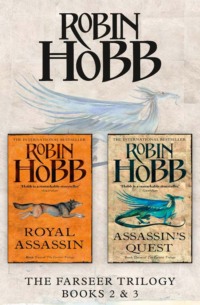
Kitabı oku: «The Farseer Series Books 2 and 3: Royal Assassin, Assassin’s Quest»
The Farseer Trilogy Books One and Two
Royal Assassin Book Two
Assassin’s Quest Book Three
Robin Hobb

Copyright
HarperVoyager An Imprint of HarperCollinsPublishers 77–85 Fulham Palace Road, Hammersmith, London W6 8JB
www.harpervoyagerbooks.com
Royal Assassin Copyright © Robin Hobb 1996
Assassin’s Quest Copyright © Robin Hobb 1997
Cover layout design © HarperCollinsPublishers Ltd
Robin Hobb asserts the moral right to be identified as the author of this work
All rights reserved under International and Pan-American Copyright Conventions. By payment of the required fees, you have been granted the nonexclusive, nontransferable right to access and read the text of this e-book on-screen. No part of this text may be reproduced, transmitted, downloaded, decompiled, reverse engineered, or stored in or introduced into any information storage and retrieval system, in any form or by any means, whether electronic or mechanical, now known or hereinafter invented, without the express written permission of HarperCollins e-books.
Ebook Edition © JUNE 2013 ISBN: 9780007531493
Version 2018-06-20
HarperCollinsPublishers has made every reasonable effort to ensure that any picture content and written content in this ebook has been included or removed in accordance with the contractual and technological constraints in operation at the time of publication.
Contents
Cover
Title Page
Copyright
Map
Royal Assassin
Assassin’s Quest
About the Author
Also by the Author
About the Publisher
Map


Royal Assassin
Book Two of the Farseer Trilogy
ROBIN HOBB
Dedication
For Giles
and for Raphael and Freddy,
the Princes of Assassins
Contents
Cover
Title Page
Dedication
Prologue
One: Siltbay
Two: The Homecoming
Three: Renewing Ties
Four: Dilemmas
Five: Gambit
Six: Forged Ones
Seven: Encounters
Eight: The Queen Awakes
Nine: Guards and Bonds
Ten: Fool’s Errand
Eleven: Lone Wolves
Twelve: Tasks
Thirteen: Hunting
Fourteen: Winterfest
Fifteen: Secrets
Sixteen: Verity’s Ships
Seventeen: Interludes
Eighteen: Elderlings
Nineteen: Messages
Twenty: Mishaps
Twenty-One: Dark Days
Twenty-Two: Burrich
Twenty-Three: Threats
Twenty-Four: Neatbay
Twenty-Five: Buckkeep
Twenty-Six: Skilling
Twenty-Seven: Conspiracy
Twenty-Eight: Treasons and Traitors
Twenty-Nine: Escapes and Captures
Thirty: Dungeons
Thirty-One: Torture
Thirty-Two: Execution
Thirty-Three: Wolf Days
Epilogue
Copyright
PROLOGUE
Dreams and Awakenings
Why is it forbidden to write down specific knowledge of the magics? Perhaps because we all fear that such knowledge would fall into the hands of one not worthy to use it. Certainly there has always been a system of apprenticeship to ensure that the understanding of magic is passed only to those trained and judged worthy of such knowledge. While this seems a laudable attempt to protect us from unworthy practitioners of arcane lore, it ignores the fact that the magics are not derived from this specific knowledge. The predilection for a certain type of magic is either inborn or lacking. For instance, the ability for the magics known as the Skill is tied closely to blood relationship to the royal Farseer line, though it may also occur as a ‘wild strain’ amongst folk whose ancestors came from both the Inland tribes and the Outislanders. One trained in the Skill is able to reach out to another’s mind, no matter how distant, and know what he is thinking. Those who are strongly Skilled can influence that thinking, or have converse with that person. For the conducting of a battle, or the gathering of information, it is a most useful tool.
Folklore tells of an even older magic, much despised now, known as the Wit. Few will admit a talent for this magic, hence it is always said to be the province of the folk in the next valley, or the ones who live on the other side of the far ridge. I suspect it was once the natural magic of those who lived on the land as hunters rather than as settled folk; a magic for those who felt kinship with the wild beasts of the woods. The Wit, it is said, gave one the ability to speak the tongues of the beasts. It was also warned that those who practised the Wit too long or too well became whatever beast they had bonded to. But this may be only legend.
There are the Hedge magics, though I have never been able to determine the source of this name, which are both verified and suspect, including palm reading, water gazing, the interpretation of crystal reflections, and a host of other skills that attempt to predict the future. In a separate unnamed category are the magics that cause physical effects, such as invisibility, levitation, giving motion or life to inanimate objects – all the magics of the old legends, from the Flying Chair of the Widow’s Son to the North Wind’s bewitched tablecloth. I know of no people who claim these magics as their own. They seem to be solely the stuff of legend, ascribed to folk living in ancient times or distant places, or beings of mythical or near mythical reputation: dragons, giants, the Elderlings, the Others, pecksies.
I pause to clean my pen. My writing wanders from spidery to blobbish on this poor paper. But I will not use good parchment for these words; not yet. I am not sure they should be written. I ask myself, why put this to paper at all? Will not this knowledge be passed down by word of mouth to those who are worthy? Perhaps. But perhaps not. What we take for granted now, the knowing of these things, may be a wonder and a mystery someday to our descendants.
There is very little in any of the libraries on magic. I work laboriously, tracing a thread of knowledge through a patchwork quilt of information. I find scattered references, passing allusions, but that is all. I have gathered it, over these last few years, and stored it in my head, always intending to commit my knowledge to paper. I will put down what I know from my own experience, as well as what I have ferreted out. Perhaps to provide answers for some other poor fool, in times to come, who might find himself as battered by the warring of the magics within him as I have been.
But when I sit down to the task, I hesitate. Who am I to set my will against the wisdom of those who have gone before me? Shall I set down in plain lettering the methods by which a Wit-gifted one can expand his range, or can bond a creature to himself? Shall I detail the training one must undergo before being recognized as a Skilled one? The hedge wizardries and legendary magics have never been mine. Have I any right to dig out their secrets and pin them to paper like so many butterflies or leaves collected for study?
I try to consider what one might do with such knowledge, unjustly gained. It leads me to consider what this knowledge has gained for me. Power, wealth, the love of a woman? I mock myself. Neither the Skill nor the Wit has ever offered any such to me. Or if they did, I had not the sense nor ambition to seize them when offered.
Power. I do not think I ever wanted it for its own sake. I thirsted for it, sometimes, when I was ground down, or when those close to me suffered beneath ones who abused their powers. Wealth. I never really considered it. From the moment that I, his bastard grandson, pledged myself to King Shrewd, he always saw to it that all my needs were fulfilled. I had plenty to eat, more education than I sometimes cared for, clothes both simple and annoyingly fashionable, and often enough a coin or two of my own to spend. Growing up in Buckkeep, that was wealth enough and more than most boys in Buckkeep Town could claim. Love? Well. My horse Sooty was fond of me, in her own placid way. I had the true-hearted loyalty of a hound named Nosy, and that took him to his grave. I was given the fiercest of loves by a terrier pup, and it was likewise the death of him. I wince to think of the price willingly paid for loving me.
Always I have possessed the loneliness of one raised amidst intrigues and clustering secrets, the isolation of a boy who can not trust the completeness of his heart to anyone. I could not go to Fedwren, the court scribe who praised me for my neat lettering and well-inked illustrations, and confide that I was already apprenticed to the Royal Assassin, and thus could not follow his writing trade. Nor could I divulge to Chade, my master in the diplomacy of the knife, the frustrating brutality I endured trying to learn the ways of the Skill from Galen the Skillmaster. And to no one did I dare speak openly of my emerging proclivity for the Wit, the ancient beast magic, said to be a perversion and a taint to any who used it.
Not even to Molly.
Molly was that most cherished of items: a genuine refuge. She had absolutely nothing to do with my day to day life. It was not just that she was female, though that was mystery enough to me. I was raised almost entirely in the company of men, bereft not only of my natural mother and father, but of any blood relations who would openly acknowledge me. As a child, my care was entrusted to Burrich, the gruff Stablemaster who had once been my father’s right-hand man. The stable hands and the guards were my daily companions. Then as now, there were women in the guard companies, though not so many then as now. But like their male comrades, they had duties to perform, and lives and families of their own when they were not on watch. I could not claim their time. I had no mother, nor sisters or aunts of my own. There were no women who offered me the special tenderness said to be the province of women.
None save Molly.
She was but a year or two older than myself, and growing the same way a sprig of greenery forces its way up through a gap in the cobblestones. Neither her father’s near constant drunkenness and frequent brutality nor the grinding chores of a child trying to maintain the pretence of both home and family business could crush her. When I first met her, she was as wild and wary as a fox cub. Molly Nosebleed she was called among the street children. She often bore the marks of the beatings her father gave her. Despite his cruelty, she cared for him. I never understood that. He would grumble and berate her even as she tottered him home after one of his binges and put him to bed. And when he awoke, he never had any remorse for his drunkenness and harsh words. There were only more criticisms: why hadn’t the chandlery been swept and fresh strewing herbs put on the floor? Why hadn’t she tended the bee hives, when they were nearly out of honey to sell? Why had she let the fire go out under the tallow pot? I was mute witness more times than I care to remember.
But through it all, Molly grew. She flowered, one sudden summer, into a young woman who left me in awe of her capable ways and womanly charms. For her part, she seemed totally unaware of how her eyes could meet mine and turn my tongue to leather in my mouth. No magic I possessed, no Skill, no Wit, was proof against the accidental touch of her hand against mine, nor could defend me against the awkwardness that overwhelmed me at the quirk of her smile.
Should I catalogue her hair flowing with the wind, or detail how the colour of her eyes shifted from dark amber to rich brown depending on her mood and the hue of her gown? I would catch a glimpse of her scarlet skirts and red shawl amongst the market throng, and suddenly be aware of no one else. These are magics I witnessed, and though I might set them down on paper, no other could ever work them with such skill.
How did I court her? With a boy’s clumsy gallantries, gaping after her like a simpleton watching the whirling discs of a juggler. She knew I loved her before I did. And she let me court her, although I was a few years younger than she, and not one of the town boys and possessed of small prospects as far as she knew. She thought I was the scribe’s errand boy, a part-time helper in the stables, a keep runner. She never suspected I was the Bastard, the unacknowledged son who had toppled Prince Chivalry from his place in the line of succession. That alone was a big enough secret. Of my magics and my other profession, she knew nothing.
Maybe that was why I could love her.
It was certainly why I lost her.
I let the secrets and failures and pains of my other lives keep me too busy. There were magics to learn, secrets to ferret out, men to kill, intrigues to survive. Surrounded by them, it never occurred to me that I could turn to Molly for a measure of the hope and understanding that eluded me everywhere else. She was apart from these things, unsullied by them. I carefully kept preserved from her any touch of them. I never tried to draw her into my world. Instead, I went to hers, to the fishing and shipping port town where she sold candles and honey in her shop, and shopped in the market and, sometimes, walked on the beaches with me. To me, it was enough that she existed for me to love. I did not even dare to hope she might return that feeling.
There came a time when my training in the Skill ground me into a misery so deep I did not think I could survive it. I could not forgive myself for being unable to learn it; I could not imagine that my failure might not matter to others. I cloaked my despair in surly withdrawal. I let the long weeks pass, and never saw her or even sent her word that I thought of her. Finally, when there was no one else that I could turn to, I sought her. Too late. I arrived at the Beebalm Chandlery in Buckkeep Town one afternoon, gifts in hand, in time to see her leaving. Not alone. With Jade, a fine broad-chested seaman, with a bold earring in one ear and the sure masculinity of his superior years. Unnoticed, defeated, I slunk away and watched them walk off arm in arm. I let her go, and in the months that followed, I tried to convince myself that my heart had let her go as well. I wonder what would have happened if I had run after them that afternoon, if I had begged one last word of her. Odd, to think of so many events turning upon a boy’s misplaced pride and his schooled acceptance of defeats. I set her out of my thoughts, and spoke of her to no one. I got on with my life.
King Shrewd sent me as his assassin with a great caravan of folk going to witness the pledging of the Mountain princess Kettricken as Prince Verity’s bride. My mission was quietly to cause the death of her older brother, Prince Rurisk, subtly of course, so that she would be left the sole heir to the Mountain throne. But what I found when I arrived there was a web of deceit and lies engineered by my youngest uncle, Prince Regal, who hoped to topple Verity from the line of succession and claim the princess as his own bride. I was the pawn he would sacrifice for this goal; and I was the pawn who instead toppled the game pieces around him, bringing his wrath and vengeance down on myself, but saving the crown and the princess for Prince Verity. I do not think this was heroism. Nor do I think it was petty spite wreaked on one who had always bullied and belittled me. It was the act of a boy becoming a man, and doing what I had sworn to do years before I knew the cost of such an oath. The price was my healthy young body, so long taken for granted.
Long after I had defeated Regal’s plot, I lingered in a sickbed in the Mountain Kingdom. But finally a morning came when I awoke and believed that my long illness was finally over. Burrich had decided I was recovered enough to begin the long journey back home to the Six Duchies. Princess Kettricken and her entourage had left for Buckkeep weeks before, when the weather was still fine. Now winter snows already smothered the higher parts of the Mountain Kingdom. If we did not leave Jhaampe soon, we would be forced to winter there. I was up early that morning, doing my final packing, when the first small tremors began. Resolutely, I ignored them. I was just shaky, I told myself, with not yet having eaten breakfast, and the excitement of the journey home. I donned the garments that Jonqui had furnished for our winter journey through the Mountains and across the plains. For me there was a long red shirt, padded with wool. The quilted trousers were green, but embroidered with red at the waist and cuffs. The boots were sacks of soft leather, almost shapeless until my feet were laced inside them, padded with sheared wool and trimmed with fur. They fastened to the feet with long wrappings of leather strips. My trembling fingers made tying them a difficult task. Jonqui had told us they were wonderful for the dry snow of the mountains, but to beware of getting them wet. There was a looking glass in the room. At first, I smiled at my reflection. Not even King Shrewd’s Fool dressed as gaily as this. But above the bright garments, my face was thin and pale, making my dark eyes too large, while my fever-shorn hair, black and bristly, stood up like a dog’s hackles. My illness had ravaged me. But I told myself I was finally on my way home. I turned aside from the mirror. As I packed the few small gifts I had selected to take home to my friends, the unsteadiness grew in my hands.
For the last time, Burrich, Hands and I sat down to break fast with Jonqui. I thanked her once again for all she had done towards healing me. I picked up a spoon for the porridge, and my hand gave a twitch. I dropped it. I watched the silvery shape fall and fell after it.
The next thing I remember is the shadowy corners of the bedroom. I lay for a long time, not moving or speaking. I went from a state of emptiness to knowing I had had another seizure. It had passed; both body and mind were mine to command once more. But I no longer wanted them. At fifteen years old, an age when most were coming into their full strength, I could no longer trust my body to perform the simplest task. It was damaged, and I rejected it fiercely. I felt savagely vindictive toward the flesh and bone that enclosed me, and wished for some way to express my raging disappointment. Why couldn’t I heal? Why hadn’t I recovered?
‘It’s going to take time, that’s all. Wait until half a year has passed since the day you were damaged. Then assess yourself.’ It was Jonqui the healer. She was sitting near the fireplace, but her chair was drawn back into the shadows. I hadn’t noticed her until she spoke. She rose slowly, as if the winter made her bones ache, and came to stand beside my bed.
‘I don’t want to live like an old man.’
She pursed her lips. ‘Sooner or later, you will have to. At least, I so wish that you will survive that many years. I am old, and so is my brother King Eyod. We do not find it so great a burden.’
‘I should not mind an old man’s body if the years had earned it for me. But I can’t go on like this.’
She shook her head, puzzled. ‘Of course you can. Healing is tedious sometimes, but to say that you cannot go on … I do not understand. It is, perhaps, a difference in our languages?’
I took a breath to speak, but at that moment Burrich came in. ‘Awake? Feeling better?’
‘Awake. Not feeling better,’ I grumbled. Even to myself, I sounded like a fretful child.
Burrich and Jonqui exchanged glances over me. She came to the bedside, patted my shoulder, and then left the room silently. Their obvious tolerance was galling, and my impotent anger rose like a tide. ‘Why can’t you heal me?’ I demanded of Burrich.
He was taken aback by the accusation in my question. ‘It’s not that simple,’ he began.
‘Why not?’ I hauled myself up straight in the bed. ‘I’ve seen you cure all manner of ailments in beasts. Sickness, broken bones, worms, mange … you’re Stablemaster, and I’ve seen you treat them all. Why can’t you cure me?’
‘You’re not a dog, Fitz,’ Burrich said quietly. ‘It’s simpler with a beast, when it’s seriously ill. I’ve taken drastic measures, sometimes, telling myself, well, if the animal dies, at least it’s not suffering any more, and this may heal it. I can’t do that with you. You’re not a beast.’
‘That’s no answer! Half the time the guards come to you instead of the healer. You took the head of an arrow out of Den. You laid his whole arm open to do it! When the healer said that Greydin’s foot was too infected and she’d have to lose it, she came to you, and you saved it. And all the time the healer was saying the infection would spread and she’d die and it would be your fault.’
Burrich folded his lips, quelling his temper. If I’d been healthy, I’d have been wary of his wrath. But his restraint with me during my convalescence had made me bold. When he spoke, his voice was quiet and controlled. ‘Those were risky healings, yes. But the folk who wanted them done knew the risks. And,’ he said, raising his voice to cover the objection I’d been about to voice, ‘they were simple things. I knew the cause. Take out the arrow head and haft from his arm and clean it up. Poultice and draw the infection from Greydin’s foot. But your sickness isn’t that simple. Neither Jonqui nor I really know what’s wrong with you. Is it the aftermath of the poison Kettricken fed you when she thought you had come to kill her brother? Is this the effect of the poisoned wine that Regal arranged for you? Or is it from the beating you took afterward? From being near drowned? Or did all those things combine to do this to you? We don’t know, and so we don’t know how to cure you. We just don’t know.’
His voice clenched on his last words, and I suddenly saw how his sympathy for me overlay his frustration. He paced a few steps, then halted to stare into the fire. ‘We’ve talked long about it. Jonqui has much in her mountain lore that I have never heard of before. And I’ve told her of cures I know. But we both agreed the best thing to do was give you time to heal. You’re in no danger of dying that we can see. Possibly, in time, your own body can cast out the last vestiges of the poison, or heal whatever damage was done inside you.’
‘Or,’ I added quietly, ‘it’s possible that I’ll be this way the rest of my life. That the poison or the beating damaged something permanently. Damn Regal, to kick me like that when I was trussed already.’
Burrich stood as if turned to ice. Then he sagged into the chair in the shadows. Defeat was in his voice. ‘Yes. That is just as possible as the other. But don’t you see we have no choice? I could physick you to try to force the poison out of your body. But if it’s damage, not poison, all I would do was weaken you so that your body’s own healing would take that much longer.’ He stared into the flames, and lifted a hand to touch a streak of white at his temple. I was not the only one who’d fallen to Regal’s treachery. Burrich himself was but newly recovered from a skull blow that would have killed anyone less thick-headed than he. I knew he had endured long days of dizziness and blurred vision. I did not recall he had complained at all. I had the decency to feel a bit of shame.
‘So what do I do?’
Burrich started as if roused from dozing. ‘What we’ve been doing. Wait. Eat. Rest. Be easy on yourself. And see what happens. Is that so terrible?’
I ignored his question. ‘And if I don’t get better? If I just stay like this, where the tremors or fits can come over me at any time?’
His answer was slow in coming. ‘Live with it. Many folk have to live with worse. Most of the time, you’re fine. You’re not blind. You’re not paralyzed. You’ve your wits, still. Stop defining yourself by what you can’t do. Why don’t you consider what you didn’t lose?’
‘What I didn’t lose? What I didn’t lose?’ My anger rose like a covey of birds taking flight and likewise driven by panic. ‘I’m helpless, Burrich. I can’t go back to Buckkeep like this! I’m useless. I’m worse than useless, I’m a waiting victim. If I could go back and batter Regal into a pulp, that might be worth it. Instead, I will have to sit at table with Prince Regal, to be civil and deferential to a man who plotted to overthrow Verity and kill me as an added spice. I can’t endure him seeing me tremble with weakness, or suddenly fall in a seizure. I don’t want to see him smile at what he has made me; I don’t want to watch him savour his triumph. He will try to kill me again. We both know that. Perhaps he has learned he is no match for Verity, perhaps he will respect his older brother’s reign and new wife. But I doubt he will extend that to me. It’ll be one more way he can strike at Verity. And when he comes, what shall I be doing? Sitting by the fire like a palsied old man, doing nothing. Nothing! All I’ve been trained for, all Hod’s weaponry instruction, all Fedwren’s careful teachings about lettering, even all you’ve taught me about taking care of beasts! All a waste! I can do none of it. I’m just a bastard again, Burrich. And someone once told me that a royal bastard is kept alive only so long as he is useful.’ I was practically shouting, but even in my fury and despair, I did not speak aloud of Chade and my training as an assassin. At that, too, I was useless now. All my stealth and sleight of hand, all the precise ways to kill a man by touch, the painstaking mixing of poisons, all were denied me by my own rattling body.
Burrich sat quietly, hearing me out. When my breath and my anger ran out and I sat gasping in my bed, clasping my traitorously trembling hands together, he spoke calmly.
‘So. Are you saying we don’t go back to Buckkeep?’
That put me off balance. ‘We?’
‘My life is pledged to the man who wears that earring. There’s a long story behind that, one that perhaps I’ll tell you someday. Patience had no right to give it to you. I thought it had gone with Prince Chivalry to his grave. She probably thought it just a simple piece of jewellery her husband had worn, hers to keep or to give. In any wise, you wear it now. Where you go, I follow.’
I lifted my hand to the bauble. It was a tiny blue stone caught up in a web of silver net. I started to unfasten it.
‘Don’t do that,’ Burrich said. The words were quiet, deeper than a dog’s growl. But his voice held both threat and command. I dropped my hand away, unable to question him on this at least. I felt strange that the man who had watched over me since I was an abandoned child now put his future into my hands. Yet there he sat before the fire and waited for my words. I studied what I could see of him in the dance of the firelight. He had once seemed a surly giant to me, dark and threatening, but also a savage protector. Now, for perhaps the first time, I studied him as a man. The dark hair and eyes were prevalent in those who carried Outislander blood, and in this we resembled each other. But his eyes were brown, not black, and the wind brought a redness to his cheeks above his curling beard that bespoke a fairer ancestor somewhere. When he walked, he limped, very noticeably on cold days, the legacy of turning aside a boar that had been trying to kill Chivalry. He was not as big as he had once seemed to me. If I kept on growing, I would probably be taller than he was before another year was out. Nor was he massively muscled, but instead had a compactness to him that was a readiness of both muscle and mind. It was not his size that had made him both feared and respected at Buckkeep, but his black temper and his tenacity. Once, when I was very young, I had asked him if he had ever lost a fight. He had just subdued a wilful young stallion and was in the stall with him, calming him. Burrich had grinned, teeth showing white as a wolf’s. The sweat had stood out in droplets on his forehead and was running down his cheeks into his dark beard. He spoke to me over the side of the stall. ‘Lost a fight?’ he’d asked, still out of breath. ‘The fight isn’t over until you win it, Fitz. That’s all you have to remember. No matter what the other man thinks. Or the horse.’
I wondered if I were a fight he had to win. He’d often told me that I was the last task Chivalry had given him. My father had abdicated the throne, shamed by my existence. Yet he’d given me over to this man, and told him to raise me well. Maybe Burrich thought he hadn’t finished that task yet.
‘What do you think I should do?’ I asked humbly. Neither the words nor the humility came easily.
‘Heal,’ he said after a few moments. ‘Take the time to heal. It can’t be forced.’ He glanced down at his own legs stretched toward the fire. Something not a smile twisted his lips.
‘Do you think we should go back?’ I pressed.
He leaned back into the chair. He crossed his booted feet at the ankle and stared into the fire. He took a long time answering. But finally he said, almost reluctantly, ‘If we don’t, Regal will think he has won. And he will try to kill Verity. Or at least do whatever he thinks he must to make a grab for his brother’s crown. I am sworn to my king, Fitz, as are you. Right now that is King Shrewd. But Verity is King-in-Waiting. I don’t think it right that he should have waited in vain.’
‘He has other soldiers more capable than I.’
‘Does that free you from your promise?’
‘You argue like a priest.’
‘I don’t argue at all. I merely asked you a question. And one other. What do you forsake, if you leave Buckkeep behind?’
It was my turn to fall silent. I did think of my king, and all I had sworn to him. I thought of Prince Verity and his bluff heartiness and open ways with me. I recalled old Chade and his slow smile when I had finally mastered some arcane bit of lore. Lady Patience and her maid Lacey, Fedwren and Hod, even Cook and Mistress Hasty the seamstress. There were not so many folk that had cared for me, but that made them more significant, not less. I would miss all of them if I never went back to Buckkeep. But what leaped up in me like an ember rekindled was my memory of Molly. And somehow, I found myself speaking of her to Burrich, and him just nodding as I spilled out the whole story.
When he did speak, he told me only that he had heard that the Beebalm Chandlery had closed when the old drunkard that owned it had died in debt. His daughter had been forced to go to relatives in another town. He did not know what town, but he was certain I could find it out, if I were determined. ‘Know your heart before you do, Fitz,’ he added. ‘If you’ve nothing to offer her, let her go. Are you crippled? Only if you decide so. But if you’re determined that you’re a cripple now, then perhaps you’ve no right to go and seek her out. I don’t think you’d want her pity. It’s a poor substitute for love.’ And then he rose and left me to stare into the fire and think.
Was I a cripple? Had I lost? My body jangled like badly-tuned harp strings. That was true. But my will, not Regal’s, had prevailed. My Prince Verity was still in line for the Six Duchies throne, and the Mountain princess was his wife now. Did I dread him smirking over my trembling hands? Could I not smirk back at he who would never be king? A savage satisfaction welled up in me. Burrich was right. I had not lost. But I could make sure that Regal knew I had won.
If I had won against Regal, could I not win Molly as well? What stood between her and me? Jade? But Burrich had heard she had left Buckkeep Town, not wed. Gone penniless to live with relatives. Shame upon him, had Jade let her do so. I would seek her out, I would find her and win her. Molly, with her hair loose and blowing, Molly with her bright red skirts and cloak, bold as a red-robber bird, and eyes as bright. The thought of her sent a shiver down my spine. I smiled to myself, and then felt my lips set like a rictus, and the shiver became a shuddering. My body spasmed and the back of my head rebounded sharply off the bedstead. I cried out involuntarily, a gargling wordless cry.
In an instant Jonqui was there, calling Burrich back, and then they were both holding down my flailing limbs. Burrich’s body weight was flung on top of me as he strove to restrain my thrashing. And then I was gone.
I came out of blackness into light, like surfacing from a deep dive into warm waters. The down of the feather bed cradled me, the blankets were soft and warm. I felt safe. For a moment, all was peaceful. I lay quiescent, almost feeling good.
‘Fitz?’ Burrich asked, leaning over me.
The world came back. I knew myself a mangled, pitiful thing, a puppet with half its strings tangled or a horse with a severed tendon. I would never be as I was before; there was no place left for me in the world I had once inhabited. Burrich had said, pity is a poor substitute for love. I wanted pity from none of them.
‘Burrich.’
He leaned closer over me. ‘It wasn’t that bad,’ he lied. ‘Just rest now. Tomorrow …’
‘Tomorrow you leave for Buckkeep,’ I told him.
He frowned. ‘Let’s take it slowly. Give yourself a few days to recover, and then we’ll …’
‘No.’ I dragged myself up to a sitting position. I put every bit of strength I had into the words. ‘I’ve made a decision. Tomorrow you will go back to Buckkeep. There are people and animals waiting for you there. You’re needed. It’s your home and your world. But it’s not mine. Not any more.’
He was silent for a long moment. ‘And what will you do?’
I shook my head. ‘That’s no longer your concern. Or anyone’s, save mine.’
‘The girl?’
I shook my head again, more violently. ‘She’s taken care of one cripple already, and spent her youth doing so only to find that he left her a debtor. Shall I go back and seek her out, like this? Shall I ask her to love me, so I can be a burden to her like her father was? No. Alone or wed to another, she’s better off now as she is.’
The silence stretched long between us. Jonqui was busy in a corner of the room, concocting yet another herbal draught that would do nothing for me. Burrich stood over me, black and lowering as a thundercloud. I knew how badly he wanted to shake me, how he longed to cuff the stubbornness from me. But he did not. Burrich did not hit cripples.
‘So,’ he said at last. ‘That leaves only your king. Or do you forget you are sworn as a King’s Man?’
‘I do not forget,’ I said quietly. ‘And did I believe myself a man still, I would go back. But I am not, Burrich. I am a liability. On the gameboard, I have become but one of those tokens that must be protected. A hostage for the taking, powerless to defend myself or anyone else. No. The last act I can make as a King’s Man is to remove myself, before someone else does and injures my king in the doing.’
Burrich turned aside from me. He was a silhouette in the dim room, his face unreadable by the firelight. ‘Tomorrow we will talk,’ he began.
‘Only to say farewell,’ I interrupted. ‘My heart is firm on this, Burrich.’ I reached up to touch the earring in my ear.
‘If you stay, then so must I.’ There was a fierceness in his low voice.
‘That isn’t how it works,’ I told him. ‘Once, my father told you to stay behind, and raise a bastard for him. Now I tell you to leave, to go to serve a king who still needs you.’
‘FitzChivalry, I don’t –’
‘Please.’ I don’t know what he heard in my voice. Only that he was suddenly still. ‘I am so tired. So damnably tired. The only thing I know is that I can’t live up to what every one else thinks I should do. I just can’t do it.’ My voice quavered like an old man’s. ‘No matter what I ought to do. No matter what I am pledged to do. There isn’t enough of me left to keep my word. Maybe that’s not right, but that’s how it is. Every one else’s plans. Every one else’s goals. Never mine. I tried, but …’ The room rocked around me as if someone else were speaking, and I was shocked at what he was saying. But I couldn’t deny the truth of his words. ‘I need to be alone now. To rest,’ I said simply.
Both of them just looked at me. Neither one of them spoke. They left the room, slowly, as if hoping I would relent and call them back. I did not.
But after they had gone, and I was alone, I permitted myself to breathe out. I felt dizzy with the decision I had made. I wasn’t going back to Buckkeep. What I was going to do, I had no idea. I had swept my broken bits of life from the game table. Now there was room to set out anew what pieces I still had, to plot a new strategy for living. Slowly, I realized I had no doubts. Regrets warred with relief, but I had no doubts. Somehow it was much more bearable to move forward into a life where no one would recall who I had once been. A life not pledged to someone else’s will. Not even my king’s. It was done. I lay back in my bed, and for the first time in weeks, I relaxed completely. Farewell, I thought wearily. I would have liked to wish them all farewell, to stand one last time before Verity and see his brief nod that I had done well. Perhaps I could have made him understand why I did not wish to go back. It was not to be. It was done now, all done. ‘I am sorry, my king,’ I muttered. I stared into the dancing flames in the hearth until sleep claimed me.
ONE
Siltbay
To be the King-in-Waiting, or the Queen-in-Waiting, is to straddle firmly the fence between responsibility and authority. It is said that the position was created to satisfy the ambitions of an heir for power, while schooling him in the exercising of it. The eldest child in the royal family assumes this position upon its sixteenth birthday. From that day on, the King- or Queen-in-Waiting assumes a full share of responsibility for the running of the Six Duchies. Generally, he immediately assumes such duties as the ruling monarch cares for least, and these have varied greatly from reign to reign.
Under King Shrewd, Prince Chivalry first became King-in-Waiting. To him, King Shrewd ceded over all that had to do with the borders and frontiers: warfare, negotiations and diplomacy, the discomforts of extended travel and the miserable conditions often encountered on the campaigns. When Chivalry abdicated and Prince Verity became King-in-Waiting, he inherited all the uncertainties of the war with the Outislanders, and the civil unrest this situation created between the Inland and Coastal duchies. All of these tasks were rendered more difficult in that, at any time, his decisions could be overridden by the King. Often he was left to cope with a situation not of his creating, armed only with options not of his choosing.
Even less tenable, perhaps, was the position of Queen-in-Waiting Kettricken. Her Mountain ways marked her as a foreigner in the Six Duchies court. In peaceful times, perhaps she would have been received with more tolerance. But the court at Buckkeep seethed with the general unrest of the Six Duchies. The Red Ships from the Outislands harried our shoreline as they had not for generations, destroying far more than they stole. The first winter of Kettricken’s reign as Queen-in-Waiting saw also the first winter raiding we had ever experienced. The constant threat of raids, and the lingering torment of Forged ones in our midst rocked the foundations of the Six Duchies. Confidence in the monarchy was low, and Kettricken had the unenviable position of being an unadmired King-in-Waiting’s outlandish queen.
Civil unrest divided the court as the Inland duchies voiced their resentment at taxes to protect a coastline they did not share. The Coastal duchies cried out for warships and soldiers and an effective way to battle the raiders that always struck where we were least prepared. Inland-bred Prince Regal sought to gather power to himself by courting the Inland dukes with gifts and social attentions. King-in-Waiting Verity, convinced that his Skill was no longer sufficient to hold the raiders at bay, put his attentions to building warships to guard the Coastal duchies, with little time for his new queen. Over all, King Shrewd crouched like a great spider, endeavouring to keep power spread amongst himself and his sons, to keep all in balance and the Six Duchies intact.
I awakened to someone touching my forehead. With an annoyed grunt, I turned my head aside from the touch. My blankets were weltered around me; I fought my way clear of their restraint and then sat up to see who had dared disturb me. King Shrewd’s Fool perched anxiously on a chair beside my bed. I stared at him wildly, and he drew back from my look. Uneasiness assailed me.
The Fool should have been back in Buckkeep, with the King, many miles and days from here. I had never known him to leave the King’s side for more than a few hours or a night’s rest. That he was here boded no good. The Fool was my friend, as much as his strangeness allowed him to be friends with anyone. But a visit from him always had a purpose, and such purposes were seldom trivial or pleasant. He looked as weary as I had ever seen him. He wore an unfamiliar motley of greens and reds and carried a fool’s sceptre with a rat’s head on it. The gay garments contrasted too strongly with his colourless skin, making him a translucent candle wreathed in holly. His clothing seemed more substantial than he did. His fine, pale hair floated from the confines of his cap like a drowned man’s hair in sea water, while the dancing flames of the fireplace shone in his eyes. I rubbed my gritty eyes and pushed some of the hair back from my face. It was damp; I’d been sweating in my sleep.
‘Hello,’ I managed. ‘I didn’t expect to see you here.’ My mouth felt dry, my tongue thick and sour. I’d been sick, I recalled. The details seemed hazy.
‘Where else?’ He looked at me woefully. ‘For every hour you’ve slept, the less rested you seem. Lie back, my lord. Let me make you comfortable.’ He plucked at my pillows fussily, but I waved him away. Something was wrong here. Never had he spoken me so fair. Friends we were, but the Fool’s words to me were always as pithy and sour as half-ripened fruit. If this sudden kindness was a show of pity, I wanted none of it.
I glanced down at my embroidered nightshirt, at the rich bedcovers. Something seemed odd about them. I was too tired and weak to puzzle it out. ‘What are you doing here?’ I asked him.
He took a breath and sighed. ‘I am tending you. Watching over you while you sleep. I know you think it foolish, but then, I am the Fool. You know then that I must be Foolish. Yet you ask me this same thing every time you awake. Let me then propose something wiser. I beg you, my lord, let me send for another healer.’
I leaned back against my pillows. They were sweat-damp, and smelled sour to me. I knew I could ask the Fool to change them and he would, but I would just sweat anew if he did. It was useless. I clutched at my covers with gnarled fingers and asked him bluntly, ‘Why have you come here?’
He took my hand in his and patted it. ‘My lord, I mistrust this sudden weakness. You seem to take no good from this healer’s ministrations. I fear that his knowledge is much smaller than his opinion of it.’
‘Burrich?’ I asked incredulously.
‘Burrich? Would that he were here, my lord! He may be the Stablemaster, but for all that, I warrant he is more of a healer than this Wallace who doses and sweats you.’
‘Wallace? Burrich is not here?’
The Fool’s face grew graver. ‘No, my king. He remained in the mountains, as well you know.’
‘Your king,’ I said, and attempted to laugh. ‘Such mockery.’
‘Never, my lord,’ he said gently. ‘Never.’
His tenderness confused me. This was not the Fool I knew, full of twisting words and riddles, of sly jabs and puns and cunning insults. I felt suddenly stretched thin as old rope, and as frayed. Still, I tried to piece things together. ‘Then I am in Buckkeep?’
He nodded slowly. ‘Of course you are.’ Worry pinched his mouth.
I was silent, plumbing the full depth of my betrayal. Somehow I had been returned to Buckkeep. Against my will. Burrich had not even seen fit to accompany me.
‘Let me get you some food,’ the Fool begged me. ‘You always feel better after you have eaten.’ He rose. ‘I brought it up hours ago. I’ve kept it warm by the hearth.’
My eyes followed him wearily. At the big hearth he crouched to coax a covered tureen away from the edge of the fire. He lifted the lid and I smelled the rich beef stew. He began to ladle it into a bowl. It had been months since I’d had beef. In the mountains, it was all venison and mutton and goat’s flesh. My eyes wandered wearily about the room. The heavy tapestries, the massive wooden chairs. The heavy stones of the fireplace, the richly worked bed-hangings. I knew this place. This was the King’s bedchamber at Buckkeep. Why was I here, in the King’s own bed? I tried to ask the Fool, but another spoke with my lips. ‘I know too many things, Fool. I can no longer stop myself from knowing them. Sometimes it is as if another controlled my will, and pushed my mind where I would rather it did not go. My walls are breached. It all pours in like a tide.’ I drew a deep breath, but I could not stave it off. First a chill tingling, then as if I were immersed in a swift flowing of cold water. ‘A rising tide,’ I gasped. ‘Bearing ships. Red-keeled ships …’
The Fool’s eyes widened in alarm. ‘In this season, your majesty? Surely not! Not in winter!’
My breath was pressed tight in my chest. I struggled to speak. ‘The winter has crept in too softly. She has spared us both her storms and her protection. Look. Look out there, across the water. See? They come. They come from the fog.’
I lifted my arm to point. The Fool came hastily, to stand beside me. He crouched to peer where I pointed, but I knew he could not see. Still, he loyally placed a hesitant hand on my thin shoulder, and stared as if he could will away the walls and the miles that stood between him and my vision. I longed to be as blind as he. I clasped the long-fingered, pale hand that rested on my shoulder. For a moment I looked down at my withered hand, at the royal signet ring that clung to a bony finger behind a swollen knuckle. Then my reluctant gaze was drawn up and my vision taken afar.
My pointing hand indicated the quiet harbour. I struggled to sit up taller, to see more. The darkened town spread out before me like a patchwork of houses and roads. Fog lay in hollows and was thick upon the bay. Weather change coming, I thought to myself. Something stirred in the air that chilled me, cooling the old sweat on my skin so that I shivered. Despite the blackness of the night and the fog, I had no difficulty in seeing everything perfectly. Skill-watching I told myself, and then wondered. I could not Skill, not predictably, not usefully.
But as I watched, two ships broke out of the mists and emerged into the sleeping harbour. I forgot what I could or could not do. They were sleek and trim, those ships, and though they were black under the moonlight, I knew their keels were red. Red Ship Raiders from the Outislands. The ships moved like knives through the wavelets, cutting their way clear of the fog, slicing into the protected water of the harbour like a thin blade slicing into a pig’s belly. The oars moved silently, in perfect unison, oarlocks muffled with rags. They came alongside the docks as boldly as honest merchants come to trade. From the first boat, a sailor leaped lightly, carrying a line to make fast to a piling. An oarsman fended her off the dock until the aft line was thrown and made fast as well. All so calmly, so blatantly. The second ship was following their example. The dreaded Red Ships had come into town, bold as gulls, and tied up at their victims’ home dock.
No sentry cried out. No watchman blew a horn, or threw a torch onto a waiting heap of pitchpine to kindle a signal fire. I looked for them, and instantly found them. Heads on chests, they were idling at their posts. Good woollen homespun had gone from grey to red sopping up the blood of their slit throats. Their killers had come quietly, overland, sure of each sentry post, to silence every watcher. No one would warn the sleeping town.
There had not been that many sentries. There was not much to this little town, scarce enough to deserve a dot on the map. The town had counted on the humbleness of its possessions to shelter it from raids such as this. Good wool they grew there, and they spun a fine yarn, it was true. They harvested and smoked the salmon that came right up their river, and the apples here were tiny but sweet, and they made a good wine. There was a fine clam beach to the west of town. These were the riches of Siltbay, and if they were not great, they were enough to make life treasured by those who lived here. Surely, though, they were not worth coming after with a torch and a blade. What sane man would think a keg of apple wine or a rack of smoked salmon worth a raider’s time?
But these were Red Ships, and they did not come to raid for wealth or treasures. They were not after prize breeding cattle or even women for wives or boys for galley slaves. The wool-fat sheep would be mutilated and slaughtered, the smoked salmon trampled underfoot, the warehouses of fleeces and wines torched. They would take hostages, yes, but only to Forge them. The Forge magic would leave them less than human, bereft of all emotions and any but the most basic thoughts. The Raiders would not keep these hostages, but would abandon them here, to work their debilitating anguish upon those who had loved them and called them kin. Stripped of every human sensitivity, Forged ones would scour their homeland as pitilessly as wolverines. This setting of our own kin to prey upon us as Forged ones was the Outislanders’ cruellest weapon. This I already knew as I watched. I had seen the aftermath of other raids.
I watched the tide of death rise to inundate the little town. The Outislander pirates leaped from the ship to the docks and flowed up into the village. They trickled silently up the streets in bands of twos and threes, as deadly as poison unfurling in wine. Some few paused to search the other vessels tied to the dock. Most of the boats were small open dories, but there were two larger fishing vessels and one trader. Their crews met swift death. Their frantic struggles were as pathetic as fowl flapping and squawking when a weasel gets into the chicken house. They called out to me with voices full of blood. The thick fog gulped their cries greedily. It made the death of a sailor no more than the keening of a sea bird. Afterwards, the boats were torched, carelessly, with no thought to their value as spoils. These raiders took no real booty. Perhaps a handful of coins if easily found, or a necklace from the body of one they had raped and killed, but little more than that.
I could do nothing except watch. I coughed heavily, then found a breath to speak. ‘If only I could understand them,’ I said to the Fool. ‘If only I knew what they wanted. There is no sense to these Red Ships. How can we fight those who war for a reason they will not divulge? But if I could understand them …’
The Fool pursed his pale lips and considered. ‘They partake of the madness of he who drives them. They can only be understood if you share that madness. I myself have no wish to understand them. Understanding them will not stop them.’
‘No.’ I did not want to watch the village. I had seen this nightmare too often. But only a heartless man could have turned away as if it were a poorly-staged puppet show. The least I could do for my people was to watch them die. It also was the most I could do for them. I was sick and a cripple, an old man far away. No more could be expected from me. So I watched.
I watched the little town awaken from soft sleep to the rough grip of a strange hand on the throat or breast, to a knife over a cradle, or the sudden cry of a child dragged from sleep. Lights began to flicker and glow throughout the village; some were candles kindled on hearing a neighbour’s outcry; others were torches or burning houses. Although the Red Ships had terrorized the Six Duchies for over a year, for these folk it became completely real tonight. They had thought they were prepared. They had heard the horror stories, and resolved never to let it happen to them. But still the houses burned and the screams rose to the night sky as if borne on the smoke.
‘Speak, Fool,’ I commanded hoarsely. ‘Remember forward for me. What do they say about Siltbay? A raid on Siltbay, in winter.’
He took a shuddering breath. ‘It is not easy, nor clear,’ he hesitated. ‘All wavers, all is change still. Too much is in flux, your majesty. The future spills out in all directions there.’
‘Speak any you can see,’ I commanded.
‘They made a song about this town,’ the Fool observed hollowly. He gripped my shoulder still; through my nightshirt, the clutch of his long, strong fingers was cold. A trembling passed between us and I felt how he laboured to continue standing beside me. ‘When it is sung in a tavern, with the refrain hammered out to the beat of ale mugs upon a table, none of this seems so bad. One can imagine the brave stand these folks made, going down fighting rather than surrendering. Not one, not one single person, was taken alive and Forged. Not one.’ The Fool paused. A hysterical note mingled with the levity he forced into his voice. ‘Of course, when you’re drinking and singing, you don’t see the blood. Or smell the burning flesh. Or hear the screams. But that’s understandable. Have you ever tried to find a rhyme for “dismembered child”? Someone once tried “remembered wild” but the verse still didn’t quite scan.’ There was no merriment in his banter. His bitter jests could shield neither him nor me. He fell silent once more, my prisoner doomed to share his painful knowledge with me.
I witnessed in silence. No verse would tell of a parent pushing a poison pellet into a child’s mouth to keep him from the Raiders. No one could sing of children crying out with the cramps of the swift, harsh poison, or the women who were raped as they lay dying. No rhyme nor melody could bear the weight of telling of archers whose truest arrows slew captured kinfolk before they could be dragged away. I peered into the interior of a burning house. Through the flames, I watched a ten-year-old boy bare his throat for the slash of his mother’s knife. He held the body of his baby sister, strangled already, for the Red Ships had come, and no loving brother would give her to either the Raiders or the voracious flames. I saw the mother’s eyes as she lifted her children’s bodies and carried them into the flames with her. Such things are better not remembered. But I was not spared the knowledge. It was my duty to know these things, and to recall them.
Not all died. Some fled into the surrounding fields and forests. I saw one young man take four children under the docks with him, to cling in the chill water to the barnacled pilings until the raiders left. Others tried to flee and were slain as they ran. I saw a woman in a nightgown slip from a house. Flames were already running up the side of the building. She carried one child in her arms and another clung to her skirts and followed her. Even in the darkness, the light from the fired huts awoke burnished highlights in her hair. She glanced about fearfully, but the long knife she carried in her free hand was up and at the ready. I caught a glimpse of a small mouth set grimly, eyes narrowed fiercely. Then, for an instant, I saw that proud profile limned against firelight. ‘Molly!’ I gasped. I reached a clawed hand to her. She lifted a door and shooed the children down into a root cellar behind the blazing home. She lowered the door silently over them all. Safe?
No. They came around the corner, two of them. One carried an axe. They were walking slowly, swaggering and laughing aloud. The soot that smeared their faces made their teeth and the whites of their eyes stand out. One was a woman. She was very beautiful, laughing as she strode. Fearless. Her hair was braided back with silver wire. The flames winked red in it. The Raiders advanced to the door of the root cellar, and the one swung his axe in a great arcing blow. The axe bit deep into the wood. I heard the terrified cry of a child. ‘Molly!’ I shrieked. I scrabbled from my bed, but had no strength to stand. I crawled toward her.
The door gave way, and the Raiders laughed. One died laughing as Molly came leaping through the shattered remnants of the door to put her long knife into his throat. But the beautiful woman with the shining silver in her hair had a sword. And as Molly struggled to pull her knife clear of the dying man, that sword was falling, falling, falling.
At that instant, something gave way in the burning house with a sharp crack. The structure swayed and then fell in a shower of sparks and an upburst of roaring flames. A curtain of fire soared up between me and the root cellar. I could see nothing through that inferno. Had it fallen across the door of the root cellar and the Raiders attacking it? I could not see. I lunged forth, reaching out for Molly.
But in an instant, all was gone. There was no burning house, no pillaged town, no violated harbour, no Red Ships. Only myself, crouching by the hearth. I had thrust my hand into the fire and my fingers clutched a coal. The Fool cried out and seized my wrist to pull my hand from the fire. I shook him off, then looked at my blistered fingers dully.
‘My king,’ the Fool said woefully. He knelt beside me, carefully moved the tureen of soup by my knee. He moistened a napkin in the wine he had poured for my meal, and folded it over my fingers. I let him. I could not feel the burned skin for the great wound inside me. His worried eyes stared into mine. I could scarcely see him. He seemed an insubstantial thing, with the faltering flames of the fireplace showing in his colourless eyes. A shadow like all the other shadows that came to torment me.
My burned fingers throbbed suddenly. I clutched them in my other hand. What had I been doing, what had I been thinking? The Skill had come on me like a fit, and then departed, leaving me as drained as an empty glass. Weariness flowed in to fill me, and pain rode it like a horse. I struggled to retain what I had seen. ‘What woman was that? Is she important?’
‘Ah.’ The Fool seemed even wearier, but struggled to gather himself. ‘A woman at Siltbay?’ He paused as if racking his brains. ‘No. I have nothing. It is all a muddle, my king. So hard to know.’
‘Molly has no children,’ I told him. ‘It could not have been her.’
‘Molly?’
‘Her name is Molly?’ I demanded. My head throbbed. Anger suddenly possessed me. ‘Why do you torment me like this?’
‘My lord, I know of no Molly. Come. Come back to your bed, and I will bring you some food.’
He helped me to my feet and I tolerated his touch. I found my voice. I floated, the focus of my eyes coming and going. One moment I could feel his hand on my arm, the next it seemed as if I dreamed the room and the men who spoke there. I managed to speak. ‘I have to know if that was Molly. I have to know if she is dying. Fool, I have to know.’
Ücretsiz ön izlemeyi tamamladınız.