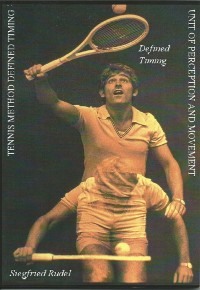
Kitabı oku: «Tennis Method - Defined Timing»
Siegfried Rudel
Tennis Method - Defined Timing
Unit of Perception and Movement
Translated from the original German by
Jürgen Schiffer
1. Edition - 1999
ISBN 9783000042966
PREFACE
At present, interdisciplinary research focusses on behaviour theories: They are dealt with by psychology, biology, sport science, industrial science and anthropological medicine. One of the starting points was V. v. WEIZSÄCKER's Gestaltkreis, which is a theory of perception and movement. Perception and movement form a unit, not only as a sensorimotor functional connection, but also as the working together in comprehensive 'biological acts' or 'per-formances'. As v. WEIZSÄCKER's assistant and successor, I take the liberty to give my opinion on the work presented by Siegfried RUDEL: It is a further development of the Gestaltkreis in the area of movement theory, shown with the example of tennis and the development of a teaching method called 'defined timing'.
Tennis is an interaction game between two opponents which integrates fast ballistic movement sequences. From the point of view of behavioural theory, it is an 'open', complex system. In such systems, there are 'guiding lines', which resemble so-called 'operative systems of representation' and 'inner·models' - i.e. 'schemata' which continuously coordinate the part actions. The author's teaching method is centred around 'defined timing' with gravitation as the connecting factor between perception and movement. As far as time is concerned, form and content are connected by the invariance of gravitation by means of a form movement.
The principle found is related to a special principle of the compositional act of seeing which was found in V.v. WEIZSÄCKER's Gestaltkreis laboratory. For example, fluorescent points moving around in a dark room are perceived by the seeing eye as deviating from their objective course in such a way as one would expect them to move individually and towards each other if they were guided by any physical law. That means that the seeing eye behaves as if it knew this law. V, v. WEIZSÄCKER and his assistants called this principle nomophily or nomotropy.
This behaviour cannot be derived from the classical aestesiophysiologica1 theory of perception and points into a direction which can be assigned to the compository act of performance under more difficult conditions, namely to the special conditions which in the earlier experiments were attached to the 'emptiness' of the field of vision or a more complex move-ment. Similar conditions prevail in the author's investigations on the complex field of interaction in tennis. It is a special biological act which reveals itself in a form principle which could be summed up by the the keyword 'complexity reduction'. Considered as a whole, RUDEL's work can be seen as a confirmation of 'nomophily' (nomotropy) and an expansion of sport science. This and the whole investigation by S. RUDEL will perhaps lead to completely new discoveries.
Prof. Dr.med. P. Christian
Allgemein-klinische und Psychosomatische Medizin
Klinikum der Universität Heidelberg
I. METHOD -
DEFINED TIMING
PRESENTATION OF THE PROBLEM
A tennis teacher stands in front af his pupils and shows them the movement of a stroke. He wants to give them a very detailed demonstration of the movement and performs it very slowly. After this he asks his pupils to imitate the demonstrated movement. The pupils try to do this, the teacher corrects their movements, and after some repetitions the pupils' movements correspond with the teacher's idea. This is an everyday situation, and it is typical of tennis instruction. The learning process seems to be unproblematic since, after a short period of practice, the pupils' movements resemble the movement form demonstrated by the teacher.
After this, the teacher places himself opposite his pupils on the other side of the net and hits the ball to each of them; they are asked to return the ball. The first pupil remembers the movement demonstrated by the teacher well and performs it correctly with the intention to return the ball. However, he misses the ball. "Your movement is correct, but don't forget to hit the ball", is the teacher's comment.
A ball is then hit to the second pupil. He has listened to the teacher's correction and therefore tries to hit the ball at all events. He succeeds in hitting the bali, but the movement form which he practised only a short time ago is hardly recognizable."You hit the ball, but your movement is not correct. Have you forgotten for example the sideways stance?" the teacher asks in order to draw the pupil's attention to one of the movement phases demonstrated by him.
The third pupil now tries to perform the sideways stance, but he hits the ball only with the frame of his racket. The ball disappears behind the fence."Concentrate on hitting correctly! Focus Your eyes on the ball!" And so it goes on. If the pupils perform the movement as it was demonstrated by the teacher, they do not hit the ball; if they hit the ball, their movement form is not correct. Both teacher and pupils are at a loss.
Finally, the pupils do not know anymore which of the teacher's instructions they should follow because everything they do is wrong. The teacher is helpless because none of his advice results in the pupils returning the ball correctly. Is this only a little unimportant tennis story or is there more sense in it?
The dilemma which expresses itself in this interaction between teacher and pupils is the core of a problem which scientists, or better, those with a certain way of looking at science are confronted with. The tennis teacher who demonstrates a movement to his pupils and simultaneously explains it in detail is a phenograph; i.e., he explains the outward picture of the movement as if it were a moving photograph, e.g. the moving arm, the trunk, the knees, etc. In research, too, people try to solve the movement problem by highly exact measurement procedures, by analysing only individual parts of human beings. These investigations are even extended to the nervous system. But even electroencephalographic measurements are basically nothing more than a phenographic way of looking at things, which is an attempt to salve the problem with tape measure and slide-rule, by constantly introducing new parameters and with technical aids.
It is, however, forgotten that every human movement has a meaning. Or, as in the example given above, the teacher succinctly says: "Concentrate on hitting the ball correctly!" However, hitting the ball correctly really consitutes the meaning of the movement. Why is it that the tennis teacher suddenly refers to the hitting, the aim, i.e. the meaning of the movement whereas he usually applies a teaching method which is only oriented to the outward movement? "Concentrate on hitting the ball correctly!" By this statement, the tennis teacher approaches the core of the problem, but his teaching method is not oriented towards this goal. Rather, he considers hitting the ball correctly and mastering it so that it can be played to a point chosen in advance as unimportant or as a matter of course. Only after all instructions have failed is the meaning of the movement considered. Perhaps this example can make clear that there is a discrepancy between the presentation (description) of a movement form and its meaning, which is inherent in this form.
The way of looking at human behaviour whose aim it is to objectivate man is meaning-less! However, to postulate this meaning and to connect it with the movement form must be the very objective of a movement theory which does more justice to man! If movement forms are represented by recording the trace of a body point in a photograph by means of long-term exposure, it is useless if afterwards this trace is measured with all kinds of aids. The objective must be to give a meaning to his trace, to ask for the cause of its coming into existence and in doing so to understand the meaning of this very movement form.
1. DEFINED TIMING: THEORETICAL FOUNDATION
So, the starting point is the meaning of the movement, i.e. hitting the ball correctly, and on this basis it will be attempted to approach the form of the movement. Who or what hits the ball? The racket face hits the ball and not the player's body. If the racket face shall hit the ball, what is meant by hitting it correctly? The ball is hit correctly if it is played to a place chosen in advance. 'Placing' is therefore the optimum result of the meeting of racket face and ball.
This way of asking makes clear what compulsion the movement form is subjected to. The compulsion of hitting the ball with the racket face admits the idea of reducing the movement form to the form of the movement of the racket face in order to be able to examine it better. Under the condition that the ball shall be hit to a certain place, the racket face must perform a compulsive movement in relation to the ball. In doing so, it is the task of the player's body to make possible this compulsive movement, This restricts the body's freedom of movement; but in spite of this, the movement possibilities are immense.
The relationship between racket face and ball, however, restricts the movement of the racket face to a certain form, just as if the racket face were put into a guiding machine (ball behaviour). The player must move in such a way that this 'act of being guided' is not disturbed. This process allows for a multitude of movement possibilities which can only be described as ´Gestalt´. Under the conditions mentioned above, the movement form of the racket represents the player's performance in relation to the moving ball. There must be a relation between the movement of the racket face and the movement of the ball, i.e., the question about the movement form is the question about the relationship existing between the ball which must be perceived by the player and the racket face.
It corresponds with the demand already made by V.v. WEIZSÄCKER (1973, 176): "... then our question is not anymore how spatial relationships can be perceived, but the question rather is: What relationship between the ego and the environment is created by perception?"

Figure 1: The ball as the object of perception
1.1 The ball as the object of perception
It needs no further consideration to identify the ball as the object which the tennis player must focus his eyes on and which he must observe (figure 1). in spite of this, the teaching method which is still used today pretends that the ball does not exist. Although all the player's movement sequences are described in detail, he is kept 'blind'. The instruction "Look at the ball!" only shows the uselessness of this method, which does not make it possible to relate the player's movement form to his perception, which takes place simultaneously. Only if it were possible to establish this relation between the movement of the racket face and the movement of the ball, would the demand to consider perception and movement always as a unit be fulfilled. This means that the movement of the racket face must be related to the movement of the ball, which is the object of perception as far as space and time are concerned. Thus, timing is placed at the centre of attention!
1.2 Ball behaviour - gravitation - possibility theorem of perception
If it proves to be meaningful to consider the ball as the object of perception, what shall and can be perceived of this object must be considered. The possibilities of perception are infinite, even if perception is focussed on the ball. For example, the player can concentrate on the colour, the round form, the shadow of the ball, or on how the ball seems to become bigger or smaller during its flight, or on the rotation of the ball, etc. These are possible perceptions whose selection is, among other things, determined by the wish to find a describable relationship between the movement of the racket face and the movement of the ball. The ball moves in a curve which is a spatial presentation in time and a physical fiction, an imagined line by means of which movements can be can be described. If the player lets his actions be guided by this ball curve, the question occurs whether he is able to do so. Can he perceive the curve of the ball?
V.v, Weizsäcker has shown that the movements which man perceives are not always correspondent with reality, i.e., it is not possiblefor man to perceive arbitrary movements objectively. But, "the.perceiving eye behaves as if it were aware of this law - one could allegorically say - as if it were a mathematician or a physicist". - "We call this behaviour nomophily or nomotrophy ..." (V.v. Weizsäcker 1973, 13). Elsewhere we read: "Perception behaves as if there were a world existing of only two bodies in an empty room which follow the law of gravitation. The eye perceives what physically would be possible" (V.v. Weizsäcker 1973, 264). This possibility theorem means that it is useful to folow the physical principle because this represents one possible way of perception. Since human perception even behaves in such a way if the movement does not follow this principle, it is necessary to examine in how far the real movement, i.e. in this case the movement of the ball, fulfills or follows the law of gravitation. The objective must be to discover the law of gravitation in reality in order to establish a connection between a fact and the perception of this fact. In order to do this, the objective ball behaviour must be looked at. By objective the presentation of certain phenomena under physical conditions is meant. Newton formulates the following laws:
K = m x b bzw. G:= m x g
This means that in a vacuum all things, even if their weight is different, fall to the ground with identical velocity (see the comparison between a feather and a ball). This law holds valid independent of an inertial system moving at a constant speed. What does this mean? A ball which is dropped from a certain height falls with the same velocity as a ball which is dropped from the same hight inside a moving train. An outside observer, however, does not see the vertical fall, but a throwing/flying parabola if the train moves at a constant speed. This is the principle of the independence of translation movements. The importance of the invariance of gravitation and the independence of translation movements can be illustrated by a further example. In figure 2, three ballistic ball curves with different horizontal velocities are shown. The balls are shot off horizontally at the same time, the curves having an identical maximum.

Figure 2: Ballistic ball curves of different horizontal velocities
The first ball is only dropped (VH1 = 0), the second ball is shot off at a slow horizontal velocity (VH2) and the third ball at a higher horizontal velocity (VH3). The silhouettes of these three balls, which are created on a screen which is placed perpendicularly to the level of the ball curve by parallel light coincide with each other. The pictures of the two balls shot off at different horizontal velocities are identical with the movement of the ball which only falls. The balls are at the same time at identicaI heights! The time available to the player is only dependent on the vertical distance covered by the ball.
This phenomenon is expressed in the fall law
H = g/2 t2
and means that the falling movement takes place independently of the respective horizontal velocity.Thus the horizontal component can be looked at separately from the vertical component, Another finding is that a body which is only acted upon by small forces or no forces at all, remains in a state of uniform movement. Since the gravitation force only acts vertically, i.e. perpendicularly to the centre of the earth, and there is no influence of any horizontal force, the horizontal velocity remains constant with such throwing/flying curves (definition of a parabola).
What do these laws mean for the movement of the tennis ball ? If one compares two balls, the one being smoothly struck vertically into the air, the other being hit hard across the field, one finds that with the flight height of the balls being identical the duration of the flight - from striking until landing -is also identical. This means that the time available or striking the ball can be determined by the vertical distance covered by the ball.
This is not the place to explain in detail what deviations the ball is submitted to under consideration of the distance-time behaviour. However, basically it can be said of the so-called ballistic curves (taking into account of friction losses in the air and on the ground with a given form of the ball) that the horizontal velocities of the tennis ball are high as compared with the vertical velocities (exception: high lobs). The reason for this is that the length of the tennis court is very great, whereas the height of fall is not very considerable. A consequence of this is that friction hardly influences the vertical movement of the ball, whereas the horizontal velocity of the ball is considerably reduced by the air resistance (R v2). Although friction proportionally grows with the square of velocity, the decrease in ball velocity is insignificant (up to 4 %). The loss in vertical height, however, is almost identical. Since, however, only the vertical movement is interesting for time orientation, the 'ideal' law of gravitation is almost fulfilled.
Things are different with balls with forward spin (drive/topspin) or backward spin (slice). The so-called ´Magnus effect´, which is characterised by a combination of very high horizontal velocities and high rotational velocities (identical level of direction), changes the behaviour of the ball. In this case the vertical distance-time-law deviates from this phenomenon, and with the simultaneous appearance of spin, the horizontal velocity is responsible for the ball falling to the ground faster or slower. A physical explanation for this is that gravitation is superimposed upon by another force which has its origin in the spin. This means as far as perception is concerned that one sees the ball rising or falling as if in a slow-motion or fast-motion film. Such a ball with 'higher gravitation' has to be corresponded to by the movement of the racket face with a changed vertical velocity. It must be mentioned here that e,g. the topspin, which falls down faster and thus helps to save time, later loses this time again by reaching a higher maximum during bounding (later as far as time is concerned). The importance of this physical fact is that it makes possible for the player to let his movements as far as time and space are concerned be guided by the vertical movements of the ball.
In accordance with the possibility theorem of perception, which implies the idealised movement, and the invariance of gravitation, which even exists under ballistic conditions, there is the possibility to determine the relationship between object and subject as regards time and space. 'Timing' can be defined. Perception and movement can be related to each other. The structural problem of form is solved with the example of a concrete movement. The required unit of perception and movement (see Rudel 1977, teaching film) can be expressed in a 'graspable' relationship.
In order to explain once again the connecting character of gravitation as far as perception and movement are concerned, it must once more be stated which perception and which movement are meant. The movement is the flight of the ball with its invariance in the vertical aspect and the movement af the racket face. They are connected in the 'guiding-beam movement' of the racket face, in the 'sticking', in the simultaneous 'drawing', or whatever image one uses.
1.3 Contact movement racket face - ball
It has already been mentioned that the player's movement is the establishment of a relation between himself and the ball. This relation is established evem before the player touches the ball with the racket face by orienting to the opponent's stroke and the behaviour of the ball during the flight. The better the player adapts his movements to the behaviour of the approaching ball as far ds space and time are concerned, the more exactly ('timed') can the stroke be performed. The demands on the relationship to be described must encompass all space-time relations between player and ball before, during and after hitting the ball. In doing so, the contact movement between racket face and ball is helpful.
Just imagine the following situation: Two players are standing opposite each other, one of them perpendicularly strikes the ball up to the height of his head. It is the other player's task to catch the falling ball with the racket face so that the ball does not hounce.
From this the following movement sequences are developed:
• striking perpendicularly downward when the ball is rising or falling above net height;
• striking perpendicularly upward when the ball is falling for the first time;
• hitting perpendicularly upward after the ball has touched the ground and is rising again (figure 3);
• hitting perpendicularly upward after the ball has touched the ground and is falling for the second time.

Figure 3 : Half-volley - vertical aspect
In order to catch the ball smoothly, the velocity of the movement of the racket face must correspond with the velocity of the ball. If the player right from the time of his partner's stroke tries to follow the vertical movement of the ball with his racket face, the approach to identical height when the ball falls can easily be achieved. In order to perform this movement, the space-time-relation can be determined. In doing so, the 'timing' of the racket face movement represents the performance of the movement of the whole body. This acquired vertical contact behaviour is also used when performing the movement sequences mentioned above:
• When striking downward: in doing so, the racket face first all follows the upward movement of he ball; during the strike it moves downward·. This movement goes hand in hand with an upward-downward movement (smash/service) of the player.
• When striking upward: first of all, the racket face follows the upward movement of the ball, then it moves downwards, and after this, during the strike, upward again. In doing so the racket face causes the player to make a downward-upward movement with a rhythmical change (volley, half-volley, groundstroke).It does not matter how high the hitter strikes the ball, the timespace relations remain constant.·The movement rhythms created for the strokes mentioned above can be transferred to:
• all smashes and services
(hitting zone during the first rise and first fall above net height)
• all volleys (hitting zone during the first fall of the ball)
• all groundstrokes.
(hitting zone during the second fall after bouncing (figure·4).
| Movement Rhythms | Strokes | Moment of hitting | Racket face movement (vert.) |
| 1 | smash /service | during the 1 rise a. first fall above net height | upward - downward |
| 2 | volley | during the first fall | upward - downward - upward |
| 3 | half-volley | during the rise after bouncing | upward - downward - upward |
| 4 | groundstroke | during the second fall after bouncing | upward - downward - upward |
Figure 4: Division of the strokes according to movement rhythms
The cause is the independence of the respective horizontal velocity of the ball. If the players move away from each other, the 'catching movement' must also be adapted to the horizontal movement of the ball, with the time constancy in the vertical relations remaining the same. In doing so, the racket face can 'stick' to the ball within the direct space of movement However, as soon as it leaves this space, the longitudinal axis of the racket which points to the ball, keeps contact by means of the simultaneous drawing' of the flight curve of the ball (figure 5).

Figure 5: Half-volley - 'drawing'
The rhythm which is created by this keeping of contact, as discussed above, makes possible a controlled imparting of impulse at the moment of hitting. Even if the impulse time only lasts part of a second and no conscious movement correction is possible, the form movement of the racket face must correspond with the actual as well as with the required flight curve before as well as after hitting the ball. This is achieved by a 'guiding path' which is as long as possible. At the same time, the centre of the racket face is level with the target direction, the vertical movement regulates the height, and the inclination of the racket face influences the modulation of the ball flight. If, for example, the ball must be hit without spin, the racket face must be perpendicular to the present movement direction of the ball at the moment of hitting. Since, however, the movement of the ball changes during the movement of the racket, the inclination of the racket face must correspond with the flight curve of the ball by a rotation around the longitudinal axis. Thus, the flight curve of the ball is first of all followed and then anticipated by the 'opening' and 'closing' of the racket face.
However, the racket face is no object hanging in mid-air, but the player must set it into a corresponding motion. In doing so, he orientates his movement action (movement of the racket face) to the ball curve, in moving upward and downward to the vertical aspect, in moving to and fro to the horizontal aspect, and in changing the inclination of the racket face to the connection between the vertical and the horizontal aspect of the ball curve.
The transmitting of the ball curve via the movement of the racket face to the player's body is a grasping, a feeling, a simultaneous 'drawing' of with the player perceives of the ball curve with the aim to determine the future movements of the ball in the 'guiding movement'. This succeeds the better, the more exact this unity with the ball, the unit of perception and movement, is achieved.
1.4 Gravitation and rhythm
If the player's movement is created by the process of 'drawing' of what he sees or strives for, the movement rhythm (timing) which is created in the unit of ball and player thus described is a result of the relations made between the racket face and the ball. The ball curves, which always resemble each other, and the racket face, which simultaneously follows the ball curve, impose the movement rhythm on the player. The recurring movements of the body are similar because the body makes possible the rules which the racket face must stick to. There is a correspondence between the compulsion of the racket face to move rhythmically and the form of the movement of the whole body.
The implication of the simultaneous process of perception and movement is made possible by gravitation.
The player behaves as if he already knew what was going to happen in the future. In moving, he abandons himself to a law which he takes for granted. When moving, he trusts in the validity of the law of gravitation. This trust corresponds to a process which can be made clear by the example of dance. The dancer does not move his feet after having heard a sound or a beat of the melody, but simultaneously with this sound or musical beat. He trusts in the flow/rhythm of the melody, he takes it for granted.
1.5 Own and outside speech
Defined timing offers the possibility of influencing imagination by speech/verbal accompaniment so that a controlled movement can be learned. The invariance of movement rhythms, created by the constancy of time in the vertical aspect, makes possible a simultaneous, i.e. synchronous verbal accompaniment of the movement. In doing so, the form can be made finer by the contents of the words; moreover, the connection of the words as far as time is concerned can be followed. If one counts at the moment of ball contact (series number of strokes), one becomes conscious of the ball contact. If, on top of that, one counts the hitting points of one's partner, one also becomes conscious of the time available for the backswing and the stroke. This optimal utilization of the time available for the return of the ball according to one's objective is achieved via the contact-face form movement which must be learned. The contact-face form movement conveys the movement rhythm: timing a, time experienced A loud verbal accompaniment of the movement brings about the integration of the rythm into the movement. Contrary to thinking out loud, the spokenwords have, apart from their mental contents, a time structure.
So the simultaneous verbal accompaniment makes it possible to imagine the mental contents and the grasping of a universal phenomenon, namely gravitation, which is a part of nature and which physics expresses in terms of laws. The ambiguous unit of concentration and meditative process can be found in the spoken word. Perception as a kind af fixation (cf. C.F.v.Weizsäcker 1983) is given its identity in the simultaneous grasping of the total action.
Whereas with the beginner first of all the period for hitting ('sticking-drawing') the ball is more important in order to find the hitting point, the ball control by means of 'guiding' becomes more important after one has learned the total rhythm. But only by grasping their interrelation can the backswing and the stroke be developed to increasingly dynamic and exact movements. Hitting the ball as a point of the guiding path only has the meaningless function of revealing the physical data of the ball curve by a force vector afterwards. The biological act which is responsible for the result cannot be explained by this.
While practising one speaks and hears one's movement. If one also accompanies the movements of one's partner verbally, one helps him in timing and trains oneself in watching and grasping one's partner'' movement which determine one's future (next ball to hit). If both players (figure 6) accompany their own and their partner's movements verbally, an automatic correction of timing ('mirror image'/ model) is done by means of the synchronousness of the language ('chorus').
In both cases a continuous concentration is achieved, a flowing 'thread', which cannot be disturbed by influences outside the game. This process is responsible for creating this absentmindedness which is characteristic of all playful acts.

Figure 6 : Identity of mirror movement and synchronous speech
1.6 Freedom and compulsion
The different approach is made clear by d~veloping the success of a movement by means of the contact-face form movement of racket face and ball and not by seeking the solution by means of a phenographic movement description. While the phenographic approach is based on the belief in the existence of 'the movement' and the 'required value', our approach regards movement only as a possibility. The mov ment form is not determined by the determinism of a kybernetic system, but by the person's freedom in a situation which he is responsible for and which he nust react to. In doing so, the contact-face form movement, which must be learned, at first sight appears to be an unnatural compulsion, a compulsive movement between racket face and ball. Between racket face and ball a mathematical-physical relation is established, and straight lines, parabolas and gravitation are used in order to make the description more precise. This clearness regarding the phenographic form in connection with the purpose of the movement, namely to hit the ball correctly, corresponds to an exactly defined idea as far as perception is concerned. Movement terms such as 'keeping contact', 'guiding', 'opening', 'closing' can be described by physical terms such as circle, straight line, parabola, curve and pendulum.

Figure 7 : Groundstroke - 'Guiding'
In reality, however, the compulsive movement is only the ambiguous side of freedom. The freedom of making the decision to achieve a definite goal has to be paid with the sacrifice of the variety of possibilities, i.e., the player must make a decision. After having chosen, he is submitted to the laws of one possibility. In this context, Christian (1963) speaks of the turning-to, which at the same time is an act of assessment, as something typically human.
If the ball must be placed into a large target area, the racket face can move only very uncontrolled (in an unstructured way). If the small target area, however, is hit well (series), the face movement gets more precise in order to guide the ball (figures 7, 8). If the distance and the height of the ball curve are established in advance, if: forward and backward spin (modulation) are additionally reguired, if the conditions of ball expectation and the actions of the partner involved are taken account of, then the movement of the racket face, which at the moment of hitting must have the corresponding strength momentum, gets more and more definite.
The coincidental form between ball and racket face, the parallelism between perception and movement - offers the possibility to describe the process as a psycho-physical interrelation, which takes account of the axiological character, the purpose of the movement (cf. Christian 1963).
The mathematical-physicaI relation between the movement of the racket face and the ball in connection with the purpose af the movement to hit the ball correctly and to place it makes possible the description of a space-time-structure, the timing of the movement. This structure is characterised by goal, expectancy, speach and action and opens up possibilities of movement learning unthought of-
This learning of movement must take account of the definiteness of a mathematical-physica1 terminology as well as of the realisation of the perception which takes place simultaneously.
Thus, the seeming contradiction between freedom and compulsion resolves itself in the form.

Figure 8 : Half-volley - 'Guiding'

Figure 9 : Throwing' - 'Catching'
2. DEFINED TIMING: PRACTICAL CONSEQUENCES
Like the finding of the coincidental movement form, the 'forming' by 'grasping', the outer structure of the teaching system was developed through the continuous interplay between the whole action of a lesson and its realisation.
2.1 Movement rhythms and definition zones
The definable perception zones and the corresponding movement structures are related to the four movement rhythms: groundstroke, half-volley, volley and smash.
Figure 9 shows the throwing and catching of the ball as a basic exercise from which the four movement rhythms are deduced
The curve in figure 10 shows the player's whole perception zone when performing the groundstroke. The broken part of the curve represents the hitting zone: racket face - ball (second falling).

Figure 10 : Definition zone - groundstroke
The movement structure 'sticking' of the racket face to the ball, which is a part of the hitting zone, can be seen in figure 11. This 'sticking' within the direct space of movement develops the 'drawing' of the ball curve in the distance.

Figure 11 : Movement rhythm groundstroke - 'sticking'
The curve in figure 12 is a demonstration of the whole perception zone for the half-volley. The broken part of the curve (rising section after the bouncing of the ball) is once again a representation of the hitting zone.

Figure 12 : Definition zone - half-volley
Figure 13 shows the corresponding movement structure with the example of the half-volley played out of the hand. Racket and ball are simultaneously at an identical height.

Figure 13: Movement rhythm half-volley - 'low'
Note: The requirement of a 'steady' perception has as its goal a slow guiding-beam-movement (eye-head-body-ball). The movement of the whole body when turning to the ball is a reasonable measure for achieving a retinal image which is as motionless as possible. Within the zone of a guiding-beam-velocity that is 'too high', a gap of perception is a reasonable equivalent. This particularly concerns the zone shortly after the bounce of the ball on the ground (high vertical angular velocity~of the guiding beam). Within the zone of the direct movement space of the body, the player avoids a too high horizontal angular velocity of the perception-guiding-beam by hitting the ball in front of the body (between himself and the intended direction of the ball).
Figure 14 shows the whole zone of perception when playing a volley.The broken part of the curve (first falling of the ball) represents the hitting zone.

Figure 14 : Definition zone - volley
Figure 15 shows the structure of the movement. The racket face follows the ball.

Figure 15 : Movement rhythm volley - 'drawing'
Figure 16 is an illustration of the perception and hitting zone for the smash, which is identical with the serve.

Figure 16 : Definition zone - serve/smash
Figure 17 shows how racket face and ball rise simultaneously as in the example of the serve. When the ball leaves the direct movement space of the body a guiding-beam movement of the horizontal axis of the racket keeps contact with the ball. The toss of the ball when performing the serve corresponds with the partner's lob when hitting a smash. Contrary to the rhythms of the groundstroke, the half-volley and volley, the target in this case is down on the ground i.e., the movement of the racket face is, as far as space is concerned, no longer performed downward - upward, but upward - down-ward.

Figure 17 : Movement rhythm serve - 'high'
2.2 Exercise sequence
Exercise instructions and explanazions (for film or instruction board) are laid down in the so-called exercise sheet as follows (figure 18):
• exercise number
• exercise sequence
• definition zone (movement rhythm)
• title
• target and anticipation areas
• movement instruction
• speech
• performance measurement
The symbolic and verbal information ist sufficient for the description of an exercise. A cinematic (pictorial) presentation is not necessary, but simplifies e.g. the understanding of the sequence of exercises and the organisation of the lesson. The pupils must be shown by means of the cibernatic presentation the spatial distribution and role attribution (hitter, umpire etc.). The division into a vertical and lateral aspect when watching the movemnet (e.g. in the film) is a ´natural view´ because of the invariance of G. Thus, the pictures from rear view structure the movement in the clearest way.
The independence of the vertical and the horizontal movement makes it possible to construct the exercise sequence from the easy to the difficult as a geometrical developement from clos to distant. If the movement rhythm ist constant, there is only a quantitative change of hte movement form which takes place parralel to this developement. So the player's state of performance can be determined by geometrical structures. For the four movement rhythms and their combination a modified line system for the target and anricipation areas is necessary. These lines fix the limits of the game within the space, on the spot, when walking and running as well as when playing with the partner, from a small to a great distance.
The determinability of the perception contents parallel to the action, which takes place in time, makes speech possible. The words are connected with the action as far as contents and time are concerned
| 1. EXERCISE Nr.: | 2.EXERCISE SEQUENCE: |
| 3.DEFINITIONZONE: | 4.TITLE: |

5. TARGET-ANTICIPATION-AREAS

6. MOVEMENT-INSTRUCTION:
7. SPEECH:
8. EXERCISE SEQUENZ
| Player A | Player B | ||||||
| Face | Speech MI | Required performance | Face | Speech MI | Required performance | Exercise time | |
| 1. | |||||||
| 2. | |||||||
| 3. | |||||||
| 4. | |||||||
| 5. | |||||||
| 6. | |||||||
| 7. | |||||||
| 8. | |||||||
Additional concentration phase:
Abreviations:
Figure 18 : Exercise sheet
2.3 Medial aids
The following working materials (apart from racket and balls) make the implementation of the learning system possible (figure l9):

Figure 19 : Learning System
• Line system: The target areas of specific exercises must be marked. Particularly with the short distances the normal court lines do not correspond with the markings needed for the exercise.
• Course sheet: Every player fills in his results achieved in the pre-test, post-test and the exercises.
• Exercise form or exercise film: Contents and sequence of the exercises are given and explained.
• Flow text: This text is a detailed comment on the sequence of the lesson. Although it is not absolutely necessary, in the course of the years,while dealing with the exercises in the group it has proved to be the solution to all time and form constraints and thus has turned out to be useful. So the control and regulation of the complete teaching process is possible by means of a videocassette containing the exercise explanation as well as the flow text. Thus, the learning tennis players independent of a teacher.
2.3.1 Line system
In the course of the continuing learning process, the target and anticipation areas are continuously changed. In connection with the series numbers (hitting in unbroken sequence), they are an aid which makes it possible for the pupil to evaluate his performance on his own. Thus, within the context of the clearly defined movement instructions, the whole system is independent of outside influences and can be understood by the pupil. Therefore, the decision of whether something is "wrong" or "correct" can be concluded from the matter itself.
The lines marking the playing areas regulate the development of the play from a short to a longer distance. This applies to all movement rhythms (groundstroke, half-volley, volley and smash/serve). Whereas the player (individual exercise) first of all hits the ball from below or above in space, he must keep the ball bouncing within a fixed circle during the following learning step. In the next exercise, the ball must be hit over a certain distance, and then this action must be combined with a fixed geometrical preliminary movement. The next step is a partner exercise with the players playing on the spot over a marked line. After this, the players do the same while walking forward. This exercise form is then transferred to the net area of the court (distance: 1 m). Supplementary exercises are the play over the net while walking or running forward with a subsequent controlled moving away from the net.
The line plan (figure 20) shows all the markings which are necessary for the whole system. At an advanced stage, these markings are replaced by the original markings of the tennis court.

Figure 20 : Line system
2.3.2 Control sheet
Figure 21 shows the control or course sheet of the learning system, into which the pupil enters his performances in all the exercises in numbers beside the pre- and post-test.
The exercise sequences of the different movement rhythms, the modulation of the strokes (forward and backward spin), the combination of the various rhythms, which finally develop into complex rhythm combinations, are arranged vertically. On the horizontal level (exercise numbers), apart from the aspect 'practising of the movement form (dissolution into vertical and horizontal structure, as well as the aspect of curvature)' one finds a continually increasing differentiation and an increase in the distance between target and anticipation areas. By means of this control sheet one can record the whole movement space of tennis in a controlled way.

Figure 21 : control sheet
The use of the control sheet is smoothly integrated into the teaching process. Apart from the personal data (name, age, level of performance course 1, 2 ...>) each player is assigned a letter which is used for the test. Before and after each learning phase, the same test is performed, the results achieved documenting the learning progress. When doing the test, the performances in the strokes to be learned (stroke rhythms) are measured in such a way that the series numbers are determined when the target and anticipation areas for six possible trials are fixed. In doing so, the maximal result which can be achieved is a series of 10. Each player plays against every other member of his group (6 trials) and after this enters the result achieved into the pre- or post-test sequence under the respective letter of the player.
Example (course 1): The target and anticipation area for players A and B is the T-field where the ball must touch the ground. If one assumes that both players manage to play the ball to and fro 5 times (= series of 5) out of the available 6 balls (6 trials), player A notes down a 5 in the pre-test sequence under B in his sheet, whereas player B notes down the same number in the pre-test sequence under A in his sheet. After this, each of them plays with another partner. Thus a sequence of numbers is created which can be compared with the sequence achieved during the last course unit. For certain statements there exist various mathematical operations. The difference between the average numbers achieved in the pre- and post-test for example, documents the learning process. The series of 10 which are achieved, however, signify the state of performance which is necessary for the selection of the next learning objective and the group formation. Under the test sequences, the various exercises are given. They consist of four movement rhythms (groundstroke, half-volley, volley and smash/serve) and their combination as well as modulation (forward and backward spin). Every exercise sequence that shows progress is subjected to a pre- and post-test.
2.3.3 Exercise sheet
The clearness of the exercises makes a purely verbal explanation possible. The exercise sheet contains all the necessary information. Furthermore, the pictorial presentations (exercise film and photos) make easier the joint action as well as the instructions, which
are either given by the tennis teacher himself, through the exercise card, or through the standardised flow text (videocassette: ) (cf. chapter 3.3.4).
Explanation of the exercise sheet illustrated by the example of exercise 1 - groundstroke (figure 22):
According to the instructions under (3) definition zone, the ball must bounce once. From (4) title it follows that the player must hit the ball from below in the space. (5) For the practising player, the whole space is target and exercise area. He does not have to stick to a further (6) movement instruction, but must accompany his movement by speech as indicated (7). The sequence of exercises (8) indicates that player A plays individually since there is no entry under B. The performance required consists of a series of 10 each with forehand, backhand and forehand-backhand alternately. For his attempts to achieve a series of 10, the player has available approximately the time of a series of 30. After having performed the series of 10 as required, the player enters a plus ("+") under 1 into the control sheet. If he is not successful, he puts in a minus ("-").
In the additional phases of concentration, the faults which - from experience - occur most frequently are presented. The instructions which can be found under additional phases of concentration are integrated into the sequence of exercises: For example, the hammer grip and and the implications of speech must be checked. If, for example, the beginning of the speaking of the word "and"actually corresponds with the beginning of the following movement of the ball, the first letter of the number '1' (one) is spoken when counting the series at the moment of ball contact.
GROUNDSTROKE
1. Exercise

Hitting in the space
Hit the ball with the chosen hammer grip from below after bouncing.
Target area is free - The ball can bounce everywhere
Reqired performance: Try to reach a series of 10 with forehand, backhand and the alternation each
Speech: Count and speak : ´and´, when the ball falls, ´1´ (etc.) when you hit the ball:
ADDITIONAL CONCENTRATION PHASE
1. Say ´1`(etc), at the moment of ball contact - ´and´, when the ball falls, the á ´beginning at the start
ENCLOSURE FOR GROUP -TRAINING
| 1. EXERCISE: 1 | 2. EXERCISE SEQUENCE: Groundstroke |
| 3. DEFINITIONZONE: |

4.TITLE: Playing in the T-court
5. TARGET-ANTICIPATION-AREAS

6. FACE-MOVEMENT-INSTRUCTIONS
| no |
7. SPEECH:
| count: | ´and´, when the ball falls, | ´1´, | when you hit the ball |
| or speek: | ´-´, when the ball falls, | ´-´, | when you hit the ball |
8.EXERCISE SEQUENCE
| Player A | Player B | ||||||
| Face | Speech MI | required performance | Face | Speech MI | required performance | Exercise timet | |
| 1. | F | count | series of 10 | series of 30 | |||
| 2. | B | count | series of 10 | series of 30 | |||
| 3. | A | count | series of 10 | series of 30 | |||
| 4. | |||||||
| 5. | also | with | partner | ||||
| 6. | F | count | series of 10 | F | count | series of 10 | series of 20 |
| 7. | etc. |
ADDITIONAL CONCENTRATION PHASE: 1.Say ´1`(etc), at the moment of ball contact -
2. ´and´, when the ball falls, the á ´beginning at the start
ABBREVIATIONS: MI = Movement instruction- F= Forehand) - B= Backhand
Figure 22: Exercise form with control sheet (example exercise 1)
Flow text - exercise 1
Please, move to any free place on the tennis court. Take your rackezt using the hammer grip described described above. Put the ball onto the forehand face. Drop the ball and hit it from below after bouncing. Count out loud until you have achieved a series of 10.
„Let's go!„ - 30 seconds practice time - „And stop!„-
Put the ball once more onto the forehand face. Concenrtrate once again on speaking the 'number' exactly at the moment of ball contact.
„Let's go!„ - 15 seconds practice time - „And stop!„-
~ Now concentrate on speaking the word 'and' exactly when the ball falls.
„Let's go!„ - 15 seconds practice time - „And stop!„-
if you have spoken the 'and' during the falling of the ball, check whether the ´and´ begins at the highest point of the ball curve.
„Let's go!„ - 15 seconds practice time - „And stop!„-
Put the ball onto the the backhand face. Hit the ball from below after bouncing, Say ´and´ when the ball falls; count at the moment of ball contact.
„Let's go!„ - 30 seconds practice time - „And stop!„-
At the latest when changing from forehand to backhand, you notice whether you have always kept the hammer grip.
„Let's go!„ - 30 seconds practice time - „And stop!„-
End of exercise. Please go to the course sheet and fill in under exercise 1 whether you have achieved 3 series. Plus or minus. Please sit down and have a look at exercise 2·
Figure 22: exercise sheet
2.3.4 Flow text
For tennis instruction various teaching methods are possible:
• The tennis teacher is at the centre and goes the teaching himself by means of the usual verbal aids such as movement task, movement description, movement instruction and visual aids, such as personal demonstration, presentation (film/ slide) etc.
• The pupils work with so-called exercise cards, a standardised text giving the impulses for the learning of techniques.
• The flow text (not to be confused with the standardised text of a book programme) can be presented by the teacher himself or·by the audio-visuel self-learning system of ´defined timing´ (see 5 Video tapes).
In the present case, the latter method is used. The flow text which accompanies the lesson should contribute to the organisation of the learning progress and should make the procedure transparent, as far as teaching method, organisation and contents are concerned. The flow text takes over functions of the teacher ( who has only a supervisory function) , e.g. the methodical measures and procedures mentioned above, in order to give the tennis teacher the time which is necessary for organising group work. On the one hand, the instruction is done in a 'flowing' way on the other hand, this method of teaching makes the learning processs more objective as compared with the other methods mentioned above. Contrary to learning by means of exercise cards, the process organisation guaranties optimal conditions for all pupils without loss of time. This is made possible by means of repetitions and additional phases of concentration (-impulses). In the printed text, the bare exercise times are given in seconds, it starts with “let's go“ and with “And stop“ the exercise is finished.
The process of practising is only interrupted by intructions and the information which is necessary for the organisation of teaching unit. The tallk at the end of a teaching unit, the analysis, is also a part of this process of practising. All this taken together constitutes the flow text of the sequence of actions. With Defined Timimg this flow text can be standardised, so that, as far as time. space and contents are concerned, all actions can be transmitted by means of an audio-visual system (videocassette). For the fist course this flow text is printed together with the exercise sheets and guarentees a learning process taking place independently.
2.4 Learning categories
1. Without a previous determination of target and anticipation (-areas), no statements, either by teacher or by the learner can be made on the succes of a movement. The invariance of gravitation makes possible to structure the exercise sequence from the easy to the difficult in such a way that the target and anticipation areas can be developed from taking place on the spot to taking place in distance and space. The series which has 'only just' been achieved gives information about the player's level of performance.
2. Movement instructions must be clearly described as far as space and time are concerned (point, line, gravitation which is natural ' giver of time'). This is done by means of the contact point which is in this case the meeting of racket face and ball. The movement form is created by learning this describable contact-point form movement. The invariance G, apart from creating distance, also makes possible - as a learning method - the differentiation of the whole form movement into a vertical and horizontal aspect, as well as into the aspect of curve. Thus, the interdependence of the various aspects and quantative disclosure are experienced.
3. The movement must always be considered in combination with the corresponding perception. If the space-time-structure is known, speech (spoken words) serves to exert influence and to control. The conditioning of difficult coordinative process is made possible through 'time giving'.. The correspondance between movement and word symbolism serves the formation of concepts. Time must be related to mental contents, which makes the invariance G possible. The spoken words, whose rhythm is an imitation of the movement rhythm, represent the unit of percetion and movement, silence being the conscious dealing with speech.
4. The learning process is determined in the pre- and post-tests via the relation to the partner in such a way that in defined learning intervals. Series games (under standardised conditions: defined target and anticipation area, limitation of attempts) are required for the respective goals. The series does justice to the casuistic character of the movement. It is an expression of the harmony between the movement and the image connected with it. Statistical details, as for example hitting rates, contrast with this. A typical characteristic of such misunderstanding is the use of ball throwing machines and ball baskets. They are the killer of learning a rhythmical perceiving movement. According to our conception of movement evry basket and machine are rejected on principle. The delopement towards a series means to play with only one ball in the long run, The measurement of the exercise performance is done by means of the serial counting of the mere number of hits into the target area or the following of movement instructions which are connected with this. The clearness of the description of these movement instructions makes it possible for practising player to make a statement in the form of yes or no (digitalisation). By the partner potential taking over of the teacher's role the player experiences a continual personal assessment
Ücretsiz ön izlemeyi tamamladınız.