Kitabı oku: «Magpie»
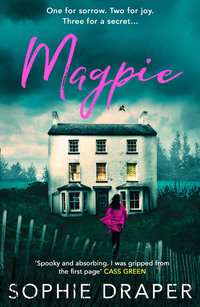
MAGPIE
Sophie Draper

Copyright
Published by AVON
A Division of HarperCollinsPublishers Ltd
1 London Bridge Street
London SE1 9GF
www.harpercollins.co.uk
First published in Great Britain by HarperCollins Publishers 2019
Copyright © Sophie Draper 2019
Cover design by Lisa Horton © HarperCollinsPublishers Ltd 2019
Cover photographs © Stephen Mulcahey/Trevillion Images (house and woman); Silas Manhood/Arcangel Images (fence); Shutterstock.com (sky, magpie, water, grass)
Sophie Draper asserts the moral right to be identified as the author of this work.
A catalogue copy of this book is available from the British Library.
This novel is entirely a work of fiction. The names, characters and incidents portrayed in it are the work of the author’s imagination. Any resemblance to actual persons, living or dead, events or localities is entirely coincidental.
All rights reserved under International and Pan-American Copyright Conventions. By payment of the required fees, you have been granted the non-exclusive, non-transferable right to access and read the text of this e-book on screen. No part of this text may be reproduced, transmitted, down-loaded, decompiled, reverse engineered, or stored in or introduced into any information storage and retrieval system, in any form or by any means, whether electronic or mechanical, now known or hereinafter invented, without the express written permission of HarperCollins.
Source ISBN: 9780008311315
Ebook Edition © November 2019 ISBN: 9780008311322
Version: 2019-10-15
Dedication
For my boys.
Epigraph
One for sorrow,
Two for joy,
Three for a girl,
Four for a boy,
Five for silver,
Six for gold,
Seven for a secret,
Never to be told.
Contents
Cover
Title Page
Copyright
Dedication
Epigraph
Chapter 1: Claire – Before
Chapter 2: Claire – Before
Chapter 3: Duncan – Six Weeks After
Chapter 4: Claire – Before
Chapter 5: Claire – After
Chapter 6: Claire – Before
Chapter 7: Claire – After
Chapter 8: Duncan – After
Chapter 9: Claire – Before
Chapter 10: Claire – Before
Chapter 11: Duncan – After
Chapter 12: Duncan – After
Chapter 13: Claire – Before
Chapter 14: Claire – Before
Chapter 15: Claire – After
Chapter 16: Duncan – After
Chapter 17: Claire – Before
Chapter 18: Claire – Before
Chapter 19: Claire – After
Chapter 20: Duncan – After
Chapter 21: Claire – After
Chapter 22: Duncan – After
Chapter 23: Claire – Before
Chapter 24: Claire – Before
Chapter 25: Claire – After
Chapter 26: Claire – After
Chapter 27: Claire – Before
Chapter 28: Claire – After
Chapter 29: Duncan – After
Chapter 30: Claire – After
Chapter 31: Claire – Before
Chapter 32: Claire – After
Chapter 33: Claire – Before
Chapter 34: Claire – Before
Chapter 35: Claire – After
Chapter 36: Duncan – After
Chapter 37: Claire – Before
Chapter 38: Claire – Before
Chapter 39: Claire – After
Chapter 40: Duncan – After
Chapter 41: Claire – Before
Chapter 42: Claire – After
Chapter 43: Claire – Before
Chapter 44: Claire – Before
Chapter 45: Claire – Before
Chapter 46: Duncan – After
Chapter 47: Claire – After
Chapter 48: Claire – After
Chapter 49: Claire – Before
Chapter 50: Duncan – After
Chapter 51: Claire – Before
Chapter 52: Claire – Before
Chapter 53: Claire – After
Chapter 54: Claire – Before
Chapter 55: Duncan – After
Chapter 56: Claire – Before
Chapter 57: Duncan – After
Chapter 58: Claire – After
Chapter 59: Claire – After
Chapter 60: Claire – After
Chapter 61: Duncan – 22 Years Before
Chapter 62: Duncan – After
Chapter 63: Claire – After
Chapter 64: Claire – After
Chapter 65: Duncan – After
Chapter 66: Duncan – After
Chapter 67: Claire – After
Chapter 68: Duncan – After
Chapter 69: Claire – After
Chapter 70: Claire – After
Chapter 71: Claire – After
Chapter 72: Duncan – After
Chapter 73: Claire – After
Chapter 74: Claire – After
Chapter 75: Duncan – After
Acknowledgements
Keep Reading …
About the Author
By the Same Author
About the Publisher
CHAPTER 1
CLAIRE – BEFORE
There’s a dog protesting from one of the cages on the ward. Pain, the animal’s in pain. Its cries cut across my thoughts and I turn away from Duncan’s consulting room, past Sally on reception and through the doors to the back of the building.
Imogen, the animal care assistant, is already there, doing her rounds. Her body is bent as she checks each animal. She reads the clipboards pegged to every cage and tops up food and water.
‘Is it the Great Dane again?’ I ask.
She nods, gesturing to the biggest enclosure. It’s out of sight by the stockroom and I turn the corner. The dog is on its feet, swaying from side to side, one back leg visibly shorter than the other. It lifts its head, jowls wet with saliva, pressing its cheek against the bars. Large brown eyes roll as it recognises a human face and it howls again, a long two-toned cry, setting off another sequence of barks and whimpers in the room.
I unhook the door, dropping to my knees. The Great Dane hobbles cautiously towards me. It easily matches me for height in this position, pushing against my body. I take the animal’s head into my arms.
‘Hey, there, big fella, how’re you doing?’
I shift my feet, holding one hand to the side of the dog’s head, the animal panting. Its eyes are dilated, its tongue hanging out, tasting the very smell of me. The dog tugs away, distrusting even the comfort of my body, yet drawn to me. Its oversized legs are partially splayed, its tail tight and stiff. I run my hands along the underside of its stomach, pausing in the middle before slowly rising up and along the back, approaching one hip. The animal lets out a moan and throws its head like a horse.
‘It’s okay, sweetheart, I know.’
I press with care, eyes watching the dog closely, pressing just enough to determine the exact spot and no more. The dog moans again and I let my hand drop.
‘Imogen.’ I raise my voice. ‘Can you come and help me here a moment?’
‘Coming!’
I hear the clatter of a metal bowl being set on the floor and Imogen appears, slightly out of breath.
‘What is it?’
‘How long has she been like this?’
‘Since I came in this morning.’
I frown. My hand reaches up to turn a page on the clipboard.
‘Has she eaten at all?’ I nod to the full bowl of dried food pellets.
‘She had some of the wet food last night, but none of the dried.’
‘But she’s drinking?’
The water bowl is full too, I note.
‘Claire – I’m not sure …’ Imogen looks at me uncertainly. Then: ‘Yes – I filled it only a few moments ago.’
‘Okay. It’s happened again – she’s dislocated her hip …’
‘Claire!’ It’s Duncan, my husband, striding round the corner.
He stops in front of us, lifting one hand to his smooth round head. He towers over me as I crouch on the floor and glares at me with barely concealed annoyance.
‘Claire. Sally said you were looking for me.’
His voice is clipped and professional. He smiles at Imogen.
‘Would you give us a moment?’
She throws me an anxious glance.
‘Sure,’ she says. ‘Lovely to see you, Claire.’
Duncan’s arms are toned, his neck bare against his dark blue tunic. His name is embroidered on the front pocket: Duncan Henderson, Clinical Director. He waits until Imogen has gone, then turns on me.
‘What are you doing, Claire? I really don’t appreciate you coming onto the ward like this. It confuses the hell out of the staff and undermines my authority. We’ve talked about this before.’
He steps between me and the Great Dane, gently pushing the dog back into its crate.
‘Come on, now,’ he says to the dog. ‘I know, I’m sorry. But you’re next, I promise.’ He pats the dog.
I feel the heat rising up my neck. The Great Dane moves slowly around in the confined space, claws tangling in the blanket at its feet. Water spills from the bowl. I feel clumsy and embarrassed as Duncan slips the door catch back into position. He turns to me, but I speak before he does.
‘She’s got a dislocated hip and I noticed the femoral head on the x-ray—’
‘Have you been going through my notes?’ He’s openly angry now.
‘You left them on the kitchen table,’ I say. ‘It’s the second time this month, isn’t it? Dislocation. Manipulation isn’t going to work this time, there’s a—’
‘You need to go, Claire. And leave me to do my job. Why did you come here?’
‘I …’
I don’t know what to say. I came to say hello? He’s not going to believe that. I thought … I don’t know what I thought – that there was still a way for us to connect? When we were newly married, we always discussed difficult cases. As I look at his face now, I know he doesn’t even remember that, or doesn’t want to. And he certainly doesn’t want to hear what I have to say about the Great Dane. Well, screw you, Duncan, you can work it out for yourself, then.
‘Nothing. I was in town and I was dropping off the notes you left behind.’
I rummage in my bag and produce a folder. He takes it, our fingers not even touching.
But that’s a lie. The file is just an excuse. I know there’s no point in trying anymore.
I came for a look, to check out the staff. To work out if … which one of them, this time, it might be.
CHAPTER 2
CLAIRE – BEFORE
I was never quite sure about this house. It’s not a house, it’s a barn. A great, vast tomb of a place, all gleaming sleek lines and huge panes of glass. Very beautiful, very impressive, but not a home. Not at first, not to me.
Duncan said I’d get used to it. All that space, the mod cons, the view – that amazing aspect over the valley. It’s Derbyshire at its best, lush and verdant with the reservoir glittering at the bottom of the fields. And the privacy. There’s not another house for at least a mile in each direction, who wouldn’t want that? And even I had to admit, I did appreciate the privacy.
But home to me is smaller. Shoes by the back door, coffee stains on the table, dog hairs on the sofa, knick-knacks, photographs and postcards cluttering the mantelpiece. A proper mantelpiece, not one of those engineered slabs of wood buried in the wall.
If he clears my stuff away, I discreetly put it back. And if Joe, our son, or Arthur, the dog, leave muddy footprints on the tiles, I cheer. That first scratch on the polished work surface in the kitchen was uniquely satisfying. Always striving for perfection is not much fun.
The front door glides shut with a soft clunk. Duncan has gone to work. I hear the smooth hum of his car and the measured crunch of wheels on gravel. I stretch out the fingers of my hand and roll my shoulders. Then I gather my long hair at the back of my head and twist it into a loose bun. Strands of brown hair fall on either side of my face; I never was much good at grooming.
The wind gusts across the walls of the house and a sweep of rain splatters against the full-height window in the sitting room. I see my own shape reflected back; it makes me look taller, larger than I am, at least that’s what I tell myself. Strong. The sky is green, not grey, coloured by the triple-layered tinted glass so that even the view is tainted by Duncan’s choice of architecture.
Everything about this place was his choice, not mine.
I turn back to the sink. The deep-set window behind it was the only thing left unsullied by the builders. At my insistence. One last remnant of the building that was before, the old cottage that stood beside the barn. I would have kept it whole, perhaps linked by a glass atrium, but Duncan wanted it gone, to focus on the barn itself, stripped and open to the roof. There’s not much sense that this was all once a busy working farm.
As I plunge the mug into the hot water, I see my son, Joe, crossing the lawn from the top field. His head is bent against the weather, his dark hair damp and curling against his neck.
Moments later, the utility room door flies open and dead leaves bluster across the floor. Arthur, our black Labrador, scampers inside. His jaws are slack, drooling with saliva, and he shakes the rain from his coat so that water sprays on to the cupboard doors. He heads for his metal drinking bowl and I hear the sound of his tongue pushing it across the floor.
Joe hops on one foot and then the other, slinging each boot into the corner by the ironing board.
‘For heaven’s sake, Joe, take some care!’
He ignores me. He doesn’t even look up as his awkward frame passes into the kitchen.
‘Where have you been?’
It’s a stupid question, I know the answer. It’s almost eight o’clock in the morning and he’s been out all night. Not clubbing or drinking like most teenagers – I should be so lucky – but out there, in the fields.
Joe doesn’t reply and I see that ‘thing’ he always takes with him, the metal detector. He’s left it against the wall, looping the headphones and cable over the handle. He crosses the kitchen to find the biscuit tin, fishing out a handful of digest-ives. He shoves one in his mouth and the rest stick out from between his fingers like the roof of the Sydney Opera House.
‘Joe!’
I raise my voice, trying to break into his thoughts, but he simply gestures to his full mouth with his biscuit knuckle-duster and leaves the room. I swear I love my son very much, but his lack of eye contact cuts right through me sometimes, even now after all these years.
Today, he seems more than usually distracted.
He takes the stairs two at a time. A door bangs and the music starts. Thump, thump. Rude and raucous and irreverent. Very satisfying. The volume blasts up a notch, a heavy tuneless beat that reverberates through the ceiling. There’s the surge of hot water from the shower in the bathroom. The sound carries across the open roof spaces in the barn. You can hear everything, despite the distance. I let it wash over me. It’s the silence of the house that gets to me, when he isn’t here. Like a cathedral with no worshippers, a grand theatrical production that no one comes to watch. But when he is here, the noise of him annoys me, too. Eventually. There’s no pleasing me. My mouth twists into a smile.
At least he’s looking after himself. Not like before.
I dry my hands, leaving the towel dumped untidily on the kitchen island. I pour hot water from the kettle into a new mug. My fingers reach around to comfort myself and I breathe in the warm steam. The familiar smell of coffee tickles my throat. Familiar is good: a hot drink, a slab of bread thick with butter. It grounds me.
At least this time my son has come home.
‘There was this man ten years ago who discovered a hoard in Somerset.’
I’m prepping tea and Joe is sat at the kitchen island with a long glass of milk in his hand. He fidgets on his seat, as if he can’t stop himself from moving.
‘It was in a field next to an old Roman road. He’d found a couple of coins and ended up discovering a clay pot of some kind, sunk into the ground. It was crammed full of coins – can you imagine that?’
He doesn’t wait for me to answer.
‘And so heavy you couldn’t possibly lift the whole thing out. The sides of the pot were broken and he had to leave it in place, carefully removing the coins under cover of night. He did that so that no one else knew what he’d found.’
I have an image in my head of an old man in his cardigan pulling out green coins with his bare fingers by the light of the moon. I have to smile.
‘Layer by layer, coin by coin, over several nights, until the whole thing was extracted. He didn’t report the find till after that. There were more than fifty thousand coins in total!’
Joe loves telling me these stories, when he finds his voice. It’s his dream, finding a hoard. When Duncan’s not around he talks about it endlessly, the different coin types, how to date them, how to clean them, the different patterns on each side.
‘The rules are complicated,’ he says. ‘And the coroner has to be told.’
Joe’s told me this so many times. I’d always thought coroners only dealt with the dead, but they deal with treasure too, apparently.
‘They have to estimate the level of precious metal content – that’s important when it comes to what happens next and how much the find is worth … Mum, are you listening?’
‘Course I am, Joe. You were telling me about the coroner.’
‘No, I was telling you about metal content.’
He flashes a look of frustration at me. Then he’s off again, detailing different measurements, his hands animated, his body leaning over the kitchen island, gulping down his milk in between long, rambling fact-filled sentences.
It’s a boy thing, I tell myself, all that data and statistics, the kind of information overload that makes me want to walk away but sets Joe on fire. All I can think is, at least he’s doing something constructive, active, and he’s communicating with me. I feel the guilt of my disinterest wash over me. It’s nice to see him on fire.
‘Come on, Joe, that’s enough for now, tea’s ready. If you drink too much of that milk you won’t be hungry. Help me take this through to the table.’
I shouldn’t begrudge him the milk. As a teenager, he guzzles the stuff. Listen to me, I sound so much like the mother that I am. Joe goes to the fridge for more milk and I text Duncan upstairs to say that tea is ready.
We eat in silence. Duncan pushes the pasta into neat piles before scooping it into his mouth and Joe shovels it like a farmhand clearing out the stables. I glance between the two of them, the one with too little hair, the other with too much, and then Duncan’s mobile beeps.
His fingers tap twice and inch towards the phone, then he pulls back.
It beeps again. He looks at me. I refuse to look at him and Joe keeps on eating. After a few minutes, I push my plate away, all pretence at hunger gone.
Then the stupid thing beeps again.
‘Can’t you switch it off?’ I say.
My voice is quiet but sharp and the pulse at my neck is racing. Duncan’s eyes meet mine then slide away. He carries on eating as if I haven’t spoken.
Lo and behold, the phone beeps again. I feel my cheeks suck in and taste the blood on my tongue. I reach for his phone and he grabs it just in time.
‘No phones at the table, we said. Remember?’ I let my voice twist into a sneer.
‘I’m on call,’ he says.
‘Like hell.’
Joe stops in mid-forkful.
‘It’s only work, Claire. You know that.’ Duncan’s tone is smooth and appeasing.
I hate him when he’s like this. As if I’m a child, playing up, or a fool, easily deluded.
‘No, it’s not,’ I say. ‘We both know it’s not.’
‘That’s nonsense, Claire, you’re being paranoid.’
He arranges another pile of pasta.
‘Oh, really?’
Joe is watching us both, eyes wide and unblinking. It reminds me of when he was little, still trying to make sense of the world. Like when we shared a bedtime story, his gaze glued to me as I read, not the book. He’d follow the cadence of each word on my face. I drop my eyes, curling my fingers and breathing long and slow, trying hard to keep it in. But my eyes are drawn back to the phone and then Duncan. He’s actually smiling, like it’s a game.
‘How can you sit there and pretend?’ I say. ‘Day in, day out. How can you do this?’
He doesn’t answer. His fingers tap again and he stands. He picks up his plate and turns round, his back stiff and unyielding. He moves into the kitchen. I hear the click of the automatic bin and the clunk of the dishwasher. A few minutes later there’s the swoosh of the front door. He’s gone. And Joe goes back to eating.
I think of the papers hidden in the folds of the magazine by my bed. The appointment I’ve made for tomorrow. Duncan thinks that nothing’s changed. That I’ll stay, like I always have. But our son is eighteen now; he left school months ago. He’s all grown up, a legally independent, responsible adult.
And I’m the one in control here, not Duncan.
CHAPTER 3
DUNCAN – SIX WEEKS AFTER
Duncan’s gloved hands were stained with blood. The dog’s skin was peeled back, revealing the bloodied bone and yellow subcutaneous fat. The radio played softly in the background and the monitors beeped with a reassuring regularity as he dabbed at the opening with a swab.
There were three of them: Duncan and Paula, the newest vet at the practice, and Frances, the senior nurse. Their legs and hips were pressed against the operating table and the light blazed a harsh white over their heads, picking up a glint of red hair from beneath Paula’s surgical cap.
‘Okay,’ said Duncan. ‘Let’s get this little chap put together again.’
He tugged gently on the flaps of skin, pulling them towards each other. It was a struggle; the dog was barely a year old and the metal pins holding the leg bones left little space for the original skin to meet. Duncan shifted the skin a little higher.
‘Frances – can you hold it there?’
She took the clamps into her hands.
‘Left a bit. Hold it … wait …’
Duncan pursed his lips and pulled again, reaching in with a suture needle, feeding the thread between his gloved fingers to make the first stitch.
‘Excellent,’ he said. ‘And another. Paula, can you clean around here?’
They worked together in silence. Ten minutes later, the opening had been closed. Frances gave a relieved smile and Duncan took a step back.
‘That’s it. Thank you, both. I’m glad to see that one done.’
‘She’s looking good,’ Frances replied. ‘You should go and ring the owner. You’ve earned that. We’ll finish off and resuscitate. I’ll see this one to the ward.’
Frances smiled again. She was older than Duncan, her darker skin and years of experience warming her features, the lines around her eyes creasing above her mask.
Duncan pulled the gloves from his hands, dropping them into the refuse bucket. He tugged the mask from his face and left the room, pushing the door with his shoulder and reaching up to rub his neck. Three hours on one dog – the smaller animals were often the most difficult. But it had been a success. He headed for his consulting room to make the call.
‘Duncan!’
It was Sally on reception. Her usually straight blonde hair was falling unkempt about her shoulders. A collection of dirty coffee mugs stood by the phone and the printer was spewing out blank sheets of paper. As ever, the room was busy with people and animals. Duncan nodded briskly at the man who lifted one hand in greeting.
‘Yes?’ Duncan responded to Sally.
‘Call for you – urgent, they said. I’ll put it through.’
He mouthed a question and Sally shrugged her shoulders. Her lips said police. He glared at her and she jabbed one finger towards his consulting room.
‘Okay,’ he said, biting down his emotions.
‘Duncan Henderson, here.’
He sank into his chair and swung round to face the window.
‘Duncan, it’s Martin. Very sorry to disturb you at work. I’m afraid I have to ask you to come back to your house.’
One phone call, that’s all it took to hijack all those appointments. Duncan turned his car up the drive to his house. The constant slash of rain against the windscreen had left him with a painful furrow of concentration on his forehead and a thick spray of black mud on the paintwork of his car. The vehicle slowed on the deep gravel, cruising between the pink cherry trees that lined the drive. Spring had been interrupted by a blast of cold, stormy weather, and wet leaves and translucent blossom clung like damp butterflies to the big sheet window. The barn glowed a peachy flushed red.
Duncan felt his heart contract, his jaw tighten. There were cars and vans slewed every which way they could, blocking his usual turning circle. Beyond the perimeter fencing, where the fields tipped towards the silver bowl of the reservoir, already a double line of blue-and-white plastic tape rippled down the slope.
He squeezed his car into a gap, in the corner where Claire used to park. He got out. The grumbling blast of a generator assailed his ears. A pair of uniformed officers stood by the top gate, stiff and upright like tin soldiers. By the garage, a tent had been pitched up, and in the distance, at the bottom, were more tents, slick with wet. Grey sheets of rain blustered across the valley and figures in white hooded overalls ran across the scrub. The whole scene had the surreal air of an alien landing site.
Duncan approached his front door.
‘Excuse me, sir. Can I see some ID?’ An officer appeared at his shoulder.
Duncan swung round to face him.
‘I live here,’ he snapped.
‘Even so, if you don’t mind.’
Duncan scowled and fished out his driving licence. There was an awkward pause as the officer scanned the photograph.
‘Mr Henderson, thank you. The boss said to have a word with you as soon as you arrived.’ The man gestured towards the first tent. ‘If you don’t mind.’
The boss. DCI Martin White. They’d known each other since their first day at school.
‘This way, please, sir.’
The tent opening thrashed in the wind. Inside a huddle of officers stood around a table with several computers, and their papers scattered upwards as the flap fell back into place.
‘Duncan?’
A man looked up, his hands holding down the papers. He wore a green waxed jacket, his grey suit loosely buttoned underneath. His hair was cut close to his head, black peppered with white, and a broad platinum wedding ring glinted from the back of his hand.
‘Martin.’
Duncan wiped the rain from his forehead. The police team wasn’t huge for the area, it was inevitable that Martin would be in charge. Duncan had a brief image of Martin standing by his side in the registry office at Claire and Duncan’s wedding, leaning forwards in his shoes, discreetly scanning the room like some kind of security officer.
‘Thank you for coming back,’ said Martin. Their eyes met. ‘I expect this is a shock.’
Duncan didn’t reply and Martin dipped his head in acknowledgement.
‘I’m sorry to be here in these circumstances. And I apologise for the disruption. But I’m sure you understand why this is necessary.’
Duncan’s eyes were drawn to the table. There was a shallow crate covered in a cloth.
He felt his body sway, unaccountably off balance. He clenched his hands and pushed them down his side, forcing himself to stay upright.
‘Cup of tea, sir?’ A younger man stepped forwards, offering Duncan a mug.
‘Do you think I want a fucking cup of tea?’ Duncan turned on the man, eyes flaring.
A blue light flickered from one of the computer screens and the wind sucked at the canvas over their heads. Silence had fallen on the tent.
‘I’m sorry. I …’ Duncan pushed his hand across his head, rubbing the bare skin, then smoothing down to the closely cropped hair at the back of his neck. His jaw moved and his eyes closed momentarily.
‘It’s alright, Duncan.’ Martin followed his friend’s gaze. He gestured to a chair. ‘Everyone here understands. Why don’t we sit down?’
Duncan shook his head. He stood still, his arms held stiffly by his side.
‘No,’ he said. ‘I don’t want …’ Duncan’s breath heaved in and out and his eyes were pulled once again to that crate.
Martin took a step closer.
‘Duncan, look at me. It’s okay. Look at me!’
Duncan lifted his eyes to Martin. It seemed to him there were just the two of them then, in that tent, all sense of the outside, the weather, the people, the cars on his drive, banished to the edges of his mind.
Then he took control of himself, responding to Martin’s unspoken signal.
‘What exactly have you found?’ He pushed the words out between his lips.
‘Human remains. A body has been found by the shore at the bottom of your land.’
Martin paused, as if unwilling to broach what came next.
‘What kind of body?’ Duncan said.
There was another pause.
‘Come on, man, you can’t not tell me!’
‘We’re not sure yet. I’m sorry, Duncan, that’s all I can tell you right now.’
Duncan made himself move, reaching out one hand to clutch the table, forcing himself to stay focused.
‘I don’t understand … I …’ His body swayed.
‘Duncan, are you alright?’
Martin took a step forwards.
‘Duncan—’
CHAPTER 4
CLAIRE – BEFORE
‘Hey, Becky. How are you this morning?’
I can hear a voice in the background, the clunk of crockery and a tray being set down on a table.
‘Are you up to a visitor around twelve?’ I ask.
‘Yes, please,’ says Becky.
She sounds happy. One of the things I’ve always loved about Becky is her cheeriness. Upbeat and optimistic, despite her circumstances.
‘Great. I’m in town anyway this morning to do some jobs. I’ll bring us some lunch, shall I? Fish from the chippie sound okay?’
‘Sounds perfect,’ she says. ‘It’ll just be me. See you then.’
The phone clicks and she’s gone.
Town is busy. It’s market day and the car park on the small square has been taken over by stalls and vans. Every street is filled with parked cars and the cobbles judder under my wheels then disappear as I turn into the customer car park of the veterinary surgery. I ease the car into a spot furthest away from the front door. One of the advantages of being the boss’s wife is I get to park for free whenever I need to. Through the glass doors I can see the reception desk, the familiar head of Sally bent over the screen. I walk out of the car park, dodging the bus shelter to head towards the main precinct and the estate agents behind the town hall.
‘Hi,’ I say to the young man leaning back on his chair behind the desk nearest to the door. ‘I have an appointment. Claire Henderson.’
My head swings over my shoulder, scanning the street outside. I will the man to speed up and he senses my agitation.
‘Sure. Hold on a minute,’ he says.
He tips forwards and pushes away, standing up to disappear into a conference room. When he comes back, I think how he doesn’t look much older than my Joe, a narrow blue tie swinging against his crisp white shirt. Except these days you’d never catch Joe in a white shirt, let alone a tie.
‘This way,’ he says.
I move too fast into the conference room.
‘Hello, there. Do sit down.’
This agent is older than the lad by the front door. Hungry-looking, like one of those midsized birds of prey hovering over a small animal by the roadside. He’s assessing me.
‘Mrs Henderson, how are you?’ He doesn’t stand up but reaches out a cold hand.
It’s one of those questions you’re not supposed to answer. I contemplate actually telling him. Do you really want to know? says the voice in my head.
‘I think I’ve found the perfect place for you,’ he says. ‘Not too far, like you asked. Though perhaps a little closer than you wanted, but there’s not a lot out there on the market at the moment. It’s near the reservoir with a bit of character and a fantastic view.’
He pulls out a one-page leaflet with a small flourish, pushing it under my nose. My eyes scan the paper and I have a brief impression of a rambling old cottage with a defunct hanging basket blocking the back door and a roof that sags in the middle. Character – that’s one way of putting it. Agent-speak for a house that’s small and run-down and probably expensive to heat. He taps on the rent.
‘It’s four hundred pounds a month.’
That is cheap for round here. The location is doable. It’s on the other side of the dam, so there would be a wall of concrete between me and Duncan. How appropriate, I think. I glance up at the agent’s face.
‘Can I view it?’
‘Of course you can.’ He smiles. ‘Let me check the diary.’
He snaps back to his PC, scrolling down the screen.
‘How about on Thursday, eleven am? My colleague, John Hardcastle, will show you around.’
I nod. He starts to type.
‘Can you remind me of your current address, Mrs Henderson?’
‘Brereton Barn, Hob Lane.’
‘Ah! Yes, of course, lovely spot.’
He doesn’t ask why I’m looking for a place to rent. Or why I don’t want to buy. And he doesn’t ask about my financial circumstances. He knows of my husband, the town supervet, with his shiny new practice and growing reputation, living in one of the poshest houses in the district. Why else would his wife be searching for a new home? Instead, the agent looks me briefly up and down, as if speculating if Duncan knows yet. Everyone knows everything about your business in this town. It won’t be long before the gossip spreads.
Which means, now I’ve started this, I’m already running out of time.
‘Ooh, that smells amazing!’
Becky pokes her face into the greasy papers and takes a good long whiff. Her short hair is fluffed up and she gives me one of her big open smiles, freckles creasing on her cheeks. I’ve always envied her that smile – it lights up the room. Duncan has the same smile, when he chooses to use it, it’s one of the things I loved about him when we first met, but that’s where their sibling likeness stops.
‘Sinful, but who cares!’ she says. She grins again and places the package on the table.
‘Where’s Alex?’ I ask, referring to her son.
Becky swings back to the cupboard to pluck out a cheap carton of salt and some vinegar.
‘He’s at the day care centre. Dropped him off earlier. We’ve got a couple of hours.’ She turns back with a plate in each hand and slides onto a chair. ‘Grab us some cutlery, will you?’
I rummage in the drawer behind me and Becky tips the food onto our plates. There’s a moment of silence as we both dive in with the same hungry enthusiasm as Arthur after a long walk.
‘Mmm, this is good. So …’ Becky catches my eye. ‘How was your appointment?’
Appointment? I feel a prickle of alarm; I hadn’t told her I had an appointment. I haven’t told her anything yet. How can I? She’s Duncan’s sister for all she’s my best friend and I don’t know where to begin to explain that I’m about to leave her brother. Besides, I need to finalise things and tell Joe before I tell anyone else. Let alone Duncan. I owe him that at least.
‘It was okay.’ I force myself to relax. Becky’s just interpreting the ‘jobs’ I mentioned on the phone. ‘Boring stuff with the bank.’ I scatter salt on my chips. ‘I had to sign accounts and stuff, what with technically being a director of the business.’
How easily the lie slips from my tongue. Not that my story means very much. Yes, I’m listed as a director of the surgery, but Duncan’s always been fiercely protective of his business. He doesn’t let me see anything.
‘You should make him let you work there. Alongside him as a partner.’
‘Oh, God, no. I mean, I like the medical stuff, and the research especially, but the business side of things? We’d only argue. We have quite different ideas about how to manage things. No, I could never work alongside him. Besides, it’s been such a long time since I was in the profession …’
‘Come on, Claire. Joe’s eighteen now. You’d pick it up again. I know you, you’ve kept up to date with all the science and I bet you’ve been hankering to go back to work for years. And you’re darn clever, every bit as much as Duncan. I know you’ve had Joe to deal with, but he’s settling down a bit, isn’t he? Not like before.’
Not like before. All those years of Joe screaming at the teachers. Joe digging his heels in and refusing to go to school. Joe disappearing for days on end and driving me frantic. I bite my lip. The last time Joe went missing for over a week, it was just before his A-level exam results. Perfect timing. But who am I to complain about my son? Becky has far more to deal with than I. She puts me to shame. My son is hale and hearty. Her son, Alex, is confined to a wheelchair, profoundly physically disabled.
‘It’s true,’ I say. ‘I’d like to go back to work. I have thought about it, but I’m not sure.’
It’s half a truth, isn’t it? I have every intention of going back to work. I’m going to have to, we’ll need the money, Joe and I. But not with Duncan, and probably not even here in Belston. Derby, perhaps – or further afield, if I have to go that far to find the right thing.
Whether or not Joe will stomach it. After.
CHAPTER 5
CLAIRE – AFTER
The horse moves with a fast, rhythmic pace, its broad back swaying beneath its rider’s legs. I watch them pass the giant shrubs of rhododendron that block out the light. Their buds are almost pink and the leaves are almost black, gleaming in the cold, steady rain.
They ride on, beyond the gardens. Into the woods. The mist hangs low over the canopy of trees, lingering with the reluctance of the newly deceased floating over a still warm bed.
The reservoir is visible now. Not far. I hear the water lapping and the ducks calling to each other in the reeds. A pheasant hurtles from the banks, a flash of red, shrieking, guttering, the sound bouncing along the shore like stones skipping across the water.
The young man’s head scrapes across the ground, the weight of it dragging on his neck. I can almost feel the pain that must be spreading across his body, his shoulder blades and back. Each thump and drag of his head erupting like fireworks behind his eyes. I feel it as he feels it, as the rider slows the horse to a walk. The lad tries to lift his head, only for it to fall. His body lurches into movement as the horse moves on, pulling upon the rope.
He is like a stick floating on a stream, stones and earth, the lumps in the ground forcing his skull up and down, buffeting him this way and that. Black mud is smeared on his face and his wet clothes cling to his body, sucked in against his frame so that the bones are clearly visible. I see him try to lift one arm – his arms are free, but not his legs. They are tied. The rope red around his bare ankles. The rider shifts his grip, nudging the horse with the heels of his boots again, urging her to move faster along the path beside the reservoir.
The view opens up. The full expanse of water is revealed. A glint of metal pierces the surface not far from the shore. The slender shape is half tipped, draped with soft black weed, as if poised between two realms. It hasn’t appeared for a hundred years, not since the summer of 1918. The last year of the Great War. One cross in a field of crosses, marking the growing dead. That’s what they’d said in the village then, as the women grieved for their men.
The cross is taller than before. A spindle, sharp enough to prick a finger.
My gaze returns to the boy. I see the debris brushing against his cheek, how the clagging scent of the forest makes him want to retch. He tries to cough but the angle is all wrong. His chest must be burning from the effort to breathe, his tongue swollen, his airways blocked, his flesh bloated like rehydrated seaweed. They’re right on the shore, riding over stony mud, and it drags against his flesh. The speed at which they’re moving and the grogginess of his brain means that all he can do is flap his arms uselessly like a drunken swimmer until they fall back above his head and the ground beats and pounds his skull and he’s near faint with the pain of it.
I am consumed by nausea. I feel it as he feels it, everything blackness and confusion. His brain – my brain – stuck inside my skull like the tiny building in a glass globe. Snowflakes, I see thousands of snowflakes fluttering into life, my head fixed but everything else loose and drifting.
The horse’s hooves sink into the mud. Water swirls about the rider’s boots and the boy floats. The rider tugs on the rope and his hair blows across his face and the metal cross shines, dazzling his eyes as he waits for the geese to pass, for the mist to draw breath. For the spire to sink from sight and the sun to rise unseen and the breeze and the birds to settle.
There’s a voice in my head. ‘It shouldn’t have been like this,’ it says. ‘If only the boy had accepted his fate and stayed upon the island. They wouldn’t have had to do this.’
The rain has turned to snow, the snow has turned to hail and stones of ice pitch down against the water. The rider spurs his horse again and again, and she plunges forwards into the lake, deeper. As their bodies begin to disappear, the rider’s face turns back towards the shore. His lips move and I hear his voice, even though he does not speak.
‘Hasn’t it always been like this, Claire? Especially with the young ones.’
Our eyes meet.
‘They just don’t want to die.’
I let out a soft moan and my head rolls to one side. The mattress heaves beneath my body and beads of damp trickle down my skin. The air in the room sweeps cool across my face and I slowly open my eyes, blinking once.
Then I remember.
Joe, my son, has gone.
Ücretsiz ön izlemeyi tamamladınız.