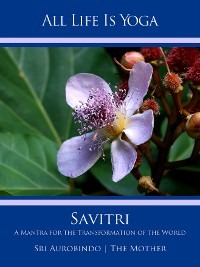
Kitabı oku: «All Life Is Yoga: Savitri»

Omsriaurobindomira
All
Life
Is
Yoga
“All life is Yoga.” – Sri Aurobindo
Savitri
A Mantra for the Transformation of the World
Sri Aurobindo | The Mother

SRI AUROBINDO
DIGITAL EDITION

Copyright 2020
AURO MEDIA
Verlag und Fachbuchhandel
Wilfried Schuh
www.auro.media
www.savitri.center
www.sriaurobindo.center
eBook Design
SRI AUROBINDO DIGITAL EDITION
Germany, Berchtesgaden
ALL LIFE IS YOGA
SavitriA Mantra for the Transformation of the World Selections from the Works of Sri Aurobindo and The Mother First edition 2020 ISBN 978-3-96387-052-1

© Photos and selections of the works of Sri Aurobindo and the Mother:
Sri Aurobindo Ashram Trust
Puducherry, India

Flower on the cover:
Bixa orellana. Pale lavender pink. Spiritual significance and explanation given by the Mother: New world The result of transformation.
Publisher’s Note
This is one in a series of some e-books created by SRI AUROBINDO DIGITAL EDITION and published by AURO MEDIA (a section of SRI AUROBINDO BHAVAN Berchtesgadener Land, Germany) under the title All Life Is Yoga. Our effort is to bring together, from Sri Aurobindo and the Mother, simple passages with a practical orientation on specific subjects, so that everyone may feel free to choose a book according to his inner need. The topics cover the whole field of human activity, because true spirituality is not the rejection of life but the art of perfecting life.
While the passages from Sri Aurobindo are in the original English, most of the passages from the Mother (selections from her talks and writings) are translations from the original French. We must also bear in mind that the excerpts have been taken out of their original context and that a compilation, in its very nature, is likely to have a personal and subjective approach. A sincere attempt, however, has been made to be faithful to the vision of Sri Aurobindo and the Mother. These excerpts are by no means exhaustive.
Bringing out a compilation from the writings of Sri Aurobindo and the Mother, which have a profound depth and wideness unique, is a difficult task. The compiler’s subjective tilt and preferences generally result in highlighting some aspects of the issues concerned while the rest is by no means less significant. Also without contexts of the excerpts the passages reproduced may not fully convey the idea – or may be misunderstood or may reduce a comprehensive truth into what could appear like a fixed principle.
The reader may keep in mind this inherent limitation of compilations; compilations are however helpful in providing an introduction to the subject in a handy format. They also give the readers a direct and practical feel of some of the profound issues and sometimes a mantric appeal, musing on which can change one’s entire attitude to them.
The excerpts from the writings of Sri Aurobindo and the Mother carry titles and captions chosen by the editor, highlighting the theme of the excerpts and, whenever possible, borrowing a phrase from the text itself. The sources of the excerpts are given at the end of each issue.
We hope these compilations will inspire the readers to go to the complete works of Sri Aurobindo and the Mother and will help them to mould their lives and their environments towards an ever greater perfection.
“True spirituality is not to renounce life, but to make life perfect with a Divine Perfection.” – The Mother
* * *
ContentsTitle PageCopyrightPublisher’s NoteQuotationsI. INTRODUCTION1. Savitri – This Wonderful Prophetic Poem2. Savitri – the Divine Mother3. The Composition of SavitriII. A VISION OF HIGHER REALMS THAN OURS1. The Supramental Vision and Its ExpressionIII. THE CREATIVE WORD1. Theory of the Mantra2. Poetic Vision and the Mantra3. The Poetry of the FutureIV. SAVITRI – THE DIVINE WORD1. Savitri – The Sun-Word2. Savitri – A Legend and a Symbol3. Savitri – A Revelation4. The Extraordinary Power of Savitri5. Messages from the MotherV. SAVITRI – THE SONG OF THE INFINITE AND ETERNAL (Selections from Sri Aurobindo’s Savitri)1. The Book of BeginningsCanto 1: The Symbol DawnDark BeginningThe Revelation and the FlameThe God-LightMortality and the Eternal’s TouchSavitri’s Inner ConflictThe Day of Satyavan’s DeathCanto 2: The IssueThe Many-Imaged PastSavitri and the God of LoveThe Immortal and the Snare of TimeA Magic LeverageThe Victory for God in ManCanto 3: The Yoga of the King: The Yoga of the Soul’s ReleaseThe Seer, Savitri’s FatherThe Growing DivinityAswapati’s Growth into Larger SelfA Magical AccordThe Inner PlanesTime’s DramaNew DiscoverySilent SelfBeyond ThoughtThe Unseen GuideInspirationThe Universe as God’s BodyRelease from IgnoranceCanto 4: The Secret KnowledgeOur Forgotten VastnessesIn Great Lonely HoursThe Labour of the Earth GoddessThe Immortals VisionTime’s FulfilmentThe Certitude of our Divine DestinyDream TruthHe and SheThe Self-Determining AbsoluteA Nameless ResidentThe Voyager SoulCanto 5: The Yoga of the King: The Yoga of the Spirit’s Freedom and GreatnessThe Eternal’s PromiseThe Tessellated WholeTowards the EternalThe Transforming DescentMind – A Mediator DivinityThe Hierarchy of Worlds2. The Book of the Traveller of the WorldsCanto 1: The World-StairThe Ascending World HierarchyLadder Towards DeityThe Mystery’s ProcessCanto 2: The Kingdom of Subtle MatterEarth-Nature’s OriginsOur Lives and Divine IntimationsEarth’s Forms and Man’s ArtThe Finite Perfection and the ImmeasurableCanto 3: The Glory and the Fall of LifeThe Heavens of LightCanto 4: The Kingdoms of the Little LifeThe Formless YearningThe Birth of SenseCanto 5: The Godheads of the Little LifeThe Deeper Vision of the SpiritThe Divine InfluxCanto 6: The Kingdoms and Godheads of the Greater LifeDeath – A Passage to New WorldsThe Certitude of God’s DescentCanto 7: The Descent into NightLife: Its Obverse and Reverse FacesThe Abysm of HellCanto 8: The World of Falsehood, the Mother of Evil and the Sons of DarknessAswapati Crosses the World of FalsehoodCanto 9: The Paradise of the Life-GodsThe Life HeavensCanto 10: The Kingdoms and Godheads of the Little MindThe Human AscentReason and the InfiniteGreat ThoughtsCanto 11: The Kingdoms and Godheads of the Greater MindThe Spirit of MindEternal TruthCanto 12: The Heavens of the IdealThe Deathless RoseOur Hidden CentresThe Deathless FlameCanto 13: In the Self of MindThe Source of KnowledgeThe Mind-SelfCanto 14: The World-SoulEntry into the World-SoulThe Interval Between Birth and BirthThe Supreme PowerCanto 15: The Kingdoms of the Greater KnowledgeOvermind and Oversoul3. The Book of the Divine MotherCanto 1: The Pursuit of the UnknowableThe OneCanto 2: The Adoration of the Divine MotherSelf and WorldThe Everlasting YesThe Experience of the All-BeautifulThe Vision of the Supreme MotherThe Descent of the Mother-MightCanto 3: The House of the Spirit and the New CreationAspirationThe Universal SoulCanto 4: The Vision and the BoonThe Advent of the Divine MotherAswapati and the Divine MotherSavitri and Her Mission4. The Book of Birth and QuestCanto 1: The Birth and Childhood of the FlameThe Cycle of the SeasonsSavitri’s BodyCanto 2: The Growth of the FlameThe Truth of Ethics and PhilosophyThe Divine WordTowards Love’s UniversalityCanto 3: The Call to the QuestThe Working of the MantraCanto 4: The QuestSavitri’s Memory-Waking QuestDivine ProvidenceYogis and NatureThe Fateful Search5. The Book of LoveCanto 1: The Destined Meeting-PlaceThe Meeting-PlaceCanto 2: SatyavanThe MeetingThe Significance of the MeetingThe Truth of LoveFitness to Receive LoveAffinity RevealedCanto 3: Satyavan and SavitriThe RecognitionSatyavan’s Inner Sight and HearingSatyavan’s Deepening Vision of the SoulSatyavan Finds the Key to TransformationThe Gold LinkThe Marriage GarlandThe All-Embrace6. The Book of FateCanto 1: The Word of FateThe Descent of NaradHis Vision of the FutureThe King’s Plea to NaradMan’s Tragic StruggleThe Mystery of PainNarad Describes SatyavanSavitri’s Resolute WillCanto 2: The Way of Fate and the Problem of PainWorld Pain and Its NecessityEnd of the Law of PainOrigin of Death and FateThe Working of ProvidenceNarad on Death as the Spirit’s OpportunityThe Heroic Strength7. The Book of YogaCanto 1: The Joy of Union; the Ordeal of the Foreknowledge of Death and the Heart’s Grief and PainJoy and GriefCanto 2: The Parable of the Search for the SoulMind’s RestlessnessThe Persistent PastCanto 3: The Entry into the Inner CountriesThe Mission of the AvatarSavitri Enters the Inner WorldsLife’s Nether RealmsCanto 4: The Triple Soul-ForcesSavitri to the Three Soul-ForcesCanto 5: The Finding of the SoulThe Search for the SoulThe Finding of the SoulThe Rising of the Serpent PowerCanto 6: Nirvana and the Discovery of the All-Negating AbsoluteAutumnal MellownessAn Upsurge of the InconscientThe Saviour’s LabourIntroversionMystic VisitationsThe Mystery of the GeniusThe Stilling of ThoughtNirvanaCanto 7: The Discovery of the Cosmic Spirit and the Cosmic ConsciousnessUnreal RealityEnlightenment8. The Book of DeathCanto 3: Death in the ForestSatyavan’s Death9. The Book of Eternal NightCanto 1: Towards the Black VoidA New Birth of ConsciousnessSavitri’s Spiritual StatureThe God of DeathSavitri in the ForestSavitri Pursues Death in the Occult PlanesCanto 2: The Journey in Eternal Night and the Voice of the DarknessNight Threatened by LightSavitri’s Challenge to Death10. The Book of the Double TwilightCanto 1: The Dream Twilight of the IdealNight the Shadow of DayTwilight of the GodsA Dream WorldCanto 2: The Gospel of Death and Vanity of the IdealLove, the Rapturous Core of SunsSavitri’s Great PromiseCanto 3: The Debate of Love and DeathThe World as God FulfilledThe Tangle-Dance of the OneThe Growth of the Inner LightThe Graded Ascent of LoveSavitri on Love Linking Earth and HeavenSavitri’s Universal HeartPsychic FireCanto 4: The Dream Twilight of the Earthly RealSavitri, God and the WorldBeyond LawMost Bound Most FreeThe Overhead PlanesTransformation – Its Phases11. The Book of Everlasting DayCanto 1: The Eternal Day: The Soul’s Choice and the Supreme ConsummationGod’s Everlasting DayThe Delights of the Purified HeartThe Dance CelestialSpirit – An Upsoaring BirdRevelation of the Supreme DivineThe Divine’s PromiseSavitri’s Universal LoveSavitri’s SupplicationOrdinary HumanitySavitri and Satyavan – Their Appointed WorkSavitri and the Supreme LordThe Supreme Lord to SavitriThe Things to ComeThe Descent to Earth12. EpilogueCanto 1: The Return to EarthBack to LifeAPPENDIXA Brief Introduction to SavitriReferencesGuideCoverTable of ContentsStart Reading

Let us meditate on the most auspicious (best) form of Savitri, on the Light of the Supreme which shall illumine us with the Truth. — Sri Aurobindo
Savitri, that marvellous prophetic poem which will be humanity’s guide towards its future realisation. — The Mother
We are in a very special situation, extremely special, without precedent. We are now witnessing the birth of a new world; it is very young, very weak – not in its essence but in its outer manifestation – not yet recognised, not even felt, denied by the majority. But it is here. It is here,making an effort to grow, absolutely sure of the result. But the road to it is a completely new road which has never before been traced out – nobody has gone there, nobody has done that! It is a beginning, a universal beginning. So, it is an absolutely unexpected and unpredictable adventure. — The Mother
* * *
Part I
INTRODUCTION
...my long labour on Savitri ... was not labour in the ordinary sense, not a labour of painstaking construction, I may describe it as an infinite capacity for waiting and listening for the true inspiration and rejecting all that fell short of it, however good it might seem from a lower standard until I got that which I felt to be absolutely right. — Sri Aurobindo
Chapter 1
Savitri – This Wonderful Prophetic Poem
Words of the Mother
About Savitri
1) The daily record of the spiritual experiences of the individual who has written.
2) A complete system of yoga which can serve as a guide for those who want to follow the integral sadhana.
3) The yoga of the Earth in its ascension towards the Divine.
4) The experiences of the Divine Mother in her effort to adapt herself to the body she has taken and the ignorance and the falsity of the earth upon which she has incarnated.
*
A Hymn to Savitri
Rig Veda (V.81)
l. The illumined yoke their mind and they yoke their thoughts to the illumined godhead, to the vast, to the luminous in consciousness; the one knower of all manifestation of knowledge, he alone orders the things of the sacrifice. Great is the praise of Savitri, the creating godhead.
2. All forms are robes the Seer puts on that he may create the good and bliss for the double and the quadruple1 creature. Savitri describes by his light our heavenly world; supreme is he and desirable, wide is the light of his shining in the march of the Dawn.
3. And in that march all the other gods in their might follow after the greatness of this godhead. This is that bright god Savitri who by his power and greatness has measured out our earthly worlds of light.
4. But also thou goest, O Savitri, to the three shining worlds of heaven and thou art made manifest by the rays of the Sun, and thou encirclest on both sides the Night, and thou becomest Mitra, O god, with his settled laws of Truth.
5. And thou alone hast power for the creation and thou becomest the Increaser, O god, by thy marchings in thy path, and thou illuminest all this world of the becoming. Shyavashwa, O Savitri, has found the affirmation of thy godhead.
*
Explanation of Sri Aurobindo
The Rishi hymns the Sun-God as the source of divine knowledge and the creator of the inner worlds. To him, the Seer, the seekers of light yoke their mind and thoughts; he, the one knower of all forms of knowledge, is the one supreme ordainer of the sacrifice. He assumes all forms as the robes of his being and his creative sight and creates the supreme good and happiness for the two forms of life in the worlds. He manifests the heavenly world, shining in the path of the dawn of divine knowledge; in that path the other godheads follow him and it is his greatness of light that they make the goal of all their energies. He has measured out for us our earthly worlds by his power and greatness: but it is in the three worlds of light that he attains to his real greatness of manifestation in the rays of the divine sun; then he encompasses the night of our darkness with his being and his light and becomes Mitra who by his laws produces the luminous harmony of our higher and lower worlds. Of all our creation he is the one author, and by his forward marches he is its increaser until the whole world of our becoming grows full of his illumination.
* * *
Chapter 2
Savitri – the Divine Mother
Words of Sri Aurobindo
Savitri is represented in the poem as an incarnation of the Divine Mother... This incarnation is supposed to have taken place in far past times when the whole thing had to be opened, so as to “hew the ways of Immortality”.
*
Words of Sri Aurobindo
Aswapati’s Yoga falls into three parts. First, he is achieving his own spiritual self-fulfilment as an individual and this is described as the Yoga of the King. Next, he makes the ascent as a typical representative of the race to win the possibility of discovery and possession of all the planes of consciousness and this is described in the second book: but this too is as yet only an individual victory. Finally, he aspires no longer for himself but for all, for a universal realisation and new creation. That is described in the Book of the Divine Mother.
*
Words of the Mother
Mother, suffering comes from ignorance and pain, but what is the nature of the suffering and pain the Divine Mother feels for her children – the Divine Mother in Savitri?
It is because she participates in their nature. She has descended upon earth to participate in their nature. Because if she did not participate in their nature, she could not lead them farther. If she remained in her supreme consciousness where there is no suffering, in her supreme knowledge and consciousness, she could not have any contact with human beings. And it is for this that she is obliged to take on the human consciousness and form, it is to be able to enter into contact with them. Only, she does not forget: she has adopted their consciousness but she remains in relation with her own real, supreme consciousness. And thus, by joining the two, she can make those who are in that other consciousness progress. But if she did not adopt their consciousness, if she did not suffer with their sorrow, she could not help them. Hers is not a suffering of ignorance: it is a suffering through identity. It is because she has accepted to have the same vibrations as they, in order to be able to enter into contact with them and pull them out of the state they are in. If she did not enter into contact with them, she would not be felt at all or no one could bear her radiance.... This has been said in all kinds of forms, in all kinds of religions, and they have spoken very often of the divine Sacrifice, but from a certain point of view it is true. It is a voluntary sacrifice, but it is true: giving up a state of perfect consciousness, perfect bliss, perfect power in order to accept the state of ignorance of the outer world so as to pull it out of that ignorance. If this state were not accepted, there would be no contact with it. No relation would be possible. And this is the reason of the incarnations. Otherwise, there would be no necessity. If the divine consciousness and divine force could work directly from the place or state of their perfection, if they could work directly on matter and transform it, there would be no need to take a body like man’s. It would have been enough to act from the world of Truth with the perfect consciousness and upon consciousness. In fact that acts perhaps but so slowly that when there is this effort to make the world progress, make it go forward more rapidly, well, it is necessary to take on human nature. By taking the human body, one is obliged to take on human nature, partially. Only, instead of losing one’s consciousness and losing contact with the Truth, one keeps this consciousness and this Truth, and it is by joining the two that one can create exactly this kind of alchemy of transformation. But if one did not touch matter, one could do nothing for it.
* * *
Chapter 3
The Composition of Savitri
Words of Sri Aurobindo
The poem was originally written from a lower level, a mixture perhaps of the inner mind, psychic, poetic intelligence, sublimised vital, afterwards with the Higher Mind, often illumined and intuitivised, intervening. Most of the stuff of the first book is new or else the old so altered as to be no more what it was; the best of the old has sometimes been kept almost intact because it had already the higher inspiration. Moreover there have been made successive revisions each trying to lift the general level higher and higher towards a possible Overmind poetry. As it now stands there is a general Overmind influence, I believe, sometimes coming fully through, sometimes colouring the poetry of the other higher planes fused together, sometimes lifting any one of these higher planes to its highest or the psychic, poetic intelligence or vital towards them.
*
Words of Sri Aurobindo
With your silent consciousness, it should be possible to draw from the highest planes with the slightest pull.
The highest planes are not so accommodating as all that. If they were so, why should it be so difficult to bring down and organise the supermind in the physical consciousness? What happy-go-lucky fancy-web-spinning ignoramuses you all are. You speak of silence, consciousness, overmental, supramental etc. as if they were so many electric buttons you have only to press and there you are. It may be one day but meanwhile I have to discover everything about the working of all possible modes of electricity, all the laws, possibilities, perils etc., construct modes of connection and communication, make the whole far-wiring system, try to find out how it can be made fool-proof and all that in the course of a single lifetime. And I have to do it while my blessed disciples are firing off their gay or gloomy a priori reasonings at me from a position of entire irresponsibility and expecting me to divulge everything to them not in hints – but at length. Lord God in omnibus!
*
Words of Sri Aurobindo
I used Savitri as a means of ascension. I began with it on a certain mental level, each time I could reach a higher level I rewrote from that level. Moreover I was particular – if part seemed to me to come from any lower level, I was not satisfied to leave it because it was good poetry. All had to be as far as possible of the same mint. In fact, Savitri has not been regarded by me as a poem to be written and finished, but as a field of experimentation to see how far poetry could be written from one’s own Yogic consciousness and how that could be made creative.
*
Words of Sri Aurobindo
I don’t think about the technique because thinking is no longer in my line. But I see and feel first when the lines are coming through and afterwards in revision of the work. I don’t bother about details while writing, because that would only hamper the inspiration. I let it come through without interference; only pausing if there is an obvious inadequacy felt, in which case I conclude that it is a wrong inspiration or inferior level that has cut across the communication. If the inspiration is the right one, then I have not to bother about the technique then or afterwards, for there comes through the perfect line with the perfect rhythm inextricably intertwined or rather fused into an inseparable and single unity; if there is anything wrong with the expression that carries with it an imperfection in the rhythm, if there is a flaw in the rhythm, the expression also does not carry its full weight, is not absolutely inevitable. If on the other hand the inspiration is not throughout the right one, then there is an after examination and recasting of part or whole. The things I lay most stress on then are whether each line in itself is the inevitable thing not only as a whole but in each word; whether there is the right distribution of sentence lengths (an immensely important thing in this kind of blank verse); whether the lines are in their right place, for all the lines may be perfect, but they may not combine perfectly together – bridges may be needed, alterations of position so as to create the right development and perspective etc., etc. Pauses hardly exist in this kind of blank verse; variations of rhythm as between the lines, of caesura, of the distribution of long and short, clipped and open syllables, manifold combinations of vowel and consonant sounds, alliteration, assonances, etc., distribution into one line, two line, three or four or five line, many line sentences, care to make each line tell by itself in its own mass and force and at the same time form a harmonious whole sentence – these are the important things. But all that is usually taken care of by the inspiration itself, for as I know and have the habit of the technique, the inspiration provides what I want according to standing orders. If there is a defect I appeal to headquarters till a proper version comes along or the defect is removed by a word or phrase substitute that flashes – with the necessary sound and sense. These things are not done by thinking or seeking for the right thing – the two agents are sight and call. Also feeling – the solar plexus has to be satisfied and, until it is, revision after revision has to continue. I may add that the technique does not go by any set mental rule – for the object is not perfect technical elegance according to precept, but sound-significance filling out word-significance. If that can be done by breaking rules, well, so much the worse for the rule.
*
Words of Sri Aurobindo
I have not anywhere in Savitri written anything for the sake of mere picturesqueness or merely to produce a rhetorical effect; what I am trying to do everywhere in the poem is to express exactly something seen, something felt or experienced; if, for instance, I indulge in the wealth-burdened line or passage, it is not merely for the pleasure of the indulgence, but because there is that burden, or at least what I conceive to be that, in the vision or the experience. When the expression has been found, I have to judge, not by the intellect or by any set poetical rule, but by an intuitive feeling, whether it is entirely the right expression and, if it is not, I have to change and go on changing until I have received the absolutely right inspiration and the right transcription of it and must never be satisfied with any à peu près or imperfect transcription even if that makes good poetry of one kind or another. This is what I have tried to do. The critic or reader will judge for himself whether I have succeeded or failed; but if he has seen nothing and understood nothing, it does not follow that his adverse judgment is sure to be the right and true one, there is at least a chance that he may so conclude, not because there is nothing to see and nothing to understand, only poor pseudo-stuff or a rhetorical emptiness but because he was not equipped for the vision or the understanding. Savitri is the record of a seeing, of an experience which is not of the common kind and is often very far from what the general human mind sees and experiences. You must not expect appreciation or understanding from the general public or even from many at the first touch; as I have pointed out, there must be a new extension of consciousness and aesthesis to appreciate a new kind of mystic poetry.
*
Words of Sri Aurobindo
This is not the method of Savitri. Its expression aims at a certain force, directness and spiritual clarity and reality. When it is not understood, it is because the truths it expresses are unfamiliar to the ordinary mind or belong to an untrodden domain or domains or enter into a field of occult experience; it is not because there is any attempt at a dark or vague profundity or at an escape from thought. The thinking is not intellectual but intuitive or more than intuitive, always expressing a vision, a spiritual contact or a knowledge which has come by entering into the thing itself, by identity.
* * *
Part II
A VISION OF HIGHER REALMS THAN OURS
Sri Aurobindo incarnated in a human body the supramental consciousness and has not only revealed to us the nature of the path to follow and the method of following it so as to arrive at the goal, but has also by his own personal realisation given us the example; he has provided us with the proof that the thing can be done and the time is now to do it. — The Mother
Chapter 1
The Supramental Vision and Its Expression
The Nature of the Supermind
Words of Sri Aurobindo
We have to regard therefore this all-containing, all-originating, all-consummating Supermind as the nature of the Divine Being, not indeed in its absolute self-existence, but in its action as the Lord and Creator of its own worlds. This is the truth of that which we call God.
*
Words of Sri Aurobindo
The Supermind is in its very essence a truth-consciousness, a consciousness always free from the Ignorance which is the foundation of our present natural or evolutionary existence and from which nature in us is trying to arrive at self-knowledge and world-knowledge and a right consciousness and the right use of our existence in the universe. The Supermind, because it is a truth-consciousness, has this knowledge inherent in it and this power of true existence; its course is straight and can go direct to its aim, its field is wide and can even be made illimitable. This is because its very nature is knowledge: it has not to acquire knowledge but possesses it in its own right; its steps are not from nescience or ignorance into some imperfect light, but from truth to greater truth, from right perception to deeper perception, from intuition to intuition, from illumination to utter and boundless luminousness, from growing widenesses to the utter vasts and to very infinitude. On its summits it possesses the divine omniscience and omnipotence, but even in an evolutionary movement of its own graded self-manifestation by which it would eventually reveal its own highest heights, it must be in its very nature essentially free from ignorance and error: it starts from truth and light and moves always in truth and light. As its knowledge is always true, so too its will is always true; it does not fumble in its handling of things or stumble in its paces. In the Supermind feeling and emotion do not depart from their truth, make no slips or mistakes, do not swerve from the right and the real, cannot misuse beauty and delight or twist away from a divine rectitude. In the Supermind sense cannot mislead or deviate into the grossnesses which are here its natural imperfections and the cause of reproach, distrust and misuse by our ignorance. Even an incomplete statement made by the Supermind is a truth leading to a further truth, its incomplete action a step towards completeness. All the life and action and leading of the Supermind is guarded in its very nature from the falsehoods and uncertainties that are our lot; it moves in safety towards its perfection. Once the truth-consciousness was established here on its own sure foundation, the evolution of divine life would be a progress in felicity, a march through light to Ananda.
*
The Supramental Vision
Words of Sri Aurobindo
He gazed across the empty stillnesses
And heard the footsteps of the undreamed Idea
In the far avenues of the Beyond.
He heard the secret Voice, the Word that knows,
And saw the secret face that is our own.
The inner planes uncovered their crystal doors;
Strange powers and influences touched his life.
A vision came of higher realms than ours,
A consciousness of brighter fields and skies,
Of beings less circumscribed than brief-lived men
And subtler bodies than these passing frames,
Objects too fine for our material grasp,
Acts vibrant with a superhuman light
And movements pushed by a superconscient force,
And joys that never flowed through mortal limbs,
And lovelier scenes than earth’s and happier lives.
A consciousness of beauty and of bliss,
A knowledge which became what it perceived,
Replaced the separated sense and heart
And drew all Nature into its embrace.
*
Words of the Mother
In the supramental vision one has a direct and total and immediate knowledge of things, in the sense that one sees everything at the same time, complete in itself, total. The truth of a thing in all its aspects at the same time and... simultaneous, complete. And as soon as one wants to explain that or to describe it, one is obliged to come down, so to say, to a plane which he calls here “the Mind of Light”, where things have to be said or even thought or expressed one after another, in a certain order and a certain relation with one another; the simultaneity disappears, for in the present state of our mode of expression, to say everything at the same time, all at once, is impossible, and we are compelled to veil one part of what we see or know in order to bring it out one thing after another; and this is what he calls the “veil”, which is transparent, for one sees everything, knows everything at the same time; one has the total knowledge of a thing, but one cannot express it fully all at once. There are no words or any possibility of expression, so long as we are what we are. We must necessarily make use of an inferior process to express ourselves, and yet, at the same time we have the full knowledge; it is only the necessity of transmitting his knowledge in words which compels us to veil, so to say, a part of what we know and to let it come out only successively. But it is a transparent veil, for we know the thing – we know it, see it, understand it in its totality – but we cannot express it all at the same time. We have to say it, one thing after another, successively. It is the veil of the expression adapted to our needs both of utterance and understanding. The knowledge is there, it is there in reality – not that one is searching for it and expressing it as one goes on finding it – it is there in its totality but the expression demands that one says it one thing after another; and so this naturally diminishes the omnipotence of which he speaks, for omnipotence is the total vision of the thing expressed in its totality. Omniscience is there in principle, it is there, perceptible, but the total power of this omniscience cannot act since it needs to come down one plane to be able to express itself.
To be able to live fully in the supramental knowledge requires other means of expression than the ones we have now. New means of expression must be worked out to make it possible to express the supramental knowledge in a supramental way.... Now, we are obliged to raise our mental capacity to its utmost so that there is only, so to say, a sort of hardly perceptible borderline, but one that still exists, for all our means of expression still belong to this mental world, do not have the supramental capacity. We do not have the necessary organs for that. We would have to become beings of the supermind, with a supramental substance, a supramental inner organisation, in order to be able to express the supramental knowledge in a supramental way. So far we are... half way; we can, somewhere in our consciousness, rise entirely into the supramental vision and knowledge, but we cannot express it. We have to come down again one plane in order to express ourselves.
* * *
Part III
THE CREATIVE WORD
The function of a mantra is to create vibrations in the inner consciousness that will prepare it for the realisation of what the mantra symbolises and is supposed indeed to carry within itself. — Sri Aurobindo
Chapter 1
Theory of the Mantra
The Supreme Word
Words of Sri Aurobindo
...We must recollect that in the Vedic system the Word was the creatrix; by the Word Brahma creates the forms of the universe. Moreover, human speech at its highest merely attempts to recover by revelation and inspiration an absolute expression of Truth which already exists in the Infinite above our mental comprehension. Equally, then, must that Word be above our power of mental construction.
All creation is expression by the Word; but the form which is expressed is only a symbol or representation of the thing which is. We see this in human speech which only presents to the mind a mental form of the object; but the object it seeks to express is itself only a form or presentation of another Reality. That reality is Brahman. Brahman expresses by the Word a form or presentation of himself in the objects of sense and consciousness which constitute the universe, just as the human word expresses a mental image of those objects. That Word is creative in a deeper and more original sense than human speech and with a power of which the utmost creativeness of human speech can be only a far-off and feeble analogy.
The word used here for utterance means literally a raising up to confront the mind. Brahman, says the Upanishad, is that which cannot be so raised up before the mind by speech.
Human speech, as we see, raises up only the presentation of a presentation, the mental figure of an object which is itself only a figure of the sole Reality, Brahman. It has indeed a power of new creation, but even that power only extends to the creation of new mental images, that is to say of adaptive formations based upon previous mental images. Such a limited power gives no idea of the original creative puissance which the old thinkers attributed to the divine Word.
If, however, we go a little deeper below the surface, we shall arrive at a power in human speech which does give us a remote image of the original creative Word. We know that vibration of sound has the power to create – and to destroy – forms; this is a commonplace of modern Science. Let us suppose that behind all forms there has been a creative vibration of sound.
Next, let us examine the relation of human speech to sound in general. We see at once that speech is only a particular application of the principle of sound, a vibration made by pressure of the breath in its passage through the throat and mouth. At first, beyond doubt, it must have been formed naturally and spontaneously to express the sensations and emotions created by an object or occurrence and only afterwards seized upon by the mind to express first the idea of the object and then ideas about the object. The value of speech would therefore seem to be only representative and not creative.
But, in fact, speech is creative. It creates forms of emotion, mental images and impulses of action. The ancient Vedic theory and practice extended this creative action of speech by the use of the Mantra. The theory of the Mantra is that it is a word of power born out of the secret depths of our being where it has been brooded upon by a deeper consciousness than the mental, framed in the heart and not originally constructed by the intellect, held in the mind, again concentrated on by the waking mental consciousness and then thrown out silently or vocally – the silent word is perhaps held to be more potent than the spoken – precisely for the work of creation. The Mantra can not only create new subjective states in ourselves, alter our psychical being, reveal knowledge and faculties we did not before possess, can not only produce similar results in other minds than that of the user, but can produce vibrations in the mental and vital atmosphere which result in effects, in actions and even in the production of material forms on the physical plane.
As a matter of fact, even ordinarily, even daily and hourly we do produce by the word within us thought-vibrations, thought-forms which result in corresponding vital and physical vibrations, act upon ourselves, act upon others, and end in the indirect creation of actions and of forms in the physical world. Man is constantly acting upon man both by the silent and the spoken word and he so acts and creates though less directly and powerfully even in the rest of Nature. But because we are stupidly engrossed with the external forms and phenomena of the world and do not trouble to examine its subtle and non-physical processes, we remain ignorant of all this field of science behind.
The Vedic use of the Mantra is only a conscious utilisation of this secret power of the word. And if we take the theory that underlies it together with our previous hypothesis of a creative vibration of sound behind every formation, we shall begin to understand the idea of the original creative Word. Let us suppose a conscious use of the vibrations of sound which will produce corresponding forms or changes of form. But Matter is only, in the ancient view, the lowest of the planes of existence. Let us realise then that a vibration of sound on the material plane presupposes a corresponding vibration on the vital without which it could not have come into play; that again presupposes a corresponding originative vibration on the mental; the mental presupposes a corresponding originative vibration on the supramental at the very root of things. But a mental vibration implies thought and perception and a supramental vibration implies a supreme vision and discernment. All vibration of sound on that higher plane is, then, instinct with and expressive of this supreme discernment of a truth in things and is at the same time creative, instinct with a supreme power which casts into forms the truth discerned and eventually, descending from plane to plane, reproduces it in the physical form or object created in Matter by etheric sound. Thus we see that the theory of creation by the Word which is the absolute expression of the Truth, and the theory of the material creation by sound-vibration in the ether correspond and are two logical poles of the same idea. They both belong to the same ancient Vedic system.
This, then, is the supreme Word, Speech of our speech. It is vibration of pure Existence, instinct with the perceptive and originative power of infinite and omnipotent consciousness, shaped by the Mind behind mind into the inevitable word of the Truth of things; out of whatever substance on whatever plane, the form or physical expression emerges by its creative agency. The Supermind using the Word is the creative Logos.
The Word has its seed-sounds – suggesting the eternal syllable of the Veda, AUM, and the seed-sounds of the Tantriks – which carry in them the principles of things; it has its forms which stand behind the revelatory and inspired speech that comes to man’s supreme faculties, and these compel the forms of things in the universe; it has its rhythms, – for it is no disordered vibration, but moves out into great cosmic measures, – and according to the rhythm is the law, arrangement, harmony, processes of the world it builds. Life itself is a rhythm of God.
But what is it that is expressed or raised up before the mental consciousness by the Word in the phenomenal world? Not Brahman, but truths, forms and phenomena of Brahman. Brahman is not, cannot be expressed by the Word; he does not use the word here to express his very self, but is known only to his own self-awareness. And even the truths of himself that stand behind the forms of cosmic things are in their true reality always self-expressed to his eternal vision in a higher than the mental vibration, a rhythm and voice of themselves that is their own very soul of movement. Speech, a lesser thing, creates, expresses, but is itself only a creation and expression. Brahman is not expressed by speech, but speech is itself expressed by Brahman. And that which expresses speech in us, brings it up out of our consciousness with its strivings to raise up the truth of things to our mind, is Brahman himself as the Word, a Thing that is in the supreme superconscience. That Word, Speech of our speech, is in its essence of Power the Eternal himself and in its supreme movements a part of his very form and everlasting spiritual body, brahmano rupam.
Therefore it is not the happenings and phenomena of the world that we have to accept finally as our object of pursuit, but That which brings out from itself the Word by which they were thrown into form for our observation by the consciousness and for our pursuit by the will. In other words, the supreme Existence that has originated all.
Human speech is only a secondary expression and at its highest a shadow of the divine Word, of the seed-sounds, the satisfying rhythms, the revealing forms of sound that are the omniscient and omnipotent speech of the eternal Thinker, Harmonist, Creator. The highest inspired speech to which the human mind can attain, the word most unanalysably expressive of supreme truth, the most puissant syllable or mantra can only be its far-off representation.
*
The Mantra – a word of power and light
Words of Sri Aurobindo
The mantra as I have tried to describe it in The Future Poetry is a word of power and light that comes from the Overmind inspiration or from some very high plane of Intuition. Its characteristics are a language that conveys infinitely more than the mere surface sense of the words seems to indicate, a rhythm that means even more than the language and is born out of the Infinite and disappears into it, and the power to convey not merely the mental, vital or physical contents or indications or values of the thing uttered, but its significance and figure in some fundamental and original consciousness which is behind all these and greater.
*
The three highest intensities of poetic speech
Words of Sri Aurobindo
The mantra, poetic expression of the deepest spiritual reality, is only possible when three highest intensities of poetic speech meet and become indissolubly one, a highest intensity of rhythmic movement, a highest intensity of interwoven verbal form and thought-substance, of style, and a highest intensity of the soul’s vision of truth. All great poetry comes about by a unison of these three elements; it is the insufficiency of one or another which makes the inequalities in the work of even the greatest poets, and it is the failure of some one element which is the cause of their lapses, of the scoriae in their work, the spots in the sun. But it is only at a certain highest level of the fused intensities that the Mantra becomes possible.
*
The Mantra – a divinely burdened rhythmic word
Words of Sri Aurobindo
The Mantra in other words is a direct and most heightened, an intensest and most divinely burdened rhythmic word which embodies an intuitive and revelatory inspiration and ensouls the mind with the sight and the presence of the very self, the inmost reality of things and with its truth and with the divine soul-forms of it, the Godheads which are born from the living Truth. Or, let us say, it is a supreme rhythmic language which seizes hold upon all that is finite and brings into each the light and voice of its own infinite.
*
The Mantra – the highest power of speech
Words of Sri Aurobindo
A supreme, an absolute of itself, a reaching to an infinite and utmost, a last point of perfection of its own possibilities is that to which all action of Nature intuitively tends in its unconscious formations and when it has arrived to that point it has justified its existence to the spirit which has created it and fulfilled the secret creative will within it. Speech, the expressive Word, has such a summit or absolute, a perfection which is the touch of the infinite upon its finite possibilities and the seal upon it of its Creator. This absolute of the expressive Word can be given the name which was found for it by the inspired singers of the Veda, the Mantra. Poetry especially claimed for its perfected expression in the hymns of the Veda this name. It is not confined however to this sense, for it is extended to all speech that has a supreme or an absolute power; the Mantra is the word that carries the godhead in it or the power of the godhead, can bring it into the consciousness and fix there it and its workings, awaken there the thrill of the infinite, the force of something absolute, perpetuate the miracle of the supreme utterance. This highest power of speech and especially of poetic speech is what we have to make here the object of our scrutiny, discover, if we can, its secret, regard the stream of poetry as a long course of the endeavour of human speech to find it and the greater generalisation of its presence and its power as the future sign of an ultimate climbing towards an ultimate evolution as a poetic consciousness towards the conquest of its ultimate summits.
*
The Mantra – a great formative and illuminative power
Words of Sri Aurobindo
For neither the intelligence, the imagination nor the ear are the true or at least the deepest or highest recipients of the poetic delight, even as they are not its true or highest creators; they are only its channels and instruments: the true creator, the true hearer is the soul. The more rapidly and transparently the rest do their work of transmission, the less they make of their separate claim to satisfaction, the more directly the word reaches and sinks deep into the soul, the greater the poetry. Therefore poetry has not really done its work, at least its highest work, until it has raised the pleasure of the instrument and transmuted it into the deeper delight of the soul. A divine Ananda,1 a delight interpretative, creative, revealing, formative, – one might almost say, an inverse reflection of the joy which the universal Soul felt in its great release of energy when it rang out into the rhythmic forms of the universe the spiritual truth, the large interpretative idea, the life, the power, the emotion of things packed into an original creative vision, – such spiritual joy is that which the soul of the poet feels and which, when he can conquer the human difficulties of his task, he succeeds in pouring also into all those who are prepared to receive it. This delight is not merely a godlike pastime; it is a great formative and illuminative power.
*
Sound has a power in the material world
Words of the Mother
Sweet Mother, there’s a flower you have named “The Creative Word”.
Yes.
What does that mean?
It is the word which creates.
There are all kinds of old traditions, old Hindu traditions, old Chaldean traditions in which the Divine, in the form of the Creator, that is, in His aspect as Creator, pronounces a word which has the power to create. So it is this... And it is the origin of the mantra. The mantra is the spoken word which has a creative power. An invocation is made and there is an answer to the invocation; or one makes a prayer and the prayer is granted. This is the Word, the Word which, in its sound... it is not only the idea, it is in the sound that there’s a power of creation. It is the origin, you see, of the mantra.
In Indian mythology the creator God is Brahma, and I think that it was precisely his power which has been symbolised by this flower, “The Creative Word”. And when one is in contact with it, the words spoken have a power of evocation or creation or formation or transformation; the words... sound always has a power; it has much more power than men think. It may be a good power and it may be a bad power. It creates vibrations which have an undeniable effect. It is not so much the idea as the sound; the idea too has its own power, but in its own domain – whereas the sound has a power in the material world.
I think I have explained this to you once; I told you, for example, that words spoken casually, usually without any reflection and without attaching any importance to them, can be used to do something very good. I think I spoke to you about “Bonjour”, “Good Day”, didn’t I? When people meet and say “Bonjour”, they do so mechanically and without thinking. But if you put a will into it, an aspiration to indeed wish someone a good day, well, there is a way of saying “Good Day” which is very effective, much more effective than if simply meeting someone you thought: “Ah! I hope he has a good day”, without saying anything. If with this hope in your thought you say to him in a certain way, “Good Day”, you make it more concrete and more effective.
It’s the same thing, by the way, with curses, or when one gets angry and says bad things to people. This can do them as much harm – more harm sometimes – than if you were to give them a slap. With very sensitive people it can put their stomach out of order or give them palpitation, because you put into it an evil force which has a power of destruction.
It is not at all ineffective to speak. Naturally it depends a great deal on each one’s inner power. People who have no strength and no consciousness can’t do very much – unless they employ material means. But to the extent that you are strong, especially when you have a powerful vital, you must have a great control on what you say, otherwise you can do much harm. Without wanting to, without knowing it; through ignorance.
*
Making the power of the word effective
Words of the Mother
It seems unnecessary to draw your attention to the quantity of useless words that are uttered each day; this evil is well known to all, although very few people think of remedying it.
But there are many other words which are spoken needlessly. That is to say, in the course of the day, we often have the opportunity of expressing a helpful wish by pronouncing one word or another, provided that we know how to put the appropriate thought behind the words.
But too often we lose this opportunity of drawing a beneficial mental atmosphere around the people we know and thus of truly helping them. It would be very useful to remedy this neglect.
To do this, we must refuse to allow our minds to remain in that state of vague and passive imprecision which is almost constant in most people.
To cure ourselves progressively of this somnolence, we can, when pronouncing a word, force ourselves to reflect upon its exact meaning, its true import, in order to make it fully effective.
*
The power of words comes from three different sources
Words of the Mother
In this regard, we can say that the active power of words comes from three different causes.
The first two lie in the word itself, which has become a battery of forces. The third lies in the fact of living integrally the deep thought expressed by the word when we pronounce it.
Naturally, if these three causes of effectiveness are combined, the power of the word is considerably enhanced.
1) There are certain words whose resonance in the physical world is the perfect vibratory materialisation of the more subtle vibration produced by the thought in its own domain. If we examine closely this similarity between the vibrations of thought and sound, we can discover the limited number of root syllables which express the most general ideas, and which are to be found in most spoken languages with an almost identical meaning. (This origin of language should not be confused with the origin of written languages, which are of an altogether different nature and correspond to different needs.)
2) There are other words which have been repeated in certain circumstances for hundreds of years and which are instinct with the mental forces of all those who have pronounced them. They are true batteries of energy.
3) Finally, there are words which assume an immediate value when they are pronounced, as a result of the living thought of the one who pronounces them.
To illustrate what I have just said with an example, here is a very powerful word, for it can combine the qualities of all three categories: it is the Sanskrit word “AUM”.
It is used in India to express the divine Immanence. There, it is associated with every meditation, every contemplation, every yogic practice.
More than any other sound, this sound “AUM” gives rise to a feeling of peace, of serenity, of eternity.
Moreover, this word is instinct with the mental forces which for centuries all those who have used it have accumulated around the idea that it expresses; and, for Hindus especially, it has the true power of bringing one into contact with the divine Essence it evokes.
And as Orientals have a religious mind and the habit of concentration, few pronounce this word without putting into it the conviction that is needed to make it fully effective.
In China, a similar effect is obtained with a word of identical meaning and somewhat similar sound, the word “TAO”.
Our western languages are less expressive; in their present form, they are too far removed from the root language which gave birth to them. But we can always animate a word by the power of our living and active thought.
Besides, there are formulas which we could profitably add to all those in common use.
These formulas were used in certain ancient schools of initiation. They served as greetings, and in the mouth of one who knew how to think them, they had a very special power of action. The disciples, the neophytes who were taking their first steps on the path, were greeted: “May the peace of equilibrium be with you.”
All those who by their constant and progressive inner and outer attitude had shown their deep and lasting goodwill, were greeted: “May the highest good be yours.”
And in certain instructors manifesting especially high forces, this word was endowed with the power of transmitting true gifts, for example, the gift of healing.
* * *
1 Ananda, in the language of Indian spiritual experience, is the essential delight which the Infinite feels in itself and in its creation. By the infinite Self’s Ananda all exists, for the Self’s Ananda all was made.
Chapter 2
Poetic Vision and the Mantra
Words of Sri Aurobindo
Vision is the characteristic power of the poet, as is discriminative thought the essential gift of the philosopher and analytic observation the natural genius of the scientist. The Kavi1 was in the idea of the ancients the seer and revealer of truth, and though we have wandered far enough from that ideal to demand from him only the pleasure of the ear and the amusement of the aesthetic faculty, still all great poetry instinctively preserves something of that higher turn of its own aim and significance. Poetry, in fact, being Art, must attempt to make us see, and since it is to the inner senses that it has to address itself, – for the ear is its only physical gate of entry and even there its real appeal is to an inner hearing, – and since its object is to make us live within ourselves what the poet has embodied in his verse, it is an inner sight which he opens in us, and this inner sight must have been intense in him before he can awaken it in us.
Therefore the greatest poets have been always those who have had a large and powerful interpretative and intuitive vision of Nature and life and man and whose poetry has arisen out of that in a supreme revelatory utterance of it. ... Sight is the essential poetic gift. The archetypal poet in a world of original ideas is, we may say, a Soul that sees in itself intimately this world and all the others and God and Nature and the life of beings and sets flowing from its centre a surge of creative rhythm and word-images which become the expressive body of the vision. The great poets are those who repeat in some measure this ideal creation, kavayah satyasrutah, seers of the poetic truth and hearers of its word.
*
The poet-seer sees differently, thinks in another way, voices himself in quite another manner than the philosopher or the prophet. The prophet announces the Truth as the Word, the Law or the command of the Eternal, he is the giver of the message; the poet shows us Truth in its power of beauty, in its symbol or image, or reveals it to us in the workings of Nature or in the workings of life, and when he has done that, his whole work is done; he need not be its explicit spokesman or its official messenger. The philosopher’s business is to discriminate Truth and put its parts and aspects into intellectual relation with each other; the poet’s is to seize and embody aspects of Truth in their living relations, or rather – for that is too philosophical a language – to see her features and, excited by the vision, create in the beauty of her image.
*
...it is well to insist that the native power of poetry is in its sight, not in its intellectual thought-matter, and its safety is in adhering to this native principle of vision; its conception, its thought, its emotion, its presentation, its structure must rise out of that or else rise into it before it takes its finished form. The poetic vision of things is not a criticism of life, not an intellectual or philosophic view of it, but a soul-view, a seizing by the inner sense. The Mantra too is not in its substance or its form a poetic enunciation of philosophic verities, but a rhythmic revelation or intuition arising out of the soul’s sight of God and Nature and itself and of the world and of the inner truth – occult to the outward eye – of all that peoples it, the secrets of their life and being.
*
...one poet may seem to excel in the concrete presentation of things and falter or be less sure in his grasp of the purely subjective, while another may move freely in the more subjective worlds and be less at home in the concrete; and both may be poets of a high order. But when we look closer, we see that just as a certain objectivity is necessary to make poetry live and the thing seen stand out before our eyes, so on the other hand even the most objective presentation starts from an inner view and subjective process of creation or at least a personal interpretation and transmutation of the thing seen. The poet really creates out of himself and not out of what he sees outwardly: that outward seeing only serves to excite the inner vision to its work. Otherwise his work would be a mechanical construction and putting together, not a living creation.
*
From our present point of view we may say that the poet may do as he pleases in all that is not the essential matter. Thought-matter may be prominent in his work or life-substance predominate. He may proceed by sheer force of presentation or by direct power of interpretation. He may make this world his text, or wander into regions beyond, or soar straight into the pure empyrean of the infinite. To arrive at the Mantra he may start from the colour of a rose, or the power or beauty of a character, or the splendour of an action, or go away from all these into his own secret soul and its most hidden movements. The one thing needful is that he should be able to go beyond the word or image he uses or the form of the thing he sees, not be limited by them, but get into the light of that which they have the power to reveal and flood them with it until they overflow with its suggestions or seem even to lose themselves and disappear into the revelation and the apocalypse. At the highest he himself disappears into sight; the personality of the seer is lost in the eternity of the vision, and the Spirit of all seems alone to be there speaking out sovereignly its own secrets.
*
...it is not sufficient for poetry to attain high intensities of word and rhythm; it must have, to fill them, an answering intensity of vision and always new and more and more uplifted or inward ranges of experience. And this does not depend only on the individual power of vision of the poet, but on the mind of his age and country, its level of thought and experience, the adequacy of its symbols, the depth of its spiritual attainment. A lesser poet in a greater age may give us occasionally things which exceed in this kind the work of less favoured immortals. The religious poetry of the later Indian tongues has for us fervours of poetic revelation which in the great classics are absent, even though no mediaeval poet can rank in power with Valmiki and Kalidasa. The modern literatures of Europe commonly fall short of the Greek perfection of harmony and form, but they give us what the greatest Greek poets had not and could not have. And in our own days a poet of secondary power in his moments of inspiration can get to a vision far more satisfying to the deepest soul within us than Shakespeare’s or Dante’s. Greatest of all is the promise of the age that is coming, if the race fulfils its highest and largest opening possibilities and does not founder in a vitalistic bog or remain tied in the materialistic paddock; for it will be an age in which all the worlds are beginning to withdraw their screens from man’s gaze and invite his experience, and he will be near to the revelation of the Spirit of which they are, as we choose, the obscuring veils, the significant forms and symbols or else the transparent raiment. It is as yet uncertain to which of these consummations destiny is leading us.
* * *
1 The Sanskrit word for poet. In classical Sanskrit it is applied to any maker of verse or even of prose, but in the Vedic it meant the poet-seer who saw the Truth and found in a subtle truth-hearing the inspired word of his vision.
Chapter 3
The Poetry of the Future
Words of Sri Aurobindo
The poetry of the future has to solve, if the suggestions I have made are sound, a problem new to the art of poetic speech, an utterance of the deepest soul of man and of the universal spirit in things, not only with another and a more complete vision, but in the very inmost language of the self-experience of the soul and the sight of the spiritual mind. The attempt to speak in poetry the inmost things of the spirit or to use a psychical and spiritual seeing other than that of the more outward imagination and intelligence has indeed been made before, but for the most part and except in rare moments of an unusually inspired speech it has used some kind of figure or symbol more than a direct language of inmost experience; or else, where it has used such a language, it has been within the limited province of a purely inward experience as in the lofty philosophic and spiritual poetry of the Upanishads, the expression of a peculiar psychic feeling of Nature common in far eastern poets or the poetic setting of mystic states or of an especial religious emotion and experience of which we have a few examples in Europe and many in the literature of western Asia and India. It is a different and much larger creative and interpretative movement that we now see in its first stages, an expansion of the inner way of vision to outer no less than to inner things, to all that is subjective to us and all that is objective, a seeing by a closer identity in the self of man with the self of things and life and Nature and of all that meets him in the universe. The poet has to find the language of these identities, and even symbol and figure, when brought in to assist the more direct utterance, must be used in a different fashion, less as a veil, more as a real correspondence.
The first condition of the complete emergence of this new poetic inspiration and this vaster and deeper significance of poetic speech must be the completion of an as yet only initial spiritualised turn of our general human feeling and intelligence. At present the human mind is occupied in passing the borders of two kingdoms. It is emerging out of a period of active and mostly materialistic intellectualism towards a primary intuitive seeking to which the straining of the intellect after truth has been brought in the very drive of its own impulse by a sort of slipping over unexpected borders. There is therefore an uncertain groping in many directions some of which are only valuable as a transitional effort and, if they could be the end and final movement, might land us only in a brilliant corruption and decadence. There is a vitalistic intuitivism sometimes taking a more subjective, sometimes a more objective form, that lingers amid dubious lights on the border and cannot get through its own rather thick and often violent lustres and colours to a finer and truer spiritual vision. There is an emotional and sensational psychical intuitivism half emerging from and half entangled in the vitalistic motive that has often a strange beauty and brilliance, sometimes stained with morbid hues, sometimes floating in a vague mist, sometimes – and this is a common tendency – strained to an exaggeration of half vital, half psychic motive. There is a purer and more delicate psychic intuition with a spiritual issue, that which has been brought by the Irish poets into English literature. The poetry of Whitman and his successors has been that of life, but of life broadened, raised and illumined by a strong intellectual intuition of the self of man and the large soul of humanity. And at the subtlest elevation of all that has yet been reached stands or rather wings and floats in a high intermediate region the poetry of Tagore, not in the complete spiritual light, but amid an air shot with its seekings and glimpses, a sight and cadence found in a psycho-spiritual heaven of subtle and delicate soul experience transmuting the earth tones by the touch of its radiance. The wide success and appeal of his poetry is indeed one of the most significant signs of the tendency of the mind of the age. At the same time one feels that none of these things are at all the whole of what we are seeking or the definite outcome and issue. That can only be assured when a supreme light of the spirit, a perfect joy and satisfaction of the subtlety and complexity of a finer psychic experience and a wide strength and amplitude of the life soul sure of the earth and open to the heavens have met, found each other and fused together in the sovereign unity of some great poetic discovery and utterance.
It is possible that it may be rather in Eastern languages and by the genius of Eastern poets that there will come the first discovery of this perfection: the East has always had in its temperament a greater constant nearness to the spiritual and psychic sight and experience and it is only a more perfect turning of this sight on the whole life of man to accept and illuminate that is needed for the realisation of that for which we are still waiting. On the other hand the West has this advantage that though it is only now emerging not so much into the spiritual light as into an outer half-lit circle and though it is hampered by an excessive outward, intellectual and vital pressure, it has at present a more widely ranging thought and a more questing and active eye, and if these once take the right direction, the expression is not so much encircled by past spiritual forms and traditions. It is in any case the shock upon each other of the oriental and occidental mentalities, on the one side the large spiritual mind and inward eye turned upon self and eternal realities, on the other the free inquiry of thought and the courage of the life energy assailing the earth and its problems that is creating the future and must be the parent of the poetry of the future. The whole of life and of the world and Nature seen, fathomed, accepted, but seen in the light of man’s deepest spirit, fathomed by the fathoming of the self of man and the large self of the universe, accepted in the sense of its inmost and not only its more outward truth, the discovery of the divine reality within it and of man’s own divine possibilities, – this is the delivering vision for which our minds are seeking and it is this vision of which the future poetry must find the inspiring aesthetic form and the revealing language.
*
The world is making itself anew under a great spiritual pressure, the old things are passing away and the new things ready to come into being, and it may be that some of the old nations that have been the leaders of the past and the old literatures that have been hitherto the chosen vehicles of strong poetic creation may prove incapable of holding the greater breath of the new spirit and be condemned to fall into decadence. It may be that we shall have to look for the future creation to new poetical literatures that are not yet born or are yet in their youth and first making or, though they have done something in the past, have still to reach their greatest voice and compass. A language passes through its cycle and grows aged and decays by many maladies: it stagnates perhaps by the attachment of its life to a past tradition and mould of excellence from which it cannot get away without danger to its principle of existence or a straining and breaking of its possibilities and a highly coloured decadence; or, exhausted in its creative vigour, it passes into that attractive but dangerous phase of art for art’s sake which makes of poetry no longer a high and fine outpouring of the soul and the life but a hedonistic indulgence and dilettantism of the intelligence. These and other signs of age are not absent from the greater European literary tongues, and at such a stage it becomes a difficult and a critical experiment to attempt at once a transformation of spirit and of the inner cast of poetic language. There is yet in the present ferment and travail a compelling force of new potentiality, a saving element in the power that is at the root of the call to change, the power of the spirit ever strong to transmute life and mind and make all young again, and once this magical force can be accepted in its completeness and provided there is no long-continued floundering among perverted inspirations or half motives, the old literatures may enter rejuvenated into a new creative cycle.
*
It is this spiritual realisation that the future poetry has to help forward by giving to it its eye of sight, its shape of aesthetic beauty, its revealing tongue and it is this greatening of life that it has to make its substance.
It is in effect a larger cosmic vision, a realising of the godhead in the world and in man, of his divine possibilities as well as of the greatness of the power that manifests in what he is, a spiritualised uplifting of his thought and feeling and sense and action, a more developed psychic mind and heart, a truer and a deeper insight into his nature and the meaning of the world, a calling of diviner potentialities and more spiritual values into the intention and structure of his life that is the call upon humanity, the prospect offered to it by the slowly unfolding and now more clearly disclosed Self of the universe. The nations that most include and make real these things in their life and culture are the nations of the coming dawn and the poets of whatever tongue and race who most completely see with this vision and speak with the inspiration of its utterance are those who shall be the creators of the poetry of the future.
* * *
Part IV
SAVITRI – THE DIVINE WORD
All world is expression or manifestation, creation by the Word. — Sri Aurobindo
Chapter 1
Savitri – The Sun-Word
Words of Sri Aurobindo
O Sun-Word, thou shalt raise the earth-soul to Light
And bring down God into the lives of men;
Earth shall be my work-chamber and my house,
My garden of life to plant a seed divine.
When all thy work in human time is done
The mind of earth shall be a home of light,
The life of earth a tree growing towards heaven,
The body of earth a tabernacle of God.
*
“O living power of the incarnate Word,
All that the Spirit has dreamed thou canst create:
Thou art the force by which I made the worlds,
Thou art my vision and my will and voice.”
*
The omniscient hush, womb of the immortal Word...
*
A Word, a Wisdom watches us from on high...
*
An ear of mind withdrawn from the outward’s rhymes
Discovered the seed-sounds of the eternal Word,
The rhythm and music heard that built the worlds,
And seized in things the bodiless Will to be.
*
Then from the heights a greater Voice came down,
The Word that touches the heart and finds the soul...
*
The Word that ushers divine experience...
* * *
Chapter 2
Savitri – A Legend and a Symbol
Words of Sri Aurobindo
The tale of Satyavan and Savitri is recited in the Mahabharata as a story of conjugal love conquering death. But this legend is, as shown by many features of the human tale, one of the many symbolic myths of the Vedic cycle. Satyavan is the soul carrying the divine truth of being within itself but descended into the grip of death and ignorance; Savitri is the Divine Word, daughter of the Sun, goddess of the supreme Truth who comes down and is born to save; Aswapati, the Lord of the Horse, her human father, is the Lord of Tapasya, the concentrated energy of spiritual endeavour that helps us to rise from the mortal to the immortal planes; Dyumatsena, Lord of the Shining Hosts, father of Satyavan, is the Divine Mind here fallen blind, losing its celestial kingdom of vision, and through that loss its kingdom of glory. Still this is not a mere allegory, the characters are not personified qualities, but incarnations or emanations of living and conscious Forces with whom we can enter into concrete touch and they take human bodies in order to help man and show him the way from his mortal state to a divine consciousness and immortal life.
* * *
Chapter 3
Savitri – A Revelation
On the 18th January 1960, when a young disciple met the Mother for a personal interview, she said to him: “I shall give you something special; be prepared.” The next day, when he again met her, she spoke in French first about how to kindle the psychic Flame and then in this connection started speaking about Sri Aurobindo’s great epic Savitri and continued to speak at length.
The disciple, after returning from the Mother, wanted to note down immediately what She had said, but he could not do so because he felt a great hesitation due to his sense of incapacity to transcribe exactly the Mother’s own words. After nearly seven years, however, he felt a strong urge to note down what the Mother had spoken; so in 1967 he wrote down from memory a report in French. The report was seen by the Mother and a few corrections were made by her. To another disciple who asked her permission to read this report, she wrote: Years ago I have spoken at length about Savitri to Mona Sarkar and he has noted in French what I said. Some time back I have seen what he has written and found it correct on the whole. (4 December 1967)
On a few other occasion also, the Mother had spoken to the same disciple on the value of reading Savitri which he had noted down afterwards. These notes have been added at the end of the main report.
A few members of the Ashram had privately read this report in French, but afterwards there were many requests for its English version. A translation was therefore made in November 1967. A proposal was made to the Mother in 1972 for its publication and it was submitted to her for approval. The Mother wanted to check the translation before permitting its publication but could check only a portion of it.
In view of the great value of what the Mother had said about Savitri and also because of the increasing demand for the English version, it is now being published in this here. This is a report written from memory but is amazingly distinct and vivid. We should be multiply thankful to Mona Sarkar for giving it to us all. The Mother says the direct road to Savitri is by ‘the heart’.
Words of the Mother
Do you read Savitri?
Yes, Mother.
You have read the whole of it?
Yes, Mother, I have read it twice.
Have you understood all that you have read?
Not much, but I like poetry, that is why I read it.
It does not matter if you do not understand Savitri, read it always. You will see that every time you read it, something new will be revealed to you. Each time you will get a new glimpse, each time a new experience; things which were not there, things you did not understand arise and suddenly become clear. Always an unexpected vision comes up through the words and the lines. Every time you try to read and understand, you will see that something is added, something which was hidden behind is revealed clearly and vividly. I tell you, the very verses you have read once before, will appear to you in a different light each time you re-read them. This is what happens invariably. Always your experience is enriched, it is a revelation at each step.
But you must not read it as you read other books or newspapers. You must read with an empty head, a blank and vacant mind, without there being any other thought; you must concentrate much, remain empty, calm and open; then the words, the rhythms, the vibrations will penetrate directly to this white page, will put their stamp upon the brain, will explain themselves without your making an effort.
Savitri alone is sufficient to make you climb to the highest peaks. If truly one knows how to meditate on Savitri, one will receive all the help one needs. For one who wishes to follow this path, it is a visible help, as though the Lord himself were taking you by the hand and leading you to the destined goal. And then, every question, however personal it may be, has its answer here, every difficulty finds here its solution, indeed there is everything that is necessary for doing the Yoga.
He has crammed the whole universe in a single book. It is a marvellous work, magnificent and of an incomparable perfection.
You know, before writing Savitri Sri Aurobindo said to me “I am impelled to launch on a new adventure; I was hesitant in the beginning, but now I am decided. Still I do not know how far I shall succeed. I pray for help.” And you know what it was? It was – before beginning, I warn you in advance – it was his way of speaking, so full of humility and divine modesty. He never... asserted himself. And the day he actually began it, he told me: “I have launched myself in a rudderless boat upon the vastness of the Infinite.” And once having started, he wrote page after page without intermission, as though it were a thing already complete up there and he had only to transcribe it in ink down here on these pages.
In truth, the entire form of Savitri has descended “en masse” from the highest region and Sri Aurobindo with his genius only arranged the lines – in a superb and magnificent style. Sometimes entire lines were revealed and he has left them intact; he worked hard, untiringly, so that the inspiration could come from the highest possible summit. And what a work he has created! Yes, it is a true creation in itself. It is an unequalled work. Everything is there, and it is put in such a simple, such a clear form; verses perfectly harmonious, limpid and eternally true. My child, I have read so many things, but I have never come across anything which could be compared with Savitri. I have studied the best works – in Greek, Latin, English and of course in French literature, also in German and all the great creations of the West and the East, including the great epics; but I repeat it, I have not found anywhere anything like Savitri. All these literary works seem to me empty, flat, hollow, without any deep reality – apart from a few rare exceptions, and these too represent only a small fraction of what Savitri is. What grandeur, what amplitude, what reality: it is something immortal and eternal he has created. I tell you once again, there is nothing like it in the whole world. Even if one puts aside the vision of the reality, that is, the essential substance which is the heart of the inspiration, and considers only the lines in themselves, one will find them unique, of the highest classical kind. What he has created is something man cannot imagine. For, everything is there, everything.
It may then be said that Savitri is a revelation, it is a meditation, it is a quest of the Infinite, of the Eternal. If it is read with this aspiration for Immortality, the reading itself will serve as a guide towards Immortality. To read Savitri is indeed to practise Yoga, spiritual concentration; one can find there all that is needed to realise the Divine. Each step of the Yoga is noted here, including the secret of all other Yogas. Surely, if one follows sincerely what is revealed here in each verse one will finally reach the transformation of the Supramental Yoga. It is truly the infallible guide who never abandons you; its support is always there for him who wants to follow the path. Each verse of Savitri is like a revealed Mantra which surpasses all that man possesses by way of knowledge, and I repeat this, the words are expressed and arranged in such a manner that the sonority of the rhythm leads you to the origin of sound, which is OM.
My child, yes, everything is there: mysticism, occultism, philosophy, the history of evolution, the history of man, of the gods, of creation, of Nature; how the universe was created, why, for what purpose, what destiny – all is there. You can find there all the answers to all your questions. Everything is explained, even the future of man and of the evolution, all that nobody yet knows. He has expressed them in beautiful and clear words so that spiritual adventurers who wish to solve the mysteries of the world may understand it more easily. But the mystery is well hidden behind the lines and one must rise to the required level of true consciousness to discover it. All the prophecies, all that is going to happen is presented with a precise and wonderful clarity. Sri Aurobindo gives you here the key to find the Truth, to discover the Consciousness, to solve the problem of what the universe is. He has also indicated how he has opened the door of the Inconscience so that the light may penetrate there to transform it. He has shown the path, how to liberate oneself from the Ignorance to climb up to the Superconscience; each stage, each plane of consciousness, how one can scale them, how one can cross the very barrier of death and attain Immortality. You will find the entire route in detail, and as you go forward you can discover things altogether unknown to man. That is what Savitri is, and yet much more. It is truly an experience – reading Savitri. All the secrets that man possesses, he has revealed them, as well as all that awaits him in the future; all this is found in the depths of Savitri; but one must have the knowledge to discover them, – the experience of the planes of consciousness, the experience of the Supermind, even the experience of the conquest of Death. He has noted all the stages, marked each step needed in order to advance in an integral way in the integral Yoga.
All this is his own experience, and what is most surprising is that it is also my own experience. It is my sadhana which he has described. Each object, each event, each realisation, all the descriptions, even the colours are exactly what I saw and the words, the phrases are also exactly what I heard. And all this before having read the book. I read Savitri many times afterwards, but earlier, when he was writing he used to read it to me. Every morning I used to hear him read Savitri, at night he would write and in the morning read it to me. And I observed something strange, that – day after day, the experiences he read out to me in the morning were those I had had the previous night, word for word. Yes, all the descriptions, the colours, the pictures I had seen, the words I had heard, all, all, I heard it, put by him into poetry, into miraculous poetry. Yes, they were exactly my experiences of the previous night which he read out to me the following morning. And it was not just one day, but for days and days together. And every time I used to compare what he said with my previous experiences and they were always the same. I repeat, it was not that I had told him my experiences and that he had noted them down afterwards, no, he knew already what I had seen. It is my experiences he has presented all along and they were also his experiences. It is, moreover, the picture of our adventure together into the unknown or rather into the Supermind.
These are experiences lived by him, realities, supracosmic truths. He experienced all these as one experiences joy and sorrow in a physical manner. He has walked in the darkness of inconscience, even in the neighbourhood of death, endured the sufferings of perdition, and he has emerged from the mud, the world-misery, to breathe the sovereign plenitude and enter the supreme Ananda. He has traversed them all, these realms, borne the consequences, suffered and endured physically what one cannot imagine. Nobody till today has suffered like him. He has accepted suffering to transform suffering into the joy of union with the Supreme. It is something unique and incomparable in the history of the world. It is something that has never happened, he is the first to have traced the path in the Unknown so that we may be able to walk with certitude towards the Supermind. He has made the work easy for us. Savitri is his whole Yoga of transformation, and this Yoga, it is for the first time that we see it appear in the earth-consciousness.
And I think that man is not yet ready to receive it. It is too high and too vast for him. He cannot understand it, grasp it, for it is not by the mind that one can understand Savitri. One needs spiritual experiences in order to understand and assimilate it. The more one advances on the path of Yoga, the more one assimilates and better. No, it is something which will be appreciated only in the future, it is the poetry of tomorrow of which he has spoken in The Future Poetry. It is too subtle, too refined, – it is not in the mind or by the mind, it is in meditation that Savitri is revealed.
And men have the audacity to compare it and find it inferior in inspiration to that of a Virgil or a Homer. They do not understand, they cannot understand. What do they know? Nothing at all. And it is useless to try to make them understand. It will be known what it is, but in a distant future. It is only the new race with the new consciousness which will be able to understand. I assure you there is nothing under the blue sky to compare with Savitri. It is the mystery of mysteries. It is a ’super-epic’, it is super-literature, super-poetry, super-vision, it is a super-work even if one considers the number of lines he has written. No, these human words are not adequate to describe Savitri. Yes, one needs superlatives, hyperboles to describe it. It is a hyper-epic. No, words express nothing of what Savitri is. There are no proper adjectives to describe what Savitri is, at least I do not find them. It is of immense value – spiritual value and all other values; it is eternal in its subject, and infinite in its appeal, miraculous in its mode and power of execution; it is a unique thing, the more you come in contact with it, the higher will you be lifted up. Ah, truly it is something! It is the most beautiful thing he has left for man, the highest possible. What is it? When will man know it? When is he going to lead a life of truth? When is he going to accept this in his life? This yet remains to be known.
My child, everyday you are going to read Savitri; read properly, with the right attitude, concentrating a little before opening the pages and trying to keep the mind as empty as possible, absolutely without a thought. The direct road is through that – the heart. I tell you, if you try to really concentrate with this aspiration you can light the flame, the psychic flame, the flame of purification in a very short time, perhaps in a few days. What you cannot do normally, you will do it with the help of Savitri. Try and you will see how very different it is, how new, if you read with this attitude, with this something at the back of your consciousness; as though it were an offering to Sri Aurobindo. You know it is charged, fully charged with consciousness; as though Savitri were a being, a real Guide. I tell you, whoever wants to practise Yoga, if he tries sincerely and feels the necessity, he will be able to climb with the help of Savitri to the highest rung of the ladder of Yoga, will be able to find the secret that Savitri represents. And this without the help of a Guru. And he will be able to practise it anywhere. Savitri by itself will be his guide, for all that he needs he will find in Savitri. If he remains absolutely quiet when he is faced with a difficulty, or when he does not know where to turn in order to go forward and how to overcome obstacles, for all these hesitations and these incertitudes which overwhelm us at every moment, he will have the necessary indications, and the necessary concrete help. If he remains absolutely calm, open, if he aspires sincerely, always he will be as if led by the hand. If he has faith, the will to give himself and the essential sincerity, he will reach the final goal.
Indeed, Savitri is something concrete, living, it is all replete, packed with consciousness, it is the supreme knowledge above all human philosophies, all human religions. It is the spiritual path, it is Yoga, Tapasya, Sadhana, everything, in its single body. Savitri has an extraordinary power, it sends out vibrations for him who can receive them, the true vibrations of each stage of consciousness. It is incomparable, it is truth in its plenitude, the Truth Sri Aurobindo brought down on the earth. My child, one must try to find the secret that Savitri represents, the prophetic message Sri Aurobindo reveals there for us. This is the work before you, it is hard but it is worth the trouble.
* * *
Chapter 4
The Extraordinary Power of Savitri
Words of the Mother
If you are depressed, if you feel miserable, if you do not succeed in what you do or else if what happens is always the contrary of what you expect, however much you try – if it has come to such a pass that you lose your temper, life becomes disgusting and you are unhappy, then immediately take Savitri and, after a moment’s concentration, open it at any page and read. You will see that all your misery disappears like smoke. And you will have the strength to overcome the worst sorrows; you will no longer feel that which was tormenting you. Instead, you will feel a strange happiness, a reversal of consciousness along with the energy and force to conquer everything, as though there was nothing impossible. And you will feel this inexhaustible joy that purifies everything. Read just a few lines and that is enough to establish the contact with your inmost being. Such is the extraordinary power of Savitri.
Or else, after having read, if you concentrate very deeply, then too you can find the solution to what was tormenting you. You have only to open Savitri at random and without thinking and you will have the answer to your problems.
Do it with faith and simplicity, the result is certain.
* * *
Ücretsiz ön izlemeyi tamamladınız.