Kitabı oku: «All Life Is Yoga: The Sunlit Way of Yoga»

Omsriaurobindomira
All
Life
Is
Yoga
“All life is Yoga.” – Sri Aurobindo
The Sunlit Way of Yoga
Sri Aurobindo | The Mother

SRI AUROBINDO BHAVAN
BERCHTESGADENER LAND

Copyright 2020
AURO MEDIA
Verlag und Fachbuchhandel
Wilfried Schuh
Germany
www.sriaurobindo.center
www.auro.media
ALL LIFE IS YOGA
The Sunlit Way of Yoga Selections from the Works of Sri Aurobindo and The Mother First edition 2020 ISBN 978-3-96387-065-1

© Photos and selections of the works of
Sri Aurobindo and the Mother:
Sri Aurobindo Ashram Trust
Puducherry, India

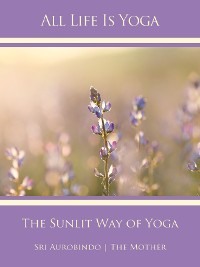
Flower on the cover:
Prunus dulcis. White to pink. Spiritual significance and explanation given by the Mother: Smile of Nature Nature rejoices in her beauty.
Publisher’s Note
This is one in a series of some e-books created by SRI AUROBINDO DIGITAL EDITION and published by AURO MEDIA under the title All Life Is Yoga. Our effort is to bring together, from Sri Aurobindo and the Mother, simple passages with a practical orientation on specific subjects, so that everyone may feel free to choose a book according to his inner need. The topics cover the whole field of human activity, because true spirituality is not the rejection of life but the art of perfecting life.
While the passages from Sri Aurobindo are in the original English, most of the passages from the Mother (selections from her talks and writings) are translations from the original French. We must also bear in mind that the excerpts have been taken out of their original context and that a compilation, in its very nature, is likely to have a personal and subjective approach. A sincere attempt, however, has been made to be faithful to the vision of Sri Aurobindo and the Mother. These excerpts are by no means exhaustive.
Bringing out a compilation from the writings of Sri Aurobindo and the Mother, which have a profound depth and wideness unique, is a difficult task. The compiler’s subjective tilt and preferences generally result in highlighting some aspects of the issues concerned while the rest is by no means less significant. Also without contexts of the excerpts the passages reproduced may not fully convey the idea – or may be misunderstood or may reduce a comprehensive truth into what could appear like a fixed principle.
The reader may keep in mind this inherent limitation of compilations; compilations are however helpful in providing an introduction to the subject in a handy format. They also give the readers a direct and practical feel of some of the profound issues and sometimes a mantric appeal, musing on which can change one’s entire attitude to them.
The excerpts from the writings of Sri Aurobindo and the Mother carry titles and captions chosen by the editor, highlighting the theme of the excerpts and, whenever possible, borrowing a phrase from the text itself. The sources of the excerpts are given at the end of each issue.
We hope these compilations will inspire the readers to go to the complete works of Sri Aurobindo and the Mother and will help them to mould their lives and their environments towards an ever greater perfection.
“True spirituality is not to renounce life, but to make life perfect with a Divine Perfection.” – The Mother
* * *
ContentsTitle PageCopyrightPublisher’s NoteI. SOME REMARKS OF THE PATHFINDERSQuotations1. The Hour of God2. The Law of the Way3. This is Thy Work and the Aim of Thy Being4. The Burden of Humanity5. Preparation of the Sunlit Path6. Conditions to Follow the Sunlit Path7. The Path of Integral Yoga – A Spiritual Adventure8. The Path9. The Sunlit Path to Divine GraceII. MAKE OF THY DAILY WAY A PILGRIMAGEQuotation1. The Call2. The Value of Education3. Morality, Religion, Yoga4. Surrender, Self-Offering, Humility5. Sincerity, Vigilance, Will-Power6. Other Persons and Forces7. Courage, Endurance, Effort8. Receptivity and Aspiration9. Concentration, Meditation, Work10. The Divine Work11. Peace and Quiet12. The Spirit and the Psychic Being13. The Ego and Self-Giving14. Faith and the Grace15. Controlling One’s Thoughts16. Developing the Mind and Senses17. Mundane Affairs18. Words, Opinions, Judgments19. Virtue, Purity, Freedom20. Effort, Patience, Progress21. The Divine, the World and ManIII. THE ODYSSEY OF THE PSYCHIC BEINGQuotation1. Introduction2. The Breadths and Depths of Our Psychic Complex3. The Awakening4. The Influence of the Psychic Presence5. After-Life and Rebirth6. Natal Home of the Psychic Being in the World-Soul7. The Two Dimensions of Psychic Growth8. The Adventure of Ignorance9. Odyssey of the Psychic Being on the Ocean of Inconscient10. Central Conflict of the Psychic Being11. The Divine Mother and the Psychic Being12. The Psychic Being Calls the Divine Mother to Manifest in MatterAPPENDIXReferencesGuideCoverTable of ContentsStart Reading
Part I

The spiritual consciousness and spiritual life are exceedingly difficult to attain; it needs a deep and strong call and the turning of all the energies towards the one object to arrive at any kind of full success (siddhi). Even those who have cut off all other ties, find it difficult not to live in a double consciousness, one inward and turned towards the spiritual change and the other which is still chained to the ordinary movements and pulls them down from their spiritual experience into the persistent and unchanged course of the lower nature. If you have not the entire and undivided call, it is better not to take the plunge, unless you are prepared for very bitter inner struggles, great difficulties and relapses and a hampered and doubtful progress. It is better in that case to prepare yourself by meditation and concentration while still living in the family and the usual human life, until the spiritual attraction is strong enough to overshadow and destroy all others.
Next, you speak of leading a higher life in order to fit yourself for service to others. But leading a higher life is a vague mental phrase and the object of Yoga is not service to others. The object of Yoga is to enter into an entirely new consciousness in which you live no longer in the mind and the ego but in the divine consciousness and grow into the true inmost truth of your being above mind and life and body. The aim in most ways of Yoga is to draw back altogether from life into this greater existence. In Sri Aurobindo’s Yoga, the aim is to transform mind, life and body into an expression of this divine Truth and to make the outward as well as the inward life embody it – a much more difficult endeavour. To act out of this greater consciousness becomes the only rule of life, abandoning all other dharmas. Not to serve either one’s own ego or others, but to serve the Divine Shakti and be the instrument of her works is the law of this life. – Sri Aurobindo
* * *
I had a clear vision of the two kinds of opposites in nature (not only in nature but in life) which almost everyone carries within himself: one is the possibility of realization, the other is the path chosen to attain it. There is always (it’s probably inevitable) the stormy path of struggle, and then there is the sunlit path. After much study and observation, I have had a sort of “spiritual ambition” (if it can be called that) to bring to the world a sunlit path, to eliminate the necessity for struggle and suffering: something that aspires to replace this present phase of universal evolution with a less painful phase. – The Mother
* * *
Chapter 1
The Hour of God
Words of Sri Aurobindo
There are moments when the Spirit moves among men and the breath of the Lord is abroad upon the waters of our being; there are others when it retires and men are left to act in the strength or the weakness of their own egoism. The first are periods when even a little effort produces great results and changes destiny; the second are spaces of time when much labour goes to the making of a little result. It is true that the latter may prepare the former, may be the little smoke of sacrifice going up to heaven which calls down the rain of God’s bounty. Unhappy is the man or the nation which, when the divine moment arrives, is found sleeping or unprepared to use it, because the lamp has not been kept trimmed for the welcome and the ears are sealed to the call. But thrice woe to them who are strong and ready, yet waste the force or misuse the moment; for them is irreparable loss or a great destruction.
In the hour of God cleanse thy soul of all self-deceit and hypocrisy and vain self-flattering that thou mayst look straight into thy spirit and hear that which summons it. All insincerity of nature, once thy defence against the eye of the Master and the light of the ideal, becomes now a gap in thy armour and invites the blow. Even if thou conquer for the moment, it is the worse for thee, for the blow shall come afterwards and cast thee down in the midst of thy triumph. But being pure cast aside all fear; for the hour is often terrible, a fire and a whirlwind and a tempest, a treading of the winepress of the wrath of God; but he who can stand up in it on the truth of his purpose is he who shall stand; even though he fall, he shall rise again, even though he seem to pass on the wings of the wind, he shall return. Nor let worldly prudence whisper too closely in thy ear; for it is the hour of the unexpected, the incalculable, the immeasurable. Mete not the power of the Breath by thy petty instruments, but trust and go forward.
But most keep thy soul clear, even if for a while, of the clamour of the ego. Then shall a fire march before thee in the night and the storm be thy helper and thy flag shall wave on the highest height of the greatness that was to be conquered.
* * *
Chapter 2
The Law of the Way
Words of Sri Aurobindo
First be sure of the call and of thy soul’s answer. For if the call is not true, not the touch of God’s powers or the voice of his messengers, but the lure of thy ego, the end of thy endeavour will be a poor spiritual fiasco or else a deep disaster.
And if not the soul’s fervour, but only the mind’s assent or interest replies to the divine summons or only the lower life’s desire clutches at some side attraction of the fruits of Yoga-power or Yoga-pleasure or only a transient emotion leaps like an unsteady flame moved by the intensity of the Voice or its sweetness or grandeur, then too there can be little surety for thee in the difficult path of Yoga.
The outer instruments of mortal man have no force to carry him through the severe ardours of this spiritual journey and Titanic inner battle or to meet its terrible or obstinate ordeals or nerve him to face and overcome its subtle and formidable dangers. Only his spirit’s august and steadfast will and the quenchless fire of his soul’s invincible ardour are sufficient for this difficult transformation and this high improbable endeavour.
Imagine not the way is easy; the way is long, arduous, dangerous, difficult. At every step is an ambush, at every turn a pitfall. A thousand seen or unseen enemies will start up against thee, terrible in subtlety against thy ignorance, formidable in power against thy weakness. And when with pain thou hast destroyed them, other thousands will surge up to take their place. Hell will vomit its hordes to oppose thee and enring and wound and menace; Heaven will meet thee with its pitiless tests and its cold luminous denials. Thou shalt find thyself alone in thy anguish, the demons furious in thy path, the Gods unwilling above thee. Ancient and powerful, cruel, unvanquished and close and innumerable are the dark and dreadful Powers that profit by the reign of Night and Ignorance and would have no change and are hostile. Aloof, slow to arrive, far-off and few and brief in their visits are the Bright Ones who are willing or permitted to succour. Each step forward is a battle. There are precipitous descents, there are unending ascensions and ever higher peaks upon peaks to conquer. Each plateau climbed is but a stage on the way and reveals endless heights beyond it. Each victory thou thinkest the last triumphant struggle proves to be but the prelude to a hundred fierce and perilous battles... But thou sayest God’s hand will be with me and the Divine Mother near with her gracious smile of succour? And thou knowest not then that God’s grace is more difficult to have or to keep than the nectar of the Immortals or Kuvera’s priceless treasures? Ask of His chosen and they will tell thee how often the Eternal has covered his face from them, how often he has withdrawn from them behind his mysterious veil and they have found themselves alone in the grip of Hell, solitary in the horror of the darkness, naked and defenceless in the anguish of the battle. And if his presence is felt behind the veil, yet is it like the winter sun behind clouds and saves not from the rain and snow and the calamitous storm and the harsh wind and the bitter cold and the grey of a sorrowful atmosphere and the dun weary dullness. Doubtless the help is there even when it seems to be withdrawn, but still is there the appearance of total night with no sun to come and no star of hope to pierce the blackness. Beautiful is the face of the Divine Mother, but she too can be hard and terrible. Nay, then, is immortality a plaything to be given lightly to a child or the divine life a prize without effort or the crown for a weakling? Strive rightly and thou shalt have; trust and thy trust shall in the end be justified; but the dread Law of the Way is there and none can abrogate it.
* * *
Chapter 3
This is Thy Work and the Aim of Thy Being
Words of Sri Aurobindo
This is thy work and the aim of thy being and that for which thou art here, to become the divine superman and a perfect vessel of the Godhead. All else that thou hast to do, is only a making thyself ready or a joy by the way or a fall from thy purpose. But the goal is this and the purpose is this and not in power of the way and the joy by the way but in the joy of the goal is the greatness and the delight of thy being. The joy of the way is because that which is drawing thee is also with thee on thy path and the power to climb was given thee that thou mightrest mount to thy own summits.
If thou hast a duty, this is thy duty; if thou ask what shall be thy aim, let this be thy aim; if thou demand pleasure, there is no greater joy, for all other joy is broken or limited, the joy of a dream or the joy of a sleep or the joy of self-forgetting. But this is the joy of thy whole being. For if thou say what is my being, this is thy being, the Divine, and all else is only its broken or its perverse appearance. If thou seek the Truth, this is the Truth. Place it before thee and in all things be faithful to it.
It has been well said by one who saw but through a veil and mistook the veil for the face, that thy aim is to become thyself; and he said well again that the nature of man is to transcend himself. This is indeed his nature and that is indeed the divine aim of his self-transcending.
What then is the self that thou hast to transcend and what is the self that thou hast to become? For it is here that thou shouldst make no error; for this error, not to know thyself, is the fountain of all thy grief and the cause of all thy stumbling.
That which thou hast to transcend is the self that thou appearest to be, and that is man as thou knowest him, the apparent Purusha. And what is this man? He is a mental being enslaved to life and matter; and where he is not enslaved to life and matter, he is the slave of his mind. But this is a great and heavy servitude; for to be the slave of mind is to be the slave of the false, the limited and the apparent. The self that thou hast to become, is the self that thou art within behind the veil of mind and life and matter. It is to be the spiritual, the divine, the superman, the real Purusha. For that which is above the mental being, is the superman. It is to be the master of thy mind, thy life and thy body; it is to be a king over Nature of whom thou art now the tool, lifted above her who now has thee under her feet. It is to be free and not a slave, to be one and not divided, to be immortal and not obscured by death, to be full of light and not darkened, to be full of bliss and not the sport of grief and suffering, to be uplifted into power and not cast down into weakness. It is to live in the Infinite and possess the finite. It is to live in God and be one with him in his being. To become thyself is to be this and all that flows from it.
Be free in thyself, and therefore free in thy mind, free in thy life and thy body. For the Spirit is freedom.
Be one with God and all beings; live in thyself and not in thy little ego. For the Spirit is unity.
Be thyself, immortal, and put not thy faith in death; for death is not of thyself, but of thy body. For the Spirit is immortality.
To be immortal is to be infinite in being and consciousness and bliss; for the Spirit is infinite and that which is finite lives only by his infinity.
These things thou art, therefore thou canst become all this; but if thou wert not these things, then thou couldst never become them. What is within thee, that alone can be revealed in thy being. Thou appearest indeed to be other than this, but wherefore shouldst thou enslave thyself to appearances?
Rather arise, transcend thyself, become thyself. Thou art man and the whole nature of man is to become more than himself. He was the man-animal, he has become more than the animal man. He is the thinker, the craftsman, the seeker after beauty. He shall be more than the thinker, he shall be the seer of knowledge; he shall be more than the craftsman, he shall be the creator and master of his creation; he shall be more than the seeker of beauty, for he shall enjoy all beauty and all delight. Physical, he seeks for his immortal substance; vital he seeks after immortal life and the infinite power of his being; mental and partial in knowledge, he seeks after the whole light and the utter vision.
To possess these is to become the superman; for it is to rise out of mind into the supermind. Call it the divine mind or Knowledge or the supermind; it is the power and light of the divine will and the divine consciousness. By the supermind the Spirit saw and created himself in the worlds, by that he lives in them and governs them. By that he is Swarat Samrat, self-ruler and all-ruler.
Supermind is superman; therefore to rise beyond mind is the condition.
To be the superman is to live the divine life, to be a god; for the gods are the powers of God. Be a power of God in humanity.
To live in the divine Being and let the consciousness and bliss, the will and knowledge of the Spirit possess thee and play with thee and through thee, this is the meaning.
This is the transfiguration of thyself on the mountain. It is to discover God in thyself and reveal him to thyself in all things. Live in his being, shine with his light, act with his power, rejoice with his bliss. Be that Fire and that Sun and that Ocean. Be that joy and that greatness and that beauty.
When thou hast done this even in part, thou hast attained to the first steps of supermanhood.
* * *
Chapter 4
The Burden of Humanity
Words of Sri Aurobindo
I have said that the Avatar is one who comes to open the Way for humanity to a higher consciousness – if nobody can follow the Way, then either our conception of the thing, which is also that of Christ and Krishna and Buddha, is all wrong or the whole life and action of the Avatar is quite futile. X seems to say that there is no way and no possibility of following, that the struggles and sufferings of the Avatar are unreal and all humbug, – there is no possibility of struggle for one who represents the Divine. Such a conception makes nonsense of the whole idea of Avatarhood – there is then no reason in it, no necessity for it, no meaning in it. The Divine being all-powerful can lift people up without bothering to come down on earth. It is only if it is part of the world-arrangement that he should take upon himself the burden of humanity and open the Way that Avatarhood has any meaning.
*
Words of Sri Aurobindo
Mother spoke to me of the right attitude as one without tension and strain, one which is full of sunshine and as spontaneous as a flower opening to the light. This is all very well for beings like you and the Mother, who are Avatars, but how can we poor mortals take this vague prescription for guidance? And how to get this attitude if not through constant prayer, arduous meditation and a constant effort to reject wrong movements?
You say that this way is too difficult for you or the likes of you and it is only “avatars” like myself or the Mother that can do it. That is a strange misconception, for it is on the contrary the easiest and simplest and most direct way and anyone can do it, if he makes his mind and vital quiet, even those who have a tenth of your capacity can do it. It is the other way of tension and strain and hard endeavour that is difficult and needs a great force of Tapasya. As for the Mother and myself, we have had to try all ways, follow all methods, to surmount mountains of difficulties, a far heavier burden to bear than you or anybody else in this Asram or outside, far more difficult conditions, battles to fight, wounds to endure, ways to cleave through impenetrable morass and desert and forest, hostile masses to conquer, a work such as I am certain none else had to do before us. For the Leader of the Way in a work like ours has not only to bring down and represent and embody the Divine, but to represent too the ascending element in humanity and to bear the burden of humanity to the full and experience not in a mere play or lila but in grim earnest all the obstruction, difficulty, opposition, baffled and hampered and only slowly victorious labour which are possible on the Path. But it is not necessary nor tolerable that all that should be repeated over again to the full in the experience of others. It is because we have the complete experience that we can show a straighter and easier road to others – if they will only consent to take it. It is because of our experience won at a tremendous price that we can urge upon you and others, “Take the psychic attitude; follow the straight sunlit path, with the Divine openly or secretly upbearing you – if secretly, he will yet show himself in good time, – do not insist on the hard, hampered, roundabout and difficult journey.”
* * *
Chapter 5
Preparation of the Sunlit Path
Words of Sri Aurobindo
Peace was the very first thing that the Yogins and seekers of old asked for and it was a quiet and silent mind – and that always brings peace – that they declared to be the best condition for realising the Divine. A cheerful and sunlit heart is the fit vessel for the Ananda and who shall say that Ananda or what prepares it is an obstacle to the Divine union? As for despondency, it is surely a terrible burden to carry on the way. One has to pass through it sometimes, like Christian of The Pilgrim’s Progress through the Slough of Despond, but its constant reiteration cannot be anything but an obstacle. The Gita specially says, “Practise the Yoga with an undespondent heart”, anirvinnacetasa.
I know perfectly well that pain and suffering and struggle and excesses of despair are natural – though not inevitable – on the way, – not because they are helps, but because they are imposed on us by the darkness of this human nature out of which we have to struggle into the Light. I do not suppose Ramakrishna or Vivekananda would have recommended the incidents you allude to as an example for others to follow – they would surely have said that faith, fortitude, perseverance were the better way. That after all was what they stuck to in the end in spite of these bad moments and they would never have dreamed of giving up the Yoga or the aspiration for the Divine on the ground that they were unfit and not meant for the realisation.
At any rate Ramakrishna told the story of Narada and the ascetic Yogi and the Vaishnava Bhakta with approval of its moral. I put it in my own language but keep the substance. Narada on his way to Vaikuntha met a Yogi practising hard tapasya on the hills. “O Narada,” cried the Yogi, “you are going to Vaikuntha and will see Vishnu. I have been practising terrific austerities all my life and yet I have not even now attained to Him. Ask Him at least for me when I shall reach Him.” Then Narada met a Vaishnava, a Bhakta who was singing songs to Hari and dancing to his own singing, and he cried also, “O Narada, you will see my Lord, Hari. Ask my Lord when I shall reach Him and see His face.” On his way back Narada came first to the Yogi. “I have asked Vishnu; you will realise Him after six more lives.” The Yogi raised a cry of loud lamentation, “What, so many austerities! such gigantic endeavours! and my reward is realisation after six long lives! O how hard to me is the Lord Vishnu.” Next Narada met again the Bhakta and said to him, “I have no good news for you. You will see the Lord, but only after a lakh of lives.” But the Bhakta leapt up with a great cry of rapture, “Oh, I shall see my Lord Hari! after a lakh of lives I shall see my Lord Hari! How great is the grace of the Lord.” And he began dancing and singing in a renewed ecstasy. Then Narada said, “Thou hast attained. Today thou shalt see the Lord!” Well, you may say, “What an extravagant story and how contrary to human nature!” Not so contrary as all that and in any case hardly more extravagant than the stories of Harishchandra and Shivi. Still I do not hold up the Bhakta as an example, for I myself insist on the realisation in this life and not after six or a lakh of births more. But the point of these stories is in the moral and surely when Ramakrishna told it, he was not ignorant that there was a sunlit path of Yoga! He even seems to say that it is the quicker way as well as the better! You are quite mistaken in thinking that the possibility of the sunlit path is a discovery or original invention of mine. The very first books on Yoga I read more than thirty years ago spoke of the dark and sunlit way and emphasised the superiority of the second over the other.
It is not either because I have myself trod the sunlit way or flinched from difficulty and suffering and danger. I have had my full share of these things and the Mother has had ten times her full share. But that was because the finders of the Way had to face these things in order to conquer. No difficulty that can come on the sadhak but has faced us on the path; against many we have had to struggle hundreds of times (in fact that is an understatement) before we could overcome; many still remain protesting that they have a right until the perfect perfection is there. But we have never consented to admit their inevitable necessity for others. It is in fact to ensure an easier path to others hereafter that we have borne that burden. It was with that object that the Mother once prayed to the Divine that whatever difficulties, dangers, sufferings were necessary for the path might be laid on her rather than on others. It has been so far heard that as a result of daily and terrible struggles for years those who put an entire and sincere confidence in her are able to follow the sunlit path and even those who cannot, yet when they do put the trust find their path suddenly easy and, if it becomes difficult again, it is only when distrust, revolt, abhiman, or other darknesses come upon them. The sunlit path is not altogether a fable.
But you will ask what of those who cannot? Well, it is for them I am putting forth all my efforts to bring down the supramental Force within a measurable time. I know that it will descend but I am seeking its near descent and, with whatever dark obstruction of the earth-nature or furious inroads of the Asuric forces seeking to prevent it, it is approaching the terrestrial soil. The supramental is not, as you imagine, something cold, hard and rocklike. It bears within it the presence of the Divine Love as well as the Divine Truth and its reign here means for those who accept it the straight and thornless path on which there is no wall or obstacle of which the ancient Rishis saw the far-off promise.
The dark path is there and there are many who make like the Christians a gospel of spiritual suffering; many hold it to be the unavoidable price of victory. It may be so under certain circumstances, as it has been in so many lives at least at the beginning, or one may choose to make it so. But then the price has to be paid with resignation, fortitude or a tenacious resilience. I admit that if borne in that way the attacks of the Dark Forces or the ordeals they impose have a meaning. After each victory gained over them, there is then a sensible advance; often they seem to show us the difficulties in ourselves which we have to overcome and to say, “Here you must conquer us and here.” But all the same it is a too dark and difficult way which nobody should follow on whom the necessity does not lie.
In any case one thing can never help and that is to despond always and say, “I am unfit; I am not meant for the Yoga.” And worse still are these perilous mental formations such as you are always accepting that you must fare like X (one whose difficulty of exaggerated ambition was quite different from yours) and that you have only six years etc. These are clear formations of the Dark Forces seeking not only to sterilise your aspiration but to lead you away and so prevent your sharing in the fruit of the victory hereafter. I do not know what Krishnaprem has said but his injunction, if you have rightly understood it, is one that cannot stand as valid, since so many have done Yoga relying on tapasya or anything else but not confident of any divine Grace. It is not that, but the soul’s demand for a higher Truth or a higher life that is indispensable. Where that is, the Divine Grace whether believed in or not, will intervene. If you believe, that hastens and facilitates things; if you cannot yet believe, still the soul’s aspiration will justify itself with whatever difficulty and struggle.
* * *
Chapter 6
Conditions to Follow the Sunlit Path
Words of Sri Aurobindo
The sunlit path can only be followed if the psychic is constantly or usually in front or if one has a natural spirit of faith and surrender or a face turned habitually towards the sun or psychic predisposition (e.g. a faith in one’s spiritual destiny) or if he has acquired the psychic turn. That does not mean that the sunlit man has no difficulties; he may have many, but he regards them cheerfully as “all in the day’s work”. If he gets bad beatings, he is capable of saying, “Well, that was a queer go, but the Divine is evidently in a queer mood and if that is his way of doing things, it must be the right one; I am surely a still queerer fellow myself and that, I suppose, was the only means of putting me right.” But everybody can’t be of that turn, and surrender which would put everything right is, as you say, difficult to do completely. That is why we do not insist on total surrender at once, but are satisfied with a little to begin with, the rest to grow as it can.
I have explained to you why so many people (not by any means all) are in this gloomy condition, dull and despondent. It is the tamas, the inertia of the Inconscient, that has got hold of them. But also it is the small physical vital which takes only an interest in the small and trivial things of the ordinary daily and social life and nothing else. When formerly the sadhana was going on on higher levels (mind, higher vital etc.), there was plenty of vigour and verve and interest in the details of the Asram work and life as well as in an inner life; the physical vital was carried in the stream. But for many this has dropped; they live in the unsatisfied vital physical and find everything desperately dull, gloomy and without interest or issue. In their inner life the tamas from the Inconscient has created a block or a bottleneck and they do not find any way out. If one can keep the right condition and attitude, a strong interest in work or a strong interest in sadhana, then this becomes quiescent. That is the malady. Its remedy is to keep the right condition and to bring gradually or, if one can, swiftly the light of the higher aspiration into this part of the being also, so that whatever the conditions of the environment, it may keep also the right poise. Then the sunlit path should be less impossible.
*
Words of Sri Aurobindo
There is no contradiction between my former statements about the sunlit path and what I have said about the difficult and unpleasant passages which the Yoga has to pass through in its normal development in the way of human nature. The sunlit path can be followed by those who are able to practise surrender, first a central surrender and afterwards a more complete self-giving in all the parts of the being. If they can achieve and preserve the attitude of the central surrender, if they can rely wholly on the Divine and accept cheerfully whatever comes to them from the Divine, then their path becomes sunlit and may even be straightforward and easy. They will not escape all difficulties, no seeker can, but they will be able to meet them without pain and despondency, – as indeed the Gita recommends that Yoga should be practised, anirvinnacetasa, – trusting in the inner guidance and perceiving it more and more or else in the outer guidance of the Guru. It can also be followed even when one feels no light and no guidance if there is or if one can acquire a bright settled faith and happy bhakti or has the nature of the spiritual optimist and the firm belief or feeling that all that is done by the Divine is done for the best even when we cannot understand his action. But all have not this nature, most are very far from it, and the complete or even the central surrender is not easy to get and to keep it always is hard enough for our human nature. When these things are not there, the liberty of the soul is not attained and we have instead to undergo the law or fulfil a hard and difficult discipline.
That law is imposed on us by the Ignorance which is the nature of all our parts; our physical being is obviously a mass of ignorance, the vital is full of ignorant desires and passions, the mind is also an instrument of Ignorance struggling towards some kind of imperfect and mostly inferior and external knowledge. The path of the seeker proceeds through this ignorance; for a long time he can find no light of solid experience or realisation, only the hopes and ideas and beliefs of the mind which do not give the true spiritual seeing; or he gets glimpses of light or periods of light but the light often goes out and the luminous periods are followed by frequent or long periods of darkness. There are constant fluctuations, persistent disappointments, innumerable falls and failures. No path of Yoga is really easy or free from these difficulties or fluctuations; the way of bhakti is supposed to be the easiest, but still we find constant complaints that one is always seeking but never finding and even at the best there is a constant ebb and tide, milana and viraha, joy and weeping, ecstasy and despair. If one has the faith or in the absence of faith the will to go through, one passes on and enters into the joy and light of the divine realisation. If one gets some habit of true surrender, then all this is not necessary; one can enter into the sunlit way. Or if one can get some touch of what is called pure bhakti, suddha bhakti, then whatever happens that is enough; the way becomes easy, or if it does not, still this is a sufficient start to support us to the end without the sufferings and falls that happen so often to the ignorant seeker.
In all Yoga there are three essential objects to be attained by the seeker: union or abiding contact with the Divine, liberation of the soul or the Self, the Spirit, and a certain change of the consciousness, the spiritual change. It is this change, which is necessary for reaching the other two objects, necessary at least to a certain degree, that is the cause of most of the struggles and difficulties; for it is not easy to accomplish it; a change of the mind, a change of the heart, a change of the habits of the will is called for and is obstinately resisted by our ignorant nature. In this Yoga a complete transformation of the nature is aimed at because that is necessary for the complete union and the complete liberation not only of the soul and the spirit but of the nature itself. It is also a Yoga of works and of the integral divine life; for that the integral transformation of nature is evidently necessary; the union with the Divine has to carry with it a full entrance into the divine consciousness and the divine nature; there must be not only sayujya or salokya but sadrsya or, as it is called in the Gita, sadharmya. The full Yoga, Purna Yoga, means a fourfold path, a Yoga of knowledge for the mind, a Yoga of bhakti for the heart, a Yoga of works for the will and a Yoga of perfection for the whole nature. But, ordinarily, if one can follow wholeheartedly any one of these lines, one arrives at the result of all the four. For instance, by bhakti one becomes close to the Divine, becomes intensely aware of Him and arrives at knowledge, for the Divine is the Truth and the Reality; by knowing Him, says the Upanishads, one comes to know all. By bhakti also the will is led into the road of the works of love and the service of the Divine and the government of the nature and its acts by the Divine, and that is Karmayoga. By bhakti also comes spiritual change of the consciousness and the action of the nature which is the first step towards its transformation. So it is with all the other lines of the fourfold path.
But it may be that there are many obstacles in the being to the domination of the mind and heart and will by bhakti and the consequent contact with the Divine. The too great activity of the intellectual mind and its attachment to its own pride of ideas, its prejudices, its fixed notions and its ignorant reason may shut the doors to the inner light and prevent the full tide of bhakti from flooding everything; it may also cling to a surface mental activity and refuse to go inside and allow the psychic vision and the feelings of the inner heart to become its guides, though it is by this vision and this feeling that bhakti grows and conquers. So too the passions and desires of the vital being and its ego may block the way and prevent the self-giving of the mind and heart to the Divine. The inertia, ignorance and inconscience of one’s physical consciousness, its attachment to fixed habits of thought and feeling and action, its persistence in the old grooves may come badly in the way of the needed change. In such circumstances the Divine may have to bide his time; but if there is real hunger in the heart, all that cannot prevent the final realisation; still, it may have to wait till the obstructions are removed or at least so much cleared out as to admit an unimpeded working of the Divine Power on the surface nature. Till then, there may be periods of inner ease and some light in the mind, periods also of the feeling of bhakti or of peace, periods of the joy of self-consecration in works and service; for these will take long to stay permanently and there will be much struggle and unrest and suffering. In the end the Divine’s working will appear and one will be able to live in his presence.
I have described the difficulties of Yoga at their worst, as they may hamper and afflict even those predestined to the realisation but as often there is an alternation or a mixture of the light and the darkness, initial attainment perhaps and heavy subsequent difficulties, progress and attacks and retardations, strong movements forward and a floundering in the bogs of the Ignorance. Even great realisations may come and high splendours of light and spiritual experience and yet the goal is not attained; for in the phrase of the Rig Veda, “As one climbs from peak to peak there is made clear the much that is still to be done.” But there is always something that either carries us on or forces us on. This may take the shape of something conscious in front, the shape of a mastering spiritual idea, indestructible aspiration or fixed faith which may seem sometimes entirely veiled or even destroyed in periods of darkness or violent upheaval, but always they reappear when the storm has passed or the blackness of night has thinned, and reassert their influence. But also it may be something in the very essence of the being deeper than any idea or will in the mind, deeper and more permanent than the heart’s aspiration but hidden from one’s own observation. One who is moved to Yoga by some curiosity of the mind or even by its desire for knowledge can turn aside from the path from disappointment or any other cause; still more can those who take it up from some inner ambition or vital desire turn away through revolt or frustration or the despondency of frequent check and failure. But if this deeper thing is there, then one cannot permanently leave the path of spiritual endeavour: one may decide to leave the path but is not allowed from within to do it or one may leave but is obliged to return to it by the secret spiritual need within him.
All these things are common to every path of Yoga; they are the normal difficulties, fluctuations and struggles which come across the path of spiritual effort. But in this Yoga there is an order or succession of the workings of the secret Force which may vary greatly in its circumstances in each sadhak, but still maintains its general line. Our evolution has brought the being up out of inconscient Matter into the Ignorance of mind, life and body tempered by an imperfect knowledge and is trying to lead us into the light of the Spirit, to lift us into that light and to bring the light down into us, into body and life as well as mind and heart and to fill with it all that we are. This and its consequences, of which the greatest is the union with the Divine and life in the divine consciousness, is the meaning of the integral transformation. Mind is our present topmost faculty; it is through the thinking mind and the heart with the soul, the psychic being behind them that we have to grow into the Spirit, for what the Force first tries to bring about is to fix the mind in the right central idea, faith or mental attitude and the right aspiration and poise of the heart and to make these sufficiently strong and firm to last in spite of other things in the mind and heart which are other than or in conflict with them. Along with this it brings whatever experiences, realisations or descent or growth of knowledge the mind of the individual is ready for at the time or as much of it, however small, as is necessary for its further progress: sometimes these realisations and experiences are very great and abundant, sometimes few and small or negligible; in some there seems to be in this first stage nothing much of these things or nothing decisive – the Force seems to concentrate on a preparation of the mind only. In many cases the sadhana seems to begin and proceed with experiences in the vital; but in reality this can hardly take place without some mental preparation, even if it is nothing more than a turning of the mind or some kind of opening which makes the vital experiences possible. In any case, to begin with the vital is a hazardous affair; the difficulties there are more numerous and more violent than on the mental plane and the pitfalls are innumerable. The access to the soul, the psychic being, is less easy because it is covered up with a thick veil of ego, passion and desire. One is apt to be swallowed up in a maze of vital experiences, not always reliable, the temptation of small siddhis, the appeal of the powers of darkness to the ego. One has to struggle through these densities to the psychic being behind and bring it forward; then only can the sadhana on the vital plane be safe.
However that may be, the descent of the sadhana, of the action of the Force into the vital plane of our being becomes after some time necessary. The Force does not make a wholesale change of the mental being and nature, still less an integral transformation before it takes this step: if that could be done, the rest of the sadhana would be comparatively secure and easy. But the vital is there and always pressing on the mind and heart, disturbing and endangering the sadhana and it cannot be left to itself for too long. The ego and desires of the vital, its disturbances and upheavals have to be dealt with and if not at once expelled, at least dominated and prepared for a gradual if not a rapid modification, change, illumination. This can only be done on the vital plane itself by descending to that level. The vital ego itself must become conscious of its own defects and willing to get rid of them; it must decide to throw away its vanities, ambitions, lusts and longings, its rancours and revolts and all the rest of the impure stuff and unclean movements within it. This is the time of the greatest difficulties, revolts and dangers. The vital ego hates being opposed in its desires, resents disappointment, is furious against wounds to its pride and vanity; it does not like the process of purification and it may very well declare Satyagraha against it, refuse to cooperate, justify its own demands and inclinations, offer passive resistance of many kinds, withdraw the vital support which is necessary both to the life and the sadhana and try to withdraw the being from the path of spiritual endeavour. All this has to be faced and overcome, for the temple of the being has to be swept clean if the Lord of our being is to take his place and receive our worship there.
* * *
Chapter 7
The Path of Integral Yoga – A Spiritual Adventure
Words of Sri Aurobindo
The teaching of Sri Aurobindo starts from that of the ancient sages of India that behind the appearances of the universe there is the Reality of a Being and Consciousness, a Self of all things one and eternal. All beings are united in that One Self and Spirit but divided by a certain separativity of consciousness, an ignorance of their true Self and Reality in the mind, life and body. It is possible by a certain psychological discipline to remove this veil of separative consciousness and become aware of the true Self, the Divinity within us and all.
Sri Aurobindo’s teaching states that this One Being and Consciousness is involved here in Matter. Evolution is the method by which it liberates itself; consciousness appears in what seems to be inconscient and once having appeared is self-impelled to grow higher and higher and at the same time to enlarge and develop towards a greater and greater perfection. Life is the first step of this release of consciousness; mind is the second; but the evolution does not finish with mind, it awaits a release into something greater, a consciousness which is spiritual and supramental. The next step of the evolution must be towards the development of Supermind and Spirit as the dominant power in the conscious being. For only then will the involved Divinity in things release self entirely and it become possible for life to manifest perfection.
But while the former steps in evolution were taken by Nature without a conscious will in the plant and animal life, in man Nature becomes able to evolve by a conscious will in the instrument. It is not, however, by the mental will in man that this can be wholly done, for the mind goes only to a certain point and after that can only move in a circle. A conversion has to be made, a turning of the consciousness by which mind has to change into the higher principle. This method is to be found through the ancient psychological discipline and practice of Yoga. In the past, it has been attempted by a drawing away from the world and a disappearance into the height of the Self or Spirit. Sri Aurobindo teaches that a descent of the higher principle is possible which will not merely release the spiritual Self out of the world, but release it in the world, replace the mind’s ignorance or its very limited knowledge by a supramental Truth-Consciousness which will be a sufficient instrument of the inner Self and make it possible for the human being to find himself dynamically as well as inwardly and grow out of his still animal humanity into a diviner race. The psychological discipline of Yoga can be used to that end by opening all the parts of the being to a conversion or transformation through the descent and working of the higher still concealed supramental principle.
This however cannot be done at once or in a short time or by any rapid or miraculous transformation. Many steps have to be taken by the seeker before the supramental descent is possible. Man lives mostly in his surface mind, life and body, but there is an inner being within him with greater possibilities to which he has to awake – for it is only a very restricted influence from it that he receives now and that pushes him to a constant pursuit or a greater beauty, harmony, power and knowledge. The first process of Yoga is therefore to open the ranges of this inner being and to live from there outward, governing his outward life by an inner light and force. In doing so he discovers in himself his true soul which is not this outer mixture of mental, vital and physical elements but something of the Reality behind them, a spark from the one Divine Fire. He has to learn to live in his soul and purify and orientate by its drive towards the Truth the rest of the nature. There can follow afterwards an opening upward and descent or a higher principle of the Being. But even then it is not at once the full supramental Light and Force. For there are several ranges of consciousness between the ordinary human mind and the supramental Truth-Consciousness. These intervening ranges have to be opened up and their power brought down into the mind, life and body. Only afterwards can the full power of the Truth-Consciousness work in the nature. The process of this self-discipline or sadhana is therefore long and difficult, but even a little of it is so much gained because it makes the ultimate release and perfection more possible.
There are many things belonging to older systems that are necessary on the way – an opening of the mind to a greater wideness and to the sense of the Self and the Infinite, an emergence into what has been called the cosmic consciousness, mastery over the desires and passions; an outward asceticism is not essential, but the conquest of desire and attachment and a control over the body and its needs, greeds and instincts are indispensable. There is a combination of the principles of the old systems, the way of knowledge through the mind’s discernment between Reality and the appearance, the heart’s way of devotion, love and surrender and the way of works turning the will away from motives of self-interest to the Truth and the service of a greater Reality than the ego. For the whole being has to be trained so that it can respond and be transformed when it is possible for that greater Light and Force to work in the nature.
In this discipline the inspiration of the Master, and in the difficult stages his control and his presence, are indispensable – for it would be impossible otherwise to go through it without much stumbling and error which would prevent all chance of success. The Master is one who has risen to a higher consciousness and being and he is often regarded as its manifestation or representative. He not only helps by his teaching and still more by his influence and example but by a power to communicate his own experience to others.
This is Sri Aurobindo’s teaching and method of practice. It is not his object to develop any one religion or to amalgamate the older religions or to found any new religion-for any of these things would lead away from his central purpose. The one aim of his Yoga is an inner self-development by which each one who follows it can in time discover the One Self in all and evolve a higher consciousness than the mental, a spiritual and supramental consciousness which will transform and divinise human nature.
*
Words of Sri Aurobindo
[The Integral Yoga] is new as compared with the old Yogas:
(1) Because it aims not at a departure out of world and life into a Heaven or a Nirvana, but at a change of life and existence, not as something subordinate or incidental, but as a distinct and central object. If there is a descent in other Yogas, yet it is only an incident on the way or resulting from the ascent – the ascent is the real thing. Here the ascent is indispensable, but what is decisive, what is finally aimed at is the resulting descent. It is the descent of the new consciousness attained by the ascent that is the stamp and seal of the sadhana. Even Tantra and Vaishnavism end in the release from life; here the object is the divine fulfilment of life.
(2) Because the object sought after is not an individual achievement of divine realisation for the sole sake of the individual, but something to be gained for the earth-consciousness here, a cosmic, not solely a supra-cosmic achievement. The thing to be gained also is the bringing in of a Power of consciousness (the supramental) not yet organised or active directly in earth-nature, even in the spiritual life, but yet to be organised and made directly active.
(3) Because a method has been preconised for achieving this purpose which is as total and integral as the aim set before it, viz. the total and integral change of the consciousness and nature, taking up old methods but only as a part action and passing on to others that are distinctive. I have not found this method (as a whole) or anything like it in its totality proposed or realised in the old Yogas. If I had I should not have wasted my time in hewing out a road and in thirty years of search and inner creation when I could have hastened home safely to my goal in an easy canter over paths already blazed out, laid down, perfectly mapped, macadamised, made secure and public. Our Yoga is not a retreading of old walks, but a spiritual adventure.
* * *
Chapter 8
The Path
Words of Sri Aurobindo
The supramental Yoga is at once an ascent towards God and a descent of Godhead into the embodied nature.
The ascent can only be achieved by a one-centred all-gathering upward aspiration of the soul and mind and life and body; the descent can only come by a call of the whole being towards the infinite and eternal Divine. If this call and this aspiration are there, or if by any means they can be born and grow constantly and seize all the nature, then and then only a supramental uplifting and transformation becomes possible.
The call and the aspiration are only first conditions; there must be along with them and brought by their effective intensity an opening of all the being to the Divine and a total surrender.
This opening is a throwing wide of all the nature on all its levels and in all its parts to receive into itself without limits the greater divine Consciousness which is there already above and behind and englobing this mortal half-conscious existence. In the receiving there must be no inability to contain, no breaking down of anything in the system, mind or life or nerve or body under the transmuting stress. There must be an endless receptivity, an always increasing capacity to bear an ever stronger and more and more insistent action of the divine Force. Otherwise nothing great and permanent can be done; the Yoga will end in a break-down or an inert stoppage or a stultifying or a disastrous arrest in a process which must be absolute and integral if it is not to be a failure.
But since no human system has this endless receptivity and unfailing capacity, the supramental Yoga can succeed only if the Divine Force as it descends increases the personal power and equates the strength that receives with the Force that enters from above to work in the nature. This is only possible if there is on our part a progressive surrender of the being into the hands of the Divine; there must be a complete and never failing assent, a courageous willingness to let the Divine Power do with us whatever is needed for the work that has to be done.
Man cannot by his own effort make himself more than man; the mental being cannot by his own unaided force change himself into a supramental spirit. A descent of the Divine Nature can alone divinise the human receptacle.
For the powers of our mind, life and body are bound to their own limitations and, however high they may rise or however widely expand, they cannot rise above their natural ultimate limits or expand beyond them. But, still, mental man can open to what is beyond him and call down a supramental Light, Truth and Power to work in him and do what the mind cannot do. If mind cannot by effort become what is beyond mind, supermind can descend and transform mind into its own substance.
If the supramental Power is allowed by man’s discerning assent and vigilant surrender to act according to its own profound and subtle insight and flexible potency, it will bring about slowly or swiftly a divine transformation of our present semi-perfect nature.
This descent, this working is not without its possibility of calamitous fall and danger. If the human mind or the vital desire seizes hold on the descending force and tries to use it according to its own limited and erring ideas or flawed and egoistic impulses, – and this is inevitable in some degree until this lower mortal has learned something of the way of that greater immortal nature, – stumblings and deviations, hard and seemingly insuperable obstacles and wounds and suffering cannot be escaped and even death or utter downfall are not impossible. Only when the conscious integral surrender to the Divine has been learned by mind and life and body, can the way of the Yoga become easy, straight, swift and safe.
And it must be a surrender and an opening to the Divine alone and to no other. For it is possible for an obscure mind or an impure life force in us to surrender to undivine and hostile forces and even to mistake them for the Divine. There can be no more calamitous error. Therefore our surrender must be no blind and inert passivity to all influences or any influence, but sincere, conscious, vigilant, pointed to the One and the Highest alone.
Self-surrender to the divine and infinite Mother, however difficult, remains our only effective means and our sole abiding refuge. Self-surrender to her means that our nature must be an instrument in her hands, the soul a child in the arms of the Mother.
*
Words of the Mother
The mountain path leads always in two directions, upward and downward – all depends on what we put behind us.
*
Words of the Mother
Life is a perpetual choice between truth and falsehood, light and darkness, progress and regression, the ascent towards the heights or a fall into the abyss. It is for each one to choose freely.
*
Words of the Mother
In each one’s life a moment comes when he has to choose between the Path and the muddle. You cannot put one foot here and one foot there. If you try to, you will be torn to pieces.
A heart that does not choose is a heart that will die.
*
Words of the Mother
You take up the spiritual path only when you feel you cannot do otherwise.
*
Words of the Mother
When the path is known it is easy to tread upon it.
*
Words of the Mother
To follow the path to the end, one must be armed with a very patient endurance.
*
Words of the Mother
On the spiritual path each step forward is a conquest and the result of a fight.
*
Words of the Mother
The road to the Divine: always long, often dry in appearance, but always abundant in its results.
*
Words of the Mother
Ascension: stage by stage one climbs towards the Consciousness.
*
Words of the Mother
Spiritual ascension: fearless, regular, uninterrupted.
*
Words of the Mother
One will pass through as many stages as it is necessary to take, but one will arrive.
*
Words of the Mother
The intellectual attitude comes first and practice follows little by little. What is very important is to maintain very alert the will to live and to be what one knows to be the truth. Then it is impossible to stop and even more to fall back.
*
Words of the Mother
All human beings have a spiritual destiny which is near or far depending on each one’s determination.
One must will in all sincerity.
*
Words of the Mother
All depends upon the choice of the force that you allow to make use of you as its instrument. And the choice has to be made at every moment of your life.
*
Words of the Mother
It is the conflict in you between what is attached to ordinary life and what aspires for the divine life. It is up to you to choose which is the strongest in you and to act accordingly.
*
Words of the Mother
You can follow the meanderings of innumerable reincarnations or choose the steep and rapid path of intensive “sadhana”.
*
Words of the Mother
He who follows the steep path that climbs the heights can easily slip down into the abyss.
*
Words of the Mother
For those whose destiny it is to scale the summits, the least false step risks being a mortal danger.
*
Words of the Mother
The perfect path: for each one the path which leads fastest to the Divine.
*
Words of the Mother
All was gold and gold and gold, a torrent of golden light pouring down in an uninterrupted flow and bringing with it the consciousness that the path of the gods is a sunlit path in which difficulties lose all reality.
Such is the path open before us if we choose to take it.
* * *
Chapter 9
The Sunlit Path to Divine Grace
Words of Sri Aurobindo
To walk through life armoured against all fear, peril and disaster, only two things are needed, two that go always together – the Grace of the Divine Mother and on your side an inner state made up of faith, sincerity and surrender. Let your faith be pure, candid and perfect. An egoistic faith in the mental and vital being tainted by ambition, pride, vanity, mental arrogance, vital self-will, personal demand, desire for the petty satisfactions of the lower nature is a low and smoke-obscured flame that cannot burn upwards to heaven. Regard your life as given you only for the divine work and to help in the divine manifestation. Desire nothing but the purity, force, light, wideness, calm, Ananda of the divine consciousness and its insistence to transform and perfect your mind, life and body. Ask for nothing but the divine, spiritual and supramental Truth, its realisation on earth and in you and in all who are called and chosen and the conditions needed for its creation and its victory over all opposing forces.
Let your sincerity and surrender be genuine and entire. When you give yourself, give completely, without demand, without condition, without reservation so that all in you shall belong to the Divine Mother and nothing be left to the ego or given to any other power.
The more complete your faith, sincerity and surrender, the more will grace and protection be with you. And when the grace and protection of the Divine Mother are with you, what is there that can touch you or whom need you fear? A little of it even will carry you through all difficulties, obstacles and dangers; surrounded by its full presence you can go securely on your way because it is hers, careless of all menace, unaffected by any hostility however powerful, whether from this world or from worlds invisible. Its touch can turn difficulties into opportunities, failure into success and weakness into unfaltering strength. For the grace of the Divine Mother is the sanction of the Supreme and now or tomorrow its effect is sure, a thing decreed, inevitable and irresistible.
* * *
Part II

The Mother
Do not take my words for a teaching. Always they are a force in action, uttered with a definite purpose, and they lose their true power when separated from that purpose. – The Mother
* * *
Chapter 1
The Call
The Great Adventure
We are in a very special situation, extremely special, without precedent. We are now witnessing the birth of a new world; it is very young, very weak – not in its essence but in its outer manifestation – not yet recognised, not even felt, denied by the majority. But it is here. It is here, making an effort to grow, absolutely sure of the result. But the road to it is a completely new road which has never before been traced out – nobody has gone there, nobody has done that! It is a beginning, a universal beginning. So, it is an absolutely unexpected and unpredictable adventure.
There are people who love adventure. It is these I call, and I tell them this: “I invite you to the great adventure.”
It is not a question of repeating spiritually what others have done before us, for our adventure begins beyond that. It is a question of a new creation, entirely new, with all the unforeseen events, the risks, the hazards it entails – a real adventure, whose goal is certain victory, but the road to which is unknown and must be traced out step by step in the unexplored. Something that has never been in this present uni verse and that will never be again in the same way. If that interests you... well, let us embark. What will happen to you tomorrow – I have no idea.
One must put aside all that has been foreseen, all that has been devised, all that has been constructed, and then... set off walking into the unknown. And – come what may! There.
* * *
The Sublimest of Adventures
There is a moment when life such as it is, the human consciousness such as it is, seems something absolutely impossible to bear, it creates a kind of disgust, repugnance; one says, “No, it is not that, it is not that; it can’t be that, it can’t continue.” Well, when one comes to this, there is only to throw in one’s all – all one’s effort, all one’s strength, all one’s life, all one’s being – into this chance, if you like, or this exceptional opportunity that is given to cross over to the other side. What a relief to set foot on the new path, that which will lead you elsewhere! This is worth the trouble of casting behind much luggage, of getting rid of many things in order to be able to take that leap. That’s how I see the problem.
In fact it is the sublimest of adventures, and if one has in him in the slightest the true spirit of adventure, it is worth risking all for all.
* * *
A Decisive Turning-Point
At the moment we are at a decisive turning-point in the history of the earth, once again. From every side I am asked, “What is going to happen?” Everywhere there is anguish, expectation, fear. “What is going to happen?...” There is only one reply: “If only man could consent to be spiritualised.”
And perhaps it would be enough if some individuals became pure gold, for this would be enough to change the course of events.... We are faced with this necessity in a very urgent way.
This courage, this heroism which the Divine wants of us, why not use it to fight against one’s own difficulties, one’s own imperfections, one’s own obscurities? Why not heroically face the furnace of inner purification so that it does not become necessary to pass once more through one of those terrible, gigantic destructions which plunge an entire civilisation into darkness?
This is the problem before us. It is for each one to solve it in his own way.
* * *
Chapter 2
The Value of Education
One Dreams of Miracles
One dreams of miracles when one is young, one wants all wickedness to disappear, everything to be always luminous, beautiful, happy, one likes stories which end happily. This is what one should rely on. When the body feels its miseries, its limitations, one must establish this dream in it – of a strength which would have no limit, a beauty which would have no ugliness, and of marvellous capacities: one dreams of being able to rise into the air, of being wherever it is necessary to be, of setting things right when they go wrong, of healing the sick; indeed, one has all sorts of dreams when one is very young.... Usually parents or teachers pass their time throwing cold water on it, telling you, “Oh! it’s a dream, it is not a reality.” They should do the very opposite! Children should be taught, “Yes, this is what you must try to realise and not only is it possible but it is certain if you come in contact with the part in you which is capable of doing this thing. This is what should guide your life, organise it, make you develop in the direction of the true reality which the ordinary world calls illusion.”
This is what it should be, instead of making children ordinary, with that dull, vulgar common sense which becomes an inveterate habit and, when something is going well, immediately brings up in the being the idea: “Oh, that won’t last!”, when somebody is kind, the impression, “Oh, he will change!”, when one is capable of doing something, “Oh, tomorrow I won’t be able to do it so well.” This is like an acid, a destructive acid in the being, which takes away hope, certitude, confidence in future possibilities.
When a child is full of enthusiasm, never throw cold water on it, never tell him, “You know, life is not like that!” You should always encourage him, tell him, “Yes, at present things are not always like that, they seem ugly, but behind this there is a beauty that is trying to realise itself. This is what you should love and draw towards you, this is what you should make the object of your dreams, of your ambitions.”
* * *
The Art of Living
Usually you are taught very few things – you are not taught even to sleep. People think that they have only to lie down in their bed and then they sleep. But this is not true! One must learn how to sleep as one must learn to eat, learn to do anything at all. And if one does not learn, well, one does it badly! Or one takes years and years to learn how to do it, and during all those years when it is badly done, all sorts of unpleasant things occur. And it is only after suffering much, making many mistakes, committing many stupidities, that, gradually, when one is old and has white hair, one begins to know how to do something. But if, when you were quite small, your parents or those who look after you, took the trouble to teach you how to do what you do, do it properly as it should be done, in the right way, then that would help you to avoid all – all these mistakes you make through the years. And not only do you make mistakes, but nobody tells you they are mistakes! And so you are surprised that you fall ill, are tired, don’t know how to do what you want to, and that you have never been taught. Some children are not taught anything, and so they need years and years and years to learn the simplest things, even the most elementary thing: to be clean....
To live in the right way is a very difficult art, and unless one begins to learn it when quite young and to make an effort, one never knows it very well. Simply the art of keeping one’s body in good health, one’s mind quiet and goodwill in one’s heart–things which are indispensable in order to live decently – I don’t say in comfort, I don’t say remarkably, I only say decently. Well, I don’t think there are many who take care to teach this to their children.
* * *
One Needs Education
You think that you are sent to school, that you are made to do exercises, all this just for the pleasure of vexing you? Oh, no! It is because it’s indispensable for you to have a frame in which you can learn how to form yourself. If you did your work of individualisation, of total formation, by yourself, all alone in a comer, nothing at all would be asked of you. But you don’t do it, you wouldn’t do it, there’s not a single child who would do it, he wouldn’t even know how to do it, where to begin. If a child were not taught how to live, he could not live, he wouldn’t know how to do anything, anything.... If everyone had to go through the whole experience needed for the formation of an individuality, he would be long dead before having begun to live! This is the advantage of those – accumulated through centuries – who have had the experience and tell you, “Well, if you want to go quickly, to know in a few years what has been learnt through centuries, do this!” Read, learn, study and then, in the material field, you will be taught to do this in this way, that in that way, this again in this way (gestures). Once you know a little, you can find your own method, if you have the genius for it! But first one must stand on one’s own feet and know how to walk. It is very difficult to learn it all alone. It’s like that for everyone. One must form oneself. Therefore, one needs education.
* * *
Control Your Impulses
From the time you are quite young, the work of your educators is to teach you to control your impulses and obey only those which are in conformity with the laws under which you live or with the ideal you wish to follow or the customs of the environment in which you are. The value of this mental construction which will govern your impulses depends a great deal on the surroundings in which you live and the character of the parents or people who educate you. But whether it be good or bad, mediocre or excellent, it is always the result of a mental control over the impulses. When your parents tell you, “You should not do this”, or when they say, “You have to do that”, this is a beginning of education for the mind’s control over the impulses.
* * *
Reason Must Be the Master
It is a good thing to begin to learn at an early age that to lead an efficient life and obtain from one’s body the maximum it is able to give, reason must be the master of the house. And it is not a question of yoga or higher realisation, it is something which should be taught everywhere, in every school, every family, every home: man was made to be a mental being, and merely to be a man – we are not speaking of anything else, we are speaking only of being a man – life must be dominated by reason and not by vital impulses. This should be taught to all children from their infancy.... The first thing which should be taught to every human being as soon as he is able to think, is that he should obey reason which is a super-instinct of the species. Reason is the master of the nature of mankind. One must obey reason and absolutely refuse to be the slave of instincts. And here I am not talking to you about yoga, I am not talking about spiritual life, not at all; it has nothing to do with that. It is the basic wisdom of human life, purely human life: every human being who obeys anything other than reason is a kind of brute lower than the animal. That’s all. And this should be taught everywhere; it is the basic education which should be given to children.
The reign of reason must come to an end only with the advent of the psychic law which manifests the divine Will.
* * *
Reason Is Developed by Using It
How can the reason be developed?
Oh! By using it. Reason is developed like the muscles, like the will. All these things are developed by a rational use. Reason! everyone possesses reason, only he doesn’t make use of it. Some people are very much afraid of reason because it contradicts their impulses. So they prefer not to listen to it. Then, naturally, if one makes it a habit not to listen to reason, instead of developing, it loses its light more and more.
To develop reason you must want to do it sincerely; if on one side you tell yourself, “I want to develop my reason”, and on the other you don’t listen to what the reason tells you to do, then you never come to anything, because naturally, if each time it tells you, “Don’t do this” or “Do this”, you do the opposite, it will lose the habit of saying anything at all.
* * *
Education: Preparing the Consciousness
Usually all education, all culture, all refinement of the senses and the being is one of the best ways of curing instincts, desires, passions. To eliminate these things does not cure them; to cultivate, intellectualise, refine them, this is the surest means of curing. To give the greatest possible development for progress and growth, to acquire a certain sense of harmony and exactness of perception, this is a part of the culture of the being, of the education of the being....
Education is certainly one of the best means of preparing the consciousness for a higher development. There are people with very crude and very simple natures, who can have great aspiration and attain a certain spiritual development, but the base will always be of an inferior quality, and as soon as they return to their ordinary consciousness they will find obstacles in it, because the stuff is too thin, there are not enough elements in their vital and material consciousness to enable them to bear the descent of a higher force.
* * *
A Child’s Desires
Sweet Mother, how can we help a child to come out of this habit of always asking?
There are many ways. But first of all you must know whether you will not just stop him from freely expressing what he thinks and feels. Because this is what people usually do. They scold, even sometimes punish him; and so the child forms the habit of concealing his desires. But he is not cured of them. And you see, if he is always told, “No, you won’t have that”, then, simply, this state of mind gets settled in him: “Ah, when you are small, people don’t give you anything! You must wait till you are big. When I am big I shall have all that I want.” That’s how it is. But this does not cure them. It is very difficult to bring up a child. There is a way which consists in giving him all he wants; and naturally, the next minute he will want something else, because that’s the law, the law of desire: never to be satisfied. And so, if he is intelligent, one can tell him, “But you see, you insisted so much on having this and now you no longer care for it. You want something else.” Yet if he was very clever he would answer, “Well, the best way of curing me is to give me what I ask for.”
Some people cherish this idea all their life. When they are told that they should overcome their desires, they say, “The easiest way is to satisfy them.” This kind of logic seems impeccable. But the fact is that it is not the object desired that has to be changed, it is the impulse of desire, the movement of desire. And for this a great deal of knowledge is needed, and this is difficult for a very young child....
In fact, perhaps one should begin by shifting the movement to things which it is better to have from the true point of view, and which it is more difficult to obtain. If one could turn this impulsion of desire towards a... For example, when a child is full of desires, if one could give him a desire of a higher kind – instead of its being a desire for purely material objects, you understand, an altogether transitory satisfaction – if one could awaken in him the desire to know, the desire to learn, the desire to become a remarkable person... in this way, begin with that. As these things are difficult to do, so, gradually, he will develop his will for these things. Or even, from the material point of view, the desire to do something difficult, as for example, construct a toy which it is difficult to make – or give him a game of patience which requires a great deal of perseverance.
If one can orient them – it requires much discernment, much patience, but it can be done – and if one can orient them towards something like this, to succeed in very difficult games or to work out something which requires much care and attention, and can push them in some line like this so that it exercises a persevering will in them, then this can have results: tum their attention away from certain things and towards others. This needs constant care and it seems to be a way that’s most – I can’t say the easiest, for it is certainly not easy – but the most effective way.
* * *
True Need and Desire
It is very difficult to find the borderland between a true need and a desire.... And there we really face a problem which compels an extraordinary sincerity, for the very first way in which the vital meets life is through desire – and yet, there are necessities. But how to know if things are really necessary, not desired?... For that you must observe yourself very, very attentively, and if there is anything in you which produces something like a small intense vibration, then you may be sure that there lies a desire. For example, you say, “This food is necessary for me” – you believe, you imagine, you think that you need such and such a thing and you find the necessary means to obtain the thing. To know if it is a need or a desire, you must look at yourself very closely and ask yourself, “What will happen if I cannot get the thing?” Then if the immediate answer is, “Oh, it will be very bad”, you may be sure that it is a matter of desire. It is the same for everything. For every problem you draw back, look at yourself and ask, “Let us see, am I going to have the thing?” If at that moment something in you jumps tip with joy, you may be certain there is a desire. On the other hand, if something tells you, “Oh, I am not going to get it”, and you feel very depressed, then again it is a desire.
* * *
Give up Desire
The Buddha has said that there is a greater joy in overcoming a desire than in satisfying it. It is an experience everybody can have and one that is truly very interesting, very interesting....
There is a kind of inner communion with the psychic being which takes place when one willingly gives up a desire, and because of this one feels a much greater joy than if he had satisfied his desire. Besides, most usually, almost without exception, when one satisfies a desire it always leaves a kind of bitter taste somewhere.
There is not one satisfied desire which does not give a kind of bitterness; as when one has eaten too sugary a sweet it fills your mouth with bitterness. It is like that. You must try sincerely. Naturally you must not pretend to give up desire and keep it in a comer, because then one becomes very unhappy. You must do it sincerely.
* * *
Win Your Little Victories
If through an effort of inner consciousness and knowledge, you can truly overcome in yourself a desire, that is to say, dissolve and abolish it, and if through inner goodwill, through consciousness, light, knowledge, you are able to dissolve the desire, you will be, first of all in yourself personally, a hundred times happier than if you had satisfied this desire, and then it will have a marvellous effect. It will have a repercussion in the world of which you have no idea. It will spread forth. For the vibrations you have created will continue to spread. These things grow larger like the snow-ball. The victory you win in your character, however small it be, is one which can be gained in the whole world....
If you really want to do something good, the best thing you can do is to win your small victories in all sincerity, one after another, and thus you will do for the world the maximum you are able to.
* * *
Change Yourself First
You can do nothing for others unless you are able to do it for yourself. You can never give a good advice to anyone unless you are able to give it to yourself first, and to follow it. And if you see a difficulty somewhere, the best way of changing this difficulty is to change it in yourself first. If you see a defect in anyone, you may be sure it is in you, and you begin to change it in yourself. And when you will have changed it in yourself, you will be strong enough to change it in others. And this is a wonderful thing. People don’t realise what an infinite grace it is that this universe is arranged in such a way that there is a collection of substance, from the most material to the highest spiritual, all that gathered together into what is called a small individual, but at the disposal of a central Will. And that is yours, your field of work, nobody can take it away from you, it is your own property. And to the extent you can work upon it, you will be able to have an action upon the world. But only to that extent. One must do more for oneself, besides, than one does for others.
* * *
Chapter 3
Morality, Religion, Yoga
Spirituality and Morality
[There is a] great difference between spirituality and morality, two things that are constantly confused with each other. The spiritual life, the life of Yoga, has for its object to grow into the divine consciousness and for its result to purify, intensify, glorify and perfect what is in you. It makes you a power for manifesting the Divine; it raises the character of each personality to its full value and brings it to its maximum expression; for this is part of the Divine plan. Morality proceeds by a mental construction and, with a few ideas of what is good and what is not, sets up an ideal type into which all must force themselves. This moral ideal differs in its constituents and its ensemble at different times and different places. And yet it proclaims itself as a unique type, a categoric absolute; it admits of none other outside itself; it does not even admit a variation within itself. All are to be moulded according to its single ideal pattern, everybody is to be made uniformly and faultlessly the same. It is because morality is of this rigid unreal nature that it is in its principle and its working the contrary of the spiritual life. The spiritual life reveals the one essence in all, but reveals too its infinite diversity; it works for diversity in oneness and for perfection in that diversity. Morality lifts up one artificial standard contrary to the variety of life and the freedom of the spirit. Creating something mental, fixed and limited, it asks all to conform to it. All must labour to acquire the same qualities and the same ideal nature. Morality is not divine or of the Divine; it is of man and human. Morality takes for its basic element a fixed division into the good and the bad; but this is an arbitrary notion. It takes things that are relative and tries to impose them as absolutes; for this good and this bad differ in differing climates and times, epochs and countries. The moral notion goes so far as to say that there are good desires and bad desires and calls on you to accept the one and reject the other. But the spiritual life demands that you should reject desire altogether. Its law is that you must cast aside all movements that draw you away from the Divine. You must reject them, not because they are bad in themselves, – for they may be good for another man or in another sphere, – but because they belong to the impulses or forces that, being unillumined and ignorant, stand in the way of your approach to the Divine. All desires, whether good or bad, come within this description; for desire itself arises from an unillumined vital being and its ignorance. On the other hand you must accept all movements that bring you into contact with the Divine. But you accept them, not because they are good in themselves, but because they bring you to the Divine. Accept then all that takes you to the Divine. Reject all that takes you away from it, but do not say that this is good and that is bad or try to impose your outlook on others; for, what you term bad may be the very thing that is good for your neighbour who is not trying to realise the Divine Life.
* * *
Hasn’t Morality Helped?
Sweet Mother, hasn’t morality helped us to increase our consciousness?
That depends on people. There are people who are helped by it, there are people who are not helped at all.
Morality is something altogether artificial and arbitrary, and in most cases, among the best, it checks the true spiritual effort by a sort of moral satisfaction that one is on the right path and a true gentleman, that one does one’s duty, fulfils all the moral requirements of life. Then one is so self-satisfied that one no longer moves or makes any progress.
It is very difficult for a virtuous man to enter the path of God; this has been said very often, but it is altogether true, for he is most self-satisfied, he thinks he has realised what he ought to have realised, he no longer has either the aspiration or even that elementary humility which makes one want to progress. You see, one who is known here as a sattwic man is usually very comfortably settled in his own virtue and never thinks of coming out of it. So, that puts you a million leagues away from the divine realisation.
What really helps, until one has found the inner light, is to make for oneself a certain number of rules which naturally should not be too rigid and fixed, but yet should be precise enough to prevent one from going completely out of the right path or making irreparable mistakes – mistakes the consequences of which one suffers all one’s life.
To do that, it is good to set up a certain number of principles in oneself, which, however, should be for each one, in conformity with his own nature. If you adopt a social, collective rule, you immediately make yourself a slave to this social rule, and that prevents you almost radically from making any effort for transformation.
* * *
Serving Humanity
Why do you want to serve humanity, what is your idea? It is ambition, it is in order to become a great man among men. It is difficult to understand?... I can see that!
The Divine is everywhere. So if one serves humanity, one serves the Divine, isn’t that so?
That’s marvellous! The clearest thing in this business is to say: “The Divine is in me. If I serve myself, I am also serving the Divine!” (Laughter) In fact, the Divine is everywhere. The Divine will do His own work very well without you.
I see quite well that you do not understand. But truly, if you do understand that the Divine is there, in all things, with what are you meddling in serving humanity? To serve humanity you must know better than the Divine what must be done for it. Do you know better than the Divine how to serve it?
The Divine is everywhere. Yes. Things don’t seem to be Divine.... As for me, I see only one solution: if you want to help humanity, there is only one thing to do, it is to take yourself as completely as possible and offer yourself to the Divine. That is the solution. Because in this way, at least the material reality which you represent will be able to grow a little more like the Divine.
We are told that the Divine is in all things. Why don’t things change? Because the Divine does not get a response, everything does not respond to the Divine. One must search the depths of the consciousness to see this. What do you want to do to serve humanity? Give food to the poor? – You can feed millions of them. That will not be a solution, this problem will remain the same. Give new and better living conditions to men? –The Divine is in them, how is it that things don’t change? The Divine must know better than you the conditions of humanity. What are you? You represent only a little bit of consciousness and a little bit of matter, it is that you call “myself’. If you want to help humanity, the world or the universe, the only thing to do is to give that little bit entirely to the Divine. Why is the world not divine?... It is evident that the world is not in order. So the only solution to the problem is to give what belongs to you. Give it totally, entirely to the Divine; not only for yourself but for humanity, for the universe. There is no better solution. How do you want to help humanity? You don’t even know what it needs. Perhaps you know still less what power you are serving. How can you change anything without indeed having changed yourself?
In any case, you are not powerful enough to do it. How do you expect to help another if you do not have a higher consciousness than he? It is such a childish idea! It is children who say: “I am opening a boarding-house, I am going to build a crèche, give soup to the poor, preach this knowledge, spread this religion....” It is only because you consider yourself better than others, think you know better than they what they should be or do. That’s what it is, serving humanity. You want to continue all that? It has not changed things much. It is not to help humanity that one opens a hospital or a school....
You may open millions of hospitals, that will not prevent people getting ill. On the contrary, they will have every facility and encouragement to fall ill. We are steeped in ideas of this kind. This puts your conscience at rest: “I have come to the world. I must help others.” One tells oneself: “How disinterested I am! I am going to help humanity.” All this is nothing but egoism.
In fact, the first human being that concerns you is yourself. You want to diminish suffering, but unless you can change the capacity of suffering into a certitude of being happy, the world will not change. It will always be the same, we tum in a circle – one civilisation follows another, one catastrophe another; but the thing does not change, for there is something missing, something not there, that is the consciousness. That’s all.
* * *
Religion
Religion belongs to the higher mind of humanity. It is the effort of man’s higher mind to approach, as far as lies in its power, something beyond it, something to which humanity gives the name God or Spirit or Truth or Faith or Knowledge or the Infinite, some kind of Absolute, which the human mind cannot reach and yet tries to reach. Religion may be divine in its ultimate origin; in its actual nature it is not divine but human. In truth we should speak rather of religions than of religion; for the religions made by man are many....
The first and principal article of these established and formal religions runs always, “Mine is the supreme, the only truth, all others are in falsehood or inferior.” For without this fundamental dogma, established credal religions could not have existed. If you do not believe and proclaim that you alone possess the one or the highest truth, you will not be able to impress people and make them flock to you.
This attitude is natural to the religious mind; but it is just that which makes religion stand in the way of the spiritual life. The articles and dogmas of a religion are mind-made things and, if you cling to them and shut yourself up in a code of life made out for you, you do not know and cannot know the truth of the Spirit that lies beyond all codes and dogmas, wide and large and free. When you stop at a religious creed and tie yourself in it, taking it for the only truth in the world, you stop the advance and widening of your inner soul. But if you look at religion from another angle, it need not always be an obstacle to all men. If you regard it as one of the higher activities of humanity and if you can see in it the aspirations of man without ignoring the imperfection of all man-made things, it may well be a kind of help for you to approach the spiritual life. Taking it up in a serious and earnest spirit, you can try to find out what truth is there, what aspiration lies hidden in it, what divine inspiration has undergone transformation and deformation here by the human mind and a human organisation, and with an appropriate mental stand you can get religion even as it is to throw some light on your way and to lend some support to your spiritual endeavour.
* * *
Yoga and Religion
Sweet Mother, what is the difference between yoga and religion?
Ah! my child... it is as though you were asking me the difference between a dog and a cat!
(Long silence)
Imagine someone who, in some way or other, has heard of something like the Divine or has a personal feeling that something of the kind exists, and begins to make all sorts of efforts: efforts of will, of discipline, efforts of concentration, all sorts of efforts to find the Divine, to discover what He is, to become acquainted with Him and unite with Him. Then this person is doing yoga.
Now, if this person has noted down all the processes he has used and constructs a fixed system, and sets up all that he has discovered as absolute laws – for example, he says: the Divine is like this, to find the Divine you must do this, make this particular gesture, take this attitude, perform this ceremony, and you must admit that this is the truth, you must say, “I accept that this is the Truth and I fully adhere to it; and your method is the only right one, the only one which exists” – if all that is written down, organised, arranged into fixed laws and ceremonies, it becomes a religion.
* * *
Sri Aurobindo’s Teaching and Religion
Many people say that the teaching of Sri Aurobindo is a new religion. Would you say that it is a religion?
People who say that are fools who don’t even know what they are talking about. You only have to read all that Sri Aurobindo has written to know that it is impossible to base a religion on his works, because he presents each problem, each question in all its aspects, showing the truth contained in each way of seeing things, and he explains that in order to attain the Truth you must realise a synthesis which goes beyond all mental notions and emerge into a transcendence beyond thought....
I repeat that when we speak of Sri Aurobindo there can be no question of a teaching nor even of a revelation, but of an action from the Supreme; no religion can be founded on that.
But men are so foolish that they can change anything into a religion, so great is their need of a fixed framework for their narrow thought and limited action. They do not feel secure unless they can assert this is true and that is not; but such an assertion becomes impossible for anyone who has read and understood what Sri Aurobindo has written. Religion and Yoga do not belong to the same plane of being and spiritual life can exist in all its purity only when it is free from all mental dogma.
* * *
The Resolution to Do Yoga
You see, one may have a very good will, a life oriented towards a divine realisation, in any case a more or less superficial consecration to a divine work, and not do yoga.
To do Sri Aurobindo’s yoga is to want to transform oneself integrally, it is to have a single aim in life, such that nothing else exists any longer, that alone exists. And so one feels it clearly in oneself whether one wants it or not; but if one doesn’t, one can still have a life of goodwill, a life of service, of understanding; one can labour for the Work to be accomplished more easily – all that–one can do many things. But between this and doing yoga there is a great difference.
And to do yoga you must want it consciously, you must know what it is, to begin with. You must know what it is, you must take a resolution about it; but once you have taken the resolution, you must no longer flinch. That is why you must take it in full knowledge of the thing. You must know what you are deciding upon when you say, “I want to do yoga”; and that is why I don’t think I have ever pressed you from this point of view....
But the day you make a choice – when you have done it in all sincerity and have felt within yourself a radical decision–the thing is different. There is the light and the path to be followed, quite straight, and you must not deviate from it. It fools no one, you know; yoga is not a joke. You must know what you are doing when you choose it. But when you choose it, you must hold on to it. You have no longer the right to vacillate. You must go straight ahead. There!...
To do the yoga, this yoga of transformation which, of all things, is the most arduous – it is only if one feels that one has come here for that (I mean here upon earth) and that one has to do nothing else but that, and that it is the only reason of one’s existence – even if one has to toil hard, suffer, struggle, it is of no importance – “This is what I want, and nothing else” – then it is different. Otherwise I shall say, “Be happy and be good, and that’s all that is asked of you. Be good, in the sense of being understanding, knowing that the conditions in which you have lived are exceptional, and try to live a higher, more noble, more true life than the ordinary one, so as to allow a little of this consciousness, this light and its goodness to express itself in the world. It would be very good.” There we are.
But once you have set foot on the path of yoga, you must have a resolution of steel and walk straight on to the goal, whatever the cost.
* * *
A Call for the Path
What do you want the Yoga for? To get power? To attain to peace and calm? To serve humanity?
None of these motives is sufficient to show that you are meant for the Path.
The question you are to answer is this: Do you want the Yoga for the sake of the Divine? Is the Divine the supreme fact of your life, so much so that it is simply impossible for you to do without it? Do you feel that your very raison d’etre is the Divine and without it there is no meaning in your existence? If so, then only can it be said that you have a call for the Path.
This is the first thing necessary – aspiration for the Divine.
The next thing you have to do is to tend it, to keep it always alert and awake and living. And for that what is required is concentration – concentration upon the Divine with a view to an integral and absolute consecration to its Will and Purpose.
Concentrate in the heart. Enter into it; go within and deep and far, as far as you can. Gather all the strings of your consciousness that are spread abroad, roll them up and take a plunge and sink down.
A fire is burning there, in the deep quietude of the heart. It is the divinity in you – your true being. Hear its voice, follow its dictates.
* * *
Chapter 4
Surrender, Self-Offering, Humility
Two Paths of Yoga
There are two paths of Yoga, one of tapasya (discipline), and the other of surrender. The path of tapasya is arduous. Here you rely solely upon yourself, you proceed by your own strength. You ascend and achieve according to the measure of your force. There is always the danger of falling down. And once you fall, you lie broken in the abyss and there is hardly a remedy. The other path, the path of surrender, is safe and sure. It is here, however, that the Western people find their difficulty. They have been taught to fear and avoid all that threatens their personal independence. They have imbibed with their mothers’ milk the sense of individuality. And surrender means giving up all that. In other words, you may follow, as Ramakrishna says, either the path of the baby monkey or that of the baby cat. The baby monkey holds to its mother in order to be carried about and it must hold firm, otherwise if it loses its grip, it falls. On the other hand, the baby cat does not hold to its mother, but is held by the mother and has no fear nor responsibility; it has nothing to do but to let the mother hold it and cry ma ma.
* * *
Surrender and the Yoga
Surrender is the decision taken to hand over the responsibility of your life to the Divine. Without this decision nothing is at all possible; if you do not surrender, the Yoga is entirely out of the question. Everything else comes naturally after it, for the whole process starts with surrender. You can surrender either through knowledge or through devotion. You may have a strong intuition that the Divine alone is the truth and a luminous conviction that without the Divine you cannot manage. Or you may have a spontaneous feeling that this line is the only way of being happy, a strong psychic desire to belong exclusively to the Divine: “I do not belong to myself,” you say, and give up the responsibility of your being to the Truth. Then comes self-offering: “Here I am, a creature of various qualities, good and bad, dark and enlightened. I offer myself as I am to you, take me up with all my ups and downs, conflicting impulses and tendencies – do whatever you like with me.”
* * *
True Surrender Enlarges You
By surrender we mean... a spontaneous self-giving, a giving of all your self to the Divine, to a greater Consciousness of which you are a part. Surrender will not diminish, but increase; it will not lessen or weaken or destroy your personality, it will fortify and aggrandise it. Surrender means a free total giving with all the delight of the giving; there is no sense of sacrifice in it. If you have the slightest feeling that you are making a sacrifice, then it is no longer surrender. For it means that you reserve yourself or that you are trying to give, with grudging or with pain and effort, and have not the joy of the gift, perhaps not even the feeling that you are giving. When you do anything with the sense of a compression of your being, be sure that you are doing it in the wrong way. True surrender enlarges you; it increases your capacity; it gives you a greater measure in quality and in quantity which you could not have had by yourself. This new greater measure of quality and quantity is different from anything you could attain before: you enter into another world, into a wideness which you could not have entered if you did not surrender. It is as when a drop of water falls into the sea; if it still kept there its separate identity, it would remain a little drop of water and nothing more, a little drop crushed by all the immensity around, because it has not surrendered. But, surrendering, it unites with the sea and participates in the nature and power and vastness of the whole sea.
* * *
The Most Important Surrender
The most important surrender is the surrender of your character, your way of being, so that it may change. If you do not surrender your very own nature, never will this nature change. It is this that is most important. You have certain ways of understanding, certain ways of reacting, certain ways of feeling, almost certain ways of progressing, and above all, a special way of looking at life and expecting from it certain things – well, it is this you must surrender. That is, if you truly want to receive the divine Light and transform yourself, it is your whole way of being you must offer – offer by opening it, making it as receptive as possible so that the divine Consciousness which sees how you ought to be, may act directly and change all these movements into movements more true, more in keeping with your real truth. This is infinitely more important than surrendering what one does.
It is not what one does (what one does is very important, that’s evident) that is the most important thing but what one is. Whatever the activity, it is not quite the way of doing it but the state of consciousness in which it is done that is important. You may work, do disinterested work without any idea of personal profit, work for the joy of working, but if you are not at the same time ready to leave this work, to change the work or change the way of working, if you cling to your own way of working, your surrender is not complete. You must come to a point when everything is done because you feel within, very clearly, in a more and more imperious way, that it is this which must be done and in this particular way, and that you do it only because of that. You do not do it because of any habit, attachment or preference, nor even any conception, even a preference for the idea that it is the best thing to do – else your surrender is not total.
* * *
Ücretsiz ön izlemeyi tamamladınız.