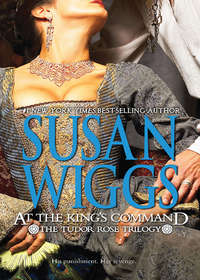
Kitabı oku: «At The King's Command»
Praise for the novels of #1 New York Times bestselling author
SUSAN WIGGS
“Wiggs is one of our best observers of stories of the heart. Maybe that is because she knows how to capture emotion on virtually every page of every book.”
—Salem Statesman-Journal
“A bold, humorous and poignant romance that fulfills every woman’s dreams.”
—Christina Dodd on Enchanted Afternoon
“[Wiggs] has created a quiet page-turner that will hold readers spellbound as the relationships, characters and story unfold. Fans of historical romances will naturally flock to this skillfully executed trilogy, and general women’s fiction readers should find this story enchanting as well.”
—Publishers Weekly on The Firebrand
“The Charm School draws readers in with delightful characters, engaging dialogue, humor, emotion and sizzling sensuality.”
—Costa Mesa Sunday Times
“Susan Wiggs delves deeply into her characters’ hearts and motivations to touch our own.”
—Romantic Times BOOKreviews on The Mistress
“An inspiring story that will touch your heart.”
—Oakland Press on The Horsemaster’s Daughter
“[A] delightful romp…With its lively prose, well-developed conflict and passionate characters, this enjoyable, poignant tale is certain to enchant.”
—Publishers Weekly on Halfway to Heaven
“[A] lovely, moving novel with an engaging heroine…Wiggs’s talent is reflected in her thoroughly believable characters as well as the way she recognizes the importance of family by blood or other ties. Readers who like Nora Roberts and Susan Elizabeth Phillips will enjoy Wiggs’s latest. Highly recommended.”
—Library Journal [starred review] on Just Breathe
“Tender and heartbreaking…a beautiful novel.”
—Luanne Rice on Just Breathe
“Delightful and wise, Wiggs’s latest shines.”
—Publishers Weekly on Dockside
“Another excellent title to [add to] her already outstanding body of work.”
—Booklist on Table for Five [starred review]
“With the ease of a master, Wiggs introduces complicated, flesh-and-blood characters into her idyllic but identifiable small-town setting, sets in motion a refreshingly honest romance, resolves old issues and even finds room for a little mystery.”
—Publishers Weekly on The Winter Lodge
[starred review, a PW Best Book of 2007]
“A human and multilayered story exploring duty to both country and family.”
—Nora Roberts on The Ocean Between Us
At the King’s Command
At the King’s Command
Susan Wiggs

This book is for Joyce Bell—
friend, fellow writer, voice of reason,
ear at the other end of the phone
and all-around fairy godmother.
ACKNOWLEDGMENTS
I owe a debt of gratitude to Joyce Bell, Betty Gyenes and Barbara Dawson Smith for their frequent and patient readings of the book in progress.
Glory is like a circle in the water, Which never ceaseth to enlarge itself, Till by broad spreading it disperse to naught.
—William Shakespeare
Contents
Prologue
Chapter One
Chapter Two
Chapter Three
Chapter Four
Chapter Five
Chapter Six
Chapter Seven
Chapter Eight
Chapter Nine
Chapter Ten
Chapter Eleven
Chapter Twelve
Chapter Thirteen
Chapter Fourteen
Chapter Fifteen
Chapter Sixteen
Chapter Seventeen
Chapter Eighteen
Epilogue
Author’s Note
Prologue
December 1533
The gypsy was hiding something. Juliana was sure of it. Even in the dimness of the barn, illuminated only by a wick burning in an oil-filled horn, she could see Zara’s eyes dart nervously, her big-knuckled hands dive for cover in the layers of her tattered skirts.
“Oh, come, Zara,” Juliana prompted. “You promised to read my future.”
Zara’s fingers came up to toy with her necklace of coins. “The hour is late. You should go back to the house. If your mother knew you’d sneaked out to consort with gypsies, she would beat you raw and turn us out in the snow to freeze.”
Juliana fingered the garnet buttons on her cloak. “Mama will never find out. She never comes to the nursery at night.” Juliana wrinkled her nose. “Besides, I shouldn’t have to sleep in the nursery anymore. I’m getting too old for Misha’s silly pranks and Boris’s night frights.”
Zara’s hand, large and heavy and smelling faintly of sheep fat, cradled Juliana’s cheek with a gentleness the girl had never felt from her mother.
“Fourteen is not so old,” Zara whispered.
Juliana peered at her through the dusty air, misted from the breath of the horses stabled in the back of the barn. The sweet, earthy smell of hay and animals drifted around her and insulated the small space from the blustering cold outside.
“Old enough to be betrothed.” Juliana placed her hands upon her knees, the sable lining of her cloak soft beneath her palms. “Is that why you won’t tell my fortune? Is Alexei Shuisky…Is he someone I can love?”
She thought of Alexei, a black-haired, fair-skinned stranger who had arrived only yesterday to settle the betrothal arrangements with her father. She had met him but once, for the house was vast and like everyone else, Alexei seemed to think she belonged in the nursery.
“After we are wed, will he beat me?” Juliana asked recklessly. “Take a new wife and send me to a nunnery? Grand Prince Vasily did exactly that. Perhaps it’s all the fashion now.”
Zara’s lips parted in the beginnings of a smile, yet worry haunted her dark eyes. Gaps showed where she had sacrificed a tooth for each child she had borne. Her brood, now seven strong, slept upon straw and rough blankets in an empty stall. Her husband, Chavula, and her uncle Laszlo were presently out checking the traps for rabbits for the pot.
A feeling of comfort and belonging settled over Juliana. It was rare for a band of gypsies to travel this far north, yet each winter they came to Novgorod, high in the forested heartland northwest of Moscow. Juliana’s father, Gregor Romanov, allowed the small tribe to shelter on his huge estate during the cold months.
The privilege was not lightly extended. At the age of three, Juliana had gotten lost in the thick, river-fed forest. Her father had mounted a frantic search. Hope dwindled as the cold northern darkness fell, and then a stranger had appeared.
Dressed in the bright breeches and beribboned blouse of a Carpathian, he had helped himself to a leash of three windhounds from Gregor’s kennel. Searching tirelessly with the huge, fleet dogs, he had located Juliana huddled and weeping by an icy stream.
She remembered little of the incident, but she would never forget the ecstatic barking of the windhounds or Laszlo’s wonderfully fierce face and the strength in his arms as he had lifted her up to carry her home.
Since that day, she had felt drawn to these mysterious, nomadic people. Her veins coursing with royal blood, she had been groomed from the cradle to be the wife of a powerful boyar. She was not even supposed to notice gypsies, much less associate with them. The fact that they were forbidden to her only made their secret meetings more delicious.
“Well?” she prompted Zara. “Have you seen such a vision of Alexei?”
“You know my visions are not so clear, nor so obvious.”
“Then what?” Impatient, Juliana yanked a silver button off her hood. “Here, this is worth at least a hundred kopeks.” Zara’s hand closed around the bauble, and Juliana smiled slyly. “Ah. Does that help you see more clearly?”
Zara dropped the button into her bodice. “You Gaje,” she said good-naturedly. “You’re all so easily gulled.”
Juliana laughed, the button no more valuable to her than a stick of kindling. Her family’s wealth was a fact she accepted as readily as she had accepted her father’s long absences in the service of Vasily III, grand prince of the neighboring city-state, Moscow.
The thought sobered her. A few weeks earlier, Vasily had died. He had left his son Ivan, a mere three years old, on the throne and his council of boyars quarreling bitterly amongst themselves.
Lately, Papa stayed locked in his study, writing frantic missives to allies in other cities. He was worried about the ruthless nobles who had begun to clamor for the power to rule now that the prince was dead.
Shaking off the image of her father’s troubled eyes, his drawn face, she held out her hand, palm up. “Hold nothing back this time. ‘Long life and happiness’ might satisfy the superstitious Gaje, but I want the truth.”
Zara reluctantly turned Juliana’s palm toward the flickering light of the lamp. “Some matters are better left unknown.”
“I’m not afraid.”
Zara’s eyes locked with Juliana’s, veiled pools of black confronting clear emerald green. “It is good to be fearless, Juliana.” Zara’s nail, edged with ancient dirt, traced a sinuous unbroken line across Juliana’s palm. Then the gypsy looked at the large brooch Juliana wore pinned at her shoulder.
The thin flame from the lamp gave the ruby a glow of life, making the precious jewel appear depthless in its cruciform setting of gold and pearls.
Zara’s eyes glazed and her cheek—the one marked so wonderfully with a star—seemed to droop slightly. Without moving, she appeared to slip away, deep into a secret realm of intuition and imagination.
“I see three strong women.” Zara spoke slowly, her Romany accent thickening. “Three lives entwined.”
Juliana frowned. Three women? She was her father’s only daughter, though she had innumerable Romanov cousins in Moscow.
“Their fates are flung like seeds to the four winds,” Zara continued, still staring at the heart of the jewel, and always her fingers stroked and circled, discovering the unique topography of Juliana’s hand.
Zara touched a delicate curved line. “The first will travel far.” Her blunt finger continued, edging along until it encountered a broken line. “The second will douse the flames of hatred.”
Zara’s finger circled back, finding the point where the three main lines converged. “The third will heal old wounds.”
A chill slid up Juliana’s back. “I don’t understand,” she whispered, fighting the urge to snatch back her hand. Outside, the wind rattled through the bare trees, a lonely voice in a world of ice and darkness. “How can you see the destinies of two others in my palm?”
“Hush.” Zara clutched her hand tighter, closed her eyes, and began to sway as if to a melody only she could hear. “Destiny falls like a stone into still water. The circles flow ever outward, encompassing other lives, crossing invisible boundaries.”
In the distant kennels, the dogs added their voices to the howl of the wind. Zara winced at the sound. “I see blood and fire, loss and reunion, and a love so great that neither time nor death can destroy it.”
The harshly whispered words hung, suspended like dust motes, in the dimness. Juliana sat motionless, part of her perfectly aware that Zara was a practiced trickster who could no more see the future than could her brother’s favorite troika pony. Yet deep inside Juliana something moved and shifted, grew warm like an ember fanned by the breath of the wind. She sensed a bright magic in Zara’s words, and for all that they were but vague prophecies, they embedded themselves in her heart.
A love so great. Is that what she would find with Alexei? She had met him only once. He was handsome and youthful, merry eyed and ambitious. But love?
Questions crowded into her throat, but before she could speak, an owl hooted softly from the rafters of the barn.
“Bengui!” Zara dropped Juliana’s hand. Fear shone sleek in her eyes.
“What’s the matter?” Juliana asked. “Zara, what are you hiding?”
Zara shaped her fingers into a sign to ward off evil. “The owl sings to Bengui—to the devil.” Her voice trembled. “It is a clear portent of…”
“Of what?” Faintly, Juliana heard the drumbeat of hooves. Not so much heard it as felt the deep rhythm in the pit of her stomach. “Zara, it’s merely a barn owl. What could it possibly portend?”
“Death,” Zara said, jumping up and running to the stall where her children slept.
Juliana shivered. “That’s ridic—”
The barn door banged open. In a swirl of blowing snow, lit from behind by the icy glow of the moon, Laszlo entered. Behind him came Chavula, Zara’s husband. Both men’s swarthy faces appeared taut with terror.
Chavula spoke rapidly in the Romany tongue. Then he spied Juliana, and the color slid from his cheeks. “God!” he said in Russian. “Don’t let her see!”
Cold apprehension gripped Juliana. “What’s happening, Chavula?” She moved toward the door.
Laszlo stood in her way. “Do not go outside.”
Anger rushed up to join with her fear. “You have no right to order me about. Step aside.”
Juliana took advantage of his hesitation. She pushed past him and stepped out into the blustering snow.
The wind tore at her cloak. Swirling snowflakes pelted her face, and she squinted through the storm in the direction of the main house.
An eerie red glow lit the rambling mansion.
Juliana screamed.
The house was ablaze. Her family and all the servants were in danger. Her beloved windhounds and hunting dogs were confined to the kennels adjacent to the kitchen.
Laszlo yelled a command to Chavula. Lifting her skirts, Juliana raced toward the house. She felt Laszlo grab at her sleeve, but she shook him off.
She ran as if her feet had wings, skimming over the soft snow rather than sinking into the drifts. She saw flames lashing from the windows, heard the yelp of a dog and the whinny of a horse.
But the horses were all stabled for the night. The thought slid through her panicked mind, then disappeared like water through a sieve.
As she was crossing the broad lawn where snowclad bushes and arbors created soft hillocks, she heard heavy breathing behind her.
“Juliana, stop. I beg you.”
“No, Laszlo,” she called over her shoulder. “My family—” Papa. Mama. The boys and their nurse. Alexei. New urgency increased her speed.
Laszlo’s hand gripped the hood of her cloak. He hauled back, and the sudden motion caused her feet to fly out from under her. She hit the ground with a muffled thud, landing beneath a snow-draped weeping mulberry. A shower of snow half buried her.
She opened her mouth to scream. Laszlo’s hand, in a smelly leather mitten, clapped itself over her parted lips, and all she managed was a huff of frantic rage.
Pinning her to the ground with his own body, Laszlo spoke softly into her ear. “I am sorry, little Gaja, but I had to stop you. You do not know what is happening here.”
She wrenched away from his hand. “Then I must go and see—”
A series of loud pops punctuated the air.
“Gunfire!” Laszlo dragged her deeper into the cavelike shelter of the snow-covered mulberry. With a shaking hand, he parted the lower branches to reveal the front of the house.
Shock robbed Juliana of speech. She lay as motionless as a gilt icon. The flames were brighter now, fed by the high winter wind, roaring like giant tongues from the windows and casting bloodred shadows on the ground.
A group of horsemen rode up and down in front of the house. Their mounts were skittish, mist pluming from their distended nostrils and snow flying from beneath their hooves.
At the base of the stone staircase, a black shape lay on the ground.
“Gregor!”
Her mother’s voice. The edge of tormented agony was one Juliana had never heard before. Natalya Romanov flung herself upon the shape. Even as her cries keened with the sharpness of grief, a broad-shouldered man in a fur hat and black boots strode forward. His wicked curved sword flashed in the firelight.
Natalya Romanov’s screams stopped.
“Mama!” Juliana tried to scramble out from beneath the bush, but Laszlo held her fast.
“Be still,” he whispered. “There is nothing you can do.’
Nothing. Nothing to do but watch the murder of her family. She spied Alexei rushing to and fro, and for a moment hope crested inside her. Perhaps Alexei would save her brothers.
But as quickly as he had appeared, he faded from sight, surrounded by menacing attackers and roaring flames.
It was evil torture for Juliana to lie there, helpless, as if in the grip of the hideous nightmare. The assassins struck like a storm. They were no band of outlaws but soldiers, doubtless under the command of one of her father’s many rivals. Fyodor Glinsky from across the river—only the week before, the rival lord had called her father a traitor.
“Shield your eyes, little one,” Laszlo begged her.
She sobbed into her cold hands, but she would not look away. It was too late to help her loved ones, for the soldiers were swift. Their shadows loomed like demons on the fire-colored snow. In seconds she saw Mikhail’s throat slit, little Boris fly backward as a man shot him at close range. Servants were herded like cattle into the courtyard and stabbed. The dogs, loosed from the kennel, were slaughtered as they lunged at the invaders.
Her entire glittering world, once so full of opulent promise, shattered like a house of spun sugar.
Juliana’s mouth opened in a voiceless scream. Her hand closed convulsively around her pearl-and-ruby brooch. The priceless piece had been a gift from her father. The cruciform shape concealed a tiny stabbing dagger, but the weapon was useless against the swords and sabers and firing pieces of the soldiers.
The snap and hiss of the flames invaded the snow-insulated quiet of the night. Then a dog barked. Squinting, Juliana saw two men locked in a struggle. One of them was Alexei, she was sure of it! She closed her eyes and offered a brief, frantic prayer for his safety.
The baying of a dog caused her to open her eyes. One of the windhounds leaped out of the shadows and clamped its jaws around a booted leg. Juliana heard a muffled curse. “Be damned to hell!” As one man fell to the ground, she saw the stark outline of his cheek above a thick beard and felt a stab of awareness, but the feeling quickly dissolved into the eerie horror of blood and flame.
A blade flashed, met the animal’s shoulder. The dog sped yelping into the night.
Through a drumbeat of shock, Juliana heard male voices rolling across the lawn.
“…find the girl?”
“Not yet.”
“Devil take you. Look again. We can’t let a child of Gregor Romanov live.”
“I’m here,” Juliana called to them, but her voice was only a dry whisper. “Yes, I am here. Come for me!”
“Fool!” Laszlo covered her mouth again. “What will it serve to sacrifice yourself to these boyars, as well?”
Like the bitter winter wind, comprehension swept over Juliana. Boyars. Jealous, power-hungry nobles. They had killed her father, her family, her fiancé.
She remembered the whispered arguments between her parents. Over the fearful objections of her mother, Gregor had helped the grand prince draw up a new will on his deathbed, one that slashed the powers of the boyars. Now Juliana understood her mother’s fear. The nobles would murder even women and children to seize control of the realm.
“Search the outbuildings,” one of the soldiers called.
She turned her tortured gaze to Laszlo and whispered, “Help me.”
“We must hurry.” He dragged her from beneath the bush. “Keep low and to the shadows,” he said, taking her by the hand. They skirted the lawn, her neck prickling in anticipation of the sting of a razor-edged blade.
They reached the barn and slipped inside. Moonglow shone through gaps in the wood siding.
Zara, Chavula and the children were gone. Only the faint scent of burnt oil from the lamp lingered.
Yet in the crossties between the stalls stood Gregor’s two swiftest horses, bred for speed and endurance in the vast and distant steppes. The mounts had been saddled, and they stood with heads low, blowing softly into the chill air.
“Quickly, get on,” Laszlo said, cupping his linked hands to receive her booted foot.
A muffled explosion sounded. Juliana looked through the open door to see that part of the palace roof had caved in, shooting a plume of sparks into the night sky. The sudden rush of firelight outlined three figures jogging toward the barn.
“We’ll leave through the grazing pasture,” Laszlo said, shouldering open a door in the rear.
Juliana bent low over the neck of her mount and slapped the reins. Her mind retreated and cringed in agony. The winter darkness swallowed the two riders as they headed toward the river Volkhov. They skirted the earthwork ramparts and walls of the kremlin of Novgorod, its torchlit towers speeding past in a blur of light.
The snow-muffled thunder of hooves startled the sleepy tollman at the wooden Veliky Bridge, but Juliana and Laszlo had stormed across by the time he roused himself to demand payment.
They galloped through the small merchant district of the town. Dogs barked and someone shouted, but the riders paid no heed. Not until the road had diminished to a snow-covered track and the naked woods walled them on two sides did they slow their pace to a lope.
“Someone is following us,” Laszlo said.
Juliana whipped a glance over her shoulder. A narrow shadow slipped toward them.
Laszlo yanked a dagger from his sleeve.
“No!” Juliana said, dismounting in a billow of skirts and cloak. “It’s only Pavlo.” In moments the huge borzoya filled her arms. Pavlo was but a year old, her favorite and one she had been charged with training. She was not surprised the dog had caught up with them. The windhounds were bred to run with breathtaking speed, tirelessly, for miles, to exhaust a wolf so the hunters could bring it down.
“Pavlo.” She buried her face in the deep fur of the dog’s neck.
And smelled blood.
“He’s been hurt, Laszlo.” She plucked an image from the midst of her nightmare—a dog leaping, the slash of a blade, a forgotten curse followed by a pitiful animal yelp.
Laszlo was crouched in the path, examining something. “He’s left a trail of blood, Gaja. I am sorry, but we must leave him.”
Juliana struck away his sharp dagger. “Don’t you dare.” Her voice held a hardness, a note she had never heard before. It was the voice of a stranger, no longer a girl but a woman who had seen hell. “By God’s light, Laszlo, he’s all I have now.”
The gypsy muttered something in Romany. He found a strip of material and bound the wound in the dog’s shoulder. Moments later, they were on their way again.
Laszlo pushed ahead with unwavering purpose. Only when the silver thread of dawn glittered on the snowy horizon did Juliana ask the obvious question.
“Laszlo, where are we going?”
He hesitated, then cast his gaze west, away from the rising sun. “To a place I have heard of in the songs of my people. A place called England.”
England. It was but a vague idea in Juliana’s mind, a few words on the page of a book she had once read. A murky, misty land of barbarians. Her tutor, a glib and gifted man, had taught her the language so he could read her odd poems of adventure and virtue triumphant.
“But why so far?” she asked. “I should go to Alexei’s family in Moscow to tell them what befell their son.”
“No.” Laszlo spoke harshly, and the shadows hid his face. “It is too dangerous. The assassins could be neighbors, people you once trusted.”
Juliana shivered, thinking of Fyodor Glinsky and all her father’s rivals. “But…England,” she said in a dazed voice.
“If we stay here,” Laszlo said, “they will hunt you down and kill you. You heard them, little one. I dare not risk a journey to Moscow.”
Exhausted by loss, she closed her eyes and drew a deep breath. But in the darkness behind her eyelids she saw it again—death, blood, fire, all painted in the bright red hues of savagery.
Juliana forced her eyes open. The rising sun cast a ray of weak winter light on a dead snow-covered leaf that lay in the path.
Then she remembered the prophecy. Zara had whispered it to her only the night before, but an eternity had passed since then.
The first will travel far.
One
Richmond Palace, England
1538
Stephen de Lacey, baron of Wimberleigh, walked into the Royal Bedchamber to find his betrothed in bed with the king.
His face as cold and unflinching as a Holbein portrait, Stephen stared at the dark-eyed Welsh beauty all but hidden beneath the quilted silk counterpane. A hissing tide of resentment roiled deep inside him, threatening to drown him. Clenching his fists at his sides, Stephen conquered the turmoil within. Through deliberately blank eyes, he looked at King Henry VIII.
“My liege,” he said, blowing stiffly, inhaling the scent of dried lavender and bergamot from the sachets in the bed hangings. By the time he straightened up, the king’s attendants had arrived to groom their sovereign for the day.
“Ah, Wimberleigh.” The king put out his arms as an attendant scurried forward and helped him don a loose silk jacket. Henry smiled. In that smile there lingered yet a hint of the old charm, the derring-do of a golden young prince. A prince whom Stephen, as a boy, had idolized as the second Arthur.
The legendary Arthur had died young, in a blaze of glory. Henry had made the mistake of living on into the corrupt mediocrity of middle age.
“Come, come,” said Henry, beckoning. He swung his swollen legs over the side of the bed and pushed his pale feet into a pair of brocade slippers held by a kneeling servant. “You may approach the royal bed. See what I’ve found you.”
As he crossed the huge room, Stephen felt the searing curiosity of the sovereign’s attendants. By now the chamber was crowded with titled gentlemen, all engaged to supervise the most intimate bodily functions of the king—and also to influence the policies of the realm.
Sir Lambert Wilmeth, groom of the stool, took His Majesty’s bowel movements as seriously as Scottish border disputes. Lord Harold Blodsmoor, surveyor of the wardrobe, regarded the king’s collection of shoes as highly as the crown jewels. Yet at the moment, the attention of these great gentlemen burned into Stephen de Lacey.
The girl smiled shyly and even managed to summon an artful blush. She stretched with catlike grace, a bare shoulder emerging from the bedclothes. Like most of the king’s mistresses, she took a perverse pride in sharing the bed of the sovereign.
After so many betrayals, Stephen should have known better than to trust the king. Should have known that the summons could only mean more petty cruelty.
“I was feeling frisky today.” Henry’s grin held both mischief and subtle rancor. Limping slightly, he went to the royal stool, speaking over his shoulder as he relieved himself. “I decided to exercise the droit du seigneur—again. An antiquated notion, to be sure, but one that has its merits and deserves to be revived from time to time. Now, make a gracious greeting to your lady Gwenyth, and then we’ll—”
“Sire,” Stephen broke in, heedless of the gasps from the noblemen present. No one interrupted the king. In the thirty years of his reign, Henry VIII had put men to death for lesser offenses.
Instantly Stephen regretted the risk he had taken. With that one blurted word he might have jeopardized everything.
“Yes?” The king seemed only mildly annoyed as his gentlemen helped him into doublet and hose. “What is it, Wimberleigh?”
Stephen couldn’t help himself. A killing rage rose like a fountain of fire inside him. “To hell with your droit du seigneur.”
He turned on his heel and strode from the Royal Bedchamber. Though well aware of the infraction he was committing, he could not be a willing player in the familiar, vicious diversion that so delighted Henry.
The red-and-white livery of the king’s Welsh yeomen passed in a blur as Stephen strode out into the paved central court. Seeking a place to cool his temper in private, he stalked into a walled garden. A pebbled path led him through tortured little plots of whitethorn and sweetbriar. The flower beds had been arranged geometrically, so that they resembled rather coarse mosaics.
Stephen wished for the hundredth time that he had ignored the king’s annual summons and stayed in Wiltshire.
But to refuse the command was to risk the one thing Stephen would kill to safeguard. If the price of keeping his secret was to have his heart ripped out and his pride publicly shredded, then so be it.
His conviction that the king hadn’t finished with him proved correct, for an hour later, a haughty majordomo summoned him to the Presence Chamber.
An open-timbered ceiling arched high over the hall. The watery sunlight of early spring streamed in through twin banks of mullioned windows. Colored glass made a shifting, jeweled pattern on the walls and floor. Somewhere, an unseen lute player strummed softly, the shimmering music a sweet undercurrent to the murmur of voices.
Members of the Privy Council stood by, sharp eyed, their shoulders hunched beneath heavy, long robes.
Stephen paced over the smooth flagstones to the gold-and-scarlet-draped dais. There he stopped, swept his satin-lined cloak back over one shoulder, and sank into a formal obeisance. Even without looking at the king, he knew Henry relished the submissive pose of a man of Stephen’s height. Henry took pleasure in anything that made Stephen feel smaller.
He rose with hatred and defiance clear in his eyes, and a gift in his extended hands.
Henry sat upon his massive carved chair, looking like Bacchus clad in silver and gold. In recent years, his face had grown as large as a haunch of beef.
“What’s this?” he asked, nodding to a page. The lad took the small wooden coffer from Stephen and offered it to the king. With childlike haste, Henry opened it and extracted a tiny watch on a golden chain. “Marry, my lord, you never fail to amaze me.”
“A trinket, no more,” Stephen said in a flat, dead voice. Henry had many appetites, most of them insatiable. Satisfying his craving for unique gifts was no challenge.
Henry slipped the chain through the baldric that encircled his ample girth. “I assume the design is original.”
Stephen nodded.
“You’ve a rare talent for inventions of all sorts, Wimberleigh. A pity you are so lacking in plain manners.” The breadth of his cheeks made his eyes look beady, his mouth thin lipped and tight. “You left the Royal Bedchamber without begging leave, my lord.”
“So I did, sire.”
Henry’s hand, pudgy and sparkling with rings, smacked down on the arm of his chair. His fingers strangled a carved gargoyle. “Damn your eyes, Wimberleigh. Must you always breach the limits of propriety and decorum?”
“Only when provoked, sire.”
The king’s expression did not change, yet his small bright eyes took fire. “Has it never occurred to you,” he asked in a soft, deadly voice, “that you might do better to dance with your betrothed rather than with my patience? Lady Gwenyth is beautiful. She’s well-bred and reasonably wealthy.”
“She is also ruined, sire.”
“I did honor to the wench,” Henry snapped. “There is only one king of England, just as there is only one sun. My favor is not for one alone.”
Stephen bit his tongue to stop himself from responding. It was useless to quarrel with a man who likened himself to a heavenly body. He could satisfy his every whim all too easily, for what sane man or woman would dare refuse him?
“For God’s sake, Stephen,” Henry thundered, “your evasiveness bedevils me. I’ve found you four eligible ladies in the past year, and you’ve refused them all. What is it that makes you so much better than any other noble?”
“I do not wish to marry again,” Stephen stated. He could not resist adding, “My favor is for no one, not even that silly Welsh comfit I found in your bed.”
“Comfits are sweet and agreeable to the palate,” Henry pointed out.
“Aye, but when handled by too many fingers, they lose their savor. And when left long enough to themselves, they rot.”
Without taking his eyes off Stephen, the king held out his hand. A servitor stepped forward and placed in it a silver cup of sack. Henry drank deeply of the Canary wine, then said, “Ah. Still you pine for your Margaret, now seven years cold.”
With all that he was, Stephen resisted the urge to bury his fist in his sovereign’s face. How blithely Henry spoke of Meg—as if he had never even known her at all.
“Was she so very dear to you, then,” the king went on, twisting the knife, “that you cannot love another?”
Stephen held himself motionless as his mind filled with memories of Meg. Peeking at him timidly from behind her veil on their wedding day. Weeping in pain and fear in their marriage bed. Hiding her secrets from the husband who adored her. Dying in a sea of blood and bitter curses.
“Margaret was—” Stephen cleared his throat “—child. Gullible. Easily impressed.” With terrible, blade-sharp guilt, he knew he had forced her into womanhood and then into motherhood. And finally and most unforgivably, into death.
“I know well what it is to mourn a wife,” Henry said, an unexpected note of sympathy in his voice. Stephen knew he was thinking of quiet, dutiful Jane Seymour, who had died giving the king the one gift he craved above all others: a male heir to the throne.
“However,” Henry continued, imperious again, “a wife is a necessary ornament to a man’s station, and old memories should not make you balk at duty. Now. As to the Welsh lady—”
“Sire, I humbly beg your pardon.” He dropped his voice so only the king could hear. “I will not take any man’s leavings—not even those of the king of England. I’ll not be a salve to your conscience.”
“My conscience?” Henry’s mouth curved into a cold sickle of amusement. His voice was a whisper meant for Stephen alone. “My dear lord of Wimberleigh, where on earth did you get the notion that I had one?”
Stephen’s neck tingled. He reminded himself that Henry VIII had put aside his first wife and brought about the execution of the second. He had appropriated the authority of the church, taken possession of monasteries, driven the poor from their lands. The mere ruining of a young virgin would hardly trouble a man like Henry Tudor.
“My mistake,” Stephen replied softly. “But never mind, the Lady Gwenyth would not want me anyway.”
“Ah, your tarnished reputation,” Henry said, waving his now-empty cup. “Wild revels, gambling and rapine. The gossip does find its way to court. Marry, sir, every maiden in the realm quails in fright at the very thought of you.”
Stephen preferred it that way. He had worked hard to hide his few good qualities beneath a patina of ill repute. “I am a man of low morals. An unfortunate flaw in my character. And now if it please Your Majesty, I must withdraw from court.”
With a swiftness that belied his age and bulk, the king came out of his chair. His thick-fingered hand closed in the front of Stephen’s quilted doublet. “By God, it does not please me.” He put his face very close to Stephen’s, so close that Stephen could smell the warm sweetness of sack on his breath. “Get you a wife, Wimberleigh, and then get you a proper heir, else all of England will know what you hide at your Wiltshire estate.”
An animal roar of denial surged to Stephen’s throat. With an effort born of years of iron control, he forced himself to keep from tearing into the royal face. How Henry had come to know Stephen’s terrible secret was a mystery; how he intended to use the knowledge was becoming painfully obvious.
With a will, Stephen expelled his breath slowly and stepped back. The king no longer gripped him, yet the hold lingered invisibly—would linger until Stephen shed himself once and for all of the king’s ire.
“To your knees, Wimberleigh.”
His cheeks on fire with rage, Stephen sank down.
“Now swear it. Let me hear you vow that you will obey me.” The king’s voice rang loud. “Let me hear that you will wed—if not Lady Gwenyth, then another.”
The command hung, suspended, in the deafening silence that followed. From his low perspective, Stephen caught details with uncommon clarity: the ancient dust clinging to the hem of the king’s cloak, the faint, septic smell of the ulcer on Henry’s leg, the soft chink of the sovereign’s chain of office as his massive chest rose and fell, and the dying echo of a plucked lute string.
All the court waited in a state of breath-held anticipation. The king had flung down the gauntlet, had challenged one of the few men in the realm who dared defy him.
Stephen de Lacey was no fool, and he valued his neck. The years, at least, had taught him to equivocate. “Your will be done, sire.” He spoke clearly so all could hear, for he knew if he mumbled the pledge, the king would make him repeat it.
A collective sigh came from the Privy Councillors. How they loved seeing one of their own humiliated.
Henry lowered his vast bulk onto the throne. “I trust you’ll obey this time.”
Stephen stood. The king dismissed him with a curt nod. Almost immediately, Henry began to bellow for his attendants. “Saddle my horse, I wish to go riding.”
Stephen left the Presence Chamber and passed through the antechamber. The air of corruption lingered even here, in the heavy scent of sandalwood burning in a corner brazier, in the stale mats of rushes that had not been changed in months.
Prior to his audience, Stephen had requested that his horse be brought out, for he wanted to be away swiftly. The grooms of the royal stables had promised to have the tall Neapolitan mare ready outside the west gate.
Stephen strode across the courtyard and passed between the octagonal-shaped twin towers. He paused beneath the ornate portcullis, the pointed wrought-iron bars aimed straight down at his head.
As promised, his mare stood ready in saddle and trappings, tethered to an iron loop in the shade of a spreading oak some distance beyond the gatehouse.
He frowned at the negligence of the grooms. Didn’t they know better than to leave a valuable animal unattended? And where the devil was Kit, his squire?
Cocking his head, Stephen saw a movement beside the mare. A wraithlike shadow, secretive as an unconfessed sin.
A filthy gypsy woman was stealing his horse.
Juliana could not believe her luck. So desperately had she needed a horse for the fair in Runnymede tomorrow, she had been prepared to enter the very walls of the riverside palace and boldly steal an animal.
Instead, as she crouched in a stand of copper beeches and regarded the glistening walls and gilt turrets of Richmond Palace, a groom had emerged with one of the most magnificent beasts she had ever seen. The horse was fitted out with trappings of silver and Morocco leather that would, if traded, feed the gypsy tribe for a decade.
Pavlo, her windhound, had scared the lad off. By now it was a common ploy. No Englishman had ever seen a borzoya, and most thought the huge white dog some sort of mythical beast.
She glanced around to gauge the chances of being caught. A pair of guards in Kendal green-and-white livery stood sentinel in front of the twin gate towers about two hundred paces distant. Their blank gazes were trained on the horizon of the hills that rose above the river Thames; they paid no heed to the horse standing quietly in the shadows.
Juliana paused to touch her luck token—the dagger brooch she wore pinned inside the waistband of her skirt. Then she crept out of the beech grove. The matted grass was damp and springy beneath her bare feet, and her anklets of cheap tin clicked softly with each step. Her skirts, constructed of pieced-together bits of fabric, brushed the ground.
After five years of living among the gypsies of England, she had grown accustomed to looking like a beggarwoman—and to behaving like one when necessary. She accepted her lot with a sort of weary resignation that belied the purpose that still burned in her heart.
Never had she forgotten her identity: Juliana Romanov, daughter of a nobleman, betrothed to a boyar. One day, she vowed, she would return to her home. She would find the men who had murdered her family. She would see the killers brought to justice.
It was a grand undertaking for a penniless girl. The early months in England had been almost hopelessly hard. She and Laszlo, who posed as her father, had bartered her clothes and jewels, bit by bit, on the long journey to England. She had arrived with nothing save her precious brooch, the glittering jewel encircled by twelve matched pearls, the secret blade inside, and the Romanov motto etched in Cyrillic characters on the back: Blood, vows and honor.
It was her last link with the privileged girl she had been. Never would she trade it away.
In time, the shock of losing her family had become a dull, constant ache. Juliana threw herself into her new life with the same determined concentration that had so pleased her riding and dancing masters, her tutor and music teacher, in Novgorod.
She had learned how to barter for a horse in apparently ill health, heal the animal, conceal its defects, and then sell it back to the Gaje for profit. How to appear at a market square looking like the most bedraggled, afflicted of creatures, so filthy that people gave her coin simply to be rid of her. How to perform breathtaking carnival tricks on horseback and afterward, with a lazy, seductive smile, collect coins thrown by her rapt spectators.
Life might have gone on like this indefinitely, but for Rodion.
Juliana shuddered as she thought of him—young, crudely handsome, glaring across the campfire at her with a sort of cruel possessiveness hard on his features.
The inevitable marriage proposal had come last night. Laszlo had advised her to accept Rodion. Unlike her, Laszlo had long since surrendered any dreams of returning to the old country.
Not so Juliana.
Rodion’s plans had spurred her on her quest. The time had come to leave the gypsy train, to present herself to the king of England and request an armed escort back to Novgorod.
Her first order of business was to obtain a set of proper attire. She had become adept at pilfering food from market carts and washing pegged out on lines. A fancy court dress was much more of a challenge.
In the past, the men of the tribe had taken all her earnings. This handsome mare was for her alone.
A smile tugged at the corners of her mouth. The town of Runnymede held its horse fair starting at dawn tomorrow. She would make the sale quickly, then put her plan into motion.
“Stay here, Pavlo,” she whispered. The large, shaggy dog cast a worried look at her, but lay down and settled his long muzzle between his front paws.
Crouching low, Juliana approached the horse from the front, slightly to one side. “There, my pretty,” she whispered to warn it of her presence. “You’re a pretty mare, that you are.”
The horse ceased its browsing in the tufts of clover at the base of the tree. Its nostrils dilated, and Juliana heard the soft huff of its breath. The well-shaped ears lay back.
Juliana made a low clicking sound with the back of her tongue, and the ears eased up a little. She held out her hand, palm up, offering the horse a pared turnip she had filched from someone’s kitchen garden.
The mare devoured the raw turnip and nudged Juliana’s hand for more. She smiled. For all their strength and speed and endurance, horses were simple creatures easily led by their appetites. Not unlike men, Catriona would say.
Though tension burned in her shoulders and the need for haste pressed at her, she fed the mare another piece of turnip and moved close, running her hand down one side of the smooth, firm neck and up the other. All the time, she kept up a soft patter of speech, English words, mostly nonsense, the lulling language of a mother soothing a child to sleep. In moments, she knew the horse was relaxed and docile.
She glanced at the gate; the guards had neither stirred nor noticed her. A man appeared beneath the portcullis. From this distance, she had only the swift impression that he was tall, broad and tawny haired.
Filled with a sense of impending triumph, Juliana untied the braided cord that secured the horse to the iron loop. She placed one bare foot in the stirrup and reached for the raised cantle of the saddle to hoist herself up.
“Stop, thief!”
For a fraction of a heartbeat, the shout froze her. But in the next instant, Juliana swung up as if lifted by the hand of God and landed astraddle. Without breaking the flow of motion, she slammed her heels against the sides of the horse and made a loud smooching sound.
The horse took off like an arrow shot from a bow. Juliana gloried in the sensation of riding the best horse she had mounted since her frantic flight from Novgorod five years before.
“I see the gypsy’s stealing your horse, Wimberleigh.”
Stephen was so shocked to see the woman galloping off astride Capria that he had not realized King Henry, surrounded by his entourage, had appeared on the high walk between the gate towers.
“She’ll not get far,” Stephen stated loudly. He whirled toward the stables where a groom was leading a saddled hunter out into the yard. “Bring me that horse at once,” he shouted.
The groom looked momentarily confused. Then, apparently convinced by the thunderous scowl on Stephen’s face, he hurried toward the gate with the horse.
“I’ll make you a wager.” Henry shaded his eyes and squinted at the fleeing figure of the woman, tattered skirts and tangled hair flying on the wind. “A hundred crowns says you’ll never see that mare again.”
“Done,” Stephen snapped, mounting the hunger. He dug in his spurs and clattered across the bridge, out onto the open road. The horse had an indifferent gallop and a hard mouth. Stephen would have a bit of a chase on his hands, for Capria was the superior animal. And, he conceded, the gypsy wench was a skilled rider.
She flew past a grove of copper beeches, and a large white dog joined her on the road. Surprise stabbed at Stephen. The lanky, long-haired dog was nearly as swift as the horse.
He bent low over the pumping neck of the hunter. The brown clay road streaked beneath him in a blur. The gypsy whipped a glance back and banged her bare heels against Capria’s sides.
Stephen closed a bit more of the distance between them. A sense of certainty surged up in him. He did not have to ride the woman down. He knew another way to bring Capria back. He needed only to get within earshot.
When he was sure his quarry lay close enough, he put his fingers to his lips. Shaping his mouth with his fingers, he emitted a long, ear-splitting whistle.
The mare jerked her head to the side. The reins slipped from the gypsy’s grasp. Capria slid to a stop, wheeled, and charged back the way she had come.
“No!” The thief’s faint cry carried across the undulating downs along the river. She groped for the flying reins, but the whiplike length of leather eluded her.
Stephen took a dark pleasure in her struggle. A lesser rider would have fallen, possibly to her death, but the woman’s legs stayed tight around the horse’s girth, her feet firmly in the stirrups.
With her throat locked in terror and her hands gripping the mare’s gray mane, Juliana exhorted the horse to turn, or at the very least to stop.
But the stubborn creature only did so when it reached a large man standing beside a horse in the middle of the road. Catching the loose rein, he held out a treat in his other hand.
A crushing sense of defeat caved in on Juliana, but she gave herself not a moment for regrets. Even before the mare came to a full stop, she hit the ground running.
Her head jerked back, and she felt a tearing pain. She loosed a low, throaty scream. The villain had hold of her long braid.
She kicked out with her bare feet, bruising them against the man’s tall boots. She scratched, digging her claws into his neck, his ears, anywhere she could reach.
The fight lasted mere seconds. With perfunctory swiftness, he used the leather reins to lash her wrists together.
“Now then.” His voice was a deep rumble of anger.
“Pavlo!” Juliana screamed.
The dog lunged. A hundredweight of muscle and fur hurled itself at the unsuspecting man.
Pavlo’s yelp of pain pierced the air. Juliana blinked in amazement. Somehow, the man had grabbed Pavlo’s crimson vellat collar and twisted, choking off the dog’s windpipe.
“It would be a pity,” he said, his tone infuriatingly blasé, “to destroy so magnificent an animal. But I shall, wench, unless you command it off the attack.”
Juliana did not hesitate. Nothing, not even her own freedom, was more precious to her than Pavlo. “Let up, Pavlo,” she said in Russian. “Easy, boy.”
The dog submitted, relaxing his knotted muscles and emitting a strangled whine. The man eased his grip on the collar and then let go. “I wonder,” he said. “Is this a case for the sheriff or the palace warden?”
“No!” Juliana had learned to loathe and fear the sheriffs of England. She plunged to her knees in front of her captor, her bound hands held high in supplication. “My lord, I beg you! Do not turn me over to the sheriff!”
“Christ’s bones, woman.” His face flushed with chagrin, he gave her sleeve a tug. “Get up. I mislike begging.”
Heaving a sigh of resignation. Juliana stood. Vaguely she became aware of movement high on the walk between the two towers of the distant palace gate, but her gaze stayed riveted on her captor. He was garbed as a gentleman, in a costume of such exaggerated virility that she blushed. An abbreviated doublet allowed his white shirt to billow forth. Huge sleeves with clever slashings bloomed from the armholes. Tight particolored hose hugged his long legs, his muscular thighs, and culminated in an immense codpiece all decked with silver braid.
A large hand, surprisingly gentle, touched her under the chin and drew her gaze upward. “Nothing but trouble there,” he said, a faint note of cynical amusement in his voice.
With the fire in her cheeks intensifying, she studied his face. He was cleanshaven, an attribute that never failed to shock her, for Russian and gypsy men alike always wore full beards. Framed by a mane of wheat-colored hair, this man’s face was smooth and stark, with chiseled angles that bespoke strength—and intimidating power.
Fear fluttered in her chest. It was his eyes that discomfited her. They were unusual, of the palest, opaque blue, cold as moonstones. She peered into the icy blankness and was startled at what she saw there. A hard, tight pleasure. As if he had enjoyed the chase.
Suddenly the thought of being handed over to the sheriff did not seem so dire as tarrying in the company of this huge, forbidding lord.
But instinct told her not to show fear. She tossed her head. “You’ve got your horse back. She’s a disobedient nag anyway, so why don’t you let me go on my way?”
The man’s mouth tightened. His version of a sardonic smile, she decided.
“Disobedient?” Absently he fed the mare a morsel from a pouch that hung from his wide, ornate belt. “Nay, just greedy. Capria learned long ago that to come to my whistle meant to win a bit of marzipan.”
Before she could catch herself, Juliana mouthed the unfamiliar word.
“Almond sugar,” the man said pleasantly enough. He held out a pasty-looking morsel. “Would you like some?”
She turned up her nose in resentment. The horse snatched at the tidbit.
“Where did you learn to ride like that?” her captor asked.
Juliana hesitated, wondering which lie to tell. If she admitted she had polished her considerable skills with the gypsies, it would endanger the band, for the Romany people were rarely welcome among gentlefolk. Unexpectedly, she heard herself blurting out the truth. “I learned from my father’s riding master. In Novgorod, a kingdom of Russia north of Muscovy.”
The man lifted one tawny eyebrow. “Not only a horse thief, but a lunatic, as well. How long has it been since you escaped Bedlam?”
“Not only a bully, but a braying ass, too,” she shot back.
“Lord Wimberleigh!” A man in palace livery came pounding along the road. “You’ve collared the horse thief, then.”
“It appears that I have, Sir Bodely.”
“Well done, my lord, and you gave His Majesty a few moments of diversion in the process. Though I trow he’ll not look kindly on losing the bet.”
“Your prisoner, Sir Bodely,” Wimberleigh said with a mocking bow. He grinned at Juliana. “The palace warden’s thief taker, at your service.”
Sir Bodely’s brows beetled together. “A wench, is it? Looks gypsy to me.” With swift, jerky movements, he bound her hands with coarse rope and gave the discarded reins to Lord Wimberleigh.
From a belt overhung with an ale-swiller’s gut were the tools of the thief-taker’s trade: a black whip, manacles, and hobbles.
Wimberleigh’s gaze fixed on the savage utensils. His eyes turned flinty, and beneath his billowing sleeves, his shoulders hunched. He turned away. “I’d best be on my way, then.”
In a red haze of fury and fear, Juliana called out, “Are all great lords as cowardly as you, sir?”
His back stiffened, and he swung around to regard her with the respect he might afford a spider. “Were you addressing me?”
“You are the only cowardly lord present at the moment.”
His eyebrows slid upward. “So. You find me cowardly, do you?”
Gingerly she lifted her bound hands. “You are quick to accuse me of stealing your horse, yet you balk at staying to see me punished. What is the penalty for my crime? Hanging? Or perhaps since I failed in my endeavor, I shall merely have my nostrils slit or a hand or an ear cut off. A true man would not lack the stomach to watch.”
His squarish jaw tightened. He addressed the palace official. “Will the wench have a chance to face her accuser in a court of law?”
Ücretsiz ön izlemeyi tamamladınız.