Kitabı oku: «Snowfall at Willow Lake»
Acclaim for New York Times bestselling author Susan Wiggs
‘… Truly uplifting …’
—Now magazine
‘This is a beautiful book’
—Bookbag on Just Breathe
‘… Unpredictable and refreshing,
this is irresistibly good’
—Closer Hot Pick Book on Just Breathe
‘A human and multi-layered story
exploring duty to both country
and family’
—Nora Roberts on
The Ocean Between Us
‘Susan Wiggs paints the details
of human relationships with
the finesse of a master.’
—Jodi Picoult, author of Lone Wolf
‘The perfect beach read’
—Debbie Macomber on Summer by the Sea
Also by
Susan Wiggs
The Lakeshore Chronicles SUMMER AT WILLOW LAKE THE WINTER LODGE DOCKSIDE SNOWFALL AT WILLOW LAKE FIRESIDE LAKESHORE CHRISTMAS
The Tudor Rose Trilogy AT THE KING’S COMMAND THE MAIDEN’S HAND AT THE QUEEN’S SUMMONS
Contemporary HOME BEFORE DARK THE OCEAN BETWEEN US SUMMER BY THE SEA TABLE FOR FIVE LAKESIDE COTTAGE JUST BREATHE All available in eBook
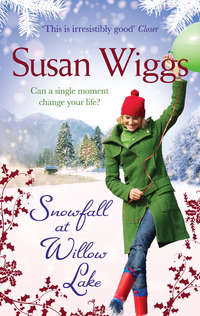
Snowfall at Willow Lake
Susan Wiggs

www.mirabooks.co.uk
To Rose Marie Harris,
who owned and operated Paperbacks Plus, the best
little bookstore in Washington State for the past
twenty-seven years. She’s the kind of bookseller every
writer dreams about—well-read, enthusiastic, caring
and helpful, with an uncanny knack for putting the
right book into the hands of the reader who is sure
to love it. A book signing at Paperbacks Plus always
involved plenty of food, friends and fun, making for
unforgettable events, year in and year out.
To Rose Marie, Kate, Lois and the rest of
the staff—it was a great run, ladies.
Thanks for everything.
ACKNOWLEDGEMENTS
The daily work of a writer involves spending many hours alone with a roomful of fictional characters, and it takes a lot of love and understanding from the real people in my life to put up with that.
Thanks to the real Momzillas, who are nothing like the ones in this book.
I am truly blessed by the women writers in my life. Their moral support and brain power enrich the entire experience of making stories and art, and their talents keep me in awe—Anjali Banerjee, Carol Cassella, Sheila Rabe, Suzanne Selfors, Elsa Watson, Kate Breslin, Lois Faye Dyer, Rose Marie Harris, Patty Jough-Haan, Susan Plunkett and Krysteen Seelen.
Thanks also to Margaret O’Neill Marbury, my ever-patient editor, Meg Ruley, my agent, and her associate Annelise Robey, for invaluable advice and input.
Thanks to my publisher and readers for turning the Lakeshore Chronicles into a great success. The books came from me, but the success from you.
I’m so very grateful for my family, including our newest arrival, Barkis the wonderdog. Special thanks to my wonderful mom and dad—I only wish I could be as good as you think I am.
Part One

February
Lake Effect
Each winter, when cold arctic air sweeps across North America, snow squalls may form along the lee shores of lakes. These squalls, known as lake-effect snowstorms, bring locally heavy snowfalls to a relatively small area. Often, while squalls hit one area, brilliant blue skies prevail only a short distance away.
One
Avalon, Ulster County, New York
Every station on Noah Shepherd’s truck radio was broadcasting the incessant warning. The National Weather Service had issued an advisory—a prediction of snow, ice and wind—whiteout conditions in a lake-effect snowstorm. Authorities were urging people to stay home tonight, to keep the roads clear for emergency vehicles only. The county airport had closed hours ago. Even the heaviest snow-removal equipment was having trouble lumbering along the highway. Only madmen and fools would be out in this.
Well, madmen, fools and large-animal vets. Noah wished his windshield wipers had a faster setting. The wind-driven snow was coming so hard and fast it was like a solid wall of white. He could barely tell whether or not he was on an actual road.
Legend had it that during lake effect, magic happened. Right, he thought. If this was magic, he’d stick with reality.
After delivering the Osmonds’ foal, he should have taken them up on their offer to stay the night, waiting until the weather and roads cleared before making his way back to his home and adjacent clinic miles away. However, according to reports, it could be days before the storm played itself out and it was likely to get worse before it got better. He had the Palmquists’ geriatric beagle in the clinic, a cat recovering from spinal surgery and his own animals, which currently included an abandoned pup. He knew he could always call his neighbor, Gayle, to look in on them, but he hated to bother her. With her husband serving overseas and three kids underfoot, she sure as hell didn’t need to go traipsing over to his place to check on the animals.
Besides, his scrubs were covered in birth blood and fluid. He needed a shower, bad. He was wearing his favorite hat, a wool cap with earflaps. It was from his “early dork” phase, as one of his former girlfriends had called it. Noah had quite a few former girlfriends. Women his age tended to want something other than life with a country vet.
He leaned forward over the steering wheel, squinting at the road ahead. Illuminated by his headlamps, the snowflakes appeared to be flying straight at him in a movielike special effect. He thought of Star Wars, when the Millennium Falcon went into warp speed. And that thought, of course, inspired him to whistle the Star Wars theme between his teeth. Bored with crawling along, he imagined his windshield was a window to a galaxy far, far away. He was Han Solo, and the snowflakes flying at him were stars. He issued orders to his copilot, who perked up at the sound of his master’s voice. “Prepare for throttle up. Chewie, do you read? Go at throttle up.”
Rudy, a mutt in the passenger seat, gave a huff in response, fogging the window.
Noah’s last girlfriend, Daphne, used to accuse him of being a kid who would never grow up. And Noah, who had the subtlety of a jackhammer, suggested only half-jokingly that they make a few kids of their own so he’d have someone to play with.
That had been the last he’d seen of Daphne.
Yeah, he had a real way with the ladies. No wonder he worked exclusively with animals.
“General Kenobi, target sighted, a thermal detonator,” he said. In his mind, Noah pictured a galaxy slave clad in a chain mail bikini. If only the universe would actually send him someone like that.
Then he changed his voice to a wise baritone with a bad English accent. “I trust you will find what you seek. And … shit.” A pale shadow glimmered in the road right in front of him. He turned the wheel and eased off the accelerator. The truck fishtailed. Rudy scrabbled around on his seat, trying to stay put. In the middle of the road stood a big-eyed doe, ribs showing through its thick winter coat.
He leaned on the horn. The doe sprang into action, sprinting across the road, leaping the ditch and disappearing into darkness. Midwinter was the worst time of year for the wildlife. The starving season.
The radio station played its usual test of the emergency broadcast system. He turned it off.
Almost home. There were no landmarks visible to tell him so, just an inner sense that he was nearing home. Other than college and vet school at Cornell, he’d never lived anywhere else. Each rural mailbox was supposed to be marked by a tall segment of rebar, but the snowdrifts were too deep and the rebar and mailboxes were buried.
He sensed but could not see Willow Lake, which lay to the left of the road. Willow Lake was the prettiest in the county, a natural beauty fringed by the Catskills wilderness. At the moment it was invisible behind the curtain of snowfall. Noah’s place was across the road from the lake and slightly uphill. Along the lakefront itself were several old summer cottages, unoccupied in winter.
“General Azkanabi, we need reinforcements,” he said, hearing the imaginary music swell in his ears. “Send me someone without delay!”
In that instant, he noticed … something. A glimmer of red in the snowy shadows. The whistled theme song died between his teeth. He eased off the accelerator and kept his eyes on the crimson glow, eventually making out a matching light. Taillights, which seemed to belong to a car stuck in a snowbank.
He stopped the truck in the middle of the road. The car was still running; he could see a plume of exhaust coming from its unnaturally angled pipe. The taillights poured an eerie red light into the night. One of the headlights was buried in the snowbank. The other illuminated the deer that had been hit.
“Stay, boy,” Noah ordered Rudy. He grabbed his kit, which contained enough tranquilizer to put down the deer. He lit his flashlight, an elastic headlamp.
Switching on his hazard lights, he emerged into the stormy night. The flying snow and howling wind sliced at him like blades of ice. He hurried over to the car, spying a single occupant inside, a woman. She seemed to be fumbling with a cell phone.
She lowered the window. “Thank God you came,” she said, and got out of the car.
She was inadequately dressed for the weather, that was for sure. A high-fashion coat and thin leather boots with tall, skinny heels. No hat. No gloves. Blond hair, blowing wildly in the wind, partially obscured her face.
“You got here so quickly,” she yelled.
He figured she thought he was from roadside assistance or the highway department. No time to explain.
She seemed to share his urgency as she grabbed his sleeve and pulled him to the front of the car, wobbling a little on her boots. “Please,” she said, her voice strained with distress. “I can’t believe this happened. Do you think it can be saved?”
He aimed the beam of the headlamp at the deer. It wasn’t the doe he’d spotted earlier, but a young buck with a broken antler on one side, three points on the other. Its eyes were glassy and it panted in a way Noah recognized—the panicked breaths of an animal in shock. He saw no blood, but so often, the injuries that killed were internal.
Damn. He hated putting animals down. Hated it.
“Please,” the stranger said again, “you have to save it.”
“Hold this,” he said, handing her a flashlight from his kit to supplement the headlamp. He eased himself down next to the animal, making a soothing sound in his throat. “Easy, fella.” He took off his gloves, stuffed them in a pocket of his parka. The rough coat of the deer warmed his fingers as he palpated its belly, finding no sign of fluid, no abnormal softening or heat. Maybe—
Without warning, the deer scrambled into action, legs flailing for traction in the deep, soft snow. Noah caught a sharp blow to the arm and backed off. The animal lurched to its feet and leaped over a snowbank; Noah instinctively moved in front of the woman to shield her from the hooves as the animal clambered off into the woods.
“I didn’t kill it,” the woman said. “You saved it.”
No, he thought, although it must have looked impressive, what with the deer jumping up as soon as he placed his hands on it. He didn’t say so, but there was still a good chance the buck might collapse somewhere in the forest, and die.
He turned off the headlamp and straightened up. She shone the flashlight into his face, blinding him. When he flinched, she lowered the beam. “I’m sorry,” she said.
Pulling on his gloves, he asked her, “Where are you headed?”
“Twelve forty-seven Lakeshore Road. The Wilson place. Do you know it?”
He squinted, getting his bearings. She had run her car off the road right by his driveway. “Another few hundred yards down toward the lake and you’re there,” he said. “I can give you a lift.”
“Thank you.” Snowflakes caught in her eyelashes, and she blinked them away. He caught a glimpse of her face—startlingly pretty, but pale and strained. “I’ll get my things.” She handed him the flashlight, then fetched a purse and a big tote bag from her car. There was also a roll-aboard, fluttering with tags. In the glow of the dome light, he could see words in some foreign language—’s-Gravenhage? He had no idea what that was. And another with an official-looking seal, like from the State Department or something. Whoa, he thought. International woman of mystery.
She turned off the ignition and the lights. “I don’t suppose there’s anything to be done about the car,” she said.
“Not tonight, anyway.”
“I’ve got a few more bags in the trunk,” she said. “Do you think it’s safe to leave them?”
“Probably not a huge night for thieves.” He led the way to his truck and opened the passenger-side door. “Get in the back,” he ordered Rudy, and the dog leaped into the jump seat behind.
The woman hesitated, clutching the purse to her chest and staring up at him. Even in the dim light from the truck’s cab, he could tell her eyes were blue. And she was no longer regarding him as the Deer Whisperer. Now she was looking at him as though he were an ax murderer.
“You’re looking at me as if I’m an ax murderer.”
“How do I know you’re not one?”
“Noah Shepherd,” he said. “I live right here. This is my driveway.” He gestured. The drive leading up to the house, flanked by pine trees weighted with snow, now lay beneath knee-deep drifts. A glimmer shone from the front window, and the porch light created a misty yellow aura around the front door. The entranceway to the clinic, kennels and stables lay off to the left, the security lights barely visible.
She paused, touched her teeth to her lower lip. “Even ax murderers have to live somewhere.”
“Right. So how do I know you’re not an ax murderer?”
She seemed completely unperturbed by the question. “You don’t,” she said simply, and got in the truck.
As he walked around the front to the driver’s side, Noah wondered if strange forces were at work. He wasn’t given to thinking of such things, but hadn’t he just been wishing for someone? Was the universe listening after all?
Of course, he didn’t know anything about his unexpected passenger. As she’d aptly pointed out, he didn’t even know whether or not she was an ax murderer.
Like that mattered. With those looks, she could be Lizzie Borden and he probably wouldn’t care. She was gorgeous, and she was sitting in his pickup truck. Why look a gift horse in the mouth? A gift horse. Ha-ha.
He hoped the smell of snow-wet dog and birth fluid wouldn’t bother her too much. Don’t blow this, he cautioned himself as he climbed into the driver’s seat. And quit jumping the gun. He didn’t know if she was seeing someone, married, engaged, gay or psychotic. The only thing he knew for sure was—
“Damn,” he said before he could stop himself, “Why didn’t you tell me you were wounded?” Grabbing the flashlight, he shone the beam on her, following a viscous crimson stain up her leg to the ripped knee of her trousers.
She made a sound in her throat, a wheeze of fright so intense that Noah cringed. Then she began to tremble, her breath coming in panicked little gasps. She said something in a foreign language, like a German dialect, maybe. It sounded like a prayer. She looked up at him with wild fear in her eyes, as though he were her worst nightmare.
So much for not blowing it, Noah thought.
“Hey, no need to freak out,” he said, but she was lost somewhere, drowning in panic, and then … nothing. She simply melted against the truck seat, her head tilting to one side.
“Hey,” he said again, louder now. Shit, had the woman passed out? He ripped off his glove and felt her carotid artery for a pulse. She had one, thank God. “Come on, miss,” he urged her, gently cupping her cheek in his hand. “Snap out of it.”
Behind him, Rudy scrambled to and fro, whimpering. He could probably smell her terror and her blood. Then he paused, put back his head and howled.
That’ll teach me, Noah thought. When he asked the stars to send him someone, he should be a little more specific. “Send me a Hooters waitress” was what he should have said, not some crazy-ass stranger who fainted at the sight of her own blood.
As far as Noah could tell, this was a loss of consciousness brought on by injury, fear and anxiety. In animals, it was sometimes a defense mechanism. In humans … he wasn’t quite sure what it meant. Regardless, he needed to check her blood pressure, tend to her wound.
He made sure the truck was still in four-wheel drive, then eased it up the driveway. He passed the house and continued to the next building, which was his clinic. The property had once been his family’s dairy, and this building had housed the company offices. When he set up his practice three years ago, he had transformed it into his veterinary clinic.
He got out of the truck and motioned to Rudy. With a yelp, the agile mutt cleared the front seat and bounded away, racing across a snowy field. Clearly he was eager to flee the stranger.
Noah jumped out and ran to the passenger side. “Miss? Can you hear me, miss?”
The woman was still unresponsive. He rechecked her pulse, then awkwardly pulled her from the cab, staggering backward in the knee-deep snow. She wasn’t a large woman, but her deadweight dragged at him as he carried her to the clinic. He shouldered open the door and stepped inside, pausing to disarm the alarm system, which he managed to do without dropping the woman. Then he crossed the dimly lit reception area to an exam room. He lowered her to the stainless steel table, extending it to accommodate her length. It wasn’t designed for humans, but he had no other choice. “Miss,” he said yet again. Damn. He wondered if he should start CPR.
“Come on, come on, come on,” he said, jiggling her with one hand, pulling out an oxygen mask with the other. The cone-shaped mask was designed to fit over a muzzle, but by pressing down hard, he made it work.
Her eyes flew open. Wide awake, she struggled and cried out. Noah backed away, holding his hands palms out. “Yo, calm down, okay?” he practically pleaded, thinking about the horse tranquilizer in his kit. He wondered what she would do if he said, Don’t make me get out the horse tranquilizer … Bad idea. He was at a loss here. Should he touch her? Soothe her? Or throw water in her face? Touch her, definitely.
“Miss …” He put a gentle hand on her wrist, intending to check her pulse.
Big mistake. She jerked away as though he’d burned her, scrambling to a sitting position and regarding him as though he were Jack the Ripper.
“Miss,” he said again, planting himself in front of her so she wouldn’t fall off the table if she passed out again, “you’re going to be all right, I swear. Please, look at me. I can help, but you need to focus.”
Finally, his words seemed to penetrate. He could see the glaze of fear in her eyes begin to soften. She took a deep breath in a visible effort to calm herself.
“Hey,” he said, resisting the urge to take her hand. “Calm down. It’s going to be all right.” He used his most soothing tone, the one he reserved for feral cats and skunks with distemper. “We’re in my clinic. I’m a—I have training.” Best to hold off explaining he was a vet. “I need to check you out, okay? I swear, that’s all I want to do. Please?”
She began to shake, her face as white as the moon. “Yes,” she said. “Yes, thank you. I … I don’t know what came over me.”
No shit, he thought.
“My guess is you experienced a vasovagal syncope,” he said. “In layman’s terms, you fainted from the sight of your own blood. There’s been some physical trauma, so I need to ask you some questions, check your pulse and blood pressure.”
This time, finally, his words seemed to penetrate. He took a risk, touched his fingers to her chin and studied her pupils. Her skin was velvet smooth, but chilled and clammy. He felt her effort to stop trembling, saw the resolution on her face. “I’m sorry,” she said, her voice still slightly tremulous. “That was unforgivable of me.” She squared her shoulders and tipped up her chin. She seemed to grow in confidence, transforming herself into a different person. The cowering victim disappeared. In her place was a controlled—though clearly shaken—young woman.
“No apology necessary,” he said. “Lots of people freak out when they’re hurt and bleeding.” He shrugged. “Proves you’re only human.”
“What is this place?”
“My clinic,” he said.
“I crashed my car in front of your clinic? That was good planning.” She offered a weak smile.
“Has this happened before?” he asked her. “The syncope—fainting.”
“No. Good heavens, no, never.”
“Before the episode, do you recall experiencing headache, back pain, chest pain, shortness of breath?”
“No. I was right beside you. I felt fine up until … I don’t recall.”
He took off his parka, then remembered his scrubs were stained with blood and fluid from the foaling. He quickly turned away so she wouldn’t see, peeled off his shirt, stuffed it into a hamper for the service, then grabbed a clean lab coat.
His patient was extremely quiet now. He turned to find her staring at his naked torso. Her mouth—a beautiful mouth, even for a crazy lady—formed a perfectly round O of surprise. Her face was still pale though; she was probably still at risk for syncope. And despite his fond wish, it was not over his physique. Something had spooked her, and he hoped it wasn’t him.
“Just need to put on a clean shirt,” he said.
Her gaze flicked away from him and darted around the clinic.
He felt her trust in him draining away. At vet school, they didn’t teach you not to take your shirt off in front of a patient, because as a general rule, the patient didn’t care.
“Sorry,” he muttered to her, and quickly slung a stethoscope around his neck, hoping that might reassure her. “I swear, I just want to help.”
“And I appreciate it,” she said, bracing her hands on the waist-high stainless steel table, the array of supplies and instruments on the counter. “I won’t go into a panic again. That was … it wasn’t like me. And this is all very … Rocky Horror Picture Show.”
Noah instantly flashed on Susan Sarandon in her bra and panties. I wish.
He used a foot pump to lower the table. “You’re still bleeding—no, don’t look.” He didn’t want another fainting episode. “I really need to check out that leg.” He scrubbed his hands at the sink, then plucked a pair of latex-free gloves from a dispenser, eyeing her leg as he drew them on. “I might need to cut your trousers off,” he said, then couldn’t suppress a grin.
“Is something funny?” she asked.
“It’s just that I’ve never said that to a patient before. Have a seat on the table, okay? And scoot back so your leg’s stretched out.”
To his surprise, she obliged, propping herself on her hands as she looked around the exam room, focusing on canine growth charts and a calendar from a veterinary drug company. “You’re not a real doctor, are you?”
“That’s pretty much my favorite question,” he said. “See, if I were a real doctor, I’d only know the anatomy and pathology of one species, not six. I’d only have one specialty instead of nine.”
“I guess you must get that a lot.”
“Just enough to annoy me.” He took a step back, holding his gloved hands up. “Listen, I’m fine with not doing this.”
“If you don’t mind, I’d like you to go for it.”
So much for playing hard to get. “I’ll need to check you out, see where else you’re injured.”
“It’s just my knee.”
“You might have an internal injury.”
“And you can tell this.”
“You’re exhibiting signs of shock. I need to examine your chest and belly for bruising and palpate your abdomen.”
“You’re not kidding, are you?” She stiffened, folding her arms tightly. “I’ll pass. I didn’t hit myself on anything. I don’t hurt anywhere. It’s just the knee.”
He wasn’t about to push her. The situation was already bizarre enough. “I could call EMS, but on a night like tonight, I’d hate to call them for anything less than a life-threatening emergency,” he said.
“This isn’t life threatening,” the woman said. “Believe me, I know the difference.”
“Okay. Just the knee for the time being. But if you feel anything—double vision, dizziness, anything—you need to let me know.” He checked her blood pressure. It was in the normal range, a good sign. An internal bleed caused the pressure to drop. “Okay,” he said. “Let’s have a look at that knee.”
She lay back and covered her eyes with her forearm. “You’ll understand if I don’t watch.”
“I noticed you’re not fond of blood.” He selected a pair of bandage cutters and started at the hem of the dark wool trousers, cutting upward. The thin, expensive-looking leather of her boot was drenched in blood. He kept cutting upward, hoping he didn’t have to go so far that he’d look like a complete perv. The cut was arc shaped; she must have sliced it on something under the dashboard. “You’ve got a gash here, just above the knee.” The laceration probably hurt like hell. It wasn’t a bad cut, but it appeared to be a bleeder. “You need sutures,” he said.
“Can you do it?”
“I’m no plastic surgeon. Whatever I do is bound to leave a scar.”
“Then can you stop the bleeding and I’ll find a surgeon in the morning?”
“It can’t wait that long. The risk of infection is too high. The maximum any doc would allow is seven hours. Roads’ll still be closed in the morning.”
“Then stitch it up, and I’ll live with the scar.”
For a woman this good-looking, it was an unexpected remark. “All right. I can numb the area … it’ll probably need a dozen stitches. If I make them really small, it’ll minimize the scarring.” He considered offering her a tranquilizer to calm her down, but wasn’t sure of the dosage. She probably weighed about the same as a Rottweiler, so 80 mg should do it. Then again, maybe not. He’d stick with a local anesthetic.
“I’ll hold still for the novocaine,” she said.
“It’s lidocaine, one percent.” And he hoped it didn’t take much to numb the area. It was strange, having a patient that didn’t need restraining. He injected the local and she didn’t flinch.
“That’ll go numb in a couple of minutes,” he said.
“I’m counting on it.” She took her forearm away from her eyes, turned her head and stared at the counter. “If I’m really good, do I get one of those biscuits from the jar?”
“You can have as many as you want,” he said, making a slit in the sterile wrap of a suture tray. “They give you minty-fresh breath and whiter teeth.”
“We can all use that,” she murmured.
He changed gloves and got busy with the cleansing and suturing. Many animals had skin that was more delicate than humans. He chose 3-0 nylon with a skin-cutting needle, standard equine external suture material.
He put on a pair of magnifying glasses and angled a task light at the site, working with as much delicate precision as he could to avoid a zipperlike scar on her pale, delicate skin. He felt her starting to tremble again and wondered if he should be making small talk to ease her nerves a little and, please God, make her hold still. With his regular patients, a few sympathetic clucks usually did the trick.
“I didn’t get your name,” he said.
“It’s Sophie. Sophie Bellamy.”
“Any relation to the Bellamys that have the resort up at the north end of the lake?”
“Sort of. I was married to Greg Bellamy. We’re divorced now.”
But she still used the guy’s name, Noah observed.
“I’ve got two kids here in Avalon,” she continued.
That probably explained the name, then. What it didn’t explain was why the kids didn’t live with her. Noah reminded himself that it was none of his business. People were complicated, with a mind-boggling array of emotions and issues. Nothing was simple with this species. He found working with animals to be much more straightforward. Dealing with humans was like crossing a minefield. You never knew when something might blow up in your face.
Small talk, he thought. Distract her with small talk. “So are you here for a visit? Or just getting back from a trip?”
She paused, as though considering what to say, which was odd, since it was not a challenging question. She said, “I landed at JFK this afternoon. There were no commuter flights to Kingston-Ulster Airport because of the weather, so I rented a car and drove up. I suppose I could’ve taken the train, but I was just so anxious to get here.”
Landed at JFK from where? He didn’t ask, expecting her to fill him in. When she didn’t, he focused on his task. Human skin was remarkably similar to canine or equine, he noted. “And you’re staying with the Wilsons across the road?” he prompted.
“Not exactly. I’m using their house. It’s a summer place. Alberta—Bertie—Wilson and I have known each other since law school.”
“Oh.” His hands stilled. “You’re a lawyer?”
“Yes.”
“A real lawyer?”
“Okay, I deserved that,” she said.
“You couldn’t have told me this before I stitched you up with equine sutures?”
“Would you have treated me any differently?”
“I don’t know,” he said honestly. “I might not have treated you at all. Or I might have asked you to sign a treatment waiver.”
“That’s never stopped a good lawyer.” She quickly added, “But you don’t have a thing to worry about. You rescued me and made the bleeding stop. The last thing in the world I’d do is sue you.”
“Good to know.” Noah removed the surgical draping from her leg and gave the wound a final washing with povidone iodine topical solution. “Although you should probably take a look. It’s not real pretty.”
She braced her hands behind her and sat up. The stitching formed a thin black curve in her pale flesh, now painted amber with the disinfectant. “You stopped the bleeding,” she said again.
“It appears so.” He laid a gauze patch over the wound. “I have to bandage this. You’ll need to be careful, not mess with the stitches or let them pull. If you were one of my usual patients, I’d fit you with a lamp-shade collar to keep you from chewing at the bandage.”
“That won’t be necessary.”
“You need to keep this area dry if possible.”
“I think I can handle that.” She held still while he finished bandaging her. He checked her blood pressure a second time. He studied the meter. “No change,” he said. “That’s good.”
“Thank you. Really, I can’t thank you enough.”
He held both her hands as she gingerly let herself down off the table. She swayed a little, and he slipped his arm around her. “Easy now,” he said. “You’re going to need to keep that leg elevated as much as possible tonight.”
“All right.”
The shock of holding her in his arms struck him. His chin brushed over her silky hair. She smelled like crisp winter wind, and she felt both soft and light.
She seemed equally startled by his touch, and a small shudder went through her. Fear? Relief? He couldn’t tell. Then, very gently, she extracted herself from his arms. He led the way to the reception area. Mildred’s workstation was as meticulously neat as his assistant herself was. Noah’s desk was cluttered with journals and reference books, toys and little figurines, cards from patients’ owners. There was a small bulletin board entirely devoted to notes from kids and photos of them with their pets. Noah was a complete sucker for kids.
“Thank you again,” she said. “You need to let me know what I owe you.”
“You’re kidding, right?”
“I never kid. You performed a professional service. You’re entitled to charge for that.”
“Right.” Spoken like a true lawyer. If he’d performed the same procedure on a Doberman, he would’ve charged a few hundred bucks. “It’s on the house. You should be seen by a doctor as soon as possible.”
“Well. You’ve gone above and beyond the call of duty,” she said. “My hero.”
He still detected a subtle vibrato of fear in her voice, so he suspected she was just trying to show him some bravado—or irony. “No one’s ever called me that before.”
“I bet some of your patients would if they could talk.” She looked away, and he was glad to see a bit of color in her face. And damn, she was one good-looking woman. “Anyway. I should get down to the cottage now—”
“That’s not going to happen,” he said. “Not tonight.”
“But—”
“The roads are worse than ever. I know there’s a driveway down to the Wilsons’, but it’s buried under feet of snow. The place is probably freezing. Tonight, you’re staying here.”
She looked around the clinic. “So you’re going to put me in a crate in the back?”
“Right next to Mrs. Levinson’s Manx cat.” He gestured at the Naugahyde bench in the waiting area. “Have a seat and put your leg up. I need to check on my patients, and then we’ll go over to the house. It’s not the Ritz, but I’ll give you something to eat and a place to sleep. I’ve got tons of room.”
“I’ve already troubled you far too much—”
“Then a little more won’t matter.”
“But—”
“Seriously, it’s no trouble.” He went in the back, where dim bluish night-lights illuminated the area. Toby the cat was alert but seemed content in her crate. She had plenty of water. Brutus, the beagle, was sound asleep and snoring loudly. The other cat, Clementine, sat methodically grooming itself.
Noah detached its nearly empty water bottle. “Did you see her, Clem?” he whispered. “Can you believe my luck? I won the girl-stuck-in-the-ditch lottery.”
The cat blinked at him, then lifted a forepaw and started grooming it.
“Yeah, high fives to you, too,” Noah said. Sure, an accident had brought Sophie to him. But maybe fate had a hand in it, too. The most gorgeous woman in the galaxy, a woman who called him “my hero,” was going to be moving in across the road from him.
All right, so he was probably reading too much into a chance encounter. But what the hey. Han Solo wouldn’t hesitate to make the most of the situation. She was beautiful and had made a point of telling him she was single. And she had kids. Noah loved kids. He’d always wanted a houseful. His last girlfriend had left him over the issue of wanting kids. Now here was a woman who already had some.
He washed up at the sink, reminding himself not to get ahead of himself, something he had a habit of doing. Fate had dropped a golden opportunity in his hands. Now it was up to him to see what this might become.
Noah was pretty sure he’d never met anyone like Sophie Bellamy. He wondered who she really was, besides some guy’s ex-wife. He wondered where she had come from and what had driven her here in the dark, in the middle of a snowstorm, and if the desperation he glimpsed in her eyes was something that should worry him.
Part Two
One month earlier
Epiphany
An epiphany is a sudden realization, insight or rebirth, often brought on by a life-altering event.
Originally from the Greek for “appearance” or “manifestation,” Epiphany is a Christian feast, also know as Twelfth Day, as it is the twelfth day after Christmas. Traditionally, this coincides with the visit of the Magi. The day is marked by feasting and celebration.
Gougères
Gougères are airy French cheese puffs that originated in France, and are traditionally served this time of year with champagne dry, not brut.
1 cup water
1 stick unsalted butter, cut into small pieces
1/2 teaspoon salt
1 cup flour
4 large eggs
1 1/2 cups coarsely grated Gruyère cheese
Preheat oven to 375°F. Line a baking sheet with parchment paper. Place the water, butter and salt in a saucepan and bring to a boil, then reduce heat to moderate. Add flour all at once and beat with a wooden spoon until the mixture pulls away from side of pan.
Transfer mixture—known as pâte à choux—to a bowl and use an electric mixer to beat in the eggs, one at a time. If the batter is too stiff, add another egg.
Stir the Gruyère into the pâte à choux and drop by tablespoons, about one inch apart, on the baking sheet. Bake for about twenty-five minutes, or until golden brown. Serve warm.
Two
The Peace Palace
The Hague, Holland
6 January – Epiphany
The shiny black limousine glided to a stop in front of the carved-stone Gothic building, its blocky silhouette cutting into the false glow of yellow fog lights. A hard rain peppered the roof of the Citroën with the tinny sound of birdshot.
Behind the bulletproof glass windows of the passenger compartment, Sophie Bellamy performed one final check of her hair and makeup and snapped her compact shut. She tucked her evening bag into a cubby in the armrest. With security so tight at the palace these days, it was just simpler to enter the building with nothing but her prescreened credential card and the clothes on her back.
When she’d first started attending functions at the Peace Palace, she used to feel naked without an evening bag. Now she’d grown used to spending a formal evening without lipstick or comb, a set of keys or a mobile phone. Such things were forbidden in the interest of security.
Tonight, cautious measures were warranted. The recent decision rendered by the International Criminal Court on war crimes, a case that had consumed two years of her life, was controversial and apt to incite violence.
The limo took its place in a line behind a few others and waited its turn. Sophie used to be consumed by excitement when she attended ceremonial events, but now they had become routine. It was amazing how accustomed to this she had grown. Drivers and security agents, a couture wardrobe and smiling dignitaries, translations whispered into an earpiece—all were commonplace to her these days.
Guests were being shuttled to the outer guard gate under black umbrellas, their corrugated shadows reflecting silver-black on the cut-stone surface of the Paleisplein. She’d been told to expect media coverage of the event, but she only saw one windowless news van, its bedraggled crew setting up the requisite thirty meters from the building. Despite the historic significance of tonight’s event, despite the fact that Queen Beatrix herself would be in attendance, the occasion would go unnoticed by the world at large. In America, people were too busy watching the latest Internet video to tune in to the fact that the geography of Africa had just changed, thanks, in large part, to Sophie herself.
Her phone vibrated—a photo and text message from her son, Max: white sand beach and turquoise sea with the caption “St Croix awesome. Dad & Nina getting ready 2 tie the knot. Xoxo!”
Sophie stared at the words from her twelve-year-old. She’d known today was the day, though she’d been trying not to think about it. Her ex was on a tropical island, about to marry the woman who had stepped into the shoes Sophie had left vacant. She gently closed the phone and held it against her chest, trying to quiet the feelings churning inside her and gnawing a hole in her heart. Not possible. Not even tonight.
André, her driver, turned on the hazard lights to signal that he was about to exit the vehicle. He adjusted the flat cap of his uniform. His shoulders lifted as he took a deep breath. A native of Senegal, André had never been a fan of the weather in Northern Europe, particularly in January.
A sudden squeal of tires and a sound like a gunshot erupted. Without a single beat of hesitation, Sophie dropped to the floorboards, at the same time grabbing for the car phone. In the front seat, André did the same. Then came a honking horn and a voice over the loudspeaker, giving the all-clear in Dutch, French and English.
André lowered the shield between the driver and passenger compartment. “C’est rien,” he said. “A car backfired, that is all. Merde. Always some reason to be on edge.”
For the past week, the city had been on special alert due to gang violence, and foreign service drivers were often targets for robbery, since they tended to park for hours in public places, sleeping in their cars.
Sophie reached for the compact mirror to check herself again. She’d undergone hours of crisis training and she dealt with some of the most dangerous people in the world, yet she never really feared for her own safety. There were so many security measures in place that the risk was extremely low.
André held up a gloved hand to ask her wordlessly if she was ready. She abandoned vanity and nodded, clutching the laminated carte d’identité in her hand. The passenger door opened and a dark umbrella bloomed overhead, held by a liveried palace attendant.
“On y va, alors,” she said to André. Here we go.
“Assurément, madame,” he said in his lilting French-African accent. “J’attends.”
Of course he would be waiting, she thought. He always did. And thank God for that. She was going to be high as a kite by the end of the evening, on champagne and a soaring sense of accomplishment, with no one to babble her news to. André was a good listener. During the short drive tonight from Sophie’s residence to the palace, she had confessed to him how much she missed her children.
She would have loved to have Max and her daughter Daisy by her side tonight, to bear witness to the honors that would be bestowed upon her. But they were an ocean away, with their father who on this very day was getting married. Married. Perhaps at this very moment, her ex-husband was getting remarried.
The knowledge sat like a stone in her shoe. The dull truth of it stole some of the glitter from the evening.
Stop it, she admonished herself. This is your night.
She emerged from the car. Her foot slipped on the wet cobblestones and, for a nightmarish second, she nearly went down. A strong arm caught her around the waist, propping her up. “André,” she said a little breathlessly, “you just averted a disaster.”
“Rien du tout, madame,” he replied, hovering close. The light glimmered over his solemn, kindly face.
It occurred to her that this was the closest she’d come to being held in a man’s arms in … far too long. She shut down the entirely inappropriate thought, steadied her footing and stepped away from him. The cold drilled into her. Her long cashmere coat wasn’t enough, not tonight. There were predictions of snow. It would be a rare occurrence for The Hague, but already, the rain was hardening to sleet. Under the broad umbrella, she hurried past the guardhouse to the first checkpoint. A walkway circled the eternal peace flame monument, shielded from the weather by a hammered metal hood. It was another twenty meters to the portico, which had been fitted with an awning and red carpet for the occasion. Once she was safely under the shelter of the arched awning, her attendant murmured, “Bonsoir, madame. Et bienvenue.” Most of the personnel spoke in French which, along with English, was the common language of the international courts.
“Merci.”
The attendant with the umbrella ducked back out into the rain to collect the next guest.
The line to the main entrance moved slowly, as there was a cloakroom to pass through, and another security checkpoint. Sophie didn’t know any of the people in line, but she recognized many of them—black-clad dignitaries and their families, Africans in ceremonial garb, diplomats from all over the globe. They had come to pay homage to a new day for Umoja, the nation the court had just liberated from a warlord financed by a corrupt diamond syndicate operating outside the law.
There was an American family ahead of her. The uniformed husband had the effortless good posture of a career military man. The wife and teenage daughters surrounded him like satellite nations. Sophie vaguely recognized the husband, an attaché from Supreme Headquarters Allied Powers Europe in Belgium. She didn’t greet them, not wanting to interrupt what appeared to be a delightful family outing.
The attaché’s wife pressed close to him as though shielding herself from the cold. She was plump and easy in her confidence; like Sophie, she wore plain gold earrings unadorned by gemstones. To wear stones, especially diamonds, to an event like this would be the height of insensitivity.
The American family looked safe and secure in their little world of four. In that moment, Sophie missed her own children so much it felt like a stab wound.
A searingly cold wind swept across the plaza, stinging her eyes. She blinked fast, not wanting her mascara to run. She lifted the collar of her coat and turned her back to the wind. At a side entrance to the palace was a caterer’s van. Haagsche Voedsel Dienst, S.A. Good, thought Sophie. The best caterer in town. They must be running late, though. The white-coated waiters were rushing about with a frantic air, shoving heavy carts into a service entrance to the building and speaking in agitated fashion to one another.
Sophie was shivering when she reached the cloakroom. There were few places that felt as cold as The Hague did during a winter storm. The city lay below sea level, built on land reclaimed from the frigid North Sea, walled off by dikes. During a storm, it felt as though nature was trying to wrest back its own. The wind sliced like a knife, cutting to the bone. In The Hague there was a saying: If I can stand up in it, I can go out in it.
Reluctantly, she peeled off her butter-soft deerskin gloves and surrendered her long cashmere coat, handing them over to an attendant and making a note of the numbered card: 47. She slipped it into the pocket of her dress. As she smoothed the front of her outfit and turned toward the entranceway, she noticed the attaché’s wife watching her, a hint of both envy and admiration in her eyes.
Sophie had spent half the day getting ready. She was wearing a couture gown and shoes that cost more than a piece of furniture. The gown fit her beautifully. She’d been a distance swimmer in college and still competed at the master’s level, an endeavor that kept her in shape. Her every blond hair was in place, pulled sleekly back into a chignon. Bijou, her stylist, claimed she looked exactly like a latter-day Grace Kelly. An actress, which was appropriate. A big part of this job had to do with image and theatrics. Smoke and mirrors.
She smiled at the attaché’s wife and felt a twinge of irony. Don’t envy me, she wanted to say. You have your family with you. What more could you want?
After walking through a metal detector, she proceeded unaccompanied down an open, colonnaded walkway toward the grand ballroom. She waited amid a milling crowd in the doorway for her turn to be announced.
Standing on tiptoe, she craned her neck to see. So much of her work took place in the glass-and-steel high-rise of the International Criminal Court that she often forgot the romantic ideals that had driven her career to this point. But here in the ornate palace, built by Andrew Carnegie with no regard for expense, she remembered that this was a job most people only dreamed of. She was Cinderella, but without the prince.
The majordomo, resplendent in palace livery, bent toward her to study her identity card. He was wired with an interpreter’s mike, a tiny coil into his ear. “Have you an escort, madame?”
“No,” Sophie said. “I’m by myself.” In this job, who had time for a prince?
“Madame Sophie Lindstrom Bellamy,” he proclaimed in ringing tones, “au Canada et aux États-Unis.”
From Canada and the United States—she had dual citizenship, thanks to her Canadian mother and American father. Although the U.S. wasn’t a member of the ICC, the rest of the world concurred with the need for a vehicle to prosecute war criminals, so it was as a Canadian citizen that Sophie served the court. Fixing a camera-ready smile on her lips, she entered the ballroom, brilliant with golden light beaming from chandeliers and wall sconces, the air ringing with greetings from other guests. Despite the warm welcome, she understood that she would face tonight the way she had faced nearly all the greatest moments of her life—alone.
She chased away the thought with a flute of champagne served by a tall, awkward waiter. She was not about to spoil this with regrets and second thoughts. After all, it wasn’t every night you got to meet an actual queen and accept a medal of freedom from a grateful nation.
The Hague was a royal city, the seat of the Dutch government, and Queen Beatrix was tireless when it came to performing her official duties. Britain’s royals might have their scandals, but the Oranje-Nassau family of Holland had a monarch who was as hardworking as any salaried official. Security agents in street clothes discreetly patrolled the periphery of the room, their restless eyes scanning the crowd. It was an international, festive group. There was a woman in a head scarf, her tiered dress a bright flare of color, and another in a kimono, several men in colorful dashikis, as well as the Westerners in their tailored suits and evening gowns. For these few moments Sophie felt vibrant and alive, letting herself forget what was happening with her family. In their crisp, starched school uniforms, smiles displaying the gaps of lost teeth, a children’s choir performed with contagious joy, their bright voices filling the cavernous Gothic hall. The music was a mix of cultural offerings—traditional songs for Epiphany, such as “Il Est Né, Le Divin Enfant” and “Ça Bergers,” as well as native dance songs and the throaty humming of a ceremonial chant.
The choir launched into “Impuka Nekati,” an action chant dramatizing the chase of a cat and mouse. They were still able to sing, these orphans of war. Sophie wished she could take every single one home with her. She recognized some of them from earlier in the week when a group of them had come to deliver flowers to the prosecution team.
Her fight to stop transnational crimes against children took all her time and attention, and the ones who paid the price for that were her own kids. How many of Max and Daisy’s recitals and performances had she missed because of work? Had her son and daughter ever sung with their faces filled with joy, or had they scanned the audience, their eyes dimming when they failed to spot their mom? Dear Lord, how she wished they could be here to see the results of their sacrifice. Maybe then, they would understand. Maybe they’d forgive her.
There was a girl, all knobby legs and big white teeth, who sang as though singing was the same as breathing for her—necessary to sustain life. When the song ended, Sophie sought out the show-stealing girl. “Your singing is beautiful,” she said.
Oh, that smile. “Thank you, madame,” said the girl. She bashfully added, “My name is Fatou. I come from the village of Kuumba.”
She didn’t have to explain further. The militia’s attack on that village had rivaled the worst of wartime atrocities. Remembering the reports of Kuumba, Sophie felt a new surge of rage at the men who committed their inhuman acts upon children like Fatou.
Imagining what those velvety brown eyes had seen, what this child had endured, made Sophie wonder how Fatou was still standing, how she could face the world. How she could open her mouth and sing.
“I’m so happy you’re here now,” Sophie said, “and that you’re safe.”
“Yes, madame. Thank you, madame.” She smiled again.
And that smile reflected all the reasons Sophie did what she did, living far from her family and working more hours than a day actually had, or so it seemed, sometimes.
Just then, a murmur rippled through the crowd. The girl looked apprehensive, but Sophie overheard someone whispering. There was a rumor of snow.
“Come,” Sophie said, taking Fatou by the hand. “Look out the window.” She led the way to a tall Gothic window and pushed aside the velvet drapes. “Look,” she said again.
Fatou cupped her hands around her eyes and leaned forward. The snow was coming down in thick flakes now, turning the palace gardens into a winter wonderland, bathed in a glow from the sodium vapor lights. “I have never seen such a thing before. It is magic, madame,” Fatou said.
Outside, on a small cobble-paved driveway, shadows flickered across the fast-whitening ground. Sophie leaned in for a closer look, noting that the courtyard was deserted and peaceful. She wished Max and Daisy could see this, the splendor and the gravitas of this night. She was glad, at least, that the friendly girl beside her was sharing the moment. She turned to her with a smile.
Fatou didn’t notice but kept looking out the window, seemingly mesmerized by the snowfall.
Ücretsiz ön izlemeyi tamamladınız.