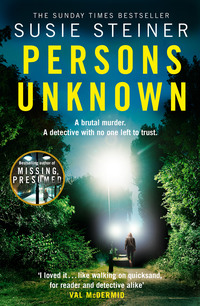
Kitabı oku: «Persons Unknown»
PERSONS UNKNOWN
SUSIE STEINER

Copyright

The Borough Press
An imprint of HarperCollinsPublishers
1 London Bridge Street
London SE1 9GF
www.harpercollins.co.uk
Published by HarperCollinsPublishers 2017
Copyright © Susie Steiner 2017
Susie Steiner asserts the moral right to be identified as the author of this work
A catalogue record for this book is available from the British Library
First published by HarperCollinsPublishers 2017
Cover layout by Claire Ward © HarperCollinsPublishers Ltd 2017
Cover photographs: Front © Henry Steadman. Back © Dave Wall/Arcangel
This novel is entirely a work of fiction. The names, characters and incidents portrayed in it are the work of the author’s imagination. Any resemblance to actual persons, living or dead, events or localities is entirely coincidental.
All rights reserved under International and Pan-American Copyright Conventions. By payment of the required fees, you have been granted the non-exclusive, non-transferable right to access and read the text of this e-book on-screen. No part of this text may be reproduced, transmitted, down-loaded, decompiled, reverse engineered, or stored in or introduced into any information storage and retrieval system, in any form or by any means, whether electronic or mechanical, now known or hereinafter invented, without the express written permission of HarperCollins e-books
Ebook Edition © February 2017 ISBN: 9780008123352
Source ISBN: 9780008123338
Version: 2020-04-03
Contents
Cover
Title Page
Copyright
14 December
Jon-Oliver
Manon
Davy
Manon
Davy
Day 1
Manon
Davy
Kilburn, North London
Bernadette
Davy
Manon
Day 2
Manon
Davy
Birdie
Day 3
Davy
One Week in
Manon
Davy
Day 9
Davy
Birdie
Saskia
Davy
Manon
Two Weeks in
Davy
Manon
Day 15
Davy
Manon
Six Months Earlier
Saskia
Manon
Day 16
Davy
Manon
Day 17
Manon
Davy
Three Weeks in
Manon
Birdie
Day 23
Manon
Day 24
Davy
Manon
Davy
Manon
Day 25
Davy
Birdie
Manon
Day 27
Davy
Manon
Birdie
Manon & Birdie
Day 28
Davy
Manon
Davy
Day 30
Davy
Gary Stanton
Davy
Manon
Davy
Day 32
Manon
Davy
Manon
Ellie
February
Birdie
May
Manon
July
Davy
August
Manon
Acknowledgements
Keep Reading …
About the Author
Also by Susie Steiner
About the Publisher
14 December
Jon-Oliver
Down. Dizzy. Pitching left. He is draining away like dirty water, round and round. Stumbling not walking, the ground threatening to come up and meet him. And yet he presses on. Something’s not right.
He is swampy, heavy-footed. His shin is throbbing. A scuffle – like being spun in blind man’s buff – so quick that when it was over he thought he’d been mugged, but he patted himself down and his wallet and phone were there all right.
His muscles are soupy, unresponsive. His legs wade, the landscape too broad for him to make headway. The air is close like a wet web. He can barely draw breath.
He stumbles to the right, into a muddy wooded area in a direction he hadn’t intended to take and it’s as if the ground is reaching for him. Is it quicksand, not mud?
He’s really scared now; nervously places a hand to his chest. His shirt is wet through but it’s not raining. He looks at his hand. It is glistening dark; the colour unclear because of the dark and the orangey street lighting.
He starts to panic, cannot fill his lungs. What is happening to him?
He falls into the mud, feels some arms take him up and cradle him, looks up to see blonde hair. The alien scent of perfume.
Saskia?
‘Sass?’ he whispers, confused. Is she the cause of this, after all her stupidity? She went too far and he couldn’t stop her.
‘Sass?’
His sight dims, he is too tired.
The world dips.
Manon
Crisp in one hand, sandwich in the other; the tickle and press of light internal kneading around her pelvis, like butterflies in a sack. Seems typical that pregnancy has brought zero in the way of nausea but has instead turbo-charged Manon’s appetite.
She becomes aware of Harriet and Davy talking, urgent and low, on the other side of the open-plan office. Something’s up. They’re quickening. Manon elongates her neck, craning to hear, but her colleagues are too far away.
As they pass her desk she says, ‘Anything up?’
‘Job’s come in,’ Harriet says, but it’s clear she can’t be bothered to fill Manon in.
‘Ooh, who is it?’ Manon says, full mouth.
They ignore her.
She looks at Davy, full of himself these days; Detective Sergeant Davy Walker, promoted by the super, Gary Stanton. He might as well call Stanton ‘Daddy’. Well, he’s welcome to it. Manon is in hot pursuit of the work–life balance: desk job, regular hours, house full of children. She wants to focus on whether to sign up for an organic veg box or whether this would be taking her personal reinvention too far. You can lead a horse to uncooked beetroot …
And yet she is straining out of her seat to overhear the conversation between Harriet and Davy.
‘I could be special advisor at the scene, brackets, teas,’ she offers.
When she’d first begged Harriet for a job back in the Major Crime Unit, determined to leave behind the misery of the Met (awful boss, crushing workload) and the cost of London living, she said she’d do anything, didn’t care how boring. Cold cases.
‘You don’t want to do cold cases,’ Harriet said. ‘There is no greater career cul-de-sac than cold cases.’
‘I do, seriously. Boring dead-end redundancy’s where I’m at.’
And cold cases is where she’s ended up, while her belly enlarges (now at the five-month mark), spending quite a few of her days following her satnav inexpertly around the Fens – turn around where possible – to interview people who couldn’t remember much about last week, never mind a decade ago. Telling herself this is fine. This is what’s called Having It All (though most of the time, it feels like having small slivers of the duller bits) – home by five, pick up some Persil non-bio. You have reached your destination on your right.
Christ, really?
Harriet has marched off in a hurry.
‘Davy; oi, Davy,’ Manon hisses at him as he thumbs his mobile phone and Davy – who used to work for her, who used to do her bidding while she shushed him – shushes her with his finger. Now he’s the DS running the job while she … Well, she is quite tired to be fair.
‘Just tell me what’s up,’ she says when he’s off the phone.
‘Stabbing, male, in Hinchingbrooke Park.’
‘Nice of him to kark it so local.’
‘Actually, he might not even be dead yet,’ says Davy, eyes darting with all the thoughts he’s having, checklist and scene log and SOCO, no doubt. ‘Right by the forensics lab as well. We can all walk it from here. Really couldn’t be more convenient.’
And he is back on his mobile, heading for MCU’s double doors.
Her Nineties house, squat in its tray of mown turf, the very image of a child’s drawing complete with pitched roof and windows like eyes. Not too bright: a stoic face, happy with its lot. Around the lawn is a frill of box hedging, so low you could step over it – and what’s the point in that, she wonders, remembering the burglary prevention advice she used to dole out when she was in uniform. Plant prickly bushes under windows. Halt! This is a shrubbery!
Her key in the plastic door with its fake leaded lights, letting herself in and noticing that the reality is a step removed from what she’d hoped for, moving back to Huntingdon. She thought it would be all spacious living and glorious rural(ish) childhoods for Fly and Solly.
‘I don’t want to bring up a black boy in London,’ she said to her sister Ellie at the start of her campaign for them to move back to Cambridgeshire. This had followed Manon being summoned to the headmaster’s office at Fly’s vast, terrifying comprehensive school and an encroaching fear that he was getting in with the wrong crowd, or possibly that he was the wrong crowd.
‘That’s exactly where you should bring up a black boy,’ Ellie said.
‘And watch him get stopped and searched every five minutes of his life? Arrested for stuff he didn’t do? Looked at by old ladies who think he’s going to mug them? I watch them, you know, giving him a double take, and it breaks my fucking heart.’
‘So what, you’d rather take him out to the UKIP heartlands, would you, where he’ll be the only black boy for miles around?’ Ellie said. ‘You should see the old ladies out there.’
‘We can’t afford to stay here. The rent’s crippling me. It’s crippling you as well. Come on, we could get a big house, the four of us. Fly would never agree to leave Sol, you know that.’
Ellie looked uncertain. ‘It is astronomical,’ she admitted. ‘But God, I hate being uprooted. Having to start again somewhere new, making new friends. Makes me feel exhausted just thinking about it. I’ve got a group of mums I feel comfortably ambivalent about, right here.’
‘We could get a mansion in Huntingdon or Ely or Peterborough,’ Manon pleaded. ‘You could—’
‘Start a course of antidepressants?’
‘Go back to work.’
Their charmless four-bedroom house opposite police HQ in Hinchingbrooke is costing a fraction of what they were spending on two flats in the capital, and is more than double the size. They each – her, Ellie, 12-year-old Fly (whose trainers alone, like cruise ships adrift, have their own housing needs) and Ellie’s nearly-3-year-old Solomon – have a capacious bedroom, hers and Ellie’s both with en suites. The house has one of those bolt-on hexagonal conservatories made from uPVC and, beyond, a 150-foot lawn dotted with menacing conifers. The Bradshaws can even boast a utility room (and what says you have arrived more than a utility room?) with grey marble-effect laminate worktops.
Manon calls ‘Hello?’ into the volume of the house, clattering her keys onto a glass-topped console in the hallway (an irritant none of them could be bothered to remove – whatever domestic improvements are hatched in the utopias of the night are laid to waste in the harum-scarum day). She smells cooking – whatever Solly has just had for tea.
She stands in the doorway to the lounge, already disappointed by the scene in front of her: an oatmeal vista, its candelabra lights descending stiffly from the low ceiling (a persecution of a ceiling – she feels at times as if it is lowering in real time and will one day crush her). The three-piece suite, extra wide and squat, is the most engulfing Manon has ever sat in, so much so that she often feels she is being consumed by it. Everything beige, so that the whole atmosphere is one of porridgy comfort. They’ve lived here for five minutes, and she’s already nostalgic for the high ceilings of Victorian London.
‘Oh Fly, don’t play Temple Run with him,’ she says, removing her coat. ‘His brain’s not even formed yet.’
‘He loves it,’ Fly answers without looking up from the iPad he is hunched over, Solly nestled in his lap. Manon walks back out to hang her coat on the banister and to drop her bag at the foot of the stairs. Where is Ellie? At work? Her shifts run from 7.30 a.m. to 3.30 p.m. or 1.30 p.m. to 8.30 p.m., and this is considered part time. The entire shift usually on her feet, sometimes with no chance for a break. When she’s on nights, she’ll often have Solly all day the next day because she’s trying to save money on the childminder (Ellie’s sense of impoverishment is their microclimate). She’ll doze on the sofa while he plays in front of rolling episodes of Peppa Pig. There has never been a worse time to work for the NHS, Ellie says. The management obsessed with targets and budgets, every shift short-staffed. No love, only constraint and a communal sense of harassment. Yet her sister has also been a master of evasion lately, time thick yet hollow. The stresses and strains mingled with absences unexplained. ‘Shift ran over, sorry.’ Or, ‘Training. Kept me late.’
Manon frowns at the children: ‘He’d also love to bury his face in Haribo; doesn’t mean he can, does it?’ She strides over and lifts the iPad out of Fly’s hands and Solly – predictably – howls, launching himself, starfish-shaped, to the floor. The passion erupting from him, their three-foot Vesuvius. Solomon Bradshaw is either happy or angry. There appears to be nothing in between.
‘See what you did?’ says Fly.
Home three seconds, and already she’s the object of hatred.
‘Where’s Ellie?’ Manon asks, keeping hold of the iPad and wondering where she can hide it this time. Out in the shed? In the freezer? This is the wonder of parenting: behind every new low is a lower low, to which you thought you’d never stoop.
‘Gone out.’
‘Out? Where? Working?’
‘Dunno.’
‘Well, how long did she leave you alone with Solly?’
If she’s on a shift, she should have cleared it, made sure Manon could cover her. Or is she having some fun – heaven forfend! – leaving Manon sore, bicep straining as she holds aloft her measuring jug of what is owed and what’s been taken. A life with children has brought out in Manon her meanest spirit – never a moment when she isn’t keeping a tally.
Fly has got up, lifting Solly’s stiff body off the floor. ‘Not long,’ he says. ‘Anyway, I don’t mind. Come on dude, time for the bath.’
Manon watches them walk out towards the stairs, Solly’s puce face, his breathing juddering with outrage, his little splayed fat hands on Fly’s close-cut hair.
Flumping into an armchair, Manon feels her tiredness mingle with affection for her adopted son; so much older than his years. She’s often washed over with it – pride in his reading, in his gentleness, his soft manners, his decency, his care of Solly.
Solly’s mission statement, bellowed while trying to climb the cupboard shelves towards the biscuit tin, is MY DO DAT! He can turn purple at the prospect of being denied complete autonomy – for example, not being allowed to start the car or push his buggy blindly into oncoming traffic; eat a snail or run off with the back-door key. Hot cheeks, angry square face torn up with his despair; trousers descending below the nappy-line, impossibly short legs. His unreasonableness smiled at (most of the time), especially when, tears spurting, he rubs furiously at his eyes and shouts ‘MY NOT TIRED!’ as if the mere suggestion is a gross slur on his toddler honour.
She could sleep right now.
She could sleep walking up the stairs.
She could sleep stirring a pan at the stove.
The baby squirms, bag of eels.
Yes, it’s laughable that she should consider herself the author of Fly’s best qualities. She’s been his mother for such a short time she can no more claim credit for his good qualities than his bad. His goodness is courtesy of his alcoholic mother, Maureen Dent, slumped with her bottle of Magners in front of Cash in the Attic (no cash in their attic, in fact no attic), and down to his brother Taylor, who loved him, who took care of him, probably in much the same way Fly cares for Solly now she thinks about it – you love in the way you have been loved, after all. Taylor turned tricks on Hampstead Heath and was murdered because of it – the homicide that brought Manon and Fly together. Perhaps his goodness is down to the genes of a Nigerian father Fly has never met. The more Manon lives with children, the more she believes in the determination of genes.
Neither a child nor a teenager, though if she has to pick, Manon would place Fly closer to the adolescent camp. People who meet him think him nearer 15 than 12. She has come to realise adolescence is not switched on at once – it seeps, gradually, during late childhood. There are glimpses from age 10. Some say earlier, though she doesn’t know about that. It’s more like a litmus paper turning blue, as the hormones leach.
Fly can read a room before she can. If there is an accident in his vicinity, he acknowledges vicarious feelings of guilt; can trace the root of awkwardness in a conversation. He once said of a rather sadistic PE teacher, ‘She’s mean to us because she had an injury and now she can’t be an athlete.’ He can identify envy without judging a person for it. All this he does quietly, and though she has always thought of empathy as imbued or developed, with him it seems innate. Its flip side is heightened sensitivity – an aversion to high collars and the congestion of cuffs under his coat, which means he wears only a fraction of his wardrobe: one beloved pair of tracksuit bottoms and one hoodie – with the hood down, Manon is forever insisting, though he takes less and less notice of her. Tall black youth with his hood up? He might as well wear a sign saying ‘Arrest me now.’
Stork-like, he is all limbs. Silent much of the time and unknowable. Fly is unhappy – she knows that much, knows too that she is the cause, and this she can hardly bear. She has uprooted him, unfurled his sensitivities like wounds open to the air. He is not himself. She hopes he’ll settle in.
Even so, he has his playful moments – has begun taking pleasure in irony: putting his arm around her shoulder, towering lankily above her, and saying, ‘I’m just off out,’ and her saying, ‘No you’re not,’ and him saying, ‘That’s right, I’m not, I don’t know where that came from.’ Both of them smiling at each other. They can begin to enjoy a new kind of conversation, with meanings other than what is said.
‘You are so down with the kids,’ he’ll say to her when she puts some kind of easy-listening mum-pop on the iPod.
Not yet old enough for a man, nor young enough for a boy. What is that? Lines from Twelfth Night embedded in her brain. Funny that she’d resented all the drumming and drilling at school, the tittering and yawning in uniforms as lines were delivered by lacklustre boys and girls leaning back in their chairs. The essays on Coriolanus or Much Ado. She hadn’t realised those lines would be the ones to comfort her most in the second half of her life. Perhaps the teachers knew; had thought to themselves, ‘You’ll thank me one day.’
Davy
It’s good to have Manon back, he thinks, striding across the police station car park towards the featureless grass expanse of Hinchingbrooke Park. He plans to cut through to the wooded area where the body has been found – quicker than trying to walk the enormous curve of Brampton Road. That road is gridlocked with rush-hour traffic, the headlights of school-run mums and commuters out of Huntingdon. Only around five-ish – an unusual time of day for someone to meet a violent death. And opposite a school, too.
He’s anxious to get there, to be the first. He breaks into a jog. In the distance, he can see blue lights illuminating the trees in a rhythmic sweep, the flash of a couple of fluorescent jackets.
It’s good to have her back, but Manon has to understand that things have changed. He isn’t her DC any more – she can’t sit in a car the way she used to and bark orders at him. He’ll likely be leading this case – not as SIO, that’ll be Harriet – but on the ground, running the constables. The thought makes him jog faster. He wants to get there, get started. But his excitement – or is it a stitch? – is tugged at from below by something like aversion. His body pushes forward but his inner self pulls back. He can’t do it. He isn’t up to it. He’s been over-promoted by the super, who thinks of him as a son.
Davy is panting (it’s a wonder he passed his last bleep test); his heart knocking with impatience to master the scene, and with fear also. He might be unmasked at any moment.
‘The shallowness deep within,’ Manon said, ages ago now – just after his promotion – when he’d discussed his Imposter Syndrome with her. ‘You’re not the only one, you know.’ And he’d wondered whether she meant, ‘You’re not the only one who thinks you’re a useless twat.’
Why does he keep thinking about her? He wishes she was here, that’s why. She seems a more substantial person than he does. He slows to a walk because the stitch is really painful now. Even more substantial these days: her breathing laboured, her breasts enormous. He doesn’t want to be one of those men, but it’s like trying to pretend you’re looking out to sea when there’s a vast mountain range right in your sightline.
He comes alongside the body. Looks around him. Harriet’s not here, nothing’s started yet. Within half an hour this place’ll be crawling with uniforms. Looking down, he sees the clothing has been cut open so paramedics could work on the victim’s chest – white shirt, suit jacket, wool coat, Ozwald Boateng written on the purple shimmering lining. The eyes are open, mouth too, the chest caked in dried blood and the small incision of the wound itself, evidently from a knife, like a cut in an uncooked joint of pork. Small red opening in waxy yellow flesh.
Davy looks around him again.
He crouches down unsteadily, and a gust of wind nearly pushes him on top of the corpse. He puts a hand out to balance himself. You don’t want to contaminate the scene – isn’t that the first rule, the only thing they drum into you at training? Keep your hands in your pockets.
If only he could cop a glance at that wallet that he can see poking out of the purple silk lining – then he could get started. If he could get a name off a bank card, an ID, then the story can start and this is a whopper. This one’ll be all over the news. The pressure, he can feel it already popping at his temples, is going to be massive. Keep your hands in your pockets, Davy Walker.
‘What the fuck are you doing, Davy?’ It is Harriet.
He jumps up. ‘Nothing,’ he says. ‘I’m not doing anything.’
‘Yeah, well, step away from the evidence until SOCO gets here,’ she says.
‘Know who he is?’ Davy asks.
‘Not yet. But he’ll still be dead in an hour after forensics have got what they need so there’s no need to be patting him down.’
He takes a step back.
‘We need to cordon this section of wood, make it wide,’ Harriet says. ‘Where’s your notebook, Davy? C’mon, or do you not want to run this scene? First priority is hands-and-knees search for a weapon. No point getting the dogs out, too many people around. But we do need community policing down here – I want the public reassured by not being able to move for police officers. We need a community inspector to go into the school, talk to the head, make sure all the kids get home safely. Same at the hospital.’
‘We should check Acer Ward,’ Davy says.
‘Yes, good thought. See if you can track down the consultant psychiatrist, ask him if they had any psychos go walkabout this afternoon. I didn’t just use that word, by the way.’
‘What about an ARV?’
‘No, leave them out – what can armed response do, realistically? Let’s not blow the budget. I want scene guards on the cordon, not the idiots we had on the last one. There’s a lot of footfall, I don’t want this scene contaminated, OK?’
‘Who found him?’
‘Judith Cole, over there,’ Harriet says, nodding towards a woman whose hair is matted against her head with blood. It’s smeared down her cheek and has soaked the collar of her coat. She has the distant look of a person who has yet to take in what has happened to her. Someone – a paramedic, probably – has placed a foil blanket over her shoulders of the kind used by runners at the end of a race.
‘She’s significant, obviously – last person to see him alive. We need her clothes for forensics.’
‘Why is there blood on her face and hair?’
‘She cradled the victim, tried to listen to his last words apparently.’
Davy is writing furiously, his hand cold and shaky. Harriet doesn’t stop, rat-a-tat-tat. ‘Also at the hospital, let’s check to see if anyone’s self-admitted. Knife wounds.’ She nods at the executive detached homes curling around the cul-de-sac adjacent to the school. ‘Over there, Snowdonia Way, that’s where I want house to house to start. And we can warn them to be vigilant while we’re at it. Set up a roadblock. We want witnesses, people who were driving in this direction.’
Davy is writing down Acer Ward while his brain tries to keep a tab on the subsequent items on the checklist. Nothing must fall off the checklist. He’s thinking Snowdonia Way, that was next, then – what? – something to do with clothes.
At the same time some other part of his brain is thinking, this isn’t a tidy one: not the usual kind of murder where the person who did it is lying smashed next to the victim or is making a cack-handed run for it towards a waiting panda car or where their perp is just, well, obvious because of the backstory: in a relationship with the victim, threatened them with it last time, just did a massive drugs deal and owed someone money. Sent a text saying, ‘I’ll get you, you’re for it.’ Their perps, often, were not the brightest bulbs in the chandelier and the cases were tidy. Dirty but clean, as in ring-fenced, not leaching towards the executive new builds of Snowdonia Way with their gas barbecues and two-car garages. Davy feels the anxiety reach its fist around his stomach.
‘So that woman Judith Cole,’ Harriet is saying, while Davy scribbles hosp – knife wounds? ‘He died in her arms apparently. At least, he was dead by the time the paramedics arrived. They tried to resuscitate him but no luck.’
‘Funny place to die,’ Davy says.
‘Yes. Very public. Who the fuck is stabbed at half four in the afternoon?’ Harriet’s swearing always peaks at a crime scene. ‘Let’s start with a statement from Mrs Cole, down at the station. Send someone to get her a change of clothes. She only lives over there, 5 Snowdonia Way.’
‘He looks well-to-do, not our usual lot,’ Davy says, nodding at the body.
He steps across the seeping ground to take a look at the man’s face the right way up. He has pouches beneath his eyes the size of teabags, a Roman nose. In fact the whole head seems Roman: his hair, cut close, curling forwards towards his forehead like Caesar’s crown of leaves. What was it made of? Manon would know.
As she walks away, Harriet adds, ‘Need to get the CCTV off the road and this footpath, if there is any.’
Time is of the essence, even when your victim is dead. Witnesses move, rain washes fibres away, memories fade. The commuter who might have noticed something vital goes home to his family, eats dinner, watches TV and soon cannot distinguish between Tuesday and Wednesday. CCTV gets inadvertently wiped by a shopkeeper who knows no better; car number plates are forgotten, descriptions blurred with other memories. They don’t call them the mists of time for nothing.
Investigations, Davy realises as he looks at his checklist without knowing quite where to begin, run on the energy of time, run against it sometimes if a living person’s in danger – a kidnap, say, or a kiddie lost. Other times it’s justice that runs against the clock. Given time, your perp can get rid of the weapon, wipe down his prints, cook up an alibi or hot-foot it to somewhere sunny. The Costa Brava is bristling with British timeshare criminals.
Time blunts all.
It’s a relief, now, to be in the warmth of the major crime unit: frying drips on the coffee-machine hotplate; the clack of fingers on computer keys; muffled mobile calls saying, ‘No I won’t be home, job’s come in.’ There is no one for Davy to call, no one who minds whether he stays out all night. There’s been no one since Chloe, and that ended more than a year ago. Not so much that she put him off all relationships, more that he didn’t get back on the horse, and now he’s not even in the vicinity of a stable.
As with investigations, so it is with heartbreak: time drains the sharpness from the picture. When Davy’d first broken up with Chloe, she was in every thought he had. He cried every day when they separated, even though it was his choice (doom balloon that she was). Nowadays, he can think of her dispassionately as a significant ex, could even bump into her without a rise in his vital signs. The love has run cold, just like it will with the evidence if he doesn’t get a shifty on.
Davy glances at his watch – 8 p.m. Being outside for three hours has made his checklist damp. He spent it standing in that patch of wood, sometimes taking a break to sit in an unmarked car, receiving updates from his DCs. Nothing from the hospital; nothing from house to house, except varying degrees of alarm; nothing from the roadblock.
He’d spotted a scene guard smoking a fag and throwing it to the ground.
‘What’s that?’ he asked, pointing at the fag butt.
‘What? Nothin’ to do with me,’ the chap said.
‘Better not be,’ Davy said, ‘because it’s going to be tested by forensics and if your DNA is anywhere near it, you’ll be in big trouble.’
‘OK, well, actually it might be mine,’ he said, picking the butt up and putting it in his pocket.
‘Victim’s name is Jon-Oliver Ross,’ Harriet told him, when SOCO were done. ‘Banking type from London. Business card says Dunlop & Finch Wealth Management.’
‘Never had call for a wealth manager myself.’
‘No, me neither. I find an overdraft is all the wealth management I need,’ Harriet said. ‘Anyway, we need to find out why he was in Huntingdon, when he travelled in and how. Fella that did it might not be local either. We’ve also got a photo of a woman found in his jacket pocket. A four by six of a blonde, real stunner. She’ll be an ex, so we better know who she is as soon as possible.’
SOCO discovered drips of blood at wide intervals along the footpath leading away from where the body was found, and these are being analysed. The phone found on the body is an iPhone, latest version, locked with a passcode so as good as useless. Call data from the telecom company will tell them when texts were sent and to which number, but not their contents. For that, you need access to the handset. Same with apps like WhatsApp and Snapchat.
Davy stretches back, trying to release the stiffness in his shoulders. The frenetic atmosphere has calmed somewhat. The Hinchingbrooke School kids have all gone home, there are no other reports of anyone being stabbed, so it’s looking less and less like a random psycho on the rampage, which doesn’t surprise him because it’s almost never a random psycho. Relationships are what drive people to murder, in Davy’s experience.
DC Kim Delaney appears before him, her arms arranged like a forklift, piled with folded clothes. ‘Change of clothing for Judith Cole,’ she says. ‘Brought in by her husband. He’s downstairs.’
‘D’you want to talk to her about changing out of her clothes?’ Davy says. ‘Better coming from you, really.’
‘Why?’ Kim asks.
‘Oh, you know, you being,’ he coughs, ‘you know, a woman.’
‘So I have to have all the underwear chats, is that it?’
Davy colours up. It’d be just his luck to fall foul of some kind of mishandling of the politics of the sexes.
‘No, no, of course not. I’ll do it then, shall I?’ he says.
‘Don’t be a twat, Davy. I was only joking.’
‘Oh,’ says Davy. ‘Oh, right.’
Manon
As they turn out the light and close Solly’s door, Manon whispers to Fly, ‘You’re so good with him.’
She can hear her neediness, as well as the distant sound of Sol singing to himself; he will sleep on his front, bottom in the air like the ruck in a blanket.
They stomp downstairs, Manon with one hand on Fly’s shoulder. ‘Hungry?’ she says.
He doesn’t reply and she’s used to this. She’ll often have to say things five or six times before he responds. This is not particular to Fly – she’s heard of parents hauling their children for hearing tests, the doctor saying witheringly, ‘There’s a difference between not being able to hear and not listening.’
‘I’ll need your help when this one comes,’ she says, her other hand on her bump, and even as she says it she thinks, leave the poor boy alone, remembers some parent or other at school saying, ‘Never plead with children’ and the way she nodded, thinking, I’m always pleading with children. It’s my base position.
Lighten up, she tells herself. He’s all right.
And yet he isn’t.
Five days ago, the school office called at 9 a.m. to say Fly hadn’t arrived at school.
‘I don’t understand it,’ Manon said. ‘He left half an hour ago in his uniform. Where is he?’
‘I was hoping you’d know the answer to that.’
‘Leave it with me,’ she said.
First thing she did was run out of the house, jogging the route of his walk to school, all the while on her mobile phone, checking admissions at the hospital, calling Fly’s mobile over and over.
She drove around Huntingdon, paced the high street, barging in and out of cafés. She wondered whether to call it in, really scare him with a police search but she had a gut feeling he’d come in for tea. He wasn’t a baby, wasn’t her baby. He had lived without any assistance from her for ten of his twelve years.
Other thoughts tugged at her: he’s been mugged, he’s in some trouble he can’t get out of, he had his buds in his ears as a car mowed him down. She checked the hospital again.
He came in carrying his schoolbag, at a calculated 3.45 p.m. – trying to pass it off. Bag by the banister, shoes off, uniform dishevelled.
‘Don’t give me that,’ she said, her body shaking, wanting to hit him.
‘What?’ he said.
‘Look at your phone.’
He looked at it. ‘Twenty-eight missed calls.’
‘So what was that performance all about? I’ve been worried sick.’
He sniffed. Shrugged.
‘Where’ve you been?’
‘Home,’ he said.
It was like a sinkhole opening up beneath her.
He has gone to watch TV while she puts the pasta on. Endless pasta, endless cooking it, throwing it in the bin, cooking it again, emptying the dishwasher, loading the dishwasher.
He calls her ‘Mum’ only sporadically – consciously, to please her or as a deliberate expression of connection. When he is unthinking, she is ‘Manon’. They are mother and son by degrees, not innately and not to their core.
‘How was school?’ she asks, serving his spaghetti.
No response.
‘Fly, how was your day?’
‘Shit, as usual.’
The truancy took her into the head’s office – a discussion about how to help Fly settle, in-school strategies (greater teacher focus), support at home (in this she read criticism). Fly promised not to do it again, said he understood it was about his own safety. To be fair, he looked shaken by the adult response. Perhaps he’d never been under such intense adult scrutiny before and he found it unexpected. The trouble with this sort of thing, she thinks now, lying in bed with a book flattened onto her chest, is she can’t solve it. She can’t solve Fly, can’t make him better overnight. She must let his feelings granulate over time and often she finds it impossible to summon the patience to back off. She wants to work on him like a case. She should have more faith.
She’s roused from dozing by the sound of Ellie coming in and by a reawakening anger (she is angry so much of the time and it is exhausting). She must have words. Ellie cannot leave Sol alone with Fly whenever she wants; Fly who is after all only 12, much as he seems older, and not old enough to bear responsibility for a 2-year-old, certainly not when there is the possibility of the Internet within a thousand-mile radius.
Davy
Kim has placed the clothes on the table in front of Mrs Cole, saying, ‘So, if you could change out of all your clothes. Your husband has brought you some clean things to wear. Put everything in this evidence bag if you wouldn’t mind.’
‘Evidence bag? You want my clothes?’ says Mrs Cole, taking the brown paper bag from Kim with a shaking hand.
‘We’ll need to send them to forensics, yes,’ says Davy.
‘What, even my underwear?’ she asks, with a brittle laugh.
‘Why not your underwear?’ Kim says, looking at her very directly. Eyeballing her, Davy would go so far as to say.
‘Just seems a bit …’ Mrs Cole begins. The blood has dried to a crust on her cheek and neck and has made her hair stiff.
‘These things can feel intrusive,’ Davy says, ‘but there’s nothing to worry about. Your things will be returned to you in due course. When you’re ready, we’ll start the interview, OK?’
He and Kim close the door behind them and walk in silence along the corridor. At the turn of the stairs up to the second floor, Kim says, ‘What’s in her undies that she doesn’t want us to look at?’
Would Kim know the meaning of her clothing, Davy wonders, in the way Manon would? Not the clothing sent to forensics – well those, yes, as well – but her clothing in general: the colours, the price bracket, the shop they came from. These were all markers that Manon could ‘read’. He’s not sure Kim is feminine in that way. Oh Lord, is he being sexist? Not feminine then; judgemental. Manon was master of the snap judgement, which often contained a kernel of truth.
The clothes Judith Cole has changed into are smart and unadorned: navy cardigan with a funny wavy edge and no buttons, very white T-shirt, so white it could have come straight from the packet. Dark, well-cut jeans. Everything new-looking. The blood-stained clothes, from what he could tell beneath the dark burgundy discolouration, were in a range of colours he would describe as light brownish, though he’s aware that there are more sophisticated words for it. Mushroom? Apart from her jeans, which were white – before she cradled a stab victim, that is.
Judith Cole is well turned out, that much he can see as he returns to interview room one and sets his pad down on the table.
‘Is my husband still downstairs?’ she asks. He hasn’t set the tape yet.
‘He is, yes,’ says Kim.
‘There’s really no reason for him to stay. Our house is only a five-minute walk from here.’
Kim remains silent. She told Davy earlier she likes to create discomfort in interviews, said it provides the space for confession. Davy’s acute sense of embarrassment can barely tolerate this.
‘I can’t see what help he would be; he wasn’t even there,’ Mrs Cole adds.
‘Right, here we go,’ Davy says, as the long beep rings out from the recording device.
He lists the date, time and people in the room.
‘Mrs Cole, you live on Snowdonia Way, is that correct?’
‘Yes.’
She confirms she’s 44 and works in insurance, is married to Sinjun Cole, which she spells more than three times for Davy who cannot understand why she seems to be spelling out ‘St John’. Eventually she does it so aggressively, he drops the subject. The Coles have 12-year-old twin boys attending Hinchingbrooke School, situated opposite the crime scene and adjacent to Snowdonia Way.
‘Did you know the victim, Jon-Oliver Ross?’ Davy asks.
‘No, I’ve never seen him before.’
‘Can you describe what happened when you came across the victim?’
‘Yes, I was facing the park and he was walking towards me. I saw him swaying, really weaving from side to side and I thought he was drunk, so I started to think of ways to avoid him but then he fell, right there in front of me. Something about the way he fell – his legs literally went from under him – I knew it wasn’t right. I could see he was ill. I rushed over to him and saw the blood coming from his chest. He was awake but he was panicking. He was really very distressed. I had his upper body in my lap. I called the ambulance on my mobile and I held him, which is why I got so soaked in his blood.’ She puts a hand gingerly to the side of her face. ‘His eyes were rolling back in his head, his chest was going up and down. I was trying to comfort him, saying, “Help is coming, hang on in there, stay awake,” that sort of thing. He whispered something which I didn’t hear so I put my head next to his mouth and he said, “Sass”.’
‘Sass? S-A-S-S?’ says Davy, pen poised on his notepad, not wishing to open up another spelling debacle.
Mrs Cole shrugs. ‘I couldn’t understand it either. Perhaps it wasn’t even a word, more like an exhalation. But he repeated it. I wondered if he was trying to say “mass” if he was religious – a Catholic. But he said it again, “Sass”. A name, perhaps?’
‘And why were you in the woods at that time, Mrs Cole?’ asks Kim.
‘You can call me Judith,’ she says with a wrinkling of her nose, which Davy supposes is intended to be friendly. ‘I was taking the dog out for a walk – I crossed Hinchingbrooke Park Road with the intention of going to the open ground where I can let him off the lead. He can run about there.’
‘And what was your dog doing, when you were seeing to the victim?’
‘I’m sorry?’
‘Where was the dog?’ repeats Kim.
‘Sorry, I don’t understand what you’re asking me,’ says Judith, shifting in her seat.
‘It’s a simple question. You drop to your knees to cradle a dying man. Where’s the dog?’
‘Oh, right, well, I didn’t really notice. I suppose he was snouting around the verges somewhere, you know what dogs are like. Sniffing tree roots, that kind of thing.’
‘We didn’t see him at the crime scene. The dog. Did you lose track of him?’
‘No, no, I didn’t lose him. He’s back at home. My husband must’ve taken him – picked him up, I mean.’
She has flushed. She flaps at her cardigan to cool herself down. Is she of an age for a hot flush? Davy isn’t versed in such things.
‘I’m not under any suspicion, am I?’
‘Why d’you ask that?’ says Kim.
‘Only, you’re talking to me as if I were a suspect.’
‘No we’re not.’
‘Why are you asking me all these questions when I’m just an innocent bystander?’
‘You were the last person to see the victim alive,’ says Kim. ‘That makes you a significant witness.’
Day 1
‘Time, everyone – time is of the essence,’ Davy says to the 8 a.m. briefing – a semi-circle of grey-faced detectives who haven’t been to bed. Priorities—’
Harriet coughs.
Davy looks at her, flushes; steps aside.
Harriet’s voice is loud and strong. ‘Jon-Oliver Ross,’ she informs the team. ‘Thirty-eight years old, of Holland Park, west London. Wealth manager to high-net-worth individuals at a private bank called Dunlop & Finch. This victim was well-to-do, probably well connected. First priority while we wait for forensics is his journey to Huntingdon. Did he come by car or train? I want CCTV off the stations including King’s Cross. Did he travel alone or did our perp mark him? There will be a lot of financial work on this one and yes, I’m looking at you Colin Brierley.’
Colin is MCU’s resident nerd – an expert in technology, the police investigations database HOLMES and the minutiae of financial records. Colin can tolerate vast panoramas of tedious detail, where others glaze over and lose not merely their thread but the will to live. Colin, though, has a childish excitement about the more inanimate side of police work. He doesn’t like to leave the office and so is handed laptops and iPads, phone records or reams of bank statements and he can sit and sit, drilling down into them with a kind of prurient glee. Colin is also the least politically correct man in East Anglia, and for this accolade he has seen off stiff competition.
Harriet has finished and the silence gives space for a discussion, so Davy says, ‘Who or what is Sass?’ Just to open it up, really.
‘Person who killed him?’ says Kim.
‘Judith Cole might have killed him,’ Davy says.
‘That’s a bit of a stretch – they didn’t know each other by all accounts,’ says Harriet.
‘Something about her isn’t right,’ Kim says. ‘Her husband told us he was unexpectedly working at home at four thirty-ish, the time she went to walk the dog’ – at this Kim makes large quotation marks in the air – ‘but he says the dog was lying on his feet the whole time.’
‘Should we question the dog?’ asks Colin.
‘Yeah, let’s ruff him up,’ says Kim, making a little barking sound.
‘Where were the children?’ Harriet asks.
‘At a sports club at the school,’ Kim says.
‘Ross’s next of kin,’ Harriet says to the room. ‘Gareth and Branwen Ross, mum and dad, from north Wales. I sent plod round this morning to notify them, so we should expect them sometime today or tomorrow. In their eighties. They’ll be knocked sideways, so respect and care, everyone, yes?’
In Davy’s periphery, Manon ambles in through the double doors carrying her usual paper bag of pastries and a coffee. She has a rolling gait these days, as well as a double chin, as if someone has attached a bicycle pump to her backside and inflated her. She hails team four across the room, saying, ‘Don’t mind me,’ and Davy can tell she’s wanting to sidle in on the briefing. She’ll perch on a desk and Harriet will be all ears, awaiting her pearls of investigative wisdom. Well, he’s not having it.
‘Boss,’ he whispers to Harriet, nodding in Manon’s direction, ‘shouldn’t we keep it confidential, it is a murder briefing …’
‘Oh for fuck’s sake, Davy, it’s only Manon. She’ll nod off in a minute.’
‘Who was he then?’ says Manon, breathless. She is smiling at Harriet and Davy can see the vicarious excitement on her face. ‘Your posh stiff,’ she says. ‘Got an ID yet?’
‘Jon-Oliver Ross,’ says Harriet, peering into Manon’s paper bag. ‘Have you got an apricot one of those? Rich banker type, from Lon—’
‘Fuck,’ says Manon.
‘What?’ says Harriet.
‘Fuck,’ Manon says again, feeling behind her for a surface on which to perch or steady herself. ‘He’s Solly’s dad. Jon-Oliver is Ellie’s ex.’
Manon
‘Only met him a couple of times, for like five minutes, but he’d started having contact in the last six months. Wanting to see Solly. That’ll be why he was here – in Huntingdon, I mean.’
Her mind is whirring, too full to listen to what Harriet is saying in reply. She must tell Ellie. Should she just blurt it out? Will Ellie be upset? Does some corner of her carry a residue of love for him, like a cupboard shelf that hasn’t been wiped? Does she harbour faint hopes of a reconciliation? Or will she not care? Perhaps she’ll be relieved that he’s out of her hair.
No, she thinks, Ellie had come round to the idea of Jon-Oliver playing a part in Solly’s life. Visits once a month had been accommodated, though Manon was usually either working or on her way out when they occurred. The thought of Solly brings tears to Manon’s eyes (tears come easily these days) – no chance of a father now. All the potential of that relationship cut down, before it could begin. It is a tragedy for Solly.
The sound of Harriet’s voice becomes louder and clearer as Manon rejoins the present. She becomes aware that the three of them – she, Harriet and Davy – have moved into Harriet’s office.
‘Where’s Ellie now?’ Harriet is saying, pacing behind her desk; coiled spring, hitching at her bra straps. Harriet’s body is sinewy, taut because she’s a ball of constrained movement – a rubber band at full stretch, wanting to ping. Physically, Manon thinks, we couldn’t be more different. I have no inner spring. I am in constant preparation for sitting down.
‘Home with Sol I guess,’ says Manon. ‘They were there when I left for work.’
‘Let’s bring her in for interview,’ Harriet says, half to herself and half to Davy. ‘What can she do for childcare?’ she asks Manon.
‘Childminder’ll take Sol at short notice,’ says Manon. ‘Go easy on her. Look, can I break the news to her? I don’t know how she’ll—’
‘You know you can’t,’ says Davy. ‘You’re connected to the case. We’ll need to keep you away from all future briefings. And you’re not allowed to search the database or ask officers about the case.’
‘He really needs to calm his tits,’ Manon says to Harriet.
‘That’s enough, you two,’ says Harriet.
Manon realises Davy wants to tell Ellie himself so he can watch her, see how she reacts. Everyone close to the victim is a suspect and how they take the news is part of a close-circuit observation that is often disguised as sympathy and support. We are giving you a liaison officer to keep you informed/watch your every move and report it back to the investigation.
‘One more thing, Manon,’ says Davy. ‘Where was Ellie yesterday afternoon and evening?’
‘Am I being interviewed?’ asks Manon, placing a protective hand on her bump. ‘Because if I am, I want all the proper gear – recording device and everything.’
Davy
‘Should we put a trace on Judith Cole’s phone?’ he says, now that he and Harriet are alone. ‘See what she was really doing in the woods at that time? Kim thinks she wasn’t walking the dog.’
Harriet has closed the door to her office and is pacing, the wings of her jacket pinned back by her hands on her hips. ‘Nah, Judith Cole’s not the issue. Woman from across the road who didn’t know him? Who cares what she was doing in the park? We don’t have grounds for a trace.’
‘Except her being the last person to see him alive, and also lying,’ Davy points out.
‘Yes, but she might be lying for some other reason. Just because she called it in, doesn’t put her in line for investigation – you know the Samaritan rule. Priority is questioning Ellie Bradshaw. She’s the person who can give us the most on Ross – who he was, who might have wanted to stab him.’
‘What are our main lines, boss?’
‘I’d say financial work and exes – so that’s Ellie. And the photo in his jacket – the blonde. We need to find out who she is. Maybe she’s Sass. There’s a strong money motive, with someone like him.
‘Judith Cole has come in for re-interview,’ Davy says.
‘Has she? Right, OK, you can have another go at her – gently, Davy – just to fill in the gaps in her statement while we wait for Ellie Bradshaw to come in. But no more than that – husband’s a lawyer, I don’t want a complaint. And Davy? Take Kim with you. Sounds like she was doing a very good job last time.’
Davy is upended by jealousy, like a small boy in rough surf, while the adult in him says, ‘Righto, boss.’
‘Your husband says you weren’t walking the dog,’ Kim says, as soon as the bleep sounds, without warning or preamble.
Judith Cole blanches to the colour of her semi-sheer white blouse, which has a white vest visible beneath. At her throat is a sparkling pendant, a single diamond on a silver chain. Unlike the last time they saw her, she is freshly blow-dried and wearing immaculate makeup.
‘I did have the dog,’ she says, though Davy hears uncertainty in her voice. ‘He must be mistaken.’
‘Why would you walk over a busy main road to Hinchingbrooke Park when there’s a nicer one at the end of your road, which is nearer?’ Kim asks.
‘I don’t think it’s nicer,’ says Mrs Cole. ‘I like Hinchingbrooke Park. I can let the dog off the lead and he can run around.’
‘It was pitch dark though,’ says Kim. ‘Seems a bit odd.’
‘Yes, it was dark, but it wasn’t late – only four-ish. Do you have a dog?’ Mrs Cole asks.
Kim and Davy are silent.
‘Well, you see, if you had a dog, you’d know that owning one means venturing out in snow, hail, darkness, you name it. A dog’s gotta do what a dog’s gotta—’
‘Davy?’ Harriet is at the door. ‘A word, please.’
He and Kim step outside.
‘CCTV from King’s Cross has come in. I’d like you to take a look.’
‘Right, so there’s Ross,’ Harriet says, pointing at the screen. They are standing around Colin’s computer, looking at the grainy images of King’s Cross station platform as people make their way to board the train.
Davy watches Ross put his ticket into the barrier and walk through it. He strides down the platform with confidence, coat well cut. He looks like a businessman on his way to a meeting that will not challenge him greatly. His face is unfazed, neither angry nor anxious. How little we know of what lies ahead.
‘Look at this fella,’ Harriet says.
‘Who?’
Harriet is leaning over Colin and tapping on his keyboard to set the tape back a few frames. ‘There.’
She points at a big man, bald with a black smudge at his ear, possibly an earpiece. He wears a bomber jacket and underneath it he is stocky and muscled, causing his arms to sit wide. The image quality is poor. He is coming through the ticket barriers shortly after Ross.
‘He’s looking at Ross like he’s dinner,’ Harriet says.
Even on grainy CCTV footage, they can all see the man’s focus is on his quarry, who is just ahead of him. He glances down briefly to get his ticket from the barrier, but then his eyes are back on Ross, hurrying to keep up with him and then boarding the same carriage.
‘Who is he? That’s what we need to find out,’ Harriet says.
They all straighten, away from the screen.
‘I’ve looked at the Huntingdon CCTV and this chap does not get off the train with Ross, so where does he get off? That’s question one,’ Harriet says. ‘And where does he go? It’s identifying him that’s going to be the problem.’
‘What’s the timing on that?’ Davy asks. ‘We need to get the information off that ticket machine.’
‘So, Ross goes through the barrier at 3.08 and forty seconds. The other guy is going through twenty seconds later, so at 3.09 p.m. exactly. We’re going to need the station staff to identify whether his ticket was bought with a card.’
‘Might’ve paid cash,’ says Davy. ‘We should also capture the rest of his journey at the London end, off station CCTV and underground, roads.’
‘We could email his picture to local forces, see if anyone recognises him,’ Kim suggests.
‘How about Crimewatch?’ Davy says. ‘Do you know this man?’
Everyone groans.
‘I don’t think we’re ready to be buried in a gazillion false leads just yet,’ says Harriet. ‘But he’s marking him, right? I mean, he’s definitely marking him.’
The others nod, Davy regretting he is not more reassuring in the face of her need for it. There is so much to do, so many tiny steps to complete in just this fragment of the case. He can feel himself getting into a state, a feeling of panic which renders him inactive when what he needs to do is hurry up. And forensics will be in tomorrow, which will present them with still more avenues for inspection. And he hasn’t even resolved the dog-no-dog question and the small matter of why Judith Cole is lying. Not to mention the fact he’s starving. And who, or what, is ‘Sass’?
‘Are you all right, Davy?’ Harriet asks.
He realises he has been rubbing his brow and frowning at the floor.
‘Yes boss, I’m fine. Just wondering where to begin,’ he says, with a weak smile. He wishes his face was more Jack Reacher, less Charlie Brown. ‘I’m still curious about what Ross was saying – the Sass thing.’
Harriet lifts her chin – a kind of worried nod – and Davy wonders if his display of anxiety will make her fearful she’s put the wrong man on the job. He needs inspiration – the kind of moment when the memory of a phrase in interview, an unconscious connection made, an imaginative idea of an avenue to try, all these coalesce into investigative brilliance. Combined with luck, you can sometimes crack them that way.
But not when you’re desperate, overloaded and vaguely panicking.
Kilburn, north London
Bernadette
—sting testing one two three.
Stop. Rewind. Record.
Right, my memo of evidence. Most people would record this on their phones but I can’t work mine. It’s an android and I’ve only just worked out how to find a number and dial it. Anyway, Sanjeev had one of these knock-off dictaphones on the market, so here we go. I am Birdie Fielding and this is a true and accurate account of everything that’s happened. I apologise now if I go off the point a bit.
I came out like anyone would – to see what all the tooting and commotion was about. I heaved out through the door of the Payless Food & Wine, could see them all gathering on the corner where Iceland is. I turned over the ‘Closed’ sign and locked up.
And out into the crowd – the rubberneckers eager for a glimpse of misfortune. Wheelie shoppers, niqabs, prams, hoop earrings. A whole mass on the pavement, spilling into the road. The air was soft outside Shoe Zone and Palace Amusements – this was back in November, ever so mild. I remember thinking, this is nice, should’ve got out sooner.
I pushed through to the centre. I’m not one to loiter at the back. I spotted Nasreen from the cash and carry, who smiled at me. Never liked Nasreen. Competitive. Always asking me how busy I am at Payless. I smiled back as if we were friends.
Now I saw what they were all staring at – a body on the ground, thrown there by a car I shouldn’t wonder, but she was coming round, squeezing her eyes as if she was in pain. Not dead then. And people were beginning to shuffle away with their disappointment at her being alive. She lay there, a mass of skirts like an upended toilet doll. Everything black: lace, broderie anglaise, in layers – and DM boots poking out. Her eyes were fluttering, black kohl pencil against porcelain skin, and she must’ve spotted the few remaining stragglers getting their mobiles out to call 999 because she shook her head saying, ‘No, no. I’m OK. I’ll get up in a minute.’ Then she opened her eyes fully – I could see it was a struggle – and her gaze fell upon me. I was bending right over her by this point. She signalled to me so I put my face next to hers. She didn’t smell how you expect Goths to smell – no cheapo joss sticks or Body Shop musk. She smelled expensive. Citrussy.
‘No cops,’ she whispered to me, ‘no ambulance. Can you get me into your shop?’
Why was she asking me? Well, it wasn’t the first time we’d met, was it?
It’s not at all like me to help somebody. My gut instinct is to keep out of the way of other people’s needs and wants. I live by a policy of non-intervention: I don’t want to send in ground troops and never be able to get them out. So I was already out of my comfort zone when Nasreen’s dad, Sathnam, helped me carry the Goth into Payless, depositing her at the foot of the stairs to my flat.
She was slumped and I wondered if she was losing consciousness. I put my arms around her neck and tried to hoist her up the stairs like a body in a life jacket – me being the life jacket.
She grimaced, pushed her head to one side. ‘I can’t breathe …’
‘You think you’ve got problems,’ I said, panting.
I was forced to change position. I tried the bridal lift and let me tell you, it required Herculean strength to get all 20 stone of me and all of her up those stairs. Each step was a heaving stomp, the kind Frankenstein’s monster would take. At the top, once the front door was flung open (and that was a world of pain, her propped against the wall while I fumbled for my keys), I pitched towards the sofa and deposited her down on it with some force.
I collapsed to my knees, panting, then looked up at Tony, there on the wall, and crossed myself – I don’t know why, I figured it’s what he would have wanted – and said, ‘Sweet Jesus, Tony, I hope she doesn’t die on me. Not in my flat.’
She didn’t die.
She slept. For a couple of hours, as it goes. Then she seemed to come round, though her eyes were still closed, and she shook her head from side to side, saying ‘They’re coming to get me. They’re going to get me.’
I gave Tony a look, which said, ‘We’ve got a right one here.’ Because there’s only one thing worse than a Goth, and that’s a paranoid Goth. A Goth with conspiracy theories.
Why did she pick me? Well, she’d been coming into my shop for a few months, since the heatwave last summer. I recognised a kindred spirit because despite it being 30 degrees, she wore a long-sleeve black T-shirt, black trousers with all manner of rips and rivets, and DM boots. I, too, was clad from my wrists to my ankles and nearly dying in the heat. Anyone who is fat will recognise the reluctance to bare flesh, even in tropical temperatures. Perhaps it wasn’t flab she was covering up – impossible to know the state of her physique under all that garb – and anyway, who knows why Goths keep it under wraps? But I nodded at her capacious sleevage and said, ‘Sweltering, isn’t it? Still, nice day for Lambrini, that’ll be £2.50 please,’ and handed her bottle of sweet pear wine back to her across the counter. It was to be a couple more weeks before she said a word to me.
At first it was just a faint, ‘Hiya,’ from under a canopy of kohl black eye pencil. Then, come September, she shivered, and said, ‘Season’s turning.’ Quite the poet.
She always bought Lambrini – the drunkard’s tipple of choice. Even the millionaire bloke who invented Lambrini drank himself to death, cheap and swift. I assumed she was taking it to a bench in Kilburn Grange, to join the other winos congregating there. They sit slumped, talking shite, seeping piss, and watching the ladies in hijabs on the outdoor gym equipment.
Then, about a month before the incident that flattened her in front of the Payless Food & Wine (so this would’ve been October), she came into the shop swaying, approached the counter with her bottle as usual, and promptly sank to the floor. I leaned over it, said, ‘Are you all right?’ but there was no response.
She was out cold.
I dragged her to the back of the shop, where there’s a frayed old armchair (which I’ll be honest, doesn’t smell too good) and allowed her to sober up out there. So by the time the accident happened in November, we were quite close really.
So, back to her being out cold on my sofa: she was sleeping and sleeping, perhaps working off months of the Lambrini in her system, perhaps recovering from whatever damage the car had done when it hit her. For a time, I moved around her laid-out body in the lounge, sort of wafting in and out, clattering a bit, washing things up, hanging some laundry in the box room – generalised fussing which got louder the more I wanted her to wake up. I began wondering if it would be all right to leave her on her own or if it was all a ruse and she’d leap up and steal all my stuff the minute my back was turned. The more time went on, the more unlikely this seemed – perhaps I got used to her and so feared the stranger in her less. I went downstairs and opened up the shop, thinking that she couldn’t leave the flat without passing me at the till. Things were pretty quiet. I popped up a few times to check on her, but nothing.
It was kind of boring waiting for her to wake up, so I had this idea that I should go and buy her a towelling robe for when she came round. She’d be wanting a bath, I reasoned, and you can’t step out of a nice hot bath and immediately Goth yourself up, can you? It’s quite mad what you think of when you’re out of your comfort zone, and someone being in my flat was way out of my comfort zone.
I could have gone to Primark which is right by the Payless on the Kilburn High Road, but I’m quite tight by nature, and what the fuck was I doing buying a complete stranger a bathrobe anyway? So I headed to the British Heart Foundation shop by Argos.
I’ll tell you the most annoying thing about being fat – the weight! No, I mean the actual weight: carrying it around. Walking anywhere does me in. If you’re not heavy, you cannot imagine what it feels like for your limbs to pull you down with every step. Imagine lifting pillars of concrete each time you place a step. Imagine gravity being such a force in your life that you’re pulling against it with every movement. That’s what it’s like being me. I’m lugging myself places. Before I’d even crossed the road outside Poundland, I was out of puff.
I got this bathrobe – pink, a bit scratchy but serviceable – in the British Heart Foundation shop. I know she would have liked a black one, being a Goth, but how many black towelling bathrobes do you see in the shops? I like looking in charity shops, browsing, but I can never find anything to fit – everything’s tiny. I see it as evidence that everyone else is expanding, too. I am not alone, if the charity shops are anything to go by – full of size 8s and 10s, but no lovely roomy upper sizes. No one’s shedding the size 20s as far as I can see, because taking weight off? It’s easier to broker peace in Syria or get to grips with quantitative easing.
Once I got into the flat, I was surprised to see the sofa empty and I looked at Tony, as if to say, ‘What’ve you done with her?’ I thought I was stuck with a size 10 towelling robe which I wouldn’t even be able to get one arm into, but then she appeared, her face seeming bruised from sleep, her hair matted to one side of her head.
‘How are you feeling?’ I said.
‘Better,’ she said, but she was walking gingerly, a hand to her side.
‘I think you should see a doctor,’ I said.
‘No.’
I could see she was in pain because of the way she was holding herself. Movement was causing her to wince. Perhaps she’s broken something, I thought. How could a car hit you and not cause a fair bit of damage? I’d want a doctor to look me over. I’m at an age where death is more a distinct possibility than a distant dream.
She sat slowly, lowering herself by increments down onto the sofa.
‘I’m Birdie, by the way,’ I said. ‘Bernadette, but everyone calls me Birdie.’ I don’t know why I said ‘everyone’ – not as if I’ve got an entourage.
‘Angel,’ she said, but I didn’t believe that was her name. I mean, who is called that in real life? Also, it was as if she was saying it for the first time.
‘Cup of tea?’ I said. ‘Or would you like a bath? I bought you a bathrobe.’ And I held out my charity shop plastic bag.
‘That was kind of you,’ said Angel, peering into the bag reluctantly, and I wished I hadn’t bothered.
Her black hair hung in wet rats’ tails. She was back on the sofa, with her feet up. The bathrobe, now I could see it in a better light, was more peach than pink and had an unfortunate Care Bear on the pocket.
I could examine her face, too, without all that black muck around her eyes. She was a corker – I mean, not mildly attractive. I mean a proper looker, top class. Pale skin without a single blemish, and gas-blue eyes that you couldn’t help doing a double take over. Black was definitely not her hair colour, not with eyes like that. I’d say she’d be auburn or maybe even redhead. Her peach-coloured lips were what the term ‘bee-stung’ was invented for – they gave her a slightly teary look. She was maybe not supermodel beautiful, but she could definitely get paid to do a catalogue or the Marks & Sparks website.
Another thing I knew for sure at that moment: she wasn’t a proper Goth. No offence to Goths, but they’re quite often minging.
She was looking around my living room – the velveteen sofa on which she was curled, tobacco-coloured with ruffled seams; the two recliners, facing the telly; the nets, which were not grey because I’d soaked them in Vanish only the day before; the swirly carpets, gas fire, knobbly Anaglypta on the walls. I’d not noticed before that my decor was rocking an elderly vibe, though I’m only in my fifties myself, which I had probably inhaled from Nanny Fielding. I love my lounge: it’s the perfect place to sit in front of the television and pop things in your gob.
‘Why’ve you got a picture of Tony Blair on your wall?’ Angel asked.
‘Because I love him,’ I said. ‘I’m the last person on earth who still thinks he’s marvellous.’
Oh he has his faults, it’s not that I don’t realise that. For example, although he’s even more handsome than he used to be, now that he’s grey and perma-tanned from the Middle East, he’s always travelling and that’d get me down, him being away all the time.
So I’m not blind, I know he’s not perfect. The God thing, that makes me uneasy, and towards the end he let it be known how irritated he was by the general public and that was probably a mistake. And he’s partial to making a bob or two, but which of us isn’t? The whole B-Liar thing, though: the epic righteousness of it would be enough to send anyone postal.
And in his heyday, my goodness! He united everyone. He didn’t make you hang your head in shame. All those years the Labour Party suffered with the bad comb-overs, the stumbling on the beach and then Tony came along, our shiny straight-talking saviour. We almost couldn’t believe he was left wing. He made me feel safe: I could sleep well knowing his hand was on the tiller. Three terms he gave us and now it’s as if that was a crime.
I got up and kissed my two fingers, then planted them on Tony’s lips. His cross/stern eyebrows seemed to raise at this and he appeared to smile, in that way that said, ‘Let’s not let this go too far.’ A bit Presbyterian, a bit hair shirt.
We sat in amiable silence, then I said, ‘I’m not being funny, but have you ever thought of modelling?’
She pushed some wet hair over her face and sucked on a strand. Perhaps she was embarrassed. ‘Yeah, I have. Ages ago. It’s not a good business for girls. Makes them vulnerable. You can get caught up in things.’
‘What things?’
‘Dodgy stuff. There are blokes who hang around models like, well, like hyenas round meat.’
‘I wouldn’t know,’ I said. ‘The modelling scouts appear to have passed me by.’ The self-deprecating joke – safe haven to fatties everywhere.
‘Actually, plus size is a growing area,’ she said and I flushed. I wasn’t prepared for her to acknowledge the elephant in the room quite so readily. ‘Sorry,’ she said. ‘I don’t mean … You’re not big.’
‘Thanks,’ I said but the atmosphere had darkened and she got up off the sofa.
‘Better get dressed,’ she said.
‘Shouldn’t we talk about what happened?’ I said. ‘About the car accident. About going to the police?’
‘Nothing serious,’ she said. ‘Not worth making a fuss.’
Angel opened the bathrobe and showed me her torso – the left side. She had a huge bruise – deep red, black in places – from her bra strap down to the waistband of her knickers.
‘It’s feeling a lot better,’ she said.
‘I just don’t get it,’ I told her. Then I went to the kitchen to wash up our tea mugs. ‘You were hit by a car and you don’t want to tell the police about it?’
Angel moved to stand at my bathroom mirror, in order to re-Goth. My flat is tiny, so it’s easy to talk across rooms.
I said to her, ‘What if the bloke was drunk and he goes and hits a child next?’
‘It was probably my fault,’ she said. ‘Maybe I wasn’t looking where I was going. I think I stepped out without thinking.’
‘CCTV will show what happened,’ I said. I had come out into the hall, drying my hands on a tea towel and watching her layer awful black pencil all over her eyelids. Crying shame, shading over such a lovely face. ‘I don’t think there’s anywhere on earth with more CCTV than Kilburn High Road. And anyway, even if you did step out, it’s still an offence to drive away from an accident. He should’ve stopped at the very least to make sure he hadn’t killed you.’
‘Yeah, well, he didn’t, did he, so let’s just drop it, OK?’
She’d finished with the kohl pencil and mascara, and was zipping up her makeup bag. She came out of the bathroom and was peering in at my box room – it had a single mattress on the floor and one of those concertina laundry airers, hung with stiff tea towels.
‘You’ve got an extra room,’ she said.
‘Think calling it a room is stretching it.’
‘Can I ask a favour?’ she said. ‘It won’t be for long.’
She told me she wanted to stay a while, to get herself straight. I assumed she meant laying off the Lambrini, in which case I wasn’t too sure my flat was her best bet, it being above an entire shop full of cheap spirits and tins of super-strength lager – killing the poor quicker and younger. Carlsberg Special Brew, Tennent’s Super and Skol Super 9%. They used to die at 65, now they die at 45, even though they look 65. But I digress.
Angel walked to the window in the lounge and lifted the nets, peered out at the street as if she was George Smiley looking for shadowy figures in doorways.
‘Are you on the run from MI6?’ I said, as a joke obviously, trying to change the subject away from latent alcoholism. I didn’t actually think she was on the run. I don’t think anyone is on the run in real life, but she turned, sharply, and said, ‘Why d’you say that?’
‘You’re acting like you think you’re in The Bourne Supremacy instead of sitting in a flat above the Killy High Road.’ I was going to add, ‘wearing too much eyeliner’ but thought better of it.
‘Look,’ she said, still peering out from under the nets, ‘there are people who would like to know where I am, and who I’d rather keep away from. That’s all you need to know. I could do with a place to lie low. I could go, tonight, get a bag of stuff, if you don’t mind me kipping in your box room for a while?’
I thought about saying, ‘How long is a while?’ But instead, I said, ‘I’ll think about it. Now, I’ve got to open up downstairs or my lovely regulars will be wondering where to get their tramp juice.’
Downstairs, turning my keys in the lock to open up, I thought about what it would be like later on, watching telly with someone there to pass the odd comment to, making a plate of carbonara for two and not eating it all myself. Asking if she’d like a bag of Frazzles and popping down to the crisp aisle. The drinking worried me a bit. I don’t like drinkers, much as they are my core fan base. I don’t like the feelings of risk and uncertainty they create. That said, we’ve all got our thing, haven’t we – that zone where we’re not in control? I’m quite safe around a bottle of Chardonnay. I’ve been known to yawn in the face of pornography. Show me a shoe shop and I can walk on by. But salty snacks? I will MOW. YOU. DOWN.
This’ll shock you, but I own Payless. I don’t lease it; it’s not a franchise. About fifteen years ago, when I was in my mid-thirties, this lawyer managed to track me down and told me there was all this money held in trust for me and did I want to collect it, because I’d got to a responsible age when I wouldn’t squander it and he was retiring, so there would be no one left who knew the details of my legacy. I guessed it was money from Mum and Dad’s house, maybe from Nanny Fielding when she died. I didn’t really ask any questions – like why it had taken so long to come to me.
I was working in Payless at the time, just on Saturdays – the rest of the time I was on the till in Primark and doing the odd shift on a street stall which sold lighters and knock-off Dove shower gel and the like, and so the next time I was in I asked Majid, who I worked for, how much he wanted for the shop and he laughed and laughed and laughed. And then he spoke very quickly in Urdu to his wife, and she split her sides laughing as well.
Anyway, once they’d stopped laughing, I bought it off them.
In retrospect, I realise I should’ve bought myself a hairdressers. Firstly, because I’ve always thought I’d make quite a good hairdresser, and second because of all those surveys about professions and rates of happiness. Hairdressers are the happiest people: there’s creativity, but only up to a point (too much, I’ve read, can send you demented; just look at poets). There’s craic – plenty of chat, but not that much intimacy (intimacy being a most overrated aspect of human relationships). And hairdressing also garners a great deal of loyalty. I read that the average woman stays with her stylist for twelve years. The average marriage lasts eleven.
But primarily I should’ve bought myself a hairdressers because it would’ve limited my access to the crisp aisle.
Did you know Britain has been voted the loneliness capital of Europe? The Office for National Statistics found we have fewer friends and that we Britons don’t know our neighbours and it’s killing us. Loneliness is as big a health hazard as smoking fifteen fags a day, and not nearly as enjoyable.
I think it is the English way. We can’t stand too much contact. We don’t know where to look during intimate conversations. The web of connections, which is a comfort to southern nationalities, especially Latin people who love to hug and wail at funerals, pains the Englishman. I remember living with Nanny Fielding and all the kids at school were going on sleepovers or to each other’s houses, but I didn’t. I went home to my gran and we barely exchanged a word. She made baked apple with sultanas and custard and there were lace-edged antimacassars on the arms of her wing chairs. She used to smooth a tea towel across her knees, not sure why, as if she was about to dress a wounded foot or shell some peas. It was just a pointless act of fastidiousness, which annoyed me until I missed it so much. I think this is why I seem so much older than my years – the grannyish house and the solitary ways. I’ve taken in Nanny Fielding and I don’t know any other way to live.
Anyway, without us having a conversation about it as such, Angel fetched a bag of stuff and installed herself in the box room, which started to smell of Chanel Cristalle because she sprayed it about like it was Impulse. Low-level drinking – she wasn’t bladdered, but she was hugging the Lambrini pretty close. She spent a lot of time on the Internet, saving files and copying Wikipedia pages, and the rest of the time she was standing by the window, lifting the nets and watching the Killy High Road. She was furtive. When I said something, she jumped. And when I called her name, she didn’t turn around.
I said, from the kitchen, ‘Angel? Cup of tea?’ But I had to walk into the room before she realised I was talking to her. I took it as proof that Angel was a made-up name. The question was why?
And what was her real name? What was with all the curtain twitching and mystery? And also, if I was going to make up a name for myself, I don’t think I’d pick Angel, d’you know what I’m saying?
But she wasn’t totally self-absorbed. I could see she was trying to make herself a pleasant house guest. A couple of days later, for example, she stood in the doorway, holding aloft two Sainsbury’s bags and smiling. ‘Thought I’d make burgers,’ she said. ‘I’m assuming you’ve got ketchup.’
‘Do I look like the sort of person who wouldn’t have ketchup?’
‘You look like the sort of person who wouldn’t have vinaigrette,’ she said.
We decided to watch The Hotel on telly – one of those documentaries where people act like they’re not aware they’re being filmed, when in fact they’re completely aware but pretending, and the programme’s main aim is the Ring of Truth, as if you’re peeping in unseen. Fixed-rig cameras is how they’re made. Rigged and a fix, I call it. I love those shows. I love watching people without having to spend any time with them.
Angel and I had a recliner chair each, the sofa being too uncomfortable to spend an evening on. I keep it because it was Nanny Fielding’s. I have always had two recliners; I bought them as a pair from DFS. Don’t ask me why – I think it seemed too sad to buy one. But there’s never been anyone to sit in the second one. Talk about hopeful purchase.
In The Hotel, you are shown round the penthouse floor of the Carlton Mayfair, ‘London’s most exclusive establishment’, according to the breathy voiceover. The penthouse floor has three marble bathrooms, including a ‘rainforest showering experience’ which plays the sounds of tropical birds and other wildlife while dappling you in a moving light show so you think you’re in a glade. The penthouse floor has two grand living rooms, each with about six sofas; a cinema; a catering kitchen, should the restaurant not suit, and a treatment room for on-site massages and facials. The penthouse floor is home to Donald Trump when he visits, and the Sultan of Brunei. The King of Saudi Arabia books it for the entire month of August and installs his family, flying over his fleet of cars, which they park all over Knightsbridge and get parking tickets they’ll never pay. They spend the month shopping at Harrods.
Angel and I were watching all this, the smears of ketchup hardening on our discarded plates, our feet up as if our legs were paralysed – which they were, I suppose. There is little in modern life more paralysing than the recliner chair.
‘Been there,’ she said, nodding at the telly.
‘Yeah, right,’ I said. ‘Me too. Stay there all the time.’
‘No, really, I have.’
I looked at her. ‘You what?’
‘I can prove it,’ she said, pushing down with her ankles (you have to use some force, as if the recliner is unwilling to give you up) so that her chair moved into the upright mode. She left the room and came back with a bag full of Carlton Mayfair toiletries. Shampoo, conditioner, body wash. Even a pack of cotton pads and buds, which you’re not supposed to put into your ears. I find it almost impossible not to put them in my ears.
‘How come you’ve been to the Carlton Mayfair?’ I said.
‘On business,’ she said simply.
‘Right, yeah, business. What business would that be? Cleaning the rainforest experience?’
‘No!’ she scoffed, but she’d gone back to watching the telly and when I tried to ask another question, she shushed me.
Couple of days later, Angel went out – for longer this time than just to Sainsbury’s, which is about a hundred yards away – and I was relieved to have the place to myself without her loitering at the windows or jumping out of her skin every time I made a noise.
I’m not sure I’m built to live with anyone. It annoyed me when she was in the bathroom or in the kitchen making herself a cup of tea. The squeaky noise she made when she opened the door to the box room annoyed me, even though it was my door – my squeak. It annoyed me that she was hardly ever out, that she liked Laughing Cow cheese. It annoyed me that I couldn’t trump openly or walk from the bathroom in my pants. Sometimes the sound of her breathing was more than I could stand.
Anyway, I used the opportunity of her being out to go through her stuff.
Lots of things about this girl didn’t add up. Firstly, her holdall was Chanel – with the linked ring symbol. Now, I know a knock-off when I see one, I used to sell enough of them on the market, and this holdall, which was leather, with some animal-hide areas, like a furry cow’s back, was no knock-off.
Second, she had all these creams – Clarins, Crème de la Mer, Kérastase shampoo. Posh bottles and lotions. How did she afford them? So while she was out, I took the opportunity to have a try – washed my hair with the Kérastase, tried the Crème de la Mer. I didn’t use the Carlton Mayfair stuff because the size of the bottles would have made it obvious.
Third thing, I was patting through the pockets of her coat and I found there was something – the shape of a lighter but smaller – sewn into the lining at the hem. I felt around it and it was a neat rectangle. I pushed my fingers around the seam but there was no way in. Perhaps it was just a weight, to keep the fabric hanging nicely. But I doubted it.
Fourth thing (come to think of it, there was precious little about this girl that did add up): she had what can only be described as a stalker’s dossier. It was a brown folder, the type that’s open on two edges, and slipped inside were all these newspaper clippings, lots of them from the FT and the City pages of other papers. Pictures of Chinese blokes circled, names in the text highlighted. Printouts from the Forbes China Rich List.
Davy
‘I just can’t believe it,’ Ellie Bradshaw is saying.
They are in interview room one, Harriet and Davy across the table from Ellie, who is shaking her head, hair swaying. She’s got nice hair – hasn’t got Manon’s ringlets. Instead it is wavy, to her shoulders, in a sort of honey shade. And it looks almost impossibly soft, like advert hair. Davy thinks it probably smells nice, of chamomile or lemon.
‘So you were where, between 4 p.m. and 5 p.m. last night?’ he asks.
‘Me? I was home with Solly, my son.’
She’s slim too, lovely dark eyes. Yes, Ellie is attractive; he can’t deny that. Strange to be sitting in an interview room with her because she is so like Manon – the very same voice and mannerisms. Yet at the same time, not similar at all. Like the same pudding in a different flavour – you can enjoy the orange, but find the mint tastes a bit like washing-up liquid.
‘Jon-Oliver was coming to see us – well, coming to see Solly. That’ll be why he was in Huntingdon. He was due to come over today. I guess he was booked into the George Hotel last night. It’s only, I dunno, the fifth or sixth time he’s seen our son.’
He frowns. ‘Can you think of a reason why he walked in the opposite direction to the George, along the Brampton Road towards the hospital?’
Ellie is thinking. Davy can’t take his eyes off her. Maybe she’d be worried about the age gap – Davy being ten years younger – but if it was good enough for Susan Sarandon …
‘Not really,’ she says. ‘I mean, he knows where I work. Knew, I mean. Maybe he was coming to see me?’
‘Did he know someone called Judith Cole?’ Davy asks. ‘Ever mention that name?’
Ellie turns down the corners of her mouth. ‘Doesn’t ring any bells, but Jon-Oliver knew a lot of women.’
‘What about this person?’ Harriet asks, placing a four-by-six photograph on the table in front of Ellie. The picture is of a blonde woman, tanned and manicured. Sunglasses on her head. The sort of person who might frequent Cannes or appear in Hello!
Ellie leans forward to look at the photo without picking it up. ‘No,’ she says.
‘The photo was found on Jon-Oliver’s body,’ Harriet adds.
‘Well it’s probably his current girlfriend then,’ says Ellie simply. ‘She looks like his type.’
‘His type?’ says Harriet.
‘Yes – stunningly beautiful, young, probably very bendy. And keen on cold hard cash by the looks of her.’
Bit bitter, thinks Davy.
‘He didn’t mention any names to you, talk about his personal life?’ asks Harriet.
‘We weren’t really on those sort of terms,’ Ellie says. ‘I hadn’t seen him for two years, then he contacted me out of the blue last summer – July or August, I can’t remember – wanting to see Solly. I was having none of it. It took me ages to get over him, and having a baby on your own … Well, I keep telling Manon, it’s no picnic.’ The reference to Manon is jarring. She is trying to remind them they’re friends, Davy thinks with some irritation – all on the same side. Well, they’re not. ‘I had to agree to give him access. Jon-Oliver gives – gave – me money, you see.’
‘He supported you?’ Davy asks.
‘Well, I work, but nursing doesn’t make me rich. I need his maintenance payments, yes. Anyway, Jon-Oliver’s on the birth certificate, so I had no choice. Since then, he’s visited Solly once a month. The meetings have been awkward – Solly usually ends up crying because he doesn’t know what to do with a stranger in a suit crouching on the floor next to him. Doesn’t know what it means, y’know?’
‘So you disliked him? Your relationship with Jon-Oliver was strained, would you say?’ says Harriet.
Ellie nods. ‘Strained, yes, that’s fair. I didn’t trust him, and I wasn’t too keen on having him back on the scene. I didn’t want too much involvement with him, that’s how I felt – like I wanted to keep my distance. Maybe that’s what made Solly cry. Babies pick up on everything in the room. But,’ she gives a resigned shrug, ‘I’m not the first woman this has happened to and I won’t be the last. You do it for your child, even though every bit of you doesn’t want to. You do it to give them the possibility of having a father. So yes, it was strained but we were trying to make room for him.’
‘So you were at home the whole time, between four and five yesterday?’ Davy asks.
‘More or less,’ she says, distracted by the bleep of her phone. ‘Sorry, I just have to look at this in case it’s the childminder.’ She reads the text message, then punches something into her phone – a reply, presumably. Rude, and rather presumptuous, Davy thinks. She looks up, saying, ‘Sorry. Yes, you can ask Solly if you like. You won’t get much of an answer – he’s 2. Do 2-year-olds count as alibis?’
She is smiling as she says this and Davy struggles with how it might be intended – as a friendly joke?
He says, ‘Did anyone else see you at home, anyone else who can confirm your whereabouts?’
‘No,’ she says quietly. ‘Fly came home from school at about quarter to five, and I asked him to watch Solly so I could pop out. Listen, I’ve got to get back to my son. He’s been at the childminder too long as it is.’
‘Just a minute please – you had to pop out? Where to?’ asks Davy.
‘Oh, just into town. I had to pick up a couple of things.’
At that moment, when Davy wants to ask where and for how long, Gary Stanton enters the room. Davy cannot remember the last time the chief super came in on a key witness interview.
‘How are we getting on?’ Stanton asks.
Harriet’s face is awash with confusion. ‘Yes, all fine,’ she says.
‘I think if we’re all done here,’ Stanton says, ‘we should have a quick departmental review upstairs. Shall we go? Thank you, Miss Bradshaw, for helping us with our inquiries. We will contact you should we need further assistance from you.’
‘Why did he shut that down?’ Davy hisses, so the department can’t hear.
‘I don’t know,’ Harriet says.
‘She’s a key witness and she’s got no alibi. And he says, off you pop, no further questions?’
‘Well, I’m not sure he was saying that exactly.’
‘What was he doing in there? I mean, when was the last time the super came in on an interview? And where is he for this departmental review he was so keen to have?’
Various colleagues have gathered around them for the briefing. Harriet is glancing furtively at them and she says, ‘Let’s talk about this later.’
They perch on desks or at their computers, Harriet and Davy at the front.
‘Right, Derry says we’re not getting the PM results till tomorrow, so let’s press on with other lines until forensics come in,’ says Harriet.
‘I did a bit of digging around at Dunlop & Finch,’ Colin says. ‘Head of the firm is one Markus van der Lupin, then beneath him are the two vice presidents, equally pegged as far as I can tell – Ross and this other chap, Giles Carruthers.’
Hariet nods, saying, ‘So let’s look closely at the structure there – any rivalries, fallings-out, that kind of thing. Very competitive, the City. Davy, you’d best head down there, interview Carruthers and the rest of the staff. Rest of you, priority is still our King’s Cross chap. Who is he, where’s he from and how can we collar him?’
Marie from reception has entered the room, and says, ‘The Ross parents have arrived. I’ve shown them into interview room one.’
‘Let’s not keep them waiting,’ Harriet says to Davy.
‘I’m very sorry,’ Davy says, ‘for your loss. This must be a difficult time.’
They nod, but don’t speak. Both are little; beady. Grey hair in a scribble above faces mottled with sunspots. They have cried, he can see that from the puffiness around their eyes, but he can see their reserve also, making them contain their grief in front of strangers. Not like some he’s done this kind of interview with. Some like to wail and holler as if volume proves how much they feel.
‘When did you last see your son?’ Davy asks.
‘Last Christmas,’ Mr Ross says.
Davy waits. They’re not the sort to elaborate. Rural people, Harriet said.
‘Right, so that’s nearly a year ago.’
‘He always said how busy he was,’ Mrs Ross says. ‘Said he’d like to come and see us more, but he couldn’t get away from work. We live out of the way. Not easy to get to. He was due to come this Christmas again.’
‘Did you know about the cruise?’ Davy asks.
They look at one another. Shake their heads.
‘He had purchased two tickets in your names for a cruise on the Crystal Serenity. Around the Caribbean. For two weeks in January.’
‘Ah, no,’ Mr Ross said, shaking his head sadly. They look down at their hands. After a pause, he continues, ‘It’s not our way. We’re not fancy people. We don’t like restaurants and cruises and all that kind of thing. Jonno was always buying us that kind of thing and—’
‘We didn’t want him to,’ Mrs Ross says.
Davy had looked up the Crystal Serenity online, its £17million refurb complete with retractable roof above the Trident Grill, its seahorse-shaped swimming pool and on-deck golf course, a seemingly endless roster of dining opportunities. Something about it had the ring of battery-chicken coop. He could picture himself pressing his face against the cabin glass and screaming to be let off. ‘Enough with the langoustine fricassee!’ He couldn’t picture these two, who seemed more the cheese-on-toast kind, browsing the on-board diamond emporiums.
Ross’s father sighs. ‘We’re not … comfortable in those situations. It sounds ungrateful now I say it.’
Mrs Ross says, ‘We felt he was always trying to impress us, to shower us with gifts and whatnot. We didn’t know how to say that he was enough in himself. We were so happy to have him.’ She doesn’t gasp or sob, but the tears leak from the edges of her eyes. Her quietness fells Davy. ‘You see, we thought we couldn’t have any children. We were married for twenty years and nothing at all happened. We were devastated by that but we’d come to terms with another sort of life. Then, when I was 42, Jonno came along, out of the blue.’
Davy nods, swallows.
‘But children are only on loan,’ Mrs Ross is saying. ‘You can’t keep them. We hoped he would have his own child one day, so that he might realise what we feel … to love someone not because of what they do but because they are. That they exist is wonderful, they don’t have to do much more to make you proud.’ Mr Ross takes her hand. She is quiet, thinking. Then she says, ‘But somehow – and we don’t know how this happened – it was as if the way we were, the sort of people we are, well … it wasn’t the way he was going to be. And all these gifts, all these luxury things, were his way of saying he wanted us to be different. Oh I’m not making any sense. I’m just trying to describe the place we were in, with Jonno.’
It is not Davy’s place to tell them about Solomon Bradshaw, much as he would like to comfort them with a grandchild they are not yet aware of. That’s Ellie’s job.
Instead, Davy says, ‘Jon-Oliver, as I’m sure you’re aware, was a rich man. He had moved a sum of money, rather a large sum of money, into a company registered offshore. Do you have any idea who the beneficiary of that company might be?’
Mr Ross is shaking his head. ‘I know he had a few bob, but I didn’t understand his work. I don’t understand about wealth management, couldn’t get to grips with what he did. I make furniture for a living. Tables mostly. I take pieces of wood, and I sand them and turn them and create joints, and when they’re made, someone pays me for them, and they take the table away. And that I can understand. I used to ask him again and again, but his work stayed a mystery to me.’
Manon
‘Oh God, you need wine,’ Manon says, pouring Sauvignon Blanc into a glass and handing it to Ellie, who’s sitting at the kitchen table pushing a balled tissue into a nostril. Her eyes are red, her lips cracked. She takes the glass gratefully. ‘Hang on,’ says Manon, making for the doorway, ‘right back …’
Out in the hall, she calls ‘Fly! Fly?’ up the stairs.
No response. She can hear the bath running, knows what they’ll be doing up there. Fly will be lying on his bed reading his latest Anthony Horowitz novel, imagining himself a teen spy, while Solly squats on the carpet constructing the same dinosaur puzzle he works at every night: repetition being a source of unalloyed joy for the 2-year-old.
‘Fly!’ she shouts, a notch louder and with more irritation.
She weighs up her exhaustion and desire to talk to Ellie versus the need to intervene. She very much doesn’t want to heave her bulk up those stairs but knows that Fly’s total immersion in his book means Sol could be drawing on the walls while the bath overflows. Her belly creaks, she yawns, thinks, fuck it. ‘Turn the tap off!’ she bellows, her parting shot as she returns to her sister, whose floodgates have re-opened.
These are feelings entirely not put to bed, Manon thinks, looking at Ellie’s dissolving face.
‘Sorry,’ Ellie says.
‘Don’t be.’
‘It’s just … it’s just … there’s no chance of anything now,’ she says in a watery voice, plucking another tissue from the floral cube beside her, ‘for him and Solly. No chance of a father for Sol. That’s going to be a loss all his life. It’s a fucking tragedy.’ She breaks down again. ‘It, it, it can’t be undone. I can’t ever make this better for him.’
‘His parents are here, did Harriet tell you? There’s a chance to give Solly some grandparents. We should invite them to stay.’
‘I did,’ says Ellie. ‘They didn’t want to but they’re coming to meet Sol tomorrow.’
‘Is part of it,’ Manon begins, girding herself, ‘that there’s no chance for you and Jon-Oliver now?’
‘No. No, it’s definitely not that, not even in my unconscious. I’d never have gone back to him. Jon-Oliver was a great one for fresh starts, saying he was going to change, but you’d have been a complete moron to believe him. You know, when he first reappeared in the summer in London, he said, “I want to be good. I want to be a good father.” And I said, “Right, and you think Solly’s going to make you good? That’s a lot to ask of a 2-year-old.” He said, “I just think I can be a different person if you and Solly were in my life.’’’
‘So he wanted you back? What did you say?’
‘Told him he could leave me out of it.’
‘Are you hungry?’ asks Manon. ‘I could make the tarragon chicken thing.’
‘Christ, is that a threat?’
‘Crisps?’
‘Go on, then.’
In the getting up, opening a cupboard, emptying the Kettle Chips (sweet chilli flavour) into a bowl, Manon says, ‘What was it like with Jon-Oliver?’ Of course they’d discussed it in the past, but never in detail.
Ellie sighs. Sips her wine. ‘He had this slept-in face – and my God he could be funny. Slightly dangerous-funny – irreverent, bit close to the wire. We’d come home from a night out, he’d mix some cocktails and then we’d go out again. And the sex—’
‘Yes all right,’ says Manon, shoving more crisps than seems feasible into her mouth, frightened it might be true – about all the sex she’s missing out on.
‘Anyway, he had all that rich boy’s confidence, and I knew he was a bit of a player – you could just tell from his moves, and I’m telling you, his friends from the City were wankers, I mean boorish, sexist, the works. But Jon-Oliver … I suppose I thought if I was the one he settled down with, then I’d get all the sexiness and the money – the money was a really big part of it, I’m not gonna lie – and the other stuff he’d grow out of. Thought I’d be living in Holland Park and wearing taupe to yoga.’
‘Nearly got there,’ Manon says.
‘Single mum living in Hinchingbrooke? Yep, not far off.’
‘So what happened? Between you and him, I mean.’
‘Playboys aren’t fun when you’re pregnant. They’re the opposite of fun. First there was just a line over and over again on a bank statement he’d left out by accident. Awork. I Googled it. Adult work – a prostitutes’ website. He came clean, said he was watching porn videos late at night, nothing more than that. But it’s always more than that. The stuff they come clean about is only ever a fraction of it. To be honest, it was a disaster to have got pregnant and I say that with love in my heart for Sol.’
The thought of the unaware baby upstairs makes them both silent.
Ellie rotates her glass. ‘To be honest, I’m not that surprised he’s dead. I know that sounds awful, but the world he moved in … It was all glinting surfaces hiding God knows what. It wouldn’t surprise me if he was trading for dangerous people. There was no heart …’ Ellie is rubbing her fingers together, as if trying to assess a fabric. ‘Nothing real to it, you know? He was a man without any substance. Every now and then, he’d deny himself – no coke, no prostitutes, back to the gym, kale in his NutriBullet, a really superficial bout of CBT. And then he’d rebel against the clean slate so hard it was terrifying. Jon-Oliver liked a cold kind of pleasure – sex without a relationship. I’d say it was some Russian bitch he was shagging. That’ll be who stabbed him.’
They are silent again. Ellie sips her wine. Manon wishes she could have some.
‘He told me some insane stories about the City. Champagne, hotels, piles of drugs, piles of girls. He told me about one party they had where they hired a whole floor of a London hotel and it ended up being a sea of naked bodies.’
‘Don’t get much of that in the police,’ says Manon. ‘Not on cold cases, certainly.’
‘No, there’s not much of it in nursing either. I mean there’s bodies, and they’re often naked, but not in a good way.’
‘In general,’ Manon says, ‘if you’re after the orgiastic experience, public sector isn’t really the way to go.’
She is struck by a drip on the bridge of her nose. She touches it with her fingers, looks at the wetness, looks up at the ceiling. There is a small gathering of drips, trembling on the ceiling, waiting to fall.
‘Fuck!’ says Manon. ‘The fucking bath!’
She gets up and makes for the hallway with every molecule of haste she can muster and generates all the speed of an 80-year-old. ‘Fly! Flyyyyy! Pull the flipping plug out!!!’
Upstairs, the water is tumbling over the edge of the bathtub – rather beautifully, she notices, like an infinity pool at a posh hotel. She turns the tap off and pulls out the plug, wetting her sleeve and hearing the gushing of water down the waste pipe. The sound prompts an urgent need to pee. She grabs all the towels hanging on hooks on the wall and flings them onto the floor to soak up the wet; sighs, closes the bathroom door.
Only five months pregnant. Is it possible she will become still more ungainly?
When she emerges and walks into Fly’s room, he predictably hasn’t lifted his face from the page. Solly is squatting happily in his nappy. ‘Dine-soar,’ Solly says, pointing with his little pointy finger. He sets the universe in order with the naming of things with the pointy finger and she hopes he never grows out of it.
‘Right, so thanks for flooding the bathroom, Fly,’ Manon says.
He doesn’t look up.
‘Fly, listen. There was water coming through the ceiling in the kitchen. Really! Jesus, Fly!’
Was he this disrespectful when they were in London, or is his disdain part of her punishment for uprooting him? For being pregnant? She snatches his book away. He is forced to look up.
‘What?’ he asks, genuinely nonplussed. It’s as if he’s been in a bubble, the outside world on mute.
‘You flooded the bathroom.’
‘Oh my God, sorry. Did I?’
She is furious, but he genuinely didn’t notice.
Day 2
Manon
They cannot take their eyes off Solomon, especially Mrs Ross.
All movement and talk swirls about them in the lounge; offers of tea, isn’t it awful, you must be devastated, but Mrs Ross doesn’t take her eyes off Solly.
Sitting forward, on the edge of the sofa, she drinks him in as he plays with his Duplo, making a tower in order to knock it down. He is delighted by knocking things down.
Fly is at school (Manon hopes). She has been tempted to walk him in each morning, to make certain he arrives, but stopped herself. The headmaster didn’t think it was a good strategy either. ‘You want to rebuild trust, not infantalise him,’ he said.
For everyone else in the room, with grief as with illness, normal service has been suspended, hence the midday tea party.
‘Isn’t he like Jonno?’ Mrs Ross whispers to Mr Ross. (They have not offered their first names – not, Manon suspects, because they are formal, but because the moment has passed and they are not smooth operators who can re-route the social flow.)
A smile plays about the corner of Mrs Ross’s mouth as if she dare not find happiness at a moment such as this.
‘The very spit,’ says Mr Ross.
Their voices have a lovely Welsh song to them, but subtly and not all the time.
‘We never met you,’ Mrs Ross says, looking up at Ellie as if she is confused by the way in which Ellie and Jon-Oliver had this child, without marrying or meeting the parents.
‘Where are your people?’ Mr Ross asks. He holds his tea with one hand under the mug’s base. Thick hands.
‘Our dad’s in Scotland,’ Manon says. She is about to say, ‘With our stepmother Una,’ but it is all wrong. There is nothing of the mother in Una. Instead she says, ‘Mum died when we were kids – teenagers.’
‘Oh how terrible for you,’ says Mrs Ross.
‘Yes, it was,’ says Manon.
Mr and Mrs Ross have gone back to drinking Solly in, as if they can soak up enough of him to take back to Wales.
‘You’ll have to visit us,’ Mr Ross says. ‘We’ve got a tractor, Solomon. Do you like tractors? I could take you on a ride in it.’
Sol looks up at his grandfather. Manon has been observing her nephew and he seems to have got around the difficulty of this social occasion by ignoring these elderly interlopers entirely. But the tractor is too much. He is awed by chunky vehicles. Manon has become accustomed to screeching to a halt in the car and bellowing, ‘DIGGER!’ She’s even found herself doing this when no one is strapped into the back seat.
‘Yes,’ Mr Ross is saying, and his whole face crinkles in a most kindly way, ‘a real tractor. Brum brum! Would you like that, Solly?’
‘Trac-tor,’ says Solly. He swills words, like a wine taster. ‘Too-day’ and ‘birf-day’ and ‘Babe Buntin’ when they’re reading Each Peach Pear Plum.
‘Trac-tor,’ says Mrs Ross, with a look of wonderment. ‘Oh he’s wonderful,’ she says to Ellie. ‘You are wonderful,’ she says to Solly.
Ellie smiles at them but Manon thinks it is brittle. Then Ellie leaves the room. She has not sat down since they arrived, first making the tea, searching for biscuits, asking where they’d like to sit, plumping cushions, offering to open or close windows, put the fire on. In and out of the room. It has reached such a pitch of fidgetry that Manon is concerned her sister is being rude. As Ellie makes for the door, she hisses, ‘Can’t you sit down for one fucking minute?’
‘Fresh pot,’ Ellie says.
Manon frowns, nods at the olds. Perhaps it is next to the Rosses’ stillness that Ellie seems manic and incapable of contemplation.
‘She’s off again!’ Manon says to the room, as Ellie bustles out with the teapot.
Sol starts to fuss and whine. Mrs Ross immediately pitches onto her knees on the floor next to him, proffering him another block for his tower.
‘You really should stay here with us,’ Manon says. ‘It’d be no trouble.’
‘We don’t like to be a burden,’ says Mr Ross. ‘It’s a nice place, where we’re staying. Mrs Linton, she cooked a full English this morning. Not that we felt like it. We’ll go home tomorrow, I think. Police – well,’ he nods at Manon, ‘you’ll know better than me. But they can’t see a reason for us to hang on.’
The double meaning of those last words seems to suspend in the silence that follows.
Solly’s whining is increasing, harder to mollify because really, he needs a nap but doesn’t always take one (Ellie and Manon are clinging on, resolutely putting him to bed at lunchtime in the vain hope of retaining their midday hiatus). Sol is doubly exhausted by all the tension between the adults; tired from being lapped up by his grief-stricken stranger-grandparents.
‘I’m going to have to put this one to bed in a minute,’ says Ellie, bustling back in with the teapot.
‘I think we’ll go back for a nap too, Gareth, shall we?’ says Mrs Ross. ‘We didn’t sleep much last night.’
‘Won’t you have a fresh cup first?’ asks Ellie.
‘No thank you,’ says Mrs Ross. They have risen. ‘I wish I’d brought him a present. I didn’t know …’
‘No need for presents,’ Ellie says, stiffly.
‘You will let us see him, won’t you?’ Mrs Ross says. ‘We don’t expect anything from you, only to see him and to get to know him. We can help you, in holidays and things. It can’t be easy, having him on your own. Although I know you’ve got …’ She trails off.
Ellie blusters her way through the departures, avoiding eye contact. ‘Well, it was nice to meet you.’
Busying herself with Solly.
Hiding behind Solly.
Manon cannot understand it. These are visibly good people in search of a connection.
‘What the fuck was that all about?’ she says, after the front door has closed and after a respectful beat of silence so the Rosses can be safely out of earshot.
Ellie has Sol on her hip, stroking his forehead.
‘Language,’ Ellie says. ‘I’m going to put him down.’
‘My not tired,’ says Solly, through the oval of a yawn.
Davy
He’s standing in front of a Georgian townhouse with a polished brass plaque saying Dunlop & Finch. The black gloss door is adorned with a wreath of greenery and red berries. Davy thinks it looks like a traditional Christmas card image. His two detective constables flank him and Davy presses the buzzer.
They are buzzed into a hallway with black and white floor tiles. An enormous ornate mirror hangs on one wall. An oversized vase of white lilies fills the air with heavy perfume. The DCs – two lads who have been seconded to him from team two and whom he barely knows, follow him into reception. On the train, Davy was anxious to brief them thoroughly. ‘You’re looking for strains and pressures on the victim, any fallings-out, office politics which might’ve got out of hand. Any backstory which colleagues were aware of – girlfriends, friendships gone awry.’ The DCs were too relaxed to his mind and he didn’t want to join in their banter during the rest of the journey, preferring to read his case file or gaze out of the window; making notes in his hardback notebook when questions occurred to him that he must not forget.
They are met with hushed tones from the receptionist. ‘Ah yes, of course, take a seat.’
Davy remains standing and is annoyed when his DCs take up chairs.
A woman in a pencil skirt and tucked-in shirt comes to fetch them, leading them up a carpeted staircase with a polished banister. ‘It’s so terrible,’ she says as she leads. ‘We’re all in shock.’
After some preamble and apportioning of interviews, Davy takes Giles Carruthers.
He is shown into a bright room with a large desk in front of the window. Around the fireplace is an arrangement of deep armchairs at the centre of which is a square coffee table set with a silver coffee set.
‘I’m in shock,’ Giles says. ‘We all are. Can’t believe it to be honest.’
He wears an impeccable suit of darkest navy and his white shirt shines brightly against it. Cufflinks. A slight tan. After some generalities about his friendship with Ross, their positions in the firm, Davy says, ‘Was there much rivalry between the two of you? I understand you held equal positions as vice presidents, below van der Lupin.’
Giles says, ‘I wouldn’t call it rivalry. Look, we were up against each other but it was all friendly stuff. Coffee?’
Davy demurs. He doesn’t like to take anything from anyone when he’s on the job, not so much as an orange juice. Even coffee, with those sugar crystals that are all different shades of brown, like semi-precious stones. When his dad had taken him out once as a kiddie, Davy had rolled them against his teeth secretly.
‘Markus – van der Lupin, our boss – he likes to foster a bit of competitiveness. Thinks it gets the best out of us. Happens all the time in the City. Jon-Oliver and I were your classic public school boys, you know?’
Davy nods. Smiles. Not a clue, he thinks.
‘We couldn’t play a game of squash without wanting to thrash each other. All good fun. But he was my friend. I’m gutted. Still can’t believe it.’
Having met Ross’s parents, Davy would be very surprised if Ross had been privately educated. Giles Carruthers is working hard to insinuate Davy into a world that couldn’t be more alien to him. Above all, Davy doesn’t like him. Is this political? Is it class? Is he stereotyping? A bit of all three and a gut response.
‘Where were you on the night Mr Ross died?’ Davy asks.
‘At home,’ Giles says quickly. He has one hand on the arm of the chair, which is boxy and leather. The other hand lifts and smooths his tie a noticeable number of times. ‘I got a Chinese takeaway and I ate it in front of the telly by myself. Rock ’n’ roll, eh?’
‘Which takeaway was that?’ Davy asks, pen poised.
‘The Lotus Blossom, Upper Street.’
At the end of the interview, they stand and Davy asks to speak with the office manager, a woman called Linda Kapuschinski.
‘Not sure she’s relevant,’ says Giles. ‘Leaving us this week, sadly.’
‘Think I’ll interview her all the same,’ Davy says.
‘Fine. Why not use my office? The coffee’s there, you can use the comfortable chairs. I’ll just sit over here and get on with some work. You won’t even know I’m here.’
‘Ah,’ says Davy, looking at the proximity of Giles Carruthers’ desk. ‘That’s jolly kind of you, but we’ll need a private space. One of your meeting rooms, perhaps.’
Linda Kapuschinski is giving him nothing. Yes/no answers, pulling at a lip of skin to the edge of her thumbnail. Pulling at it so it’s getting red.
‘You’ll do yourself an injury,’ Davy says, nodding at her hand. He leans back in his chair, taps his pen onto his pad. ‘Look, I don’t know about you, but I’m starving. What would you say to going out and grabbing a sandwich? We could carry on chatting while we eat.’
Two blocks away they find a café with steamed-up windows and, with the churn and spit of the milk warmer filling the air, Linda starts to relax.
‘So,’ he says. ‘Pastures new.’
She nods.
‘Got another job to go to?’
Linda has health problems, she tells him, brought on by stress at work. Insomnia, alopecia, she says, touching the underside of her hair. She lifts a clump of it and he sees a bald patch beneath.
‘Gosh,’ he says.
‘I’ve had some compassionate leave but …’ She pauses. ‘It was never going to work. This place, the City … well, they don’t believe in looking after people, put it that way. I’m surprised they’ve allowed me to work my notice. Probably because I’m only back room. Front-room staff are out without warning. The executions.’
‘Sorry?’ Davy says, alarmed at the word.
‘That’s the term for firings – executions, or the cull. Most people who’ve been culled aren’t even allowed back to their desks. They’re marched out by security.’
Davy blows out through pursed mouth.
‘Last week it happened to my friend Emma. She called my mobile and said, ‘Can you get my coat and bag?’ She was out on the pavement with a blocked security pass. You think you can get hardened to it, but it has an effect on people, that culture. No one feels safe. You feel powerless.’
‘What about Mr Ross and Mr Carruthers, how did they feel about the cull?’
‘Jon-Oliver? Indifferent I’d say. Teflon man. But Giles thrives on it. He’s the master of executions. He’s always saying how it keeps the organisation lean, keeps people sharp. I think the opposite is true. It makes people not themselves, twisted with anxiety. It’s also a massive disruption to the work – people’s projects are halted midway, handed to someone new. Takes a while to hire new people. It’s a macho thing; it doesn’t make us efficient. Giles is wedded to it. He’s always going on about how he came from Goldman Sachs but my guess is he was culled at Goldman Sachs and he’s somehow playing it out, forever.’
‘You don’t like Giles then?’
‘I don’t dislike him. I just think he’s the most damaged person I’ve ever come across.’
‘Damaged how?’
‘He can’t be contradicted, he can’t listen or change position. He’s vengeful. If you cross him, you’re out.’
‘Did Jon-Oliver cross him?’
Linda shrugs. ‘Jon-Oliver was his equal. Giles couldn’t touch him.’
‘How does the cull work?’
‘Every autumn they fire their worst-performing staff. They do it in autumn to avoid paying Christmas bonuses – means there’s more in the pot for everyone else. Happens all over the City. It’s normalised, as if you shouldn’t be a cry baby over losing your job.’
‘How was Jon-Oliver’s relationship with the boss, Markus …?’
‘Van der Lupin. He’s very softly-softly as a person, everything unspoken. He’ll say something vague in a meeting, like “Brazil, rather untapped for us. Any leads?” And he’ll leave it hanging, undelegated, so that everyone falls over themselves to solve the Brazil problem. Giles and Jon-Oliver were at the top and there was an unspoken rivalry – they were both after the top job, as deputy chairman to Markus, but he left them to fight it out. Jon-Oliver had more or less blown Giles out of the water by signing the Chinese billionaire, Xi Ping. Now Giles will get his clients. And his bonuses of course.’ She stops.
Davy turns his cup in its saucer a fraction. Waits.
‘I’ve got some part-time work at my local health food shop.’ She says this to Davy defiantly, as if he might deride her about it.
‘That’ll be good,’ he says. ‘Change of pace.’
‘From success to failure, you mean? I thought I could change myself to fit into the culture here, but now I realise you have to make yourself cut off to do that. Stupid thing is, a part of me still wishes I could’ve made it work.’ The end of her sentence tilts upwards as if it were a question.
‘Natural, I suppose,’ says Davy. He considers offering Linda another coffee – cappuccino for Kapuschinski? – but he has glanced at his watch and it’s getting late. He wants to hug his public sector pension to his chest. In his job, there might not be brass plaques and lilies, but there was none of this culling or execution abomination either. You could put an awful lot of feet wrong before you were sacked from the police.
He escorts Linda back to the black gloss door in the gathering dusk and picks up his DCs for the journey home.
On the walk back to the tube station, his constables chatting away behind him, Davy notices how the Christmas lights of Mayfair are almost exclusively of the white pin variety – understated compared to the winking green, red and yellow cacophony above Huntingdon town centre; love hearts and sleighs.
While walking, he takes out his mobile and calls the Lotus Blossom but is unable to get to anyone with enough English to answer his questions about Carruthers’ takeaway.
‘You wan order?’ a girl keeps shouting, over the hiss of frying.
He should visit the place in person, but not tonight. He is anxious to get back to Huntingdon tonight. Doesn’t want to spend it in a Premier Inn.
On arrival at Huntingdon station, he says goodbye to his constables, who are heading off for a pint together.
‘I’ll see you lads. I’m going in here to get myself a sandwich,’ he says to them, before heading into the station buffet.
After paying, he slides the receipt alongside others in his wallet, thinking how these jobs put a serious dent in his efforts to eat his five a day. It is with relief that he sinks into the seat of his car, throwing his sandwich onto the passenger seat. Cars at night are lovely – warm and easy.
Headlights sweep past him both ways, illuminating the smears on his windscreen, then returning him to darkness on Hinchingbrooke Park Road.
He is within sight of Judith Cole’s house. He can see her front door, but his car is under the shadow of a tree and as good as invisible. If she’s lying – and that’s the consensus in the department – then he wants to know why, even though he has been denied authorisation for any kind of trace or surveillance.
Another wash of headlights. Her front door opens, a slice of yellow light from her hallway. She pads outside to put a bulging bin bag into a black bin to the side of her driveway. She’s wearing slippers. The front door closes again as she goes back in.
Anyway, this isn’t surveillance. He’s just parked here, in the dark in an unmarked car, eating a cheese sandwich for his supper.
The darkness of the car is soporific. He yawns, brushes the sandwich crumbs off his lap, checks his mobile. He Googled Giles Carruthers while on the train and apart from the Dunlop & Finch web pages on which he was featured, with its expensive profile photography, Davy unexpectedly found a Wikipedia page. He had the urge to check the IP address, on the suspicion that Carruthers had written the page himself. He was a boarder at Gordonstoun from the age of eight; his father was a stockbroker, his mother a housewife who went on to become a magistrate and active in the local Conservative Party. As mentioned by Linda, Carruthers had been on the Goldman Sachs training scheme before joining Dunlop & Finch.
Davy is so tired and Judith Cole is wearing slippers so his hunch hasn’t paid off. He looks at his phone again out of boredom – looks at it far too much, like it’s an addiction. When he’s not looking at it, he’s thinking about looking at it.
Yawning, he accepts he might be wrong about Judith Cole. The idea had come to him in the middle of the night; made him sit bolt upright. It was the moment Judith Cole’s husband had said he was ‘unexpectedly working from home’ on the afternoon Ross was killed.
Davy starts the engine. Tonight his moment of inspiration has proved a dud – that can happen with ideas, he finds. They need to be road-tested. But he’ll stake her out again, just in case.
Ücretsiz ön izlemeyi tamamladınız.