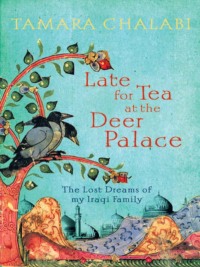
Kitabı oku: «Late for Tea at the Deer Palace: The Lost Dreams of My Iraqi Family»
TAMARA CHALABI
Late for Tea at the Deer Palace
The Lost Dreams of
my Iraqi Family


To my dearest ammooooo, Hassan Chalabi

Contents
Maps
Family tree
Chronology
Prologue
Book One: Fallen Pomegranates
 December 2007
1 Duty Calls: A Busy Day for Abdul Hussein (1913)
2 Stacking Rifles: Hadi and the War (1914–1916)
3 All That is Good Will Happen: A Marriage Prospect (1916)
4 Sugared Almonds and Jasmine: Bibi and Hadi’s Wedding (1916)
5 A Giant Broken: The End of the Ottomans (1917–1918)
 November 1999, Beirut
Book Two: Replanting Eden
 September 2005
6 Café Chantant: The British in Baghdad (1918) 77
7 Rebellion: Fighting for Freedom (1919–1920) 86
8 A New King for a New Country: From Mesopotamia to Iraq (1920–1921)
9 Fesanjoon, a Royal Luncheon: Faisal Visits Kazimiya (1921)
10 Banished: Out of Kazimiya (1922–1924)
11 Accidents of Nature: The Baghdad Boil (1925–1926)
12 In Between: A Home Between Two Cities (1926–1929)
13 Stolen Hopes: A Young Life Lost (1928–1929)
14 Bursting Energy: Hadi’s Growing Empire (1931–1933)
15 Prison: Uninvited Guests at a Feast (1935–1936)
16 Carefree: Growing Up in the Golden Age (1936–1938)
17 A Dark Cloud: The End of a Generation (1938–1939)
18 A New Home: The Shadow of Death (1937–1939)
 October 2006
Book Three: A Dangerous Garden
 May 1993
19 Mountains and Floods: Domestic Changes (1939–1941)
20 Blood and Salons: Mounting Tensions (1941)
21 An Education Overseas: Mixed Fortunes (1941–1945)
22 Love in Strange Quarters: Of Marriage and Other Unions (1946–1947)
23 The Girl on the Bridge: Anger on the Streets (1947–1949)
24 Precious Things: Towards a New World (1950–1951)
25 Storm Clouds Gathering: Family Feuds and Revolution (1952–1956)
26 Defiance: A Crisis and a Key (1956)
27 Revolution: Slaughter of a Family (1958)
 February 2005, Sadr City
Book Four: Fields of Wilderness
 December 2007
28 Lost Lands: Seeking Shelter (1958)
29 Migration: Precious Cargo (1958)
30 Hunger Pangs: Yearning for Home (1958)
31 Arrivals and Departures: The Importance of Contacts (1958–1959)
32 Escape to Nowhere: The Threat of the Clown Court (1959)
33 A Temporary Home: Visits to the Park (1959)
34 Return to the Shrine: A Life by the Sea (1959–1963)
35 Of Carpets and New Blood: The Emergence of New Patterns (1967)
36 The Ruins of Kufa: A Coup and a Birth (1968–1972)
37 Civil War: A Shattered Sanctuary (1975–1982)
38 Creased Maps: A Move to a Different Land (1980s)
39 Lessons in Humility: The Loss of Everything Precious (1980s)
40 The Mortality of Gods: Burials of the Banished (1988)
41 The Lost Talisman: When Everything is Taken (1989–1992)
42 A Question of Identity: In Search of a Way to Be (1990–2009)
 30 January 2005, Election Day in Baghdad
Epilogue
Glossary of Iraqi Terms
Acknowledgments
Searchable Terms
About the Author
Copyright
About the Publisher
Maps


CHALABI FAMILY TREE

Chronology
| 1833 | Ali Chalabi is born. |
| 1869–72 | Midhat Pasha, Ottoman governor in Baghdad, launches a series of much needed reforms aimed at modernization. |
| 1879 | Abdul Hussein is born. |
| 1898 | Hadi is born. |
| 1900 | Bibi is born. |
| 1908 | The Young Turks or CUP (Committee of Union and Progress) Revolt occurs. |
| 1909 | Persian Constitutional Revolution takes place in Iran. |
| 1911 | Bibi’s father, Sayyid Hassan al-Bassam, dies. |
| 1912 | The Turkish Petroleum Company is formed for oil exploration. Its main partners are British and Dutch. |
| 1914 | World War I begins. |
| 1916 | T. E. Lawrence is sent by the British to Sharif Hussein of Mecca to foment an Arab revolt against the Ottomans, aimed at weakening the Ottoman position near the Persian |
| Gulf to Britain’s advantage. | |
| Faisal, the son of Sharif Hussein, leads the revolt alongside Lawrence. | |
| Signature of the Sykes–Picot Agreement, a contract between Britain and France carving up the Ottoman Empire, including the Arab provinces, into spheres of control. | |
| Gertrude Bell, traveller and archaeologist, arrives in Basra to serve as the only female British political officer with knowledge of the terrain and the Arab tribes of Iraq. Bibi and Hadi are married. | |
| 1917 | Baghdad is captured by British troops marching from the south. |
| 1918 | Word War I ends and Rushdi is born. |
| The British occupy the provinces that make up Iraq. | |
| The French occupy Syria and Lebanon. | |
| 1919 | The Paris Peace Settlement is signed. Faisal heads an Arab delegation to the conference, accompanied by T. E. Lawrence, to lobby unsuccessfully for Arab independence. |
| 1920 | The Treaty of San Remo is decided at a meeting to determine fate of former Arab Ottoman territories, based on the previous Sykes–Picot agreement and overlooking British promises to Sharif Hussein for an Arab Kingdom. |
| Gertrude Bell becomes Oriental Secretary to British Commissioner Sir Percy Cox and plays a key role in supporting Arab rule in Iraq. | |
| Faisal is crowned King of Syria but is driven out by the French after the battle of Maysaloun in June. | |
| Revolt breaks out in southern and central Iraq among Shi’a tribes and there is joint Sunni–Shi’i resistance to the British in Baghdad. | |
| The idea of the India Office running Iraq as an administration is abandoned by the British in favour of national rule. | |
| 1921 | In April, the Cairo Conference is called by Winston Churchill to decide the fate of Iraq, which is now too costly for the British to run. Lawrence and Bell attend. Faisal is chosen as King of Iraq. |
| King Faisal arrives in Basra in June, then through the main Iraqi cities to Baghdad. He receives a cool reception, but among those welcoming him is Abdul Hussein Chalabi. | |
| Faisal is crowned at a ceremony in Baghdad in August. Gertrude Bell is charged with setting up his court. | |
| Hassan is born. | |
| 1922 | Abdul Hussein becomes Minister of Education, breaking with the Shi’a fatwa forbidding participation in government. He is banished from Kazimiya. |
| The Chalabi family moves to the Deer Palace late November. | |
| 1923 | Thamina is born. |
| 1924 | Raifa is born. |
| Hassan loses his sight. | |
| Tensions that will later explode under Saddam Hussein begin to brew in the Ministry of Education, under Sunni Arab nationalist Director of Education Sati’ al-Husri. | |
| 1925–8 | Abdul Rasul studies at Cambridge. |
| 1926 | Gertrude Bell founds the Iraqi Museum in June, then commits suicide in July. |
| 1929 | Abdul Rasul is diagnosed with cancer and travels to Europe with Hadi to seek treatment. |
| The Turkish Petroleum Company becomes the Iraqi Petroleum Company. Majority shares are still held by European partners, with Iraq benefiting from only 20 per cent of revenue. | |
| 1930 | Abdul Rasul dies of a brain tumour. Hadi becomes a Member of Parliament for the town of Diwaniya. |
| Hadi becomes the agent for Andrew Weir & Co., supplying wheat and barley – Iraq’s main agriculture exports along with dates. | |
| 1932 | Faisal struggles with a tension between local demands and Britain’s intervention in what has until now remained a British mandate. This year, Iraq officially becomes independent. |
| Iraq joins the League of Nations. | |
| Rebellion breaks out in the north and is dealt with brutally by the British. 4000 die. | |
| 1933 | Umm Kalthoum holds her first concert in Baghdad. Bibi attends with Shamsa. |
| Talal is born. King Faisal dies unexpectedly. Ghazi becomes king. | |
| 1935 | Hazem is born. Hadi is arrested on charges of treason, imprisoned and sentenced to death, but released three months later. |
| 1936 | Abdul Hussein serves his final parliamentary term and becomes a senator. |
| A military coup d’état is attempted. | |
| Hadi becomes the first head of the Iraqi stock exchange. | |
| 1937 | Rushdi travels to London to study, then transfers to the American University of Beirut. |
| 1938 | The Chalabi family move from the Deer Palace to new house built by Hadi, now called the Sif Palace. |
| Jamila dies. | |
| 1939 | Abdul Hussein dies. |
| King Ghazi dies in car crash. Popular opinion holds that the British killed him because he was a nationalist and popular with the military. | |
| The Second World War breaks out while the Chalabi family is travelling back from holiday in Lebanon, then under French rule. | |
| 1940 | Hassan starts his degree at the law college and is introduced to Jamila. |
| Minister of Finance and former adviser to King Faisal Rustum Haidar is killed in his office. The murder is widely seen as a sectarian attack against the Shi’a. | |
| 1941 | A successful pro-Nazi coup d’état is led by Rashid ’Ali Gailani. The royal family flees. |
| British and Iraqi forces clash at Habbaniya. | |
| Baghdad is rocked by the Farhud – the Great Loot – during which Jewish shops and homes are attached by angry anti-British mobs. | |
| The royal family returns to Baghdad with British help. Some coup d’état leaders are arrested, others flee. The British temporarily reoccupy Baghdad. | |
| Thamina marries Bibi’s cousin Saleh Bassam. | |
| Rushdi becomes involved in Freya Stark’s anti-Nazi Brotherhood of Freedom. | |
| Four officers behind the coup are executed by order of the Prince regent, in a move that proves unpopular. | |
| 1942 | Thamina gives birth to Leila, Bibi’s first granddaughter. |
| 1943 | Iraq enters World War II, fighting against the Axis powers. |
| Raifa marries Abdul Amir Allawi. | |
| Rumia dies. | |
| 1944 | Hadi makes his first trip to America as part of a business delegation. |
| Ahmad is born. | |
| Hassan goes to university in Egypt to pursue a doctorate in law. Jamila goes with him. | |
| Raifa and Thamina give birth one after the other to Ghazi and Mahdi, respectively. | |
| 1946 | The Communist leader ‘Fahd’ is imprisoned for inciting workers to protest against the government. |
| 1947 | Rushdi marries Ilham and becomes MP for Kazimiya. |
| Hadi becomes a senator. | |
| Hassan briefly returns to Baghdad before moving to Paris to continue his doctorate at the Sorbonne. Jamila follow him. | |
| 1948 | Raifa’s second son, Ali, is born. Rushdi first child, Hussein, is born. |
| The Arab Israeli war – what the Israelis call the War of Independence and the Palestinians call the Catastrophe (Nakba) – breaks out with the abrupt ending of the British mandate in Palestine. As part of the Arab Legion that included forces from Jordan, Syria, Egypt, Lebanon, Saudi Arabia and Yemen, Iraq initially sends 3,000 men to fight, later increasing that number to 21,000. Pressure on Iraq’s Jewish population increases. | |
| 1949 | Bibi travels to Europe for the first time to visit Hassan in Paris. |
| Fahd is executed. | |
| Salim Chalabi temporarily becomes secretary general of the Iraqi Communist Party. | |
| 1950 | Najla marries Abdul Latif Agha Jaafar, Ilham’s brother. |
| 1951 | Hassan is hospitalized in Paris. |
| Hadi, Bibi and their three youngest boys take a family trip to Europe. | |
| 1952 | Hassan returns to Cairo to defend his PhD. |
| Revolution in Egypt topples the monarch. Jamal Abdul Nasser, a military officer, takes over. | |
| Hassan begins a career as a professor at Baghdad University. | |
| 1953 | 18-year-old King Faisal II is crowned in Baghdad. |
| 1954 | Hadi buys Latifiyyah Estate from Andrew Weir. |
| Rushdi becomes Minister of Agriculture. | |
| 1955 | The Baghdad Pact is signed, including Iran, Turkey, Pakistan and Britain in a political and economic bloc aimed at countering Soviet influence in the region. |
| Hadi becomes deputy head of the Senate. | |
| 1956 | During the Suez crisis, Britain, France and Israel attack Egypt in response to the nationalization of the Suez Canal. |
| 1957 | Frank Lloyd Wright visits Baghdad before designing the Baghdad Opera House. Le Corbusier and Walter Gropius are likewise commissioned to design public buildings. |
| 1958 | Rushdi participates in successful negotiations with British Petroleum. Iraq’s share of its oil revenue increases to 80 per cent. |
| In a coup d’etat on 14 July, the entire royal family is murdered, except for Princess Badiya and her children. | |
| Prime Minister Nuri Said hides in Thamina’s house, then is taken to her in-laws in Kazimiya. | |
| On 15 July, Rushdi is arrested with Abdul Amir Allawi and Fadhil Jamali. | |
| Nuri’s location is discovered. He seeks refuge with the Istrabadi family but is shot dead alongside Bibi’s old friend, Bibi Istrabadi. | |
| Thamina’s husband Saleh is arrested for helping Nuri Said. | |
| Britain officially recognizes new Iraq government on 1 August. | |
| Hadi arrives in London in September and is joined a month later by Ahmad and Ghazi. | |
| Rushdi is released from jail and put under house arrest. | |
| 1959 | In January Bibi joins Hadi in London. |
| In March, Rushdi and his remaining siblings try to escape by car to Jordan. Their attempt is thwarted. | |
| Rushdi’s house arrest ends in July. He leaves for London to join the rest of the family. | |
| Thamina’s husband, Saleh, is released from jail. | |
| The Mahdawi court – known as ‘the clown court’ – is set up to try officials of the old regime. Four are executed. | |
| Saeeda dies. | |
| 1960 | Bibi and Hadi move to Beirut. The rest of the family will follows in following years. Only Hassan and Jawad remain in Baghdad. |
| 1961 | Ahmad is admitted to MIT. |
| 1962 | Hadi is given permission to visit Baghdad briefly. It was his last visit. |
| 1963 | In a Ba’ath coup, President Abdul Karim Qassim is executed in Baghdad. Shortly thereafter, General Abdul Salam Arif becomes president. |
| 1967 | Arab countries suffer a major defeat in the Arab–Israeli War. |
| 1968 | A second Ba’ath coup d’etat takes place, leaving the Ba’athists in charge. |
| Ni’mati dies. | |
| 1969 | Hassan is the last family member to leave for Beirut. |
| Ahmad returns from the U.S. with a Phd in Mathematics, then travels with Hassan to Iran to meet with Mulla Mustafa Barzani, a Kurdish leader fighting the Ba’athists for Kurdish autonomy. Ahmad takes teaching post at the American University of Beirut. | |
| 1975 | The Persian Gulf Treaty is signed in Algiers, resolving a dispute between Iran and Iraq over the Persian Gulf and reneging on a promise to allow Kurds autonomy in Iraq. |
| Civil war breaks out in Lebanon. | |
| 1978 | Ahmad establishes the Petra Bank in Jordan. |
| 1979 | The Iranian revolution overthrows the Shah. An Islamic government led by Ayatollah Khomeini emerges. Saddam Hussein takes over as president of Iraq. |
| Saddam accuses several Baghdadi Jews of espionage and executes them. He then executes leading religious scholar Sayyid Muhammad Baqir al-Sadr and his sister Bint al-Huda. He liquidates many members of the Ba’ath Party disloyal to him. | |
| 1980 | The Iran–Iraq war is provoked by Saddam Hussein. |
| Entire communities, predominantly Shi’a, are forcibly deported from Iraq. | |
| 1982 | Israel invades Lebanon. |
| 1988 | Hadi dies and is buried in Damascus. |
| Saddam Hussein launches the genocidal al-Anfal campaign against the Kurds. Civilians in Halabja are gassed with chemical weapons. As many as 182,000 people are killed. | |
| The Iran–Iraq war ends in stalemate, with over one million dead. | |
| 1989 | Bibi dies and is buried next to Hadi, despite her wish to be in interred in Najaf. |
| Ahmad is in Jordan when martial law is declared. Under threat of handover to Saddam, Ahmad flees Jordan and enters fully into opposition politics. | |
| Ahmad and his family move to London. | |
| 1990 | Saddam invades Kuwait. The First Gulf War, led by U.S.-coalition forces, forces Saddam to withdraw. |
| 1991 | United Nations sanctions are imposed on Iraq. |
| 1992 | The Iraqi National Congress, an umbrella group for all forces opposed to Saddam’s regime, holds its founding conference. Ahmad plays a leading role. He later moves to Iraqi Kurdistan, to a U.N. no-fly zone, where the INC holds its first conference on Iraqi soil. |
| 1994 | Tamara first visits Iraq. |
| 1996 | Saddam Hussein’s forces attack Arbil, a town in the no-fly zone, kill INC members and demolish their set up. Many flee to the Turkish border. |
| 1998 | Rushdi dies and is buried in London. |
| Ahmad plays leading role in lobby for Iraq Liberation Act that is passed by U.S. Congress. | |
| 2001 | Najla dies and is buried next to Hadi and Bibi are now in Damascus. |
| Al-Qaeda attack of the World Trade Centre in New York City. The U.S. declares war on the Taliban in Afghanistan. | |
| 2003 | In January, the INC crosses on foot into Iraqi Kurdistan. |
| In March, U.S. coalition forces attack Iraq to topple Saddam Hussein’s regime. | |
| The Iraqi Museum and National Archives are looted. | |
| Ahmad, Tamara and the INC group arrive in Baghdad on April 15. | |
| In May, U.N, Security Council Resolution 1483 declares a U.S.-coalition occupation of Iraq. The Iraqi Governing Council is appointed in July. Ahmad is one of 9 rotating members. A Coalition Provisional Authority is formed. The Iraqi Governing Council is appointed during this period. | |
| Saddam Hussein is captured in a hole in the ground by U.S. forces. | |
| A Special Tribunal is established to try Saddam and senior Ba’ath government members for crimes against humanity. | |
| 2004 | Transitional Iraqi government is established. |
| Bibi’s remains are transferred to Najaf. | |
| 2005 | First nationwide elections are held in Iraq. |
| Ahmad Chalabi becomes Deputy Prime Minister. | |
| 2006 | Saddam Hussein is executed. |
| 2007 | Hassan visits Baghdad for the first time since 1969. |
Prologue
THE KITCHEN WAS bare, an abandoned room. The sole trace of its former occupants was a squat, white bone-china teapot. I reached for it, turning it over in my hands. On its underside were stamped the words ‘State of India’. Alone in this silent space, the teapot spoke to me of a bygone era that had come to an abrupt end.
It was 19 April 2003, ten days after the fall of Baghdad to the US-led coalition forces, and the city, depleted and derelict, was grappling with a new reality. The heat of the day was intolerable, and I could feel my very eyeballs become coated in perspiration, a strange and unwelcome sensation. This was my first ever visit to Baghdad, my father’s home, his parents’ and grandparents’ before him, and theoretically mine as well. I had arrived in the capital after a long car journey from the south in the company of my father – Ahmad Chalabi, a leading opposition figure to Saddam Hussein’s fallen regime.
Everybody asks me about my father. He has been labelled a maverick, a charlatan, a genius. He has been named as the source of supposedly faulty intelligence that led America into the war in Iraq. He has been called a triple agent for the US, Iran and Israel. But this is my story. He has his own tale to tell, although I acknowledge that my father has played a pivotal role in shaping my relationship to his country, Iraq. As with everything in the Middle East, nothing makes sense until you understand the past, and the past is never straightforward.
During this, my first visit to Baghdad, whole convoys and fresh hordes were descending on the capital: the streets were busy with an assortment of opposition leaders, formerly exiled professionals, gold diggers and prospectors, sceptical foreign journalists – and ordinary Iraqis: doctors, lawyers, carpenters and shopkeepers who were returning home. For many, their homecoming was clearly a source of mixed emotions. For my part, as I entered the city with a large group of Iraqis who had been working for the opposition in exile, I swiftly understood that my life here would not be governed by a familiar set of values based on logic, chronology and order.
All of my companions, including my father, had their own personal memories of Baghdad. Like little children, they sparked with enthusiasm and anticipation when we entered the city in which they had been born. Many kissed the ground in tears before rising hastily, anxious to find their relatives and loved ones. I had none to find here. I stood by, silently searching their faces for an emotion I could recognize. None came. I felt cold and detached. This place was as foreign to me as any other, and I had no memories to draw upon to make me feel otherwise. What came instead was an image of Beirut, my birthplace. I remembered clearly the feelings of comfort, safety and warmth I always had deep inside whenever I was on a plane coming in to land in Beirut, the sea shimmering against the horizon. As much as I wanted to push that image away and connect with the ground beneath my feet in Baghdad, I couldn’t.
It quickly became clear on our arrival that the promised ‘liberation’ had not happened. The sense of excitement and expectation with which I had travelled was replaced by a deep foreboding as I entered a shattered world. I went to my grandparents’ house in Baghdad. Forty-five years had passed since they had been forced to flee the country. A big, solid, four-storey home, it was designed in the Bauhaus style and built in the late 1940s. The clean lines of the windows, the large rooms and elegant staircases were all suggestive of that era’s faith in a better future. The place smelt the same as my grandparents’ subsequent homes in Britain, infused with an aroma of rice and something indefinable. In London, they had recreated what they could of all that was soothing and familiar to them, building altars to their old life through the objects that had followed them into exile – their photographs, silver and precious carpets. However, they had merely been repeating a process they had already been through during an earlier period of forced expatriation, in Beirut, before the Lebanese Civil War drove them on once more.
I knew this house from the stories of other relatives, stories which had been told to me over and over again, but I could never have imagined the sense of emptiness that echoed down the long corridors and through the airy rooms. I tried to remember the rhythms of my grandmother’s deep voice as she spoke of her former home when I was a little girl: ‘You can’t imagine the wonderful life we had in Baghdad, Tamara. I was like a queen …’
A life-size stone statue of a deer stood in the withered garden outside the house. I knew that my grandfather Hadi had loved that deer as much as his father before him. Someone had beheaded it. My first impression was that the deer looked almost offensive among the unkempt grounds, as it suggested a more carefree time when the people and the country had been very different. It was now a dirty ivory colour, yet there remained a certain sensuality about it as it stood proud, the fluidity of its hind muscles elegantly carved. Even the amputated head lying on the ground was playful. Its large dark eyes were well defined and penetrating, their gaze frozen in time.
My journey to Iraq had really begun in my head many years earlier, in my grandparents’ house in Beirut. It was 1981. I was seven years old. A man’s voice, sonorous and beautiful, cut across a crowded room, singing about a land I did not know.
A man fired an arrow that slayed the child.
Oh my child, they killed a child
Woe is me, woe is me …
Although the singer was tucked away in a corner, his voice held the room captive. I could not understand why the audience wept as he sang about a thirsty child killed in his father’s arms. I had never heard anything like it before. It disturbed my sense of the established routine and quiet of my grandparents’ house.
I crawled through the legs of the grieving adults towards the familiar figure of my uncle Hassan. He sat listening intently, inscrutable in the dark glasses he wore to mask his blindness. I squeezed myself in next to him, watching as he tapped his knee with the palm of his hand in time to the song. I asked him why everyone was crying. He told me that it was in memory of Imam Hussein.
‘Did he die today?’ I asked.
‘No, no, Tamoura,’ he said fondly, calling me by the nickname he had given me. ‘He died a long time ago, before any of us were born.’
‘So why are you still crying?’
He explained that the singer was commemorating the Battle of Karbala, when Imam Hussein, the Prophet’s grandson, was confronted by Caliph Yazid’s forces of 4,000 men. A very long time ago Hussein had gone to war, taking his family along, and a small army of only seventy-two men, many of whom also went into battle with their women and children. When the armies clashed on the banks of the Euphrates River, in the month of Muharam, Hussein was defeated. He, his infant son and his men were slain and the women and children taken into captivity.
My uncle smiled sadly. He said that time did not lessen the sense of tragedy of an act that had the power to haunt people forever. He told me that Hussein had been killed by an evil man for the sake of haqq – truth and justice.
‘But if it was so long ago, then why are you still crying?’ I persisted.
Hassan told me that during the first ten days of Muharam, which were called Ashura, this event and its consequences were remembered. My grandfather Hadi used to host a recital in Baghdad on the last day of Ashura, and hundreds of people would go to his home to commemorate it. He added that Ashura was especially painful for our family, because it reminded us that we had been deprived of our own country.
‘We are foreigners everywhere, and we have lost so much,’ he said. He touched me lightly on the shoulder. ‘You should know these things. They are part of your history, of who you are.’ I hated what he said. Surely I belonged exactly where I was? My uncle sensed my discomfort. ‘Do you deny your roots?’ he asked, smiling. I didn’t understand what he meant; he explained that he, my father, my grandfather and grandmother had once had another country, but that they had lost it. Their homeland was my home as well. I scowled. Lebanon was my country and my mother’s country, Beirut the city where I had been born. I was not a foreigner here.
A slice of chocolate cake soon made me forget what my uncle had said, but on some level I dimly perceived that the grievance captured in the words of the song was the same as that which made my father’s family weep in their exile. They were waiting to return to their homeland. Their lost country maintained a hold over them, the legacy of an inheritance centuries old.
The earliest indications of a settled civilization in the world are found in the region that is known today as Iraq. Between the fifth and fourth millennia BCE, lower Tigris and Euphrates basin cities such as Ur, Uruk and Larsa emerged and stratified societies developed within them. Mesopotamia – as the Greeks referred to the region between the two rivers – covered roughly the central southern part of what is now Iraq. Mesopotamia was also the term used to describe the provinces of the Ottoman Empire that belonged to this region. The ancient history of Mesopotamia is now lost to us, but it was mythologized by the Sumerians in epics such as the story of Gilgamesh, which was first written down in around 2000 BCE and which is a story of kingship and heroism that has informed and inspired people ever since.
The region that corresponds to the north of modern-day Iraq was the birthplace of the world’s first empire. The Assyrians, descendants of the Akkadians who settled in the land of Sumer, engaged in what amounted to a conquest of the known world of their time – from Persia to Egypt. The Sumerians, Akkadians, Assyrians and later the Babylonians created what are, in effect, the foundations of civilization today. Our seven-day week, sixty-minute hour and much of our understanding of the constellation of the skies are the direct legacies of this defining period in human history. The mythologies of a large cast of gods and goddesses survived from this period too: Anu, the heaven-god of Mesopotamia, was the equivalent of Greek Zeus, while Ishtar or Inana was the goddess of love, war and fertility, and the precursor of Egyptian Isis.
The fortunes of Mesopotamia were largely dictated by its geography, in particular its position in relation to the frontier lands of the Graeco-Roman and Iranian worlds. The territory changed hands as part of the ebb and flow of the respective powers of these historical entities. Alexander the Great and Darius the Persian fought over the land, while many prophets passed through it, including Abraham and Mani, the founder of the ancient but now extinct religion of Manichaeism.
The Muslim conquest of the region in the seventh century CE reconfigured the coordinates of Mesopotamia, and the Islamic empire transformed this former frontier land into the centre of a global empire. The region became central in shaping the ensuing Islamic civilization. In the ninth century, the Caliph al-Mansur ordered the building of a round city with four gates, which grew into a dazzling capital: Baghdad. Baghdad was not only the capital of the Abbasids’ Islamic empire, but of a civilization. The Tales of the One Thousand and One Nights, many of which speak of Baghdad, represent a vivid example of the city’s fusion of cultures, mythologies and styles. The city also became an important trading centre on the Silk Road.
By the thirteenth century, Mesopotamia was a frontier territory once again after the Mongols’ invasion that left its cities and sophisticated irrigation system devastated. In 1534, the region was captured by Ottoman Turks, but from 1623 to 1638 it lay in Iranian hands. My father’s family originally came to Mesopotamia with the army of the Ottoman ruler Murad IV, Sultan of Sultans and God’s Shadow Upon Earth. Murad was a warrior prince, famed for his prodigious strength and the last Ottoman Sultan to command an army on the battlefield. His campaign against Persia led to the invasion of Azerbaijan and Armenia. And, in the last decisive feat of Imperial Ottoman arms, Murad recaptured Baghdad from the Persian Shah Abbas I in 1638. The city remained under Ottoman rule for nearly four hundred years.
The three Ottoman wilayets, or provinces of Mesopotamia, that were referred to as the pachalik of Baghdad included Mosul in the north (which comprised part of the high Zagros mountain range extending from Turkey to Iran), the Kurdish regions, Baghdad itself and Basra in the south, perched on the Persian Gulf. These were subject to various different forms of administrative rule after their conquest by the Ottomans, whose central government was based in Constantinople in Turkey. Most usually, the pachalik was administered through indirect rule, which meant that local families or tribes controlled the areas but paid taxes to the central Ottoman government. The system was changed in the first half of the nineteenth century, when the authorities in Istanbul decided to impose direct rule and sent an army along with a wali, or governor, to re-establish their authority over Baghdad and to collect taxes in the name of the Sultan. This diminished the power of many of the local leaders, especially amongst the tribes, who remained resentful of the central government in Istanbul.
By the early twentieth century, the Ottoman Empire was contracting. It had lost control of the Balkans and earlier of Greece, and was gradually whittled down to half the size it had been in the sixteenth century. As in the rest of the Empire, there was a multi-ethnic and multi-religious population in the area of Mesopotamia that became Iraq, consisting of Arabs, Kurds, Turks, Persians, Lurs, Sunnis, Shi’a, Christians, Jews, Mandaeans and Yezidis, among others. The Iraqi dialect of Arabic had strong Turkish and Persian influences. The blend of cultures made for a rich, diverse but highly complicated society.
By the time they were exiled in 1958, as a consequence of a revolution that overthrew the monarchy, my family had become firmly entrenched in Iraq’s political life and society. Over the course of three centuries they had transformed themselves from warriors into administrators and the confidants of the ruling family. They had arrived as Sunni Muslims, but they left as Shi’a Muslims. They became the administrative rulers of Kazimiya, where they lived, which lay across the Tigris to the north of Baghdad, but which is now a part of the city itself. With the Ottoman reforms, the family’s administrative role in the town came to an end by 1865. However, they retained their high standing in society.
Across the region, the Sunnis were dominant, with the exception of shrine cities such as Kazimiya. Generally excluded from political power, the increasingly disenfranchised Shi’a populations of these areas immersed themselves in learning and religion, criticizing their Sunni overlords from the high ground of their religious authority. As Shi’as who were deeply involved in politics, my family was caught between two worlds. They were both insiders and outsiders.
The rudiments of my family history, with its tale of loss and privilege, were relayed to me principally by my uncle Hassan over the course of a few years in Beirut and London. The story whose seed he had planted in my seven-year-old head gave Iraq a status that grew inside me as I grew, and slowly came to embody my sense of the future: I created the country in my mind long before I ever saw it. Its importance was heightened by the impact Iraq had on my family once my father entered the world of politics in opposition to Saddam Hussein’s regime in the early nineties, adding a layer of gravity, urgency and uncertainty to our daily life. Iraq came to dominate my thoughts, and I poured my imagination into this mythical place.
I first found a doorway to my Iraqi inheritance through learning about Iraq’s culture and history. I imagined a place of scholars and antiquities, music and poetry, a multicultural haven of different peoples – Arabs, Kurds, Turks and Persians – and languages mixing together peacefully in a green and lush land by the riverbanks. This vision defied all the horrors of the country that I read about in the news.
But it was really anger that triggered me to write this book. My anger grew out of my experiences in Iraq in the aftermath of the war in 2003, with the US occupation of the country and the new political powers that were in place. I was angry at what I perceived initially as a country hurled back to the Middle Ages through misrule, neglect and sanctions, and a beaten people who had lost their voice long ago. I was also angry about what I saw as the expropriation of those people’s silent voices, and of Iraq as a land by the US civil administration and the international press to serve their own agendas, political and otherwise. They became the designated spokespeople for an Iraq they barely knew and didn’t care about, in the shadow of a greater preoccupation with the role of America in the region. They reduced Iraq to a desert of tanks, screaming women and barefoot children. The country’s ancient history and cultural output over millennia meant nothing to them. I tried to understand the silence of the Iraqis themselves – perhaps it was the consequence of enduring fear, or a habit developed as the result of decades of oppression; perhaps it was their unfamiliarity with the latest means of communication owing to those long years of sanctions, I didn’t know. One of Iraq’s burdens has always been the way it is presented to the outside world as patchy, Manichaean, extreme. It is a nation that is portrayed either through its politics, most notoriously through Saddam and his regime, or through its ancient and glorious history, but never through its people.
The Iraq that I witnessed in person for the first time challenged all my preconceptions. It continues to do so, throwing back at me contradictions and tangents just when I think I am beginning to understand it, raising as many questions as it provides answers. It makes me wonder why there should be such a strong attachment to the country in my family. What does this attachment suggest? Does it represent a refusal to move on, to grow and embrace the world?
In the wake of what I saw for myself in their homeland, my family and their stories made me wonder anew about my own origins. Writing about their experiences challenged my notions of language, as I tried to render an Iraqi Arabic with all its idiosyncratic nuances into English. Most of all, it made me wonder about the very concept of Iraq: as a modern state, an ancient land, a nation, a word, a song, a river, a grave, a shrine, a statue of a deer.
In writing this book, I have been fortunate to have had access to a wealth of material: oral histories, archive materials, newspapers, buildings, relics, memoirs, music, interviews and photographs. This book is my attempt to make the unruly disciplined, to assemble the disordered, unorganized parts of the past into a cohesive narrative. As Iraq has an ancient oral tradition, and a great deal of this story was transmitted to me orally, I have tried to respect those elements, and to remain faithful to and respectful of the memories my family have entrusted to me. The timescale of memory is not the same as the timescale of history. Major periods of history can be summarized while minor periods can be expanded. This was certainly true of my family, who when speaking to me dwelled on their happy childhoods in Iraq, but for whom the revolution and many of the years following it passed in a blur. My family’s stories of Iraq are more personal and intimate than a dispassionate and neatly constructed history. They show the country through the lives of people who have loved it.
BOOK ONE
Fallen
Pomegranates


DECEMBER 2007
I am walking through Kazimiya’s alleyways, exploring the crumbling houses with Fatima, a friend from the town, and looking for the old family home. We are following the directions of an elderly historian who is too frail to show us the way in person. He has directed us verbally: turn left by the old train station, right at the donkey stables and left again by the old water pump. Because Kazimiya is a shrine town, and therefore quite conservative, I am wearing an abaya – a long over-garment – which keeps slipping off my head.
Narrow channels of water flow through the middle of the cobbled streets we walk along. Children play and old men sit in their shop fronts, watching us and muttering to each other as they wonder what these strangers are looking for. I wince, thinking about the century that has passed since my grandmother walked these same streets as a little girl, a daughter of this town, and of the many waves of people who have passed through this frontier land, contested between the Ottomans and Persia over many centuries, and later between the British and now the Americans. My grandmother was born an Ottoman subject, just like a native of Istanbul or Izmir, and here I am trying to find remnants of that time and place. She certainly wouldn’t have struggled with the abaya as I do now, nor needed directions to find the main square.
We head towards the side gate of the shrine, Bab al-Murad, said to have been designed by the angel Gabriel, where my grandmother and many others once gave offerings to the poor in gratitude for prayers answered by the seventh Imam. I stop and do the same as I wait to go inside to make my wish.
1
Duty Calls
A Busy Day for Abdul Hussein
(1913)
ABDUL HUSSEIN CHALABI rose early, performed his ablutions, uttered his prayers unto Allah and the Prophet, then sat down to a large breakfast of his favourite food in all the world: fresh gaymar, cream of buffalo milk, velvety-smooth in texture, spread over just-baked bread and crowned with amber honey from the Kurdish mountains.
He was still tired. He had slept poorly and his troubled dreams had been of his dead sister. In them, she had stood silently before him, her eyes burning with reproach. He had tried his best to appease her, to explain that the family’s decision had really been for the best. She had opened her mouth as if to speak, and then he had woken with a start. Alone in his bedroom, he had taken a few minutes to recollect himself before rising.
Feeling better for having eaten, he adjourned and sat with his head thrown back while his butler shaved his plump face. He could hear his mother, Khadja, barking orders at her servant across the long corridor that led to her quarters. Once shaved, he dressed as always after breakfast – never before – so that the belt of his cloak would not cramp his enjoyment of the best meal of the day. At the age of thirty-seven, Abdul Hussein remained very particular about his appearance, forever sending the servants into panic attacks with his complaints of poorly-ironed shirts and badly-polished boots.
He wore the typical attire of a sophisticated urbanite: a traditional robe tailored in Baghdad from sayah, a delicate striped cotton material bought in Damascus, over white drawstring trousers. On his head he wore a fez, decreed by the Sultan in Istanbul to be the appropriate headgear of the modern Ottoman Empire. Abdul Hussein not only embraced this symbol of modernity; he believed that it suited his full face rather better than the old-fashioned keshida still sported by his eldest son, Hadi. A cloth wrapped around a conical hat, the keshida was also much more cumbersome than this new headgear. As a final indulgence to vanity Abdul Hussein smoothed the hairs of his moustache with a small bone comb he had purchased in Istanbul.

Oil portrait of Abdul Hussein Chalabi.
As for any powerful and influential man, his day was ruled by a rigorous schedule. He barely had time to browse the morning papers before a servant came to inform him that at least ten people awaited his presence in the dawakhana, the formal drawing room in the men’s quarters of the large yet overrun house.
As a mark of his status it was Abdul Hussein’s lot to sit and receive men all morning in the dawakhana, a ritual chore inherited from his father and from the grandfather he had never known. Men came to him in need of services, favours and assistance. They presented him with their problems concerning their lands, the government, the tribes, the mullahs, the weather, even – on occasions – God Himself. Abdul Hussein would sit in a wooden armchair and listen carefully as the chaiqahwa, the tea-coffee boy, made his rounds of the assembled visitors.
Today, his enthusiasm for the job in hand was at a particularly low ebb. He was still unsettled by reports of the Ottomans’ latest defeat in the Balkan war and the subsequent loss of the majority of the Empire’s European provinces. At a meeting in Baghdad the previous day, the Governor had broken the bad news to the Mejlis-i-idare-i-Vilayet, the advisory council for the Baghdad Vilayet, of which Abdul Hussein was a member. The prognosis was dispiriting; the Ottoman Empire was in decline.
A servant interrupted his thoughts with a message from the house of his sister Munira. She was married to Agha Muhammad Nawab, a wealthy Indian Shi’a notable who, Abdul Hussein learned, had just returned from a long trip to India. Abdul Hussein read in the note that Munira had recently taken delivery of a new arrival, which, the Nawab promised, would interest him greatly. He sent his sister a reply to let her know to expect him for lunch. Today’s challenge would be to discharge his duties as swiftly and shrewdly as his wits would allow him so that he would be free to call on the Nawab in the afternoon.
The dawakhana began with the usual exchange of greetings. Ibrahim, the wiry manager of one of Abdul Hussein’s estates, was waiting to give him his weekly report on the progress of the crop in one of his citrus and pomegranate orchards, which lay north by the river. Although Abdul Hussein had visited the land only a few days earlier, he could always rely on Ibrahim to show up with something fresh to complain about – any excuse to visit the dawakhana. Addressing Abdul Hussein as hadji in reference to his recent pilgrimage to Mecca, Ibrahim began to explain the reason for his presence.
He complained that the Bedouins were cutting the telegraph lines again – he had even caught one them using the lines to tie goods to his donkey – and that his men were having to waste their time throwing the nomads off the land, while the authorities did nothing to tackle them.
Abdul Hussein knew his manager was right – that over the past few decades the area’s administrators had fallen into slipshod ways; the vandalism of the telegraph lines was only part of an ongoing problem which the Ottoman Governor had not been able to resolve. Whenever there was a lull in security, the desert tribes attacked the towns. Lying a few miles to the north-west of Baghdad, across the River Tigris, Abdul Hussein’s home town of Kazimiya’s proximity to the open desert to the north made it vulnerable even though, like Baghdad, it had walls and gates that were meant to protect it.
Abdul Hussein felt frustrated that he could not do more himself to maintain public order. But the grand old days when his family had been Kazimiya’s rulers had passed. The family surname, Chalabi, was an honorific title that came from the Turkish Çelebi, a term which had several meanings, amongst them ‘sage’, ‘gentleman’ and even ‘prince’. It had been bestowed on the family when they had administered the region for the Ottomans. As direct rule had been imposed on these parts by Istanbul some decades earlier, the Chalabis no longer performed those duties, although they remained at the heart of Kazimiya’s political and social life.
Ibrahim’s father had worked for Abdul Hussein’s powerful father Ali Chalabi, and Ibrahim had grown up hearing stories of the latter’s iron fist and courage. Ali had been feared in Kazimiya, even hated by some, but he was admired by Ibrahim: this much Abdul Hussein knew. And so Abdul Hussein could hardly object when Ibrahim decided to share with the dawakhana a story he had heard concerning Ali’s ingenuity.
Abdul Hussein’s younger brother Abdul Ghani joined them as Ibrahim began to tell their guests how, one day many years ago, news reached Kazimiya of a plague of locusts that was approaching the city from the north. The sight was terrifying: a cloud of dark green insects rolling towards them at startling speed. No force on earth could push them back, making the townsfolk panic as they prepared to ride out the attack behind locked doors. Many had already resigned themselves to losing their crops, and with them their annual profit, but not Ali effendi. That year he had decided to plant a new crop of tomatoes. Determined to save them, he summoned the farmers to discuss what could be done. Then he threw his camel-hair cloak, his abaya, to one side and paced up and down his land for two days in his muddy boots. His guards followed him, their rifles on their backs. Shaking his head, Ibrahim said, ‘None of his employees had ever seen him behave like this.’
The rumour spread around Kazimiya that the great Ali Chalabi had gone mad. Witnesses described how he would stop in his tracks, scratch his dark beard, look up to the sky, turn around and resume his pacing. By the second day, his guards were wilting in the heat and gave up marching after him, yet Ali was so distracted he didn’t even notice. Suddenly, they heard him shout, ‘I’ve got it! I’ve got it!’

Ali Chalabi, seated centre, holding his youngest daughter, surrounded by family and friends.
He ordered his men to go to all the markets and buy every single mud pot they could find. ‘And don’t you dare tell anyone what you’re buying the pots for!’ he added. Intimidated, his men scoured every market in Baghdad. As soon as one returned with a batch of pots, Ali would send him off to buy more. When he had laid his hands on every pot in the area, he ordered the farmers to take them and cover every single tomato plant, hiding them from the locusts and making his fields look like a pockmarked sheet of baked mud. No one else in Kazimiya had thought of the idea, and when the locusts arrived the next day all the crops were ruined except for Ali’s tomatoes. He made a fortune.
‘Allah Yirahamah, may he rest in peace. We need men like him today to guide us through these changing times,’ Ibrahim concluded. Abdul Hussein had never approved of his father’s severe nature, but he knew what Ibrahim meant. The teetering Ottoman government had been radically transformed in 1908, when a group of nationalist Turkish army generals – the ‘Young Turks’ – had seized the reins of power from the Sultan in Istanbul, limiting his role and facilitating a new constitutional era. The events of 1908 had at first brought with them a new energy, promising freedom and equality for the many multi-ethnic communities of the Empire. But gradually it became clear that the Young Turks were promoting a European-style nationalism, with Turkishness as its main identity. The Arab people of the Ottoman Empire had begun to feel increasingly marginalized and disadvantaged as swathes of secular modernity swept through the Empire to the west of them.
Abdul Hussein had entertained certain hopes for the modernizing projects proposed by Istanbul. On paper, the proposed German-engineered Berlin-to-Baghdad railway had been more exciting than anything the locals had dreamed of … but now, what of it? The Germans were still viewed positively as an advanced industrial people who had come to help develop Mesopotamia, yet very little track had actually been laid since the project’s inception a year ago. Many pieces of machinery already lay abandoned, surrounded by rubble, collecting dust or rusting. To Abdul Hussein it was a source of bewilderment that even deepest Anatolia had already been linked up to the rest of the world by rail. Why not us? he wondered.
He could see that new ideas did not grow as freely or as quickly in Baghdad as in Istanbul, for all the new cafés, newspapers and government schools that were now springing up. Kazimiya was even slower to embrace change, partly because it was a Shi’a shrine town and therefore more religious in outlook. Abdul Hussein felt as many did that this backwardness was enforced from above, as a consequence of the town’s predominantly Shi’a character: under an Ottoman system dominated by the Sunnis the Shi’a were never going to receive their proper due. Politically they were weak, and everybody knew it.
He sensed a haughtiness and disregard among Ottoman officials when it came to his people and this land. Midhat Pasha had been the only governor to do anything for Baghdad, but he had left the area in 1873, three years before Abdul Hussein was born. The new constitutional reforms, with their accompanying bureaucratic language, threatened to alienate Abdul Hussein from his own heritage. And now he had to shed his claim to it, because in the eyes of central government he was an Arab from Kazimiya. Yet he considered himself every bit as Ottoman as any Istanbuli, whether they liked it or not.
Next, an anxious young man introduced himself as coming from Baghdad and explained that he was visiting the dawakhana with a common acquaintance. Clearly upset and frustrated, he said that he had been attacked earlier that morning by some robbers in Agarguf, an archaeological site located in the desert outside Kazimiya. Like Ibrahim, he blamed the government, and complained to the dawakhana about poor security, poor governance … Abdul Hussein soothed the man, and called one of the servants to attend to him and, when he had rested, to hail a rabbil, a carriage, for him from the station down the road.
No sooner had Abdul Hussein turned around than another man raised his voice to air his grievances. His brother had broken his shoulder in an accident the previous week, and he wanted to claim compensation from the trammai company, in which Abdul Hussein and his family were major shareholders. The tram tracks were now more than thirty years old, and – like all else in the locality – suffering from government neglect. ‘May God heal your brother!’ he reassured the claimant. ‘We will give him compensation, don’t worry.’
Over the next couple of hours Abdul Hussein listened carefully to a torrent of requests and concerns, at times instructing his clerk to note down information for him to follow up. His visitors were more than living up to the locals’ reputation for cool nerves and slow conversation. The Kazmawis, the townsfolk of Kazimiya, were not nicknamed ‘cucumbers’ for nothing.
Finally his steward Sattar burst into the room to tell him that he was awaited at the shrine, where he had promised to be by noon. Abdul Hussein apologized to the remaining men in the dawakhana. All nodded knowingly; when the shrine called, everyone heeded. The men rose in unison to say their goodbyes.

The Baghdad–Kazimiya tram, circa 1910.
Abdul Hussein went to the shrine with Sattar on foot. The ten-minute journey would have been difficult to negotiate in his preferred mode of transport, his Landau carriage. Instead, the two men manoeuvred their way through dark unpaved alleyways until they reached the first fruit and vegetable stalls on the fringes of the main square. An old woman was selling baklava, struggling to bat away the flies that buzzed around her tray of wares. The overpowering smell of the market assailed them, the stench of the dirt on the ground mixing with that of the running water in the open culverts.
There were a good many foreigners in the vicinity, and a medley of languages filled the air. Many Persians were milling around, others sitting on the ground to sell their goods, mostly foodstuffs. The locals relied on the steady influx of these visitors, who sold important supplies of Persian specialities, particularly the much prized saffron. The market was also busy with Indians dressed in their salwar kamizes, Afghans in heavy coats and curly-moustachioed Iranians. There were as many types and styles of hat as there were people – the charawiya, the yashmak, the arakchinn, the keshida, the saydiya, the fina, the ’igal. There were even a few travellers from as far away as Rangoon. The horse-drawn tram had just made its final stop at Kazimiya station, which lay close to the shrine, and people were pouring out of the double-decker carriage, old women complaining loudly as they were jostled by young boys.

The shrine of Imam Musa al-Kazim and Imam Muhammad Jawad in Kazimiya was renowned for its two domes and four minarets.
In Kazimiya, the courtyard of the shrine was the first port of call for anyone wanting to find out the business of the day, from crop prices to political intrigues, to the state of the river. It was, therefore, an indispensable meeting place for any influential man in the town. As with the other shrine cities of Mesopotamia, there was a strong Persian influence in Kazimiya, and the beauty of the shrine owed much to the piety of the Iranian and Indian Shi’a, whose financial and artistic contributions had flowed into it through the ages. Unlike other Shi’a shrines in Mesopotamia, Kazimiya’s boasted four golden minarets on the outer side of the larger square complex that contained it, and two golden domes. They gave a dramatic dressing to the building, dominating the skyline.
The shrine housed the bodies of Imam Musa Ibn Ja’afar, the seventh Imam, and of his grandson Muhammad Jawad, the ninth Imam, who were direct descendants of the Prophet through his daughter Fatima. The seventh Imam had lived during the golden age of Baghdad, before being poisoned by the Caliph, Harun al-Rashid, the notorious figure mentioned in the Thousand and One Nights.
Abdul Hussein and Sattar entered the shrine through the silver-gilded main gate, the Bab al-Qibla, which opened onto a vast white square courtyard. Immediately they veered right under the arcaded, turquoise-and-yellow-tiled gallery. They were recognized by one of the many children who virtually lived at the shrine, and the boys dashed over to them, tugging at their robes. It was well known that Abdul Hussein always carried numihilu, lemon-flavoured sweets. He didn’t disappoint them, but reached deep into his pockets and gave each child a sweet. They tended to know better than his adult friends inside what the news of the day was, and they never hesitated to repeat what they had heard that morning.
In turn, Abdul Hussein took pleasure in gently scolding them. ‘You again? I thought I told you to go to school, ya razil, you rascal! What will loafing about here with your friends do for you when you grow up?’ He would hold up his hands in mock horror. ‘Yalla, don’t come back to me for a sweet if you don’t go to school!’ Part of him knew such chastisement was futile. These children had no compass in life. It wasn’t their fault – their parents were no better – and there weren’t enough schools in the locality to take on all these children.
Leaving the clamouring children in their wake, Abdul Hussein and Sattar crossed the courtyard. The shrine was half-empty. It was late morning, and the seminary students who occupied several of the alcoves in the arcade galleries were sitting, legs crossed, listening to their teachers. Their black and white turbans, indicating their lineage, or lack thereof, to the Prophet, moved up and down as they looked from their books to their teacher and back again.
Abdul Hussein’s friend the Kelidar, the shrine’s hereditary overseer, was standing with a group of men near the main entrance to the tomb room. Several old ladies in thin black abayas were seated nearby on the tiled floor. They leaned against the outer wall of the tomb room, chatting. Against the yellow brick, the patterned tiles shone turquoise, white and navy in the sun.
Before he could join the Kelidar Abdul Hussein felt his attention drawn to a well-dressed older man sitting alone in a corner, weeping. Puzzled by this distressing sight, he walked towards the man. ‘Assalamu alaikum – peace be upon you, my friend,’ he said courteously.
‘Wa alaikum assalam – and upon you,’ the man replied, brushing tears from his eyes with the heel of his hand.
‘Khair, what is the matter with you? Why are you crying?’
‘What can I tell you, ammi? Life has dealt me a cruel blow,’ the man said, pulling himself upright. He cleared his throat and explained: ‘God blessed me with a good fortune and I decided to divide it between my three sons. And now their mother has died and they don’t want to see me. I go to my eldest son and he barely offers me tea, the second one is always travelling and the third one is too scared of his wife, who doesn’t like me.’ He shook his head sadly. ‘I’ve always been a good Muslim, praying, fasting and giving alms – and I can’t believe this has happened to me. I’ve been left all alone. What kind of children are these?’ he asked in despair.
Abdul Hussein nodded gravely. ‘Don’t worry, my friend; there is a solution for everything.’ He promised to discuss the matter further with him once he had concluded his business with the Kelidar. Politely, he took his leave and crossed the courtyard.
‘Hadji, good that God brought you!’ the Kelidar exclaimed. The two men greeted each other warmly. ‘And how is the child?’ the Kelidar asked. Earlier that week Abdul Hussein’s son Hadi had given refuge to a little lost soul who had been haunting the shrine. The small boy had been found sitting in a corner of the shrine, crying and refusing all offers of help, even turning away a glass of water. But Hadi had broken through the boy’s misery, established that his name was Ni’mati, and offered him a place to stay under his father’s roof. Abdul Hussein assured the Kelidar that the child was settling in well.
‘That’s wonderful news, I can’t thank you enough!’ The Kelidar then proceeded to business. He explained that the town was organizing a welcoming committee to accept the gift of some new carpets which were arriving from Iran the following week, having been purchased through the Oudh Bequest. The result of a complex diplomatic agreement, the Oudh Bequest involved the political authorities of the Indian Raj and the Shi’a religious powers of Mesopotamia, and benefited the shrines in the region with regular improvements and maintenance. However, the mayor of Kazimiya had fallen out with the Nawab family, the Indian Shi’a notables who were in charge of administrating the bequest. One of them, Agha Muhammad Nawab, was Abdul Hussein’s brother-in-law, and the Kelidar hoped that Abdul Hussein could smooth the way for the ceremony.
For Abdul Hussein the request was a godsend; it meant that he could safely ignore the many other matters that the Kelidar hoped to raise with him, on the pretext of hastening to undertake this vital errand. He brushed his moustache with his thumb and index fingers, and said, ‘Zain – fine. I’ll undertake this without further delay.’ He excused himself and made his exit from the shrine, sending Sattar home ahead of him to prepare the landau for the short journey to the Nawab’s house. Following on Sattar’s heels as fast as he could, he huffed his way through the heat to the stables next to the house. ‘Bring me some water, quickly!’ he called out into the courtyard.
His son Hadi’s new friend, Ni’mati, came out carrying an engraved copper pitcher of water and a matching copper cup on a tray. Abdul Hussein smiled at the boy and rested his fez on one knee while he mopped the sweat from his brow. Then he drank deeply while his carriage was readied. Refreshed, he took his place on the left-hand side of the carriage seat. Accompanied by the steadfast Sattar, who never left his side outside the house, Abdul Hussein was soon on his way.
The palatial home of Agha Muhammad Nawab, Abdul Hussein’s brother-in-law, lay outside Kazimiya, south towards Baghdad. Abdul Hussein liked to take the picturesque route to it that ran closest to the river. There was one field in particular that he adored because of its wheat and reed sheafs, which stood nearly as tall as him. Their golden hue when the sun shone upon them was one of his favourite colours, and a momentary sadness always surfaced in him when the time came to cut them down.
The carriage drew up in front of the house and Abdul Hussein dismounted. Standing placidly in the waters of the rectangular pool was the new addition to the estate: a life-size stone statue of a deer. Abdul Hussein clapped his hands and repeated ‘Ayaba, ayaba’ in admiration as he walked back and forth around the pool, studying the stag from all angles.
Some of the garden staff and stable boys drifted over to watch, amused by his uncustomary excitement. They explained to him that the deer had arrived yesterday as a surprise gift for their master’s wife. Praising it, Abdul Hussein supposed that the Nawab had bought the statue to remind him of Hyderabad; there, deer hunting was a noble sport often portrayed in exquisite Mughal miniatures. In giving Munira the stag as a gift, the Nawab was also bringing a little of his home country to Baghdad.
A gardener told him that the stone deer had made the journey in a large wooden crate, travelling from Bombay to Basra by boat; then by steamer to Baghdad, with many stops along the way, until it had been conveyed by a small vessel to the jetty at the bottom of the Nawab’s garden, and finally installed in the middle of the pool.

The deer statue through the gates of the Deer Palace, circa 1925.
As absorbed as he was in the deer, Abdul Hussein was nevertheless looking forward to lunch, although not particularly to the company of his sister Munira, whose long face had tested his patience of late. Yet he hoped that she had prepared the food herself, as she sometimes did, because her culinary skills were superior to those of any of her servants. Her turshi pickles were legendary and, like a good bottle of wine, only improved the longer she kept them. Many years ago she had pickled an exceptionally fine batch of cucumbers, storing them in jars, one of which remained in Abdul Hussein’s pantry, where it was coveted by all.
When Abdul Hussein crossed the threshold he learned from a servant that the ageing Agha Muhammad Nawab was already taking his afternoon nap, recovering from his long trip. The dining room was empty, except for a servant girl who was laying out the dishes on the table. Munira was nowhere to be seen, but Abdul Hussein could hear her voice issuing faintly from the kitchen, where she was supervising some final touches. That was a good sign, he thought; she must have done the cooking.
As he sat down, Abdul Hussein automatically reached for the pickles, stuffing one into his mouth. He had barely begun crunching on it when his sister appeared and sat down in silence across the table from him.
Greeting her, he said, ‘What a wonderful deer the Nawab has brought for you! Your husband has really outdone himself this time!’
‘Yes,’ Munira replied dully. Her eyes with their deep shadows remained fixed on her hands.
Abdul Hussein held his plate out to be served another favourite dish: aromatic basmati rice infused with dried lime and saffron-flavoured chicken. He tried another tack. ‘Have you heard about the little boy Hadi found by the shrine, crying?’ Munira raised her head and glared across the steaming dishes at him. This time Abdul Hussein avoided her gaze.
He knew in his heart that she wouldn’t want to hear about children; that she blamed him for her childless marriage to the man she held responsible for their sister’s death. Their sister Burhan, the Nawab’s first wife, had been subjected to all the same rumours of barrenness and inadequacy that taunted her now. True, Abdul Hussein had thought that the match would be a good idea; the Nawab was a rich and influential man who could give Munira a good life. When Burhan had died and Munira had been married to him, nobody had known for certain that he wouldn’t be able to sire a family.
‘He doesn’t speak a word of Arabic,’ continued Abdul Hussein. ‘Probably from Hamadan or somewhere around there.’ When Munira sniffed unsympathetically, he snapped, ‘Not every fifteen-year-old would have done what Hadi did, and brought him home. You could at least be proud of your nephew!’
Munira glowered, but Abdul Hussein persevered: ‘Anyway, he seems to have taken well to the horses in the stables. We’ll sort him out. His name is Ni’mati.’
Munira leaned forward, her face covered with one hand, her elbow propped on the table-top. Abdul Hussein abandoned any further effort to enjoy his lunch. ‘What is wrong now, sister? Speak!’ he exclaimed. ‘You have everything you could possibly want – this palace, a respected and rich husband. A beautiful garden, that wonderful deer. All these servants … What on earth is wrong?’
‘This deer will be a curse,’ Munira said sullenly. ‘There has already been a crowd outside, staring at it. And they’ve started calling our house “the Deer Palace”.’
‘What rubbish!’ Abdul Hussein erupted. ‘Let the people talk – they talk anyway, and now at least they’ll have something pleasant to gossip about.’ He rose to his feet, threw his napkin on the table and curtly took his leave of her.
Ücretsiz ön izlemeyi tamamladınız.