Sadece Litres'te okuyun

Kitap dosya olarak indirilemez ancak uygulamamız üzerinden veya online olarak web sitemizden okunabilir.

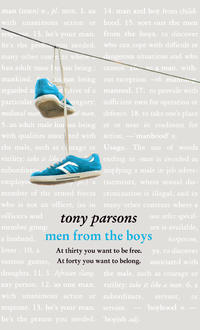
Kitabı oku: «Men from the Boys», sayfa 3

Yazı tipi:

Three

Joni grinned at me with her vampire smile.

Her two front teeth were both gone now. The wonky one had come out in her sandwich and the one next to it had quickly come out in sympathy. It must have been looser than she knew when she was focusing all her attention on the wonky one. So now when she smiled the milk teeth that remained at the sides of her mouth appeared like fangs.

‘I’ll brush my teeth,’ she said, and her gummy grin gave her a jaunty air, like a sailor on shore leave. ‘You get the book.’

‘Okay.’

She had strict bedtime rituals. When she was in her pyjamas and her remaining teeth had been cleaned, she hugged everyone who was in the house and told them she loved them. But she didn’t kiss anyone, because kissing was gross this year. Then she trooped up to her room and I read her a story. As she settled herself under the duvet, I looked at her bookcase for something suitable.

Joni was at that awkward age when she was getting too old for princesses and fairies but was still too young for anything to do with having a crush on boys. My wife and I had made half-hearted attempts to interest her in the Hannah Montana industry and the High School Musical business but when Joni watched the TV shows, or saw the DVDs, she was unmoved by all those white teeth, all that canned laughter and all those teenage children trying to talk like they were in a Neil Simon play. Joni was never going to go for cheesy American rubbish. So I stuck with the classics.

Terrible curses. Murderous adults. Wicked stepmothers. Beautiful maidens being taken to the woods for slaughter. Girls drugged and placed in glass coffins. All the stuff to give a seven-year-old a good night’s sleep.

Tonight it was Aurora.

We settled down. I had just got to the bit where Briar Rose had realised that the nice peasant boy and Prince Philip were – conveniently enough – one and the same when Joni yawned, lay back on her pillow and raised her hand, bidding me stop.

For a long time – years – Joni had been afraid of Maleficent, and at first I thought that she wanted me to stop before I reached the wicked witch losing her rag.

But it wasn’t that.

‘They all end the same way, don’t they?’ said my daughter. ‘The princess stories. They start off a bit different but they all end the same way. The prince saves them and they get married and they live happily ever after.’

I smiled and closed the book. ‘Well, it’s true,’ I said. ‘It’s always the same ending.’ I felt like kissing her on the cheek but I knew that wasn’t allowed. So I just touched her hair. ‘You’re getting a bit old for these stories now.’

She snuggled down and I pulled the duvet up to her chin.

‘It’s a load of arse,’ said my seven-year-old, and I cursed the day that Ken Grimwood had come to our door.

Elizabeth Montgomery was being dropped off at school.

She was in the car in front of us as I pulled up to let Pat out. And I know he saw her too, because he was perfectly still yet poised for flight, like a rabbit who suddenly realises that he is loitering in the fast lane of a motorway.

Elizabeth Montgomery wasn’t being dropped off by her dad. Not unless her dad had a barbed-wire tattoo at the top of his arm, and played the Killers at full volume at eight thirty in the morning in his souped-up BMW. Which I suppose was entirely possible in the lousy modern world.

In the passenger seat, Pat sat petrified.

‘Probably her brother,’ I said, but before the words were out the driver in front had his tongue in Elizabeth Montgomery’s ear, and she was laughing and squirming away. ‘More likely a cousin,’ I said.

And I felt like saying, Ah, don’t care so much, kiddo. Don’t be so quick to say, Here’s my heart. Why not have a game of five-a-side football with it? Go ahead. And I felt like saying, You will meet a dozen like Elizabeth Montgomery. A hundred.

But I didn’t, because I knew it was not true.

My son was almost fifteen years old and there would only ever be one Elizabeth Montgomery.

And I felt it again – I wanted to give him some sage advice. I wanted to say something meaningful about the fleeting nature of desire, or the way the person who cares the most is always the person who gets hurt the most.

I wanted to talk about love. But everything I could have said would have been about forgetting Elizabeth Montgomery. And I knew he could not do that.

So what I said was, ‘I saw Gina.’

He started at his mother’s name. A physical flinch, as if he had been struck. That is what it had come to.

He turned away from Elizabeth Montgomery in the car in front of us and looked at me. And I saw that his eyes were exactly the same colour as his mother’s eyes. This Pacific Ocean blue. The blue you see on a Tiffany catalogue. It is a special blue.

‘What do you mean – you saw her?’

‘She’s back from Japan,’ I said.

‘A holiday?’ he said.

‘Back for good. Back in London. She wants to see you.’

I have this theory about divorce. I have this theory that it is never a tragedy for adults and always a tragedy for children. Adults can lose weight, find someone nicer, get their life back. Divorce gives grown-ups a get-out-of-jail-free card. It is the children who pay the price, and pay it for the rest of their lives. But we can’t admit that, all us scarred veterans of the divorce court, because it would mean admitting that we have inflicted wounds on our children that they will carry for the rest of their lives.

Pat was looking back at Elizabeth Montgomery. But I don’t think he was seeing her any more.

‘How long…’

‘I saw her last week,’ I said. ‘She’s been back for about a month. She wants to see you.’

I watched the fury flush his face. ‘And you tell me now? You get round to telling me now?’

The children of divorced parents hold something back. They get so used to shuttling between warring homes when they are little that it stays with them. This restraint, this pragmatic reserve, this need to be a pint-sized Kofi Annan diplomat. So when they lose it, they really lose it.

He was out of the car, hauling out his rucksack, furious with me. I wasn’t so naïve that I thought it was just me that he was angry about. It was divorce, separation, the absent parent – it was the whole sorry package that he had been handed without ever asking for it.

‘You around tonight?’ I said.

‘I don’t know,’ he said, and he slammed the passenger door.

I watched him walk through the school gates, his rucksack slung over his shoulder, his shirt miraculously unfurling from his trousers, the swatch of white cloth that appeared as if from a magician’s hat. Then he was gone, but still I sat there, boxed in by the car in front and the car behind.

Watching Elizabeth Montgomery snog the boy with the barbed-wire tattoo, as the bell rang for registration.

Riddle me this, Lateral Thinking Club – she is my daughter but I am not her father: who am I?

I am a step-parent. Ah, but I don’t really believe in the term step-parent. I don’t think the role exists. Not really. For in the end you are either a child’s parent or you are not. And blood does not have a lot to do with it. At least, that is what I would like to believe.

Cyd and I watched Peggy coming down the stairs. She was almost exactly the same age as Pat and yet she seemed to be effortlessly gliding on air to adulthood. Peggy went to stage school, and every day of her life she danced and she sang, and she studied the performing arts and wrestled with the sub-text of difficult plays while other girls her age were snogging older boys with cars and barbed-wire tattoos. While other kids wore blazers, Peggy donned a black leotard and learned to dance jazz, ballet and tap. Above all, she wanted to act, following in the footsteps of Italia Emily Stella Conti, her school’s founder, and her father, a TV cop.

Peggy made life look easy.

Now she was all dressed up for going out – a cowboy hat, and cowboy boots, a retro Motorhead-London T-shirt and a skirt that was way too short. She kissed both of us on the cheek and glided off to the mirror in the hall. We could hear her humming a popular tune.

Cyd was looking at me and smiling. ‘Don’t say it,’ she said.

I looked dumb.

‘You know,’ she said. ‘“You’re not going out dressed like that.”’

What women forget is that men know boys. We know what is in their heads and in their hearts. We are all poachers turned gamekeepers. Every single one of us. And I knew that no boy was going to look at Peggy and think, Yeah, Motorhead, Lemmy and all that, yeah, they were a pretty good band. I knew exactly what they would be thinking, the dirty little bastards. And I didn’t like it.

‘It’s only her dad,’ Cyd said.

We heard a motorbike outside and Peggy ran to the door with a happy, ‘I’ll get it!’

Cyd gave me a look and drifted off to the kitchen. I went to the door and looked out at Peggy’s dad sitting astride his Harley.

Jim Mason. Ten years ago he was the bad boy. The deserter, the fornicator, the runaway. The absent father. But in recent years I had to admit Jim’s stock had risen. After a long, disorderly line of Asian girlfriends in the wake of his marriage to Cyd, he had been married to a nurse from Manila for years – but there had been no more children. And I suspected that must have been a relief for Peggy.

I never really spoke to the guy, beyond platitudes about what the latest weather meant for motorbikes. A couple of years ago, when his TV show was taking off – you might have seen him, he was the divorced, alcoholic detective on PC Filth: An Unfair Cop – he had offered to start paying Peggy’s school fees. I had brushed him off, told him that Cyd and I had it covered. But I felt that he could teach Gina and me a few lessons about how to conduct yourself after a divorce. Despite his inappropriately long hair, and Lewis Leathers, and past crimes, Peggy’s dad was living proof that you could be an absent parent and still be some kind of presence in your child’s life.

An absent parent but a parent still.

Peggy pulled on her helmet and climbed on to the pillion. They both raised their hands and I waved as they shot off, the throaty roar of the Harley ringing through the neighbourhood. The group of kids loitering at the end of the road watched them go. Long after they had disappeared, I could hear the growl of the motorbike.

And I felt a dull ache of resentment towards him. I could not help it. Because although the guy did his best to be a good dad to Peggy, there was so much he had missed. She was my daughter although I would never be her dad. We did not have the unbreakable bonds of blood, but we had something else.

I was the one who was there when, aged ten, she split her head open on the ice rink at Somerset House, foolishly attempting a complicated leap. And I was the one who was there when she endured two terms of bullying at her old school before we got her into Italia Conti. And I was there for other stuff – no blood, no tears. But meals shared together, and TV watched together, and holidays, and walking to school, and a good-night hug. Sometimes I think that stuff is more important than the times of high drama, when there is blood on the ice rink and a mad dash to Accident and Emergency.

She was not my daughter but we had been part of the same family for ten years. And I was more of a father to her than her real dad would ever be – wasn’t I?

Sometimes I thought so. But when she went off once a week on the Harley, looking so happy on that pillion, with her dad the big-shot actor, well, then I wasn’t so sure. And mostly I tried not to think about it at all.

Because it’s like someone says in The Terminator when cyborgs are coming back in time to murder children yet unborn:

You could go crazy thinking about this stuff.

Marty and I sat in the Pizza Express next to Broadcasting House and nobody looked at him twice.

TV fame is like youth or money. It just runs out when you are not looking. Ten years ago, Marty walked into a room and everybody stared at him. But the years on radio had eroded that recognition factor, and we were left unmolested by the early evening crowd.

Next to us was a table full of ageing lads in business suits. Their banter was of a sexual nature – birds and blow-jobs. Effing and blinding. Taking the front way and the back way. The usual stuff. Little did they know that they were next door to Marty Mann, the presenter formerly known as edgy and controversial.

And even less did they care.

It was the usual crowd. BBC worker bees grabbing some carbs before the evening shift. Office workers dawdling before they caught the train home. And revellers off to frolic in the tawdry lights of the West End.

The demographic skewed to a younger crowd – probably too young to listen to A Clip Round the Ear on Radio Two – but looking for a table among the funsters were a pair of old ladies who had big night out written all over them. I wondered what musical they were going to see, and I thought of my mum happily singing along to Chicago and Les Misérables and Guys and Dolls. It seemed like a lifetime ago now.

The old ladies carefully parked themselves two tables away from us. The lads in their suits were next door. And suddenly they seemed louder than ever.

‘No, fuck it, this is a true story,’ one of them said, holding his hands up at the derisive profanities of his chums. ‘Guy goes to a whore and says, “How much for a hand-job? One hundred quid? That’s a lot.” But the whore says, “Listen, see this Rolex, I bought it by giving hand-jobs.”’

Marty looked up at me from his Four Seasons. He glanced quickly at the old ladies and looked away. You would think that a man with Marty’s CV would not care about profanity in the pizza parlour. But, like all transgressors, he understood that context is everything.

The old ladies were staring at each other. The suits were in uproar. The comedian took a bite of garlic bread and ploughed on.

‘Next day he goes back and says to the whore, “How much for a blow-job?” She says, “Five hundred quid.” “Five hundred quid! Fuck me, that’s a lot of dough.” She says, “Listen, you see that Mercedes? I bought it by giving blow-jobs.”’

Marty pushed his pizza away.

‘We should say something,’ I said, my voice pathetically low. ‘We should say something to these creeps.’

Marty nodded. But he kept staring at his pizza. ‘Except there’s five of them,’ he said. ‘Except they might not like it. Except they might have knives.’

‘You kidding? These guys haven’t got knives. They’ve got BlackBerrys. What do you think they are going to do? Slash you with their iPhones?’

But for all my big talk, I sat there just like Marty, useless in my disapproval.

There was bedlam at the next table. Red faces. Drunken voices. The joke coming to its punchline. The old ladies were getting up to go. They were telling a confused waitress that they were not so hungry after all.

‘And then he goes to the whore and says, “How much for the lot?” And she says, “One thousand quid.” And he says, “Fuck my old boots, that’s a lot.” And she says, “See that big house over there?”’

‘She says, “If I had a pussy,”’ Marty muttered to himself, ‘“I bet I could buy that.”’

‘I feel like saying something,’ I said, staring at the suits as I watched the old ladies heading for the door, their big night out already violated.

But I just sat there, and I said nothing.

Four

I drove Pat to Soho. He was still not really speaking to me. We were on grunting terms.

I walked him to the door and found the bell with her surname. The name she had before me, the name she had after me. I looked at Pat as I rang it. He was impassive, neutral – the inscrutable offspring of divorced parents.

‘Hello?’

It was strange that I had not recognised her face. Because the voice could not belong to anyone else. Pat and I leaned towards the metal grille.

‘It’s us,’ I said.

‘It’s me,’ Pat said.

Gina laughed with delight – a sound that I had not heard in, oh, about a thousand years. ‘Great, come up,’ she said, and she buzzed the front door open. Pat gave me a blank look and went inside. I stood there for just a moment after the door swung shut.

I don’t know what I had been expecting. But I had driven him across town with a mounting sense of dread. And nothing had happened. Had it? I walked back to the car. But I did not get in. I just kept walking. And the reasons that we stay together or come apart just seemed so heartbreakingly random that I could have sat down in Old Compton Street and wept.

Would she take him out to dinner? Or would it be easier for both of them if they stayed home? They would talk, wouldn’t they? Or would Gina – would both of them – want to avoid too much talking, and just try to rack up some together time?

It’s their thing, I thought. And I was totally lost. I felt flat. And suddenly older.

If I had not slept with someone else, if she had given me another chance, if she had not been so quick to try again with another man…not much had to happen to keep us together, I thought.

But I was the child of a nuclear family, and growing up in a family that never comes apart makes you believe in the inevitability of staying together. And I could see that there was a banality about my expectations – like the predictability of the princess stories that my seven-year-old daughter had suddenly grown out of.

Gina came from a family where the father walked out. She did not expect happy endings. She did not expect families to stay together. She expected them to fall apart. I walked out of Soho and into Chinatown, reluctant to start the drive back across town in case it all went wrong, and there were accusations and raised voices and slammed doors and the call to come quick. I kept my phone in my hand in case it suddenly began to vibrate. But I walked all over Chinatown, and it never did.

Five good things about being a single parent.

You are alone now, so you can make all decisions concerning your kid without consultation.

You know, with total certainty, that a child only needs one good parent.

You know that your child is loved, and will always be loved.

There is no need to feel like a freak at the school gates, because the world is overflowing with single parents now.

And your ex is out of your life.

Five bad things about being a single parent.

You are alone now, so you constantly feel like you are the last line of defence between your kid and the lousy modern world.

You know, with total certainty, that a child is always better off with two good parents.

You know your child is scarred by his parents breaking up, and will carry those scars forever.

You feel like a freak at the school gates, because the world is full of happy, unbroken families.

And our ex can come barging back into your life whenever they feel like it, just by uttering the magic words – ‘This is my child too.’

But what did I know about it?

I had not been a single parent for years.

What made me such an expert?

It had been ten years since Pat and I had lived alone – that strange, messy period between my first marriage and my second. A time of raw pain all round, and being unable to wash his hair without both of us having a nervous breakdown, and the slow realisation of how much I had relied on Gina to give shape to my life, and form to our family, and to wash our child’s hair and put him to bed while I heard their laughter through the walls.

And what I remembered most of all about that time was the feeling that I had failed. I could still taste it, ten years down the line. The feeling of failure, as undeniable as a broken arm – failed as a father, failed as a husband, failed as a man. Lugging that feeling of failure to the supermarket, to the school gates, to the house of my parents – that’s what I remembered most of all. Failed as a son.

But it was all years ago. And although I still noticed the single parents at the school gates – their time much tighter, their love somehow fiercer and more protective and more evident – I could not pretend that I was one of their number.

I had a wife and three children. And they were our children. And if you wanted to be picky, and prissy, and small-hearted, then you could say that the boy was my son and the older girl was her daughter and the seven-year-old was our daughter together.

But we did not think that way.

The whole menagerie had been mixed up for so long – for most of the lives of the elder two, and for all of the life of the youngest – so that we did not think in those terms. Sociologists and commentators and politicians – they think in terms of blended families. In the real world, you just get on with it, and it either works or it doesn’t.

It worked for us.

This little post-nuclear family where the females out-numbered the males. It was home. But seeing Gina again had prised open some secret chamber in my heart where I still felt like the father I had been so long ago.

A card-carrying single parent.

Gina made me see that bitter truth.

Once a single parent, always a single parent.

‘The whites are worse than the darkies,’ Ken Grimwood said, and I did not know where to begin.

He was a time capsule containing everything that was rotten about the country I grew up in. Yet I found myself feeling curiously grateful that he was enlightened enough to see that the morality had little to do with the colour of your skin. But the casual talk of darkies – it gave me exactly the feeling of dread that I felt when I saw him producing his tin of tobacco and packet of Rizlas, which he was doing right at this moment. I felt like opening all the windows.

‘Please, could you save it until I’ve got you home?’ I said. His home was only in another corner of North London. But it felt like another planet, another century.

‘At least the darkies have God and church,’ he said, carrying on as if an audience had asked him to elaborate on his feelings about race relations in modern Britain. The roll-ups and the baccy tin sat in his lap, apparently forgotten. ‘God and church keep them in line. Nothing wrong with a fear of hell. Nothing wrong with believing you’re going to burn in the eternal fires of hell if you step out of line.’

‘I agree,’ I said. ‘It’s very healthy.’

‘As long as their God doesn’t tell them to stick a rucksack full of Semtex on the Circle Line,’ he said.

I looked at him and shook my head. ‘How can you talk like that?’

‘Like what?’

‘All this stuff about darkies,’ I said. ‘You fought against all of that, didn’t you? When the Nazis were building factories to kill people. You were fighting for tolerance. For freedom.’

He smiled. ‘I fought for your dad,’ he said. ‘I fought for my mates. For them. Not for King and country or anything else. We fought for each other.’

I kept my eyes on the road. Where was his son? Where was his daughter? They had never called back. Didn’t they love their father? Shouldn’t they be doing this chore, instead of Harry’s Magic Taxis?

He was looking out the window. The twenty-four-hour shops were lit up like prison camps. And I remembered how my mother and father would look at those same streets, the streets of London where they grew up. The look that said, There must be something out there I still recognise. ‘But the whites – what have they got? Cheap booze and talent shows and benefits,’ the old man said, looking at me sternly, as if I had just disagreed with him.

‘What’s the knife for?’ I said. ‘I can’t believe it’s just for sticking in your leg.’

‘Dogs,’ he said. ‘The knife is for dogs. Where I live, there’s a lot of big dumb animals – and some of them own very large dogs. The kind of dog that gets a kiddy in its cakehole and doesn’t let go. You can’t pull them off. Do you think you can pull them off? You can’t. That’s what the knife is for, smart arse. If a dog gets a kiddy.’

‘What did you do?’ I said. ‘What was your job?’

‘Print,’ he said, cramming sixty years of working life into one syllable. ‘That ended.’ He laughed. ‘The welfare state was built for men like your father,’ he said, and then his eyes shone with a sudden flare of anger. ‘Gift of a grateful nation. It was meant to be an effing safety net for the needy – not an effing comfy sofa for the effing feckless. Men – like your dad and me.’

Except that my dad would never have said effing three times in the same sentence. That was the big difference between my old man and this old man. I glanced at him and saw him staring out at the city streets, shaking his head.

‘Where did England go?’ said Ken Grimwood.

‘You’re looking at it,’ I replied.

‘This country’s finished,’ he said. ‘Land fit for heroes? They told us we were heroes and then they made us crawl. Told us we were heroes and then they made us crawl! More like a land fit for yobs and scroungers and anyone who just jumped off the banana boat…’

‘Then why stay?’ I said, cheerfully rising to the bait. I had argued like this before. It was like Sunday dinner with Dad.

‘I wanted to go,’ the old man said, with that same hard, resentful certainty that my father could summon up so easily. ‘Fifty year ago. To Australia. That’s the place. Got a son out there. Wanted to go myself. We were going to be ten-pound Poms. You went on the boat. Took bloody ages. We had been down to Australia House. Filled in all the forms and everything.’

‘What happened?’

‘My wife,’ he said. ‘My Dot.’ He smiled, thinking about his dead wife. ‘In the end she wouldn’t leave her mum.’ Then his voice went flat and hard. ‘So we stayed.’

‘I think they may have one or two immigrants in Australia,’ I said. ‘In fact, now I come to think of it, the entire country is made up of immigrants.’

‘That’s just where you’re wrong,’ he said, and he looked out at the grimy streets of King’s Cross but he was seeing Bondi Beach. ‘And I fancied seeing the penguins. I always wanted to see that. The penguins on Phillip Island near Melbourne. Thousands and thousands of the little buggers. They come out of the sea when it gets dark. On Summerland Beach. Every night of the year. I always fancied seeing that. What a sight it must be – all the penguins on Summerland Beach.’

‘Penguins?’ I said. ‘In Australia?’

He stared at me thoughtfully.

‘Exactly how little do you know?’ he said.

The dog was on me as soon as I got out of my car.

A rocket of muscle and teeth and bulging eyes, bounding up on my chest, pushing me back against the car, growling as though it had a human bone lodged somewhere deep in its throat.

Two men were milling around outside the flats. They were not kids with hooded tops that covered their faces and baggy jeans that did not cover their backsides. They were men around my age who had been losing hair and gaining weight for twenty years, so that now they resembled a pair of giant boiled eggs. I could see them tearing up the terraces in their number one crops two decades ago. They were old but they were not exactly adult. They were Old Lads. They looked up at me with their blank white faces. And they smiled.

Ken was ambling across the courtyard, fumbling with his keys. I tried to follow him and the dog shoved me back against the car with an outraged snarl. I looked up at the Old Lads.

‘He likes you,’ one of them said, and they both had a giggle at that. ‘Tyson likes you, mate. If Tyson didn’t like you he would have ripped your face off by now. You should be flattered, mate.’

And he did like me. I could tell by the way he suddenly settled down with his hindquarters wrapped around one of my legs. The growling subsided to a romantic moan.

I tore myself away, the vicious creature whimpering with frustration, and ran after Ken. He had paused halfway up the stairs.

‘Just taking a breather,’ he said, and I remembered how, near the end of his life, every breath my father took had been an effort. I stared down at the courtyard that the low-rise council flats overlooked. The Old Lads were shuffling off, the dog snarling and snorting around their snow-white trainers.

‘They should keep that thing on a lead,’ I said.

Ken began to get up. I took his arm and helped him the rest of the way.

‘They love their dogs round here,’ he said. ‘Big animal lovers, they are. Those two charmers are in the flat above me. With their old mum. They love their mum and their mutt, but not much else, as far as I can fathom.’

We had reached the first-floor landing. He had his keys in his hand, outside a green door that appeared to be made of cardboard. I could hear what sounded like a hundred television sets. I wasn’t used to it. All these people living on top of you.

‘Thanks for the lift,’ he said. ‘Fancy a cup of tea before you shoot off?’

I wanted to get out of here. But I looked down at the courtyard and the Old Lads were still mooching around with their killer dog. They strolled around the double-parked cars as if they owned all they surveyed, their giant bald noggins like twin moons. It looked like a car park in hell.

So I found myself following Ken inside. His flat seemed far too tiny to be the final stop in a lifetime. On the wall was a framed poster of a blonde girl on a white beach. Australia, it said. What are you waiting for?

There were photos on the mantelpiece. In black and white, a sailor and his bride. Also in black and white, a boxer posing for the camera, trying not to smile. The young Ken Grimwood, fists in a southpaw stance, a glint in his eye, his stomach like a washboard. And in faded colour, three smiling children in the sixties. Two boys and a girl, grinning on the doorstep of a caravan.

₺86,19
Yaş sınırı:
0+
Litres'teki yayın tarihi:
27 aralık 2018
Hacim:
290 s. 1 illüstrasyon
ISBN:
9780007327997
Telif hakkı:
HarperCollins