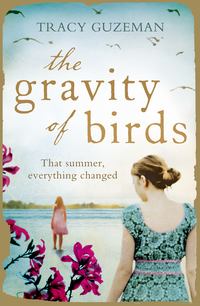
Kitabı oku: «The Gravity of Birds»
THE GRAVITY OF BIRDS
Tracy Guzeman

For my parents, Jane and Dean and my sisters, Jill and Marnie—voracious readers, all
I wake earlier, now that the birds have come
And sing in the unfailing trees.
On a cot by an open window
I lie like land used up, while spring unfolds.
Now of all voyagers I remember, who among them
Did not board ship with grief among their maps?—
Till it seemed men never go somewhere, they only leave
Wherever they are, when the dying begins.
For myself, I find my wanting life
Implores no novelty and no disguise of distance;
Where, in what country, might I put down these thoughts,
Who still am citizen of this fallen city?
On a cot by an open window, I lie and remember
While the birds in the trees sing of the circle of time.
Let the dying go on, and let me, if I can,
Inherit from disaster before I move.
Oh, I go to see the great ships ride from harbor,
And my wounds leap with impatience; yet I turn back
To sort the weeping ruins of my house:
Here or nowhere I will make peace with the fact.
Mary Oliver, ‘No Voyage,’ 1963
Table of Contents
Title Page
Dedication
Epigraph
Chapter One
Chapter Two
Chapter Three
Chapter Four
Chapter Five
Chapter Six
Chapter Seven
Chapter Eight
Chapter Nine
Chapter Ten
Chapter Eleven
Chapter Twelve
Chapter Thirteen
Chapter Fourteen
Chapter Fifteen
Chapter Sixteen
Epilogue
Acknowledgments
The Gravity of Birds: Q&A with Tracy Guzeman
About the Author
Praise for Tracy Guzeman
Copyright
About the Publisher

Chapter One August 1963
Alice haunted the mossy edge of the woods, lingering in patches of shade. She was waiting to hear his Austin-Healey throttle back when he careened down the utility road separating the state park from the cabins rimming the lake, but only the whistled conversation of buntings echoed in the branches above. The vibrant blue males darted deeper into the trees when she blew her own sweet-sweet chew-chew sweet-sweet up to theirs. Pine seedlings brushed against her pants as she pushed through the understory, their green heads vivid beneath the canopy. She had dressed to fade into the forest; her hair was bundled up under a long-billed cap, her clothes drab and inconspicuous. When at last she heard his car, she crouched behind a clump of birch and made herself as small as possible, settling into a shallow depression of ferns and leaf litter. Balancing her birding diary and a book of poetry in her lap, she peeled spirals of parchment from the trunks and watched as he wheeled into the graveled parking space at the head of his property.
He shut off the engine but stayed in the convertible and lit a cigarette, smoking it slowly, his eyes closed for so long she wondered if he had fallen asleep or maybe drifted into one of his moody trances. When he finally unfolded himself from the cramped front seat, he was as straight and narrow as the trunks behind him, the dark, even mass of them swallowing his shadow. Alice twitched, her left foot gone to pins and needles. The crunch of brush beneath her caused no more disturbance than a small animal, but he immediately turned to where she was hidden and stared at a spot directly above her head while she held her breath.
‘Alice,’ he whispered into the warm air. She could just hear the hiss of it, could barely see his lips moving. But she was sure he had said her name. They had that in common, the two of them; they were both observers, though of different sorts.
He lifted a single paper bag from the passenger seat, cradling it close to his chest, almost lovingly. Bottles, she decided, thinking of her father and his many trips back and forth between the car and their own cabin, carefully ferrying the liquor he’d brought, enough for a month’s worth of toasts and nightcaps and morning-after hair-of-the-dogs. Damn locals mark their inventory up at the first sign of summer people, her father had said. Why should I pay twice for something I’m only going to drink once? No one was going to get the better of him. So there’d been bottles of red and white wine, champagne, Galliano and orange juice for her mother’s Wallbangers, vodka and gin, an assortment of mixers, one choice bottle of whiskey, and several cases of beer. All of which had been cautiously transported in the same fashion Thomas Bayber now employed.
She waited until he’d navigated the short flight of flagstone steps and the screen door banged shut behind him before she moved, choosing a soft mound of earth pillowed with needles. She scratched at a mosquito bite and opened the book of poetry to read it again. Mrs. Phelan, the librarian, had set it aside for her when it first came in.
‘Mary Oliver. No Voyage and Other Poems. My sister sent it to me from London, Alice. I thought you might like to be the first to read it.’ Mrs. Phelan fanned the pages recklessly, winking at Alice as though they were conspirators. ‘It still has that new book smell.’
Alice had saved the book for the lake, not wanting to read any of the poems until she was in exactly the right surroundings. On the dock that morning, she’d grabbed a towel, still faintly damp and smelling of algae, and stretched out on her stomach, resting on her elbows as she thumbed through the book. The glare of sunlight off the crisp pages gave her a headache, but she stayed where she was, letting the heat paint her skin a tender pink. She kept reading, holding her breath after each stanza, focusing on the language, on the precise meaning of the words, regretting that she could only imagine what had been meant, as opposed to knowing with any certainty. Now the page with the poem ‘No Voyage’ was wrinkled, pocked from specks of sand, its corner imprinted with the damp mark of Alice’s thumb. I lie like land used up … There were secrets in the lines she couldn’t puzzle out.
If she asked, Thomas would decipher the poem for her, without resorting to the coddling speech adults so often used, choosing vague words and pretending confusion. The two of them had fallen into the habit of bartering knowledge whenever she visited. He schooled her in jazz, in bebop and exotic bossa nova, playing his favorites for her while he painted—Slim Gaillard, Rita Reys, King Pleasure, and Jimmy Giuffre—stabbing the air with his brush when there was a particular passage he wanted her to note. In turn, she showed him the latest additions to her birding diary—her sketches of the short-eared owl and American wigeon, the cedar waxwing and late warblers. She explained how the innocent-looking loggerhead shrike killed its prey by biting it in the back of the neck, severing the spinal cord before impaling the victim on thorns or barbed wire and tearing it apart.
‘Good grief,’ he’d said, shuddering. ‘I’m in the clutches of an avian Vincent Price.’
She suspected their conversations only provided him with reasons to procrastinate, but she made him laugh with her descriptions of the people in town: Tamara Philson, who wore her long strand of pearls everywhere, even to the beach, after reading of a burglary in the neighboring town; the Sidbey twins, whose parents dressed them in matching clothes, down to the barrettes in their hair and the laces in their sneakers, the only distinguishable difference between the two being a purple dot Mr. Sidbey had penned onto the earlobe of one. You, Alice, Thomas said, are my most reliable antidote to boredom.
She peered through the birch trunks toward the back of the house. If she waited too long before knocking, he might start working, and then she risked interrupting him. His manner would be brisk, his sentences clipped. He was like a feral animal that way, like the cats at home she tried to entice from behind the woodpile and capture. She would never have gone over without an invitation—one had been extended, after all, in general terms—but even so, she had found it best to approach him cautiously.
Come over and visit, he’d said to her family that first day, introducing himself on the dock the properties shared, appearing from the woods to retrieve the frenzied dog that circled his feet. But introductions weren’t necessary—at least not on his part. They knew exactly who he was.
***
‘That artist’ was the way her father referred to him, the same way he might say ‘that ditch digger’ or ‘that ax murderer.’ She’d staked out a listening post at the top of the stairs at home long before they’d ever driven to the lake, eavesdropping on her parents’ conversation.
‘Myrna says he’s gifted,’ her mother had said.
‘Well, I imagine she would know, what with her expertise in the field of … what is it he does?’ Her father’s voice had the exasperated tone he often used when confronted with Myrna Reston’s expertise in a myriad of subjects.
‘You know perfectly well what he does. He’s a painter. She says he’s received a scholarship to the Royal Academy.’
Her father snorted, unimpressed. ‘A painter. So people pay him to drink their booze and make eyes at their daughters and sit in a chair sucking on the end of a paintbrush. Nice work if you can get it.’ Alice pictured her father rolling his eyes.
‘There’s no need for sarcasm, Niels.’
‘I’m not being sarcastic. I just don’t want anyone in my family fawning over some artist. We’ve already had more than we can handle with …’ There was a pause, the whispers became inaudible, and Alice knew they were discussing Natalie. Her father’s voice boomed again and startled her on the step where she perched. ‘Why now, after all these summers of the house being deserted? Better it should stay that way—’
Her mother interrupted. ‘Whether or not they use the house is no business of ours. You’re only annoyed because if he’s there, you won’t be able to keep one of the boats tied up to the Baybers’ side of the dock. You can hardly blame the young man for that.’
Her father exhaled loudly—his sigh of defeat. ‘I can certainly try.’
The four of them had arrived on a Saturday evening three weeks ago: Alice, her parents, and her older sister, Natalie, all of them sweaty and road-weary, wrinkled and wretched from the long drive. When she woke the next morning the first things she saw were their suitcases lying open-jawed on the bedroom floor, spilling things yet to be unpacked. The swimsuit she grabbed from the clothesline and tugged onto her body after breakfast pulled like rubber against her skin, still damp from their ritual swim at dusk the night before. In spite of her father’s wild laughter as he splashed Alice and her mother, and her mother’s dramatic squeals in response, Natalie had refused to join in, and remained on the shore in the fading light, just watching them; her arms crossed and her face fixed with a cold violence, an expression she’d mastered since returning from her time away. Alice couldn’t account for Natalie’s sudden and intense dislike of the three of them. Why are you being such a pill? she’d whispered in the backseat of the car on the drive up, deliberately choosing a word Natalie often directed at her, then elbowing her sister when she refused to reply. You’re going to make them unhappy. You’re going to ruin everything.
When Alice was younger, her father had fashioned a rough mask from evergreen needles and lake grass glued to a rotten shell of pine bark, shed like a skin. He secured it to the end of their canoe with heavy yellow cord, telling Alice their ancient Dutch relatives believed water fairies lived in the figureheads of ships, protecting the vessels and their sailors from all manner of ills—storms, narrow and treacherous passageways, fevers, and bad luck. Kaboutermannekes he called them. If the ship ran aground, or even worse, if it sank, the Kaboutermannekes would guide the seafarers’ souls to the Land of the Dead. Without a water fairy to guide him, a sailor’s soul would be lost at sea forever. Natalie, locked in place on the rocky shore, did not look like she would protect any of them from anything.
Alice lounged on the dock that first morning, listening to her parents talk about all the things they might do with the day. They never moved from their chairs, only shifted from one hip to the other, their skin smeared white with contrails of suntan lotion, their eyes invisible behind dark glasses, their fingers intertwined until they traded sections of newspaper or reached for their Bloody Marys. When the dog suddenly appeared on the dock, a low growl deep in its throat, Alice’s mother drew her feet up onto the chair, alarmed. They heard a voice coming from the deep part of the woods, calling sharply, ‘Neela. Neela, come here right now.’
‘She’s really harmless, just suffers from ‘small dog complex’ is all’ was what he said. She was tempted to say in return, ‘You’re not what I expected,’ but held her tongue.
She stopped at the back door to Thomas’s cabin, the books tight in her hand, and took a deep breath, brushing the forest from her feet: a stain of pitch, the powdery dust of dry leaves, a citron smear of moss. It wasn’t as though she hadn’t visited him before, but her parents had always known exactly where she was, had waved and shouted after her, Don’t be a bother and don’t overstay your welcome. In that moment she realized what it was to be Natalie, to know what you shouldn’t do, and to do it anyway.
The paint on the door was tired brown fading to gray, cracked and buckled as alligator hide, chunky flakes of it falling to the ground as she brushed against it. She folded up the right sleeve of her shirt to hide the damp cuff she’d let dangle in the lake while reading. The wet of it soaked through, cooling a patch of her skin, but the rest of her body felt like a thing on fire, all twitchy and skittering. She rocked on her heels, holding her books to her chest. When she touched the doorknob it felt electric in her hand, hot from a shaft of sunlight slicing between the pines. She held on to it, letting it burn against her palm.
A breeze shifted across the lake, carrying with it the echo of gulls and the pungent smell of alewives rotting onshore after last night’s storm. Alice looked up through the maze of branches knotted overhead, to the bright washed sky. Her head swam, and she held the doorknob more firmly in her hand.
Feel free to visit whenever you like, he’d said. At the time of the invitation her mother nodded hesitantly, eyeing Bayber’s dog as the animal sniffed and scratched its way from plank to plank. Her father pulled himself up from the weathered Adirondack, causing the dock to sway slightly beneath them. With that unexpected movement something shifted, and Alice felt they were suddenly different people from the family they’d been only moments before.
‘Felicity Kessler,’ her mother said, offering her hand. ‘This is my husband, Niels. We rent the Restons’ cabin every August. You must know Myrna, Mrs. Reston?’
‘My family doesn’t let me out very often.’ He winked at her mother, and Alice was appalled to see her mother’s cheeks color. ‘Myrna’s—Mrs. Reston’s—name may have come up in conversation, but I haven’t yet had the pleasure.’
‘Lucky you, on that count,’ her father said.
‘Niels!’
‘I’m only joking, of course. As my wife will tell you, Mr. Bayber, it can be useful to have the acquaintance of someone so … well-informed.’
‘Please, I only answer to Thomas.’ He was wearing a dark sweater unraveling at the cuffs with a white button-down beneath it and paint-spattered khakis. A wicker basket piled with grapes swayed in one of his hands. ‘Here,’ he said, handing the basket to her father. ‘Our property’s thick with them. It seems criminal to let them go to waste when they’re ripe.’
When no one replied, he forged on, undeterred by the guarded look on her father’s face.
‘Consider them a peace offering. An apology for Neela, here. She and I have a great deal in common, chief being that, according to my mother, we’re both completely untrainable.’
That was the moment Alice liked him. Up until then she’d merely thought him strange, with his paint-spotted clothes, unruly hair, and eyes the same gray as the morning lake. Too sure of himself and too tall. And he stared at them—something her mother constantly admonished her not to do—but nonetheless there he was, staring at them quite deliberately and making no attempt to hide it, as if he could see past their fleshy outlines and deep inside them, into the places where they hid their weaknesses and embarrassments.
She wasn’t used to people speaking so directly, especially not at the lake, where adult conversations were burdened with enthusiasm and insincerity. We must get together while you’re here! You must come over for cocktails! What charming, attractive children you have! I’ll call soon! With August stretched out before her, she’d been sure her only excitement would be found in the books she’d brought. Living next door to someone completely untrainable sounded like salvation.
‘I’m Alice,’ she said, reaching down to pat Neela’s head. ‘What sort of dog is she?’
He towered over her. His eyelashes were black and as long as a girl’s and his hair was black and long as well, curling up around the pointed ends of his collar.
‘Alice. Pleased to meet you. Well, no one seems sure of her parentage. I have my suspicions, but, being a gentleman, one hesitates to make accusations. There’s a border collie and a Yorkie we usually see sitting on the porch of the market in town. Neela starts up with an earsplitting racket whenever we drive past. I’m quite sure they must be relatives of hers.’
Alice shielded her eyes from the sun in an attempt to get a better look at him. ‘So you and Neela come here often?’
He laughed, but it was a dry, cracked sound without a trace of happiness. ‘Lord, no. My parents have owned this property for decades, but have too much leisure time on their hands to actually vacation. Relaxation is very hard for the rich. There’s always something that needs to be watched, some event requiring an appearance.’ He glanced at her mother before adding, ‘Mrs. Reston may have mentioned they’re quite wealthy.’
Alice watched her mother’s throat work as she swallowed slowly and looked down to examine the planks of the dock. Her father choked on his Bloody Mary before laughing and slapping Thomas Bayber on the back. ‘And you said you’d never met the woman. Ha!’
Thomas smiled. ‘Up until now circumstances have prevented me from spending any time in this tranquil community.’ He gazed out across the lake. ‘But now arrived earlier this year, in no uncertain terms, speaking in an emphatic voice that sounded amazingly like my father’s. So I’ve been here since June, using their summer house as a studio. I paint, as you may be able to tell.’ He gestured toward his clothes and shrugged. ‘Not something my father considers a suitable occupation.’
He took a step back and squinted, studying them with his chin down, his arms folded. Alice wondered what they looked like to a stranger. Common enough, she imagined, like any cluster of people you’d see getting off of a train or passing you on the street, with only the vaguest hints that they somehow belonged to each other: the way they smoothed their hair with the palms of their hands; the determined set of their shoulders; the pale skin, easily freckled; a feature echoed here or there—her mother’s pert nose on Natalie, her father’s pale blue eyes repeated in her own face. The sister who was lovely; the other who was smart; a father with an expression grown increasingly somber through the years; a mother who knew how to achieve a certain degree of balance among all of them. They could be any family she knew.
Thomas nodded, his expression thoughtful. ‘Your arrival provides me with an opportunity. I wonder, would you let me sketch you? All of you together, I mean.’
‘Well, I’m not really sure—’
Thomas cut her father off. ‘You’d be doing me a favor, sir, I assure you. I can only paint this idyllic scenery so many times. Birches, hemlocks, the gulls and woodcocks, boats tacking back and forth across the lake. Frankly, I’m losing my mind.’
Her mother laughed, interrupting before Alice’s father could demur. ‘We’d be delighted. It’s very kind of you to ask. How exciting!’
‘You could keep the sketch. Who knows? Someday it might be worth something. Of course, it’s equally possible that someday it will be worth absolutely nothing.’
Alice could see her father weighing his options, one of which was likely four weeks of her mother’s wrath if he declined Bayber’s invitation. She wondered why he hesitated.
‘I suppose if it’s all of us together, it would be all right,’ he finally offered. ‘You’ve already met Alice, our amateur ornithologist. She’s fourteen, and starting ninth grade in the fall. And this is Natalie, our oldest. She’ll be a junior at Walker Academy next month.’
Alice realized then that her sister hadn’t looked up from the dock once, seemingly enthralled with a book she was reading. Odd, considering Natalie was long accustomed to being the center of attention. She had the shiny, polished look of a new toy. Her appearance drew gawky young men to their front porch in droves, each of them hoping to be favored with a task: fetching lemonade if Natalie was warm, retrieving a sweater if she felt a chill, swatting at bugs drawn too close to her dizzying gravity. Alice had less immunity to Natalie than any of them, practicing her sister’s mannerisms in the mirror when she was alone; accepting her hand-me-downs with secret delight; wishing for even a small measure of Natalie’s unapologetic impulsiveness. There was power associated with her sister’s prettiness. Even now, listless and drawn from some bug she’d caught after weeks spent away looking at colleges, Natalie was still the bright sun, the star around which the rest of them orbited. Her failure to attempt to charm, or even acknowledge Thomas Bayber was surprising. Even more surprising was the fact that neither of her parents admonished Natalie for her rude behavior or insisted she say hello. And Thomas Bayber, for his part, seemed equally unaware of Natalie.
‘Hello. Thomas, are you there? It’s Alice.’ She knocked louder; the slick doorknob turned in her hand and the door creaked open.
‘Thomas?’
Her father was on the skiff, halfway across the lake; Natalie had shunned her invitation to skip rocks, and instead put on her swimsuit, packed a lunch, and said she was going to the beach near town and didn’t want company. Her mother was meeting summer friends for a game of bridge.
‘Thomas?’
There was a scrambling sort of noise, and there he was, looming in front of her, blocking out the light. He looked as though he’d been sleeping—sloe-eyed, one side of his cheek creased with little half-moon impressions, his dark hair knotted—though she’d watched him carry the paper bags into the house not quite half an hour ago.
‘You look a fright,’ she said.
He smiled at her and ran a hand through his hair. ‘Alice. What an unexpected surprise.’
‘Is it all right?’
‘Of course. Why wouldn’t it be?’
‘Where’s Neela?’ She’d grown attached to the little dog, carrying table scraps with her in case of a chance encounter. Natalie, on the other hand, referred to Neela as the vicious little cur.
‘She’ll bite you if you’re not careful,’ she’d told Alice.
‘She will not. You’re jealous because she likes me.’
‘That didn’t stop her from taking a bite out of Thomas, and he’s her owner.’
‘I don’t believe you.’
‘You should.’ Natalie had smirked. ‘I’ve seen the scar.’
Thomas turned and walked into the main room of the cabin. ‘Neela’s out visiting friends, I imagine.’ His bare feet left marks in a fine dust on the floor, and Alice trailed in after him.
‘Damn chalk dust,’ he said. ‘It gets over everything.’
‘What are you working on? Can I see?’
‘I’m not sure it’s ready for public consumption, but if you insist, I suppose you can have a preview. Stay there.’ He sorted through canvases stacked on an easel facing the bank of windows overlooking the lake. Settling on one, he picked it up by the edges and walked back across the room, sitting on an old velvet sofa, patting the cushion next to him.
The sofa was the color of dark chocolate, the fabric stained and threadbare in places, with big tapestry pillows stuffed into the corners. In spite of its condition, a shadow of elegance clung to it. That same shadow cloaked everything in the room. Beautiful books with tattered covers and pages plumped by mildew, a grandfather clock with a cracked cabinet door and a sonorous chime that sounded on the quarter hour, expensive-looking Oriental carpets with patchy fringe—all of it near to ruin, yet perfect in the way that something is exactly as you imagine it should be. The Restons’ cabin, by comparison, was a third the size and designed to look as though its owners were sportsmen, though nothing could be further from the truth. This place was like Thomas, Alice decided: flawed and sad, yet perfectly true.
She settled on the sofa next to him, folding her legs underneath her. He turned the canvas so she could see. It was a chalk sketch of the beach near town, sadly without birds. She recognized the silhouette of hemlock trees against the sky and the lip of shoreline that curled back toward itself after the point. But even though she knew the location, the way Thomas had depicted it made it unfamiliar. The pier was drawn in dark, violent slashes; the trees were leafless, charred spires; and the water looked angry, foaming against rocks and railing against the beach.
‘Why did you draw it that way? It scares me to look at it.’
‘I should thank you for preparing me for the critics. It’s supposed to do that, Alice.’
‘That stretch of beach is beautiful. It doesn’t look anything like this.’
‘But you recognized it.’
‘Yes.’
‘You recognized it even though it frightens you, even though you find it dark and ugly. So maybe those qualities are inherent, but you choose to overlook them. You don’t see the ugliness because you don’t want to. That’s the job of an artist: to make people look at things—not just at things, but at people and at places—in a way other than they normally would. To expose what’s hidden below the surface.’
Alice followed the line of a tree trunk, the tip of her finger hovering just above the paper. When she realized he was looking at her hands, she tucked them under her legs.
‘Why are you hiding them?’ His voice was patient, but firm. ‘Let me see.’
She wavered before offering them up for inspection. He took both of them in his own, his palms warm and smooth as a stone. He examined them carefully, turning over first the right, then the left. He ran his own fingers slowly down each of hers, circling her knuckles and rubbing the skin there as if trying to erase something, watching her face the whole time. Alice bit the inside of her cheek and tried not to wince, but the pain was sharp and she pulled away.
‘Be still. Why are you fidgeting?’
‘It hurts.’
‘I can see that.’ He let go of her hands, got up from the sofa, and walked to the window, resting his sketch again on the easel. ‘Have you told anyone?’
‘No.’
‘Not your parents?’
She shook her head.
He shrugged. ‘I’m not a doctor. I’m barely an artist to some people’s way of thinking. But if something hurts you, you should tell someone.’
‘I’ve told you, haven’t I?’
Thomas laughed. ‘I hardly qualify as a responsible party.’
She knew something was wrong; she’d known for a while now. She limped when she got out of bed in the morning, not every morning, but often enough that she wouldn’t be able to blame it on something random much longer: a twisted ankle, a stone bruise, a blister. Fevers came on like sudden storms at night, leaving her flushed and dizzy, then vanished by the time she got up and went to the medicine cabinet for an aspirin. Rashes dotted her trunk and disappeared along with the fevers. Her joints warred with the rest of her body, using tactics that were simple but effective: flaming the skin around her knees to an unappealing red, conjuring a steady, unpleasant warming that annoyed like an itch. She’d never been blessed with Natalie’s natural grace, but lately she was wooden and clumsy. Balls, pencils, the handles of bags—all fell from her fingers as if trying to escape. She stumbled over her own feet, even when staring at them. At night, time slowed to the point of stopping, each tick of the clock’s minute hand stretching longer as she tried to distract herself from the pain in her joints.
She’d said something to her mother, but only in the vaguest of terms, making every effort to sound unconcerned. Her mother’s reactions tended toward the extreme and Alice had no interest in finding herself confined for the entire summer. But her mother, who’d been getting ready for a dinner party at the time, had answered absently, ‘Growing pains. They’ll pass. You’ll see.’
‘Sometimes my hands shake,’ she told Thomas.
‘Sometimes my hands shake, too. That’s when a little whiskey comes in handy.’
She couldn’t help smiling. ‘I don’t think my parents would approve of that.’
‘Hmm. I imagine you’re right. Do you think you could sit still for a bit?’
‘I suppose so. Why?’
‘I just want to do a quick sketch. That is, if you don’t mind.’
‘You already did the drawing of all of us.’
‘I know. But now I just want to sketch you. Is it all right or not?’
‘As long as you don’t draw my hands.’
He rolled up his shirtsleeves and shook his head. ‘Don’t start hating parts of yourself already, Alice; you’re too young. I won’t sketch your hands if you don’t want me to, but they’re lovely. Hold them up. See? Your fingers are perfectly tapered. You could hold a brush or play a musical instrument more easily than most people because of the distance from the middle joint of your finger to the tip. Ideal proportions.’
He picked up a pencil and sharpened it against a small square of sandpaper. ‘Why do we lack the capacity to celebrate small bits of perfection? Unless it’s obvious on a grand scale, it’s not worth acknowledging. I find that extremely tiresome.’
‘Birds are perfect. Yet most people completely overlook them.’
‘Well, if birds are perfect, then you are as well. And I can’t imagine anyone failing to notice you, Alice. Now, hold up your hand. I want you to study it.’
She was suddenly self-conscious, aware of her unruly hair, her dirty feet. She held up one hand and stared at the back of it, wondering what it was she was supposed to see, while Thomas went to the phonograph in the corner of the room and thumbed through a stack of albums before taking one from its sleeve. He set the needle down on the record, then poured himself a drink and lit a cigarette. The voice that filled the room was French and mournful, the singer entirely alone in the world.
‘Are you concentrating on your hand? Do you see that river of blue running just beneath your skin? It’s a path begging to be followed, or a stream running over a crest of bone before dipping into a valley. Now sit still and let me sketch you. I’ll be quick.’
‘Who is that?’
‘Edith Piaf.’
‘She doesn’t sound happy.’
He sighed. ‘You’re going to have to stop talking. Your expression keeps changing. She’s called the Little Sparrow—ah, something bird-related! If she doesn’t sound happy it’s because she hasn’t had reason to be. Married young. Got pregnant. Had to leave her child in the care of prostitutes while she worked.’ He paused and looked up from his easel. ‘Am I shocking you?’
She shook her head, secretly alarmed over the woman’s circumstances, but thrilled with the image that formed: an insignificant brown-gray bird with a stubby beak breaking forth into magnificent, sorrowful tones.
‘The little girl died when she was just two years old from meningitis. Piaf was injured in a car accident and became a morphine addict. Her one true love died in a plane crash. She’s quite a tragic figure. But her history flavors her music, don’t you think? She’s haunted. You hear it in her voice.’ He hummed along, apparently pleased with his macabre story.
‘You’re not happy. Are you haunted?’
He peered at her from the side of his sketch pad before setting the pencil down on the easel tray. He was scowling, but one corner of his mouth curved up, as if she’d amused him. ‘What makes you think I’m unhappy?’
It was a fault of hers, telling people exactly what was on her mind. You should practice the art of subtlety, Natalie had told her once.
‘I shouldn’t have said anything.’
‘Alice.’
She bit the inside of her cheek before answering him. ‘Unhappiness is easy to see. People try so hard to hide it.’
‘Very astute. Continue.’
‘Maybe you hide it by the way you look at people. You only focus on their bits and pieces. Like you don’t want to get to know them as a whole person. Or maybe you just don’t want them to get to know you. Maybe you’re afraid they won’t like you very much.’
He stiffened at the last. ‘I’m finished. I told you I’d be quick. It’s an interesting theory, especially coming from a fourteen-year-old.’
‘You’re angry.’
‘With someone as precocious as you? That would be dangerous.’
‘Don’t call me that.’
‘You don’t like it? It’s meant as a compliment.’
‘It’s not a compliment.’ A flush of heat swept her cheeks and her eyes started to tear. She was miserable realizing she’d said the wrong thing. ‘It only means you know more than adults think you should, and that you make them uncomfortable. They’re not sure what they can and can’t say around you. Besides, it sounds too much like precious. I hate that word.’
He walked over to the sofa and offered her a handkerchief crusted with paint, but she pushed it back toward him, blinking in an effort not to cry. Thomas chuckled. The thought that he was laughing at her made her furious, and she started stammering until he put a finger under her chin and turned her face up to his.
The air in the room grew warm. The sound of her own heart startled her, the racing thump of it so obvious, so loud in her ears. How could he not hear? It drowned out the Little Sparrow, roaring over her words, her melancholy cry. The contents of the room twisted and Alice’s mouth went dry. She couldn’t get enough air into her lungs. Soon she’d be gasping to breathe, a fish flailing in shallow water. Her eyes darted from his feet, to the cuff of his sleeve, to the needle of the phonograph, gently bobbing along the surface of the record. Her skin tingled. There was no help for it. She had to look at him and, when she did, his expression changed from mock remorse, to concern, and then to understanding. Her face burned.
He dropped his hand and stepped back, studying the floor for a moment before looking at her again. ‘Fine. From this point forward, I will eliminate both precocious and precious from my vocabulary. Am I forgiven?’ He made a face and pressed his hands together, as if praying.
He was making fun of her in a kind way, or else trying to make her laugh. The world righted itself as quickly as it had been thrown off its axis. He was sorry he’d hurt her feelings. He wanted to be forgiven. A small current of power coursed through her.
‘Yes. I forgive you. Besides, I’ll bet if I asked your parents, they’d say you weren’t very mature yourself. You can’t be that much older than I am, Thomas.’
This time he didn’t smile. ‘Subterfuge doesn’t suit you, Alice, and I hope it’s not something you’ll grow into. If you want to know how old I am, just ask. Although I wouldn’t recommend it as a common practice. Most people would take offense. Fortunately, I am not most people.’ He bowed at the waist. ‘I’m twenty-eight. Worlds older than you. Ancient.’
‘You don’t seem ancient.’
‘Well, I am. I was born old. My mother told me once that I looked like a grumpy old man from the moment I was born—wrinkled, pruney face, rheumy eyes. You’ve heard the expression an old soul? I was born with a head full of someone else’s failed dreams and a heart full of someone else’s memories. There’s nothing to do for it, I suppose, although if I knew I was going to turn out this way, I would have preferred to choose whose memories and heartbreaks I’d be saddled with.’ He looked at her. ‘And you? I suppose, like most people your age, you’re anxious to be older.’
She ignored the pointed people your age. She didn’t want to admit that whatever serious plans she’d made for herself changed depending on the day of the week, or on the book she’d just read, or whether she felt strong from a full night of sleep or weak from a fevered one. The future was a dark cave yawning just ahead, beckoning her to enter.
‘Not anxious. You get older, whether you want to or not.’ She shrugged. ‘Maybe we’ll all be blown up and it won’t matter.’
‘What? You mean by the Communists? I shouldn’t think so.’
‘Why not?’
‘I don’t suppose the majority of them want to blow us up any more than they’d want us blowing them up.’
Alice nodded, remembering other conversations she’d overheard. ‘Mutual assured destruction.’
‘I’m shocked at the knowledge you possess. At your tender age I think it might be healthier for you to be less well-informed. At the very least, it would make for better sleeping. You’ll grow up fast enough as it is. One becomes jaded and cynical so quickly.’ He tore a filmy piece of vellum from a roll, placing it over the sketch and rolling the pieces into a tube.
‘Maybe one should try harder not to be so jaded and cynical.’
Thomas laughed and poured himself another drink. ‘A toast to you, Alice. You’re a young lady wise beyond your years. Wise beyond mine, as well. May nothing, and no one, disappoint you. Now take your drawing and go. I’ve got work to do.’
‘Can I come again tomorrow?’
‘I’ll likely go mad if you don’t. And as you kindly indicated, I need help improving my perspective.’
She was almost all the way down the drive and back to the Restons’ cabin before she realized she’d left her books sitting on the end table next to the sofa. She hadn’t even asked him about the poem. Tomorrow, she thought. But there was a sketch she wanted to finish—the domino-marked bufflehead she’d spotted scooting through the lake’s shallows that morning—and other poems waiting to be read. So she retraced her steps.
The wind picked up. A flock of grackles darkened the sky overhead, their raucous chatter filling the air like the swing of rusty gates. There was another storm coming in and if she wasn’t quick she’d be drenched, even though the walk back was no more than five minutes. She left the door to the cabin ajar when she went in, calling his name softly, but there was no answer. Work to do most likely meant sleep, she imagined, seeing his empty glass. She hurried into the main room. The doors leading to other parts of the house were closed and everything was quiet. The cabin itself seemed to have stopped breathing, its creaks and settlings absent in spite of the wind outside. She could still see his footprints in the chalk dust on the floor, like a ghost’s, leading to and away from his easel.
A gust swept into the room and sent the pile of drawings resting on the easel flying. Why hadn’t she thought to close the door? She started to pick them up, intending to put them back before he noticed anything was out of place, but stopped when she glanced at the first piece of paper she touched, a colored pencil sketch. Her breath caught in the back of her throat and her skin turned clammy. She sank to her knees, unable to breathe.
Even if she hadn’t looked at the face, she would have known it was Natalie. Those were her sister’s arms and legs flung so casually across the sofa, the pale thread of a scar just below her knee from a skiing accident two years prior. That was Natalie’s hair, mussed and wild, like caramelized sand, one long curl wrapped around a finger. That was the necklace from her latest boyfriend, the tiny pearls glowing against the skin of her neck. The tan line crossing the slope of her breasts, the small whorl of her belly button, the pale skin stretched taut between her hip bones, all the secret, private pink of her. And, erasing any hope or possible doubt, Natalie’s knowing smile.
Chapter Two October 2007
Finch groped for the belt of his raincoat as he got out of the cab, holding his arm up in an attempt to shield his bare head from the late October rain. He crossed the sidewalk in two steps and took the steep flight of stairs, steering clear of the refuse and odors percolating on either side of him, but landing squarely in the puddles that had formed in the centers of the treads. The wet seeped into his socks as he watched the cab disappear. Stranded. He briefly considered calling a car service and returning to his own apartment, a warmly lit, tidy brownstone in Prospect Heights, where, thanks to his daughter, the refrigerator would be well-stocked with wholesome if uninteresting food. Your blood pressure, she would say. Your heart. Your knees. He would ask, How are prunes going to help my knees?, wondering if he had remembered to hide his pipe, and she would simply shrug and smile at him and in that smile he would see for the briefest of moments his wife’s mouth, and his entire perfect world, all as it had once been.
When he’d arranged for the Williamsburg apartment for Thomas Bayber five years ago, the neighborhood was in what the smiling real estate agent termed ‘a period of transition.’ Finch had considered it an investment, optimistically assuming it would transition for the better, but gentrification had yet to make its way this far south. He peered through a grimy, cracked pane of glass. He could barely open the front door, swollen from all the rain, and when he pressed the buzzer for 7A there was, as always, a comedic interlude when buzzer and buzzee could not coordinate their efforts and Finch yanked impatiently at the elevator door several times, always managing to turn the knob just as the lock reengaged. After three thwarted attempts and much cursing under his breath, he turned down the hall and headed toward the stairs.
He made it as far as the fifth-floor landing before he stopped, sitting down on a step and rubbing his throbbing knees. These persistent fissures in the machinery presented themselves with stunning diligence. His head ached, whether from guilt or anger, he couldn’t be sure. He only knew he didn’t enjoy being summoned. There was a time he might have chalked this visit up to a responsibility of friendship, stretching the very definition of the word. But he had moved beyond the requirement of an explanation and now saw things for what they were. He was useful to Thomas at times, less so at others. It was as simple as that.
His wife would not have wanted him here. Claire might even have surprised him by voicing the words she’d kept tied beneath her tongue for so many years. Enough is enough, Denny. She would have been right. Even the elaborate funeral spray Thomas had sent to the church—Finch couldn’t help but wonder whether he’d paid for that expression of Thomas’s largesse as well—wouldn’t have appeased Claire. Nor had it been of any particular comfort to him. Thomas, or things regarding Thomas, had consumed too many of their hours together to be balanced by one obscene display of orchids. A wave of grief washed over Finch, and he was overcome with her absence. Eleven months was not long—he still found the occasional sympathy card in his mailbox—but time had expanded and slowed. His days swelled with the monotony of hours, piling up in colossal heaps before and after him, the used the same as the new.
He shuddered to his feet and grabbed the stair rail, reminding himself to be thankful for this diversion. Would he have otherwise left the house today? This week? It was far more likely he’d have barricaded himself in the brownstone, surrounded by dissertations and examinations, half-listening to Vaughan Williams’s Tallis Fantasia and allowing a sharp red pencil to float just above the surface of a paper. The text would waver in front of his eyes and he would lose interest in whatever thought his student had been struggling to express, instead becoming maudlin and drifting in and out of sleep, his head snapping to attention before sinking again to his chest.
Even the small distraction of teaching might soon be behind him. Dean Hamilton had strongly suggested a sabbatical at the beginning of the new term next year, a suggestion Finch had opted not to share with his daughter or anyone else. ‘Take some time, Dennis,’ Hamilton had said to him, smiling as he stuffed wristbands and racquetball goggles into a shiny gym bag. It was all Finch could do not to throttle the man. Time. There was too damn much of it. If only he could wish it away.
When he was younger, he had often wondered about the kind of old man he was likely to become. His father had been a well-grounded person, amiable and easygoing with strangers, though rigorous with his own son. Finch assumed when he reached his own waning years he’d likely be the same, perhaps slightly more reserved. But in the void left by Claire, he found himself morphing into someone less agreeable. It was apparent to him that while they’d been together, he’d viewed people through his wife’s far more generous lens. The neighbors she’d always insisted were thoughtful, he now found prying and meddlesome, cocking their heads with an expression of concern whenever he passed, clucking noises of pity escaping from their mouths. The woman across the street, for whom Claire had cooked unsettled, custardy things, seemed helpless and completely incapable of the smallest task, calling on Finch whenever she needed a lightbulb changed or her stoop swept. As if he were a houseman. The general rudeness, the lack of civility, the poor manners—all of humanity appeared to be crashing in on itself, exhibiting nothing but bad behavior.
Reaching the sixth floor, he realized it was easy enough to shift all the blame to Thomas. The man made himself an obvious target. But with each step, he recalled some slight, some other way he himself had no doubt hurt his wife over the years. The gallery openings and the parties, any occasion where Thomas held court, his arm snug around the waist of a lovely young thing. The girl would be draped in fabric that clung to her sylphlike frame; hair polished and floating about her shoulders, buoyant with light; lips stained dark and in a perpetual pout, close to Thomas’s ear. These were the girls who looked off to a point just beyond Finch’s shoulder, never at his face, never interested enough to pretend to commit anything about him to memory. In spite of these offhanded dismissals, how many times had he casually unlaced his fingers from Claire’s or let his arm slide, almost unbidden, from her waist to his side? How many times had he taken a half step in front of her? Created a meaningful wedge of distance by gently grasping her elbow and turning her in the direction of the bar or the nearest waiter? As if she wasn’t quite enough, not in this situation, not with these people. His head throbbed and a slow burn flickered and ignited somewhere near the base of his spine as he forced himself up the final flight of stairs. She had been more real than anything else in those carefully ornamented rooms, the chill so prevalent he could almost see his own breath.
There was something more he alone bore responsibility for, the thing he knew must have cut her to the quick. It was the way he’d inferred that Thomas’s talent was beyond her understanding, that to be in the presence of such a rare thing was reason enough to allow oneself to be subjugated, to play the lesser role. He’d struggled against using the very words you just don’t understand on more than one occasion. But she’d understood well enough. She knew this was as close as he was ever going to get to adulation and success on a grand scale and he’d done more than just succumb to the temptation. He dove in, headfirst, with a great splash, causing a swell that threatened to upend everything, and everyone, in his life.
Forty years ago, Finch was teaching art history and struggling to support his young family on what the college considered generous recompense for someone of his age and limited experience. A colleague suggested he pad his meager funds by writing reviews for exhibition catalogs, which in turn led to his writing newspaper articles on various gallery shows. He was fair and open-minded in his appreciations, a stance that engendered neither an ardent following nor vocal detractors, but kept the work coming his way. He was temperate with his praise, anxious to encourage interest in an artist he felt deserved it, but never overly enthusiastic, staying well back from the precipitous edge of fawning. Then, a simple request from a friend in the English Department. A young man, quite gifted she’d heard, had a small showing at a gallery uptown. Would he stop by? The father was wealthy and well-connected, had contributed generously to the college. Could he just take a look? Finch mumbled under his breath before reluctantly agreeing. Days later, halfway home before he remembered his promise, he turned around in a disagreeable state and made his way to the gallery.
At first he’d thought Thomas was the gallery owner. He was too well-dressed for a young artist, not nearly as nervous as Finch would have expected for someone giving his first solo show. He stood in a corner, towering a head above the tight circle of women surrounding him. Occasionally one would sacrifice her spot to fetch another glass of wine or a plate of cheese, returning only to find her place taken. Finch noted with humor the jostling for position. These women were all purposeful elbows and withering glances. When he parted the waters and forced a hand into the circle to introduce himself, Thomas barely smiled but grasped his hand firmly and pulled himself toward Finch as if he’d been thrown a life preserver.
‘How long do I have to stay, do you suppose?’ he asked. He pushed a dark curl away from his face, and Finch gauged that they were of a similar age, while acknowledging this was the only physical quality they shared. Thomas would certainly have been thought of as striking: his thin nose, unsettling gray eyes, and skin with the same pallor as a blank canvas. His shoes were tasseled and uncreased, as if purchased just for this occasion. His clothing looked flawlessly tailored and expensive, and made Finch immediately conscious of the haphazard nature of his own appearance—slightly rumpled verging on disheveled.
He shook his head, not understanding. ‘I beg your pardon?’
‘Here, I mean. Do I stay until the drink is gone or until the people are? I certainly know what my preference would be.’
Finch smiled, disarmed by the man’s honesty. ‘You’re not the gallery owner.’
‘Afraid not. I’m the one with all the stuff on the walls. Thomas Bayber.’
‘Dennis Finch. Happy to meet you. Don’t take this the wrong way, but I should probably excuse myself.’
‘Ah. Critic, heh?’
‘Afraid so.’
‘Oh, nothing to be afraid of, I’m sure. Everyone seems to think I’m quite brilliant.’ He motioned to a passing waiter for a drink and holding up two fingers, tilted his head toward Finch. ‘I’ll look forward to reading your review. The Times?’
Finch liked him a little less. ‘For a first show, that would be unlikely, Mr. Bayber.’
‘Please. Call me Thomas. No one ever calls me Mr. Bayber, thank God.’ He put an arm around Finch’s shoulder as if they were conspirators. ‘Perhaps at our next meeting we will both be in slightly more elevated positions.’ Thomas pointed in the direction of a group of canvases. ‘As I said, I look forward to your review.’
It was as close as Finch had come to deliberately disliking something before seeing it. Criticism with malice, he thought, as he made his way across the room. Hubris was a quality he found hard to stomach; respectful deference had been drilled into him by both his parents. But standing in front of the work, it was impossible not to see the talent behind it, and not to be shocked. The series of surrealistic portraits was unlike anything Finch had seen, managing to look new at a time when most said the movement was dying down. There was boldness in the way Bayber used color—it made Finch feel as if he were being shouted at—and an intimacy that made him almost ashamed to study the canvas closely. People pressed in all around him, stunned into collective silence. He felt the need for air. He tried taking notes, but quickly scratched out the few words he put to paper, unable to adequately describe what he was seeing. Something pricked at his skin, tightened in his throat. He turned. Bayber was staring at him with a smile.
At the seventh floor Finch paused and wiped his face and the back of his neck with a handkerchief. Four o’clock in the afternoon and he was exhausted. He stood outside Thomas’s apartment and wondered why he hadn’t bothered to inquire as to the purpose of this visit. When he knocked on the door, it opened. The curtains were drawn and what little afternoon light filtered into the room was filled with swirling motes of dust. The ceiling was the same pale ivory as always, but in the year and a half since his last visit the walls had been painted a deep shade of pomegranate. Finch looked more closely and realized the paint had been applied directly onto the wallpaper, already flaked and bubbling in spots. Chairs were everywhere, turning the space into an obstacle course. As his eyes adjusted to the dim, he noticed Thomas sitting in an overstuffed wing chair against the east wall, spiraling remnants of wallpaper cascading down on either side of him. Thomas’s eyes opened and closed slowly, those of a lizard king in a drugstore comic. He was dressed entirely in black except for the scarf around his neck, a plaid of dirty colors, and though Finch was used to his appearance, today it stuck in his craw. Damned annoying affectation. It certainly wasn’t cold in the room; the heat and smells of liquor and sweat washed over him in waves, and he looked for someplace to sit down.
‘Denny! Come in. Make yourself comfortable, why don’t you? Don’t hover in the doorway like some sort of salesman.’ Thomas’s eyes narrowed and he leaned forward in his chair as if trying to satisfy himself of something. ‘You don’t look well.’
‘I’m fine. Couldn’t be better. But I can’t stay long, I’m afraid. I’m having dinner with Lydia. Some new bistro she and my son-in-law have discovered.’ Finch despised lying in others as much as in himself, but he offered this up without a pang of remorse. Much easier to lay the groundwork for taking his leave sooner rather than later. He chose one of the small chairs and instantly regretted it, first hearing the squeak of springs and then feeling an uncomfortable pressure against his backside.
‘How is your daughter?’
‘Lydia is fine, thank you, although she fusses over me to no end. It’s almost like having a babysitter.’ He paused, realizing how disloyal he sounded. ‘I’m lucky to have her.’
‘Indeed you are. I question whether anyone really knows their own good fortune before it’s too late.’ Thomas gave Finch a rueful smile. ‘Too late to enjoy it or exploit it, one of the two.’
Thomas appeared at odds with himself. His hands worried the fabric at the ends of the chair arms, and Finch found himself growing nervous. He couldn’t remember the artist ever seeming so distracted, so undone. Thomas muttered something under his breath and looked up at Finch, as though surprised to see him still standing there.
‘Tell me the truth, Denny. You’ve envied me my solitude at times, no doubt. No more than I have envied you the companionship of a daughter. And the bosom of family to rest your weary head upon, eh?’ He gave a barely perceptible wave of his hand, before frowning. ‘Well, what’s to be done about it at this point?’
Had he ever wished for Thomas’s solitary life? Finch tried to imagine his home of so many years void of its past activity, absent its sounds and smells of family, the briefly lingering childhood traumas, their daily interactions that had turned, almost unnoted, into habits. His wife brushing his daughter’s hair in the afternoon at the kitchen table, her hand following flat behind the brush, smoothing any errant hair into place. The three of them, a family of readers, curled into small pieces of furniture on Sunday mornings, faces half-hidden behind a newspaper or a book. Claire tucked up next to him in bed, her body a sweet comma pressed against his. Lydia in his study in the evenings, her cinnamon breath warming his neck as she leaned over his shoulder and asked about the work he was studying. This and so much more had been his life. He could not bring to mind a moment when he had wished any of it away.
‘You know, Denny, the older we get, the better I like you and the less fond I become of myself.’
‘You’re sounding positively maudlin. You must be out of gin.’
‘I’m serious.’
‘In that case you’ve proven what I’ve always surmised. The most successful artists are filled with self-loathing. This revelation on your part must indicate you’re entering a new period of productivity, my friend.’
A thin smile broke across Thomas’s lips and he closed his eyes briefly before responding. ‘We both know I’ll never paint anything again.’ He rose from the chair and walked over to the credenza to pick up a decanter. ‘Join me in a drink?’
Finch patted his coat pocket. ‘I’ll stick with my pipe, if you don’t mind.’
‘Each to his own agent of destruction.’
Finch could feel his mood deteriorating from its already low state. The atmosphere in the room was oppressively dismal. ‘So, Thomas. Something is on your mind.’
Thomas laughed, a dry rattle that turned to a cough and reverberated across the room. ‘Always one to dispense with the niceties, Denny. I appreciate that. Yes, there is something on my mind.’ He hesitated, and Finch drummed his fingers against the worn fabric on the arm of the chair. ‘What would you say if I told you I had a painting I wanted you to see?’
‘An artist you’re interested in?’
‘The artist I’ve always been most interested in, of course. It’s one of mine.’
Finch was certain he’d misheard. ‘I’ve seen everything you’ve done, Thomas. You know I’m one of your most ardent admirers, but you haven’t picked up a brush in twenty years. You told me so yourself.’
Ücretsiz ön izlemeyi tamamladınız.