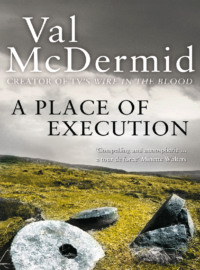
Kitabı oku: «A Place of Execution»
VAL McDERMID
A Place of Execution

Copyright
This novel is entirely a work of fiction. The names, characters and incidents portrayed in it are the work of the author’s imagination. Any resemblance to actual persons, living or dead, events or localities is entirely coincidental.
HarperCollinsPublishers Ltd. 1 London Bridge Street London SE1 9GF
www.harpercollins.co.uk
First published in Great Britain by HarperCollinsPublishers in 1999
Copyright © Val McDermid 1999
Val McDermid asserts the moral right to be identified as the author of this work
A catalogue record for this book is available from the British Library
All rights reserved under International and Pan-American Copyright Conventions. By payment of the required fees, you have been granted the non-exclusive, non-transferable right to access and read the text of this ebook on-screen. No part of this text may be reproduced, transmitted, down-loaded, decompiled, reverse engineered, or stored in or introduced into any information storage and retrieval system, in any form or by any means, whether electronic or mechanical, now known or hereinafter invented, without the express written permission of HarperCollins ebooks
HarperCollinsPublishers has made every reasonable effort to ensure that any picture content and written content in this ebook has been included or removed in accordance with the contractual and technological constraints in operation at the time of publication
Source ISBN: 9780007217144
Ebook Edition © MAY 2009 ISBN: 9780007327591
Version: 2016-12-16
Praise for A Place of Execution
‘Compelling and atmospheric…a tour de force’
MINETTE WALTERS
‘Val McDermid is a roaring Ferrari amid the crowded traffic on the crime-writing road…a crime writer capable of holding her own in any company…she is a strong enough writer to create her own distinctive world’
JANE JAKEMAN, Independent
‘A gut-wrenching tale that spans two decades and brings the resonance of Greek tragedies to England. Psychological suspense that probes, prods and disturbs. A terrific achievement’
MAXIM JAKUBOWSKI, Time Out
‘This is an engrossing story, with its atmospheric portrait of a closed, inbred community…A Place of Execution is a substantial book and an impressive one, possibly the best McDermid has written, and it takes this most accomplished writer into higher territory’
SUSANNA YAGER, Sunday Telegraph
‘Beautifully written…this book is not simply a puzzle; it is almost an archaeological delving into a multi-layered, enclosed society. It may be that McDermid will write better novels than this in the future, but I do not see how’
GERALD KAUFMAN, Daily Telegraph
‘A Place of Execution has verve, depth and an unerring grasp of human responses’
She
‘Like a complex jigsaw puzzle, the pieces eventually fall into place, and for those who choose crime fiction for plotting and denouement, this will prove surprising and completely satisfying’
SUSIE MAGUIRE, Scotland on Sunday
‘A Place of Execution makes you question your assumptions about the whole crime genre…A crime novel about a miscarriage of justice, A Place of Execution is a wake-up call to crime writers everywhere. A terrific and original novel, brilliantly executed’
PAUL DAVIES, Daily Mirror
‘It [A Place of Execution] must be in the running for best crime novel of the year. She has propelled herself into the ranks of the very best in the business…If you’ve never read any McDermid, try this. Basically, if you can read at all, try this. Atmosphere, characters, strong plot, tension, menace – it’s got the lot’
JANICE YOUNG, Yorkshire Post
‘Deserves to be the crime novel of the year’
Prima
‘There is a great deal to admire in this novel…above all the book’s formal adventurousness and subtle orchestration of different narrative levels, that sets it apart from most thrillers. With A Place of Execution, McDermid has wrought a powerful, resonant novel about power and its abuse, about the past’s hold on the present, about the nature of knowledge’
LIAM MCILVANNEY, Glasgow Herald
‘Arguably her finest yet…Fear infuses every page…in this epic tragedy’
ERIC JACKSON, Manchester Evening News
‘This is an extraordinarily accomplished book…the whole affair is a complete success’
F. E. PARDOE, Birmingham Post
Dedication
To my evil twin; laissez les bon temps rouler, cher.
Epigraph
You shall be taken to the place from whence you came, and thence to a place of lawful execution, and there you shall be hanged by the neck until you be dead, and afterwards your body shall be buried in a common grave within the precincts of the prison wherein you were last confined before your execution; and may the Lord have mercy on your soul.
The formal death sentence of the English legal system
LE PENDU: THE HANGED MAN
Divinatory meaning: The card suggests life in suspension. Reversal of the mind and one’s way of life. Transition. Abandonment. Renunciation. The changing of life’s forces. Readjustment. Regeneration. Rebirth. Improvement. Efforts and sacrifice may have to be undertaken to succeed towards a goal which may not be reached.
Tarot Cards for Fun and Fortune Telling S. R. Kaplan
Contents
Title Page
Copyright
Praise for A Place of Execution
Dedication
Epigraph
BOOK 1
Introduction
Prologue
PART ONE: The Early Stages
Chapter 1
Chapter 2
Chapter 3
Chapter 4
Chapter 5
Chapter 6
Chapter 7
Chapter 8
Chapter 9
Chapter 10
Chapter 11
Chapter 12
Chapter 13
Chapter 14
PART TWO
Chapter 1
Chapter 2
Chapter 3
Chapter 4
PART THREE
The Remand
The Murder Charge
The Committal
The Trial 1
The Trial 2
The Trial 3
The Trial 4
The Trial 5
The Trial 6
The Trial 7
The Verdict
A Place of Execution
BOOK 2
PART ONE
PART TWO
1 February 1998
2 October 1997 – February 1998
3 February 1998
4 February/March 1998
5 April 1998
6 May 1998
7 May 1998
8 May/June/July 1998
9 August 1998
PART THREE
1 August 1998
2 August 1998
3 August 1998
4 August 1998
5 August 1998
6 August 1998
7 August 1998
8 August 1998
9 August 1998
10 October 1998
Keep Reading
Acknowledgements
About the Author
By the Same Author
About the Publisher
BOOK 1
Introduction
Like Alison Carter, I was born in Derbyshire in 1950. Like her, I grew up familiar with the limestone dales of the White Peak, no stranger to the winter blizzards that regularly cut us off from the rest of the country. It was in Buxton, after all, that snow once stopped play in a county cricket match in June.
So when Alison Carter went missing in December 1963, it meant more to me and my classmates than it can have done to most other people. We knew villages like the one she’d grown up in. We knew the sort of things she’d have done every day. We suffered through similar classes and cloakroom arguments about which of the Fab Four was our favourite Beatle. We imagined we shared the same hopes, dreams and fears. Because of that, right from the word go, we all knew something terrible had happened to Alison Carter, because something we also knew was that girls like her – like us – didn’t run away. Not in Derbyshire in the middle of December, anyway.
It wasn’t just the thirteen-year-old girls who understood that. My father was one of the hundreds of volunteer searchers who combed the high moorland and the wooded valleys around Scardale, and his grim face when he returned home after a fruitless day scouring the landscape is still sharply etched in my memory.
We followed the hunt for Alison Carter in the newspapers, and every day at school for weeks, someone would be bound to start the speculation rolling. All these years later, I still had more questions for George Bennett than the former policeman could answer.
I have not based my narrative solely on George Bennett’s contemporaneous notes and current memories. While researching this book, I made several visits to Scardale and the surrounding area, interviewing many of the people who played a part in the unfolding of Alison Carter’s story, gathering their impressions, comparing their accounts of events as they experienced them. I could not have completed this book without the help of Janet Carter, Tommy Clough, Peter Grundy, Charles Lomas, Kathy Lomas and Don Smart. I have taken some artistic licence in ascribing thoughts, emotions and dialogue to people, but these sections are based on my interviews with those of the surviving protagonists who agreed to help me to try to create a truthful picture both of a community and the individuals within it.
Some of what happened on that terrible December night in 1963 will of course never be known. But for everyone who has ever been touched, however remotely, by Alison Carter’s life and death, George Bennett’s story is a fascinating insight into one of the most heartless crimes of the 1960s.
For too long, it has remained hidden in the shadow of the understandably more notorious Moors Murders. But Alison Carter’s fate is no less terrible for coming at the hands of a killer who had but a single victim. And the message of her death is still as important today. If Alison Carter’s story tells us one thing, it is that even the gravest of dangers can wear a friendly face.
Nothing can bring Alison Carter back. But reminding the world of what happened to her might prevent others coming to harm. If this book achieves that, both George Bennett and I will feel some satisfaction.
Catherine Heathcote Longnor, 1998
Prologue
The girl was saying goodbye to her life. And it was no easy farewell.
Like any teenager, she’d always found plenty to complain about. But now that she was about to lose it, this life suddenly seemed very desirable. Now at last she began to understand why her elderly relatives clung so tenaciously to every precious moment, even if it was riven with pain. However bad this life was, the alternative was infinitely worse.
She had even begun to regret things. All the times she’d wished her mother dead; all the times she’d wished that her dream of being a changeling would come true; all the hate she’d expended on the children at school who had called her names for not being one of them; all the fervent longings to be grown up, with these miseries behind her. It all seemed irrelevant now. The only thing that mattered was the uniquely valuable life she was about to lose.
She felt fear, inevitably. Fear of what lay beyond as well as what lay immediately ahead. She’d been brought up to believe in heaven and in its necessary counterweight, hell, the equal and opposite force that held things stable. She had her own very clear ideas of what heaven would be. More than she had ever hoped anything in her short life, she hoped that that was what lay in wait for her, so terrifyingly close now.
But she was desperately afraid that what she was going to was hell. She wasn’t so clear about what hell would consist of. She just knew that, compared to everything she’d hated about her life, it would be worse. And given what she knew, that meant it was going to be very bad indeed.
Nevertheless, there was no other possible choice for her. The girl had to say goodbye to her life.
For ever.
PART ONE The Early Stages

Manchester Evening News,
Tuesday, 10th December 1963, p. 3
£100 reward in boy hunt
Police continued to hunt for 12-year-old John Kilbride today – and hoped that a £100 reward might produce a new lead.
For a local managing director has offered £100 to anyone who gives information which leads directly to the discovery of John who vanished from his home in Smallshaw Lane, Ashton-under-Lyne 18 days ago.
1
Wednesday, 11th December 1963. 7.53 p.m.
‘Help me. You’ve got to help me.’ The woman’s voice quavered on the edge of tears. The duty constable who had picked up the phone heard a hiccuping gulp, as if the caller was struggling to speak.
‘That’s what we’re here for, madam,’ PC Ron Swindells said stolidly. He’d worked in Buxton man and boy for the best part of fifteen years and for the last five, he’d found it hard to shake off a sense that he was reliving the first ten. There was, he reckoned, nothing new under the sun. It was a view that would be irrevocably shattered by the events that were about to unfold around him, but for the moment, he was content to trot out the formula that had served him well until now. ‘What seems to be the problem?’ he asked, his rich bass voice gently impersonal.
‘Alison,’ the woman gasped. ‘My Alison’s not come home.’
‘Alison’s your lass, is she?’ PC Swindells asked, his voice deliberately calm, attempting to reassure the woman.
‘She went straight out with the dog when she came in after school. And she’s not come home.’ The sharp edge of hysteria forced the woman’s voice higher.
Swindells glanced automatically at the clock. Seven minutes before eight. The woman was right to be worried. The girl must have been out of the house near on four hours, and that was no joke at this time of year. ‘Could she have gone to visit friends, on the spur of the moment, like?’ he asked, knowing already that would have been her first port of call before she lifted the telephone.
‘I’ve knocked every door in the village. She’s missing, I’m telling you. Something’s happened to my Alison.’ Now the woman was breaking down, her words choking out in the intervals between sobs. Swindells thought he heard the rumble of another voice in the background.
Village, the woman had said. ‘Where exactly are you calling from, madam?’ he asked.
There was the sound of muffled conversation, then a clear masculine voice came on the line, the unmistakable southern accent brisk with authority. ‘This is Philip Hawkin from the manor house in Scardale,’ he said.
‘I see, sir,’ Swindells said cautiously. While the information didn’t exactly change anything, it did make the policeman slightly wary, conscious that Scardale was off his beat in more ways than the obvious. Scardale wasn’t just a different world from the bustling market town where Swindells lived and worked; it had the reputation of being a law unto itself. For such a call to come from Scardale, something well out of the ordinary must have happened.
The caller’s voice dropped in pitch, giving the impression that he was talking man to man with Swindells. ‘You must excuse my wife. She’s rather upset. So emotional, women, don’t you find? Look, Officer, I’m sure no harm has come to Alison, but my wife insisted on giving you a call. I’m sure she’ll turn up any minute now, and the last thing I want is to waste your time.’
‘If you’ll just give me some details, sir,’ the stolid Swindells said, pulling his pad closer to him.
Detective Inspector George Bennett should have been at home long since. It was almost eight o’clock, well beyond the hour when senior detectives were expected to be at their desks. By rights, he should have been in his armchair stretching his long legs in front of a blazing coal fire, dinner inside him and Coronation Street on the television opposite. Then, while Anne cleared away the dishes and washed up, he’d nip out for a pint and a chat in the lounge bar of the Duke of York or the Baker’s Arms. There was no quicker way to get the feel of a place than through bar-room conversation. And he needed that head start more than any of his colleagues, being an incomer of less than six months’ standing. He knew the locals didn’t trust him with much of their gossip, but gradually, they were beginning to treat him like part of the furniture, forgiving and forgetting that his father and grandfather had supped in a different part of the shire.
He glanced at his watch. He’d be lucky to get to the pub tonight. Not that he counted that a great hardship. George wasn’t a drinking man. If he hadn’t been obliged by his professional responsibilities to keep his finger firmly on the pulse of the town, he wouldn’t have entered a pub from one week to the next. He’d much rather have taken Anne dancing to one of the new beat groups that regularly played at the Pavilion Gardens, or to the Opera House to see a film. Or simply stayed at home. Three months married, and George still couldn’t quite believe Anne had agreed to spend the rest of her life with him. It was a miracle that sustained him through the worst times in the job. So far, those had come from tedium rather than the heinous nature of the crimes he encountered. The events of the coming seven months would put that miracle to a tougher test.
That night, however, the thought of Anne at home, knitting in front of the television while she waited for him to return, was far more of a temptation than any pint of bitter. George tore a half-sheet of paper off his scratch pad, placed it among the papers he’d been reading to mark his place, and firmly closed the file, slipping it into his desk drawer. He stubbed out his Gold Leaf cigarette then emptied his ashtray into the bin by his desk, always his last act before he reached for his trench coat and, self-consciously, the wide-brimmed trilby that always made him feel faintly silly. Anne loved it; she was always telling him it made him look like James Stewart. He couldn’t see it himself. Just because he had a long face and floppy blond hair didn’t make him a film star. He shrugged into the coat, noting that it fitted almost too snugly now, thanks to the quilted lining Anne had made him buy. In spite of the slight straining across his broad cricketer’s shoulders, he knew he’d be glad of it as soon as he stepped into the station yard and the teeth of the biting wind that always seemed to be whipping down from the moors through the streets of Buxton.
Taking a last look around his office to check he’d left nothing lying around that the cleaner’s eyes shouldn’t see, he closed the door behind him. A quick glance showed him there was nobody left in the CID room, so he turned back to indulge a moment’s vanity. ‘Detective Inspector G. D. Bennett’ incised in white letters on a small black plastic plaque. It was something to be proud of, he thought. Not yet thirty, and a DI already. It had been worth every tedious minute of the three years of endless cramming for the law degree that had eased him on to the fast track, one of the first ever graduates to make it to the new accelerated promotion stream in the Derbyshire force. Now, seven years from swearing his oath of allegiance, he was the youngest plain-clothes inspector the county force had ever promoted.
There was no one about to see the lapse of dignity, so he took the stairs at a run. His momentum carried him through the swing doors into the uniformed squad room. Three heads turned sharply as he entered. For a moment, George couldn’t think why it was so quiet. Then he remembered. Half the town would be at the memorial service for the recently assassinated President Kennedy, a special Mass open to all denominations. The town had claimed the murdered leader as an adopted native son. After all, JFK had practically been there only months before his death, visiting his sister’s grave a handful of miles away in Edensor in the grounds of Chatsworth House. The fact that one of the nurses who had helped surgeons in the fruitless fight for the president’s life in a Dallas hospital was a Buxton woman had only strengthened the connection in the eyes of the locals.
‘All quiet, then, Sergeant?’ he asked.
Bob Lucas, the duty sergeant, frowned and raised one shoulder in a half-shrug. He glanced at the sheet of paper in his hand. ‘We were until five minutes ago, sir.’ He straightened up. ‘It’s probably summat and nowt,’ he said. ‘A pound to a penny it’ll be sorted before I even get there.’
‘Anything interesting?’ George asked, keeping his voice light. The last thing he wanted was for Bob Lucas to think he was the kind of CID man who treated uniforms as if they were the monkeys and he the organ grinder.
‘Missing lass,’ Lucas said, proffering the sheet of paper. ‘PC Swindells just took the call. They rang here direct, not through the emergency switchboard.’
George tried to picture Scardale on his mental map of the area. ‘Do we have a local man there, Sergeant?’ he stalled.
‘No need. It’s barely a hamlet. Ten houses at the most. No, Scardale’s covered by Peter Grundy at Longnor. He’s only two miles away. But the mother obviously thought this was too important for Peter.’
‘And you think?’ George was cautious.
‘I think I’d better take the area car out to Scardale and have a word with Mrs Hawkin, sir. I’ll pick up Peter on the way.’ As he spoke, Lucas reached for his cap and straightened it on hair that was almost as black and glossy as his boots. His ruddy cheeks looked as if he had a pair of Ping-Pong balls tucked inside his mouth. Combined with glittering dark eyes and straight black eyebrows, they gave him the look of a painted ventriloquist’s dummy. But George had already found out that Bob Lucas was the last person to let anyone else put words in his mouth. He knew that if he asked a question of Lucas, he’d get a straight answer.
‘Would you mind if I came along?’ George asked.
Peter Grundy replaced the phone softly in its cradle. He rubbed his thumb along a jaw sandpaper-rough with the day’s stubble. He was thirty-two years old that night in December 1963. Photographs show a fresh-faced man with a narrow jaw and a short, sharp nose accentuated by an almost military haircut. Even smiling, as he was in holiday snaps with his children, his eyes seemed watchful.
Two calls in the space of ten minutes had broken the routine peace of an evening in front of the TV with his wife Meg, the children bathed and in bed. It wasn’t that he hadn’t taken the first call seriously. When old Ma Lomas, the eyes and ears of Scardale, took the trouble to subject her arthritis to the biting cold by leaving the comfort of her cottage for the phone box on the village green, he had to pay attention. But he’d thought he could wait till eight o’clock and the end of the programme before he did anything about it. After all, Ma might be dressing up the reason for her call as concern over a missing schoolgirl, but Grundy wasn’t so sure it wasn’t just an excuse to stir things up for the lass’s mother. He’d heard the talk and knew there were a few in Scardale as thought Ruth Carter had been a bit quick to jump the broomstick with Philip Hawkin, even if he had been the first man to put roses in her cheeks since her Roy had died.
Then the phone had rung again, bringing a scowl to his wife’s face and dragging him out of his comfortable armchair into the chilly hall. This time, he couldn’t ignore the summons. Sergeant Lucas from Buxton knew about the missing girl, and he was on his way. As if it wasn’t bad enough having Buxton boots tramping all over his ground, he was bringing the Professor with him. It was the first time Grundy or any of his colleagues had ever had to work with somebody that had been to university, and he knew from the gossip on his occasional visits to the sub-division in Buxton that they were none of them comfortable with the idea. He hadn’t been slow to join the mutterings about the university of life being the best teacher for a copper. These graduates – you couldn’t send them out of a Saturday night on to Buxton marketplace. They’d never have seen a pub fight in all their born days, never mind know how to deal with one. As far as Grundy could make out, the only good thing that could be said about DI Bennett was that he could turn a handy bat at cricket. And that wasn’t reason enough for Grundy to be happy about him arriving on his patch to upset his carefully nurtured contacts.
With a sigh, he buttoned up his shirt collar. He pulled on his tunic jacket, straightened his cap on his head and picked up his overcoat. He stuck his head round the living room door, a conciliatory smile fastened nervously on his face. ‘I’ve to go to Scardale,’ he said.
‘Shh,’ his wife admonished him crossly. ‘It’s getting to the exciting bit.’
‘Alison Carter’s gone missing,’ he added, spitefully closing the living room door behind him and hurrying down the hall before she could react. And react she would, he knew only too well. A missing child in Scardale was far too close to home for Longnor not to feel a chill wind on its neck.

George Bennett followed Sergeant Lucas out to the yard where the cars were parked. He’d have far preferred to travel in his own car, a stylish black Ford Corsair as new as his promotion, but protocol demanded he climb into the passenger seat of the liveried Rover and let Lucas drive. As they turned south on the main road through the market square, George tried to stifle the prickle of excitement that had stirred in him when he had heard the words, ‘missing lass’. Chances were, as Lucas had rightly pointed out, that it would all come to nothing. More than ninety-five per cent of cases of children reported missing ended in reunion before bedtime, or at worst, before breakfast.
But sometimes, it was a different story. Sometimes, a missing child stayed missing long enough for the certainty to grow that he or she would never come home. Occasionally, that was from choice. More often, it was because the child was dead and the question for the police then became how long it would take them to find a body.
And sometimes, they seemed to vanish as cleanly as if the earth had opened up and gulped them down.
There had been two cases like that within the last six months, both of them less than thirty miles away from Scardale. George always made a careful note of bulletins from outside forces as well as other Derbyshire divisions, and he had paid particular attention to these two missing persons cases because they were just close enough that the children might fetch up on his patch. Dead or alive.
First had been Pauline Catherine Reade. Dark-haired and hazel-eyed, sixteen years old, a trainee confectioner from Gorton, Manchester. Slim build, about five feet tall, wearing a pink and gold dress and a pale-blue coat. Just before eight on Friday, 12th July, she had walked out of the terraced house where she lived with her parents and her younger brother to go to a twist dance. She was never seen again. There had been no trouble at home or at work. She had no boyfriend to fall out with. She had no money to run away with, even if she’d wanted to. The area had been extensively searched and three local reservoirs drained, all without a trace of Pauline. Manchester police had followed up every report of a sighting, but none had led them to the vanished girl.
The second missing child appeared to have nothing in common with Pauline Reade apart from the inexplicable, almost magical nature of his disappearance. John Kilbride, 12 years old, 4ft 10 ins tall with a slim build, dark-brown hair, blue eyes and a fresh complexion. He was wearing a grey check sports jacket, long grey flannel trousers, a white shirt and black, chisel-toed shoes. According to one of the Lancashire detectives George knew from cricket, he wasn’t a bright lad, but a pleasant and obliging one. John went to the cinema with some friends on Saturday afternoon, the day after Kennedy died in Dallas. Afterwards, he left them, saying he was going down to the marketplace in Ashton-under-Lyne, where he often earned threepence making tea for the stallholders. The last anyone saw of him, he was leaning against a salvage bin around half past five.
The resulting hunt had been given a last desperate boost only the day before when a local businessman had offered a £100 reward. But nothing appeared to have come of it. That same colleague had remarked to George only the previous Saturday at a police dance, that John Kilbride and Pauline Reade would have left more traces if they’d been abducted by little green men in a flying saucer.
And now a missing girl on his patch. He stared out of the window at the moonlit fields lining the Ashbourne road, their rough pasture crusted with hoarfrost, the dry-stone walls that separated them almost luminous in the silvery light. A thin cloud crossed the moon and in spite of his warm coat, George shivered at the thought of being without shelter on a night like this in so inhospitable a landscape.
Faintly disgusted with himself for allowing his eagerness for a big case to overwhelm the concern for the girl and her family that should have been all that was on his mind, George turned abruptly to Bob Lucas and said, ‘Tell me about Scardale.’ He took out his cigarettes and offered one to the sergeant, who shook his head.
‘I won’t, thanks, sir. I’m trying to cut down. Scardale’s what you might call the land that time forgot,’ he said. In the short spurt of light from George’s match, Lucas’s face looked grim.
‘How do you mean?’
‘It’s like the Middle Ages down there. There’s only one road in and out and it comes to a dead end by the telephone box on the village green. There’s the big house, the manor, which is where we’re headed. There’s about a dozen other cottages and the farm buildings. No pub, no shop, no post office. Mr Hawkin, he’s what you might call the squire. He owns every house in Scardale, plus the farm, plus all the land a mile in all directions. Everybody that lives there is his tenant and his employee. It’s like he owns them an’ all.’ The sergeant slowed to turn right off the main road on to the narrow lane that led up past the quarry. ‘There’s only three surnames in the place, I reckon. You’re either a Lomas, a Crowther or a Carter.’
Not, George noticed, a Hawkin. He filed the inconsistency away for later inspection. ‘Surely people must leave, to get married, to get work?’
‘Oh aye, people leave,’ Lucas said. ‘But they’re always Scardale through and through. They never lose it. And every generation, one or two people do marry out. It’s the only way to avoid wedding your cousins. But often as not, them as have married into Scardale come out a few years later looking for a divorce. Funny thing is, they always leave the kids behind them.’ He cast a quick glance at George, almost to see how he was taking it.
George inhaled his cigarette and kept his own counsel for a moment. He’d heard of places like this, he’d just never actually been in one. He couldn’t begin to imagine what it must be like to be part of a world so self-contained, so limited, where everything about your past, present and future must be information shared with an entire community. ‘It’s hard to believe a place like that could exist so close to the town. What is it? Seven miles?’
‘Eight,’ Lucas said. ‘It’s historical. Look at the pitch of these roads.’ He pointed up at the sharp left turn into the village of Earl Sterndale where the houses built by the quarry company to house their workers huddled along the hillside like a rugby scrum. ’Before we had cars with decent engines and proper tarmac roads, it could take you the best part of a day to get from Scardale to Buxton in the winter. That’s when the track wasn’t blocked with snowdrifts. Folk had to rely on their own. Some places around here, they just never got out of the habit.
‘Take this lass, Alison. Even with the school bus, it probably takes her the best part of an hour to get to and from school every day. The county have been trying to get parents to agree to sending children like her as boarders Monday to Friday, to save them the journey. But places like Scardale, they just flat refuse. They don’t see it as the county trying to help them. They think it’s the authorities trying to take their children off them. There’s no reasoning with them.’
The car swung through a series of sharp bends and began to climb a steep ridge, the engine straining as Lucas changed down through the gears. George opened the quarterlight and flicked the remains of his cigarette on to the verge. A draught of frosty air tinged with smoke from a coal fire caught at his throat and he hastily closed the window. ‘And yet Mrs Hawkin wasn’t slow to call us in.’
‘According to PC Swindells, she’d knocked every door in Scardale first, though,’ Lucas said drily. ‘Don’t take me wrong. It’s not that they’re hostile to the police. They’re just…not very forthcoming, that’s all. They’ll want Alison found. So they’ll put up with us.’
The car breasted the rise and began the long descent into the village of Longnor. The limestone buildings crouched like sleeping sheep, dirty white in the moonlight, with plumes of smoke rising from every chimney in sight. At the crossroads in the centre of the village, George could see the unmistakable outline of a uniformed officer, stamping his feet on the ground to keep them warm.
‘That’ll be Peter Grundy,’ Lucas said. ‘He could have waited indoors.’
‘Maybe he’s impatient to find out what’s happening. It is his patch, after all.’
Lucas grunted. ‘More likely his missus giving him earache about having to go out of an evening.’
He braked a little too hard and the car slewed into the kerb. PC Peter Grundy stooped to see who was in the passenger seat, then climbed into the back of the car. ‘Evening, Sarge,’ he said. ‘Sir,’ he added, inclining his head towards George. ‘I don’t like the sound of this at all.’
2
Wednesday, 11th December 1963. 8.26 p.m.
Before Sergeant Lucas could drive off, George Bennett held up one finger. ‘Scardale’s only two miles away, yes?’ Lucas nodded. ‘Before we get there, I want to know as much as possible about what we’re getting into. Can we give PC Grundy a couple of minutes to give us some more details?’
‘A minute or two can’t do any harm,’ Lucas said, easing the car back into neutral.
Bennett squirmed round in his seat so he could see at least the dim outline of the local man’s face. ‘So, PC Grundy, you don’t think we’re going to find Alison Hawkin sitting by the fire getting a tongue-lashing from her mother?’
‘It’s Carter, sir. Alison Carter. She’s not the squire’s daughter,’ Grundy said with the faint air of impatience of a man who sees a long night of explanations ahead of him.
‘Thank you,’ George said mildly. ‘You’ve saved me putting my foot in it over that at least. I’d appreciate it if you could give us a quick briefing on the family. Just so I have an idea what we’re dealing with.’ He held out his cigarettes to Grundy to defuse any idea the man might have that he was being condescended to.
With a quick glance at Bob Lucas, who nodded, Grundy slipped a smoke from the packet and fumbled in his overcoat pocket for a light.
‘I’ve told the inspector the set-up in Scardale,’ Lucas said as Grundy lit his cigarette. ‘About how the squire owns the village and all the land.’
‘Right,’ Grundy said through a swathe of smoke. ‘Well, until about a year ago, it was Hawkin’s uncle who owned Scardale. Old Mr Castleton. There’ve been Castletons in Scardale Manor as far back as parish records show. Any road, old William Castleton’s only son was killed in the war. Flew bombers, he did, but he got unlucky one night over Germany and the last anyone heard was he was missing believed killed in action. His parents had been a good age when young William were born, and there were no other children. So when Mr Castleton died, Scardale went to his sister’s son, this Philip Hawkin. A man that nobody in the place had cast eyes on since he was in short trousers.’
‘What do we know about him?’ Lucas asked.
‘His mother, the squire’s sister, she grew up here, but she married a wrong ’un when she wed Stan Hawkin. He were in the RAF back then, but that didn’t last long. He always claimed he’d taken the rap for one of his senior officers, but the long and short of it was they threw him out for selling tools out the back gate. Any road, the squire took it on himself to see Hawkin right, and he got him a job with an old pal of his, selling cars down south. From all accounts, he never got caught on the fiddle again, but I reckon a leopard never changes its spots, and that’s why the family stopped coming up for visits.’
‘So what about the son, Philip?’ George asked, trying to speed up the story.
Grundy shrugged, his bulk making the car rock. ‘He’s a good-looking beggar, I’ll say that for him. Plenty of charm and smarm, an’ all. The women like him. He’s always been all right wi’ me, but I still wouldn’t trust him to hold the dog while I went for a pee.’
‘And he married Alison Carter’s mother?’
‘I was just getting to that,’ Grundy said with slow dignity. ‘Ruth Carter had been a widow close on six years when Hawkin arrived from down south to take up his inheritance. According to what I’ve heard, he was right taken with Ruth from the off. She’s a fine-looking woman, it’s true, but it’s not every man who’d be willing to take on another man’s child. Mind you, from what I’ve heard, that were never a problem to him. He never let up on Ruth, though. And she wasn’t averse to it, either. He put a sparkle back in her eye and no mistake. They were wed three months after he first showed his face in Scardale. They made a handsome couple.’
‘A whirlwind romance, then?’ George said. ‘I bet that caused a bit of ill feeling, even in a place as tight-knit as Scardale.’
Grundy shrugged. ‘I’ve heard nowt of the sort,’ he said. George recognized a stone wall when he saw it. He’d clearly have to earn Grundy’s trust before the village bobby would hand over his hard-won local knowledge. That the knowledge was there, George didn’t doubt.
‘Right then, let’s head on into Scardale and see what’s what,’ he said. Lucas put the car in gear and drove through the village. At a ‘no through road’ sign, he took a sharp left off the main road. ‘Well signposted,’ George commented drily.
‘Anybody that needs to go to Scardale knows the road there, I reckon,’ Bob Lucas said as he concentrated on driving up a narrow track that seemed to double back on itself in a series of switchback rises and falls. The twin cones of the headlamps made only a slight impression on the darkness of the road, hemmed in as it was by high banks and uneven dry-stone walls that bulged and leaned at apparently impossible angles against the sky.
‘You said when you got in the car that you didn’t like the look of this, Grundy,’ George said. ‘Why’s that?’
‘She seems like a sensible lass, this Alison. I know who she is – she went to primary school in Longnor. I’ve got a niece was in the same class and they went on to the grammar school together. While I was waiting for you, I popped in and had a quick word with our Margaret. She reckons Alison were the same as usual today. They came home on the bus together, just like always. Alison were talking about stopping off in Buxton after school one night this week to buy some Christmas presents. Besides, she says, Alison’s not one for running. If there’s ever owt wrong, she faces it head on. So it looks like whatever’s happened to Alison, it’s likely not happened from choice.’
Grundy’s heavy words sat like a stone in George’s stomach. As if to mirror their ominous nature, the roadside walls disappeared, replaced by steep cliffs of limestone, the road weaving through the narrow defile in a route entirely dictated by topography. My God, George thought, it’s like a canyon in a Western. We should be wearing stetsons and riding mules, not sitting in a car.
‘Just round the next bend, Sergeant,’ Grundy said from behind, his breath bitter with tobacco.
Lucas slowed the car to a crawl, following the curve of an overhanging pinnacle of rock. Almost immediately, the road ahead was blocked by a heavy barred gate. George drew his breath in sharply. If he’d been driving, unaware of the obstacle, he’d have crashed, for sure. As Grundy jumped out and trotted to open the gate, George noticed several paint scrapes in a variety of colours along the rock walls on either side of the road. ‘They don’t exactly welcome strangers with open arms around here, do they?’
Lucas’s smile was grim. ‘They don’t have to. Beyond the gate, technically it’s a private road. It’s only in the last ten years that it’s been asphalted. Before that, nothing that wasn’t a tractor or a Land Rover got up or down the Scardale road.’ He eased the car forward, waiting on the far side of the gate for Grundy to close up and rejoin them.
They set off again. Within a hundred yards of the gate, the limestone cliffs fell back, sloping away on either side to form a distant horizon. Suddenly they’d emerged from gloom into full moonlight once more. Against the starry sky, it looked to George as if they’d emerged from the players’ tunnel into a vast stadium, at least a mile across, with an almost circular ring of steep hills in place of tiers of seats. The arena was no sports field, however. In the eerie light of the moon, George could see fields of rough pasture rising gently from the road that bisected the valley floor. Sheep huddled together against the walls, their breath brief puffs of steam in the freezing air. Darker patches revealed themselves as areas of coppiced woodland as they drove past. George had never seen the like. It was a secret world, hidden and separate.
Now he could see lights, feeble against the moon’s silver gleam, but strong enough to outline a straggle of buildings against the pale limestone reefs at the far end of the dale. ‘That’s Scardale,’ Grundy said needlessly from the back seat.
The conglomeration of stone soon resolved itself into distinct houses huddled round a scrubby circle of grass. A single standing stone leaned at an angle in the middle of the green, and a telephone box blazed scarlet at one side, the only vivid splash of colour in Scardale by moonlight. There looked to be about a dozen cottages, none identical, each separated from its neighbours by only a few yards. Most were showing lights behind their curtains. More than once, George caught a glimpse of hands making a gap for faces to peer through, but he refused to be drawn into a sideways look.
At the very back of the green was a sprawl of ill-assorted gables and windows that George assumed must be Scardale Manor. He wasn’t sure quite what he’d been expecting, but it wasn’t this glorified farmhouse that looked like it had been thrown together over several hundred years by people who’d had more need than taste. Before he could say anything, the front door opened and an oblong of yellow light spilled out on to the yard in front of it. Against the light a woman’s form was silhouetted.
As the car drew to a halt, the woman took a couple of impulsive steps towards them. Then a man appeared at her shoulder and put an arm round her. Together they waited while the police officers approached, George hanging back slightly to let Bob Lucas take the lead. He could use the time Lucas was taking for the introductions to note his first impressions of Alison Carter’s mother and stepfather.
Ruth Hawkin looked at least ten years older than his Anne, which would put her in her late thirties. He reckoned she was about five feet three, with the sturdy build of a woman used to hard work. Her mid-brown hair was pulled back in a ponytail, which emphasized the drawn look around grey-blue eyes that showed signs of recent weeping. Her skin looked weather-beaten but her pursed lips showed faint traces of lipstick in their cracks. She wore an obviously hand-knitted twin set in a blue heather mixture over a pleated grey tweed skirt. Her legs were encased in ribbed woollen stockings, her feet shod sensibly in ankle boots with a zip up the front. It was hard to square what he was seeing with Peter Grundy’s description of Ruth as a good-looking woman. George would not have looked twice at her in a bus queue except for her obvious distress, which showed in the tightness of her body, arms crossed defensively across her chest. He assumed it had also drained her attractiveness from her.
The man standing behind her seemed far more at ease. The hand that wasn’t lightly touching his wife’s shoulder was thrust casually into the pocket of a dark-brown cardigan with suede leather facings. He wore grey flannel trousers whose turn-ups flopped over well-worn leather slippers. Philip Hawkin hadn’t been out knocking on village doors with his wife, George noted.
Hawkin was as handsome as his wife was ordinary. A couple of inches under six feet, he had straight dark hair swept back from a widow’s peak, lightly brilliantined to hold it in place. His face reminded George of a shield, with a broad, square forehead tapering to a pointed chin. Straight brows over dark-brown eyes were like an heraldic device; a slender nose seemed to point to a mouth shaped so that it appeared always to be on the point of a smile.
All of this George itemized and filed away in his memory. Bob Lucas was still speaking. ‘So if we could come in and take some details, we can get a clearer picture of what’s happened.’ He paused expectantly.
Hawkin spoke for the first time, his voice unmistakably alien to the Derbyshire Peaks. ‘Of course, of course. Come inside, officers. I’m sure she’s going to turn up safe and well, but it doesn’t hurt to follow the procedures, does it?’ He dropped his hand to the small of Ruth’s back and steered her back into the house. She seemed numb, certainly incapable of taking any initiative. ‘I’m sorry you’ve been dragged out on such a cold night,’ Hawkin added smoothly as he crossed the room.
George followed Lucas and Grundy across the thresh-old and into a farmhouse kitchen. The floors were stone flagged, the walls rough stone brightened with a coat of white distemper that had discoloured unevenly, depending on its proximity to the wood-burning stove and the electric cooker. A dresser and several cupboards of differing heights painted hospital green ranged round the walls, and a pair of deep stone sinks were set under the windows that looked out towards the end of the dale. Another pair of windows gave a view of the village green, the phone box bright against the darkness. Various pans and kitchen implements hung from the black beams that crossed the room a few feet apart. It smelled of smoke, cabbage and animal fat.
Without waiting for anyone else, Hawkin sat down immediately in a carving chair at the head of a scrubbed wooden table. ‘Make the men some tea, Ruth,’ he said.
‘That’s very kind of you, sir,’ George interjected as the woman lifted a kettle off the stove. ‘But I’d rather we pressed on. Where it’s a matter of a missing child, we try not to waste any time. Mrs Hawkin, if you could sit down and tell us what you know.’
Ruth glanced at Hawkin as if seeking his permission. His eyebrows twitched upwards, but he nodded acquiescence. She pulled out a chair and sank into it, folding her arms on the table in front of her. George sat down opposite her, with Lucas beside him. Grundy unbuttoned his overcoat and lowered himself into the carver at the opposite end to Hawkin. He took his pocketbook from his tunic and flipped it open. Licking the end of his pencil, he looked up expectantly.
‘How old is Alison, Mrs Hawkin?’ George asked gently.
The woman cleared her throat. ‘Thirteen past. Her birthday’s in March.’ Her voice cracked, as if something inside her were splintering.
‘And had there been any trouble between you?’
‘Steady on, Inspector,’ Hawkin protested. ‘What do you mean, trouble? What are you suggesting?’
‘I’m not suggesting anything, sir,’ George said. ‘But Alison’s at a difficult age, and sometimes young girls get things out of all proportion. A perfectly normal ticking-off can feel like the end of the world to them. I’m trying to establish whether there are any grounds for supposing Alison might have run away.’
Hawkin leaned back in his seat with a frown. He reached behind him, tipping the chair back on two legs. He grabbed a packet of Embassy and a small chrome lighter from the dresser and proceeded to light a cigarette without offering the packet to anyone else. ‘Of course she’s run away,’ he said, a smile softening the hard line of his eyebrows. ‘That’s what teenagers do. They do it to get you worried, to get their own back for some imagined slight. You know what I mean,’ he continued with a man-of-the-world air that included the police officers. ‘Christmas is coming. I remember one year I went missing for hours. I thought my mum would be so glad to see me back home safe that I’d be able to talk her into buying me a bike for Christmas.’ His smile turned rueful. ‘All I got was a sore backside. Mark my words, Inspector, she’ll turn up before morning, expecting the fatted calf.’
‘She’s not like that, Phil,’ Ruth said plaintively. ‘I’m telling you, something’s happened to her. She wouldn’t worry us like this.’
‘What happened this afternoon, Mrs Hawkin?’ George asked, taking out his own cigarettes and offering them to her. With a tight nod of gratitude, she took one, her work-reddened fingers trembling. Before he could get his matches out, Hawkin had leaned across to light it. George lit his own cigarette and waited while she composed herself to respond.
‘The school bus drops Alison and two of her cousins at the road end about quarter past four. Somebody from the village always goes up and picks them up, so she gets in about the half-hour. She came in at the usual time. I was here in the kitchen, peeling vegetables for the tea. She gave me a kiss and said she were off out with the dog. I said did she not want a cup of tea first, but she said she’d been shut in all day and she wanted a run with the dog. She often did that. She hated being indoors all day.’ Ambushed by the memory, Ruth faltered then stopped.
‘Did you see her, Mr Hawkin?’ George asked, more to give Ruth a break than because he cared about the answer.
‘No. I was in my darkroom. I lose all sense of time when I’m in there.’
‘I hadn’t realized you were a photographer,’ George said, noticing Grundy shift in his seat.
‘Photography, Inspector, is my first love. When I was a lowly civil servant, before I inherited this place from my uncle, it was never more than a hobby. Now, I’ve got my own darkroom, and this last year, I’ve become semi-professional. Some portraiture, of course, but mostly landscapes. Some of my picture postcards are on sale in Buxton. The Derbyshire light has a remarkable clarity.’ Hawkin’s smile was dazzling this time.
‘I see,’ George said, wondering at a man who could think about the quality of light when his stepdaughter was missing on a freezing December night. ‘So you had no idea that Alison had come in and gone out?’
‘No, I heard nothing.’
‘Mrs Hawkin, was Alison in the habit of visiting anyone when she went out with the dog? A neighbour? You mentioned cousins that she goes to school with.’
Ruth shook her head. ‘No. She’d just go up through the fields to the coppice then back. In summer, she’d go further, up through the woodland to where the Scarlaston rises. There’s a fold in the hills, you can hardly see it till you’re on it, but you can cut through there, along the river bank, into Denderdale. But she’d never go that far of a winter’s night.’ She sighed. ‘Besides, I’ve been right round the village. Nobody’s seen hide nor hair of her since she crossed the fields.’
‘What about the dog?’ Grundy asked. ‘Has the dog come back?’
It was a countryman’s question, George thought. He’d have got there eventually, but not as fast as Grundy.
Ruth shook her head. ‘She’s not. But if Alison had had an accident, Shep wouldn’t have left her. She’d have barked, but she wouldn’t have left her. A night like tonight, you’d hear Shep anywhere in the dale. You’ve been out there. Did you hear her?’
‘That’s why I wondered,’ Grundy said. ‘The silence.’
‘Can you give us a description of what Alison was wearing?’ asked the ever-practical Lucas.
‘She had on a navy-blue duffel coat over her school uniform.’
‘Peak Girls’ High?’ Lucas asked.
Ruth nodded. ‘Black blazer, maroon cardie, white shirt, black and maroon tie and maroon skirt. She’s wearing black woolly tights and black sheepskin boots that come up to mid-calf. You don’t run away in your school uniform,’ she burst out passionately, tears welling up in her eyes. She brushed them away angrily with the back of her hand. ‘Why are we sitting here like it was Sunday teatime? Why aren’t you out looking for her?’
George nodded. ‘We’re going to, Mrs Hawkin. But we needed to get the details straight so that we don’t waste our efforts. How tall is Alison?’
‘She’s near on my height now. Five foot two, three, something like that. She’s slim built, just starting to look like a young woman.’
‘Have you got a recent photograph of Alison that we can show our officers?’ George asked.
Hawkin pushed his chair back, the legs shrieking on the stone flags. He pulled open the drawer of the kitchen table and took out a handful of five-by-three prints. ‘I took these in the summer. About four months ago.’ He leaned across and spread them out in front of George. The face that looked up at him from five coloured head-and-shoulders portraits was not one he’d forget in a hurry.
Nobody had warned him that she was beautiful. He felt his breath catch in his throat as he looked down at Alison. Collar-length hair the colour of set honey framed an oval face sprinkled with pale freckles. Her blue eyes had an almost Slavic set to them, set wide apart on either side of a neat, straight nose. Her mouth was generous, her smile etching a single dimple in her left cheek. The only imperfection was a slanting scar that sliced through her right eyebrow, leaving a thin white line through the dark hairs. In each shot, her pose varied slightly, but her candid smile never altered.
He glanced up at Ruth, whose face had imperceptibly softened at the sight of her daughter’s face. Now he could see what had attracted Hawkin’s eye to the farmer’s widow. Without the strain that had stripped gentleness from Ruth’s face, her beauty was as obvious as her daughter’s. With the ghost of a smile touching her lips, it was hard to imagine he’d believed her plain.
‘She’s a lovely girl,’ George murmured. He got to his feet, picking up the photographs. ‘I’d like to hang on to these for the time being.’ Hawkin nodded. ‘Sergeant, if I could have a word outside?’
The two men stepped from the warm kitchen into the icy night air. As he closed the door behind them, George heard Ruth say in a defeated voice, ‘I’ll make tea now.’
‘What do you think?’ George asked. He didn’t need Lucas’s confirmation to know that this was serious, but if he assumed authority now over the uniformed man, it was tantamount to saying he thought the girl had been murdered or seriously assaulted. And in spite of his growing conviction that that was what had happened, he had a superstitious dread that acting as if it were so might just make it so.
‘I think we should get the dog handler out fast as you like, sir. She could have had a fall. She could be lying injured. If she’s been hit in a rock fall, the dog could have been killed.’ He looked at his watch. ‘We’ve got four extra uniformed officers on duty at the Kennedy memorial service. If we’re quick, we can catch them before they go off duty and get them out here as well as every man we can spare.’ Lucas reached past him to open the door. ‘I’ll need to use their phone. No point in trying the radio here. You’d get better reception down the bottom of Markham Main pit shaft.’
‘OK, Sergeant. You organize what you can by way of a search party. I’m going to call in DS Clough and DC Cragg. They can make a start on a door-to-door in the village, see if we can narrow down who saw her last and where.’ George felt a faint fluttering in his stomach, like first-night nerves. Of course, that’s exactly what it was. If his fears were right, he was standing on the threshold of the first major case he’d been entirely responsible for. He’d be judged by this for the rest of his career. If he didn’t uncover what had happened to Alison Carter, it would be an albatross round his neck for ever.
3
Wednesday, 11th December 1963. 9.07 p.m.
The dog’s breath swirled and hung in the night air as if it had a life of its own. The Alsatian sat calmly on its haunches, ears pricked, alert eyes scanning Scardale village green. PC Dusty Miller, the dog handler, stood by his charge, one hand absently fingering the short tan and brindle hair between its ears. ‘Prince’ll need some clothes and shoes belonging to the lass,’ he told Sergeant Lucas. ‘The more she’s worn them, the better. We can manage without, but it’d help the dog.’
‘I’ll have a word with Mrs Hawkin,’ George interjected before Lucas could assign anyone to the task. It wasn’t that he thought a uniformed officer would be deficient in tact; he simply wanted another chance to observe Alison Carter’s mother and her husband.
He walked into the warm fug of the kitchen, where Hawkin was still sitting at the table, still smoking. Now he had a cup of tea in front of him, as did the WPC who sat at the other end of the table. They both looked up as he entered. Hawkin raised his eyebrows in a question. George shook his head. Hawkin pursed his lips and rubbed a hand over his eyes. George was pleased to see the man finally showing some signs of concern for his stepdaughter’s fate. That Alison might be in real danger seemed finally to have penetrated his self-absorption.
Ruth Hawkin was at the sink, her hands among the suds in the washing-up bowl. But she wasn’t doing the dishes. She was motionless, staring intently into the unbroken dark of the night. The moonlight barely penetrated the area behind the house; this far down the valley, the tall limestone reefs were close enough to cut off most of it. There was nothing beyond the window but a faint, dark outline against the grey-white of the cliffs. An outbuilding of some sort, George guessed. He wondered if it had been searched yet. He cleared his throat. ‘Mrs Hawkin…’
Slowly, she turned. Even in the brief time they’d been in Scardale, she seemed to have aged, the skin tightening across her cheekbones and her eyes sinking back into her head. ‘Yes?’
‘We need some of Alison’s clothes. To help the tracker dog.’
She nodded. ‘I’ll fetch something.’
‘The dog handler suggested some shoes, and something she’s worn a few times. A jumper or a coat, I suppose.’
Ruth walked out of the room with the automatic step of the sleepwalker. ‘I wonder if I could use your phone again,’ George asked.
‘Be my guest,’ Hawkin said, waving his hand towards the hallway.
George followed Ruth through the door and made for the table where the old-fashioned black Bakelite phone squatted on a piecrust table next to a wedding photograph of a radiant Ruth with her new husband. If Hawkin hadn’t been so handsomely unmistakable, George doubted he would have identified the bride.
As soon as he closed the door behind him, he felt icy coldness grip him. If the girl was used to living in temperatures like this, she’d stand a better chance outside, he thought. He could see Ruth Hawkin disappear round the turn in the stairs as he lifted the receiver and began to dial. Four rings, then it was picked up. ‘Buxton four-two-two,’ the familiar voice said, instantly soothing his anxieties.
‘Anne, it’s me. I’ve had to go out to Scardale on a case. A missing girl.’
‘The poor parents,’ Anne said instantly. ‘And poor you, having that to deal with on a night like this.’
‘It’s the girl I’m worried about. Obviously, I’m going to be late. In fact, depending on what happens, I might not be back at all tonight.’
‘You push yourself too hard, George. It’s bad for you, you know. If you’re not back by bedtime, I’ll make up some sandwiches and leave them in the fridge so there’s something for you to eat. They’d better be gone by the time I get up,’ she added, her scolding only half teasing.
If Ruth Hawkin hadn’t reappeared on the stairs, he’d have told Anne how much he loved the way she cared about him. Instead, he simply said, ‘Thanks. I’ll be in touch when I can,’ and replaced the receiver. He moved to the foot of the stairs to meet Ruth, who was clutching a small bundle to her chest. ‘We’re doing all we can,’ he said, knowing it was inadequate.
‘I know,’ she said. She opened her arms to reveal a pair of slippers and a crumpled flannelette pyjama jacket. ‘Will you give these to the dog man?’
George took the clothes, noting with a stab of nameless emotion how pathetic the circumstances had rendered the blue velveteen slippers and the pink sprigged jacket. Holding them gingerly, to avoid contamination with his scent, George walked back through the kitchen and out into the night air. Wordlessly, he handed the items to Miller and watched while the dog handler spoke soft words of command to Prince, offering the garments to its long nose.
The dog raised its head delicately, as if scenting some culinary delight on the wind. Then it started nosing the ground by the front door, its head swinging to and fro in long arcs, inches above the ground. Every few feet, it gave a snorting snuffle then looked up, thrusting its nostrils towards Alison’s clothes and her scent, as if reminding itself what it was supposed to be seeking. Dog and handler moved forward in tandem, covering every inch of the path from the kitchen door. Then, at the very edge of the dirt track that skirted the back of the village green, the Alsatian suddenly stiffened. As rigid as a child playing statues, Prince paused for long seconds, hungrily drinking in the scent from the scrubby grass. Then in one smooth, liquid motion, the dog moved swiftly across the grass, its body close to the ground, its nose seeming to pull it forward in a low lope.
PC Miller quickened his step to keep up with the dog. On a nod from Sergeant Lucas, four of the uniformed men who’d arrived minutes after the dog team fell into step behind them, fanning out to cover the ground with the cones of their torch beams. George followed them for a few yards, not certain whether he should join their party or wait for the two CID officers he’d summoned but who hadn’t arrived yet.
Their path touched the village green at a tangent then, via a stone stile, into a narrow salient between two cottages that gave out into a larger field. As the dog led them unwaveringly across the field, George heard a car grumbling down the road into the village. As it pulled up behind the cluster of police vehicles already there, he recognized the Ford Zephyr of Detective Sergeant Tommy Clough. He threw a quick glance over his shoulder at the tracker team. Their torches gave their positions away. It wouldn’t be hard to catch up with them. He turned on his heel, strode over to the bulky black car and yanked open the driver’s door. The familiar ruddy harvest moon face of his sergeant grinned up at him. ‘How do, sir,’ Clough said on a wave of beer fumes.
‘We’ve got work to do, Clough,’ George said shortly. Even with a drink in him, Clough would still do a better job than most officers sober. The passenger door slammed and Detective Constable Gary Cragg slouched round the front of the car. He’d watched too many Westerns, George had decided the first time the lanky DC had swaggered into his line of vision. Cragg would have looked fine in a pair of sheepskin chaps with matching Colt pistols slung low on his narrow hips and a ten-gallon hat tipped over his hooded grey eyes. In a suit, he had the air of a man who’s not quite sure how he got where he is, but wishes with all his heart he was somewhere else.
‘Missing girl, is that right, sir?’ he drawled. Even his slow voice would have been more at home in a saloon, asking the bartender for a shot of bourbon. The only saving grace, as far as George could see, was that Cragg showed no signs of being a maverick.
‘Alison Carter. Thirteen years old,’ George briefed them as Clough unfolded his chunky body from under the steering wheel. He gestured over his shoulder with his thumb. ‘She lives in the manor house, stepdaughter of the squire. Her and her mother are Scardale natives, though.’
Clough snorted and clamped a tweed cap over his tight brown curls. ‘She’ll not have had the sense to get lost, then. You know about Scardale, don’t you? They’ve all been marrying their cousins for generations. Most of them would be hard pressed to find their backsides in a toilet.’
‘Alison managed to make it to grammar school in spite of her handicaps,’ George pointed out. ‘Which, as I recall, is more than we can say for you, Sergeant Clough.’ Clough glared at the boss who was three years his junior, but said nothing. ‘Alison came home from school at the usual time,’ George continued. ‘She went out with the dog. Neither of them’s been seen since. That was the best part of five hours ago. I want you to do a door-to-door round the village. I want to know who was the last person to see her, where and when.’
‘It’ll have been dark by the time she went out,’ Cragg said.
‘All the same, somebody might have seen her. I’m going to try and catch up with the dog handler, so that’s where I’ll be if you need me. OK?’ As he turned away, a sudden chill thought struck him. He looked round the horseshoe of houses huddled round the green, then swung back to face Clough and Cragg. ‘And every house – I want you to check the kids are where they should be. I don’t want some mother having hysterics tomorrow morning when she discovers her kid’s missing too.’
He didn’t wait for an answer, but set off for the stile. Just before he got there, he checked his stride and turned back to find Sergeant Lucas in the middle of directing the remaining six uniformed officers he’d managed to rustle up from somewhere. ‘Sergeant,’ George said. ‘There’s an outbuilding you can see from the kitchen window of the house. I don’t know if anyone’s checked it yet, but it might be worth taking a look, just in case she didn’t go for her usual walk.’
Lucas nodded and gestured with his head to one of the constables. ‘See what you can see, lad.’ He nodded to George. ‘Much obliged, sir.’
Kathy Lomas stood at her window and watched the darkness swallow the tall man in the mac and the trilby. Illuminated by the headlights of the big car that had just rolled to a halt by the phone box, he’d borne a remarkable resemblance to James Stewart. It should have been a reassuring thought, but somehow it only made the evening’s events all the more unreal.
Kathy and Ruth were cousins, separated by less than a year, connected by blood on both maternal and paternal sides. They had grown into women and mothers side by side. Kathy’s son Derek had been born a mere three weeks after Alison. The families’ histories were inextricably intertwined. So when Kathy, alerted by Derek, had walked into Ruth’s kitchen to find her cousin pacing anxiously, chain-smoking and fretting, she’d felt the stab of fear as strongly as if it had been her own child who was absent.
They’d gone round the village together, at first convinced they would find Alison warming herself at someone else’s fire, oblivious to the passing of time, remorseful at causing her mother worry. But as they drew blank after blank, conviction had shrivelled to hope, then hope to despair.
Kathy stood at the darkened window of Lark Cottage’s tiny front room, watching the activity that had suddenly bloomed in the dismal December night. The plain-clothes detective who had been driving the car, the one who looked like a Hereford bull with his curly poll and his broad head, pushed his car coat up to scratch his backside, said something to his colleague, then started towards her front door, his eyes seeming to meet hers in the darkness.
Kathy moved to the door, glancing towards the kitchen where her husband was trying to concentrate on finishing a marquetry picture of fishing boats in harbour. ‘The police are here, Mike,’ she called.
‘Not before time,’ she heard him grumble.
She opened the door just as the Hereford bull lifted his hand to knock. His startled look turned into a smile as he took in Kathy’s generous curves, still obvious even beneath her wraparound apron. ‘You’ll have come about Alison,’ she said.
‘You’re right, missus,’ he said. ‘I’m Detective Sergeant Clough, and this is Detective Constable Cragg. Can we come in a minute?’
Kathy stepped back and let them pass, allowing Clough to brush against her breasts without complaint. ‘The kitchen’s straight ahead. You’ll find my husband in there,’ she said coldly.
She followed them and leaned against the range, trying to warm herself against the cold fear inside, waiting for the men to introduce themselves and settle round the table. Clough turned to her. ‘Have you seen Alison since she got home from school?’
Kathy took a deep breath. ‘Aye. It was my turn to pick up the kids off the school bus. In the winter, one of us always drives up to the lane end to collect them.’
‘Was there anything different about Alison that you noticed?’ Clough asked.
Kathy thought for a moment, then shook her head. ‘Nowt.’ She shrugged. ‘She were just the same as usual. Just…Alison. She said cheerio and walked off up the path to the manor. Last I saw of her she was walking through the door, shouting hello to her mum.’
‘Did you see any strangers about? Either on the road or up at the lane end?’
‘I never noticed anybody.’
‘I believe you went round the village with Mrs Hawkin?’ Clough asked.
‘I wasn’t going to leave her on her own, was I?’ Kathy demanded belligerently.
‘How did you come to know Alison was missing?’
‘It was our Derek. He’s not been doing as well as he should have been at school, so I took it on myself to make sure he was doing his homework properly. Instead of letting him go off with Alison and their cousin Janet when they got home from school, I’ve been keeping him in.’
‘She makes him sit at the kitchen table and do all the work his teachers have set him before she’ll let him loose with the girls. Waste of bloody time, if you ask me. The lad’s only going to be a farmer like me,’ Mike Lomas interrupted, his voice a low rumble.
‘Not if I have anything to do with it,’ Kathy said grimly. ’I tell you what’s a waste of time. It’s that record player Phil Hawkin bought Alison. Derek and Janet are never away from there, listening to the latest records. Derek was desperate to get over to Alison’s tonight. She’s just got the new Beatles number one, “I Want To Hold Your Hand”. But it was after tea before I let him out. It must have been just before seven. He came back within five minutes, saying Alison had gone out with Shep and hadn’t come home. Of course, I went straight over to see what was what.
‘Ruth was up to high doh. I told her she should check with everybody in the village, just in case Alison had popped in to see somebody and lost track of the time. She’s always sitting with old Ma Lomas, her and her cousin Charlie keeping the old witch company, listening to her memories of the old days. Once Ma gets going, you could sit all night. She’s some storyteller, Ma, and our Alison loves her tales.’
She settled herself more comfortably against the range. Clough could see she was on a roll, and he decided just to let her run and see where her story took them. He nodded. ‘Go on, Mrs Lomas.’
‘Well, we were just about to set off when Phil came in. He said he’d been in his darkroom, messing about with his photographs, and he’d only just noticed the time. He was going on about where was his tea and where was Alison? I told him there were more important things to think about than his belly, but Ruth dished him up a plate of the hotpot she’d had cooking. Then we left him to it and went knocking doors.’ She came to a sudden halt.
‘So you never saw Alison again after she got out of the car coming back from school?’
‘Land Rover,’ Mike Lomas growled.
‘Sorry?’
‘It were a Land Rover, not a car. Nobody has cars down here,’ he said contemptuously.
‘No, I’ve not seen her since she walked in the kitchen door,’ Kathy said. ‘But you’re going to find her, aren’t you? I mean, that’s your job. You are going to find her?’
‘We’re doing our best.’ It was Cragg who trotted out the formulaic placebo.
Before she could utter the angry retort Tommy Clough could see coming, he spoke quickly. ‘What about your lad, Mrs Lomas? Is he where he should be?’
Her mouth dropped open in shock. ‘Derek? Why wouldn’t he be?’
‘Maybe the same reason Alison’s not where she should be.’
‘You can’t say that!’ Mike Lomas jumped to his feet, his cheeks flaming scarlet, his eyes tight with anger.
Clough smiled, spreading his hands in a conciliatory gesture. ‘Nay, don’t take me wrong. All I meant was, you should check in case something’s happened to him an’ all.’
By the time George got over the stile, the lights from the tracker team’s torches were no more than a hazy wavering in the distance. He guessed they had entered some woodland by the way the yellow beams seemed suddenly to disappear and reappear at random. Switching on the torch he’d borrowed from the police Land Rover that had brought some of the men over from Buxton, he hurried across the uneven tufts of coarse grass as quickly as he could.
The trees loomed up sooner than he’d expected. At first, all he could see was undisturbed undergrowth, but swinging the torch to and fro soon revealed a narrow path where the earth was packed hard. George plunged into the woodland, trying to balance haste against caution. The torch beam sent crazy shadows dancing off in every direction, forcing him to concentrate harder on the path than he’d had to do in the field. Frosted leaves crunched under his feet, the occasional twig whipped his face or brushed his shoulder, and everywhere the decaying mushroomy smell of the woodland assailed him. Every twenty yards or so, he snapped off his torch to check his bearings against the lights ahead. Absolute darkness swallowed him, but it was hard to resist the feeling that there were hidden eyes staring at him, following his every move. It was a relief to snap his torch on again. A few minutes into the wood, he realized the lights before him had stopped moving. Putting on a spurt that nearly sent him flying over a tree root, he almost collided with a uniformed constable hurriedly retracing his steps.
‘Have you found her?’ George gasped.
‘No such luck, sir. We have found the dog, though.’
‘Alive?’
The man nodded. ‘Aye. But she’s been tied up.’
‘In silence?’ George asked incredulously.
‘Somebody taped her muzzle shut, sir. Poor beast could barely manage a whimper. PC Miller sent me back to fetch Sergeant Lucas before we did owt.’
‘I’ll take responsibility now,’ George said firmly. ‘But go back anyway and tell Sergeant Lucas what’s happened. I think it might be wise to keep people out of this piece of woodland until daylight. Whatever’s happened to Alison Carter, there might be evidence that we’re destroying right now.’
The constable nodded and took off along the path at a trot. ‘Bloody mountain goats they breed around here,’ George muttered as he blundered on down the path.
The clearing he emerged into was a chiaroscuro of torchlight and strangely elongated shadows. At the far end, a black and white collie strained against a rope tied round a tree. Liquid brown irises stood out against the white of its bulging eyes. The dull pink of the elastoplast that was wound round its muzzle looked incongruous in so pastoral a setting. George was aware of the stares of the uniformed men, looking him over speculatively.
‘I think we should put that dog out of its misery. What do you say, PC Miller?’ he asked, directing his question to the dog handler, who was methodically covering the clearing with Prince.
‘I don’t think she’ll argue with you on that, sir,’ Miller said. ‘I’ll take Prince out of the way so he won’t upset her.’ With a jerk on the dog’s leash and a word of command, he made for the far side of the clearing. George noticed his dog was still casting around as he’d done outside the house earlier.
‘Has he lost the scent?’ he asked, suddenly concerned about more important matters than a dog’s discomfort.
‘Looks like the trail ends here,’ the dog handler said. ‘I’ve been right round the clearing twice, and down the path in the opposite direction. But there’s nothing.’
‘Does that mean she was carried out of here?’ George asked, a cold tremor twitching upwards from his stomach.
‘Like as not,’ Miller said grimly. ‘One thing’s for sure. She didn’t walk out of here unless she turned straight round and walked back to the house. And if that’s what she did, why tie up the bitch and muzzle her?’
‘Maybe she wanted to creep up on her mum? Or her stepdad?’ one of the constables hazarded.
‘The dog wouldn’t have barked at them, would she? So there’d be no need to muzzle her, or leave her behind,’ Miller said.
‘Unless she thought one or other of them might be with a stranger,’ George said, half under his breath.
‘Aye well, my money says she never left this clearing under her own steam.’ Miller spoke with finality as he walked his dog down the path.
George approached the dog cautiously. The whimper in the dog’s throat turned to a soft grumble. What had Ruth Hawkin called it? Shep, that was it. ‘OK, Shep,’ he said gently, holding his hand out so the dog could sniff his fingers. The growl died away. George hitched up his trousers and kneeled down, the frozen ground uneven and ungenerous beneath his knees. Automatically, he noticed the elastoplast was the thicker kind, from a roll two inches wide with a half-inch band of lint bulging up the middle of it. ‘Steady, girl,’ he said, one hand gripping the thick hair at the scruff of the dog’s neck to hold her head still. With his other hand, he picked at the end of the elastoplast till he had freed enough to pull clear. He looked up. ‘One of you, come over here and hold the dog’s head while I get this stuff off.’
One of the constables straddled the nervous collie and grasped her head firmly. George gripped the end of the elastoplast strip and pulled it as hard as he could. Inside a minute, he’d yanked the last of it free, narrowly avoiding the snapping teeth of the collie, panicking in response to having chunks of her fur ripped away with the tape. The constable behind her hastily jumped clear as she swung round to try her chances with him. As soon as she realized her mouth was free, Shep dropped to the ground and began to bark furiously at the men. ‘What do we do now, sir?’ one of the constables asked.
‘I’m going to untie her and see where she wants to take us,’ George said, sounding more confident than he felt. He walked forward cautiously, but the dog showed no sign of wanting to attack him. He took out his penknife and sawed through the rope. It was easier than trying to untie it while the dog was straining against it. And it had the advantage of preserving the knot, just in case there was anything distinctive about it. George thought not; it looked pretty much like a standard reef knot to him.
Instantly, Shep lunged forward. Taken by surprise, George gouged a slice out of his thumb as he tried to hold on to the sheepdog. ‘Damn!’ he exploded as the rope whirled through his fingers, burning the skin where it touched. One of the constables attempted to grab the rope as the dog fled, but failed. George clutched his bleeding hand and watched helplessly as the dog raced down the path Miller and Prince had taken from the clearing.
Moments later, there was the sound of a scuffle and Miller’s voice shouting sternly, ‘Sit.’ Then silence. Then an eerie howling split the night.
Groping in his pocket for a handkerchief, George followed the dog’s path. A dozen yards into the wood, he came upon Miller and the two dogs. Prince lay on the ground, his muzzle between his paws. Shep sat on the ground, her head lifted towards the sky, her mouth opening and closing in a long series of heart-stopping wails. Miller held the rope, securing the straining collie. ‘She seems to want to go this way,’ Miller said, gesturing with his head down the path away from the clearing.
‘Let’s follow her, then,’ George said. He wrapped his bleeding thumb with the handkerchief then took the rope from the handler. ‘Come on, girl,’ he encouraged the collie. ‘Show me.’ He shook the rope.
Immediately, Shep bounded to her feet and set off down the trail, tail wagging. They wove through the trees for a couple of minutes, then the track emerged from the trees on to the banks of a narrow, fast-flowing stream. The dog promptly sat down and looked back at him, her tongue hanging out and her eyes bewildered.
‘That’d be the Scarlaston,’ Miller’s voice said behind him. ‘I knew it rose in these parts. Funny river. I’ve heard tell it just sort of seeps out of the ground. If we have a dry summer, it sometimes vanishes altogether.’
‘Where does it lead?’ George asked.
‘I’m not sure. I think it flows either into the Derwent or the Manifold, I can’t remember which. You’d have to look at a map for that.’
George nodded. ‘So if Alison was carried out of the clearing, we’d lose the trail here anyway.’ He sighed and turned away, guiding his torch beam over his watch. It was almost quarter to ten. ‘There’s nothing more we can do in darkness. Let’s head back to the village.’
He practically had to drag Shep away from the Scarlaston’s edge. As they made their slow progress back to Scardale, George fretted about Alison Carter’s disappearance. Nothing made sense. If someone was ruthless enough to kidnap a young girl, surely they wouldn’t show mercy to a dog? Especially a dog as lively as Shep. He couldn’t imagine a dog with the collie’s spirit meekly submitting to having elastoplast tightly wound round its muzzle. Unless it had been Alison who’d done the deed?
If it had been Alison, had she acted on her own initiative or had she been forced to silence her own dog? And if she’d done it for her own ends, where was she now? If she’d been going to run away, why not take the dog with her for protection, at least until dawn broke? The more he thought about it, the less he understood.
George trudged out of the woods and through the field, the reluctant dog trailing at his heels. George found Sergeant Lucas conferring with PC Grundy in the light of a hurricane lamp hanging from the back of the Land Rover. Briefly, he explained the scenario in the woods. ‘There’s no point in trampling through there in the dark,’ he said. ‘I reckon the best we can do is put a couple of men on guard and at first light, we search the woodland inch by inch.’
Both men looked at him as if he’d gone mad. ‘With respect, sir, if you’re intending to keep the villagers out of the wood, there’s not a lot of point in leaving a couple of men to catch frostbite in the field,’ Lucas said wearily. ‘The locals know the lie of the land far better than we do. If they want to get into those woods, they will, and we’ll never know about it. Besides, I don’t think there’s a soul in the place who hasn’t already volunteered to help searching. If we tell them what’s what, they’ll be the last ones to destroy any possible clues.’
He had a point, George realized. ‘What about outsiders?’
Lucas shrugged. ‘All we have to do is post a guard on the gate on the road. I don’t imagine anybody’ll be keen enough to hike in from the next dale. It’s a treacherous path up the Scarlaston banks at the best of times, never mind on a frosty winter night.’
‘I’m happy to trust your judgement, Sergeant,’ George said. ‘I take it your men have been searching the houses and outbuildings?’
‘That’s right. Not a trace of the girl,’ Lucas said, his naturally cheery face as sombre as it could manage. ‘The building out the back of the manor, it’s where the squire develops his photographs. Nowhere for a lass to hide in there.’
Before George could respond, Clough and Cragg appeared from the shadows on the village green. Both looked as cold as he felt, the collars of their heavy winter coats turned up against the chill wind that whistled up the valley. Cragg was flipping back the pages of his notebook. ‘Any progress?’ George asked.
‘Not so’s you’d notice,’ Clough complained, offering his cigarettes round the group. Only Cragg took one. ‘We spoke to everybody, including the cousins she came back from school with. It was Mrs Kathy Lomas’s turn to pick them up at the road end, which she did as per usual. The last she saw of Alison, the lass was walking in the kitchen door of the manor. So the mother’s telling the truth about the lass getting home in one piece. Mrs Lomas went indoors with her lad and never saw Alison again. Nobody saw hide nor hair of the girl after she came home from school. It’s like she vanished into thin air.’
Ücretsiz ön izlemeyi tamamladınız.