Kitabı oku: «Orlando. A Biography / Орландо»
© Шитова А. В., адаптация, сокращение, словарь, 2021
© ООО «ИД «Антология», 2021
1
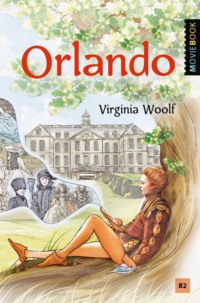
He – and there could be no doubt about his sex, though the fashion of the time tried to disguise it – was trying to strike the skull of a Moor which hung from the ceiling of the attic. It was the color and the shape of an old coconut, with a strand or two of dry hair. Orlando's father, or even his grandfather, had brought it from the battlefields of Africa; and now it swung gently in the breeze which was always blowing through the attic rooms of the gigantic house of the lord who had killed that Moor.
Orlando's fathers had ridden in fields of wild lilies, among stones, and along strange rivers. The fathers had struck many heads off many shoulders and brought them back to hang from the ceiling. Orlando would do that too, he vowed. But now he was only sixteen – too young to ride with them in Africa or France. So he would run away from his mother and the peacocks in the garden and go to his attic room, and there he would slice the air with his sword. Sometimes he would cut the cord and the skull would fall to the floor. Then he would put it up again. The skull was swinging freely because the house, at the top of which Orlando lived, was so vast that the wind itself seemed to live there, blowing this way and that way, winter and summer, stirring the green tapestries.
Orlando's fathers had been noble. They came out of the northern mists, wearing crowns on their heads.
Now Orlando stood in the center of the yellow body of a heraldic leopard as the sunlight poured in through the stained glass of a massive coat of arms1 in the window. When he put his hand on the window-sill to push the window open, it was colored red, blue, and yellow like a butterfly's wing. His strong legs, his handsome body and wide shoulders were decorated with different colors of that heraldic light. But Orlando's honest and serious face, as he opened the window, was lit only by the sun.
Orlando was something to look at. His red cheeks were covered with peach down, and the down on the lips was only a little thicker. His teeth were white; he had a short straight nose; the hair was dark, the ears small. But the most spectacular were his forehead and eyes. He had eyes like two large dewy violets; and a forehead like a marble dome.
Sights disturbed Orlando – like that of his mother, a very beautiful lady in green, walking out to feed the peacocks with Twitchett, her maid, behind her. Sights excited him – the birds and the trees. Sights made him in love with death – the evening sky, the ravens. When all these sights, and the garden sounds too, flowed into the brain of the young man and created the confusion of passions and emotions, Orlando sat down at the table.
As he did every day at this hour, he took out a writing book with 'Aethelbert: A Tragedy in Five Acts' written on it and dipped an old goose quill in the ink. Soon he had covered more than ten pages with poetry. He was fluent, but abstract. Vice, Crime, Misery were the characters of his drama; there were Kings and Queens; horrifying plots; noble sentiments. Not a word was said as he himself would have said it, but all of it was just sweetness of the sixteenth century.
At last, however, he stopped. He was describing, as all young poets do, nature, and, to describe the shade of green, he looked at a laurel bush growing beneath the window. After that, of course, he could write no more. Green in nature is one thing, but green in literature is another. The green Orlando now saw spoiled his rhyme and broke his meter. Besides, one look out the window made him drop the pen, take his cloak, and, as he was walking out of the room, almost trip over a chest – because Orlando was a bit clumsy.
He was careful to avoid meeting anyone outside. There was Stubbs, the gardener, walking along the path. Orlando hid behind a tree till he had passed. He went out through a little gate in the garden wall. Unseen, he walked past the stables, the dog kennels, the breweries, the wash-houses – because the house was as big as a town filled with men at work – and took the ferny path leading uphill through the park.
Orlando loved solitude. He naturally loved to feel himself for ever and ever and ever alone.
'I am alone,' he whispered at last after a long silence. He had walked very quickly uphill through ferns and hawthorn bushes, startling deer and wild birds, to a place where a single oak tree grew. The hill was very high – so high that nineteen English counties could be seen from there; and on clear days – thirty; or even forty, if the weather was fine. Sometimes one could see the English Channel2. Rivers could be seen with boats on them; and galleons, and armadas, and cannons firing, and forts, and fortresses, and castles. To the east there was London, and the smoke of the city, and Snowdon3 herself among the clouds. For a moment Orlando stood gazing, recognizing. That was his father's house; that his uncle's. His aunt owned those three great turrets among the trees there. The moorland was theirs and the forest; the pheasant, the fox, the deer, and the butterfly.
He sighed and dropped down onto the earth beneath the oak tree. He loved to feel the earth beneath him. Image followed image – it was the back of a great horse he was riding, or the deck of a ship – or anything. He needed something hard to which he could attach his floating heart that seemed to be filled with spiced winds every evening at this time when he walked out. He tied it to the oak tree as he lay there, and the heart stilled itself4. The little leaves hung, the deer stopped, the pale summer clouds floated; his body grew heavy on the ground as he lay so still that summer's evening.
After an hour or so – the sun was setting quickly, the white clouds had turned red, the hills were violet, the woods purple, the valleys black – a trumpet sounded. Orlando jumped to his feet. The sound came from the valley. It came from a dark spot down there. It came from the heart of his own great house in the valley, which suddenly lost its darkness and was now filling with lights. Some of them were small lights, as if servants were running along corridors; others were high and bright lights, as if they burnt in empty halls made ready to receive guests; and others fell and rose, as if the serving men were welcoming indoors a great Princess who had got out of her carriage.
The Queen5 had come.
Orlando looked no more. He ran downhill. He rushed through the gate. He ran up the stairs. He reached his room. He threw his stockings to one side of the room, his jacket to the other. He combed his hair. He washed his hands. He cut his finger nails. He put on crimson breeches, a lace collar, a waistcoat, and shoes. He was ready in less than ten minutes. He was flushed. He was excited. But he was terribly late.
By shortcuts he knew, he walked now through the vast rooms to the banqueting-hall, five acres away, on the other side of the house. But on the way there, in the part of the house where the servants lived, he stopped. The door of Mrs. Stewkley's room was open – she was gone, obviously, with all her keys, to help her mistress. But there, sitting at the table with paper in front of him, was a rather fat, shabby-looking man. He was holding a pen in his hand, but he was not writing. He seemed to be rolling some thought in his mind. His eyes, clouded like some green stone, were fixed6. He did not see Orlando.
Though he was in a hurry, Orlando stopped dead. Was this a poet? Was he writing poetry? 'Tell me', he wanted to say, 'everything in the whole world.' He had the wildest ideas about poets and poetry. But how to speak to a man who does not see you? So Orlando stood gazing while the man turned his pen in his fingers, this way and that way, and then, very quickly, wrote half-a-dozen lines and looked up. At that moment, Orlando, overcome with shyness, ran off.
He reached the banqueting-hall only just in time to drop to his knees and, hanging his head low, to offer a bowl of rose water to the great Queen herself. Such was his shyness that he only saw her ringed hand in water; but it was enough. It was a memorable hand; a thin hand with long fingers; a nervous, sickly hand; a commanding hand; a hand that had only to be raised for a head to fall; a hand, he guessed, attached to an old body that smelt like a cupboard in which furs are kept. The body that was decorated with gems; the body that held itself very upright even in pain and in fear. The Queen's watchful eyes were light yellow. All this Orlando felt as the great rings flashed in the water and then something touched his hair. This night his mind was filled with opposites – of the darkness and the burning candles, of silent fields and the noisy serving men, of the shabby poet and the great Queen. Yet, he could only see a hand.
The Queen herself could only see a head. But if it is possible to imagine a body by looking at a hand of a great Queen, surely a head can tell as much – especially when it is looked down upon by a lady whose eyes were always wide open. The long, curly hair, the dark head bent so innocently before her, told of a pair of fine legs; and violet eyes; and a heart of gold; and loyalty and charm – all qualities which the old woman loved, yet was losing herself. She was growing old and tired. She always saw the poison and the long knife she feared. She always heard the guns and the cannons she feared. And it was that same night, when Orlando was already asleep, that she made the gift of the great house to Orlando's father.
Orlando slept all night, ignorant. He had been kissed by a queen without knowing it. And perhaps it was his ignorance and how he started when her lips touched him that kept the memory of her young cousin – because they were related – green in her mind. And so, two years of this quiet country life later, when Orlando had already written about twenty tragedies and a dozen of sonnets, a message came that he had to see the Queen at Whitehall.
'Here,' she said, watching him walking down the long gallery towards her, 'comes my innocent!' He still looked innocent, but, technically, he was not. 'Come!' she said. She was sitting upright beside the fire, looking him up and down. Eyes, mouth, nose, chest, hands – she looked at them with her yellow eyes, and when she saw his legs she laughed out loud. He was the true image of a noble gentleman. But what about his soul? The young man stood before her, blushing. There was strength, grace, romance, poetry, youth – she read him like a book. She took a ring off her finger, put it onto his, and named him her Treasurer and Steward. Next she made him bend his knee and tied the jeweled order of the Garter7 around it.
He could have everything after that. She kept him with her. The old woman loved him, and the Queen, who knew a man when she saw one, planned for him a splendid career. Lands and houses were given to him. He was the son of her old age; her strength. At the height of her triumph, when the guns were firing at the Tower, she pulled him down among the cushions where her women had laid her because she was so weak and old and made him bury his face in her skirts – she had not changed her dress for a month – which smelt, as he remembered, like some old cupboard at home where his mother kept her furs. He got up, suffocating.
'This', she whispered, 'is my victory!' A rocket went up and colored her cheeks scarlet.
The long winter months went on and on. Every tree in the park was white with frost. The river ran slowly. One day, when the snow was on the ground, and the dark rooms were full of shadows, she saw in the mirror, which she always kept by her side for fear of spies, through the door, which she always kept open for fear of murderers, a boy – could it be Orlando? – kissing a girl. Who the Devil was this goddamn girl? She grabbed her sword and struck the mirror with it. The glass shattered; people came running; she was lifted and set in her chair again. But her days were coming to an end.
Perhaps it was Orlando; yet could he be blamed? He was young; he was boyish. The age was the Elizabethan. Their morals were different; their poets, their weather, even their vegetables – everything was different. Sunsets were redder; dawns were whiter. The flowers bloomed and died. The sun rose and sank. The lovers loved and went. Girls were roses, and their seasons were short.
Orlando loved not only the garden flowers; he also loved the wild and the weeds. He thought that the mixture of brown earth and blue blood was a good one. So he began going to Wapping8 and the beer gardens quite frequently at night, wearing a grey cloak to hide the star at his neck and the garter at his knee. There, with a mug before him, he listened to sailors' stories of horror and violence. The women there sat on his knee and put their arms round his neck, knowing that something extraordinary was hidden under his cloak. The river was busy early and late with barges. Every day some fine ship sailed to and from the sea. No one gossiped if a boy or girl played a little on the water after sunset or slept among the sacks in each other's arms.
Soon, however, Orlando grew tired, not only of this way of life, but of the primitive manner of the people. It was not to seek 'life' or 'reality' that Orlando went among them. Yet he was bored with their stories of crime and poverty, and decided that the arts and the sciences interested him much more. So, always keeping them in a happy memory, he stopped going to the beer gardens, hung his grey cloak in his wardrobe, let his star shine at his neck and his garter twinkle at his knee, and appeared once more at the Court of King James.
He was young; he was rich; he was handsome. Many ladies were ready to show Orlando their favors. The names of three he was planning to marry were Clorinda, Favilla, and Euphrosyne – or so he called them in his sonnets.
Clorinda was a sweet-mannered, gentle lady. Indeed, Orlando was in love with her for six months and a half. But she had white eyelashes and could not bear the sight of blood. She was also influenced by the Church, and decided to clear off Orlando's sins, which made him so sick that he canceled the wedding and did not much regret it when she died of the small-pox soon after that.
Favilla was of a different sort altogether. She was the daughter of a poor Somersetshire gentleman, but she had beautiful eyes, and could ride a horse and dance equally well. Once, however, she severely whipped a spaniel that had torn one of her silk stockings, and she happened to do that beneath Orlando's window. Orlando, who was a lover of animals, now noticed that her teeth were crooked, which, he said, was a sure sign of cruelty in women, and so he broke the engagement that very night for ever.
The third one, Euphrosyne, was by far9 the most serious of his passions. She had a family tree just as old as Orlando's. She was fair and a bit phlegmatic. She spoke Italian well and had perfect teeth. She loved whippets and spaniels, and fed them with white bread from her own plate. She sang sweetly and was never dressed before mid-day. In short, she would have made a perfect wife for such a nobleman as Orlando, if it had not been for10 the Great Frost.
The Great Frost was the most severe that has ever visited the islands. Birds froze in mid-air and fell like stones to the ground. At Norwich a young countrywoman started to cross the road, and then was seen to turn to powder and be blown off like dust over the roofs as the icy wind struck her at the street corner. The sheep and cattle died. It was a common sight: a whole herd of pigs frozen on the road. The severity of the frost was so extraordinary that the fields were full of shepherds, ploughmen, horses, and little boys – all frozen in the act of the moment – one with his hand to his nose, another with the bottle to his lips, a third with a stone raised to throw at the ravens.
But while the country people suffered, London enjoyed a brilliant carnival. The Court was at Greenwich11, and the new King used the opportunity of his coronation to please the citizens. He ordered the frozen river to be decorated like a park or pleasure ground, with pavilions, pagodas, mazes, alleys, and drinking booths – all at his expense12. For himself and the Court, he reserved a space right opposite the Palace gates, and at once the place became the centre of the most brilliant society in England. Great statesmen discussed state affairs under the crimson awning of the Royal Pagoda. Admirals walked up and down the narrow pathways, glass in hand, telling stories. Lovers sat upon divans covered with sables. Frozen roses fell in showers when the Queen and her ladies passed by. Colored balloons floated in the air. Here and there bonfires burnt with green, orange, and purple flames, but the heat could not melt the thick ice.
The ice was so clear that fish could be seen frozen in it. Near London Bridge13, where the river had frozen to a greater depth, a wrecked boat overloaded with apples was clearly visible. It was lying on the bed of the river where it had sunk last autumn. The old woman, who was carrying her fruit to market, could be seen sitting there in her plaids, with her lap full of apples, as if she were going to serve a customer. It was a sight King James and the Court especially liked to look at.
In short, the carnival was the most brilliant scene by day, and the merriest at night. The frosty nights were perfectly still; the moon and stars shone like diamonds, and the people danced to the fine music of flute and trumpet.
At about six in the evening of the seventh of January, Orlando had just finished some dance when he saw, coming from the pavilion of the Muscovite Embassy14, a figure which made him curious. He could not tell whether it was a boy or a woman because of the tunic and trousers of the Russian fashion. The person was of medium height, very slender, dressed in cream-colored velvet and some greenish fur. But these details were not important because that person was extremely seductive.
Images and metaphors twisted in Orlando's mind. He called her a melon, a pineapple, an olive tree, an emerald, and a fox in the snow – all within three seconds. He did not know whether he had heard her, tasted her, seen her, or all three together – so he just stared, with the Lady Euphrosyne hanging upon his arm. It must be a boy, he thought because no woman could skate so well. Orlando was ready to tear his hair because that person was of his own sex, and thus the romance was out of the question15. Now the skater came closer. Legs and hands were a boy's, but no boy ever had a mouth like that; no boy had those breasts; no boy had such deep blue eyes.
Finally, the unknown skater stopped. She was a woman.
Orlando stared; trembled; turned hot; turned cold. The stranger's name, he found, was the Princess Marousha Stanilovska Dagmar Natasha Iliana Romanovitch, and she had come with the Muscovite Ambassador, who was her uncle perhaps, or perhaps her father, to attend the coronation. Very little was known of the Muscovites. In their great beards and furred hats they sat almost silent, drinking some black liquid. None spoke English, and French was then little known at the Court.
It was by accident that Orlando and the Princess became acquainted. They were seated opposite each other at the great table under a huge awning. The Princess was placed between two young Lords – one was Lord Francis Vere, and the other the young Earl of Moray. Both were fine lads in their way, but they had no knowledge of the French language. When at the beginning of dinner the Princess complimented the Queen's hairstyle in French, both Lord Francis and the Earl showed embarrassment. One put a sauce on her plate; the other called his dog and gave it a bone. The Princess laughed, and Orlando, catching her eyes, laughed too.
He laughed, but then the laugh froze on his lips. Whom had he loved? What had he loved until now? An old woman. Red-cheeked women of the beer gardens. A nun. A cruel dancer. Too much lace and ceremony. Love had meant nothing to him. The joys of it had a bland taste. As he looked at the Princess, his blood melted; the ice turned to wine in his veins; he heard the waters flowing and the birds singing; he saw the spring coming.
Then the Princess asked him, 'Would you pass me the salt?'
He blushed deeply. 'With all the pleasure in the world, Madame,' he replied, speaking French perfectly because his mother's maid had taught him.
The Princess continued. Who were those bumpkins, she asked him, who sat beside her? What was the strange food on her plate? Did the dogs eat at the same table with the men in England? Was that funny figure at the end of the table with her hair put up really the Queen? And did the King always drool like that? Though these questions embarrassed Orlando at first, they made him laugh; and he saw from the blank faces of the company that nobody understood a word. So he answered her as freely as she asked him, speaking, as she did, in perfect French.
Thus began an intimacy between the two which soon became the scandal of the Court.
Soon it was obvious that Orlando paid the Muscovite much more attention than it was necessary. He was always by her side, and their conversation was all blushes and laughter. Then, the change in Orlando himself was extraordinary. In one night he had been freed of his boyish clumsiness. Nobody had ever seen him so happy before; but a cloud hung over it all. The old men shrugged their shoulders. The young laughed. All knew that Orlando was engaged to another. The Lady Margaret O'Brien O'Dare O'Reilly Tyrconnel – that was the real name of Euphrosyne who wore Orlando's splendid sapphire ring on her finger – had the supreme right to his attention. Yet when she skated, which she did rather clumsily, no one was at her side, and, if she fell, which she did rather heavily, no one pulled her to her feet. Although she was naturally phlegmatic and did not believe that a foreigner could take her Orlando away, at last even the Lady Margaret herself started to suspect that there was something going on.
Indeed, as the days passed, Orlando tried to hide his feelings less and less. Making some excuse or other, he would leave the company. Next moment it would be noticed that the Muscovite was missing too. But what bothered the Court most was that the couple was often seen disappearing among the crowd of common people in the public part of the river.
'Take me away. I hate your English Court,' the Princess would say to Orlando. She could not stand it. It was full of old women, she said, who stared in her face, and of young men who stepped on her toes. They smelt bad. Their dogs ran between her legs. It was like being in a cage. In Russia they had rivers ten miles wide on which one could gallop six horses all day long without meeting a soul. Besides, she wanted to see the Tower16, the Beefeaters17, the Heads on Temple Bar18, and the jewelers' shops in the city.
So Orlando took her into the city, showed her the Beefeaters and the rebels' heads, and bought her whatever she liked. But this was not enough. Each needed the other's company more and more. Instead of taking the road to London, they would turn the other way and would soon reach the frozen parts of the Thames19 where not a living soul ever came their way.
Thus, Orlando and Sasha, as he called her for short and because it was the name of a white Russian fox20 he had had as a boy – a creature soft as snow, but with teeth of steel, which bit him so violently that his father had it killed – had the river to themselves. Hot with skating and with love, they would fall to the ground. Wrapped in a great fur cloak, Orlando would take her in his arms and for the first time murmur the words of love. Then, he would tell her of his other loves, and how, compared with her, they had been nothing. And laughing at him, she would marvel that the ice did not melt with their heat. Then, wrapped in their sables, they would talk of everything under the sun; of sights and travels; of Moor and Pagan; of this man's beard and that woman's skin; of a rat that fed from her hand at table; of the green tapestries that were always stirred by the wind in the hall at home; of a face; of a feather. Nothing was too small for them; nothing was too great.
Then, suddenly, Orlando would fall into one of his melancholic moods. He would lie face down on the ice and look into the frozen waters and think of death. 'All ends in death,' Orlando would say, sitting upright on the ice, his face clouded with gloom. 'All ends in death.' But Sasha – who had no English blood in her, who was from Russia where the sunsets are longer, the dawns slower, and sentences often left unfinished – Sasha stared at him, perhaps laughed at him because he must have seemed childish to her, and said nothing. When the ice grew cold beneath them, which she disliked, she pulled him to his feet, and he forgot the frozen waters, or the night coming, or the old woman, or whatever it was. He tried to tell her what she was like – with the passion of a poet whose poetry is squeezed out of him by pain. Snow, cream, marble, cherries, gold? None of these. She was like a fox, or an olive tree; like the waves of the sea; like an emerald; like the sun on a green hill – like nothing he had seen or known in England. Words failed him. He wanted another landscape, and another language. English was too simple for Sasha. In all she said, there was something hidden; in all she did, there was some secret, like the green flame hidden in the emerald.
But Sasha was silent. When Orlando had finished telling her that she was a fox, an olive tree, or a green hilltop, and had given her the whole history of his family; how their house was one of the most ancient in Britain; he paused and asked her, Where was her own house? What was her father? Had she brothers? Why was she here alone with her uncle? Then, somehow, though she answered, an awkwardness came between them. At first he suspected that her rank was not as high as she would like; or that she was ashamed of her own people; so he did not press her. But he felt that her silence could not be for that reason, because she dressed in velvet and pearls, and her manners were exquisite.
What, then, was she hiding from him?
Skating farther than usual that day, they reached the part of the river where the ships had anchored and been frozen in the middle of it. Among them was the ship of the Muscovite Embassy with its double-headed black eagle on the main mast. Sasha had left some of her clothing on board, and, thinking the ship was empty, they climbed on deck and went looking for it. They had not gone too far when a fine young man appeared out of nowhere and, saying something in Russian, probably offered to help the Princess to find what she wanted because he then lit a candle and disappeared with her into the lower parts of the ship.
Time went by, and Orlando, wrapped in his own dreams, waiting for her, thought only of the pleasures of life; of his jewel; of ways of making her his own. There were difficulties to overcome. She wanted to live in Russia where there were frozen rivers and wild horses. It was true that a landscape of pine and snow did not excite him. Nor was he ready to ruin his career. Still, he would do anything for her. As for his marriage to the Lady Margaret, it was absurd. Nothing mattered now compared with Sasha herself. On the first dark night they would flee. They would take ship to Russia. So he thought, walking up and down the deck.
It was almost evening; the sun was setting; and Sasha had been gone for an hour or more. Suddenly, overcome with a bad feeling, Orlando rushed the way he had seen them go into the lower part of the ship; and, after walking among chests and barrels in the darkness, he finally saw a light in the corner. They were seated there. For one second, he saw Sasha sitting on the sailor's knee; saw her lean towards him; saw them embrace. Then the light was clouded by his rage. He howled, and Sasha jumped up and stood between him and the sailor. Then a deadly sickness came over Orlando and they had to lay him on the floor and give him brandy to drink.
When he had returned to his senses21 and was sitting on the deck, he saw Sasha standing over him, taking care of him, so that now he began to doubt what he had seen. Maybe it had just been the shadow moving in the candle light? The box was heavy, she said; the sailor was helping her to lift it. Orlando believed her one moment, but the next he was filled with anger at her again. Then Sasha herself turned white; she stamped her feet; she said let her Gods kill her if she, a Romanovitch, had lain in the arms of a sailor. Indeed, looking at them together, Orlando could not understand how his imagination had painted such a picture. She was so slim and delicate, and the man looked so wild and brutal. So he agreed; he believed her; and asked her to forgive him. Yet when they were getting down the ship's side, Sasha stopped, turned back to the sailor and said some Russian greetings, not a word of which Orlando could understand. But there was something in her tone that reminded Orlando of an incident that had happened some nights ago. He had found her in a corner with a candle-end which she had picked from the floor. She was biting it in secret. It was pink; it was covered with gold; it was from the King's table; but it was made of fat, and she ate it. Was there not, he thought, something peasant about her? But again, as they skated towards London, all his suspicions melted.
It was a beautiful evening. As the sun set, all the domes, spires, and turrets of London rose in blackness against the red sunset clouds. The ice had become so blue and so smooth that they seemed to be skating faster and faster to the city all the time. Sasha was nicer to him than usual and even more delightful. She seldom talked about her past life, but now she told him how, in winter in Russia, she would listen to the wolves howling. Then he told her of the horses in the snow at home, and how they would walk into the great hall for warmth and be fed by an old man with porridge from a bucket. And then she praised him; for his love of animals; for his legs. He told her that he could find no words to praise her; yet he immediately thought how she was like the spring and green grass and blue waters. Later, as they stopped, panting, she said, that he was like a Christmas tree, decorated with a million candles and yellow globes; lighting a whole street with his glowing cheeks, his dark curls, his black and crimson cloak – he looked as if he was lit with a million candles that were burning within.
All the colors soon faded. Night came. When the orange light of sunset was gone, the torches and bonfires lit up the river. Then the strangest transformation happened: all the churches and palaces seemed to be floating on the air. As Orlando and Sasha skated closer to the carnival, they heard people shout as a rocket flew into the air. Above and around this brilliant circle was the deep black of a winter's night. And then, into this darkness, there began to rise many flowering rockets; snakes; a crown. At one moment, the woods and the hills showed green as on a summer's day; the next moment, all was winter and blackness again.
There was a great crowd on the river: tailors; fishwives; horse sellers; scholars; maids; servants; drunkards; sober citizens. Indeed, all the common people of the London streets were there, stamping their feet, whistling. Most stood opposite a stage upon which some kind of show was going on. A black man was waving his arms. A woman in white lay on a bed. And when the Moor strangled the woman in her bed, Orlando suddenly felt as if it was Sasha whom he killed with his own hands.
At last the play ended, and all had grown dark. The tears were streaming down Orlando's face. Looking up into the sky, he saw that there was nothing but blackness there. Ruin and death, he thought, cover all. Our life ends in the grave, and worms eat us.
Even as he thought this, some hope rose in his memory. The night was dark, so dark; but it was such a night as this that they had been waiting for; it was on such a night as this that they had planned to flee. He remembered everything. The time had come. He embraced Sasha and whispered in her ear, 'Jour de ma vie!22' It was their signal. At midnight they would meet at an inn near Blackfriars23. Horses waited there. Everything was ready. So they parted – she went to her tent, he to his.
Long before midnight Orlando was in the little courtyard of the inn, waiting. The night was of an extraordinary blackness and stillness. Many times Orlando's heart jumped at the sound of some footsteps on the cobbled street, or at the rustle of a woman's dress. But they passed, and the street was quieter than before. The lights in the houses went out, and the street lanterns were few there. The darkness then became even deeper than before. Orlando checked the saddles a dozen times at least till he could be sure that everything was ready. Though it was still some twenty minutes to midnight, he could not make himself go indoors. He listened to every footstep, every sound, as if it could be an omen to his venture. Yet, he had no fear for Sasha. She would love this adventure. She would come alone, in her cloak and trousers, dressed like a man. Her light footsteps would hardly be heard, even in this silence.
So he waited in the darkness. Suddenly, something hit him in the face, softly, yet heavily. He started and put his hand to his sword. The blow was repeated a dozen times on his forehead and cheeks. It took him a minute to realize that these blows were raindrops falling. At first, they fell slowly, one by one. But soon the rain began to pour. In five minutes Orlando was soaked to the skin24.
He quickly put the horses under cover and stood in the doorway from where he could still see the courtyard. The air was now thicker than ever, and the rain was so heavy that no footsteps could be heard above it. The roads would be under water now, but he did not think about it. He was looking at the cobbled pathway, waiting for Sasha to come. Sometimes, in the darkness, he seemed to see her, but then the image disappeared.
Suddenly, with an awful ominous voice, which raised fears in Orlando's soul, St. Paul's25 struck the first stroke of midnight. Orlando had decided that she would come on the sixth stroke. But the sixth stroke passed; then the seventh came, and the eighth; and they seemed to promise death and disaster. When the twelfth struck, he knew that he was doomed. He could not reason; she might be late; she might be stopped; she might be lost. The passionate heart of Orlando knew the truth. Other clocks struck, one after another. The whole world seemed to ring with the news of her deceit.
Orlando felt as if he was bitten by a thousand poisonous snakes. He stood in the doorway in the rain without moving. As the minutes passed, he dropped to his knees. He could hear great guns booming, loud noises of falling oak trees, and terrible wild cries. But Orlando stood there till Paul's clock struck two, and then, crying aloud, 'Jour de ma vie!' he jumped on his horse and galloped he knew not where.
By some instinct, he rode along the river bank in the direction of the sea. It was almost morning; the sky was turning a pale yellow, and the rain nearly stopped. He found himself on the banks of the Thames at Wapping and saw the most extraordinary sight. Where there had been thick ice for three months and more, now was a stream of yellow waters. The river broke free in the night. There were icebergs everywhere. Some of them were as broad as a field and as high as a house; others were no bigger than a man's hat. The river was flowing and twisting like a snake, tossing the icebergs from bank to bank, smashing them against the piers, destroying everything that stood in their way.
But the most awful sight was the terror of the people trapped in the night on the moving islands of ice. Whether they jumped into the water, or stayed on the ice, their doom was certain. Some of these poor creatures were standing on their knees, praying. One old man was reading aloud from a holy book. As they were carried out to sea, some could be heard crying for help, confessing their sins and making promises if God would hear their prayers. Others sat still and silent, staring blindly before them. One group of young sailors were shouting tavern songs. An old nobleman went down not far from where Orlando stood. Many drowned holding some silver pot or other treasure tightly; and some poor ones drowned because they jumped from the bank into the river as they saw valuable possessions of all sorts being carried away on the icebergs. Among other strange sights was a cat with its kitten; a table laid for a supper of twenty; a couple in bed.
Astonished, Orlando could do nothing for some time but watch the waters flow as they went past him. At last, he spurred his horse and galloped along the river bank in the direction of the sea. He reached that place where – not even two days ago – the ships of the Ambassadors had stood frozen. Quickly, he counted them all: the French; the Spanish; the Austrian; the Turkish. All were still there, except for the Russian ship. For a moment, Orlando thought that it must have sunk; but then, raising his eyes, he saw the shape of a ship on the horizon, with the black eagles flying from the mast.
The ship of the Muscovite Embassy was going out to sea.
2
In the summer that followed that terrible winter which saw the frost, the flood, the deaths of many people, and which ruined Orlando's hopes, as he was banned from Court, he went to his great house in the country and lived there in solitude.
One June morning – it was Saturday the 18th – Orlando did not get up at his usual hour, and when his servants went to call him, he was found asleep and could not be awakened. He lay as if in a trance, almost without breathing. The dogs were barking under his window; drums were beaten in his room; his feet were covered with mustard – still he did not wake up, take food, or show any sign of life for seven whole days.
On the seventh day, he woke at his usual time – a quarter before eight – and sent everyone out of his room, which was natural enough. Strangely enough, he was not aware of any trance, but simply dressed himself and sent for his horse as if he had woken from a usual night's sleep. Yet some change – as it was suspected – must have taken place in his brain, because though he was perfectly rational and even gloomier than before, he seemed to have forgotten some events of his past life. He would listen when people spoke of the great frost, or the skating, or the carnival, but he never gave any sign that he had witnessed them himself. When the events of the past six months were discussed, he seemed puzzled, as if he was listening to stories which some other person had already told him. If Russia was mentioned, or Princesses, or ships, he would become gloomy and get up and look out of the window or call one of the dogs to him. But the doctors only told him to lie in bed all day and ride forty miles between lunch and dinner, and left him to himself. In their opinion, all the strangeness was due to the fact that he had been asleep for a week.
But if it was sleep, then what was its nature? Was it a cure? Was it the finger of death? Are people made so that they have to take death in small doses daily or they could not go on with their life? Had Orlando died for a week, and then come to life again? And if so, of what nature is death and of what nature life?
Now Orlando led a life of extreme solitude. His disgrace at Court and his grief were partly the reason of it. He seldom invited anyone to visit him, though he still had many friends. To be alone, in the great house of his fathers, suited him well. Solitude was his choice. Nobody quite knew how he spent his time. In the dark of the evening, the servants, whose business was to dust empty rooms and to tidy the beds that were never slept in, watched a light passing along the galleries and the banqueting-halls, up the stairs, into the bedrooms, and knew that it was their master taking a walk through the house, alone. None of them dared follow him, of course, because the house was haunted by a great variety of ghosts.
When the light disappeared, Mrs. Grimsditch, the housekeeper, would say to Mr. Dupper, the chaplain, that she hoped his Lordship had not had any bad accident. Mr. Dupper would answer that his Lordship was probably on his knees, among the tombs of his ancestors, in the Chapel, half a mile away on the south side. They agreed that it was such a pity to see a fine nobleman moping about the house when he might be hunting the fox and deer. In short, all his serving men and women thought that his Lordship was a handsome and pleasant gentleman; they respected him and cursed the foreign Princess.
Indeed, Mr. Dupper was right. Orlando now enjoyed the thoughts of death, and, after walking along galleries and ballrooms with a candle in his hand, looking at picture after picture, he would come into the family chapel and sit for hours watching the tapestries stir in the moonlight. Even this was not enough for him, so he would go down into the sepulcher where his ancestors lay, coffin upon coffin, for ten generations together. The place was so seldom visited that the rats made holes in the coffins, and a bone or a skull would catch at his cloak or roll under his foot as he passed. It was a grim sepulcher, dug deep beneath the house as if the first Lord of the family had wished to show how the skeleton lies beneath the flesh: how people that dance and sing above must then lie below; how the crimson velvet turns to dust; how the ring loses its ruby and the eye shines no more.
'Nothing is left of all these Princes, except the dates,' Orlando would say, taking a skeleton hand in his, bending it this way and that, then putting it back with the other bones. 'Whose hand was it? The right or the left? The hand of man or woman, of old or young? Had it held a rose or cold steel?'
So, taking his candle, he returned to that curious, moody walking down the galleries, looking for something among the pictures. Soon it was interrupted by a spasm of sobbing when he saw a snow landscape painting by an unknown artist. Then it seemed to him that life was not worth living any more. Forgetting the bones of his ancestors, he stood there, shaking with sobs, desiring a treacherous woman in Russian trousers. She had gone. She had left him. He would never see her again. And so he sobbed. And so he went back to his room. And Mrs.
Grimsditch, seeing the light in the window, thanked God his Lordship was safe again.
Back in his room, Orlando sat at the table and opened the works of Sir Thomas Browne26.
Strangely, Orlando had many moods: melancholy, laziness, passion, love of solitude. But the mood for books was an early one. As a child, he was sometimes found at midnight still reading. When servants took his candle away, he used glow-worms. When they took the glow-worms away, he almost burnt the house down with a tinder. To put it simply, he was a nobleman infected with a love of literature. Many people of his time, especially of his rank, did not have the infection and thus were free to run or ride or make love. But some were early infected by this disease, the nature of which was to substitute an illusion for reality. So when Orlando opened a book, everything around him turned to mist. The nine acres of stone which were his house, one hundred and fifty servants, his eighty horses, countless carpets, sofas, and china – all disappeared.
So Orlando would sit by himself, reading in solitude. He would often read six hours into the night; and when the servants came to him for orders, he would put away his book and look as if he did not understand what was said to him. This broke the hearts of Mrs. Grimsditch, the housekeeper, of Mr. Dupper, the chaplain, and of all the others. A fine gentleman like that, they said, had no need of books. Let him leave books, they said, to the sick or the dying.
But worse was yet to come27. Orlando fell in love with writing. It is a disaster for any man, and especially for a rich one. He would give every penny he had to write one little book and become famous; yet no gold would buy him the treasure of a well-written line.
Happily, Orlando was strong enough, and the disease never broke him down as it had broken many others. Yet when he had read for an hour or so, and the call of the night watchman showed that it was the dead of night28 and all were asleep, he crossed the room, took a silver key out of his pocket, and unlocked a great cabinet which stood in the corner. Inside there were about fifty drawers, and in each drawer lay a thick document, all written in Orlando's hand. He paused, thinking which one to open.
The truth was that Orlando had been afflicted with this disease for many years. Never had any boy asked for sweets or apples as Orlando asked for paper and ink. He would hide behind curtains, or in the cupboard behind his mother's bedroom, with an inkpot in one hand, a pen in another, and a roll of paper on his knee. Thus he had written, before he turned twenty-five, about forty-seven plays, histories, romances, poems; some in prose, some in verse; some in French, some in Italian; all romantic, and all very long. One of them he had had printed; but he had never dared show it even to his mother because for a nobleman, as he knew, to write was a disgrace.
Now, however, was the dead of night, and he was alone, so he chose one thick document called 'Xenophila: A Tragedy', and another thin one, called simply 'The Oak Tree'. But then he paused.
People's Memory is a strange thing. Dipping his pen in the ink, Orlando suddenly saw the mocking face of the lost Princess and immediately asked himself a million questions. Where was she; and why had she left him? Was the Ambassador her uncle or her lover? Was she forced? Was she married? Was she dead?
But then a different face overlay the face of the Princess in Orlando's mind. Whose is it?he asked himself. And looking at the new picture which lay on top of the old, he had to wait perhaps half a minute before he could say to himself, This is the face of that rather fat, shabby man who sat in Twitchett's room so many years ago when old Queen Elizabeth came here; and I saw him, sitting at the table, as I stopped on my way downstairs, and he had the most amazing eyes. But who the devil was he? Not a nobleman; not one of us… A poet, I dare say!
Orlando paused because Memory still held before him the image of a shabby man with big, bright eyes. Still he looked, still he paused. Once before he had paused, and Love had burst into his life. From Love he had suffered, and now, again, he paused, and in jumped Ambition, and Poetry, and Desire of Fame. Standing upright, alone in his room, he vowed that he would be the first poet of his family and would make a name for himself29. His ancestors had fought and killed, but what was left of all that killing, and drinking, and love-making, and hunting, and riding, and eating? A skull; a finger. Then, turning to the book of Sir Thomas Browne and comparing that achievement with those of his ancestors, he cried that their deeds were dust and ashes, but this man and his words were immortal.
He soon saw, however, that the battles to win a kingdom were not even half as hard as the battle which he was now fighting to win immortality against the English language. Anyone familiar with the composition will not need to be told the story in detail; how he wrote and it seemed good; read and it seemed horrible; corrected and tore the paper up; cut out; put in; was excited; was in despair; had his good nights and bad mornings; found ideas and lost them; acted his people's parts as he ate; as he walked; now cried; now laughed; chose between this style and that; and still could not decide whether he was a genius or the greatest fool in the world.
To find the answer to this last question after many months of his battle, he decided to break the solitude of years and meet with the outer world. He had a friend in London, Giles Isham, of Norfolk, who knew certain writers and could put him in touch with30 some of them. For Orlando, there was a glory about a man who had written a book and had it printed. He could think of no greater happiness than to be allowed to sit behind a curtain and hear them talk. He thought with pride that he himself had always been called a scholar and laughed at for his love of solitude and books. He had never been good at pretty phrases. He would often stand still and blush when talking to ladies. He had twice fallen from his horse. Recalling these episodes of his social life, he hoped that all the troubles of his youth, his clumsiness, his blushes, his long walks, and his love of the country proved that he himself was not an aristocrat by birth, but a writer. For the first time since the night of the great flood he was happy.
He now paid Mr. Isham of Norfolk to deliver to Mr. Nicholas Greene31 of Clifford's Inn a document in which Orlando expressed his admiration for his works – as Nick Greene was a very famous writer at that time; and his desire to meet him in person, if Mr. Nicholas Greene would be so kind as to visit him. That last thing Orlando almost did not dare ask for because he had nothing to offer in return. To Orlando's delight, quite soon, Mr. Greene accepted the Noble Lord's invitation and thus was received at seven o'clock on Monday, April the twenty-first, in the southern hall of the main building.
Many Kings, Queens, and Ambassadors had been received there. Judges and warriors had stood there. The loveliest ladies of the land had come there. There were coats of arms32 with their lions and their leopards. There were the long tables with the gold and silver plates. There were vast marble fireplaces where nightly a whole oak tree, with its million leaves and its bird nests, was burnt to ashes. Nicholas Greene, the poet, stood there now, dressed in his old hat and a shabby black coat, holding a small bag in one hand.
Orlando, who rushed to greet him, was slightly disappointed. The poet was of medium height, lean and somewhat stooped. Entering the hall, he stepped on a dog, and the dog bit him. What is more, Orlando did not know where to place him33. He belonged neither to servants, nor to noblemen. His head with its high forehead and big nose was fine, but the chin was small. The eyes were brilliant, but the lips hung loose34. The expression of the face was disturbing – it was neither noble or pleasant to look at; nor was it a well-trained face of a servant. He was a poet, but it seemed that he would rather criticize than praise; quarrel than make peace; struggle than rest; hate than love. His movements were quick, and there was something suspicious in his glance. Orlando was taken aback35. Yet they went to dinner.
Here Orlando was, for the first time, suddenly ashamed of the number of his servants and of the richness of his table. At dinner, the poet said that although the name of Greene was common, the family had been of the highest nobility in France. Unfortunately, they had lost their wealth and status and simply left their name to the royal district of Greenwich. Then he talked about lost castles, coats of arms, cousins in the north, noble families in the west, how some Greens wrote their name with an e at the end, and others without. Only by the end of the dinner did Orlando dare mention a more important matter than the Greens; that is the subject of poetry.
When the word was first mentioned, the poet's eyes flashed; he forgot his fine gentleman manners, banged his glass on the table, and began telling one of the longest and most passionate stories that Orlando had ever heard – about his play; another poet; and a critic. Orlando understood only that poetry was harder to sell than prose, and though the lines were shorter, it took longer to write.
So the talk went on and on, until Orlando mentioned that he himself had been trying to write. At that, the poet jumped up from his chair. A mouse had squeaked in the wall, he said. The truth was, he explained, that his nerves were in a poor state. A mouse's squeak could upset him for two weeks. The poet then gave Orlando the full story of his health for the past ten years or so. It had been so bad that it was a miracle that he still lived. He had had the palsy, the gout, the three kinds of fevers; in addition to which he had heart, spleen, liver and spine problems. Sometimes he woke with a brain like lead; other times it was as if a thousand candles or fireworks were burning inside him. He could feel a rose leaf through his mattress, he said. Altogether, he was finely made and curiously put together, and it surprised him that he had only sold five hundred copies of his poem. But that, of course, was due to the conspiracy against him. All he could say, in the end, banging his fist on the table, was that the art of poetry was dead in England.
'But what about Shakespeare, Marlowe, Ben Jonson, Browne, Donne36?' Orlando asked.
Greene laughed. Shakespeare, he admitted, had written some things that were good enough; but he had taken them from Marlowe. Marlowe was probably a nice boy, but what else could you say of a man who died before he was thirty? As for Browne, he was writing poetry in prose, and people soon got tired of it. Donne wrapped up his lack of meaning in hard words. As for Ben Jonson – that was his friend, and he never said bad things about his friends.
No, he concluded, the great age of literature had passed; the great age of literature was the Greek, not the Elizabethan age. In the past, men cherished an ambition. Now all young writers were writing any trash that would sell, and Shakespeare was one of them. Though it hurt him to say it, because he loved literature as he loved his life, he could see no good in the present and had no hope for the future. Here he poured himself another glass of wine.
Orlando was shocked by what he had heard; yet the critic himself did not seem pessimistic. On the contrary37, the more he criticized his own time, the more pleased with himself he became. He could remember, he said, a night at a tavern when Kit Marlowe was there. Kit was rather drunk and in a mood to say silly things. He was saying that they were on the verge of a great age in English literature, and that Shakespeare would play an important role in it. Happily for himself, he was killed two nights later in a drunken fight, and so did not live to see how it turned out. 'Poor foolish fellow,' said Greene, 'to go and say things like that! A great age! The Elizabethan – a great age?'
'So, my dear Lord,' Greene continued, sitting comfortably in his chair, holding the wine-glass between his fingers, 'we must make the best of it, cherish the past and honor those writers who write not for pay but for glory. If only I had a pension of three hundred pounds a year, paid quarterly, I would live for the poetry and fine writing alone. But it's necessary to have a pension to do it.'
By this time Orlando had lost all hope of discussing his own work with the poet. The talk now moved on to the lives and characters of Shakespeare, Ben Jonson, and the rest, all of whom Greene had known personally and about whom he had a thousand funny stories to tell. These were his gods, and Orlando had never laughed so much in his life.
So time passed, and Orlando felt for his guest a strange mixture of liking and contempt, of admiration and pity, of fear and fascination. He talked only about himself all the time, yet was such good company that one could listen to his stories for ever. Then he was so witty; then he was so irreverent; then he was so free; then he was so full of strange ideas in his head. He could make salad in three hundred different ways; knew all about mixing wines; played several musical instruments, and was the first person, and perhaps the last, to fry cheese in the great marble fireplace. The fact that he did not know many other common things amazed Orlando who had never met anybody of his kind before. Even the maids laughed at his jokes, and the servants stayed in the room to hear his stories. Indeed, the house had never been so lively as now that he was there. This gave Orlando much to think about and to compare this way of life with the old. In the end, he came to the conclusion that he had invited to his house a spirit of unrest that would never let him sleep well again.
At the same moment, Nick Greene came to quite the opposite conclusion. Lying in bed on the softest pillows between the smoothest sheets, he thought that he needed to escape somehow. Getting up, dressing and hearing the fountains fall, he thought that unless he could hear the roar of the cobbled streets, he would never write another line. If this goes on much longer, he thought, hearing the servants lay the table with silver dishes, I will fall asleep and die.
So he found Orlando in his room, and explained that he had not been able to sleep all night because of the silence. Indeed, the house was surrounded by a park and a wall. Silence, he said, was bad for his nerves. He wanted to end his visit that very morning. Orlando felt some relief at this, yet also a great reluctance to let him go. The house, he thought, would seem very dull without him. As the poet was leaving, Orlando dared give him his play and ask his opinion of it. The poet took it; he started muttering something about ambition when Orlando interrupted him by promising to pay the pension quarterly.
The great hall had never seemed so large and so empty when the poet went away. Orlando knew that he would never have the courage to fry cheese in the marble fireplace again. He would never have the wit to tell jokes about Italian pictures; never have the skill to mix punch as it should be mixed. Yet what a relief, what a luxury to be alone once more, after these six weeks.
Upon return, Nick Greene found things going on much as he had left them. Mrs. Greene was giving birth to a baby in one room; Tom Fletcher38 was drinking gin in another. Books were lying on the floor; dinner was set on a table where the children had been playing with mud. But this, Greene felt, was the atmosphere for writing; here he could write, and so he did. The subject was made for him. A noble Lord at home. A Visit to a Nobleman was the title of his new poem. It was a very spirited satire. It was done so that no one could doubt that the young Lord in the poem was Orlando. And if there had been any doubt about it, Greene added some passages from Orlando's play, which he found extremely wordy.
The booklet was soon printed and sent by friends to Orlando himself. When he had read it, which he did quietly and calmly from start to finish, he called his servant and told him to drop the document in the filthiest mud on the estate. Then he added that he wanted to buy two fine dogs.
'Because I have done with men', he said.
Yet, he paid the pension quarterly.
Thus, at the age of thirty, the young nobleman had not only had every experience that life has to offer, but had seen the worthlessness of them all. Love and ambition, women and poets were all vain. The night after reading Greene's Visit to a Nobleman, he burnt fifty-seven of his works, keeping only ' The Oak Tree', which was his boyish dream and very short. Two things he could still trust: dogs and nature. So he called his dogs to him and walked through the park.
He had been alone for so long, writing and reading in his room, that he had almost forgotten the pleasures of nature, which can be great in June. When he reached that high hilltop from where on fine days half of England and some of Wales and Scotland could be seen, he dropped down under his favorite oak tree and felt that if he never spoke to another man or woman as long as he lived, if he never met a poet or a Princess again, he would still live quite happily.
Here he came then – day after day, week after week, month after month, year after year. He saw the young ferns grow; he saw the green leaves turn golden; he saw the moon rise and the sun set; he saw how spring follows winter and autumn summer; how night follows day and day night; he saw a storm and then fine weather; he saw how things stayed the same for two or three hundred years. Time passed and nothing whatsoever happened.
But Time, which makes animals and plants bloom and fade, unfortunately, has no such simple effect on the mind of man. The mind of man has a strange effect on the time. There is a big difference between time on the clock and time in the mind. An hour may become fifty or a hundred years in one's mind; on the other hand, an hour may seem as one second. When a man has reached the age of thirty, as Orlando now had, time when he is thinking becomes unusually long; and time when he is acting becomes unusually short. Thus Orlando gave his orders and did his business in a second; but when he was alone on the hilltop under the oak tree, the seconds became years.
Ücretsiz ön izlemeyi tamamladınız.