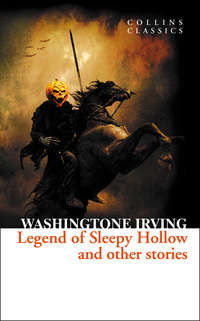
Kitabı oku: «The Legend of Sleepy Hollow and Other Stories»
THE LEGEND OF SLEEPY HOLLOW AND OTHER STORIES
Washington Irving

“I have no wife nor children, good or bad, to provide for. A mere spectator of other men’s fortunes and adventures, and how they play their parts; which, methinks, are diversely presented unto me, as from a common theatre or scene.”
—BURTON.
CONTENTS
Title Page
Epigraph
History of Collins
Life & Times
Preface
The Author’s Account of Himself
The Voyage
Roscoe
The Wife
Rip Van Winkle
English Writers on America
Rural Life in England
The Broken Heart
The Art of Book-making
A Royal Poet
The Country Church
The Widow and her Son
A Sunday in London
The Boar’s Head Tavern
The Mutability of Literature
Rural Funerals
The Inn Kitchen
The Spectre Bridegroom
Westminster Abbey
Christmas
The Stage-Coach
Christmas Eve
Christmas Day
The Christmas Dinner
London Antiques
Little Britain
Statford-on-Avon
Traits of Indian Character
Philip of Pokanoket
John Bull
The Pride of the Village
The Angler
The Legend of Sleepy Hollow
Postscript
L’Envoy
Footnotes
Classic Literature: Words and Phrases adapted from the Collins English Dictionary
Copyright
About the Publisher
History of Collins
In 1819, millworker William Collins from Glasgow, Scotland, set up a company for printing and publishing pamphlets, sermons, hymn books and prayer books. That company was Collins and was to mark the birth of HarperCollins Publishers as we know it today. The long tradition of Collins dictionary publishing can be traced back to the first dictionary William published in 1824, Greek and English Lexicon. Indeed, from 1840 onwards, he began to produce illustrated dictionaries and even obtained a licence to print and publish the Bible.
Soon after, William published the first Collins novel, Ready Reckoner, however it was the time of the Long Depression, where harvests were poor, prices were high, potato crops had failed and violence was erupting in Europe. As a result, many factories across the country were forced to close down and William chose to retire in 1846, partly due to the hardships he was facing.
Aged 30, William’s son, William II took over the business. A keen humanitarian with a warm heart and a generous spirit, William II was truly ‘Victorian’ in his outlook. He introduced new, up-to-date steam presses and published affordable editions of Shakespeare’s works and Pilgrim’s Progress, making them available to the masses for the first time. A new demand for educational books meant that success came with the publication of travel books, scientific books, encyclopaedias and dictionaries. This demand to be educated led to the later publication of atlases and Collins also held the monopoly on scripture writing at the time.
In the 1860s Collins began to expand and diversify and the idea of ‘books for the millions’ was developed. Affordable editions of classical literature were published and in 1903 Collins introduced 10 titles in their Collins Handy Illustrated Pocket Novels. These proved so popular that a few years later this had increased to an output of 50 volumes, selling nearly half a million in their year of publication. In the same year, The Everyman’s Library was also instituted, with the idea of publishing an affordable library of the most important classical works, biographies, religious and philosophical treatments, plays, poems, travel and adventure. This series eclipsed all competition at the time and the introduction of paperback books in the 1950s helped to open that market and marked a high point in the industry.
HarperCollins is and has always been a champion of the classics and the current Collins Classics series follows in this tradition – publishing classical literature that is affordable and available to all. Beautifully packaged, highly collectible and intended to be reread and enjoyed at every opportunity.
Life & Times
The Legend of Sleepy Hollow and Timeless Tales
Originally the eponymous tale, The Legend of Sleepy Hollow, was just one story among more than 30 in a collection entitled The Sketch Book of Geoffrey Crayon, Gent (1819–20). Geoffrey Crayon was the pseudonym of the American author Washington Irving. Of those stories, two in particular became more famous than the others: The Legend of Sleepy Hollow and Rip Van Winkle. Both stories were set in New York State, but Irving wrote them in Birmingham – not in Birmingham, Alabama, but in the West Midlands, England, where he happened to be staying with his sister at the time.
Other stories include The Spectre Bridegroom, which has its source in a folklore tale shared by the 2005 stop-frame animation film, Tim Burton’s Corpse Bride. Another story, entitled Little Britain, was the name of a squalid and colourful district in 19th-century London, so called because it was a microcosm of British society. Irving’s story amounts to a stroll through this defining heart of the capital. The British comedians Matt Lucas and David Walliams used the same title for their comedy sketch show because they populated it with a cast of eccentrically British characters, in much the same vein as Irving’s story. Further stories are set in America, England, Scotland and Ireland.
The reasons why the stories of The Legend of Sleepy Hollow and Rip Van Winkle have become more successful than the others seems to be threefold. Firstly, they have a sense of completeness in the tradition of storytelling, in that they have a beginning, middle and end. Secondly, one would be forgiven for believing that they were both genuine American folk stories, which Irving had simply committed to the page. Thirdly, because they are set in America, they possess a distinctive quality – to the British audience, they had a romantic exoticness, while to the American audience, they filled a perceived gap in folk tradition as the country was still in its infancy at that time.
The Legend of Sleepy Hollow cleverly combines ghost story with romantic comedy and also has an uncertain ending, leaving the reader to surmise what may, or may not, have happened. It also has memorable, if a little clichéd, characters, representing archetypes of sorts. Rip Van Winkle deals with the transition of America, from sovereignty to independence, by imagining what a character would experience if he were to fall asleep for 20 years, much like in a fairy tale.
About the Author: Transatlantic Popularity
Irving was very much a product of the emergent US. The year of his birth, 1783, marked the end of the American Revolutionary War, and he was named after George Washington, who was then commander-in-chief of the Continental Army and would go on to become the first president of the United States of America in 1789. The war had lasted eight years and was seen as a metamorphosis that was keenly felt by Irving’s parent’s generation.
This sense of transition is where he found his inspiration for Rip Van Winkle, as the character was a traveler in time, spanning the turbulence. The eponymous Rip is, in effect, a personification of the metamorphosis of America from larva, through pupa, to imago. Little was Irving to realize, however, that America would be plunged into bitter civil war just two years following his death. Independence in itself was not enough, as the North and South had different ideas about what it actually meant to be American. In the end, much more blood would be shed in order to find the way forward.
Irving is credited with having become the first American author to garner international success. This is partly because his parents were British immigrants who settled in New York. This gave Irving a footing on both sides of the Atlantic, a fact he took full advantage of by establishing many contacts in both America and Europe. In addition to this, Irving was influenced by the wealth of folk stories that emanated from the European continent and lived on in the subcultures of those who had found their new home in the US.
The result was that Irving had an eye for writing stories that, although original, had an air of traditional authenticity, along with a ready market comprising Europeans and their New World diaspora. Irving had an extended stay in Britain and Europe and, at one stage, and had a liaison with Mary Shelley, the author of Frankenstein, following the death of her husband and subsequent return to England.
Within the literary community, Irving was very highly regarded on both sides of the Atlantic. He actively encouraged his fellow American authors to try their luck on the international scene, and his work was also admired by contemporary British authors. At the time, writing was not generally accepted as an orthodox profession, but Irving amply demonstrated that it was possible to make a respectable living from the pen. He also initiated the idea that there should be laws to protect authors and publishers from infringement of copyright and piracy, as it was all too easy for others to steal original ideas or to simply sell counterfeit copies of novels without fear of prosecution.
Irving is famed for his clever marketing prowess. In 1809 he was ready to publish his first major work, with the ludicrously long title A History of New-York from the Beginning of the World to the End of the Dutch Dynasty, by Diedrich Knickerbocker. To garner attention, Irving placed ‘missing person’ postings in New York papers, pretending that Knickerbocker was a real Dutch author who had vanished from his hotel room. He followed this with a hoax posting from the proprietor of the hotel, stating that an abandoned manuscript would be used to settle Knickerbocker’s hotel bill if he failed to resurface. New Yorkers were so beguiled that they were primed for reading the book, which was published in December of that year.
Irving initially took the pseudonym Knickerbocker, but the readership didn’t mind when he revealed that they had been duped, because they so loved the book and admired Irving’s guile. He had become an overnight celebrity, and his writing career was assured. Today the name Knickerbocker has become synonymous with those who live in Manhattan, but it was also used as the title of an influential literary magazine. Irving himself became a member of its staff for a few years.
The period 1842–46 saw Irving enter politics, as Minister to Spain. He presumed that the role would be somewhat honorary, so that he could spend much of his time writing. However, it was anything but, as Spain was a rather turbulent place at the time due to the Spanish queen still being a child, so that there was much infighting for power among those in government. Irving also became involved with long-winded negotiations over trade between the Americans and the Iberians. This included the Spanish territory of Cuba, which was problematic due to the use of slave labour – the issue that would soon ignite the American Civil War.
When Irving returned to America, he grew ever closer to the hearts of the nation the older he became. He was viewed as a sage of American literature and a wise elder statesman. He was blessed with talent, intelligence and an affable personality, which gave him an unprecedented likeability.
Interestingly, the perception of Irving’s learnedness was so strong that he inadvertently introduced a historical myth that became taught as historical fact; a fact that has persisted after his death, to this day. He published a biography of the explorer Christopher Columbus in 1828, in which he stated that Europeans believed the world to be flat, so that Columbus’s crew feared falling off the edge of the world during their voyage into the unknown. The truth is that Aristotle, the Greek philosopher, had settled on the idea of the world being spherical in the 4th century BC and medieval European culture was based on Aristotelian thinking. Furthermore, the curvature of the Earth was clearly in evidence to those navigating the oceans in 1492.
PREFACE TO THE REVISED EDITION.
The following papers, with two exceptions, were written in England, and formed but part of an intended series for which I had made notes and memorandums. Before I could mature a plan, however, circumstances compelled me to send them piecemeal to the United States, where they were published from time to time in portions or numbers. It was not my intention to publish them in England, being conscious that much of their contents could be interesting only to American readers, and, in truth, being deterred by the severity with which American productions had been treated by the British press.
By the time the contents of the first volume had appeared in this occasional manner, they began to find their way across the Atlantic, and to be inserted, with many kind encomiums, in the London Literary Gazette. It was said, also, that a London bookseller intended to publish them in a collective form. I determined, therefore, to bring them forward myself, that they might at least have the benefit of my superintendence and revision. I accordingly took the printed numbers which I had received from the United States, to Mr. John Murray, the eminent publisher, from whom I had already received friendly attentions, and left them with him for examination, informing him that should he be inclined to bring them before the public, I had materials enough on hand for a second volume. Several days having elapsed without any communication from Mr. Murray, I addressed a note to him, in which I construed his silence into a tacit rejection of my work, and begged that the numbers I had left with him might be returned to me. The following was his reply:
MY DEAR SIR: I entreat you to believe that I feel truly obliged by your kind intentions towards me, and that I entertain the most unfeigned respect for your most tasteful talents. My house is completely filled with workpeople at this time, and I have only an office to transact business in; and yesterday I was wholly occupied, or I should have done myself the pleasure of seeing you.
If it would not suit me to engage in the publication of your present work, it is only because I do not see that scope in the nature of it which would enable me to make those satisfactory accounts between us, without which I really feel no satisfaction in engaging—but I will do all I can to promote their circulation, and shall be most ready to attend to any future plan of yours.
With much regard, I remain, dear sir,
Your faithful servant,
JOHN MURRAY.
This was disheartening, and might have deterred me from any further prosecution of the matter, had the question of republication in Great Britain rested entirely with me; but I apprehended the appearance of a spurious edition. I now thought of Mr. Archibald Constable as publisher, having been treated by him with much hospitality during a visit to Edinburgh; but first I determined to submit my work to Sir-Walter (then Mr.) Scott, being encouraged to do so by the cordial reception I had experienced from him at Abbotsford a few years previously, and by the favorable opinion he had expressed to others of my earlier writings. I accordingly sent him the printed numbers of the Sketch-Book in a parcel by coach, and at the same time wrote to him, hinting that since I had had the pleasure of partaking of his hospitality, a reverse had taken place in my affairs which made the successful exercise of my pen all-important to me; I begged him, therefore, to look over the literary articles I had forwarded to him, and, if he thought they would bear European republication, to ascertain whether Mr. Constable would be inclined to be the publisher.
The parcel containing my work went by coach to Scott’s address in Edinburgh; the letter went by mail to his residence in the country. By the very first post I received a reply, before he had seen my work.
“I was down at Kelso,” said he, “when your letter reached Abbotsford. I am now on my way to town, and will converse with Constable, and do all in my power to forward your views—I assure you nothing will give me more pleasure.”
The hint, however, about a reverse of fortune had struck the quick apprehension of Scott, and, with that practical and efficient good-will which belonged to his nature, he had already devised a way of aiding me. A weekly periodical, he went on to inform me, was about to be set up in Edinburgh, supported by the most respectable talents, and amply furnished with all the necessary information. The appointment of the editor, for which ample funds were provided, would be five hundred pounds sterling a year, with the reasonable prospect of further advantages. This situation, being apparently at his disposal, he frankly offered to me. The work, however, he intimated, was to have somewhat of a political bearing, and he expressed an apprehension that the tone it was desired to adopt might not suit me. “Yet I risk the question,” added he, “because I know no man so well qualified for this important task, and perhaps because it will necessarily bring you to Edinburgh. If my proposal does not suit, you need only keep the matter secret and there is no harm done. ‘And for my love I pray you wrong me not.’ If on the contrary you think it could be made to suit you, let me know as soon as possible, addressing Castle Street, Edinburgh.”
In a postscript, written from Edinburgh, he adds, “I am just come here, and have glanced over the Sketch-Book. It is positively beautiful, and increases my desire to crimp you, if it be possible. Some difficulties there always are in managing such a matter, especially at the outset; but we will obviate them as much as we possibly can.”
The following is from an imperfect draught of my reply, which underwent some modifications in the copy sent:
“I cannot express how much I am gratified by your letter. I had begun to feel as if I had taken an unwarrantable liberty; but, somehow or other, there is a genial sunshine about you that warms every creeping thing into heart and confidence. Your literary proposal both surprises and flatters me, as it evinces a much higher opinion of my talents than I have myself.”
I then went on to explain that I found myself peculiarly unfitted for the situation offered to me, not merely by my political opinions, but by the very constitution and habits of my mind. “My whole course of life,” I observed, “has been desultory, and I am unfitted for any periodically recurring task, or any stipulated labor of body or mind. I have no command of my talents, such as they are, and have to watch the varyings of my mind as I would those of a weathercock. Practice and training may bring me more into rule; but at present I am as useless for regular service as one of my own country Indians or a Don Cossack.
“I must, therefore, keep on pretty much as I have begun; writing when I can, not when I would. I shall occasionally shift my residence and write whatever is suggested by objects before me, or whatever rises in my imagination; and hope to write better and more copiously by and by.
“I am playing the egotist, but I know no better way of answering your proposal than by showing what a very good-for-nothing kind of being I am. Should Mr. Constable feel inclined to make a bargain for the wares I have on hand, he will encourage me to further enterprise; and it will be something like trading with a gypsy for the fruits of his prowlings, who may at one time have nothing but a wooden bowl to offer, and at another time a silver tankard.”
In reply, Scott expressed regret, but not surprise, at my declining what might have proved a troublesome duty. He then recurred to the original subject of our correspondence; entered into a detail of the various terms upon which arrangements were made between authors and booksellers, that I might take my choice; expressing the most encouraging confidence of the success of my work, and of previous works which I had produced in America. “I did no more,” added he, “than open the trenches with Constable; but I am sure if you will take the trouble to write to him, you will find him disposed to treat your overtures with every degree of attention. Or, if you think it of consequence in the first place to see me, I shall be in London in the course of a month, and whatever my experience can command is most heartily at your command. But I can add little to what I have said above, except my earnest recommendation to Constable to enter into the negotiation.”1
Before the receipt of this most obliging letter, however, I had determined to look to no leading bookseller for a launch, but to throw my work before the public at my own risk, and let it sink or swim according to its merits. I wrote to that effect to Scott, and soon received a reply:
“I observe with pleasure that you are going to come forth in Britain. It is certainly not the very best way to publish on one’s own accompt; for the booksellers set their face against the circulation of such works as do not pay an amazing toll to themselves. But they have lost the art of altogether damming up the road in such cases between the author and the public, which they were once able to do as effectually as Diabolus in John Bunyan’s Holy War closed up the windows of my Lord Understanding’s mansion. I am sure of one thing, that you have only to be known to the British public to be admired by them, and I would not say so unless I really was of that opinion.
“If you ever see a witty but rather local publication called Blackwood’s Edinburgh Magazine, you will find some notice of your works in the last number: the author is a friend of mine, to whom I have introduced you in your literary capacity. His name is Lockhart, a young man of very considerable talent, and who will soon be intimately connected with my family. My faithful friend Knickerbocker is to be next examined and illustrated. Constable was extremely willing to enter into consideration of a treaty for your works, but I foresee will be still more so when
Your name is up, and may go
From Toledo to Madrid.
—And that will soon be the case. I trust to be in London about the middle of the month, and promise myself great pleasure in once again shaking you by the hand.”
The first volume of the Sketch-Book was put to press in London, as I had resolved, at my own risk, by a bookseller unknown to fame, and without any of the usual arts by which a work is trumpeted into notice. Still some attention had been called to it by the extracts which had previously appeared in the Literary Gazette, and by the kind word spoken by the editor of that periodical, and it was getting into fair circulation, when my worthy bookseller failed before the first month was over, and the sale was interrupted.
At this juncture Scott arrived in London. I called to him for help, as I was sticking in the mire, and, more propitious than Hercules, he put his own shoulder to the wheel. Through his favorable representations, Murray was quickly induced to undertake the future publication of the work which he had previously declined. A further edition of the first volume was struck off and the second volume was put to press, and from that time Murray became my publisher, conducting himself in all his dealings with that fair, open, and liberal spirit which had obtained for him the well-merited appellation of the Prince of Booksellers.
Thus, under the kind and cordial auspices of Sir Walter Scott, I began my literary career in Europe; and I feel that I am but discharging, in a trifling degree, my debt of gratitude to the memory of that golden-hearted man in acknowledging my obligations to him. But who of his literary contemporaries ever applied to him for aid or counsel that did not experience the most prompt, generous, and effectual assistance?
W. I.
SUNNYSIDE, 1848.
THE AUTHOR’S ACCOUNT OF HIMSELF
I am of this mind with Homer, that as the snaile that crept out of her shel was turned eftsoones into a toad I and thereby was forced to make a stoole to sit on; so the traveller that stragleth from his owne country is in a short time transformed into so monstrous a shape, that he is faine to alter his mansion with his manners, and to live where he can, not where he would.
—LYLY’S EUPHUES.
I was always fond of visiting new scenes, and observing strange characters and manners. Even when a mere child I began my travels, and made many tours of discovery into foreign parts and unknown regions of my native city, to the frequent alarm of my parents, and the emolument of the town crier. As I grew into boyhood, I extended the range of my observations. My holiday afternoons were spent in rambles about the surrounding country. I made myself familiar with all its places famous in history or fable. I knew every spot where a murder or robbery had been committed, or a ghost seen. I visited the neighboring villages, and added greatly to my stock of knowledge, by noting their habits and customs, and conversing with their sages and great men. I even journeyed one long summer’s day to the summit of the most distant hill, whence I stretched my eye over many a mile of terra incognita, and was astonished to find how vast a globe I inhabited.
This rambling propensity strengthened with my years. Books of voyages and travels became my passion, and in devouring their contents, I neglected the regular exercises of the school. How wistfully would I wander about the pier-heads in fine weather, and watch the parting ships, bound to distant climes; with what longing eyes would I gaze after their lessening sails, and waft myself in imagination to the ends of the earth!
Further reading and thinking, though they brought this vague inclination into more reasonable bounds, only served to make it more decided. I visited various parts of my own country; and had I been merely a lover of fine scenery, I should have felt little desire to seek elsewhere its gratification, for on no country had the charms of nature been more prodigally lavished. Her mighty lakes, her oceans of liquid silver; her mountains, with their bright aerial tints; her valleys, teeming with wild fertility; her tremendous cataracts, thundering in their solitudes; her boundless plains, waving with spontaneous verdure; her broad, deep rivers, rolling in solemn silence to the ocean; her trackless forests, where vegetation puts forth all its magnificence; her skies, kindling with the magic of summer clouds and glorious sunshine;—no, never need an American look beyond his own country for the sublime and beautiful of natural scenery.
But Europe held forth all the charms of storied and poetical association. There were to be seen the masterpieces of art, the refinements of highly cultivated society, the quaint peculiarities of ancient and local custom. My native country was full of youthful promise; Europe was rich in the accumulated treasures of age. Her very ruins told the history of the times gone by, and every mouldering stone was a chronicle. I longed to wander over the scenes of renowned achievement—to tread, as it were, in the footsteps of antiquity—to loiter about the ruined castle—to meditate on the falling tower—to escape, in short, from the commonplace realities of the present, and lose myself among the shadowy grandeurs of the past.
I had, besides all this, an earnest desire to see the great men of the earth. We have, it is true, our great men in America: not a city but has an ample share of them. I have mingled among them in my time, and been almost withered by the shade into which they cast me; for there is nothing so baleful to a small man as the shade of a great one, particularly the great man of a city. But I was anxious to see the great men of Europe; for I had read in the works of various philosophers, that all animals degenerated in America, and man among the number. A great man of Europe, thought I, must therefore be as superior to a great man of America, as a peak of the Alps to a highland of the Hudson; and in this idea I was confirmed by observing the comparative importance and swelling magnitude of many English travellers among us, who, I was assured, were very little people in their own country. I will visit this land of wonders, thought I, and see the gigantic race from which I am degenerated.
It has been either my good or evil lot to have my roving passion gratified. I have wandered through different countries and witnessed many of the shifting scenes of life. I cannot say that I have studied them with the eye of a philosopher, but rather with the sauntering gaze with which humble lovers of the picturesque stroll from the window of one print-shop to another; caught sometimes by the delineations of beauty, sometimes by the distortions of caricature, and sometimes by the loveliness of landscape. As it is the fashion for modern tourists to travel pencil in hand, and bring home their portfolios filled with sketches, I am disposed to get up a few for the entertainment of my friends. When, however, I look over the hints and memorandums I have taken down for the purpose, my heart almost fails me, at finding how my idle humor has led me astray from the great object studied by every regular traveller who would make a book. I fear I shall give equal disappointment with an unlucky landscape-painter, who had travelled on the Continent, but following the bent of his vagrant inclination, had sketched in nooks, and corners, and by-places. His sketch-book was accordingly crowded with cottages, and landscapes, and obscure ruins; but he had neglected to paint St. Peter’s, or the Coliseum, the cascade of Terni, or the bay of Naples, and had not a single glacier or volcano in his whole collection.
THE VOYAGE.
Ships, ships, I will descrie you
Amidst the main,
I will come and try you,
What you are protecting,
And projecting,
What’s your end and aim.
One goes abroad for merchandise and trading,
Another stays to keep his country from invading,
A third is coming home with rich and wealthy lading.
Hallo! my fancie, whither wilt thou go?
OLD POEM.
To an American visiting Europe, the long voyage he has to make is an excellent preparative. The temporary absence of worldly scenes and employments produces a state of mind peculiarly fitted to receive new and vivid impressions. The vast space of waters that separate the hemispheres is like a blank page in existence. There is no gradual transition by which, as in Europe, the features and population of one country blend almost imperceptibly with those of another. From the moment you lose sight of the land you have left, all is vacancy, until you step on the opposite shore, and are launched at once into the bustle and novelties of another world.
In travelling by land there is a continuity of scene, and a connected succession of persons and incidents, that carry on the story of life, and lessen the effect of absence and separation. We drag, it is true, “a lengthening chain” at each remove of our pilgrimage; but the chain is unbroken; we can trace it back link by link; and we feel that the last still grapples us to home. But a wide sea voyage severs us at once. It makes us conscious of being cast loose from the secure anchorage of settled life, and sent adrift upon a doubtful world. It interposes a gulf, not merely imaginary, but real, between us and our homes—a gulf, subject to tempest, and fear, and uncertainty, rendering distance palpable, and return precarious.
Such, at least, was the case with myself. As I saw the last blue lines of my native land fade away like a cloud in the horizon, it seemed as if I had closed one volume of the world and its concerns, and had time for meditation, before I opened another. That land, too, now vanishing from my view, which contained all most dear to me in life; what vicissitudes might occur in it—what changes might take place in me, before I should visit it again! Who can tell, when he sets forth to wander, whither he may be driven by the uncertain currents of existence; or when he may return; or whether it may be ever his lot to revisit the scenes of his childhood?
I said, that at sea all is vacancy; I should correct the impression. To one given to day-dreaming, and fond of losing himself in reveries, a sea voyage is full of subjects for meditation; but then they are the wonders of the deep and of the air, and rather tend to abstract the mind from worldly themes. I delighted to loll over the quarter-railing or climb to the main-top, of a calm day, and muse for hours together on the tranquil bosom of a summer’s sea; to gaze upon the piles of golden clouds just peering above the horizon, fancy them some fairy realms, and people them with a creation of my own;—to watch the gently undulating billows rolling their silver volumes, as if to die away on those happy shores.
There was a delicious sensation of mingled security and awe with which I looked down, from my giddy height, on the monsters of the deep at their uncouth gambols: shoals of porpoises tumbling about the bow of the ship; the grampus, slowly heaving his huge form above the surface; or the ravenous shark, darting, like a spectre, through the blue waters. My imagination would conjure up all that I had heard or read of the watery world beneath me; of the finny herds that roam its fathomless valleys; of the shapeless monsters that lurk among the very foundations of the earth; and of those wild phantasms that swell the tales of fishermen and sailors.
Sometimes a distant sail, gliding along the edge of the ocean, would be another theme of idle speculation. How interesting this fragment of a world, hastening to rejoin the great mass of existence! What a glorious monument of human invention; which has in a manner triumphed over wind and wave; has brought the ends of the world into communion; has established an interchange of blessings, pouring into the sterile regions of the north all the luxuries of the south; has diffused the light of knowledge, and the charities of cultivated life; and has thus bound together those scattered portions of the human race, between which nature seemed to have thrown an insurmountable barrier.
We one day descried some shapeless object drifting at a distance. At sea, every thing that breaks the monotony of the surrounding expanse attracts attention. It proved to be the mast of a ship that must have been completely wrecked; for there were the remains of handkerchiefs, by which some of the crew had fastened themselves to this spar, to prevent their being washed off by the waves. There was no trace by which the name of the ship could be ascertained. The wreck had evidently drifted about for many months; clusters of shell-fish had fastened about it, and long sea-weeds flaunted at its sides. But where, thought I, is the crew? Their struggle has long been over—they have gone down amidst the roar of the tempest—their bones lie whitening among the caverns of the deep. Silence, oblivion, like the waves, have closed over them, and no one can tell the story of their end. What sighs have been wafted after that ship! what prayers offered up at the deserted fireside of home! How often has the mistress, the wife, the mother, pored over the daily news, to catch some casual intelligence of this rover of the deep! How has expectation darkened into anxiety—anxiety into dread—and dread into despair! Alas! not one memento may ever return for love to cherish. All that may ever be known, is that she sailed from her port, “and was never heard of more!”
The sight of this wreck, as usual, gave rise to many dismal anecdotes. This was particularly the case in the evening, when the weather, which had hitherto been fair, began to look wild and threatening, and gave indications of one of those sudden storms that will sometimes break in upon the serenity of a summer voyage. As we sat round the dull light of a lamp, in the cabin, that made the gloom more ghastly, everyone had his tale of shipwreck and disaster. I was particularly struck with a short one related by the captain:
“As I was once sailing,” said he, “in a fine, stout ship, across the banks of Newfoundland, one of those heavy fogs that prevail in those parts rendered it impossible for us to see far ahead, even in the daytime; but at night the weather was so thick that we could not distinguish any object at twice the length of the ship. I kept lights at the mast-head, and a constant watch forward to look out for fishing smacks, which are accustomed to anchor of the banks. The wind was blowing a smacking breeze, and we were going at a great rate through the water. Suddenly the watch gave the alarm of ‘a sail ahead!’—it was scarcely uttered before we were upon her. She was a small schooner, at anchor, with her broadside toward us. The crew were all asleep, and had neglected to hoist a light. We struck her just amidships. The force, the size, and weight of our vessel, bore her down below the waves; we passed over her and were hurried on our course. As the crashing wreck was sinking beneath us, I had a glimpse of two or three half-naked wretches, rushing from her cabin; they just started from their beds to be swallowed shrieking by the waves. I heard their drowning cry mingling with the wind. The blast that bore it to our ears, swept us out of all further hearing. I shall never forget that cry! It was some time before we could put the ship about, she was under such headway. We returned, as nearly as we could guess, to the place where the smack had anchored. We cruised about for several hours in the dense fog. We fired signal-guns, and listened if we might hear the halloo of any survivors: but all was silent—we never saw or heard any thing of them more.”
I confess these stories, for a time, put an end to all my fine fancies. The storm increased with the night. The sea was lashed into tremendous confusion. There was a fearful, sullen sound of rushing waves and broken surges. Deep called unto deep. At times the black volume of clouds overhead seemed rent asunder by flashes of lightning which quivered along the foaming billows, and made the succeeding darkness doubly terrible. The thunders bellowed over the wild waste of waters, and were echoed and prolonged by the mountain waves. As I saw the ship staggering and plunging among these roaring caverns, it seemed miraculous that she regained her balance, or preserved her buoyancy. Her yards would dip into the water; her bow was almost buried beneath the waves. Sometimes an impending surge appeared ready to overwhelm her, and nothing but a dexterous movement of the helm preserved her from the shock.
When I retired to my cabin, the awful scene still followed me. The whistling of the wind through the rigging sounded like funereal wailings. The creaking of the masts; the straining and groaning of bulkheads, as the ship labored in the weltering sea, were frightful. As I heard the waves rushing along the side of the ship, and roaring in my very ear, it seemed as if Death were raging around this floating prison, seeking for his prey: the mere starting of a nail, the yawning of a seam, might give him entrance.
A fine day, however, with a tranquil sea and favoring breeze, soon put all these dismal reflections to flight. It is impossible to resist the gladdening influence of fine weather and fair wind at sea. When the ship is decked out in all her canvas, every sail swelled, and careering gayly over the curling waves, how lofty, how gallant, she appears—how she seems to lord it over the deep!
I might fill a volume with the reveries of a sea voyage; for with me it is almost a continual reverie—but it is time to get to shore.
It was a fine sunny morning when the thrilling cry of “land!” was given from the mast-head. None but those who have experienced it can form an idea of the delicious throng of sensations which rush into an American’s bosom, when he first comes in sight of Europe. There is a volume of associations with the very name. It is the land of promise, teeming with everything of which his childhood has heard, or on which his studious years have pondered.
From that time, until the moment of arrival, it was all feverish excitement. The ships of war, that prowled like guardian giants along the coast; the headlands of Ireland, stretching out into the channel; the Welsh mountains towering into the clouds;—all were objects of intense interest. As we sailed up the Mersey, I reconnoitred the shores with a telescope. My eye dwelt with delight on neat cottages, with their trim shrubberies and green grass-plots. I saw the mouldering ruin of an abbey overrun with ivy, and the taper spire of a village church rising from the brow of a neighboring hill;—all were characteristic of England.
The tide and wind were so favorable, that the ship was enabled to come at once to her pier. It was thronged with people; some idle lookers-on; others, eager expectants of friends or relations. I could distinguish the merchant to whom the ship was consigned. I knew him by his calculating brow and restless air. His hands were thrust into his pockets; he was whistling thoughtfully, and walking to and fro, a small space having been accorded him by the crowd, in deference to his temporary importance. There were repeated cheerings and salutations interchanged between the shore and the ship, as friends happened to recognize each other. I particularly noticed one young woman of humble dress, but interesting demeanor. She was leaning forward from among the crowd; her eye hurried over the ship as it neared the shore, to catch some wished-for countenance. She seemed disappointed and sad; when I heard a faint voice call her name. It was from a poor sailor who had been ill all the voyage, and had excited the sympathy of every one on board. When the weather was fine, his messmates had spread a mattress for him on deck in the shade, but of late his illness had so increased that he had taken to his hammock, and only breathed a wish that he might see his wife before he died. He had been helped on deck as we came up the river, and was now leaning against the shrouds, with a countenance so wasted, so pale, so ghastly, that it was no wonder even the eye of affection did not recognize him. But at the sound of his voice, her eye darted on his features: it read, at once, a whole volume of sorrow; she clasped her hands, uttered a faint shriek, and stood wringing them in silent agony.
All now was hurry and bustle. The meetings of acquaintances—the greetings of friends—the consultations of men of business. I alone was solitary and idle. I had no friend to meet, no cheering to receive. I stepped upon the land of my forefathers—but felt that I was a stranger in the land.
ROSCOE.
—In the service of mankind to be
A guardian god below; still to employ
The mind’s brave ardor in heroic aims,
Such as may raise us o’er the grovelling herd,
And make us shine for ever—that is life.
THOMSON.
One of the first places to which a stranger is taken in Liverpool is the Athenaeum. It is established on a liberal and judicious plan; it contains a good library, and spacious reading-room, and is the great literary resort of the place. Go there at what hour you may, you are sure to find it filled with grave-looking personages, deeply absorbed in the study of newspapers.
As I was once visiting this haunt of the learned, my attention was attracted to a person just entering the room. He was advanced in life, tall, and of a form that might once have been commanding, but it was a little bowed by time—perhaps by care. He had a noble Roman style of countenance; a head that would have pleased a painter; and though some slight furrows on his brow showed that wasting thought had been busy there, yet his eye beamed with the fire of a poetic soul. There was something in his whole appearance that indicated a being of a different order from the bustling race round him.
I inquired his name, and was informed that it was ROSCOE. I drew back with an involuntary feeling of veneration. This, then, was an author of celebrity; this was one of those men whose voices have gone forth to the ends of the earth; with whose minds I have communed even in the solitudes of America. Accustomed, as we are in our country, to know European writers only by their works, we cannot conceive of them, as of other men, engrossed by trivial or sordid pursuits, and jostling with the crowd of common minds in the dusty paths of life. They pass before our imaginations like superior beings, radiant with the emanations of their genius, and surrounded by a halo of literary glory.
To find, therefore, the elegant historian of the Medici mingling among the busy sons of traffic, at first shocked my poetical ideas; but it is from the very circumstances and situation in which he has been placed, that Mr. Roscoe derives his highest claims to admiration. It is interesting to notice how some minds seem almost to create themselves, springing up under every disadvantage, and working their solitary but irresistible way through a thousand obstacles. Nature seems to delight in disappointing the assiduities of art, with which it would rear legitimate dulness to maturity; and to glory in the vigor and luxuriance of her chance productions. She scatters the seeds of genius to the winds, and though some may perish among the stony places of the world, and some be choked, by the thorns and brambles of early adversity, yet others will now and then strike root even in the clefts of the rock, struggle bravely up into sunshine, and spread over their sterile birthplace all the beauties of vegetation.
Such has been the case with Mr. Roscoe. Born in a place apparently ungenial to the growth of literary talent—in the very market-place of trade; without fortune, family connections, or patronage; self-prompted, self-sustained, and almost self-taught, he has conquered every obstacle, achieved his way to eminence, and, having become one of the ornaments of the nation, has turned the whole force of his talents and influence to advance and embellish his native town.
Indeed, it is this last trait in his character which has given him the greatest interest in my eyes, and induced me particularly to point him out to my countrymen. Eminent as are his literary merits, he is but one among the many distinguished authors of this intellectual nation. They, however, in general, live but for their own fame, or their own pleasures. Their private history presents no lesson to the world, or, perhaps, a humiliating one of human frailty or inconsistency. At best, they are prone to steal away from the bustle and commonplace of busy existence; to indulge in the selfishness of lettered ease; and to revel in scenes of mental, but exclusive enjoyment.
Mr. Roscoe, on the contrary, has claimed none of the accorded privileges of talent. He has shut himself up in no garden of thought, nor elysium of fancy; but has gone forth into the highways and thoroughfares of life, he has planted bowers by the wayside, for the refreshment of the pilgrim and the sojourner, and has opened pure fountains, where the laboring man may turn aside from the dust and heat of the day, and drink of the living streams of knowledge. There is a “daily beauty in his life,” on which mankind may meditate, and grow better. It exhibits no lofty and almost useless, because inimitable, example of excellence; but presents a picture of active, yet simple and imitable virtues, which are within every man’s reach, but which, unfortunately, are not exercised by many, or this world would be a paradise.
But his private life is peculiarly worthy the attention of the citizens of our young and busy country, where literature and the elegant arts must grow up side by side with the coarser plants of daily necessity; and must depend for their culture, not on the exclusive devotion of time and wealth; nor the quickening rays of titled patronage; but on hours and seasons snatched from the purest of worldly interests, by intelligent and public-spirited individuals.
He has shown how much may be done for a place in hours of leisure by one master-spirit, and how completely it can give its own impress to surrounding objects. Like his own Lorenzo de’ Medici, on whom he seems to have fixed his eye, as on a pure model of antiquity, he has interwoven the history of his life with the history of his native town, and has made the foundations of his fame the monuments of his virtues. Wherever you go, in Liverpool, you perceive traces of his footsteps in all that is elegant and liberal. He found the tide of wealth flowing merely in the channels of traffic; he has diverted from it invigorating rills to refresh the garden of literature. By his own example and constant exertions, he has effected that union of commerce and the intellectual pursuits, so eloquently recommended in one of his latest writings;2 and has practically proved how beautifully they may be brought to harmonize, and to benefit each other. The noble institutions for literary and scientific purposes, which reflect such credit on Liverpool, and are giving such an impulse to the public mind, have mostly been originated, and have all been effectively promoted, by Mr. Roscoe; and when we consider the rapidly increasing opulence and magnitude of that town, which promises to vie in commercial importance with the metropolis, it will be perceived that in awakening an ambition of mental improvement among its inhabitants, he has effected a great benefit to the cause of British literature.
In America, we know Mr. Roscoe only as the author; in Liverpool he is spoken of as the banker; and I was told of his having been unfortunate in business. I could not pity him, as I heard some rich men do. I considered him far above the reach of pity. Those who live only for the world, and in the world, may be cast down by the frowns of adversity; but a man like Roscoe is not to be overcome by the reverses of fortune. They do but drive him in upon the resources of his own mind, to the superior society of his own thoughts; which the best of men are apt sometimes to neglect, and to roam abroad in search of less worthy associates. He is independent of the world around him. He lives with antiquity, and with posterity: with antiquity, in the sweet communion of studious retirement; and with posterity, in the generous aspirings after future renown. The solitude of such a mind is its state of highest enjoyment. It is then visited by those elevated meditations which are the proper aliment of noble souls, and are, like manna, sent from heaven, in the wilderness of this world.
While my feelings were yet alive on the subject, it was my fortune to light on further traces of Mr. Roscoe. I was riding out with a gentleman, to view the environs of Liverpool, when he turned off, through a gate, into some ornamented grounds. After riding a short distance, we came to a spacious mansion of freestone, built in the Grecian style. It was not in the purest style, yet it had an air of elegance, and the situation was delightful. A fine lawn sloped away from it, studded with clumps of trees, so disposed as to break a soft fertile country into a variety of landscapes. The Mersey was seen winding a broad quiet sheet of water through an expanse of green meadow land, while the Welsh mountains, blended with clouds, and melting into distance, bordered the horizon.
This was Roscoe’s favorite residence during the days of his prosperity. It had been the seat of elegant hospitality and literary retirement. The house was now silent and deserted. I saw the windows of the study, which looked out upon the soft scenery I have mentioned. The windows were closed—the library was gone. Two or three ill-favored beings were loitering about the place, whom my fancy pictured into retainers of the law. It was like visiting some classic fountain, that had once welled its pure waters in a sacred shade, but finding it dry and dusty, with the lizard and the toad brooding over the shattered marbles.
I inquired after the fate of Mr. Roscoe’s library, which had consisted of scarce and foreign books, from many of which he had drawn the materials for his Italian histories. It had passed under the hammer of the auctioneer, and was dispersed about the country. The good people of the vicinity thronged like wreckers to get some part of the noble vessel that had been driven on shore. Did such a scene admit of ludicrous associations, we might imagine something whimsical in this strange irruption in the regions of learning. Pigmies rummaging the armory of a giant, and contending for the possession of weapons which they could not wield. We might picture to ourselves some knot of speculators, debating with calculating brow over the quaint binding and illuminated margin of an obsolete author; of the air of intense, but baffled sagacity, with which some successful purchaser attempted to dive into the black-letter bargain he had secured.
It is a beautiful incident in the story of Mr. Roscoe’s misfortunes, and one which cannot fail to interest the studious mind, that the parting with his books seems to have touched upon his tenderest feelings, and to have been the only circumstance that could provoke the notice of his muse. The scholar only knows how dear these silent, yet eloquent, companions of pure thoughts and innocent hours become in the season of adversity. When all that is worldly turns to dross around us, these only retain their steady value. When friends grow cold, and the converse of intimates languishes into vapid civility and commonplace, these only continue the unaltered countenance of happier days, and cheer us with that true friendship which never deceived hope, nor deserted sorrow.
I do not wish to censure; but, surely, if the people of Liverpool had been properly sensible of what was due to Mr. Roscoe and themselves, his library would never have been sold. Good worldly reasons may, doubtless, be given for the circumstance, which it would be difficult to combat with others that might seem merely fanciful; but it certainly appears to me such an opportunity as seldom occurs, of cheering a noble mind struggling under misfortunes by one of the most delicate, but most expressive tokens of public sympathy. It is difficult, however, to estimate a man of genius properly who is daily before our eyes. He becomes mingled and confounded with other men. His great qualities lose their novelty; we become too familiar with the common materials which form the basis even of the loftiest character. Some of Mr. Roscoe’s townsmen may regard him merely as a man of business; others, as a politician; all find him engaged like themselves in ordinary occupations, and surpassed, perhaps, by themselves on some points of worldly wisdom. Even that amiable and unostentatious simplicity of character, which gives the nameless grace to real excellence, may cause him to be undervalued by some coarse minds, who do not know that true worth is always void of glare and pretension. But the man of letters, who speaks of Liverpool, speaks of it as the residence of Roscoe. The intelligent traveller who visits it inquires where Roscoe is to be seen. He is the literary landmark of the place, indicating its existence to the distant scholar. He is like Pompey’s column at Alexandria, towering alone in classic dignity.
The following sonnet, addressed by Mr. Roscoe to his books, on parting with them, has already been alluded to. If anything can add effect to the pure feeling and elevated thought here displayed, it is the conviction, that the whole is no effusion of fancy, but a faithful transcript from the writer’s heart.
TO MY BOOKS.
As one who, destined from his friends to part,
Regrets his loss, but hopes again erewhile
To share their converse and enjoy their smile,
And tempers as he may affliction’s dart;
Thus, loved associates, chiefs of elder art,
Teachers of wisdom, who could once beguile
My tedious hours, and lighten every toil,
I now resign you; nor with fainting heart;
For pass a few short years, or days, or hours,
And happier seasons may their dawn unfold,
And all your sacred fellowship restore:
When, freed from earth, unlimited its powers.
Mind shall with mind direct communion hold,
And kindred spirits meet to part no more.
THE WIFE.
The treasures of the deep are not so precious
As are the concealed comforts of a man
Lock’d up in woman’s love. I scent the air
Of blessings, when I came but near the house,
What a delicious breath marriage sends forth—
The violet bed’s no sweeter!
MIDDLETON.
I have often had occasion to remark the fortitude with which women sustain the most overwhelming reverses of fortune. Those disasters which break down the spirit of a man, and prostrate him in the dust, seem to call forth all the energies of the softer sex, and give such intrepidity and elevation to their character, that at times it approaches to sublimity. Nothing can be more touching, than to behold a soft and tender female, who had been all weakness and dependence, and alive to every trivial roughness, while threading the prosperous paths of life, suddenly rising in mental force to be the comforter and support of her husband under misfortune, and abiding with unshrinking firmness the bitterest blasts of adversity.
As the vine, which has long twined its graceful foliage about the oak, and been lifted by it into sunshine, will, when the hardy plant is rifted by the thunderbolt, cling round it with its caressing tendrils, and bind up its shattered boughs, so is it beautifully ordered by Providence, that woman, who is the mere dependent and ornament of man in his happier hours, should be his stay and solace when smitten with sudden calamity; winding herself into the rugged recesses of his nature, tenderly supporting the drooping head, and binding up the broken heart.
I was once congratulating a friend, who had around him a blooming family, knit together in the strongest affection. “I can wish you no better lot,” said he, with enthusiasm, “than to have a wife and children. If you are prosperous, there they are to share your prosperity; if otherwise, there they are to comfort you.” And, indeed, I have observed that a married man falling into misfortune, is more apt to retrieve his situation in the world than a single one; partly, because he is more stimulated to exertion by the necessities of the helpless and beloved beings who depend upon him for subsistence, but chiefly because his spirits are soothed and relieved by domestic endearments, and his self-respect kept alive by finding, that, though all abroad is darkness and humiliation, yet there is still a little world of love at home, of which he is the monarch. Whereas, a single man is apt to run to waste and self-neglect; to fancy himself lonely and abandoned, and his heart to fall to ruin, like some deserted mansion, for want of an inhabitant.
These observations call to mind a little domestic story, of which I was once a witness. My intimate friend, Leslie, had married a beautiful and accomplished girl, who had been brought up in the midst of fashionable life. She had, it is true, no fortune, but that of my friend was ample; and he delighted in the anticipation of indulging her in every elegant pursuit, and administering to those delicate tastes and fancies that spread a kind of witchery about the sex. “Her life,” said he, “shall be like a fairy tale.”
The very difference in their characters produced a harmonious combination; he was of a romantic, and somewhat serious cast; she was all life and gladness. I have often noticed the mute rapture with which he would gaze upon her in company, of which her sprightly powers made her the delight: and how, in the midst of applause, her eye would still turn to him, as if there alone she sought favor and acceptance. When leaning on his arm, her slender form contrasted finely with his tall, manly person. The fond, confiding air with which she looked up to him seemed to call forth a flush of triumphant pride and cherishing tenderness, as if he doated on his lovely burden from its very helplessness. Never did a couple set forward on the flowery path of early and well-suited marriage with a fairer prospect of felicity.
It was the misfortune of my friend, however, to have embarked his property in large speculations; and he had not been married many months, when, by a succession of sudden disasters, it was swept from him, and he found himself reduced to almost penury. For a time he kept his situation to himself, and went about with a haggard countenance, and a breaking heart. His life was but a protracted agony; and what rendered it more insupportable was the necessity of keeping up a smile in the presence of his wife; for he could not bring himself to overwhelm her with the news. She saw, however, with the quick eyes of affection, that all was not well with him. She marked his altered looks and stifled sighs, and was not to be deceived by his sickly and vapid attempts at cheerfulness. She tasked all her sprightly powers and tender blandishments to win him back to happiness; but she only drove the arrow deeper into his soul. The more he saw cause to love her, the more torturing was the thought that he was soon to make her wretched. A little while, thought he, and the smile will vanish from that cheek—the song will die away from those lips—the lustre of those eyes will be quenched with sorrow and the happy heart which now beats lightly in that bosom, will be weighed down, like mine, by the cares and miseries of the world.
At length he came to me one day, and related his whole situation in a tone of the deepest despair. When I had heard him through, I inquired: “Does your wife know all this?” At the question he burst into an agony of tears. “For God’s sake!” cried he, “if you have any pity on me don’t mention my wife; it is the thought of her that drives me almost to madness!”
“And why not?” said I. “She must know it sooner or later: you cannot keep it long from her, and the intelligence may break upon her in a more startling manner than if imparted by yourself; for the accents of those we love soften the harshest tidings. Besides, you are depriving yourself of the comforts of her sympathy; and not merely that, but also endangering the only bond that can keep hearts together—an unreserved community of thought and feeling. She will soon perceive that something is secretly preying upon your mind; and true love will not brook reserve; it feels undervalued and outraged, when even the sorrows of those it loves are concealed from it.”
“Oh, but my friend! to think what a blow I am to give to all her future prospects–how I am to strike her very soul to the earth, by telling her that her husband is a beggar! that she is to forego all the elegancies of life—all the pleasures of society—to shrink with me into indigence and obscurity! To tell her that I have dragged her down from the sphere in which she might have continued to move in constant brightness—the light of every eye—the admiration of every heart!—How can she bear poverty? She has been brought up in all the refinements of opulence. How can she bear neglect? She has been the idol of society. Oh, it will break her heart—it will break her heart!”
I saw his grief was eloquent, and I let it have its flow; for sorrow relieves itself by words. When his paroxysm had subsided, and he had relapsed into moody silence, I resumed the subject gently, and urged him to break his situation at once to his wife. He shook his head mournfully, but positively.
“But how are you to keep it from her? It is necessary she should know it, that you may take the steps proper to the alteration of your circumstances. You must change your style of living—nay,” observing a pang to pass across his countenance, “don’t let that afflict you. I am sure you have never placed your happiness in outward show—you have yet friends, warm friends, who will not think the worse of you for being less splendidly lodged: and surely it does not require a palace to be happy with Mary—”
“I could be happy with her,” cried he, convulsively, “in a hovel!—I could go down with her into poverty and the dust!—I could—I could—God bless her!—God bless her!” cried he, bursting into a transport of grief and tenderness.
“And believe me, my friend,” said I, stepping up, and grasping him warmly by the hand, “believe me, she can be the same with you. Ay, more; it will be a source of pride and triumph to her—it will call forth all the latent energies and fervent sympathies of her nature; for she will rejoice to prove that she loves you for yourself. There is in every true woman’s heart a spark of heavenly fire, which lies dormant in the broad daylight of prosperity; but which kindles up, and beams, and blazes in the dark hour of adversity. No man knows what the wife of his bosom is—no man knows what a ministering angel she is—until he has gone with her through the fiery trials of this world.”
There was something in the earnestness of my manner, and the figurative style of my language, that caught the excited imagination of Leslie. I knew the auditor I had to deal with; and following up the impression I had made, I finished by persuading him to go home and unburden his sad heart to his wife.
I must confess, notwithstanding all I had said, I felt some little solicitude for the result. Who can calculate on the fortitude of one whose life has been a round of pleasures? Her gay spirits might revolt at the dark, downward path of low humility suddenly pointed out before her, and might cling to the sunny regions in which they had hitherto revelled. Besides, ruin in fashionable life is accompanied by so many galling mortifications, to which, in other ranks, it is a stranger. In short, I could not meet Leslie, the next morning, without trepidation. He had made the disclosure.
“And how did she bear it?”
“Like an angel! It seemed rather to be a relief to her mind, for she threw her arms around my neck, and asked if this was all that had lately made me unhappy.—But, poor girl,” added he, “she cannot realize the change we must undergo. She has no idea of poverty but in the abstract; she has only read of it in poetry, where it is allied to love. She feels as yet no privation; she suffers no loss of accustomed conveniences nor elegancies. When we come practically to experience its sordid cares, its paltry wants, its petty humiliations—then will be the real trial.”
“But,” said I, “now that you have got over the severest task, that of breaking it to her, the sooner you let the world into the secret the better. The disclosure may be mortifying; but then it is a single misery, and soon over: whereas you otherwise suffer it, in anticipation, every hour in the day. It is not poverty, so much as pretence, that harasses a ruined man—the struggle between a proud mind and an empty purse–the keeping up a hollow show that must soon come to an end. Have the courage to appear poor, and you disarm poverty of its sharpest sting.” On this point I found Leslie perfectly prepared. He had no false pride himself, and as to his wife, she was only anxious to conform to their altered fortunes.
Some days afterwards, he called upon me in the evening. He had disposed of his dwelling-house, and taken a small cottage in the country, a few miles from town. He had been busied all day in sending out furniture. The new establishment required few articles, and those of the simplest kind. All the splendid furniture of his late residence had been sold, excepting his wife’s harp. That, he said, was too closely associated with the idea of herself; it belonged to the little story of their loves; for some of the sweetest moments of their courtship were those when he had leaned over that instrument, and listened to the melting tones of her voice. I could not but smile at this instance of romantic gallantry in a doating husband.
He was now going out to the cottage, where his wife had been all day superintending its arrangement. My feelings had become strongly interested in the progress of his family story, and, as it was a fine evening, I offered to accompany him.
He was wearied with the fatigues of the day, and, as we walked out, fell into a fit of gloomy musing.
“Poor Mary!” at length broke, with a heavy sigh, from his lips.
“And what of her,” asked I, “has anything happened to her?”
“What,” said he, darting an impatient glance, “is it nothing to be reduced to this paltry situation—to be caged in a miserable cottage—to be obliged to toil almost in the menial concerns of her wretched habitation?”
Has she then repined at the change?
“Repined! she has been nothing but sweetness and good-humor. Indeed, she seems in better spirits than I have ever known her; she has been to me all love, and tenderness, and comfort!”
“Admirable girl!” exclaimed I. “You call yourself poor, my friend; you never were so rich—you never knew the boundless treasures of excellence you possessed in that woman.”
“Oh! but, my friend, if this first meeting at the cottage were over, I think I could then be comfortable. But this is her first day of real experience; she has been introduced into a humble dwelling—she has been employed all day in arranging its miserable equipments—she has, for the first time, known the fatigues of domestic employment—she has, for the first time, looked around her on a home destitute of every thing elegant—almost of every thing convenient; and may now be sitting down, exhausted and spiritless, brooding over a prospect of future poverty.”
There was a degree of probability in this picture that I could not gainsay, so we walked on in silence.
After turning from the main road up a narrow lane, so thickly shaded with forest-trees as to give it a complete air of seclusion, we came in sight of the cottage. It was humble enough in its appearance for the most pastoral poet; and yet it had a pleasing rural look. A wild vine had overrun one end with a profusion of foliage; a few trees threw their branches gracefully over it; and I observed several pots of flowers tastefully disposed about the door, and on the grass-plot in front. A small wicket-gate opened upon a footpath that wound through some shrubbery to the door. Just as we approached, we heard the sound of music—Leslie grasped my arm; we paused and listened. It was Mary’s voice singing, in a style of the most touching simplicity, a little air of which her husband was peculiarly fond.
I felt Leslie’s hand tremble on my arm. He stepped forward, to hear more distinctly. His step made a noise on the gravel-walk. A bright beautiful face glanced out at the window, and vanished—a light footstep was heard—and Mary came tripping forth to meet us. She was in a pretty rural dress of white; a few wild flowers were twisted in her fine hair; a fresh bloom was on her cheek; her whole countenance beamed with smiles—I had never seen her look so lovely.
“My dear George,” cried she, “I am so glad you are come; I have been watching and watching for you; and running down the lane, and looking out for you. I’ve set out a table under a beautiful tree behind the cottage; and I’ve been gathering some of the most delicious strawberries, for I know you are fond of them—and we have such excellent cream—and everything is so sweet and still here. “Oh!”—said she, putting her arm within his, and looking up brightly in his face, “Oh, we shall be so happy!”
Poor Leslie was overcome. He caught her to his bosom—he folded his arms round her—he kissed her again and again—he could not speak, but the tears gushed into his eyes; and he has often assured me, that though the world has since gone prosperously with him, and his life has, indeed, been a happy one, yet never has he experienced a moment of more exquisite felicity.
RIP VAN WINKLE.
A Posthumous Writing of Diedrich Knickerbocker.
By Woden, God of Saxons,
From whence comes Wensday, that is Wodensday,
Truth is a thing that ever I will keep
Unto thylke day in which I creep into
My sepulchre—
CARTWRIGHT.
[The following Tale was found among the papers of the late Diedrich Knickerbocker, an old gentleman of New York, who was very curious in the Dutch History of the province and the manners of the descendants from its primitive settlers. His historical researches, however, did not lie so much among books as among men; for the former are lamentably scanty on his favorite topics; whereas he found the old burghers, and still more, their wives, rich in that legendary lore, so invaluable to true history. Whenever, therefore, he happened upon a genuine Dutch family, snugly shut up in its low-roofed farm-house, under a spreading sycamore, he looked upon it as a little clasped volume of black-letter, and studied it with the zeal of a bookworm.
The result of all these researches was a history of the province, during the reign of the Dutch governors, which he published some years since. There have been various opinions as to the literary character of his work, and, to tell the truth, it is not a whit better than it should be. Its chief merit is its scrupulous accuracy, which indeed was a little questioned on its first appearance, but has since been completely established; and it is now admitted into all historical collections, as a book of unquestionable authority.
The old gentleman died shortly after the publication of his work; and now that he is dead and gone, it cannot do much harm to his memory to say that his time might have been much better employed in weightier labors. He, however, was apt to ride his hobby his own way; and though it did now and then kick up the dust a little in the eyes of his neighbors, and grieve the spirit of some friends, for whom he felt the truest deference and affection, yet his errors and follies are remembered “more in sorrow than in anger,” and it begins to be suspected, that he never intended to injure or offend. But however his memory may be appreciated by critics, it is still held dear among many folks, whose good opinion is well worth having; particularly by certain biscuit-bakers, who have gone so far as to imprint his likeness on their new-year cakes, and have thus given him a chance for immortality, almost equal to the being stamped on a Waterloo medal, or a Queen Anne’s farthing.]
Whoever has made a voyage up the Hudson must remember the Kaatskill mountains. They are a dismembered branch of the great Appalachian family, and are seen away to the west of the river, swelling up to a noble height, and lording it over the surrounding country. Every change of season, every change of weather, indeed, every hour of the day produces some change in the magical hues and shapes of these mountains; and they are regarded by all the good wives, far and near, as perfect barometers. When the weather is fair and settled, they are clothed in blue and purple, and print their bold outlines on the clear evening sky; but sometimes, when the rest of the landscape is cloudless, they will gather a hood of gray vapors about their summits, which, in the last rays of the setting sun, will glow and light up like a crown of glory.
At the foot of these fairy mountains, the voyager may have descried the light smoke curling up from a Village, whose shingle roofs gleam among the trees, just where the blue tints of the upland melt away into the fresh green of the nearer landscape. It is a little village of great antiquity, having been founded by some of the Dutch colonists, in the early times of the province, just about the beginning of the government of the good Peter Stuyvesant (may he rest in peace!), and there were some of the houses of the original settlers standing within a few years, built of small yellow bricks, brought from Holland, having latticed windows and gable fronts, surmounted with weathercocks.
In that same village, and in one of these very houses (which, to tell the precise truth, was sadly time-worn and weather-beaten), there lived, many years since, while the country was yet a province of Great Britain, a simple, good-natured fellow, of the name of Rip Van Winkle. He was a descendant of the Van Winkles who figured so gallantly in the chivalrous days of Peter Stuyvesant, and accompanied him to the siege of Fort Christina. He inherited, however, but little of the martial character of his ancestors. I have observed that he was a simple, good-natured man; he was, moreover, a kind neighbor, and an obedient henpecked husband. Indeed, to the latter circumstance might be owing that meekness of spirit which gained him such universal popularity; for those men are apt to be obsequious and conciliating abroad, who are under the discipline of shrews at home. Their tempers, doubtless, are rendered pliant and malleable in the fiery furnace of domestic tribulation, and a curtain-lecture is worth all the sermons in the world for teaching the virtues of patience and long-suffering. A termagant wife may, therefore, in some respects, be considered a tolerable blessing, and if so, Rip Van Winkle was thrice blessed.
Certain it is, that he was a great favorite among all the good wives of the village, who, as usual with the amiable sex, took his part in all family squabbles, and never failed, whenever they talked those matters over in their evening gossipings, to lay all the blame on Dame Van Winkle. The children of the village, too, would shout with joy whenever he approached. He assisted at their sports, made their playthings, taught them to fly kites and shoot marbles, and told them long stories of ghosts, witches, and Indians. Whenever he went dodging about the village, he was surrounded by a troop of them hanging on his skirts, clambering on his back, and playing a thousand tricks on him with impunity; and not a dog would bark at him throughout the neighborhood.
The great error in Rip’s composition was an insuperable aversion to all kinds of profitable labor. It could not be for want of assiduity or perseverance; for he would sit on a wet rock, with a rod as long and heavy as a Tartar’s lance, and fish all day without a murmur, even though he should not be encouraged by a single nibble. He would carry a fowling-piece on his shoulder, for hours together, trudging through woods and swamps, and up hill and down dale, to shoot a few squirrels or wild pigeons. He would never refuse to assist a neighbor even in the roughest toil, and was a foremost man in all country frolics for husking Indian corn, or building stone fences; the women of the village, too, used to employ him to run their errands, and to do such little odd jobs as their less obliging husbands would not do for them. In a word, Rip was ready to attend to anybody’s business but his own; but as to doing family duty, and keeping his farm in order, he found it impossible.
In fact, he declared it was of no use to work on his farm; it was the most pestilent little piece of ground in the whole country; everything about it went wrong, in spite of him. His fences were continually falling to pieces; his cow would either go astray, or get among the cabbages; weeds were sure to grow quicker in his fields than anywhere else; the rain always made a point of setting in just as he had some out-door work to do; so that though his patrimonial estate had dwindled away under his management, acre by acre, until there was little more left than a mere patch of Indian corn and potatoes, yet it was the worst-conditioned farm in the neighborhood.
His children, too, were as ragged and wild as if they belonged to nobody. His son Rip, an urchin begotten in his own likeness, promised to inherit the habits, with the old clothes, of his father. He was generally seen trooping like a colt at his mother’s heels, equipped in a pair of his father’s cast-off galligaskins, which he had much ado to hold up with one hand, as a fine lady does her train in bad weather.
Rip Van Winkle, however, was one of those happy mortals, of foolish, well-oiled dispositions, who take the world easy, eat white bread or brown, whichever can be got with least thought or trouble, and would rather starve on a penny than work for a pound. If left to himself, he would have whistled life away, in perfect contentment; but his wife kept continually dinning in his ears about his idleness, his carelessness, and the ruin he was bringing on his family. Morning, noon, and night, her tongue was incessantly going, and every thing he said or did was sure to produce a torrent of household eloquence. Rip had but one way of replying to all lectures of the kind, and that, by frequent use, had grown into a habit. He shrugged his shoulders, shook his head, cast up his eyes, but said nothing. This, however, always provoked a fresh volley from his wife, so that he was fain to draw off his forces, and take to the outside of the house—the only side which, in truth, belongs to a henpecked husband.
Rip’s sole domestic adherent was his dog Wolf, who was as much henpecked as his master; for Dame Van Winkle regarded them as companions in idleness, and even looked upon Wolf with an evil eye, as the cause of his master’s going so often astray. True it is, in all points of spirit befitting in honorable dog, he was as courageous an animal as ever scoured the woods—but what courage can withstand the evil-doing and all-besetting terrors of a woman’s tongue? The moment Wolf entered the house, his crest fell, his tail drooped to the ground, or curled between his legs, he sneaked about with a gallows air, casting many a sidelong glance at Dame Van Winkle, and at the least flourish of a broomstick or ladle, he would fly to the door with yelping precipitation.
Times grew worse and worse with Rip Van Winkle as years of matrimony rolled on; a tart temper never mellows with age, and a sharp tongue is the only edged tool that grows keener with constant use. For a long while he used to console himself, when driven from home, by frequenting a kind of perpetual club of the sages, philosophers, and other idle personages of the village, which held its sessions on a bench before a small inn, designated by a rubicund portrait of his Majesty George the Third. Here they used to sit in the shade through a long, lazy summer’s day, talking listlessly over village gossip, or telling endless, sleepy stories about nothing. But it would have been worth any statesman’s money to have heard the profound discussions which sometimes took place, when by chance an old newspaper fell into their hands from some passing traveller. How solemnly they would listen to the contents, as drawled out by Derrick Van Bummel, the school-master, a dapper learned little man, who was not to be daunted by the most gigantic word in the dictionary; and how sagely they would deliberate upon public events some months after they had taken place.
The opinions of this junto were completely controlled by Nicholas Vedder, a patriarch of the village, and landlord of the inn, at the door of which he took his seat from morning till night, just moving sufficiently to avoid the sun, and keep in the shade of a large tree; so that the neighbors could tell the hour by his movements as accurately as by a sun-dial. It is true, he was rarely heard to speak, but smoked his pipe incessantly. His adherents, however (for every great man has his adherents), perfectly understood him, and knew how to gather his opinions. When any thing that was read or related displeased him, he was observed to smoke his pipe vehemently, and to send forth, frequent, and angry puffs; but when pleased, he would inhale the smoke slowly and tranquilly, and emit it in light and placid clouds, and sometimes, taking the pipe from his mouth, and letting the fragrant vapor curl about his nose, would gravely nod his head in token of perfect approbation.
Ücretsiz ön izlemeyi tamamladınız.