Sadece Litres'te okuyun

Kitap dosya olarak indirilemez ancak uygulamamız üzerinden veya online olarak web sitemizden okunabilir.

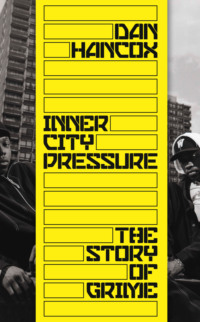
Kitabı oku: «Inner City Pressure: The Story of Grime», sayfa 3

Yazı tipi:

‘Most of us make our money from thin air,’ wrote Charles Leadbetter, a friend of Mandelson and Blair, capturing the spirit of the times – as music switched from heavy pieces of wax and shiny plastic discs to the intangibles of mp3s, and capitalism moved on from buying physical products with coins and notes to buying and selling complex, abstract ‘financial products’ like collateralised debt obligations, futures and derivatives. By 2007, the character Jez in the sitcom Peep Show would be summing it up in more day-to-day language: ‘I’m a creative. We don’t make steam engines out of pig iron in this country anymore, yeah? We hang out, we fuck around on the PlayStation, we have some Ben & Jerry’s, that’s how everyone makes their money now.’17

But even while New Labour were placing culture and creativity on a pedestal and garlanding it with £50 notes, other government changes were making it harder than ever for working-class people to develop careers out of their creative impulses and talents. In March 1998, changes to unemployment benefits that came in with the New Deal made it much harder for artists to live on the dole while honing and improving their craft – a part of the welfare state that had historically been a lifeline for working-class musicians. The NME ran a cover story about the threat to grassroots music, arts and culture these changes posed, with the banner, ‘Ever get the feeling you’ve been cheated?’ Inside, Jarvis Cocker recounted that, without the dole during the eighties, Pulp never would have made it as far as the nineties, and their vastly better and more popular albums. There were countless other musicians, artists and writers like him. Free education, a strong welfare state and affordable housing had given working-class creativity the space to breathe in the post-war years. For New Labour, it was too much like a hand-out: money for nothing.

The grime kids went without those state subsidies – but still never succumbed to the rampant individualism of their neighbours in Canary Wharf, or their political masters. For all that we should celebrate their independent, DIY spirit and sheer self-motivated perseverance – teenagers with nothing, making something more dazzling and millennial-modern than anyone could ever have imagined – they did so with the help of youth clubs, school teachers, and a collective, communitarian spirit that was being pummelled by a government determined to dismantle it, in the name of remaking the inner city.


Notting Hill Carnival, 1999

TWO

IN THE ROOTS

The irony of grime being derided as antisocial by its critics – all that clatter, hostility and bad attitude – is that it has always been community music: invented and developed collectively and collaboratively, by people whose lives and roots are deeply entwined, and who made music because it was the sociable thing to do. Community can mean a lot of different things, but whichever way you draw the diagram, grime emerged from a spider’s web of intergenerational influences, schoolmates, neighbours, friends, family, and people who knew people – from school, from the estate, from the local area.

The more you dig into its past, the more you realise grime’s social networks precede the music entirely, not just by years but by generations. Grime is black music (even if it’s not always made by black people), and its roots spread across London, and the world. While east London has for centuries been one of the most multicultural parts of the country, and a first port of call for new arrivals, the generation of Caribbean migrants who began arriving in Britain after the Empire Windrush docked in the Thames in 1948 tended to settle in Notting Hill in the west, and Brixton in the south. But with east London depopulating rapidly in the post-war decades, owing to decay, bombing, slum clearances and degeneration, housing became relatively cheap. Manufacturing jobs in places like the Dagenham Ford car plant, and Tate and Lyle, Unilever and ITT around the docks, encouraged newly arriving Caribbean nationals, now British citizens, to look to the east.

In the tightly bound geography of working-class inner London of the 1960s, 70s and 80s, many of the grime kids’ parents, and in some cases grandparents, knew each other before the kids even arrived – and as a result some of east London’s most important foundational MCs actually played together as children. D Double E’s dad went to school with Jammer’s dad. Jammer’s dad and Footsie’s dad were at Sunday school together. Footsie’s dad was in a reggae band in the 1980s with Wiley’s dad, and taught young Richard Cowie Jr how to play the drums.

‘We’ve known each other before before,’ Footsie says.1 A ridiculous number of MCs, DJs, producers and key behind-the-scenes figures met as children, at school or a playscheme; or playing football, or in someone’s aunt’s house, or at a party, or night fishing in the Hertford Union Canal, between Wiley’s estate and Victoria Park. Roll Deep’s first paid job was working for Wiley’s dad’s patty factory (they were subsequently fired when Richard Cowie Sr caught them having a food fight). ‘It’s so deep,’ Footsie continued. ‘Sometimes I think I’m not doing nothing special, other than carrying on what was already done.’

Grime’s lineage is suffused with this sense of kinship that precedes any sense of desire to make music – of being mates first, and lyrical sparring partners second. It’s easy to romanticise, but not easy to romanticise well: Kano’s nostalgic 2016 album which signalled his return to grime, Made in the Manor, does so brilliantly, telling sincere and evocative stories about his youth in his childhood home, 69 Manor Road in Plaistow, E15. On ‘T-Shirt Weather In The Manor’, Kano vividly describes multigenerational summer barbecues where the kids are listening to UK garage titans MJ Cole and Heartless Crew, and ‘the olders want some [reggae singer] Dennis Brown’, a prelapsarian community idyll, before fame, beefs and adulthood came along and complicated everything.

That kinship was formed, in part, out of marginality. Crazy Titch says he knew brothers Mak 10 and Marcus Nasty when they were children because ‘there was like three black families in Plaistow when I was growing up, and theirs was one of them’.2 In parts of inner London with more substantial black communities, grime’s originators were bound through pre-internet social networks formed by geography and background, by a sense of being marginalised by poverty, or racism. ‘It was a nice little community here,’ Kano recalled, smiling, in a short documentary accompanying Made in the Manor. ‘There was definitely a feeling that we weren’t supposed to be shit, or have shit, or become anything great. An underlying attitude that people grow up with, from around here.’3 Those narrow horizons enforced by poverty keep people down, but they bind people together, too – and when the kids at those barbecues started making music, by themselves, for each other, those bonds provided the foundations for something powerful, and lasting.

Sometimes grime’s ancestral links didn’t become apparent till years later. Footsie recently told his dad who Wiley’s dad was, and he responded that they’d played together as children. ‘I was there with Will, running around as kids, I just don’t really remember it.’4

Sitting in a pub beer garden in Bethnal Green in 2017 with Roony Keefe, creator of the seminal Risky Roadz DVD series, he told a story about Devlin, who he first filmed for his DVD in 2006, when he was a teenage MC from Barking, still only 16:

‘I’ve known Devs all these years but … my dad went to this funeral last year, and he was talking to one of his old mates there, and he said, “Oh, how’s your boy?”, and he said, “Yeah all right, still doing the music.” My dad was like, “Oh yeah, what music does he do?” Turns out my dad grew up with Devlin’s dad in Hackney, they’ve been mates all these years. But we didn’t know that until last year. It’s a really tight-knit kind of thing.’ Devlin wrote lyrics to describe this story of their dads drinking together in their favourite Hackney pub, before its gentrification-makeover, in a freestyle for Keefe’s YouTube channel: ‘Oi Roony, do me a favour and let ’em all know we’ve been around from day: like mine and your old mans, down the Kenton pub before it sold grub, just beer and grams. Funny how it all turns out … damn.’5

Wiley would watch his dad’s VHS copies of famous Jamaican sound-clash events like Sting, where rival sound-systems (with a team of engineers, hosts and selectors) would compete by offering up their biggest dubplates – also known as dubs, or white labels, because the vinyl was freshly cut from a new recording, and specially made for the occasion, rather than released to the general public by a record company. These did not have a sleeve or any artwork, just the naked simplicity of the record, its title inscribed on the white label in marker pen.

‘I sometimes heard my dad listening to Sugar Hill and the Gang,’ Wiley recalled in 2016, ‘[there was] some American rap. But it was minimal compared to all the reggae.’

Wiley had already learned to play the drums, and began to try and copy some of his dad’s reggae jams, using a Yamaha CX5, ‘the one with the big stick-in cartridge thing on top. I would go on there and see if I could play what he had just been playing.’ Reggae suffused the general atmosphere that the grime generation grew up in, tracing direct ancestral links from Britain’s pre-acid house reggae culture, some of it imported from the Caribbean, some of it created by black Britons. South London grime and dancehall MC Doctor – known for his ‘yardie flow’ – was managed by one of London’s most famous sound-systems, Saxon. Dreadlocked grime icon Jammer – a stalwart behind the scenes, a pioneering producer and a zany presence on the mic – grew up in a house immersed in this culture: his parents ran the ELRICS (East London Rastafarian Information and Community Services), which helps Rastafarians with housing, and incorporates work with young people (Jammer himself has spoken at schools and colleges, and been involved in their mentoring programmes). Iconic black British dub poet Benjamin Zephaniah was a family friend. The connections go on: Spyro’s dad is St Lucian reggae singer Nereus Joseph, Scorcher’s dad is jungle MC Mad P from early nineties crew Top Buzz.

It’s not just a family connection, or an abstract component of the musical bloodline: grime echoes its Jamaican reggae heritage in its structure, in its tropes, in its slang, in the way it’s performed, and stylistically: particularly harking back to the ‘fast chat’ reggae style of the likes of Smiley Culture, a black British MC who made it into the charts two decades before Dizzee Rascal did the same. Grime is a direct product of Caribbean sound-system culture. The legacy is more implicit than explicit a lot of the time, but it’s there in so much of what is integral to grime: in the dubplate white label culture of exclusive new tracks, in the competition of rival sound-systems or crews, in the MC responding live to the selector or DJ’s choices of instrumental tracks, or riddims. It is there in the song structures, in the sense they often do not have clearly demarcated structures: rather than the verse-bridge-chorus-verse architecture of the traditional three-minute pop song, MCs begin their careers ‘riding the riddim’, usually a steady tempo from beginning to end, that only changes when the next one is faded in.

Academic Nabeel Zuberi makes the point that MCs are middle points between the music and the audience – they have to ride the rhythm but also ‘conduct the choir’ on the dancefloor, and move the crowd to respond. In this sense the MC’s voice is ‘a social voice that includes the voice of others’, Zuberi writes.6 The performance function is more complex than simply, ‘I’m going to talk, and you’re going to listen’.

There’s a unique and productive cultural tension at the heart of grime that comes directly from its inner-London geography, of working-class cultures from the African and Caribbean diasporas intermingling with working-class London slang and culture, rubbing up against each other, borrowing, collaborating and adapting freely and fruitfully. It’s a tension familiar to fans of 1980s British reggae, where the duality is referred to as ‘Cockney and Yardie’, taken from Peter Metro and Dominic’s 1987 tune of the same name. In this song white reggae MC Dominic, born in west London, and black MC Peter Metro, born in Kingston (Jamaica, not Surrey), trade and translate slang from Jamaica (‘yardie’) and east London (‘cockney’).7 Smiley Culture’s 1984 single ‘Cockney Translation’ had performed the same ludic act of cultural elaboration, and become a surprise hit.

Grime has often been described as dazzlingly innovative, alien, groundbreaking, avant-garde, and it is all those things; one factor which explains its newness, perhaps, is not just the individual and collective daring of its creators, but the exact point at which it arrived: in a new millennium, from mostly second- or third-generation black Britons who were just estranged enough from their cultural roots in the Caribbean, or Africa, or both, and far enough along the lineage of unique British dance styles – acid house, jungle, drum ’n’ bass, UK garage – that they could draw from them all, while never being too in thrall to any of them. Just the right amount of respect for what had gone before, and just the right amount of healthy disregard for it, too – a mingling of conflicting and cooperating identities.8 ‘This is something new for your ears,’ runs the chorus of Roll Deep’s 2007 track ‘Something New’, ‘you ain’t heard beats or spitters like this: no American accents, straight English.’

Grime lyrics and vernacular – grime grammar, even – draws on a wide range of roots and influences, but Caribbean English is unsurprisingly prominent, along with grime’s own neologisms, cockney rhyming slang and other pieces of what is known to linguists as MLE (Multicultural London English). There is a minority of grime MCs who use what’s known as a ‘yardie flow’, a proudly Jamaican, often ragga-influenced, gruff, patois-heavy delivery, but a more musical one too – and some, like Riko Dan, who switch in and out of cockney and yardie as they feel the rhythm demands. Meeting cheerful Pay As U Go MC Maxwell D in a pub in Peckham recently, he lists off the MCs who would deliver ‘that extra bashment, yard vibe’ in the grime scene: ‘There’s Riko Dan, myself, Jamakabi, Flow Dan, Armour, Doctor, Durrty Goodz, God’s Gift … but the top MCs in grime were not dancehall, people like Wiley and Dizzee. My style, the dancehall reggae style, grime doesn’t sit on it, the way it’s meant to, because it’s an English way. It actually helped me develop another style, because I started doing less of the bashment style and more of the English style, because I realised the kids, the black kids, weren’t really in tune with their culture no more, it was like an English culture. In my opinion even garage was more dancehall-orientated than grime, it was still rootified. But when grime came along, Dizzee and Wiley, they changed the lyrical style.’ He barks an impression of Dizzee’s halting, staccato flow: ‘“Take that Nokia! Get that, what!” It was like rap, but an English vibe.’

While the roots of grime’s vocal style and a great deal of its slang and idioms travelled across the Atlantic with the Windrush migrants, it’s a telling part of grime’s unique flavour that its accent is so often London English – especially as ‘UK hip-hop’ (a genre in itself, distinct from grime) has often borrowed not just the genre tropes – turntablism, a fetishisation of ‘realness’ and roots – from the United States, but its accent too.9 ‘I thought it would be heavy to sound English,’ Dizzee Rascal told Sound on Sound magazine in 2004. ‘I listen to a lot of US hip-hop, and I know that is how they talk in real life, but a lot of UK hip-hop doesn’t do that. My influences are from jungle, and many of those artists still keep their English accent, and I respected that.’

Indeed, some of Dizzee’s biggest early singles, tracks like ‘Fix Up, Look Sharp’, ‘Stand Up Tall’ and ‘Jus’ A Rascal’ were not only the grimier precursors to hits like ‘Bonkers’, that made him Britain’s first black pop superstar, but in their boisterous, playful style, they also reproduced a kind of east London barrow-boy charisma, even perhaps music hall in its sensibility. How many Top 20 hits can claim to have opened with a battle-cry of ‘Oiiiiii!’ and a Carry On-style cackle? Too few, certainly. Dizzee’s delivery was so English, in fact, that it actually tripped him up on the road to international success. When he toured the US for the first time in 2004, appearing on Los Angeles’ famous rap station Power 106 with DJ Felli Fel, he spat his yelping, double-time flow over classic US rap beats from Brooklyn’s M.O.P. All was well until the end of the slot, when, chatting with Felli Fel on air, there was a telling obstacle: the DJ could literally not understand Dizzee’s accent. He asked Dizzee to repeat the name of his debut album no fewer than three times in a row. Eventually Dizzee, sounding slightly exasperated, just spelled it out: ‘B-O-Y …’

First-wave grime MC Bruza, also from east London, is the name that first comes to mind for ‘cockney grime’: for his especially boisterous delivery, frequent use of cockney rhyming slang, and proud claim that he is ‘brutal and British’. And then there are the white MCs: crews like OT Crew, from Barking, created what you could call ‘geezer grime’ – MCs like Syer B and Dogzilla, repping ‘Barking and Dogenham’, had some underground success with tunes charting their heartfelt quests for the finer things in life: ‘Where’s All The Beer?’ and ‘Where’s The Money?’. Dogzilla is one of those overlooked first-wave MCs who may not be to everyone’s taste, but he is evidence that, in the early days, distinctive voices, flows and vocal styles abounded on pirate radio. Dogzilla flipped the MC’s typical self-aggrandisement to a new level of lyrical honesty, too: ‘I’m obese, white, I smoke too much, I’m a bum, I’m a drunk … I live on strictly takeaways … I like girls in PVC, I support West Ham, UFC … here’s my fat white arse, I bet it makes you laugh.’ The pinnacle of white-boy geezer grime was a track called ‘Straight Cockney’ by an MC called Phenomenon, who it seems no one has heard of since, but whose legend lives on with over a million views on YouTube, where comments mock him to this day.

US rap has had numerous discussions of the phenomenon of the ‘wigga’, and the disproportionate media prominence and industry support given, Elvis Presley-style, to white rappers from Vanilla Ice to Eminem, by an at best cynical and at worst racist music industry. But grime has seen relatively little discussion of racial tension or cultural appropriation. It might be that the genre’s long languishing on the underground meant that, if you were a white DJ or MC taking part in the scene, your participation was implicitly understood to be out of authentic love for the music, rather than calculated profiteering or co-option – the same goes for Mr Wong, a much-loved first-wave MC and producer, the self-described ‘rude boy Chinese wigga’. It might be that the relative lack of racial segregation in Britain’s council estates and poorer areas, compared to the black ghettoised geography of ‘the projects’ in America’s big cities, had something to do with making race less of an issue. It might simply be that – while the likes of Geeneus and Slimzee were instrumental from day one – the biggest talents and crossover stars produced in grime’s early days, for several years, were all black British: Dizzee Rascal, Wiley, Kano, Shystie, Lethal Bizzle. With the exception of Lady Sovereign in 2005 – always a bit of an outsider to the scene in any case – and some years later, Devlin, the few white MCs weren’t the ones getting record deals.

There is something utopian in grime’s collectivist origins, of ‘kids hanging out together making something they enjoy’, as Jammer described it to me recently, and this is a rich part of its musical roots too. Academic Jeremy Gilbert has said that the relative weakness of neo-Nazi street thugs in British cities in the nineties, while such groups were on the rise elsewhere in Europe, owes a lot to the ‘cosmopolitan hybridity’ blooming (and booming) out of the speaker stacks and pirate-radio aerials where hardcore, jungle and UK garage were created. State-led multiculturalism takes the form of abstract government initiatives and directives, more progressive school curricula and better community and arts funding – and these things are all essential, and should be done right – but in terms of creating a more harmonious society, its impact looks fairly tepid compared to what young, working-class people of different ethnic backgrounds cooked up together on London’s council estates. In fact, to tweak James Meek’s pessimism about our class-riven, divided city, where the ingredients are laid out side by side, not touching, not mixing, perhaps the solitary demographic where multiculturalism is an organic, lived experience, rather than an idealised illusion, is in young, working-class communities where schools, youth clubs, estates and later workplaces make a shared and convivial culture not just realistic, but the unforced reality.

‘I was one of the only white kids on my estate growing up,’ recalled Nyke from white UK garage and grime duo Milkymans (humorously named, they explain, by a Caribbean bouncer, surprised to see them at a mostly black nightclub). ‘The Irish community had moved out, and me and Nikki grew up in the Afro-Caribbean communities in Peckham and Stockwell – so I lived between Ghanaians and Jamaicans; if I couldn’t smell fufu, I could hear Capleton blasting. My radiator used to shake off the wall! And even if I didn’t know what some of the artists meant, in a kind of black culture context, I was still feeling the vibrations of the music from young. I remember I used to wash my mum’s car, and I’d be blaring Kool FM – if I think back to it now, I’m lucky it was a noisy estate, because I love jungle, but that was noise. Like that was not easy listening.’ He laughed. ‘But when you’re a 13- to 14-year-old obnoxious, rebellious kid, that’s all you want to hear. It’s kinda the equivalent of someone listening to really dark heavy metal. That was our version of that.’

As with punk’s extensive late-seventies love affair with reggae, and the ‘two tone’ ska of the early 1980s, jungle saw urban multiculturalism manifested in youthful conviviality. It channelled a mixture of cultural influences into a novel, fiercely experimental form, created by a rich ethnic mix of producers, DJs and promoters, and enjoyed by a similarly diverse assembly of ravers. It transcended the difference in junglists’ backgrounds, but it did not forget those origins – something you can hear in the music, with soul and ragga samples and fierce basslines high in the mix.

In a 1994 BBC jungle documentary, UK Apache, the MC behind the superlative jungle anthem ‘Original Nuttah’, highlighted the power these styles had in forging a sense of belonging for second- or third-generation immigrants. Growing up as a working-class child of an Indian-South African mother and Iraqi father in Tooting in the 1970s and 80s, when the National Front were a menacing presence on the streets of south London, Apache made friends with kids of Jamaican heritage and went to reggae sound-system dances with them in some of the same estates in Battersea from which So Solid Crew would later emerge. He told the BBC documentary crew:

‘Jungle, because it’s from England, I can really relate to it, it’s important to me because I’m born here. I’m from England, and London, and nobody can tell me I’m not from here. Once I was ashamed of being British, but it’s like the jungle’s drawn me back into my roots, where I’m from. Although my parents are – I’m half Arab, half Asian, African – I can relate to those countries only up to a point. When I talk to my children, I say, “You’re born in England, be proud of it,” and don’t let nobody tell you different, no BNP or anything like that.’

There is another key cultural lineage to grime that is too easily overlooked. Long before Afrobeats (with an ‘s’) and its rap, R&B and bashment hybrids made their way into popular consciousness in the UK, the children of African migrants to the UK, in particular from Ghana and Nigeria, were making grime, and slipping in references to this heritage. Among others, Dizzee Rascal, Tinchy Stryder and Lethal Bizzle all have Ghanaian parents; there were musical links from London to West Africa too – genre-hopping producer, singer and MC Donaeo and grime-adjacent rapper Sway were performing big shows in Accra and collaborating with Ghanaian rapper Sarkodie in the late 2000s. Skepta, in particular, made it clear in his most well-known early radio and rave bars, that he was ‘Joseph Junior Adenuga, from Nigeria, not St Lucia – big lips, African hooter’. This didn’t preclude an upbringing in which he obsessed over Ninjaman and Jamaican sound-clash culture, but it coexisted with the West African music he heard at home. By the time I interviewed him for a second time, in 2015, black British youth culture was changing – a diasporic shift in emphasis away from Caribbean dominance had been slowly taking place in the UK. ‘When I was a yute, to be called African was a diss,’ he recalled, sadly. ‘At school the African kids used to lie and say they were Jamaican. So when I first came in the game and I’m saying lyrics like “I make Nigerians proud of their tribal scars/my bars make you push up your chest like bras”, that was a big deal for me.’

Even saying his full name in his lyrics was an act of defiant pride with a very personal context. ‘In school, when a teacher would try and read my name, as soon as she goes to try and say it, I’d be trying to say it first, to stop the embarrassment of her not being able to pronounce it. Eventually I grew up. I remember one day when I was about fifteen, my mum told me, “Junior, your name means something – just because your name isn’t some standard English name.” I remember going back into school and it started to power me up. Bare self-hate vibes was pushed into me as a kid at school, trust me. That’s why it makes me happy to see all these kids today just love Afrobeats, because since the start I’ve been trying to fucking fight this ting, for them to be able to stand up.’ He mentioned ‘Sweet Mother’, his single released in 2007 for Mother’s Day, a reworking of Prince Nico Mbarga’s 1970s hit of the same name, an early pointer to the way black British music might be going next, with Nico’s sweetly sung, Nigerian-accented chorus sitting alongside Skepta’s grimy London beats and MCing.

The ‘Black Atlantic’10 pathways between Africa, Britain, America and the Caribbean have seen cultural exchange, revision and refinement in numerous iterations, but it should be no surprise, given their histories, that black British MC culture has evolved along very different lines to American hip-hop culture. South London rappers Krept and Konan, schoolmates of Stormzy, are situated very much on the rap side of the rap-grime divide, in terms of the slower, hip-hop tempo of their beats and rhymes: and yet, they explained to me, there wasn’t that much of a divide at all – that just as black Britishness embraced its diverse roots, it also produced a family of different, coexisting genres. I’d been sent by the Observer to ask them what separated British microphone culture from its American equivalent. Konan didn’t hesitate in saying that it was essentially ‘everything’ – fairly or not, he viewed American hip-hop culture and identity as monolithic in a way black British culture never was:

‘What’s different? Our accents, our lifestyle, our culture. When we was in America we’d say “Where are you from?” and they’d say “America”. But over here if someone said where are you from you might say “Jamaica”, or “Africa” or something else – maybe “British” and adding something else. We bring different cultures to our music, and different slang, a different way of doing things. And there’s different-sounding beats: in their clubs there’s a lot of just hip-hop, in our clubs you’ll have house, dance, Afrobeats, bashment, you’ve got a blend of styles.’

Jungle was the teenage apprenticeship for the pioneers of grime. They snuck into the raves while still underage just to hear it, persuaded mums and dads to let them go with older brothers or sisters, obsessed about it on pirate radio (usually Hackney’s Kool FM, the leading jungle station), made tapes in their bedrooms and swapped them at school and college, and through that shared community forged friendships that would last into the end of the nineties, to the evolution of 2-step garage and later their own sound. The family tree is robust enough that many of grime’s first wave of MCs started out in music spitting over jungle – it was their first experiences in writing rhymes, performing in a dance. D Double E started out MCing at jungle raves aged only 14. Wiley did too, and Riko Dan. There are recordings now on YouTube of the three of them spitting at jungle’s frenetic tempo – these items themselves a beautiful low-fidelity chronology of the last 20 years of technology and urban music: an illegal and unofficial pirate-radio broadcast, recorded onto a tape cassette, stored in an attic somewhere presumably, and then years later linked up via a cable to a computer, the audio converted to mp3, then uploaded to YouTube. Many of the personnel playing jungle at house parties, raves and on radio in SS (Silver Storm) Crew – the likes of Wiley, Maxwell D and Target – would go on to form seminal garage-into-grime crew Pay As U Go Cartel.

Yaş sınırı:
0+
Litres'teki yayın tarihi:
29 haziran 2019
Hacim:
440 s. 17 illüstrasyon
ISBN:
9780008257149
Telif hakkı:
HarperCollins