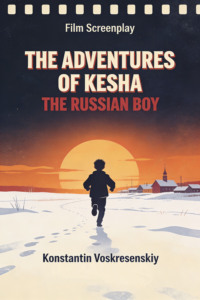
Kitabı oku: «Film Screenplay. The Adventures of Kesha the Russian Boy»
Written by Konstantin Voskresenskiy
Based on the autobiography by Konstantin Voskresenskiy
Adapted for screen
Genre: Adventure / Drama / Coming-of-Age
Format: Feature Film
Runtime: 110–120 minutes
Rating: 16+
LOGLINE: In the chaotic aftermath of the Soviet Union’s collapse, a stuttering, reckless boy named Kesha survives drowning, trains, elevators, military bases, and his own worst impulses – only to discover that the hardest thing to survive is growing up, and that the bottom is always closer than you think.
TAGLINE: A man is a boy who survived by accident.
Contact: voskon@gmail.com | Phone: +7 916 825 9840
Telegram: @Konstantin_Voskresenskiy
Revision Date: February 2026 | Draft: Third Draft
Explication – Director’s Vision
Written by Konstantin Voskresenskiy | February 2026
1. Theme
This is a film about the price of survival – and what it costs a boy to become a man when no one shows him how.
Set against the collapse of the Soviet Union and the chaos of the 1990s, the story asks a simple but devastating question: what happens to a child who is loved imperfectly, abandoned casually, and never told the truth – and who somehow turns all of that into a life worth living?
At its deepest level, this is a film about fathers and sons: the father who died before he could speak, and the son who spends his whole life finding his own words.
2. Idea / Super-Objective
The film’s super-objective: a man is not the sum of what was done to him, but the sum of what he chose to do next.
Kesha does not triumph over his circumstances. He absorbs them, converts them, and carries them forward. His stutter is not cured. His father does not come back. But by the end, he is standing on the same balcony where he grew up – and instead of running, he goes inside and adjusts his daughter’s blanket. That is the victory. Small, quiet, and absolute.
3. Conflict
EXTERNAL: Kesha vs. a country falling apart – Soviet institutions, absent parents, indifferent bureaucracies, the lawless 1990s. The world keeps removing the floor; he keeps finding new ground.
INTERNAL: Kesha vs. himself – reckless, stuttering, capable of tenderness and cruelty in the same afternoon. He fights shame, impulse, and the inability to ask for help.
INVISIBLE: Kesha vs. his dead father. Dmitriy’s absence structures the entire film. A letter never sent. A truth hidden for sixteen years. A son who becomes the father his father never got to be – without knowing that is what he is doing.
4. Main Characters
KESHA (KONSTANTIN VOSKRESENSKIY) – age 0 to 26. An engine disguised as a child: curious, reckless, resourceful, morally inconsistent, possessed of stubbornness that reads as courage until it reads as stupidity, and then, quietly, as courage again. His stutter is not merely a speech impediment – it is the physical manifestation of everything he cannot say: grief, need, love, apology. Throughline: survive – be free – be worthy of his daughter.
DMITRIY VOSKRESENSKIY (the father) – age 19 at death. Present only through absence. Writing letters his son will never receive. His death – five bullet wounds stamped as "fever" – is the wound Kesha must metabolize before he can become a father himself.
MOTHER – not a villain. A young woman who lost a husband at 22 and spent the next decade trying to stay afloat. Capable of love and neglect in the same afternoon.
STEPFATHER (SERGEY) – quiet, decent, never violent, emotionally absent. A study in the limits of good intentions: he gives Kesha space to grow up alone – which is both gift and wound.
GRANDMOTHER MARINA – formidable, loyal, Soviet steel with a human core. The family axis. She carries the truth about Dmitriy until Kesha is old enough to bear it.
GRANDFATHER NIKOLAY – a man unmade by grief and slowly remaking himself. His restraint is the film’s model of Soviet masculinity – and its damage.
5. Secondary Characters
ROMA – first accomplice; childhood freedom before consequence.
ZHENYA & ALEXEY – the "capitalism of survival" partners.
LT. COL. YARKIN – authority without cruelty; the father-shaped imprint.
MARIA (wife) – chosen life, not survived life; triggers the final emotional beat.
THE KITTEN – not a secondary character. A moral event.
6. Visual & Stylistic Concept
TONE: Warm, funny, occasionally heartbreaking – never sentimental. In the spirit of Jojo Rabbit meets Cinema Paradiso, filtered through a distinctly Russian sensibility.
COLOUR PALETTE (three registers):
– Childhood (1985–1995): warm, saturated – Soviet kitchens, blue-flower wallpaper, firelight, summer glare.
– Teens / 1990s: cooler grey-green – industrial dusk, railway platforms, empty courtyards.
– Adult frame: neutral, quiet, minimal – the calm after survival.
CAMERA: Handheld in childhood (the world moves because he moves), steadier with age. Close on faces for truth; wide in nature (pea fields, rivers, forests) to emphasise scale – the world is enormous, the boy is small.
7. Sound Design & Music
SCORE: Original soundtrack composed by Peter Svetlichnyi. A completed score for the autobiographical source material already exists, providing a musical foundation deeply embedded in the emotional DNA of the story.
MUSICAL CONCEPT:
– Childhood motifs: light, slightly ironic Soviet-era melodic themes, growing more complex as Kesha ages.
– Emotional weight: sparse piano and strings for pivotal scenes (the kitten; the father revelation; the Oka River).
– Adult frame: minimal, near-silent – the sound of having survived.
SOUND DESIGN: When the stutter locks, the world subtly muffles – a subjective, underwater quality pulling the audience into Kesha’s paralysis. Silence is structural: five seconds of black screen after the kitten scene carry no sound at all. Adult Kesha V.O. is warm but distant – a man speaking from the far shore of survival.
Synopsis
Genre: Adventure / Drama / Coming-of-Age
Format: Feature Film, 110–120 minutes
Rating: 16+
Based on: The autobiography by Konstantin Voskresenskiy
Tone: Warm, funny, occasionally heartbreaking – in the spirit of
Jojo Rabbit meets Cinema Paradiso, filtered through a distinctly Russian sensibility
In the summer of 1986, a nineteen-year-old Soviet soldier named Dmitriy Voskresenskiy is shot dead at a military outpost near the Chinese border. The government calls it hemorrhagic fever. His father Nikolay, who identifies the body in a Moscow morgue, counts five bullet wounds and says nothing. A death certificate is stamped. A life is erased. A boy named Kesha will grow up without knowing any of this.
One year earlier, in a cramped apartment in the Moscow suburb of Klimovsk, the family argues about what to name the baby. Three names go into a hat. God – or chance – picks Konstantin. The family calls him Kesha, like the cartoon parrot. The name will follow him everywhere, a joke that becomes an identity.
From the age of three, Kesha’s life is a chain of small disasters and improbable survivals. His mother remarries a man named Sergey – quiet, decent, never violent, but emotionally absent. At four, Kesha witnesses an apartment fire. One night he is simply forgotten at kindergarten, left alone until morning. At five, he is locked out of his apartment because both parents have passed out drunk. An old woman at a bus stop terrifies him so badly that he develops a stutter – a companion that will stay with him for life.
But Kesha is not a victim. He is an engine. At six, he talks his friend Roma into a bus ride to steal peas from a collective farm. At seven, he discovers the elevator game – riding on top of Soviet lift cabins in pitch darkness, inches from the shaft walls. At nine, in the darkest moment of his childhood, he drops a kitten from an eighth-floor balcony. The kitten survives, broken and mewing. Kesha never forgives himself. Twenty-four years later, when he holds a dying cat in a veterinary clinic, the echo returns – the same green eyes, the same unbearable guilt.
At ten, Kesha discovers capitalism. With friends Zhenya and Alexey, he collects bottles, steals scrap metal from military bases, builds a bench for elderly neighbours (who refuse to pay). He learns the first law of Russian business: always agree on the price beforehand.
At eleven, a dance troupe takes him to Budapest – his first foreign country. At a swimming pool, he jumps into the deep end without knowing how to swim. He nearly drowns, saved only by a metal handrail. Nobody notices.
That same summer, a teacher humiliates him at a children’s camp over clean hands. Something inside Kesha breaks – quietly, decisively. He walks out, through a forest, hitches a ride with a stranger, navigates the Moscow commuter rail network, and arrives at his grandmother’s apartment at midnight, covered in mud and leaves. He learns that sometimes the bravest thing is to stay.
At twelve, he drifts into a lake on a metal platform and gives up. His body goes slack. He sinks. Then his knee hits the bottom. The water is chest-deep. He is drowning with the riverbed inches below his feet. This moment crystallises into a life principle: never give up before it’s time. Your knee might be about to hit the bottom.
The middle years bring friendship and betrayal. His best friend Alexey blames Kesha for a smoking incident that Alexey himself confesses to. The friendship ends without a word. In school, he fights a losing war against Russian grammar, Pushkin, and teachers who call on him six lessons in a row.
At fifteen, Kesha works nights as a security guard, sleeping on cardboard for three thousand rubles a month. He plays guitar in the Moscow Metro until thugs chase him away. His class leader, a retired Lieutenant Colonel named Yarkin, becomes the closest thing to a father he has ever known – a man who disciplines with his eyes alone.
At sixteen, his grandmother reveals the truth about his father: the bullet wounds, the gas attack, the government cover-up. The cold anger that settles in his bones never fades.
At eighteen, Kesha enters university and fails MATHAN three times before cracking it through sheer stubbornness. He solves physics over a pay phone with his friend dictating answers. The Dean – who clearly sees someone else’s handwriting on his paper – passes him anyway with a gentle pat on the shoulder. Kesha learns that power is most frightening when it chooses to be kind.
An electrical engineering failure leads to a job at Siemens. He marries Maria – a Russian Literature student, making Pushkin his eternal in-law – in a registry office wearing jeans and a denim jacket. The church wedding the next day shocks the relatives.
His career is a rollercoaster. Employee of the Month at Siemens one week, fired the next. Each setback is absorbed, processed, and converted into forward motion.
At twenty-six, his daughter Masha is born. He watches the birth – blue to pink in ten seconds, the whole story of being human compressed into a moment. His finger is grabbed by five miniature fingers, and the man who spent his life running comes to a complete stop.
Years later, on the same ninth-floor balcony where he grew up, Kesha stands with his wife. Their daughter sleeps inside. Maria tells him Masha asked about his father. He says, quietly: "A man is a boy who survived by accident. But a father is a man who survives on purpose."
He goes inside. Adjusts her blanket. Closes her book of fairy tales. Leaves a crack of light in the doorway – for her to find if she wakes in the dark.
LOGLINE: In the chaotic aftermath of the Soviet Union’s collapse, a stuttering, reckless boy named Kesha survives drowning, trains, elevators, military bases, and his own worst impulses – only to discover that the hardest thing to survive is growing up, and that the bottom is always closer than you think.
Screenplay
Third Draft – February 2026
FADE IN:
Scene 1. INT. MILITARY BARRACKS, AMUR REGION – DAY (1986)
SUPER: "July, 1986. Amur Region, Russian Far East. One month before."
A cramped military bunk room. Posters of Soviet athletes on the walls. A radio crackles with Pugachova’s latest hit. Young soldiers lounge on iron beds in various states of boredom, polishing boots, writing letters, staring at the ceiling.
DMITRIY VOSKRESENSKIY (19) – handsome, dark-haired, impossibly young – sits on his bunk, writing a letter with careful, deliberate penmanship. A PHOTOGRAPH is taped to the wall beside him: a baby boy, chubby, laughing, wearing a ridiculous knitted hat.
His bunkmate SERYOGA (19) leans over.
SERYOGA
Writing to the wife again?
DMITRIY
(not looking up)
It’s for my son.
SERYOGA
He’s one year old, Dima. He can’t read.
DMITRIY
(smiling)
He will someday. I want him to know his father had neat handwriting.
Seryoga laughs. Dmitriy finishes writing. Folds the letter carefully. Puts it in an envelope. Looks at the photograph.
DMITRIY
(to the photo, quiet)
I’ll be home soon, Kesha. Hold on.
He touches the photograph with one finger. The baby is laughing at something off-camera. Dmitriy smiles. We hold on this image – a young father, impossibly young, reaching toward a son he will never hold again.
ADULT KESHA (V.O.)
He never came home. He never sent the letter. I found out about it thirty years later. By then, I had a daughter of my own. And I understood.
CUT TO:
Scene 2. EXT. MILITARY OUTPOST, AMUR REGION – NIGHT
SUPER: "August 20, 1986. 3,500 miles from Moscow."
The same base. Dead of night. A desolate compound on the Chinese border. Barbed wire fences disappear into fog. Barracks hunker low against the earth. Wind howls across the emptiness.
SILENCE. A dog barks somewhere. Then —
A single GUNSHOT cracks the night. Then another. Then chaos. Muzzle flashes strobe across terrified young faces. SOLDIERS scramble in the dark, shouting, tripping over each other. An alarm siren begins to wail.
In the confusion, we catch a glimpse of DMITRIY, stumbling out of his barracks in his undershirt. Blood blooms across his chest. Then his shoulder. Then his side. He reaches forward, toward nothing, and falls.
A COMMANDING OFFICER shouts orders nobody follows. Soldiers drag bodies. Someone is screaming for a medic. The screaming stops.
Smoke. Wind. Fog. Silence.
In the distance, a radio crackles – a tinny voice reading a situation report that nobody is alive to hear. The wind picks up, carrying ash and the smell of cordite across the compound. A single boot lies on the path between barracks, still laced, still warm.
Dawn breaks. Grey light seeps through the fog like diluted blood. MEDICS arrive in a covered truck, too late for everyone who matters. They carry stretchers with the bureaucratic efficiency of men who have done this before and will do it again.
CUT TO:
Scene 3. INT. MILITARY MORGUE, MOSCOW REGION – DAY
Fluorescent light. Tile walls. The smell of formaldehyde and institutional soap. A clock ticks on the wall. It is the only sound.
NIKOLAY TIMANOV (55), a weathered man with calloused hands and the bearing of someone who has worked outdoors his entire life, stands before a body covered by a white sheet. His jaw is clenched so tight the muscles in his neck stand out like cables. His cap is in his hands.
A MILITARY BUREAUCRAT (40s, bored, efficient, has done this a hundred times) holds a clipboard.
BUREAUCRAT
Timanov, Nikolay Petrovich? You are here to identify the remains of Private Dmitriy Anatol’evich Voskresenskiy?
Nikolay nods. Once.
His hands tremble as he reaches for the sheet. He lifts the edge. We do not see what he sees. But his face tells us everything: a spasm of grief so violent it seems to crack his skull from the inside. He suppresses it instantly. Decades of Soviet masculinity demand silence.
He lowers the sheet gently. Stands motionless for a long moment.
NIKOLAY
(barely audible)
He was nineteen.
The bureaucrat stamps a death certificate. We see it in CLOSE-UP:
SUPER: "Cause of death: Hemorrhagic Fever with Renal Syndrome."
Nikolay stares at the stamp. Then at the shape beneath the sheet. Five bullet wounds. Gas burns. And a government that calls it a fever. He folds the paper into a small square, puts it in his coat pocket, and walks toward the door.
At the threshold, he pauses. Speaks without turning around.
NIKOLAY
(to himself)
Fever. Yes. A fever with five holes in it.
He walks out into pale winter light. The door closes behind him with a soft click that sounds like a coffin lid.
CUT TO:
Scene 4. INT. FAMILY APARTMENT, KLIMOVSK – DAY (1985)
SUPER: "One year earlier."
WARM TONES. A different world. A cramped but cheerful apartment in the Moscow suburbs. Faded wallpaper with little blue flowers, lace curtains, a crib in the corner. The smell of borscht from the kitchen. A television plays the evening news at low volume.
A BABY sleeps in the crib, fists clenched, breathing softly. Around him, a family argues – not about anything grave, but with the passionate energy only Russians can bring to the subject of baby names.
MOTHER (23, beautiful, exhausted, still in her hospital gown) holds the birth certificate.
MOTHER
His name is Innokentiy. It’s decided. I’ve already written it on the form.
GRANDMOTHER MARINA (50s, formidable, hair pinned back with military precision, the kind of woman who could command a platoon and still have dinner ready by six) slams her palm on the table.
GRANDMOTHER MARINA
Innokentiy? Are you out of your mind? The boys at school will murder him! They’ll call him Kesha, like that ridiculous cartoon parrot!
GRANDFATHER NIKOLAY sits in the corner, smoking. He has been silent since he returned from the morgue three weeks ago. He watches his daughter argue and says nothing.
Little AUNT NADIA (7), sitting on the floor with a coloring book and a mouth full of biscuit, looks up brightly.
AUNT NADIA
You should call him Kesha! Like the parrot from the cartoon! Kesha is funny!
Beat. The room erupts. Mother throws her hands up. Grandmother Marina shakes her head.
GRANDMOTHER MARINA
Fine. Three names. In a hat. Whatever God decides.
Three scraps of paper are torn from a school notebook: ILYA, ROMAN, KONSTANTIN. Mother closes her eyes. Reaches into a ceramic bowl. Pulls one out. Opens it.
MOTHER
(reading)
Konstantin.
She looks at the sleeping baby. Smiles. In the corner, Grandfather Nikolay finally speaks. His voice is hoarse from disuse.
GRANDFATHER NIKOLAY
(quiet)
Konstantin means "steadfast." He’ll need that.
Nobody asks why. But the room goes quiet for a moment. The baby sleeps on, oblivious to his new name, his dead father, and the country that is already beginning to fall apart around him.
ADULT KESHA (V.O.)
I was born with someone else’s name, lost my father before I could walk, and got a new dad before I could talk. That’s Russia for you. Nothing stays the same for long. Except the borscht. The borscht never changes.
CUT TO:
Scene 5. INT. FAMILY APARTMENT – DAY (1988)
KESHA (3) sits on the floor, building a tower of wooden blocks with the concentration of a nuclear physicist. Each block is placed with deliberate care. He bites his lower lip as he works.
His MOTHER stands in the doorway with a new man: STEPFATHER (28), kind-faced, quiet, wearing a freshly ironed shirt that suggests he has spent the morning preparing for this introduction. His shoes are polished. His hands are clean.
Stepfather crouches down to Kesha’s level. Extends his hand. Kesha looks at the hand. Looks at the man’s face. With the gravity of a tiny diplomat making his first international appearance, he shakes it.
KESHA
(brightly, without hesitation)
Hi, Dad.
Stepfather blinks. Looks at Mother. She nods. He turns back to Kesha, something fragile and unprepared moving across his face.
STEPFATHER
(careful)
Hello, Kesha. That’s a fine tower.
KESHA
It falls down a lot. But I keep building it.
He hands Stepfather a wooden block. Stepfather places it on the tower. It balances perfectly. Kesha nods approvingly, as if this man has passed an important test.
Mother watches from the doorway. Her eyes are wet. She turns away before anyone sees.
ADULT KESHA (V.O.)
He never said a word in anger or laid a finger on me. He also preferred not to interfere, but just help out financially. I can’t say it was the most successful strategy. But he gave me space to grow up by myself. Without trying to forge me in his own image. For that, I am eternally grateful.
CUT TO:
Ücretsiz ön izlemeyi tamamladınız.