Kitabı oku: «A People Betrayed»

Copyright
William Collins
An imprint of HarperCollinsPublishers
1 London Bridge Street
London SE1 9GF
WilliamCollinsBooks.com
This eBook first published in Great Britain by William Collins in 2020
Copyright © Paul Preston 2020
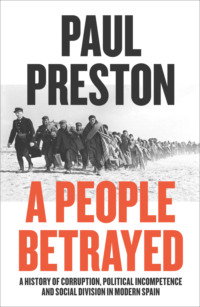
Cover photograph © Robert Capa/International Center of Photography/Magnum Photos
Paul Preston asserts the moral right to be identified as the author of this work
A catalogue record for this book is available from the British Library
Information on previously published material appears here.
All rights reserved under International and Pan-American Copyright Conventions. By payment of the required fees, you have been granted the non-exclusive, non-transferable right to access and read the text of this e-book on screen. No part of this text may be reproduced, transmitted, down-loaded, decompiled, reverse engineered, or stored in or introduced into any information storage and retrieval system, in any form or by any means, whether electronic or mechanical, now known or hereinafter invented, without the express written permission of HarperCollins.
Source ISBN: 9780007558391
eBook Edition © February 2020 ISBN: 9780007558384
Version: 2021-01-12
Dedication
For María Jesús González
and
Linda Palfreeman
Contents
1 Cover
2 Title Page
3 Copyright
4 Dedication
5 Contents
6 Preface
7 1 Spanish Stereotypes? Passion, Violence and Corruption
8 2 Violence, Corruption and the Slide to Disaster
9 3 Revolution and War: From the Disaster of 1898 to the Tragic Week of 1909
10 4 Revolution and War: From the Tragic Week of 1909 to the Crisis of 1917–1918
11 5 A System in Disarray: Disorder and Repression, 1918–1921
12 6 From Colonial Disaster to Dictatorship, 1921–1923
13 7 The Primo de Rivera Dictatorship: The Years of Success, 1923–1926
14 8 The Primo de Rivera Dictatorship: The Years of Failure, 1926–1931
15 9 The Second Republic: Reform and Frustration, 1931–1933
16 10 The Black Years and the Coming of War, 1933–1936
17 11 Civil War: Hatred, Incompetence and Profit, 1936–1939
18 12 World War: Survival, Hypocrisy and Profit, 1939–1945
19 13 The Franco Regime: Corruption and Terror, 1945–1953
20 14 The Franco Regime: Corruption and Complacency, 1953–1969
21 15 The Twilight Years of a Corrupt Regime, 1969–1975
22 16 The Painful Creation of a Democracy, 1975–1982
23 17 The Grandeur and Misery of a Newborn Democracy, 1982–2004
24 18 The Triumph of Corruption and Incompetence, 2004–2018
25 Acknowledgements
26 Notes
27 Index
28 By the Same Author
29 About the Author
30 About the Publisher
LandmarksCoverFrontmatterStart of ContentBackmatter
List of Pagesiiiivvixxxixiixiiixivxvxvixviii12345678910111213141516171819202122232425262728293031323334353637383940414243444546474849505253545556575859606162636465666768697071727374757678798081828384858687888990919293949596979899100101102103104105106107108109110111112113114115116117118119120121122123124125126128129130131132133134135136137138139140141142143144145146147148149150151152153154155156157158159160161162163164165166167168169170171172173174175176177178179180181182183184185186187188189190191192193194196197198199200201202203204205206207208209210211212213214215216217218219220221222223224225226227228229230231232233234235236237238239240241242243244245246247248249250251252253254255256258259260261262263264265266267268269270271272273274275276277278279280281282283284285286287288289290291292293294295296297298299300302303304305306307308309310311312313314315316317318319320321322323324325326327328329330332333334335336337338339340341342343344345346347348349350351352353354355356357358359360361362363364365366368369370371372373374375376377378379380381382383384385386387388389390391392393394395396397398399400401402403404405406407408409410411412413414415416417418419420421422423424425426427428429430431432433434435436437438439440441442443444445446447448449450451452453454455456457458459460461462463464465466467468469470471472473474475476477478479480481482483484485486487488489490491492493494495496497498499500501502503504505506507508509510511512513514515516517518519520521522523524525526527528529530531532533534535536538539540541542543544545546547548549550551552553554555556557558559560561562563564565567568569570571572573574575576577578579580581582583584585586587588589590591592593594595596597598599600601602603604605606607608609610611612613614615616617618619620621622623624625626627628629630631632633634635636637638639640641642643644645646647648649650651652653654655656657658659660661662663664665666667668669670671672673674675676677678679680681682683684685686687688689690691692693694695696697698699700701702703707708709710711712713714715716717718719720721722723724725726727728729730731732733734735736737738739740741742743744745746747748749750ii
Preface
The philosopher José Ortega y Gasset wrote in 1921: ‘Starting with the monarchy and moving on to the Church, no national authority has thought of anything but itself. When has the heart, after all foreign, of a Spanish monarch or of the Spanish Church ever beat for ends that were deeply Spanish? As far as is known, never. They have done the exact opposite. They have ensured that their ends have been adopted as if they were in the national interest.’1 In similar vein, the poet Antonio Machado, during the Spanish Civil War, wrote to a Russian friend, the novelist, David Vigodsky: ‘The best thing in Spain is the people. That is why the selfless and heroic defence of Madrid, which has astounded the world, moves me but it does not surprise me. It has always been like that. In difficult times, the señoritos – our Boyars – invoke the fatherland and then they sell it; the people do not even mention it but they buy it back with their blood and they save it. In Spain, it is impossible to be a decent person and not love the people. For us, love of the people is a basic duty of gratitude.’2
Similar views were expressed in the nineteenth century by the English romantic travellers. The most celebrated, Richard Ford, author in 1845 of A Handbook for Travellers in Spain and one year later of Gatherings in Spain, portrayed ordinary Spaniards as generous and noble while referring constantly to bad government and misgovernment: ‘The real permanent and standing cause of Spain’s thinly peopled state, want of cultivation, and abomination of desolation, is BAD GOVERNMENT, civil and religious.’ He claimed that, at all levels of government, there were despots always open to bribes.3 Gerald Brenan agreed to a certain extent: ‘Spain has been seen as the land of paradox where a people of great independence of character allowed themselves to be governed by corrupt and arbitrary rulers.’ However, commenting on the extent to which such criticisms derived from an idealized image of Britain at the time when Ford was writing, Brenan remarked: ‘He has much to say of Spanish mismanagement and poverty, yet who would not have preferred to be a Spanish workman in those days to an English miner or mill-hand or agricultural labourer?’4
The present volume is another work written by a British historian who loves Spain and one who has spent the last fifty years studying the country’s history. As might be deduced from its title, this book echoes the spirit of Richard Ford and of many Spanish commentators such as Lucas Mallada, Ricardo Macías Picavea, Joaquín Costa, Manuel Azaña and José Ortega y Gasset. While drawing on the perceptions of Ford, it does not adopt his simplistic comparisons of a benighted Spain with an idealized Britain. Equally, while deriving great insight from the critical analysis of the regenerationists, it does not share the view of Costa that the problem called for an authoritarian solution – the ‘iron surgeon’. This book makes no attempt to suggest that Spain is unique in terms of corruption or governmental incompetence. There are other European nations for which, at various historical moments, similar interpretations might be valid. For instance, while writing the book, I have lived, on a daily basis for the last three years, under the shadow of the Brexit process in Britain. It has been a painful experience to have to witness the combination of lies, governmental ineptitude and corruption that have bitterly divided the nation and threatened to provoke the break-up of the United Kingdom.
There are many possible approaches to the rich and tragic history of Spain. This book spans the period from the restoration of the Borbón monarchy in 1874 with Alfonso XII, to the early days of the reign of his great-great-grandson Felipe VI in 2014. It aims to provide a comprehensive and reliable history of Spain with a dramatic emphasis on the way the country’s progress has been impeded by corruption and political incompetence. It demonstrates how these two features have resulted in a breakdown of social cohesion that has frequently been met with, and exacerbated by, the use of violence by the authorities. All three themes consistently emerge in the tensions between Madrid and Catalonia. Throughout the Restoration period, and most spectacularly during the Primo de Rivera dictatorship, institutional corruption and startling political incompetence were the norm. Popular disgust with this opened the way to the country’s first democracy, the Second Republic.
From the inception of the Republic in 1931 until its demise in 1939, corruption was less toxic, not least because the newly installed political elite was inspired by many of the propositions of the regenerationists. That is not to say corruption did not exist. A recurring character in the book, the multi-millionaire Juan March, who was behind some of the most spectacular corruption during the Primo de Rivera period, was equally active during the Republic, as indeed he would be in the first decades of the Franco dictatorship. This was also true of Alejandro Lerroux, an important politician who was on March’s payroll. A lifetime of shameless corruption reached its peak when, as Prime Minister in 1935, Lerroux brazenly sponsored a system of fixed roulette wheels, an outrageous operation that gave rise to the word estraperlo which has become a synonym for economic malfeasance.
The victory of General Franco saw the establishment of a regime of terror and pillage which allowed him and his elite supporters to plunder with impunity, enriching themselves while giving free rein to the political ineptitude that prolonged Spain’s economic backwardness well into the 1950s. Ironically, throughout his life, Franco would express a fierce contempt for the political class that he held responsible for the loss of empire in 1898. In 1941, on the fifth anniversary of the outbreak of the civil war, he declared in a speech to the top brass of the Falange: ‘when we started out in life … we saw our childhood dominated by the contemptible incompetence of those men who abandoned half of the fatherland’s territory to foreigners’.5 In fact, some of his own fatuous errors would far outdo those of the predecessors he mocked. That he would not scruple to put his determination to stay in power above national interests can be seen in his relationships with the Third Reich and later with the United States. His scatterbrained get-rich-quick schemes, ranging from alchemy and synthetic water-based gasoline to the disaster of his autarkic policies, contributed to Spain’s backwardness until he was persuaded in 1959 to let others supervise the economy.
In denouncing politicians in 1941, Franco was far from alone. With brief intervals when optimism flowered, between 1931 and 1936 and the first decade of the rule of King Juan Carlos, the attitude of Spaniards towards their country’s political class has often been one of disdain bordering on despair. Belief in the incompetence and venality of politicians has been an underlying constant of Spanish life since the Napoleonic invasion if not before. Franco used rhetoric about corrupt politicians to justify a dictatorship under which corruption flourished unchecked and was indeed exploited ruthlessly by the Caudillo himself, both for his own enrichment and to manipulate his followers.
The humiliation of 1898 was just the final confirmation of a truth that had been coming for nearly a century. Spain’s internal economic problems could no longer be alleviated by imperial plunder. A backward agrarian economy, an uneven and feeble industrial sector, the heavy hand of the Catholic Church, parasitical armed forces and growing regional divisions were endemic burdens. They were perpetuated, as was perceived by the far-sighted polymath Joaquín Costa, by a corrupt and incompetent political system which blocked social and economic progress and kept the Spanish people in the servitude, ignorance and misery which lay behind the contemporary slur that ‘Africa begins at the Pyrenees’. However, the solution proposed by Costa, the iron surgeon, showed little confidence in the people and in democracy.
Other equally damaging, and inextricably linked, features of Spanish politics and society have endured since the late nineteenth century. The unspoken assumption that political and social problems could more naturally be solved by violence than by debate was firmly entrenched in a country in which for hundreds of years civil strife was no rarity. In modern times, certain forms of social violence have been a consequence of corruption and government incompetence. Electoral corruption excluded the masses from organized politics and challenged them with a choice between apathetic acceptance and violent revolution. The war of 1936–9 was the fourth such conflict since the 1830s.
Between 1814 and 1981, Spain witnessed more than twenty-five relatively serious pronunciamientos, or military coups.6 That crude statistic provides a graphic indication of the divorce between soldiers and civilians. In the first third of the nineteenth century, those pronunciamientos were liberal in their political intent, but thereafter a tradition of mutual misunderstanding and mistrust between the army and civil society developed to a point at which soldiers considered themselves more Spanish than civilians. Accordingly, a factor generating hatred within Spanish society was the repression by the army of deep-rooted social conflicts that had arisen in the wake of imperial decline and military defeat. Military resentment of politicians in general and of the left and the labour movement in particular was the other side of the same coin.
The role of violence in Spain was consolidated by the way in which the armed forces dealt with post-imperial trauma. A resentful officer corps, which blamed the humiliation of 1898 on the politicians who had provided inadequate support, came to consider itself the ultimate arbiter in politics. Determined to lose no more battles, it became obsessed not with the defence of Spain from external enemies but with the defence of national unity and the existing social order against the internal enemies of the regions and of the left. At one level, this was not surprising. After the Cuban disaster, the army was inefficient, overburdened by bureaucracy and ill equipped. An absurdly high proportion of the total military budget was absorbed by salaries, administration and running costs which left very little for training or equipment.
Spain’s rulers had tried to shake off the immediate post-war shame with a disastrous new imperial endeavour in Morocco. Woefully unprepared, this African adventure stimulated massive popular opposition to conscription, thereby intensifying the mutual hatred of the military and the left. While working-class conscripts became militant pacifists in response to the appalling conditions in North Africa, there emerged within the military an elite corps of tough professional officers, the Africanistas, of whom Franco became the iconic example. They came to believe that they were a beleaguered band of heroic warriors alone concerned with the fate of the patria. This inevitably exacerbated their sense of apartness from a society which they felt had betrayed them. The Africanistas came to dominate the officer corps, particularly in the late 1920s when Franco was Director of the Military Academy. They would be at the heart of the coup of 1936 and then used against Spanish civilians the same terror tactics that they had perfected in Morocco.
They would be a favoured element of Franco’s kleptocratic elite. The survival of their ‘values’ through and beyond the dictatorship would guarantee the determination of sectors of the armed forces to derail the new democracy established in the late 1970s. Fortunately, popular distrust of the armed forces came to an end with the democratization of the army after the military reforms carried out during the first Socialist government. Generational change within the officer corps and the entry of Spain into NATO have seen a dramatic reversal of popular perception of the armed forces and the Civil Guard, which are now among the most highly rated institutions in Spain. Popular perception of Spain’s problems puts the political class second only behind unemployment.7
Equally damaging to Spain’s attempts to attain modernity was the dead hand of the Catholic Church. In the civil wars of both the nineteenth and twentieth centuries, the Catholic Church took sides against the threat of liberalism and modernization. Besieged by violent popular anti-clericalism and impoverished by the disentailment of its lands in the 1830s and 1850s, the Church allied itself with the powerful. Already by the 1880s the Church, in its educational provision for the middle and upper classes, had become the legitimizing agent of the socio-economic and political system. The history of the Catholic Church in Spain in the twentieth century parallels that of the country itself. Almost every major political upheaval of a turbulent period – with the possible exception of the revolutionary crisis of 1917–23 – had its religious backcloth and a crucial, and often reactionary, role for the Church hierarchy.
What follows interleaves these themes of military and ecclesiastical influence, popular contempt for the political class, bitter social conflict, economic backwardness and conflict between centralist nationalism and regional independence movements. It also places these processes in an international context. The breakdown of the Second Republic and the coming of the civil war are incomprehensible without consideration of the influence of international developments, particularly fascism and communism, on domestic developments. The course of the Spanish Civil War will be analysed with particular attention to the interplay between domestic and international factors in determining its outcome. In many respects, the Spanish conflict can be seen as either a rehearsal for the Second World War or as the location of its first battles. Spanish neutrality in the Second World War played a key role in the outcome of the conflict in Europe. The process whereby the Franco dictatorship shook off international ostracism to become the valued ally of the Western powers will be fully considered.
The book shows how Spain went from utter despair in 1898 on a roller coaster that culminated in the present state of almost comparable pessimism. The civil war was the most dramatic of a series of uneven struggles between the forces of reform and reaction which had punctuated Spanish history from 1808 to the present day. There is a curious pattern in Spain’s modern and contemporary history, arising from a frequent desfase, or lack of synchronization, between the social reality and the political power structure ruling over it. Lengthy periods during which reactionary elements have used political and military power to hold back social progress were followed by outbursts of revolutionary fervour. In the 1850s, in the 1870s, between 1910 and 1912, between 1917 and 1923 and above all during the Second Republic, efforts were made to bring Spanish politics into line with the country’s social reality. This inevitably involved attempts to redistribute wealth, especially on the land, which in turn provoked reactionary efforts to stop the clock and reimpose the traditional order of social and economic power. Thus were progressive movements crushed by General O’Donnell in 1856, by General Pavia in 1874, by General Primo de Rivera in 1923 and by General Franco between 1936 and 1939. It took the horrors of the civil war and the nearly four decades of dictatorship that followed to break the pattern. The moderation shared by the progressive right and a chastened left underlay a bloodless transition to democracy.
The pattern of conflict between the political establishment and sociological development – progressive forces pushing for change until driven back by violence and the imposition of dictatorship – changed in 1977. Nevertheless, the new democratic establishment was tainted by the old ways. As asserted by Baltasar Garzón, one of the judges who has worked to eliminate corruption: ‘In Spain, no one has ever been afraid to be corrupt. Given that its existence was taken for granted, corruption is not something that has bothered the average citizen. This indifference has ensured that its roots have grown deep and solid and sustain a structure of interests that is very difficult to bring down.’ In the view of Garzón, the justice system has contributed to this situation: ‘Judgments that are laid down after long years of delay, laughable sentences, incomprehensible dismissals or shelving of cases, unacceptable collusions and connivance …’8
Throughout the entire period covered by this book, corruption and political incompetence have had a corrosive effect on political coexistence and social cohesion. Spain’s transition to democracy has been widely admired. Nevertheless, the scale of uninterrupted corruption and periodic ineptitude demonstrated by the political class at various levels of society since 1982 has been remarkable. Politicians of both right and left have been unable or unwilling to deal with corruption and the pernicious clash between Spanish centralist nationalism and regional desires for independence. Only during brief periods in the early 1930s and in the first years of the transition to democracy was there a degree of public respect for politicians. However, widespread contempt and resentment have intensified anew during the economic crisis of recent years. The boom of the 1990s fostered corruption and witnessed political incompetence on an unprecedented scale. From the late 1980s to the present day, endemic corruption and renewed nationalist ferment has brought disillusionment with the political class almost full circle. While not at the unrepeatable low point of 1898, politicians are nevertheless rated by the Spanish population far lower than could have been imagined when the transition to democracy was being hailed as a model for other countries.

A satirical cartoon published in the magazine La Araña in August 1885. ‘Poor Spain. How beautiful she is. The more they strip her, the more beautiful she is.’ Among the watching European leaders are Otto von Bismarck and King Umberto of Italy. Among those ripping the flag from her body are the architects of electoral corruption, Francisco Romero Robledo, Antonio Cánovas del Castillo and Práxedes Mateo Sagasta.
1
Spanish Stereotypes? Passion, Violence and Corruption
Spain has often been seen through the myths of national character. One of the most persistent has been that of corruption and dishonesty, which owed much to the numerous translations into other European languages of the first and hugely popular picaresque novels, the anonymous Lazarillo de Tormes (1554) and Francisco de Quevedo’s El buscón (o Historia de la vida del Buscón, llamado don Pablos; ejemplo de vagamundos y espejo de tacaños) (written 1604, published 1626). During the eighteenth and nineteenth centuries, Spain was a frequent, and conveniently exotic, setting for operas by foreigners. Among the most extreme examples of operas based on myths of national character, especially Spanish, are almost certainly Mozart’s Don Giovanni, Verdi’s Il trovatore and La forza del destino and Bizet’s Carmen. Artists wishing to portray violent passions drew upon a view of Spain, its history and its people as the embodiment of fanaticism, cruelty and uncontrolled emotion. This image went back to the Reformation, when a series of religiously inspired pamphlets had denounced the activities of the Spanish Inquisition, the Tribunal of the Holy Office and the terrors of the auto-da-fé. Religious hatreds aside, the European perception of Spain was confirmed by the experience of an empire in the Americas, Italy and Flanders built on greed and maintained by blood. The Peninsular Wars, or the wars of national independence, and the subsequent nineteenth-century series of civil wars did nothing to undermine stereotypes which survived into the twentieth century in the literature spawned by the Spanish Civil War.
Collectively, this view of Spain constituted what the Spaniards themselves came to call ‘the black legend’, the most extreme examples of which were collected in the celebrated work by the historian Julián Juderías, La leyenda negra. Combating the notion of universal laziness and violence, Juderías railed against ‘the legend of the inquisitorial, ignorant, fanatical Spain, under the yoke of the clergy, lazy, incapable of figuring among civilized nations today as well as in the past, always ready for violent repressions; enemy of progress and innovations’.1 What Juderías had in mind were definitions of Spain such as that by Sir John Perrot, Elizabeth I’s Lord Deputy of Ireland (1584–6), who observed: ‘This semi-Morisco nation … is sprung from the filth and slime of Africa, the base Ottomans and the rejected Jews.’2 The stereotypes which caused greatest outrage to Spaniards, however, were fundamentally the product of the romantic era. From 1820 to 1850, British and French travellers were drawn to Spain by what they saw as the picturesque savagery of both its landscapes and its inhabitants. Rugged mountains infested by brigands, their paths travelled by convoys of well-armed smugglers, the bloody rituals of the bullfight, the ruins of Moorish palaces and castles, and erotic encounters (probably imagined) with languid olive-skinned beauties became the clichés of romantic literature about Spain. The stereotypes would be maintained even in the 1920s when bar owners in the sleazy Raval district of Barcelona exploited the reputation of the ‘Barrio Chino’ for the benefit of foreign tourists. They would stage ‘spontaneous’ incidents in which ‘gypsies’, apparently inflamed with jealousy by the sight of their women (the waitresses) flirting with the tourists, waved knives, the incidents being settled with rounds of expensive drinks.3
Bizet’s Carmen remains perhaps the most famous ‘Spanish’ opera, largely because of its deployment of most of these Spanish stereotypes. Carmen presents the archetypes of the passionate Andalusian woman, the knife-wielding murderer and the bullfighter set in a context of smugglers, bandits, sex and violence. The notion that the Spaniards were sex-crazed underlay the fact that syphilis was known in France as le mal espagnol. The German writer August Fischer also wrote of the frantic, indeed fanatical, sexuality of Andalusian women – a view shared by Lord Byron, who visited Andalusia in 1809. The French diplomat Jean-François Bourgoing, in his Nouveau voyage en Espagne (1788; expanded in 1803 into the three-volume Tableau de l’Espagne moderne), complained about the open sensuality of flamenco dancing and excoriated the vice-ridden daily life of gypsies.4 Rather more wistfully, Giacomo Casanova, the Venetian sexual athlete, praised the fandango thus: ‘Everything is represented, from the sigh of desire to the final ecstasy; it is a very history of love. I could not conceive a woman refusing her partner anything after this dance, for it seemed made to stir up the senses.’5
It was Washington Irving’s Tales of the Alhambra (1832) that really put Spain on the map for romantics. A decade later, he was outdone by Théophile Gautier whose Un Voyage en Espagne (1843) described the dusky, flashing-eyed Andalusian beauties who warmed his blood with their flamenco dancing and the blood-chilling gypsy knife fighters and their fancy cutlery.6 English writers like George Borrow (The Bible in Spain, 1843) and Richard Ford (Handbook for Spain, 1845, and Gatherings in Spain, 1846) portrayed Spaniards’ alleged obsession with honour, their religious fanaticism, their extremes of love and hate, and the proliferation of lawless cut-throats. This was intensified even more by Alexandre Dumas. Massively famous as a result of the success of The Three Musketeers and The Count of Monte Cristo, Dumas had been invited by the Duc de Montpensier to attend his wedding on 10 October 1846 to the Infanta Luisa Fernanda, daughter of King Fernando VII. Dumas spent two months in Spain on the basis of which he wrote his massive four-volume De Paris à Cadix. Here he described his disgust at Spanish food and at what he saw as the licentiousness and depravity of gypsy dancers in Granada. Yet, in Seville, he was delighted by the voluptuousness of professional flamenco dancers and rejoiced in the flirtations between young army officers and the pretty girls who worked in the great Fábrica de Tabaco.7 Prosper Mérimée’s novella Carmen (1845) concentrated all the romantic clichés about Seville in one personage. A cigarette factory worker, Carmen was also a flamenco dancer, lover of a bullfighter, accomplice of smugglers and bandits, voluptuous, independent, untamed – just the thing to titillate the Parisian bourgeois who seemed to view Spain as a kind of human zoo.8 Mérimée’s patronizingly anthropological attitude to his characters was popularized even further by Bizet’s opera.
A context of readily familiar assumptions about Spain had long since been established by Marie-Catherine Le Jumel de Barneville, Baronne d’Aulnoy. Her Mémoire de la cour d’Espagne (1690), published in English as Memories of the Court of Spain written by an ingenious French lady, was a prurient account of the allegedly syphilis-ridden royal court in Madrid. Uninhibited by the fact that she had almost certainly never visited Spain at all, this armchair fantasist then quickly produced her immensely influential Rélation du voyage d’Espagne, which was first published in 1691 and was regularly reprinted in several languages well into the nineteenth century. Despite claiming to relate ‘nothing but what I have seen’, Madame d’Aulnoy described a country full of exotic animals including monkeys and parrots. Her cast of invented characters was based on other travel books, diplomatic memoirs and the plays of Calderón and other Spanish dramatists. Her wild exaggerations presented corrupt officials, aristocratic men ever ready to kill or die for questions of honour and promiscuous women invariably in the throes of passion.9 Nevertheless, the caricatures created by Madame d’Aulnoy, including the notion that virtually the entire population was afflicted with venereal disease, allowed Bizet to present the insolent and primeval sexuality of Carmen as somehow typically Spanish.10
In Britain, the image of an exotic, semi-oriental Spain of crumbling cathedrals and mosques, castles and bridges, inhabited by colourful, passionate and sensual people, drew on the exquisite paintings and drawings of David Roberts and John Frederick Lewis in the 1830s and of Charles Clifford in the 1850s. Many of their most characteristic works became immensely popular through collections of best-selling lithographs. Their views of Spain were confirmed by many Spanish painters of the romantic era, particularly Genaro Pérez de Villaamil, whose work was exhibited and published in Paris.11 Nothing symbolized the Spain of the romantic era more than Andalusian beauties and bandit-infested sierras. Foreign travellers returned home to dine out on stories of the risks they claimed that they had undergone.12 Virtually all travellers to Spain, whatever their nationality and whatever they thought of the sex, the bandits, the bulls and the Inquisition, complained about the rutted tracks which passed for roads. They often declared confidently that Spain would never be penetrated by railways.13 In fact, it was the introduction of railways from the late 1850s onwards that dramatically changed the stereotypes. As Spain enjoyed an extremely uneven industrial revolution, foreign investment increased. Thereafter, observers and travellers were concerned less with romantic stereotypes than with political instability, corruption and social violence.
In fact, the fundamentals of Spanish society had little to do with the steamy erotic stereotypes beloved of foreign travellers. The reality was altogether more mundane, its central characteristics the linked factors of social inequality and violence and political incompetence and corruption. In 1883, the Tribunal Supremo entitled part of its annual report on criminality ‘On the Violent Customs of the Spanish People’. It was symptomatic of Spain’s dysfunctional society that, between 1814 and 1981, there were more than fifty attempted pronunciamientos, or military coups of which only a handful succeeded.14 That crude statistic provides a graphic indication not just of the divorce between soldiers and civilians but of the extent to which the Spanish state did not adequately serve its citizens. A tradition of mutual misunderstanding and mistrust between the army and civil society developed to a point at which soldiers considered themselves more Spanish than civilians. The year 1833 saw the outbreak of the first of four civil wars with the battlefield hostilities of the last coming to a close in 1939. In fact, to some extent, the civil war of 1936–9 is the war that never ended. Indeed, in some respects, Spain still suffers today from some of the divisions of 1936.
The early 1830s experienced both the loss of the bulk of the once great Spanish empire and the beginning of dynastic conflict. The death in 1833 of Fernando VII, succeeded as queen by his infant daughter, Isabel, and the attempt by his brother Carlos to seize power provided the spark that ignited what came to be called the first Carlist War, which raged until 1840. Carlos sought support among deeply reactionary landowners and extreme ultramontane Catholics and was opposed by modernizing liberals led symbolically at least by Isabel’s mother, the Queen-Regent María Cristina. Carlist forces were commanded, even more symbolically, by the Vírgen de los Dolores, a commitment to theocracy that guaranteed the support of the Church hierarchy. A second, rather more sporadic, Carlist war was fought from 1846 to 1849 and a third from 1872 to 1876. The active role of the Catholic Church in these Carlist Wars, with some lower clergy even taking up arms, contributed to the subsequent popular perception of priests as deeply reactionary.15 In the 1860s, there had been fewer than 50,000 secular priests, monks and nuns in Spain. In the period between the monarchical Restoration of 1874 and the end of the century, the numbers would increase to more than 88,000. When the Primo de Rivera dictatorship fell in 1930, the clergy had swelled to over 135,000.16 In the view of the anarchists, the Catholic Church commercialized religion but did not practise morality. They saw it as a corrupt and rapacious institution which exploited the people and also blocked social progress.
Thus, even though black, reactionary Spain was startled by the French revolution and was shaken out of its lethargy by the Napoleonic invasion of 1808, many of the European stereotypes of Spain lamented by Juderías, certainly those based on the violence of its political life, were confirmed rather than shattered by the cycle of nineteenth-century civil wars. The notion that deep social and political problems could be resolved by violence was to afflict Spain well into the twentieth century. The Franco regime which followed the civil war was a regime built on terror, plunder and corruption. None of these elements was the invention of Franco. Indeed, it is the central thesis of this book that the violence, corruption and incompetence of the political class have betrayed the population at least since 1833 and almost certainly before. There are many possible historical reasons to do with religion and empire but perhaps the most potent and enduring has been the lack of a state apparatus popularly accepted as legitimate. After a state of near civil war between the death of Franco in 1975 and the military coup of 1981, it looked as if Spain was witnessing the creation of a legitimate state. The prosperity of the late twentieth century masked the extent to which the new polity was as mired in corruption and incompetence as its predecessors. An especially vibrant economic boom fuelled by the cheap credit facilitated by Spain joining the euro drew a veil over rampant corruption that reached as far as the royal family. The recession that followed saw the veil torn away, the political establishment lose legitimacy and problems such as regional nationalism divide the country in, rhetorically at least, violent terms.
In the nineteenth century, the Spanish state was weak in the face of geographic obstacles, poor communications and historical and linguistic traditions utterly opposed to a centralized state. Unlike, say, France or Italy after 1871, Spanish governments failed to create an all-embracing patriotism and sense of nationhood. In other countries, this task was largely assumed by the armed forces. However, in Spain, the army was an engine of division, above all because of the appalling conditions faced by conscripts in overseas wars. By the early twentieth century, army officers were ripe for persuasion by extreme conservatives that it was their right and duty to interfere in politics in order to ‘save Spain’. Unfortunately, that ostensibly noble objective actually meant the defence of the interests and privileges of relatively small segments of society. The armed forces were thus not the servants of the nation defending it from external enemies but the defenders of narrow social interests against their internal enemies, the working class and the regional nationalists. In the hundred years before 1930, it was possible to discern the gradual and immensely complex division of the country into two broadly antagonistic social blocs. Accordingly, popular hostility to the armed forces grew as deep-rooted social conflicts, at a time of imperial decline and military defeat, were repressed by the army. A further layer of the dialectic between violence and popular discontent was the way in which regional nationalism was crushed in the name of a patriotic centralism. Military resentments of politicians in general and of the left and the labour movement in particular were the other side of the same coin.
Ironically, it was in 1833 that the biggest step towards creating a state had been taken. This was the adoption of a highly centralized French territorial model with fifty broadly uniform provinces under the control of a civil governor appointed by Madrid. This systematized the distribution of patronage and therefore fostered corruption. Although the idea of Spain had long existed, the country seemed to be a flimsy collection of virtually independent provinces and regions whose languages and dialects were often mutually unintelligible. The 1833 definition of regions and provinces has subsequently been modified but, broadly speaking, it still holds good and can be recognized in the current system of so-called autonomies into which Spain is now divided. Similarly, further measures taken in the 1840s saw the beginnings of something resembling a central state with a crude and divisive taxation system and the creation of local and national police forces. However, with the exception of the Civil Guard, it was an inadequately implemented process. Taxation did not finance the state because wealth was not taxed, whereas consumption was. Ancient forms of politics, social influence and patronage, caciquismo or clientelism, took precedence over any kind of modern political machinery, poisoning what falteringly developed as electoral politics and leaving the state underfinanced and weak, other than in its coercive capacity.
After the process known as the disentailment or desamortización, Spain ceased to be a feudal society in legal and economic terms. However, it remained so in social and political terms. Traditional rural elites retained their power long after the Restoration of the monarchy in 1874 and the attempt to create a modern state by Antonio Cánovas del Castillo in his Constitution of 1876. That state worked only in so far as it was in the interests of the local bosses or caciques (a South American Indian word meaning ‘chief’) to allow it to do so. It was only with the growth of industry in the Basque Country, Asturias, Catalonia and Madrid that a different and more modern politics became even a remote possibility. Then, the vested interests of the landed caciques ensured that their superior power was exerted over the reforming bourgeoisie which, itself under pressure from the first signs of working-class discontent, scurried to make an alliance in which it was the junior partner. Loss of empire would lead to a weakening of the alliance but it would always be consolidated when the industrial bourgeoisie needed the protection of the repressive machinery that was the state’s principal asset. Pressure for political change and social development was simply dismissed as subversion.17
Richard Ford wrote in the 1840s: ‘I once beheld a cloaked Spaniard pacing mournfully in the burial ground of Seville. When the public trench was opened, he drew from beneath the folds the dead body of his child, cast it in and disappeared. Thus, half the world lives without knowing how the other half dies.’18 In a land in which oppressive poverty coexisted with an equally parasitical government and Church, the law was not respected and smugglers and bandits were the objects of hero worship. When Ford enquired of Spaniards where brigands hid, he was frequently told that ‘it was not on the road that they were most likely to be found, but in the confessional boxes, the lawyers’ offices, and still more in the bureaux of government’. Of the Civil Guard, Ford wrote that they were nothing but rogues ‘used to keep down the expression of indignant public opinion, and, instead of catching thieves, upholding those first-rate criminals, foreign and domestic, who are now robbing poor Spain of her gold and liberties’.19
Founded by two royal decrees of 28 March and 13 May 1844, the Civil Guard was intended to be a disciplined nationwide police force, staffed by men seconded from the army. The corps was organized by the Inspector General of the Army, the Duke of Ahumada.20 Between 1844 and the 1860s, the Civil Guard established itself as a dour and brutal army of occupation protecting the great estates and mines against the resentment of their workers. It became part of the army in 1878. Banditry was gradually eliminated, but the Civil Guard’s ominous ubiquity forced the peasants to direct their rebelliousness against it and therefore against the state. ‘Every Civil Guard became a recruiting officer for anarchism, and, as the anarchists increased their membership, the Civil Guard also grew.’21 In fact, from the last quarter of the nineteenth century until the death of General Franco, many Civil Guards were actually recruited from the sons of men who had served in the corps.
The sense that the Civil Guard was a hostile institution imposed from outside was intensified by the fact that social interaction was forbidden between the rank and file and the inhabitants of the area where they served. Needless to say, this prohibition did not extend to the officers, who usually maintained cordial relations with the local clergy and those who owned the land, the mines and the factories. In small towns and villages, Civil Guards and their families lived in fortified barracks known as the casa-cuartel. In Asturias, the casa-cuartel was often paid for by the mining companies. In many places, it was common for the local fuerzas vivas (notables) and employers’ organizations to subsidize the casa-cuartel with gifts of food, wine and, sometimes, furniture. Such gifts were publicized in the local press as well as in the official publications of the Civil Guard, which intensified the sense that the corps was a force at the service of the wealthy.22 This perception was reinforced by the fact that a Civil Guard could not serve in the area where he or his wife had been born. In a country of fierce localism (patriotismo chico), where any stranger could be seen not just as an outsider but virtually as a foreigner, this increased the hostility towards the Civil Guard. In Asturian mining villages, for instance, the hatred of the Civil Guard was intense both for political reasons and also because they were often from Galicia. Guards were not permitted to move about unarmed or alone and so were usually in pairs (la pareja). Thus ‘their relations with the working classes were of open hostility and suspicion. Living as they did among their enemies, they became unusually ready to shoot.’23
The Civil Guard responded to any social upheaval with aggression. In particular, signs of anarchist ideology were perceived as an especially pernicious and barbaric foreign doctrine. Anarchists were seen as ‘harmful beasts’, worse than common criminals because of their utopian ambitions for society. So the destructive influence of ‘those who have ideas’ had to be eliminated. Anarchists were the enemies of society and especially of the Civil Guards.24
Ford believed that bad government and poor communications were the principal cause of poverty and economic backwardness.
It has, indeed, required the utmost ingenuity and bad government of man to neutralise the prodigality of advantages which Providence has lavished on this highly favoured land, and which, while under the dominion of the Romans and Moors, resembled an Eden, a garden of plenty and delight, when in the words of an old author, there was nothing idle, nothing barren in Spain – ‘nihil otiosum, nihil sterile in Hispania’. A sad change has come over this fair vision, and now the bulk of the Peninsula offers a picture of neglect and desolation, moral and physical, which it is painful to contemplate.
He added, ‘Spain is a land which never yet has been able to construct or support even a sufficient number of common roads or canals for her poor and passive commerce and circulation.’25
For Ford, the essence of bad government in Spain was corruption. ‘Public poverty’, he wrote,
is the curse of the land, and all empleados or persons in office excuse themselves on dire necessity … Some allowance, therefore, may be made for the rapacity which, with very few exceptions, prevails; the regular salaries, always inadequate, are generally in arrear, and the public servants, poor devils, swear that they are forced to pay themselves by conniving at defrauding the government; this few scruple to do, as all know it to be an unjust one, and that it can afford it; indeed, as all are offenders alike, the guilt of the offence is scarcely admitted. Where robbing and jobbing are the universal order of the day, one rascal keeps another in countenance … A man who does not feather his nest when in place, is not thought honest, but a fool; es preciso, que cada uno coma de su oficio. It is necessary, nay, a duty, as in the East, that all should live by their office; and as office is short and insecure, no time or means is neglected in making up a purse …
He offers an example:
We remember calling on a Spaniard who held the highest office in a chief city of Andalucia. As we came into his cabinet a cloaked personage was going out; the great man’s table was covered with gold ounces, which he was shovelling complacently into a drawer, gloating on the glorious haul … This gentleman, during the Sistema, or Riego constitution, had, with other 1oyalists, been turned out of office; and, having been put to the greatest hardships, was losing no time in taking prudent and laudable precautions to avert all similar calamity for the future. His practices were perfectly well known in the town, where people simply observed, ‘Está atesorando, he is laying up treasures,’ – as every one of them would most certainly have done, had they been in his fortunate position … Donde no hay abundancia, no hay observancia. The empty sack cannot stand upright, nor was ever a sack made in Spain into which gain and honour could be stowed away together; honra y provecho, no caben en un saco o techo; here virtue itself succumbs to poverty, induced by more than half a century of misgovernment, let alone the ruin caused by Buonaparte’s invasion, to which domestic troubles and civil wars have been added.26
For all that Spanish intellectuals resented the belittling of their country by foreign writers, there were those who did it themselves, albeit in a different way. There was a substantial literature that lamented Spain’s loss of empire, uninterrupted military failures, deep-rooted political instability and economic backwardness.27 In November 1930, the intellectual Manuel Azaña, a future prime minister and president of the Second Republic, echoed Richard Ford’s judgement. He described the political system as functioning with two mechanisms, despotic authoritarianism and corruption. The great practitioner of the first was the reactionary General Ramón María Narváez, who was seven times Prime Minister between 1844 and 1868. He was notorious for remarking on his deathbed: ‘I have no enemies. I have shot them all.’ The wizard of electoral falsification was Luis José Sartorius, who, in the 1840s and 1850s, according to Azaña, ‘elevated political corruption into a system and became a master in the art of fabricating parliamentary majorities’. During their collaboration, in Azaña’s view, ‘the most illustrious elements of Spanish society applied themselves to squeezing profit out of politics’.28
The civil war of 1936–9 represented the most determined effort by reactionary elements in Spanish politics to crush any reforming project which might threaten their privileged position. The enduring dominance of reactionary forces reflected the continued power of the old landed oligarchy and the parallel weakness of the progressive bourgeoisie. The painfully slow and uneven development of industrial capitalism in Spain accounted for the existence of a numerically small and politically feeble commercial and manufacturing class. Spain did not experience a classic bourgeois revolution in which the structures of the ancien régime were broken. The power of the monarchy, the landed nobility and the Church remained more or less intact well into the twentieth century. Unlike Britain and France, nineteenth-century Spain did not see the establishment of an incipiently democratic polity with the flexibility to absorb new forces and to adjust to major social change. The legal basis for capitalism was established albeit without there being a political revolution and with the survival of elements of feudalism. Accordingly, with the obvious difference that its industrial capitalism was extremely feeble, Spain followed the political pattern established by Prussia.
Within this authoritarian model, until the 1950s capitalism in Spain was predominantly agrarian except for Asturias, Catalonia and the Basque Country in the north. Spanish agriculture is immensely variegated in terms of climate, crops and land-holding systems. There have long existed areas of commercially successful small and medium-sized farming operations, especially in the lush, wet hills and valleys of those northern regions which also experienced industrialization. However, throughout the nineteenth century and for the first half of the twentieth, the most politically influential sectors were, broadly speaking, the large landowners. In the main, the latifundios, the great estates, are concentrated in the arid central and southern regions of New Castile, Extremadura and Andalusia, although there are also substantial latifundios to be found scattered throughout parts of Old Castile and particularly in Salamanca. The political monopoly of the landed oligarchy saw occasional tentative challenges by the emasculated industrial and mercantile classes. However, reliant on the repressive power of the oligarchy, their efforts met with little success. Until well into the 1950s, the urban haute bourgeoisie was obliged to play the role of junior partner in a working coalition with the great latifundistas. Despite sporadic industrialization and a steady growth in the national importance of the political representatives of the northern industrialists, power remained squarely in the hands of the landowners.
On occasion, over-zealous local officials would produce majorities comprising more than 100 per cent of the electorate. It was not unknown for results to be published before the elections took place. As the century wore on, after the introduction of universal male suffrage, casual falsification became ever more difficult and, if the requisite number of votes could not be mustered, the caciques sometimes registered the dead in the local cemetery as voters. In Madrid in 1896, fictitious voters, known as Lázaros, used the names of deceased electors. More frequently, they sent gangs of paid voters from village to village to vote for the government party. In 1879, Romero Robledo used the technique of ‘flying squads’ – 200 Aragonese raced around Madrid from polling station to polling station using their votes. It was said that one man had voted forty-two times. The alteration of the electoral list or the addition or subtraction of votes was known as pucherazo or tupinada, the packing of the pot. Sometimes, announcements were placed in the local press announcing, falsely, that a rival had withdrawn his candidacy. More common was to change the timing of elections so that hostile voters would not arrive in time or having thugs present to intimidate rival voters. At other times, the voting urns were placed where voters would not want to go, in a fever hospital, a pigsty or on a high roof. In 1891, in one voting station in Murcia, the supervisor obliged voters to pass their voting slips through a window so that he could change them at his convenience. Advantage could also be taken of some who simply did not bother to vote. If the vote was not going as planned, there were thugs on hand to raid the polling station and seize the voting urns. Sometimes, those likely to vote for the unofficial candidate would be thrown in jail or else threatened with investigation of their tax status. Most common of all was simply the falsification of the count.55

The USS Maine, blown up in Havana harbour, the excuse for the Spanish-American war of 1898. (The History Collection/Alamy)
2
Violence, Corruption and the Slide to Disaster
The consequence of the turno system was that politics became an exclusive minuet danced by a small privileged minority. As well as the caciques who were committed to one or other of the parties, the Conservative La Cierva or the Liberal Gamazo, there were amenable caciques who would work for both parties. This is illustrated by the oft-related story of the cacique of Motril in the province of Granada. When the coach with the election results arrived from the provincial capital, they were brought to him in the local rich men’s club or Casino. Leafing through them, he declared to the expectant hangers-on: ‘We the Liberals were convinced that we would win these elections. However, the will of God has decreed otherwise.’ A lengthy pause. ‘It appears that we the Conservatives have won the elections.’ Excluded from organized politics, the hungry masses could choose only between apathy and violence. Their apathy allowed the local authorities to fabricate the results without too much opposition. Violent resistance guaranteed arrest, torture and perhaps execution. From 1876, the electorate consisted of men over the age of twenty-five who could afford to register to vote, by paying a 25 peseta tax on property or a 50 peseta tax on their economic activities. For the elections of 1879, 1881, 1884 and 1886, the electorate numbered approximately 850,000. The introduction of universal male suffrage in 1890 extended the electorate to just under four million for the elections of 1891, 1893, 1896, 1898, 1899, 1901 and 1903. By increasing the threat of the electorate using its votes in its own interests, the reform also intensified the use of electoral corruption in the interests of property.1
However, the electoral list had little to do with those whose votes were actually registered. Control of the local judiciary facilitated the removal of enemies and the addition of friends. In 1879, around 40 per cent of those who voted in Barcelona were government functionaries whose jobs depended on how they voted. In 1881, in Valencia, 75 per cent of those that voted had no right to do so. In 1884, Romero Robledo managed to reduce the potential electorate in Madrid from 33,205 to 12,250. That alcaldes were government nominees ensured that they would be willing electoral agents. Those who refused could simply be removed or forced to resign by threatening them with exorbitant fines for invented or trivial offences such as failure to respond to letters or to introduce the metric system.2
This all worked best in poor rural areas, particularly in Galicia and Andalusia, because the votes of a poverty-stricken and largely illiterate electorate could be falsified easily. Accordingly, the official turnout in rural areas was recorded as an utterly implausible 80 per cent. The cities, where it was so much more difficult for the techniques of caciquismo to be applied, recorded much lower electoral participation. As the century wore on, votes in the cities were increasingly the only ones that could be accepted as genuine. Thus, to neutralize them, the ministers of the interior of the dynastic parties had no compunction about resorting to gerrymandering, flagrantly changing electoral boundaries to swamp towns with the falsified votes of surrounding rural areas. This was possible while the Cortes was small and constituencies large. Even then, backward Galicia was over-represented in the Cortes while industrial Catalonia was dramatically under-represented. Between 1876 and 1887, there were only 210 deputies in the Cortes. After 1891, there were 348. By the turn of the century, urbanization saw an increasing influx of deputies from non-dynastic parties and even republicans.3
The quest for government jobs went on unabated. The queues of place-seekers outside his house obliged Sagasta on occasion to sleep in an hotel. Within two weeks of coming to power, he had replaced all the under-secretaries of all the ministries, virtually all the directors general in the ministries of the Navy, of Overseas Territories, of Finance and of Development, seven in the Ministry of the Interior and four in the Ministry of War, forty-seven civil governors, the Chief Justice of the Supreme Court and three of the eight captains general of the military regions. Sagasta’s election fixer, Venancio González, emulated Romero Robledo and arranged a substantial Liberal majority in the late-summer elections of 1881. The immediate consequence was that, at provincial and municipal level, the number of sacked bureaucrats was legion.4
Under Cánovas, gambling casinos were illegal but were allowed to function when the appropriate bribes were paid. In Madrid, for instance, each casino paid 35,000 pesetas to the Civil Governor of Madrid, the Marqués de Heredia Spínola. Theoretically, the money was for charitable purposes, but there was no auditing. Heredia’s successor, the Conde de Xiquena, tried to close the casinos, only for the owners to mount a bombing campaign in June 1881 which severely injured a number of children. It was later alleged by Xiquena that Romero Robledo had been one of the beneficiaries of the bribes paid by the gambling bosses. The accusation had to be abandoned when Cánovas threatened to bring the Cortes to its knees by leading a walkout of the Conservative Party.5
While the Liberals failed to introduce significant reform, working-class opposition to the system was growing. The Federación de Trabajadores de la Región Española (FTRE), the Spanish section of the International Workingmen’s Association or ‘First International’, began to organize openly. It soon had 57,000 members, concentrated mainly in Andalusia and Catalonia, but was split over the relative efficacy of strikes and terrorism. The nucleus of the Socialist movement, the Asociación del Arte de Imprimir, was gaining ground through a successful strike by typesetters in 1882.6 In January 1884, Alfonso XII had brought back Cánovas. His Minister of the Interior, Romero Robledo, presided over notoriously corrupt elections on 27 April that year and secured a Conservative majority of 295 seats against 90. Cánovas’s government faced numerous problems – military subversion, the ongoing concerns about the alleged anarchist secret society called the Mano Negra, a cholera epidemic, unrest in Cuba and the fact that the King was facing a progressively more debilitating battle with virulent tuberculosis. In fact, Alfonso did not look after himself, failing even to wear warm clothing on hunting trips in bad weather.
Armed with such a big majority, the new cabinet’s instinctive response to most problems was reactionary. Cánovas himself was seen as intolerably arrogant. The Cuban situation was worsened by the new Minister of Overseas Territories, Manuel Aguirre de Tejada, refusing to contemplate the abolition of slavery. This was not unconnected with the interests of Romero Robledo, who was the son-in-law of the fabulously rich sugar magnate Julián de Zulueta y Amondo. Known as ‘the prince of the slavers’, the Basque Zulueta had huge plantations and three sugar mills in Cuba and others in Álava.7 That connection explains why Romero Robledo would later, in November 1891, seek to be named Minister for Overseas Territories. Shortly after the 1884 elections, a minor republican uprising at Santa Coloma de Farners near Girona was easily suppressed. However, when courts martial failed to hand out death sentences for the two leaders, a major and a captain, the government went ahead and had them shot despite widespread protests, including from the King. On 20 November 1884, a minor student demonstration in favour of a professor who had been excommunicated for making a speech in favour of the theories of Charles Darwin was repressed with some violence by the Civil Guard. On Christmas Eve, a series of earthquakes in Andalusia left thousands homeless, many of whom died from cold and others from the cholera epidemic. A visit to the affected areas left the King disgusted with what he had seen of government neglect. He also ignored the Prime Minister’s advice and visited areas affected by cholera.
Alfonso XII complained to the German envoy that Cánovas ‘knows everything, decides everything and interferes in everything, even in military matters of which he knows nothing and that he gives no consideration to the King’s views and wishes’. He believed that Cánovas was using funds that were needed to modernize the army’s weaponry in order to fortify harbours because there were more opportunities for graft in construction. On 25 November 1885, Alfonso died, aged just twenty-seven. Apparently, Cánovas had been made aware of the seriousness of the King’s condition by his doctor, who had told him that a warmer climate would probably prolong Alfonso’s life. However, he had sworn the doctor to secrecy lest news of the King’s weakness inflame the republican movement.8 His wife María Cristina became Queen Regent and some months later gave birth to a child, the future Alfonso XIII. To ensure that the system established by Cánovas would endure, the two party leaders met at the Palace of the Pardo and signed a pact that consolidated the so-called turno.
In the south, land hunger was creating an increasingly desperate desire for change, the more so as Andalusian labourers came under the influence of anarchism. This was partly the consequence of the fact that, in November 1868, Giuseppe Fanelli, an Italian disciple of the Russian anarchist Mikhail Bakunin, had been sent to Spain by the First International. His oratory found fertile ground and soon inspired his own evangelists to take anarchism to village after village. Part of the message was that alcoholism, the frequenting of prostitutes and gambling were degrading. Alongside the advocacy of austerity, Fanelli also argued that justice and equality should be seized by direct action. This struck a chord among the starving day labourers or braceros and gave a new sense of hope and purpose to hitherto sporadic rural uprisings. Fanelli’s eager converts took part in outbreaks of violence, crop burnings and strikes. However, poorly organized, these revolutionary outbursts were easily crushed and alternated with periods of apathy.9
Commenting in 1910 on why revolution was slow in developing, Rafael Shaw wrote:
The patient submission of the labourer to conditions which he believes to be unalterable is partly the result of three hundred years of corrupt government, during which he has been steadily squeezed to provide money for the wars, luxuries, and amusements of the governing classes; partly of the terror of the Inquisition and the tradition of silence that it has left behind it; partly of Oriental fatalism; but is certainly not due to the animal indifference and stupidity to which his ‘betters’ attribute it. The peasant refrains from open complaint, not because he is contented and has nothing to complain of, but because long experience has taught him the uselessness and the danger of protest. He may offend his employer and lose his place, or, still worse, he may offend the Church and the Jesuits, in which case he will be a marked man, and can never hope to get permanent employment again.
Another reason for the lack of protest against the ease with which corruption dominated the political system was that, at the turn of the century, around 75 per cent of the population was illiterate. Thousands of villages had no school at all. Even in Madrid and Barcelona, there were fewer than half of the schools required by law. Where there were schools, attendance was not imposed and schoolteachers were poorly paid and often not paid at all. Rudimentary literacy skills were taught in the army.10 At first, hunger and injustice had found their champions in the banditry for which the south was notorious, but the day labourers had not been long in finding a more sophisticated form of rebellion.11 When they came, the inevitable outbreaks of protest by the unrepresented majority were repressed violently by the forces of order, the Civil Guard and, at moments of greater tension, the army.
The owners of the great estates, unwilling to engage in artificial fertilization or expensive irrigation projects, preferred instead to build their profits on the exploitation of the great armies of landless day labourers, the braceros and jornaleros.12 The latifundios were usually administered by bailiffs, who took every advantage of a mass of surplus labour. When seasonal work was available, the braceros and jornaleros were obliged to work long hours, often from sun-up to sun-down. Work was often available only far from home which meant having to sleep in insanitary huts provided by the landowners. The labourers endured harsh working conditions on starvation wages and lengthy periods of unemployment. When the more easy-going clerics and nobles of an earlier age sold up and the common lands were enclosed, most of the social palliatives which had alleviated rural misery were curtailed. The encroachment on the lands of religious orders or the sleepier aristocrats saw the collection of windfall crops or firewood, the occasional hunting of rabbits or birds, the watering of domestic animals, which had hitherto kept the poverty-stricken south from upheaval, come to an end. Paternalism was replaced by repression. Thus was intensified the process of the proletarianization of a great army of landless labourers. The powder keg of resentment was kept in check by the institutionalized violence of the Civil Guard and armed thugs hired by the bailiffs.
Other devices were used, such as conspiracies fabricated or wildly exaggerated in order to justify the repression of the principal working-class organization, the FTRE. Its weekly journal, the Revista Social, was subject to censorship and occasional confiscation. In the last week of September 1882, the FTRE’s second congress was celebrated in Seville. A total of 209 sections and nearly 50,000 members were represented, mainly from Andalusia (30,000) and from Catalonia (13,000). The FTRE was portrayed by the authorities as a band of bloodthirsty revolutionaries. In fact, the organization’s immediate objective was the eight-hour day and its long-term ambition the collectivization of agriculture and industry. However, this relative moderation was undermined by the fact that members of the FTRE were being discriminated against by landowners and industrialists. In numerous towns, the alcaldes banned public meetings and the Civil Guard treated private ones as subversive. Accordingly, a breakaway group, Los Desheredados, advocated secret revolutionary action and the use of terrorism.13
A drought in the summer of 1881 led to crop failures across Andalusia but especially in the provinces of Cadiz and Seville. The consequent hunger the following winter saw landless labourers and their families begging in the streets of the towns. There were dramatic increases in the number of deaths from malnutrition and related illnesses such as measles, particularly among children. There were violent attacks on property, crop burning and sheep rustling, thefts from bakeries and other food shops and cases of banditry.14 There were some towns where the authorities vainly tried to raise funds to ameliorate the predicament of the starving labourers and isolated incidents of charitable donations for the poor. In some cases, municipal resources were used to finance road mending or irrigation projects to give work to the unemployed. More often, however, labourers were simply advised to seek work in other provinces. By the autumn of 1882, social tension had intensified notably. A wave of strikes was met by heavy-handed repression at the hands of a substantially reinforced Civil Guard. In Jerez, there were demonstrations by labourers demanding work which soon degenerated into food riots. In December 1892, four murders were registered in the area.15 The panic-stricken authorities seized the opportunity to claim that the killers in Jerez and the perpetrators of numerous other unconnected crimes, brawls and robberies belonged to the Mano Negra (Black Hand), a name referring to the dirty hands of manual labourers. The Mano Negra was said to be conspiring to avenge the crimes committed against the working class by the landowners. Allegedly, it aimed to wage war on the southern rich by means of murder, kidnappings and robbery. Furthermore, it was claimed that this secret organization had over 70,000 members. In this context, many workers were imprisoned on the basis of denunciations by a landlord, a magistrate or a Civil Guard, without any need for proof.
In the words of James Joll, the Mano Negra ‘may never have existed outside the imagination of the police, who were always ready to attribute isolated, unconnected acts of violence to a single master organization’. Nevertheless, it is certainly the case that in 1880 some member organizations of the FTRE had agreed to carry out reprisals against the owners. By the spring of 1883, as a result of indiscriminate arrests of members of workers’ societies and readers of (legal) anarchist newspapers, 5,000 prisoners were being held in Cadiz and Jerez. Little or no distinction was made between union activity and crime as confessions of membership of the Mano Negra were extracted by torture. The FTRE denied the existence of the Mano Negra and accused the government of concocting a supposed revolutionary organization out of unconnected criminal elements. In fact, it seems that, while there may possibly have existed since the late 1870s a small criminal mafia called the Mano Negra, the link between it and the transparent and moderate FTRE was an invention to justify the repression of the rural labourers’ movement. Indeed, documents produced at the trial of its supposed members in the summer of 1883 revealed that the decisive ‘proof’ of the existence of Mano Negra just happened to have been provided by the commander of the Jerez garrison of the Civil Guard who had conveniently stumbled across a copy of this secret society’s written constitution under a rock in the countryside. Many were sentenced to life imprisonment, which meant confinement in filthy dungeons, and seven were publicly executed by garrotte in June 1884.16 The repression decimated the membership of the FTRE to the extent that, at a congress held in Valencia in September and October 1888, it was dissolved.17
The Spanish Socialist Party, the Partido Socialista Obrero Español (PSOE), was founded in 1879 but constituted little challenge to the anarchist movement. Its trade union strength was largely in the printers’ union in Madrid, the Asociación General del Arte de Imprimir, and the textile union in Barcelona known as the Tres Clases de Vapor. The party’s founder, Pablo Iglesias, admitted that, in the 1880s, the PSOE had only around 200 members. Rigidly Marxist, the PSOE leadership both refused alliances with bourgeois republicans and rejected the violent revolutionism of the anarchists. It thus remained isolated. It was not until 1886 that its newspaper El Socialista was published and only in 1888 that its trade union, the Unión General de Trabajadores (UGT), was established in Barcelona. So poor was its development that, in 1899, its headquarters were moved to Madrid. The key to the strategy adopted by Pablo Iglesias was to achieve political power by electoral means which rendered questionable the refusal to make alliances with the liberal republicans. For Pablo Iglesias, the purpose of strikes was not revolutionary but reformist, the improvement of working conditions, and thus insufficiently combative to attract workers in the miserable conditions of late nineteenth-century industrial Spain. By the end of the decade, the UGT was acquiring substantial support in the mining districts of the Basque Country and Asturias.18
Throughout the 1880s, and indeed beyond, the much larger anarchist movement was divided on tactics and strategy. Broadly speaking, on the one hand, there were the so-called collectivists who favoured the building of economic power through legal trade union activity that could eventually implement the social revolution. On the other, there were the so-called communists, who rejected this reformism as consolidating the capitalist system. In its stead, they advocated revolutionary violence. To replace its collectivist ideology, relative moderation and reliance on legal methods, there was emerging a more individualistic anarchism committed to ‘propaganda by the deed’ carried out by fragmented clandestine cells or ‘affinity groups’ such as those advocated by Los Desheredados.19
Strikes and demonstrations started to give way to acts of terrorism. As anarchism took ever deeper root in the small workshops of the highly fragmented Catalan textile industry, there was a wave of bomb outrages that provoked savage and indiscriminate reprisals from the forces of order. Between June 1884 and May 1890, there were twenty-five bomb incidents in Barcelona. The most frequent incidents came as a result of labour disputes and targeted factories, the homes of the managers or the owners, the offices of the industrialists’ association, the Foment del Treball Nacional, and police stations. There were three fatalities and many injured. From 1890 to 1900, there would be another fifty-nine incidents which caused a further thirty-five deaths. The worst years in terms of violence would be those between 1893 and 1896. The intensification of social violence was not simply a result of the ideology of anarchist revolutionaries. Their ideas spread in the fertile soil of a Catalonia experiencing a profound process of social and economic transformation. Rural workers were being attracted to Barcelona and other cities by the growth of industries, especially in textiles. The recent arrivals, relying on insecure work, were forced to live in appalling shanty towns of unhygienic hovels without basic sanitation or adequate nutrition, resulting in high levels of infant, and indeed adult, mortality. Moreover, there was no schooling available for their children. Radicalization, similar to that taking place in France and Russia, was facilitated by the recent invention of dynamite which was available for purchase without restriction in Barcelona. It was not uncommon in the taverns of the poorer parts of Barcelona to encounter men passing the hat for ‘a few pence for dynamite’.20
The social conflicts deriving from the painfully slow but inexorable progress of industrialization matched those arising in the southern countryside from the brutal social injustices intrinsic to the latifundio economy. The rural proletariat existed on the most meagre subsistence diet. There was rarely more than one meal per day, and it was usually poor-quality bread and gazpacho, a soup made from tomatoes, onions, cucumber, peppers and garlic. Such a diet never contained more than secondary sources of protein, since meat, fish and eggs were beyond the means of the day labourer. A common cold could be disastrous.21 The 1890s were a period of economic depression which exacerbated the grievances of the lower classes, both in the urban slums and in rural areas.
The misery of the southern peasantry was the motive force behind direct action. The indiscriminate repression unleashed in the midst of the Mano Negra panic fostered the belief that any direct action up to and including individual terrorism was licit against the tyranny of the state. In a context of poor harvests with the consequent price inflation and mass unemployment, there were increasing levels of social violence in the form of sporadic estate occupations, thefts of livestock and grain and attacks on owners and estate managers. In late 1891, a building worker from Madrid, Félix Grávalo ‘El Madrileño’, preached anarchist ideas in the villages surrounding Jerez. Among his disciples grew the naive idea of seizing Jerez in order to create an anarchist stronghold as the first step to taking control of the entire province of Cadiz. On the night of 8 January 1892, more than 500 braceros from Arcos de la Frontera, Ubrique, Trebujena, Sanlúcar de Barrameda, El Puerto de Santa María and other towns in Cadiz and Lebrija in Seville, gathered on the outskirts of the city. Armed only with sickles, scythes, pitchforks and sticks but driven by hunger, they invaded the city centre. In part, they were intending to free dozens of workers recently imprisoned after the Mano Negra trials. Their battle cry was ‘Brothers, we are coming for you!’ However, parallel uprisings in several other towns of the province of Cadiz suggested Grávalo’s wider revolutionary purpose. The braceros briefly held Jerez, although their belief that the local military garrison would join them was entirely misplaced. Their triumph was short-lived and the police swiftly regained control. Two innocent passers-by, a commercial traveller and an office worker, had been killed by elements of the mob in an outburst of class hatred. Because they were well dressed and wore gloves, they had been assumed to be ‘oppressors’.22 Fear of the spectre of revolution provoked by the Jerez events ensured that the consequent repression would be severe and extend right across western Andalusia. In subsequent military trials, despite lack of concrete evidence, other than the testimony of Grávalo obtained under duress, four labourers were condemned to life imprisonment. Four more were sentenced to death and executed by garrotte in the market place of Jerez.23
One of the consequences of the repression was the creation of an anarchist martyr in the form of the saintly Fermín Salvochea. He was accused of being the brains behind the entire event in Jerez despite already being in prison. In 1873 he had been Alcalde of Cadiz and had long been a target of the authorities who were frightened by his immense popularity. In April 1891, they had shut down his newspaper La revolución social and, after the May Day celebrations, arrested him. While in jail, he had been visited by the organizers of the Jerez invasion whom he had tried to dissuade from what he saw as a suicidal project. It was claimed that he was behind the assault on Jerez via ‘El Madrileño’ who was deemed to be his puppet. Several prisoners were taken out and tortured so that they would declare that Salvochea had offered the support of the anarchists of Cadiz for the Jerez operation. He was sentenced to twelve years’ hard labour but was amnestied in 1899 after serving for eight years.24
The knowledge that confessions had been obtained by torture intensified the spread of anarchism in other parts of Spain. In particular, in Barcelona there were numerous acts of solidarity with the Andalusian labourers which in turn provoked state violence in the form of indiscriminate arrests, torture and executions in the Catalan capital. Initially, anarchist efforts to emulate the terrorist campaigns taking place in France and Russia were notable for their incompetence.25 On 24 September 1893, as a direct response to the repression in Jerez, there was a failed attempt on the life of the Captain General of Barcelona, Arsenio Martínez Campos, who, it will be recalled, had led the military coup that had restored the monarchy in December 1874. He was noted for his open hostility to the workers’ movement. The bomb attack during a parade in honour of the patroness of the city, the Virgin of Mercy (La Mare de Déu de la Mercè) was the beginning of three of the bloodiest years of terrorism in Barcelona. One Civil Guard and several horses were killed and sixteen people badly injured. Although Martínez Campos was thrown from his horse and had shrapnel in his leg, he was otherwise unharmed. The would-be assassin, a thirty-one-year-old printer and father of three, Paulí Pallàs, a member of an affinity group, made no attempt to escape and was arrested on the spot.
The philosopher José Ortega y Gasset reflected on Cánovas and the system that he invented: ‘the Restoration, gentlemen, was a panorama of phantasms and Cánovas the great impresario of phantasmagoria … above and beyond being a great orator and a great thinker, Cánovas, gentlemen, was a great corruptor, as we might say, a professor of corruption. He corrupted even the incorruptible.’51

A demonstration in Barcelona in protest against the repression that followed the Semana Tragica or Tragic Week. (The History Collection/Alamy)
3
Revolution and War: From the Disaster of 1898 to the Tragic Week of 1909
With the humiliatingly swift defeat in an eight-month war against the United States, the effort to crush the rebels in Cuba and the Philippines came to a disastrous end. The shattering of the illusion of Spanish great-power status brought private grief and public chagrin to what had been a bellicose population. Lord Salisbury’s ‘dying nations’ speech was echoed in newspaper editorials and on political platforms. As Sebastian Balfour puts it, ‘the crisis occurred at the highest point in the age of empire, when the possession of colonies was seen as the bench-mark of a nation’s fitness to survive’.1 Yet the constitutional monarchy – which had gone into the war convinced that its own survival was at stake – did not suffer the fate of Napoleon III in 1870 or of Kaiser Wilhelm II in 1918. This was a reflection of the fact that the principal arbiters of politics – the military – were busy licking their wounds and administering the complex process of demobilization. The rest of Spanish society was excluded from a corrupt political system which offered workers and the rural dispossessed only the stark choice of violent resistance or apathy.
The fallout from the disaster of 1898 eventually hit several parts of the Spanish economy especially in Catalonia, for whose products Cuba had been a protected market. The sectors most dependent on colonial trade were badly hit, although a diversification of export targets and technological change eventually eased the difficulties. Uprooted Spanish entrepreneurs came back home with business know-how and substantial capital. Nonetheless, Catalan industrialists were driven to campaign for political change and modernization to increase domestic consumption. Moreover, the disaster of 1898 intensified the pre-existing alienation of the Catalan middle classes from the Spanish state. Already a cauldron of social tension as anarchist labourers migrated from the estates of Andalusia, Murcia and the Catalan hinterland, Barcelona was the scene of strikes and terrorist atrocities by both anarchists and government agents provocateurs. Although the Spanish economy remained predominantly agrarian, in the early years of the century a modern capitalist economy was developing around the textile and chemical industries of Cataluña, the iron and steel foundries of the Basque Country and the mines of Asturias.2 Asturian coal was of lower quality and more expensive than that from British mines. Neither Catalan textiles nor Basque metallurgy could compete with British or German products in the international market, and their growth was stifled by the poverty of the Spanish domestic market. Nonetheless, even the hesitant growth of these industries led to the emergence of a militant industrial proletariat. Industrial development also fostered the beginnings of nationalist movements in Catalonia and the Basque Country born of resentment that Basque and Catalan industrialists paid a very high proportion of Spain’s tax revenue but had little or no say in a government dominated by the agrarian oligarchy.
The notoriously corrupt elections of 19 May 1901 saw the machinery of caciquismo move from the exchange of favours for votes to outright purchase of them or the use of violence to force voting in one direction or another or simply to prevent voting altogether. Nevertheless, the Catalanist party, the Lliga Regionalista, won its first electoral victory. It had been established only three weeks earlier by uniting the most conservative elements of Catalan nationalism with the express intention of working ‘by all legitimate means for the autonomy of the Catalan people within the Spanish State’. Its leader was the shrewd banker Francisco Cambó, the President of the industrialists’ association, the Fomento Nacional. Between 1901 and 1905, the Lliga and the republicans destroyed the turno system in Barcelona. In the elections of 1901, all four Lliga candidates and both republicans won their seats. Henceforth, elections would be fought on left–right lines, between the various left-wing republican groups and the conservative and Catalanist Lliga.3
Elsewhere, the corrupt system of the Restoration survived, with the increase in electoral competition being met by an intensification of corrupt practices. At the turn of the century, the accounts of the March Hermanos Company of Mallorca revealed substantial payments made in cash, cigars and even cakes (ensaimadas) to secure votes in elections and to bribe frontier guards (carabineros), to turn a blind eye to tobacco smuggling.4 In 1905, electors were abducted off the streets in Alicante. In Guadalajara and other provinces, in 1905 and in most elections of the period, the Conde de Romanones used his immense fortune to establish an arsenal of favours and threats that his agents could use to gain votes.5 The choice between the purchase of votes and the exercise of violence depended in part on the financial resources of the political group in question. Wealthy industrialists and mine owners in the Basque Country frequently resorted to purchase while the wheat growers of Old Castile were more often to be found using compulsion of one kind or another, especially the threat to foreclose mortgages or not to buy the wheat of the small producers. In order for any of this to happen, candidates had first to be authorized by the Ministry of the Interior. There, the encasillado (the list of candidates selected to win a seat) was drawn up according to the political needs of the day and the recommendations of influential figures.6 Thus electoral fraud signified that there would be wild swings of votes from one election to the next, especially in rural areas. In some poor regions, such as Andalusia or Galicia, the government of the day was able to maintain control of the elections. In Andalusia, between 1899 and 1923, some 49 per cent of Cortes seats went to members of the Liberal Party and 44 per cent to members of the Conservative Party. Only 7 per cent of seats were ‘won’ by members of opposition parties and, even then, only because the Ministry of the Interior had included them in the encasillado.7
The impact of 1898 among intellectuals of the right and the left saw unmitigated criticism of the deficiencies of the political system. One response came from the austere Conservative Antonio Maura, who tried to reform Spanish politics between 1900 and 1910 by means of the so-called ‘revolution from above’. Born in Palma de Mallorca in 1853, Maura had arrived in Madrid in 1868 to study law, barely able to speak Spanish. By the time he came to political prominence his eloquence in the language was legendary. He had long been committed to reform of Restoration politics, initially, as the brother-in-law of Germán Gamazo, in the Liberal Party. A rigidly austere Catholic, he would punish himself by renouncing smoking on any day on which an examination of his conscience revealed a sin.8 His scathing oratorical skills could crush opponents and rendered him a divisive figure. In fact, his arrogant and authoritarian manner belied his relatively liberal ideology. Nevertheless, his desire for reform of the political system was inhibited by a fear of the masses.9
Maura would be Prime Minister five times, the first from December 1903 to December 1904; the longest (with a brief one-month interruption in March 1907) from January 1907 to October 1909 and finally for three short periods during the death agony of the Restoration system: March to November 1918, April to July 1919 and August 1921 to March 1922. His successes, and even more his failures, illustrate the problems of the Restoration system. If he was the great white hope of the system in his first governments, by 1918 he would be called upon, in the words of his friend César Silio, to be ‘the fireman of the monarchy’.10 After the death of Gamazo, he had taken the remnants of his faction into Francisco Silvela’s Conservative Party in 1902. He had gradually come to believe that Silvela was more open to ideas of national regenerationism than the Liberals. In 1899, Silvela had underlined ‘the need for a real revolution carried out from above with a determination to change profoundly our political, administrative and social way of being’. In July 1901, Maura declared in the Cortes that there had to be a revolution imposed by the government in order to forestall a more catastrophic revolution from below.11
In April 1903, as Minister of the Interior in Silvela’s cabinet, Maura supervised ‘clean’ elections for the first time in the history of the Restoration. He undermined the networks of clientelism by appointing provincial civil governors without links to the local caciques. He also curtailed bribes to the press and refrained from using the encasillado, the imposition of governmental candidates on constituencies. His lifelong contempt for the press was reciprocated, which would always be a serious handicap. Since his speeches were often distorted, he declared that ‘the diary of parliamentary proceedings is my newspaper’. Although, thanks to the entrenched power of the caciques, the Conservatives achieved a healthy majority, with government intervention limited, in the 1903 elections, thirty-four republican candidates were returned in Barcelona, Madrid and Valencia. The Queen Regent was furious, convinced that Maura had endangered the monarchy with what she regarded as self-indulgent moralism. Still having enormous influence over her recently enthroned son, she mobilized him against Silvela. The young King told Silvela that he must either oblige Maura to use the full arsenal of electoral chicanery or sack him. He refused. In fact, suffering ill health, he was more than ready to resign and, ironically, his departure saw Maura become leader of the Conservative Party.12 This tension with the Royal Palace and Maura’s austere manner explain why he was the only minister whom Alfonso XIII did not address with the informal tú form, but rather with the more respectful usted and ‘Don Antonio’. This accounts for the underlying contradiction whereby, in the words of Maura’s protégé Ángel Ossorio y Gallardo, ‘the King would regard him with profound respect and uncontrollable antipathy’.13
From the beginnings of their relationship, the young Alfonso XIII resented Maura’s attempts to make him act with the dignity becoming his role. The eighteen-year-old King was becoming obsessed with fast French cars. In early September 1904, several ministers expressed in cabinet their concern that Alfonso was risking his life with such powerful vehicles. Maura had declared: ‘We have only him and, if anything happens to him, no one else.’ The King bore a grudge. When Maura’s Minister of War tried to name a new chief of the General Staff, Alfonso insisted on his own candidate, General Camilo García de Polavieja. Opposing the view of the entire cabinet, he refused to back down and forced the resignation of Maura’s government. That his behaviour resembled an infantile tantrum was revealed when Alfonso took Maura’s successor, the seventy-one-year-old General Marcelo de Azcárraga Palmero, to watch him driving a car over blazing logs and then told him to make sure that he told Maura what he had seen. General Azcárraga’s government lasted little more than a month.14
After this brief hiatus, Maura returned to power following the election of 21 April 1907, managed by the Minister of the Interior, the thuggish Juan de la Cierva. It was one of the most corrupt in Spanish history. Maura disliked La Cierva’s open espousal of electoral corruption yet came to rely on him. The relationship would consistently undermine his own career. Although the anarchists eschewed establishment politics, the Socialists and Republicans were slowly becoming ever more effective in mobilizing working-class votes in order to secure representation in the Cortes. Alejandro Lerroux’s Radical Republican Party had also had some success in this regard in Catalonia in the elections of 1901 and 1903.15 In consequence, La Cierva’s ‘skills’ came to seem indispensable.
Elections aside, in the two decades before the First World War the principal challenges to the system came from a burgeoning anarchosyndicalism and the more slowly growing Socialist movement. The Partido Socialista Obrero Español (PSOE), the Socialist Party founded in 1879, and its trade union organization, the Unión General de Trabajadores (UGT), saw their ranks swelled by the working-class aristocracy of printers and craftsmen from the building and metal trades in Madrid, the steel and shipyard workers in Bilbao, and the coalminers of Asturias. Given the ideological differences between anarchism and socialism, there was never much likelihood of overall unity within the organized workers’ movement. The possibility was definitively eliminated by the decision, in 1899, of the party’s rigid leader Pablo Iglesias to move the headquarters of the UGT from the industrial capital, Barcelona, to the administrative capital, Madrid. To a large extent, this cut off the Socialist option for many Catalan workers. Moreover, the PSOE was further hobbled by its reliance on a rigid and simplistic French Marxism, mediated through the dead hand of Pablo Iglesias. He rendered the party isolationist, committed to the view that the Socialists should work legally for workers’ interests, convinced of the inevitability of revolution, without, of course, preparing for it.16
The differences between the Socialists and the anarcho-syndicalists were illustrated by the general strike that paralysed Barcelona in mid-February 1902. In May 1901, the government had responded to a strike of tram workers by declaring martial law. So many workers were arrested that there was no room in the city prison and many were detained in the hold of the battlecruiser Pelayo.17 This was followed in December by a strike of metalworkers in favour of a reduction of the working day from ten to nine hours. The metalworkers had faced fierce obstacles. They had no strike funds, and widespread unemployment made it easy for the factory owners to recruit blacklegs. Nevertheless, 10,000 workers managed to stay out for the next eight weeks. Then on 17 February 1902, the anarchist unions declared a general strike in solidarity with the metallurgical unions. Within a few days, it involved around 80,000 of Barcelona’s workforce of 144,000. The city was without public transport, newspapers, shops, banks and cafés for a week. The response of the authorities was brutal. Martial law was declared within a week. Strike leaders were arrested and pickets broken up with cavalry charges. At least twelve workers were killed and several dozen injured. The strikers were defeated and returned to work on 24 February. The organized workers’ movement in Catalonia was dramatically weakened. Trade unions were suppressed and the anarchist movement forced underground. The Socialist leadership had urged its militants to stand aside for fear of such consequences. Pablo Iglesias later denounced the anarchists for their irresponsibility and the party newspaper El Socialista accused the anarchists of being ‘auxiliaries of the bourgeoisie’. Although it was a failure, the 1902 strike ultimately strengthened the anarchists and consolidated their hostility towards the Socialist movement.18
The long-standing monopoly of political power by the landed oligarchy was thus gradually being undermined by industrial modernization, but it would not be surrendered easily. Industrialization brought with it challenges from powerful industrialists and the organized working-class movement. The system was also opposed by an increasingly influential group of middle-class republicans. As well as distinguished individuals like Joaquín Costa, the philosopher Miguel de Unamuno and the novelist Vicente Blasco Ibáñez, there were dynamic new political groupings. In Asturias, the moderate liberal Melquiades Álvarez worked for a democratization of the monarchical system, in 1912 creating the Reformist Party. Álvarez’s project for modernization attracted many young intellectuals who would later find prominence in the Second Republic. The most notable among them was the intensely learned man of letters Manuel Azaña, who would eventually become Prime Minister and later President of the Second Republic.
Some elements within the PSOE, notably the young Asturian journalist Indalecio Prieto, recognized that the non-violent triumph of socialism required the prior establishment of liberal democracy. The rise of republicanism inclined them to fight for an electoral alliance with middle-class Republicans. Anti-clericalism, anti-militarism and opposition to the Moroccan adventure was bringing the two closer together. Prieto’s experiences in Bilbao had shown that, alone, the Socialists had little chance of electoral success while, with the Republicans, it was possible. His advocacy of a Republican–Socialist electoral combination in 1909 opened up the long-term prospect of building socialism legally from parliament. However, it also brought him into conflict with local leaders such as Facundo Perezagua, who advocated an exclusively syndicalist strategy of confrontational strike action. After a long and bitter struggle within the Federación Provincial Socialista de Vizcaya, Prieto eventually defeated Perezagua, and thereafter Bilbao became a stronghold of Republican–Socialist collaboration. That was enough to earn Prieto the lifelong hostility of the UGT Vice-President, Francisco Largo Caballero, who shared Perezagua’s distrust of bourgeois Republicans. Republican–Socialist collaboration would be the basis of eventual PSOE success. Indeed, Pablo Iglesias himself was elected to parliament in 1910. Nevertheless, the unrelenting animosity of Largo Caballero would bedevil Prieto’s existence and eventually, in the 1930s, have devastating consequences for Spain.19
Another Republican movement that seemed to be threatening the system was the brainchild of the outrageous rogue and virtuoso carpetbagger Alejandro Lerroux. After his success on the back of the Montjuïc tortures, his popularity was consolidated by his exposure of a series of provocations by a Civil Guard named Captain Morales. In 1903, Morales fabricated a supposed anarchist conspiracy to set off bombs in Tarragona. Having then ‘discovered’ a cache of bombs and thus ‘foiled’ the plot, he had numerous workers arrested who, after being tortured, confessed their involvement. Lerroux played a leading part in exposing the farce and securing the release of the prisoners and the arrest, trial and imprisonment of Morales.20 His skills as a rabble-rousing demagogue propelled him to the leadership of a mass Republican movement in the slums of Barcelona and his ability as an organizer built a formidable electoral machine. He was receiving money from the central government, a common practice in a period when politicians paid for news to be inserted in or excluded from newspapers. This gave rise to the widespread belief that he had been sent to Barcelona by Segismundo Moret, the Minister of the Interior in Mateo Sagasta’s government, in order to deploy his rabble-rousing skills to divide the anarcho-syndicalist masses and undermine the rise of Catalan nationalism.
Probably no government slush fund could have achieved what he did. His links to anti-monarchical terrorist conspiracies would also have made him far from suitable as an agent of Madrid. He had been called to Barcelona to be a republican parliamentary candidate in the 1901 general elections. To become ‘Emperor of the Paralelo’, the Barcelona district where misery, criminality and prostitution held sway, required more genuine appeal than anything that could be conjured up in Madrid ministries. His sincere concern for the injustice suffered by the working class did not need bribery. His popularity would be built on the Radicals’ provision of urban services, including libraries and ateneos (debating clubs) and, less salubriously, the near-pornographic techniques of his anti-clerical demagogy. Lerroux shared the profound anti-clericalism of immigrant labourers for whom the Church was the defender of the brutally unjust rural social order from which they had fled. It was only later that his venality saw anti-Catalanism and pro-militarism coming to the fore in his oratorical repertoire.21
The rural and urban proletariats believed that the Church was the ally and legitimizer of economic oppression. A factor that fed the notion was a deeply held conviction that priests systematically betrayed the secret of the confessional in the interests of the rich. It was believed that domestic servants were sent to confession so that the mistress might learn from the priest what the maid had been doing wrong and that crimes committed by the illegitimate children of clergymen were immune from prosecution. The religious orders were seen as parasites. Commenting on the ‘silent defiance’ of workmen, Rafael Shaw wrote: ‘For years past I have noticed that no member of the working classes salutes a priest or friar in the streets.’ Another factor in popular hostility was the fact that monasteries and convents undercut small tradespeople engaged in baking, laundry or needlework. Enmity was not one-sided. Through its press and pulpits, the Catholic Church carried out virulent and incendiary campaigns against lay education.22
There were two attempts on the life of the Prime Minister Antonio Maura in 1904, in Barcelona on 12 April and in Alicante two weeks later. Hoping to drive a wedge between Catalan Conservatives and the Republicans and anarchists, Maura had decided that it was time for King Alfonso XIII to visit Catalonia. For fear of terrorism, María Cristina had not been to Barcelona since 1888 and, since his coronation in May 1902, nor had her son. It was an adventurous gamble. On 4 April 1904, Lerroux wrote an article in La Publicidad, urging ‘the poor, the paralysed and the beggars’ to line the route of the King’s procession in their shabbiest rags: ‘Let them approach, let them see him at close range and observe how the monster of history has the face of a child and questioning eyes.’ Tramps and the disabled in rags thronged the centre of the city. The King made some pro-Catalan gestures, such as asking for the members of the landowners’ association, the Instituto Catalán de San Isidro, to address him in the language. Maura’s gamble paid off. Alfonso received a degree of public acclaim and the visit seemed to have passed off without major incident. However, on 12 April, as the royal party was leaving the Cathedral after a Te Deum, a nineteen-year-old anarchist stonemason, Joaquim Miquel Artal, jumped on the running board of Maura’s carriage, shouting ‘Long live anarchy!’ He leaned in and stabbed and slightly wounded Maura with a kitchen knife. He seems to have been acting, alone although he was carrying a copy of the newspaper with Lerroux’s article. He was given a seventeen-year sentence and died in prison in Ceuta in November 1909, allegedly as a result of a savage beating. Maura was not harmed in the second attack in Alicante two weeks later and the unknown assailants were never caught. The attacks and his survival massively consolidated Maura’s prestige.23
After the success of the Barcelona trip, Maura now decided that the image of Alfonso XIII could be improved even more by international visits. For Spanish revolutionaries, especially Lerroux, this constituted a threat to their efforts to present the Spanish monarchy as authoritarian and priest-ridden. It was also seen as an opportunity to kill the King and hasten the advent of a republic. By 1903, Lerroux, whose rhetoric was as radical as that of the anarchists, had managed to unite most republican groups into the Unión Republicana. Spanish revolutionaries exiled in Paris, led by the exiled republican Nicolás Estévanez, who had very briefly been Minister for the Army in the government of Pi y Margall, created a similar group, known as the Junta de Acción y Unión Republicana. Since early 1904, they had been publishing virulent pamphlets denouncing the monarchy as responsible for the tortures of Montjuïc and calling for Artal’s example to be followed. One of the authors was an anarchist medical student, Pedro Vallina, a protégé of Fermín Salvochea. He had suffered some months in prison, having been framed by the police for involvement in an alleged conspiracy to assassinate Alfonso XIII during his coronation in May 1902. To avoid further police attention, Vallina had fled to France in October that year with a letter of introduction from Salvochea to Nicolás Estévanez. There, he had acquired some skill in bomb making.
Now, in response to news that Alfonso XIII was to make a state visit to France, the group began to plan his assassination. The mastermind and financier of the conspiracy was the fiercely anti-clerical educationalist Francesc Ferrer i Guàrdia, the wealthy director of the rationalist Escuela Moderna and of a number of lay schools in Barcelona. Ostensibly bookish and respectable, Ferrer was using his fortune to sponsor major acts of terrorism. There were close links between the Paris and Barcelona groups of anarchists and radical republicans. Indeed, Vallina had visited Barcelona in February 1905 where he had persuaded Lerroux that the death of the unmarried and childless King would expose divisions in the army and facilitate a republican coup. To this end, Ferrer had paid for Vallina to set up a laboratory that could manufacture crude Orsini bombs in Barcelona. Lerroux and Estévanez made plans with sympathizers within the army. Lerroux also sent his friend Ricardo Fuente, the one-time editor of El País, to Paris, apparently to cover the royal visit but really so that he could telegraph him with the news of the outcome of the attempted regicide. The bombs to be used in Paris were prepared by Vallina. The bomb thrower was to be Mateo Morral Roca, the austere and highly educated son of a wealthy Catalan textile industrialist. Morral was a close collaborator of Ferrer, working as librarian and in the publishing section of the Escuela Moderna. He was also a devoted admirer of Estévanez whose pamphlet Pensamientos revolucionarios he had published and which Ferrer had paid for. On 25 May, the French police arrested Vallina and several other conspirators. Nevertheless, on the night of 31 May 1905, as Alfonso XIII and President Émile Loubet returned from the opera, Morral threw two bombs at the cavalcade as it passed down the Rue de Rohan. Only one exploded, injuring seventeen people, but the King and the President were unharmed.24
Morral escaped, but the planned coup in Spain came to nothing. The anarchists arrested alongside Vallina included an Italian, Carlo Malato, an Englishman, Bernard Harvey, and a Frenchman, Eugène Caussanel. Although Harvey was a teacher of English, his knowledge of chemistry had helped Vallina and Morral make the bombs. They were held for six months before eventually being put on trial in October 1906. Malato was a senior freemason and had influential political friends in the French establishment. A major campaign was mounted linking the trial to the scandal over the Montjuïc tortures and arguing that the assassination attempt had been a provocation prepared by the Spanish police in order to discredit the republicans in Spain. Among those who made eloquent speeches for the defence, as well as Lerroux and Estévanez, were the French Socialists Jean Jaurès and Aristide Briand. Despite overwhelming evidence of their involvement in the assassination plot, Vallina and the three others would be found innocent.25
The first years of the twentieth century thus saw an explosive cocktail of intransigence on the part of landowners, industrialists and the military and subversion from a disparate array of anarchists, Lerroux’s Radicals, moderate republicans and regional nationalists. It was a period in which rapid albeit sporadic industrialization and increasing labour organization coincided with a resurgence of terrorism and post-imperial trauma in the armed forces. Disappointed by defeat in Cuba and subsequent budgetary restrictions, a resentful army turned inwards, determined to lose no more battles. Wounded pride turned into a neurotic sensitivity to perceived slurs on military honour. In the immediate aftermath of the disaster, General Camilo García de Polavieja, the Minister of War in Francisco Silvela’s Conservative administration, blamed defeat on political incompetence and floated the idea of a military dictatorship.
The army’s inflated sense of its importance in domestic politics was exaggerated by Alfonso XIII who saw himself as a soldier-king. He had been educated as an officer cadet and, like his admired cousin Kaiser Wilhelm II, he delighted in dressing up in uniform, presiding over parades and granting audiences to favoured officers. He encouraged senior generals to discuss problems with him directly rather than through the official channel of the Ministry of War. He exceeded his constitutional powers by interfering in military appointments, promotions and decorations, favouring his pet officers to a degree that smacked of corruption. According to one minister, the future President of the Second Republic Niceto Alcalá-Zamora, he behaved as if he was the Minister of War, in which capacity he frequently indulged petty personal caprices. He even charged the expenses of the deposed Austro-Hungarian monarchy to the Ministry’s budget. By his identification with the army and his insistence on his personal prerogatives, the King impeded the modernization of the Restoration system. In a series of clashes between civilian and military power, he undermined the authority of various governments and encouraged military insubordination.26
In mid-1907, a variety of Socialists led by Antoni Fabra i Rivas and anarchist groups led by Anselmo Lorenzo and Tomás Herreros united to form an apolitical trade union known as Solidaridad Obrera. This was succeeded in September 1911 by the Confederación Nacional del Trabajo (CNT). It was initially an umbrella organization that gathered together the whole spectrum of anarchism together with Socialists and Republicans. In the minority, the latter were soon repelled by anarchists’ view that strikes and industrial sabotage were the best weapons against bourgeois society. In consequence, the CNT was soon an exclusively anarcho-syndicalist organization.58 Before long it would be Spain’s largest union.

Juan de la Cierva, the cacique from Murcia who fixed elections for Antonio Maura. (The History Collection/Alamy)
4
Revolution and War: From the Tragic Week of 1909 to the Crisis of 1917–1918
The relatively brief honeymoon of Solidaritat Catalana came to an end in May 1909 when its essentially contradictory composition saw it divide and suffer defeat at the hands of Lerroux in local elections. The organization’s fate was sealed by the events that took place in Barcelona two months later in July. The popular violence and the church burnings seen during that critical week hardened the conservative instincts of the Lliga which in turn generated working-class support for Lerroux. The origins of the Semana Trágica lay in the working-class pacifism that had been deepened by the disaster of 1898. This rendered it even more difficult for Spain to follow the example of France, Britain, Germany and Italy in using imperialist adventures to divert attention from domestic social conflict. Few poor families had not suffered one or more of their menfolk being killed or disabled during the long years of colonial war in the Philippines and Cuba. The survivors had brought back gruesome accounts of their experiences which had provoked widespread hostility to the governing classes held responsible for the disasters. The belief that conscripts were merely the cannon fodder of political corruption was based on knowledge of how the army had been poorly fed, inadequately armed and badly led. Nevertheless, many army officers were eager for an enterprise that could compensate for the colonial humiliation of 1898. Spain’s consequent Moroccan entanglement was widely seen as being driven by the King and the owners of the iron mines, including, it was rumoured, the Jesuits.1
In the first week of July 1909, Rif tribesmen attacked the railway link from Melilla that was being built to facilitate commerce with what were wrongly believed to be important mineral deposits. The Minister of War in Maura’s government, General Arsenio Linares, under pressure from army officers close to Alfonso XIII, from the King himself and from investors in the mines, reluctantly sent an expeditionary force and claimed that this was merely ‘a policing operation’ with no intention of it being extended into a military aggression. The Cortes was closed to prevent awkward questions being asked. From 11 July, large numbers of reservists, mainly married men with children, were called up and embarked from Barcelona with no provision being made for the upkeep of their families. For the rich, it was possible to buy exemption via a procedure known as cash redemption for 1,500 pesetas, the equivalent of a year’s wages for a workman. It was a deeply unpopular privilege among those who could not afford to pay. The Socialist Party launched the slogan ‘Everyone or No One’ and there were waves of protest in the anarchist and republican press.2 In fact, the scale of evasion of military service can be deduced from the fact that before 1895 and after 1898 the device brought into the exchequer between 9 and 12 million pesetas annually. During the three years of the Cuban War, it brought in 40 million pesetas per year.3
With no time for adequate preparation of the expedition, the reservists were being sent to a probable death. They had no wish to die to further the interests of what they considered to be a corrupt oligarchy or to satisfy the desire of the army to erase the memory of 1898. In Barcelona, on Sunday 18 July 1909, as the conscripts were marched towards the port, a pacifist demonstration pressured the Maura government into announcing that no further embarkations would take place. Nevertheless, a republican press campaign instigated by Lerroux’s Radicals and the Catalan nationalists led by Antonio Rovira i Virgili kept anti-war sentiment at boiling point. The Radicals’ youth wing, the Jóvenes Bárbaros (young barbarians), were noisily militant in nightly demonstrations that the police could not control. Within two days, similar disturbances took place in Madrid and in other cities with railway stations from which conscripts were being transported to Barcelona. Meanwhile, a broad spectrum of Catalan politicians sent a telegram to Maura demanding that he put a stop to the war, and the Socialist Party planned a general strike. Maura refused point blank and tension was heightened by news that ten of the reservists who had taken part in the Sunday demonstration had been court-martialled and might be executed. The Socialist plans were seconded by the anarcho-syndicalists. The Civil Governor Ángel Ossorio y Gallardo refused to deploy the hated Civil Guard, a stance which brought him into conflict with Maura’s brutal Minister of the Interior, Juan de la Cierva, who believed that what was being planned was all-out revolution that must be crushed.4
On that same Sunday, Rif tribesmen intensified their resistance against the Spanish expeditionary force. Ill equipped and virtually untrained, the Spanish conscripts were subjected to constant harassment by an infinitely more skilful force. Over the course of the next week, anti-war sentiment spread within a population convinced that corrupt politicians were responsible for the deficient weaponry of the troops. The Spanish commander in Morocco, General José Marina Vega, successfully requested more reinforcements, but his troops were defeated on Tuesday, 27 July at the battle of Barranco del Lobo.5 On the previous day, a general strike had broken out in Barcelona and lasted until 1 August, seven days that came to be known as the tragic week (the Semana Trágica). Having decided to treat it as an insurrection, La Cierva instructed the Captain General of the region to declare martial law. In response, workers dug up thousands of paving stones and set up barricades. What had started as anti-conscription protests escalated into anti-clerical disturbances and church burnings. The maintenance of order was initially rendered difficult because many troops were fraternizing with the strikers. Twenty-one churches and thirty convents were set alight, but assaults on clergy were rare. It was noteworthy that public buildings, banks and the mansions of the rich were left untouched. By Thursday, 29 July, the tide had turned with the arrival of additional troops and Civil Guards. As working-class districts were bombarded by artillery, the movement was put down by what Rafael Shaw called ‘the terrorism exercised by the priest-ridden Government of Señor Maura’. In the course of the week, 104 men and six women were killed and around 300 treated for injuries. Five soldiers and two Civil Guards lost their lives. Three monks were killed during the rioting, one of them asphyxiated as he hid in the monastery cellar, although most of the violence was directed not at individual clerics but at the symbols of ecclesiastical power. Inflamed by Lerroux’s lurid propaganda, the rioters burst into convents convinced that they would liberate nuns from torture and sexual servitude. Elsewhere in most Catalan towns, the strike went on and, in some, the Republic was declared.6
The Semana Trágica had serious consequences for Spanish politics. The officer corps of the army, determined to mask its feeble performance at Barranco del Lobo, became an ever more aggressive colonial lobby. The high command of the African Army successfully pushed for an expansion of military operations in Morocco, the costs of which quickly escalated, not just in financial terms. As both Liberal and Conservative governments had to turn to the army to suppress proletarian discontent, much of which was related to the human costs of the Moroccan adventure, the officer corps became increasingly intolerant of any civilian supervision.7 Moreover, the events of July and August were followed by a fierce repression which moulded future working-class strategies. In Barcelona, the thoughtful Ángel Ossorio y Gallardo was replaced as Civil Governor by the hard-line Evaristo Crespo Azorín, who imposed martial law, banned most left-wing organizations and was particularly harsh on Solidaridad Obrera and the Radicals. Around 3,000 prisoners were taken and 1,725 cases were subsequently brought to trial by court martial. Seventeen men were sentenced to death, of whom five were actually executed. They included Francesc Ferrer and a charcoal burner whose crime was to have danced in the street with the desiccated corpse of a nun.
Ferrer’s lay schools, like Spain’s few Protestant schools, were subjected to furious and ceaseless abuse by the Catholic press. Ferrer himself was found guilty of masterminding the events in Barcelona despite there being only the flimsiest of evidence. Nevertheless, he had been involved in the planning and funding of both failed attempts on the life of Alfonso XIII. For the government and the military high command, the repression was deemed necessary because the disturbances combined elements of anti-militarism, anti-clericalism and Catalan separatism. In this sense, during the Semana Trágica the hostility between the military and the labour movement prefigured the violent hostilities of the civil war. Ironically, the Semana Trágica also saw the Catalan bourgeoisie scurry back to the protection of the Madrid government.
The execution of Ferrer on 13 October 1909 unleashed massive protest demonstrations across Spain and in several European capitals. The campaign with the slogan ‘Maura No’ was strengthened by the bullying policies of La Cierva. When the Liberal leader Segismundo Moret protested in the Cortes about the repression and called for Maura’s resignation, La Cierva aggressively suggested that Moret’s opposition to his methods was responsible for events such as the assassination attempts against the King. His tone was widely condemned, but Maura congratulated him on his speech. Although Maura had a substantial parliamentary majority, on 21 October Alfonso XIII seized the opportunity to get rid of Maura by precipitately accepting what the devastated Prime Minister had intended as merely a symbolic offer of resignation.8 The King therefore ensured that the Conservative Party would henceforth be in the hands of elements opposed to substantial reform.9 Alfonso then offered the government to Moret, who, unable to unite the faction-ridden Liberal Party, was replaced in February 1910 by José Canalejas, leader of the left wing of the Liberals and a politician genuinely concerned with social justice. There was an assassination attempt on Maura in Barcelona in the summer of 1911.10
In October 1908, to avoid imprisonment for his involvement in the assassination attempt on Alfonso XIII, Lerroux had gone to Argentina, where he remained until August 1909. Greeted by cheering crowds, he had returned a changed man. While in Argentina, he had received considerable gifts, including shares in meat-export companies and amusement parks as well as cash. In consequence, he began to invest in service companies that were then granted lucrative contracts by town councils controlled by the Radicals. The corruption of party members with positions in local administration helped Lerroux both to become a very rich man and to finance his party. And as he accumulated possessions, cars, jewellery and an estate in San Rafael, his rhetoric became ever more conservative. He was also involved in corrupt activities in the cement and building-supplies trade.11
The first elections called by Canalejas, on 8 May 1910, saw for the first time the election to the Cortes of a Socialist deputy. It has been suggested that Canalejas was, in his heart of hearts, a republican whose acceptance of the monarchy was purely pragmatic.12 Certainly, he came to power determined to implement a regenerationist programme in the hope of weaning the working class away from anarchism and socialism. He was prepared to countenance state arbitration in wage settlements, to legislate on working conditions and even to contemplate the expropriation of the great latifundio estates on grounds of social utility. He introduced several important reforms including universal military service which put an end to the divisive practice whereby the rich could buy their way out. He also replaced the unjust tax on the consumption of food, drink and fuel known as the impuesto de consumos with taxes on the wealthy.
However, despite his reforming ambitions, he was beset by growing opposition. There was continued anti-war agitation and, in August 1911, some members of the crew of the warship Numancia mutinied and threatened to bombard Malaga in support of a republican coup. The intensification of left-wing and trade union agitation brought out Canalejas’s instincts as a man of order. He used the army to repress strikes, most notably a nationwide general strike in September 1911 after which he suspended the CNT. There was a conviction within the anarchist movement that he was in collusion with Lerroux to destroy Solidaridad Obrera and subsequently the CNT. Indeed, he was the object of a hate campaign by both the left and the extreme right. Canalejas was shot dead by an anarchist in front of the Librería San Martín in Madrid’s Puerta del Sol on 12 November 1912.13
Maura informed Alfonso XIII that he would not work with the Liberals because they were moving too close to republicanism. That decision together with the death of Canalejas left the two dynastic parties in chaos and marked the end of any serious attempt to reform the Restoration system. In 1913, when a government led by the Conde de Romanones fell, Alfonso XIII ignored the fact that Maura was leader of the Conservative Party and opened discussions with the lacklustre lawyer Eduardo Dato who, in contrast, was prepared to work with the Liberals. In protest at what they regarded as disrespect for their leader, Maura’s more dynamic followers formed a group called Los Jóvenes Mauristas. Rather like the broader regenerationist movement, Maurismo would divide into two incompatible wings. On the one hand, led by Ossiorio y Gallardo, were those who shared their leader’s desire to carry out political reform by putting an end to caciquismo. On the other hand, the majority, led by Antonio Goicoechea, would eventually develop into a key right-wing anti-republican group.14
The Liberal Party also divided into two major factions led respectively by Manuel García Prieto, the Marqués de Alhucemas, and Álvaro de Figueroa, the Conde de Romanones, the canny cacique of Guadalajara, an expert more in the exploitation than in the reform of the system. Nevertheless, in 1915, Romanones did bring the dynamic Santiago Alba into his government as Minister of the Interior. Alba was determined to reduce the size of the bureaucracy and the army in order to finance investment in both agriculture and industry. This seduced the Reformist Republicans of Melquíades Álvarez away from their alliance with the Socialists.
The CNT was becoming more radical as, gradually, the Socialists and Republicans became more moderate. In the course of the bitter industrial conflicts during the First World War, it became an exclusively anarcho-syndicalist movement. It mushroomed from its initial 15,000 members to over 700,000 by 1919, a reflection of the country’s burgeoning industrial base. The number of workers engaged in non-agricultural activities had quadrupled from 244,000 in 1887 to 995,000 in 1900.15 The leaders of the new organization rejected both individual violence and parliamentary politics, opting instead for what was called revolutionary syndicalism. This involved a central contradiction which would bedevil the organization until the Spanish Civil War. As recruits flooded in, the CNT had to act as a conventional trade union defending the interests of its members within the existing order while at the same time advocating direct action to overthrow that order. The involvement of its members in violent acts of industrial sabotage and revolutionary strikes meant the new organization would frequently be declared illegal.
Surprisingly, however, when the next challenge to the Restoration system came, it was not mounted by the rural anarchists or the urban working class but by the industrial bourgeoisie. Nevertheless, once the crisis started, proletarian ambitions came into play in such a way as to ensure that the basic hostilities within Spanish politics became more acute than ever. The social problems faced by the Restoration system, with political power concentrated in the hands of those who also enjoyed the monopoly of economic power, had been intensifying for decades. They were pushed to breaking point by the coming of the First World War. Given Spain’s near bankruptcy and the parlous state of its armed forces, the Conservative government led by the wealthy lawyer Eduardo Dato had little choice but immediately to declare strict neutrality. Nevertheless, in a letter to Maura explaining his decision, Dato revealed his sympathies for the Austro-German Central Powers.16 Political passions were aroused by an ongoing acrimonious debate about whether Spain should intervene and, if so, on which side. The army, most Conservatives, the Mauristas and the Carlists admired what they saw as Prussian discipline and efficiency and so supported the Central Powers. The Liberals, Lerroux’s Radicals, the left and most intellectuals equated Germany with barbarism and so supported the Western Allies, whose cause they associated with civilization. The fiercely pro-Allied Romanones inspired a controversial article entitled ‘Fatal Neutralities’, although he quickly accepted that there was no alternative to neutrality. Heated polemics in the press (much of it owned or lavishly subsidized by Germans) and in mass meetings intensified the ever growing divisions within the Liberal and Conservative parties. Despite the lack of options, the political system would be torn apart by the economic consequences of the war, by the massive social upheaval that came in its wake and by the reverberations of the Russian revolution.17 Within the polemics about Spain’s possible participation in the conflict could be discerned the personal interests of some politicians. Needless to say, where there was corruption, Alejandro Lerroux could usually be found. His enthusiastic espousal of Spanish military intervention on the Allied side saw him attacked by pro-German gangs. While probably sincere, his stance was not unconnected with the exports by his companies, particularly of meat, to the French Republic.18
As a non-belligerent, Spain was in the economically privileged position of being able to supply both the Anglo-French Entente and the Central Powers with agricultural and industrial products. Manufacturers benefited from import substitution in the domestic market and from the possibility of filling the gaps left in their own export markets by the belligerent powers. Coalmines in Asturias, iron-ore mines and the shipping industry in the Basque Country, the Catalan textile and chemical industries, the Valencian and Mallorcan leather industries all experienced a frenetic boom which stimulated a dramatic take-off for the Spanish economy. The profits of Basque shipping lines increased from 4.43 million pesetas in 1913 to 52.69 million in 1915. In Bilbao, investment in new companies went up from 14.5 million pesetas in 1913 to 427.5 million by the end of the war.19
The boom had attracted rural labour to mines and factories in towns where the worst conditions of early capitalism prevailed, especially in Asturias and the Basque Country. The increase in the numbers of industrial workers would soon constitute a daunting challenge to the Restoration system. Between 1910 and 1918, the numbers of miners would rise from 90,000 to 133,000, of metallurgical workers from 61,000 to 200,000 and of textile workers from 125,000 to 213,000. At the same time, massive exports created domestic shortages, galloping inflation and plummeting living standards. Per capita consumption of basic foodstuffs, such as wheat, rice, chickpeas and potatoes, fell dramatically as prices rocketed during the war years. The Catalan bourgeoisie did not plough back profits into modernizing their factories. Rather, they frittered them away on building spectacular residences, buying luxury cars and frequenting the casinos, cabarets and brothels that sprang up. Working-class militancy was provoked by popular resentment of such conspicuous consumption together with the reluctance of the newly enriched bourgeoisie to concede wage increases.20 As a result, in December 1915, the Dato government collapsed and the King called upon Romanones to replace him. Despite promises of clean elections, the contest of 9 April 1916 was rigged and saw Romanones gain a substantial majority. The new parliament was known as ‘the Cortes of the relatives’ since all the principal Conservative and Liberal leaders had managed to secure the election of family members. In fact, it was well known that party leaders maintained their position by nepotism, patronage and turning a blind eye to the plundering of state resources. The Socialist press revealed that the same political grandees sat on the boards of the country’s most prosperous companies, citing this as proof that Spain was controlled by a small privileged elite.
Government ministers were actively involved in corruption. During the war, the Minister of Finance, Santiago Alba, made substantial sums of money from his alliance with the Mallorcan robber baron Juan March, who was making colossal profits from exporting food to both belligerents, as well as from his key business, tobacco smuggling. In this, March exploited the widespread nicotine addiction of Spaniards. Nearly three-quarters of a century earlier, Richard Ford had noted that ‘a cigar is a sine qua non in every Spaniard’s mouth, for otherwise he would resemble a house without a chimney, a steamer without a funnel’.21 So successful was March’s smuggling operation that government revenue from tobacco duty was plummeting to such an extent that it was decided to grant him the official monopoly for a fee.22 Alba’s reputation for venality was such that when he was appointed minister, some journalists said to March, ‘Now you will have the doors of the Ministry wide open.’ He smiled and replied smugly, ‘I won’t be the one visiting him. He will come to see me when I decide that the time is ripe.’23
The ‘extreme friendship’ that March demonstrated towards the young Liberal politician was expressed in many ways. On one occasion, March organized a banquet in Palma de Mallorca for him and presented Alba’s wife with a bouquet of flowers in which were concealed ten 1,000-peseta notes. A striking example of how Alba expressed his gratitude for the friendship arose out of the introduction in 1915 of the Subsistence Law, the purpose of which was to bring under control the massive and highly profitable export of necessary foodstuffs to belligerent powers. Alba secured for March several exceptional export licences which allowed the Mallorcan plutocrat legally to bypass the restrictions imposed by the law. In 1916, the government prohibited the export of rice from Valencia. March’s agents in the Valencian region began to stockpile huge quantities of rice and applied for an extraordinary licence on the grounds there was a surplus beyond the market’s capacity to absorb. Without requiring any proof or instituting any inspection, Alba secured for March the necessary licence to allow him to sell the rice in Europe at inflated prices, having previously bought it at extremely low prices. Alba and the Conde de Romanones endeared themselves further to March by failing to make any serious effort to challenge his massive tobacco-smuggling activities. Alba’s political ambitions received substantial financial support from March, especially in Mallorca. In return, Alba arranged for March to have a parliamentary seat in 1923. A number of extremely senior and influential government officials were alleged to be in March’s pocket. It is hardly surprising that Alejandro Lerroux was also on the payroll of March, who contributed substantially to his electoral expenses as well.24
Romanones was no more successful than Dato in dealing with the social problems provoked by the world war. In 1916, a total of 2,415,304 working days were lost in strikes, more than six times as many as in the previous years, and there were also a number of dramatic bread riots.25 Strikes secured some wage rises but these were not sufficient to keep up with the inflation of food prices. From 1913 to 1917, prices increased by 50 per cent, profits by 88 per cent and wages by only 10 per cent. Under pressure from the rank and file, the twelfth congress of the Socialist UGT on 12–13 May decided to call on the anarcho-syndicalist CNT to undertake joint action to resolve the social problems. The agreement was enshrined in the Pact of Zaragoza, signed on 17 July 1916, which coincided with a successful strike of Socialist railway workers in favour of recognition of their union. After more revolutionary proposals from the CNT had been rejected, the success of a one-day UGT strike in December 1916 encouraged hopes that a joint general strike might lead to free elections and then reform. The economic crisis thus brought about a remarkable alliance of the reformist UGT and the revolutionary CNT. Nevertheless, there was friction between the essential caution of the UGT and the militant élan of the CNT.26 The survival of the alliance was facilitated by the fact that the CNT at the time was led by the thoughtful duo of the watch-mender Ángel Pestaña and the house painter Salvador Seguí. Known as El Noi del Sucre (the Sugar Boy) because of his sweet tooth, the affable Seguí was always elegant in public, usually wearing a hat and a starched collar and sporting a silk handkerchief in his breast pocket. The gruff Pestaña was more outspoken than his more subtle friend. Although later regarded as moderates, by 1917, believing that the monarchy was about to fall and that revolution was imminent, both countenanced violence to further those aims.27
As a result of the boom, the balance of power within the economic elite was beginning to shift. Although agrarian interests remained pre-eminent, industrialists were no longer prepared to tolerate their subordinate political position. Their dissatisfaction came to a head in June when Romanones’s Minister of Finance, Santiago Alba, proposed paying for radical economic reforms by means of a tax on the notoriously spectacular war profits of northern industry without a corresponding measure to deal with the profits made by the agrarians. Accordingly, the measure was denounced by Basque, Catalan and Asturian industrialists as a tyrannical attempt to punish the productive classes. In fact, the outrage expressed on their behalf by Cambó and the Basque industrialist Ramón de la Sota was largely to do with the challenge to their profits. Largely at the hands of Cambó, Alba’s initiative was blocked in December in the Cortes and thereby the possibility of alleviating the desperate situation of a substantial part of the population was frustrated.28 Nonetheless, Alba’s initiative so underlined the arrogance of the landed elite that it would precipitate a bid by the industrial bourgeoisie to implement political modernization. In the meantime, Romanones was coming under increasing pressure from the left for his inability to resolve the economic crisis and from the right for his pro-Allied stance. With Spanish shipping under attack from German submarines, he had proposed breaking off relations with the Central Powers. In response, the Germanophile Alfonso XIII forced him to resign and invited García Prieto to form a government.
In 1917, the working class, the military and the industrial bourgeoisie would all mount challenges to the existing order. Seemingly linked by their temporal coincidence, their aims were, however, starkly contradictory. The opposition to the Restoration system of Basque and Catalan industrialists had already seen the emergence of powerful regionalist movements backed by industrialists – the Partido Nacionalista Vasco (PNV) and the Lliga Regionalista. The equivalent in Asturias was the Reformist Party led by Melquíades Álvarez. While there was a revolutionary air to these groups’ opposition to the economic inertia and political incompetence of the rural oligarchy, they also pursued reactionary and oppressive policies against their own workforces. The leader of the Lliga, the shrewd financier Cambó, emerged as spokesman for the northern industrialists and bankers. He was convinced that drastic action was necessary to prevent the Restoration system being engulfed by a revolutionary cataclysm. His vision of a controlled revolution from above was based on the idea of an autonomous Catalonia as the dynamo of a new Spain.29 Ironically, the reforming zeal of industrialists enriched by the war saw them ally briefly with the proletariat that was being impoverished by it. While industrialists and workers with significantly different agendas were agitating for change, middle-rank army officers were protesting at low wages, antiquated promotion structures and political corruption. A deceptive and short-lived alliance between all three was forged in part because of a misunderstanding on the part of the first two regarding the political stance of the army.

Alfonso XIII with the coalition government formed by Antonio Maura on 21 March 1918 in response to his threat to abdicate.
5
A System in Disarray: Disorder and Repression, 1918–1921
The coming of peace in November 1918 brought an intensification of Spain’s political crisis. The huge profits made in mines, steel production and textiles had not, in the main, been invested in new technology. Indeed, widespread publicity given to spending by the nouveaux riches on luxury items, at a time of food shortages, had intensified working-class resentment of what was seen as a parasitic plutocracy. The return to peacetime production of British, French and American industry plunged the Spanish economy into crisis.1 Thus, while military brutality had permitted the discredited political system to survive the crisis of 1917, mass hunger and unemployment after the end of the war would intensify the pressure on the establishment. Already in 1918, there were strikes, bread riots and looting of shops. Nevertheless, the repression of the August 1917 strike had damaged the relationship between the Socialists and the anarchists and also divided both movements internally. The PSOE, too traumatized by the events of August 1917 to pursue further revolutionary action with the CNT, sought, instead, an electoral strategy in collaboration with the Republicans. This provoked a reaction from more militant elements that would eventually secede to form the Communist Party. While the Socialist leaders were worried by the success of the Bolsheviks in Russia, hard-line anarchists were thrilled. Oblivious to the authoritarian elements of Leninism, they believed that the events in Russia heralded the coming of a worldwide anarchist utopia. However, the more thoughtful syndicalists like Ángel Pestaña and Salvador Seguí would have been prepared to countenance joint strike action with the UGT.2
In the immediate aftermath of 1917, while UGT membership stagnated, the CNT grew substantially. One reason for this was the greater militancy of the anarcho-syndicalists. This had hitherto been rendered ineffective because the Catalan working class was dispersed into myriad small federations across individual trades and neighbourhoods. In 1917, there were 475 federations in Barcelona alone. The difficulty of arranging collective action played into the hands of the employers. The situation changed when the congress of the Catalan CNT, the Confederació Regional del Treball, held at Sants from 28 June to 1 July 1918, adopted a much more effective strategy. This was the creation of the so-called Sindicatos Únicos (united unions), in order to gather all the workers in each industry into a single body. It was further decided that all the Sindicatos Únicos in a given area would be grouped together in a local federation. Moreover, to prevent the growth of bureaucracy, union dues were abolished and paid administrative posts reduced to a bare minimum. With the help of some violent coercion of reluctant workers, the 475 small, weak unions in Barcelona were reduced to thirteen powerful ones. Henceforth, there would be fewer but much longer strikes, many of them initially successful. The Sindicato Único provided a channel for the resentments of the thousands of immigrant labourers who had arrived during the war years and were crammed into unhygienic tenements and paid starvation wages. The new union structure effectively imposed the militancy of the majority of these unskilled workers on the labour aristocracy and ensured that trade disputes quickly escalated. The brainchild of Seguí and Pestaña, the Sindicatos Únicos were adopted by the CNT nationally. By the end of 1918, the CNT had 70,000 members in Catalonia and 114,000 nationally. Within a year, this had swelled to 800,000.3
However, helped by the divisions within the working class and reinforced by the collaboration of the Lliga, the turno system was not quite dead yet. After the fall of the second national government, Alfonso XIII appointed a Liberal government under Manuel García Prieto, the Marqués de Alhucemas. It would be merely the first of ten brief administrations between November 1918 and September 1923, some of which would last for only a matter of weeks. La Cierva’s presence was divisive but necessary to keep the army in check, albeit at a high price. By accepting the Juntas as an army trade union, La Cierva was effectively tolerating indiscipline and demands which were a step towards military dictatorship. Riddled with factionalism, incapable of agreeing on a common agenda, one government after another failed to resolve ever-intensifying problems.4
The cracks in the Restoration system were worsened by the machinations of the King. Concerned by the fall of other European monarchies and fearing that his own downfall might be precipitated by the outbreak of revolution in Barcelona, on 15 November Alfonso XIII tried to secure the loyalty of Cambó. He told him that he saw Catalan autonomy as the only certain way to divert the revolutionary threat. Cambó made the mistake of falling for what was simply a cynical ploy and went ahead with a project for autonomy. Although received sympathetically by Romanones, who had formed a new government on 10 December 1918, it was rejected violently in the Cortes by both the Liberals and Maura. Niceto Alcalá-Zamora scored a direct hit when he pointed out the contradiction between Cambó’s two ambitions, autonomy for Catalonia and hegemony of the Spanish state. He said: ‘the problem with Cambó is that he wants to be at the same time the Bolívar of Catalonia and the Bismarck of Spain’ – a phrase later accepted as true by Cambó himself. The defeat of his aspirations for Catalonia deeply embittered Cambó and led to the Catalan deputies withdrawing from the Cortes for six weeks. Cambó himself was moved to break with Alfonso XIII. On 16 December, he made a speech in Barcelona under the title ‘Monarquia? República? Catalunya!’ in which he declared that the Lliga, while not expecting a republic to bring about autonomy, would not abandon campaigning for autonomy out of any concern that it might bring about the fall of the monarchy.5
In 1919, the Liberal senator Amós Salvador, without naming him, compared Alfonso XIII to a naughty child: ‘Dealing with kings is like dealing with children. One is inclined to let them do whatever they want despite being convinced that there is no better way to do them the most damage.’6 In his memoirs, the Conservative Manuel Burgos y Mazo wrote: ‘After 1919, I promised myself that I would not serve again as a minister for a disloyal King who could never be trusted by any one of his advisers.’7 Cambó had a similar perception, believing that the King was behind the creation of the virulently anti-Catalan Unión Monárquica Nacional, a group that would eventually play a key role in the conspiracy to overthrow the Second Republic. Essentially, Alfonso XIII’s meddling would contribute to the definitive break between conservative Catalanism and the monarchy.8
Despite these fissures and the aspirations of the coalition governments, at the end of the First World War Spain was still broadly divided into two mutually hostile social groups, with landowners and industrialists on one side and workers and landless labourers on the other. Only one numerous social group was not definitively aligned within this broad cleavage – the smallholding peasantry. Significantly, in the course of the second decade of the century, the Catholic farmers of Old Castile were mobilized in defence of big landholding interests. As left-wing ideologies captured the urban working classes, the more far-sighted landowners realized that efforts had to be made to prevent the poison spreading to the countryside. Counter-revolutionary agrarian syndicates sponsored by landlords had begun to appear from 1906. The process was systematized by Ángel Herrera, the éminence grise of political Catholicism in Spain, and founder in 1909 of the Asociación Católica Nacional de Propagandistas (ACNP), a group of dynamic, high-flying Catholics in the professions. From 1912, Herrera and the Palencian landowner Antonio Monedero Martín set out to divert the smallholders away from socialism and anarchism by the implementation of the Christian-social encyclicals of Pope Leo XIII. In the next five years, through the efforts of the determined activists of the ACNP, a series of Catholic Agrarian Federations appeared in León, Salamanca and Castile and tried to prevent impoverished farmers turning to the left by offering them credit facilities, agronomic expertise, warehousing and machinery. Access to such assistance was made explicitly dependent on adherence to a militantly conservative Catholicism. Taken to its logical extremes, the rhetoric of the federations implied a challenge to the economic interests of big landowners. Only in the more prosperous north was it possible to maintain an uneasy balance between the mitigation of poverty and defence of the socio-economic status quo. By 1917, the various local federations were united as the Confederación Nacional Católico-Agraria (CNCA), but their implantation was intermittent outside the provinces of León and Old Castile. This was understandable since, in the south, the only palliative that landowners could offer the braceros, possession of the land, involved an unacceptable transfer of wealth.9 The credibility, in the eyes of hungry labourers, of rich landowners arriving in limousines to establish a ‘union’, was necessarily minimal.10
The CNCA would almost certainly have remained confined to the smallholding areas of central and northern Spain had it not been for the massive upsurge in the revolutionary militancy of the rural proletariat of the south after 1917. Social tensions had been intensifying since the desamortización. Both the more ruthless exploitation of church and aristocratic lands by their new owners and the enclosure of the common lands had put an end to many practices that had eased rural hardship. The economic model of southern latifundismo was the exploitation of the labour of the landless rural proletariat.11 For the majority, work was available only at harvest time and involved long hours of backbreaking labour often from sun-up to sun-down on starvation wages. The situation was dramatically worsened during the First World War. While landowners were enriched by the massive export of agricultural produce, the day labourers were impoverished by the inability of wages to keep pace with rocketing food prices.12
The consequence was a wave of strikes, land occupations and bread riots across Andalusia, especially in Cordoba, Jaén, Malaga and Seville, between 1918 and 1920. The period was termed the ‘three Bolshevik years’ by the great chronicler of the events, Juan Díaz del Moral, the liberal notary from Bujalance in Cordoba. The initial objectives were wage increases and better working conditions, although, inspired by the Russian revolution, some militant leaders saw the possibility of ‘a red dawn’.13 Even though the intentions of the majority of the strikers were considerably more reformist than revolutionary, the peasant agitations were seen by the big landowners as equivalent to the Russian revolution. Fear of insurrection provoked cursory interest in the CNCA from some latifundistas. That was hardly surprising since, as an acute observer of the revolutionary agitation of the spring of 1919, the distinguished agronomist Pascual Carrión, noted, ‘we cannot forget the extension and intensity of the workers’ movement; the strike in Cordoba, among others, was truly general and impressive, managing to frighten the landowners to such a degree that they were ready to hand over their estates’.14
From early 1919 until late 1920, the CNCA had received financial support each month from Alfonso XIII himself. As the class conflict intensified, however, he switched his support to the more aggressive landowners’ organization, the Liga de Terratenientes Andaluces. There was a vain hope that this organization would collect money to combat ‘the red wave’, but during the trienio bolchevista it resorted to more violent measures. Throughout Andalusia, the sons of landowners formed cavalry units to support the Civil Guard in clashes with the workers.15 In Andalusia, as in Catalonia, the King had little interest in promoting social cohesion, just like the majority of the latifundistas, whose intransigent response to the strikes intensified the social resentments of the rural south. The consequences of the trienio bolchevista would be masked by the imposition of a military dictatorship between 1923 and 1930. Nevertheless, the conflicts of 1919–21 ended the previous uneasy modus vivendi of the agrarian south. The repression intensified the hatred of the braceros for the big landowners and their estate managers. What remained of those elements of paternalism that mitigated the daily brutality of the braceros’ lives came to an abrupt end.
The CNCA began an extensive propaganda campaign in Andalusia in January 1919, denouncing the blind egoism of the landowners, who were ‘Catholics who boasted about their charity but then paid lower wages and exacted higher rents than they would ever dare admit to their confessor’. Teams of CNCA representatives toured the southern provinces and were egged on by the ACNP newspaper, El Correo de Andalucía, which declared: ‘Anarchy is spreading amongst those below and is being fomented by the apathy of those above. We live in serious times; either Andalusia will be saved now if she follows you or will die for ever in the clutches of hatred and revolution … If the landowners of Andalusia follow you, they will be saved; if they repudiate you, they will be drowned in their own blood.’ In the first months of the year, the CNCA campaign was extremely successful with the owners, but the orators sent to workers’ centres were booed off the stage. In their panic, a few latifundistas put up money and made available small plots of wasteland for settlement by suitably deferential labourers. However, the majority of landowners were not prepared to make substantial concessions and preferred to paralyse strikers with the unrestrained violence of their estate guards (guardas jurados) backed by the Civil Guard. In some towns such as Puente Genil, the local bourgeoisie created a well-armed militia to assist the Civil Guard in clashes with strikers, a pre-echo of what would happen in many Andalusian towns in the summer and autumn of 1936. Some landowners abandoned their estates and fled to Madrid, while those who stayed bought stocks of weaponry for themselves and their retainers. The CNCA continued to preach the gospel of class collaboration, but its real position was starkly exposed as conflict grew more acute.16
On 18 April 1919, Antonio Monedero Martín was made Director General of Agriculture and his appointment was greeted by El Socialista with the headline ‘Scabs in power’. There was little proletarian faith in the CNCA’s declared ambition of creating a class of smallholding peasants. Monedero soon confirmed the Socialist view that he was the puppet of the landowners when he called for the closure of working-class organizations and for the deportation or imprisonment of strike leaders. In mid-April, the government of Antonio Maura intensified the repression by suspending constitutional guarantees, declaring martial law in Cordoba and sending in cavalry units to reinforce the Civil Guard. The Africanista General Manuel de la Barrera was put in command of the 20,000 troops sent against the landless labourers. He declared that ‘the Andalusian problem will not be solved without a cruel and energetic persecution of the propagandists who organise the masses’.17 There were more than 2,000 arrests. The leaders of all unions, except Antonio Monedero’s Catholic unions, were detained. Republican and Socialist leaders who had had nothing to do with the strike were deported from the province specifically to disrupt their campaigns for the April 1919 elections. With the area under virtual military occupation and the owners free to intimidate strikers, the revolutionary movement was gradually brought under control.18 However, the repression of 1919–20 and the dictatorship of Primo de Rivera between 1923 and 1930 did nothing but douse an agitation which continued to smoulder until the Second Republic revived the spectre of land reform.
Indeed, Pascual Carrión noted that the landowners’ instinctive intransigence and ready resort to repressive violence during the trienio bolchevista ensured that peasant rebellion was unlikely to end soon:
Nobody who knows the history of those movements could possibly think that, after that period, the caciques and the landowners would not recover their previous domination. The weight of the government repression, the deportations and reprisals carried out by a well-known general [Manuel de la Barrera] sent by the government in May 1919 to Andalusia, put an end to the proletarian movement. Instead of channelling that movement, it was crushed with cruelty as so often before and, for that reason, it is not surprising that hatred of the latifundistas was fomented among the humble classes and that now [in 1932] there is a resurgence of agitation and revolts with greater violence than ever.19
While the Spanish countryside seethed with conflict, the failures of the two national governments in 1918 were exacerbated by the social crisis in industrial cities that followed the end of the First World War. The Basque iron and steel industry was hit by the dumping of the wartime surpluses accumulated in Britain and the United States. The shipping industry, which relied on transporting ore to Britain, was hit by the post-war slump in the British steel industry. During the war, Asturian mines and the Catalan textile industry had expanded but profits had not been ploughed back into achieving greater efficiency. Everywhere in industry and agriculture, the end of the war saw wages reduced and workers laid off.20 Working-class militancy increased and was met by military intervention. The Spanish state faced similar challenges to those confronting the defeated belligerent nations of Europe. In Madrid, there were strikes and food riots during which trams were set alight. According to significantly understated official figures, the number of strikes mushroomed from 71,440 in 1917 to 244,684 in 1920, while the number of working days lost in those strikes increased from 1.75 million to 7.25 million.21 Already terrified by the Russian revolution and the collapse of the German and Austro-Hungarian monarchies, the Spanish ruling classes were further alarmed by the foundation in Moscow of the Communist International (Comintern) in March 1919. Although defeat in 1917 had traumatized the Socialist leadership, it had not marked the end of the assault on the system. Between late 1918 and the beginning of 1921, industrial workers in northern Spain followed the example of the anarchist day labourers of the south. Industrialists responded to economic recession by limiting production, cutting wages and laying off large numbers of workers. This inevitably provoked greater worker militancy, to which industrialists in Catalonia and landowners in the south reacted by turning to the army.
In Catalonia in 1919, determined to crush the CNT, intransigent industrialists were backed by the hard-line Captain General of the IV Región Militar, Lieutenant General Joaquín Milans del Bosch y Carrió. He in turn enjoyed the support of the Juntas Militares de Defensa. Conflict intensified after a strike broke out on 8 February at the Anglo-Canadian-owned Barcelona Traction, Light and Power Company or Riegos y Fuerzas del Ebro, known as La Canadiense. It began in protest at the arbitrary dismissal of eight administrative staff for trying to unionize. It mushroomed as successively the sacked men’s department, then the entire factory and finally, in a show of power by the Sindicato Único of Gas, Water and Electricity, all the power workers in Catalonia went on strike. By 21 February, three-quarters of Catalan industry had been forced to close down for lack of power. Trams were stalled in the streets, and cafés and theatres had to close. Milans del Bosch, himself an upper-class Catalan with connections to the industrialists, called for a declaration of martial law. The government of Romanones hesitantly agreed on 1 March. Workers were conscripted, a measure that exposed strikers to the threat of four years’ imprisonment for mutiny. Despite the arrest of 3,000 workers, the strike did not fold. Romanones appointed a distinguished criminal lawyer, Gerardo Doval, as chief of police. He also named a conciliatory Civil Governor, Carlos Montañés, and sent the Under-Secretary of the cabinet office, José Morote, to negotiate with the strikers. Helped by the moderation of Seguí, these mediation initiatives led to the Canadiense agreeing in mid-March to rehire the workers and raise wages. At a mass meeting of nearly 30,000 initially hostile workers on 19 March, Seguí’s oratory secured agreement for a return to work conditional on the release of prisoners. However, it was to be only a brief truce. Within five days, the city was again paralysed.22
Interestingly, in 1919, Lerroux had been placed on the payroll of the Canadiense (in addition to his many other income streams), in the hope that his rabble-rousing skills might help break the strike by undermining working-class solidarity. The company continued to pay him a monthly stipend for at least a further decade and half. In 1934, when he was Prime Minister, he was asked by the London offices of the Canadiense to try to reduce the company’s fiscal obligations. It is not known what action he took.23 Although the strike in the spring of 1919 had not been violent, the employers, shaken by the CNT’s ability to shut down Barcelona, were determined to destroy the union. Moreover, Milans and the Juntas were infuriated by the readiness of Romanones to work for a peaceful solution. Even before the Canadiense strike, confident of the support of the army, the industrialists were becoming more militant. In February 1919, the recently formed Unión Monárquica Nacional had called for action against both strikers and Catalanists. Fearful of losing its conservative support, the Lliga-dominated employers’ organization, the Foment Nacional del Treball, toned down its Catalanist aspirations and threw its support behind the coalition of the army and industrialists determined to destroy the Catalan section of the CNT, the Confederación Regional de Trabajo (CRT). The principal function of the industrialists’ organization, the Federació Patronal de Catalunya, under its belligerent president Félix Graupera, was simply to combat the Sindicatos Únicos. To this end, it emulated the structure and tactics of the Sindicatos Únicos. Against the general strike would be deployed the general lock-out. The Catalan Federation belonged to the nationwide Confederación Patronal Española presided over by the equally militant Francisco Junoy. In Barcelona, as in Bilbao, Madrid and Valencia, the most hard-line members of the Confederación Patronal Española were owners of small and medium businesses in the metallurgical, building and woodworking industries who were badly hit by the post-war economic crisis and the rise in labour militancy.24
With the enthusiastic support of industrialists and businessmen, Milans del Bosch was already going onto a war footing against the CNT. On 22 March, he authorized a citizens’ militia, the Somatén. Originally created in medieval times to repel Muslim raids, its name refers to the bells rung to summon the militia, so emetent, literally ‘emitting sound’ – that is, sounding the alarm. In fact, the revival of the Somatén had been long in preparation as a Guardia Cívica. However, now that it was armed by Milans del Bosch, this 8,000-strong auxiliary military force seriously worried Romanones, but he did not subject the Somatén to civilian authority. On 25 March, Milans decreed that anyone not a member of the Somatén caught carrying arms would be considered guilty of military rebellion.25 The Somatén ran public transport and patrolled the streets, arresting and mistreating strikers and obliging shops and cafés to remain open. Milans also approved the use of a parallel police force financed by the Federació Patronal de Catalunya and led by the recently released Manuel Bravo Portillo. This gang of well-paid gunmen and cut-throats recruited in the underworld carried out assaults on trade union leaders that ranged from beatings to murder. To facilitate these activities, military funds financed the compilation of a huge card index of prominent CNTistas, the so-called Fichero Lasarte, compiled by a Civil Guard, Captain Julio de Lasarte Persino, who had worked with Baron de Koenig. With the encouragement of the recently appointed Military Governor, General Severiano Martínez Anido, Lasarte’s often fabricated information was used to facilitate arrests and occasionally murders.26
Neither Milans del Bosch nor the Federació Patronal was interested in conciliation. When Milans refused to release prisoners, undermining the agreement for the return to work, the CNT was provoked into declaring a disastrous general strike on 24 March. With the loud support of the Barcelona garrison, martial law was reimposed, CNT offices were shut down and hundreds of union leaders, including Pestaña, arrested. The assault on the CNT was led by Martínez Anido, a brutal Africanista and a favourite of Alfonso XIII, who had been appointed Military Governor in February. The moderate syndicalists and the Romanones appointees, Montañés and Doval, were outflanked by the military. Milans was furious when Doval called on him to break up Bravo Portillo’s gang. He sent the intimidating Martínez Anido and Colonel Julio Aldir of the Civil Guard to threaten Montañés and Doval that they would be imprisoned if they did not leave Barcelona immediately. With the strike effectively broken, it took the oratory of Seguí to persuade another mass meeting that a return to work was the only way to avoid further disaster. Unsurprisingly, the principal military newspaper denied, in rather vague language, that the Barcelona garrison had had anything to do with the expulsion of Montañés and Doval.27
The treatment of Montañés and Doval demonstrated the impotence of civilian rule. It provoked the fall of Romanones’ cabinet and opened up a major political crisis in which a key role was played by Alfonso XIII.28 Romanones asked the King to dismiss Milans, but Alfonso refused to accept the General’s token resignation. In the light of the King’s unreserved support for Milans, Romanones had no choice but to resign.29 Alfonso’s identification with the most reactionary elements of the army and the Church would consistently undermine any government attempts at conciliatory social policy. Indeed, the King was flirting ever more keenly with the idea of a military dictatorship. He chose to replace Romanones with a reluctant Maura on 15 April. It would be a temporary solution since Maura no longer represented the dominant sector of the Conservative Party, which was now led by Eduardo Dato. The shift in power within the party derived from disquiet at the methods of Juan de la Cierva and his links with the Juntas de Defensa. Dato and others inclined to a policy of negotiation with the moderate trade unionists. Suffering ill health, Dato had favoured a government under his ally, the moderate Conservative Joaquín Sánchez de Toca. However, the King granted Maura the dissolution decree. Despite his reputation as an opponent of electoral corruption, to secure success in the elections of 1 June 1919 Maura opted to exploit the worst kind of caciquismo. It was to no avail. Opposed by much of his own Conservative Party, he failed to win an overall majority. Moreover, his reputation was shattered and he resigned on 20 July.30
Under Maura and persisting after his fall, despite the defeat of the CNT’s ‘general strike’, the dirty war against the organization continued in Catalonia. At the behest of Milans del Bosch, the Bravo Portillo gang maintained its offensive against trade unionists, eliminating moderates in order to disrupt industrial negotiations. Among those murdered had been Pau Sabater (‘El Tero’), a distinguished leader of the textile Sindicato Único, whose bullet-riddled body was found on 20 July. Inevitably, there was a desire for reprisals. Moreover, the scale of the repression undermined the credibility of the moderate trade unionists among their own affiliates. And, as the economic repression bit harder and more workers were laid off, there were more men ready to take a small salary to become gunmen.31 When Bravo Portillo was assassinated on 5 September, his gang would be taken over by the sinister Prussian Friedrich Stallman who, it will be recalled, went by the fake title of Baron de Koenig. He was described by the conservative politician Francisco Bastos Ansart as ‘a prince of rogues’. Koenig was subsidized by the French secret service as well as by the bosses who paid him to murder trade union leaders. In turn, he also blackmailed the industrialists with a protection racket and was finally expelled from Spain in May 1920.32
To the delight of industrialists and landowners, in the twelve weeks that Maura was in government, aided by Antonio Goicoechea, his hard-line Minister of the Interior, he had responded with brutal force to social tension in Catalonia and the south. Constitutional guarantees were suspended and union leaders were imprisoned. As has been seen, he had sent General de la Barrera to Andalusia to smash the rebellion of the agricultural labourers. When Dato once more suggested as Maura’s successor the moderate Joaquín Sánchez de Toca, Alfonso XIII resisted, pushing for Maura, even threatening to appoint the relatively left-wing Melquíades Álvarez. Eventually, Dato was able to secure the appointment he wanted. An enlightened team consisting of Sánchez de Toca, his Minister of the Interior, the devout social Catholic Manuel Burgos y Mazo, and a new Civil Governor of Barcelona, Julio Amado, adopted a conciliatory line towards the unions. According to Burgos y Mazo, there were 43,000 syndicalists in prison. Believing that repression could only encourage the extremist wing of the CNT, the government was inclined to recognize the unions as the legitimate representatives of the workers in dialogue with the industrialists. To this end, prisoners were released, martial law lifted and the eight-hour day introduced. The intelligent application of conciliation resolved strikes in Valencia and Malaga and saw a significant reduction in the number of assassinations in Barcelona. In return, Seguí, Manuel Buenacasa and other moderate syndicalists issued a manifesto declaring that if the CNT was legalized, strikes would be peaceful. They denounced state violence as the cause of left-wing terrorism.33

Severiano Martinez Anido, the brutal civil governor of Barcelona.
6
From Colonial Disaster to Dictatorship, 1921–1923
Already weakened by disorder in Barcelona, the credibility of the establishment was rocked by the overwhelming defeat of Spanish forces by Moroccan tribesmen at Annual in June 1921. Hostilities had broken out in 1919 after a lengthy period of inaction occasionally interrupted by skirmishes. Peace had been maintained largely by a culture of bribing tribal chieftains which fostered venality and complacence among the Spanish officer corps. While there was no fighting, there was gambling, recourse to prostitutes and dubious moneymaking schemes. These ranged from selling equipment to the tribesmen, via charging the government for the wages of fictitious native mercenaries, to conspiring with local tradesmen to cheat on materials used for road-building projects.1 When systematic local resistance by the indigenous population began, the Spanish occupying forces were as poorly armed and trained as they had been in 1909. The most threatening rebellion was led by El Raisuni, the charismatic bandit chief of the Beni-Aros kabila (tribe) and leader of the Berbers of the north-western area of Jibala.2
The colonial occupiers were vulnerable because they held some important towns but little of their hinterland. The towns were linked by chains of wooden blockhouses, garrisoned by platoons of twenty-one men who lived in appallingly isolated conditions and whose morale was undermined by the uncertainty of the arrival of water, food and firewood every few days. The senseless loss of life saw popular hostility in Spain intensify and Madrid ever more reluctant to sink resources into a colonial war. The government had no stomach for anything beyond action in the immediate area around the two coastal enclaves of Ceuta and Melilla. This led to a deep division between politicians opting for a defensive policy of guarding the towns and the Africanist officer corps anxious to see the full-scale occupation of the Rif. Things improved in late 1919 when a new High Commissioner, General Dámaso Berenguer, began a long-term policy of slow occupation, fanning out from Ceuta. Part of his strategy was a commitment to pacifying the colony by means of negotiation with the tribes.3
One of his policy’s greatest triumphs was the occupation, on 14 October 1920, of El Raisuni’s headquarters, the picturesque mountain town of Xauen, the ‘Sacred City’. However, the basic problem of controlling the marauding tribes between Xauen and Tetuán in the north and El Araich (Larache) to the west involved a ruinously expensive policing operation. Among those officers who thought that the answer was rapid full-scale occupation was Berenguer’s friend the hotheaded Commander-in-Chief, General Manuel Fernández Silvestre. He was a favourite of Alfonso XIII, who encouraged his foolhardy temerity.4 While Berenguer concentrated on squeezing El Raisuni’s territory in the west, the impetuous Silvestre engaged in a more ambitious, indeed reckless, campaign in early 1921, moving swiftly westward from Melilla to occupy Monte Arruit (Al Aaroui) 40 kilometres to the south. This advance into inaccessible and hostile territory brought him into conflict with Abd el-Krim, the aggressive leader of the Beni-Urriaguel kabila of the Rif, who had begun to unify the other Berber tribes of that mountain region. In the third week of July 1921, Abd el-Krim inflicted a massive defeat on Silvestre’s forces near Melilla.5
Beginning at the village of Annual, position after position fell in a domino effect over a period of three weeks, which saw the Spanish occupation rolled back as far as Melilla itself. As the Spanish troops fled, enthusiastic tribesmen joined the revolt. Garrison after garrison was slaughtered. The deficiencies of the poorly fed and equipped Spanish forces were brutally exposed.6 Those deficiencies are all the more shocking given that in 1921 the military budget absorbed more than 35 per cent of the total budget of the state. The inefficiency of national politics was matched by the military inefficiency reflected in the excessive, indeed macrocephalic, size of the officer corps in relation both to the numbers of rank-and-file troops and to Spain’s realistic military needs and capacity. There were more generals and fewer artillery pieces per 1,000 men than in the armies of Rumania, Montenegro or Portugal. There was an officer for every four rank-and-file soldiers. Accordingly, 70 per cent of the total military budget was absorbed by officers’ salaries, ensuring that equipment was not modernized.7
Spain’s long war in Morocco was of benefit only to those who had business interests in the protectorate, not least Alfonso XIII. The corollary of that was the undermining of social support for the monarchy. Hostility to the African adventure intensified popular hostility not only to the army but to all the institutions of the Restoration system.8 The local tribes had been provoked by the brutality of the occupiers and now there were horrific revenge massacres at outposts near Melilla, Dar Drius, Monte Arruit and Nador. Within a few weeks, more than 9,000 Spanish soldiers had died and huge quantities of war materiel were lost. Silvestre was thought to have committed suicide. The tribesmen were on the outskirts of a panic-stricken Melilla. However, too preoccupied with looting, they failed to capture it, unaware that the town was virtually undefended.9 Over the next two years, the territory was clawed back but the question was now starkly posed – withdrawal or occupation?
The murder of Dato had seen the return to power, on 13 March, of Manuel Allendesalazar, at the head of a hard-line coalition determined to put an end to the anarchist threat. However, within three months the disaster of Annual, blamed on the incompetence of his cabinet, particularly of the Minister of War, the Vizconde de Eza, exacerbated the crisis of the Restoration system. While near civil war raged in the streets of Barcelona, a deeply damaging national controversy began over the issue of responsibility for Annual. The Africanistas blamed the government for failing to commit enough funds for an efficient war. The left blamed the King and the army high command for its incompetence.10 In desperation, Alfonso XIII turned again to Maura. Maura had long since abandoned his grand ambition of reforming the Restoration system and was deeply reluctant to return to active politics. He did so only because he felt that the monarchy was under threat and so reconciled himself to being the fireman of the system. He faced considerable difficulty in forming a government not least because of the mutual hostility of the followers of Dato and of La Cierva. Even greater was the mutual antipathy between the fiercely anti-Catalanist La Cierva and Cambó. In consequence, Maura’s oddly assorted cabinet, including La Cierva as Minister of War and Cambó as Minister of Finance, was not settled until 14 August.11
In fact, the defeat in an already deeply unpopular colonial war had unleashed a wave of public hostility against both the King and the dynastic parties. It was popularly believed that Alfonso XIII had specifically encouraged Silvestre in his disastrous advance. The Moroccan situation saw successive governments faced with considerable economic demands.12 In addition, the defeat intensified the divisions between the Junteros and the Africanistas. The consequent instability would conclude only with the establishment of a military dictatorship in September 1923.13
Maura was confronted by a daunting range of pre-existing problems: working-class discontent and subversion, particularly in Barcelona, the Catalan question and the profound economic difficulties following the end of the world war, all exacerbated by the Moroccan disaster. The cost of the military adventure had to be met and the responsibilities for it confronted. Maura wrote to his son on 26 August 1921: ‘We shall see how long the wedding cake lasts. It will last as long as we don’t squander with our mistakes the overwhelming weight of opinion currently running in our favour and divert it towards those who would be delighted to see the government have a spectacular failure.’ Until October 1921, he governed with the Cortes closed. Nevertheless, over the following months, he achieved considerable practical success. In military terms, the territory lost in July 1921 was soon reconquered. As Minister of Finance, Cambó had reformed the banking system.14 Moreover, the wave of left-wing opposition had been calmed by one of the Vizconde de Eza’s last and most efficacious acts. Eza’s principal concern had been to prove that he was not to be blamed for the debacle and, on 4 August 1921, he had appointed the sixty-four-year-old General Juan Picasso González to head an inquiry into the responsibilities for Annual. The much decorated General was uncle to the artist Pablo Picasso.15
There was generalized support for the massive revenge campaign that saw the recovery of the territory lost after Annual. The sight of masses of corpses of hideously tortured Spanish soldiers triggered vengeance of untrammelled savagery. The brutalization of the officer corps would be visited on the Spanish left during the civil war.16 There was disagreement over Cambó’s ambitious economic reform plans, although the central preoccupation was the reconquest of the Moroccan colony. Cambó clashed constantly with La Cierva who, with the encouragement of the King, pursued policies of ingratiation with the army as well as supporting the Unión Monárquica Nacional. Such was the tension between La Cierva and Cambó and indeed between La Cierva and other ministers that the government fell in the second week of March 1922.17 In the hope of preventing Maura from resigning, Alfonso XIII had proposed, via Cambó, that the two should form a new government and rule by decree. Maura refused on grounds of age, saying ‘It’s already too late for me.’18
Maura was replaced by José Sánchez Guerra. Sánchez Guerra’s government lived in dread of the impending Picasso report on the responsibility for the Moroccan disaster. The Socialist Indalecio Prieto had travelled to North Africa on 24 August 1921 and toured the area indefatigably for seven weeks interviewing survivors, accompanying the troops, witnessing the most gruesome sights. His series of twenty-eight vividly written articles about conditions after Annual, published in El Liberal between 30 August and 18 October, constituted the first reliable account of the magnitude of the disaster. Written with objectivity and some sympathy for the military on the ground, the articles were widely reproduced by other newspapers. Prieto also made resounding speeches in the Cortes that, together with the articles, had a massive impact.19
When the Cortes debate began as a result of the official inquiry led by General Picasso, there were broadly three approaches. The government of Sánchez Guerra wanted to limit responsibilities to the military high command in Morocco. The first casualty within the high command was General Berenguer, who resigned as High Commissioner on 10 July 1922 and was replaced by General Ricardo Burguete.20 The Liberals wanted to widen the issue to include the Allendesalazar government in power at the time of Annual. Prieto and the Socialists, however, wanted to go further and implicate the King.21 Prieto took the lead with several powerful speeches in the Cortes, the first of which was delivered eight days after his return from Morocco. The Picasso report exposed the incompetence and corruption within the high command in relation to the disappearance of funds and the sale of food supplies to hotels and restaurants and of weaponry to the enemy. The issue went further in that the financial interests of the Spanish oligarchy in terms of mining, electricity and railways as well as shipping were protected by the army without any particular benefit to the nation. The military high command were involved in corrupt relations with the economic interests that they protected.22 This was hardly new. For years, corruption had been denounced by the left-wing press, particularly in La Lucha, the newspaper of the Partit Republicà Català, which had been founded in 1917 by Marcelino Domingo, Lluís Companys and Francesc Layret.23 Nevertheless, for the Picasso report to bring the matter to national prominence and in a way that demanded action constituted a bombshell.
In Melilla, large-scale funding for roads, for barracks and for equipment disappeared into the pockets of the colonels and generals. There were cases where money requisitioned for the bribery of non-existent Berber chieftains had been pocketed. These devices, together with large-scale selling of weaponry by senior officers, saw the accumulation of considerable fortunes. In the same way as underpaid government officials depended on bribes, lower-rank officers traded in army supplies of soap, building materials, food and arms and ammunition. It was discovered that, in just one ordnance depot, 77 million pesetas had been spent without any plausible account appearing on the books. Officers and their wives bartered guns and ammunition for fresh vegetables in the market places of the protectorate. Rank-and-file soldiers were often the victims in terms of poor-quality food and equipment. Indeed, they were often forced to go barefoot. Even more scandalous was the appalling state of military hospitals where the lack of pharmaceuticals was notorious. The military monopoly on all aspects of the colonial administration meant that contracts for garrison construction were often given to relatives of officers. Private individuals who wished to build houses were obliged to employ military engineers, who charged exorbitant fees for their work. While the corruption of the politicians could occasionally be reported in the press, the Law of Jurisdictions made it dangerous to comment on military misdeeds.24
Prieto’s devastating oratory had a huge national impact. Speaking of the ‘putrefaction’ of Melilla, he highlighted government incompetence, military corruption and the atrocities committed against the Moroccan population by officers of the African Army, especially the frequency with which women were raped. He declared: ‘Melilla is a brothel and a den of thieves.’ He accused La Cierva – who had put obstacles in the way of Prieto’s tour of Morocco – of so favouring the Juntas as to undermine military efficiency. He condemned the government for not issuing figures for the number of dead, which he put at 8,000. When seeking to allocate responsibility, he blamed the King for encouraging Silvestre and denounced ‘this wretched reign’. He ended with the damning words: ‘Those fields of colonial dominion are now fields of death; eight thousand corpses are gathered on the steps of the throne to demand justice.’25 Eventually, Picasso’s report would put the casualties at more than 13,000.
An indication of the scale of the corruption can be seen in the considerable fortune that Santiago Alba made in 1921 while he was Foreign Minister, with the help of Juan March, from the sale of weaponry to the Moroccan rebels. The arms were transported from Dutch and Portuguese ports and from Gibraltar. At the time, the Compañía Transmediterránea, of which March was one of the major shareholders, had the monopoly of troop and materiel transport for the North African coast for the duration of the war.26 Military corruption was not confined to the Moroccan colony. Niceto Alcalá-Zamora, who was Liberal Minister of War in 1923, discovered that the quartermasters’ corps (Intendencia) was involved in a massive swindle involving invented purchases of flour.27
Despite being preoccupied with establishing responsibility for Annual, Sánchez Guerra had embarked on a conciliatory social policy. To the fury of the Catalan industrialists, and even more so of Martínez Anido, he restored constitutional guarantees and opened the way to the legalization of the CNT. In fact, this coincided with a move to greater moderation within the CNT. A delegation was sent to Martínez Anido to request the reopening of workers’ centres and the legalization of trade unions. He responded violently: ‘I shit on Sánchez Guerra’s order to restore constitutional guarantees. Here in Barcelona and its province, I’m in charge, not him. Get out of my sight immediately if you don’t want a hard time.’ With so many senior figures either dead or imprisoned, the leadership was in flux and Martínez Anido’s response strengthened the more radical elements. Among the new figures there was intense enthusiasm for the Russian revolution and consequently a bitter conflict over the relationship of the CNT to the Comintern.28
The Secretary General of the CNT Evelio Boal López had been arrested in March 1921 and subsequently murdered by the police in a demonstration of the ley de fugas. Boal had been replaced by a young journalist, Andreu Nin. His sympathy for the Comintern was matched by that of Joaquín Maurín, who become leader of the CRT Federation in Lleida in April 1921. Nin was born in 1892 in El Vendrell in the province of Tarragona where he had been a pupil of the cellist Pau Casals. Maurín was born in 1896 in the tiny village of Bonansa in the province of Huesca. It had been decided in April 1921 to send a small CNT delegation to the inaugural congress of the Red International of Labour Unions (Krasnyi Internatsional Profsoyuzov, or Profintern) that took place in Moscow in July 1921. The visit confirmed Nin and Maurín in their view that the CNT should join the Comintern. Nin remained in Russia and eventually became a close collaborator of Trotsky. Maurín returned to Catalonia and replaced Nin as Secretary General of the CRT but faced a wave of hostility to the idea of adherence to the Comintern. However, he was arrested in February 1922.29 The resurgence of the more moderate elements was confirmed at the Congress of Zaragoza on 11–12 June 1922. Ángel Pestaña had visited the Soviet Union in 1920 and returned deeply disillusioned. He had been arrested immediately on arrival in Spain and was therefore unable to put his views to the organization. Now, he and Seguí argued successfully against joining the Profintern. They both felt that it was important to reunite the anarchist movement and to seek legality. They were even ready to cooperate with liberal political groups. The moderate syndicalist Joan Peiró replaced Maurín.30
Both Martínez Anido and the employers’ organizations, ‘the Patronal’, were dismayed by the re-emergence of the CNT, which they blamed for the more liberal policies of Sánchez Guerra. However, the triumph of the trade union wing of the CNT was, thanks to the Civil Governor’s intransigence, paralleled by a resurgence of pistolerismo by the action groups. Needless to say, the Libres were not slow to retaliate. From March to October 1922, the Libres carried out eight assassinations and the anarchists five. Martínez Anido was engaging in a deliberate provocation to build up opposition to Sánchez Guerra. Criticism of the Libres in the Cortes by Indalecio Prieto saw the group’s deputy leader, Juan Laguía Lliteras, travel to Madrid and, on 16 May, physically attack the Socialist deputy. On 7 August, Martínez Anido made a token offer of resignation which, under threats from Primo de Rivera and demonstrations of support from industrialists’ organizations, Sánchez Guerra was obliged to refuse.31
Some weeks later, the Civil Governor was outraged to learn that Pestaña was going to make a speech in Manresa. On 25 August, Pestaña was waylaid by a gang of gunmen including Laguía Lliteras. The operation was ordered by Martínez Anido and financed by Muntadas. Pestaña was badly wounded, with one of the bullets puncturing a lung. He was laid up for two months during which time Arlegui had the Libres send another squad to surround the hospital with a view to finishing him off. In local brothels, they boasted about their intentions. The left and liberal press reported the case and Prieto delivered protests in the Cortes. Sánchez Guerra, more to prevent a scandal than to save Pestaña’s life, instructed the Minister of the Interior, Vicente Piniés, to send Civil Guards to guard the hospital. He also ordered Martínez Anido to report daily on Pestaña’s health. Nothing was done to arrest the Libre hit squad.32
There were several unsuccessful efforts by anarchist action groups to kill Martínez Anido. The most elaborate was actually a trap set up by the police. In the hope of justifying a massacre of anarchist militants, Arlegui commissioned the agent provocateur Inocencio Feced and Pere Mártir Homs, a labour lawyer on his payroll, to mount a fake assassination attempt on Martínez Anido. According to Ricardo Sanz, it was Homs who had organized the murder of Layret. In coordination with elements in police headquarters, including Captain Lasarte, Homs was the link to the paid assassins of the Libres. Now, Feced and a police agent called Florentino Pellejero infiltrated an anarchist group from Valencia led by José Claramonte and convinced them that it would be easy to kill Martínez Anido. Feced provided dummy bombs filled with sawdust which the others believed were to be thrown at the Civil Governor’s car as he returned from the theatre.
As the group lay in ambush, Pellejero opened fire on them and shot Claramonte, who managed to shoot him in return. Another of the anarchists, Amalio Cerdeño, was captured and shot by the police, using the ley de fugas. However, he did not die immediately. He and other anarchists detained earlier in the proceedings were interrogated by a judge who quickly saw what Arlegui had planned. He informed the senior prosecutor, Diego Medina. In the early hours of the morning, Medina telephoned Sánchez Guerra, gave him details of what had happened and revealed that Arlegui and Martínez Anido had already planned to kill around 200 anarchists as a reprisal for the ‘assassination attempt’. The Prime Minister seized on the excuse for getting rid of both. He telephoned Martínez Anido and informed him that, in view of these lamentable events, he was dismissing Arlegui. Justifying the attempt on the life of Pestaña, the Civil Governor commented: ‘As long as the putrefaction that for many years has been hanging over Barcelona is not cleared away, expelling the scum that comes from all over, nothing useful can be done.’ Unused to anyone challenging him and utterly furious, Martínez Anido had already declared that, if Arlegui were dismissed, he would resign. To his consternation, Sánchez Guerra replied that he reluctantly accepted his resignation.33
The Catalan financial and industrial elites were outraged and the conservative press in Barcelona declared that Sánchez Guerra’s action had left the city defenceless. One week later, on 31 October, the Barcelona haute bourgeoisie gathered at the Ritz to give Martínez Anido a spectacular send-off.34 However, the effect of his removal was somewhat diminished by Sánchez Guerra’s appointment of Miguel Primo de Rivera as Captain General on 14 March 1922. Fiercely hostile to the CNT, Primo was furious that his close friends Martínez Anido and Arlegui had been dismissed. A delegation of employers’ organizations had visited Primo on 27 October and had been reassured by his statement that he shared their distress at the loss of two ‘most worthy officers’. The tension was increased when the government recognized the workers’ right to free association. The new Civil Governor, General Julio Ardanaz, authorized the opening of workers’ centres and the activities of Catalan trade unions.35
Feeling vulnerable, industrialists were heartened by the triumph of fascism in Italy. El Eco Patronal, the journal of the leaders of the Madrid building industry, declared that fascism was an example to be followed in Spain. Mussolini was praised as ‘a modest man’ and proudly declared to be ‘one of our own’ because he had been a building labourer. He was praised for ‘restoring normality’ to Italian political life, a euphemism for the crushing of left. The Somatén was compared with the Fascist Party and the editorial asked if it was not possible to find a Spanish Mussolini. The Duce was enviously seen as the model for the iron surgeon that Spain needed. Such enthusiasm naturally provoked fears on the left. The Confederación Patronal Española even launched an unsuccessful newspaper called La Camisa Negra (The Black Shirt) with editorial support from the extreme right-wing Maurista Manuel Delgado Barreto. The hard-line President of the Catalan federation, Félix Graupera, called for businessmen across Spain to emulate their Italian equivalents. It was hardly surprising that the patronal press approved of the violence used by the Fascists to crush the working-class movement in Italy, an operation it referred to as a ‘necessary and inevitable evil’.36
Cambó, however, stressing its anti-democratic character, saw Italian fascism as merely chronologically parallel to events in Spain but not suitable for emulation.37 The Conde de Romanones was aware of efforts to create a fascist party out of the Sindicatos Libres. The commander of the Barcelona garrison, Bartolomé de Roselló, held a meeting of officers in the Casino Militar in the spring of 1923 ‘to discuss the creation of a fascist party whose basis would be the Sindicato Libre, to which end the secretary is already in Italy’. The Secretary of the Libres, the notorious Juan Laguía Lliteras, had indeed gone to Rome. He held talks with the Fascists which came to naught. Discussions with the Partito Popolare were more fruitful. Important right-wing civilians were present at the meeting in the Casino Militar. The pro-fascist officers from the Barcelona garrison formed a group known as La Traza (the Project) with links to other garrisons. Emulating Mussolini’s Black Shirts, they wore a blue shirt as their uniform. Their aim to become a nationwide organization failed totally. That there was never to be a full-scale Spanish equivalent of Italian fascism until the civil war was largely the consequence of Spanish neutrality in the Great War and the lack of thousands of post-war ex-combatants.38
The concerns of the Catalan elite about the departure of Martínez Anido were exacerbated by the continuing instability of the political system, over which hung the issue of responsibility for the disaster of Annual. The two principal parties were divided internally and the cabinet of Sánchez Guerra could not muster a parliamentary majority to get approval for the budget. Prieto had kept the issue at boiling point in the Cortes on 4 May 1922 with his stark analysis of the army’s failure.39 However, his most devastating intervention came after Sánchez Guerra, who had also assumed the portfolio of Minister of War, had responded to the widespread demand for action by agreeing, on 19 July, that General Picasso’s findings could be discussed in the Cortes after a special parliamentary commission had analysed it. Prieto thanked him for this act of respect for the Cortes. Romanones, in contrast, was appalled. He was planning his own comeback with a grand coalition of the four main Liberal factions – his own more conservative grouping, the moderate centrist ‘liberal-democrats’ under García Prieto, the followers of the progressive, albeit personally corrupt, Santiago Alba and the Reformists under Melquíades Álvarez. Accordingly, he was aghast that Sánchez Guerra should have made this concession and thereby exposed García Prieto and other ministers to accusations of complicity in the disaster.40
The final Picasso report was presented to the Cortes on 15 November but not fully discussed until one week later.41 Prieto, who was a member of the special commission, made a passionate speech to the Cortes over two days, on 21 and 22 November. He found reason to blame every government since 1909 but reserved his most pungent criticisms for that of Allendesalazar. He also criticized the three most senior generals at the time of Annual, Berenguer, Navarro, who was the captive of Abd el-Krim, and Fernández Silvestre, who was dead. The President of the Cortes was scandalized when Prieto quoted Silvestre as saying that he was going to Morocco to capture Alhucemas (the key to the Rif) ‘because the King had authorized it and urged him to do so’. He ended with a sarcastic reference to the King’s pleasure-seeking in Paris and on fashionable French beaches.42
Romanones was not alone in questioning the political wisdom of the Prime Minister. The King told Romanones that it was reckless folly to allow the Picasso report to be discussed by the Cortes.43 Desperate for more stable government, he revealed further doubts about Sánchez Guerra when he implicitly compared him to Maura. He remarked to Maura’s friend César Silio: ‘We used to be in the Ritz Hotel and now we’ve ended up in the Posada del Peine.’ (The Posada del Peine was a traditional and very modest inn in old Madrid.)44 The King’s solution was to turn to Cambó. Cambó was one of the few prominent politicians who seemed to be exempt from corruption, electoral or otherwise. On 30 November, Alfonso XIII offered him the post of Prime Minister, suggesting that he could rule with or without parliament. The King cited the exhaustion of Maura, the scale of government problems and Cambó’s brilliant performances in the Ministries of Public Works and Finance. However, his offer of total power was conditional on Cambó’s renunciation of Catalanism and taking up residence in Madrid. It was not much of an offer. Even if Cambó did give up his aspirations for Catalonia, the opposition of the dynastic parties was guaranteed and, if he renounced Catalanism, the Lliga would be finished.
In the early hours of the morning of 13 September 1923, Primo’s coup d’état was launched. He had long since ingratiated himself with the Catalan elite. It was alleged at the time that he had held secret meetings with Junoy, the architect Josep Puig i Cadafalch, President of the Catalan assembly of local councillors, the Mancomunitat, and other Catalan business leaders at the Font-Romeu health spa on the French side of the border. There, apparently, he agreed, in return for their support, to promote their ambitions in terms of greater autonomy, protectionist policies and public order.87 In what must be presumed to be a cynical pantomime, he had made efforts to speak Catalan at public events and gave every sign of admiring Catalan culture, especially the national dance, the sardana. When he coincided with Cambó, he would always ask, ‘How are you, my dear Chief?’ He regularly dined with the leading industrial barons of the most conservative elements of the Lliga, such as Félix Graupera of the Federació Patronal, Domingo Sert of the Foment de Treball Nacional, the Marqués de Comillas and Ferran Fabra y Puig (Marqués de Alella).88 In that sense, Primo’s coup was more about meeting Catalan determination to see the CNT crushed than silencing the Picasso report on the responsibility for Annual, although that certainly clinched the support of both the Africanista generals and Alfonso XIII. The role of the King was crucial, not because he played an active role but rather because he irresponsibly stood and watched. When the crunch came, the response of the government was feeble largely because of a conviction that the overall political situation required desperate measures. Thus, despite knowing what Primo and the Cuadrilátero were up to, nothing was done to stop him returning to Barcelona. In fact, far from sure of success, he was fearful, as he had been in June, that he would be arrested on the way back. According to López Ochoa, Catalanist supporters had a car ready to spirit him across the French border if things went badly.89
Meanwhile, the carefree monarch was trying out a new sports car on the road between San Sebastián and Biarritz. On 12 September, Santiago Alba, the minister deputed to accompany Alfonso on his summer holiday learned of the imminence of the coup. Knowing how much military hatred was directed at his person, Alba resigned. Moreover, Martínez Anido, a key collaborator in the plot, was in San Sebastián with orders to arrest Alba as soon as the coup had succeeded, subject him to a summary court martial and shoot him. Warned of this and fearing for his life, Alba crossed the international bridge into France.90 In Madrid, the government dithered. García Prieto was in favour of arresting Primo, but the Minister of War, General Luis Aizpuru, was reluctant to believe that he was involved in a plot. By the time of their inconsequential conversation, Primo de Rivera had already issued orders for the establishment of martial law in Barcelona, for the occupation of all major public buildings and for street patrols by the Somatén. At the same time, he published a manifesto to the nation in which he described himself as the long-awaited iron surgeon who would clear away the incompetence and corruption of the venal professional politicians as the first step to national regeneration. To do so, he would perform radical surgery on the sick body politic. Among the problems to be solved, he listed subversion, social violence, public disorder and separatism but was non-committal about his plans for Morocco, declaring only that he aimed to find a ‘prompt, worthy and honourable’ resolution.91
Without popular support, the government could do little to stand in the way of the army. Even less was it likely to stand against Alfonso XIII, who may not have been actively involved in the coup but certainly knew about it and was not displeased to see it prosper. He had long been indiscreet about his impatience with the inefficiency of various governments and their weakness in the face of revolutionary threats. He believed that he represented the national will better than any corruptly elected government. There had been his rash speech in May 1921 in Cordoba. In February and March 1923, rumours that he was thinking in terms of a dictatorship were fed by the right-wing daily La Acción, whose director, Manuel Delgado Barreto, was a prominent figure on the extreme right. Now there was the immediate advantage of preventing parliamentary discussion of the Picasso report.92 It was therefore no surprise that, on 14 September, a beaming Alfonso XIII, wearing army uniform, arrived in Madrid and announced his support for the military rebels. He refused to dismiss the rebellious generals and thereby obliged his civilian government to resign. He then summoned Primo de Rivera to Madrid and named him head of a Military Directory with executive and legislative powers. García Prieto seemed more relieved than anything, commenting to journalists, ‘I have a new saint to whom I can pray: St Miguel Primo de Rivera, because he has freed me from the nightmare of government.’93 Around 4,000 well-dressed Catalans headed by the Mayor of Barcelona, the Marqués de Alella, the President of the Mancomunitat, Puig i Cadafalch, and the most prominent industrialists, were at the station on the evening of 14 September to bid farewell to Primo on his journey to Madrid to take power.94 The significance of what had just happened has been frequently expressed in medical metaphors for the obvious reason that Primo himself adopted the classic regenerationist image of the iron surgeon. For Raymond Carr and Shlomo Ben-Ami, Primo butchered the mewling democracy of García Prieto’s cabinet, while for Javier Tusell and José Luis García Navarro, he simply buried a corpse. Both views rather let Alfonso XIII off the hook. After all, without his intervention, the coup could easily have been stopped. By indulging his penchant for military government, the King left himself with no alternative when the military too ran out of ideas. More subtle altogether is the brilliant conclusion of Francisco Romero: ‘In fact, the “iron surgeon” had just switched off the life support system of the comatose patient. Having thought to do so himself, the chief consultant, King Alfonso XIII, was not troubled to sign the death certificate.’95

Miguel Primo de Rivera and Alfonso XIII, together with the generals of the recently formed Military Directory.
7
The Primo de Rivera Dictatorship: The Years of Success, 1923–1926
The manifesto published by Primo de Rivera on 12 September consisted of a diatribe against the nepotism and corruption of the political system of the constitutional monarchy. Primo invited the population to denounce any ‘perversion of the course of justice, bribery or immorality’ and promised ‘to punish implacably those who had thereby offended, corrupted or dishonoured Spain’.1 This laudable ambition seemed at odds with the fact that his own meteoric military career had benefited immensely from the patronage of his uncle, Fernando Primo de Rivera, and that he had tried unsuccessfully to achieve a parliamentary seat in Cadiz not by election but by getting a place in the encasillado. Ángel Ossorio described the manifesto as ‘a hotchpotch of boorish, coarse clichés and idiotic vulgarity’ and mocked its whitewashing of the responsibilities of the military for the condition of Spain. The choleric philosopher Miguel de Unamuno called it ‘pornographic’. Honourable politicians were outraged; others, such as Juan de la Cierva, simply assumed that the criticisms were directed at others.2
It was typical of the frivolity of Alfonso XIII that he failed to realize that, as the King who had chosen the politicians of the old system, some of the mud splashed on him. Gabriel Maura wrote: ‘it is very possible that neither he [Primo] nor the King perceived at the time, as most ordinary Spaniards did not notice until much later, that among the institutions overthrown by the new regime was to be found the monarchy’.3 Thus Alfonso XIII blithely made the crucial individual decision not to support the constitutional government and to offer power instead to Primo. He delayed his return to Madrid, despite the pleas of the government, claiming that he was held up by bad weather. In fact, he was visiting Burgos, Valladolid and Zaragoza to take the pulse of the garrisons there. Advised by General Sanjurjo to keep these visits secret, he then returned to San Sebastián to begin his journey to Madrid.4
That the government of García Prieto had hardly been the harbinger of real democracy was revealed by how little opposition there was to the coup. Indeed, it was greeted without drama. In the towns, in cafés and around newspaper kiosks, the reaction ranged from indifference to enthusiasm.5 There was rejoicing aplenty from the upper classes, many senior generals and, above all, the King. The Supreme War Council had been due to meet on 15 September and hear the case against the officers accused of responsibility for Annual. On 20 September, the special parliamentary commission charged with examining the Picasso report was also due to meet to finalize its conclusions that would then be debated on 1 October in the Cortes. Unsurprisingly, the King, after spending an anxious summer, was delighted by a coup that put an end to the judicial process. As one of Primo’s fellow conspirators, General Cavalcanti, said: ‘You will understand, Miguel, that I haven’t made a revolution just to be found guilty.’
Indeed, one of Primo’s first actions would be an attempt to seize the report and the supporting documentation. However, the commission’s President, Bernardo Mateo Sagasta, anticipating this, had removed the material from the archive of the Cortes and hidden it.6 On 27 June 1924, the Supreme War Council found General Berenguer guilty of responsibility for the collapse of the Melilla command and sentenced him to expulsion from the army. However, a wide-ranging amnesty one week later would annul the sentence and effectively draw a line under further investigation of the disaster of Annual. Primo airily dismissed the catastrophe as the consequence of ‘the adversity that occasionally occurs in the best armies’. The amnesty included political offences.7
The nature of the new regime was in fact revealed when, on Primo’s first day in Madrid, Alfonso XIII signed a decree establishing a Military Directory. Under the presidency of Primo, it consisted of a general from each of the eight military regions and an admiral, Antonio Magaz, who would serve as official Vice-President of the Directory. On the same day, martial law was imposed and would not be lifted until 16 March 1925. The press was subjected to rigid censorship. The Cortes was shut down and constitutional guarantees suspended. Ministries would continue to exist but be headed by under-secretaries, with Primo himself as a kind of super-minister with overall responsibility for all departments. However, on 22 September, his crony Severiano Martínez Anido was named ‘subsecretario de Gobernación’, effectively Minister of the Interior and rather more his effective deputy than the merely symbolic Admiral Magaz. Martínez Anido’s erstwhile deputy, the disgraced chief of police in Barcelona, General Miguel Arlegui, was restored to prominence as Director General of Public Order; his deputy was the sinister Captain Julio de Lasarte Persino, who specialized in fabricating ‘information’.8
The three principal problems facing the new regime were the class war in Barcelona, the corrupt political system and the difficulties in the Moroccan Protectorate, although Primo’s rhetoric focused on his proclaimed campaign against corruption. However, the group of largely inexperienced cronies assembled by Primo would have difficulty in resolving the latter issue given the extent of their own enjoyment of the spoils of office. In the caustic phrase of Eduardo Ortega y Gasset, elder brother of the philosopher José: ‘There was too much fun to be had with arbitrary rule to leave any space in such mediocre minds for more serious work.’9
The inability of previous constitutional governments to resolve these problems explains the relief that greeted Primo de Rivera’s coup. The first group to express support for the new regime was motivated by enthusiasm for its anticipated role in suppressing social disorder and by the prospect of an end to caciquismo. The Fomento Nacional del Treball was quick to inform Primo of ‘its unshakeable commitment to the programme of government and regeneration of our motherland outlined in the manifesto with indisputable competence and authority’.10 The other organizations of Catalan industrialists and landowners were not far behind. In a series of secret meetings with the top brass of the Lliga Regionalista and the Foment, Primo had made explicit promises that, once in power, he would expand Catalan autonomy in return for their support for his coup.11 The President of the Mancomunitat, Josep Puig i Cadafalch, sent an optimistic note to Primo declaring: ‘If the conflict is between an illegal act and corruption, we choose the former.’ This was hardly surprising. Primo had made numerous earlier pro-Catalan and federalist statements. On this basis, Puig i Cadafalch was convinced that Primo could be relied upon to promote the importance of Catalonia within Spain. Accordingly, he went on to promise optimistically, ‘we will collaborate with the generous project now begun’.12
Francesc Cambó, however, was much more cautious. Despite suggesting that the coup was ‘the only sweetness tasted in many bitter years’, he advised his followers not to commit themselves to the Directory. Indeed, he maintained that he had always believed that a dictatorship would be a disaster for the country.13 Shrewd as ever, he clearly saw that Primo’s pro-Catalanism was never more than at best superficial and at worst a device to secure support for his plans. He could never have sold Catalan autonomy to the rest of the army. His move against all regional nationalisms – seen specifically by Gabriel Maura as ‘the anti-Catalan crusade’ – began on 18 September with a decree ordering that only the Spanish flag could be flown on public buildings and that, at public events and in schools, only Castilian Spanish could be used. In the Basque Country, the Partido Nacionalista Vasco and its cultural clubs, the batzokis, were banned. In Catalonia, the militant nationalist parties, Estat Català and Acció Catalana, were dissolved. The sardana and the singing of the unofficial anthem ‘Els Segadors’ were banned and the Catalan half of bilingual street signs removed. Primo declared that of the crimes of syndicalism, communism and separatism, the latter was the worst. He replaced Puig i Cadafalch as President of the Mancomunitat with the centralist Alfonso Sala of the Unión Monárquica Nacional (UMN). However, as his own Spanish nationalism intensified, against the advice of his Director General of Local Administration, José Calvo Sotelo, he abolished the Mancomunitat in the summer of 1924. From exile, Cambó became a bitter critic of the government. More importantly for the future, outrage at what was perceived as the betrayal by the Lliga saw the leadership of the Catalanist cause pass to the left-wing groups.14
In fact, the swift jettisoning of the promises of Catalan autonomy and the pre-eminence of Martínez Anido and Arlegui suggested that the most important of the tasks assumed by Primo was the counter-revolutionary one. Inevitably, the fortunes of the Libres were revived by the return to prominence of the two. Membership was up to 111,252 by 1925 and to 197,853 by 1929, mainly in provincial Catalonia and Valencia. This suggests that, with the CNT banned, those of the rank and file who were not ideologically doctrinaire anarchists sought refuge in any organization that could protect their wages. However, the political preferences of Catalan workers would be seen clearly enough when, after the fall of Primo de Rivera in 1930, support for the Libres evaporated once again and there was a boom in CNT membership. In April 1931, when the left Republican Esquerra came to power in Catalonia with CNT votes, the Libres were finished.15
The delight of the Catalan bourgeoisie was fed by the decree of 18 September which, as a step towards the militarization of society, established the Somatén in every town in Spain. Conservative citizens were invited to join these armed militias under army supervision and act as an auxiliary force to the police and army in order to put an end to the disorder of the years of pistolerismo.16 As an armed militia, the Somatén was meant to be part of the regime’s repressive machinery. Although the dictatorship cannot under any circumstances be seen as bloody, in many respects, including the leeway given to the Somatén, it would constantly abuse the rule of law. A decree of 14 October 1926 authorized the government to suspend any sentence that it adjudged to be ‘prejudicial’ to the interests of the administration. Members of the Somatén often committed acts of violence. In some cases, membership of the Somatén was used to cover up acts of poaching; in others, murder. On one occasion, a somatenista, in resisting eviction for failure to pay his rent, killed the house owner. When brought to trial, he asked: ‘So, why did they give me this rifle?’ If crimes committed by somatenistas came to trial, they were pardoned by the regime’s decree of 16 May 1927, a decree denounced by the distinguished criminologist Quintiliano Saldaña as a ‘juridical monster’.17 Outside Catalonia, the Somatén was not the success anticipated by Primo. Many people joined only to avoid having to pay for a hunting licence. At the time of their creation on a nationwide basis, the Somatén had 21,868 members. This rose to a peak of 100,425 in 1925 and then declined rapidly until, by 1928, it was reduced to 22,492. Moreover, their main function was to provide numbers in official parades and ceremonies.18
One politician who could have no doubt of the manifesto’s targets was Santiago Alba, since the manifesto announced that proceedings were in train against this ‘depraved and cynical minister’. Primo and Alba, as advocates of the abandonment of the Moroccan colony, had previously had cordial relations, but now Primo made a cheap and unfounded accusation that, in going into exile, Alba had stolen a government car. He even blamed Alba for the military coup, telling a journalist from El Imparcial: ‘the activity of this politician was the trigger for this movement. We have conclusive proof of his crimes which will be the basis of the prosecution.’19
These dark references hinted at Alba’s murky relationship with Juan March. In an interview given three days after the coup, Primo repeated his accusation that Alba had provided a motive for his movement: ‘Señor Alba has signed commercial contracts with capitalist elements for his personal benefit … Señor Alba is mixed up in contraband.’ The smuggling activities of Juan March were well known, but Primo and his fellow generals had no hard evidence against Alba. His house was searched by the police and his bank accounts frozen. An investigating magistrate was sent to Valladolid on a fishing expedition. His job was to implicate Alba in alleged corrupt dealings connected with a proposed railway from Valladolid to Toro that was paid for but not built. He found no evidence that Alba was involved. The Tribunal Supremo eventually dismissed the forty-one charges and also reprimanded the magistrate for making them up. However, the regime censorship prevented publication of its judgment.20
Given their previously warm relationship, the malice of Primo’s persecution of Alba requires explanation. Alba was loathed by the military and by Catalan industrialists. During the First World War, as Minister of Finance he had infuriated the northern industrialists with proposals for a tax on their spectacular war profits without a corresponding measure to deal with the profits of his allies the agrarians. Alba’s attempts to reduce the military budget, both in Morocco and in the Peninsula, were reviled within the army. More specifically, the Africanistas had never forgiven him for permitting the payments made to Abd el-Krim for the release of the prisoners taken after Annual. According to Francisco Franco, when the Foreign Legion attacked a Moroccan position, they advanced chanting ‘Long live Spain! Death to Alba!’ Thus an attack on Alba was part of Primo’s strategy of consolidating support among his important early supporters.21 There was also an element of personal resentment in that Primo unjustly blamed Alba for his failure to secure a seat in the Cortes. He believed, wrongly, that Alba had refused to persuade one of his political allies, the Liberal cacique of Cadiz, Primo’s principal opponent in the province, to drop his opposition to Primo’s candidacy.22 Unsurprisingly, in exile, Alba would offer to finance the anarchists and others committed to the overthrow of the regime.23
One of the first initiatives in Primo’s declared war on corruption and contraband was the beginning of an investigation into the massive tobacco smuggling that significantly diminished the revenue of the government monopoly, the Compañía Arrendataria de Tabacos. Inevitably, it focused on Juan March. An investigating magistrate was given material from various government departments relating to the issue and more than 400 house searches were carried out in Mallorca. It was alleged in the press that Juan March, like his puppet Alejandro Lerroux and Alba, had fled into exile and that he had a million pounds sterling (34 million pesetas) awaiting him in foreign banks. Frontier police had been given orders to arrest him. They were unable to do so because he had remained in Madrid. In fact, already, on 19 or 20 October, March had audaciously requested an interview with Primo. Whatever was said in that first of many meetings, March somehow persuaded Primo that his tobacco business benefited the state and that the regime would gain more from collaboration than from conflict with him.
Despite evidence that he was continuing with his smuggling activities, it soon became clear that the dictatorship no longer considered him one of its targets. March’s shipping concern, the Compañía Trasmediterránea, began to receive significant government subsidies, his company Petróleos Porto Pi benefited from a change in the import duty on fuel and, in 1927, he was eventually granted the state tobacco monopoly for Morocco. Regarding the latter decision, Primo had had to overcome the misgivings of some ministers, most notably José Calvo Sotelo. In return for these favours, and at the explicit request of Primo himself, March supplied the tobacco needs of Spanish forces in Morocco, helped finance pro-regime newspapers such as La Correspondencia Militar and La Nación, bought land in Tangier for the Spanish state and paid for the building of a Catholic church there.
Juan March’s corrupt activities during the dictatorship and before would be investigated by the Responsibilities Commission set up by the Cortes in 1931. A heated debate in the Cortes was provoked on 8 May 1934 when a lengthy speech by a member of the Commission, the Socialist Teodomiro Menéndez, detailed the long history of the corruption carried out by Juan March, from 1911 onwards, in securing the tobacco monopoly. Menéndez demonstrated that the investigations of the Responsibilities Commission had exposed how money provided by March, at the request of Primo, to bail out La Correspondencia Militar coincided exactly with the renewal of contracts for the tobacco monopoly. He also recounted how March had paid off huge debts accumulated by Queen Victoria Eugenia with various jewellers in Paris.
In the corridors of the Cortes afterwards, journalists overheard Cambó congratulate Menéndez for his speech while also pointing out that he was not the first politician to try to put a stop to March’s corruption. Cambó then told the journalists that, when he was Minister of Finance, he had discovered that, to facilitate his smuggling operation, March had put numerous officers of the Carabineros on his payroll. Accordingly, to stop the practice, Cambó had threatened the senior commanders with disbanding the corps. He also discovered that, when March’s vessels were captured by the navy, the cases against him were dismissed by naval courts and his ships returned to him. Cambó therefore introduced a law bringing smuggling offences into civilian juridiction. On receiving howls of complaint about this from the admirals who feared losing March’s bribes, Cambó sent a message to them declaring that, if they didn’t desist, he would reveal what they had been doing. Cambó also put a special watch on March, as a result of which ex-prime ministers and ex-ministers stopped visiting his house. He ended with an explosive declaration: ‘The whole business of March is the most scandalous that the world has seen, because, for eleven years, he had one-time prime ministers and ministers at his service and effectively ran Spain. He could bring down governments whenever he liked and his influence even reached parliament.’24
Since securing Tangier for Spain was one of Primo’s greatest ambitions, he expressed his delight at March’s action by hosting a dinner in his honour. On the following day, he visited the Royal Palace for an audience with the King and, as he left, told the assembled courtiers: ‘A great patriot has put his money at the service of the fatherland. You should all follow his example.’ The loathing for Primo of Alfonso XIII’s aristocratic intimates was thereby intensified. Also, at the behest of the Dictator, March had not only paid off the Queen’s jewellery debts but, more importantly, had financed both the Instituto del Cáncer of which she was honorary president and the building of a tuberculosis sanatorium in Mallorca (which, as late as 1936, remained unfinished). In return, March would be the beneficiary in 1924 of Primo’s interference in the judicial system and also of the Dictator’s frequent public acknowledgement.25
Unamuno swiftly perceived that the rhetoric about the dictatorship, being merely a short-term project to clean up politics, was a cover for the principal objective of crushing revolution. He declared that the promises, couched in regenerationist language, of ‘uprooting caciquismo and re-establishing authority’ were just ‘the theatrical scenery aimed at attracting the deluded idiots who have nightmares about communism and trades unions’.26 If anything, the task was much easier than it might have seemed. There was little opposition from any of the working-class forces. Neither union organization had any interest in fighting to defend the corrupt constitutional system. The CNT was already a broken reed.27
The Socialists were concerned primarily with safeguarding their union structures. Their initial response to the news of the coup was cautious. Given the social agitation of the previous years, intense popular hostility to the Moroccan enterprise and the furore over responsibility for Annual, a military intervention was eminently foreseeable. Nevertheless, the Socialists neither predicted the coup nor showed great concern when it came, even though the new regime soon began to persecute other workers’ organizations. While the King was still wending his leisurely way from San Sebastián to Madrid and rumours were circulating that Santiago Alba had been arrested, the front page of El Socialista carried a joint note of the PSOE and UGT executives declaring that ‘no tie of solidarity or political sympathy links us to the governing class’ and expressing ‘the harshest reproaches for the way our politicians broke the promises made on the road to power’. Referring to Primo’s claim that he would be putting an end to corruption and favouritism, the Socialist leadership was suspicious: ‘With what authority can such claims be made by those who got to the top thanks to political favours influenced in their turn by royal suggestions?’ The note ended ordering workers to take no initiatives without instructions from the executive committees of both the Socialist Party and the union. Primo’s immediate appointment of Martínez Anido as his effective Minister of the Interior was another factor that counselled caution.
A second Socialist note instructed workers to abstain from initiatives likely ‘to throw the proletariat into sterile movements that would justify precisely the repression longed for by reactionary forces’.28 The Socialists speedily rejected an invitation from the CNT and the Communist Party to join them in a general strike. Indeed, the Socialist leadership not only did not try to impede the establishment of the regime but was also soon collaborating with it. This reflected the extent to which the leadership had emerged from the trauma of 1917 convinced of the need to stick to a legalist strategy, never again to risk the existence of the unions in direct clashes with the state, and to safeguard at all costs the achievements of existing social legislation.29
The Socialists’ reluctance to oppose Primo’s coup derived from the belief that, although the political struggle was suspended, daily trade union activity had to go on. Francisco Largo Caballero and the trade union bureaucracy believed that their first task was to use any means possible to protect the material interests of their members. Soon collaboration with the dictatorship would go from pragmatic realism to an opportunistic desire to steal an advantage over the anarcho-syndicalists. Ever since the breakdown of the pact with the CNT in December 1920, Largo Caballero had been determined to attract the rank and file of the CNT to the UGT.30 He saw only advantage when the CNT and the Communist Party were banned and hundreds of their militants imprisoned.
Ücretsiz ön izlemeyi tamamladınız.