Sadece Litres'te okuyun

Kitap dosya olarak indirilemez ancak uygulamamız üzerinden veya online olarak web sitemizden okunabilir.

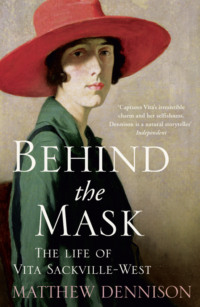
Kitabı oku: «Behind the Mask: The Life of Vita Sackville-West», sayfa 3

Matthew Dennison
Yazı tipi:

A journalist in Vita’s lifetime described Knole as ‘too homely to be called a palace, too palatial to be called a home’88 – an outsider’s view. For Vita, even as a child, Knole was more than either home or palace. It was a living organism, ‘to others dormant but to me awake’:89 she lavished upon it the quick affection children usually reserve for their parents. ‘God knows I gave you all my love,’ she wrote later, ‘Scarcely a stone of you I had not kissed.’90 ‘So I have loved thee, as a lonely child/ Might love the kind and venerable sire/ With whom he lived,’ she claimed in a poem she dedicated to Knole.91

Finding her way through passages and galleries, crossing courtyards, peeping into workshops and domestic offices, what was Vita looking for and what did she see? Why did she give over her days to wandering and exploring, save for the pleasure of escaping her nursemaid or eluding her mother? At times, the connection she forged with Knole was the strongest bond of her life: to strengthen her conviction of reciprocity she endowed the house and its park with human attributes. ‘I knew thy soul, benign and grave and kind/ To me, a morsel of mortality,’ she wrote self-consciously, the night before she left Knole as a married woman for a new home of her own;92 in a later unpublished poem she went a step further and claimed that she was Knole’s soul. From a precociously young age, she was nourished and sustained by Knole’s accumulated memories: swaggering, picturesque, tragic or simply humdrum. The history she learned she read in its tapestries and portraits. In the first instance it was companionship Vita sought in the cavernous house: the romantic distraction of the past came next. ‘I knew all the housemaids by name … [and] was on intimate terms with the hall-boy … The hall-boy and I used to play cricket together.’93 They also indulged in wrestling bouts, for which Vita was punished by being made to keep her diary in French. But the hall-boy’s name is lost and we question the intimacy of those terms.

Day by day Vita absorbed an inflated, erroneous sense of Knole’s importance. Its place in British life – the prestige of her own family – overwhelmed her imagination. That sense persisted. A novel written when she was fourteen included the question, from father to son, ‘And you can bear that name, the name of Sackville, and yet commit a disgraceful action?’94 In fact, in the 850 years since Herbrand de Sackville had journeyed from Normandy with William the Conqueror, the Sackville achievement had been middling. Knole suggested otherwise, and it was Knole’s version of her family history that the young Vita unquestioningly imbibed and the mature Vita avoided revising.

As a child events conspired to delude her. In 1896, after Lord Sackville had persuaded the prime minister, Lord Salisbury, to make Lionel a temporary honorary attaché to the British embassy in Moscow, Lionel and Victoria set off from Knole to the coronation of Nicholas II of Russia; on the eve of departure their neighbours flocked to admire Victoria’s dresses and her jewels laid out for display like wedding presents. Two years later, the Prince and Princess of Wales lunched at Knole, in a party that included the Duke and Duchess of Sparta, heirs to the throne of Greece. Photographs show Vita and the Princess of Wales holding hands, an intimacy few six-year-olds could rival; they had stood side by side at the inevitable tree-planting ceremony. In his thank-you letter written afterwards, the prince admired Knole as ‘so beautifully kept’, a state he attributed to ‘the tender care “de la charmante Chatelaine!”’.95 In the summer of 1897, Victoria had recorded in her diary the visit to Knole of ‘Thomas the Bond Street jeweller’. She had summoned him to examine the silver. ‘He said that we had not the largest, but the best collection of silver in England.’96 Her life at Knole turned Victoria’s head. Knole turned Vita’s head too. In Vita’s case she knew no alternative.

The child shaped by parental absenteeism, maternal whim and her extraordinary surroundings was all angles and corners, ‘all knobs and knuckles’, ‘with long black hair and long black legs, and very short frocks, and very dirty nails and torn clothes’.97 She regarded her mother – indeed everyone outside the closed Knole–Sackville circle – with unavoidable hesitancy. Like the Godavarys in her later novella, The Death of Noble Godavary, she mistrusted any alien element within the family circle. From an early age, she took on her grandfather’s role of showing the house to visitors: the task exacerbated a tendency to unsociability. Although by modern standards Knole’s visitor numbers were low – on a ‘busy’ August day in 1901, the tally reached twenty-seven98 – Vita’s guide work stimulated her sense of possessiveness towards the house that would never be hers, and a rigid, atavistic pride in its glories. Showing the house was an exercise in showing off. Even as a teenager, travelling through Warwickshire en route to Scotland, Vita measured everything she saw against Knole’s yardstick. Of Anne Hathaway’s cottage she noted only its ‘very small, low rooms’, and she poured scorn on the idea that ruined Kenilworth Castle, covering three acres, had any claim to be considered ‘enormous’: ‘Knole covers between four and five acres.’99

The ‘tours’ she led even as quite a young child sealed the imaginative pact Vita made with Knole. She was reluctant and unskilled at making friends, sullen and shy confronted by unknown visitors, hostile and bullying to local children to the extent that ‘none of [them] would come to tea with me except those who … acted as my allies and lieutenants’.100 Knole superseded Clown Archie as her childhood love; perhaps it precluded – or prevented – other intimacies. ‘Vita belonged to Knole,’ Violet Keppel remembered; ‘to the courtyards, gables, galleries; to the prancing sculptured leopards, to the traditions, rites, and splendours. It was a considerable burden for one so young.’101

Unsurprisingly, given her surrounds, while her social instincts faltered, her imagination blossomed: her taste was for adventure. Vita was a scruffy, despotic, busy child. Her inclinations were starkly at odds with late-Victorian ideas about little girls. Victoria did her best. She commissioned elaborate fancy dress costumes, including a tinsel fairy dress, a May queen dress complete with a maypole made from wild flowers, and a flower-encrusted frock intended to transform Vita into a basket of wisteria (Victoria herself had been ‘very much admired’ when she wore a dress of similar design, with added diamonds, to a costume ball in 1897102). It was not enough. Neither in appearance nor character would Vita achieve conventional prettiness and all that it implied; Victoria’s diary does not suggest she always troubled to sympathise with the daughter whose nature and instincts were so different from her own. Of a seaside holiday in August 1898, her mother recorded simply: ‘Vita was much impressed by seeing a runaway horse smashing a butcher’s cart.’103 Victoria and Lionel’s presents to Vita that year included a costly tricycle and a balloon. Even Vita’s greedy passion for chocolates and bonbons challenged Victoria’s ideas of appropriate behaviour. Concerned for her daughter’s complexion, and the figure she would later cut in the marriage market, Victoria ‘put away mercilessly what I thought was bad for her’.104

Although she was not aware of it, Vita learnt cruelty from her mother. It was not simply that isolation bred introspection or that Knole itself made Vita a dreamer, uninterested in those outside her gilded cage. Victoria’s exactingness threatened to deprive those closest to her both of autonomy and their sense of themselves. Her unconditional love for her daughter, whose birth she had regarded as a ‘miracle’, an ‘incredible marvel’, ceased with Vita’s babyhood. In time Vita learned to fear the mother whose love was so contrary, ‘so it was really a great relief when she went away’105: she never stopped loving her mother extravagantly. The family name for Victoria, ‘BM’ (Bonne Mama), contained no deliberate irony. ‘I love thee, mother, but thou pain’st me so!/ Thou dost not understand me; it is sad/ When those we love most, understand us least,’ Vita’s Chatterton exclaims in the verse drama she wrote about the doomed poet in 1909.106 Vita wrote the part of Chatterton for herself. Like many who are bullied, she responded by becoming herself a bully. Children invited to Knole to play with Vita were left in little doubt of the value she placed on their companionship.

Vita contributed a less-than-flattering anecdote to a volume of childhood reminiscences published at the height of her literary fame in 1932. It concerned the children of neighbours called Battiscombe, four girls and a boy, and happened at the beginning of the Second Boer War in 1899. Vita befriended the boy, Ralph. ‘The four girls were our victims’, forced to impersonate Boers. Together Vita and Ralph Battiscombe tied the girls to trees, thrashed their legs with nettles and blocked their nostrils with putty.107 Vita dressed for this activity in a khaki suit in which she masqueraded as Sir Redvers Buller, a popular military commander in South Africa and winner of the Victoria Cross. At her mother’s insistence, and much to Vita’s irritation, the suit had a skirt in place of trousers. The girls, she insisted in 1932, enjoyed their ordeal ‘masochistically’. She was equally clear about the sadistic pleasure she derived from her own part in this horseplay. For her seventh birthday that year, according to Victoria’s diary, Vita had received only presents of model soldiers. Within a year her toy box included guns, swords, a bow and arrow, armour and a fort for the soldiers. Seery bought her a cricket set. It ranked alongside her football among her prized possessions. ‘I made a great deal of being hardy, and as like a boy as possible,’ she wrote in 1920.108 She described a Dutch museum full of ‘all kinds of odds and ends: instruments of torture … old carriages’ as ‘a place where one could spend hours’.109 Forgotten were Clown Archie and his fellows. She composed a single poem about a doll. It was written in French in 1909 and called simply ‘La Poupée’. She invested more of herself in her subsequent biography of Joan of Arc. Like Vita, the tomboyish French saint fought her battles in armour and men’s clothing: brave, zealous, uncompromising. ‘One wonders what her feelings were, when for the first time she surveyed her cropped head and moved her legs unencumbered by her red skirt,’ Vita mused.110

Throughout her life Vita would appear easy with the inevitability of inflicting pain. There was a thoughtlessness to much of her cruelty, just as there was to Victoria’s. From Victoria, Vita had learnt that pain and suffering were implicit in the complicated experience of love. ‘Pain holds beauty in a fiery ring/ Much as the wheelwright fits the hissing tyre/ White-hot to wooden wheel,’ she wrote later.111 In a short poem, ‘The Owl’, she admired a similar combination: ‘Such beauty and such cruelty were hers,/ Such silent beauty, taloned with a knife.’112 All the principal relationships of Vita’s life – with her mother, with her husband Harold Nicolson, with Violet Keppel and a host of subsequent lovers, as well as with Knole – included this negotiation between positive and negative. The surprise is that she herself remained highly sensitive and easily wounded.

In keeping with her cruelty and her sensitivity, Vita also retained the habit, learnt in childhood, of secrecy. ‘Secrecy was my passion,’ she confessed.113 She later suggested that the passion for secrecy was the natural state of childhood.114 She avoided punishment as a small child by hiding under the pulpit in Knole’s Chapel, which lay within easy reach of her bedroom; as a teenager she resorted to code for those parts of her diary she meant to be private; later, in order to foil her mother, she wrote her diary entirely in Italian. Secrecy was Vita’s retreat: it inspired neither guilt nor reflection. Instead she excused it on grounds of heredity: ‘it’s a trait I inherit from my family. So I won’t blame myself excessively for it.’115 But while the family she referred to meant Lionel and the Sackvilles, the secretive impulse she developed as a child arose in response to the non-Sackville aspect of her upbringing, Vita’s understanding of her mother’s uncontrolled, unmannerly ‘Spanish’ emotionalism, which frightened and, over time, alienated her and forced her to keep her own counsel. For all her unwitting cruelty, Vita was seldom histrionic. The instinct for concealment, her dislike of ‘scenes’, were legacies of her childhood. As one future lover would remember, ‘She did demand peace and quiet … no rows. Certainly no inquisitiveness …’116

It seems surprising that Vita claimed subsequently that her memories of her childhood were hazy. As early as February 1912, weeks short of her twentieth birthday, she wrote to her future husband Harold Nicolson a selective description of her growing up that excluded more than it confided. It revealed what we know already, that like all children of her class, Harold included, Vita had led a double life: that of her parents’ daughter and that of the girl entrusted to a shifting cast of nurses and governesses. In addition, in Vita’s case, was the interior life of an only child who, inspired by her home and by loneliness, absented herself into daydreams and make-believe. As she grew older, while her parents travelled, Vita mastered time travel. She spirited herself into moments of Knole’s past, at one with the portraits and historic artefacts which surrounded her: the silver furniture made for James I in the King’s Room; the paintings by Holbein, Frans Hals, Van Dyck and Gainsborough; the heraldic leopards which prompted her to verse (‘Leopards on the gable ends, Leopards on the painted stair’); the white-painted rocking horse belonging to the 4th Duke of Dorset, an object doubly endowed in Vita’s eyes since the duke’s tragic early death in the hunting field had resulted in Knole’s inheritance by his sisters, a period of female ownership spanning half a century. Her spirited reveries excluded her parents. Often she dressed up, as in those Boer War games with the Battiscombes, fought in trenches among the rhododendrons; actually and metaphorically she would go on dressing up for much of her life. At the outset, the performance was for herself, Vita as player and Vita as audience.

As a writer, Vita seldom dwelt on the subject of childhood. Even the stories she wrote as a child focused on adults. Her poetic description of ‘children taken unawares’, ‘Arcady in England’, is an outdoor scene as much concerned with the lushness of an idealised autumn day as the particular nature of the children who catch the poet’s eye. For Vita’s upbringing was one in which, unusually alone, she learnt above all to observe; she forged few childish relationships, even within her family. Some things she saw clearly: the wonders of the great house that captivated her from infancy, ghosts of the past, the power of genius loci. Others she struggled to discern with any clarity throughout her life, among them her mother’s oscillation between absence and presence, affection withheld and affection lavishly bestowed, spite and charm. As in every childhood, happiness was balanced with unhappiness for Vita. As an adult she quoted one of her favourite forebears, Lady Anne Clifford: ‘the marble pillars of Knole in Kent … were to me oftentimes but the gay arbours of anguish’.117

Vita’s response to her dilemma was creative: she mythologised an existence she only partly understood. It was her own version of her mother’s ‘Quel roman est ma vie!’, but lacked the unqualified exuberance of Victoria’s joyful exclamation. For Vita, she and Knole and its whole population of relatives and servants became characters in a fable. She described her grandfather as ‘rather like an old goblin’. Contemptuously she listened to her mother ‘making up legends about the place, quite unwarrantable and unnecessary’, but acknowledged that ‘no ordinary mother could introduce such fairy tales into life’.118 Stalwartly and in silence, she worshipped her long-suffering father whom she imagined not as an individual but a type, ‘a pleasing man’119 – as Virginia Woolf described him, ‘the figure of an English nobleman, decayed, dignified, smoothed, effete’.120 Even the buildings themselves had an unreal quality, like a theatrical backcloth: ‘my little court [is] so lovely in the moonlight. With its gabled windows it looks like a court on a stage, till I half expect to see a light spring up in one window and the play begin.’121 When at length Vita devised a role for herself, she existed in a mythical tower, part heroine, part observer. At Sissinghurst thirty years on, she made good that pretence. Her sense of life as a performance – theatrical and containing elements of make-believe – began much earlier.

Victoria rejoiced in a reality that surpassed any romantic novel: Vita transformed the reality of her unsatisfactory childhood into a personal fiction. It was one way of placing herself centre stage and making sense of her fellow actors; the process also implied distance. These impulses of mythomania and detachment would remain part of Vita’s psyche until death. Early on, albeit subconsciously, she resorted to fiction to clarify the business of living: later she recycled her own reality as the principal element of her fiction, and all her novels contain fragments of autobiography. Despite this, Vita was an honest child and naturally affectionate. For the most part, those traits too would endure.

Vita Sackville-West described the childhood of the Spanish saint, Teresa of Avila, in The Eagle and the Dove, published in 1943. Identifying Teresa’s favourite childhood pastime as ‘tales of adventure’, she warmed to her theme. Throughout her youth, Vita wrote, Teresa, along with her brother Rodrigo, ‘could think of nothing but honour and heroism, knights and giants and distressed ladies, defeated evil and conquering virtue; they even collaborated in composing a story of their own, modelled on these lines’.122

Vita’s was a life of storytelling. Aspects of her poetry, the fiction she wrote in order to make money, her nonfiction and much of her journalism have a strong narrative content; ditto her diary, in which events, appointments and people take the place of analysis or self-searching. Honour, heroism and conquest – sometimes metaphorical, sometimes reimagined – all find a place within the stories Vita spun; invariably she projects herself into the person of her hero. She glimpsed an echo of these vigorous heroics in the youthful St Teresa, a fiery and imaginative aristocratic teenager sent to the Convent of Santa Maria de Gracia after suspicions of a lesbian affair. It was this swashbuckling quality that endeared Teresa to her: similar feelings coloured Vita’s interpretation of seventeenth-century writer Aphra Behn and French saint Joan of Arc, whose biographies she also wrote. Vita’s juvenilia, written in her teens, includes ‘tales of adventure’: so too the more fanciful of her mature fiction, for example, Gottfried Künstler and The Dark Island. The greatest adventure was writing itself. It would remain so. ‘I do get so frightfully, frenziedly excited writing poetry,’ she once admitted. ‘It is the only thing that makes me truly and completely happy.’123 Predictably her happiness was shared by neither of her parents, both of whom disapproved.

At Knole, Vita wrote at a small wooden table in a summerhouse shaded by tall hedges. It overlooked the Mirror Pond and the sunken garden. Previously, it had served as her schoolroom. She did her lessons there: by the time she was ten, essays written in English, French and German on geography and history (Norway and Sweden, ‘L’Amérique du Nord’, Charlemagne, Charles I, William and Mary, Trafalgar), as well as exercises in creative writing (‘Un jour de la vie d’un petit Chien’). Vita cannot have enjoyed these lessons unreservedly: she remembered at moments of boredom or revolt gouging the table’s wooden surface with the blade of her pocketknife.

Initially she wrote what she subsequently described as ‘historical novels, pretentious, quite uninteresting, pedantic’.124 She wrote plays, too, inspired by history or by plays she had seen or read and particularly enjoyed. She wrote at speed. Fully bilingual until her late teens, she was as comfortable in French as in English; she worked with an easy facility, as if writing were for her the most natural thing imaginable. Inspiration never failed her: ‘the day after one [book] was finished another would be begun’.125 In 1927 she quoted a contemporary assessment of Aphra Behn: ‘her muse was never subject to the curse of bringing forth with pain, for she always writ with the greatest ease in the world’.126 So it was, at the outset of her career, for Vita. Rapidly, the pile of lined Murray’s exercise books and foolscap ledgers mounted. All were neatly written in the clear, unselfconscious, undecorated handwriting that scarcely changed until her death. She dated her efforts, noting the days she began and ended. Sometimes a comment recurs in the margin: V. E. – ‘my private sign, meaning Very Easy; in other words, “It has gone well today.”’127 From the outset Vita’s manuscripts were remarkable for their tidiness and the absence of large-scale corrections and alterations. She claimed that she began writing at the age of twelve and ‘never stopped writing after that’.128 She identified as a catalyst Edmond Rostand’s Cyrano de Bergerac.

When Vita first encountered it, Rostand’s play was relatively new: it was written in 1897. By her twelfth birthday seven years later, she knew all five acts by heart. It was a work custom-made for this proud, fierce, boyish but still, on occasion, sentimental young woman of gnawing insecurities, a story of a nobly born soldier-poet, swashbuckling by nature but crippled by self-doubt on account of his enormous nose: ‘My mother even could not find me fair … and, when a grown man, I feared the mistress who would mock at me.’ The play is set in seventeenth-century France. The teenage Vita followed Rostand’s lead and repeatedly returned to the grand siècle: in Richelieu, a 368-page historical novel she began in French in October 1907; Jean Baptiste Poquelin, a one-act comedy about Molière, also written in French the same year; and Le Masque de Fer, a five-act French drama about Richelieu and Louis XIII, written, like Cyrano, in a poetic form resembling alexandrines. At the time Vita’s favourite writers were historical novelists Walter Scott and Alexandre Dumas: their shadows loomed large.

A portrait of Scott hung in Knole’s Poets’ Parlour, the room used by Lionel and Victoria as their family dining room. Vita’s early writing could never be anything but self-conscious. ‘She allowed her readings of … heroic romances to … flavour her interpretation of her hero with an air of classic chivalry,’ the mature Vita wrote of Aphra Behn’s story of thwarted love and racial prejudice, Oroonoko. ‘Oroonoko resembles those seventeenth-century paintings of negroes in plumes and satins, rather than an actual slave on a practical plantation.’129 It was a criticism she might have levelled at her younger self. The teenage Vita admired heroism, grand gestures, the dramatic (and the melodramatic) impulse. ‘In our adolescence, I suppose we have all thought Ludwig [II of Bavaria] a misunderstood figure of extravagant romance,’ she reflected later; ‘in the sobriety of later years we see him to have been only an exaggerated egoist … who happened also to be a king.’130 Twice as a young woman she wrote about Napoleon, a suitably leviathan figure – in a novel, The Dark Days of Thermidor, and a verse drama, Le roi d’Elbe, both written in 1908. Both are exercises in historic romanticism.

In the beginning Vita approached her writing in a spirit of earnestness and painful sincerity: she described her adolescent self as ‘plain, priggish, studious (oh, very!)’.131 Her teenage notebooks include historical jottings, scene-by-scene breakdowns of her plays, and chapter summaries for novels. Heavily she puzzled over the nature of literature, the qualities necessary to write well and the purpose and requirements of art; essays from this time include ‘The difference between genius and talent’, and ‘The outburst of lyric poetry under Elizabeth’. ‘Sincerity is the only possible basis for great art,’ she offered sententiously;132 certainly her output lacked humour. Vita’s submergence in her self-appointed task was complete. She revelled in losing herself in an imaginary past; she was dizzy with the thrill of creation: here was an occupation to match her loneliness. Her adult self likened the experience to drunkenness. It was especially heady on those occasions when she turned her attention to family history.

Vita wrote her first ‘Sackville’ novel in 1906. The Tale of a Cavalier was inspired by Edward Sackville, 4th Earl of Dorset, for Vita ‘the embodiment of Cavalier romance’. His portrait by Van Dyck, in breastplate and striped vermilion doublet, hung in Knole’s Great Hall, constantly before her. The following year she wrote The King’s Secret. Its subject was Charles Sackville, 6th Earl of Dorset, minor poet, rake, lover of Nell Gwyn, latter-day patron of Dryden and friend of Charles II (Victoria described it as Vita’s ‘Charles II book’). The 6th Earl was largely responsible for the appearance of the Poets’ Parlour in Vita’s childhood. In addition to Scott, its panelled walls were crowded with portraits of Chaucer, Shakespeare, Milton and Dr Johnson, alongside Sackville’s friends and contemporaries Dryden, Addison, Congreve, Wycherley and Pope. Such an illustrious visual compendium provided a powerful spur to Vita’s sense of vocation.

The King’s Secret included a self-portrait: ‘a boy muffled up in a blue scarf … scribbling something in a ponderous book … His pen flowed rapidly over the paper … He wrote from morning till evening.’133 She called her alter ego Cranfield Sackville, the first of numerous masculine fictional self-representations. He wrote ‘in a little arbour situated in the garden at Knole’.134 As she worked, Vita remembered, ‘the past mingled with the present in constant reminder’,135 the former as tangible as the latter, she herself in her own words a fragment of an age gone by.136 Victoria queried Vita’s self-portrait: Cranfield she considered ‘more open, less reserved’ than Vita. Plaintively she confided to her diary the wish that her daughter could ‘change and become warmer-hearted’.137 By chance, a visit to Dover Castle on 18 July, midway through The King’s Secret, brought Vita to the last meeting place of Charles II and his sister Henrietta. ‘This is interesting to me, as I am just writing about their meeting!’ she noted.138 Her earliest approaches to fiction were the literary equivalent of method acting.

But it was from a less picturesque source that Vita drew her first literary income. In July 1907, she was one of five winners of an Onlooker competition to complete a limerick. Her prize was a cheque for £1. In her diary, fifteen-year-old Vita put a characteristically heroic spin on events: ‘This morning I received the £1 I had won in the “Onlooker” verse competition. This is the first money I have got through writing; I hope as I am to restore the fortunes of the family that it will not be the last.’139 She resorted to code to record her intention of restoring the family fortunes. A fitting ambition for this ardent Sackville scion, it was not one she intended to expose to her mother’s watchful gaze.

Predictably, opposition came from close to home: Vita’s parents. Lionel was too conventional to embrace the idea of a daughter whose writing was more than a diversion. Like the majority of upper-class Englishmen of the time he mistrusted intellectualism, particularly in women: Vita described life at Knole as ‘completely unintellectual … analysis wasn’t the fashion’.140 Lionel had sown his wild oats in marrying his illegitimate cousin; in the short term, there would be no further public transgressions. Even the eventual breakdown of his marriage was managed with relative decorum on Lionel’s part. In her diary Victoria noted the physical resemblance between father and daughter and Lionel’s pride in Vita; his only plan for her was marriage into a family like his own, preferably to an eldest son. More than anything he longed for her to embrace ‘normal and ordinary things’, among which he did not count writing.141

On the surface, Victoria showed more sympathy. Victoria was Vita’s chosen reader. ‘How marvellously well she writes!’ she admitted later. ‘Reading her calm descriptions fills me with admiration … No one can beat her at her wonderful descriptions of Nature, or analysing a difficult character.’142 But Victoria too mistrusted the intensity of Vita’s involvement with her writing. Pepita’s daughter was too parvenu to condone such evident disregard for the conventional preoccupations of the society she had married into. (Vita afterwards condemned these preoccupations as limited to parties and investments, pâté de foie gras and the novels of E. F. Benson.) Two years earlier Victoria had confided to her diary her relief that Vita was ‘getting a little more coquette and tidy’, suggesting a growing interest in clothes and appearances to match her own; it was a chimera. On 16 July 1907, while she continued to work on The King’s Secret, Vita’s parents finally made their feelings plain: ‘Mama scolded me this morning because she said I write too much, and Dada said he did not approve of my writing … Mother does not know how much I love my writing.’

88.Nicolson, Portrait of a Marriage, p. 14.
89.V. Sackville-West, ‘To Knole’.
90.See Stevens, V. Sackville-West, p. 115.
91.V. Sackville-West, ‘To Knole’.
92.Ibid.
93.V. Sackville-West, ‘The Edwardians Below Stairs’.
94.V. Sackville-West, Tale of a Cavalier, quoted in Nicolson, Portrait of a Marriage, p. 63.
95.Sackville-West, Inheritance, p. 189.
96.Alsop, Lady Sackville, p. 142.
97.Trefusis, Don’t Look Round, p. 70; Vita to Harold, 27 February 1912, quoted in Nicolson, ed., Vita & Harold, p. 23.
98.Brown, Vita’s Other World, p. 26.
99.Vita’s diary, 13 August 1907, Lilly Library.
100.Norman Rose, Harold Nicolson (Jonathan Cape, London, 2005), p. 42.
101.Trefusis, Don’t Look Round, p. 42.
102.Alsop, Lady Sackville, p. 142.
103.Victoria Sackville diary, 21 August 1898, Lilly Library.
104.Victoria Sackville, ‘Book of Happy Reminiscences’, Lilly Library.
105.Nicolson, Portrait of a Marriage, p. 11.
106.V. Sackville-West, Chatterton (repr. The Through Leaves Press, 2002), p. 10.
107.Alan Pryce-Jones, Preface to Little Innocents: Childhood Reminiscences (Cobden-Sanderson Limited, London, 1932, repr. Oxford University Press, Oxford, 1986), p. 98.
108.Nicolson, Portrait of a Marriage, p. 11.
109.Vita’s diary, 2 June 1909, Lilly Library.
110.Saint Joan of Arc (Cobden-Sanderson, London, 1936; Folio Society repr. 1995), p. 7.
111.V. Sackville-West, Solitude (The Hogarth Press, London, 1938), p. 24.
112.V. Sackville-West, ‘The Owl’, Collected Poems, p. 125.
113.Nicolson, Portrait of a Marriage, p. 17.
114.V. Sackville-West, The Eagle and the Dove, p. 112.
115.Nicolson, Portrait of a Marriage, p. 17.
116.Sackville-West/Evelyn Irons Archive, The Dobkin Collection of Feminism and Judaica, Dobkin Collection Item 4655540, Glenn Horowitz Bookseller, New York.
117.V. Sackville-West, The Diary of Lady Anne Clifford, p. xxxix.
118.Nicolson, Portrait of a Marriage, pp. 14, 13; Souhami, Mrs Keppel and her Daughter, p. 84.
119.Glendinning, Vita, p. 22.
120.Virginia Woolf’s diary, 23 January 1927.
121.Nicolson, Portrait of a Marriage, p. 82.
122.V. Sackville-West, The Eagle and the Dove, p. 16.
123.See Stevens, V. Sackville-West, p. 107.
124.Nicolson, Portrait of a Marriage, p. 24.
125.Ibid.
126.V. Sackville-West, Aphra Behn (Gerald Howe, London, 1927), p. 60.
127.Fox and Funke, Vita Sackville-West, p. 13.
128.See Stevens, V. Sackville-West, p. 26.
129.V. Sackville-West, Aphra Behn, p. 74.
130.V. Sackville-West, ‘Turning Over New Leaves’, Vogue, 10 July 1929, p. 43.
131.Nicolson, Portrait of a Marriage, p. 24.
132.Fox and Funke, Vita Sackville-West, p. 14.
133.Quoted in Nicolson, Portrait of a Marriage, p. 62.
134.Ibid.
135.See Glendinning, Vita, p. 25.
136.V. Sackville-West, ‘Sissinghurst’, Collected Poems, p. 113.
137.Sackville-West, Inheritance, p. 202.
138.Vita’s diary, 18 July 1907, Lilly Library.
139.Ibid., 12 July 1907.
140.V. Sackville-West, Pepita, p. 230.
141.Glendinning, Vita, p. 41.
142.Victoria Sackville, ‘Book of Happy Reminiscences’, Lilly Library.
₺644,10