Kitap dosya olarak indirilemez ancak uygulamamız üzerinden veya online olarak web sitemizden okunabilir.
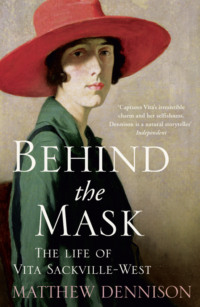
Kitabı oku: «Behind the Mask: The Life of Vita Sackville-West», sayfa 4
Vita was mistaken. Both her parents saw the extent of her passionate engagement with her writing. They noted, for example, that the majority of her thirteenth birthday presents were books: as a counterbalance, their own present consisted of sumptuous squirrel furs.143 Yet, despite their disapproval, they did little to redirect Vita’s energies. By 1907, confronted by overwhelming evidence of Lord Sackville’s mismanagement, they had embarked on a course of unwelcome financial retrenchment which only the Scott bequest would resolve; Victoria’s troublesome siblings continued their carping demands for money and title which afterwards erupted into the succession case of 1910. Above all, Victoria and Lionel knew now that their marriage was broken beyond repair. If Lionel’s response was one of courteous indifference, Victoria’s emphatically was not. She was angry, hurt, uncomprehending. There would be no resolution. Their days of acting in unison were running out. For her twenty-first birthday, Victoria presented Vita with the Italian desk which remains today in her writing room at Sissinghurst.
On 8 April 1908, an ebullient Vita recorded in her diary, ‘We had the results of the exams at Miss Woolff’s. I am first in French literature, French grammar, English literature and geography, and I won the prize essay. Brilliant performance!’ Later that year she consolidated her position. ‘Prize essay day at Miss Woolff’s,’ she wrote on 16 December: ‘I won it (“Reminiscences of an Oak Tree”). I was also first in mythology!’ She won the same prize for the third time on 5 April 1909. The title on that occasion played to bookish Vita’s strengths: ‘Thoughts in a Library’.
By 1909, Vita was in her fourth and final year at Helen Woolff’s School for Girls in London’s South Audley Street. She had first attended classes there at the age of thirteen and pursued her studies thereafter during the autumn and Easter terms. At the same time, until July 1905, Victoria retained the services of Vita’s French governess of ‘such an uneven temper’, Hermine Hall.144 Vita continued to write outside school: her earliest surviving poems, along with fragments of poems, date from this period. Like Cyrano de Bergerac, Miss Woolff’s school was a catalyst in Vita’s life: it represented her first sustained participation in the world of her contemporaries outside Knole. Neither the curriculum studied nor Miss Woolff herself impacted significantly on her intellectual growth or her development as a writer. Nor did she much relish the company of her peers, dismissing in her diary ‘the average run of English girls’ as dull and stupid.145 Meanwhile Victoria oversaw her cultural education: on 13 February 1909, Vita attended a matinée of The Mikado; on 16 February she went to an organ recital in Westminster Abbey given by Master of the King’s Musick, Sir Walter Parratt; on the following day she was present at ‘a most interesting lecture on Madame Récamier’.
More compelling than anything Miss Woolff or Victoria offered was Vita’s unquenchable thirst for her writing. ‘There is writing, always writing,’ she remembered of this period:146 her best days resembled those of Cranfield Sackville, at work undisturbed in his garden arbour. Vita was an autodidact. In every area she prized most highly, from poetry to gardening, she was partly self-taught. Writing had the added attraction of temporarily screening Vita from her parents’ world of acrimony and threats of litigation: she excluded from her first fictions anything unheroic in her Sackville heredity. In Orlando, her fictional ‘biography’ of Vita, Virginia Woolf describes Orlando’s hope ‘that all the turbulence of his youth … proved that he himself belonged to the sacred race rather than the noble – was by birth a writer rather than an aristocrat’.147 Throughout her life, Vita thirsted for just such an acknowledgement. She was never brave enough to separate her two identities. At first an aristocrat who wrote, she became a writer whose work affirmed her own ideal of aristocracy. It was one of several conflicts in her nature.
Vita considered that she had worked hard at Miss Woolff’s. ‘I set myself to triumph at that school, and I did triumph. I beat everybody there sooner or later, and in the end-of-term exams, I thought I had done badly if I didn’t carry off at least six out of eight first prizes.’148 Her triumph transcended examinations. She did indeed earn the reputation for cleverness she had deliberately cultivated. It went some way towards softening the blow of her unpopularity, which she attributed to her moroseness, pedantry, priggishness and savagery, as well as an appearance of aloofness that she was at a loss to explain. There were other discoveries too. Among her fellow pupils were girls who fell in love with Vita.
As an adult, Vita seldom loved singly and was always, as one of her sons remembered, in love.149 Her childhood had been poor preparation for intimacy. Neither Victoria nor Lionel consistently gave her grounds to suppose herself the exclusive object of their affections. Victoria’s love was erratic, Lionel’s mostly implied. As Vita wrote of Shirin le Breton in The Dark Island, ‘It was not a particularly united family, and indeed was held together, as is the case in many families, less by the ties of affection than by those of convenience and convention.’150 Vita loved Knole and believed that Knole returned her love. Her attitude refuted that of Leonard Anquetil in The Edwardians: ‘Chevron [Knole] is really a despot of the most sinister sort: it disguises its tyranny under the mask of love.’151 Yet the house could not wholly replace more conventional relationships. When she was older, Vita wrote in one of the unpublished private poems she called diary poems: ‘The horrible loneliness of the soul makes one crave for some contact.’152 ‘Contact’ was not love, nor limited to a single donor or recipient. During her teenage years at Miss Woolff’s, Vita inspired, and partly reciprocated, the love of two classmates: Rosamund Grosvenor and Violet Keppel.
She had known them both before. Rosamund Grosvenor was an old familiar, Vita’s first friend, a relation of the Duke of Westminster. They were ten and six respectively when Rosamund first visited Vita at Knole in 1899. In his capacity as commander of the West Kent Yeomanry, Lionel had departed for South Africa and the Boer War, and Victoria worried that Vita would be lonely. Rosamund stayed for three days: Vita remembered only that her neatness and cleanliness contrasted with her own grubbiness. Until 1908, when her family moved away from Sevenoaks, Rosamund shared Vita’s morning lessons at Knole. Initially, theirs was a milk-and-water relationship. Vita complained in private of Rosamund’s ordinariness and lack of personality; Rosamund fell under the combined spell of Vita and Knole. Despite her four years’ seniority, Rosamund learned to adopt the role of supplicant. It may have come naturally to her or she may have realised that the Vita who prided herself on her hardiness and her resemblance to a boy could only be conquered by weakness. Fortunately for Rosamund, who by her late teens was deeply in love, she had good looks on her side. Her soft, creamy curvaceousness earned her the nickname ‘the Rubens lady’. Eventually it was Rosamund’s body, not her mind, which provoked a response in Vita. In her diary for 17 July 1905, she noted that Rosamund had gone swimming, noted too her appearance in a bathing costume ‘on the skimpy side’. Vita was thirteen, Rosamund seventeen. When their relationship progressed beyond girlish friendship, Vita was clear that, as far as she was concerned, its root was physical attraction: Rosamund was fatally uninterested in books.
Hero worship, and a tendency she could not resist to regard Vita as the living incarnation of centuries of Sackville swank, characterised Rosamund’s love. She revelled too in Vita’s Spanish blood, an association of exotic glamour which Vita herself exploited. Vita provoked a similar response in Violet Keppel: ‘All this, and a gipsy too! My romantic heart overflowed.’153 Rosamund addressed Vita as ‘Princess’; for Violet, Vita was her ‘Rosenkavalier’.154 Both names imply status, desirability, a prize.
Violet’s novel Broderie Anglaise offers a version of her relationship with Vita, whom she reimagines as a youthful peer, John Shorne. There is ‘a languid grace’ about Shorne, ‘a latent fire’. Like Vita, he bears a strong resemblance to his family portraits. His ‘face recalled so many others seen in frames and surrounded by a ruff, a jabot or a stock, a face that had been a type since 1500 … a hereditary face which had come, eternally bored through five centuries’.155 Like Rosamund, Violet romanticised Vita. Yet while Rosamund’s affection had the puppyishness of first love, Violet’s, even as a child, was characterised by an obsessive decisiveness. It was not, Vita insisted, ‘the kind of rather hysterical friendship one conceives in adolescence’:156 there was nothing exploratory about Violet’s feelings. Her emotional precocity was matched only by her determination. If Rosamund’s love for Vita resembled the blushing passions of a girls’ school story, Violet’s possessed from the beginning a more adult quality. Her decision that Vita was her destiny was virtually instantaneous and never rescinded. Decades later she underlined in her copy of The Unquiet Grave Cyril Connolly’s statement that ‘We only love once, for once only are we perfectly equipped for loving.’157 She had not needed a book to tell her that. Even at the end of her life, fragile and lonely in the Villa Ombrellino in Florence, Violet spoke of Vita in adulatory tones. When it happened, she became Vita’s lover through force of will. Vita was a mostly willing participant, but it was Violet who contrived their collision.
Their first meeting took place on a winter afternoon: Mayfair, 1905, a tea party of sorts for a girl friend with a broken leg, who remained in her bed. The only fellow guest Violet noticed at the bedside was Vita. Vita was thirteen, tall for her age, ungainly and unmannerly (Lionel had recently complained of her abruptness and her roughness). Violet was two years younger. Vita rebuffed her conversational gambits, Violet inwardly criticised Vita’s dress. Both were evidently curious. Violet persuaded her mother to invite Vita to tea; Vita’s mother was delighted and Vita went. Again their conversation was at cross purposes. Violet described Paris while Vita enlarged on her rabbits. They found common ground in inventorying aloud lists of their ancestors: as Vita explained later, in upper-class Edwardian society ‘genealogies and family connections … formed almost part of a moral code’.158 On Vita’s departure, Violet kissed her. At home Vita congratulated herself on having made a friend – this was so unusual that she sang about it in the bath – while Violet embarked on what would become a lengthy and at times inflammatory sequence of letters. Vita responded with more news of her rabbits and also her dogs: an Aberdeen terrier called Pickles and an Irish terrier predictably known as Pat. Nothing daunted, Violet poured out what Vita labelled ‘precocious letters on every topic in a variety of tongues, imaginative exceedingly, copiously illustrated, bursting occasionally into erratic and illegible verse’.159
Between letters Vita visited Violet at her parents’ house in Portman Square; Violet was invited to Knole. Portman Square, where Violet’s mother, Alice Keppel, played host to Edward VII as his mistress, suggested sex at its most discreet and profitable; Knole, with its whispering galleries of Sackville history, imparted romance, a thrill of derring-do glittering in dust motes. Vita’s shortcomings as a correspondent notwithstanding, for Violet it was a perfect combination. ‘I fell in love with John when I was eleven and a half – I swear that’s the truth – and for eight years I never stopped thinking about him,’ she wrote of Vita–John in Broderie Anglaise.160 In another novel, Hunt the Slipper, she suggested that ‘one never loves more passionately than at the age of ten’.161
Vita and Violet shared dancing and Italian lessons. In the spring of 1906 they were in Paris at the same time. In the apartment in the rue Laffitte, in front of an audience of Lionel and Victoria and Sir John Murray Scott’s French servants, they staged Vita’s play about the reign of Louis XIII, Le Masque de Fer. Vita took the part of the Man in the Iron Mask and was delighted when Seery’s cook burst into tears. Less competent a French speaker than Vita (she did not have the benefit of a French-convent-educated mother), Violet took French lessons. They began to talk to one another in French. There was a special excitement to the intimacy of addressing each other as ‘tu’. That sense of intimacy grew. In the spring of 1908, Violet told Vita she loved her, ‘and I,’ wrote Vita, ‘finding myself expected to rise to the occasion, stumbled out an unfamiliar “darling”’.162 Violet sought to make a pact of the exchange by presenting Vita with a ring when next they met. The ring had been a reluctant present to Violet from the Bond Street art dealer Sir Joseph Duveen when Violet was six. It was carved from red lava with the image of a woman’s head and had belonged to a Venetian Doge of the early Renaissance. The sixteen-year-old Vita composed a special entry in her diary and kept the ring lifelong.
Vita’s relationship with Violet Keppel changed the course of her life: she was slow to respond fully to overtures which, on Violet’s part, contained a sexual dimension almost from the start. This was not, Vita would claim, because she mistook Violet’s intentions. Violet was always unique among Vita’s friends: colourful and sophisticated; her ‘erratic’ friend, as she introduced Violet to Harold Nicolson; ‘this brilliant, this extraordinary, this almost unearthly creature’, as Vita described her at the height of their affair in 1920;163 the friend whose love she argued she had recognised immediately. She said that she had understood Violet’s early feelings for her as she had understood those of Rosamund, whom she had admitted she loved by the time she was fifteen. Her mother’s diary challenges such assertions of sexual maturity. ‘Vita and I had begun together The Woman in White,’ Victoria wrote on 21 September 1904; ‘I dropped it as the child’s mind is still too young and I am careful to keep her very pure-minded.’ She had confiscated The Count of Monte Cristo for the same reasons.
If Vita was aware of the nature of Rosamund and Violet’s feelings, she ought to have recognised that they were rivals. In the event she admitted no need to arbitrate between them. In this way, at the outset of her romantic career, she established a pattern which would continue, juggling multiple lovers with no apparent sense of conflict or disloyalty. ‘All love is a weakness … in so far as it destroys some part of our independence,’ says Sebastian in The Edwardians.164 For Vita, invariably more loved than loving, love would seldom compromise her independence. She exercised freedom of choice both romantically and sexually, countering Silas’s statement to Nan in her early novel The Dragon in Shallow Waters that ‘freedom goes when the heart goes’.165 Invariably she retained a clear conscience, and she did not often lose her heart.
Vita did not return to Miss Woolff’s school in the autumn of 1909. Instead she went abroad with her mother and Sir John. Her extended visit to the Continent took in Germany, Austria, Poland and Russia. At Antoniny in the Ukraine, Vita experienced a last gasp of the ancien régime, staying with Count Joseph Potocki, ‘riding, dancing, laughing; living at a fantastic rate in that fantastic oasis of extravagance and feudalism, ten thousand horses on the estate, eighty English hunters, and a pack of English hounds; a park full of dromedaries; … Tokay handed round by a giant; cigarettes handed round by dwarfs in eighteenth-century costumes’.166 Potocki’s estate covered a hundred miles. Dazzled by splendour, aware of the poverty endured by all bar her host, Vita recognised an alternative, and disturbing, version of the tale of inheritance she had imbibed as Knole’s child. The inequalities shocked her. ‘That experience was really like going back to France before 1789,’ she wrote in 1944. ‘It was horrible; it was revealing.’ The travellers wound up in October in Paris, where Victoria ordered dresses for Vita at Worth. As her eighteenth birthday approached, her mother had different plans for Vita, who that year had begun her reluctant career as a debutante. ‘Party in the evening at Lady Jane Coombe’s,’ Vita had written laconically in her diary on 25 January: ‘Hated it.’ For Lionel and Victoria, whose ambitions for Vita’s marriage were considerable, it was an ominous beginning to her first season. Vita would discover, as she had predicted leaving Russia, a stultifying sense of confinement about the life that was now expected of her at home: ‘How shall I ever be able to live in this restricted island! I want expanse.’167 In the short term she did not rebel. She wrote out her protest in a new novel. In Behind the Mask, a story of modern marriage set in France, she dismissed ‘the whole business’ of the marriage market as ‘coarse and vulgar’.168
On 5 October 1905, Victoria Sackville-West had decided to make a new will. She had visited the family solicitor, Mr Pemberton of Meynell & Pemberton, back in March 1897, in order to formalise her intention of leaving ‘everything to Lionel in trust for Vita, till she marries with his consent; then he will give her the income of the capital’.169 On that occasion Vita was days short of her fifth birthday. By the time Victoria returned to the fray, her daughter was thirteen. Victoria explained her motives: ‘Now … I do not think I shall have another child, after all the precautions Lionel and I have taken.’170
Sexual intercourse ceased for Lionel and Victoria Sackville-West in 1904. Once it had formed the bedrock of this mismatched couple’s relationship. The decision was Victoria’s, her justification the weakness of her nervous system, as explained to her by her obliging physician Dr Ferrier. From now on, iron tablets rather than Lionel would be her medicine. Her husband was thirty-seven years old, active and highly sexed: previously Victoria had described him as ‘a stallion’, their lovemaking ‘delirium’. Lionel, for his part, had once thought Victoria ‘the very incarnation of passionate love’: ‘Her breasts are too delicious for words – round firm and soft with two darling little buttons which I adore kissing. She has the most magnificent hips and legs with the most ravishing little lock of hair between them which is as silky and soft as possible.’171 During the early years of their marriage, Victoria’s diary is full of sex: when, where and how often. In the beginning, the naughtiness of ‘Baby’ (Lionel’s penis) is a constant refrain. Sex forced the couple to miss morning appointments; it inconvenienced the servants; it kept Victoria awake at night; it bound them together.
Childbirth brought about the change. For Victoria, desire gave way to fear. Uppermost in her mind was the spectre of another unendurable confinement. In the aftermath of Vita’s birth, she claimed she would do anything to make Lionel happy, ‘even if it meant undergoing the horrors of childbirth’.172 Then she persuaded him to adopt the rudimentary contraceptive practices of the time and did her best to avoid that very contingency.
If abstinence appeared to reassure Victoria, its effect on Lionel was quite different. Victoria was volatile. In all her relationships she lacked self-control. In her marriage she positively embraced the Sturm und Drang of lovers’ quarrels. By contrast Lionel was peaceable, uncommunicative, too polite for histrionics: the more Victoria railed, the further Lionel retreated behind a carapace of good manners and watery dislike, and so on and on. Like Evelyn Jarrold in need of reassurance from Miles Vane-Merrick in Family History, ‘the more she saw that she was making herself a nuisance, the more of a nuisance she made herself’.173 Despite their close blood relationship, the Sackville-Wests were remarkably ill-suited. For ten years, beginning around 1899, they no longer scrupled to disguise their differences. Vita witnessed this breakdown. She absorbed a highly distorted idea of marriage at a time when she was insufficiently emotionally mature to set it in context or to recognise the unusual starkness of her parents’ incompatibility. Instead she struggled to reach a solution through writing. In Behind the Mask, written between November 1909 and March 1910, her heroine renounces the man she loves in order to avoid the coruscating effects of marriage: ‘It is better for us to live apart and love each other all our lives, than to marry and quarrel after a few months.’174 The extremes in her parents’ behaviour suggested to Vita an oversimplified equation of Englishness and equanimity on Lionel’s part and Victoria’s Spanish blood and emotional misrule, as well as a model of marriage in which love was doomed to fail. Increasingly she would choose to blame Victoria. As one of her later fictional heroines states, ‘I hate lack of control … I hate people who let themselves go.’175
The collapse of her parents’ marriage was one factor which convinced Vita of her own ‘duality’: that her nature combined conflicting elements or ‘sides’, the English and the Spanish, which both demanded satisfaction. She imagined those elements as opposites and therefore irreconcilable: propriety pitched against protest, conformity against self, kindness against cruelty, ‘a free spirit or a prisoner’;176 or, as Violet Keppel explained it to Vita, purity and gravity on the one hand, dominance, sensuousness and brutality on the other. An inward struggle along these lines is often part of the experience of growing up. Vita never fully outgrew it because she regarded it as a quirk of her heredity rather than a passing phase; it further complicated her transition from childhood to adulthood. In her first published novel, Heritage, of 1919, she investigated the same dichotomy in the character of Ruth, a version of herself. Ruth is ‘cursed with a dual nature, the one coarse and unbridled, the other delicate, conventional, practical, motherly, refined …’.177 Another of her heroines likens such polarities to the two halves of an apple: ‘Was it impossible ever to keep the apple whole?’ she asks herself, ‘a globe to hold entire in the hand?’178 For Vita, the ‘coarse and unbridled’ side of her nature was every bit as appealing as its more refined opposite. On the eve of her first visit to Spain in 1913, a journey that took her from Madrid south to Granada, she wrote to her friend Irene Lawley: ‘I am going to SPAIN … If I write about it, my hand begins to shake, and my hair piles itself up on the top, like under a mantilla, with a comb, all of its own accord. So I won’t say any more.’179 A kind of coarseness could excite Vita.
Instead of steering a middle course, or choosing one way over the other, Vita indulged both inclinations separately. ‘My whole curse has been a duality with which I was too weak and too self-indulgent to struggle,’ as she explained in 1920.180 ‘Nothing is foreordained./ I hold my liberty/ Unstained and unconstrained,’ Vita would write in her poem ‘Heredity’. In the event, the ‘stain’ of her parents’ marriage proved ineradicable. The desire to satisfy in full both facets of her make-up would shape key moments in her life.
Lionel and Victoria had in common their devotion to Knole and to Vita: even that was at variance, different in origin, form and expression. A selfish and romantically uncomplicated man, Lionel was incapable of interpreting Victoria’s sexual withdrawal other than as a corresponding emotional withdrawal, so he sought satisfaction elsewhere. In transferring his desire he ended up transferring his affection. Victoria expended her energy on Knole and, with increasing frequency, on scenes of the sort guaranteed to drive Lionel further away. Unwitting it may have been, but Victoria’s first blind steps along the road to bitterness and disillusion were taken deliberately.
Vita watched her and saw what she regarded as her mother’s ‘mistake’. It did not occur to her that Victoria’s behaviour was a cri de coeur. She had not read in her mother’s diary her desperate desire for warmth; she suspected nothing then of her frustration at the coldness first of Lord Sackville, then Lionel and even Vita herself, with her tendency to keep her feelings secret and resist confidences. Vita’s solution, explored through fiction, was a world in which partners simply deceived one another, concealing their true emotions beneath a smiling veneer, their motives self-protection and survival, the result a semblance of marriage in appearance only: legitimate mendacity in the interests of the greater happiness. Behind the Mask is among the most aptly titled of her books. ‘Is there anyone without the mask?’ she asks.181 It was a pragmatic, cynical approach, and undesirable in a girl of eighteen on the brink of adulthood. She saw it very clearly: she was never wholly disabused of her theory. ‘Men have two natures,’ she wrote later, ‘and one of them they keep concealed.’182 At another level, her conviction that each of us presents to the world a mask which conceals as much as it reveals explained the impossibility of ever fully knowing anyone but ourselves, another theme she would explore in her fiction. ‘When you see a person, a body, marvellous casket and mask of secrets, what do you think?’ she asked in Heritage.183
Unsurprisingly, Victoria proved incapable of wearing any sort of mask. As her relationship with Lionel worsened, she took up with Seery instead. As an added distraction, she opened a shop on South Audley Street, selling lampshades, waste-paper baskets, boxes, blotters and ashtrays decorated with epigrams and mottoes, including her favourite: ‘A camel can go for nine days without water, but who wants to be a camel?’ She called the shop Spealls, an anagram of the name of its first manageress, and harried Vita to think up similar mottoes and short verses; Vita failed. Spealls enabled Victoria to visit London frequently. Her relationship with Seery grew closer; it was peppered with rows and reconciliations. Seery resented Spealls and its call on Victoria’s time; the shop provided further grounds for differences. Then, sporadically, Seery threatened to cut Victoria out of his will. To both of them this constant negotiation and renegotiation of the terms of their relationship was the breath of life. Even as a teenager, such tempestuousness appalled Vita. After witnessing a particularly acrimonious quarrel between Seery and her mother on 22 March 1910, Vita wrote: ‘I thought they would quarrel for good, but he became apologetic and they have half patched it up, though it can’t ever be as before. It was all very unpleasant, and they called each other names and I hated it.’184
For Victoria, such incidents were a game, a form of self-affirmation. They proved her continuing ability to dominate a man completely. With Seery in the role of cavaliere servente, there was no unwelcome complication of sex. Vita’s own self-affirmation would take different forms, though, like Victoria, her ‘Spanish’ side revelled in the world of feelings: like the narrator of Heritage, ‘Spanish’ Vita believed that ‘the vitality of human beings is to be judged … by the force of their emotion’.185 In the decades to come, her own emotions, alongside her attitude to sex, would give rise to numberless complications.