Sadece Litres'te okuyun

Kitap dosya olarak indirilemez ancak uygulamamız üzerinden veya online olarak web sitemizden okunabilir.

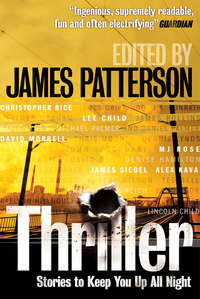
Kitabı oku: «Thriller: Stories To Keep You Up All Night», sayfa 2

Kollektif
Yazı tipi:

The Laney sheriff opened a map. Thought hard. Penney wouldn’t be aiming to stay in California. He’d be moving on. Probably up to the wilds of Oregon or Washington State. Or Idaho or Montana. But not due north. Penney was a veteran. He knew how to feint. He would head west first. He would aim to get out through Sacramento. But Sacramento was a city with an ocean not too far away to the left, and high mountains to the right. Fundamentally six roads out, was all. So six roadblocks would do it, maybe on a ten-mile radius so the local commuters wouldn’t get snarled up. The sheriff nodded to himself and picked up the phone.

Penney walked north for an hour. It started raining at dusk. Steady, wetting rain. Northern California, near the mountains, very different from what Penney was used to. He was hunched in his jacket, head down, tired and demoralized and alone. And wet. And conspicuous. Nobody walked anywhere in California. He glanced over his shoulder at the traffic stream and saw a dull olive Chevrolet sedan slowing behind him. It came to a stop and a long arm stretched across and opened the passenger door. The dome light clicked on and shone out on the soaked roadway.

“Want a ride?” the driver called.

Penney ducked down and glanced inside. The driver was a very tall man, about thirty, muscular, built like a regular weight lifter. Short fair hair, rugged open face. Dressed in uniform. Army uniform. Penney read the insignia and registered: military police captain. He glanced at the dull olive paint on the car and saw a white serial number stenciled on the flank.

“I don’t know,” he said.

“Get in out of the rain,” the driver said. “A vet like you knows better than to be walking in the rain.”

Penney slid inside. Closed the door.

“How do you know I’m a vet?” he asked.

“The way you walk,” the driver said. “And your age, and the way you look. Guy your age looking like you look and walking in the rain didn’t beat the draft for college, that’s for damn sure.”

Penney nodded.

“No, I didn’t,” he said. “I did a jungle tour.”

“So let me give you a ride,” the driver said. “A favor, one soldier to another. Consider it a veteran’s benefit.”

“Okay,” Penney said.

“Where you headed?” the driver asked.

“I don’t know,” Penney said. “North, I guess.”

“Okay, north it is,” the driver said. “I’m Jack Reacher. Pleased to make your acquaintance.”

Penney said nothing.

“You got a name?” the guy called Reacher asked.

Penney hesitated.

“I don’t know,” he said.

Reacher put the car in drive and glanced over his shoulder. Eased back into the traffic stream. Clicked the switch and locked the doors.

“What did you do?” he asked.

“Do?” Penney repeated.

“You’re running,” Reacher said. “Heading out of town, walking in the rain, head down, no bag, don’t know what your name is. I’ve seen a lot of people running, and you’re one of them.”

“You going to turn me in?”

“I’m a military cop,” Reacher said. “You done anything to hurt the army?”

“The army?” Penney said. “No, I was a good soldier.”

“So why would I turn you in?”

Penney looked blank.

“What did you do to the civilians?” Reacher asked.

“You’re going to turn me in,” Penney said helplessly.

Reacher shrugged at the wheel. “That depends. What did you do?”

Penney said nothing. Reacher turned his head and looked straight at him. A powerful, silent stare, hypnotic intensity in his eyes, held for a hundred yards of road. Penney couldn’t look away. He took a breath.

“I burned my house,” he said. “Near Mojave. I worked seventeen years and got canned yesterday and I got all upset because they were going to take my car away so I burned my house. They’re calling it arson.”

“Near Mojave?” Reacher said. “They would. They don’t like fires down there.”

Penney nodded. “I was real mad. Seventeen years, and suddenly I’m shit on their shoe. And my car got stolen anyway, first night I’m away.”

“There are roadblocks all around here,” Reacher said. “I came through one south of the city.”

“For me?” Penney asked.

“Could be,” Reacher said. “They don’t like fires down there.”

“You going to turn me in?”

Reacher looked at him again, hard and silent. “Is that all you did?”

Penney nodded. “Yes, sir, that’s all I did.”

There was silence for a beat. Just the sound of the wet pavement under the tires.

“I don’t have a problem with it,” Reacher said. “A guy does a jungle tour, works seventeen years and gets canned, I guess he’s entitled to get a little mad.”

“So what should I do?”

“Start over, someplace else.”

“They’ll find me,” Penney said.

“You’re already thinking about changing your name,” Reacher said.

Penney nodded. “I junked all my ID. Buried it in the woods.”

“So get new paper. That’s all anybody cares about. Pieces of paper.”

“How?”

Reacher was quiet another beat, thinking hard. “Classic way is find some cemetery, find a kid who died as a child, get a copy of the birth certificate, start from there. Get a social security number, a passport, credit cards, and you’re a new person.”

Penney shrugged. “I can’t do all that. Too difficult. And I don’t have time. According to you, there’s a roadblock up ahead. How am I going to do all of that stuff before we get there?”

“There are other ways,” Reacher said.

“Like what?”

“Find some guy who’s already created false ID for himself, and take it away from him.”

Penney shook his head. “You’re crazy. How am I going to do that?”

“Maybe you don’t need to do that. Maybe I already did it for you.”

“You got false ID?”

“Not me,” Reacher said. “Guy I was looking for.”

“What guy?”

Reacher drove one-handed and pulled a sheaf of official paper from his inside jacket pocket.

“Arrest warrant,” he said. “Army liaison officer at a weapons plant outside of Fresno, peddling blueprints. Turns out to have three separate sets of ID, all perfect, all completely backed up with everything from elementary school onward. Which makes it likely they’re Soviet, which means they can’t be beat. I’m on my way back from talking to him right now. He was running, too, already on his second set of papers. I took them. They’re clean. They’re in the trunk of this car, in a wallet.”

Traffic was slowing ahead. There was red glare visible through the streaming windshield. Flashing blue lights. Yellow flashlight beams waving, side to side.

“Roadblock,” Reacher said.

“So can I use this guy’s ID?” Penney asked urgently.

“Sure you can,” Reacher said. “Hop out and get it. Bring the wallet from the jacket in the trunk.”

He slowed and stopped on the shoulder. Penney got out. Ducked away to the back of the car and lifted the trunk lid. Came back a long moment later, white in the face. Held up the wallet.

“It’s all in there,” Reacher said. “Everything anybody needs.”

Penney nodded.

“So put it in your pocket,” Reacher said.

Penney slipped the wallet into his inside jacket pocket. Reacher’s right hand came up. There was a gun in it. And a pair of handcuffs in his left.

“Now sit still,” he said quietly.

He leaned over and snapped the cuffs on Penney’s wrists, one handed. Put the car back into drive and crawled forward.

“What’s this for?” Penney asked.

“Be quiet,” Reacher said.

They were two cars away from the checkpoint. Three highway patrolmen in rain capes were directing traffic into a corral formed by parked cruisers. Their light bars were flashing bright in the shiny dark.

“What?” Penney said again.

Reacher said nothing. Just stopped where the cop told him and wound his window down. The night air blew in, cold and wet. The cop bent down. Reacher handed him his military ID. The cop played his flashlight over it and handed it back.

“Who’s your passenger?” he asked.

“My prisoner,” Reacher said. He handed over the arrest warrant.

“He got ID?” the cop asked.

Reacher leaned over and slipped the wallet out from inside Penney’s jacket, two-fingered like a pickpocket. Flipped it open and passed it through the window. A second cop stood in Reacher’s headlight beams and copied the plate number onto a clipboard. Stepped around the hood and joined the first guy.

“Captain Reacher of the military police,” the first cop said.

The second cop wrote it down.

“With a prisoner name of Edward Hendricks,” the first cop said.

The second cop wrote it down.

“Thank you, sir,” the first cop said. “You drive safe, now.”

Reacher eased out from between the cruisers. Accelerated away into the rain. A mile later, he stopped again on the shoulder. Leaned over and unlocked Penney’s handcuffs. Put them back in his pocket. Penney rubbed his wrists.

“I thought you were going to turn me in,” he said.

Reacher shook his head. “Looked better for me that way. I wanted a prisoner in the car for everybody to see.”

Reacher handed the wallet back.

“Keep it,” he said.

“Really?”

“Edward Hendricks,” Reacher said. “That’s who you are now. It’s clean ID, and it’ll work. Think of it like a veteran’s benefit. One soldier to another.”

Edward Hendricks looked at him and nodded and opened his door. Got out into the rain and turned up the collar of his leather jacket and started walking north. Reacher watched him until he was out of sight and then pulled away and took the next turn west. Turned north and stopped again where the road was lonely and ran close to the ocean. There was a wide gravel shoulder and a low barrier and a steep cliff with the Pacific tide boiling and foaming fifty feet below it.

He got out of the car and opened the trunk and grasped the lapels of the jacket he had told Penney about. Took a deep breath and heaved. The corpse was heavy. Reacher wrestled it up out of the trunk and jacked it onto his shoulder and staggered with it to the barrier. Bent his knees and dropped it over the edge. The rocky cliff caught it and it spun and the arms and legs flailed limply. Then it hit the surf with a faint splash and was gone.

James Grippando

It’s no accident that five of James Grippando’s ten thrillers are legal thrillers featuring Jack Swyteck, an explosive criminal defense lawyer. Grippando is a lawyer himself, though fortunately with far fewer demons than Jack. What’s it like to be Jack? Simply imagine that your father is Florida’s governor, your best friend was once on death row and your love life could fill an entire chapter in Cupid’s Rules of Love and War (Idiot’s Edition). Throw in an indictment for murder and a litany of lesser charges, and you’ll begin to get the picture.

Readers of the Swyteck series know that Jack is a self-described half-Cuban boy trapped in the body of a gringo. That’s a glib way of saying that Jack’s Cuban-born mother died in childbirth, and Jack was raised by his father and stepmother, with no link whatsoever to his Cuban heritage. Grippando is not Cuban, but he considers himself an “honorary Cuban” of sorts. His best friend since college was Cuban born and that family dubbed him their otro hijo, other son. Quite remarkable, considering that Grippando grew up in rural Illinois and spoke only “classroom” Spanish. When he first arrived in Florida, he had no idea that Cubans made better rice than the Chinese, or that a jolt of Cuban coffee was as much a part of midafternoon in Miami as thunderclouds over the Everglades. He’d yet to learn that if you ask a nice Cuban girl on a date, the entire family would be waiting at the front door to meet you when you picked her up. In short, Grippando—like Jack Swyteck—was the gringo who found himself immersed in Cuban culture.

In Hear No Evil, the fourth book in the Swyteck series, Jack Swyteck travels back to Cuba to discover his roots. Naturally, he runs into a mess of trouble, all stemming from a murder on the U.S. naval base at Guantanamo Bay. Grippando prides himself on his research, and threw himself into all things Cuban when researching the thriller. At the time it was impossible to speak to anyone about the U.S. naval base at Guantanamo Bay without the problem of the detainees dominating the conversation. It was then that Grippando came across a forty-year-old plan—Operation Northwoods—which, in the hands of someone with an extremely devious mind, could cause a mountain of trouble.

So was born this story.

In Operation Northwoods, Jack and his colorful sidekick, Theo Knight, find themselves in the heat of a controversy after an explosion at the U.S. naval base at Guantanamo Bay, Cuba—an explosion that rocks the world.

Operation Northwoods

6:20 a.m., Miami, Florida

Jack Swyteck swatted the alarm clock, but even the subtle green glow of liquid-crystal digits was an assault on his eyes. The ringing continued. He raked his hand across the nightstand, grabbed the telephone and answered in a voice that dripped with a hangover. It was Theo.

“Theo who?” said Jack.

“Theo Knight, moron.”

Jack’s brain was obviously still asleep. Theo was Jack’s best friend and “investigator,” for lack of a better term. Whatever Jack needed, Theo found, whether it was the last prop plane out of Africa or an explanation for a naked corpse in Jack’s bathtub. Jack never stopped wondering how Theo came up with these things. Sometimes he asked; more often, he simply didn’t want to know. Theirs was not exactly a textbook friendship, the Ivy League son of a governor meets the black high-school dropout from Liberty City. But they got on just fine for two guys who’d met on death row, Jack the lawyer and Theo the inmate. Jack’s persistence had delayed Theo’s date with the electric chair long enough for DNA evidence to come into vogue and prove him innocent. It wasn’t the original plan, but Jack ended up a part of Theo’s new life, sometimes going along for the ride, other times just watching with amazement as Theo made up for lost time.

“Dude, turn on your TV,” said Theo. “CNN.”

There was an urgency in Theo’s voice, and Jack was too disoriented to mount an argument. He found the remote and switched on the set, watching from the foot of his bed.

A grainy image filled the screen, like bad footage from one of those media helicopters covering a police car chase. It was an aerial shot of a compound of some sort. Scores of small dwellings and other, larger buildings dotted the windswept landscape. There were patches of green, but overall the terrain had an arid quality, perfect for iguanas and banana rats—except for all the fences. Jack noticed miles of them. One-and two-lane roads cut across the topography like tiny scars, and a slew of vehicles seemed to be moving at high speed, though they looked like matchbox cars from this vantage point. In the background, a huge, black plume of smoke was rising like a menacing funnel cloud.

“What’s going on?” he said into the phone.

“They’re at the naval base in Guantanamo Bay. It’s about your client.”

“My client? Which one?”

“The crazy one.”

“That doesn’t exactly narrow things down,” said Jack.

“You know, the Haitian saint,” said Theo.

Jack didn’t bother to tell him that he wasn’t actually a saint. “You mean Jean Saint Preux? What did he do?”

“What did he do?” said Theo, scoffing. “He set the fucking naval base on fire.”

6:35 a.m., Guantanamo Bay, Cuba

Camp Delta was a huge, glowing ember on the horizon, like the second rising of the sun. The towering plume of black smoke rose ever higher, fed feverishly by the raging furnace below. A gentle breeze from the Windward Passage only seemed to worsen matters—too weak to clear the smoke, just strong enough to spread a gloomy haze across the entire southeastern corner of the U.S. Naval Station at Guantanamo Bay, Cuba.

Major Frost Jorgenson was speeding due south in the passenger seat of a U.S. marine Humvee. Even with the windows shut tight, the seeping smoke was making his eyes water.

“Unbelievable,” he said as they drew closer to the camp.

“Yes, sir,” said his driver. “Biggest fire I’ve ever seen.”

Major Jorgenson was relatively new to “Gitmo,” part of the stepped-up presence of U.S. Marines that had come with the creation of a permanent detention facility at Camp Delta for “enemy combatants”—suspected terrorists who had never been charged formally with a crime. Jorgenson was a bruiser even by marine standards. Four years of college football at Grambling University had prepared him well for a life of discipline, and old habits die hard. Before sunrise, he’d already run two miles and peeled off two hundred sit-ups. He was stepping out of the shower, dripping wet, when the telephone call had come from Fire Station No. 1. An explosion at Camp Delta. Possible casualties. Fire/Rescue dispatched. No details as yet. Almost immediately, he was fielding calls from his senior officers, including the brigadier general in charge of the entire detainee program, all of whom were demanding a situation report, pronto.

A guard waved them through the Camp Delta checkpoint.

“Unbelievable.” The major was slightly embarrassed for having repeated himself, but it was involuntary, the only word that seemed to fit.

The Humvee stopped, and the soldiers rushed to strap on their gas masks as they jumped out of the vehicle. A wave of heat assaulted the major immediately, a stifling blow, as if he’d carelessly tossed a match onto a pile of oversoaked charcoal briquettes. Instinctively he brought a hand to his face, even though he was protected by the mask. After a few moments, the burning sensation subsided, but the visibility was only getting worse. Depending on the wind, it was like stepping into a foggy twilight, the low morning sun unable to penetrate the smoke. He grabbed a flashlight from the glove compartment.

Major Jorgenson walked briskly, stepping over rock-hard fire hoses and fallen debris, eventually finding himself in the staging area for the firefighting team from Fire Station No. 2. Thick, noxious smoke made it impossible to see beyond the three nearest fire trucks, though he was sure there were more, somewhere in the darkness. At least he hoped there were more. Once again, the heat was on him like a blanket, but even more stifling was the noise all around him—radios crackling, sirens blaring, men shouting. Loudest of all was the inferno itself, an endless surge of flames emitting a noise that was peculiar to fires this overwhelming, a strange cross between a roaring tidal wave and a gigantic wet bedsheet flapping in the breeze.

“Watch it!”

Directly overhead, a stream of water arched from the turret of a massive, yellow truck. It was one of several three-thousand-gallon airport rescue and firefighting machines on the base, capable of dousing flames with 165 gallons of water per minute. It wasn’t even close to being enough.

“Coming through!” A team of stretcher bearers streaked past. Major Jorgenson caught a glimpse of the blackened shell of a man on the gurney, his arms and legs twisted and shriveled like melted plastic. On impulse, he ran alongside and then took up the rear position, relieving one of the stretcher bearers who seemed to be on the verge of collapse.

“Dear God,” he said. But his heart sank even further as the lead man guided the stretcher right past the ambulance to a line of human remains behind the emergency vehicles. The line was already too long to bear. They rolled the charred body onto the pavement.

“Major, in here!”

He turned and saw the fire chief waving him toward the side of the fire truck. An enlisted man stepped in to relieve his commanding officer of stretcher duty. The major commended him and then hurried over to join the chief inside the cab, pulling off his mask as the door closed behind him.

The fire chief was covered with soot, his expression incredulous. “With all due respect, sir, what are you doing out here?”

“Same as you,” said the major. “Is it as bad as it looks?”

“Maybe worse, sir.”

“How many casualties?”

“Six marines unaccounted for so far. Eleven injured.”

“What about detainees?”

“Easier to count survivors at this point.”

“How many?”

“So far, none.”

The major felt his gut tighten. None. No survivors. A horrible result—even worse when you had to explain it to the rest of the world.

The fire chief picked a flake of ash from his eye and said, “Sir, we’re doing our best to fight this monster. But any insight you can give me as to how this started could be a big help.”

“Plane crash,” the major reported. “That’s all we know now. Civilian craft. Cessna.”

Just then, a team of F-16s roared across the skies overhead. Navy fighter jets had been circling the base since the invasion of airspace.

“Civilian plane, huh? It may not be my place to ask, but how did that happen?”

“You’re right. It’s not your place to ask.”

“Yes, sir. But for the safety of my own men, I guess what I’m getting at is this: if there’s something inside this facility that we should know about…I mean something of an explosive or incendiary nature—”

“This is a detention facility. Nothing more.”

“One heck of a blaze for a small civilian aircraft that crashed into nothing more than a detention facility.”

The major took another look through the windshield. He couldn’t argue.

The chief said, “I may look like an old geezer, but I know a thing or two about fires. A little private plane crashing into a building doesn’t carry near enough fuel to start a fire like this. These bodies we’re pulling out of here, we’re not talking third-degree burns. Upward of eighty-five, ninety percent of them, it’s fourth- and even fifth-degree, some of them cooked right down to the bone. And that smell in the air, benzene all the way.”

“What is it you’re trying to tell me?”

“I know napalm when I see it.”

The major turned his gaze back toward the fire, then pulled his encrypted cellular phone from his pocket and dialed the naval station command suite.

7:02 a.m., Miami, Florida

Jack increased the volume to hear the rapid-fire cadence of an anchorwoman struggling to make sense of the image on the TV screen.

“You are looking at a live scene at the U.S. naval base in Guantanamo Bay,” said the newswoman. “We have no official confirmation, but CNN has obtained unofficial reports that, just after sunrise, there was an explosion on the base. A large and intense fire is still burning, but because both the United States and the Cuban military enforce a buffer zone around the base, we cannot send in our own camera crew for a closer look.

“Joining me now live by telephone is CNN military analyst David Polk, a retired naval officer who once served as base commander at Guantanamo. Mr. Polk, as you watch the television screen along with us, can you tell us anything that might help us better understand what we’re viewing?”

“As you can see, Deborah, the base is quite large, covering about forty-five square miles on the far southeastern tip of Cuba, about four hundred air miles from Miami. To give you a little history, the U.S. has controlled this territory since the Spanish American War, and the very existence of a military base there has been a source of friction in U.S./Cuba relations since Fidel Castro took power. There is no denying that this is Cuban soil. However, for strategic reasons, the U.S. has clung to this very valuable turf, relying on a seventy-year-old treaty that essentially allows the United States to stay as long as it wishes.”

“We’ve heard reports of an explosion. Has anything of this nature ever happened before at Guantanamo?”

“No. Tensions have certainly run high over the years, spiking in the early sixties with the Bay of Pigs and Cuban Missile Crisis, and spiking again in 1994 when sixty-thousand Cuban and Haitian refugees were detained at Guantanamo. But never anything like this.”

“What might cause an explosion and fire like this at the base?”

“That would be pure speculation at this juncture. We’ll have to wait and see.”

“Can you pinpoint the location of the fire for me? What part of the base appears to be affected?”

“It’s the main base. What I mean by that is that Guantanamo is a bifurcated base. The airstrip is on the western or leeward side. The main base is to the east, across the two-and-a-half-mile stretch of water that is Guantanamo Bay. You can see part of the bay in the upper left-hand corner of your television screen.”

“What part of the main base is burning?”

“It’s the southern tip, which is known as Radio Range because of the towering radio antennae that you can see in your picture. Interestingly enough, the fire is concentrated in what appears to be Camp Delta, which is the new high-security detention facility.”

“Camp Delta was built to house suspected terrorists, am I right?”

“The official terminology is ‘enemy combatant.’ Originally, the only detainees there were the alleged members of the al-Qaeda terrorist network. In recent months, however, the United States has broadened the definition of ‘enemy combatant.’ As a result, Camp Delta now houses drug lords and rebels from South America, suspected war criminals from Chechnya, kidnappers and thugs from Cambodia and a host of others who meet the Defense Department’s definition of ‘enemy combatant’ in the ever-widening war on terrorism.”

“This whole issue of detainees—this has become quite an international sore spot for President Howe, has it not?”

“That’s an understatement. You have to remember that none of the detainees at this facility has ever been charged with a crime. This all goes back to what I said earlier—the base is on Cuban soil. The Department of Defense has successfully argued in the U.S. federal courts that the base is not ‘sovereign’ territory and that inmates therefore have no due-process rights under the U.S. Constitution. The White House has taken the position that the military can hold the prisoners indefinitely. But pressure has steadily risen in the international community to force the U.S. either to charge the detainees with specific crimes or release them.”

“Some of these detainees are quite dangerous, I’m sure.”

“Even the president’s toughest antiterrorism experts are beginning to worry about the growing clamor over holding prisoners indefinitely without formal charges. On the other hand, you could probably make a pretty strong case that some of these guys are among the most dangerous men in the world. So Camp Delta is a bit of a steaming political hot potato.”

“Which has just burst into flames—literally.”

“I think this is on the verge of becoming one of the toughest issues President Howe will face in his second term—What should be done with all these enemy combatants that we’ve rounded up and put into detention without formal charges?”

“From the looks of things, someone may have come up with a solution.”

“I wasn’t suggesting that at all, but—”

“Mr. Polk, thank you for joining us. CNN will return with more live coverage of the fire at the U.S. naval base in Guantanamo Bay, Cuba, after these commercial messages.”

Jack hit the mute button on the remote. “You still there?” he asked over the phone.

“Yeah,” said Theo. “Can you believe he did it?”

“Did what?”

“They said it was a Cessna. Wake up, dude. It’s Operation Northwoods.”

There was a pounding on the door. It had that certain thud of authority—law enforcement. “Open up. FBI!”

Jack gripped the phone. “Theo, I think this lawyer may need a lawyer.”

There was a crash at the front door, and it took Jack only a moment to realize that a SWAT team had breached his house. Jack could hear them coming down the hall, see them burst through the bedroom door. “Down, down, on the floor!” someone shouted, and Jack instinctively obeyed. He had never claimed to be the world’s smartest lawyer, but he was sharp enough to realize that when six guys come running into your bedroom in full SWAT regalia before dawn, generally they mean business. He decided to save the soapbox speech on civil liberties for another day, perhaps when his face wasn’t buried in the carpet and the automatic rifles weren’t aimed at the back of his skull.

“Where’s Jack Swyteck?” one of the men barked at him.

I’m Jack Swyteck.”

There was silence, and it appeared that the team leader was checking a photograph to confirm Jack’s claim. The man said, “Let him up, boys.”

Jack rose and sat on the edge of the bed. He was wearing gym shorts and a Miami Dolphins jersey, his version of pajamas. The SWAT team backed away. The team leader pointed his gun at the floor and introduced himself as Agent Matta, FBI.

“Sorry about the entrance,” Matta said. “We got a tip that you were in danger.”

“A tip? From who?”

“Anonymous.”

Jack was somewhat skeptical. He was, after all, a criminal defense lawyer.

“We need to talk to you about your client, Jean Saint Preux. Did he act alone?”

“I don’t even know if he’s done anything yet.”

“Save it for the courtroom,” Matta said. “I need to know if there are more planes on the way.”

Jack suddenly understood the guns-drawn entrance. “What are you talking about?”

“Your client has been flying in the Windward Passage for some time now, hasn’t he?”

“Yeah. He’s Haitian. People are dying on the seas trying to flee the island. He’s been flying humanitarian missions to spot rafters lost at sea.”

“How well do you know him?”

“He’s just a client. Met him on a pro bono immigration case I did ten years ago. Look, you probably know more than I do. Are you sure it was him?”

“I think you can confirm that much for us with the air traffic control recordings.” He pulled a CD from inside his pocket, then said, “It’s been edited down to compress the time frame of the engagement, but it’s still highly informative.”

Yaş sınırı:
0+
Litres'teki yayın tarihi:
27 aralık 2018
Hacim:
581 s. 2 illüstrasyon
ISBN:
9781408925492
Telif hakkı:
HarperCollins