Kitap dosya olarak indirilemez ancak uygulamamız üzerinden veya online olarak web sitemizden okunabilir.
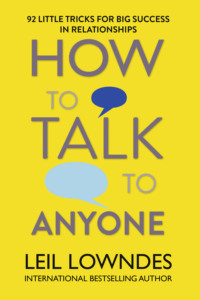
Kitabı oku: «How to Talk to Anyone: 92 Little Tricks for Big Success in Relationships», sayfa 5
Is small-talk-o-phobia curable?
Someday, scientists say, communications fears may be treatable with drugs. They’re already experimenting with Prozac to change people’s personalities. But some fear disastrous side effects. The good news is that when human beings think, and genuinely feel, certain emotions – like confidence they have specific techniques to fall back on – the brain manufactures its own antidotes. If fear and distaste of small talk is the disease, knowing solid techniques like the ones we explore in this section is the cure.
Incidentally, science is beginning to recognize it’s not chance or even upbringing that one person has a belly of butterflies and another doesn’t. In our brains, neurons communicate through chemicals called neurotransmitters. Some people have excessive levels of a neurotransmitter called norepinephrine, a chemical cousin of adrenaline. For some children, just walking into a kindergarten room makes them want to run and hide under a table.
As a tot, I spent a lot of time under the table. As a pre-teen in an all-girls boarding school, my legs turned to spaghetti every time I had to converse with a male. In high school, I once had to invite a boy to our school prom. The entire selection of dancing males lived in the dormitory of our brother school. And I only knew one resident, Eugene. I had met Eugene at summer camp the year before. Mustering all my courage, I decided to call him.
Two weeks before the dance, I felt the onset of sweaty palms. I put the call off. One week before, rapid heartbeat set in. I put the call off. Finally, three days before the big bash, breathing became difficult. Time was running out.
The critical moment, I rationalized, would be easier if I read from a script. I wrote out the following: ‘Hi, this is Leil. We met at camp last summer. Remember?’ (I programmed in a pause where I hoped he would say yes.) ‘Well, National Cathedral School’s prom is this Saturday night and I’d like you to be my date.’ (I programmed in another pause where I prayed he’d say yes.)
On Thursday before the dance, I could no longer delay the inevitable. I picked up the receiver and dialled. Clutching the phone waiting for Eugene to answer, my eyes followed perspiration droplets rolling down my arm and dripping off my elbow. A small salty puddle was forming around my feet. ‘Hello?’ a sexy, deep male voice answered the dorm phone.
In faster-than-a-speeding-bullet voice, like a nervous novice telemarketer, I shot out, ‘Hi, this is Leil. We-met-at-camp – last-summer-remember?’ Forgetting to pause for his assent, I raced on, ‘Well-National-Cathedral-School’s-prom-is-this-Saturday-night-and-I’d-like-you-to-be-my-date.’
To my relief and delight, I heard a big, cheerful ‘Oh that’s great, I’d love to!’ I exhaled my first normal breath all day. He continued, ‘I’ll pick you up at the girl’s dorm at seven thirty. I’ll have a pink carnation for you. Will that go with your dress? And my name is Donnie.’
Donnie? Donnie! Who said anything about Donnie?
Well, Donnie turned out to be the best date I had that decade. Donnie had buckteeth, a head full of tousled red hair, and communications skills that immediately put me at ease.
On Saturday night, Donnie greeted me at the door, carnation in hand and grin on face. He joked self-deprecatingly about how he was dying to go to the prom so, knowing it was a case of mistaken identity, he accepted anyway. He told me he was thrilled when ‘the girl with the lovely voice’ called, and he took full responsibility for ‘tricking’ me into an invitation. Donnie made me comfortable and confident as we chatted. First we made small talk and then he gradually led me into subjects I was interested in. I flipped over Donnie, and he became my very first boyfriend.
Donnie instinctively had the small-talk skills that we are now going to fashion into techniques to help you glide through small talk like a hot knife through butter. When you master them, you will be able, like Donnie, to melt the heart of everyone you touch.
The goal of How to Talk to Anyone is not, of course, to make you a small-talk whiz and stop there. The aim is to make you a dynamic conversationalist and forceful communicator. However, small talk is the first crucial step toward that goal.
How to start a conversation without strangling it
You’ve been there. You’re introduced to someone at a party or business meeting. You shake hands, your eyes meet … and suddenly your entire body of knowledge dries up and thought processes come to a screeching halt. You fish for a topic to fill the awkward silence. Failing, your new contact slips away in the direction of the cheese tray.
We want the first words falling from our lips to be sparkling, witty, insightful. We want our listeners to immediately recognize how riveting we are. I was once at a gathering where everybody was sparkling, witty, insightful, and riveting. It drove me berserk because most of these same everybodies felt they had to prove it in their first ten words or less!
Several years ago, the Mensa organization, a social group of extremely bright individuals who score in the country’s top 2 per cent in intelligence, invited me to be a keynote speaker at their annual convention. Their cocktail party was in full swing in the lobby of the hotel as I arrived. After checking in, I hauled my bags through the hoard of happy-hour Mensans to the lift. The doors separated and I stepped into a lift packed with party goers. As we began the journey up to our respective floors, the lift gave several sleepy jerks.
‘Hmm,’ I remarked, in response to the lift’s sluggishness, ‘the lift seems a little flaky.’ Suddenly, each elevator occupant, feeling compelled to exhibit his or her 132-plus IQ, pounced forth with a thunderous explanation. ‘It’s obviously got poor rail-guide alignment,’ announced one. ‘The relay contact is not made up,’ declared another. Suddenly I felt like a grasshopper trapped in a stereo speaker. I couldn’t wait to escape the attack of the mental giants.
Afterward, in the solitude of my room, I thought back and reflected that the Mensan’s answers were, indeed, interesting. Why then did I have an adverse reaction?
I realized it was too much, too soon. I was tired. Their high energy and intensity jarred my sluggish state.
You see, small talk is not about facts or words. It’s about music, about melody. Small talk is about putting people at ease. It’s about making comforting noises together like cats purring, children humming, or groups chanting. You must first match your listener’s mood.
Like repeating the note on the music teacher’s harmonica, Top Communicators pick up on their listener’s tone of voice and duplicate it. Instead of jumping in with such intensity, the Mensans could have momentarily matched my lethargic mood by saying, ‘Yes, it is slow, isn’t it?’ Had they then prefaced their information with, ‘Have you ever been curious why an elevator is slow?’ I would have responded with a sincere ‘Yes, I have.’ After a moment of equalized energy levels, I would have welcomed their explanations about the rail-guard alignment or whatever the heck it was. And friendships might have started.
I’m sure you’ve suffered the aggression of a mood mismatch. Have you ever been relaxing when some overexcited hot-breathed colleague starts pounding you with questions? Or the reverse: you’re late, rushing to a meeting, when an associate stops you and starts lazily narrating a long, languorous story. No matter how interesting the tale, you don’t want to hear it now.
The first step in starting a conversation without strangling it is to match your listener’s mood, if only for a sentence or two. When it comes to small talk, think music, not words. Is your listener adagio or allegro? Match that pace. I call it making a Mood Match.
Matching the mood can make or break the sale
Matching customers’ moods is crucial for salespeople. Some years ago, I decided to throw a surprise party for my best friend Stella. It was going to be a triple-whammy party because she was celebrating three events. One, it was Stella’s birthday. Two, she was newly engaged. And three, Stella had just landed her dream job. She had been my buddy since our school days and I was floating on air over her birthday-engagement-congratulations bash.
I had heard one of the best French restaurants in town had an attractive back room for parties. About 5 P.M. one afternoon, I wafted happily into the restaurant and found the seated maitre d’ languidly looking over his reservation book. I began excitedly babbling about Stella’s triple-whammy celebration and asked to see that fabulous back room I’d heard so much about. Without a smile or moving a muscle, he said, ‘Zee room ees een zee back. You can go zee eet eef you like.’
CRASH. What a party pooper! His morose mood kicked all the party spirit out of me, and I no longer wanted to rent his stupid space. Before I even looked at the room, he lost the rental. I left his restaurant vowing to find a place where the management would at least appear to share the joy of the happy occasion.
Every mother knows this instinctively. To quiet a whimpering infant, mama doesn’t just shake her finger and shout, ‘Quiet down.’ No, mama picks baby up. Mama cries, ‘Ooh, ooh, oh,’ sympathetically matching baby’s misery for a few moments. Mama then gradually transitions the two of them into hush-hush happy sounds. Your listeners are all big babies! Match their mood if you want them to stop crying, start buying, or come around to your way of thinking.
Technique 10:
Make a mood match
Before opening your mouth, take a ‘voice sample’ of your listener to detect his or her state of mind. Take a ‘psychic photograph’ of the expression to see if your listener looks buoyant, bored, or blitzed. If you ever want to bring people around to your thoughts, you must match their mood and voice tone, if only for a moment.
‘What’s a good opening line when I meet people?’
I was once at a party where I spotted a fellow surrounded by a fan club of avid listeners. The chap was smiling, gesticulating, obviously enthralling his audience. I went over to hearken to this fascinating speaker. I joined his throng of admirers and eavesdropped for a minute or two. Suddenly, it dawned on me: the fellow was saying the most banal things! His script was dull, dull, dull. Ah, but he was delivering his prosaic observations with such passion. Therefore, he held the group spellbound. It convinced me that it’s not all what you say, it’s how you say it.
Often people ask me, ‘What’s a good opening line when I meet people?’ I give them the same answer a woman who once worked in my office always gave me. Dottie often stayed at her desk to work through lunch. Sometimes, as I was leaving for the sandwich shop, I’d ask her, ‘Hey Dottie, what can I bring you back for lunch?’
Dottie, trying to be obliging, would say, ‘Oh anything is fine with me.’
‘No, Dottie!’ I wanted to scream. ‘Tell me what you want. Ham and cheese? Chicken Salad with mayonnaise? Peanut butter with sliced bananas? Be specific. Anything is a hassle.’
Frustrating though it may be, my answer to the opening-line question is ‘Anything!’ because almost anything you say really is OK – as long as it puts people at ease and sounds passionate.
How do you put people at ease? By convincing them they are OK and that the two of you are similar. When you do that, you break down walls of fear, suspicion, and mistrust.
Why banal makes a bond
Samuel I. Hayakawa was a college president, U.S. senator, and brilliant linguistic analyst of Japanese origin. He tells us this story that shows the value of, as he says, ‘unoriginal remarks.’11
In early 1942, a few weeks after the beginning of World War II – at a time when there were rumours of Japanese spies – Hayakawa had to wait several hours in a railroad station in Oshkosh, Wisconsin. He noticed others waiting in the station were staring at him suspiciously. Because of the war, they were apprehensive about his presence. He later wrote, ‘One couple with a small child was staring with special uneasiness and whispering to each other.’
So what did Hayakawa do? He made unoriginal remarks to set them at ease. He said to the husband that it was too bad the train should be late on so cold a night.
The man agreed.
‘I went on,’ Hayakawa wrote, ‘to remark that it must be especially difficult to travel with a small child in winter when train schedules were so uncertain. Again the husband agreed. I then asked the child’s age and remarked that their child looked very big and strong for his age. Again agreement, this time with a slight smile. The tension was relaxing.
After two or three more exchanges, the man asked Hayakawa, ‘I hope you don’t mind my bringing it up, but you’re Japanese, aren’t you? Do you think the Japs have any chance of winning this war?’
‘Well,’ Hayakawa replied, ‘your guess is as good as mine. I don’t know any more than I read in the papers. But the way I figure it, I don’t see how the Japanese, with their lack of coal and steel and oil … can ever beat a powerfully industrialized nation like the United States.’
Hayakawa went on, ‘My remark was admittedly neither original nor well informed. Hundreds of radio commentators … were saying much the same thing during those weeks. But just because they were, the remark sounded familiar and was on the right side so that it was easy to agree with.’
The Wisconsin man agreed at once with what seemed like genuine relief. His next remark was, ‘Say, I hope your folks aren’t over there while the war is going on.’
‘Yes, they are,’ Hayakawa replied. ‘My father and mother and two young sisters are over there.’
‘Do you ever hear from them?’ the man asked.
‘How can I?’ Hayakawa answered.
Both the man and his wife looked troubled and sympathetic. ‘Do you mean you won’t be able to see them or hear from them until after the war is over?’
There was more to the conversation but the result was, within ten minutes they had invited Hayakawa – whom they initially may have suspected was a Japanese spy – to visit them sometime in their city and have dinner in their home. And all because of this brilliant scholar’s admittedly common and unoriginal small talk. Top Communicators know the most soothing and appropriate first words should be, like Senator Hayakawa’s, unoriginal, even banal. But not indifferent. Hayakawa delivered his sentiments with sincerity and passion.
Ascent from banality
There is no need, of course, to stay with mundane remarks. If you find your company displays cleverness or wit, you match that. The conversation then escalates naturally, compatibly. Don’t rush it or, like the Mensans, you seem like you’re showing off. The bottom line on your first words is to have the courage of your own triteness. Because, remember, people tune in to your tone more than your text.
Technique 11:
Prosaic with passion
Worried about your first words? Fear not, since 80 percent of your listener’s impression has nothing to do with your words anyway. Almost anything you say at first is fine. No matter how prosaic the text, an empathetic mood, a positive demeanour, and passionate delivery make you sound exciting.
‘Anything, except liverwurst!’
Back to Dottie waiting for her sandwich at her desk. Sometimes as I walked out the door scratching my head wondering what to bring her, she’d call after me, ‘Anything, except liverwurst, that is.’ Thanks, Dottie, that’s a little bit of help.
Here’s my ‘anything, except liverwurst’ on small talk. Anything you say is fine as long as it is not complaining, rude, or unpleasant. If the first words out of your mouth are a complaint, BLAM, people label you a complainer. Why? Because that complaint is your new acquaintance’s 100 per cent sampling of you so far. You could be the happiest Pollyanna ever, but how will they know? If your first comment is a complaint, you’re a griper. If your first words are rude, you’re a creep. If your first words are unpleasant, you’re a stinker. Open and shut.
Other than these downers, anything goes. Ask them where they’re from, how they know the host of the party, where they bought the lovely suit they’re wearing – or hundreds of etceteras. The trick is to ask your prosaic question with passion to get the other person talking.
Still feel a bit shaky on making the approach to strangers? Let’s take a quick detour on our road to meaningful communicating. I’ll give you three quickie techniques to meet people at parties – then nine more to make small talk not so small.
What’s a Whatzit?
Singles proficient at meeting potential sweethearts without the benefit of introduction (in the vernacular, making a ‘pickup’), have developed a deliciously devious technique that works equally well for social or corporate networking purposes. The technique requires no exceptional skill on your part, only the courage to sport a simple visual prop called a Whatzit.
What’s a Whatzit? A Whatzit is anything you wear or carry that is unusual – a unique pin, an interesting purse, a strange tie, an amusing hat. A Whatzit is any object that draws people’s attention and inspires them to approach you and ask, ‘Uh, what’s that?’ Your Whatzit can be as subtle or overt as your personality and the occasion permit.
I wear around my neck an outmoded pair of glasses that resembles a double monocle. Often the curious have approached me at a gathering and asked, ‘Whatzit?’ I explain it’s a lorgnette left to me by my grandmother, which, of course, paves the way to discuss hatred of glasses, ageing eyes, love or loss of grandmothers, adoration of antique jewellery – any way the inquisitor wants to take it.
Perhaps, unknowingly, you have fallen prey to this soon-to-be-legendary technique. At a gathering, have you ever noticed someone you would like to talk to? Then you’ve racked your brain to conjure an excuse to make the approach. What a bounty it was to discover that he or she was wearing some weird, wild, or wonderful something you could comment on.
The Whatzit way to love
Your Whatzit is a social aid whether you seek business rewards or new romance. I have a friend, Alexander, who carries Greek worry beads with him wherever he goes. He’s not worried. He knows any woman who wants to talk to him will come up and say, ‘What’s that?’
Think about it, gentlemen. Suppose you’re at a party. An attractive woman spots you across the room. She wants to talk to you but she’s thinking, ‘Well, Mister, you’re attractive. But, golly, what can I say to you? You just ain’t got no Whatzit.’
Be a Whatzit seeker, too
Likewise, become proficient in scrutinizing the apparel of those you wish to approach. Why not express interest in the handkerchief in the tycoon’s vest pocket, the brooch on the bosom of the rich divorcée, or the school ring on the finger of the Director whose company you want to work for?
The big spender who, you suspect, might buy a hundred of your widgets has a tiny golf-club lapel pin? Say, ‘Excuse me, I couldn’t help but notice your attractive lapel pin. Are you a golfer? Me, too. What courses have you played?’
Your business cards and your Whatzit are crucial socializing artifacts. Whether you are riding in the elevator, climbing the doorstep, or traversing the path to the party, make sure your Whatzit is hanging out for all to see.
Technique 12:
Always wear a Whatzit
Whenever you go to a gathering, wear or carry something unusual to give people who find you the delightful stranger across the crowded room an excuse to approach. ‘Excuse me, I couldn’t help but notice your … what IS that?’
The next quickie technique was originated by doggedly determined politicians who don’t let one partygoer escape if they think he or she could be helpful to their campaigns. I call it the Whoozat technique.
Ücretsiz ön izlemeyi tamamladınız.